53.5 F
Davis

Davis, California

Tuesday, December 23, 2025
Home Blog Page 767

The Ethical Wallet

0

greenburg_opGet on Santa’s good list!

Think of the food, gifts, games and memories that will fill your home this holiday season. Now think of the origin of all those things. The wrapping paper, the packaging for the food you purchased — consider all the greenhouse emissions that will be produced creating that food and those toys. From Thanksgiving to New Year’s Day, Americans generate 25 percent more household waste than the rest of the year, amounting to about one million tons of trash.

Just like how every dollar we spend can be a vote toward more ethical business practices, every way that we can reduce our family unit’s waste can be a contribution to the rest of the planet.

Personally, my favorite meal doesn’t take place at Thanksgiving dinner. I much prefer indulging the following morning in the leftover stuffing and cranberry sauce with eggs and toast. Something about food refrigerated overnight makes it that much better. However, if you have little interest in leftovers, keep in mind that there are many others who would be happy to have your food. The Yolo Food Bank, which serves 25,000 people per month through 60 non-profit partner agencies, accepts food donations. But, if your cousin is like mine and plops every food item on his plate to mix together into a big, unappealing Thanksgiving soup, the result will be less than suitable for a donation. Compost becomes your best friend in this situation. Take a couple pounds off of that extra million and turn your leftovers into soil and nutrients for your or a neighbor’s garden.

While preparing for parties and holiday events, remember to bring your own bag to fill while shopping. Grocery stores and malls are packed at this time of year; imagine if no bags were dispersed at all during the holidays. Everyone would be forced to find alternative ways to transport their gifts and food from the store to their homes.

But if you truly want to go above and beyond, avoid going shopping for your gifts all together. There are hundreds of inexpensive and meaningful gift ideas online. Something about receiving a homemade gift fills the heart with holiday spirit and joy in a way that store bought items can’t compete with. Keep in mind that some of the best gifts also take zero materials. Membership to a museum, a cooked meal for friends or a free massage are all low-cost and low-waste.

Once you’re ready to wrap everything, use reusable materials like pretty cloth fabrics, maps or even the Sunday comics. Half of the 85 million tons of paper product we use each year is allotted for packaging and decorating items. And much wrapping paper will have gold, silver or glitter on it, deeming it unrecyclable.

Another potentially recyclable item is the Christmas tree. If you or your family celebrates Christmas and plans on getting a tree, look into tree composting programs in your area. Check with your community’s waste department to find out if they compost trees. Trees can be turned into mulch for your garden, moved outside to serve as a wild bird home or sunk to the bottom of a pond to make a new home for fish.

If you plan to hang lights on your tree, around the fireplace or on your roof, try to get LED outdoor holiday lights which use 1/50th the energy of regular lights and will last at least a couple decades. As always, try to keep the lights (as well as other electronics) unplugged when you aren’t actively enjoying their glow.

The holidays are a wonderful time for indulging in the pleasures of family, food, festivities and cheer. This year, as all years, I am thankful that I get to enjoy these wonderful treasures of the holiday season. So let’s all be good this year. By doing our part to reduce and recycle this holiday season, we’ll save a whole lot more than coal by staying off Santa’s naughty list.

You can contact Martha Greenburg at mzgreenburg@ucdavis.edu or on Twitter @Marthazane94.

Are you prepared for an earthquake in Davis?

0
HEE-AH YOO / AGGIE
HEE-AH YOO / AGGIE

Davis Fire Chief discusses preparedness for earthquakes

According to Davis Earthquake Track, 255 earthquakes occurred in and around Davis in the last year. The San Andreas Fault, which runs through California, has been anticipated to erupt for a long time. According to a forecast by the U.S. Geological Survey, the risk of an 8.0 magnitude earthquake striking California in the next few decades has risen to seven percent.        

  “The City of Davis is currently drafting an update for its All-Hazard Emergency Operations Plan,” said Davis Fire Chief Nathan Trauernicht. “The City of Davis Community Development and Sustainability Department has been integral in moving building permit regulations forward as they advance to include more earthquake retrofit construction practices on both remodel and new construction projects.”

Trauernicht emphasizes that individual preparedness is key in any future earthquake disaster. Despite programs to increase the city’s readiness, individual citizens will also have to be prepared in the face of calamities.

“Every household in Davis should be able to take care of the family for at least the first 72 hours of any disaster/emergency,” Trauernicht said. “[This includes] making a family emergency plan, putting an emergency kit together for all the members of the family and staying informed.”

Rita Baljian, a second-year political science major, adds that the responsibility to prepare for a possible 8.0 magnitude earthquake does not fall solely on Davis residents.

The big earthquake could come any second,” Baljian said. “I believe a major priority for all college students is to prepare for any possible natural disaster.”  

Second-year biological sciences major Ryan Daroy worries that buildings with basements may not be earthquake-ready.

I have regular club meetings in below-ground offices, and I am deeply concerned about how safe I am down there,” Daroy said.

Although Davis does not sit directly on the San Andreas Fault, Trauernicht explains that shaking from faults at further distance could still pose significant damage to the Davis area.

While no previously identified faults lie within the city, there is always the possibility that shaking from a nearby fault line would still be felt within the city,” Trauernicht said. “It is also important for citizens within the City of Davis to understand that during a large Bay Area earthquake, the City of Davis could be used as an evacuation point for those leaving the Bay Area or possibly even a staging area to get resources into the Bay Area.”

Written By: TRISTEN THALHUBER citynews@theaggie.org

Keeping up with the council

0
HEE-AH YOO / AGGIE
HEE-AH YOO / AGGIE

DBID Report approved, public worried about issues affecting downtown night safety

On Nov. 17, the Davis City Council approved the Davis Downtown Business Association’s (Davis Downtown) annual Downtown Business Improvement District (DBID) Report for the 2016-2017 fiscal year.

Davis Downtown is an organization dedicated to advocating on behalf of the downtown businesses, developing regional marketing opportunities, promoting diverse business and expanding relations with the city and UC Davis.

Downtown businesses are levied a fee by the City of Davis, which is transferred to Davis Downtown for marketing, advocacy and events.

The DBID Report is prepared by Davis Downtown and is used to inform the council and Davis residents of the activities, achievements, and ways in which funds were used to improve the downtown community. It also offers an overview of the goals and events expected to be accomplished in the upcoming year.

City Chief Innovation Officer Diane Parro, who presented the DBID report, discussed the numerous comments she received from business and property owners.

“Comments were largely about how the promotions drove traffic to downtown, how [business owners] felt that collaboration was very worthwhile and provided services they couldn’t afford on their own, and that they were very happy with events that were very successful in downtown,” Parro said.

People also expressed concerns to Parro about safety and cleanliness issues and the homeless in downtown.

Executive Director of Davis Downtown Stewart Savage, provided a summary of activities and achievements happening in downtown.

The upcoming fourth annual Davis Downtown Window Decorating Contest for downtown businesses, and the Holiday Tree Lighting ceremony are some of the events Davis Downtown help market.

Some of the big achievements this year for Davis Downtown include supporting Jumpstart Davis and F Street Screever Fest, promoting Yolo County in a San Francisco Chronicle advertisement, and joining the restaurant and bar committee to address safety issues in downtown.

“Davis is a downtown where people want to locate their businesses,” Savage said.

After a lengthy discussion between members of the council, councilmember Brett Lee introduced a motion to approve the DBID Report and it was unanimously approved.   

While approval was not conditional, council members asked Davis Downtown to hold an open conversation with city staff and members of the public in order for people to address their concerns about a variety of issues and increase transparency.

“Our role is to oversee the collection of these funds and then to give them to an entity to carry out the city’s goals,” Lee said. “In that role, we would like to have the Davis Downtown participate with city staff in an open forum to discuss the general success of the organization and any concerns we have about the organization. This meeting would be open to all interested parties and supported with full appropriate city staff presence.”

During the meeting, concerned Davis resident and former councilmember Mike Harrington urged the City Council to strengthen public safety downtown by requiring bars and clubs to end business hours earlier.

“The downtown issues really have to be handled,” Harrington said. “I personally think that [1 to 2 a.m.] is way too late. I think midnight is just about right and I feel like a lot of people probably agree with me.”

Paul Frydendal, the uncle of one of the three boys who were attacked in Downtown Davis on Nov. 14 also addressed the council and asked them to find solutions to the crime and safety issues.

“Something needs to be done to significantly address the crime that is happening in your downtown,” Frydendal said.

After having spoke with Frydendal, Harrington once again addressed the council to emphasize his concerns.

“It’s nice hearing about holiday parties and all of that and the downtown is a lively place to be, but public safety is number one and what’s going on right now is completely intolerable,” Harrington said. “If you close the bars at midnight you will prevent a lot of problems.”

Bar safety in Davis has been an ongoing concern to residents. The issue was also discussed at the Nov. 3 City Council meeting and will likely continue to be brought up in the future.

Written By: CARLA ARANGOcity@theaggie.org

Is crime in Davis on the rise?

JAY GELVEZON / AGGIE

Students, police officers discuss increase in crime alerts, preventative measures.

Due to a recent rise in the frequency of crime alerts UC Davis students receive from the UC Davis Police Department (UCDPD), many students are under the misconception that crime rates in Davis have increased heavily in the past year.

“[There were] maybe three to five [crime alerts] a quarter before,” said fourth-year human development major Elizabeth Dietz. “Now it’s like five or more.”

The rise in crime alerts is a byproduct of the UCDPD’s increased efficiency, according to UCDPD Chief of Police Matthew Carmichael. Due to its increasing campus-wide social network, the department is able to improve its methods of communication with students.

“The efficiency really has a lot to do with our outreach,” Carmichael said. “We devote a considerable amount of time and resources to ensuring that we are connected with our students.”

However, most students are unaware of the system’s increased efficiency, leading to the impression that crime in Davis is on a steady incline.

“I heard about someone getting robbed the other day in the Arboretum,” said second-year biochemistry major Kim Nguyen. “It’s kind of dangerous there because a lot of people use the bike path […] to commute. I don’t want to bike down the bike path anymore, so I have to ask my housemates to come pick me up. I definitely feel a little more unsafe.”

Because of the recent crime alerts regarding public masturbation and indecent exposures, some students also feel that sexual assault has become a much more frequent crime on campus. Furthermore, in recent years, UC Davis has had to take action against anti-Semitic and racist incidents, with various campus groups and organizations having served as targets of heinous hate crimes.

“I’m Jewish, so a lot of [the] stuff that happened last year at [the predominantly Jewish fraternity] Alpha Epsilon Pi, and the [incidents] with those cars that got vandalized this year [is relevant],” said fourth-year political science major Jack Mizes. “That also goes to show that other forms of bigotry […] still exist on this campus. Just because you have one isolated incident that gets more promotion from the administration doesn’t mean that these other things don’t exist until an occurrence happens.”

The UCDPD employs over 130 students through the Aggie Host Security Program. According to Carmichael, this program provides students with services designed to cater toward the safety of students, including Safe Ride, the transportation system that allows students a free and protected means of getting home.

“We’re a large student employer, so that gives us a good feel for what’s going on in the community,” Carmichael said. “[We’ve been] improving our Safe Ride services to keep students safe; we’re more efficient with that service. Last month, I think we [provided] about 5,000 rides for students.”

The student employees who are part of the department also work with Carmichael and his officers to make technological advances in the program, including improvements on the police alerts system.

“We’ve improved our technology, [so] students can request safe rides on their smartphones now, which is huge,” Carmichael said. “We’ve improved our technology with social media [and] we’re better at sending out our email notifications […] in a relatively timely fashion.”

Both the UC Davis Police and the Davis City Police are working to keep the safety of students and residents in check by talking to restaurant owners, bar owners and property owners. Recently, the UCDPD trained a bar owner on the use of metal detectors to prevent violence, while the Davis City Police has been active in communicating with residents on staying safe.

“We’re going through and talking to residents about what we can do to promote safety,” said Assistant Police Chief Darren Pytel. “We ask all the neighborhoods to participate in the neighborhood watch program.”

The Davis City Police have also implemented programs such as Nixel, a subscriber-based email system and the Everbridge Alert System, which allows people to receive emergency information.

Meanwhile, the UCDPD has developed a variety of systems specifically for student safety, including Safe Ride, Tipsy Taxi and the Guardian, which is a new smartphone application that tracks the owner to their destination.

“It turns your phone into a personal security,” Carmichael said. “If you don’t want to use Safe Ride, and you decide to walk on your own, you set who your guardian is — it could be a parent, a loved one, it could be the police department — and you hit a start button.”

If the user does not turn off the app once they reach their end location, alerts are sent to the user’s guardians.

“One mission we’re on right now is to look at top universities in the country and look at their downtown scene, and see what others are doing,” Carmichael said. “It’s going to be a team partnership between students and the police, so we’ll have a couple student representatives probably from ASUCD […] go visit these campuses [to] get a good picture of what’s going on there. My motto is, let’s see what everyone else is doing, and […] be better.”

With steps being taken toward crime prevention and the protection of Davis students and residents, both the campus and city police hope to see a safer environment in Davis’ future.

To students, residents and anyone else at risk of becoming a victim of crime, Pytel gives a word of advice: “Lock your doors, lock your stuff up and pay attention to your surroundings.”
Written by: Allyson Tsuji – features@theaggie.org

Conclusive concussions

0
GREGORY URQUIAGA / UC DAVIS

UC Davis researcher seeks to make conclusive concussion tests available to all.

From breaking stories on Real Sports with Bryant Gumbel, to a 2015 feature film starring Will Smith, concussions have never had greater share of the limelight, even though diagnosing them is still subjective and ineffective. One man endeavors to change that.

Dr. Khizer Khaderi is a driven man, seeking to unite his personal background in technology and ophthalmology in a way to help athletes everywhere. Ophthalmology is the branch of medicine concerning the eye surgically, diagnostically and medically.

Khaderi and his team are developing a robust testing system that accurately determines whether a concussion has occurred. Khaderi is developing this system to be widely available, with current units being in the neighborhood of a couple hundred dollars. This test looks at three basic functions pertaining to the eye and the brain: eye movement tests, pupil dilation tests and a brain wave test.

“We look at four separate eye movements, then at the pupils as the fifth and EEGs [electroencephalogram] as the sixth,” Khaderi said.

The problems with current concussion tests are that they are subject to the player’s response and are easy to cheat.

AXON, the current system used nationwide, requires athletes to take cognitive tests beforehand to establish a baseline. These tests are easy to cheat on, as a player could intentionally perform poorly so that in the event of a concussion, their results would not appear that different. The tests are also highly subjective — the medical professional administering the tests after a suspected concussion event largely has to rely on player feedback regarding how that athlete is feeling.

Testing Eye Movements

The test uses an eye tracker while the patient looks at a screen. The tracker gauges the speed of the patient as they perform four different types of eye movements, with each movement being a different neural exercise.

“We started off with a literature review [to formulate the first tests],” Khaderi said. “We look at a normal distribution and one standard deviation of normality as a guideline for normal brain’s operation times.”

They found the average times the brain takes to complete basic tasks involved in directing the eye.

This means that Khaderi’s test does not need individualized baselines. Furthermore, the test is objective, in that it does not require athletes to assess their own state. Eye movements are controlled by the brain in a way that they cannot be realistically messed up; they only move so fast once the decision to move them has been made. Players cannot cheat.

If the results of the test are outside the parameters, or standard deviations, then a concussion is likely.

Proving Pupil Dilation

Another method of testing for concussions has been the use of light and pupil dilation. An unequal or lack of pupil dilation has been a common testing parameter, and are often the go-to tests because they show a large amount of information about what is going on inside the brain.

However, tests comprised of shining lights into the patient’s eyes are not wholly effective. Many factors could affect the test: time of day, presence of background light and the setting of the test to just name a few.

Khaderi has borrowed the principles in the psychology-backed International Affective Picture System (IAPS) to test pupil dilation. IAPS is based on the principle that the pupil will involuntarily respond to outside stimuli, such as viewing something pleasant or scary, and will not respond to something that has no cognitive implication.

As the pupil dilation results from psychological factors and not light changes, Khaderi’s test is objectively more precise at determining concussions. The test is comprised of showing pictures with targeted involuntary pupil responses to patients, and then using an eyetracker to measure if the pupils respond as they should. The prospective pleasant and scary images activate different parts of the brain, and are interspersed with neutral images to isolate dilation events during the test.

Failing to respond properly to the images indicates that the patient likely has a concussion.

Monitoring Brain Waves

The third test uses an electroencephalography (EEG) band. The band tests electrical activity of the brain and can classify the activity into various wavelengths. Khaderi looks specifically at the relative balance between two types of brain waves: alpha and theta waves.

A brain that is healthy and awake will typically put out more alpha brain waves than theta. Conversely, a brain that is in a dreamlike state, or one that has gone through recent trauma, will put out relatively more theta brainwaves.

Therefore, by using a noninvasive EEG headband, Khaderi and his team are hoping to be able to definitively say when concussion occurs.

The Bottom Line

“I was an ESPN Junkie. I’ve coached basketball back when I was younger,” Khaderi said about his motivation. “I wanted something for peewee leagues, middle schoolers or even younger.”

Seeking to consolidate his test into an easy to purchase and use system, Khaderi has shopped high and low for ways to bring his research to as widely an applicable area as possible. He is developing an application that can run on all tablets or computers in conjunction with an eye tracker and an EEG headband as part of a kit.

“When we first looked into eye trackers, Arrington Research had one for $1500,” Khaderi explained. “So I looked around and found the one we use now, on Kickstarter, from a company in Denmark.”

Khaderi’s current eyetracker costs around $100. In time, he sees these costs dropping.

“By the time this goes to market, technology will have surpassed it,” Khaderi said.

It is likely that these advances will make the technology itself cheaper, better and more readily available.

Currently, Khaderi’s test is in clinical trials with student-athletes at UC Davis.

The real issue of concussion is the danger of going back onto the field before the injury has healed. Theoretically, these tests will be able to plot out when the concussion occurred and would be able to detect concussion throughout the entire healing process. Furthermore, Khaderi would be able to use his test to determine if individuals have a history of traumatic brain injury as well.

“The human body is amazing at adapting,” Khaderi said.

Even with the ability to adapt and to heal, concussions are a very real threat to the mental health of any individual. Khaderi’s research aims to make them more diagnosable and preventable.

Written by: Aaron Sellers – sports@theaggie.org

Christmas shopping at Central Park

0
SALLY PARKER / SQUARE TOMATOES CRAFTS FAIR

UC Davis Craft Center instructors hold crafts fair in Central Park.

Winter break is coming full speed ahead, and with the holiday season comes the often stressful process of gift shopping. The Square Tomatoes Craft Fair, held biweekly in Central Park on Sundays during the holiday season, provides a fun and friendly environment to purchase gifts for everyone on your list.

Sally Parker, a UC Davis craft center instructor, started the craft fair in 2012 as a place to sell her hand-crafted jewelry. She started her own fair in response to Davis Farmers Market’s strict guidelines on selling crafts.

“In 2012, the farmer’s market was very strict with their crafts,” Parker said. “They did not allow jewelers to sell. So I invited people to start our own craft fair first at a parking lot near the Davis Co-op and now in Central Park to display what we do.”

Parker enlisted UC Davis Craft Center instructors to help run the fair as well as sell their own crafts. One of these instructors is Jeff Geren, a mechanic and glass sculpture enthusiast who sells small glass turtle and elephant figurines.

Geren truly enjoys spending time at the craft center and being immersed in the artistic community of the center.

“Everyone is very laid back [at the craft center] and it’s a friendly bunch. There’s no negativity in art, which is fun part of it,” Geren said. “I like hanging out with artists because they are just a fun group.”

This relaxed atmosphere can also be seen at the craft fair, which has a pleasant, homey vibe complete with a jazz band and food vendors. This band, called the New Harmony Jazz Band, is one of Parker’s favorite things about the monthly craft fair.

“The New Harmony Jazz band has nine players that sing and perform collections of classical American jazz,” Parker said. “Every piece you can dance to and [the music] carries through the fair. It is fun to get up and move around.”

Although the jazz band is a nice addition to the fair, the core of the event still lies in the high quality crafts that are sold by the vendors. The vendors sell a wide variety of goods, including jewelry, quilts, woodwork, succulents, finger-puppets, stuffed toys, knit items, glassware and much more.

Kent and Dianne Rosner sell their fused glass and knitted crafts together at the craft fair. They enjoy that the fair provides a different holiday shopping experience than the typical Black Friday frenzy.

“It’s nice to see handmade crafts rather than [mass]-produced things,” Dianne Rosner said.

For many vendors, the event is a fun, easy way to sell some of the crafts they have accumulated over the years.

“I do fused glass and you make so much of it that you got to get rid of it somehow and you can’t keep giving it as gifts to everyone you know,” Kent Rosner said. “[The Square Tomatoes Craft Fair] is a good outlet to sell off some of my stuff and reinvest the money back into the raw materials.”

It costs between $20 to 25 to be a vendor, a cheap price in comparison to other craft fairs that can charge upwards of $200. Because of this, the prices of the goods sold at Square Tomatoes are cheaper and there are many bargains to be found. However, it is the atmosphere and charm of the vendors and their devotion to art that really makes the craft fair special.

“If you want to make good-looking art, you have to get through the ugly first. All the people at the craft center have gotten through the ugly. They have maintained their passion through the ugly stage and make excellent art,” Geren said. “I had to go through many ugly turtles to get where I am today.”

So if you’re interested in finding some unique holiday gifts or just witnessing some beautiful craftsmanship, be sure to attend the Square Tomatoes Craft Fair every other Sunday in Central Park. The next two fairs will be held on Nov. 29 and Dec. 13. For more information, go to http://squaretomatoescrafts.com/.

WRITTEN BY: Megan Perry – arts@theaggie.org

New movie Spotlight gets it right

0
(Left to right) Rachel McAdams as Sacha Pfeiffer, Mark Ruffalo as Michael Rezendes and Brian d’Arcy James as Matt Carroll in SPOTLIGHT. (KERRY HAYES / OPEN ROAD FILMS)

The true story of how a group of journalists exposed one of the world’s oldest and most trusted institutions.

One of the best films of the year, Spotlight, is a spellbinding masterpiece and poised to be a favorite at this year’s Oscars. Director Tom McCarthy (Win Win, The Visitor, The Station Agent) presents a refreshing bit of cinema, void of the usual Hollywood gimmicks, that moviegoers have been seeking. Simply put, the film gets it right. Its subtle and enthralling take on investigative journalism will have you at the edge of your seat, while the story itself is powerful enough to leave you speechless.

Spotlight covers the true story of how the Pulitzer Prize-winning Boston Globe investigative team exposed one of the world’s oldest and most trusted institutions: the Catholic Church. By bringing the dark child molestation scandal to light, the Spotlight investigative team soon discovers that the system is corrupt from the top down. The film follows team members Mike Rezendes (Mark Ruffalo), Walter ‘Robby’ Robinson (Michael Keaton), Sacha Pfeiffer (Rachel McAdams) and Matt Carroll (Brian d’Arcy James), as they dig deeper and learn more about the decades old cover-up, shocking the world as the truth is finally revealed.

The McCarthy and Josh Singer (The Fifth Estate) duo write an exquisite script, full of gorgeous detail and sophisticated dialogue. With one of the year’s best directorial efforts, McCarthy proves that less is more, focusing on the interaction between characters and the substantial buildup of evidence, fully aware that the story itself is captivating enough to keep the viewer engaged throughout.

Prepare to be stunned. McCarthy gives audiences an overwhelming feeling of shock and disgust throughout the movie as he details the profound guilt felt by every victim. He never wastes any screen time, and every scene feels just as essential and significant as the last. Without a doubt, Spotlight is easily his best work to date.

As far as acting goes, the performances of Ruffalo, Keaton and McAdams were unnoticeable — unnoticeable in the sense that the three actors were so convincing in their portrayals of their characters that it felt like they were the Spotlight team, not just actors reading playing parts. Spotlight is one of the rare films where the cast is absolutely perfect.

Despite this star-studded cast, all eyes are on Ruffalo as he unexpectedly outshines both the talented McAdams as well as Keaton, who is coming off of an Oscar nomination for Best Actor. Ruffalo is a revelation, taking his character development a step further than his costars by adding in unique expressions and mannerisms that contribute to his superb portrayal of journalist Mike Rezendes. Ending on a high note, Ruffalo explodes and captures the magnitude of his outstanding performance through a single breathtaking scene that will leave viewers flooded with emotion, stamping his claim this year for an Oscar of his own.

The most powerful scene comes toward the end of the film, as Ruffalo’s character, Rezendes, on the outside looking in, visits the local church. As he gazes on, we hear a children’s choir singing the traditional Christmas carol, “Silent Night,” which symbolizes the repeated hushing of the child molestation victims. This was the scene that truly drove the message home and solidified Spotlight as a true work of cinematic art.

As difficult as it may be to predict a Best Picture winner, Spotlight surely makes a compelling argument. As astonishing as it is unsettling, it’s the must-see movie of the year that shakes your grip on reality and leaves you with more questions than you had coming in.

Spotlight is currently showing in theatres nationwide.

WRITTEN BY: David Park – arts@theaggie.org

Daily Calendar

0

DailyCalTUES., NOV. 24

Salsa Tuesday

9:30 p.m.

The Graduate, Davis

Dance lessons with Cori from ‘Barbara’s Dancing Tonight,’ hosted by DJ Miguel. Tickets are $6.

Trivia Night

9:30 to 11:30 p.m.

Sophia’s Thai Kitchen, Davis

Compete against other teams in answering the hardest trivia questions! Free and open to all ages.

New Parent Network

10 to 11:30 a.m.

Davis Food Co-op, Davis

For future parents who don’t know what to expect!


WED., NOV. 25

Unofficial Scrabble Club

5:30 to 11:30 p.m.

Crepeville, Downtown Davis

Play everyone’s favorite word game and compete with local Scrabblers! All levels welcome.

NaNoWriMo Write-In

7 to 11 p.m.

Crepeville, Davis

Come plan and write your original novel for National Novel Writing Month with other participants!

Trivia Night

8 p.m.

Ketmoree Thai Restaurant

Compete against other teams in answering the hardest trivia questions! Free and open to all ages.

Evan Daly

9:30 p.m.

Our House, Davis

Enjoy a night of live blues music free of charge.


THURS., NOV. 26

Trivia Night

9 to 11 p.m.

Woodstock’s Pizza, Davis

Join teams of three to six people to answer unique and challenging trivia questions. Prizes, fun and pizza are in store.


FRI., NOV. 27

Into the Woods

8 p.m.

Davis Musical Theatre Company, Davis

Come see everyone’s favorite new musical, featuring tales from Cinderella, Little Red Riding Hood and Rapunzel. Tickets are $18 for general admission and $16 for students and seniors.


SAT., NOV. 28

Local Live Music

9 p.m.

Woodstock’s Pizza, Davis

Enjoy a fun night of live music free of charge!

A Christmas Carol

2 p.m.

Davis Musical Theatre Company, Davis

Join in on the holiday cheer with this Christmas classic for only $8!

Into the Woods

8 p.m.

Davis Musical Theatre Company, Davis

Come see everyone’s favorite new musical, featuring tales from Cinderella, Little Red Riding Hood and Rapunzel. Tickets are $18 for general admission and $16 for students and seniors.

DJ Smilez

11 p.m.

Our House, Davis

Dance floor opens up for a free night of dancing!

NaNoWriMo Write-In

2 to 5:30 p.m.

Crepeville, Davis

Come plan and write your original novel for National Novel Writing Month with other participants!


SUN., NOV. 29

NaNoWriMo Write-In

1 to 4 p.m.

Cloud Forest Cafe, Davis

Come plan and write your original novel for National Novel Writing Month with other participants!

International Folk Dancing

7 to 10 p.m.

Davis Arts Center, Davis

Enjoy a night of dancing from all around the world. Your first time is free!

Into the Woods

2 p.m.

Davis Musical Theatre Company, Davis

Come see everyone’s favorite new musical, featuring tales from Cinderella, Little Red Riding Hood and Rapunzel. Tickets are $18 for general admission and $16 for students and seniors.

Square Tomatoes Crafts Fair

11 a.m. to 4 p.m.

Central Park, Davis

Spend the day crafting with the best artisans in Davis!


MON., NOV. 30

Pub Quiz

7 p.m.

de Vere’s Irish Pub, Davis

Free quiz night hosted by Dr. Andy, with teams of up to six players. Arrive an hour early to secure a table.

UC Davis announces new campaign aimed at preventing sexual violence

KATIE LIN / AGGIE
KATIE LIN / AGGIE

Campaign aims to teach students about consent, encourages students to become upstanders.

UC Davis announced a new campaign this month that aims to stop sexual violence on campus. The new program plans to give students a better way to understand consent and how to prevent instances of sexual assault.

The campaign will work to develop an understanding of consent as well as to assist students in preventing sexual assault on campus. The campaign will also encourage students to take to social media with the hashtags #UCDavisUpstander and #UConsent to show their support in ending sexual assault on college campuses.

Sam Alavi, a third-year sociology major and director of the Office of Advocacy and Student Representation, spoke about working with the campaign and what it will teach students at UC Davis.

“There are two components of the campaign. One’s a preventative measure and one’s a reactionary measure. So first we have our ‘Uconsent’ part where we teach students what consent is. Consent is affirmative, it’s revocable, it’s mandatory,” Alavi said.

The second part of the campaign focuses on equipping students with tools to spread their knowledge of consent and be proactive in promoting consent on campus.

The campaign started largely in response to the recent discussion of sexual assault on college campuses as a national problem. After UC President Janet Napolitano addressed the issue earlier this year, UC Davis began working on the campaign, which Alavi describes as unique among UC campuses.

“I can’t think of another school that is doing a sexual assault campaign to the extent that we’re doing it, with the amount of support from administration,” Alavi said. “Other schools have a peer education program but their administration isn’t helping support it. Other schools have posters but they’re not reaching students the way we plan on reaching students. I’m confident in the fact that we’re a trendsetter.”

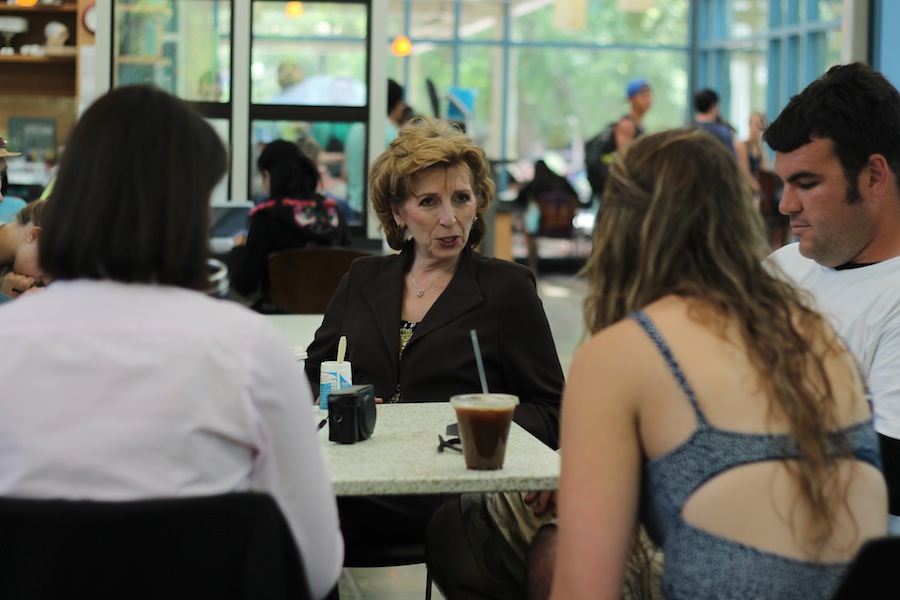
Emily Prieto-Tseregounis, chief of staff to the vice chancellor of student affairs, has helped organize the campaign through the administration. She discussed what this campaign says about the current situation at the university.

“I think the fact that we are just having this campaign, having this language around sexual assault and sexual violence, demystifying the topic, I think that in itself is going to really encourage students to report cases,” Prieto-Tseregounis said. “Students are going to be more aware about this topic and feel like this is a safe space to go to certain campus offices and report it and go to different resources and get the help that they need.”

Danielle Santiago, a third-year political science major and an ASUCD senator, has focused on sexual violence through her role in student government and gave her voice on the campaign in an email interview.

“I hope this campaign encourages students to do research for themselves,” Santiago said in the email. “I hope this campaign challenges students to look at the statistics across the nation, challenge their beliefs about intimacy between themselves and others (not just sex or sexual situations), challenge the language you use like ‘I raped that midterm,’ one step further, challenge the person that says that.”

As the campaign goes forward, Alavi said that the issue of sexual violence will not be fixed in the span of a couple of years. After the release of the campaign’s video with Chancellor Linda P.B. Katehi, the group is set to reach out to students through social media, banners, posters, videos, resources and programs to teach students about what consent actually means in a relationship.

“I think that one thing that UC Davis is good at is that we’re committed to students that come onto this campus, and we want to make sure that they leave as better people with more skills,” Alavi said. “One of these skills that will help you throughout your whole life is learning what consent is and learning how to prevent sexual assault in your own life and in other people’s lives.”
Written by: Ivan Valenzuela – campus@theaggie.org

Students protest police brutality on anniversary of UC Davis pepper spray incident

ANGELICA DAYANDANTE / AGGIE

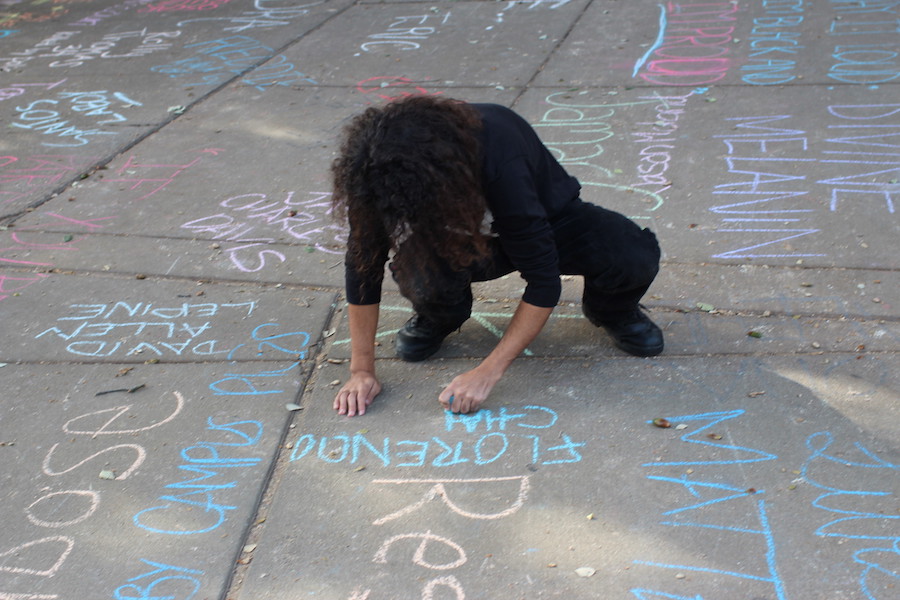
Protesters write names of police brutality victims on UC Davis Quad as part of ‘Disarm the Pepper Spray University’ protest.

On Nov. 18, UC Davis students against police brutality took their frustrations to the Quad in an effort to increase visibility of the issue as part of the “Disarm the Pepper Spray University” protest.

The protest was held on the same day as UC Davis’ 2011 pepper spray incident, when former UC Davis Police Lieutenant John Pike pepper-sprayed a line of nonviolent protesters.

At noon, the protesters gathered on the Quad, where demonstrators handed out pieces of paper that displayed six names of police brutality-related deaths that occurred earlier this year. Additionally, the demonstrators also handed out chalk for protesters to write other names of police brutality victims from 2015. In a matter of minutes, the Quad was filled with hundreds of names.

Additionally, the protesters displayed a board with names of students who were victims of police brutality within the UC system to add increased significance to the movement.

“This is non-stop; we are going to keep coming out here to protest, to bring light to what has been happening on campus and around the nation,” said Pablo Silva, a history graduate student.

He continued to stress the importance of the movement against police brutality and put emphasis on the impact that writing these names on the campus can have.

“We can never gauge what the real impact can be, but I think it is important for us to be out here,” Silva said. “The names have a deep impact. For sure it brings awareness and it starts a dialogue.”

Brandon Buchanan, a sociology graduate student and a protest organizer, expressed how this movement can affect those who see the display.

“This action is about physically taking up space with the names of people who have been killed by police just this year,” Buchanan said. “Part of what we’re trying to do is express awareness amongst the student body that these people are being killed.”

According to Buchanan, the decision to hold the protest on the anniversary of the 2011 pepper spray incident at UC Davis was chosen by the protesters to further emphasize the dire need to stop police brutality.

“We chose this space for a number of reasons and we chose this day for a number of reasons,” Buchanan said. “We chose this space because the front of the Memorial Union has a lot of traffic. We hope to disrupt the everyday operation of the university.”

With regard to the protest, Andy Fell, associate director of news and media relations at UC Davis, referenced a website the university created after the 2011 pepper spray incident in order to increase transparency for police-related issues at the university.

“We were aware of the protest, of course,” Fell said. “I don’t think I have a specific comment to make on this protest, but I want to note that since November 2011, UC Davis conducted and has implemented recommendations from several reports.”

The day after the protest, the university washed away a majority of the names written on the Quad. Dave Lawlor, vice chancellor and chief financial officer at UC Davis, released a statement the following day via email to the entire student body with an apology for the action and a reason behind the decision to erase the names.

“I am deeply sorry that university employees erased the names of more than 1,000 people who were killed by police,” Lawlor said in the email. “Please know that erasing the names was a mistake, and it was fundamentally wrong. As the lead for the university’s finances, operations, and administration, I take full responsibility for these actions.”

Following his apology, Lawlor touched briefly on the statistics of police brutality in the United States and finished his statement with a list of names of individuals who have died due to police.

“The number of people killed by police stands at 1,053 since Jan. 1,” Lawlor said. “Here are the names of 1,040; names were not available for 13 of them, and ages only were available for four.”

Emily Breuninger, a sociology graduate student, expressed her negative opinion on police brutality, criticizing the issue for now being part of UC Davis’ legacy.

“We are not isolated; we have problems with police brutality and racism on our campus,” Breuninger said. “This is the anniversary of the pepper spray incident. We have become world-renowned for police brutality.”

Written by: Nick Griffen – campus@theaggie.org

DARPA grants UC Davis researchers $1.8 million to innovate sensor technology

DEBPARNA PRATIHER / AGGIE

Team of professors, postdoctoral researchers develop ultra-low-powered sensors.

In October, the Defense Advanced Research Projects Agency (DARPA) granted $1.8 million to a team of professors and postdoctoral researchers led by UC Davis aerospace engineering professor David Horsley to develop ultra-low-powered sensors.

Horsley created a team of three engineering professors including himself, Rajeevan Amirtharajah and Xiaoguang Leo Liu, along with a post-doctoral engineering researcher Jeronimo Segovia-Fernandez.

DARPA initially proposed the idea to create this technology with the goal of developing an unattended sensor that can work for years without replacement, and only be powered by a small battery.

The sensors that this project will be developing are motion-sensing, much like the sensors that currently exist in smartphones and other smart devices.

“The Department of Defense has an unfilled need for persistent, event-driven sensing capabilities, where physical, electromagnetic and other sensors can remain dormant, with near zero-power consumption, until awakened by an external trigger or stimulus,” states the UC Davis engineering page.

The team believes that this technology can be useful in many applications once it is developed.

“Many everyday applications could leverage the technology developed by this research. For example, home security systems could directly use the same sensors,” Amirtharajah said. “The same technology can enable voice-activated devices in outdoor spaces or remote locations where electricity is not available. The technology could be used to monitor wildlife and help track their movements and populations.”

For the manufacturing portion of the project, the team is collaborating with InvenSense, a San Jose-based company that currently produces motion sensors commercially. Since DARPA does not provide manufacturing, this collaboration will allow the sensors to be quickly marketed to companies, such as Apple or Samsung, once they are developed.

“Any discoveries that we make can be quickly commercialized by InvenSense,” Segovia-Fernandez said. “InvenSense only makes products for consumer electronics. They’re not a military contractor. This means that any sensors that come of our project will be for consumers.”

With the popularity of sensors in modern technology, Segovia-Fernandez believes that the vast improvement in sensor development will be successful in today’s market.

“Right now, sensors in wearables and mobile devices are a hot topic,” Segovia-Fernandez said. “If we can make a sensor that operates below one microwatt — 1000 times lower power than the microphone in your cell phone, but still 100 times higher than DARPA’s goal — InvenSense could ship one billion of these.”

According to Amirtharajah, the team has been researching low-power sensors long before taking on the project proposed by DARPA. Armirtharajah revealed that this experience has given the team the confidence to take on this innovative technology.

“Our project was initiated in response to the DARPA solicitation for new technology to address the ultra-low-power sensor need for a specific defense application,” Amirtharajah said. “However, my research group has been working in ultra-low-power circuits for sensor applications for the last 12 years.”

The project is currently underway and within the next few months, prototypes will be tested. The first prototypes are expected to be tested in January 2016, according to Segovia-Fernandez. In the test, the sensors are required to sense the presence of a power generator in an urban environment while fulfilling a minute power budget.

The team had already collaborated with a group of UC Berkeley researchers prior to this project to create ultrasonic fingerprint scanning that will likely be used in smartphones by 2018.

“This is an exciting win for our college,” said Jean VanderGheynst, associate dean of research and graduate studies at the College of Engineering. “Professor Horsley’s research team is leveraging major investments that the college and campus have made in nano- and micro-manufacturing. I look forward to seeing additional success in these areas.”

Written by Nick Griffen – campus@theaggie.org

U.S. Bicycling Hall of Fame holds annual induction ceremony

Alison Dunlap, champion of both road and off-road racing, accepts her induction into the US Bicycling Hall of Fame. (HANNAH WODRICH / AGGIE)

Four members recognized for contributions to cycling at 29th annual ceremony

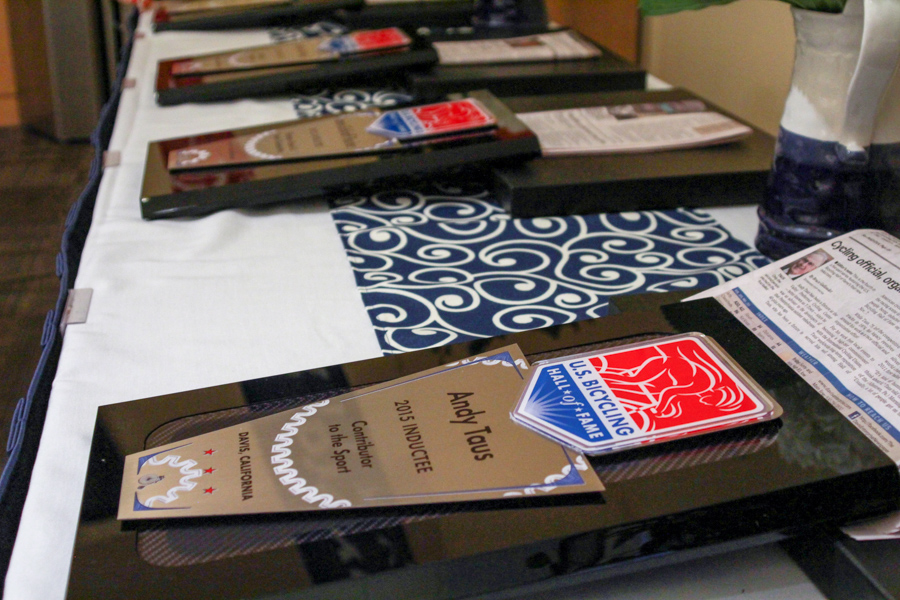
On Nov. 7, the U.S. Bicycling Hall of Fame, located in Davis, held their 29th annual induction ceremony to honor the four new inductees. Al Crossley, Alison Dunlap, Janie Eickhoff and Andy Taus all contributed to the sport of cycling largely enough to be recognized by the national board.

“There are usually four inductees every year. Three of them are here tonight and one is deceased, Al Crossley,” said Bob Bowen, current president of the U.S. Bicycling Hall of Fame.

Although this was the 29th induction for the U.S. Bicycling Hall of Fame, this was the eighth year the induction was held in Davis, where the ceremony was first hosted in 2008. The Bicycling Hall of Fame started in Somerville, New Jersey in 1985, but ran into financial issues in 2007.

“There was a competition, other cities applied, and in 2008 we did an induction in Davis on speculation,” Bowen said. “[Hall of Fame representatives] came out in 2008, and they saw Davis people biking all the time, [that] we have the bike team, [and that] we have 100 plus miles of designated bikeways in the community.”

In 2009, the Hall of Fame moved to Davis, and the current Hall of Fame building on 3rd and B St. opened on April 24, 2010. The City of Davis made the Central Park location available to the organization for $1 a year. According to Bowen, the whole operation runs on less than $50,000 a year.

Every year, the national board reviews people’s submissions for induction nominees and looks at their accomplishments. According to Bowen, people can also be inducted for their influence on the sport, such as the Schwinn family who created the Schwinn bike company.

“People have put forward names in the bicycling world, whether they be classic racers going back to the six-day races, contributors to the sport such as officials or those who weren’t riders but helped the sport of cycling, off-road riding such as mountain biking or cyclocross, and track,” Bowen said.

HANNAH WODRICH / AGGIE

2015 inductee Albert Crossley was a professional six-day racer for 12 years starting at age 21 in 1929, and competing until 1940. Six-day racing entails two-man teams taking turns riding on the track so that at any given moment, one of them is riding for six days straight. The team that completes the most laps wins the race. Of the 89 six-day races that Crossley competed in, he had 10 wins, 15 second places, 17 third places and 16 fourth places.

Alison Dunlap, another inductee at the Nov. 7 ceremony, began road cycling during her first-year at Colorado College when she was cut from the soccer team. She became the women’s national collegiate champion in road racing by her senior year of college. Dunlap saw even greater success after her transition into mountain biking. She went on to become a two-time Olympic team member, world champion in her new discipline and winner of a gold medal at the 1999 Pan American Games.

“To be a world class cyclist takes an unbelievable amount of dedication and discipline,” Dunlap said. “To be the best, there is a level of commitment that goes beyond what is logical, almost into the absurd.”

Following a career-ending knee injury in soccer, inductee Janie Eickhoff began cycling and became the national junior track champion in only two years. Eickhoff became a national champion and earned a bronze medal at the 1989 World Championships, the only member of the U.S. track cycling team to do so. She currently holds the U.S. women’s record for the kilometer time trial standing start. Eickhoff won 10 national titles, six medals at world championship events, and two gold medals at the 1995 Pan American Games.

Although only racing from 1968 to 1974, inductee Andy Taus had a profound impact on the world of cycling starting when he received his Category 1 official’s license in 1981. He went on to officiate at the national and international level while also helping organize and teach courses on officials training. He was a key member at events such as the World Track Championships, the Olympic Games and the Pan American Games for 41 years.

“When I watched my first race in 1968, I had no idea how it was going to affect the rest of my life,” Taus said. “Today, being here with the rest of the inductees of the U.S. Bicycling Hall of Fame, and to now be included, is special. To be recognized by your peers is really truly special.”

Bowen hopes that ceremony attendees, including junior racers who are in their first years of racing, are inspired by the inductees’ speeches. He also hopes to reach out to younger crowds in Davis and believes the lifestyle of Davis is oriented towards bicycling.

“You see five-year-olds riding their bikes to school in Davis,” Bowen said. “Maybe more towns in the U.S. can learn what we have learned over the years. Not only the health benefits, but also the infrastructure.”

Written by: RIVA BALLIS – city@theaggie.org

This week in sports

0
TIFFANY CHOI / AGGIE

UC Davis athletics from Nov. 16 to Nov. 22.

Men’s basketball (2-1)

UC Davis vs. Fresno Pacific (W, 76-46)

The men’s basketball team crushed Fresno Pacific in their third home game, as their defense stopped the Sunbirds from making any significant gains. Despite 22 turnovers and 13 steals by Fresno Pacific, superior play by UC Davis led to a 76-46 win. Read a full recap by sports reporter Veronica Vargo here.

Men’s basketball will make the short journey to Sacramento State for their first away game on Tuesday, Nov. 24.

Football (2-9 overall, 2-6 conf.)

UC Davis at Sacramento State (W, 35-21)

In the last game of the season, the UC Davis football team took down the Sacramento State Hornets 35-21 in the 62nd annual Causeway Classic match-up. Redshirt freshman C.J. Spencer threw over 300 yards for his second game in a row for three touchdowns. Three juniors excelled in the rivalry game: for a career high, running back Manusamoa Luuga rushed 117 yards, wide receiver Chris Martin claimed 115 yards and linebacker Brady Stibi had a career-high 10 tackles.

Men’s water polo (18-8, conf. 6-0)

WWPA Championship at U.S. Air Force Academy in Colorado

UC Davis vs. Cal Baptist (W, 14-13)

UC Davis vs. UC San Diego (L, 6-5)

For their first match of the WWPA Championship, the men’s water polo team beat Cal Baptist in a 14-13 victory. Freshman attacker Ido Goldschmidt led the team by a wide margin with seven goals, leading all players by at least four.

Falling 6-5 to UC San Diego in the WWPA championship match, the Aggies end their season with a perfect conference record. Sophomore goalkeeper Spencer Creed had 11 saves for the game, and five of his teammates were able to score against the Tritons.

Women’s basketball (1-2)

UC Davis vs. Pacific (L, 66-53)

UC Davis vs. San Diego State (W, 65-54)

The women’s basketball team lost their second official game of the year after playing Pacific on Nov. 16. The lack of a strong offensive presence denied UC Davis the win, though they ultimately were defeated 66-53 on their home court. Check out sports reporter Veronica Vargo’s recap here.

Three days later, the team traveled to San Diego State where they nearly flipped around the score from the previous game. UC Davis played a good defensive game, defeating the Aztecs by 11 points for a 65-54 win.

The Aggies play Air Force at home on tonight at 6 p.m.

Women’s swimming and diving

Phill Hansel Invitational (Third of 10)

Wildcat Diving Invitational

In the Phill Hansel Invitational, the women’s swim team finished third in a field of 10, behind Rice and Tulane Universities. The Aggies took home the medal for the 400-yard free relay, and a school record was set by freshman Solie Laughlin in the 200 back.

For the divers at the Wildcat Diving Invitational, senior Lucy Lafranchise placed 11th in the platform finals with a score of 181.45, and went on to win the 1-meter dive consolation final (269.80).

The Aggies begin the three-day AT&T Winter Nationals on Dec. 3 in Federal Way, Wash.

Volleyball (14-15 overall, 9-6 conf.)

UC Davis vs. UC Irvine (W, 3-2)

A five-set win advances the Aggies’ conference record to 9-6, after scoring 25-23, 16-25, 25-18, 15-25 and 15-9 against UC Irvine. Senior outside hitter Kaylin Squyres hit 21 kills for the match, junior outside hitter Kendall Walbrecht had 12 and sophomore middle blocker Aima Eichie claimed 11.

In the concluding match of the season, the UC Davis volleyball team will return home to play Cal Poly tomorrow at 7 p.m.

Written by: BRYAN SYKES – sports@theaggie.org

Hot out of the oven: Innovation

0
JAKE NEWMAN / COURTESY

UC Davis student finalist in pizza box design competition

This past October and November, the Capitol Public Radio station and Hot Italian restaurant, which is set to open a Davis location this fall, collaborated with the local community to host the third annual Print Radio Competition.

The contest asked entrants to create a pizza box design inspired by three keywords: avanti, which means innovation in Italian; passione, meaning passion; and fresco, which means fresh. The competition was open to student and professional artists.

Sofia Lacin, a current board member for Capitol Public Radio, UC Davis alumnus and co-owner of LC Studio Tutto, has been involved with the Print Radio Competition since its inception and was one of the jurors for this year’s contest. She sees the competition as a good way for artists to engage with Capitol Public Radio and the content the station creates.

“Print Radio connects groups with overlapping interests,” Lacin said. “Creative types seek out innovative content for their inspiration and education, and Capital Public Radio creates that rich cultural content. I saw a natural overlap and partnership [between the two].”

James Housefield, an associate professor in the UC Davis Department of Design, invited Sofia Lacin and her business partner to come to his Design 1: Introduction to Design class to talk to his students about the contest. Housefield required his students to create a design and enter it in the Print Radio contest as a class assignment. He saw the assignment as a way to introduce his students to a challenge that they might encounter in their professional lives as designers.

“It is such a benefit to be introduced to the professional world that awaits you after graduation. Professor Housefield diligently does just that,” Lacin said. “I wish I could take his class. It’s inspiring to be surrounded by such fresh [and] enthusiastic minds.”

The two winners who were chosen — one general winner and one student winner — received a $500 cash prize and had their designs featured on Hot Italian biodegradable pizza boxes for the month of November. An additional top 10 finalists had their designs showcased during a pizza party at Hot Italian on Nov. 4.

One of the winners of the contest was UC Davis student Jake Newman, a first-year who is undeclared but plans to pursue majors in industrial design and computer science.

Working with a computer science background, Newman’s design was inspired by the sensory experience a consumer goes through when enjoying pizza.

“Integrating programming code into my design perhaps seemed slightly unrelated at first,” Newman said. “But how often do consumers actively think about the multi-sensory user experience of opening a pizza box?”

Housefield is proud of Newman’s accomplishment because becoming a finalist in the competition is a substantial honor.

Written by: DIMITRA LOUMIOTIS  – arts@theaggie.org

The award for the most useless talent goes to…

0
ANGELICA DAYANDANTE / AGGIE

Students discuss their impractical, yet one-of-a-kind talents

“If you had to enter a competition for the “Most Uselessly Unique Talent,” what would your talent be?”

narda_gonzalez_rovingreporter_fe_DayandanteNarda Gonzalez, second-year genetics major

“I’m really good at stuffing things into my backpack.”


israel_curry_rovingreporter_fe_DayandanteIsrael Curry, first-year microbiology major

“Eating. I’m good at eating.”


blake_bailey_rovingreporter_fe_DayandanteBlake Bailey, third-year neurobiology, physiology and behavior major

“I can pop my shoulder blades out of my back.”


jewel_kaur-sabhok_rovingreporter_fe_DayandanteJewel Kaur-Sabhlok, first-year film studies major

“I have double-jointed fingers and hands.”


azza_malik_rovingreporter_fe_DayandanteAzza Malik, first-year sociology major

“I’m really good at spicing meals with Tabasco.”


ryan_calbreath_rovingreporter_fe_DayandanteRyan Calbreath, second-year economics major

“I’m really good at getting a group of people to start dancing.”


emma_askea_rovingreporter_fe_DayandanteEmma Askea, second-year English and communication double major

“I’m good at mispronouncing names.”


sara_remmes_rovingreporter_fe_DayandanteSara Remmes, fourth-year wildlife conservation major

“The ability to make bread toast faster.”


matharin_lee_rovingreporter_fe_DayandanteMatharin Lee, first-year environmental science major

“Annoying my roommate.”


kiana_hosseinian_rovingreporter_fe_DayandanteKiana Hosseinian, first-year biochemistry and molecular biology major

“Hiccuping on cue.”