54.1 F
Davis

Davis, California

Tuesday, December 23, 2025
Home Blog Page 766

The Internet Explorer: Activism in social media

HANNAH LEE / AGGIE
HANNAH LEE / AGGIE


Igarcia_opn light of the recent terrorist attacks in Paris, many have taken to social media to pay tribute to the fallen victims and express sorrow for the city. Like many people, I found out about the tragedy through Facebook. Shortly after the attacks, the site made a photo filter of the French flag available for users to superimpose over their profile pictures as a declaration of solidarity. It’s an act of compassion. We lament that the City of Love could see such cruelty.

But are our online expressions of solidarity really a form of activism? Within its very name, activism indicates action. Yet the term ‘hashtag activism’ implies that even the passive act of typing on a keyboard is equivalent to standing up to social injustice. That being said, I don’t mean to speak harshly about activism on social media, and I especially don’t discredit feelings of compassion as being shallow or meaningless. I just want to critically consider both sides of the debate before I arrive at any conclusion about whether social media is a propellor or antagonist to activism.

I see hashtag activism every time when I log onto my Facebook account. I see how shared links, images and hashtagged movements like #BlackLivesMatter, and #HeForShe have been popularized by social media sites.The hashtags are harmless in that they spread awareness of deplorable acts and social injustices that persist in modern society. However, critics have deemed hashtag activism as a form of ‘slacktivism.’

Chris Wallace, George Will and Brit Hume of Fox News noted that hashtag activism was a “useless exercise in self esteem.”

“I do not know how adults stand there, facing a camera, and say, ‘Bring back our girls,’” Will said. “Are these barbarians in the wilds of Nigeria supposed to check their Twitter accounts and say, ‘Uh oh, Michelle Obama is very cross with us, we better change our behavior?’”

Critics of hashtag activism charge that its ease could lead to overuse and public fatigue. They say that in the worst, most extreme cases, it may even desensitize the public to acts of violence and injustice.

But the Internet’s version of activism is more equivalent to an organized protest on a larger scale. Those who demean hashtag activism can say, ‘But you’re not really doing anything!’ Well, to those people, I would respond, ‘Well, what would you do?’

What can we do? Most of us don’t hold positions of power to make executive decisions. But we can avoid being idle bystanders. Social media and hashtagging have encouraged us to express our opinions. I would go as far as to say that these features pressure us to have convictions about very critical issues. This could be dangerous given that 64 percent of U.S. adults use social media sites — namely Facebook — to get their daily dose of news. Many online sources are politically biased and often deal in misinformation.

Overall, hashtag activism evokes action through sentiment. It gives us — constituents of the general public — a role to play by offering us a chance to express our opinions. It’s not like the issues don’t affect us. By hashtagging a cause on our social media platforms, we are identifying ourselves with it. While many critique social media for dehumanizing relationships, the Parisian attacks have shown us that the medium allows us to reach out in sympathy. And, small as it may be, that is one of the most humane acts of all.

You can reach Jazmin García at msjgarcia@ucdavis.edu

This week in sports

0
TIFFANY CHOI / AGGIE

UC Davis athletics from Nov. 23 to Nov. 29

Men’s Basketball (3-2)

UC Davis at Sacramento State (L, 84-79)

UC Davis at Utah Valley (W, 82-70)

History was made away from home as senior forward Josh Fox added 18 rebounds to the game against Sacramento State the most rebounds by any UC Davis player in Division I history while also adding 16 points for his second season double-double. Junior guards Brynton Lemar and Darius Graham also managed to put up career high scores with 21 and 17 points, respectively.

Despite the Aggie’s strategic play against the Hornets, they were left with their second loss of the season, in an 84-79 defeat.

The Aggies upset the Utah Valley Wolverines by scoring the final 12 points in the match and causing them to put up four turnovers in the process. Five Aggies put up double figures against Utah Valley to dominate the game, leaving the Wolverines to howl with anger for their first home loss.

The men’s basketball team will rematch Sacramento State at the Pavilion on Wednesday night at 7 p.m.

Women’s basketball (4-2)

UC Davis vs. Air Force (W, 66-40)

UC Davis at  Portland State (W, 82-70)

UC Davis at Portland (W, 72-47)

The women’s basketball team took an early lead against the Air Force to win the game and irritate the Falcons. Senior forward Alyson Dougherty celebrated her birthday by leading the Aggies with 18 points to contribute to the 66-40 win.

See a full recap of the game by sports reporter Veronica Vargo here.

Against Portland State, Doherty led three Aggie teammates in double figures with a team high of 22 points and 10 rebounds. The Aggies added 26 assists on 33 makes, a season high, while sophomore guard Dani Nafekh added eight for her career high. The Vikings were no match for the UC Davis offense when 20 turnovers turned into 19 points for an Aggie win of 82-70.

Ten Aggies put up at least two points in the game away against the Portland Pilots to shoot 50 percent from the field. Doherty led her team once more during the game and is expected to become the 17th Aggie to reach 1,000 career points in the next match-up against St. Mary’s on Thursday. UC Davis maintained a lead with a gap that the Pilots could not bridge for the 72-47 win.

Volleyball (15-15 overall, 10-6 conf.)

UC Davis vs. Cal Poly (W, 3-1)

The last game of the year drew in the season-best home crowd as outside hitter Kaylin Squyres and middle blocker Jillian Johnson said farewell in the Senior Night proceedings. The volleyball team defeated Cal Poly in four sets, going 23-25, 25-11, 25-22 and 25-22 to end their season with a 10-6 conference record.

See a full recap of the match by sports reporter Julia Wu here.

Written by Veronica Vargo – sports@theaggie.org

The Aggie gives thanks

0
HANNAH LEE / AGGIE
HANNAH LEE / AGGIE

Editorial Board thankful for UC Davis.

Ellie Dierking, Features Editor

It’s that time of year again: the season of “thankfulness.” While there are lots of things to be thankful for this holiday season, you’re probably most thankful for the opportunity to stuff your face with Thanksgiving dinner plus pumpkin pie, cookies, ice cream and other assorted desserts after a month and a half of eating Dining Commons food or having to cook for yourself. However, this Thanksgiving, here’s something that all of us as UC Davis students have to be thankful for: toned legs. It’s a known fact that Davis is one of the most bike-filled campuses in California. According to livestrong.com, the muscles used most while biking are the “gluteal muscles, quadriceps, hamstrings and calf muscles.”

This means there might a cure for the treacherous guilt you’ll feel after gaining five pounds upon the eve of Nov. 26: look in the mirror and know you’ll be able to support your newly-conceived food baby with your ripped calves and toned quads. Not to mention how impressed family and friends will be when they see your firm glutes. The amazing reflexes you’ve developed from steering your bike to dodge all those squirrels is just an added bonus. If you take Unitrans however, just be thankful for not having to bike.


Jason Pham, Campus News Editor

‘Tis the season to be thankful, and what better way to be thankful for the fruits of UC Davis’ labor than by thanking the school’s greatest fruit of all – $2 CoHo pizza. Though technically not a fruit, the CoHo’s two-something gourmet, cheese-covered delicacies are easily one of the university’s unsung secrets. From the pizza handler’s five-star service to Ciao’s fine China paper plates, the CoHo’s take on a timeless Italian classic gives me something to really be thankful for this year, and all for a low pocket-change price.


Eli Flesch, Opinion Editor

16 Things about UC Davis’ Haring Hall That I’m Thankful For:

  1. Sounds like ‘Harry Hall’ if you say it reasonably fast.
  2. Long hallway. So long you might be tempted to yodle, even though you’re pretty sure you won’t get an echo.
  3. Not yet plagued by asbestos exposure.
  4. Not only does Haring Hall provide men’s bathrooms, but women’s restrooms too. Progress.
  5. The spot where The Accident occurred is well-marked for all to see.
  6. There’s a vending machine that I once lost a nickel in while trying to buy a Take 5 candy bar. I didn’t realize vending machines don’t take nickels, so now I’m thankful that I know better, and everybody who passes by the machine should also be thankful for knowing better because of the sign I put up that says: “This vending machine doesn’t take nickels.”
  7. Close enough to the Silo Starbucks that if you sprint fast enough after class, you might only have to wait 20 minutes for a cup of coffee.
  8. A seat and a desk for every man, woman and child.
  9. Relatively few alums nostalgically strolling through the corridors.
  10. I had Economics 101: Intermediate Macroeconomics in Haring Hall, with a great professor named Paul Bergin. It was a fine class. I got a B+. I’d like to think that the general arrangement of the class setting (in Haring Hall), along with Professor Bergin’s instruction, was critical to my success.
  11. The halls are long enough that you could call them corridors.
  12. Devyn has class there on Tuesdays and Thursdays.
  13. It’s not the architectural abomination that is Young Hall.
  14. Contains varying classroom sizes for the easy accommodation of discussion sections and lectures alike.
  15. Unlike most buildings at UC Davis, Haring Hall was built in 1949.
  16. These are 16 things about UC Davis’ Haring Hall that I am thankful for.


Amanda Ong, Arts Editor

Fall is the season of change. It’s the beginning of a new school year — the leaves are turning red and orange and gold, and the air is getting crisp and cold. But this Thanksgiving, I’d like to give thanks to something that hasn’t changed since I’ve come to Davis. This is something that’s been a constant source of support and comfort in my life. Something that’s an unsung hero in the lives of many Davis students, something that never receives the recognition it deserves.

I’m talking about the bathrooms on the second floor of the Student Community Center. While bathrooms in Wellman and Olson Hall fill up with trash and graffiti, the Student Community Center bathrooms always remain pristine. If I’ve drunk too much coffee before an exam and need a safe space, they’re there for me.

So, thanks, bathrooms on the second floor of the Student Community Center. You rock.


Bryan Sykes, Sports Editor and resident bard

Today is a day to have boatloads of fun,

To eat and to eat till your stomach is done.


The turkey and stuffing and gravy galore,

Will leave me content, passed out on the floor.


There is much to be happy for, much to be glad,

Like my sister and dog and my mom and my dad.


But in the end, what I’m thankful for most,

Is a group of great friends and a well-cooked pot roast.


Kayla Zola, City News Editor

Today I’ll give thanks to the unsung hero, my savior on a cloudy day (aka Monday). As I find my way to the CoHo to get a much needed cup of coffee — computer, water bottle, textbooks, sweatshirt and lunch in hand — a knight in shining armor comes to my side, and holds open the door to the CoHo. Shout out to you fellow Aggie, alum, visiting parent or prospective student. Although I don’t know you, and will likely never see you again, thank you for holding open the door and making the day of a struggling college student.

Senior Night brings out the best in the Aggies

BRIAN LANDRY / AGGIE

Women’s volleyball beats Cal Poly in final game of season.

The victory against Cal Poly was a sweet ending to an emotionally charged Senior Night, which celebrated outside hitter Kaylin Squyres and middle blocker Jillian Johnson. In front of the biggest crowd of the season, the Aggies battled it out for a final score of 23-25, 25-11, 25-22 and 25-22.

It was a night of big numbers, as redshirt freshman middle blocker Kelechi Ohiri matched her career-high of 12 blocks and junior outside hitter Kendall Walbrecht and freshman opposite Nicola Moore made a combined 25 kills.

Coming off of Senior Night festivities, the Aggies started off the first set more tense than usual. Cal Poly was able to find open spots on the court to attack, leaving their opponents scrambling after the ball and inhibiting their ability to play their usual offensive game. Squyres made two kills to even out the score in the middle of the first set, but the Mustangs created a lead at the last second and finished the set with 23-25.

“We had a lead, and we backed off a little bit, and so [after the set] we talked about settling down and playing our style of game,” Head Coach Dan Conners said.

That worked well for the Aggies, and in the second set they anticipated the Mustangs’ moves and hit an attack average of 0.481. The Aggie lead was set by Moore at the start of the game with three consecutive kills, all assisted by junior setter Sophia Mar, and stayed consistent until the end. At one point, Johnson came in as a substitute and played her last set as an Aggie.

Set three kept the entire arena at the edge of their seats, with 11 lead changes and long points that could have been won by either team. However, junior outside hitter Allie Wegener made three aces in a row while Moore and Walbrecht dominated the defense on the right side of the court to get a lead. Ohiri came in with a well-aimed block to clock in another set for the Aggies.

Ohiri was instrumental in the fourth set, making all five kills and cutting potentially messy rallies short. To finish the game, the Aggies earned match point with a kill from Ohiri. Squyres made the last kill of the match, the cherry-on-top to her illustrious volleyball career.

“It feels awesome to get one last kill and leave my final mark on the program,” Squyres said. “But I’m also excited for the future of this team. Kendall Walbrecht, Allie Wagner, Sophia Mar [and] Aima Eichie are going to do such great jobs leading as seniors next year.”

The Aggies closed out their season with a 10-6 record in Big West Conference play and 15-15 overall.

Written by: Julia Wu – sports@theaggie.org

The Millennial Age: The Power Behind Blogging

0
JENNIFER WU/ AGGIE
JENNIFER WU/ AGGIE

prokos_opTwenty years ago, a career in writing or media meant working for a newspaper, magazine or a TV or radio station. Basic blogging sites may have existed, but a person certainly couldn’t make a living through this medium.

Entirely different standards define today’s careers in media. Advances in blogging and social media have not only allowed individuals to differentiate themselves through online profiles and accounts, but also to create their own personal brands.

Today’s bloggers embody the essential innovative and entrepreneurial air of the Millennial Age.

Six years ago, Chiara Ferragni was an Italian law student who posted avidly about her personal style on Flickr and Lookbook.nu. She received so much support and affirmation from her followers that she decided to start her own website. After successfully monetizing her blog, The Blonde Salad, Ferragni was able to build a fashion empire. Her blogging success ultimately led to the launch of her own shoe collection and openings of pop-up stores worldwide.

Ferragni, 28, who now runs two companies worth a total of $8 million, hasn’t employed anyone over the age of 30.

Like most Millennials, the blogger’s initial goal was just to inspire creativity.

“When I started […] I was doing it just to share […] because I love sharing my photos,” Ferragni said in an interview for CBS News. “My intention was to create something that people loved to look at, and they could find inspiration from, and that was it.”

In 2014, Ferragni attracted the attention of academics and acclaimed business professionals and became the first blogger selected for a case study by Harvard Business School. The case study, led by Professor Anat Keinan and her students, was designed to shed light on how Ferragni’s start-up was able to become so successful in such a short time.

Keinan suggested that a large part of Ferragni’s success came from her ambition as an entrepreneur as well as her ability to relate to fans and consumers.

Others indicate that Ferragni was able to become so successful simply because she recognized the influence of a new medium before anyone else.

“Your followers are your currency,” said Joe Zee, the editor-in-chief of Yahoo Style. “[Chiara] was really there at the very beginning, when you are sort of a trailblazer in a new medium, you really grow your fans fast […] and really with a lot of loyalty.”

Zee may have a point in arguing that Ferragni was able to dominate the blogging industry merely because she entered it in its infancy. But there is also credibility in Ferragni’s claim that success is really generated from boundless creativity and strong visions.

“I feel right now we are in the best moment for the fashion industry for what I do,” Ferragni said. “All the rules have changed so much, and so now there are no rules.”

Aspiring fashionistas aren’t the only ones who have found ways to profit from social media and blogging culture. Figures like Tim Ferriss and Jake Dobkin have also been able to incur huge profits from blogging on topics in their fields of interest and expertise.

Ferriss, 38, gained a huge following through his blog which focuses on healthy living. Some people also credit him with popularizing today’s fetish of entrepreneurs working on their laptops anywhere in the world, at any time.

The founder and editor-in-chief of the news blog The Gothamist, Jake Dobkin, was also a blogging pioneer. He innovated the field of culture blogging, hiring writers to cover food, art and current events in over 10 cities worldwide.

Not only has blogging allowed the individual to develop their own voice, but it has created the opportunity to share their interests with others and make an incredible living as a result.

Of course, with these innovations becoming more accessible and ubiquitous, it may be harder for Millennials and Generation Zers to attain the same success. With so many blogs on the internet, people have a hard time developing original concepts. Yet, as Ferragni suggested, without constraints for creating trends and spreading these unique ideas, the possibilities are endless.

Reach HAYLEY PROKOS at hprokos@ucdavis.edu.

Same ol’ Thanksgiving

AGGIE FILE
AGGIE FILE

Eight things that are guaranteed to happen this Thanksgiving.

This time of year is all about being thankful. That could mean a variety of things, including thankfulness for friends, family, health, safety or an abundance of good food. Whatever you’re thankful for, here are eight things that are no-doubt guaranteed to happen this Thanksgiving:

  1. You’ll hit incredibly bad traffic on your drive home.

If you’re traveling the day before Thanksgiving, there’s really only one thing to say: good luck. Whether your final destination is an hour’s car drive or eight hours, there might be a point after 40 minutes of moving a staggering two inches in bumper-to-bumper traffic that you stop and wonder: is this worth it? Is it worth spending a small lifetime in the car to go home for a few short days? Believe me when I say it is. I promise that if you focus on fluffy mashed potatoes, roast vegetables, stuffing, crispy pumpkin pie, ice cream or any other Thanksgiving dish, you’ll survive the travel home — no matter how treacherous it might seem.

  1. Your parents, aunts, uncles and/or grandparents will ask you what you’re thankful for…

…and you’ll tell them what they want to hear. Put on your most impressive puppy eyes, wipe the forced tear from your eye and tell them wholeheartedly, “My family, my friends, my education, this wonderful meal and most of all: you.” It’s a foolproof way to automatically become the favorite. It works like a charm, every time (especially with Grandma).

  1. Every family member will ask you how school is going.

One of the best parts about going home is that the main thing you talk about with friends and family is the place you just left. “How’s school?” The best way to combat this question is to smile, use the angsty middle-schooler response, “good,” and change the subject immediately. Don’t think about that final project you have due the Monday you get back from break, or the multitude of finals you have yet to study for. As previously mentioned, Thanksgiving is about being thankful, and since school work doesn’t traditionally fit under that criteria, no one will blame you for pushing it out of your mind.

  1. Some sort of singing will probably ensue.

Large groups of people like to sing, it’s basically a fact. Especially during the holidays when they have bellies full of turkey, potatoes and wine. Don’t be startled if one of your uncles suddenly breaks out in song— he truly can’t help it. Eventually everyone will be singing as well, so join in and there you have it: a beautiful Thanksgiving memory for the ages is born.

  1. Someone will bring up El Niño.

Let it happen. This is an exciting year for Californians; at long last, talk of the drought just might be coming to a close. Do your research beforehand and offer up some insightful statistics, then tell a couple humorous tales about biking in the rain to finish off the conversation (maybe throw in the freshman stripe detail, it’s a classic) and you’re good to go. Urge to discuss El Niño = satiated.

  1. You’ll eat a disgustingly large amount of food.

Whether you’re the type of person who regrets it or takes pride in it — you will eat Thanksgiving dinner, and it will be a disgustingly large amount. How you choose to feel about it afterwards is up to you.

  1. You’ll vow to work out the next day.

Empty promises, I assure you.

  1. You won’t work out the next day.

Happy Thanksgiving!

Written by: Ellie Dierking – features@theaggie.org

Inside the game with Malia Bolko

0
BRIAN LANDRY / AGGIE

Defensive Player of the Week twice in one season

The California Aggie sat down with freshman libero Malia Bolko, a newcomer who is already making big waves here at UC Davis. Since she started playing this past fall season, Bolko has won the title of the Big West Conference Defensive Player of the Week twice, first on Oct. 5 and again on Nov. 8. She ranks third in the Big West with 4.16 digs per set, and is an essential component to the team.

How and when did you start playing volleyball?

I went to a Catholic middle school and they had a CYO [Catholic Youth Organization] program where 5th through 8th grade [students] could play volleyball, so I started playing there. I didn’t start playing competitive club until 8th grade.

After high school, what made you choose to play for Davis?

First of all, I came here for academics because my parents were really pushing for it. I also wanted to be close to home, but far away enough so I didn’t have to see my parents all the time. I live an hour away, an hour and a half with traffic.

I also had an official visit with five of the other freshman recruits and we all got to meet each other, which was really cool. We all played together in club, so it was nice to see familiar faces.

How was it adjusting from high school and club volleyball to college volleyball?

Well, high school is a little easier and it gets a little harder in club. I played on an 18s team but it was not equivalent to this. The transition was harder than I thought because we came in and right off the bat we had a lot of work. But I really like playing here, and after this year I have gotten a lot better.

You were Defensive Player of the Week twice this season. How does it feel?

It feels really awesome. I wasn’t really expecting it, but getting it was such a reward because it means that everything that we’ve been training for is paying off.

Can you describe your position as a libero and how you got started in it?

I get a different colored jersey and I don’t count as a sub. When I first started playing club I was taller for my age, so I played outside, which is hard to believe. While on the 18s team in club, I realized I wasn’t tall enough to be a big hitter, because, you know, they’re all six-feet tall, so I started working on passing because I thought that was what I could do to help the team out.

Then I got recruited by Dan [Head Coach Dan Conners], and I started working on it more and more until I got pretty good at it.

How have you improved throughout the season?

Dan has given me lots of keys to work on. The game is a lot faster and I can’t do these little movements that would cause me to slow down. Having more discipline [in the libero position] has helped me pick up more balls and be more consistent.

What do you look forward to in the future?

I’m looking forward to the next three years. This season was really fun and I’m hoping that eventually we will get the Big West title. That would be really fun. And I can’t wait to grow up with everybody on the team.I’m also excited for off-season, because I heard it’s really hard but I can’t wait to work out in the weight room and get a lot stronger.

Written by: Julia Wu – sports@theaggie.org

The Nishi Gateway Project slowly slides toward the ballot box

0
NICKI PADAR / AGGIE
NICKI PADAR / AGGIE

$300 million development project faces city council, voter decisions

The City of Davis is deliberating on a $300 million development called the Nishi Gateway Project which would create a new residential, business and research space in South Davis. On Nov. 17 the Davis City Council, in a 5-0 vote, asked to see more specific proposals for the project before allowing it on the ballot for voter approval in June.

“Over the past three years, the City, UC Davis and Yolo County have been collaborating with the property owner to explore development of the Nishi property as a component to a mixed-use innovation district which could include lands that are owned by UC Davis” said Katherine Hess, community development administrator for the Davis Department of Community Development and Sustainability.

Hess said that the City Council adopted five goals when reviewing the Nishi proposal, which include creating jobs for Davis residents and the city’s businesses, building high-density urban residential development, making the entrance to Davis look more appealing, increasing support for downtown and increasing tax revenue for the city.

“The planning commission will be making a recommendation to City Council in the next couple of months. We’re working on a schedule that would allow the council to place the applications on the June 2016 ballot,” Hess said.

Support for the project among Davis residents has been far from unanimous, according to Hess, since residents are still divided on certain aspects of the project. Survey responses point out that many do support the proposal but many others still have doubts and concerns.

“The question is the balance between the cost of public services that would be provided by the city and revenue that would be provided through sales tax and property tax,” Hess said.

City Councilmember Brett Lee highlights that traffic problems are another major concern for residents, but adds that the idea of the project is still appealing.

“I think there’s general support for the concept but the specifics really matter. For instance if you asked the public, ‘do you think you would support that we build rental housing for students and have more moderately priced for-sale housing,’ everybody says yes. On the other hand if you say, ‘oh by the way, it will cause a traffic gridlock at Richards, Olive [Drive] and Downtown,’ everybody says no,” Lee said.

Lee adds that one of the major concerns about the Nishi proposal has been the fact that Olive Drive is the only access point to the proposed project. A second crossing is currently being considered by UC Davis, but it is not going to be built concurrently with the Nishi project. Lee thinks that the project needs to be broken into phases to prevent too much congestion.

“The first phase would be based upon the single access point. Once the university decides to construct a second access point, that would allow them to form phase 2. The problem is, if they go ahead build everything before there’s a second access point, it creates a huge traffic problem. What we want is a specific proposal, broken into phase one, phase two,” Lee said.

With regard to the timing of the project, City Councilmember Rochelle Swanson stresses that everything is subject to negotiation and approval by various entities, including the City Council, the Davis community and the Regents of the University of California.

“Our job as City Council is to decide whether or not [the project is] even [reviewed] enough to go on the ballot,” Swanson said.

Swanson is determined to get enough information about the project before the proposal goes before the people. She stresses that Davis residents are educated as well as engaged with the community; it is therefore essential that they have the details required to make an informed decision if the measure goes to the ballot in June.

“The biggest concerns [for residents] are access and traffic impact… I think the main advantage is supplying space for graduate students, professors and even private business and undergrads to be able to have a space where there will be some start-up energy,” Swanson said.

Like Lee, Swanson also highlights the idea of UC Davis building a second crossing as being key to the project and its future development plans.

“It’s my understanding that… to really get underway, it’s going have to be after the Regents [make a decision] and there is a final determination as to that second crossing. There is preliminary steps that could go underway, whether it’s trying to bring some investment in Olive Drive and investment in some of the upgrades we want to do to Richards Boulevard,” Swanson said.

This enormous Nishi Gateway Project fills a void that is important to many Davis residents, but the concerns surrounding the proposal are still legitimate. If and when the proposals are approved by City Council, it is ultimately for the people to decide the fate of the project and to weigh the pros and cons that are associated with it.

Written By: JUNO BHARDWAJ-SHAH – city@theaggie.org

UC Regents plan to enroll 10,000 more in-state undergraduate students by 2018

DEBPARNA PRATIHER / AGGIE

Napolitano plans to expand graduate student enrollment, increase non-resident tuition in addition to massive in-state undergraduate expansion

From Nov. 18 to 20, the UC Board of Regents convened at the UC San Francisco Mission Bay Conference Center to discuss and vote on UC President Janet Napolitano’s plan to expand in-state undergraduate enrollment by 10,000 students.

The enrollment would be across all nine UC undergraduate campuses. The first expansion will include an increase of 5,000 in-state undergraduate students by the 2016-2017 school year. The plan also seeks to enroll 2,500 additional in-state undergraduates by the 2017-2018 school year and another 2,500 in-state undergraduates in the 2018-2019 school year, for a total of 10,000 students.

The plan also includes an increase of non-resident tuition by eight percent, with the goal of collecting $68.7 million in new revenue.

“The University of California is committed to ensuring educational opportunity for current and future generations of students,” Napolitano said in a public statement. “That imperative is the driving force behind the proposal to increase access for Californians, to sustain that expanded access and to maintain the excellence of what is commonly considered to be the best research university in the world.”

The UC is also requesting an additional $6 million in state funding to enroll 600 more graduate students by the 2016-2017 school year, and will seek to continue increasing graduate student enrollment at a proportionate rate to the undergraduate increases for the following two years.

On Nov. 19, the Committees on Finance and Long Range Planning gave preliminary approval to Napolitano’s enrollment plan as part of their consideration of the university’s proposed operating budget for the 2016-2017.

The increase in California undergraduates is made possible by a state budget allocation of $25 million, with an additional $25 million provided by the university.

Nathan Brostrom, the UC system’s chief financial officer, said in a public statement that the UC’s efforts in growth are due to its commitment to the California Master Plan for Higher Education, a plan that sets a coherent system for postsecondary education, defining specific roles for the UC schools, the California state colleges, California State Universities and the California Community Colleges system.

“The history of the UC shows it has consistently added students in order to meet the Master Plan and make sure that there is access at UC campuses for students that are qualified,” Brostrom said.

Under this plan, California residents in the top 12.5 percent of their graduating class in terms of academic standing are guaranteed a spot at a UC school.

Jesse Wong, a third-year psychology major, expressed her negative feelings toward the plan, stating that she does not think it is a very good move on behalf of the UC system.

“It’s more detrimental than beneficial,” Wong said. “As a third-year, I’ve noticed it’s been difficult for me and my transfer peers to get classes at this point in time. If we accept even more students, it isn’t fair to the current students who have been working so hard to get the classes they need and are being held back by this huge influx of students. And it isn’t fair to the freshmen if they can’t get the classes they need because of overpopulation.”

Video footage from the meeting as well as a full agenda can be found online.

Written by: Demi Caceres – campus@theaggie.org

Government Inspector blends cynicism and slapstick

0
POLLINATOR ARTS / COURTESY

Theatre and dance department excels in their production of Russian play

This month, the UC Davis Department of Theatre and Dance put on a production of Government Inspector, written by Nikolai Gogol and adapted by David Harrower. The play focuses on how the officials and citizens of an unnamed Russian town react to news that a stranger named Khlestakov, played by second-year theatre and dance major Taylor Church, is actually a government inspector in disguise.

One of the most striking aspects of the play was its unique blend of cynicism and slapstick. The use of physical comedy in combination with absurd characters is used to perfection in Government Inspector. Every character has a tick or flair that makes them distinctly hilarious.

One of the drawbacks of this adaptation was that, at times, the corruption depicted in the Russian town seemed to lack nuance. The plot is centered on the idea that every official in the town can be bought for the right price and that the poor are powerless against dishonesty, but this concept becomes repetitive at times. For example, there is a scene where a sergeant’s widow, played by second-year theatre and dance major Jasmine Washington, confronts the inspector about an unjust flogging she received and the inspector cannot help her. I felt like this scene lacked the emotional punch it should have had because we had already seen a similar depiction of unjust punishments earlier on the play. While the injustice of the town seemed like a realistic enough depiction of 19th century Russia, I would have appreciated a bit more complexity in this adaptation.

Apart from that, the production was an entertaining watch. I had a chance to observe the cast during their rehearsals, and the chemistry from their practices definitely carried onto the actual stage performance. The energy of the play picked up whenever there were multiple actors on stage, a testament to the tight-knit quality of the cast. Two characters in particular, Dobchinsky and Bob Chinsky (played by fifth-year dramatic arts majors Jesse Chung and Karl Uriza respectively), earned big laughs whenever they were on stage.  

As the layers of Khelstakov’s deception grew deeper, the play became more surreal, creating moments for expressive performances and the cast relished each opportunity. The play concludes with a intense soliloquy from the town’s mayor, delivered with deranged aplomb by third-year dramatic arts major Daniel Ferrer. I’ve always felt that actors derive some glee from playing characters at their lowest, or in this case, most insane. And as I watched Ferrer leap across the stage and bark his lines, I could tell that he was clearly enjoying his manic, unhinged role.

The play ended with a slow-motion fight sequence involving nearly the entire cast. It felt like a fitting way to end the play watching a group of actors commit themselves to their characters eccentricities with youthful enthusiasm, all to the sound of the audience’s laughter and applause.

WRITTEN BY: Rashad Hurst – arts@theaggie.org

Photo of the Week: 11/25/2015

SNowdon_PoTW
This photo was taken in Yosemite National Park a little over two weeks ago, where I spent the weekend with three absolutely wonderful friends. With this photo, I’m giving thanks for finding people so lovely and so well aligned with myself and my need to explore. Without them I never would have experienced snowball fights in California, eating lunch surrounded by deer at the bottom of Half Dome, or scrambling rocks to the see the bottom of a waterfall, where we probably shouldn’t have been. Happy Thanksgiving! (KATE SNOWDON / AGGIE)

Organized Aggies force back Falcons

0
ASHLEY LUGO / AGGIE
ASHLEY LUGO / AGGIE

Women’s basketball improves to 2-2 record with 66-40 win

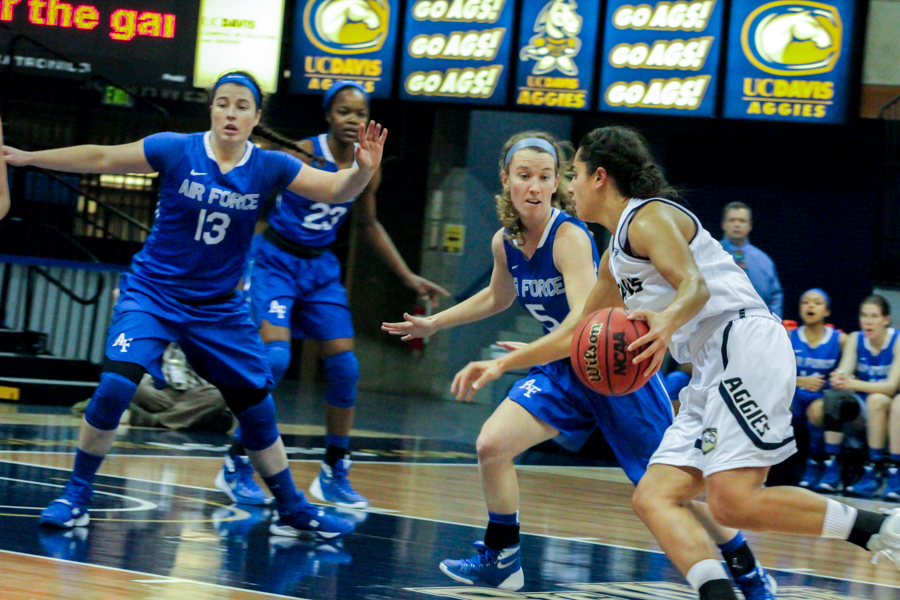
UC Davis women’s basketball took an early lead against the Air Force that only grew throughout the game as the Aggies went on to win 66-40, gaining their second win after beating San Diego State last Thursday.

“We spent a couple games where we really did focus a lot on our offense,” said Head Coach Jennifer Gross. “We found in the first two games we were taking a little too much leeway with our transition and we didn’t have enough structure to get into our stuff.”

The Aggies worked on running in a more organized fashion against Air Force and were successful. However, despite the win, the Aggies still strive for consistency.

“We are taking okay shots, but we’re not taking great shots,” Gross said. “We value great shots. We’ve always had tremendous field goal percentage because of that, and I think that we are starting to get a lot more picky with our shot selection.”

UC Davis’ field goal percentage was at 39.3 percent by the end of the game as the Aggies made 22 of 56 attempts. A majority of their missed shots were layups and balls that hit off the rim.

Senior center Alyson Doherty celebrated her birthday during the game and lead the Aggies with 18 points and nine rebounds with a singing fan base beside the court. Doherty and senior forward Celia Marfone who sank all of her shots taken and sophomore forward Pele Gianotti each put up double points, with 18, 11 and 11, respectively, while freshman forward Morgan Bertsch followed closely with nine.

Sophomore guard Rachel Nagel added seven points and four rebounds with a spectacular three-pointer that caught nothing but net at the sound of the buzzer for the end of the third quarter.

The Falcon’s defense was a tough opponent for UC Davis. Although the Aggies had a 23-point lead by the end of the third quarter, the Falcons still pressured key players into committing multiple fouls and to miss several layups.

The Aggies accumulated 19 fouls; Gianotti alone committed four fouls as sophomore guard Dani Nafekh, Marfone, and Bertsch added three each.

“It was really frustrating for me to come into the game getting two really quick fouls and then having to sit on the bench until I went in again for 20 seconds and then I got another one,” Bertsch said. “But it was really important to me because it really taught me to keep my head in the game and not let it get to me and I think it’s a step forward in learning how to deal with different situations. I think that I was able to come back in the third quarter and give it my all.”

The energy of the game was commented on by both Bertsch and Gross as they complimented the team’s ability to maintain 40 minutes of high effort and energy, only faltering a minute or two throughout the game. This, compared to the previous home game against the University of the Pacific where the Aggies were drained going into the second half, is a significant improvement.

In addition to the win, senior forward Heidi Johnson played a total of 16 minutes, a little over what her average per game was last season. Johnson added five rebounds, four points and three assists.

The Aggies will spend the Thanksgiving holiday away, improving their shot selection against Portland State this Friday, Nov. 27 with a 2-2 record, while the Falcons add another loss to their record, going home 0-5.

Written by: VERONICA VARGO – sports@theaggie.org

UC Davis launches welcome program for new employees

NICKI PADAR / AGGIE
NICKI PADAR / AGGIE

New Employee Program provides newly hired staff a space to get to know UC Davis

On Oct. 20, 80 new UC Davis employees attended the university’s first New Employee Program (NEW) at the UC Davis Conference Center.

Organized by Staff Development and Professional Services, the quarterly welcome event was created to provide new university employees a space to warm up to other staff members and the university. The event included a breakfast buffet, a resource fair, an optional campus tour and a two-hour formal program consisting of various presentations.

NEW was created by Provost and Executive Vice Chancellor Ralph J. Hexter, who also produced the Front Door website, a comprehensive resource developed for new or potential employees.

“This new event is designed to offer a truly warm welcome and help employees understand how their daily work contributes to the mission of the university,” Hexter said. “We want them to get a sense of just what a special place to work this is.”

Paul Hasson, a new physical therapist in Occupational Health Services and a UC Davis alum attended the first NEW event. He expressed his positive feelings toward the program, stating how helpful he believes this program was for new employees like him.

“It was great to have all the resources available to us in a relaxed setting,” Hasson said. “As an ex-Aggie football player I may be a bit biased, but after the program it was really obvious how committed the university is to the success of its employees. I feel very fortunate to again be a part of this great community.”

During the program, Maureen Stanton, vice provost of Academic Affairs and a professor of evolution and ecology, gave NEW’s first welcome presentation. Following Stanton, a group of representatives from the Office of Campus Community Relations spoke about diversity and introduced the Principles of Community through interactive exercises.

Afterward, Associate Executive Vice Chancellor Rahim Reed led a delegation on the Office of Campus Community Relations. Reed was accompanied by Vickie Gomez, director of campus and community engagement, and Mikael Villalobos, associate chief diversity officer.

Assistant Vice Chancellor Bob Segar spoke about the history of UC Davis, its current state and what the campus hopes for its facilities in the future. Segar believes a program like NEW will help new employees get a better feel of the UC Davis community.

“UC Davis is a great community to be a part of, but it’s a big, complex place and it can take a while to learn your way around,” Segar said. “The New Employee Program establishes some common ground about the culture of the campus that helps new employees get started.”

NEW will be held every quarter, including both summer sessions.

Written by: Demi Caceres – campus@theaggie.org

UC Davis students in Paris reflect on recent terrorist attacks

TIFFANY CHOI / AGGIE

Study abroad students in Paris during terrorist attacks discuss their initial reactions, thoughts, fears

All UC Davis study abroad students were pronounced “accounted for and unharmed” after terrorist attacks killed 130 people and injured 368 in Paris on Nov. 13.

The first attack was carried out by three suicide bombers near the Stade de France in Saint-Denis, a town north of Paris, with another suicide bombing occurring later alongside five shootings scattered across Paris locations.

“I was scared for most of the night, I never slept for more than 45 minutes at a time,” said Gabriella Aviet, a fourth-year economics and international relations double major, in an email. “I spent most of the night texting my sister convincing both her and myself that I was safe in [the] obscurity [of] the tiny apartment. I was also heartbroken, it seemed impossible that these things were happening in such a wonderful city.”

Although she is currently studying at the University of Bordeaux, Aviet spent the weekend in Paris for a fellow UC Davis abroad student’s birthday.

“We were getting ready to leave to get dinner at L’as du Fallafel, which is a restaurant […] near where many of the attacks took place,” Aviet said. “I had just sat down to put on my shoes when I checked my phone and saw my friend from back home messaged me — she knew I was in Paris that weekend and asked if I knew about the shootings going on.”

Aviet and her four UC Davis abroad friends also had plans of exploring the Christmas markets and the Musee d’Orsay, which is located only 1.5 miles away from one of the attacks in which an armed man fired shots outside a local café, killing five people and injuring eight.

“Throughout the night I was texting and calling everyone I knew to assure them I was okay,” Aviet said, in the email. “I called my parents, my friends [and] my relatives. Facebook had this check-in that notified your friends that you were safe, which was nice for me because I knew three other people in Paris at the time.”

Fourth-year economics major Sharanya Balasubramanian, another UC Davis abroad student studying at the University of Bordeaux, had traveled to Paris five hours before the attacks occurred to meet with a friend.

“I have never experienced such sheer terror in my life,” Balasubramanian said via email. “If you had asked me [a couple weeks ago], I would have said I didn’t want to come back to California. However, now I am ready to be back home. Even though I am now in Bordeaux [again], there is still some element of fear that hasn’t left me, and I don’t think it will for the time that I am in France.”

Balasubramanian said that her and the other Bordeaux students who had visited Paris during the attacks were able to offer each other support through the emotionally taxing period of time directly following that Friday.

“I am quite amazed at how the Parisians have dealt with this terrible incident. They refused to sit in their houses in fear and let the terrorists win,” Balasubramanian said. “Less than 24 hours after the attacks, people were back on the streets going about their routine. It is obvious that the city is engulfed in fear, but the citizens refuse to show it.”

Fourth-year economics and international relations double major Connie Kwong has been studying in Paris at the Institut d’etudes politiques de Paris since August.

While the attacks at the concert at Le Bataclan occurred, Kwong was at another concert about one mile away.

“I was only one arrondissement away from the concert attacks, and I actually like the band that was playing there,” Kwong said. “I can’t truthfully say ‘I almost went to the concert,’ but I could have — and it’s kind of chilling to think of that. I’m so lucky to be able to study abroad, but I value that even more now because I’m just so lucky to be safe.”

Kwong received an email alert from the University of California Education Abroad Program (UCEAP) abroad center notifying students of shootings in Paris. Kwong said she “wasn’t that shaken at first,” as shootings are an unfortunately common occurrence in the U.S.

However, upon receiving a text from her roommate, Kwong knew the matter was much more serious than she initially expected.

“I think the other UC students who are studying in Paris right now will no doubt agree that we’ve had incredible support from the UCEAP’s Paris Center,” Kwong said. “They’ve been great at communicating with us, organizing group post-trauma sessions, and letting us know what resources are available to us in the aftermath of the attacks.”

According to the UCEAP website, abroad students are encouraged to attend counseling sessions and support groups organized for those who were in Paris during the tragedy.

“There’s a great sense of solidarity within this city, and the people greatly appreciate all the love and kindness the rest of the world has been sending,” Kwong said. “Paris is a very resilient city, and it’s especially proud of its culture. I’ve seen a lot of Parisians carrying on — every day people are [still] smiling and laughing, sitting at the cafes and buying baguettes from their go-to bakery.”

Although none of the three students knew anyone personally affected by the attacks, they all agree that Paris has not let these tragedies diminish their morale, nor impede the city’s process of healing.

“It feels like it didn’t happen, like it couldn’t have happened, but you see the effects of it everywhere,” Aviet said in the email. “I feel like I’m not doing the events justice in my retelling of them. It’s hard to summarize something so big and honestly, I still get a little sick thinking about all of it — [but] France is still here.”

Written by: Ellie Dierking – features@theaggie.org

Toxicants on marijuana farms threaten weasel communities

CAMILLA DAYRIT / AGGIE

Researchers discuss wildlife protection and potential threat to humans

According to a recent UC Davis study, the fisher species has dropped dramatically in the last three years, resulting in their new classification as an endangered species in California. This decline in the fisher community has drawn attention toward possible threats that humans face as well.

Fishers, or mid-sized weasels, can be found in two areas of California: the southern Sierra Nevada and in northern California. Recently, there has been a cultivation of numerous illegal marijuana grow sites close to the natural habitats of the fishers, which are subsequently wiping out the population due to use of rodenticides.  

The head of the study, Mourad Gabriel, a former UC Davis doctoral student and current director of the nonprofit organization Integral Ecology Research Center (IERC), has been studying fishers since 2005. Gabriel began researching the impact of marijuana farms on fishers in 2010. In the first study, his team found four fishers in California that died from rat poison and identified that 79 percent of the fisher population tested had been exposed to “anticoagulant rodenticides.”

“[Anticoagulant rodenticides are] a type of rodenticide which inhibit the clotting mechanisms that are necessary for normal body processes or when an animal has an injury,” Gabriel said. “It targets those specific mechanisms, inhibits the ability to clot, and therefore the animals could potentially bleed out to death.”

Because fishers typically live in isolated forests away from communities and humans, the study required several steps that started with collecting the dead fishers and determining the cause of death. Gabriel’s team included researchers from all different backgrounds, including wildlife biology, veterinary pathology, conservation ecology and toxicology.

Dr. Leslie Woods, a professor in the school of veterinary medicine and a pathologist in the veterinary diagnostic laboratory system, has been responsible for undertaking all the fisher necropsies (the animal equivalent of an autopsy) since 2010.

“I look for changes in the tissues that indicate disease or cause of death and take portions of organs for testing,” Woods said. “The important finding of exposure to anticoagulant rodenticide stemmed from necropsy and finding bleeding into the body cavities, but with no evidence of trauma. When we see this, anticoagulant rodenticide is a suspect cause of death and we send the tissue to our toxicology lab to test it.”

When the tissue is sent to the lab, toxicologist Dr. Robert Poppenga, and his team undertake the procedure of isolating the liquid from the tissue that they want to test, and use mass spectrometers to detect any existing rodenticides.

“It’s very important in this work to make sure if you think you see something, it’s truly what you’re seeing,” Poppenga said. “There’s a lot of quality control that goes into the analysis to make sure what we’re recording is valid.”

Using this procedure, Gabriel and his team published another paper in 2013, which solidified the fact that the more marijuana cultivation there was in the habitats, the likelier it was that the fishers would be exposed. They also discovered a baby fisher that was exposed while it was completely dependent on its mother’s milk. According to Gabriel, this means the fisher was exposed either by its mother’s milk or while it was in utero. This finding shows that fishers can become contaminated from day one of their lives.

In their most recent study published this year, the team lengthened their study to three years to see how the exposure of poisoning would change the results.

“We found that exposure increased from 79 to 85 percent of fishers,” Gabriel said. “We also had eight additional poisoning cases in just three years.”

Over the three-year span, the annual rate of death for fishers from poisonings jumped from 5.6 percent to 18.7 percent, a 233 percent increase.

“This work has exposed a very serious problem in California of contamination of our environment and the danger for our wildlife populations and humans that stray onto these sites,” Woods said.

While the fishers live far enough away from metropolitan areas that the rodenticides does not directly affect humans, Gabriel notes that there are several ways they could still infiltrate human systems. People who drink downstream water in rural committees could easily become affected if the water is contaminated. The toxicants could also enter humans via the species they consume; the research has found that animals such as deer, bears and birds have also been exposed to the rodenticides, which poses a risk to the people that eat them.  

Through their publications, the researchers are determined to bring this rising issue to the forefront of public awareness and provide the best sound science available to help managers make decisions regarding fishers.

“One goal is to continue to monitor for exposure to toxicants in the environment and hopefully, monitor effects of eventual cleanup of these sites on public California land,” Woods said.

According to Woods, the difficult part about cleanup is that there are many grow sites with hundreds of pounds of garbage, toxicants and fertilizer, and limited funding to properly clean them out, along with the risk of exposure. But with such staggering new data, the team knows that the rodenticides could affect other wildlife, and hope their research will jumpstart management decisions to act on conserving the affected species.         

“The fisher has essentially become the canary in a coal mine that is now showing we have an issue,” Gabriel said. “Our end goal is to provide data to make scientifically sound decisions, but also to conserve species that are of conservation concern and stabilize them.”

Written by: Lisa Wong features@theaggie.org