


55.5 F
Davis

Davis, California

Tuesday, December 23, 2025
Home Blog Page 765

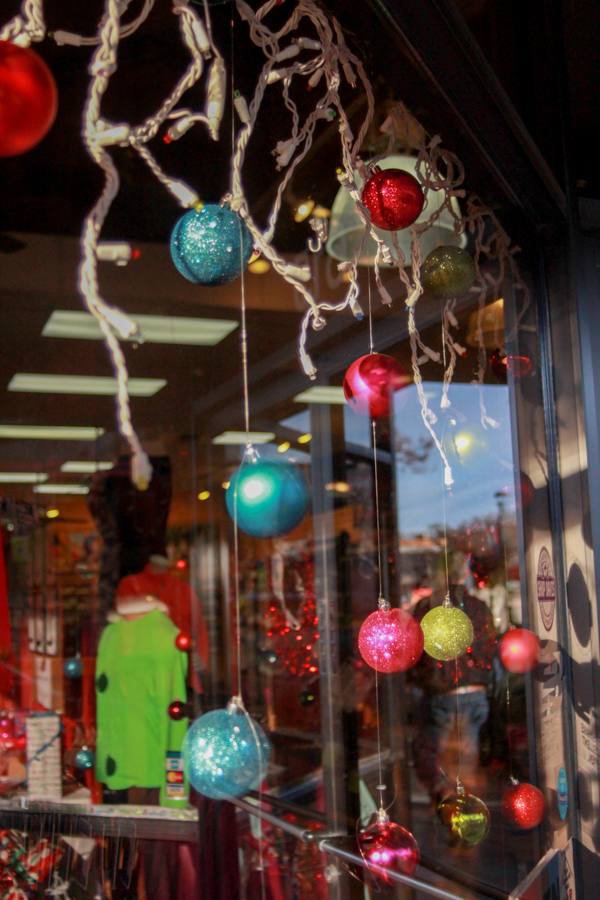
Davis storefronts get a Christmas makeover

ASHLEY LUGO / AGGIE
ASHLEY LUGO / AGGIE

Downtown Davis stores prepare for fourth annual window decorating contest.

The winners of the 4th Annual Davis Downtown Window Decorating Contest, which began on Nov. 27, will be announced during the week of Dec. 13. With 28 downtown stores competing, the competition is heating up for this Davis tradition.

“We have three place winners this year: the first place winner gets $250 in downtown gift cards, the second place winner gets $125 in gift cards and third place is $75. We also have the People’s Choice Award and that’s going to be a $100 reward. The People’s Choice Award is where the general public can go take a look at the windows and vote online for their favorite window. We also have the Director’s award which is $100,” said Stewart Savage, executive director of Davis Downtown Business Association, which runs the competition.

In its four-year history, Savage emphasizes that retailers have been overwhelmingly positive toward the program. A steady stream of around 30 retailers continue to participate year after year, many of whom are repeats.

“We participated last year and the year before. We don’t [know what our design will be yet] but we’re going brainstorm it this afternoon and come up with something, but it will probably be something music related,” said Paul Wilbur, manager at Armadillo Music.
ASHLEY LUGO / AGGIE
ASHLEY LUGO / AGGIE

Though Armadillo Music has never won the competition before, Wilbur highlighted another motivation for embracing this Davis tradition.

“It’s just to get downtown businesses to participate more in the holiday, be a part of what’s going on holiday-wise,” Wilbur said. “There [are] a lot of businesses that don’t get into the holiday spirit, so to speak, and we want all the businesses to participate and be active in making downtown festive for the holiday.”

Newcomers are also welcome in the competition and Christine Blackman, CEO of the Davis Chamber of Commerce, has decided to support their partner organization, Davis Downtown Business Organization, by signing up for the contest.

“As far as I know, this was the first year that we’ve participated. Obviously as a local business organization we do want to focus our community on the importance of shopping locally and what it does for the local economy,” Blackman said. “We focused [our window decoration] on shopping locally. We have kind of a holiday tree, fireplace theme with milk and cookies and essentially the statement of having a holly-jolly holiday while shopping small in Davis.”

With all these participants, enticing more of Davis residents to shop and relax in downtown is a key factor in businesses’ desire to decorate their shop windows. In doing so, they are creating a more festive environment for Christmas shoppers to be taken in by the holiday season.

“What we wanted to do is just bring some life and festivities to Downtown. Festivities make it a more enjoyable place to hang out during the holidays, eat at restaurants [and] shop,” Savage said.

While Davis residents wait for the contest results to be announced, they can look forward to an increasingly holiday spirited Downtown for the winter season.

Written By: JUNO BHARDWAJ-SHAH – city@theaggie.org

Davis announces new police chief

0
ROUSSEAU GlEITSMAN / AGGIE FILE

Officer Darren Pytel will take over for Chief Landy Black in 2016.

On Nov. 18, the Davis Police Department (DPD) announced that Officer Darren Pytel, a long-time veteran of the DPD, will be taking over the position of police chief in 2016. After nine years of leadership, Chief Landy Black is retiring.

Pytel started working as a cadet in Davis in 1983. He has served as a police officer, bike enforcement officer, sergeant, lieutenant, captain and most recently assistant police chief.  Pytel has worked under Black ever since Black was appointed as police chief in 2006.

“Chief Black has been a really good fit for Davis since day one. He is personable and really cares about his community,” Pytel said. “He is a very strong believer in community and intelligence led policing. He is also very collaborative, which has helped tremendously with building strong relationships.”

Pytel also hopes to keep pushing the department in the right direction.

“I’m very excited about the appointment. I have been with the Davis Police Department for 32 years, starting as a police cadet as a teenager and working my way up the ranks to this position,” Pytel said.

Pytel’s appointment to police chief begins a new era of safety for the citizens of Davis as he plans to work with his team to create a stronger, more responsive police department.

“This is a big deal. Racist crimes, and crimes in general [have] increased,” said second-year biochemistry and molecular biology major Lia Lopez. “That doesn’t make me feel safe at all. I hope Chief Pytel continues to ensure the safety of the Davis community.”

Davis resident Hasith Rajakarunanayake also raises concern about the amount of crime he sees in Davis.

“I feel safe in Davis, but for such a small town, I feel like it could be safer,” Rajakarunanayake said. “I hope Chief Pytel can make this happen.”

Pytel also hopes to pick up where Black left off and to continue building a responsive department that has a deep connection with the citizens.

“We receive tremendous community support,” Pytel said. “I want to ensure we continue to build and maintain the trust between the police department and the community we serve.”

Written by: TRISTEN THALHUBER – citynews@theaggie.org

UC Davis obtains largest solar power plant on a U.S. college campus

DANIEL TAK / AGGIE
DANIEL TAK / AGGIE

Plant to provide 14 percent of the university’s electrical needs.

On Nov. 20, UC Davis and renewable energy company SunPower Corporation announced the completion of a 16.3-megawatt solar power plant. The project, which started in fall 2014, will provide 14 percent of the campus’ electrical needs and is the largest solar power plant on a U.S. college campus.

“This is a compelling example of how, with partners such as SunPower, we at UC Davis are reducing our carbon footprint,” said Chancellor Linda P.B. Katehi in a press release. “By taking steps to aggressively reduce our carbon emissions, we can set an example to the nation and the world of what can be achieved when we combine political will with science and innovation.”

The plant is located on a 62-acres of land on the south side of Interstate 80 and is owned and operated by SunPower, who sells the energy to UC Davis. Along with the solar and hydroelectric energy the university already uses, the plant is part of UC Davis’ plan to acquire 60 percent of its energy from renewable and carbon-free sources by 2017.

The installation is part of a commitment by the University of California and UC President Janet Napolitano to reduce carbon emissions to zero by 2025, starting with a plan last year to buy 200,000 megawatt hours of solar energy every year to power the UC campuses.

“As a national leader in sustainability, the University of California is taking on bold, new goals and transforming our approach to procuring and using energy in more sustainable ways,” Napolitano said in a press release.

SunPower installed a power block that tracks the sun throughout the day on a single-axis, increasing energy capture by 25 percent. The system also has a robotic panel with a cleaning capability designed to reduce water use by 75 percent from traditional cleaning methods and possibly improve the system’s performance by 15 percent.

The project is estimated to reduce the campus’ carbon footprint by about nine percent through producing only 33 million kilowatt-hours of electricity every year. In comparison, the campus used 238 million kilowatt-hours of electricity in the 2013-2014 school year alone.

“This SunPower solar power system is generating 14 percent of the campus’ total electricity needs,” said SunPower Senior Manager Bob Redlinger in an email interview. “It is reducing the university’s carbon footprint by an estimated nine percent, which contributes to cleaner air and water and reduces our dependence on carbon-emitting sources of power.”

The completion of the plant signals the second time the university has worked with SunPower to improve its energy efficiency. In 2011, UC Davis partnered with SunPower to develop West Village into a zero-net energy community. UC Davis also produces solar power energy through multiple installations located throughout the campus.

“SunPower’s first project on the UC Davis campus included the design and construction of four megawatts of high-efficiency SunPower technology to power the UC Davis West Village neighborhood, the nation’s largest net-zero community,” said SunPower president Howard Wenger in a press release. “The university’s bold vision to integrate cost-effective, sustainable energy solutions is unparalleled, and is further advanced today by this milestone commitment to build the nation’s largest solar plant to offset electricity demand of a university campus.”

Written by: Amanda Cruz and Ivan Valenzuela – campus@theaggie.org

Preparing for El Niño

ARIEL ROBBINS / AGGIE

UC Davis experts discuss what to expect with El Niño hitting California this year.

Recently, the weather phenomenon “El Niño” has been an intriguing topic of conversation for many people, with talk of the storm hitting California this year. Due to this prediction, the UC Davis Center for Watershed Sciences hosted a discussion panel and information session on Nov. 11 at the Walter A. Buehler Alumni Center to talk about El Niño and any challenges it may pose.

“El Niño is a phenomenon of the mostly equatorial Pacific Ocean atmosphere, characterized, for example, by unusually warm surface water temperatures, and other things, like trade rims across the Pacific,” said Nicholas Pinter, a UC Davis professor in the Earth and Planetary Sciences department. “I think of El Niño as sort of a threshold phenomenon that people look at and [then] measure Pacific water temperature [to] get this El Niño index. They say if it’s more than half a degree above average, that’s an El Niño.”

California is no stranger to El Niño, with a few of its strongest appearances occurring in 1982 to 1983 and 1997 to 1998. According to Pinter, the beginnings of El Niño have already hit California.

“This is a strong one — it is predicted to be one of the strongest three El Niños ever measured,” Pinter said. “It’s not just a prediction, it’s just a matter of what effects it’s going to bring to California.”

El Niño occurs every three to seven years on average, and is particularly strong in southern California. However, this is not to say that northern California will be exempt from heavy rainfall this year.

“The results [are] increased precipitation on the western coast of North and South America, and other important implications depending on where you are,” Pinter said. “The first one we […] recognized [was in] 1982 [and] ‘83. [El Niño] is also associated with effects as far as Africa and Europe. For California, the main concern is increased likelihood of heavy precipitation, rain and snow.”

The El Niño panel featured speakers from a variety of academic, scientific and governmental institutions to discuss worst-case scenario precautions that all Californians should take in wake of the storm. During the panel, many speakers focused on environmental impacts, particularly regarding the ongoing drought in California.

“El Niño has been the great wet hope, in public discussions in the last few months,” said Jay Lund, a professor in the UC Davis Department of Civil and Environmental Engineering. “I’m kind of relieved to see that there’s something big changing in the climate and the sea conditions out in the ocean. Hopefully that will break whatever structure — and it’s a fairly resilient structure  — that’s been giving us this drought.”

El Niño may give many residents hope that this marks an end to the extreme drought that has caused water restrictions in many areas of California. However, at the panel, Lund forewarned that El Niño could still fail to completely remedy the drought.

“I’m glad to see a change, but historically, looking at the history of El Niños, that doesn’t give me a lot of solace,” Lund said. “Even if this year is fairly wet, we still have [a lot] of accumulated reduction and storage, mostly in groundwater. That makes it very likely that we will still have some sort of a drought for the next year unless it’s incredibly wet.”

Alleviating the seriousness of the drought is not the only possible positive outcome that Pinter and his fellow experts have hopes for with regards to El Niño.

“An event like [El Niño] also poses opportunities, and what we’ve learned [from] managing disasters elsewhere is that floods, for example, often catalyze important and positive changes,” Pinter said. “So we […] identify problems that need to be cleaned up to increase long-term resilience to hazards — commonly that’s done after a big disaster. The idea is to marshal the resources, [to] have this discussion beforehand, before the first drops of rainfall [and before] the first disaster occurs.”

Though El Niño is predicted to provide beneficial opportunities for California’s dry climate, there are also various challenges that come with the phenomenon. Not only could the drought still pose a problem afterwards, but Pinter and his experts determined that flooding could be a potential issue as well.

“Intense precipitation and individual watersheds on the American River or any place statewide means we need to be vigilant, particularly on the rivers without big empty reservoirs upstream of them,” Pinter said. “The second thing [I would look at is] this combination of fire followed by El Niño, [which] is a unique and rare combination that causes significant concern in the state.”

The recent Butte and Valley fires could play a dangerous role as well, said Jeffrey Lusk, director of mitigation for the Federal Emergency Management Agency Division.

“Seventeen hundred people lost their primary residence between those two fires,” Lusk said. “The fires do bring opportunities for pre-flood mitigation. Right now we’re trying to stay ahead of the curve, because the fires present us with a situation where we have an opportunity to mitigate and try to prevent a bad situation potentially from becoming much worse.”

The burned areas from the fires could be an issue to the environment due to the potentially dangerous effects if combined with floodwater.

“Some of the areas, including [those] close to Davis, [were] very intensely burned on steep slopes,” Pinter said. “So when you combine those burn areas with one of the largest El Niños ever, that is a frightening combination.”

Regardless of how devastating El Niño turns out to be for California, the experts agree that the most important thing that residents should keep in mind for this season is being prepared.

“[El Nino is] going to happen,” Lusk said. “We have to try and prepare.”


Written by: Allyson Tsuji – features@theaggie.org

UC Davis students hold Black Ribbon Week in memory of victims of terrorism, gun violence

HANNAH WODRICH / AGGIE

Event held in mourning of victims of Paris terrorist attacks, police brutality, Syrian war

From Nov. 30 to Dec. 4, UC Davis will hold Black Ribbon Week on campus in memory of victims of specific events in 2015, including incidents of police brutality, terrorism attacks across the globe and the war in Syria.

Krizzia Manlangit, a fifth-year communication major, organized the five-day event. She shed light on the specific incidents the week is commemorating and why there is a need for this event.

“Black Ribbon Week is a symbol of remembrance or mourning,” Manlangit said. “It is a public display of grief in commemoration of victims after specific events. It is also to raise awareness for non-violence and commemorating those who have been affected and passed on by the events that have happened in the year, [including events] such as the immense mass shootings, Black Lives Matter violence, terrorism attacks in Paris, Lebanon, Beirut, Iraq, the war in Syria, support for the refugee crisis, and the rise of ISIS.”

Joseph Elisha Gray, a fourth-year sociology major, is a close friend of Manlangit. He is planning on a performing a piano cover of an undecided song that falls in line with the worldwide sentiment on the recent unfortunate events. Gray believes an event like Black Ribbon Week is important because the university is in dire need of a safe space for students to take a moment to come together and think about the recent tragedies.

“To my understanding, there is no neutral, safe space where people can express themselves concerning these recent events,” Gray said.  “A space like this would allow people from different racial and socioeconomic backgrounds to come together in unity of their awareness the seriousness of these events. “

Second-year biological sciences major Kiera Clay thinks an event like this is necessary because more students need to be aware of the current situation the world faces.

“Most students live in their own bubble, not aware of or concerned over the fact that many people have died tragically due to terrorism and gun violence,” Clay said. “An event like this is needed to just take a moment and really think about others.”

There are currently no planned events during the week, but Manlangit encourages everyone to wear black on Friday, Dec. 4 and to take a moment of reflection for the week concerning the recent unfortunate events.

Written by: Demi Caceres – campus@theaggie.org

Speaking up about suicide

SURVIVOR DAY / COURTESY

UC Davis clubs host first annual International Survivors of Suicide Loss Day

On Nov. 21, Active Minds, Out of the Darkness and National Alliance on Mental Illness (NAMI) clubs collaborated to host the first-ever International Survivors of Suicide Loss Day (Survivor Day), held from 2 to 4 p.m. in the UC Davis Student Community Center.

According to Briana Megid, co-president of Out Of the Darkness and third-year political science major, this event not only served as the first Survivor Day at UC Davis, but was also the first one ever to be held at a college campus in the United States.

“We went to a Survivor Day event in Sacramento and it was great, but it was super out of touch for people under the age of 40,” Megid said. “There was a huge disconnect in resources, needs and tone. So we decided we wanted to do something following the same mission.”

Survivor Day at UC Davis was created for primarily college-aged individuals; those not in that age-group were advised to attend a different Survivor Day event. The three clubs strived to create a personal space that often isn’t available to students in public university settings.

“We’re all coming from that same angle and it’s definitely something that’s not talked about a lot and a lot of people are uncomfortable with it,” said Savannah Downey, vice president of Out Of the Darkness and third-year environmental planning and policy major. “I like this being only for college students because we want this to be talked about and it is really relevant to college students and it affects our lives greatly.”

The event included activities such as discussion circles, a film made by the American Foundation for Suicide Prevention (AFSP) and a keynote speaker.

“The idea is to have anyone that’s going through something to be able to reflect on that [at this event],” Megid said. “A lot of the time people are just running through life and they don’t get to take care of themselves and their emotions.”

With the event, all three clubs aimed to reduce the stigma surrounding mental illnesses, hoping to raise awareness and educate students and community members about mental health.

“We work with the stigma around mental illness and how we can combat that stigma,” said Alan Castillo, a NAMI ambassador and fourth-year psychology major. “[We want to] increase the conversation and make people comfortable talking about mental illnesses.”

Out of the Darkness works with the AFSP to further that mission through various programs run by the organization.

“[Out of the Darkness wants to be able] to create an atmosphere on campus for people to talk about [suicide and mental illnesses]. We’re trying to be that one group that you can identify with and reach out to,” Megid said. “It’s different from the other clubs that focus on mental health and illnesses because we’re less clinical about it. For us, it’s very personal.”

Although the three clubs have collaborated in the past, Survivor Day was the first event they held together on campus. They hope to continue Survivor Day as an annual event for future generations of UC Davis students.

“[Mental health] might’ve been a topic that was never really talked about [but] it’s always going to be a good time to talk about it,” said Jacklyn Leonardo, NAMI publicity director and third-year cognitive science and neurobiology, physiology and behavior major. “It’s not the first time [we worked together], and it wouldn’t be the last time either.”

Written by: Fatima Siddiqui – features@theaggie.org

Uniting through music and charity

World Touch Experiment at the Mondavi Center. (JAY GELVEZON / AGGIE)

Winter Charity Concert at the International House to include live music, food, spoken word and more

On Dec. 3, Global Citizens will present the Winter Charity Concert at the International House. The concert, hosted by fourth-year biological sciences major Shayan Azizi, will include live music, samples of different cuisines, dancing and spoken word.

Some of the performers will include Rudeboi, Gravy Nation, The Spokes and World Touch Experiment. Proceeds will be going toward three on-campus organizations: Shifa Clinic, Global Water Brigades and Tutors for Inmates.

Shifa Clinic is a student-run clinic that serves uninsured people in the Sacramento area; Global Water Brigades is an organization that seeks to implement clean sustainable water systems in rural Central American communities; and Tutors for Inmates is a club that helps incarcerated individuals plan their future goals once out of prison.

Azizi, the creator and organizer of the Winter Charity Concert, has performed with the World Touch Experiment at TEDx events and at the Nepal Charity show last spring, but has never organized an event such as this. His intention is to display different forms of art for people to enjoy, while also promoting student-run organizations on campus.

“I organized this charity event in order to bring together beautiful art from around the world,” Azizi said. “[I wanted] to spread a message of unity, and to raise funds for campus organizations that have the mission of improving the quality of life for minority populations.”

Bernadette Olivia Fox, a fourth-year international relations major, helped Azizi organize the concert.

“Once we had the idea we just sort of ran with it […] The next day he called and said he had reserved the venue,” Fox said. “After that it was basically calling our friends to organize talent, food, etc.”

Third-year physics major Cathy Chan is excited to attend the event and see the talented performers.

“A lot of people aren’t really aware of the great events the International House hosts,” Chan said. “I think this event will be great for the community and great for the musicians because they get to showcase their talent.”

Maya Lopez, a third-year anthropology major, realizes that there have been many recent issues and incidents here on campus and elsewhere that can cause students to feel isolated and alone.

“There have been so many crazy things going on lately — the Paris attacks, issues with gun violence. It kind of disconnects us from each other because we start to single out people,” Lopez said. “It’s important to have these kinds of events so that we can realize how much we have common with each other.”

Azizi expresses a similar hope that the charity concert will be a source of community and joy for the Davis campus.

“Art is capable of bringing people together and creating peace,” Azizi said.

The Winter Charity Concert will be held at the International House on Dec. 3 at 7 p.m. Tickets will be $10 for students and $7 for veterans. To purchase tickets, please visit the event website. For more information about the concert, please visit the Facebook event page.

WRITTEN BY: Krishan Mithal – arts@theaggie.org

The Ethical Wallet: Ethical future

0

greenburg_opFor many big corporate companies, the use of forced labor, underpaid workers or unhealthy chemicals is an attempt to maximize profits. What if we lived in a world where these types of practices didn’t result in rewards? What if profit only came to those who were patient, worked hard and played fair? We have a ways to go before we reach this dream, but there are some businesses that are already living in the future. Companies like Birkenstock, Eileen Fisher and Ben and Jerry’s Ice Cream have all had financial success while maintaining ethical practices.

If being environmentally and ethically honest isn’t rewarding enough, it’s also possible to achieve great financial success through sustainable business. Ben and Jerry’s Ice Cream is a great example of a successful enterprise that has remained loyal to its original values.

Not only is Ben and Jerry’s Half Baked ice cream delicious, but it also contains brownies sourced straight from Greyston Bakery. Greyston is a B Corp, providing jobs for residents in low-income cities. The company contributes to the many communities it inhabits through grants that allow employees to volunteer where they work. Amazingly enough, they also give back to the environment by advocating for clean energy and petitioning for the Intergovernmental Panel on Climate Change. They even send back the extra dairy waste from their factories to a methane digester which generates biomass energy to power the very farms where they source their dairy. Pretty impressive, right? As great as this is, what if it wasn’t impressive? What if it was the standard?

Eileen Fisher, a women’s clothing company that aims to inspire simplicity, sustainability and design, falls within this ideal future category. They set a great example for other clothing companies struggling to produce their clothes in the United States. Eileen Fisher is honest about the process of their products and shares their sustainability goals for the future with their customers.

Currently, they are working on transferring to a chlorine-free wool because the chlorine used to treat wool leaves behind toxins that have effects on our health as well as the environment. Eileen Fisher’s website also provides an admirable level of transparency concerning its business network and dealings. Imagine if all companies were to eliminate vague language from their terms, conditions and policies and replace them with honest and detailed facts.

Eileen Fisher follows the international standard called SA8000, a certification encouraging organizations to maintain a decent workplace across all industrial sectors. This certification assures customers that the company is in touch with what is really going on at the factories where their products are made. While 97 percent of garments sold in the U.S. are made abroad, 20 percent of Eileen’s clothes are made in New York and Los Angeles. When working with suppliers outside of the U.S., the company maintains Bluesign certification, remaining true to standards ensuring a safe and environmentally friendly production process.

Another great example of financial success through ethical business is Birkenstock. That’s right, Davis, many of you are supporting a sustainable future via the trendy sandals you wear everyday. Birkenstock was one of the first shoe manufacturers to use a majority of water-soluble and solvent-free adhesives in their shoe production. They, too, discuss the ways in which they have reduced heat energy consumption as well as the ways they still hope to improve. On their website, Birkenstock describes the practices necessary to reduce environmental impact and importantly acknowledges that although it’s a difficult process, it is worth the effort.

Honesty and hard work has done well for all of these companies. Just as we value dependability and health in our friendships, we appreciate the same qualities in the brands that supply us with our daily essentials. A few decades back, these companies wouldn’t have had the resources or the information to create such moral organizations. We are now living in a world where more facts about sustainability are available than ever before. We know about the injustices within our factories, the damage to our planet and the harmful chemicals in our foods.

By voting with your dollar in the right places, you can push companies to strive for a more ethical and sustainable future.  Every day, we get closer to a future where ethical consumption is the norm, and every day you get the chance to help build it. There is no longer an excuse for the business world to play these games, unless we give them one. Don’t give them an excuse.

You can contact Martha Greenburg at mzgreenburg@ucdavis.edu or on Twitter @marthazane94.

Rocky reboot, Creed, is a knockout

0
WARNER BROS.
WARNER BROS.

Michael B. Jordan continues to impress with his new performance in Creed.

In the new movie Creed, the young duo of director Ryan Coogler (Fruitvale Station) and up-and-coming actor Michael B. Jordan have been tasked with a tall order: to link the bridge between old and new Rocky fans. Just like in the Rocky movies, the odds are stacked against Coogler and Jordan. The two, however, overcome those odds and continue to make a name for themselves, delivering a refined piece of mainstream cinema that do the original movies justice, while setting a franchise of their own in motion.

Creed follows the life of Adonis “Donny” Johnson (Michael B. Jordan), the son of the late boxing legend and former champion Apollo Creed. As Donny was moved around from foster care to juvenile hall and then to his adopted home, one thing always stayed consistent – his ability to be a fighter. Knowing that boxing is in his blood, Donny quits his job and travels across the country to Philadelphia to seek out his deceased father’s famous rival and friend, Rocky Balboa (Sylvester Stallone). Despite insisting that he is out of the boxing game altogether, Rocky agrees to come out of retirement and train the young boxer after seeing the same tenacity and fight he had once known in Apollo. As word spreads that Rocky is in his corner, Donny lands the biggest fight of his short career and squares off against “Pretty” Ricky Conlan (Tony Bellew), the current title holder. Balancing between training, Rocky’s health and his love life, Donny’s true strength and resolution is tested as he sees if he will indeed live up to his father’s name.

It’s surprising that such a young and rather new director landed the responsibility of continuing and, in a sense, rebranding the famed Rocky franchise. Coogler, however, proves that he is the man for the job. His film has a mix of scenes that both pay homage to the old movies, evoking nostalgia for the older fans, while also creating an intriguing new storyline set to draw in newer moviegoers. Like in Fruitvale Station, Coogler’s Creed covers a specific theme that is both relevant and timely to American culture: the hardships that may come with being a young black male. Coogler masterfully illustrates these hardships through the film’s central character, Donny, as he struggles to step out of the shadow of society’s perceived image of him.

While not all viewers can relate directly to the issues of race that Donny faces, Coogler’s graceful and focused plot development effectively grabs hold of audience’s emotions and connects with fans, developing a sense of empathy for Donny’s struggles. The one major flaw of the movie is that Donny’s love life with Bianca (Tessa Thompson) appear to be a bit forced and unnecessary. But Coogler gets the movie back on track in the final fight scene, which is electrifying due to the dramatic cinematography. As young as he may be, it’s clear that Coogler is the real deal and is capable of throwing a few haymakers of his own.

Creed is yet another steppingstone on Jordan’s path to superstardom. Reunited with Coogler, Jordan is phenomenal once again and it’s clear these two have incredible cinematic chemistry. His consistently spectacular performances will soon place him among the Hollywood elite. Though his tough guy persona as Donny may be off-putting at first, Jordan’s ability to portray his character’s growth, from a young lost fighter to a boxer who’s found purpose, will soon have you falling in love with him. Simply put, Jordan is a knockout. As far as Stallone’s performance goes, I’ve often heard complaints that he is a bad actor. But in Creed, Stallone put his critics to rest with a phenomenal performance that will force even the most skeptical viewers to consider him as a serious actor and more than just an action movie star.

In short, Creed would make any Rocky fan proud. It pays respect to the original franchise but in a subtle enough way that the Rocky legacy does not have an overwhelming sense of control over the film. Its gripping narrative, convincing acting and compelling storyline makes it a winner.

WRITTEN BY: David Park – arts@theaggie.org

Community bonding over a hot cup of chai

0
CHAI CHATS / COURTESY

The Middle Eastern and South Asian Studies studies department fosters community discussions for students.

This year, the Middle Eastern and South Asian Studies (ME/SA) department and the Cross Cultural Center (CCC) at UC Davis created a series of bi-weekly events called the “Chai Chats,” where ME/SA community members can come together to engage in discussions about important issues related to identity and personal experiences.

“[They’re] providing space for reflection and critical dialogue,” said CCC Program Coordinator Kriti Garg. “There really aren’t very many spaces on campus where we can come together with folks and talk about stress, talk about family, talk about our different intersecting identities.”

The first event took place on Oct. 7 and the topic centered around how to get involved in the ME/SA community on campus.

“Because it was more of an introductory [event], we kind of just did an icebreaker to get people to meet one another,” said Abire Sabbagh, fourth-year international relations and ME/SA studies double major and CCC ME/SA Community Week Coordinator. “That just kind of got people moving and talking to people they didn’t know, finding people they had similarities with and also people they had differences with…we talked in small groups and then in big groups and [about] what we got out of those conversations.”

In addition to the icebreaker, the first event was an opportunity to introduce the ME/SA leaders, including the career and student staffs.

“We went around and kind of talked about what ME/SA means to people in general, what would they like to see from ME/SA and what they would they change if they could,” Sabbagh said. “Just to get an idea of where we’re at and how we could move forward better in the future and throughout the year.”

For each event, there are community agreements agreed upon to provide a safe space for the attendees.

“[They are] a list of agreements that we make as a group and that we follow throughout the program just to ensure everyone feels safe and comfortable,” Sabbagh said. “[Also they] ensure that we are all on the same page and how we want this space to feel for everybody.”

According to Sabbagh, as well as being the first of its kind at UC Davis, Chai Chats is an important program for the ME/SA community in the form of “validating” their presence.

“It really validates our presence on campus by giving us a community space to sit down and talk,” Sabbagh said, “[It] allows for people in our community to feel like they have somewhere they can go to and people they can go to.”

According to ME/SA studies major student affairs officer Shyama Kuver, Chai Chats is not akin to a club which requires attendance at meetings. It is a more comfortable and lenient environment where communities come together to talk about various topics.

“It’s significant to have a space that’s just kind of placed for students who can come and go as they please,” Kuver said. “It’s really just an opportunity to reflect and be introspective but also engage in communication and conversation around topics that may seem taboo sometimes for some, that people may not always get to think about.”

Although the events are designed for the ME/SA community, Sabbagh said that anyone and everyone is welcome to attend the Chai Chats.

“We actually really like it when non-MESA folks come because that’s an act of solidarity for us,” Sabbagh said. “Which is something really important for any underrepresented community.”

Sabbagh said that what’s “special” about the events is that they consist of all types of people and UC Davis communities.

“It brings together students, staff, faculty and people from all around campus,” Sabbagh said. “It’s not just students — it’s really a community.”

Since this quarter is the first time the series of chats are being held, Sabbagh said she is looking forward to the remaining Chai Chats to see what discussions may be fostered.

“I feel like we’re starting to go into the more significant and personal conversations and I don’t really know what to expect for that,” Sabbagh said. “I am excited to see what good conversations we can get out of those and how we can all take what we learn from there and use it to grow individually and as a community on campus.”

For future events, Sabbagh and other members of the staff said they would like to have the community suggests topics for Chai Chats.

“I hope that more folks express interesting in wanting to get involved in the planning of the event and maybe come up with topics and ideas that we can build more forums and community spaces around,” Garg said.

There is also interest in creating “Masala Mondays” in winter quarter, where meetings will focus more on the topics of mental health and wellness. On top of this, the ME/SA department encourages those who are interested to attend the Middle Eastern and South Asian Solidarity retreat on Feb. 6 to 7 as well as participate in the Middle Eastern and South Asian Community Week which is takes place throughout the first week of May.

Written by: Jacqueline Chu – features@theaggie.org

UC Davis professor discovers pigeons capable of identifying cancer

SARATH PADARTHI / FLICKR

Professor Richard Levenson makes breakthrough discovery in cancer research.

Richard Levenson, a UC Davis Health System professor of pathology and laboratory, discovered in a study earlier this month that pigeons can be trained to identify cancer in tissue slides and mammograms.

Levenson said that he first thought of using pigeons to detect cancer while on his way to work.

“It was just an idle thought based on something I heard on the radio,” Levenson said.

Soon after, Levenson contacted Edward Wasserman, a professor of psychological and brain sciences at University of Iowa, who designed the pigeon experiments and conducted the research in his Iowa laboratory. Levenson said that the first experiment had immediate success.

“I pulled some images from scanned slides and I separated them into two groups — the non-malignant and the malignant,” Levenson said. “Within a few weeks, the answers came back that the pigeons were naturals at this. It took months and months and months to come up with other experiments and expand.”

Levenson’s team found that the pigeons were able to correctly identify cancer even in more difficult scenarios.

“[The pigeons] were able to perform well on the masses which are much more difficult targets and which were much more difficult targets for humans [too],” said Elizabeth Krupinski, an experimental psychologist at Emory University School of Medicine who also contributed to the research.

Levenson said that it took his team a year to publish the pigeon research findings, and that the information was rejected from three different scientific journals before being published by PLOS ONE.

The research team believes that further research can be conducted based on the results of this experiment.

“As it is hinted in our paper, our next step is to work with both pigeons and computer classifiers,” said Victor Navarro, a member of the research team and second-year graduate student at University of Iowa. “People in the computer science field have made impressive advances in image processing and feature extraction, and we would like to compare the performance of our pigeons with those of their best models. Would computers and pigeons use similar strategies under the same conditions? I’m sure both fields — avian visual cognition and machine learning — would learn a lot from it.”

Wasserman adds that this study has created more questions regarding the pigeons’ ability to correctly detect cancer.

“The biggest unanswered question is, just what are the pigeons looking at in the images that allows them to so accurately report cancerous tissue?” Wasserman said. “That will be a tough nut to crack.”
Written by: Alyssa Vandenberg-campus@theaggie.org

UC Davis launches program studying border, immigration-related issues

DANIEL TAK / AGGIE
DANIEL TAK / AGGIE

University begins offering graduate seminars on human rights, border policing.

On Nov. 13, the Mellon Initiative in Comparative Border Studies held a roundtable conversation entitled “Borders, Rights, and Resistance” at the Student Community Center.

The roundtable, which seeks to educate the community on security and immigration-related topics, is one of the first events to introduce a three-year investigation led by UC Davis professors Sunaina Maira and Robert McKee regarding the study of borders.

The roundtable featured guest speakers from various backgrounds. Speakers presented on behalf of a local, state, national and international perspectives. They also addressed various ideas including the relationship between human rights and borders, different levels of border policing and solidarity toward border-related injustices and experiences.

The discussion served as an introduction to a larger interdisciplinary comparative study funded by the Mellon Research Initiative in conjunction with UC Davis’ Humanities Institute. The initiative’s main goal is to fund a three-year academic investigation on a topic of immediate importance. For the initiative, the topic of Border Studies was chosen as one that needed to be critically investigated.

The investigation is split into three topics for three years. Currently, the investigation is focused on “Human Rights, Citizenship, and Racialized Belonging.” Next year, the study will be focused on “Mobility, Militarization, and Containment.” In the following year , the study will revolve around “Protest Cultures and Transnational Solidarity.”

Currently, there are two graduate seminars being offered under this study. Dr. Maurice Stierl, a Mellon assistant professor hired to help with the investigation, is teaching a seminar titled “Resistance as Method: Social Struggles in a Violent World.” Next quarter, Maira will be teaching a graduate seminar entitled “Human Rights and Protest.”

The investigation is also planning on launching events in the future that are open to everyone. According to Irwin, the study hopes to hold events such as performances at the Mondavi Center, an exhibition at the Shrem Museum of Art and talks regarding the borders present in Yolo county.

For several professors involved in the study, the initiative’s approach is different from border study programs established by other universities. According to Border Studies co-director Robert Irwin,  this study is unlike typical border study initiatives because it seeks to re-examine the notion of borders through the shared experiences of the people affected and the activism it brought about.

“The main goals are to address the question of borders, how it functions, what they mean, particularly what they mean in people’s everyday lives,” Irwin said. “So we’re doing that not from a perspective of government policy rather from the grassroots, from the bottom up […] from the perspective of people’s everyday lives.”

Irwin, who is also a professor in Spanish and Portuguese languages, is utilizing his academic background to help add depth to the study of border and border rights. One of his most recent projects involved  helping an incarcerated immigrant translate their story. Irwin personally hopes that the investigation and analysis these kinds of experiences adds a new level of depth to the study of borders.

“My idea […] is to make visible and give some diffusion to stories like this one,” Irwin said. “[This will] hopefully encourage people to think critically and broadly about borders, immigration, and mobility issues.”

For Stierl, the study goes beyond identifying borders as a physical separation between nations and instead views borders from perspectives both outside and inside borders.

“The importance I think is to rethink borders. In mainstream discourse there is the assumption that the border is like a line made of a fence or a wall,” Stierl said. “[The study] is not saying that these barriers, these physical obstacles, are less significant. They are crucial but we also have to rethink borders in a way that does justice to their diffusion.”

While the seminars offered are for graduate students only, the topic itself is an ongoing issue that anyone can study at any time. For undergraduates who may be interested in the topic, Stierl advises to simply be aware of one’s surroundings.

“The good and bad thing is that borders are not just on the edge of nation-states but they run throughout society. You can see how people are being deported, how people are being taken from certain communities, all these struggles around these issues,” Stierl said. “So if you want to be engaged in [Border Studies], you can just look around you and see the divisions of society and how borders are behind it.”

Visit the study’s website to learn more about upcoming events.

Written by: Katrina Manrique – campus@theaggie.org

University policy regarding AP units limits amount of financial aid given to students

NICKI PADAR / AGGIE
NICKI PADAR / AGGIE

AP units decrease the number of financial aid terms available for students

An existing UC Davis policy regarding AP and transfer units has the potential to limit undergraduate students’ available financial aid.

At UC Davis, students are given a maximum of 18 terms of financial aid, with one quarter counting as one term, and summer sessions each counting as a half of a term. However, the financial aid office counts students’ AP and transfer credits toward their terms completed, and therefore some students have fewer terms available for financial aid.

Clinton Lam, a fourth-year neurobiology, physiology and behavior major and a financial-aid receiving student at UC Davis, was not aware of this policy until he received an email in early November informing him that he only had three terms left of financial aid available.

“[The financial aid office] emailed me when I had 15 out of 18 terms completed, so that came as a surprise,” Lam said. “I was informed in the past that I would be eligible for six years of financial aid, so when I saw that I had only three terms left as a first-quarter fourth-year, I was in shock.”

Lam discovered that his 40 AP credits from high school counted as two of his financial aid terms, and therefore he would be receiving two quarters fewer of financial aid than he had expected.

This realization forced Lam to change his expected graduation date.

“I initially planned to take a full fifth year to complete my double major,” Lam said. “Unless I decide to take out private loans to pay for my tuition, I will no longer be able to complete a double major and I will have to graduate either after summer or after the following fall.”

Although Lam argues that he was unaware of this policy until he received the email informing him of the news, Financial Aid Director Deborah Agee asserts that students are given access to all financial aid policies and must sign a waiver online to show that they understand them prior to receiving the aid.

“To meet federal regulations, students are required to electronically sign their Acknowledgement and Authorization each year in MyAwards to ensure that they are aware of important rights and responsibilities, which include consumer information and Satisfactory Academic Process Standards,” Agee said. “Students can refer to this document at any time by checking their completed requirements in MyAwards.”

According to Agee, it is currently not possible for students to waive off AP units from their transcripts in order to delay the financial aid limit. Students in some college Deans’ offices can waive off AP units so that they do not count towards the 225 unit cap; however, this is different from the financial aid restriction.

Some students find this policy unfair, especially as AP and IB units no longer affect registration pass times.

“[That] was the last tangible benefit of AP and IB units,” ASUCD Senator Alex Lee said. “Now [this financial aid] policy severely punishes students who sought to prepare themselves for higher education.”

Lee adds that this policy prevents students who are dependent on financial aid from graduating with their desired degrees.

“I think it’s terribly unfair to students who need financial aid to complete their education,” Lee said. “Many students seek degrees that require more than the minimum 180 units to graduate, especially those seeking pre-med paths.”

Lam agrees, stating that his AP units have hindered rather than helped him during his time at UC Davis.

“I feel that it is unfair, because not only do AP credits not help me because they no longer affect my pass time, but they now hurt me because I am forced to graduate faster,” Lam said.

In light of the policy change regarding pass times, Agee says that the financial aid office has no plans to modify how AP units affect aid given to students.

Written by: Alyssa Vandenberg-campus@theaggie.org

UC Davis Student Health and Wellness Center provides free produce to students

ANH-TRAM BUI / AGGIE

Center joins The Pantry as another free food resource to students on campus

Through the new Fruit and Veggie Up program, UC Davis students can now receive free fresh produce at the Student Health and Wellness Center by simply showing their university ID cards.

The program, which began this summer, is funded through the Global Food Initiative, a UC-wide effort to help individuals and communities access affordable and nutritious food through sustainable means.

Aria Wexler, a fourth-year clinical nutrition major, works as a food access and nutrition student assistant for Fruit and Veggie Up.

“There’s always a line starting at noon for students to get produce,” Wexter said. “All students can receive fresh produce.”

The program works in collaboration with Nugget Markets, which provides the program with produce that would normally be cleared out. The produce that Fruit and Veggie Up receives is measured in pounds and then evenly distributed to students.

The program is also working on building its nutrition education by teaching students how to cook meals with the fresh produce.

Currently, the Fruit and Veggie Up program receives two shipments per week. The Pantry, an ASUCD unit that also provides free food for students on campus, will be receiving a weekly shipment of produce from Nugget Market beginning next quarter.

The Pantry is a completely student-run organization whose goal is to provide non-perishable food and basic necessities to students. The Pantry opened on Oct. 21, 2011 and helps about 40 to 50 students a day.

Erika Hapa, a fourth-year human development major and the director of The Pantry, explained how there is a real necessity for food resources in Davis.

“The Pantry is a welcoming place where you can come and get food. People shouldn’t be embarrassed of whatever situation they’re in,” Hapa said. “We’re really just trying to address the need on campus because recently we found out one in three students are skipping meals.”

The Pantry uses a point system where any student with a valid UC Davis ID card can receive three points a day. Each item has a designated food point depending on the product. Points can be exchanged for food items and toiletries in Lower Freeborn Hall. Most of the goods in The Pantry are donations from drives that are held every year.

Hungry students can also access CalFresh, a federal program that provides nutrition assistance through monthly benefits. Students who qualify for CalFresh receive up to $194 monthly in order to purchase healthy and nutritious food. The CalFresh program has representatives at both The Pantry and at Fruit and Veggie Up location.

Carlos Bermudez-Ramirez, a CalFresh eligibility expert, explained how important CalFresh is to Davis.

“Students, in general, are considered low income because, for the most part, they’re not working and usually living off [of] financial aid,” Ramirez said. “The county sends me here because we know that in Davis, there is a big need for people to be in this program.”

The Fruit and Veggie Up program is open on Tuesdays from noon to 2 p.m. on the third floor of the Student Health and Wellness Center.

The Pantry is open from Monday through Friday from 10 a.m. to 1 p.m. and Monday through Thursday from 4 to 6 p.m. in Room 21 in Lower Freeborn Hall.

Written by: Jackie Carmaz – campus@theaggie.org

DIY holiday decor for broke college students

ELLIE DIERKING / AGGIE

10 holiday decorations that will impress both your friends and bank account

It can be hard to get into the holiday spirit with finals right around the corner and the quarter’s remaining budget running tight. Just in time to boost you through finals week and into winter break, here are 10 easy and guiltless decorations that won’t empty your wallet.

  1. Bow Wreath

What you’ll need:

-14-inch straw wreath

-Large packet of gift bows

Leave the plastic wrap on the wreath. Simply unpeel each bow and stick them onto the wreath until the surface is completely covered. Use glue if necessary. Unravel the top bow (you’ll want to reinforce this one with glue) and use the loosened ribbon to tie the wreath to your door.

  1. Candy Mint Cones

What you’ll need:

-Styrofoam cone from the Dollar Store

-Red and green swirled mints

-Glue

Here’s a quick way to get rid of those restaurant mints you’ve accumulated in jacket pockets and car cup-holders. Add a dab of glue to each unwrapped mint and stick them around the cone, starting in a line at the bottom and working your way up, alternating colors. This also works with an inverted funnel. Shape a cone from aluminum foil and use the funnel for support inside the cone. Glue the mints to the foil in the same way as above.

  1. Strung Holiday Cards

What you’ll need:

-String

-Holiday Cards

-Hole puncher

If you’re someone who can’t bear throwing away old greeting cards (or don’t know where to put your new ones), here’s a great way to turn them into a holiday decoration. Simply gather together a collection of holiday cards, hole punch the top left corners and thread string through to make a chain of cards. Knot and loop the ends and pushpin the chain over a doorway.

  1. Candy Cane Bowl

What you’ll need:

-Candy Canes

-Long glass bowl from Dollar Store

-Glue

-Ribbon

Take advantage of the candy canes you receive from friends this holiday season! Glue each cane to the outside of the bowl, working around until the surface is covered. Tie a ribbon just beneath the curved surface of the candy canes. If it’s a vase, you can leave it as is or add flowers inside for the full effect!

  1. Layered Vase

What you’ll need:

-Small pinecones

-Red berries

-Glitter

-Evergreen branches

-Vase from Dollar Store

This one is mostly an outside exploration. Prepare your vase by layering pinecones, berries and small branches and leaves inside. Dust glitter throughout to finish.

  1. Holiday Candles

What you’ll need:

-One scented candle from the Dollar Store (cinnamon, vanilla, brown sugar or forest scent)

-A few tea lights

-A few transparent, colored bowls in holiday colors

This is for those who like candles but don’t enjoy too overwhelming of a scent. Set the scented candle in the center of your table. Set up the bowls around the center candle and light the tea lights inside them. Sprinkle some sparkles, if desired.

  1. Decorative Branches in a Vase

What you’ll need:

-A handful of evergreen branches

-White or sparkly spray paint

-Vase from Dollar Store

Collect some branches and spray the ends with white or sparkly spray paint in a well-ventilated area. Lay them separately to dry. When they’re dry, gather them together and stuff them into the vase, painted ends up. Pull the ends so the branches fan out.

  1. Paper Plate Angels

What you’ll need:

-Paper plates

-Scissors

-Tape

Cut from the outside rim of the plate to the center. Fold the plate into a cone shape. Tape the cone shape closed. Make another cone from a second plate and stack it on top. Use two quarters of another plate as wings, and fashion small cones from the remaining material for arms. Cut a circle for the face. Tape all the pieces together to form your angel. If desired, decorate the wings by adding glitter or interestingly shaped hole punches.

  1. Fancy Pine Cones

What you’ll need:

-Pinecones

-Spray paint or glitter

Collect several large pinecones. Spray with gold or silver spray paint, or coat with clear glue and dust on sparkles. When they’re dry, add them to corners of tables and shelves for a subtle holiday feel.

  1. Holiday Jars

What you’ll need:

-Glass jars of any size

-Cotton balls

-Sparkles

-Thread

-Paper

-Glue or tape

Use a leftover pasta sauce jar or pickle jar and peel off the labeling. Add layers of cotton balls and dust with sparkles. Cut small snowflakes from paper and tape to various lengths of thread. Tape the threads to the inside of the jar lid. Screw the lid back on, and you should have dangling snowflakes over your snowy landscape. Coat the outside of the lid with glue and add sparkles around the edge and cotton balls to the top.

Written by: NEHA MANNIKAR – features@theaggie.org