58.4 F
Davis

Davis, California

Tuesday, December 23, 2025
Home Blog Page 324

Why do we do what we do?

College newspapers are more than just breaking news
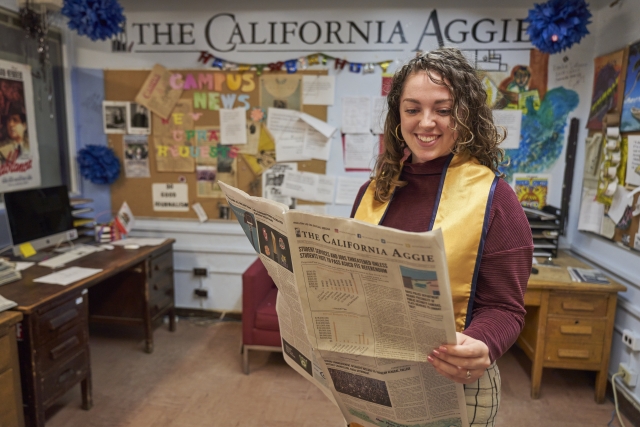
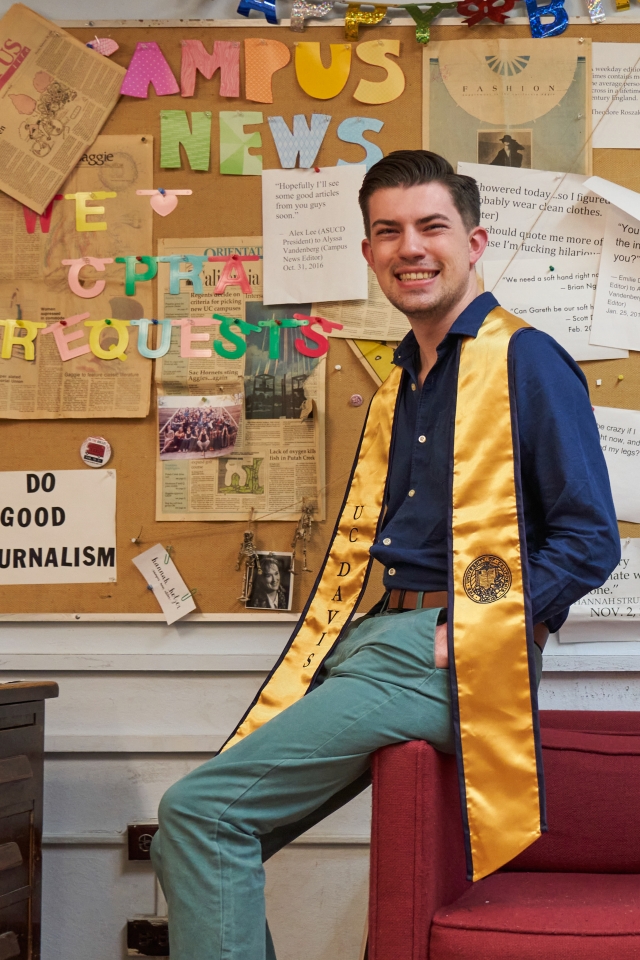
I knew I wanted to be part of The California Aggie before I even set foot on the UC Davis campus. I emailed then editor-in-chief Scott Dresser to ask when they would be hiring over the summer, to which he (graciously) responded that applications would be available in Fall Quarter. I didn’t know what to expect when I walked in for my interview, but I left 25 Lower Freeborn full of excitement and nerves. A few days later, I was a sports reporter — and no matter what Dominic Faria tells you, I was the best sports reporter to ever grace our seismically unsound office. 

Just kidding. 

Two years later, I managed to convince Emily Stack that I was qualified for the arts & culture editor position because I had seen “Phantom Thread” starring Daniel Day-Lewis and “got it.” Serving as the arts & culture editor has been one of the most rewarding experiences of my life. Every day, I had the opportunity to listen to and speak with writers about their different passions — architecture, music (from mainstream to so underground that I don’t even know how to describe it here), overalls and A24.

Because that’s what the arts desk is: an outlet for incredibly creative, eccentric people to explore and develop their interests and ideas, no matter how niche. I’ve edited articles ranging from recreational cocaine use to Earl Sweatshirt to beer die to black-and-white Polish films. The arts desk is unlike any other desk. Our meetings are the largest (and loudest), we all accidentally wear Carhartt on the same day and once, we all bought tickets to Mac DeMarco’s Sacramento concert despite zero coordination.

What does this have to do with my future career, you or my future employer might ask? Almost nothing. I don’t plan on working for Pitchfork (because who could ever work for a company that gave The Strokes’ “The New Abnormal” a score of 5.7?), and I won’t be a hard-hitting New York Times reporter. I won’t move from co-producing Couch Concerts with Caroline Rutten to producing Tiny Desk Concerts for NPR. But that’s what college clubs and organizations are for — four years of exploring your interests and pouring your heart and soul into those interests, just to say goodbye and leave it to the next class of high school graduates who are emailing the editor-in-chief to ask about hiring as I write this. 

I can’t begin to describe how often I was so drained — emotionally and physically — from daily meetings, seemingly never-ending endorsement interviews, early morning distribution and late night editing. 

But I wouldn’t trade any of that for the world. Because for every tense Editorial Board meeting in which we debated our campus’ and country’s most pressing issues and thought critically about how to approach them, there was an editorial that we were all proud to put our names on. And for every late article, there was an article that either brought me to tears or brought on a fit of laughter.

College newspapers are where the next generation of journalists develop their passions for reporting. But it’s also where future doctors, lawyers and academics make life-long friends and learn to care about what’s going on around them. 

Liz Jacobson served as the arts & culture editor from fall 2018 through spring 2020. She joined The California Aggie in fall 2016, where she worked as a sports writer for two years, covering men and women’s basketball, baseball and volleyball. She took a quarter off from working at The Aggie to study abroad in Madrid, Spain during spring 2018. She is graduating with bachelor’s degrees in Spanish and political science-public service. 

This column is a part of our 2020 Senior Issue. The rest of the issue can be found here.
A not-so grand finale

Despite an unceremonious end, this is only the beginning.

Strangely enough, I’ve always loved newspapers. As a kid, I can remember snatching the Los Angeles Times off its newsstand, flipping through the pages and skimming the black and white text for words I recognized. I remember hoarding every magazine I could get my hands on — from teeny bopper tabloids to the weekly Architectural Digest that came in the mail. 

Although I have always been fascinated by journalism and its interminable pursuit of truth, I never understood what it would mean to love a newspaper as much as I now love The California Aggie — to believe in a paper as much as I believe in The Aggie. It’s a publication that stands for so much, has achieved so triumphantly and given so generously to all who are fortunate enough to walk through its basement doors. 

The Aggie taught me to embrace everything I now love about my self — my practicality, steadfastness and tenacity. In tough situations, I learned the importance of seeking out every viewpoint in the room, never leaving a stone unturned. But my four years at The Aggie also taught me to look harder at the parts of myself that demanded I be better. To hold myself accountable and surround myself with colleagues and friends that would push me to my greatest ends. That’s what they call “growth,” I suppose. 

My growth in college can be attributed to many things — lots of different people and places that I’ve encountered throughout my time in this tiny agricultural town. It feels anticlimactic — and not at all how I imagined in my head — to graduate from university like this. I never thought I would say goodbye to people who had become my family and a place that had become my home over something as frivolous as a Zoom call or an Instagram post. This doesn’t seem like the grand finale to a chapter of my life that was most certainly grand in the best way possible. But despite how insignificant it may feel to graduate without the big ceremony and tear-stained goodbyes I imagined, I’ll still remember UC Davis in its vivid technicolor. Purple and pink sunsets, lush greenery, shady trees and twinkly lights — my secret sanctuary. I can’t thank this place enough. 

Thank you to my best friends — for us, I know this is only the beginning. 

Thank you to my housemates — for laughing with me, crying with me and putting up with me. 

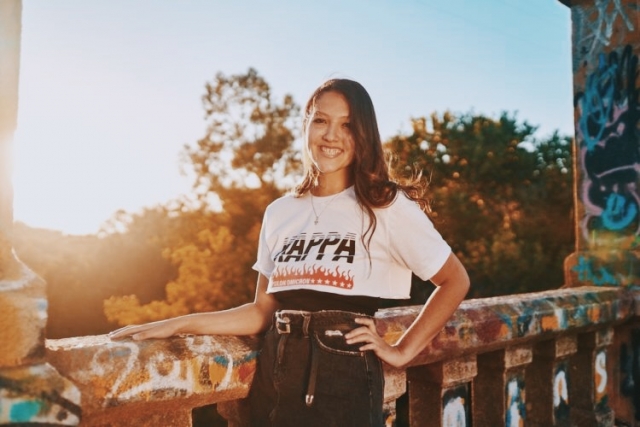
To my sisters in Kappa Kappa Gamma — for seeing something in me when I didn’t see it myself. 

Thank you to my mom for believing in me — for always building me up and never tearing me down. 

And finally, thank you to The Aggie. Thank you to the basement of Freeborn Hall. Thank you to this fearless staff — to the incredible people who make this paper great. 

Thank you for everything. 

Written by: Sydney Odman 

Sydney Odman was the 2019–20 social media manager for The California Aggie. She joined The Aggie in fall 2016 as an arts & culture reporter, where she fostered her love for entertainment journalism. She then joined The Aggie’s managing staff as the new media manager in 2018. She is graduating with a bachelor’s degree in communications and a minor in professional writing. 

This column is a part of our 2020 Senior Issue. The rest of the issue can be foundhere.


And now for something completely different

Taking a moment

The first time I was caught in a bike circle during passing period, I froze. I looked around, caught another person’s tire and crashed. I remember shakily returning to the dorms, washing the blood off my foot in the communal sinks, jumping on my bike and heading back to class. College has been a lot like bike circles. We just have to go forward, trust that others are watching out for us and embrace, with unwarranted confidence, the belief that things are going to be okay. You can’t stop and there’s no time to waver. You just have to go. 

I’ve grown used to the inertia of “go” over the last four years. I’ve worked to perfect the art of roommate chore charts, Fridays at 3rd & U and balancing back-to-back midterms.

When the pandemic hit, all of our lives were brought to a screeching halt. While many of us at the time felt like this was a full stop, I realize now it was an opportunity to pivot.

It’s been an uncomfortable exercise in patience and giving up control — two things that don’t come easy to me — but I think there’s power right now in taking a moment. With pause comes reflection, and with reflection comes potential for change.

Today, I’m pages away from finishing the last chapter of my time as an undergraduate. While I was expecting backyard barbecues, popping champagne with my roommates and a moving commencement speech from Chancellor Gary May himself, what I’ll be getting instead is a much more intimate Zoom graduation and my dad making a speech at a cardboard podium.

When I entered the bike circle again with dried blood still on my foot, I didn’t have time to second-guess. I just had to go. I leaned in toward the chaos and came out unscathed. As I continued on to class, I paused and smiled. It wasn’t much in the long scheme of my college career, but it was enough in that moment. With a grin on my face, I leaned in, pedals moving, pushing ever forward.

Written by: Ally Russell 

Ally Russell has worked as a campus news writer since her freshman year. After joining the campus news desk in winter 2016, Ally has worked continuously at The California Aggie for her entire college career, only taking off one quarter while she studied abroad. Ally is graduating with high honors and bachelor’s degrees in international relations and history with a minor in human rights.

This column is a part of our 2020 Senior Issue. The rest of the issue can be found here.
A change of pace

The value of an idyllic college town filled with resources is unbeatable

Spring Quarter has been filled with remote instruction, working from home, virtual workouts with friends and countless zoom calls to maintain sanity. I am back in my hometown, and to make the most of it, I reconnected with old friends.

During a high school friend’s social distance-compliant birthday celebration, a mix of my old friends, who are seniors at various colleges, and their roommates reflected on our last four years. Suddenly someone asked, “Why are UC Davis students so happy?” and all heads snapped toward me, eager for an explanation.

Everyone had only heard positive experiences from friends who attend Davis. The others were swapping horror stories about their colleges while I felt a sense of pride when I realized they envied the ease and joys of my college town experience.

As I reflected on my years at Davis, I remembered that the biggest lifestyle change was the pace of life. Hailing from Los Angeles and having attended a private high school in the middle of Hollywood, I was accustomed to chaotic 45-minute commutes to and from school, car dinners, friends scattered across the city and driving myself everywhere from the time I turned 16.

My freshman year at Davis felt like a convenient dream, since everything I needed was within walking or biking distance. All of my friends lived within minutes of my dorm, and even when I moved off campus, my furthest friend was just a 10-minute drive away. The close proximity of downtown and the lush Arboretum provided a sense of community and serenity.

While UC Davis is in a small college town, it is packed with resources and bountiful opportunities. Clubs and intramural sports introduced me to a new set of friends. Spanish classes catapulted me across the world to study language and culture and connected me to my first fellow Aggie staff members. Professors were eager to help me learn — they provided me with teaching opportunities and aided my professional growth. 

I challenged myself at the start of college to join at least one new activity or club each year. I was looking for an opportunity to be a graphic designer and was fortunate that The California Aggie was hiring. Remotely creating graphics for The Aggie for the past two years meant that I did not work in person with my Aggie colleagues, but it trained me well for remote classes and work during shelter-in-place. While peers were struggling to adapt to online learning and working from home, The Aggie had prepared me to work online and to be a self-disciplined and independent worker.

I will fondly remember my years at UC Davis for its community and opportunity. Davis surpassed my expectations as a college town, and the university provided a nourishing environment to grow and prepare for the next step. And for that, I am forever grateful.

Written by: Tessa Koga

Tessa Koga joined The California Aggie in fall 2018 as a graphic designer. She is graduating with a bachelor’s degree in design and a minor in history. 

This column is a part of our 2020 Senior Issue. The rest of the issue can be found here.
A note to myself and others

I love my friends so much

I think highly of myself. I am mentally strong. I can handle stress and adversity with grace. I enjoy throwing myself out of my comfort zone. I’m emotional, sometimes to the annoyance of my close friends (you’ll know exactly how I’m feeling). I am not afraid to be vulnerable. I will drop anything to be there for a friend; people are my top priority. I say what is on my mind. I am not afraid to stand up for myself and what I believe in. I am a strong communicator. I love my style of writing. I think I’m really funny. But, at times, I expect much from myself to a debilitating degree. 

I strive toward unattainable perfection. Failure is not an option, and when it inevitably happens, I take it personally. I am competitive, which can make me selfish. I am deeply afraid of being stupid. My emotions take control of me on occasion, even making me doubt the relationships I hold so dearly. My independence makes trusting others difficult, yet I worry I ask too much from others. 

I have spent my college career attempting to figure out who I am. It’s cliché, I know, but continuously discovering this person might be one of my most important tasks. A self compass serves throughout one’s life. It seems like a sense of self is a natural product of four years in this type of environment. College is fast-paced, uncomfortable at times. It’s also so fun (which I realize is a privilege to experience), pulled in various social directions. But this goal of self knowledge, I have learned, is not achieved passively. Active introspection is essential to this feat. 

It should not go unnoticed that people are a significant part of this process. Close relationships with the right people, I’ll add. Friends who you admire, who you learn something from just by being around, who motivate you to be a better person. Friends who feel like warmth, a sigh of relief. It was not until my senior year that l began to feel I had met these people or realized their existing importance in my life. I have not laughed so hard and so frequently until this year.

Andrew, a fellow arts writer, texted in a friend group chat the other day: “Do y’all think we’re a band of misfits? Is that why this friendship works so well?” 

Andrew, to answer your question quite publicly, I think that’s what you’re supposed to feel when you’ve met the right people. A sense of us against the world, devotion and deep care for the people surrounding you. Acceptance of each other without hesitation. 

Liz, Andrew, Ilya, Cole, Jack, Carson, Nick, John, Jake, Emma, Dominic, Alex, Andreas, Jaycee and Kate: You each have no idea how much you have impacted me. You have all helped mold me into the person I am. I hope I have done the same for you. 

Written by: Caroline Rutten

Caroline Rutten was the 2019–20 creative media coordinator, in which she served as the executive producer for the Couch Concert video series she helped initiate her second year. She joined The California Aggie in fall 2016 as an arts & culture writer and has stayed at the desk the entirety of her college career. She served as the associate editor for the arts & culture desk her sophomore and junior years. She is graduating with a bachelor’s degree in sociology with honors. 

This column is a part of our 2020 Senior Issue. The rest of the issue can be foundhere.

The pure cinema of going to UC Davis

An insatiable high

The beauty of going to UC Davis is that it is endlessly cinematic. If you know where to point the camera, you’re going to capture some of the most captivating people and stories, bar none. It’s the former that drives the latter, however, and I was lucky enough to be part of some truly mesmerizing times.

The day I knew that Davis was as vivid as any film — from the chaotic buzz of a Safdie flick to the gentle tenderness of a Godard story — was in the spring of last year. As I biked to campus in the harsh heat, my phone began to buzz, with my ringtone of Bonnie Tyler’s “Total Eclipse of the Heart” quickly intensifying. I scooped my cracked iPhone 6 and answered, still biking. 

“Hello?” I answered. 

“Hey man, it’s us,” the caller replied. 

“What’s up dude?” I quickly responded. 

“Where are you right now?” he asked. “We wanna show you this house we all wanna live in next year.” 

I stopped biking. There wasn’t just one person on the other end of the call, but three —  all guys who I met in the past year, some of my first and closest friends in Davis. All of them were calling to see if I was interested in living with them. There was no prior warning that my friends were looking for a fourth housemate, or even that they were looking for a new place in Davis. To think that they reached out to me, a neurotic Jew who can’t shut up about brutalist architecture, was a shock — in the best way possible, of course. 

After a few minutes, they picked me up and we toured the place. It was incredible. Outdoor garden, a shed, high ceilings and an actual, real kitchen. We were floored. A few weeks passed and… we didn’t get it. The guys were a bit sad about it, but I was glowing. I was thinking about how good it felt not only to be wanted, but to belong. 

I assured them we’d find another place, but even if we didn’t, I wasn’t going to be too down about it. Maybe the real four-bedroom duplex was the friends we made along the way. As I rode back home that day, the sun was setting, Frank Ocean was playing in my earbuds and a breeze picked up. It was an image that felt like pure cinema, an atmosphere that hasn’t left since. 

There’s magic in this cowtown, I tell ya. 

Written by: Ilya Shrayber

A maze worth navigating through

To the place where I finally found myself

I was so excited when I first stepped foot onto the UC Davis campus. Coming from Southern California, I was doe-eyed and ready for an adventure. I felt like I was always searching for something, and I followed my gut in attending UC Davis without knowing how much this campus would impact me. 

Initially, I was lost because I could not fathom how my future would pan out, let alone if I would be able to contribute to the campus in any way. I was simply trying to find myself, and in that unknowingness I kept an open mind. The void I felt then was later filled with a newfound sense of purpose and with love and lasting friendships. But it took time. 

My first year — while fun, with new friends — was also difficult. I was studying subjects that I had no interest in (chemistry and calculus), and I felt like I was trying to become someone who I am not — someone who I envisioned since I was very young. Then came a breaking point when I knew I was unhappy and decided to change course. I knew I could not come out of a maze by pushing through the same, wrong pathway each time. That epiphany to take on a different direction led me to apply to The California Aggie. 

I always found solace in words, particularly in writing. Writing allows me to think through my thoughts and express my voice. I wanted to have a tangible purpose, one outside of academics. The Aggie fit the bill, teaching me how to articulate beyond my own voice. Instead, I could tell stories and uplift others’ voices, which was much more meaningful. I became so much more invested in the Davis community, and I was starting to find my purpose: providing a voice for others. And that was exactly the answer to how I was going to solve this maze. Whichever career I ended up pursuing had to involve advocating for others through the use of words. 

I felt like my life was finally complete. I figured out my passions — what more could I want? Yet studying at UC Davis continued to surprise me. While most of my days involved speed-walking from Olson Hall to Wellman Hall and back down to the basement of Freeborn to meet with writers for The Aggie, looking back now, UC Davis holds my dearest memories. 

This campus is where I met the love of my life, on a bench right outside of the renowned Coffee House (the CoHo). This city is where I would meet up with my closest friends for deep talks at The Old Teahouse, with a side of Ohana’s to go. UC Davis will always have a piece of my heart and soul — I will never forget the place where I finally found myself. 

Written by: Stella Tran

Stella Tran was the 2019–20 city news editor. She joined The California Aggie in spring of 2017 as a reporter for city news. She is graduating with bachelor’s degrees in English and in sociology with an emphasis on law and society. 

What a different world I could have lived in

Narrowly escaping a life in ASUCD, I could never be more grateful that I found myself at The California Aggie

Looking back, I feel like I haven’t made as big of a splash as campus news editors before me. I evaded major controversy, wasn’t in cahoots with anyone in ASUCD and didn’t have to issue any major apologies.

That doesn’t mean I haven’t left my mark. My role with campus news has been more subtle than previous editors’, but I’ve never held back on my commitment to make this campus the best possible. Nonetheless, my quiet role has also let me fly under the radar to such a degree that I sat next to two former ASUCD senators at Rajas while they talked shit about one of my own writers. 

Yes, I eavesdropped, and yes, I gossiped with my fellow editors about it. Oops!

Regarding those senators, something I’ve particularly prided myself upon is my commitment to hold the ASUCD government accountable — sometimes to a slightly hyperattentive degree. The ASUCD Bylaws are, for lack of a better word, a complete shitshow. Yet I pride myself on combing through them, trying to catch the Senate table off guard. 

In Winter Quarter, my attention to detail drew the attention of some senators. When I walked into a meeting and asked an extremely specific question about confirming an Elections Committee Chair, my writer covering the meeting later heard a senator remark, “Who even cares that much about the bylaws?”

Well, I guess I do.

Maybe this habit of mine comes from another life where I’d be applying the bylaws in a different way. After all, during my first quarter at Davis in 2015, I applied to be on the Internal Affairs Commission. Needless to say, I wasn’t hired (I didn’t even get the courtesy of a rejection letter from the person who went on to be ASUCD vice president later that year), and I landed at The California Aggie, a place I’ve called home ever since.

My goal in life has always been to try and make a better world. That includes our small campus community at UC Davis. I thought that being in ASUCD would be a way to do that. Now, I sit back and watch endless infighting, bickering, circular arguments, debates that are not germaine and ad hominem attacks cloud the ability of ASUCD officials to do their jobs and serve the students they chose to represent. 

I’m glad I escaped that world, and I’m glad I landed at The Aggie. And, to quote former Aggie Editor Becky Peterson’s own graduation column, “I’ve had the last [five] years to use The Aggie as my personal agenda-pusher,” so I’ll move onto something else.

These past five years at UC Davis have shaped me in so many ways. Major losses have been accompanied by new companions. I’ve worked hard in many jobs to serve our campus community. I now speak four languages. Y además, nunca escribí nada para este diario en castellano, aunque creo que la ausencia de esa lengua en nuestros reportajes es una gran tristeza. 

So, to end things off, I owe some thank-yous to some very special Aggie staff who have helped me along the way. Thanks, Ritika Iyer, for hiring me in the first place. Jason Pham, Alyssa Vandenberg, Lindsay Floyd, Emilie DeFazio, Bryan Sykes, Hannah Holzer, Liz Jacobson, Janelle Marie Salanga (and more): Thank you all so much for everything you’ve taught me. I would never be who I am without you, and I hope you know that I carry pieces of your spirit with me every time I sit down and start to write.

Written by: Kenton Goldsby — ktgoldsby@ucdavis.edu

Kenton Goldsby, a fifth-year religious studies and Spanish double major with a minor in professional writing, is the outgoing campus news editor for The California Aggie. He took on this position in spring 2019 and served in it until his graduation in spring 2020. Prior to that, Kenton joined The Aggie in spring 2016 as a campus news reporter. He became an associate campus editor in fall 2016 and continued in that role for the remainder of that academic year. Kenton took a year off from working at The Aggie during the 2017–18 academic year while he studied abroad in Barcelona, Spain, donde mejoró su castellano i on va aprendre el català. He returned as an associate campus news editor in fall 2018 and held that role until he became editor in spring 2019.

This column is a part of our 2020 Senior Issue. The rest of the issue can be found here.

On questioning and the quest for nuance

Evolution of nuanced storytelling as informed by mentors, professors, peers and friends

A friend recently told me that nuance is underrated. When I heard that I paused for a moment and reflected on my four years at UC Davis where I have acted, first and foremost, as a storyteller — both in the realm of journalism at The California Aggie and in the realm of literary analysis within the English Department. While the writing I have done in these separate realms are distinctly different in tone and style, I have always been in search of nuance.

This word has come to mean something very different for me over the course of my college career. Whereas four years ago, I might have thought of “nuance” as denoting the representation of a diversity of opinions, I leave UC Davis knowing that not all voices deserve a platform. Nuanced storytelling is not storytelling that treats both sides of the story with equal respect and authority, it is storytelling that actively questions and condemns ideologies rooted in dishonesty or intolerance while upholding voices that seek a more just version of the truth.

As a Jew, the importance of questioning prevailing belief systems was instilled in me at a young age. In addition, my eager consumption of art, films, music, television and literature over the years — and especially in college — informed and evolved my thinking. This has led me to always be questioning. And this mindset has supported the work I’ve done at The Aggie. During the processes for the two multi-part investigative series I completed on the accessibility and availability of mental health resources and on suicide statistics in the UC system, I was always asking questions.

Someone once told me that journalists are paid to be forever curious. And that truly gets to the heart of my immense love for journalism: It is eternal curiosity paired with the civil service of disseminating accessible, truth-backed and nuanced narratives. Yet I certainly did not come to this conclusion on my own. My own beliefs were challenged by my various journalism mentors (namely, Karl Grubaugh, Steve Magagnini, Bryan Sykes, Kenton Goldsby and my editors and colleagues at The Bee). I learned a tremendous amount from my incredible professors (namely, Professors Frances Dolan, Matthew Stratton, Katie Peterson and Jasmine Kitses). And I have been unfailingly supported in all of my endeavors by so many of my family members, friends, amazing colleagues at The Aggie and three wonderful roommates.

Finally, I would be remiss not to give a specific nod to Kaelyn Tuermer-Lee, whom I am tremendously fortunate to have led The Aggie with this past year. Kaelyn: You are the most capable, intelligent and kind person I know. I am tremendously lucky that our paths at The Aggie were virtually the same, and I feel so fortunate to have grown and learned alongside you over these last four years.

Written by: Hannah Holzer

Hannah Holzer was the 2019–20 managing editor. She joined The California Aggie in fall 2016 as a features writer and she was the 2017–19 campus news editor with a brief stint as an opinion columnist in spring 2019. She is graduating with a bachelor’s degree in English and a minor in professional writing.

This column is a part of our 2020 Senior Issue. The rest of the issue can be found here.
How lucky am I to have something that makes saying goodbye so hard

After four years at The California Aggie, I’m still not ready to say goodbye

When I first applied to The California Aggie fall quarter of my freshman year, I was worried I wouldn’t be qualified enough. When I got an email from Ellie Dierking, then-managing editor, saying that I was hired, I was ecstatic.

My first desk meeting went a little like this: I sat down on the old, worn out couches with the seven other people on the city news desk as Sam, the city news editor, told us all to go around in a circle and say our names, years and majors. When I said, “Hi, my name is Kaelyn, I’m a first year and I’m a biological sciences major,” all heads turned toward me as someone immediately responded, “You’re a bio major? What’re you doing here?”

I still laugh when I think back to that day, but the joke’s on them because I switched my major to be even more science-y: neurobiology, physiology and behavior. While being very STEM-oriented, I’ve always had a love for journalism. Journalism holds such power by way of investigation, expression and exposure. It allows a story to be told by giving a voice to those without one. One of the best things about journalism, however, is that although it has adapted and will inevitably continue to change, journalistic integrity and the sole purpose of providing factual and unbiased news remains intact.

I have absolutely loved my four years at UC Davis, and I could not imagine being anywhere other than where I am right now — and a big part of that is because of The Aggie. I have loved every minute of being in our dimly lit, beloved office at 25 Lower Freeborn, whether it was to lay out that week’s print edition for hours on end every Tuesday, attend late-night storyboard meetings or sit through 36 consecutive Senate endorsement interviews (which was honestly grueling, Hannah can attest). I have loved being part of The Aggie family and being part of something bigger than myself, for the sake of both the paper and the greater community.

But what really makes The Aggie feel like my second home is the people. I have loved working with each and every person on staff. I’ve learned so much from them, and I’ve grown so much as a result.

Thank you to Ellie for seeing potential in the small, nervous freshman who wanted to carry over her high school journalism to UC Davis. Thank you to Scott Dresser for being my first editor-in-chief at The Aggie and for providing advice and support even after graduating. Thank you to Bryan Sykes, also an amazing editor-in-chief, for being someone whom I can call at any time and always count on to give me honest advice.

And last, but certainly not least, thank you to Hannah Holzer, my fearless managing editor. Hannah: I admire you to no end, and I’m forever thankful that The Aggie brought us together. Leading The Aggie with you this year has truly been the experience of a lifetime, and I will miss it greatly.

After four amazing years at The Aggie, all I can say is that I hope I’ve given back to The Aggie at least a fraction of what it’s given to me.

Written by: Kaelyn Tuermer-Lee

Kaelyn Tuermer-Lee is The California Aggie’s 2019–20 editor-in-chief. She joined The Aggie in fall of 2016 as a city news reporter before becoming the assistant city news editor the following quarter. In fall of 2017, she assumed the role of city news editor and served in that position for two years before becoming the editor-in-chief her fourth year. She is graduating with a Bachelor of Science in neurobiology, physiology and behavior and a professional writing minor.

This column is a part of our 2020 Senior Issue. The rest of the issue can be found here.
Lee School Prize Competition to reward entrepreneurs for ideas combatting COVID-19 impacts on hospitality, travel, entertainment industries

Highlighting innovation, entrepreneurship during a pandemic

Commercialization of innovation has become more and more relevant with researchers and medical professionals constantly thinking of ways to help the public through the innumerable challenges posed by  COVID-19. In order to award and motivate such efforts, the Doris and Ted Lee Family Foundation developed the Lee School Prize Competition in collaboration with the Lee Business School at the University of Nevada, Las Vegas (UNLV).

“Whenever […] disruption takes place, oftentimes innovation is accelerated because sometimes there’s needs that currently exist as a result of things like this pandemic that didn’t exist just a mere two months ago before the pandemic hit the country,” said Leith Martin, the executive director of the Troesh Center for Entrepreneurship and Innovation at UNLV. 

Aside from established companies, individuals and start-up companies from all fields are welcome to participate in the competition, Martin said. A total of $1 million will be awarded out in multiple investments for innovations that help hospitality, travel and entertainment industries offer their services while still staying safe, according to a press release. The competition opened on May 11 and will accept submissions until July 5.

“We hope that the competition […] provides an opportunity to assist entrepreneurs in moving their products into the marketplace [to] help facilitate the rebound of the hospitality travel, entertainment, food and beverage industry,” Martin said. “At a much greater stance, we hope that the competition allows individuals, organizations, to hopefully come together in such a way that the impact might be greater than just the competition itself.”

Jenna Makus, the associate director at the Institute for Innovation and Entrepreneurship at UC Davis, said that despite drawbacks due to the pandemic, the institute has been figuring out creative ways to keep their programs and curriculum running. 

“We laugh a little bit right now that we’re being forced to be innovative in the same way that we ask all our students and participants,” Makus said. 

Makus explained that their department, which is under the Graduate School of Management, is built around the power of the network and facilitating collaboration. Alumni across the country are able to participate in their programs through online mediums, allowing for the institute’s network to grow through the pandemic.

“One of our taglines that we say a lot is ‘uncommon collaborations is the birthplace of innovation,’” Makus said. “We’re trying to get creative about still allowing those networks to happen even though we’re all in our houses.”

Makus also acknowledged UC Davis for facilitating collaborations across different fields to tackle problems that are affecting people around the world. Makus said she believes that this pandemic has pushed people to recognize inequities and encourage them to take steps to remedy them. For example, she has seen students being understanding of their peers’ limitations in accessing remote resources.

“Recognizing that big diverse teams need to come together to solve world problems, that’s an assumption here,” Makus said. “There are lots of ways that it’s being pushed out in programs and initiatives, so I think that’s great.”

 Written by: Michelle Wong — science@theaggie.org

Davis Black Lives Matter protest draws crowd, despite Facebook controversy

Large group of protesters march to Davis Police Station even though protest was canceled

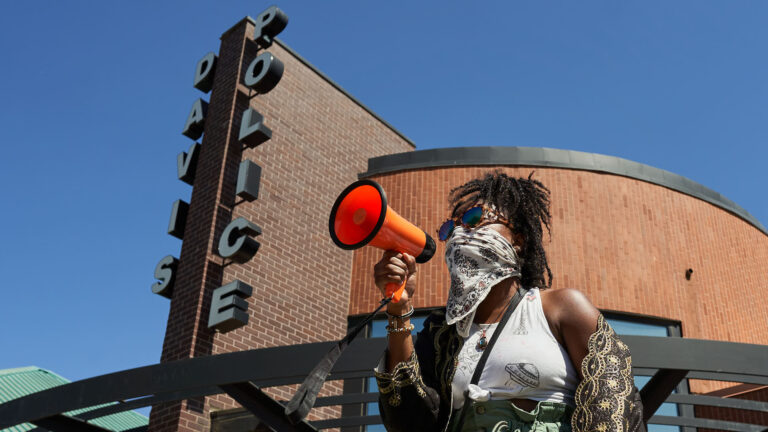
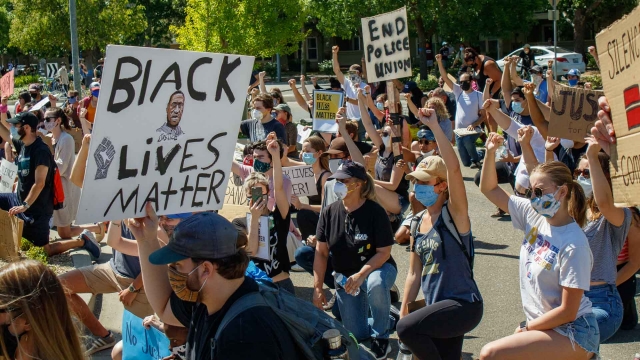
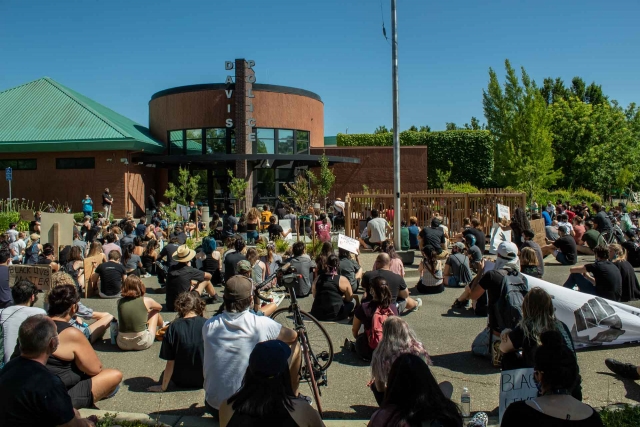
Members of the Davis community marched from the Community Park to the Davis Police Station on Saturday, June 6 in solidarity with Black Lives Matter. Leading up to the protest, however, the protest’s organization was called into question after leader Amber Greigo posted that the Davis Police Department had been notified of the event ahead of time. In addition, Greigo deleted the posts of two Black women, Chelyah Miller and Mariah Smith, on the People in Solidarity with Black Lives Matter Facebook page

Miller, a UC Davis alumna, said she asked Greigo about her organizing experience and about the safety of the protest if police became involved but received few answers. 

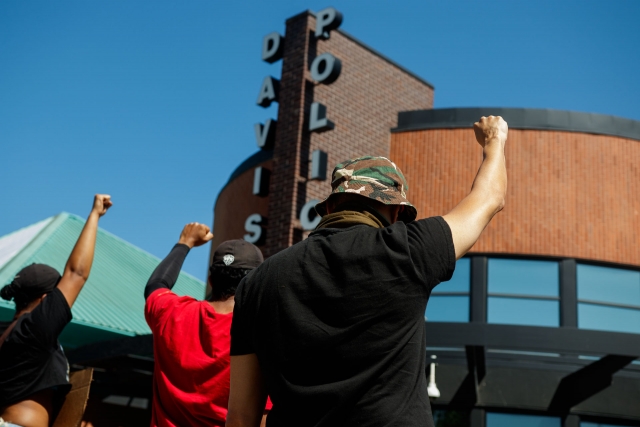
Protestors raise their fist in support of the Black Lives Matter in front of the Davis Police station on Satuday, June 6. (Quinn Spooner / Aggie)

“There was the issue of Amber working with the police,” Miller said. “They would be given information about what was going to happen, and the route that protesters were supposed to walk was posted on Facebook, and there didn’t seem to be a way that Black and Brown people would be safe. And then I asked things about the protest, like what she knew about bail as well as her organizing experience. My questions — at least largely — remained unanswered.” 

Smith, another UC Davis alumna, said Greigo’s lack of information put protesters at risk. 

“One of the main things was Amber’s inability to have an action plan,” Smith said. “If things went wrong, she did not have an idea of if we would be given a misdemeanor or felony. She had no idea where, as protestors, we would be placed if we were detained.”

Protestors raise their fist in support of the Black Live Matter movement in front of the Davis Police station on Satuday, June 6. Benjamin Cheng / Aggie

Both Miller and Smith’s posts were deleted by Greigo. Both attended the Saturday protest in Sacramento instead of this one planned for Davis. 

On Friday night, Greigo posted an apology on the page and an announcement of the protest’s cancellation. 

“I never meant to put anyone in danger but I acknowledge that I made several mistakes,” the post reads. “Also however I may have felt about posts I shouldn’t have removed them period. This a formal announcement that the event will be canceled.”

Despite the cancellation notice, the march still drew a crowd of protesters. Nicole Claiborne, a third-year Ph.D student for neurobiology at UC Davis, is one individual who attended the protest. 

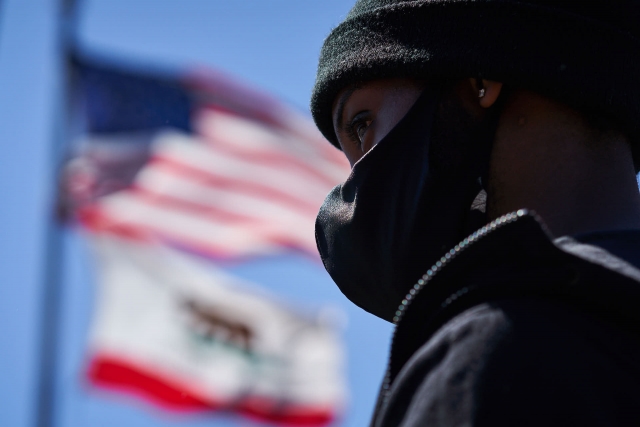
A protestor looks on as the crowd in front of the Davis Police Station holds a moment of silence for George Floyd. (Justin Han / Aggie)

“I didn’t know the protest had been canceled until I had met up with a couple of people to go,” Claiborne said. “I was actually surprised by how many people ended up showing up. I’m not sure if it was because they — like me — weren’t aware it had been canceled, or if they just decided they were going to go regardless.”

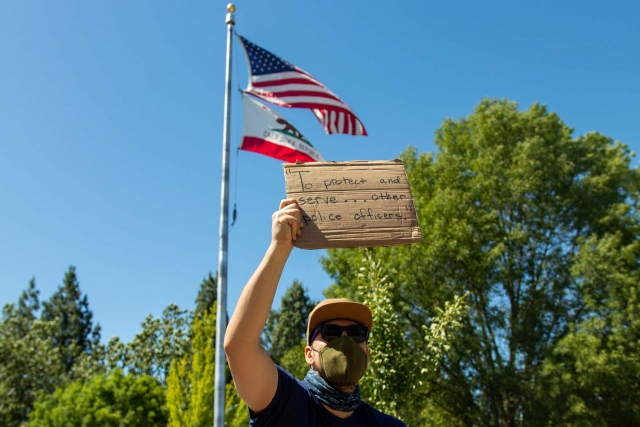
At the protest, people handed out masks, water and snacks. Workers walked out of restaurants, clapping and cheering on the marchers. Protesters chanted “No justice, no peace — no racist police” and carried signs declaring “Racism is a pandemic too” and “Black blood on blue hands.”

Claiborne explained that protests are important because they draw large crowds that show the strength of the movement. 

“Protests visualize support for people,” Claiborne said. “I think protests are important because they are disruptive, and they need to be. It shows numbers, and protesters are disruptive in the right kind of way to drag people out of their comfort — to let them know that you can’t just sit comfortably in a society that hates and hurts other human beings.”

Protestors rally at the Davis Police Station after marching from Community Park to Downtown Davis. on Saturday, June 6. (Quinn Spooner / Aggie)

Protesting is not the only way to support the international responses and actions taking place following the police killing of George Floyd.

“There are definitely a lot of ways to support the movement, and protesting is only one of them,” Miller said. “You can sign petitions, donate to bail funds, help people make snack packs for protesters or buy resources like water, snacks and masks. You don’t have to go to a protest to be involved.”

Protesters walked from the Community Park to the Davis Police Station, where a number of speakers shared their stories and beliefs about how everyone can support Black Lives Matter. 

Although the protest was peaceful, it escalated when a man aggressively walked into the crowd shouting “All lives matter.” Some members of the crowd yelled for him to leave, and he was escorted away by the police.

Claiborne, who spoke at the protest, wanted to share the importance of being actively anti-racist in everyday life and confronting uncomfortable racist ideology. 

A protestor holds up a sign in front of the Davis Police Station on Saturday, June 6. (Benjamin Cheng / Aggie)

“We need to get comfortable with being uncomfortable,” Claiborne said. “Now is the chance for people to finally become aware of acting anti-racist. There’s a lot of work to do, and if we can get more people who are actively anti-racist to work on themselves and become better people, then they can get into positions of leadership and they make change.”

Written by: Eden Winniford – city@theaggie.org

Impact of COVID-19 on tourism in Yolo County

Decline in travel spending, jobs impacted

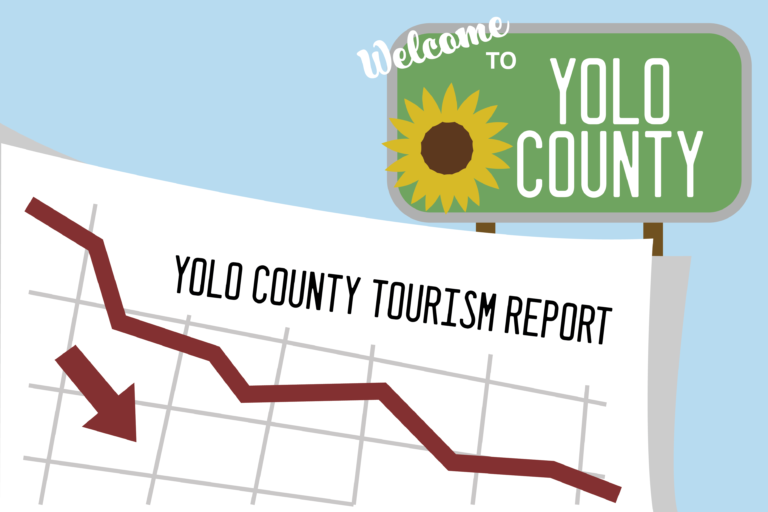
A recent report from Visit California showed the economic impact of tourism from 2010–2019 across various regions of California, including Yolo County. The results from this report, however, do not include the forecasted impact of the COVID-19 pandemic on tourism across Yolo County. 

According to the report, travel spending grew steadily during the past decade, from $324,036,782.26 in 2010 to $454,322,463.11 in 2019. The tourism expenditure helped support 1.18 million jobs across California, according to the report. 

Despite the increased jobs from the increase in travel spending in 2019, the COVID-19 pandemic has already had an impact on numerous industries across California, with millions filing for unemployment across the country. 

Terry Selk, the executive director of Visit Yolo, noted the impact on the tourism industry. 

Many programs and services that residents benefit from are funded by “tourism dollars on every level,” Selk highlighted. 

“Some hotels have had to close indefinitely while others have significantly needed to reduce staffing due to exceptionally low occupancy rates, in the single digits,” Selk said via email. “In Davis, without campus activity, the lodging properties, restaurants and other services frequented by students and their parents have suffered.”

Another report from Tourism Economics forecasted the impact that coronavirus would have on tourism across California. The economic situation could be subject to change though, the report noted. 

The report also highlighted the decline in travel spending compared to prior months. For instance, in April 2020 there was predicted to be a 81% decrease in travel spending compared to April 2019 and a 74% decrease in July 2020 compared to July 2019. 

Additionally, the report predicts the impact on jobs across the state by creating a “mitigated downturn” scenario. In this, “a scenario model was run to assess the potential gains of a more tempered downturn beginning in June, resulting in a net gain of $14.2 billion in visitor spending relative to the baseline scenario,” the report reads. 

This scenario assumes a range of efforts being implemented to help reduce the impact on the tourism industry. According to the mitigated downturn scenario, there will be a $57.9 billion decrease in tourism revenue, compared to the baseline $72.1 billion decrease. 

Furthermore, if more measures are implemented to help promote tourism, the number of travel related jobs affected will decrease. 

For example, in June 2020, there are predicted to be 608,000 “travel-related jobs” affected by COVID-19 and 363,000 in October 2020. Nevertheless, with the mitigated downturn scenario, 537,000 will be affected in June and 199,000 in October. 

Even after the pandemic is over, some businesses will not be able to recover, according to Selk.

“Many of the smaller businesses who have had to shut their doors may never be able to recover from the economic impact,” Selk said via email. “Some operations with small square footage may not be able to generate enough volume of business to be profitable. Restaurants run on very small margins and rely on the ability to serve many customers over the course of a day to be able to make payroll, rent and other necessary operating expenses.”

Businesses such as hotels may also continue to be affected, as they are dependent, to a certain extent, on a group or corporate business, according to Selk. Restrictions on gathering sizes will affect events, which create higher occupancy in establishments such as boutique hotels and vacation rental properties across the county.

“The normal of the future will likely not be the normal we knew,” Selk said via email. “Travel sentiment and trip decisions will be greatly influenced by many factors taken for granted previously such as clean and sanitized hotel rooms, social distancing spacing.”

On April 9, 2020, the California Travel Industry Coalition addressed a letter to Gov. Gavin Newsom with suggested measures to help support the travel and tourism industry. 

“As you continue to make critical decisions to prepare California for the peak of COVID-19 and ensure that we are able to meet this moment, we urge you to not lose sight of the economic hardships businesses are facing, especially those in the travel and tourism industry,” the letter read. 

There could be an increase in demand for travel, according to Selk.

“Indicators reveal that there is pent up demand for travel but execution will return in waves starting with local and regional, followed by longer haul US and then international,” Selk said via email. “Yolo County is positioned ideally for the first wave as it possesses many of the current aspects of which travelers will seek – wide open spaces, fresh air, low city congestion.”

According to the letter from the California Travel Industry Coalition, one such way to help communities who have been affected by “the potential loss of the Transient Occupancy Tax revenue base” is a “one-time emergency stimulus fund.”

Selk noted that the general public can help support tourism during this time by supporting local businesses and welcoming those who are visiting Yolo County from other areas. 

“When it is appropriate for travelers to cross county borders, invite your friends and family to come experience YOUR Yolo County, showing off what makes this a special place to live, work and play,” Selk said via email. 

Written by: Shraddha Jhingan — city@theaggie.org

UC Davis Children’s Hospital researches COVID-19-related syndrome in children

200 children in Europe, U.S. diagnosed with COVID-related inflammatory syndrome

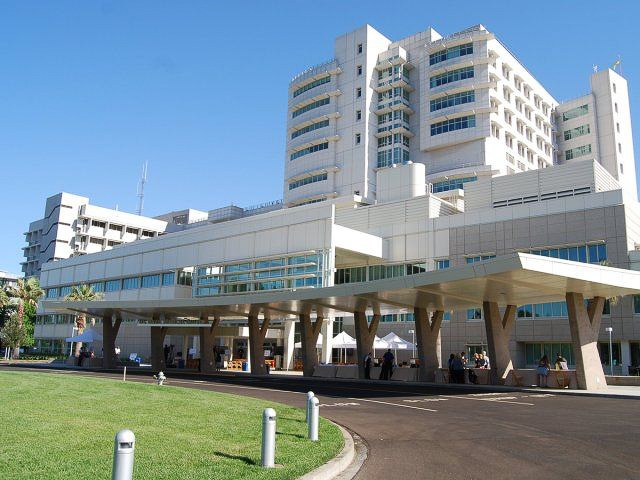
UC Davis Children’s Hospital, part of the Pediatric Emergency Research Networks (PERN), is helping conduct a global study regarding COVID-19 in children. The Children’s Hospital has thus far seen very few cases of the coronavirus in children, and none have exhibited symptoms associated with a newly reported syndrome that COVID-19 causes in children, which has affected about 200 children in the U.S. and Europe. 

This syndrome has been identified as Multisystem Inflammatory Syndrome (MIS-C) and is characterized by fever, multiorgan problems and inflammation. These symptoms can occur well after a child is infected with COVID-19 and, as with the typical version of coronavirus, patients may not even be aware that they are infected. 

Coronavirus usually targets the lungs in adults and older children, causing respiratory problems. MIS-C, however, causes inflammation. In the worst case scenario, this can lead to a heart attack, according to Nathan Kuppermann, professor and chair of emergency medicine at UC Davis. 

MIS-C presents similarly to Kawasaki disease, although it may affect the heart more severely than Kawasaki typically does. For example, it can cause myocarditis — abnormal heart rhythms — according to an article in UC Davis Health News.  

Still, children make up just 1–2% of reported COVID-19 cases as of May 2020, according to Web-MD. CDC guidelines for avoiding MIS-C match those for avoiding coronavirus in general. 

The CDC currently recommends that children over the age of two wear face masks. It also advises social distancing, hand washing, disinfecting “high-touch” spaces and avoiding both sick people and playing with other children. 

It also suggests taking “extra precautions” if the child occupies a household with another individual deemed at a greater risk for the virus.

“With limited information about risk factors, treatments and outcomes, the CDC has asked providers like UC Davis Health to closely watch for suspected cases,” UC Davis Health said. 

Written by: Rebecca Bihn-Wallace — campus@theaggie.org

A previous version of this article spelled Nathan Kuppermann’s last name incorrectly. The article has been updated to correct this.

Humor: Gary May cancels his D&D campaign during COVID-19

“All of us are making sacrifices, guys”

Chancellor Gary May sits in his office at the top of Mrak Hall. He stands next to his window and looks across the courtyard leading to Shields Library. He rubs his forehead and talks into his phone. He is on a conference call.

“We’ve been putting it off for so long, everyone,” May says. “I think it’s time to call it quits.”

“Please, Gary, reconsider,” begs a woman on the other end of the line. “People’s ways of life are at stake here.”

No,” he asserts. “We haven’t met in weeks because of the virus. And our campaign is losing momentum… Guys, I’m calling off our D&D game,” he declares.

The conference call erupts with a chorus of voices. Some are panicked, others are angry.

“Be reasonable, guys — I don’t even remember my character anymore.” May throws his hands up in frustration.

“That’s not true! You were a Dwarf Sorcerer named Garrus Maerun!” calls out Professor Edward (William) Tavernetti. “How could you forget it? ‘Garrus Maerun.’ That’s just your name.”

“He was a throwaway character,” May insists. “Look guys, this campaign means the world to me. I just don’t see any way we can meet with all the COVID stuff going on. It’s time to stop kidding ourselves.

“We could always try doing it over Skype…”
May punches the wall in his office. “YOU KNOW THAT’S NOT THE SAME.” He is breathing heavily. The phone call is silent. Over the phone, a gentle sobbing can be heard.

“I…oh god, Enderle, I…” May starts.

“Now you’ve done it,” scoffs Provost Ralph J. Hexter. “You made Enderle cry.”

May stands speechless at his window. One by one, members of the conference call hang up. His mouth hangs open and then stiffens shut. When the last of them leave the call, he stares into his reflection for a long time.

May sits down at his desk and loosens his tie. He picks up a framed picture next to his desktop. In the frame, UC Davis staff and professors sit around a dinner table in costumes as their D&D characters. Professor Bryan Enderle wears elf ears and holds a gnarled wizard’s staff. Across the table, Linda Katehi mimes a casting of “magic missile” at him. May sits at the head of the table dressed as cleric. The picture is dated 1991.

May sinks into his chair and sighs deeply. “What do I do?” he thinks to himself. He exhales and opens up his Gmail account. “Maybe if I write an email about it I’ll feel better.”

Written by: Matthew Simons — mrsimons@ucdavis.edu

(This article is humor and/or satire, and its content is purely fictional. The story and the names of “sources” are fictionalized.)