48.5 F
Davis

Davis, California

Friday, December 26, 2025
Home Blog Page 381

Sarah Dessen’s Twitter meltdown sheds light on a larger issue

Art should invite response, both positive and negative

I’m not an avid reader of young adult literature anymore, but reading YA was a rite of passage for my friends and me, especially the YA books of Sarah Dessen. By the time we left high school, we read just about every book that Dessen had written up to that point. I loved her books because they were sweet stories featuring complex themes and relationships that made great and enjoyable reads.

Dessen slowly began to fall off my radar over the past year as my interest began to shift to other authors and books. But last month, she caught my attention again for the weirdest and most unexpected reason: a Twitter spat with a Northern State University alumna.

Brooke Nelson, a 2017 graduate of Northern State University, became involved with her campus’ Common Read program in her third year of college. Every year, a committee of students and community members chooses a book for first-year students to read together. During Nelson’s third year, the book chosen for the Common Read was “Just Mercy,” a powerful book about America’s justice system written by lawyer Bryan Stevenson. 

The Twitter drama began when Dessen somehow came across an article in the Aberdeen News, in which Nelson recalled her opposition to adding Dessen’s novels to the Common Read program.

“She’s fine for teen girls,” Nelson said in an interview with the Aberdeen News. “But definitely not up to the level of Common Read. So I became involved simply so I could stop them from ever choosing Sarah Dessen.”

An upset Dessen went on the defensive and shared this article on Twitter.

“Authors are real people,” Dessen said in a since-deleted tweet. “We put our heart and soul into the stories we write often because it is literally how we survive in this world. I’m having a really hard time right now and this is just mean and cruel. I hope it made you feel good.”

Even though I don’t read Dessen’s books anymore, I still believe there’s immense value in the kind of stories that YA authors like Dessen share with their young, often female, readers. It’s understandable that as an author and storyteller, Dessen could have been hurt by Nelson’s criticism. But that’s what happens when you write — there are people who connect and fall in love with your stories and others who hold more critical, but equally valid, opinions of your work. The intent of publicizing one’s artistic work should be to elicit a response, whether it be positive or negative. Art is meaningless if its audience is indifferent toward it. 

I was shocked to see the reaction on social media by other authors whom I love and admire. Writers and novelists such as Jodi Picoult and Roxanne Gay tweeted their support for Dessen. But these tweets, most of which are now deleted, had either completely missed the point or had taken a disturbing turn.

I understand that some of these writers might have been concerned with the wider issue of how YA novels receive undue criticism. But their responses also took a very different turn from what Nelson might have originally meant — Picoult didn’t see Nelson’s criticism as a strongly formulated opinion as much as she saw it as a contributor “to gender discrimination in publishing.” 

“To not speak up about this incident isn’t just demeaning to Sarah,” Picoult tweeted. “It’s demeaning to women, period.”

Picoult’s response was disappointing to say the least, but it was more disappointing that other popular authors such as Siobhan Vivian went so far as to use profane language in disapproval of Nelson’s quote.

This felt like some sort of parallel universe where things made no sense to me. Dessen and these other authors’ conduct on Twitter was disturbing. I couldn’t wrap my mind around how authors — whom I respect and admire — could use social media in such a destructive manner in order to shame a college student for expressing her opinion. This entire debacle would not have escalated in the way it did without Twitter. 

When Nelson talked about her involvement in the Common Read program with the Aberdeen News, she was simply sharing her opinion on including Dessen’s novels in the program. It’s clear that Nelson is thoughtful and critical of the content she consumes. She’s the kind of reader who should be celebrated and praised, not shunned. How Dessen and other authors responded on Twitter wasn’t just wrong, but irresponsible. As writers with large followings, they’re supposed to be able to take, and even understand, the criticism that comes their way. Instead, Dessen decided to take the matter to Twitter and create a mess out of a misconstrued quote. 

It’s understandable that these female authors probably felt the need to defend a genre of writing that is subject to baseless, misogynistic criticism. But as important of a conversation as this is, it wasn’t one that belonged on Twitter. 

As disappointing as their reactions were, I can’t say that I’m inclined to boycott these authors or their books. It’s important that Dessen and others understand the impact and the gravity of their social media interactions. But it’s equally important that we, as a society, understand that individuals should be allowed to share their thoughts and ideas without being rebuked for holding unpopular opinions. 

Written by: Simran Kalkat –– skkalkat@ucdavis.edu

UC Davis professors working to improve the early diagnosis and detection of Alzheimer’s awarded grants

California Department of Public Health awards grants to two research teams focused on studying Alzheimer’s disease

Worldwide, 44 million people have Alzheimer’s disease, with 5.5 million of them living in the U.S, according to Alzheimers News Today. Women make up two-thirds of Americans with Alzheimer’s disease. In comparison to white individuals, African-Americans are about twice as likely and Hispanic individuals are about 1.5 times as likely to have Alzheimer’s disease or other forms of dementia.

Since Alzheimer’s is the sixth-leading cause of death in the U.S., researchers recognize the importance of understanding this disease. UC Davis joins the scientific quest to make research more inclusive, as UC Davis professors Brittany Dugger and Angela Zivkovic work to improve the early diagnosis and detection of Alzheimer’s disease in women and communities of color. The California Department of Public Health (CDPH) Chronic Disease Control Branch awarded two grants to their separate research endeavors. 

Dementia encapsulates a variety of symptoms that affect mental cognitive tasks, such as memory and reasoning. Dementia can occur due to a variety of conditions, with the most common being Alzheimer’s disease, according to Healthline.com.

Dugger, an assistant professor of pathology and laboratory medicine at UC Davis Health, leads a three-year study across several UC campuses that aims to enhance and develop machine learning approaches for detecting and diagnosing dementia. These computer systems will store images of brains and contain programs for detecting and quantifying blood vessel abnormalities in brain tissues associated with dementia. 

By studying the brains of deceased individuals with Alzheimer’s, researchers can understand how the amount, location and presence or absence of certain proteins and pathologies within the brain affect a person’s symptoms during their life, Dugger said. 

“We understand how certain brains are similar and different,” Dugger said. “By understanding how this heterogeneity can aid in precision medicine approaches, [doctors can get] the right treatment to the right patient at the right time.”

Another main goal of the research team is to investigate how these blood vessel abnormalities and how symptoms differ between genders, races and backgrounds, Dugger said. The $1,726,383 project includes colleagues at other UC campuses, including UC San Francisco, UC Irvine and UC Los Angeles. By combining brain samples from these universities, researchers can study a more diverse data set, including brains from African-Americans and individuals of Hispanic heritage. 

“We tried to divide and conquer,” Dugger said. “If we want individualized precision medicine, we need to study diverse cohorts. Many studies can be biased as they may only have subjects from select sociodemographic and ethno-racial groups.”

Another main goal of the research is to understand how the blood vessel abnormalities may relate to other diseases in patients, such as diabetes and hypertension, Dugger said. 

“We can use our data to relate to clinical findings, providing more in-depth analysis of diseases which can then lead to better treatments for all individuals,” Dugger said. 

The CDPH also awarded a separate grant of $277,921 to a one-year study led by Zivkovic, an assistant professor of nutrition in the college of agricultural and environmental sciences. This study aims to find new ways to detect and treat Alzheimer’s disease.

Zivkovic studies the evolution of dementia across disease stages through a liquid biopsy-guided strategy, meaning studying blood samples, to boost the development of specific prevention therapies for Alzheimer’s. Her study specifically looks at whether Vitamin D plays a role in the development and cognitive function of Alzheimer’s disease in patients. 

The liquid biopsy approach allows scientists to study inaccessible tissues and organs that you can not take samples of, like the brain. This technique involves blocking samples in the bloodstream, drawing blood, and then studying the sample to retrieve information about the inaccessible tissue or organ. 

“Most people are familiar with and are pretty okay with getting their blood drawn,” Zivkovic said. “We are working with that and trying to better assess what is going on in a different part of the body just by sampling the blood.”

Zivkovic is also studying how high-density lipoprotein (HDL) particles relate to Alzheimer’s disease. HDL particles are responsible for transporting lipid (fat) molecules around the body. Zivkovic’s team isolates HDL particles and studies how well they can transport extra cholesterol away from blood, which may have an impact on Alzheimer’s disease. 

“It will tell us more about Alzheimer’s patients and we can see whether the way their proteins are decorated what is going wrong in the process,” Zivkovic said.

Due to budget and timing constraints, Zivkovic said the scope of the project is smaller than proposed. The study will only look at the baseline values of cognition and Vitamin D status of a subset of 180 subjects both with and without Alzheimer’s disease.

“It is difficult to fund these projects,” Zivkovic said. “We will not be able to answer all of the questions. We are not funded to look at how specific functions would improve cognitive function.”

Like Dugger’s study, Zivkowic’s research works towards creating precision medicine by recruiting over 50% of their data cohort from minorities and women, two groups underrepresented in medical research.

“I am excited the California Department of Public Health is investing in research on women and underrepresented monitories and understand what is going on,” Zivkovic said. “Treatment approaches will be different depending on who you are, and I am happy to be a part of the process.”

During the 2019-20 fiscal year, CDPH awarded six other grants to UC researchers across campuses, according to a UC Davis Health press release. Their studies focus on disease prevention, caregiving, long term services and support systems for populations suffering from health disparities. 

As one of the only 31 research centers designated by the National Institute of Health’s National Institute on Aging, UC Davis’s Alzheimer’s Disease Center provides vital research towards improving diagnoses, treatments and preventions for this wide spread disease. 

“I am humbled and honored to spearhead such an extraordinary project alongside so many leaders in the field,” Dugger said. “We thank the people of California for supporting dementia research to alleviate the burdens of these devastating diseases for all individuals.”

Written by: Margo Rosenbaum — science@theaggie.org

LSU, Clemson poised to deliver electric title game

0

College football national championship caps memorable season

After a four-month marathon, the college football season has finally reached its closing act. Fourteen weeks of regular season action, 10 conference championship games and 40 bowl games have come and gone, producing another memorable fall for universities across America. 

But the annual College Football Playoff semi-finals have not always lived up to the hype in their six-year existence, as fans have yet to enjoy a year where both playoff games are competitive. Each year the semi-finals produce either a blowout and a thriller, or two snooze fests. Fortunately, 2019 gave us the former, with top-ranked LSU demolishing Oklahoma in the Peach Bowl and Clemson slipping past Ohio State in a captivating Fiesta Bowl. 

These results have set up a dream matchup in Monday’s national championship game, pitting Tigers against Tigers in what promises to be a fascinating showdown at the Superdome in New Orleans, LA. 

The similarities between Clemson and LSU go far beyond their names. Both teams come into the championship game sporting undefeated records and looking to complete a rare 15-0 season, something only accomplished once in FBS history by Clemson last January. 

Clemson is the more experienced team, appearing in the CFP for the fifth straight year and riding a 29-game winning streak overall. They are gunning for their third national championship in four seasons, while LSU looks to hoist the trophy for the first time since 2007. 

Both teams nickname their home venues “Death Valley”, which seems appropriate considering the nightmares endured by every opponent who ventured into these hostile environments throughout the fall. 

On each sideline, there will be a superstar quarterback destined for fame at the next level, regardless of what happens on Monday night. LSU’s Joe Burrow, the Heisman trophy winner, is a heavy favorite to be selected No. 1 overall in April’s NFL Draft and Trevor Lawrence is almost a lock to receive the same treatment if he departs for the pro’s as expected in 2021. 

Both programs are led by vocal head coaches whose interviews and press conferences have become appointment television. LSU head coach Ed Orgeron has captured the hearts of many fans across the nation with his heavy cajun accent, signature catchphrases and Louisiana pride. 

On the flip side, Dabo Swinney always brings pure honesty and passion but has now comically adopted an underdog mindset for his program this season, due to its supposed lack of credibility playing in the relatively weaker ACC conference. Swinney has often joked that his team could ill afford a single mistake because the CFP selection committee was trying to find reasons to keep them out of the final four. 

This time, Swinney actually has a valid point as LSU is currently a 5.5-point favorite in most sportsbooks around the country. But Clemson has typically thrived in the underdog role, winning six of its eight postseason games in the CFP era despite being favored just twice. 

Behind the scenes, there is no shortage of headliners on each team’s coaching staff. Both programs have invested heavily to acquire some of the top coordinators and assistant coaches in the sport. 

LSU has the luxury of leaning on defensive coordinator Dave Aranda, the highest-paid assistant coach in the country. Additionally, the arrival of passing game coordinator Joe Brady from the New Orleans Saints completely changed the entire LSU offense, as Brady implemented a modern spread scheme that has taken full advantage of Burrow’s skillset. 

Meanwhile, Clemson enjoys the services of defensive coordinator Brent Venables, the second highest-paid assistant coach and a popular name in many head coaching searches each offseason. Under his watch, the Tigers have been one of stingiest defenses on a yearly basis and continually churned out top NFL draft picks. 

With a historically long 15-day gap before the championship game, both coaching staffs will have more than enough time to correct previous mistakes and craft sophisticated gameplans with some unpredictable wrinkles. 

Nonetheless, it’s hard to imagine this game being a low-scoring affair or defensive slugfest. LSU has been held under 36 points only one time all season, and Clemson has scored at least 38 in all but one game since October. 

Burrow has shattered numerous passing records all season long, throwing for over 5,000 yards and 55 touchdowns, making him the obvious choice for the Heisman Trophy. The Ohio native took his game to a completely new level in the 63-28 demolition of Oklahoma in the Peach Bowl, throwing for seven touchdowns in the first half.

Burrow has a litany of supremely talented weapons at his disposal, including wide receivers Ja’Marr Chase, Justin Jefferson and Terrace Marshall Jr., tight end Thaddeus Moss and running back Clyde Edwards-Helaire. The wide receiver trio have combined for over 3,600 yards and 48 touchdowns.

Defensively, LSU had its fair share of struggles for most of the season but has turned a corner as of late, surrendering only 45 points in the last three games. The unit is getting healthy at the right time and will carry over lots of confidence from the semi final performance. 

After receiving the benefit of the doubt from the playoff selection committee for the second year in a row, many fans were upset at Oklahoma’s humiliating result. The reality is that the Sooners were simply the victim of an unstoppable LSU force that would have likely destroyed any one of the other playoff contenders in the same situation. 

For the first time since a narrow 21-20 win over North Carolina in September, Clemson had to play a close game and overcome adversity in the 29-23 semi final triumph over Ohio State. The Tigers fell into an early 16-0 hole but were able to stay within striking distance thanks to some key defensive stops in the red zone, which forced Ohio State to settle for three field goals. After a slow start, Lawrence and the offense eventually found its groove shortly before halftime and made the Buckeyes pay on several chunk plays. 

Lawrence found success outside of the pocket and utilizing his legs, rushing for career-highs with 16 carries and 107 yards. With three minutes left to play, he led a four-play, 94-yard drive to score the game-winning touchdown before the Tigers sealed the deal with a last-minute Nolan Turner interception in the end zone. 

The scary part for LSU is that Clemson probably put up a B- performance by its own standards and still found a way to survive against the No. 2 team in the country. With extra time to prepare and get healthy, it is hard to see Clemson making the same mistakes again and not bringing its A-game on Monday night.

LSU has a definite home field advantage with the title game being played about 80 miles from campus. All three national championships in school history have been clinched in The Big Easy, with the previous two coming inside the Superdome.

This season feels like a fairytale story for LSU, who overcame its demons against rival Alabama, finally created a high-scoring offensive attack and returned to the pinnacle of college football. It almost feels like the Bayou Bengals are destined to finish the job in their home territory and stage an all-time celebration on Bourbon Street before Burrow and numerous teammates bolt for the NFL.

At the same time, this is the exact type of situation that Clemson has thrived in time and time again. The moment is never too big for Dabo and his team, even when the odds are stacked against them. 

If the past decade is any indication, Monday’s game should be an unforgettable clash that goes right down to the wire. We’ve been blessed with so many extraordinary title games with dramatic finishes recently and this year promises to be no different. 

Written by: Brendan Ogburn — sports@theaggie.org

An ode to the 2010’s

The highlights of the decade

Dear 2010s, our relationship has had many ups and downs. It is, however, time for the decade to come to a close. “New year, new me,” as they say. Before goodbyes are exchanged to the millennium’s second decade, let us pause and reminisce.

2010: The year of seemingly ceaseless “photo-ops” and hashtags. Instagram launched at the beginning of the decade, and so the 2010s were an explosion of social media and technology. People began to adopt Instagram as a way of life and even bought followers to boost online popularity. Instagram’s birth coined a decade of a monitored self-image and hashtags. 

2011: Sorry Potterheads, but this was the year when the final Harry Potter movie, “Harry Potter and the Deathly Hallows, Part 2” was released. Many millennials grew up reading the “Harry Potter” series with a flashlight under their blankets at night and watching the movies turn the words into life. 

Quidditch is a part of the millennial vocabulary and those who watched the movies grew up alongside the characters. Wizards fans everywhere mourned and celebrated this year as the finale of childhood. Gryffindor 4ever.

2012: The birth year of some of the world’s most catchy (read: annoying) tunes. Carly Rae Jepsen’s “Call Me Maybe” and PSY’s “Gangnam Style” blared in every car. These songs of the summer have become a historic moment in music history while the Gangnam Style dance went viral. 

2013: Do you want to build a snowman? Anyone reading that question now has the Disney movie “Frozen” jingle ringing in their head. It’s inevitable, just let it happen. 

Disney shook things up a bit by advocating for women empowerment rather than the damsel in distress princess archetype. Way to go Disney! It was winter all year long in 2013 with this movie’s release, but the cold never bothered me anyway. 

2014: #BlackLivesMatter sparked a historic campaign that remains pertinent to this day. This was a year of racial distress between police officers and people of color. The movement was marked by a nationwide protest against police brutality and the justice system — a time of solidarity and heartache after the murder of Eric Garner and the lack of justice in the court’s decision in who was at blame. 

2015: It seems like every year is the Kardashians’ year, but this year Caitlyn Jenner stood in the spotlight. “Vanity Fair” cleared the air for Caitlyn Jenner’s speculatory transition with their cover “Call me Caitlyn.” As a former Olympic icon, Caitlyn reintroduced herself to the world. 

2016: Alas, the Make America Great Again debate. President Donald Trump won the election (but not the popular vote!) against Democratic opponent Hillary Clinton. A heated and controversial political moment in history began this year… and continues to this day. 

This year, the country split and red and blue stood on opposite sides of the battleline. The color orange was the most American color that everyone could agree on — Trump’s tan. 

2017: A royally embarrassing mix-up at the Oscars. Warren Beatty, sorry, but you became a Twitter sensation after messing up the Oscars! The poor producers and cast of “La La Land” — they thought they had won. Two minutes into Jordan Horowitz’s speech, a producer of “La La Land”, revealed to the audience that there had been a mistake. “Moonlight” had in fact won Best Picture. 

2018: Queen Bey took the stage as the first Black woman to headline Coachella. The festival rightfully became Beychella after Beyoncé’s momentous two-hour, mind-blowing set. 

Everyone was drooling over her performance, which was dedicated to Black traditions at Historically Black Colleges and Universities. Beyoncé knew the importance of her headline, and she did not disappoint. Yas Queen! If you missed it, don’t worry, “Homecoming” is on Netflix and features a behind-the-scenes look at the making of the show. 

2019: There’s no way to close a decade like an impeachment trial. President Trump became the third president in American history to be impeached by the House of Representatives. He has been accused with both the abuse of power and obstruction of Congress. 

Originating from the whistleblower complaint of Trump’s abuse of power and obstruction of Congress, the question still remains — will President Trump be removed from office? We will find out from the Senate trial in 2020. 

Rest in peace 2010s. All good things must come to an end, and sadly, it is about that time for the decade. We now, however, enter the roaring 20s and it is a whole new decade, a chance to reset. Cheers to a new year and a new decade — bottoms up. 

Written by: Sierra Jimenez — arts@theaggie.org

Culture Corner with Sydney Odman

The Arts Desk’s weekly picks for movies, books, music and television shows

Movie: “Little Women”

I particularly love films that you just can’t seem to shake — stories and characters and colors that take up residence in your mind, popping up when you least expect it, forever ingrained in your peripheral. Everything reminds you of it, and you wish that everyone wanted to talk about it as much as you do. “Little Women” was that kind of movie for me. Days after seeing the film, I found myself tearing up in the car, or even laughing to myself in the shower when remembering a particular line or scene. Beneath the beautiful package that Greta Gerwig’s masterful filmmaking presents, it’s Louisa May Alcott’s timeless tale of four sisters — alike in as many ways as they are different — that truly sticks. It’s the March sisters’ strength, intelligence and ambition that propels them forward, despite living in a time when people told them they ought to just stay right where they are. 

Television: “The Witcher”

I am a person who simultaneously loves the fantasy genre but also has extreme difficulty sticking to a television series. For this reason, I’m always pleasantly surprised when I find something like “The Witcher,” a show that simply did not allow me to stop watching. Based on the novel and popular video game series, “The Witcher” wondrously filled the void of my December days. Starring Henry Cavill, “The Witcher” follows the adventures of Geralt of Rivia (Cavill), a monster-hunter fated by destiny amidst a fantasy world of elves, sorcerers, monarchies, creatures and of course, witchers. If not to indulge in “The Witcher” for its thrilling action sequences or time-jumping storylines, watch it for Henry Cavill’s flowing white hair.

Novel: “Six of Crows” by Leigh Bardugo

A band of criminals, worlds at war, magical powers and an impossible heist — these are just a few of my favorite aspects of “Six of Crows,” the first installment of the duology in Leigh Bardugo’s now established “Grishaverse.” Set in a Russian-esque fantasy world, “Six of Crows” follows Kaz Brekker, a young gangster and criminal prodigy who never fails to be one step ahead of his enemies. When offered the chance at riches beyond his wildest dreams, Brekker assembles the crew just for the job. Think “Ocean’s Eleven” meets “Game of Thrones” — I cried, I laughed, I couldn’t put it down. 

Album: “Fine Line” by Harry Styles

With the release of his second solo album, Harry Styles fans everywhere rejoiced for their prayers had been answered. And if there’s one thing to take away from “Fine Line,” it’s that Harry Styles — boyband heartthrob turned psychedelic starman — has sure still got it. “Fine Line” solidifies Styles’ classic rock sound, while showcasing his seriously impressive range as a musician. We’re talking epic ballads of love and heartbreak (“Falling”), funkier upbeats you can’t help but dance to (“Adore You”) and careful melodies that I must admit have lulled me to sleep on many occasions (“Cherry”). Do yourself a favor, and just listen to it. Your simplistic heart will thank you.

Written by: Sydney Odman — arts@theaggie.org

UC Davis abortion reversal study halted after three women suffered adverse effects

First clinically sound abortion reversal study only enrolled 12 of 40 patients; three women went to emergency room 

A UC Davis Health study run by OB/GYN Dr. Mitchell D. Creinin that attempted to discern the safety of “abortion reversal” treatments ended abruptly in December when three patients experienced serious bleeding that sent them to the hospital. Researchers planned to enroll 40 patients, but only 12 had been enrolled when the study was stopped, according to an NPR report.

The study focused on stopping medication abortions, which can be done up to 10 weeks into a pregnancy. Women take two pills consecutively, and if the second pill — which forces the uterus to push out the pregnancy — is not taken, there is a chance that pregnancy can continue. In the study, which was double-blind, placebo-controlled and randomized, women did not take the second pill. 

Though bleeding is normal in a medication abortion, there usually is not a need to head to the emergency room. But Creinin said one woman who went to the hospital needed a transfusion, with others terrified by the amount of blood. 

“I feel really horrible that the women had to go through this,” he said. 

The study was backed by a grant from the Society of Family Planning and had been registered with the U.S. National Library of Medicine. Though Creinin said he did not necessarily believe the study would not work, he wanted to carry it out for the possibility that it could.

Third-year managerial economics major Karan Brar, who supports the pro-life movement, said the study was important because if such procedures are possible, they give women more choices if they change their mind about abortion. 

“We definitely shouldn’t be instituting policies like that if they put women’s health in danger,” Brar said. “That’s counterintuitive to the pro-life movement.” 

Brar also added that abortion reversal studies are important scientific contributions.

“Studies like these are important, not specifically for instituting pro-life policies, but allowing us to expand our knowledge of the human body,” he said. “We can understand where the cut-off point is when it comes to abortion.” 

Third-year pharmaceutical chemistry major Molly Mermin, a supporter of the pro-choice movement, said the study “legitimizes the idea that abortions can be reversed, even though the studies show that abortions cannot be reversed safely.” 

The abortion reversal procedure came from two studies authored by Dr. George Delgado in 2012 and 2018, where he found that patients who did not take the second drug in the regimen were unable to successfully carry their pregnancies to term. In the most recent study, which followed 547 women, nearly half of them had successful births. Unlike Creinin’s study, both of Delgado’s studies lacked proper sample group sizes and a control group. 

This year, five states — Kentucky, Nebraska, Oklahoma, Arkansas and North Dakota —  passed legislation mandating that abortion providers present abortion reversal as a legitimate, effective option. The laws have faced contention, as in North Dakota, where such legislation was ruled “devoid of scientific support, misleading, and untrue.” 

The study’s results add to the growing body of knowledge about medication abortions, which are becoming increasingly used: In 2017, 39% of abortions were medication abortions. Medication abortions are also coming to the UC Davis campus and all public California universities in 2023. 

Mermin said that one benefit of the study — and the laws that have been founded on Delgado’s research — is that it can draw attention to the harm these laws can cause. 

“These sorts of laws are providing medical misinformation, and that isn’t always talked about in regards to reproductive rights and laws surrounding abortion,” she said. “Abortion is a safe procedure if done as prescribed legally, but if you tell patients it’s possible to reverse it, you could further harm them.”

Creinin and his colleagues plan to publish their concerns in the journal Obstetrics and Gynecology in January. 

“Patients in early pregnancy who use only mifepristone may be at high risk of significant hemorrhage,” they wrote. 

Written by: Janelle Marie Salanga — campus@theaggie.org 

Student services and jobs threatened unless students vote to pass ASUCD fee referendum

Proposed fee would be $34 per quarter, the first increase to fee since 1979

Facing a roughly $500,000 deficit, the Associated Students of the University of California, Davis (ASUCD), is proposing the first increase to its student base fee in more than 40 years. According to ASUCD Controller Kevin Rotenkolber, who supports the proposed base fee increase, this deficit is due to many years of “mismanagement at the very top of the Association from previous executive teams” and “forces beyond the control [of] anyone within the Association.” 

ASUCD officials hope that the Basic Needs and Services Referendum, the name of the vote to increase the base fee which is set for the ballot this winter, will help solve the budget crisis. The current base fee — a quarterly rate that students pay to support the organization — sits at $8 per quarter, or $24 per year, unchanged since 1979. Before that, it was $7 per quarter, changing minimally since the organization’s inception in 1915.

According to projections, the referendum would raise the 2020–21 base fee from $8 to $34 per quarter, then increase by roughly $8 each subsequent year after in an attempt to sustain the many functions of ASUCD. 

Among other things, the referendum would finance The Pantry, the Mental Health Initiative (MHI), Housing Advising for Undergraduate Students (HAUS) and many other student-led organizations. It would also ideally account for other ASUCD-provided events, services and programs.

Rotenkolber explained in a 2020 financial report the challenges the association faces as well as potential solutions. The document describes the “financial freefall” ASUCD has experienced in recent years, and concludes with an in-depth look at the Basic Needs and Services Referendum. 

He said that one of the biggest obstacles that hinders the success of the Basic Needs and Services Referendum is voter apathy, demonstrated by the historically low voter turnout in previous elections. For the referendum to pass successfully, two different thresholds must be met: At least 20% of the undergraduate student body must vote and 60% of voters must vote “yes.” ASUCD hopes that the voter turnout will be comparable to last year’s Unitrans Referendum, when around 10,000 undergraduates voted “yes.”

By comparison, in the past 100-plus years, the minimum wage in California has been adjusted 31 times due to rising living costs. This has put a significant strain on the association, which employs approximately 1,200 students. While costs continue to soar, the ASUCD base fee has remained stagnant, largely contributing to the deficit. It is also notably the lowest student government base fee as compared to other UC campuses — UC Berkeley students, for example, pay $112 annually, while UC Santa Barbara students pay $630.

According to the budget report, the fee stagnation has triggered a reduction in both the quality and quantity of ASUCD services available to students, especially considering minimum wage increases. The increasing minimum wage in California provides ASUCD with two options: increase its base fee to students or make significant budget cuts to many of its units. 

ASUCD, beyond being the student government of UC Davis, also controls a large number of services used by students. In addition to The Pantry, other ASUCD units include KDVS, Whole Earth Festival and Picnic Day, one of the largest student-organized events in the nation.

One of the biggest proponents of the referendum is ASUCD Vice President Shreya Deshpande who detailed what would be at stake should the fee referendum fail in the Winter Quarter 2020 elections, set to take place at the end of this quarter. 

“If the fee is not increased, we will have to cut more units,” Deshpande said via email. “Plain and simple. If we can’t pass it, our ASUCD will be reduced […] to just [nine units] just to balance our budget. And if it’s not passed in the next year, more units will be lost […] ASUCD will no longer be able to provide the basic needs, advocacy, programming services like it used to. It won’t be able to offer students employment like it used to.” 

ASUCD is the only Associated Students organization that is financially independent from its campus administration. This means that the organization is funded entirely by students, and receives no support, financial or otherwise, from the administration. While this lack of outside funding may have contributed to ASUCD’s worsening financial conditions, many feel that this was an inevitable event given other circumstances such as changes to the state minimum wage and additional hiring within the association.

The report also maintains that ASUCD is uniquely positioned for continued student leadership, especially when compared with other UC campuses that have experienced similar difficulties but have little governmental autonomy or financial control over their operations.

If the Basic Needs and Services Referendum fails, the report said, ASUCD could be required to give up its independence in some decision-making processes, particularly when balancing the budget.

 Alternatives to the Basic Needs and Services Referendum would be the privatization of the CoHo, which would result in a minimum 80% reduction in the student workforce there. Another alternative would be to raise the costs of goods and services provided by ASUCD units. But according to the report, this would incur more debt and exacerbate the financial difficulties of ASUCD.

Many units, like the CoHo and the Bike Barn, do generate income that offsets their operational costs. There are many units, however, that are not profitable. These units incur a budget deficit that is paid for by other money-making units.

The Pantry, an organization that provides food and basic necessities to students in need of assistance, is an example of a non-profit unit that could potentially face significant budget cuts. Ryan Choi, The Pantry’s unit director, explained what would happen should the fee referendum fail in the Winter Quarter 2020 elections. 

“The Pantry’s operational budget is roughly $20,000 each year,” Choi said. “That $20,000 goes toward paying for student jobs and for supplying some of our basic operational expenses. It does not, however, cover any of our food costs or basic needs expenses in providing the actual service to students. The [increased] base fee would allow The Pantry to create a solid foundation to create long-term, sustainable Pantry jobs.”

The Pantry serves up to 800 students per day. It is a completely student-run organization that relies on volunteers to keep it operating, but the unit hopes that it will soon be able to pay its volunteers with funding from the pending base fee, making it more sustainable and beneficial for students. Each UC has a campus food pantry, Choi explained, yet UC Davis’ serves far more students than any others “by a long shot,” while also operating with the smallest budget among all the UCs. 

“It’s important to recognize that The Pantry utilizes the commitment and dedication of over 100 volunteers each quarter, and, so, to run The Pantry for seven days a week, we need to acknowledge that the university can’t consistently rely on students to commit these hours without compensation,” Choi said.

Choi encouraged students to turn their attention toward this issue, saying although it may not always be obvious, ASUCD plays an enormous role in campus life. He feels that some of the services offered by the organization –– such as basic needs services, advocacy groups and even entertainment services –– are taken for granted, and that students should research the referendum and the organization’s situation to stay well-informed. Choi also believes that students should always support students.

Michael Gofman, who served as ASUCD president in the 2018–19 term, explained that his administration chose not to pursue a fee referendum because, at the time, their main focus was on the Unitrans fee referendum. Gofman also noted that minimum wage was not as high then, giving the organization more of a “safety zone” in terms of its budget.

“The organization as a whole sort of received an added expense, year-to-year, [from the new minimum wage laws] which was really more of a salary increase,” Gofman said. “Because of that salary increase, we now have a much more expensive ASUCD. This fee referendum is essentially a result of the minimum wage increase.” 

Gofman said that, given his political views, it may be surprising that he supports the referendum, but he believes that it is the only logical solution to ASUCD’s financial crisis. 

“I know I’m making it sound as though, that given everything I’m saying, I should be against the fee referendum, but I’m really not,” Gofman said. “I might be a tax-hating conservative, but at the end of the day, right here, right now, we need a fee referendum. It’s unfortunate that we do, but it’s the reality we have.”

With the start of the quarter and elections coming up, Deshpande, along with countless others in the organization, worry about lack of student awareness and voter apathy. Deshpande is passionate about the organization and simply wants students to recognize what ASUCD encompasses and what is really at stake with the fee referendum. 

“ASUCD is a source of food, advocacy, news, programming, events — everything that makes this campus a fun place to be, ASUCD is there,” Deshpande said via email. “The passage of the basic needs and services referendum is crucial if ASUCD is to exist like how it is today.  So if students like the Pantry, they like their coffee priced the lowest on campus, they like the Aggie, they like the dope concerts that Entertainment Council puts on, we need to pass this referendum.”

The proposed fee would support all units of ASUCD and help keep them afloat. The units of ASUCD are: the Aggie Reuse Store, Aggie Studios, the ASUCD Garden, the Bike Barn, the Campus Center for the Environment, the CoHo, Creative Media, Entertainment Council, Housing Advising for Undergraduate Students (HAUS), KDVS, Picnic Day, Refrigerator Services, The California Aggie, The Pantry, Unitrans and Whole Earth Festival.

Written by: Claire Dodd and Rebecca Bihn-Wallace — campus@theaggie.org

Editor’s Note: A previous version of this article quoted Michael Gofman as saying he is a “fast-leading conservative.” This is incorrect. He actually said he is a “tax-hating conservative.” The Aggie regrets the error.

Larger systemic flaws within UC system must be addressed in new decade

New UC President presents unique opportunity to shape future of system

As the new decade begins, the UC has an opportunity for improvement. After careful reflection on previous shortcomings, the Editorial Board hopes that new leadership implements appropriate changes as the system enters a new era. 

UC President Janet Napolitano’s last day in her position is on Aug. 1. Student input and needs must be at the forefront of a search for a new UC president. The special committee to consider the selection of a president met with advisory groups consisting of “faculty, students, staff, alumni, campus chancellors, laboratory directors and vice presidents” to discuss the criteria of the position in early November, according to the one update on the search since Napolitano’s resignation in September. But it’s neither clear how involved students were in these advisory groups nor how open the committees were to ensuring student voices were representative of a diverse UC student body. 

While there was a public forum held at UC Davis during Fall Quarter, it took place on the Friday of finals week, when very little students were in town or available to attend and voice their concerns. With town halls planned across the UC for early 2020, the special committee must ensure a diverse turnout of the “constituent groups of the university,” it hopes to hear from.

Since the UC president is at the helm of the most prestigious public university system in the nation, the Editorial Board believes the new president should have a background in education and a comprehensive understanding of the flaws and inequalities that come along with it. With a student population of about 280,300 on their hands, the president should also be able to stand up to the federal government when the well-being of UC students is at risk, as was the case when the Trump Administration ended the Deferred Action for Childhood Arrivals, or DACA, program. 

The past three years have also seen six walkout strikes led by AFSCME 3299, the UC’s largest union representing about 26,000 employees. Tensions have been high as workers demand more pay and an end to the outsourcing of jobs. Many workers and advocates have taken issue with the UC’s unwillingness to even meet at the bargaining table. The UC has an obligation to conduct fair and ethical negotiations with all of its unions. 

Given the UC’s failure to meet its various waste free goals and in light of worsening climate change, the UC should reapproach its methods of reaching sustainability in a way that is more comprehensive and involves commitment at all levels across each campus. With tuition the highest it’s ever been in the system’s history, the dream of affordable higher education is becoming less and less attainable.

Student resource centers — spaces where traditionally marginalized students are able to find community — are plentiful on this campus but must receive more support in general and especially at other campuses that lack some of these resources. Along the same vein, the UC must continue hiring diverse faculty members to build up a staff that reflects the diverse student body they are teaching. 

It is essential that the UC system commits to being transparent and accessible to everyone involved in its bureaucracy on issues from tuition, to waste free progress, to labor rights, to the UC president hiring process and on. No one can be left in the dark. The whole is no greater than its parts. 

Written by: The Editorial Board

Pluto’s restaurant in Davis closes its doors

High rent leads Pluto’s to shut down indefinitely

Pluto’s, a restaurant chain based in the Bay Area, has shut down in Davis after nearly 20 years of business. First opened in San Francisco in 1995, the restaurant quickly gained popularity and moved to Davis in 2000. 

Pluto’s general manager said the high cost of rent was the reason for its closure, according to ABC 10

While locations in San Francisco, San Jose and Palo Alto remain open, many other Pluto’s restaurants have closed recently as well. Two Pluto’s closed in the Sacramento region in August of 2019. 

The chain’s motto is “Fresh food for a hungry universe,” and it is well known for its healthy menu options and affordable prices. Offering foods like salads and sandwiches, Pluto’s was a Davis restaurant staple, receiving four out of five stars on Yelp.

On the Davis Comings and Goings Facebook page, a post about Pluto’s closure received 164 likes and 87 comments. Many comments lamented the loss of a Davis community favorite and expressed hope that it might be able to find a more affordable location in Davis. 

Despite the closure, a flyer left on Pluto’s doors in Davis leaves hope for a possible reopening in the future. 

“We appreciate the community of Davis and its support during our tenure,” the flyer reads. “For parties interested in bringing Pluto’s back to the area, please contact the property owners or catering@loveplutos.com.”

Representatives from Pluto’s were unavailable for comment. 

Pluto’s was located in the Davis Commons, a shopping center at 500 First Street, which was built in 1997. In the past few years, the center has lost other stores such as Jamba Juice, The Habit and the Gap. In addition, Whole Foods, the anchor tenant of the mall’s central 22,000-square-foot space, closed in 2017. Whereas Whole Foods quickly moved into the space to replace Borders in 2012, the building that Whole Foods occupied has remained empty for the past two years. 

Written by: Eden Winniford –– city@theaggie.org

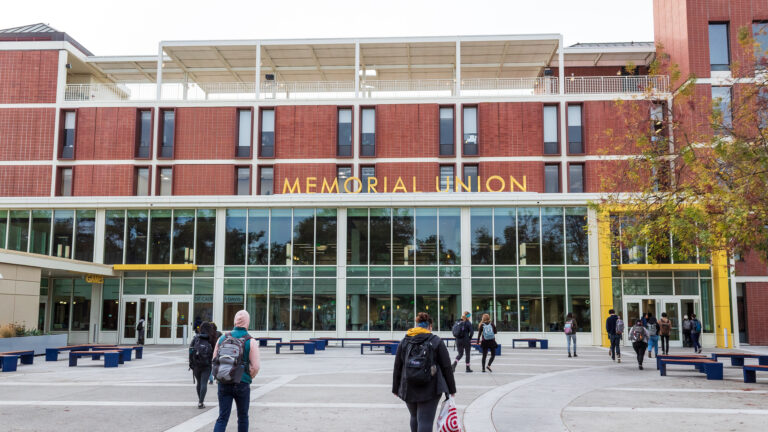
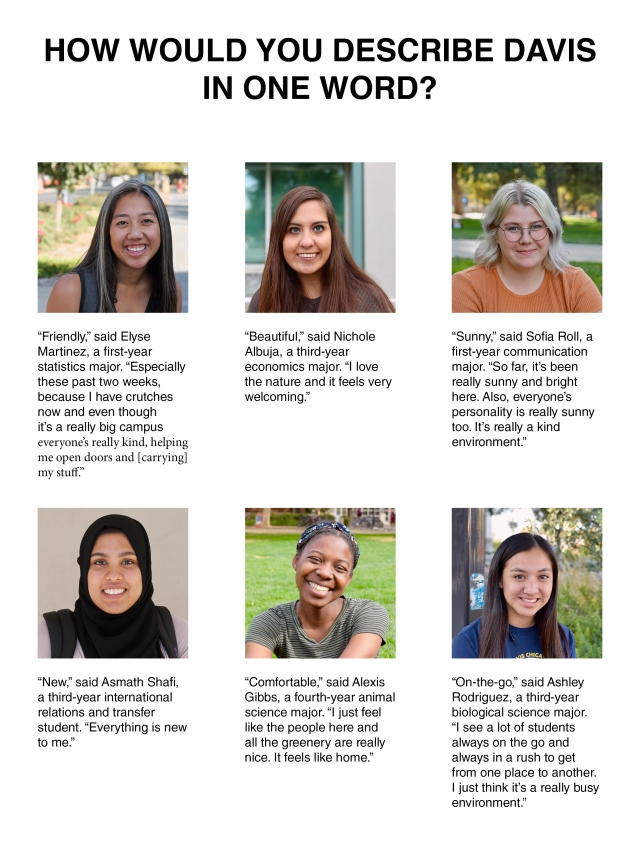
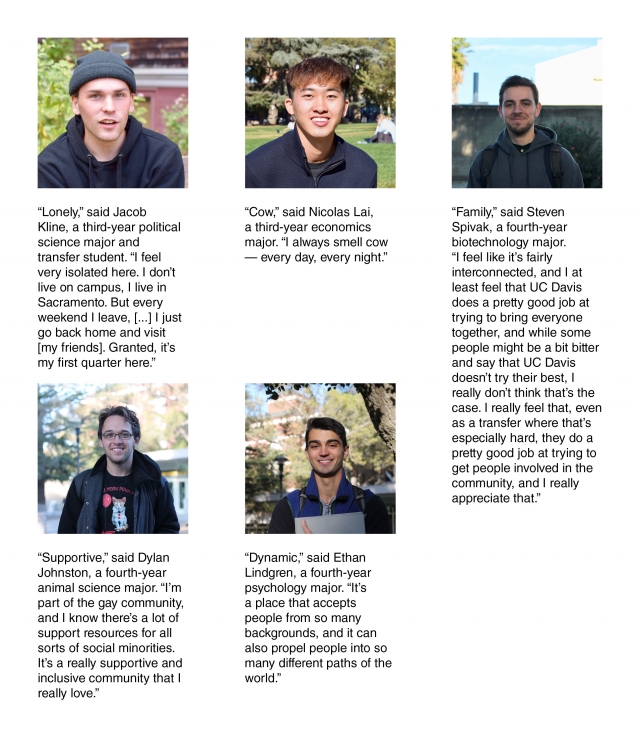
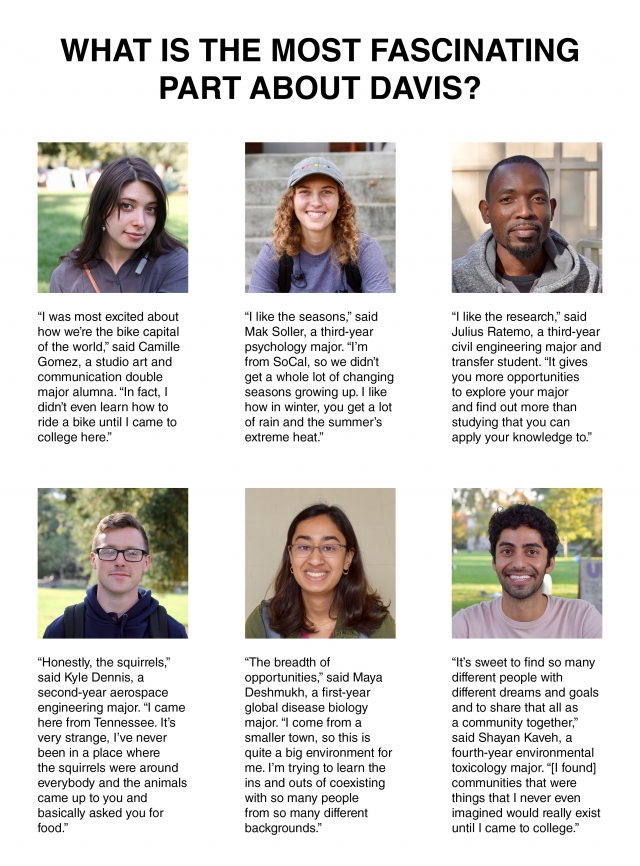
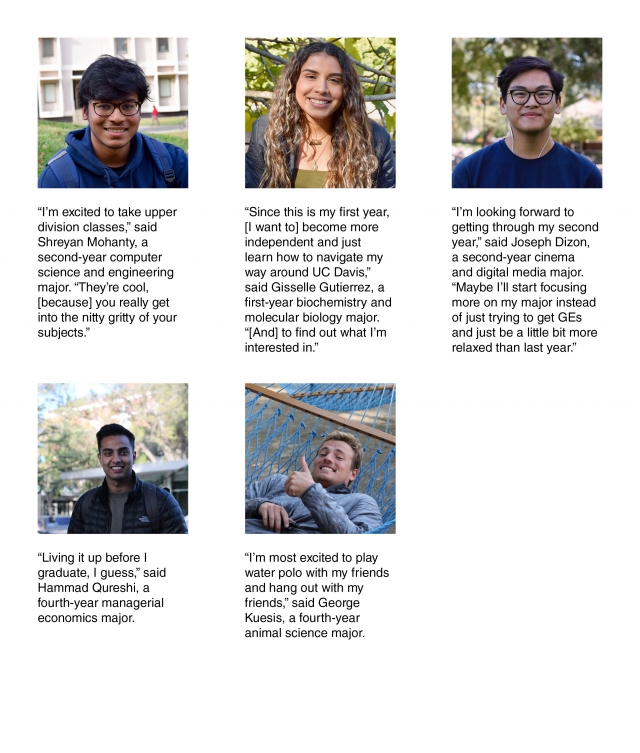
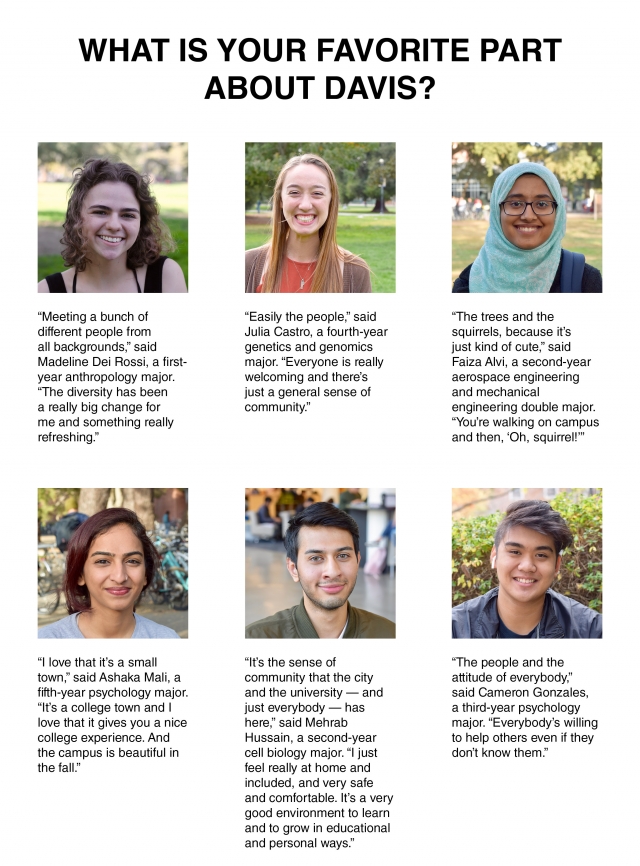
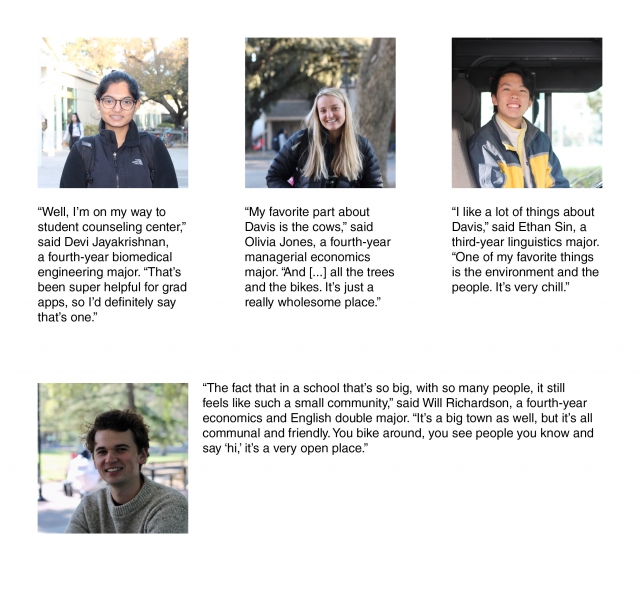
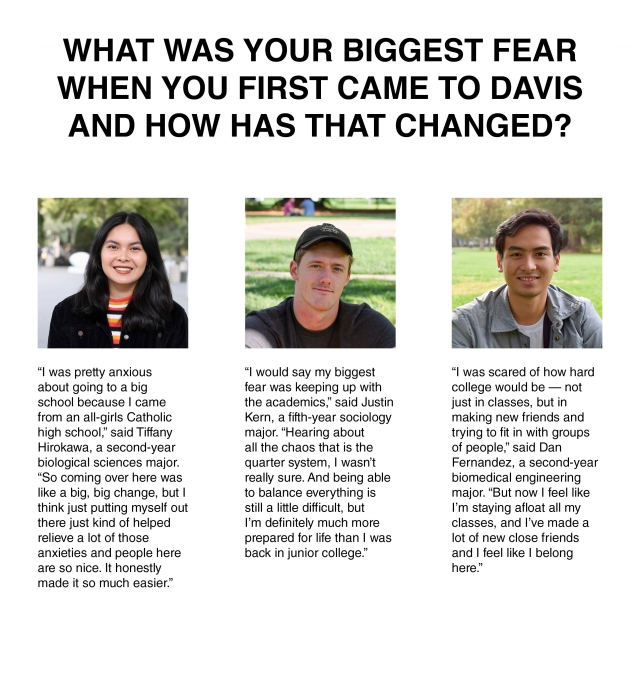
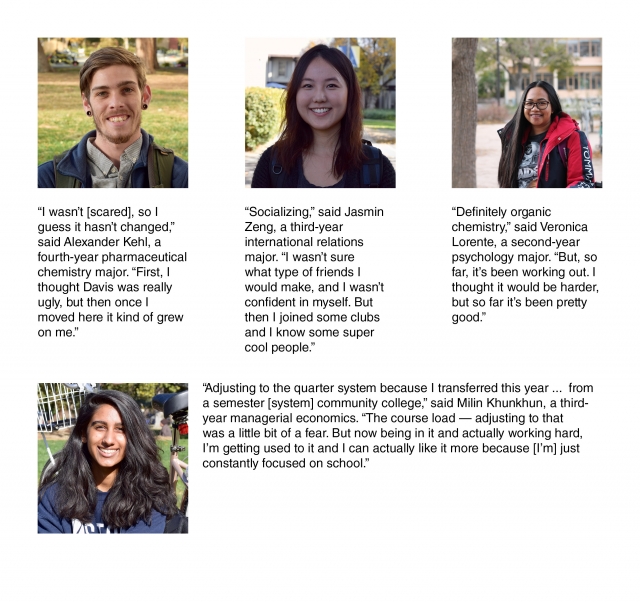
50 faces of Fall Quarter

0

Here’s what students had to say about their love for the community and experience at UC Davis

Written by: Anjini Venugopal and Claire Dodd— features@theaggie.org

Sacramento Scores 100 on LGBT Report Card

Human Rights Commission awarded Sacramento 100 points on its annual Municipal Equality Index. 

This November, the Human Rights Commission (HRC) awarded Sacramento 100 points on its Municipal Equality Index, which documents LGBT inclusivity in cities across the country. The goal of this report card, according to the HRC, is to reduce inequality experienced by the LBGT community.

“By inspiring and engaging individuals and communities, HRC strives to end discrimination against LGBTQ people and realize a world that achieves fundamental fairness and equality for all,” its website reads.

The HRC awards points based on five main categories: “non-discrimination laws,” “municipality as employer,” “municipal services,” “law enforcement” and “leadership on LGBT equality.”

This year, Sacramento was one of 14 California cities to receive a score of 100 on the HRC report card.

Steve Hansen, Sacramento’s first openly-gay city councilmember, commented on how Sacramento achieved the high score. 

“We didn’t get a perfect score by accident,” Hansen said. “Basically, we rewrote our ordinances to make sure that our city was at the forefront for providing benefits to the LGBT community to get 100% on the HRC Municipal Equality Index.” 

Hansen listed services offered by the city for the LGBT community, including affinity groups for LGBT employees, resources for the LGBT homeless youth population and financial aid for the Sacramento LGBT Community Center. 

Ariela Cuellar, the community marketing and engagement coordinator for the LGBT Community Center, spoke about the services provided by the center specifically for the homeless youth.

“There’s a lot of misconception that [because] there’s more media representation of LGBT folks, that there’s more acceptance,” Cuellar said. “But the fact of the matter is when the youth do come out, it’s often the case that they get kicked out of their homes and have nowhere else to go.”

The center provides seven-day drop-in services and support groups to help the homeless LGBT youth in Sacramento. Laundry, showers, food and clothing are provided to youth at the drop-in service.

In addition to hosting resources for the homeless youth population, Cuellar named other services provided by the center, including free HIV and STI testing, community-building programs for elderly members of the LGBT community and support groups for trans women of color.

Despite these services, there is still work to be done. The report card is scored out of 100 points, but there were also 22 bonus points available to raise a city’s score. Without bonus points, Sacramento would have received a 91.

Both Hansen and Cuellar agree there is room for improvement in Sacramento concerning the transgender community. Hansen believes that more representation in city government is necessary.

“We need to do more for the transgender community,” Hansen said. “Many of my appointments to city commission have been LGBT folks, and I really want to bring more transgender people into our commission in the next year.”

Cuellar, however, focused on the need for more treatment options for transgender women in healthcare.

“There still needs to be a lot of advocacy work to provide more rights for trans women,” Cuellar said. “The healthcare system in general needs to provide more for folks who want to receive services such as surgeries, hormone therapy or mental health counseling.”

Hansen summarized his feelings on Sacramento’s progress so far and the future advancement of LGBT rights in the city.

“Equality isn’t a destination, it’s a process,” Hansen said. “We’ll have to continue to advocate, to fight and to bring people together to create understanding. I’m excited that we’ve made this progress, but I’m not resting until we make sure everybody feels safe, respected and protected.”

Written by: Eden Winniford –– city@theaggie.org

Yolo County responds to decline of western monarchs by increasing breeding, foraging habitat

Yolo County Resource Conservation District works with Xerces Society to plant over 6,000 native plants at six sites across county

The Yolo County Resource Conservation District is planting thousands of native plants to increase the breeding and foraging habitat for the dwindling western monarch butterfly population.

The project is a joint effort between the Yolo County Resource Conservation District and the Xerces Society for Invertebrate Conservation, which sent out a Western Monarch Call to Action after western monarch butterfly populations dropped from 192,000 in 2017 to 30,000 in 2018. One of the five actions listed in the Western Monarch Call to Action is to preserve breeding and migratory habitat, much of which is located in the Sacramento Valley.

Heather Nichols, the executive director of the Yolo County Resource Conservation District (YCRCD), explained how Yolo County got involved in the statewide project led by the Xerces Society.

“The Xerces Society was able to receive funding through the Wildlife Conservation Society Climate Adaptation Fund to organize and distribute 32 monarch and pollinator habitat kits through California in strategic areas,” Nichols said. “Our RCD applied for six sites, and we were awarded four of those 32 kits.”

Each of the four kits given to the YCRCD consisted of 1,600 native and drought-resistant plants, which included narrow-leaf milkweed, showy milkweed and four types of native wildflowers — all grown at Hedgerow Farms in Winters, Calif. Alex Tremblay, the project manager at the Yolo County Resource Conservation District, described the role of milkweed as larval host plants.

“Milkweed is the primary food source for monarch caterpillars,” Tremblay said. “The caterpillars come out, start eating the milkweed, turn into a chrysalis and then they turn into a butterfly.”

Tremblay also described the role of the four native wildflowers: pacific asters, vervain, goldenrod and coyote mint.

“The four other plants that we’re planting are nectar sources,” Tremblay said. “Those flowers are California native wildflowers, and they were chosen so that their bloom periods would ensure that there’s always a flower for the butterflies to feed on.”

The six sites where the kits are being planted are located on roughly 15 acres throughout Yolo County, with three sites on private property and three on public land. The goal is to finish the planting by Jan. 1, 2020. 

“In Yolo County, which is primarily agriculture, a lot of our habitat is along waterways and farm edges,” Nichols said. “You’re going to see a lot of these monarch habitats going in along these edges where we’re trying to boost the ecosystem function.”

The YCRCD is working with other organizations in the Yolo Creek and Community Partnership to complete the planting, including the Center for Land-Based Learning, Putah Creek Council and Point Blue Conservation Science. 

One of the sites is located at North Davis Upland Habitat Area on the corner of F Street and Anderson. Tree Davis, a local nonprofit, is helping the project by bringing in community members and high school students to plant and raise awareness about the western monarch population. 

Two of the sites, at Cache Creek and Putah Creek, are being incorporated into habitat restoration projects that the YCRCD is already working on. The project is a great opportunity to bring awareness for the western monarch butterflies and to bring the community together, according to Nichols.

“We are working with landowners who we know can take care of those sites and who are committed to reduced or no chemical use in those areas,” Nichols said. “The community gets to be a part of the planting, so it works on several levels of increasing our awareness and being part of the solution.”

Though habitat loss is a likely factor contributing to the decline of western monarch populations, researchers are not entirely sure exactly why their populations are declining. The Xerces Society cites “stressors such as habitat loss and degradation, pesticides, and climate change — as well as other pressures on the migratory cycle of the monarch that we still have yet to fully study or comprehend,” on its website.

There are several steps community members can take to help protect western monarchs, including exploring a website dedicated to tracking the monarch population, according to Nichols.

“Planting milkweed in your yard and reducing pesticide use are things someone can do if they have a little bit of ground,” Nichols said. “There’s a Western Monarch Milkweed Mapper that is a community science effort. If you adopt a [milkweed] plant and monitor it, you can be a citizen of science in that way.”

Written by: Madeleine Payne — city@theaggie.org 

Davis Candlelight Parade and Holiday Tree Lighting returns for 38th year

Community gathers together to celebrate holiday season

The annual Candlelight Parade and Holiday Tree Lighting, one of Davis’ oldest community traditions, returned for its 38th year on Dec. 5. The parade, which has been sponsored by the Davis Food Co-op for over two decades, started at the Co-op at 620 G St. and ended at the E Street Plaza in Downtown Davis.

The holiday tree this year was sponsored by West Coast Arborists, and the Davis High Cheer Team and the Twinkle Light Crew assisted in decorating the tree, according to a press release published on the City of Davis’ website.

Carrie Dyer, a management analyst for the City Manager’s office, said most parts of the event remained the same as in past years, but the stage for the performance was different.

“Usually, the stage was in the E Street Plaza parking lot,” Dyer said. “But it was actually in the street this year, and we closed down E Street between the second and third for the entire event.”

The holiday celebration included a variety of activities: free horse-drawn carriage rides, a downtown window decorating contest and an ugly sweater contest. Meanwhile, multiple music bands and choirs — including the Davis Children’s Choir, the Davis High School Jazz Band and the Davis High School Madrigal Singers — performed at the event.

Nancy Jacobson from Castro Valley, Calif. visited Davis for the event with her husband.

“We love Davis and the family feel here,” Jacobson said. “Our son is a Davis resident, and he is playing Santa Claus at the event.”

Jacobson described the event as fabulous and traditional.

“It just reminds me of a good old-fashioned family Christmas,” Jacobson said. “Everyone is out here having a good time. The kids are adorable, and the families are precious.”

Alex Bugni, who has lived in Davis for about 10 years, joined the downtown holiday celebration for the third time this year to see her son play in the band.

Davis High School cheer team members also sold homemade holiday treats and refreshments at the event. Proceeds from the fundraiser will support the cheer team’s future expenses.

“We have been preparing for this [fundraiser] for probably a few weeks now,” said Aly Dolcini, a sophomore at Davis High School. “Every year we do it, we try to make it better and better.”

 Dyer said the Davis City Council had put a great amount of work into this event — from parade logistics and street closures to securing all of the entertainment and decorations, as well as the installation of the holiday tree.

“There are lots of details that go into planning this event,” Dyer said. “But we really just hope that the community can come together to celebrate and enjoy it.”

Members of the Davis City Council led participants gathered around the holiday tree in a countdown. The tree was illuminated at 6:30 p.m. in the E Street Plaza. 

Written by: Rui Ding — city@theaggie.org 

Highlights from the last Democratic Debate of the year

Biden, Sanders, Warren, Buttigieg, Klobuchar, Steyer, Yang discuss education, climate change, international relations

The California Aggie attended the sixth Democratic Debate on Thursday, Dec. 19 at Loyola Marymount University. Seven candidates qualified for the last debate of the year: Former Vice President Joe Biden, Sen. Bernie Sanders, Sen. Elizabeth Warren, Mayor Pete Buttigieg, Sen. Amy Klobuchar, entrepreneur Andrew Yang and California billionaire Tom Steyer. 

The most recent polls show Biden in the lead, with 27.8% support, followed by Sanders with 19.3%, Warren with 15.2% and Buttigieg with 8.3%. Sen. Cory Booker, Rep. Tulsi Gabbard and former Mayor Michael Bloomberg — all of whom are polling ahead of Steyer — did not qualify for this debate. In order to qualify, candidates needed to meet polling and fundraising thresholds designated by the Democratic National Committee (DNC) by Dec. 12. Booker, Gabbard and Bloomberg did not meet these thresholds.

Also present at the debate was California Governor Gavin Newsom; following the debate, The Aggie asked Newsom about his thoughts on recent discussions about the possibility of removing SAT and ACT scores from the admissions process for UC schools.

“You may have seen in some of the work we did this year in the budget that we were leaning in that direction,” Newsom said. “I think the UC will not surprise you — I think they’re poised to make a bold announcement.”

During the debate, Yang — the only candidate of color on the debate stage — said it was “both an honor and a disappointment to be the lone candidate of color on the stage tonight.” The five current democratic frontrunners in the polls are all white.

“Fewer than 5% of Americans donate to political campaigns,” Yang said. “Do you know what you need to donate to political campaigns? Disposable income. The way we fix this is we take Martin Luther King’s message of a guaranteed minimum income, a freedom dividend of $1,000 a month for all Americans. I guarantee, if we had a freedom dividend of $1,000 a month, I would not be the only candidate of color on this stage tonight.”

There has also been discussion in recent weeks over whether the lack of diversity in Iowa and New Hampshire — two of the whitest states in the country — should disqualify these states from voting first. These concerns have been chiefly voiced by Former Housing and Urban Development Secretary Julián Castro, who is polling with 1.2% support.

At last night’s event, jabs between Warren and Buttigieg over recent weeks manifested on the debate stage. Warren criticized Buttigieg for a closed-door fundraiser he held in “a wine cave full of crystals.” In response, Buttigieg said he was “literally the only person on this stage who is not a millionaire or a billionaire,” adding, “this is the problem with issuing purity tests you cannot yourself pass.”

With the Iowa Caucus and New Hampshire primary less than two months away, the debate, hosted by PBS NewsHour and Politico, was an important opportunity for candidates to reach additional voters; recent polls show that over 50% of voters have yet to decide on a top candidate for the primaries, according to Vox. An additional four debates are scheduled for January and February.

Labor disputes at UCLA and LMU

Questions relating to the two separate and ongoing labor disputes that impacted the debate were noticeably absent. The debate was originally slated to take place at UCLA, but it was relocated to LMU due to an ongoing labor dispute between the UC and the American Federation of State, County and Municipal Employees (AFSCME) 3299. AFSCME officials asked candidates to honor its boycott of UC events.

Just days before the debate took place, a labor dispute between UNITE HERE Local 11, a union representing food service workers at LMU, and the food service company Sodexo, which employs the unionized workers and is also subcontracted by LMU, raised doubts about whether the debate would indeed take place. All of the candidates said via Twitter that they would not attend the debate if it meant crossing a picket line. Two days before the event, the DNC and its chair, Tom Perez, helped secure a tentative contract agreement between the two parties, according to a DNC press release.

Perez, who addressed the crowd before the debate began, did mention the agreement he helped facilitate. 

“It’s more than just dollars, it’s about dignity,” Perez said. “When unions succeed, the middle class succeeds and America thrives.”

Education

The topic of education was brought up over halfway through the debate. Warren discussed her plans to implement a two-cent wealth tax, which, according to her estimations, would result in an $800 billion investment in K-12 public schools. 

“That will permit us to offer technical school, two-year college, four-year college for every single person who wants an education, cancel student loan debt […] put a $50 billion investment in our historically black colleges and universities and cancel student loan debt for 43 million Americans,” Warren said.

Sanders also voiced support for taxing the wealthy and making all public colleges and universities tuition-free.

“What we need right now is a revolution in education,” Sanders said.

By comparison, Buttigieg’s proposed plan offers free college, or college at a discounted tuition rate, for those families making $150,000 a year or below.

Disability rights, a topic that had not previously received much airtime at prior debates, was addressed by the moderators in a question asking candidates how they would help disabled individuals become better integrated into the workforce and their local communities. Yang, who has a son with special needs, and Warren, who previously worked as a special education teacher, both gave strong responses to the question — Warren discussed plans to fully fund the Individuals with Disabilities Education Act, which provides both a free, specialized education and services to children with disabilities, and Yang again brought up the idea of instituting a freedom dividend for every American.

Yang and Sanders were the only two candidates to bring up student debt. Both Sanders and Warren have said they will cancel all or some of the currently amassed student debt.

Climate change

Sanders was the first candidate to bring up climate change during the debate and repeatedly referenced the urgent need to combat climate change throughout the event. Given relatively recent scientific findings that certain parts of the U.S. will be unlivable by the year 2050 as a result of climate change, the candidates were asked whether they would support a new program that would relocate families and businesses away from areas such as Miami, Fla. and Paradise, Calif. In response, Klobuchar proposed re-entering the Paris Climate Agreement, Buttigieg proposed implementing a carbon tax and both Steyer and Sanders proposed declaring an immediate national emergency, if elected.

“Your question misses the mark — it is not an issue of relocating people in towns, the issue now is whether we save the planet for our children and our grandchildren,” Sanders said. “You’re talking about the Paris agreement, that’s fine. Ain’t enough. We have got to — and I’ve introduced legislation to do this — declare a national emergency.”

Protests in Hong Kong

Relations between the U.S. and China were one of the only topics relating to international relations brought up during the debate. Moderators asked about ongoing protests in Hong Kong sparked over a controversial extradition bill and relating to larger demands for full democracy, as well as recent human rights abuses by China — specifically the detention of over a million Muslim Uighurs, an ethnic minority in one of China’s regions.

Steyer said the U.S. needs to do more to “push back,” but he also said we should not be the “world’s policeman” — “if we are going to treat climate as the threat that it is, we are going to have to partner with the Chinese.” Biden, on the other hand, supported a more militarized approach.

“We should be moving 60% of our sea power to that area of the world to let […] the Chinese understand that they’re not going to go any further,” Biden said. “We are going to be there to protect other folks. We […] should make sure that we begin to rebuild our alliances, which Trump has demolished, with Japan and South Korea, Australia and Indonesia. We, in fact, need to have allies who understand that we’re going to stop the Chinese from their actions.”

Yang, who has family in Hong Kong, said China is “in the process of leapfrogging” the U.S. in terms of Artificial Intelligence “because they have more data than we do and their government is subsidizing it to the tune of tens of billions of dollars.” He proposed the implementation of an international coalition to set technology standards, stating that “this is where we need to outcompete them and win.”

Impeachment

The recent impeachment of President Donald Trump by the House of Representatives was the subject of the first question of the night posed to all of the candidates. According to the moderators, Congressional Democrats have not yet convinced a strong majority of Americans to support impeachment.  

In response, Klobuchar called recent events concerning the president a “global Watergate” and said the American people need to hear testimony from top White House officials, including Acting White House Chief of Staff Mick Mulvaney. In his response, Yang said “we have to stop being obsessed over impeachment.”

“[We need to] actually start digging in and solving the problems that got Donald Trump elected in the first place,” Yang said. “We have to take every opportunity to present a new positive vision for the country, a new way forward to help beat him in 2020 because, make no mistake, he’ll be there at the ballot box for us to defeat.”

Dreamers and reparation

With over 200,000 DACA recipients in the State of California alone — more than any other state — moderators asked candidates whether they would move to enforce a “permanent legislative fix for Dreamers” in their first 100 days in office. 

“I believe everyone on this stage would do the right thing by Dreamers in the first 100 days,” Yang said. “I would make it a top priority. I’m the son of immigrants myself. The fact is, almost half of Fortune 500 companies were started by an immigrant or children of immigrants. Immigrants make our country stronger and more dynamic.”

Buttigieg, who previously said the U.S. owes compensation to children separated from their families at the Southern Border, also said at the debate that those children should have a “fast track to citizenship.” He also voiced support for giving reparations to the descendants of enslaved people. 

“We’re not talking about a gift to anybody,” he said. “We’re talking about mending what was broken. We’re talking about the generational theft of the wealth of generations of African-Americans.”

“The United States must act immediately with investments in minority-owned businesses, with investments in health equity, with investments in HBCUs and on the longer term look at reparations so that we can mend what has been broken,” Buttigieg said.

LGBTQ issues

All of the candidates present have committed to supporting the passage of the Equality Act, a comprehensive civil rights bill.

Moderators addressed the 22 transgender individuals killed in the U.S. this year, that officials know of, who were mostly women of color. Candidates were asked how they would stop violence against transgender people.

Warren said she promises to visit the Rose Garden once a year to read the names of transgender individuals killed in the past year — “I will make sure that we read their names so that as a nation we are forced to address the particular vulnerability on homelessness.”

“The transgender community has been marginalized in every way possible,” Warren said. “And one thing that the president of the United States can do is lift up attention, lift up their voices, lift up their lives.”

In his response, Sanders brought up his support of a Medicare-for-all, single-payer program that would provide healthcare to every person in the country regardless of sexual orientation or need.

Final Question

In the final question of the night, PBS NewsHour Managing Editor Judy Woodruff asked the candidates whether they would ask for forgiveness from or give a gift to any of the other candidates. Following the responses, viewers and members of the press pointed out on social media that both of the candidates who asked for forgiveness — Klobuchar and Warren — were also the two women on the debate stage.

“We have to remember as Democrats — and if I get worked up about this, it’s because I believe it so much in my heart — that we have to bring people with us and not shut them out,” Klobuchar said. “That is the gift we can give America in this election.”

The next debate is scheduled to take place Jan. 14 in Des Moines, Iowa. So far, Biden, Warren, Sanders, Buttigieg and Klobuchar have qualified.

Written by: Hannah Holzer — campus@theaggie.org

Two dead, officer injured after domestic disturbance and officer-related shooting early Thursday morning

Two subjects pronounced dead, investigations underway

The Davis Police Department responded to a domestic disturbance call early Thursday morning, which turned into an officer-related shooting that left two dead.

Police officers received a call around 3:40 a.m. from the 400 block of Avocet Avenue in North Davis, according to Davis Deputy Police Chief Paul Doroshov.

When officers arrived on-scene, they were met by a male subject and what appeared to be an injured female subject on the floor.

“The male subject prevented the officers from going into the residence to help and assist the woman,” Doroshov said.

The male subject was armed with at least one knife and approached officers with the weapon, leading the officers to shoot the male subject. Both the man and the woman were left injured on the floor and were later pronounced dead.

One officer sustained non-life threatening injuries during the confrontation, but the injuries were not related to a gunshot or a stab wound. The nature of the officer’s injury, according to Doroshov, is still being investigated, and the officer was treated at a local area hospital.

Five officers had responded to the call.

Multiple investigations are underway following the incident. The female homicide is being reviewed by detectives at the City of Davis Police Department, along with an administrative investigation, and the West Sacramento Police Department is investigating the officer-involved shooting, Doroshov said.

“The criminal investigation is done by the other department because a life has been taken,” Doroshov said. “They basically examine to see if there’s any criminal culpability.”

The Davis Police Department posted on its Twitter account Thursday morning regarding the incident, saying the “Davis Police Department is currently conducting a death investigation that occurred early this morning. We appreciate the public’s patience as the information becomes available.”

The crime scene is still being investigated, and details are subject to change as more information emerges about the case. 

Written by: Madeleine Payne — city@theaggie.org