55.4 F
Davis

Davis, California

Sunday, December 21, 2025
Home Blog Page 547

Women’s tennis rolls into conference play

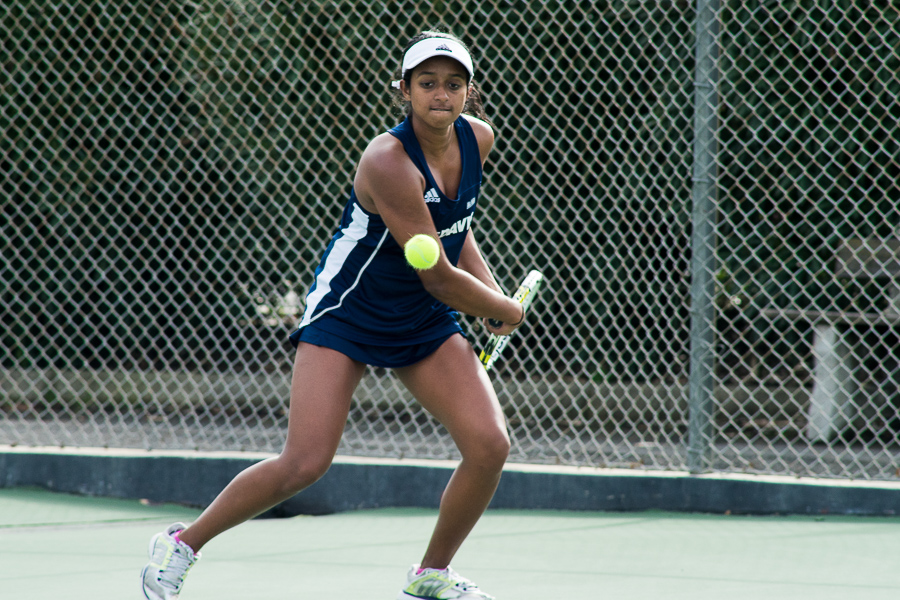
Photo not taken at event referenced in story (NICHOLAS CHAN / AGGIE FILE)

Aggies’ hot start has team confident to compete for Big West crown

It’s only February, but the UC Davis women’s tennis team is getting its gears turning early. The Aggies have won eight of their first 11 matches this season and have enjoyed top-level performances from almost every spot on the roster. But the team’s winning record so far is only a part of what makes head coach Bill Maze so adamant about the winning potential of this year’s squad.

The team’s success this month hit its peak on Feb.13, when the Aggies earned a statement victory over conference rival and last year’s Big West Conference regular season champions Hawai’i. The 4-2 win was the first time that a UC Davis women’s tennis team had defeated the Rainbow Wahine since 2007. In fact, UC Davis had fallen to Hawai’i on five straight occasions going into this season’s match, but the Aggies were able to turn the tide by dominating the Wahine in singles play after dropping the doubles point.

“I got to work on figuring Hawai’i out with the dubs,” Maze said. “But I think we just got a team that believes in themselves. [This team has] a lot of talent, they never give up.”

The Aggies did not let their failures in the doubles matches interfere with how they competed across the board in singles. When all was said and done, UC Davis swept singles play, winning four of the five completed matches –– all in straight sets. Even at the number one spot, senior Kristy Jorgensen fought to a third set and was leading 3-1 when sophomore Kristina Breisacher won at the two spot to seal the win for UC Davis.

“The fact that we won in straight sets at number two, three, four and five –– and we were up in the third set at number one –– it wasn’t like it was a fluke,” Maze said. “It was legit.”

Winning the four straight-set singles matches was just the start that the Aggies wanted in their first conference slate of the season –– especially given the team’s past struggles with Hawai’i. Maze believes that this win in particular was a unique display of the talent that this unit possesses and will “breed confidence” for the team in the matches to come.

Before their next batch of conference matches, however, the Aggies squared off against a pair of northern California private schools over president’s day weekend. The first of the two contests fell in UC Davis’ favor, as the Aggies traveled to the city by the bay to down the University of San Francisco Dons by a 4-1 score. This time, the Aggies secured the doubles point with a pair of 6-2 set wins coming from both the two and three spots.

When singles play rolled around, Breisacher finished her two-spot matchup first, making quick work of her opponent –– USF’s Anna Sokiran –– to advance to a 6-4, 6-0 straight sets victory. In the one spot, though, the Aggies lost their only point of the match when Jorgensen retired after the second set due to a nagging injury that prevented her from playing on into the third.

On the other singles courts, the surface conditions swiftly became dangerous. On nearly every court except for the number one court, a strip of water appeared to be rising up and dampening the court from below. This made the playing surface on these courts too slippery to play on. While freshman Sara Tsukamoto was able to finish out her match with a 6-2, 6-4 win, the other three singles matches had to be delayed.

Junior Isabella von Ebbe and her opponent, USF’s Alexa Meyer, were nearly through the first set of the number six match when their court was deemed unsafe. With similar hazards on almost all other courts, von Ebbe’s match was delayed and then finally relocated to the one’s court where the surface was not affected by damp conditions.

“Once you’ve already started a match, you’re already in it and you’re focused,” von Ebbe said. “Then to have some curveball thrown, like water coming up from the bottom of the court, is definitely a weird situation.”

All the eyes were now on von Ebbe and Meyer battle it out on the main court. Players and coaches from both teams, because none of the other matches could be played, sat bundled in layers and blankets to keep warm in the midst of the cold San Francisco evening that kept creeping closer. Seeing all of her teammates huddled on the sidelines gave von Ebbe an extra incentive to try and end the match by winning the final point that the Aggies needed.

“It was all the more fun to be the only one on, under the lights, everyone watching that one match and having my entire team playing every point with me,” von Ebbe said. “That’s not something that happens in your typical college match where there’s six courts and people playing on each court.”

Von Ebbe fell 6-3 in the first set, but would roar back to win the second set 6-4 in dramatic fashion. The path to victory was now clear; if von Ebbe won the third set, UC Davis would clinch the match by securing its fourth point. If she did not win, the next remaining unfinished singles match would then have to be played. If the Aggies did not win that match either, there was yet another unfinished match to be played.

“In the back of my head, I did have that thought that this match could go on til midnight if I don’t turn this around, come back and win this second and take it in the third,” von Ebbe said. “There was definitely more motivation to win that one.”

Fortunately for the Aggies, von Ebbe cruised to a 6-2 victory in the final set to clinch the match for the team and avoided prolonging the match deeper into the chilly evening. For Maze, the ability of von Ebbe and the entire team to prevail on the road despite the unusual circumstances shows that the Aggies are more than just talented –– they are “resilient.”

UC Davis had little rest following this unorthodox win in San Francisco. The Aggies returned to Davis to play Saint Mary’s College the next day at 12 p.m. The Gaels turned out to be a much more formidable opponent than the Dons were for a tired UC Davis team, battling past the Aggies for a 5-2 win. But according to Maze, even with the Aggies’ consistent number one option, Jorgensen, sidelined due to the same injury that prevented her from continuing in San Francisco, the match was much closer than the score would indicate.

Von Ebbe and redshirt sophomore Kelsie Bryant claimed the first doubles victory in a 6-1 set, but Breisacher and senior Lani-Rae Green could not overcome the Gael’s number one doubles team. The doubles point thus came down to the number two match, where Tsukamoto and sophomore Nikita Pradeep narrowly lost in a 7-6 nailbiter. In singles, there were some close matches as well. Maze opted to put Breisacher in the one spot in place of the injured Jorgensen, and although Breisacher has rarely played at the one spot, she was able to take SMC’s Maria Kozyreva into a third set.

“I was proud of our team, I think it was a good battle,” Maze said. “I think that [the loss], instead of bumming [the team] out, they thought ‘man, this team’s ranked and we were right there with them.’ I think it just gave them more and more encouragement. [SMC’s] number one doubles team is ranked 35 in the country and we lost that set 6-4 with our normal number two doubles team.”

Despite suffering just their second loss of the season, the Aggies were able to perform well against highly-ranked opponent –– something that this team has done consistently so far this season. Maze accredits this tendency to the team’s “even-keeled” nature.

“I don’t think they treat any team differently,” Maze said. “I think they play the same way every match. […] They always want to win. That’s a good quality –– to be even-keeled about your competition. You don’t want to get way up for one match, and then be overconfident in another one. They play the same consistently good tennis.”

Looking further down the schedule, the Aggies will be needing to rely on the same consistency to be successful in the conference this season, as matches against top-tier talent loom. And while talent, resiliency and consistency are all excellent traits to possess, Maze also notes that a team also has to “get lucky” in order to have a truly great year.

“You got to have not many injuries and players have to get along,” Maze said. “They’ve got to love to play and be hard workers. We have most of those ingredients, but the injury thing, you just can’t control it.”

The work ethic, however, is one thing that Aggies are certainly in control of. And while the entire team works exceptionally hard on and off the court, the team’s two true sophomores have especially shined this season. Pradeep, for one, was awarded Big West player of the week honors for her stellar singles victories in both the Hawai’i and Saint Mary’s matches. Breisacher has come into her own in her second season as well, sporting a 5-4 singles record as a top-two option in each match.

“We believe in them totally,” Maze said. “From the day they showed up in Davis they’ve proven that they know how to win. They’re talented, they work hard and they’re just really competitive people. They do not like to lose. [Pradeep] had a phenomenal record last year and she’s 8-0 this year. [Breisacher] has proven to me that she can win in one of the top two spots. We’re lucky to have them.”

Pradeep and Breisacher have been high-level contributors for the Aggies, but at such an early point in the season, anyone on the roster can still have an opportunity to rise to the occasion as UC Davis continues to fight to secure its first conference championship.

The Aggies were shut out by UCSB on Saturday, losing 4-0, but bounced back with a close win at Cal Poly on Sunday, winning 4-3. The women’s tennis team will take the Marya Welch Tennis Center again this Saturday, March 3 at 11 a.m. to face Cal State Northridge.


Written by: Dominic Faria — sports@theaggie.org
Executive ticket candidates claim biases against non-ASUCD affiliated individuals

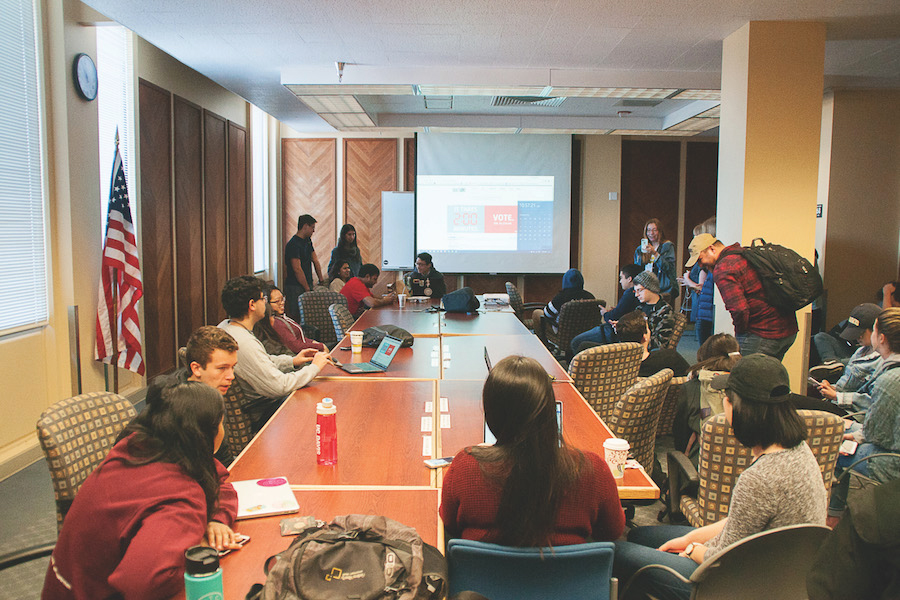
JESSE STESHENKO / AGGIE

ACT slate candidates, disqualified Golden Slate candidates allege double standards, unequal access

Candidates involved with this year’s ASUCD Winter Quarter elections have expressed frustration over alleged biases within the association — particularly within the Elections Committee — toward ASUCD-affiliated candidates.

Executive candidates from Aggie Community Transfers and former candidates from The Golden Slate have raised complaints for hindrances to their campaigns, a perceived lack of access and double standards between slates with candidates from outside the association and slates with candidates already working inside ASUCD.

Adam Hatefi, a third-year political science major, and Shreya Deshpande, a second-year cognitive science and sociology double major, were disqualified from running in the election on The Golden Slate’s executive ticket on Feb. 9 after Deshpande’s failure to be present at an Elections Committee-held mandatory candidate workshop on Feb. 3. The pair appealed their disqualification to the Judicial Council and addressed Deshpande’s absence as a medical emergency, offering a doctor’s note to exempt her. The Elections Committee previously said that the only exception they would allow for missing the meeting was for a documented medical emergency.

“They said that for documented medical emergencies, ‘We’ll schedule a make-up workshop for you,’ and I was in the clear,” Deshpande said. “I asked them whether I could Skype into the meeting whether there was any other sort of way that I could make it up and there was no response from them.”

The pair alleged a double standard regarding a similar situation with three Unite! senatorial candidates. Unite! candidates Alisha Hacker and Mohammad Qayum left the meeting early for a Model United Nations conference and Unite! candidate Colin Heurlin is currently in the UCDC program. All three were initially given one violation point rather than an immediate disqualification, as general absence from the mandatory meeting mandated. Afterward, however, Heurlin was disqualified.

In response, Elections Committee Chair Naeema Kaleem and Vice Chair Rodney Tompkins discussed their reasoning in a joint statement sent via email.

The Bylaws do not specify anything about leaving the workshop early, but rather being a half hour late,” the statement said. “The Elections Committee extended the spirit of the Bylaw in question by applying it to candidates who left the workshop a half hour early. Deshpande was absent from the entirety of the meeting, which is an automatic disqualification.”

Hatefi and Deshpande’s appeal hearing affirmed the Judicial Council’s initial ruling of disqualification under the grounds for Deshpande’s absence from the meeting not being excused by her medical documentation.

Hatefi and Deshpande pursued a lawsuit against Kaleem for $100,000 prior to their appeals hearing but subsequently dropped it, claiming to later have found it unnecessary and wanting to avoid causing Kaleem distress.

“As a mental health advocate, I didn’t want the chair of the elections committee to face that kind of burden as a student,” Deshpande said.

There have been complaints of lack of access between the Elections Committee and non-ASUCD affiliated candidates, including as emails and questions over elections code being left unanswered.

“When we have questions as to how the elections committee sees and interprets the different parts of the bylaws so that we know what we are and aren’t allowed to do and we ask questions and they don’t respond, that in itself is hindering our campaign,” Hatefi said.

ACT executive candidates Toni Sandoval, a third-year communication major, and Kevin Butt, a third-year double major in political science and African American and African studies, expressed similar frustrations over the executions of rules over the mandatory workshop.

“I had an obligation that was set almost a year in advance before I got to Davis and it happened to fall on the mandatory elections meeting,” Butt said. “As soon as I found out, I reached out immediately. I asked for any accommodations or any alternates, and I was brushed off simply by Naeema multiple times. Then to come find out it’s okay for two other senators to depart earlier and then only receive one violation point?”

Sandoval and Butt criticized the committee for holding closed sessions from the public and for not holding roll call at the mandatory meeting after candidates left early during its proceedings.

“Student government is supposed to be open session,” Sandoval said. “You’re supposed to open access to public.”

In response, Kaleem and Tompkins addressed the committee’s jurisdiction to hold closed hearings in pursuit of confidentiality in their joint statement.

“The Elections Committee requested a closed hearing due to the fact that the Office of Student Support & Judicial Affairs was involved with the Hatefi-Deshpande case,” the statement said. “It was well within our rights as respondents to request a closed hearing, as per Judicial Council Code Six.”

Issues of conflicts of interest from within the association have not come up on the Senate table for discussion. ASUCD Senator Andreas Godderis says “natural biases” against ASUCD affiliated individuals are inherent.

“Being closed off to any outsiders is a very common thing for people within ASUCD to do, but I don’t see it as very healthy,” Godderis said. “You got a few members from BASED, a few members from Unite!, those two slates both benefited from this disqualification, so naturally that’s not going to be brought up [on the table].”

Unite! candidates Michael Gofman and Shaniah Branson have been elected as the new ASUCD president and vice president, respectively. Three candidates from BASED and three candidates from Unite! were elected as the new senators.


Written by: Elizabeth Mercado — campus@theaggie.org

Correction (updated 3/2/18 at 3:30 p.m.)

A previous version of this article stated that Shreya Deshpande was a third-year student, which is incorrect. Deshpande is a second-year student.

Pass the popcorn

CAITLYN SAMPLEY / AGGIE

Contemplate the Academy Awards with The Editorial Board

Emily Stack, Managing Editor

I love the unexpectedness inherent in a live broadcast, so I’m eagerly awaiting drama and Monday morning’s “10 Wildest Things That Happened at the Oscars” articles. Will someone have an awkward, uncomfortable interaction with an E! host? Will someone give a bizarre, incoherent acceptance speech? Who will give us the worst mispronunciation of Timothée Chalamet or Saoirse Ronan? Who will show up obviously drunk or high? What profanity will Frances McDormand sneak past the censors? What will gay Twitter say?

On a more serious note, this has been the most politically-charged awards season in recent memory, and it’s nigh-impossible that #TimesUp and the reckoning currently burning through Hollywood won’t get brought up. Though I’m generally wary of performative speeches as activism, I’m eager to see what gets said and who’ll be willing to say it.


Hannah Holzer, Campus News Editor

The Oscars is one of my top five favorite days of the year. Having seen six out of the nine Best Picture nominees, I have spent a long, introspective period deciding which film should win. Finally, after much important deliberation, I’ve settled on “The Post.” Now, before you point out the obvious — yes, I am a journalist, good point — those of you who know me know Tom Hanks is one of my all-time favorite persons on the planet. And he did a darn good job.

        I know many readers are anxiously awaiting my other picks, so here you go: Paul Thomas Anderson for Best Director and “Phantom Thread” for original score and costume design. For the contentious categories of sound mixing and sound editing, I’d have to go with “Blade Runner 2049” for the former and “The Shape of Water” for the latter. It’s a scientific process.


Gillian Allen, Features Editor

I grew up watching Joan Rivers praise and rip to shreds the many looks of the Academy Awards on the red carpet, so I am most looking forward to seeing what the stars’ wardrobes have to offer for 2018. From Lady Gaga’s giant red glove aesthetic circa 2016 to Emma Stone’s 20s flare in 2017, the red carpet never fails to captivate me and my artistic side. I’m most looking forward to what daring looks the celebrities will bring to the table this year as they glide through the paparazzi. Maybe even Stormi will make an appearance.


Harnoor Gill, Science Editor

Hi everyone! I just emerged from the deep, dark depths of a hole in the ground to find myself surrounded by talk of a strange and mysterious creature known as The Oscar. I wonder who The Oscar is and why everyone is expecting his arrival. Perhaps he is the grouchy, green monster from “Sesame Street.” Or maybe the delicious Oscar Mayer weiner. Personally, I hope it is the latter. I wonder if The Oscar has a family. Why these humanoids appear to be so fixated on him is quite a conundrum to me. I think all of this excitement also tires me. In the words of Soulcrate music, “embrace the mundane.” On that note, I have an urge to climb back down into my hole again.


Veronica Vargo, Sports Editor

First of all, what are the Oscars? I know, I know, shame on me. However, as the sports editor, I find the NBA All-Star weekend and the Winter Olympics to be of much higher importance than what movie was THE best. Isn’t it all really subjective anyway? If Person X thinks movie A was great and person Y doesn’t, who wins? All I really need to say is that Professional Bull Riding is on the up and up so Google Jess Lockwood, and I’m sure we’re all dying to know when senior forward Chima Moneke will be playing basketball at UC Davis and, more importantly, why he hasn’t been playing in the first place. The Oscars are cool and all, but man, have you heard about junior forward Morgan Bertsch? I think not. While you’re at it, look at The California Aggie Facebook page because they make the best films. Give them an Oscar.


Ally Overbay, Arts & Culture Editor

As the arts editor, I feel inclined to make a bold claim about 2017’s cinematic success stories. In reality, I’ll be fulfilling my mother’s tradition: tuning in to the red carpet at 5 p.m. and shutting the TV off by 7 p.m. There’s no better entertainment than E! News’ fashion police gawking over Jennifer Lawrence because the diamond earrings that cost more than my tuition don’t match the sequins on her dress. At least someone’s making bold statements.


Kaelyn Tuermer-Lee, City News Editor

I know the Oscars are a very exciting time for many people, but I personally do not watch them — rather, I hear about them from those of my friends who do take part in the heated debate over which movie will win Best Cinematography. That being said, I did manage to find some time to watch a few movies amid hours of studying plant life cycles and o-chem — shocking, I know! Of the movies I have seen, a few stood out: “The Post”; “Three Billboards Outside Ebbing, Missouri”; “Baby Driver.” In addition, “The Greatest Showman” had wonderful music, particularly the original song “This is Me.” Although Hugh Jackman starred in “Les Misérables,” I knew him primarily from movies like “X-Men,” “The Wolverine” and “Logan,” so it was very cool to see him play this role in a movie that greatly differed from his others — and he did a really good job! 10/10 would recommend!


Taryn DeOilers, Opinion Editor

There are a few things I’m going to need to see at this Academy Awards. One, the Academy must go back in time and nominate “Twin Peaks: The Return” for Best Picture and Kyle MacLachlan for Lead Actor. No, the new series was not a film, but I (finally!) finished it literally an hour ago, and I wanted a graceful, totally on-topic way to invite readers to email me (at tldeoilers@ucdavis.edu) about the finale. Please.

Second, Sufjan Stevens must perform the entirety of his 25-minute masterpiece “Impossible Soul.” I know he got nominated for “Mystery of Love,” and that’s a beautiful song, but any performance that takes up less than an eighth of the whole ceremony will not cut it for me.

Third — and this is the most important, so listen carefully — I’m going to need “Three Billboards Outside Ebbing, Missouri” to win Best Picture. And then I’m going to need another “La La Land”/“Moonlight” moment, in which it’s revealed that “Three Billboards,” in actuality, got last place and every other movie nominated (and dozens of others that weren’t nominated) truly won that award. And then I need everyone to wake up out of this spell and realize that “Three Billboards” is sloppy, eye-roll-inducing, poorly-written, tone-deaf and possibly the most overrated film in the past few years (Frances McDormand and Sam Rockwell are chill, though). It’s a simple request, but one that’s necessary for my sanity. Thank you, and go Oscars!


Bryan Sykes, Editor-in-Chief

“Moovies… more like boo-vies…”

-Bryan Sykes, who has seen four movies in the past week, said.

Written by: The Editorial Board

Women’s basketball downs UC Irvine, clinches conference

ALEXA FONTANILLA / AGGIE

Irvine unable to match the Aggies’ hot start

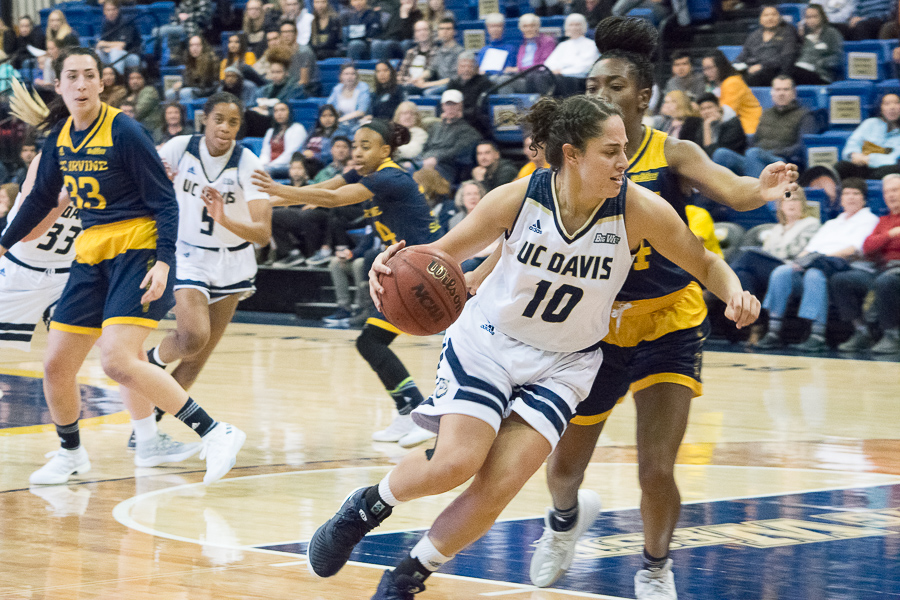
The UC Davis women’s basketball team entered the final home game of the season with the momentum of its four game win-streak intact. With the UC Irvine Anteaters coming on the heels of a two-game losing streak, but 9-4 record overall in conference play, the Aggies went into the game knowing their opponent would not go down without a fight. After honoring their departing seniors, who were stepping onto Bob Hamilton Court for the last time of their collegiate careers, the ball was tipped off and the team was ready to play.
It was an emotional game for the Aggie seniors and their teammates alike. Though there is more basketball to be played, knowing that they would not return to the floor where they spent the last four years of their playing careers bore bittersweet emotions. For senior forward Dani Nafekh, it was a time of reflection.

“I’m trying not to think of it as the last time,” Nafekh said. “I know it is, but it just was so much fun. I just tried to appreciate being out there with my team. We were thinking of it as the championship game rather than our last time. I just thought that we were very focused and ready to play.”

Senior forward Pele Gianotti echoed Nafekh’s emotions, saying that while it was fun, she tried to wear her emotions on her sleeve once the ball tipped off.

“Before I was getting a little emotional,” Gianotti said. “But, once you’re on the court, you’re there, and you’re just doing what you’ve always done the last four years. So, it’s not super different when you’re on the court.”

Once the game began, an apparent leg injury to senior guard Rachel Nagel left the entire arena silent — though Nagel would make another appearance at the end of the game to great applause. The team responded to the early scare in red-hot fashion by opening up with a 15-0 run and a 20-6 advantage going into the second. Nafekh would lead the initial charge with eight points in the first quarter, including two early buckets from downtown. Head coach Jennifer Gross praised her team’s fiery start, crediting its work on the defensive end dictating the rest of the game.

“I really liked our defensive energy from the start,” Gross said. “We started the game getting six or seven stops in a row. Obviously, when our defense is strong it’s fueling our offense.That’s the way we always like to think about it — our defense fueling our offense.”
Despite UC Irvine’s first quarter struggles, the team showed life in the second quarter, cutting an early 16-point deficit in half on a layup by freshman guard Autumn Baumgartner. The Aggies would respond with haste, however, extending their lead to 15 points going into halftime. According to Gianotti, the team’s fighting spirit and ability to stick together were key to keeping its composure as the Anteaters tried to fight their way back into the game.

“The coaches called the timeout and they really sat us down and said, ‘This is how you want the game to be. Do you want it to be stressful?’” Gianotti said. “No. I did not. It’s just kind of a refocusing. We never give up.”

Irvine would respond with intensity in the second of play, but the Aggies refused to relent. After a late-game surge, the Aggies early onslaught proved insurmountable, ending the game with the 66-56 victory. Though the first-half defense built the early lead, it was the second half defense that prevented the Anteaters from getting back into the game.

Nafekh led the team in scoring with 17 points to go with two assists, three boards, and two steals. Gianotti had 11 points to go with seven rebounds. The rest of the team provided a balanced effort, with Morgan Bertsch chipping in with 10 points and 2 rebounds and freshman guard Cierra Hall getting nine points off the bench. Junior guard Kourtney Eaton helped drive the offensive effort with seven assists on the night to go with six points.

Despite securing the top spot on the Big West Conference standings, the team sees opportunity for growth during its final two games on the road. Knowing that nothing is set in stone come March, Gross is making a special effort to make sure that her team stays hungry as it sets it sights toward March Madness.

“From day one, we said that every single day, we’re going to keep improving,” Gross said. “I look at that game, I still feel like there’s a lot of areas that they can continue to get better. The cool thing about this team is that they recognize that. They come back to work every single day ready to improve, and we want to be at our very best come tournament time.”

The Aggies take their winning streak on the road tonight at 7 p.m., where they will face Cal State Fullerton before heading down to UC Riverside for one last regular season game on Saturday, March 3 at 4 p.m.


Written by: Bradley Geiser — sports@theaggie.org

Shorts buzzer-beater wins close game by one point

ZACK ZOLMER / AGGIE

UC Davis Aggies down Highlanders 64-63 with 7 seconds on the clock

In an otherwise uneventful matchup between the UC Davis men’s basketball team and UC Riverside, the last few moments of the game got the fans on their feet, when junior guard TJ Shorts II made a powerful drive to the basket with 7 seconds left. Shorts’ layup brought the final score to 64-63.  

Both the Aggies and the Highlanders were plagued with whistles, fouls and free throws. At one point in the game, seven minutes passed before a field goal was attempted.

With senior forward Chima Moneke still suspended indefinitely, Saturday’s line-up featured an interesting match-up between 5’8” senior guard Arell Hennings and 5’9” Shorts and the Highlander’s 6’10” senior forward Alex Larsson, who hails from Södertälje, Sweden and 7’0” junior center Menn Dijkstra from Standdaarbuiten, Netherlands.

UC Davis took the lead in the first few minutes of the game and kept its lead. The first half saw moments of strong defense. At half-time, the Aggies lead the Highlanders 33-23. The Highlanders attempted to get one last lay-up in at the buzzer, but it was counted as a basket interference and the Aggies kept their double-digit lead.

The Aggies’s lead slowly withered away throughout the second half. With 11 minutes left on the clock, the Highlanders were trailing by eight points.

“[Riverside] got into a rhythm and they really got us back on our heels,” said head coach Jim Les. “They were driving the ball, getting to the free-throw line and they were able to stop the clock and pick up some points.”

After the 16th foul shot of the second half, it was looking like a one-point game. Junior forward AJ John’s trey and junior guard Siler Schneider’s foul shots increased the lead once again.

With only 1:40 left on the clock, the Highlanders caught up to the Aggies and tied the score. Finally, the slow game filled with free-throws and the sound of the referee’s foul whistle would see some excitement. Short’s free throws allowed the Aggies to take the lead again.

With a strong Aggie defense, UC Riverside couldn’t manage to get the ball in the basket, but the Highlanders used Schneider missing a three-pointer to their advantage. The Highlanders took the rebound and Dijkstra stunned the defense with a three-point shot, bringing the the score to 63-62.

With just over 7 seconds left, a timeout was called. Once back on the court, Shorts stole the show, driving the ball the ball to the basket for a game-winning buzzer beater.

Shorts’ shot left only 0.9 seconds for Dijkstra to attempt a half-court shot and the Aggies walked out of the Pavilion victorious, with a final score of 64-63.

Shorts finished the night with 16 points and five rebounds. This is the second game this season that Shorts has won the game for the Aggies, the first being in double overtime against Long Beach State on Feb. 3.

“Like last time […] we had about 6 seconds and I knew I could get the length of the court,” Shorts said. “So coach wrote another good play, I caught the ball, saw an angle I could get a bucket in and it went down for us.”

Shorts executed the coaching staffs’ “Plan A, B, and C” to a tee.

“TJ is really separating himself as a special player,” Les said. “There aren’t too many guys who go through a career and have two game winners, especially in the league season with the amount of importance that’s on these games. For him to do it twice within a month, […] he’s a heck of a player and his teammates have a lot of confidence in him, which I think is really unique and special.”

The UC Davis men’s basketball team still has a chance at the Big West title. The Aggies are currently trailing UC Irvine and UC Santa Barbara with a conference record of 10-4. The Aggies return to the Pavilion Thursday March 1 for their final home game against Hawaii and travel south for their final regular season game against UC Irvine on March 3.


Written by: Liz Jacobson — sports@theaggie.org

Aggies swept by Creighton in heartbreaking fashion

KAILA MATTERA / AGGIE

Early season tumble for UC Davis baseball continues with fifth straight defeat

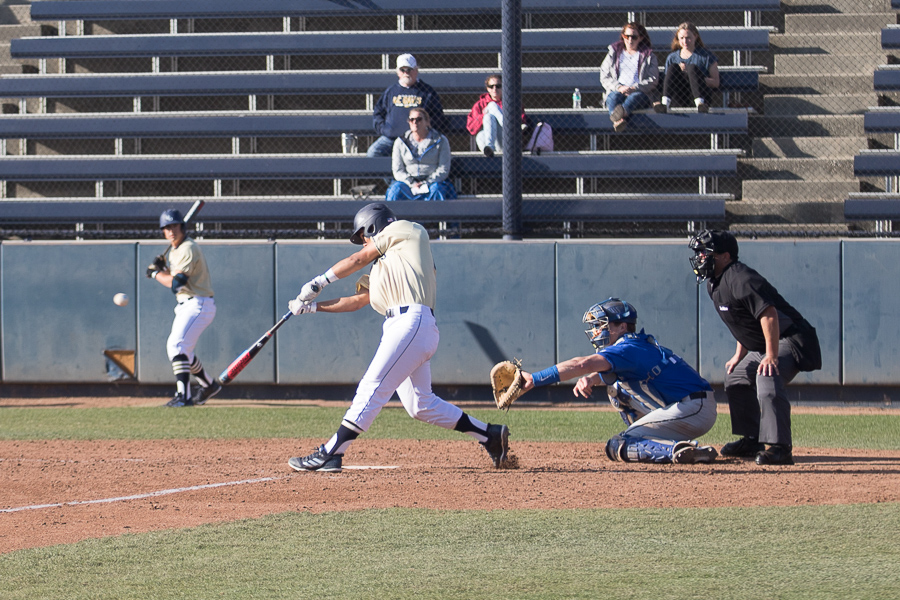
The UC Davis baseball team fell to Creighton in eleven innings by a final score of 10-7 on Sunday afternoon at Phil Swimley Field, completing a three-game sweep for the visitors. The Aggies have now lost five consecutive games after opening the season with a pair of victories last week.

The Aggies fell behind in all three contests over the weekend, and their late-inning comeback rallies came up short on each occasion.

On Sunday afternoon, UC Davis found itself in a 7-5 hole with six outs left to play. The Aggies made it a one-run game in the bottom of the eighth when redshirt sophomore catcher Logan Denholm came off the bench and beat out an infield single to drive in sophomore first baseman Alejandro Lara.

After back-to-back walks with one out in the bottom of the ninth, junior second baseman Caleb Van Blake lined an RBI single to right field to tie the game at 7-7. However, UC Davis was unable to further capitalize on the opportunity, stranding the potential winning run on third base with a strikeout and a ground out.

Creighton exploded for three runs in the top of the eleventh inning to grab a 10-7 lead, highlighted by a two-run double down the left field line. The Aggies were retired in order in the bottom half of the inning to end the game.

After conceding a pair of unearned runs to open the ballgame, due to an error on the infield, the Aggies erupted for a five-run rally in the bottom of the first. Redshirt junior designated hitter Ryan Anderson smacked an RBI single up the middle and senior shortstop Brad Pluschkell scored on a balk during the next at-bat. Then, Van Blake crushed a long three-run home run over the right field wall to give UC Davis its first and only lead of the day.

Overall, UC Davis had a hard time creating any momentum early in the game, giving up runs in each of the first four innings. The team also struggled to take advantage of some prime offensive opportunities throughout the afternoon, stranding a pair of runners in scoring position on two separate occasions.

One of the bright spots for the Aggies in the series was the play by Pluschkell, last week’s Big West Conference Player of the Week. Pluschkell continued his offensive hot streak, going 8-16 at the plate and scoring a run in each game. Primarily in the No. 2 spot in the lineup, he currently leads the team with a .563 batting average and 18 hits.

Friday afternoon’s series opener saw UC Davis lose by a final score of 6-3. Trailing 4-1 for most of the game, the Aggies battled back to make it a one-run affair with two runs in the seventh inning. Anderson ripped a home run over the left field wall, his first of the season, to get the scoring started.

The Aggies were not able to push across the tying run in a scoreless eighth, leaving two runners on base, before Creighton regained all the momentum with a two-run ninth inning to make it 6-3.

On Saturday, UC Davis played from behind for the entirety of the afternoon and faced a tough 6-1 deficit after just four innings.

The Aggies managed to come within two runs entering the ninth inning, taking advantage of a Creighton error and scoring three times to make it 6-4. Once again, the visitors added a run in the top of the ninth inning to halt the momentum and UC Davis went down quietly in its final at-bat to end the ballgame.

The Aggies’ eight-game homestand continues this weekend with a three-game set against St. John’s and culminates with a game versus St. Mary’s on Monday afternoon.


Written by: Brendan Ogburn — sports@theaggie.org

March Events Calendar

SHEREEN LEE / AGGIE

Enjoy a month of art, comedy, sports, gastronomic experiences

John Cleese, Live on Stage plus a Screening of “Monty Python and the Holy Grail”

Where? Jackson Hall, Mondavi Center

When? Wednesday, March 28 at 8 p.m.

What is it? Famed comedian John Cleese is bringing his talents to Davis. The “Monty Python” co-founder will be speaking on his life and comedic career, followed by a Q&A with the audience and a screening of the cult classic “Monty Python and the Holy Grail.”


Global Flavors: Risotto and Gnocchi
Where? Teaching Kitchen at the Davis Food Co-op
When? Friday, March 9 from 6 to 8 p.m.
What is it? Head down to the Davis Food Co-op to learn all about gnocchi and risotto. The Teaching Kitchen at the Co-op holds monthly events that often involve learning to cook exciting dishes while enjoying a drink.


Lorde: Melodrama World Tour

Where? Golden 1 Center

When? Monday, March 12 at 7 p.m.

What is it? Grammy-winning singer Lorde is coming to Sacramento’s Golden 1 Center. The young talent is on tour promoting her latest hit album, “Melodrama.” She will be joined by openers Run The Jewels and Tove Styrke.


Botanic Fanatics

Where? Wyatt Deck, UC Davis Arboretum

When? Sunday, March 4 from 12 to 2 p.m.

What is it? A seminar on plant uses. Guest will learn all about unique plant varieties and their uses with regard to creating natural dyes and oils.


“Wayne Thiebaud | 1958–1968”
Where? Manetti Shrem Museum

When? Now through May 13

What is it? A celebration of the artistic beginnings of the groundbreaking Wayne Thiebaud. The exhibition gathers a collection of paintings from the former UC Davis professor’s portfolio.


Golden State Warriors vs. Sacramento Kings

Where? Golden 1 Center

When? Saturday, March 31, 7 p.m.

What is it? End March with a bang in the state capitol. The NBA’s defending champion, the Golden State Warriors, travel north to face the Sacramento Kings. Attendance not recommended if one is a diehard Kings fan. However, if one is impartial, the event will be studded with NBA All Stars and future Hall-of-Famers.


Written by: Rowan O’Connell-Gates — arts@theaggie.org

Through the Artist’s Eye: Shuyi Qi

SHUYI QI / COURTESY

UC Davis student talks personal showcase, politics of art

Shuyi Qi, a fourth-year studio art and political science double major, is showcasing her collective work accumulated over her residence at UC Davis in an exhibit called “Journey.” The featured show is a water series, a collection of pieces inspired by the philosophical ideas introduced in Plato’s “Republic” — the struggle to transfer intangible, metaphysical forms into a visual world.

Originally from Beijing, China, Shuyi moved to the Silicon Valley at the age of 5. Growing up in an environment that produced more tech minds than artists, Qi managed to incorporate a technical, detail-oriented algorithm to her representational, not-quite-abstract work.

However, Qi explains that she wanted to allow abstract art to be the focal point of her exhibit.

“I found an interesting comparison [to Plato’s philosophy] through water,” Qi said. “At first, I was painting oceanscapes around Point Lobos near Pebble Beach. The water is constantly moving, and I wondered how I would paint this. I noticed that the water makes a diamond shape when it comes up the shore to create waves, and it reminded me of fluid dynamics.”

In the larger scope of her exhibit, Qi wanted to reflect on not only her art, but also her progression from then to now.

“It’s called ‘Journey’ because it’s about my artistic progress as a UC Davis student,” Qi said. “I have works that were done as far back as freshman year — only one, though, the only one that I thought was suitable, the one that can uphold a standard. Everything is ordered in a loosely chronological order. The oldest pieces are shown in the beginning, and as the observer works their way to the center, they find the most recent pieces.”

Her ability to appreciate her journey is refreshing and bold. It’s not often we look back and appreciate how far we’ve come and showcase it to the world.

In terms of personal growth, Qi found inspiration from her professors.  

“I definitely think that I improved a lot with each class,” Qi said. “Some of that is due to my professors pushing and challenging me to step out of my comfort zone. The advice that stood out to me most was to use more color: ‘Don’t be afraid to push the color.’ Typically, I am representational to a fault, so exaggerating color was never easy for me. Taking myself out of my comfort zone bled into my personal life. It’s made me less reluctant to open up to new experiences and new people. I learned to let go.”

With an unapologetic perspective, Qi was more than willing to share her thoughts with regard to the role an artist plays in the interpretation of their work, revealing her political side.

“I believe every artist has their own approach to assigning meaning to their art,” Qi said. “Personally, I like to be more upfront with my intention. I like to point people in certain direction to get them to think about certain topics and issues. I think it not only shows a lack of artistic skill, but cognitive skills when an artist leaves too much up for interpretation for the viewer.”

Qi, of course, recognizes there are exceptions — still lifes are a good example of that.

The artist speaks of upholding an unspoken artistic “standard.” She tried to focus on the value of her content and maintain intention with “rhyme and reason.”

“In comparison to the rest of the Art Department, I am quite ‘conventional’ with my methods, which makes me the odd one out at times,” Qi said. “Focusing on being ‘edgy’ takes away from actually understanding and interpreting their work. I don’t think there’s enough thinking going on.”

Her abstract exhibit is a great example of all the great things art has to offer. In an era of technology and practicality, it’s a breath of fresh air to see a place like Silicon Valley — the home of the Steve Jobs and Bill Gates of the world — produce such a painter.

The exhibit is being displayed at the Walter A. Buehler Alumni Center from Feb. 5 to March 9.


Written by: Josh Madrid — arts@theaggie.org

Sacramento makes traffic safety a priority

JEREMY DANG / AGGIE

Fight for zero traffic deaths by 2027

Sacramento’s Vision Zero traffic safety program aims to eliminate vehicular fatalities and serious injuries in the city by 2027.

The city is developing a Vision Zero Action Plan that will identify factors influencing traffic incidents and lay out necessary actions for stopping vehicular deaths and injuries.

Vision Zero is based on the philosophy of there being no such thing as traffic ‘accidents’ — instead, all traffic incidents are seen as preventable.

Jim Brown, the executive director of Sacramento Area Bicycle Advocates, expressed admiration for the city’s efforts put toward bike and pedestrian safety.

“Improving roadway safety is the key to realizing the environmental, health and economic benefits of bicycle transportation,” Brown said. “These are benefits that touch the entire community. [SABA] applauds the city’s ongoing work to implement Vision Zero.”

Kirin Kumar, the executive director of WALKSacramento, emphasized the benefits that stem from increased accessibility to active transportation.

“Studies have shown that one of the most important factors contributing to one’s ability to move into the next socioeconomic level is access to quality transportation,” Kumar said. “In order to make Sacramento the truly first-class city we know it can be, we must take these critical steps toward zero.”

Walt Seifert, a member of Sacramento’s Bicycle Advisory Committee and Vision Zero Task Force, echoed the sentiments of Brown and Kumar.

“Bicyclists and pedestrians are disproportionately the victims in traffic crashes,” Seifert said.

At a city council meeting in January 2017, Seifert expressed his support for automated speed enforcement.

Last February, San Francisco Assemblymember David Chiu drafted AB 342, which would legalize automated speed enforcement for a five-year pilot program in San Francisco and San Jose.

The program aims to decrease car speed by redesigning Sacramento’s streets through street narrowing, road diets and speed-feedback signs.

According to Vision Zero’s study, about a quarter of car crashes in Sacramento were alcohol-related. The city plans to create educational and promotional campaigns in order to discourage people who have been drinking from driving and instead encourage ridesharing and designated drivers.

Sacramento’s Bicycle Master Plan intends to construct protected and buffered bike lanes on streets with a mile-per-hour limit of 30 or higher as well as post signs warning drivers about the presence of bicyclists.

According to a study done by the city, 79 percent of all crashes occur on Sacramento’s high-injury network, which accounts for under a quarter of the city’s roadways. A disproportionate number of the city’s high-injury roadways run through disadvantaged neighborhoods and near schools.

Vision Zero is a multinational traffic safety program that started in Sweden in 1997. The program made its way to the U.S. in 2014 in New York and has since spread across the country. As of January, California had nine Vision Zero cities.

Traffic deaths in New York City are down 30 percent since 2013, the year before Vision Zero was implemented.

According to the Vision Zero Draft Action Plan, during the five-year period from 2010 to 2014, 130 people died in traffic crashes in Sacramento, including 48 pedestrians and 13 bicyclists.

The Vision Zero Task Force is made up of over a dozen government agencies and private organizations including SABA, Sacramento Regional Transit, Society for the Blind and Sacramento City Unified School District.

The City of Sacramento recently began its efforts in traffic safety by implementing a monthly urban bicycling class, installing Sacramento City College’s bicycle and pedestrian bridge and approving over $22 million in safety grant improvements from 2013 to 2017.

Sacramento’s Vision Zero Final Draft will be presented to City Council this spring.


Written by: Dylan Svoboda — city@theaggie.org

Happiness Campaign strives for less stress, more joy

CAITLYN SAMPLEY / AGGIE

The Happiness Campaign seeks to reduce anxiety, increase happiness

As the UC Davis-wide Happiness Campaign comes to a close, fourth-year English major Sofia Molodanof shared what makes her happy.

“Happiness is very specific to each person,” Molodanof said. “I think it is just being able to understand and being aware of things that make you happy. I really like taking walks through the Arboretum that is something I love. Some people find happiness by sitting under a tree and reading a book. It is really just acknowledging those different ways that can promote happiness for yourself.”

The Happiness Campaign, a weeklong event on campus from Feb. 26 to March 2, brings attention to the stress that students experience as well as introduces strategies to manage stress and foster mental well-being. The event is sponsored by the Health Education and Promotion department at UC Davis.

Molodanof, who is the mental well-being student coordinator for HEP, gave an overview of this year’s activities. She discussed a few events which took place earlier in the week. One event, Promote Happiness, included tabling on the Quad.

“The tabling event is focused on spreading happiness and students will be able to receive a happiness kit,” Molodanof said. “There will also be a way for students to be interactive — to get feedback on where students find happiness.”

The second event, titled Seek Happiness Through Yoga, was centered on yoga.

“The Yoga Club will have a special session that focuses on finding happiness through meditation and this is a great way for students to practice relaxing,” Molodanof said.

“Our third event is on Friday, March 2, and is our Peace, Tranquility and Happiness Crafternoon which we are co-sponsoring with our LGBTQIA [Resource] Center from 12:30 to 3 p.m.,” Molodanof said. “This will be an opportunity for students to create tranquility glitter jars, and they can learn about ways to spread more happiness.”

Emilia Aguirre, a mental well-being health promotions specialist for HEP, spoke about the purpose of the event and ways in which students can benefit from it.

“The Happiness Campaign is a social marketing campaign […] to raise awareness about positive psychologies, about positive affirmations on campus and to really just spread happiness,” Aguirre said. “We really want to remind students that everybody is going through their own struggles and just to remember and shed light on being positive.”

Molodanof gave details on the stress UC Davis students experience.

“From the information and feedback that we got in, students at UC Davis tend to be more stressed than other university campuses,” Molodanof said. “[The] main reasons include academics, relationships and students having to work. I think one of these things is just taking time for themselves. We are hoping that these activities will allow them some time to get in touch with themselves and to be relieved from stress for a little bit of the day. I think coming up with ways for students to alleviate that stress is super important.”

In a follow-up interview by email, Molodanof provided statistics on the level of stress encountered by UC Davis students.

Every other year, UC Davis implements the American College Health Association, National College Health Assessment (ACHA NCHA) which identifies health behaviors and perceptions related to a wide range of topics including mental well-being,” Molodanof said. “Based off of the most recent ACHA NCHA 2017 undergraduate survey, we found that 44 percent of UC Davis students reported that their academic performance was adversely affected by stress in the past 12 months, which is 10.2 percent higher than the national average. 62.5 percent of UC Davis students reported that academics was traumatic or very difficult to handle within the last 12 months, which is 13.8 percent higher than the national average.”

Aguirre empathized that stress management is an ongoing process.

“In addition to reaching UC Davis students through social marketing and just raising awareness [through] these events, [it is] also getting students to attend them and to take something from them — to expose them to different ways that they can take time for themselves and integrate that into a daily routine,” Aguirre said. “Really just building that time to just reflect on the good and what makes each person happy.”

Stephanie Miramontes, a third-year human development major and a volunteer at HEP, offered her ideas on being happy in an email interview.

“I think that one way you can be happier as a student at UC Davis is by getting closer to the campus community,” Miramontes said. “Joining a club, engaging in new activities, and meeting new people you can find friends and happiness at UC Davis. I also think that just taking a moment to step back and remember everything you’ve accomplished to get here can help as well! I know things can be stressful at times, so it helps to take a short break and forget about what is on your plate.”


Written by: George Liao — campus@theaggie.org


Phantom Thread: a review by the Aggie’s arts desk

DIANA LI / AGGIE

Ball gowns, toxic love — and mushrooms?

The California Aggie’s arts desk took a trip to Varsity Theater to see “Phantom Thread,” an Oscar-nominated film about Reynolds Woodcock, a 1950s London dressmaker. Aggie arts writers take a closer look at the film — and perhaps mushrooms.


Isaac Flores

For boys and girls hungry for a gripping, psychological movie theater experience, “Phantom Thread” is the movie that hits the spot — not unlike a fistful of questionable mushrooms. Inextricably tying together themes of love, violence, domesticity and dependency, the film depicts the relationship of a dressmaker and waitress in 1950s London as a means of exploring the connections between these seemingly disparate subjects. The finished product is a tapestry that artfully chronicles an increasingly toxic relationship that should challenge all viewers to examine their own personal relationships.


Sydney Odman

“Phantom Thread” transcends all cinematic expectations, in more ways than one. It is captivating as much as it is mystifying, completely enthralling its audience into the world of the Woodcock family. Daniel Day Lewis’ performance, alongside Vicky Krieps’, perfectly depicts the convoluted romance that ensues between their characters, Reynolds and Alma. “Phantom Thread” leaves you yearning for more, but also contemplating your own feelings about what transpires between the two lovers in the end. Confused? You should be.


Josh Madrid

The long, kinky journey to a man’s heart truly does end in his stomach — as the new saying goes. Daniel Day-Lewis and Vicky Krieps find balance in their relationship through exchange of power and dependency. The predictability of London in the 1950s calls for a little “it’s complicated” — woven into the lining of the clothes. The visual integrity of the era is preserved in the detail of the costuming, and the soft tones juxtapose the dark love that it clothes.


Ally Overbay

This two-hour film about a 1950s London dressmaker was anything but lacey and delicate. “Phantom Thread” is dark and foreboding, diving deep into a relationship that gives many meanings to “toxic.” The visuals are striking, with rich colors and textures dashing across the screen in the shape of gowns. Every sound is amplified to a conspicuous degree; even the puncturing sounds of needlework resonate in a theater. But the production is as successful as the film’s dynamic characters, whose complex personalities set the scene for an ending that both shocks and resolves. By the end of the film, viewers are forced to examine the autonomy of their relationships — or more accurately, their dependence on them.


Nic Rago

What’s not to expect from this movie? Well, basically anything the trailer shows. What I thought was to be a period melodrama veered hard off the beaten trail of that path, turning into a period mystery piece surrounding the possibly masochistic ideals of Abe Lincoln’s relationship with a young woman in London. Thank you Daniel Day Lewis?   


Caroline Rutten

Expect to leave the theater in a weird mix of genuine shock and gross relatability — and to be thinking about the film for days after. The underpinnings of a successful, or not so successful, relationship is the overall theme of the plot — the lengths at which we depend on those that we love. I’ll end with this: beware of mushrooms.


Cara Joy Kleinrock

Walking into the movie I had no idea what to expect besides the fact that Daniel Day Lewis would be amazing. The cinematography was exquisite, and you could see every detail in each piece of clothing. The storyline is compelling, although walking out I still didn’t understand what it was exactly that I watched.


Written by: The Arts Desk — arts@theaggie.org

A divided ASUCD

CAITLYN SAMPLEY / AGGIE

Election results further ASUCD toxicity

Michael Gofman and Shaniah Branson of the Unite! slate won the ASUCD election for president and vice president by a small margin on Friday, Feb. 23, narrowly defeating Julie Jung and Julienne Correa of the BASED slate.

The response by members of ASUCD that followed was swift, vocal and unabashedly acidic. A combination of current and former ASUCD senators, commissioners, volunteers and community members vocalized their opposition to the election results via social media with a litany of responses ranging from disappointment in the voters to serious accusations made against the Unite! presidential ticket.

In a campaign reminiscent of #NotMyPresident, the slogan “ASUCD does not represent us” has been adopted by dozens of dissatisfied students. The ASUCD Gender and Sexuality Commission went so far as to change the cover photo on its official Facebook page to reflect this slogan, writing, “In light of recent election results, we do not support executive elects complicit and active in maintaining white supremacist, trans antagonistic, lgbtqia antagonistic, and patriarchal institutions.”

This response is a shocking display of turmoil within the association and does nothing to improve existing and future relationships within the organization. It serves only to highlight the disparity in views represented at the table.

GASC, or anyone for that matter, should not blindly follow the president — on the contrary, they should take strong stances on issues they care about. Disagreements should be aired and addressed. But unqualified claims of white supremacy and animosity toward those elected by the student body — albeit, a decidedly miniscule proportion of students — only exacerbates the existing toxicity within ASUCD.

Antagonism in government breeds polarization, which can lead to gridlock and an inability to work across existing divisions. Students can either contribute to this polarization or approach ASUCD politics in a more constructive manner. This unequivocally applies to everyone within the association.

Arguably, many of the platforms that the Unite! presidential ticket ran on are similar to platforms championed by the BASED slate. Members of ASUCD should not let their reservations keep them from influencing and passing legislation that could lead to significant change for all UC Davis students.

In a recent interview with KDVS News, President-elect Gofman asserted that he wants to represent all voices on campus and create change by transcending politics. He said he wants input. It is the duty of ASUCD members to hold him to that — to never let up and to never be complacent. And they must consider the effects of refusing to engage at all.

The toxicity and deep divisions within ASUCD are more than apparent. The association is at a crossroads; its members can attempt to come together or can continue to push each other apart.

To the members of the association: The decision is up to you.


Written by: The Editorial Board 

The ordeal of speaking out in class

VENOOS MOSHAYEDI / AGGIE

Being seen as a bigot or worse in the classroom

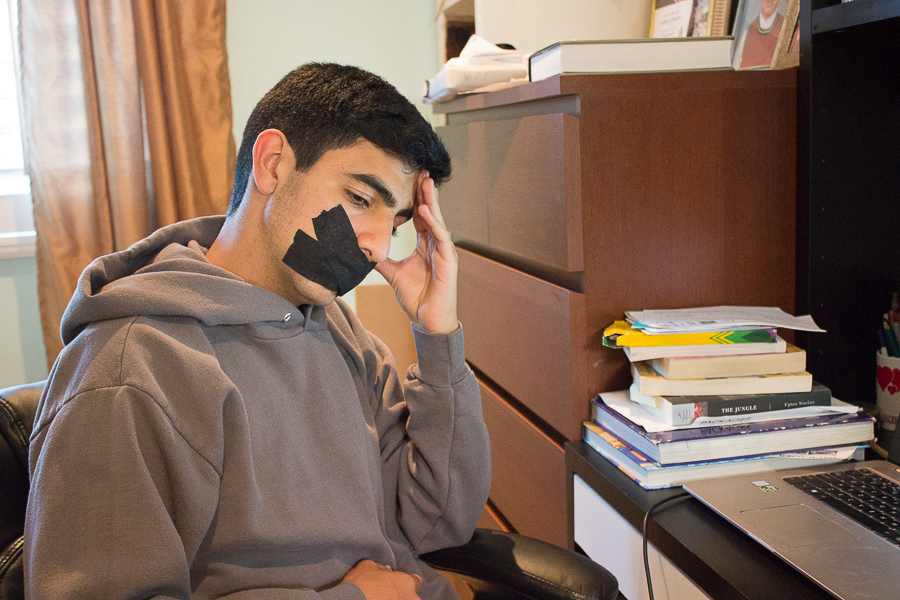
Why are students afraid to voice their opinions in the classroom? Political correctness has made it almost impossible to talk about social and sensitive issues. It’s difficult to have a rational conversation about race, women’s rights or other important topics because people’s biases impede a steady dialogue.


Namely, students are not voicing their opinions for fear of being ridiculed — or worse. I even get the sense that if I say something that borders on controversial in class, someone will nitpick and twist my words. And when students say controversial statements, it turns into a debate about how their opinion is wrong. That’s not always the case, but it does happen.

In my university writing program class, for example, we read “Women & Power: A Manifesto” by Mary Beard, a classics professor at the University of Cambridge. The book, written in the form of two lectures, focuses on historical accounts and other contemporary examples of women’s voices being silenced by men since the beginning of Western culture. Our professor assigned a set of journal questions to facilitate the discussion — except when it was time for the class to deliberate, silence ensued. The professor asked the class, “What gives?” Finally, a student in my class eloquently stated how he felt uncomfortable talking about his thoughts because he didn’t want to say something dumb.

I felt the same way as my classmate. I tend to get quiet whenever topics like those in Beard’s book come up in class. In particular, I didn’t say anything in my UWP class because I felt that my point of view as a man would be invalid versus that of a woman.

If the topic of immigration were to come up in class, for instance, I would be on high alert to refute others if what they said was insulting. In short, I feel like an expert on immigration. I’m Mexican, I have first-hand experience on how immigration affects people’s lives and I feel comfortable discussing it. But a topic like women being silenced throughout history isn’t one of my strong points. I’d feel uncomfortable saying something inaccurate, so I’d rather not even take that risk.

People are scared to voice their opinions on hot topics for different reasons. Not wanting to sound ignorant or like a bigot, some students remain quiet. At least that way they can’t be wrong or made fun of. It’s better to say nothing than to be made a fool of in class.

Even though the classroom should be a safe space for students to actively voice their concerns and thoughts, that’s not always the case.

Chiitaanibah Johnson, a Native American student at Sacramento State University, was threatened with expulsion by a history professor after she confronted him for teaching students “on whether the word ‘genocide’ is appropriate to describe what happened to American Indians.” Johnson came back to class and presented evidence against her professor, stating that she did not like the way the professor was lecturing the class on the term “genocide” and its relation to Native Americans.

The incident highlighted several important aspects of free speech and opinion: your thoughts and words have consequence, and other people may take offense to sensitive issues. So every time I say something in class, my heart races because in my head I’m thinking, “Make sure you say what you need to say, don’t sound dumb and make sure to speak clearly.” Speaking in class shouldn’t feel like it’s a big deal, but in the moment, it does.

What needs to happen in order for effective dialogue to take place in the classroom? The most important step is calmly presenting facts, evidence and other statistics that corroborate your main points. Staying calm and collected and not letting bias get in the way of arguments is essential to producing productive discourse. It may not always be possible, but we can always attempt.


Written by: Alejandro Lara — amlara@ucdavis.edu

Disclaimer: The views and opinions expressed by individual columnists belong to the columnists alone and do not necessarily indicate the views and opinions held by The California Aggie.

Reporting from Russia with love

JOSEF.STUEFER [(CC BY 2.0)] / FLICKR
Nothing can prepare for culture-shock, and that’s okay

There are those who get nervous, and there are those who say they don’t get nervous. The latter group is lying. The idea that nerves can be bought and brokered, or charged up and down at will, is also a lie. That was never made clear to me until I boarded the British Airways flight in London, final destination St. Petersburg, Russia.

The most common question I faced before heading to a country that dominates American news — rather unfavorably, I must add — was about nerves. “Are you nervous? Or wary? What do you think about living in a hostile country?” And so on. If the sentiments weren’t exactly touching on the anxieties Americans face when dealing with Russia, they were certainly implied.

So, when I finally boarded that flight at 9 in the morning on a dreary London tarmac, the nerves caught up to me in a way that was rather startling. I found my seat and opened the safety instructions booklet for the first time in my life. I followed the MO of a Jason Bourne-type spy on the run, scanning the compartment and taking note of the passengers who were definitely Russian and those who may have been Russian but lacked the look I thought would prove this.

It turns out most of the passengers were British, but that’s beside the point. The idea of studying in a country as politically relevant as Russia splashed over me, and with it came the anxiety. What had been a distant dream for so long was now a short flight from becoming reality.

As with most such tales in real life, the climax didn’t propagate death or tragedy. Instead, the plane touched down on a snowy runway surrounded by bare trees and a smattering of industrial-looking buildings. The customs checkpoint didn’t lead to detainment, the icy highways and mud-caked cars didn’t cause a fiery accident and the blank faces of commuters didn’t show hostility, but rather a way of living that favors intimacy over external emotions in public.

Now a few weeks into my stay in St. Petersburg, I’ve discovered that no amount of preparation offers a foolproof way of managing culture shock. It’s the difference between studying for the SAT and actually taking it with the pressure dial turned to its highest setting. No amount of language study or cultural knowledge or historical analysis can replicate the real thing.

The best knowledge comes from practical experience, even if it’s uncomfortable. I quickly learned that embarrassment is secondary to the information learned using butchered grammar, for example, while trying to leave a crowded metro.

Some Americans will harp on foreigners for lacking proper English skills, but it’s likely they’ve never had to purchase a gym membership in another country while speaking another language. If so, empathy for those trying to hurdle communication barriers might be more forthcoming.

This is a city ripe with history, from museums and majestic palaces detailing the golden age of the Russian monarchy to gray, stoic buildings that provide easy (and sometimes uneasy) remembrance of 70 years under the hammer and sickle of the Soviet Union.

Underneath its decor, St. Petersburg — let alone the rest of Russia — can be very intimidating. People rarely smile in public, unlike the way Americans often do. Security officers profile men with backpacks on the metro and point them to X-ray machines, reflecting heightened security concerns following a terrorist attack last year.

But beneath that is a city overflowing with life. The cold exteriors and bulky coats vanish when you walk inside or make an effort to know someone. Friendliness will be returned. Taking the risk and jumping off the deep end — facing a country that elicits stares and questions of nerves back home — is worth it.

I’m sitting in a cafe, a short walk on snow-covered streets from my apartment. Soft music fills the background murmurings, and patrons swig cups of hot tea before braving the cold outside. Whispers float by, words here and there that tend to characterize public conversations  — hushed tones that shield against eavesdroppers. I finish my coffee. The waitress walks by, feet churning in a pair of Nikes. The sun is peeking through the clouds.   


Written by: Nick Irvin — ntirvin@ucdavis.edu

Disclaimer: The views and opinions expressed by individual columnists belong to the columnists alone and do not necessarily indicate the views and opinions held by The California Aggie.

Humor: “The Aggie” found to be best newspaper at UC Davis

NICHOLAS CHAN / AGGIE FILE

We don’t host Nazis

A poll published early this week revealed that “The California Aggie” is the best newspaper in all of UC Davis. Most of the competition consisted of random WordPress writers whose content was found to be vastly inferior and indicative of how our education system is failing students, even at the college level.

“It turns out most people can’t write for shit,” said Richard Spencer on the KDVS radioshow, “Klansmen, Dictators and Vindictive Socialists.” “That’s why this interview has gone so well for me.”

The poll was split into multiple categories, with the humor department topping almost every one. Writer Drew Hanson was given the award for Most Credible News Source, next to the Trump Administration’s secret UC Davis branch in Davis College Republicans. The Davis College Democrats were given no awards and were barred from the competition for ties to international Marxists.

When asked why he read “The Aggie,” Gary May said, “Why the hell would anyone get their news from ‘The Aggie’? All it has to offer is humor, and that alone is worth the $11.19 tuition hike.”

The main competitor of “The Aggie,” both schoolwise and newspaperwise, is UC Berkeley. Of all the brilliant minds at UC Berkeley, not a single one of them works for “The Daily Californian.” Instead, their newspaper, more of a biased indoctrination service, is the work of neo-Marxists trying to dismantle what made America so great in the first place: murder and imperialism.


Written by: Drew Hanson — andhanson@ucdavis.edu

(This article is humor and/or satire, and its content is purely fictional. The story and the names of “sources” are fictionalized.)