55.1 F
Davis

Davis, California

Saturday, December 20, 2025
Home Blog Page 548

How does TherMOOstat work?

JESSICA CONTRERAS / ENERGY CONSERVATION OFFICE

UC Davis web application works to increase comfort, reduce energy waste

Since the fall of 2014, the Energy Conservation Office at UC Davis has had a tile on the myUCDavis site for its web application TherMOOstat. Students, faculty, staff and guests are able to submit comments through TherMOOstat about how rooms on campus feel — hot, warm, perfect, chilly, or cold — in order to help the ECO crowdsource comfort on campus while keeping energy costs down.

When submitting a comment through TherMOOstat, the ECO asks about the building, room number, current comfort, level of clothing and amount of physical activity performed in the last 10 minutes.The team’s mascot, Joules the Cow, is eager to assist.

“We’re excited to be able to use all of this great crowdsourced data that everyone is submitting and put it to good use,” said Kiernan Salmon, a data analyst and product developer at the ECO. “We’re able to tailor the project that we’re doing in this office to what people need.”

Managing the temperatures of a large campus is like managing a city, said John Coon, the energy project manager at the ECO. Some of the challenges are due to the diverse accomodations found in a university. Undergraduate students might be most familiar with lecture halls and classrooms, but full-time staff members may work all day in an office, while graduate students could be spending long days in a specialized laboratory. Each room has unique ventilation requirements

“We’ve got over 1,000 buildings on campus,” Coon said. “Some of the buildings have temperature control systems, so that we can see what the major equipment and what the major conditions are inside the buildings.”

Some buildings, due to age or design, are not completely visible with the remote tools used by the staff at the ECO or Facilities Management, the group which responds to submitted work orders. Haring Hall and the Memorial Union are two such structures, receiving the most comments so far this quarter, at 74 and 67, respectively. Most comments claim the buildings are too hot, but in previous quarters, most felt the buildings were too cold.

“We receive, on average, about 300 [comments] a month,” Salmon said. “One of the trends that we see is, when the seasons are changing, the number of votes we get goes way up. For us, March and April, our big months, could have 500 to 600 [comments]. October and November, when it starts to get colder outside, those are big months for us, 500 to 600 again. It fluctuates a lot in the summer, when students aren’t here.”

Every comment submitted through the TherMOOstat system is manually reviewed and investigated.

“When we get a comment, or feedback, in from TherMOOstat, I’ll take a look at it,” Coon said. “I’ll take a look at the timestamp and the building and which room they’re in, and first determine whether or not I can see anything because there are buildings on campus I can’t see at all.”

Coon is able to see what most buildings and rooms are being used for on campus at a given time. A single complaint of chilly temperature in a lecture hall of 300 students may not set off alarm bells or send a team in to rush a work order, but will be considered for historical trends.

“We take the feedback and we use it to inform future decisions,” Coon said. “There’s not much relief we can offer immediately.”

Properly controlling temperatures in campus buildings can help reduce the energy usage and expenditures on campus, as detailed in a short educational program created by the ECO.

“We have a Trim the Waste program, a four-part series where people learn a bit about how the campus uses energy,” Salmon said. “Then we show them the factors that influence how much energy each building uses.”

Energy usage, as well as the type of energy used, can have important economic impacts at UC Davis. Carrie Chung is a fourth-year communication major serving as a communications intern at the ECO. One of her roles involves crafting blog posts to share new insights to the public — including how much energy and money UC Davis saved by changing heating and cooling tendencies over breaks.

“Over the holidays, when there’s nobody here in certain buildings, we just shut those buildings off completely and turn off all heating, cooling, and lighting,” Chung said. “This saves us thousands of dollars.”

The TherMOOstat system may not be an automatic temperature control system for the thousands of students, faculty, staff and guests who work together as campus “roommates”, but by collecting information about how people feel in their rooms and buildings, the ECO is able to help increase personal comfort, reduce energy costs and educate the public about energy usage.

“We try and let people know how their building works, so they get a better idea of what they can do on their end and what we can do on our end,” Salmon said. “It’s more of a discussion that way.”


Written by: George Ugartemendia — science@theaggie.org
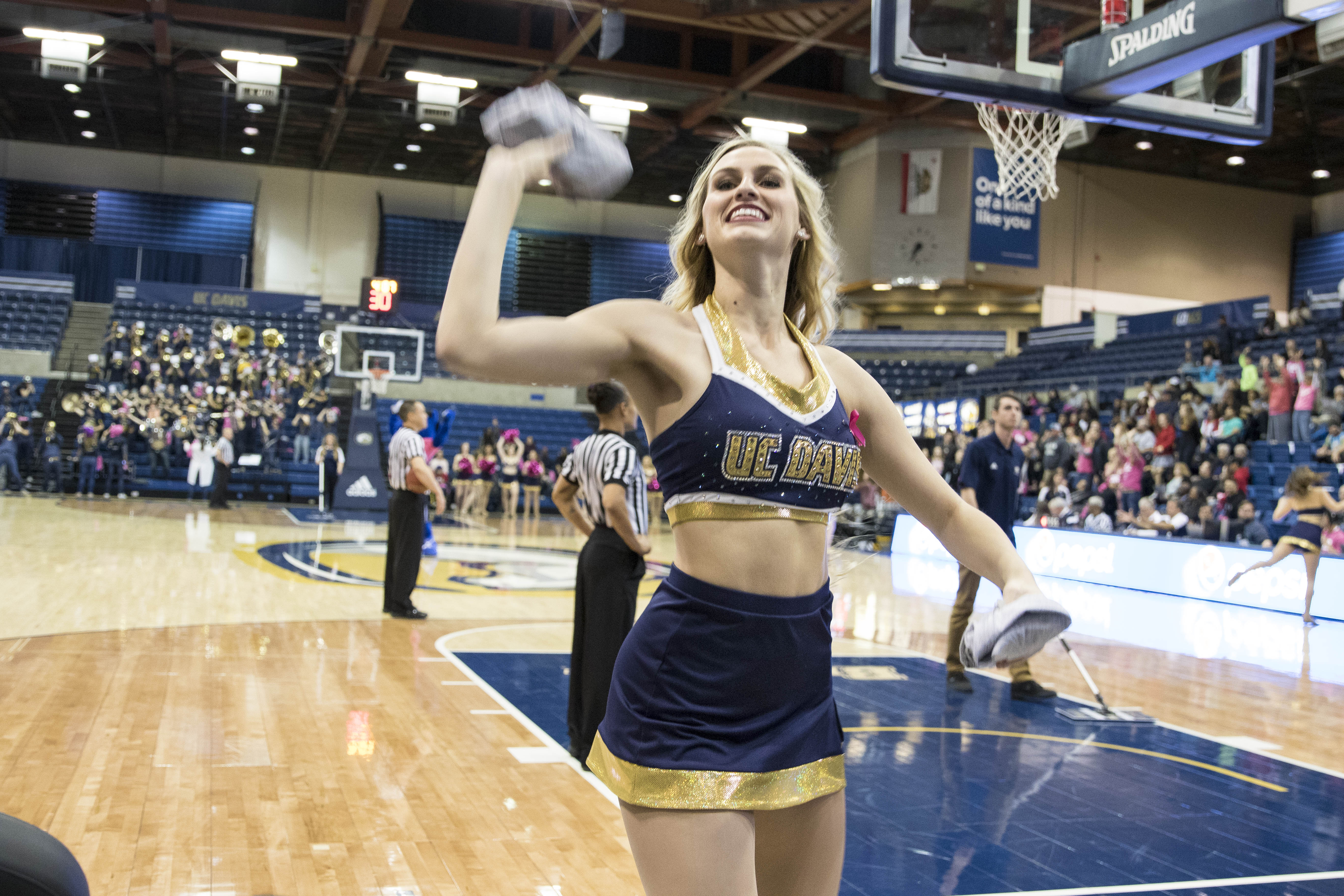
 

Cheering on home sports comes with a prize

0
DIANA LI / AGGIE

Students get opportunity to win thanks to Athletics Marketing

UC Davis students have been given an increased incentive to support the 11-1 women’s and 8-4 men’s basketball teams — UC Davis Athletics Marketing has been been sponsoring Amazon giveaways, free sushi for a year competitions and theme nights. These promotions are intended to encourage attendance and participation at athletic events.

“We’re trying really hard to get our student population more engaged with both men and women’s basketball,” said Taylor Soares, a third-year communication major and an Athletics Marketing intern. “We’ve had a lot of double headers lately and the women obviously play first and we want [students] to come to both games and also we want to support other sports teams, like lacrosse and baseball, which is coming up soon.”

In order to be in the running for an Amazon Echo and two Amazon gift cards, students had to attend two athletic events of their choice from Feb. 7 through Feb. 10. Out of the six athletic events that week, students could choose to attend a gymnastics meet, lacrosse match or basketball game. Every time a student checked in at a game, the Athletics Marketing interns tabled and added them to a list. At the men’s basketball game versus Cal State Fullerton on Feb. 10, when students checked in, they received a raffle ticket. The winners of the raffle were announced during the second half of the game.

“The promotions seem to be working really well,” Soares said. “I feel like we’ve had some record attendance at games.”

Although student promotions — like the Amazon Echo raffle, game giveaways, the Woodstock’s Pizza Obstacle Course and the West Village Shoot-Out — are handled through Athletics Marketing and its partnerships with Learfield Communications and local businesses, the free Mikuni Sushi for a year was coordinated by UC Davis men’s basketball head coach Jim Les. Les starred in a promotional video with Mikuni Sushi owner Taro Arai to promote the competition.

Students had the opportunity to win a year of free sushi from Davis staple Mikuni Sushi by making a half court shot during Feb. 8 game against the UC Santa Barbara Gauchos. UC Davis Athletics Marketing cheered on the students competing with a Fathead of Arai. Unfortunately, there were no winners in the “Mikuni Half Court Shot Challenge.”

Both UC Davis men and women’s basketball teams are members of the Big West conference. During the Big West Tour, which runs from Jan. 10 through March 3, conference representatives worked with Athletics Marketing to give fans the chance to win prizes from the Big West spin wheel and tickets to the Conference Championship game.  

UC Davis Athletics Marketing has also hosted themed nights to make the games more engaging for students. The Thursday, Feb. 15 women’s basketball home game was “PinkOut the Pav” in support of the fight against breast cancer. Attendees were given pink shirts where they could write who they were supporting on the front. This giveaway was sponsored by UC Davis West Village. The upcoming double header on Feb. 24 will be both a Greek night, where students involved in UC Davis Greek organizations compete for highest attendance, and Senior Night. The night’s theme is “Bright Out,” so all students are encouraged to wear neon colors.

For more information on what Athletics Marketing will be offering at an event, students can follow @ucdavisaggies on both Instagram and Twitter and like UC Davis Athletics on Facebook.


Written by: Liz Jacobson — sports@theaggie.org


Judah and the lion concert review

JESSE STESHENKO / AGGIE

A band that makes you feel like part of the family

“It’s not you and me, it’s us tonight.” That was the motto of the night for Judah and the Lion’s Valentine’s Day show at Ace of Spades.

Ace of Spades, for those who don’t know, is a big room with red walls and an intimate stage.  There’s no seating for the venue, which is great for tall people — but less so for short people like me.

The first band to perform was Tall Heights, a delightful surprise of an opening band. They are an electro-folk duo based out of Boston with a soft melody and a folk flare. The audience couldn’t stop swaying. At one point during their set, they instructed the audience to call the person standing next to them and then put their phones on speaker. They then told us to put the phones on top of each other, which created a humming sound that they used in their song. It was a great way for the audience to feel connected with each other and the musicians present.

The second band to perform was Colony House. Like Judah and the Lion, Colony House is also from Nashville, Tennessee. Their music was a little livelier than Tall Heights’, but still along the lines of alternative music. They were a great band to pump up the audience.

After about 15 minutes, the stage went from black to a cool blue, with fog rolling in and “Booty Wurk” by T-Pain playing in the background (at this point I questioned if I was at the right concert). But Judah and the Lion did a great cover of the song, hilarious in that “Booty Work” isn’t a song you would expect from a Nashville, folk-hip-hop band.

For the song “Reputation,” they split the audience into teams; the first team called “Overalls” based on the guitarist’s outfit, and the second called “Beard” based on, you guessed it, the other guitarist’s insane beard. They did this throughout the night at every chance they could. They clearly wanted everyone in the audience to feel as much a part of the concert and the experience as they did while performing.

Halfway through the show they brought the other two bands back on stage, and they performed a cover of “Mr. Brightside” by the Killers and the room lit up with excitement.

Their music is relevant to me, and to my peers, because it’s based on the band members’ experiences during their early 20s. At the end of the concert, Judah, the lead singer gave an inspirational speech about being able to do anything, which eventually transitioned to my favorite of their songs, “Going to Mars.” For this speech, he ran into the crowd and sang from the top of the railing he stood on, making the audience feel even more connected.

All of their songs are different in genre and overall sound. They use a banjo quite a lot, and their music simply makes you want to move. If you listen to their lyrics, some of it is ridiculous, but it works because they aren’t ashamed of who they are or how silly they can be.

This was the third time I saw Judah and the Lion perform, and it definitely won’t be the last. This performance was so full of spirit that it reignited my passion. I left the venue feeling like I could do anything.


Written by: CaraJoy Kleinrock — arts@theaggie.org

Celebrating Black History Month

0
CAITLYN SAMPLEY / AGGIE

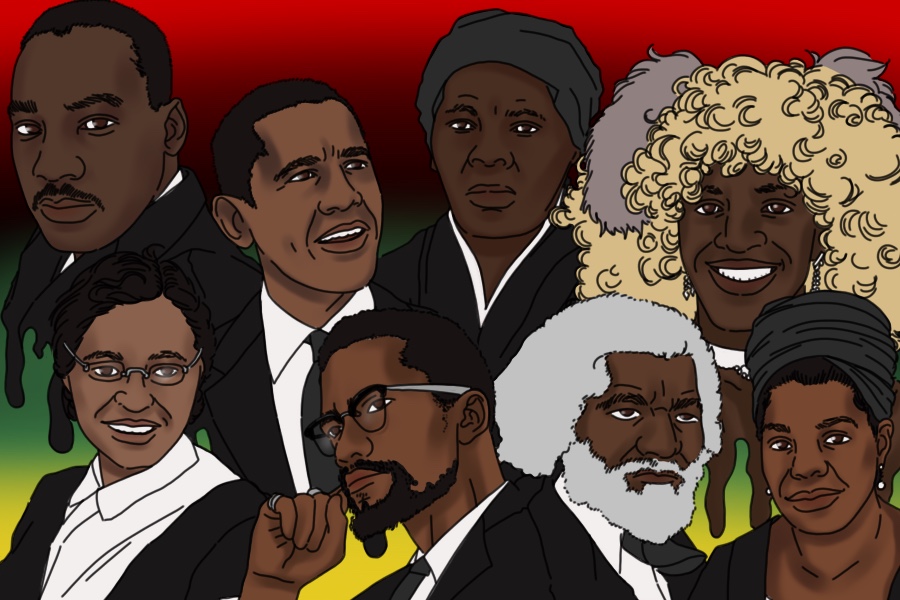
Students from the African American community reflect on Black History Month and what it symbolizes

Since the 1970s, February has been nationally recognized as Black History Month, a month dedicated to celebrating the sacrifices and contributions that African Americans have made to society. UC Davis students from the African American community see the month as an opportunity to bring collective awareness to the profound impacts that African Americans have made throughout history.

Sabrina Williams, second-year communication major and the communications director of the Black Student Union at UC Davis, appreciates the notion of setting aside an entire month to allow individuals to familiarize themselves with African American history.

“I’m glad we have a month where it’s just about us,” Williams said. “It’s very important to learn about African American history, of what [has] happened in the past and what can transpire in the future. It’s good to know what people have gone through because that lets us know what we can do for the next generation.”

Williams, like many other individuals, looks at Black History Month as a time to evaluate the past and use it as a guide to working toward an improved future.

“I think black history is American history, and it’s a shame that we have to [limit] it to just one month,” said Brandon Thomas, fourth-year theater and dance major and student administrative assistant for the Center for African Diaspora Student Success. “But the thing that is special about it being dedicated to one month, even though it’s the shortest month of the year, is that there is just something magical about it. It’s a specific time to think about the past and its implications on the present and the future and about what we can do to get better as a people.”

Black History Month is also considered by many as a sacred time to reflect on the struggles that African Americans have undergone and how their strenuous efforts have yielded progress.

Thomas believes that, though African Americans have made monumental strides toward progress, they continue to fight an ongoing battle against oppressive societal forces.

“We live in an environment filled with covert racism, where people act underhandedly or they don’t even realize they’re doing it at all because they’ve been conditioned to respond and react to our people in certain ways,” Thomas said. “It feels like no matter what approach we’ve taken, we haven’t really gotten that far.”

The 2000s have given rise to various social movements, namely the Black Lives Matter movement, that aim to fight against the systemic injustices that have been inflicted onto African Americans. Aaliayah McKnight Corcran, second-year community and regional development major and the membership development coordinator for the Black Student Union, supports the movement in its goal of uniting society to work towards a critical cause.

“I feel like often times people sweep us under the rug,” Corcran said. “When we become invisible, we are made to feel like our presence and our issues are not important. In terms of the black diaspora community, I think it was really a time where we said ‘enough is enough.’ These things have always been happening, but it became a time where we couldn’t ignore it anymore. I know for me personally, it was really hard to grapple with these people being my cousins, my uncle, my brother and potentially me.”

Corcran feels that the Black Lives Matter movement, though successful to a certain extent, was misunderstood by many groups, thereby reversing the original intent of the movement.

“I think [the movement] showed other people’s colors,” Corcran said. “When it became a thing, there were so many other people saying ‘well what about us?’ And I think the whole point of the movement was missed. It just shows that sometimes other people see what we’re doing and think ‘we go through that too, why isn’t this also about us?’ I think it kind of goes back to certain groups, especially dominant groups, feeling like they have ownership over all areas of life. It’s an entitlement that they feel.”

As mentioned by Corcran, several countermovements, including the All Lives Matter and the Blue Lives Matter movements, have risen in response to the BLM movement. Auriona Adefris, a fourth-year political science major and the vice-president of the Black Pre-Law Association, stresses the importance of acknowledging the blatant oppression of African Americans instead of merely invalidating the issue.

“Black Lives Matter is trying to focus on issues that are actually happening, issues of people of color being killed by police at a higher rate than other people,” Adefris said. “Every life does matter, and no one is trying to say ‘you’re not important,’ but this [movement] is highlighting an issue that we need to be advocating for right now because it is an actual problem.”

In light of all the negative events that have transpired, UC Davis has been trying to cultivate inclusivity and create a welcoming environment for all individuals on its campus. Gwladys Keubon, a fourth-year chemical engineering major and the president of the Black Engineers Association, sees the school’s attempts as effective for the most part.

“I’m a senior, and I can tell you that yes, Davis is doing a way better job than it was when I came here as a freshman.” Keubon said. “There is a center here called CADSS [Center for African Diaspora Student Success]. Everyone from all different races are welcome there, and you’ll see this right when you walk in. It’s in perfect location, right in the middle of campus. It’s such a great feeling for me when I know that we’re not just a small group [that’s] put in the corner of the school somewhere. I would definitely say that the campus is doing better now and I hope that it keeps going.”

Other students from the African American community, however, feel that the school is doing the bare minimum in terms of promoting inclusivity and overall diversity, which in turn makes its students, especially ones that come from minority backgrounds, feel underrepresented. According to Thomas, the school could do more to invest in different multi-ethnic, multi-cultural programs on campus to provide a wider array of support and services for students of different backgrounds.

“I think UC Davis should invest more in diversity and not just put it on paper,” Thomas said. “They don’t necessarily give the proper funds and budgeting that they need to for some retention centers and different things like that to operate optimally for their targeted group of students. They need to invest in those centers and invest in their students in order to make [those] students feel more comfortable on campus.”


Written by: Emily Nguyen — features@theaggie.org


Police Logs

0
NICKI PADAR / AGGIE

Why did the dog cross the road?

Feb. 3

“Elderly male disoriented — thinks another subject at the facility is having an emergency.”

“Male just smashed out reporting party’s neighbor’s apartment window.”


Feb. 7

“Newer model Volkswagen beetle driving in the wrong direction. Vehicle was driving eastbound in westbound traffic on Covell.”

“Male transient on the ground floor near the elevator with three bicycles — reporting party advised subject appeared to be smoking something.”

“Skunk stuck between reporting party’s decorative fence and city/county fence in his backyard and appears to be in distress — has been there possibly overnight.”

“Reporting party received a package addressed to her but does not know the sender. The package contained a pillow wrapped in plastic and was sent from China. Reporting party concerned as she does not know the sender and wants advise on how to proceed.”


Feb. 8

“Vehicle circling the straight with subject standing up out of the sunroof — vehicle is a silver four-door sedan, unknown license plate.”


Feb. 9

“Secondhand information from Yolo — dog with collar crossed roadway.”


Feb. 12

“White panel van — lock and door handles missing — reporting party believes vehicle may be stolen.”


Senator Term Review: Yajaira Ramirez Sigala

NATALIE SKLOVSKAYA / AGGIE FILE

Ramirez Sigala’s performance as ASUCD senator

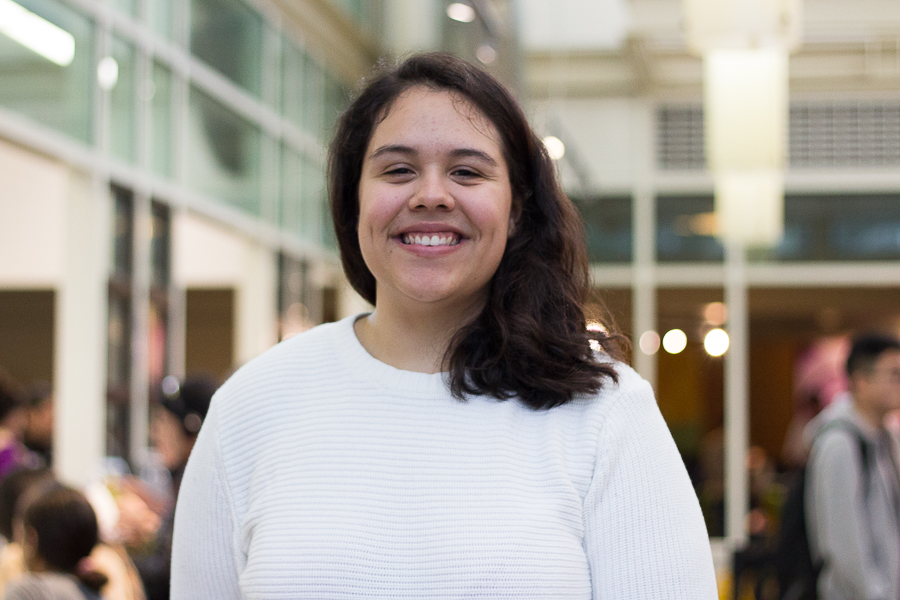
ASUCD Senator Yajaira Ramirez Sigala, a third-year sustainable agriculture and food systems and Chicana/o studies double major, will be finishing her term in the Senate at the end of this quarter. During her campaign, Ramirez Sigala ran on the platform of raising campus awareness of underrepresented groups — particularly the undocumented community — by creating mandatory sensibility trainings and safe-zone commissions.

Ramirez Sigala discussed her progress on her platform and said she believes she successfully completed her goals.

“I myself am undocumented and I saw that a lot of the need and concerns of the community weren’t being addressed by the association or any other place besides the AB540 center,” Ramirez Sigala said. “At the end of the day, it wasn’t realistic to create a whole new program [of sensibility training]. The AB540 has training for peers and for educators, so I’m more focused on improving that with the coordinator that was in charge of it and incorporating that into other trainings. What I focused more on was addressing the needs of undocumented students. I was able to address [all platforms]. I don’t think they were executed the way I originally thought.”

According to Ramirez Sigala, having an undocumented individual preside as an ASUCD senator represented significant change to the undocumented community at UC Davis.

“As for addressing the awareness and diversity of the undocumented community, I saw it in the space: more folks were being more present and knowing that there was a representative — the very first undocumented senator that UC Davis has ever had,” Ramirez Sigala said.

Also addressing her platforms, Ramirez Sigala mentioned a few of the ways she is currently trying to incorporate immigration issues into different trainings.

“I’m currently trying to finalize some efforts with PEACE training,” Ramirez Sigala said. “PEACE training addresses the different parts of students’ identity; it deals with sex, gender, income and they touch a little bit on immigration. If it were to happen that at any presentation there was somebody who was undocumented or somebody who wanted to be a better ally, [an undocumented student would] be able to address those concerns. Having an undocumented person part of the board or whoever is facilitating the trainings is more appropriate and can better address issues.”

Also a member of the DREAM committee, Ramirez Sigala said her involvement as a senator strengthened the committee.

“The table before me had totally disregarded DREAM committee and it was in the process of being removed as one of the committees and I was able to help revive it,” Ramirez Sigala said. “This year, I helped them get organized, be in the bylaws, and we were actually able to establish a budget. They got $5,000 this year. Half of it went to our lending library which provides educational materials on the loan system for students every quarter. [Part of it also went to] the cap and gown project, which I wrote a bill on, [which] was to provide rentals for caps and gowns for undocumented individuals.”

Another member of the DREAM committee, Alexandra Camille Munoz San Pablo, a fifth-year civil engineering major, provided explanation on the lending library project. The DREAM committee advocates “for initiatives on campus that will improve the education, awareness, and advocacy of issues relating to undocumented students at UC Davis,” according to the ASUCD website.

“The lending library started in the fall of 2016,” Munoz San Pablo said. “Now, our library has grown to about 300 books. Students can ask for the books that they need for the quarter and we try to either get books donated or we purchase books with the money that we do get from different sources. They can keep the books for the whole quarter instead of having to fight with the library for a book.”

Munoz San Pablo also discussed how Ramirez Sigala has helped the DREAM committee.

“She is very engaged and she works well with the current chair,” Munoz San Pablo said. “They work well together in the sense that Yajaira, in my opinion, is the person who handles most of it. We have meetings, the chair says stuff, but the person who puts it into action is Yajaira. The person we can rely on is basically Yajaira, because she has the most power in the sense that her ties with ASUCD is what brings the money into committee.”

Also passionate about environmental issues, Ramirez Sigala explained how she has tried to expand her influence on such issues.

“Undocumented issues and environmental justice intersect a lot,” Ramirez Sigala said. “We’ve been able to expand the conversation not just on environmentalism but more on environmental justice. We’re being more critical about the conversations that are happening like how accessible it is for a community to plant a tree when they’re working from 4 a.m. to 6 p.m. Now that it is in our scope and we’re acknowledging and having these conversations, hopefully folks can participate and create more physical projects. The [Campus Center for the Environment] has been super supportive of other environmental pieces, like a resolution [Environmental Justice for Underrepresented Communities] wrote asking ASUCD to support efforts of implementing environmental justice in the curriculum of the College of Agriculture.”

When asked about her weaknesses, Ramirez Sigala mentioned a few different ways she could have performed better as a senator.

“I kind of get caught up with wanting to get certain projects done,” Ramirez Sigala said. “It’s kind of hard to admit at times, but if I would’ve taken care of myself a little more, I would have been able to do way more than I had. I wish I would have been more on top of the elections thing and really pushing folks to step up and run for Senate. I could’ve built even better relationships with the Senate table earlier on.”

In an email, ASUCD President Josh Dalavai talked about Ramirez Sigala’s performance as a senator.

Senator Yajaira has been very vocal in support of her communities on the table along with being an active participant in matters regarding organizing and social justice movements on campus,” Dalavai said. “She works very well with her peers and is well respected on the table. I believe that she has followed through exceptionally on her platforms and has included many voices on the table which are not typically represented. Yajaira was overall an amazing Senator.”


Written by: Sabrina Habchi — campus@theaggie.org

CALPIRG’s Winter Quarter pledge drives

MIREYA PEREZ LOPEZ / AGGIE

History behind CALPIRG

Who are the people with clipboards that stop people in the Silo?

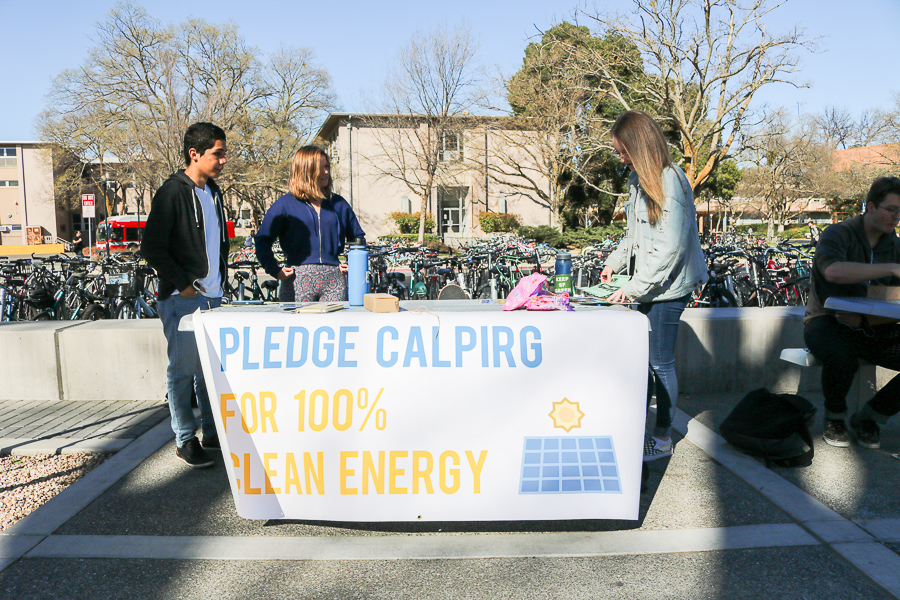
Some of them are student members of CALPIRG, a statewide student-directed and funded nonprofit organization that works to promote civic engagement, protect the environment and make college more affordable.

CALPIRG has been on campus for 40 years. According to its website, CALPIRG helped pass the statewide ban on plastic bags and helped increase federal financial aid for college students by $36 billion. The organization has also been lobbying for various other changes, including helping California convert to 100 percent clean electricity by 2045.

So why have they been out talking to students in the Silo during the past week?

The answer lies in the history of CALPIRG.

According to Jillian Patrick, a fourth-year environmental science and management major and the CALPIRG chapter chair at UC Davis, in 1999 CALPIRG almost got the government to pass the Big Green legislation, which targeted five major pesticide companies as well as big oil, agriculture and energy companies.

“The opposition went to the UC Regents and told them ‘you have to get these students, [CALPIRG], off campus: they’re misusing money and shouldn’t be allowed to have that kind of voice on campus,’” Patrick said.

As a result of this pressure, CALPIRG was expelled from campus. Over the next two years, however, various students, members of student government and faculty came out to support CALPIRG’s return.

In 2002, CALPIRG returned to campus on a compromise. CALPIRG activities fees used to be automatically applied to every students’ term bill, but with the compromise CALPIRG has to convince individual students to opt-in to the fee through its pledge drives, which is why students may have found themselves stopped in the Silo.

According to Patrick, pledge drives are conducted every Fall and Winter Quarter and last about two weeks. During the drives, CALPIRG members come out to talk to students about their organization and ask for pledges, which is a $10 fee applied to the pledging students’ term bill.

“The compromise is a setback for us,” said Carrina Lacobacci, a third-year biomedical engineering major and a student-volunteer at CALPIRG. “It’s kind of hard for college students to donate $10.”

Despite the difficulty, CALPIRG had been consistently meeting its goal of having 10 percent of the student population pledge.

“Everytime we put gas in our car, we’re supporting big oil,” Patrick said. “Everytime we go to the grocery store we’re supporting big agriculture. This is the chance for student to put their money into something that’s really valuable. It’s like sacrificing one burrito to have student activism on campus.”


Written by: Clara Zhao — campus@theaggie.org


ASUCD election results announced

JESSE STESHENKO / AGGIE

President Michael Gofman, Vice President Shaniah Branson

On Feb. 23, the results for the 2018 ASUCD elections were announced in the Mee Room of the Memorial Union.

Six senators were elected: Brandon Clemons, Simranjit Kaur, Alisha Hacker, Jumoke Maraiyesa, Atanas Spasov and Ko Ser Lu Htoo. Clemons, Hacker and Spasov ran on the Unite! slate and Kaur, Maraiyesa and Ser Lu Htoo ran with the BASED slate.

No senatorial candidates from The Golden Slate or Aggie Community Transfers were elected.

The newly-elected ASUCD president and vice president are Michael Gofman and Shaniah Branson of the Unite! slate.

After the release of the election results, there were mixed reviews. The ASUCD Gender and Sexuality Commission (GASC) Facebook page changed its profile picture to the text: “ASUCD DOES NOT REPRESENT US.”

“In light of recent election results, we do not support executive elects complicit and active in maintaining white supremacist, trans antagonistic, lgbtqia antagonistic, and patriarchal institutions,” the GASC Facebook page posted.

Newly-elected officials, however, expressed their excitement.

“I’m very shocked, very overwhelmed and very grateful,” Branson said after hearing the results. “We were running against some really amazing candidates.”

The full results were posted online at elections.ucdavis.edu.

“I’m really excited, and really relieved,” Gofman said. “I’m hoping over the next year I can represent every single student on this campus.”


Written by: Clara Zhao — campus@theaggie.org


Guest Opinion: “Paddington 2” breaks new ground for high-quality sequels

PUBLIC DOMAIN

Visual novelty, intricate points entertain all

Brian Riley is a former writer for The California Aggie (an opinion writer for Fall Quarter of 2010 and a science writer for the Winter, Spring and Summer quarters of 2012). He is currently working on his Ph.D. in education at UC Davis.

The old saying “you can’t judge a book by a cover” is equally applicable to movies: you can’t judge a movie by its poster. For “Paddington 2,” this is especially true. What looks like merely a children’s film, or a film for kids and their families, is actually so much more.

Just considering the cinematic aspects alone, the film is well worth seeing. The whole movie is imbued with carnival colors — red, light blue, yellow, green — emanating from its central “steam fair” (carnival) motif and story line, including intriguing old fashioned steam-train action scenes that create an engaging sense of timelessness with past and present blending together.

But wait! There’s much more eye candy than this. Even beyond the novel experience of seeing a friendly and hilariously accident-prone bear cub live among humans and (mostly) accepted as a normal participant in society, there are some genuinely interesting trick-photography interludes (done with CGI technology) featuring a pop-up book come to life, for example, or a mouse’s-eye view of the inside of a water pipe, for another. There’s also a part where Paddington (voiced by Ben Whishaw) rides the back of a neighborhood stray dog, like a horse, during a thrill-packed chase scene that involves water, land and air-based modes of movement.

While the kids are enjoying the slapstick fun (all of which is cleverly done), the more mature or intellectually discerning viewers can enjoy the homages to Charlie Chaplin’s “Modern Times” (when Paddington goes into a large clock’s gear assembly) or even “The Great Escape” (when Chef Knuckles barks out a line in the vocal style of James Garner).

Despite its light-hearted nature, the screenwriters and filmmakers manage to include some pointed social commentary in a way that adds to the overall punch of the movie. In a climactic moment, the family father, Mr. Brown (played by Hugh Bonneville) launches into a heartfelt speech while standing in the middle of the street that is addressed to a neighborhood bigot who had refused to grant Paddington any decent consideration. This is an obvious plea for more tolerance of diversity which, at this time in history, occurs amid the cultural tumult of the Brexit debacle in Britain.

Other veiled social commentaries can be inferred or interpreted by a close consideration of the dialogue and set-ups. Although they had the support and participation of the son and brother Jonathan (played by Samuel Joslin) during a strenuous investigation launched by the mother, Mrs. Brown (played by Sally Hawkins), and daughter Judy (played by Madeleine Harris), it was mostly a woman/girl-led endeavor, with Mrs. Brown providing the strategizing and Judy Brown providing journalistic back-up with the student newspaper she created. At a key moment when the investigation bore fruit, the up-till-then doubting and skeptical father, Mr. Brown, was eager to claim co-credit, exclaiming: “We were right!” — “Sorry, ‘we’?” says Mrs. Brown in response, gently correcting his error.

In another scene, which seems ripe for symbolic interpretation, a very large statue of an angel is loosened from its moorings (unintentionally, due to rash actions borne of vanity on the part of an aspiring elitist, the movie’s main antagonist) and makes a spectacular 100-foot drop beneath a cathedral dome, where it shatters on the floor.

One possible interpretation is that top-down authoritarian government and social control (in contrast to bottom-up, citizen led democratic methods) should finally be completely overcome. This interpretation takes a bit of understanding of British customs, since it is the sitting monarch who technically heads the church.

The bottom-up, participatory governance/running/creation of a society is not guaranteed to be without ills — a fact which is illustrated by a betrayal of trust shown in the movie between Paddington and Knuckles, one of the other (eventual) protagonists (played by Brendan Gleeson). Paddington is fooled by Knuckles into thinking that he is engaging in a democratic decision-making process in a plan to escape their captors (a corrupted legal and prison system) and right certain wrongs, but after escaping, Paddington discovers that Knuckles’ real intention was to flee the country to set up a restaurant using the marmalade recipe that he got from Paddington. When Paddington declines to leave the country with Knuckles and his two cohorts and takes off on his own, Knuckles predicts that Paddington will be recaptured and declares: “It’s his choice.” But was it really a choice? When one is defrauded, as part of an ostensibly democratic process, one’s power of choice is taken away.

Hugh Grant, playing the role of Phoenix Buchanan, the main antagonist of the movie, who is now in his mid-50s, seems finally to have hit his stride as an actor in “Paddington 2,” with a masterful performance. Some say that Grant steals the show, but I suspect a lot of that especially high praise stems from the way he first appears in the movie: as part of a public performance where the audience applauds while he makes his entrance.

This can be compared to the Beatles’ über-famous Sgt. Pepper album and the way the “Sgt. Pepper’s Lonely Hearts Club Band” receives applause near the beginning of the album. To me it seems to be the collective performance of the entire ensemble of actors, Hugh Grant included, that really adds that necessary last ingredient, or layer, that elevates this movie to greatness.

In one scene, Phoenix disguises himself as King Henry V in order to pull off a particular caper (one of many). It’s impossible for me to believe that the screenwriters chose Henry V randomly, due to the way that the entire movie is so carefully and intricately structured. Henry V was one of the most complex kings in English history, suggesting that the writers wanted to add depth to Phoenix’s character — a depth that could hint that Phoenix (i.e., Hugh Grant) might return in some way in a “Paddington 3” or a “Paddington 4” movie down the road. StudioCanal recently purchased the intellectual property rights to the Paddington Bear book character for use in film and television, so that would also give much leeway for future “Paddington” feature film projects.


Written by: Brian Riley — Guest Writer

Gender is a spectrum: How the toxicity of rigid stereotypes inhibits gender self-expression

CAITLYN SAMPLEY / AGGIE

Femininity and masculinity should be variable for each individual instead of contribute to fixed stereotypes

“I hate Black Widow. She’s a girl, and girls have cooties,” said my cousin, who was then a 6-year-old, rambunctious little boy. I stared back at him in shock and indignance.


“Do you hate me, too?” I demanded, and he immediately, earnestly shook his head and told me, “You’re different. You’re my big sister.”

My cousin had been experiencing the awkward phase when boys and girls both felt repelled by each other and believed in imaginary “cooties” to ensure the least amount of interaction possible. It was a relatively laughable incident since my cousin is now about to enter the much more awkward stage of liking girls. (Assuming it’s girls he likes.) But this relatively insignificant incident and innocent conversation reminded me of a larger controversy related to little boys seemingly rejecting Black Widow action figures while wholeheartedly accepting the male Avenger superheroes.

I’ve grown up with the Marvel and DC universes through comics, movies, soundtracks and TV shows. I remember visiting Target with my friends a couple of years ago and raiding the toy section, as bored teenagers do. We painfully discovered that the Avengers action figure sets didn’t have Black Widow in them. The spunky, powerful, sarcastic heroine, one of my greatest fictional role models, was hardly present in any of the Marvel toys we scavenged through.

It wasn’t just her who was missing. Gamora was absent from many “Guardians of the Galaxy” merchandise, and a year later, Rey was excluded from many “Star Wars: The Force Awakens” toys. Hasbro, the toy company, has come under fire for many of these controversies, and their excuses have become increasingly weaker — relying on “spoilers” as the reason for excluding integral female characters in products, while the same women’s faces are plastered across the center of movie posters.

It’s important to note that there has been a huge increase in female hero action figures and merchandise in the past year and a half. This proves a very important point — every tweet and lament about this horrible phenomenon was taken into consideration, even the heartfelt, frustrated letter a little girl wrote to Hasbro about the lack of Rey, her favorite “Star Wars” character. I never really liked classic Disney princesses. I like “Star Wars.” I like Marvel. So I’m happy to see more women represented equally in these fictional universes.

Meghan Markle, an actress on the television show “Suits,” spoke recently at a UN Women conference about when she was 11 years old and watched a disturbing Proctor and Gamble Ivory dishwashing soap commercial at school that utilized the phrase “Women all over the world are fighting greasy pots and pans.” She identified the use of words in this tagline as absolutely insensitive and unfair. Most women are busy living their lives, taking care of their responsibilities and working jobs — which makes them too busy to take on the entire burden of functioning as living, breathing dishwashers simply due to societal expectations.

Markle decided to do something about this commercial. She wrote letters to Proctor and Gamble, Hillary Clinton, civil rights lawyer Gloria Allred and Nick News anchor Linda Ellerbee. Eventually the slogan in the Ivory dishwashing soap commercial was changed to “People all over America are fighting greasy pots and pans.”

Fighting gender roles doesn’t only apply to little girls and strong women who dream about living in a society where they aren’t restricted by the rules of how they’re supposed to act. It applies to men and women and everyone in between. Men shouldn’t be forced to act strong, stoic, manly and emotionless. It should be acceptable for men to be vulnerable and sensitive while finding confidence in expressing emotions. Bro culture should no longer exist in workplaces because men shouldn’t feel obligated to embrace hypermasculinity simply to fit into a group. When we strip away the roles with which society expects us to identify, we will start to respect each other regardless of our identities. Our characteristics don’t need to be suppressed or falsified to meet the expectations of a group of people.

Transgender women and men may face the struggle of feeling like they have to embrace the most extreme characteristics of their gender in order to fit in. This creates a toxic environment where many people may feel like they can’t express their gender in subtle ways.

We should all have the freedom to make our own choices regarding our gender identity without having to fit into a checkbox on a form. If you’re passionate about changing the stereotypical role in which society is expecting you to fit, you can always do something about it. Sometimes, speaking out against or for something that you care about can have an immense impact — a concept made obvious by Markle’s letters. We often underestimate our own capabilities as individuals, and we downplay the potential influence we can have on the world. It’s time we decide to mend our society to accept everyone’s identities instead of forcing us to conform to acceptable, predetermined ones.


Written by: Akshita Gandra — agandra@ucdavis.edu

Disclaimer: The views and opinions expressed by individual columnists belong to the columnists alone and do not necessarily indicate the views and opinions held by The California Aggie.

Spirituality and environmentalism in America

KYLA ROUNDS / AGGIE

Environmentalist and believer don’t have to be mutually exclusive — and they shouldn’t be

Nature has a profound spiritual significance to me. I’m overwhelmed with admiration and respect, whether I’m watching a squirrel on campus or looking up at El Capitan — more so with the latter. No offense, squirrels.


Often, though, environmental concerns and the accompanying science tend to be thought of as lacking — even in opposition to — spirituality.

Spirituality and nature didn’t used to be so divorced. Romantic poets like William Wordsworth and scientists like Galileo Galilei recognized a connection between the divine and the natural world. But today, environmentalism is viewed by some groups as an occult.

Some Christians view environmental movements — especially those concerning climate change — as sketchy. White House Environmental Quality nominee Kathleen Hartnett White referred to global warming as “paganism.”

In the 1980s, environmental movements started focusing more on global warming and less on litter and pollution. Some American Christians became skeptical of climate change. What mostly began as a fear that the Antichrist would use global warming as a ploy to unite the world and assume power has now developed into a general distrust in climate science.

David Konisky, an associate professor at Indiana University’s School of Public and Environmental Affairs, found that Christians are less concerned about the environment than they were in the 1990s.

“Not only has there not been an amplification of concern among Christians about the environment, there’s seemingly been a decline, at least over the time period I’ve been studying,” said Konisky.

The Pew Research Center on Religion & Public Life found that only 28 percent of Christians believe that humans are causing climate change. And still other Christians tend to think that, no matter who’s causing environmental problems, God will fix them.

“As a Christian, I believe that there is a creator in God who is much bigger than us,” said Tim Walberg, a Michigan Representative. “And I’m confident that, if there’s a real problem, he can take care of it.”

I respect what Walberg has to say. But I understand the difference between having faith and being careless. I wear a seatbelt when I drive. I brush my teeth twice a day. I do what I can for the environment because I know that all actions have consequences.

We need to cooperate on a global scale about issues — like climate change — that affect us all, but environmentalism is not all about global agendas. It has a lot to do with personal decisions. Do I recycle or litter, how am I contributing to pollution and what does my carbon footprint look like? Questions like these should be at the core of environmental movements.

Most climate change skepticism today comes from divisiveness between spirituality and environmentalism. We pit them against each other, which makes people feel like they must choose: “believe in God and denounce science” or “believe in science and denounce God.” But the closer we get to understanding one, the better we appreciate the other.

“Walberg brought up the concept of stewardship, or the idea that Christians have a duty to take care of the Earth,” said Lisa Vox, a historian and author. “Those of us concerned about climate change must appeal to religious conservatives on that basis. We must accept that a number of conservative evangelicals, especially from older generations, will never support significant action on climate change, especially if it means signing a global treaty.”

I understand Vox’s reasoning. But I think she’s wrong. Today’s generation has the potential to find a solution. Some people, including myself, already realize that spirituality and environmentalism can coexist. But I do like the idea of environmental stewardship.

It applies to all of humanity. Regardless of our backgrounds and beliefs, we all have a responsibility to care for our planet.


Written by: Jess Driver — jmdriver@ucdavis.edu

Disclaimer: The views and opinions expressed by individual columnists belong to the columnists alone and do not necessarily indicate the views and opinions held by The California Aggie.

Humor: I LIVED IT: I watched “Manchester by the Sea” instead of the Super Bowl

JORDAN CHOW / AGGIE

The Super Bowl does not tell a heart-wrenching tale of love, loss and Boston

Everyone loves the Super Bowl. It’s a great time to just get together, sit with your friends (but not too close because you don’t want to give your bros the wrong impression) and turn off your brain for a solid three hours.

But this Super Bowl Sunday, instead of merely watching the Super Bowl like any other average, unbothered person, I chose to partake in a much more intellectually stimulating activity for two hours and 17 minutes. That’s right, I watched “Manchester by the Sea,” an equally troubling American drama that doesn’t involve the violence and capitalistic ideals embedded in football, but instead involves a very distraught Casey Affleck living in Boston, Mass. and just kind of making the most out of that.

Unlike the rest of America, who chose to waste their Sunday by not challenging their intellect, my intellect was particularly challenged while watching this movie because I had to take painstaking effort to figure out just what exactly each character was trying to convey through their thick, unhinged Boston accents.

For the first half of the movie, everything seemed like it was going to be okay, and I really thought I wouldn’t need to put on subtitles. “That would be ridiculous,” I thought to myself as I physically restrained my hand from clicking the subtitles button.

At some points during the movie, like when Casey Affleck is just kind of being quiet while his life falls down around him, I admit I had to ask myself whether it would just be less emotionally crippling to turn on the TV and watch the Bald Birds tackle the Nationalists.

Nevertheless, she persisted. Me, that is. I persisted and tried to keep watching “Manchester by the Sea” without subtitles, which proved to be a much more difficult task than I could have ever anticipated, because apparently everybody from Boston, Mass. has their own dialect. I tried to ignore this, but eventually caved in and turned on Justin Timberlake’s Halftime performance. After three seconds, I turned it off and proceeded with my tour of Massachusetts.

In the end, I made it a whole 45 minutes into the “movie” until I really just had to give into temptation and turn on subtitles because I couldn’t decipher a single phrase that any character was attempting to say. Once the subtitles were on, it was like I was watching the beginning of a completely different movie. In a way, I sort of preferred that, because it was as if I got two movies for the price of one.

I guess what I’m trying to say is that I had a much better Super Bowl Sunday than any other American. I not only transcended time and space by cleverly choosing to watch “Manchester by the Sea,” but I also ended up becoming fluent in an entirely different language.


Written by: Lara Loptman — lrloptman@ucdavis.edu

(This article is humor and/or satire, and its content is purely fictional. The story and the names of “sources” are fictionalized.)

Sacramento left out of race to become Amazon’s newest home

0
JEREMY DANG / AGGIE

Amazon uses public process to choose new HQ, rejects Sacramento’s bid

Amazon recently announced its contenders for a second headquarters — a list of 20 cities across the nation that, despite strong efforts and predictions otherwise, did not include Sacramento. City officials had devoted significant effort into the pitch and still believe that their thorough proposal indicated a promising future for the city.

Barry Broome, the president and CEO of the Greater Sacramento Economic Council, expressed his faith in the proposal and in the city’s potential, which included detailing the benefits of the technologically talented residents, the the city’s affordability and the proximity to Seattle, Amazon’s current headquarters.

“While Amazon is missing out on a great opportunity, we gained one,” Broome said in an article for The Sacramento Bee. “This community has shown true leadership and worked together to put together the best proposal possible in such a short time.”

Amazon intended to use a public process to choose its second headquarters in order to find out which cities and communities would most benefit from its economic contributions. The company’s final decision is expected to be announced later in 2018.

“We are looking for a location with strong local and regional talent — particularly in software development and related fields — as well as a stable and business-friendly environment to continue hiring and innovating on behalf of our customers,” Amazon said in an online statement. “We expect to invest over $5 billion and grow our second headquarters location to be a full equal to Amazon’s current campus in Seattle, creating as many as 50,000 high-paying jobs. In addition to Amazon’s direct hiring and investment, construction and operation of HQ2 is expected to create tens of thousands of additional jobs and tens of billions of dollars in additional investment in the surrounding community.”

Support for an Amazon headquarters in California was also expressed by Governor Jerry Brown, who offered $200 million in tax credit for five years and $100 million for workforce training through 10 years if the company agreed to choose California as its second headquarters.

“The Golden State is home to the best universities and research institutions in the world, a uniquely qualified and talented workforce and the most dynamic combination of innovation and investment on the planet,” Brown said in a letter to Jeff Bezos, the CEO of Amazon, in an article for The Sacramento Bee. “Put simply: there is no better place for a business like yours to continue to grow.”

Nevertheless, the chosen finalists offered much greater incentives, compared to Sacramento, such as New Jersey offering $7 billion and Maryland offering $5 billion in tax credits for the company to choose their designated contending cities.  

Although the promise of thousands of new jobs and millions of dollars being invested into the city was enticing to city officials and residents, the efforts to demonstrate to the world Sacramento’s potential had their own positive impact.

“I think we showed well and this is a long-term effort,” said Martin Tuttle, the city manager of West Sacramento, in an interview with the Sacramento Bee. “If not Amazon, it will be someone else. It’s only a matter of time.”


Written by: Hadya Amin — city@theaggie.org


Paws up for fish skins

CALIFORNIA DEPARTMENT OF FISH AND WILDLIFE / COURTESY

Innovative use of tilapia skin helps heal wildlife with burned paws

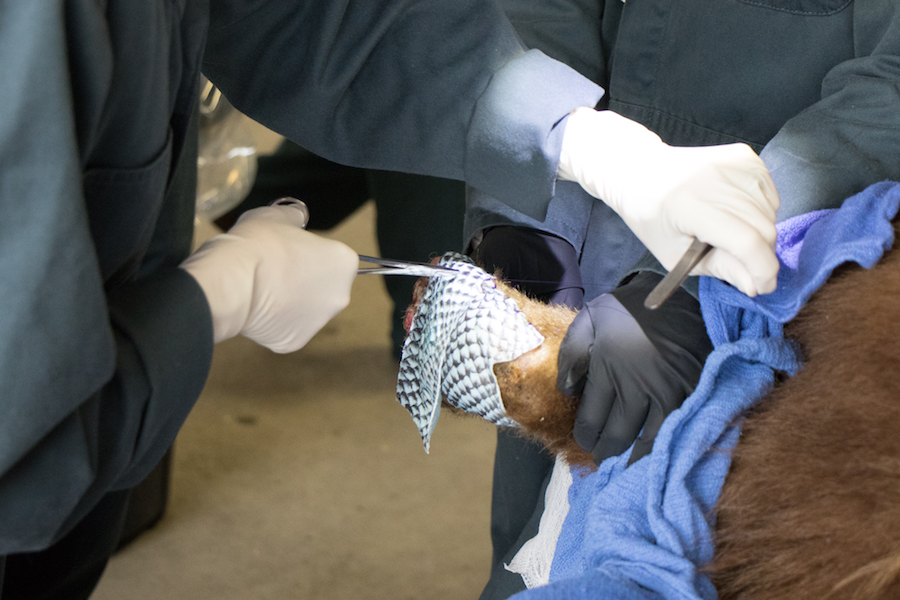
Two female bears and a mountain lion cub were treated for severe burns on their paws after the Sonoma wildfire late last year with a new type of bandage — fish skins. The collaboration between a senior wildlife veterinarian at the California Department of Fish and Wildlife and a companion veterinarian at UC Davis to heal these large carnivores started with a housecat.

Dr. Deana Clifford, the senior veterinarian at CDFW, had a cat named Craftsy, whose fractured leg did not heal properly. After looking at different options, Clifford went to Dr. Jamie Peyton, who practices integrative medicine. Clifford combines current medical practices with traditional ones, such as acupuncture.

“I’d been taking care of [Clifford’s] cat for the last year, and she was the one that talked to me and asked me if I would be interested in helping them with any pain or burn issues because I have an interest in wounds and wound healing — and I said of course,” Peyton said. “It just so happened that after we talked about that, a few weeks later they had a bear sent up for burns.”

Kirsten Macintyre, a communications manager with the CDFW, said the department mostly deals with orphaned animals or injured wildlife that does not have to be taken to a rehabilitation center.

“There are cases, like when a deer was tangled in a soccer net,” Macintryre said. “Burns are unusual. The last case was nine years ago.”

Injured wildlife is assessed by the department, and if the animals are in too much pain, they are euthanized. The three big carnivores were not the only victims of the fire, but the small animals that could be saved were sent to rehabilitation centers. However, most places for wildlife are not equipped to handle such large animals. Only a week after a bear was brought in, another bear and the mountain lion cub came in with similar injuries.

“Wildlife is a little different than treating a dog or a cat because you can’t hold them like a dog or a cat, actually to do anything with you them you have to anesthetized them,” Peyton said. “The other thing is that you can’t bandage their feet like you would [with a dog or a cat], because if they eat it, it’s a problem and if they tear it off, you can’t go into their pen and easily get it out. We had to figure it out, using traditional methods of burn care. So the creams that we use for pain control, cleaning the wounds, and then add other things.”

Peyton uses cold laser therapy, pulsed electromagnetic field therapy, acupuncture and chiropractic techniques in her work. Cold laser therapy and PEMF use infrared light or a magnetic current to help increase blood flow to injured areas to promote healing. Acupuncture and chiropractic therapy is used to help with pain management and boost the immune system. This still was not enough.

“After we started those things, we’d be watching her [the bear] and she still didn’t want to walk, because we can’t get her to take pain medication when we wanted to, and I thought we need to do something else,” Peyton said. “And that’s where the fish skin idea came in. I remembered seeing something about using fish skins to help people with burns down in Brazil. So we actually called down to Brazil […] and they said they’ve seen some really good results, but they couldn’t ship us any of the skins. So I thought to myself, well, I’m just going to make them myself, because this bear needed something. Life puts you in situations where you have to make a decision, you have to do something, because that animal needs more help than you are currently giving them.”

After getting tilapia from the local fish market, the team sterilized the skin and sutured it on the healthy skin still left on the paws. The process to make the fish skin bandage took several days, and by the time it was ready to use, it did not smell, and the animals were not able recognize the bandages were made of potential food. On both of the bears, the skins were further wrapped in rice paper and corn husks so the fish skin could not be easily taken off.

Clifford had predicted that the three animals would take three to four months to heal, but they were doing well only about a month and half later.

“Often we have to innovate, try new things with wildlife,” Clifford said. “Anything to improve their chances of getting back into the wild.”

The fish skins protected the damaged tissue, offered pain relief and helped the burned paws heal. Many scientists are excited about the possibility of expanding the use of fish skins, and Peyton wants to start clinical trials after the paper on their recent use is published. Peyton believes fish skin could help with chronic non-healing wounds and pressure sores in addition to burns.

“This holds a lot of promise,” Clifford said. “We’ve had a lot of inquiries from other rehabilitation centers.”

On Jan. 8, both bears were released after the researchers made them dens to keep the bears safe. Since they were tagged with GPS collars, the CDFW has been able to confirm that both bears are doing fine, although they have moved away from the human-made dens. One of the bears was pregnant when she was brought in, and those monitoring her are unable to tell if she has given birth.

The mountain lion cub, named Charlie, was moved to the Sonoma Wildlife Rescue Center, where he will be joining a female mountain lion who just lost her companion. Charlie is too young to be released; mountain lion cubs typically stay with their mothers for 18 months and Charlie was only 5 months old when he was brought in during December.

“I’ve been asked, why spend the money and time on this?” Macintyre said. “Peyton volunteered her time, as did two other doctors. They collected a body of knowledge and it has a  wide range of applications. It had never been done before, and I’m really excited about this.”


Written by: Rachel Paul — science@theaggie.org

Trusting the Land: Environmental Policy and Native Activism

ALEXA FONTANILLA / AGGIE

How Native Americans can reverse injustices of past

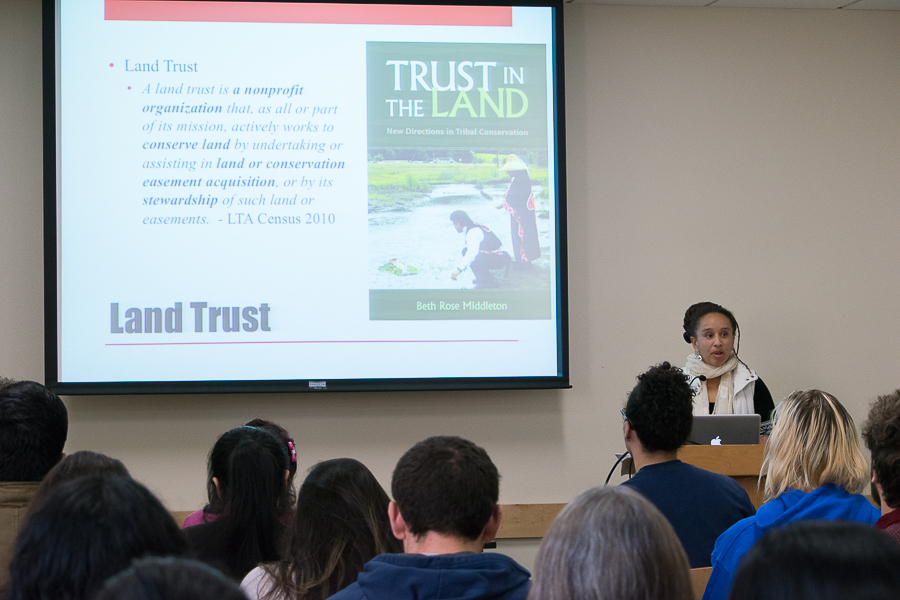
Beth Rose Middleton, a professor in the Native American Studies Department at UC Davis, recently gave a talk about the history of the sale of Native American land in California and how modern tribes can use environmental policy to help take back what is rightfully theirs. The talk was put on by the Feminist Research Institute in association with the Women’s Resource Center. The groups are working together to bring awareness to the research being done by women, especially to inform undergraduates about their work.

“Professor Middleton’s research addresses the historical origins and ongoing environmental impacts of the dispossession of California’s Indigenous peoples,” said Justin Spence, an assistant professor in the UC Davis Native American Studies Department. “Her research program engages contemporary Native American people in the process of finding creative policy solutions to a legacy of environmental injustice that has eroded their land base (both literally and figuratively). Her work provides a model of community-engaged scholarship that researchers in many fields can aspire to emulate — one where theory and praxis inform each other in support of historically underserved communities’ efforts to maintain their political and cultural autonomy.”

Middleton’s research is at the intersection of her identity as a black-multiracial woman. Her research highlights discontinuities in the treatment of Native Americans in an effort to affect policy change. For example, in 1850 and 1851, the California state government and the Native American tribes of California mutually recognized each other’s nationhood and signed treaties to establish their sovereignty. However, those treaties were never ratified by the state and were left unenforced, which allowed the state to continue selling Native American lands to companies who harm the California state ecology by flooding valleys, destroying the homes of wildlife and wasting natural resources.

The original land grants that were given to Native Americans were withheld from non-white and female citizens. Middleton’s research has uncovered documentation that showed how difficult the state government made it for women to pursue and protect rights to their lands. The government forced Native American women to be living on the land that was granted to them, which would have required them to evacuate their homes and families. Once enough time had passed without anyone living on the property, the government seized the land and sold it to power companies who created dams that flooded valleys and destroyed ecosystems. One dire effect on the ecosystem has been the systematic annihilation of salmon populations which cannot travel up the dams and are instead directed into fish hatcheries.

Tribal people of California were first displaced by the seizure of their lands and were later displaced again by the urbanization that occurred thanks to the seizure of their lands, said Middleton. She also mentioned the ‘stairway of power,’ which is a series of dams and hydropower-generation facilities in the Feather River Canyon. Not only did Native American land allow for the growth of cities in which they could not afford to live, they continue to pay these companies for power generated on the land that they bought from the government’s unlawful seizure.

Middleton’s soon-to-be-published book, “Upstream: Trust Lands and Power on the Feather River,” includes a ‘how to’ chapter for modern California tribes on what it will take to use the laws that are in effect to take back their land in a way that grants them the capacity to be the land’s caretakers. This would give them the power to stop and reverse the creation of dams, intentional flooding of valleys, and more.

“Professor Middleton’s collaboration with Native California tribes and the relevant research that she conducts are prime examples of engaged and responsible academic work,” said Zoila Mendoza, the department chair and a professor of Native American Studies at UC Davis. “She brings this commitment to her undergraduate and graduate teaching and mentoring developing an exemplary method of active learning. We are very fortunate to have Profesor Middleton as a faculty member and proud that she is the holder of the Yocha Dehe Endowed Chair for California Indian Studies.”


Written by: Jason Kelly — science@theaggie.org

Corrections (updated 2/27/18 at 7:30 p.m.)

An earlier version of this article incorrectly stated that Middleton was a black-Native American woman. The article also stated that the “stairway of power” is a series of mountain valleys. This is incorrect. The “stairway of power” instead refers to a series of dams and hydropower-generation facilities located in the Feather River Canyon.