58.6 F
Davis

Davis, California

Monday, December 22, 2025
Home Blog Page 562

UC Davis Vegan Frat Challenge

0
RAUL MORALES / AGGIE

PEACE Club raises awareness on health, environmental benefits of veganism

This week, two UC Davis fraternities battled it out in a competition centered around maintaining a diet completely free of animal products. Theta Xi and Theta Chi teamed up with Davis’ People for the Elimination of Animal Cruelty through Education club (PEACE) to compete in the campus’ first ever Vegan Frat Challenge.

“The Vegan Frat Challenge is basically where, for a week, we get two frats to go vegan,” said Emmanuelle Chicandard, a second-year animal biology major. “That means their entire house is going to be stocked with vegan food and [PEACE is] going to help them cook. I think we have a couple people every day going in for breakfast, lunch and dinner to help [guide] them cook vegan food.”

On Sunday, stewards from each fraternity accompanied PEACE members on a Costco run to pick up all the supplies necessary for the 18 or so fraternity members who live in each house. Groceries were funded by the national organization People for the Ethical Treatment of Animals (PETA), Taco Bell and Chipotle, while other foodstuffs were supplied by a few local and global plant-based companies.

PEACE designed a point system for the Vegan Frat Challenge as a way to encourage and reward the members involved. One fraternity took the championship crown and prize, but prizes were awarded to a first, second and third place individual in each fraternity as well.

“Eating a plant-based meal is 10 points, and [points are also given for] taking a photo of yourself or of your plant-based meal with the hashtag ‘vegan frat challenge’ [or] ‘VFC Theta Chi’ or ‘VFC Theta Xi,’” said McKenna Maxwell, a fourth-year environmental science and management major. “We can search through the hashtags and give points to each frat with those hashtags specifically. You can also get points for bringing friends to events and attending events yourself, and there will be a grand prize for the [winning] house […] of visiting the Animal Place animal sanctuary for free.”

Not only is the Vegan Frat Challenge a way of educating the members of the fraternities about healthy vegan eating and plant-based diets, but members also had the chance to gain points by attending events PEACE hosted throughout the week.

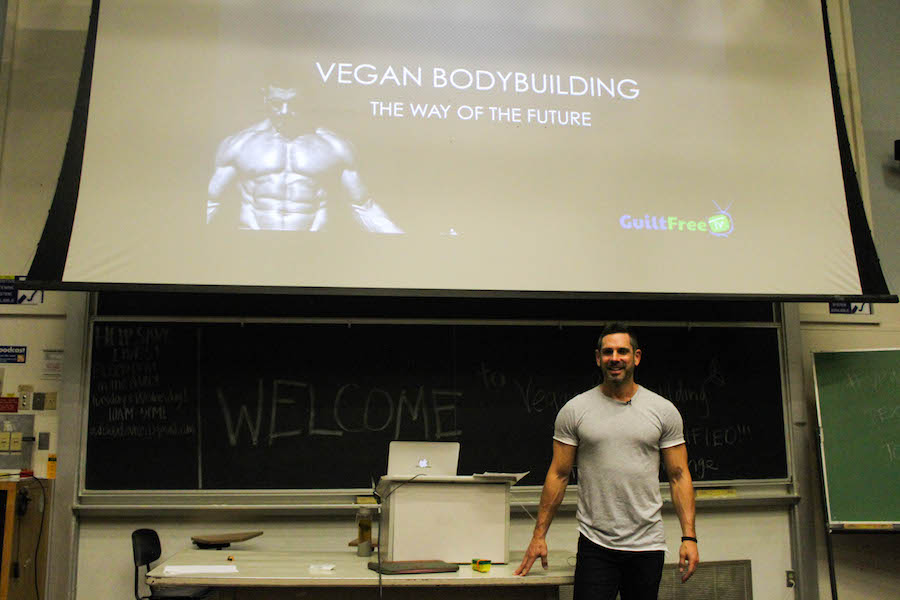
“One of the events we’re looking forward to is the vegan athlete speakers,” Maxwell said. “We’ll have three vegan athletes come who are YouTube famous […and] invite the frat community to see that. It’s to debunk the idea that [if] you’re vegan [you] can’t be strong. There’s a [lack of] education on this topic. That’s a big myth, especially for college-age students and the male population having this idea of veganism as not [providing] the protein that they need.”

Other events the club hosted throughout the week were film screenings of “Cowspiracy” and “What the Health,” as well as visual demonstrations on the Quad like the 360-degree virtual simulation of the life of a factory farm chicken through iAnimal and the Brave the Cage event.

“Brave the Cage is about factory farm hens, because a lot of them are stuck in tiny cages,” Chicandard said. “Even though we have this cage-free law going on, it takes awhile for farms to transition. So this [demonstration] shows basically a human-sized cage, and we try to stuff as many people in the cage as they would stuff hens, just to get that feeling of being in a cage.”

Like Maxwell said, there are some commonly held assumptions around veganism and fitness, like that being muscular is impossible with a vegan diet. PEACE intentionally focused the event on the male Greek community in order to dispel the stigma around veganism and masculinity as well as raise awareness for everyone across campus.

“Meat and masculinity are so tied together,” said Iliana Zisman, a third-year animal science major and president of PEACE. “The reason we are giving attention to the Greek community and the male Greek community in particular […is] because they deserve to have this education as well about this kind of lifestyle. It’s also showing vulnerability to care about something, which isn’t something to be ashamed of.”

The expectation of this event is not that members of Theta Chi and Theta Xi will emerge as vegans, but that PEACE will educate part of the Davis community about the health and ethical benefits of switching to a vegan or plant-based diet. PEACE hopes that the challenge will have inspired individuals to adopt more animal-friendly diet habits like “Meatless Mondays.”

“I think people, when they think of veganism they think it’s really difficult, but there are a lot of products that are good substitutes for things,” Chicandard said. “There are a lot of recipes that are really simple that you can do. It doesn’t have to be a complicated dish or anything like that. Like I don’t know how to cook and I don’t cook very often, but I’m still vegan.”

Animal consumption is tied to multiple environmental impacts such as deforestation, land use, waste and especially greenhouse gas emissions. Livestock and their byproducts account for roughly 51 percent of global greenhouse gas emissions not limited to carbon dioxide; these emissions also include methane and nitrous oxide, both greenhouse gasses with global warming potentials of 56 and 280 respectively and are far more destructive than carbon dioxide alone.  

“We believe the biggest way to make change is to educate and speak with each other and hear from each other and learn from each other,” Zisman said. “I think that for us this is more of a value system than it is a diet. It’s more about the basic concept of freedom for everyone to have a right to their own life and to not be dictated by another being, whether that’s a human or a non-human animal.”

Zisman herself faced no difficulties in adopting a plant-based diet, as she was able to make the change overnight. The decision to go vegan made logical sense; she should stop contributing to animal suffering since she loved animals and was going to dedicate her life to helping them. Now she’s the president of PEACE and feels her time educating students about the environmental, health and social justice issues tied to animals is time well spent.

“Of course, I’m not saying being vegan is flawless. There’s no way to be a human and be flawless,” Zisman said. “We’re still causing environmental harm, we’re still causing a lot of issues just by existing, but I think the tenet of veganism is do the best you can, and that can mean something different for everyone.”


Written by: Marlys Jeane — features@theaggie.org

On the status of undeclared studenthood

0

SPAVAAI [CC BY-NC-ND 2.0] / FLICKR
Advisors weigh in

There are many social pressures that contribute to an undeclared student’s pondering as their deadline to declare approaches. What is the opinion of your family? Your friends? Your professors? Brenna Dockter, a first-year transition coordinator in the College of Letters and Science, has something to say about these familial and social tensions.

“For some students, that’s really important,” Dockter said. “Their family has ideas and that will influence their decision.”

The social pressures of choosing a major seem to be widespread, indicating something not only about one’s position in their family or social groups, but also in the professional world. Wendy Haws, an academic advisor in the College of Letters and Science, notes this immense stress on undeclared students.

“It feels like it’s going to define your whole life,” Haws said. “And that’s one thing that we really work on, saying that your major doesn’t necessarily equate to a specific career.”

For second-year students who are currently undeclared, the deadline to declare is fast-approaching: 135 units completed. However, Dockter and Haws both encourage declaring during the 5th quarter (presumably this quarter) of enrollment. Their recommendation is not a random one, but rather one informed by research. Research done at UC Davis has indicated that declaring by the 5th quarter invites more positive educational outcomes, including on-time graduation.

On-time graduation is not the only advantage of declaring by the second year of enrollment. Immersion in major courses, relationships with professors and research opportunities number among the boons of being firmly rooted in a major.

“We want students to also get engaged with their major,” Haws said. “With the material, with the faculty, with research opportunities. If you’re waiting too late to do that, then you’re just limiting the amount of time that you can invest in that.”

Declaring a major is a benefit for technical reasons, too, according to peer advisor in the college of engineering and fifth-year mechanical engineering major Ryan De La Cruz Peterson.

“I knew who to go talk to,” De La Cruz Peterson said. “Whether it was my major advisor or what deans I needed to go to, so I kind of already knew the resources that were available […] I think that made it easier.”

But enough about the advantages to being declared. Haws, Dockter and De La Cruz Peterson, with research on their side, can attest to the logic behind being undeclared and the strengths it can cultivate within a student. Dockter addresses and protests the common misconception around the simultaneity of being undeclared and being academically behind.

“The research shows that students that come undeclared actually have slightly more positive educational outcomes than students who come declared,” Dockter said. “They don’t graduate later, they have a slightly higher GPA, so this is sort of earth shattering for some students to hear because […] there is this maybe myth out there that it’s really bad to be undeclared and the research kind of shows the opposite.”

What’s more is the emotional and practical logic of remaining undeclared at the beginning of college. Many students declare majors for which they’ve never taken a topic-specific course, or majors of which they are unfamiliar with the applicable professions. Haws understands what a formative time college can be.

“It makes sense at this point in people’s lives and developmentally to be exploring and figuring out who you are,” Haws said. “It makes sense that you would also be exploring what your major is going to be as part of that process.”

Dockter speaks to the expanding professional and academic awareness of early college students.

“In high school you’re lucky if you know up to ten categories for professional careers,” Dockter said. “When you get to college and there are over 100 majors at UC Davis to choose from, that just doesn’t quite match. And so an exploration process has to happen. All students are doing it, it just looks different across the majors.”

Dockter’s last sentiment may be on the minds of UC Davis students in STEM fields especially. It’s not rare to hear the tension between declaring a STEM major and remaining interdisciplinary, or exploring other fields, on such a balanced campus.

Pressures to accomplish prerequisites as a STEM major in which series courses are part and parcel of the experience can be a hindrance on maintaining a balanced schedule. While there are pressures to accomplish prerequisites, especially those in series’ courses, in order to graduate on time as an engineering or chemistry major, Dockter, Haws and De La Cruz Peterson beckon to the GE requirements as a built-in liberal arts and exploratory path for all students.

“Students are fortunate to be at UC Davis because of our large and diverse GE requirement that they have to take no matter what their major,” Dockter said. “So I feel like we’ve really set up the anatomy of the undergraduate degree to provide that interdisciplinary access to classes.”

In spite of and in addition to these GE requirements, Haws encourages active and conscious academic exploration to all students. This doesn’t mean avoiding the subject of majors, but rather making a plan and making choices to learn more about personal and professional aspirations. To do so, Haws and De La Cruz Peterson mentioned the Major Exploration Tool, which enables students to take a quiz based on their academic preferences. Haws has also developed a Fall Quarter freshman seminar to aid students in their major-discovery, which she hopes to evolve into a full class. To access more online major exploration, pursue Majors Card Sort Tool, What can I do with my major or degree? and Career Exploration by Interest Area.

For interpersonal support, students can join the SHCS’ Career Exploration Group and take a Career Assessment. The Student Health Center also offers one-on-one career counseling while the Internship and Career Center offers advising. Finally, taking AMS 195: Careers & Identity in American Culture can lead major-unsure students in the right direction.

Haws, Dockter and De La Cruz Peterson each had heartfelt messages for exploring students. Ultimately, advisors are in the business of guidance, refusing to leave students alone in an undeclared state, whether they like it or not.

“We really value our students and were prepared to help them strategically explore, even if they already have a major,” Dockter said.


Written by: Stella Sappington — features@theaggie.org
Last week in Senate

HANNAH LEE / AGGIE

New boba tea shop to open at MU

On Thursday, January 11 at 6:12 p.m., the ASUCD Senate meeting was called to order by Vice President Adilla Jamaludin. Business and Finance Commission Chair Shubhangi Gulati was absent.

First, ASUCD President Josh Dalavai gave an executive presentation. Notable topics included his transition out of office. During the transition, Controller Jin Zhang will remain for one to two weeks after Jamaludin and Dalavai depart. The new executive team will conduct interviews for the next controller. The pursuant weeks after Winter Quarter Elections will be dedicated to the transition of the new executive team.

Next, there was discussion on use of retail spaces in the MU East Wing. Space 2 will be filled by a boba tea shop, TeaOne. Space 3 will house the Student Disability Center and Space 4 will be occupied by the Global Food Initiative. The projected annual revenue from the rent collected from these spaces is upwards of $100,000, which will be invested into the services and units of the association.

There was a housing update that discussed Chancellor Gary May’s recently-released statement on Jan. 10 emphasizing the campus’ commitment to increasing student housing on campus. Details include 6,200 beds currently under development. Continually, there will be an increase to 8,500 beds from the Long Range Development Plan. The number includes 500 additional beds in Orchard Park and an additional 2,000 beds in West Village.

There was then talk of the business projects currently underway, including discussion about allocating funding to establish a new ASUCD career-track position that would focus on marketing. Zhang is currently advocating for the creation of this position in talks with Vice Chancellor Adela de la Torre and Interim Associate Vice Chancellor for Student Life, Campus Community and Retention Services Sheri Atkinson.

Next, Judicial Council Chair Ryan Gardner gave a presentation and updates regarding the Judicial Council. The Judicial Branch is now fully functional as of recent. Gardner said the Judicial Council is “trying to build off [their] experiences” and they are “looking at the bylaws to learn more about them and understand.”

During public announcements, Jamaludin criticized the number of bills being authored.

“In my time in the association, I’ve never seen so few bills being authored by senators,” Jamaludin said. “This is a privilege you have, being able to make changes. You’re all ambitious and intelligent and represent a large portion of the student body. If you don’t have ideas, go out and ask people.”

Also during public announcements, Senator Michael Gofman said he is CoHo’s only adopted senator and is seeking people to help out with improvement ideas. Senator Marcos Rodriguez mentioned Housing Day that will occur on Feb. 1 and asked those present to share the event on their Facebook pages.

There was a moment of silence held for Blair Fox, a second-year economics major who passed away over Winter Break.

Next, Senate Bill #22 was introduced. This bill establishes a designee of the ASUCD President to be the chairperson of the Committee on Committees.

Ex-officio reports and elected officer reports were then conducted.

The meeting adjourned at approximately 8:15 p.m.


Written by: George Liao — campus@theaggie.org

Grants given by UC Davis Blum Center aim to alleviate poverty

KAUSI RAMAN / COURTESY

Blum Center for Developing Economics offers grants to undergraduate, graduate students

The Blum Center for Developing Economics at UC Davis offers grants to both undergraduate and graduate students who are focused on alleviating poverty in developing countries and areas. According to its website, the Blum Center’s goal is “finding solutions that have a lasting and tangible impact on people living in poverty.”

Kausi Raman, a second-year design and economics double major and the outreach coordinator for The Blum Center, discussed the different grants the center offers, including the Poverty Alleviation Through Action (PATA) grant and the Poverty Alleviation through Sustainable Solutions (PASS) grant.

“We offer a couple of different grant programs: PATA is for undergraduate students, and  PASS is for graduate students,” Raman said. “The travel grant for undergraduate students is up to $2,000 and allows students to visit other parts of the world for research or service projects. PASS is between $1,000 to $4,000, and it’s seed funding for students to find and execute viable solutions for reducing poverty in the developing world.”

Raman talked about her own experience with The Blum Center after she received a grant from the group.

“I received the PATA grant last summer to travel to India,” Raman said. “The grant allowed me to go over there and work directly with government schools to test out the different things [my nonprofit organization] had been developing. We were also able to work directly with teachers and directors of schools to see exactly what it was that they needed.”

Although students who are awarded grants from The Blum Center tend to travel to a different country facing poverty constraints, some students have chosen to direct their efforts toward domestic issues.

“This program actually doesn’t have to be abroad — it just happens to be that way because people mostly go to developing areas,” Raman said. “It can be a developing area locally as well. A couple of the grants that we funded last year actually stayed in the Sacramento area. For example, one person worked in a clinic locally. It does have to work to alleviate poverty in some way.”

Fourth-year global disease biology major Maria Bala received the PATA grant last year and traveled to Nicaragua in hopes of implementing her project.

“My project is a community resource database,” Bala said. “The whole idea of it was to connect patients to resources outside of the healthcare settings. Oftentimes doctors make recommendations, give prescriptions and advise patients to do certain things, but when patients leave the hospital or clinic, they don’t have the means or the knowledge of where to get those resources from in their communities.”

Bala’s hope is that, with her database, Nicaraguans in rural areas will be able to utilize the different services available to them.

“There are a lot of non-government organizations in Nicaragua that provide a lot of different resources like water improvement and special education services, and people aren’t aware of those services,” Bala said. “The goal of my project was to connect people to those external resources, to improve health overall, and to get people to follow doctors’ recommendations.”

Bala elaborated on a number of unforseen problems that may occur while trying to implement projects to alleviate conditions in developing countries.

“I designed this project as an original idea without seeing the community I was going to serve,” Bala said. “I spent the first couple of weeks speaking to different members of the community to get their input on whether this project is something they would actually want and use. After getting their input, I finalized my idea upon tweaking it to serve the community. It took several weeks to hurdle through liability issues and feasibility issues and collecting the needs-based assessment.”

According to Bala, The Blum Center is mainly involved in approving the projects of students and awarding them grants — it is up to the student to accomplish the project.

“I was only able to finish taking the needs-based assessment. I wasn’t able to finish making the database,” Bala said. “Technically, our Blum Center projects are done after the summer because they only gave us enough funding to last for a few weeks. In essence, the Blum Center is done with our projects but it’s on us, the students, who had involved ourselves into the projects and into the communities to find a way to continue what we had started. I want to go back to Nicaragua sometime after I graduate from UC Davis and finish doing the project.”


Written by: Sabrina Habchi — campus@theaggie.org

Grit: Education’s new buzzword

JEREMY DANG / AGGIE

IQ is no longer the judge of smartness and success

One of the shortcomings of our education system is that we are never explicitly taught how to learn. Of course, we’re all told what skills the best students have, but that’s merely a matter of pattern recognition — anyone with an invested interest in their success needs to simply practice what those in pedagogy have decreed to achieve positive results. Most students learn how to learn through trial and error. But trial and error can take a long time, sometimes even months or years, and many students quit before they manage to perfect their learning techniques.

In the past, people have argued that IQ is a major contributor in who’s “smart” and who isn’t. Stephen Hawking, recognized as one of the universe’s smartest men, rebuffed that notion when he said, “People who boast about their IQ are losers.” The idea that smartness is a quality one is born with and not something that is cultivated is lazy. While there are certainly students for whom difficult subjects come easy, it’s often those who put in the energy to improve themselves that fellow students associate with the word “smart.” These are peers who persist and overcome challenges. There’s a singular quality that puts them above the fray: grit.

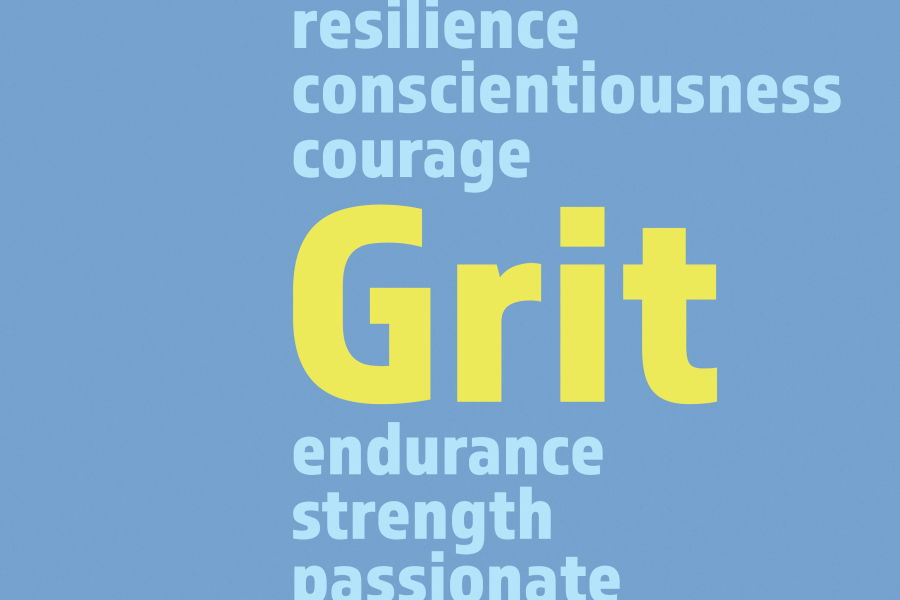
In lay language, grit is often used to describe small stones and sand. A beach-lover knows how impossible it is to get all that particulate matter out of their hair, clothes and car — days after a beach trip, sand still shows up. The concept of grit isn’t much different. Coined by Angela Lee Duckworth, a psychologist and academic at the University of Pennsylvania, grit describes one’s ability to keep going, essentially quantifying their resolve and strength of character.

In her TED talk, Duckworth claims she doesn’t know how to respond to parents and educators who ask her how to build grit in their kids.

“Talent doesn’t make you gritty,” Duckworth said. “Our data show very clearly that there are many talented individuals who simply do not follow through on their commitments. In fact, in our data, grit is usually unrelated or even inversely related to measures of talent.”

She goes on to claim that what best fosters grit is the “growth mindset,” an idea developed by Carol Dweck, a professor of psychology at Stanford University. Dweck’s claim is that success is not something intrinsic. Each person has certain qualities that yield success and certain qualities that do not. What one must do is constantly and consistently improve themselves. Most students have encountered this term — often when it comes to a course’s grading system. While many professors seem to encourage students to have a “growth mindset,” it only seems to be in retaliation to those who seem to be more obsessed with points and grades.

So, while there hasn’t yet been a consensus to what makes someone “gritty,” there certainly seems to be ideas on how to get there. If there’s really a vested interest in levelling the playing field, students must be taught how to learn — and how to learn well — as early as possible. Mainly, there should be much emphasis on Dweck’s “growth mindset.”

But this is not to say that students who don’t follow through with dreams, degrees or goals are incapable or flaky. It just suggests that the reasons they decided not to pursue what they wanted have nothing to do with the inequalities in our system — but rather the ineffectual ways they were taught to learn. It’s frustrating that even after years of these ideas being tested and proven repeatedly, with students of all races and socioeconomic classes, successful behavior is not taught in our education system. And whenever it is taught, the goals seem to be tangential to student success.

Grit is education’s new buzzword. And what makes it so fascinating is not that educators haven’t put a finger on who has it and who doesn’t, but rather that some students have tapped into it despite sharing the same broken system with those who haven’t. Education is the great equalizer, but somehow teaching the fundamental habits of success remains off the radar.


Written by: Samvardhini Sridharan — smsridharan@ucdavis.edu

Disclaimer: The views and opinions expressed by individual columnists belong to the columnists alone and do not necessarily indicate the views and opinions held by The California Aggie.

Humor: What Davis would look like if we took it and put it somewhere interesting

ALLYSON KO / AGGIE

Could we survive?

There is an old saying that goes: If a tree falls in a forest and nobody is around to hear it, did it actually fall? Well try and apply that to Davis. If UC Davis existed anywhere other than Davis, would it still contain all the cute little quirks that make Davis, Davis? And to that I say, I don’t know. This might be kind of hard to conceptualize, but trust me, it doesn’t even actually matter because Davis will never exist anywhere interesting. In fact, maybe Davis doesn’t exist at all (but that’s a whole ‘nother article).

Anyway, I will entertain the idea that Davis could exist in a bustling metropolis or relaxed beach town without changing any other part of its charm. Some questions to ask might be Where would the cows go? Could we still get away with dressing out of the early 2000s? Will bike circles work? Will everything still be overcrowded? And to that I say, I don’t know.

What I do know is that Davis without Davis kind of seems like the quarter system without midterms every week, or professors who don’t miss six weeks of the quarter for assorted conferences. As much as we complain (or maybe it’s just me), Davis anywhere else would lack the pizzazz (for lack of a better word) that most schools probably don’t even want to have.

I’m sure some people would prefer to go somewhere that could actually fit all of its residents, but I’m not really sure why. I have made so many friends waiting in various lines, and I’m not upset that I can never park anywhere because, I mean, is that any different than any other bustling city filled with other things to do? The only difference is that at least here we’re not overwhelmed with options because we know the three things we can do downtown.

I think Davis anywhere other than Davis is a nice idea for all of us who wonder what it would have been like if we had just gotten into Cal or UCLA. But it is in this distaste for our school that the overwhelming lack of school spirit that everyone’s able to relate to and bond over exists. So I will counter my own article and say that the lack of interest surrounding the town of Davis is what makes for such a tight-knit and special community.

So instead of really wondering what Davis would look like if it were somewhere else, here are some other fun food-for-thought questions: What would Davis look like if it were in Davis but not part of the cute little corrupt California public school system? Or, if Davis were Davis but were actually in Central California and instead a state school known for its engineering and architecture programs (should I have gone to Cal Poly?). Anyway, don’t let these questions bog you down too much, but think of them as more guiding philosophical questions that might ruin your life.

Author’s note: I apologize for the negativity. I actually really like Davis.

Written by: Rosie Schwarz — rschwarz@ucdavis.edu

(This article is humor and/or satire, and its content is purely fictional. The story and the names of “sources” are fictionalized.)

Assassinations In The Street: Boris Nemtsov and his Russo-American legacy

ALLYSON KO / AGGIE

Political hits a reality, not fiction in Russia

One February night in Moscow, a Russian opposition leader and his lover were walking home from a dinner date. As the couple crossed the Bolshoy Moskvoretsky Bridge, a large vehicle pulled up beside them, blocking the only working camera within range. Several gunshots rang out. Moments later, a single body lay on the pavement. The Kremlin loomed in the background.

Boris Nemtsov, one of Vladimir Putin’s harshest critics, was assassinated almost three years ago. His death was mourned around the world and in Russia. Barack Obama condemned the killing and remembered Nemtsov’s “courageous dedication to the struggle against corruption in Russia.” Vladimir Putin issued his own statement, praising Nemtsov for leaving “his mark in the history of Russia.”

Nemtsov’s alleged killers — a band of Chechens — were jailed last year following a trial deemed farcical by some. But the late opposition leader’s name lives on somewhat closer to home. The Washington D.C. City Council recently announced that it had unanimously approved a measure renaming part of the street in front of the Russian Embassy in honor of Nemtsov — a slighting gesture against Putin and his increasing hostility.

Many observers think Putin was somehow connected to the murder, given Nemtsov’s fierce criticism of the president’s alleged corruption and his connection to Ramzan Kadyrov, the murky leader of Chechnya. The location of the murder — a mere glance away from Putin’s seat of power — stoked the flames.

These suspicions — of the type that hover around Putin’s crackdown of dissenters — have followed him for almost two decades in power. And while it’s unwise to zero in solely on the man in charge, assassinations more befitting a spy novel than real life are not uncommon in ways that raise eyebrows stateside.

Two of them occurred back in 2006. Anna Politkovskaya, a famed journalist noted for her coverage of human rights violations in Chechnya and distaste for Putin, was gunned down in her apartment building on — wait for it — Putin’s birthday. Less than a month later, a former Russian FSB agent-turned-dissident named Alexander Litvinenko was poisoned with radioactive polonium in London.

Litvinenko’s murder was more drawn-out than most — doctors failed to diagnose the lethal radiation circulating his body until three weeks had passed, by which time he was close to dying. Before he died, Litvinenko directed a damning statement to Putin, whom he accused of ordering the hit:

“You may succeed in silencing me but that silence comes at a price. You have shown yourself to be as barbaric and ruthless as your most hostile critics have claimed. You have shown yourself to have no respect for life, liberty or any civilised value. You have shown yourself to be unworthy of your office, to be unworthy of the trust of civilised men and women. You may succeed in silencing one man but the howl of protest from around the world will reverberate, Mr. Putin, in your ears for the rest of your life. May God forgive you for what you have done, not only to me but to beloved Russia and its people.”

Washington D.C’s decision to affix Boris Nemtsov’s name to a stretch of politically hot real estate solidifies the uneasiness so apparent in Russian-American relations today. It’s a stinging blow to the Kremlin.

It’s also a subtle jab at Donald Trump. His grudging acceptance of Russian sanctions and denials of election interference have placed him at odds with much of the political establishment. Trump has repeatedly denounced political critics echoing the activism of Nemtsov — a man truly passionate about his cause.

This is a measure that appropriates Nemtsov’s political opposition as more American than Russian — and more American than Trumpian.

Hits on journalists, politicians and ex-spies are extraordinarily rare in the States, of course, but remembering them helps us understand Putin’s centralized grip on power that is as disturbing to Americans as it is normal for Russians. In his travelogue Midnight in Siberia, David Greene reaches a point in his journey through Russia where he realizes “that Russians may well want — and get — something else” besides the “wisdom of America’s way of life and system of government.”

I’ll find out for sure when I get there.


Written by: Nick Irvin — ntirvin@ucdavis.edu

Disclaimer: The views and opinions expressed by individual columnists belong to the columnists alone and do not necessarily indicate the views and opinions held by The California Aggie.


Sacramento native wins Golden Globe Award

CAITLYN SAMPLEY / AGGIE

Greta Gerwig’s “Lady Bird” wins two Golden Globes, brings national attention to Sacramento

At this year’s 75th annual Golden Globes Awards ceremony, Sacramento native Greta Gerwig’s latest film captured the attention of critics and moviegoers across the nation. The film “Lady Bird” won Best Musical or Comedy Motion Picture as well as Best Actress in a Musical or Comedy Motion Picture.

“Lady Bird” follows the story of a teenage girl navigating her senior year of high school in what she refers to as “the Midwest of California,” otherwise known as Sacramento. The film marks Gerwig’s first experience as a director, and she found it crucial to set the film in her hometown, bringing the nation’s attention to Sacramento. She gave a shout out to the city in her acceptance speech.

“I want to thank my mom and dad and the people of Sacramento, who gave me roots and wings and helped me get where I am today,” Gerwig said at the ceremony. “Thank you, thank you!”

The film has been extremely well-received by critics, receiving a 99 percent on Rotten Tomatoes, an almost unheard of feat. Critics said the film poignantly portrays familiarity, while still managing to feel fresh and innovative.

What Ms. Gerwig has done — and it’s by no means a small accomplishment — is to infuse one of the most convention-bound, rose-colored genres in American cinema with freshness and surprise,” said movie critic A.O. Scott in an article in The New York Times. “The characters can look like familiar figures: the sad dad and the disapproving mom; the sullen brother and his gothic girlfriend; the mean girls and the cool teachers; the too-perfect boyfriend and the dirt bag boyfriend. None of them are caricatures, though, and while everyone is mocked, nobody is treated with cruelty or contempt, at least by Ms. Gerwig.”

In an interview with The Sacramento Bee, Gerwig explained the importance of creating a film in Sacramento that would accurately portray its beauty.

“I wanted to make a love letter to Sacramento as seen through the eyes of someone who can’t appreciate how beautiful it is until she’s going away to someplace else,” Gerwig said. “I knew this was a special place, but its physical beauty — the tree canopy, the wide streets, the neighborhoods, the river — I didn’t realize how wonderful they were until I moved to a vertical city like New York. Sacramento is just so lovely.”

The film also excited many students, who felt as though it hit especially close to home with references to UC Davis.

“I thought the film felt really genuine and honest,” said Marina Broz, a fourth-year genetics and genomics major. “It was very true to what Sacramento is and makes you want to appreciate it more.”

“Lady Bird” is the first major motion picture to shine such a huge light on Sacramento and has already stirred conversation.

“I tell people it’s [Sacramento], the best place you’ve never been,” Gerwig said. “It’s a wonderful place to grow up and raise a family, but I don’t want the secret to get out too much.”

At the time the article was written, “Lady Bird” was still in theaters, playing downtown at Varsity Theatre.


Written by: Hadya Amin — city@theaggie.org

West Davis Active Adult Community in development

KYLA ROUNDS / AGGIE

Open field near Covell, Lake set for housing project

On Wednesday, Jan. 10, the city planning commission met again to resume a discussion concerning the proposed West Davis Active Adult Community. The WDAAC has been planned and discussed since Nov. 2016 as developers and city planners work together to decide how to build the new community on the open lot on the north side of Covell Boulevard, across from Sutter Davis Hospital. In particular, the commission discussed the new Environmental Impact Report for the project, which has been made available to the public for comment.

“Going to city advisory commissions to get initial comments and going back through the commissions provides responses and shows how their initial comments have been reflected into the revised projects,” said Katherine Hess, the community development administrator for the City of Davis. “As far as the site plan and concept have been concerned, we’ve been working with the applicant to increase recreational uses on the property and increase connectivity within the site.”

The developers and planners have continued their joint efforts to ensure that, if built, the new community will be easily integrated into Davis as a whole. Though the WDAAC will mostly be open to people 55 and older, planners have allocated housing spaces for caretakers and younger, conventional families to take.

“Smaller ideas and concepts […] which are very important — that’s what we’re working on improving,” said Dave Taormino, the developer and original applicant for the entire project. “It’s the best location in Davis for this type of place — this type of housing.”

Developers see the spot as an ideal area for an active adult community such as this one due to its close proximity to stores and markets and the convenient nearby transportation. Taormino also commented on the potential voting of the proposed project, mentioning the “Measure R” law.

“[Measure R states that the city and its people are to work together] to supply an adequate amount of housing to meet internal needs,” Taormino said.

The measure essentially states that open or former agriculture spaces require citizen participation — or a public vote — if it is to be repurposed for urban or housing usage. Due to the fact that the open lot in question is an open space outside of city limits, the proposal must be voted on by Davis’ general population before developers can move forward.

If the city council agrees with the plans made by city commissions and developers, the proposals could be passed as early as spring of this year and the WDAAC could be placed on the November ballot to be voted on by Davis residents.

“My thinking is that it will pass,” said David Thompson, a developer for the WDAAC. “We don’t want to take anything for granted […] but the need for senior housing in the community is growing exponentially relative to other age groups. And people have a need for affordable housing and market-rate housing — we’re already seeing people having to leave to afford housing […] The population [is] going to be very fair and thoughtful about the vote. This type of housing is valuable.”


Written by: Ahash Francis — city@theaggie.org


Senate bill to bring abortion pill to every public California college campus leaves committee

KYLA ROUNDS / AGGIE

JustCARE campaign intersects students, legislators, doctors to increase access to non-surgical abortion

California students, doctors, legislators and private funders worked together to bring the abortion pill to every public California university with the justCARE: Campus Action for Reproductive Equity campaign and Senate Bill 320. The “abortion pill” is a commonly-used term for the two medications involved in non-surgical medicated abortion. Mifepristone blocks pregnancy-maintaining hormones, while misoprostol flushes the uterus.

Senate Bill 320, written by Senator Connie M. Leyva, sought to “offer abortion by medication techniques” at “each public university student health center” before or by Jan. 1 of 2022. The Senate Education Committee passed SB 320 on Jan. 10. The bill will only apply to public universities with on-campus student health centers.   

UC Davis is already one of the few campuses in the United States to offer a Plan B vending machine, where students can access morning-after pills. Plan B differs from medicated abortion in that it inhibits sperm implantation to the egg. Other morning-after medication prevents ovulation through progestin, but does not interfere with sperm and egg implantation.

The California Aggie participated in a conference call conducted by justCARE with doctors, educators, researchers and a student on Jan. 9 to provide outreach on behalf of SB 320.

Adiba Khan, a fourth-year student at UC Berkeley majoring in public health and sociology, is the director of Students for Reproductive Justice on her campus and has partnered with justCARE. According to Khan, abortion stigma is not just a problem in conservative states, but nationwide as well.

“I’m thrilled to be part of the justCARE campaign,” Khan said. “We envision a future where reproductive health services are available to all students who need them. Coming from Oklahoma to Berkeley, I didn’t think abortion access would be a problem in this progressive state. In my home state, I know many people struggle to get abortion care, but I thought that only happened in rural or conservative places. My sophomore year in college, I learned that in fact there are actually many barriers and bureaucratic hurdles, particularly for students living on campus students [to get] abortion care. I also came to realize that abortion stigma existed everywhere, and that all of us have a role to play in dismantling the stigma and silence surrounding abortion.”

Khan found herself wondering why safe access to abortion and reproductive health care was not already an inalienable human right, especially for on campus students without cars. According to Khan, underrepresented and impoverished students bear the largest burden of accessing reproductive health care.

“Once we realized how difficult it was to get an abortion — that students have to travel off campus, sometimes spending hours on public transit and money they don’t have — we found ourselves asking why this safe, effective care wasn’t available on our campuses,” Khan said. “Today we’re part of a statewide effort looking to change this. These barriers disproportionately harm students of color, low income students, and first-generation college students. Once a student decides to end a pregnancy, there is no reason they shouldn’t be able to get the abortion pill on campus.“

Khan sees the potential in direct reproductive health care access on campus, as well as furthering abortion acceptance.

“As a woman of color and child of immigrants who grew up low-income, reproductive health is personal for me,” Khan said. “Offering the abortion pill on campus would mean that students would be able to get abortion care without needless costs, delays, emotional stress or added travel time. And It would do something else too. It would send a powerful message countering the prevailing and incredibly harmful abortion stigma in our society. Abortion is a safe and essential part of reproductive care and making it available on campus reinforces that truth.”

Daniel Grossman, a professor of obstetrics, gynecology and reproductive sciences and the director of Advancing New Standards in Reproductive Health at the University of California, San Francisco, conducted a study gauging if California campuses had the current capacity to provide medicated abortion. He concluded that there was no reason to exclude administering the abortion pill from services provided at every California student health center, if ultrasound machines and training were acquired.

“We obtained responses from all 11 UC campuses and 20 of the 23 CSU campuses,” Grossman said. ”We found that all the student health centers had the current setup to provide medication abortion. Most of the health centers would need an ultrasound [and] all of the sites would require training for staff on medication abortion care. With a reasonable amount of investment, these issues can be addressed. All the UCs have a 24-hour nurse or physician consultation hotline, but only nine of the CSU’s have this, so this will be necessary. Based on our assessments, I believe it would be very feasible for the UC and CSU campuses to be able to provide medication abortion onsite.”

According to Dr. Ruth Shaber, the founder and president of the Tara Health Foundation, the funding consortium is made up of private donors: The Women’s Foundation of California, Tara Health Foundation and an anonymous donor. Shaber said the new equipment and training that Grossman mentioned is feasibly fundable.

“We are committed to providing the necessary funding to begin to provide if this California right to access act becomes law,” Shaber said. “If SB 320 becomes law, we will provide funds to support training for health care providers, equipment, a security audit and any other upgrades. There will be no cost to clinics to become ready to provide this medical service. Not only is it the right thing to do to lift barriers to abortion care, but it’s also possible, starting right here in California. Let’s [make] reproductive health care, including abortion, available to all who need it.”

Ushma Upadhyay, an associate professor in residence, obstetrics, gynecology, and reproductive sciences at UC San Francisco, conducted a study to observe the temporal and geographic barriers on campus college students face when trying to access reproductive health care. Upadhyay is the deputy director of the University of California Global Health Institute Center of Expertise on Women’s Health, Gender, and Empowerment. Her study aimed to quantify the demand of students who want abortion access, as well as how far they would have to travel.

“There would be between 322 to 522 medication abortions occurring across all UC’s and CSU’s each month,” Upadhyay said. “15 campuses, which represent about 44 percent, are further than 5 miles from the nearest provider. Median public transit time is 34 minutes one way. Only five of the 34 abortion facilities closest to UC and CSU campus are open on weekends. The average wait time was seven days. This is important because medication abortion can only be done in the first ten weeks of pregnancy. Evidence shows that women with unplanned pregnancies and younger women are significantly less likely to recognize a pregnancy in the first six weeks.”

Shaber emphasized the need to advocate for student’s reproductive health on college campuses.

“No student should have to navigate off-site care when the campus health care center is able to provide that service,” Shaber said. “As an OB/GYN physician, I know students will have improved medical outcomes if they are able to access care from accessible providers they trust. Today, I’m very pleased to announce that a group of private funders have come to cover the cost of implementation for providing the abortion pill on California campuses. Like many across the state, we recognize the importance of keeping abortion legal, affordable and available.”


Written by: Aaron Liss — campus@theaggie.org


Women’s resources: Is UC Davis doing enough?

0
MORGAN TIEU / AGGIE

Students evaluate the sufficiency of women’s resources on campus

Women comprise 59 percent of UC Davis’ student body. With a demographic as substantial as this one, it is essential for the school to provide an ample amount of resources that are readily available and easily accessible to women. While the school does offer a wide range of women’s resources and services, including but not limited to those offered at the Women’s Resources and Research Center, many students feel that there is room for improvement.

Biana Giang, a second-year civil engineering major, believes the school has a bit of catching up to do when it comes to the amount of women’s resources available.

“The only [resource] that I’m aware of on campus is the WRRC in North Hall,” Giang said. “Other than that, I feel like there isn’t really anything else. There is always more that can be added.”

According to Giang, the school’s lack of attention in the advertising and promotion sector puts its existing resources at a slight disadvantage. Giang feels that, though the school offers certain resources for women, not enough students are aware of those resources.

“Other than what you get during orientation, or if you decide to take a class that will tell you about all the resources that are on campus, a lot of people aren’t aware of what [the school] does offer,” Giang said. “Having more advertisements or at least some more coverage on [existing resources] would definitely help.”

Mariana Huben, a fourth-year English and linguistics double major and editor-in-chief and campus correspondent for Her Campus at UC Davis, shared similar sentiments regarding the lack of campus efforts in publicizing women’s resources.

“As far as the resources go, [the school] is doing an amazing job,” Huben said. “It’s really just the promotion of those resources. And I think a big part of that is that [UC Davis] is just such a big school. You can only reach so many students through email. Only so many students actually check their emails regularly.”

Huben believes it’s the school’s duty to educate students on the resources that are available to them; failure to do so ultimately puts more responsibility on students to actively seek out the services and programs they need.

“I think you do have to seek out additional information a lot of the time,” Huben said. “There is a Society for Women Engineers if you’re in STEM and you want that cohort of just women, and if you’re into business there is Davis Women in Business and you can join that club. But you do have to step a bit outside of your comfort zone to get that information.”

Mirka Dirzo, second-year psychology and Chicanx studies double major, agrees that more can be done in order to ensure that women’s campus resources are up to par. Dirzo especially emphasizes the need for better accessibility for women seeking out these resources, especially considering the fact that most UC Davis students come from diverse socioeconomic backgrounds.

“I do know that there’s a Plan-B vending machine in the ARC, but there are women [who come] from low-income households who can’t afford it,” Dirzo said. “Even if [certain resources] are available, it’s still a hassle to get them. It would be a lot more helpful to make [these resources] more accessible.”

Accessibility seems to be a crucial problem for many UC Davis students seeking campus resources. Angela Kim, fourth-year gender, sexuality and women’s studies and American studies double major and community organizer for the WRRC, also believes that the ease at which students can access their desired resources can definitely be improved upon.

“There are a lot of resources on campus, but I think it’s more of a matter of awareness and access […] and making these abundant resources that we have on campus more accessible,” Kim said. “If you think about it, when a student is in distress or [in a] crisis, they might not always have the resources right at hand.”

The WRRC, one of the more widely known resource centers on campus, provides an open space and open resources for individuals from all different communities to utilize. Many students are, however, reluctant to take the additional steps to obtain the resources they need because they don’t feel comfortable doing so.

“We at the WRRC are a service that offers so much gender and sex education,” Kim said, “[…] but people don’t take the initiative to reach out to us. It gets difficult when the UC Davis community is not doing [its] part to become more aware and more conscious.”

Kim stressed the importance of engaging in conversations that bring awareness to stigmatized topics, topics like HIV testing or the utilization of gender-neutral bathrooms, in order to destroy preconceived notions surrounding them. According to Kim, the negative connotations surrounding these topics prevent many resources offered on campus from being fully utilized.

“I think we can do a lot more to have conversations […] about things people might normally be uncomfortable with,” Kim said. “I think it’s a matter of being engaged with the community and coming to these different [resource] centers and educating yourself more about them.”


Written by: Emily Nguyen — features@theaggie.org

Men’s Winter Fashion

GENESIA TING / AGGIE

Making college men presentable

On a budget, with little time to think about the clothes we put on every morning, looking fashionable is often the last thing us college men are thinking about. However, there is practical hope. These are some trends and tips to make your Winter Quarter more stylish without breaking the bank.

Sweatpants

If you’re going to wear sweatpants to class, dress it up by accessorizing with hats and watches (practically the only two accessories available to men). A small selection, but they do wonders for any look. Throwing on a tasteful beanie or watch can turn any look into a million bucks without spending a lot of money for designer quality. A quick stop at the Forever 21 in the U-Mall is all you need. Lastly, please be aware of the difference between sweatpants and plain old pajamas.

‘70s is the Decade

This winter is the perfect time to ask your dad for any of his old clothes collecting dust in the attic. They won’t cost you anything, and it’ll be like going on a scavenger hunt. Loose-fitting dad sweaters are in right now. Alternatively, there are a few assorted consignment stores in Davis that may be harboring some plaid sweaters if your home isn’t accessible. Other iconic pieces of the ‘70s include fringed jackets and denim everything, both of which go well with a pair of boots.

Keep it Simple

This winter season isn’t exactly the time to take bold risks. Simple hues and structured constructions are the way to go. Mid-century American fashion has resurfaced and is the main influencer of this trend. This simplicity is great for those that aren’t prepared to showcase their statement pieces that may strike up controversy. ShopCuffs is my recommendation for simple and well-made pieces — and it’s conveniently located across from 3rd and U.

Padded Jackets

Looking like you’re on your way to Tahoe is in this season. Thick downs and fur coats can add an interesting touch and keep you bundled against the cold Davis winter. However, they are on the more expensive end of the spectrum. Gap, located in the Davis Commons, has a few pieces that are reasonably priced and that will be a fine addition to any outerwear collection.


At the end of the runway, it all depends on what works for you. Wearing things that make you feel confident in your strut on the way to class is worth more than priceless couture. Good luck, gentlemen.


Written by: Josh Madrid — arts@theaggie.org

“Saturation III,” Brockhampton

CINDY CHEUNG / AGGIE

The end of the “Saturation” trilogy brings new hits and even greater expectations for 2018

2017 was a year of highs and lows. But for Brockhampton, it’s been nothing but highs. A self proclaimed “boy band” based in Los Angeles, the musical group rode a wave of success throughout the year. Just over a month ago, the band released its third and final album of 2017, “Saturation III.” The album has completed Brockhampton’s transition from cult phenomenon to critically acclaimed musicians.

Beginning with its first album of 2017, “Saturation,” Brockhampton  always prided itself on punching you in the mouth with the first tracks of its albums. On “Saturation,” it was courtesy of “HEAT,” a hard-hitting song characterized by aggressive rapping over a thunderous bass line. On “Saturation II,” “GUMMY continued the trend with an equally large and complex beat. “Saturation III” bunnyhops the previous two openers with “BOOGIE,” bringing police siren production and a perfect blend of singing and rapping.

After recovering from the onslaught of “BOOGIE,” Brockhampton presents the musicians’ multifaceted personalities over jazzy production in “JOHNNY.” The song features many of the group’s unique characters, with topics ranging from One Direction’s Harry Styles to severe depression. In any other situation this might raise questions, but with this boy band it’s not only what the fans want, but what they’ve come to expect.

Toward the middle of the album, “BLEACH” is a true standout. Anchored by one of the band’s signature catchy hooks, the song is composed of two deep verses by members Matt Champion and Ameer Vann. Fellow musical artist Ryan Beatty provides the chorus.

The album is rounded out by “RENTAL”, which, much like “BLEACH,” is held down by yet another intoxicating chorus. Brockhampton founder Kevin Abstract raps, “Ridin’ on the roof with a dollar sign attached to my head, head, head, head, head, head, head, head.” This is prefaced by Champion’s equally catchy pre-chorus, and before you know it, you’re singing along.

“Saturation III” is far from polished. However, given that this group of 14 20-year-olds self-produced, self-recorded and self-wrote not one, not two, but three good albums, we all have to give credit where credit is due. If this is Brockhampton’s ceiling then this year has still been a great moment for music. But in all likelihood, these guys are really just scratching the surface of their potential. They have three good albums under their belt, along with a dozen incredibly imaginative music videos and a national tour. If 2017 is any indication, Brockhampton is going to come out on top in 2018.

Brockhampton’s Love Your Parents Tour is coming to Sacramento in early March.


Written by: Rowan O’Connell-Gates — arts@theaggie.org

Status, health benefits of olive oil

DIANA LI / AGGIE

UC Davis hosts International Olive Oil Conference to discuss efficacy of olive oil in reducing risk of major diseases

For the first time since 2001, the International Olive Oil Institute met to present research on the health benefits of olive oil at the UC Davis Olive Center. Located at the Robert Mondavi Institute for Wine and Food Science, the conference, hosted by the International Olive Oil Council, consisted of scientists from across the United States as well as representatives from research institutions in Spain and Italy. Studies on the health benefits of olive oil consumption in relation to obesity, vascular health and diabetes were presented in conjunction with the effect of olive oil consumption and its relation to major diseases.

Representatives from the consumer side of the industry were also present to hear more about what kind of research is going on in the field and to speak with experts and researchers about their findings and opinions. One representative was Takatoshi Yamashita, a senior manager of a product development laboratory for J-Oil Mills, Inc., one of the largest manufacturers of olive oil in Japan. His expertise is in chemistry and the analysis of a compound in olive oil called oleocanthals that he, among other researchers, has found to have profound effects on appetite. When olive oil is consumed, oleocanthals bind with receptors in the digestive tract, which effectively reduce appetite. Olive oil consumption has also been linked to reduction in the development of cancer and Alzheimer’s.

Ed Blanz, a UC Davis alumni who works in the field of forensic nutrition, also attended the conference. Blanz, in association with the company that he works for in the Bay Area, investigates the questionable claims that companies and researchers make about food products.

“I usually work with health products and dietary supplements where people are making questionable claims about what their product will do for people’s health,” Blanz said. “Their science comes to me, I analyze the research, write a paper, and help to regulate the industry.”

Blanz also has a faculty position at UCSF and has travelled the world speaking about olive oil.

The meeting of researchers at the International Olive Oil Conference this year showed the many ways that olive oil influences society, from the market to our health.

The conference showcased presentations such as one given by Manuel Franco, a researcher from the University of Álcala and the Johns Hopkins Bloomberg School of Public Health, who explores the presence of healthy diets in relation to economic status in different places around the world.

There is more to olive oil than just its health benefits. Franco presented research on the affordability of foods within the Mediterranean diet and its influence on a healthy diet. He is trained in the analysis of food availability in cities and its correlation to diet and health.  

“If you move from city to city, you eat differently,” Franco said. “Why is that? And how is that related to your health?”

The Mediterranean diet is one of the healthiest non-restrictive diets around. A non-restrictive diet is one that does not enforce a strict regimen of what to eat on the dieter. There is no set type of food that the Mediterranean diet calls for, but it does call for olive oil to be used in replacement of salad dressings and other types of oil. It operates on the idea that people who rely mainly on olive oil for their caloric intake are healthier than people who do not. The consumption of olive oil also has a close relation to high consumption of vegetables.

Jean-Xavier Guinard, a UC Davis professor of Food Science and Technology, is a sensory scientist and food researcher who, among other research, studies the perception of olive oil in the eyes of consumers. Guinard is also the interim director for the study of wine and food science at UC Davis and co-hosted the International Olive Oil Conference with the Mondavi wine and food center. He focuses on the sensory aspects of olive oil, particularly its taste.

“The nature of the fat we consume is highly relevant to our health,” Guinard said. “But the context of olive oil compared to other fats and oils shows us that olive oil offers a lot of benefits. It’s time for us to talk about nutrition and health in terms of the qualities of food. But this must be done in combination with flavor and what tastes great to us. Olive oil fulfills all of these requirements, and it is also a sustainable source of energy.”

California and UC Davis play an important role in the regulation of the olive oil industry since both the state’s agricultural infrastructure and the university’s research have influenced the perception and understanding of both its benefits and functions.

The UC Davis agricultural program grows olive trees and has a yearly harvest that is well known in California and abroad for the high quality of olive oil that is produced. Students can get involved every year in the Fall to witness the process and take home some olive oil for themselves.


Written by: Jason Kelly — science@theaggie.org

Schneider sets career-high 29 points as Aggies axe 49ers

0
MACLEAN HARTFORD / AGGIE

UC Davis Aggies defeat Long Beach State 84-75

The UC Davis Aggies did not let the foggy weather outside affect their play on Jan. 17, defeating the Long Beach State 49ers in a non-conference game at home 84-75. The Aggies came into the game fourth in the Big West Conference with an 11-6 overall record and a 2-1 conference record for the 2017-18 season. In earning its 17th consecutive win at home, the team advances its home record to 6-0 on the season, and has won 39 out of the last 46 games played at home.

“I think that guys are taking pride in the home streak and I think they like that and take pride in that, it means something to them,” said head coach Jim Les. “The other part of that is that to be in the conference race in late February/early March, you have to win your home games. This league is too tough to win on the road so you can give other teams the opportunity to take those home wins. I like their [the team’s] focus and them embracing the streak, they aren’t running from it, they are running toward it.”

The first half was back-and-forth between the two teams where both were at the free throw line for majority of the half. UC Davis racked up eight team fouls in the half just shy of Long Beach’s 10. For the Aggies, junior guard Siler Schneider led the way in scoring and rebounds in the half, putting up 14 points, three rebounds, four assists and hitting three of four three-pointers taken. Junior guard TJ Shorts II helped lead the assists category as well with four in the half. As a team, UC Davis shot 53 percent from the field compared to the 49ers’ 48 percent. Exactly half of the Aggies first half points came from three pointers, the team draining 7-11 from the perimeter. Going into the second half, UC Davis was looking to keep its lead and ride out the win.

“We knew we had to just keep being aggressive,” Schneider said. “We just had to keep doing what we do in practice, being aggressive in the offensive end and getting a good shot while just letting our defense lead to the offense.”

The Aggies started strong the second half, pushing their lead to as high as 11 in the first five minutes of play. However, a drought from UC Davis — only scoring one point in about a four minute span — allowed for the 49ers to cut down the difference and keep the game close. As the game progressed, it was all Aggie offense and Long Beach could not do anything to catch the deficit, bringing the final score to 84-75 in favor of UC Davis.

The game was one of tying and breaking career records for many Aggie players.  Senior forward Chima Moneke tied his career high in blocks, and Shorts II contributed 15 points on 6-12 field goals while earning seven assists, tying his career-high in the assists category. Junior forward AJ John surpassed his career-high in threes, points and tied his career field goals made.

“My teammates found me in open spots and I haven’t hit a shot in a few games so it felt good to finally break that barrier,” John said. “We were able to knock down shots and play well offensively. I think we have a higher level to get to defensively and we know that but we are grateful to come out with the win tonight.”

Despite a large part of the roster contributing big plays, the big break was by Schneider. His 29 points and 11 out of 19 field goals made in the game were both career-highs. He contributed four three’s to the 10 total scored by UC Davis, while the six assists he dished out tied his career high mark in that category.

“The takeaway was that they were going to pack in the zone and try to take Chima [Moneke] away,” Les said about the game as a whole. “We have to get back to defense. I think we had too many breakdowns which allowed them [Long Beach] to hang around in the game and we have to get better on the defensive end. Our offense won it for us tonight but that isn’t a recipe we want to have moving forward.”

Continuing their conference play away against Hawai’i on Jan. 20, the Aggies took the 77-72 loss, pushing their overall and conference records to 12-7 and 3-2, respectively.

Playing at home tonight against CSUN at 7 p.m., UC Davis will surely look to keep on rolling through the season on the winning side of the ball.


Written by: Ryan Bugsch sports@theaggie.org