57.9 F
Davis

Davis, California

Monday, December 22, 2025
Home Blog Page 563

Raiders go all-in with monumental signing of Gruden

0
JOHN E. WOODS / PUBLIC DOMAIN

Oakland inks ex-head coach to largest coaching deal in league history

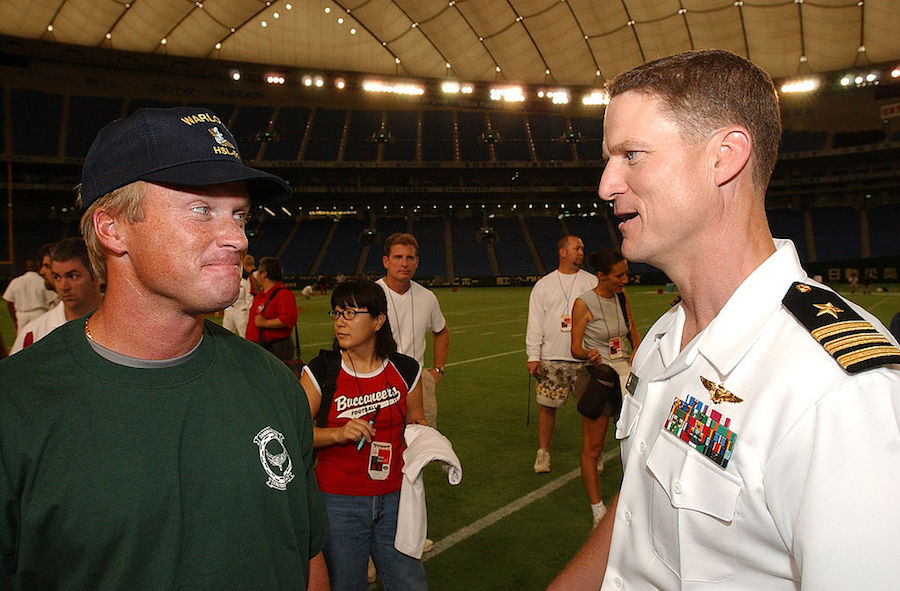
After many years of speculation and rumors, Jon Gruden has finally returned to the NFL as the head coach of the Oakland Raiders. Gruden began his head coaching career for Oakland in 1998, but was abruptly traded away after the 2001 season. He was an immensely popular figure during his time in the Bay Area, loved by both players and fans alike, and never truly wanted to leave. Raiders owner Mark Davis tried to lure Gruden back to Oakland for the last six years, but to no avail. Finally, after 16 years away, the man that Raiders fans affectionately called “Chucky”, is back in silver and black once again.

The hiring became official on the night of Jan. 6, just hours after Gruden had finished broadcasting the AFC Wild Card Game, his last call for ESPN after a nine year run in the booth. According to ESPN’s Adam Schefter, he will receive a 10 year contract worth $100 million, making him the highest paid head coach in NFL history.

The move comes just two years before the franchise plans to relocate to Las Vegas, Nev., where a new stadium will open in 2020. However, Gruden is most excited about the immediate future and putting on a show for the fans of Oakland, a city he fell in love with during his first stint with the team.

“Big reason why I’m here is the passion I have for the city of Oakland and this franchise,” said Gruden during his introductory press conference at the team’s headquarters in Alameda on Jan. 9. “I love football, and I love the city of Oakland. I had a son here and some of my great memories in life are in Oakland and I want to give them two of the best years of football that I can possibly help deliver.”

When Gruden took over for the Raiders  in 1998, he quickly led the team to back-to-back division titles in 2000 and 2001. The Raiders fell one win shy of reaching the Super Bowl in 2000 and lost to the New England Patriots in the 2001 divisional round in one of the most infamous, controversial games in league history, known as the “Tuck Rule” game. Despite the heartbreaking results in consecutive seasons, Gruden had truly reenergized the organization for the first time since it moved back to the Bay Area in 1995 and had the team poised for further success in the very near future.

Hall of Fame owner Al Davis opted to trade Gruden to the Tampa Bay Buccaneers after the 2001 season, partly due to a deteriorating relationship and power struggle between the two. Nevertheless, Davis simply could not turn down a jaw-dropping return from Tampa Bay that included two first-round draft picks, two second-round draft picks and a sum of $8 million.

Gruden promptly returned the favor by leading the Buccaneers to a Super Bowl victory over the Raiders in the very next season, setting the stage for a dreadful downfall in Oakland that produced 11 losing seasons in the ensuing 13 years.

Gruden has undoubtedly been one of the most popular, trendy options on the open market ever since the day he was fired by Tampa Bay in early 2009. His name had been linked to seemingly every high-profile heading coaching opening in both college and professional football since then, but he wanted to wait for the right situation before pulling the trigger.

“Obviously, this is very emotional for me,” Gruden said. “I never wanted to leave the Raiders. I never thought I’d be back, but here I am and I’m ready to get to work. In my heart, I feel this is the thing to do. This is the organization that I want to be a part of and I am all in.”

Gruden will look to get the Raiders back on track in 2018 after an extremely disappointing, drama-filled season that saw the team finish in third place in the AFC West with a record of 6-10.

“I think we have to improve in all areas,” Gruden said. “No matter what our record is, we’ve got to continually find ways to improve. We’ve got to improve the ways we practice. We have to improve the way we meet. And we have to improve the way we play. We have got to improve our roster, no question.”

Expectations for the Raiders were at all-time high heading into this past season, after the team finished with a 12-4 record in 2016 and broke a 13 year playoff drought, but Oakland struggled to live up to the lofty predictions or find any sort of consistency. Former head coach Jack Del Rio was fired immediately following the team’s season-ending loss to the Los Angeles Chargers, ending his three-year run at the helm.

“There were some things that went wrong, but you can’t solve all the problems today,” Gruden said. “We’ve got to come up with a plan to put the Raiders back on track and build this football team back.”

Regardless of how the Raiders performed in 2017, there is a lot of talented pieces on the roster, especially on the offensive side of the football. In addition, the team still has a pair of cornerstone players, in quarterback Derek Carr and defensive end Khalil Mack, that are prepared to lead the franchise for years to come.

Gruden is especially excited at the prospects of working with a young, skilled franchise quarterback like Carr, the type of the player he never had the luxury of coaching in his two previous head coaching stops.

“He has great arm talent, he’s athletic, he’s got natural leadership skills, he’s young, he’s in his prime, he’s healthy now,” Gruden said. “I think there is a huge ceiling in Derek Carr. I think he has proven that. It’s up to us as a coaching staff to improve around him, get more consistent, and come up with an offense that really allows him to soar into another level.”

No matter what happens on the field, this monumental signing promises to create a remarkable amount of buzz and attention around the organization, as it slowly transitions away from Northern California.


Written by: Brendan Ogburn — sports@theaggie.org
 

Garoppolo brings strength to beloved Bay Area team

0

CHIZZ510 [CC BY-SA 4.0] / COMMONS
San Francisco 49ers see winning future with hasty trade, young quarterback

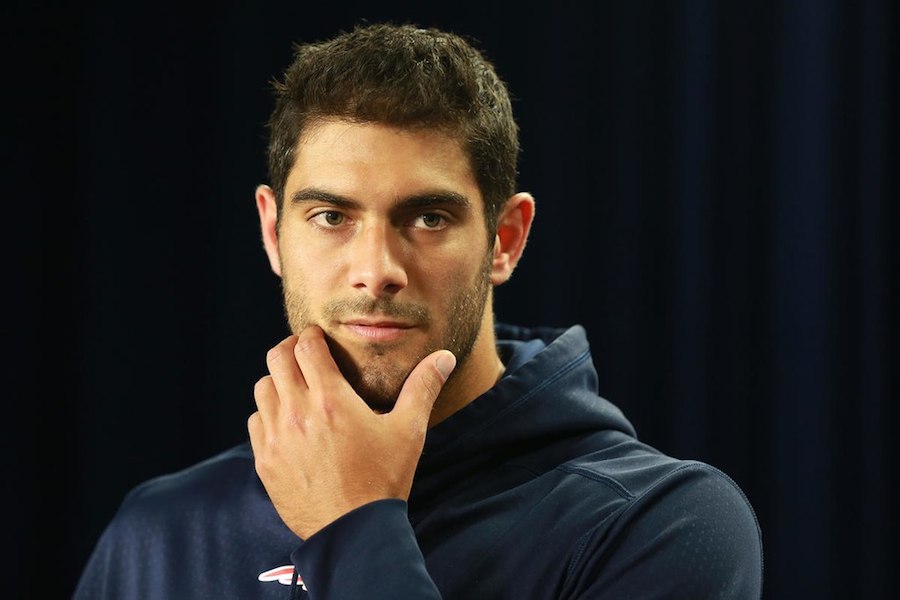
Turn on any sports radio talk show in Northern California and the conversation will be focused on Jimmy Garoppolo — for good reason. The San Francisco 49ers’ quarterback as of Oct. 30 of the 2017 season has made headlines most notably for his skill and trade from the Patriots, who may have lost their shot at a consecutive Super Bowl win by trading him.

Considered one of the better quarterback prospects in the 2014 NFL Draft, the 26-year-old Eastern Illinois alumnus was originally drafted by the New England Patriots in the second round as the 62nd pick overall. During his time with the Patriots as backup to Tom Brady, Garoppolo saw the field twice during Brady’s 2015 Deflategate suspension, earning a single game win under his belt before sustaining a shoulder injury and tearing his ACL.

Garoppolo, or Jimmy G to fans, made his 49ers debut in Week 12 after starter C.J. Beathard suffered an injury. Garoppolo had fans on their feet the second he walked onto the field and his exceptional talent did not leave fans disappointed. In the final minute of the game against the Seattle Seahawks, Garoppolo rushed for six yards in his first play. In the final play of the game, he threw a one-yard touchdown to Louis Murphy, also a new addition to the franchise. This touchdown caused quite a stir within the Niner Nation, with Garoppolo immediately being hailed as a savior to the team, as it was facing a losing season.

Garoppolo was named the starting quarterback for the week 13 game against the Chicago Bears, where he finished with 26-of-37 passing for 293 yards and an interception, helping lead the 49ers to victory. Garoppolo also earned consecutive wins in weeks 14, 15, 16 and 17 against the Houston Texans, Tennessee Titans, Jacksonville Jaguars and Los Angeles Rams, respectively. Garoppolo became the first quarterback to go 6-0 in his first six starts since Pittsburgh Steelers’ quarterback Ben Roethlisberger in 2004. Garoppolo’s success is a refreshing, exciting change of pace, bringing frustrated 49er fans their first winning streak since 2014.

Even without a top wide-receiver — Garoppolo’s currently plays to Marquise Goodwin, who was No. 3 for the Buffalo Bills last year — he’s managed to score. Critics are praising Garoppolo for his time management and his ability to throw accurately and quickly. His quick release being compared to veteran players in just his sixth start.

With such a great start as the 49ers’ franchise quarterback, it’s hard to imagine why the Patriots traded him in the first place. With MVP-favorite Brady now missing practice with an injured right hand just three days before the AFC Championship, that same thought is probably running through their heads right now. The under-the-table trade of Garoppolo had, and still has, a lot of people scratching their heads.

The New England Patriots under the direction of head coach Bill Belichick effectively sold their best insurance for just 50 cents on the dollar — for a second-round draft pick instead of a 2019 third-round compensatory pick. ESPN Magazine recently reported that Belichick wasn’t on board with the trade and was “furious and demoralized” when the trade went through, but Pats owner Robert Kraft, who allegedly pushed for the deal, sang another song to MMQB.com website, saying that Belichick was all for the trade.

Belichick and Kraft, who have been to seven Super Bowls together, will surely be kicking themselves if backup quarterback Brian Hoyer, whose only postseason appearance was a disaster, or an injured Brady has to take the field. Even though Brady is a favorite to win MVP even at 40 years old, the Jacksonville Jaguars are on a roll, especially defensively, and Brady’s hand injury could even the playing field between himself and Jacksonville Jaguars quarterback Blake Bortles. If the Patriots blow their chance at a consecutive ring, fans will be itching to point their fingers at who is to blame: Kraft, Belichick, or even a possibly jealous Brady himself.

But none of that matters right now to the Niner Nation, who already have their eyes set on Super Bowl LIII. Garoppolo will be a free agent at the end of this season, but if 49er’s Head Coach Kyle Shanahan and owner Jed York value the quarterback who changed everything for the 49ers and effectively saved the franchise, then he’ll agree to a franchise quarterback-level salary.  

With new general manager John Lynch making serious changes to the roster and creating a supporting cast for Garoppolo that is still just in its infant stages, the 2018 season is sure to be a victorious one.


Written by: Liz Jacobson — sports@theaggie.org

Streaming like never before

MIKE MOZART [CC BY 2.0] / FLICKR
The perks of being a student

Xfinity On Campus is a streaming service made specifically for students. Because UC Davis has a contract with Xfinity, the service is free for all its students. Accessible from your laptop, desktop or mobile device, TV shows can go with you anywhere as long as you sign in with your student ID. This streaming service allows you to watch live TV, record shows, watch on demand and even access all premium networks. No need to mooch off your neighbor’s cousin’s HBO Go — because now you have it for free.

The set-up is as easy as could be. Go to xfinityoncampus.com, find your school, sign in using your school credentials and then start watching.

Now you can’t make the excuse that you have no way of watching. Xfinity even has a list of shows to start from the beginning. In case you need recommendations for shows to start that are available through Xfinity On Campus, here are a few:

“Westworld”

For those of you wanting a psychological thriller, this is the perfect fit. With each episode, the overall plot makes more sense. This is not a show in which you can just watch a random episode: they must be watched in order to have the creators’ intended effect.

“Mr. Robot”

This show is just as intense as the previous, but with more twists and turns. The first season is a work of pure genius. The acting is phenomenal, and the cinematography isn’t any different. “Mr. Robot” currently has three seasons out and available online.

“Psych”

On a lighter note, this show takes a typical crime show and gives it a humorous twist. The show centers around a guy who claims to be a psychic, using his skills to help the police department solve crimes. What’s best about this show, though, is that its creators understand how stupid the concept is and they run with it.

“The Good Place” (Season 2)

When the world’s worst person ends up in heaven, the possibilities are endless. This show makes you root for all the characters while still being able to laugh at them as well as with them. The acting is incredible, and every line is hilarious. It’s a great show to make anyone feel better about life.

“Brooklyn Nine-Nine

This is a different type of police comedy. More about the characters’ relationships and the quirky situations they are thrown into, “Brooklyn Nine-Nine” is less about being a dramedy. Andy Samberg is a lovable lead character that brings out the best in each of his co-stars. All seasons are available on Netflix and the current season is on Xfinity On Campus.


Written by: CaraJoy Kleinrock — arts@theaggie.org


BØRNS Blue Madonna Tour: A Review

DIGBOSTON [CC BY 2.0] / FLICKR
Blue Madonna takes BØRNS to a new level, setting him apart

I had pretty high expectations before seeing BØRNS live in Oakland on Jan. 17. Not only had I heard great things through others who have seen him previously, but the sounds and feels of BØRNS set him up for success — the upbeat, pop-electronic tracks have an inevitable way of getting people on their feet. Not to mention that the Oakland show kicked off the tour celebrating his long-awaited second album, “Blue Madonna.” Great music, major hype — a recipe for success.

Not only was the main act memorable, but surprisingly the openers were as well. Mikky Echo produces a sound similar to BØRNS, but adds a hint more of rock. Great stage presence made them an exciting performance to start the show. Charlotte Cardin followed, with a hypnotic voice reminiscent of Amy Winehouse, producing a softer, groovier feel — a calm before a rochous storm, one could say. BØRNS chose wisely in his decision for openers, displaying real talent and a breadth of sound.

Such diversity mirrors the style of “Blue Madonna.” When I think of his pilot album “Dopamine,” while insanely catchy, it is very much pop-heavy. They are indeed intended to be and stand as classic crowd pleasers. What BØRNS does in his second album is branch out, adding different types of styles to the album to make each song distinct. The defining and masterful aspects of BØRNS are still present, don’t worry; Garrett Borns’ iconic high pitch and the catchiness of the music are prevalent. But he is more playful with the fundamental pieces: electric guitar mixed with ‘80s-esque techno beats and even instrumental pieces find their way into the mix. It’s more funky. Such transformation and display of eclectic talent is a smart move in BØRNS’ advancement and his respect in the music world and made for a much more interesting and enjoyable concert.

The emphasis of the concert rightfully focused on songs from his most recent album. Starting with “God Save Our Young Blood,” also the opener of the album itself, BØRNS later transitioned to the more instrumental, high-energy “We Don’t Care.” The showcase of the new songs ended with “Man,” the stand-out ‘80s techno-pop song of the album. Performing masterfully, BØRNS then made a swift and clean transition to performing the songs of his first album through a slower and more mellow version of “Seeing Stars.” Songs like “Past Lives,” “10,000 Emerald Pools” and of course “Electric Love” then followed. Slight twists on the songs, the pitch of a certain note for example, made their way into the performances, staying with the altering motif of “Blue Madonna,” illustrating BØRNS’ creative capabilities.

“Blue Madonna” is great in its totality, and the songs are not repetitive. While I enjoy “Dopamine,” one must admit the similarities of its songs. With the diversity of tracks on “Blue Madonna,” BØRNS is an up-and-coming, multifaceted force in the music industry not to be reckoned with. With an excellent new album and tour of the same vein, he is starting to prove himself as no longer just a catchy pop icon, but rather as a distinct and mature musical entity.  


Written by: Caroline Rutten — arts@theaggie.org

Meeting student mental health needs at UC Davis

JORDAN CHOW / AGGIE

Insight from executive director of health and wellness at UC Davis

As the executive director of health and wellness with leadership and advocacy responsibilities in Student Health and Counseling Services, I am acutely aware that strong mental health support can improve students’ academic achievements, persistence and overall wellbeing.

Recent research from the National Alliance on Mental Illness shows that 25 percent of college students have a diagnosable mental or psychological illness. At UC Davis, 13 percent of our students accessed Counseling Services last year (over 23,000 client visits). Their most common concerns were anxiety, depression, stress, academics and relationships.

Most students who request an appointment with Counseling Services can receive an initial consultation the same day or the next day. Last year, over 90 percent of students could be seen within seven days of requesting an appointment. Counseling Services’ main location is North Hall. Services also are available at the Student Health and Wellness Center. To further expand the reach of mental health services, counselors also are embedded in many academic satellite locations:

  • Colleges of Biological Sciences
  • College of Letters and Science
  • College of Agriculture and Environmental Sciences
  • College of Engineering
  • School of Veterinary Medicine
  • School of Medicine
  • School of Law
  • Office of Graduate Studies

In addition, Community Advising Network (CAN) counselors provide outreach, psycho-educational programming, clinical counseling and referral services for traditionally underserved populations. Their services are delivered through partnerships with a number of campus units:

  • Asian American Studies
  • Cross Cultural Center
  • Educational Opportunity Program
  • Lesbian, Gay, Bisexual, Transgender, Queer, Intersex, Asexual Resource Center
  • Middle Eastern/South Asian Student Affairs Officer
  • Center for African Diaspora Student Success
  • Center for Chicanx and Latinx Academic Student Success
  • Native American Academic Student Success Center
  • Services for International Students and Scholars
  • Student Recruitment and Retention Center
  • Transfer and Reentry Center
  • Veterans Success Center
  • Women’s Resources and Research Center

To assist our diverse student population, Counseling Services staff speak several languages, including English, Spanish, Mandarin, Vietnamese, Gujarati, Korean, Hindi, Urdu, Hebrew and Taiwanese.

To help improve access to mental health services on campus, new counseling positions have been created to meet the needs of our growing and diverse student body. The University of California Office of the President’s Mental Health Funding Initiative (MHFI) of 2015 has allowed UC Davis to add five counselors and stabilize five other counselor positions that had been on temporary funding. We have plans to hire three additional counselors by fall 2020. In addition, two new full-time psychiatrists were added, increasing the number of providers at the SHWC Behavioral Health Clinic to three full-time and one half-time psychiatrists.

SHCS is actively developing creative approaches to improve mental health access.  Responding to student demand for a variety of services, during an initial counseling visit, students are offered the options of self-care resources, psychoeducational workshops, group counseling and individual counseling. SHCS has invested in additional case management staff who can help connect students to other providers and resources on and off campus. SHCS also offers “You Got This” psychoeducational student workshops, a three-part series that combines evidence-based practices for more skillful management of a variety of mental health concerns.  

To accommodate students’ busy schedules, SHCS provides access to care outside of the traditional counseling office. Students can access LiveHealth Online to schedule a 45-minute appointment to talk face-to-face with a licensed therapist or psychologist through an online portal. LiveHealth Online is covered at 100 percent for UC Student Health Insurance Plan (UCSHIP) students. Students without UCSHIP can use their health insurance or pay a visit fee for this service. When offices are closed, students can receive help from a mental health professional using SHCS’ ProtoCall service by calling our main number (530) 752-2300. Lastly, this Winter Quarter, the campus plans to launch the Crisis Text Line, which will give students free access to 24/7 crisis support via text.

Research shows that sometimes it’s more comfortable for a student to speak with another student rather than a health care professional. SHCS offers Mental Health First Aid training to students who want to learn how to help someone who may be experiencing a mental health-related crisis or problem. Students are also actively involved with the Each Aggie Matters Website, which brings together students, staff and faculty to collectively raise awareness, de-stigmatize mental illness and cultivate mental health as a state of flourishing. The website includes a Mental Health Map that identifies places on campus where students can go for self-care, mental health services and other resources. SHCS also supports student-led initiatives such as the upcoming UC Davis Mental Health Conference and the Student Mental Health Coalition, a network of student groups that advise campus leadership, inform students, reduce stigma, allow for collaboration and promote resource transparency around mental health issues.

SHCS is committed to supporting students who are struggling with mental health issues and to ensuring that student mental health needs remain a priority at UC Davis. We will continue to take appropriate steps to balance the demand for increasing mental health services with existing resources. We are actively soliciting the student voice on these issues and will be forming a Student Health Advisory Committee to act as a formal liaison between the UCD student body and SHCS. The Committee will review current services and develop new programs to ensure SHCS meets the needs of students. Please contact me if you are interested in participating. Undergraduate and graduate students are welcome to apply for these stipend positions.

If you have any questions or would like to learn more about Counseling Services, please visit the SHCS website or contact me at matrout@ucdavis.edu.


Margaret Walter is the executive director of health and wellness at UC Davis.

Written by: Margaret Walter


Promoting careers in forensics

0

EXERCISE TRADEWINDS 2009 [CC BY 2.0] / FLICKR
A look at UC Davis’ Forensic Science Graduate Program

Of the many graduate programs that attract students to UC Davis, the forensic science program does not have as high of a profile as some, but it is no less successful.

In a recent article highlighting several UC Davis programs that “boost careers,” it was noted that 90 percent of graduates of the forensic science program now work directly in the field, “either for local, state, federal or private crime labs, at a DNA testing facility or within law enforcement.”

“UC Davis’ forensic science graduate program has prepared me extremely well for the rigors and workload that a forensic scientist of today must tackle,” said An Truong, a current forensic science masters student finishing his thesis. “I now work in at crime lab in Sacramento while continuing to finish to my degree, and I can honestly say without the support and guidance of the graduate program I would not be where I am today.”

Ruth Dickover, the director of the program, explained how it began in 2002.

“UC Davis was approached by the Department of Justice about the feasibility of setting up the program […] because many crime labs were having trouble filling senior positions,” Dickover said. “And FBI quality assurance standards require that people [in specific positions] have master’s degrees.”

To go back another decade, additional demand for forensic scientists was created by a Supreme Court case that increased standards for what evidence is qualified to be presented to a jury.

“In 1993, in a decision entitled Daubert v. Merrell Dow Pharmaceuticals, Inc., the United States Supreme Court reformed the test for determining the admissibility of scientific testimony,” said Edward J. Imwinkelried, the Edward L. Barrett, Jr. Professor of Law Emeritus at the UC Davis School of Law. “The Court ruled that the proponent of expert testimony based on a technique or theory must demonstrate that it had been empirically validated.”

Imwinkelried is the author of a prolifically cited book called “Scientific Evidence,” which focuses on DNA typing, forensic psychiatry and laser techniques for fingerprint detection. This book was even cited by the Supreme Court in the Daubert v. Merrell Dow Pharmaceuticals case.

“Three quarters of the states, including California, have now adopted some variation of the Daubert test,” Imwinkelried said. “After Daubert, it became clear that the experts who took the stand to testify had to know more than which buttons to push; they had to be prepared to explain the underlying science. That’s why programs like ours are so vital.”

Dickover said that many of the first graduates to complete the program were experienced forensics lab employees going back to school for master’s degrees. Nowadays, there’s more of a mixture of experienced students and undergraduates from around the world going into the program with backgrounds in science, especially chemistry and biology.

“It is important to have a strong background in chemistry, especially for the forensic DNA track,” Dickover said. “Criminalistics, the other track, also deals with controlled substances, firearms and trace evidence testing.”

Dickover also commented on how the program has grown over the years and how the subjects’ interdisciplinary nature allows for a wide variety of instructors and professors to become involved.

“This was originally a small program that had to use [a] shared space, but now it has its own building in the campus research center [across I-80],” Dickover said. “We do have professors spread across campus, people in many fields who are interested in forensics.”

While some of the program’s instructors are professors at the university in areas like biology and chemistry, Dickover added that many are professionals in the field.

“Some instructors that are teaching the heavy scientific material come from the UC Davis campus, but about half are actually professional forensic scientists, helping students to learn the equipment and learn the techniques,” Dickover said. “This can only be taught by those with hands-on experience.”

Despite the program’s success and small size, it does not plan on seeing additional growth and expansion in the coming years; according to Dickover, they have more or less “optimized” the number of students that the program’s faculty and other resources can best serve. The testimonials of current and former students demonstrate that the program has been successful in engaging students and exposing them to a variety of resources.

“The stellar staff at the UC Davis Forensic Science Graduate Program instructed and guided me to achieve my dreams in becoming a researcher in the forensic genetics field,” said Nikhil Bose from the program’s class of 2014. “The combined classroom, laboratory and research based curriculum ensured that I have high-level education suitable for a career in a crime lab as well as academia.”


Written by: Benjamin Porter — features@theaggie.org

UC Davis receives a record number of applicants for Fall 2018

Number increases 8.6 percent from last year

UC Davis received a record number of applicants for Fall 2018, a total of 95,207 applications. This number reflects an 8.6 percent increase from last year.

According to the UC Davis website, 77,727 of these applicants are incoming first-year students and 17,480 are transfer students.

In both the freshmen and the transfer applicant pools, the percentage of in-state applicants increased. California residents applying to be freshmen increased by 10 percent and the number of in-state transfer applicants increased by 5.1 percent.

Among California freshmen applicants, 36 percent were from historically underrepresented groups such as African American, American Indian and Chicano/Latino, while 28.8 percent of transfer applicants identified as members of those groups.

In addition, 41.5 percent of the applicants would be in the first generation of their family to graduate from a four-year university, and 37.6 percent are from low-income families.

The data also showed significant growth in the number of African American applicants and Chicano/Latino applicants, increasing at 7.3 percent and 9.8 percent respectively.

“Without speculating too much, we hope that [the increase in applicants] reflects UC Davis’ growing reputation as a great place to study and learn,” said UC Davis News & Media Relations Officer Andy Fell in an email interview.

Fell also discussed how many students the school plans to admit, given the increase in applicants.

“More applicants may mean that the percentage of applicants offered admission will be a bit lower than last year,” Fell said. “Not all of those offered admission will take up places at UC Davis. For comparison, last year we had 87,657 applications, including both freshmen and transfers, of whom 41,297 were offered admission and 9,257 enrolled in Fall 2017. Overall, we expect that Fall enrollment in 2018 will be about the same as in 2017.”

To prepare for possibly greater numbers of students in the future, UC Davis is planning to update the campus Long Range Development Plan. This fall, the school opened the Tercero 4 housing complex and other facilities which includes dining halls, housing and the new Large Lecture Hall currently under construction.

The record-high number of applicants to UC Davis is part of the UC-wide applicant number spike. According to the University of California website, the UC system received an overall applicant increase of 5.7 percent from last year.

“We are thrilled by yet another record-shattering year of applications from freshman and transfer students who want to attend UC,” said UC President Janet Napolitano. “The steady momentum of increasing application numbers underscores the university’s standing as one of the best higher education institutions in the world.”


Written by: Clara Zhao — campus@theaggie.org

Students hold protest in solidarity with those impacted by TPS repeal

CRIS LO / COURTESY

Protesters join together in advocating for education not deportation

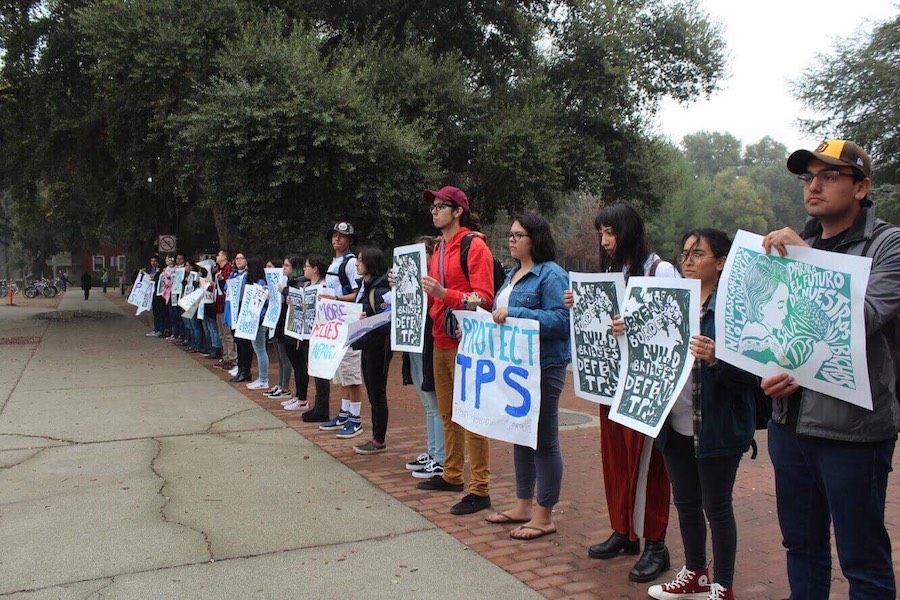
Students rallied together on the Quad on Jan. 18 to protest the Trump administration’s decision to terminate the Temporary Protected Status (TPS) for El Salvador. On Nov. 20, a similar report signaled the end of TPS for Haitian residents as well, effective in 18 months.

Chanting, “this is what community looks like,” students marched together behind a large banner outfitted with national flags from across the globe, united in their defense of TPS.

Organized by the Central/South American and Caribbean Student Alliance (CENSOCA) and the Afro-Latinx/Chicanx Club, students gathered together in solidarity with those directly impacted by TPS. Since the Trump administration’s initial announcement that they were considering not extending TPS, CENSOCA at UC Davis has hosted numerous rallies, put up posters around campuses and organized community healing spaces to support students.

Carmen Paola Palao, a fourth-year sociology major, is one of six co-founders of CENSOCA. Paola Palao spoke about the importance of standing with students impacted by TPS in a public and unified fashion.

“The purpose of organizing this rally was to bring visibility to TPS and Central American issues,” Paola Palao said. “Oftentimes we get no visibility on this campus so we have to create it ourselves.”

Currently 440,000 people in the US currently benefit under TPS. Many escaped war, poverty and social instability by relocating to the United States. Since TPS’ beginning almost two decades ago, many have built new lives for themselves and their families in the United States. According to a New York Times estimate, more than 200,000 El Salvadorians will be forced to relocate within the next year and a half.


Written by: Ally Russell — campus@theaggie.org

700 students to attend 24-hour HackDavis hackathon on Jan. 20

NADIA DORIS / AGGIE FILE

UC Davis’ third annual student-run hackathon strives for social progress

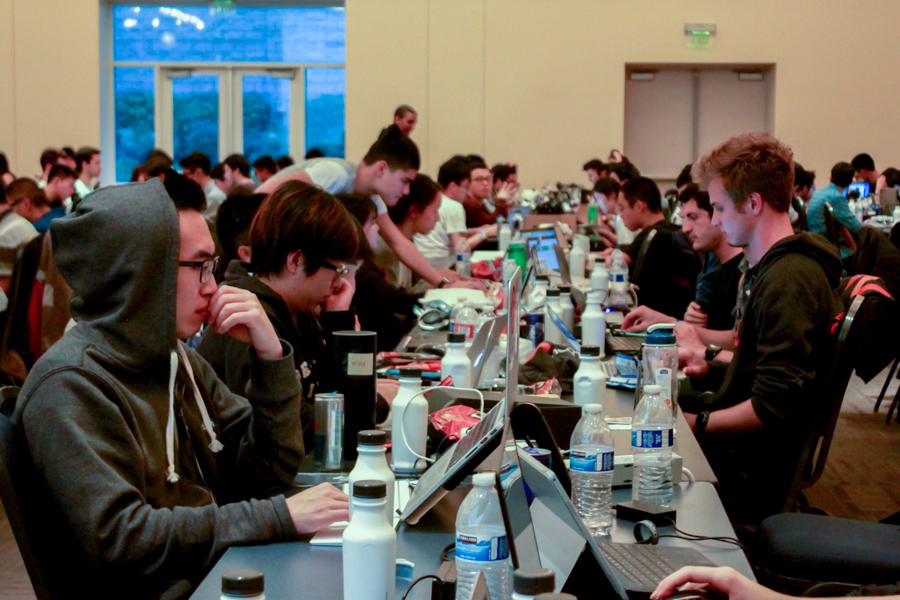
On Jan. 20 and 21, HackDavis will host 700 college students, alumni and high schoolers in the Activities and Recreation Center to code for social progress in three given tracks: health and wellness, education and the environment. Participants of all levels of expertise will create code for 24 hours, starting at 12 p.m. on Jan. 20. Judging and demonstrations will begin at 1 p.m. the following day.

Applications closed Jan. 5, and this year the event accepted 700 applications from college students, high school students over 18 and alumni who graduated within the last year.

The goal of a hackathon is to provide a space for usable, problem-driven software development in a timed competition. HackDavis harnesses this development to tackle social problems, teaming up with Habitat for Humanity this year. According to marketing team member Annie Lin, a third-year computer science major, this is what makes HackDavis unique from other hackathons. Its slogan is “code for social good.”

“HackDavis is one of the few hackathons in the country known for providing students with a platform and encouraging them to solve pressing social issues,” Lin said. “This is important because we feel that young individuals are incredibly bright, and they can achieve and learn all while helping society through health and wellness, education, or environment. HackDavis also attracts many talented students to UC Davis which helps out university recruitment.

Sriya Maram, the director of HackDavis’ external affairs and a third-year cognitive science major, participated in the 2017 event and later went on to join the team. Maram explained how the event utilizes outside nonprofit organizations involved in health, environment and education to effect true impact in the world.

“Last year, we partnered with Teach For America, and they helped make a randomized feeding chart for students,” Maram said. “We also partnered with the California Water Project. Something else that I thought was really cool was a mental health application.”

Maram talked about the impact for social good that partnering with nonprofit organizations can bring. She said she was excited for this year’s involved nonprofit organizations.

“This year we already have two confirmed nonprofit partners,” Maram said. “Habitat for Humanity — the Sacramento chapter — and Beyond Twelve, an education nonprofit.”

The event is partnered with multiple UC Davis STEM departments as well as the nonprofits and is sponsored by technology companies such as Intel, AT&T and Google Cloud Platform.

Participants in the race to code are also bolstered by hardware and technology provided by HackDavis. Lin explained how helpful it is to provide equipment for students to incorporate into their creations.

“Usually we provide gadgets like virtual reality headsets and Amazon Alexas, so teams can incorporate some hardware into their projects,” Lin said. ”My prediction is that students will be using a lot of the hardware [this year].”

Lin said workshops are provided throughout the year and at the hackathon event, so beginner and expert students alike can tackle computer coding and programming. Throughout the year, the Facebook group posts event pages for student tutorials and workshops, offering website development series, game development series and professor talks. According to Lin, the events they hold are “beneficial to the students” as they “teach students important programming skills.”

On its website, HackDavis states that it hopes to “inspire change and cultivate a growing hacker opportunity” by intersecting coding with social change. The 1,600 people who like the HackDavis Facebook page seem to agree.

“We find that hackathons often don’t result with projects as practical solutions to specific societal problems and we’re looking to change that,” the website states. “Our goal is to foster a community that uses technology to pave the way for social change. For the 3rd year in a row, we’re bringing together the most talented students in California to address the world’s most pressing issues.”


Written by: Aaron Liss — campus@theaggie.org


UC Regents postpone tuition hike vote until May

PRIYANKA SHREEDAR / AGGIE (left), DIANA LI / AGGIE (right)

Students across UC campuses protest UC tuition hikes

On Jan. 24, during a meeting of the UC Board of Regents, it was decided that a vote over proposed tuition hikes for students would be delayed until May. If passed, tuition and fees would be increased 2.7 percent for in-state students and 3.5 percent for California non-residents. This would mean an extra $342 for in-state tuition rates and an additional $978 for out-of-state students.

This discussion began in Nov. 2017, when the UC Office of the President released its “Proposed Long-Term Stability Plan for Tuition and Financial Aid.” In the document of FAQs, UCOP addressed concerns regarding its reasoning for the proposed tuition increase, its plans for the budget and how state funding contributed to the rise in tuition rates. After a wave of protests by UC students at the Regents meeting at UCSF in November, the Regents postponed the meeting to January of 2018.

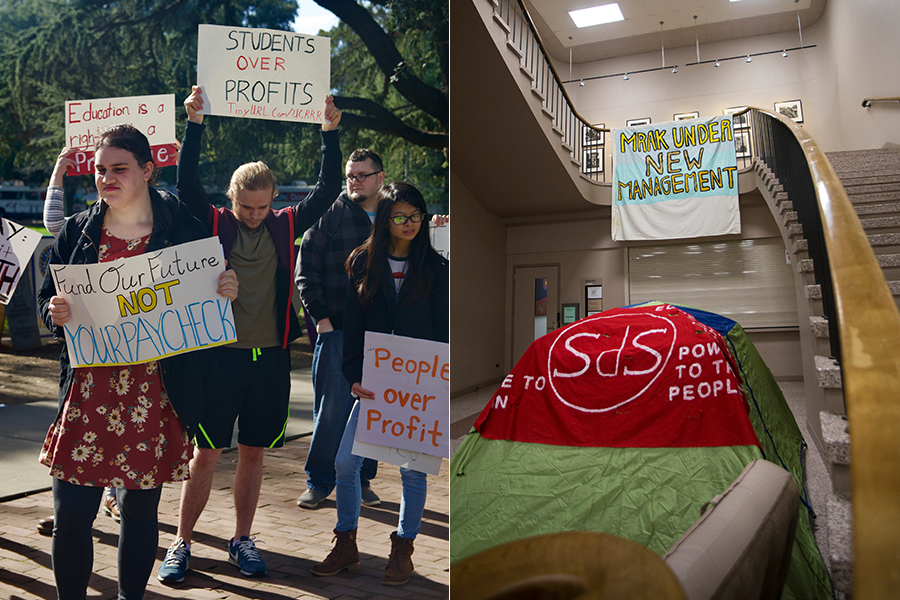
Beginning on Jan. 23 and continuing into Jan. 24, students across various UC campuses protested the impending vote over the proposed tuition hike. At UC Davis, student-run organizations like Students for a Democratic Society created Facebook events, flyers and posters calling for the student body to advocate for themselves. An organized rally took place outside of the Memorial Union on Jan. 23.

As protestors circled the flagpole in front of the MU, the rally filled the Quad with chants of “Hey, hey UCD, cut those Regents’ salaries,” “War profiteers not welcome here!” and “Whose university? Our university!”

UC Davis Chancellor Gary May walked past the protest twice. Students responded with chants — one individual asked, “How much did you make today, Gary May?” In response, the Chancellor continued walking and said “No more than I made yesterday.”

Second-year sustainable agriculture major Dexter Hampton, an active SDS member, stated the organization’s demands at the MU “NO Tuition Hike RALLY.”

“Our primary demand is to stop the raising of tuition,” Hampton said. “A secondary demand [is] showing the students that we can stand up and we can fight back and we can make a difference in our university,” Hampton said. “We don’t have to accept whatever the Regents tell us, we don’t have to accept whatever the administration tells us.”

Hampton expressed concern with the administration-to-faculty ratio on campus and discussed his personal goals for the protest.

“The administration is currently outnumbering the faculty and is paid astronomical amounts,” Hampton said. “I hope that administration recognizes that the students and the workers here are the ones that actually do the work here at the university and that administration, even though they control most of the wealth in the university, does not control this and they’re not the ones running things.”

Additionally, Hampton discussed the protest’s potential impact on the administration at UC Davis and in the UC system.

“In the past, they have been tyrannical, they’ve pepper sprayed us, they’ve pointed guns at us, they’ve arrested us,” Hampton said. “We’re hoping that this new administration is a little more open to student voices, but we’re unsure because they are still technically trying to exploit the students.”

Along with many other guest speakers, Amara Miller, the head steward of the UC Davis UAW unit and a Ph.D. candidate in the Department of Sociology, discussed the personal impact tuition hikes will have on her.

“I have over a decade in the UC system [as a student],” Miller said. “I was here as an undergrad from 2005-2009. Back then, my tuition was literally a fraction of what you are paying now. Across the time I have been in the UC system, I have seen tuition pretty much more than double. My undergrad students — I have students that are undocumented, I have students that are homeless, I have students that are fighting against white supremacy on campus that have been trying to kill them — have not been supported by the administration or the UC Regents. The UC Regents are not our friend, they consistently put their own interests first and they consistently try to line their own pockets with their positions. This is not acceptable. It’s our university, it’s not theirs. It is time for us to say no more tuition hikes.”

AJ Ballesteros, a first-year sociology major, discussed his reasoning for attending the sit-in on Jan. 23.

“I’m here at the moment protesting tuition hikes that are UC system-wide — actually, I am protesting more the fact that undergraduate students have no meaningful power over these decisions that are being made at the highest bureaucratic level,” Ballestros said. “Essentially, there’s no democratic control over the university and decisions that are affecting undergraduate populations directly.”

The overnight “Mrak Slumber Party” took place on Jan. 23 and was attended by four people.

On its Facebook page, members of SDS posted short live-streamed video updates. SDS also posted a complete video of the presentation that took place on Jan. 24, titled “Tuition and Regents Teach-In.”

On Jan. 23, SDS posted a statement describing the purpose of the sit-in.

“Tonight is our first night that we are doing a sit in at Mrak Hall to protest the tuition increases,” the statement reads. “The administration came to us wanting to hear our demands and work to a common goal. However when it got late they came back demanding our student ID numbers and told us that they are seeking disciplinary action against us. We must work together as a community and must not allow the subtle hegemony of empty promises and sanctions for ‘our safety’ prevent us from standing for students and workers in our university. Every person present at this sit-in significantly improves our strength as a group to resist administrative oppression and to make our voices heard”

On Jan. 23, UC Regents met at UCSF to discuss the proposed tuition plans. They announced shortly after that the vote regarding the proposed tuition increase would be delayed until May. According to an article released by The Sacramento Bee, “Gov. Jerry Brown has sent a letter to the UC Board of Regents urging them to reject a proposed increase in tuition at the University of California’s 10 campuses.”

A second sit-in took place at Mrak Hall on the night of Jan. 24 after the demands presented to UC Davis administrators were not met, according to a statement given to The California Aggie from the students involved in the sit-ins. Demands included a rollback in tuition, a commitment to affordable housing as well as the disarming of campus police “of all lethal weapons.” Nine students participated in the overnight sit-in.

“At 6:00 p.m. [on Jan. 24], when Mrak Hall had officially closed for the day, the student activists informed Administration that they would leave Mrak Hall on the condition that Administration […] Secure an open, accessible meeting with Gary May no later than Friday, 1/26/2018,” the statement reads.

The student activists outlined a list of demands to address with Chancellor May, including more democratic student involvement in decision-making, a cut in Chancellor May’s salary to $420,000 with leftover funds allocated toward “Resource Centers that recently lost funding” as well as a university commitment and investment in low-income housing.


Written by: Priyanka Shreedar and Aaron Liss — campus@theaggie.org

Humor: “Winter Quarter is my favorite!” professes one student in a straitjacket

PUBLIC DOMAIN

One crazed student is kicked out of school after sharing controversial opinion

When the universe created winter quarters, it made sure that, no matter the odds, every single time the air went cold, students would hate their lives. Returning in January always feels a bit stupid, like that one dumb chick in every horror movie who loves walking into basements with one exit and like four dead bodies and a sign that says “Danger!” and God himself saying, “Kid, no.”

Despite the fact that Winter Quarter is a modern black plague with few survivors, one student is still down as heck for the torment, claiming that Winter Quarter is his favorite.

“I just love the rain and how cozy everything feels!” third-year Ted Cruise said. “It’s the quarter that I came to Davis for.”

As Ted said this in the very crowded CoHo, time seemed to stop. A record scratch sounded from the speakers, which was odd because the music was definitely just some 20-year-old’s Spotify playlist and not a vinyl. A blender behind the counter blew its top off and sent a smoothie flying everywhere, but no one was phased. They were far too concerned with the monster in their midst.

“What the hell, Ted?” hollered his girlfriend across the table from him. “Are you serious? I… I can’t do this anymore. By the way, I never liked your cargo shorts. I lied. I gotta go. Tell your hamster goodbye from me.”

The woman sprinted away in horror and shock. Time stood still, until one brave person spoke up.

“Bro, you’re the worst person on this campus,” infamous ex-chancellor Linda Katehi said.

For once, no one disagreed with Katehi’s shift of blame. She walked around all day saying this to anyone who might accidentally cut in line or forget to compost, but now it was finally valid.

One of those old-timey “Looney Bin” carts with a little cage on the back (if you need help with this visual, just think of Belle’s dad in the critically acclaimed animated film “Beauty and the Beast”), and two men came bolting into the establishment.

“Everyone stay calm,” one of them whispered as the other one slowly placed Ted in a straitjacket. “You’re all safe now.”

They took Ted out to the cart, but not before Ted could say his last words to his beloved fellow students.

“Well, I guess the real lesson in the end is that society will never let us truly love things that are not conventional without being outcast by the very people you once trusted. I suppose I knew this all along… deep inside my heart. Alas, I shall never see my cherished Winter Quarter ever again, for I reckon that my room shall have no windows or doors, as I have been labeled a fool. Oh, fellow students, please remember me as the one who was crucified for his passions. Also, I pour my milk before my cereal.”

With that, the door to the cage was slammed.


Written by: Olivia Luchini — ocluchini@ucdavis.edu

(This article is humor and/or satire, and its content is purely fictional. The story and the names of “sources” are fictionalized.)

Judicial Council hearing held over prospective ASUCD presidential candidate’s violation of campaign bylaws

BRIAN LANDRY / AGGIE

Adam Hatefi received two violation points

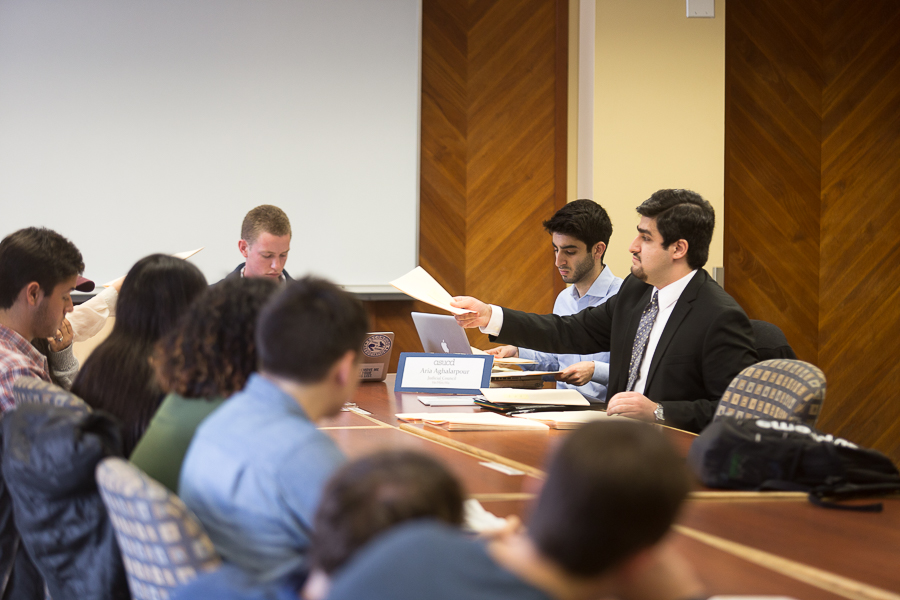
On Friday, Jan. 12, the ASUCD Judicial Council held a hearing at 1 p.m. in the Mee Room of the Memorial Union that was called to order at 1:10 p.m. by Judicial Council Chair Ryan Gardiner.

The hearing regarded a complaint submitted by the Elections Committee early in Fall Quarter. Adam Hatefi, a third-year political science major and a prospective ASUCD presidential candidate began raising funds for the upcoming Winter Quarter elections in violation of the ASUCD Bylaws.

The hearing was open to members of the public and began with a petitioner’s statement made by Naeema Kaleem, the chair of the Elections Committee and a fourth-year sociology major. Also present were Judicial Council members Sydney Hack, a third-year international relations major, Aria Aghalarpour, a third-year political science major and Elections Committee Vice Chair Rodney Tompkins, a second-year psychology major.

The fundraising in question included a GoFundMe account linked to Hatefi’s Facebook page as well as events held at Blaze Pizza and Panda Express. The dates of these fundraisers fell outside of the election cycle, when Hatefi was not qualified as a candidate.

Hatefi’s statement justified his actions by drawing attention to SB 18, a bill introduced to the Senate table in Nov. 2016. The bill proposed for a change in text to the ASUCD Bylaws which would specify the permitted types of campaign donations. Hatefi claimed to have heard rumors of a Senate bill about to pass that would have allowed for fewer restrictions on campaign donations, so he moved forward with campaigning. Changes made to the Bylaws after SB 18 changed the text, but not the regulation itself.

The regulation violated is Bylaw 412 (c) (1) which reads: “Donations to a Campaign Executive’s Election fund shall only be accepted from ASUCD members. No group donations may be made to a Campaign Executive’s Election fund by any registered student organization.  Three (3) campaign violation points shall be assessed for violating this subsection.”

Hatefi was ruled to be in violation of the Bylaws for accepting donations from non-ASUCD members through his GoFundMe account. The defendant argued he did not solicit money from anyone and that the donations made by his family members were of their own volitions — offering signed statements from family members.

The prospective ASUCD candidate also argued that the Elections Committee failed to notify him of any complaint made against him, thereby invalidating the claim.

“Due to this being an atypical case in that it was not an official election cycle, the Elections Committee did not have jurisdiction over the case,” Kaleem said. “In other words, we were unable to go through the official complaint process outlined in Chapter 4 of the ASUCD Bylaws, as we don’t have authority over prospective candidates.”

The complaint was brought directly to the Judicial Council, revalidating the claim.

Hatefi provided documents of personal bank statements to the table saying all the money raised had not been transferred from the organizations that raised them into any personal accounts of his own. The money remains with the organizations who raised it and in the GoFundMe account. After repeated attempts to refund the money from the account, it proved impossible, and he speculated donating the money to charity.

A ten minute break began at 1:40 p.m.

After the hearing was reinstated, questioning continued. Hatefi described how he accepted donations under the names of “Logikos Advocacy,” a non-UC Davis affiliated group for which Hatefi is the executive director of, and “Aggies Online Network,” a student-run organization which he is a member of, to raise money at the restaurants he held events at.

The hearing ended for deliberation at 2:30 p.m.

The council unanimously decided Hatefi was in violation of the ASUCD Bylaws for accepting donations from non-ASUCD members through his GoFundMe account.

The money raised at Hatefi’s restaurant fundraisers were not moved to an election fund and once the context of ASUCD Bylaws remained unchanged, Hatefi notified the donors their money would not go to his fund, thereby avoiding another violation. Hatefi’s actions merited two violation points of bylaws. A third violation point will result in further assessment and possible ineligibility to run for an ASUCD office position.

“Running for office is one way to [make one’s voice heard], and it is the right of any member of the association to run,” Gardiner, the Judicial Council chair, said. “However, it is important that all candidates be given a fair and equal opportunity to exercise that right. Candidates should establish dialogue with the committee instead of just brushing them off. This particular situation probably could have been avoided if that dialogue was established.”


Written by: Elizabeth Mercado — campus@theaggie.org


Star Trek as a Social Theory: To Boldly Go Into the Classroom

JEREMY DANG / AGGIE

UC Davis students learn how fictional universe mirrors our own

For over 50 years, the science fiction franchise “Star Trek” has captivated millions of fans worldwide. And at UC Davis, you don’t have to travel across the universe to take a ride aboard the USS Enterprise. There’s a class for that.

Anthropology professor James Smith, a “Star Trek” fan himself, is the Captain of the ANT 191: Topics in Anthropology starship crew. The course title is “Star Trek as a Social Theory.”

“This course uses ‘Star Trek’ as a vehicle for understanding critical themes in social theory and anthropology, while also teaching students how to think about ‘popular culture,’ television, and daily life anthropologically,” Smith said.

Each week, students watch a single, 42-minute “Star Trek” episode in addition to assigned readings and in-class discussions analyzing social and anthropological theory. The series acts as a cultural map, mirroring the social constructions of one universe and comparing it to our own.    

“It reflects the optimism of the Kennedy era in the U.S., and also presents an opportunity for us to question some of the assumptions informing that optimism,” Smith said.

Students examine questions like: Should there be a universal standard for making ethical decisions? Does technology make us “more human” or does it enslave us?

“I want students to think seriously and critically about what these imaginings of future entail so they can learn to understand some of the cultural assumptions that are packed into them,” Smith said.

Currently, the class is watching episodes fromStar Trek: The Original Series” and “Star Trek: The Next Generation,” but Smith says he may explore more of the franchise in the future.  

On Dec. 4, the UC Davis Human Rights Lecture Series explored how “Star Trek” can be used as a tool for students to examine human rights-related topics. And now, for the first time at UC Davis, “Star Trek” has become the framework for an academic course.

Human Rights Studies Director Keith David Watenpaugh and Chancellor Gary May co-hosted the event at the Crocker Art Museum in Sacramento. The title of the series was “Star Trek/Human Rights: To Boldly Go to Human Rights for All.”

“Certainly in the 50 years since ‘Star Trek’ appeared, talking about, contesting, fighting, and dying for human rights has been a definitive element to being human,” Watenpaugh said.

The “Star Trek” franchise inspired May to pursue the sciences at a young age. With a background in electrical engineering and computer science, May did just that.  

“I’m thrilled to hear about the new ‘Star Trek’ class and I hope to visit it, along with another class called the Science of Superheroes,” May said. “As many people know, I’m a ‘Star Trek’ fan — the original series — and one of the reasons I like it so much is because it deals with broader issues of the human condition: rights, race and ethics.”

As such, May jump-started a 10-year campus-wide initiative entitled, “To Boldly Go.”  The plan seeks to increase UC Davis’ national ranking by strengthening the university’s research expertise and growing a diverse community that represents the demographics of California. A final plan is scheduled to completed this July.  

May is also an aficionado of other superhero franchises like the “Avengers,” “X-Men” and “Justice League” because of their pursuits for good.  

“I want students to feel empowered to be like superheroes — agents of their own success, their careers and their destinies — to do some good in the world,” May said.  

The class will also explore the more specific themes of “Star Trek” such as politics, freedom, translation, empire, capitalism and more.

“The numerous episodes that responded to human right issues in the 1960s still resonate with us today, and also give us a sense of how people in that era were thinking about rights and also the timeless nature of human rights questions,” Watenpaugh said.

The end of the course entails a creative writing assignment in which students imagine that they are a part of a Klingon or Vulcan High Council. As a member of the council, the students must go revisit the year 2018 and write an ethnographic report on some aspect of the community from the lens of either a Klingon or Vulcan standpoint. The assignment gears students to explore the issues inherently constructed in our society.

“In the Star Trek world, this utopian future emerges after apocalyptic events in our current near future, so there is a message about the end of the world not in fact being the actual end, but rather the beginning of something else,” Smith said.


Written by: David Madey — science@theaggie.org

Blair Fox’s life, legacy

PHOTO FROM BLAIR FOX’S FACEBOOK PROFILE

Second-year student remembered as charismatic, joyful, dedicated

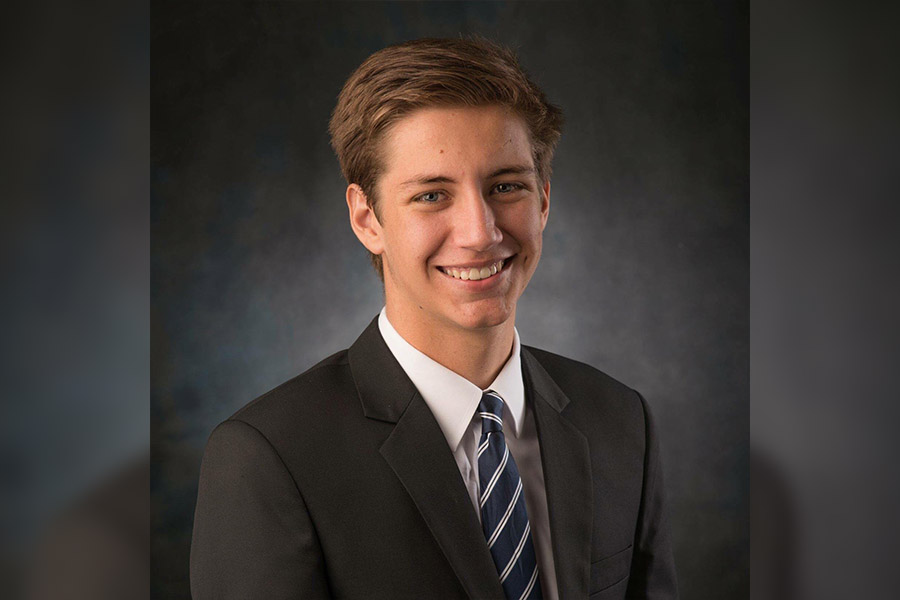
Blair Fox, a second-year UC Davis student, recently passed away in a skiing accident in Lake Tahoe. An economics major, Fox was a brother in the Sigma Nu fraternity and a member of Model United Nations. Involved in numerous ways both at UC Davis and within the Davis community, Fox touched the lives of many people.

“Blair was the type of person who would make anything really fun and who was just friends with everyone,” said fourth-year psychology major Jade Mawhinney, who was a good friend of Fox’s.

Mawhinney fondly described some of the memories she shared with Fox in the time that she knew him.

“One night, we ended up at Burgers and Brew at 2 a.m. and Blair got these disgusting fries and he was obsessed with trying to get me to try them,” Mawhinney said. “I always tagged him in memes on Facebook, and it turned into a tagging spree. He would respond and tag half of his chapter. It sounds so 21st-century millennial, but we were trying to just out-meme each other and it was just really funny.”

Andrew Isaac, a second-year community and regional development major and member of Sigma Nu, spoke about a few of the ways Fox’s presence in his life affected him.

“I met Blair when we were rushing Sigma Nu together [in the fall of 2016] and we were also living in Cuarto,” Isaac said. “I will never forget the image of Blair smiling because that is all he did. I have never seen him not happy or at least he didn’t show it. He was also really into political science and we would have our debates and that’s how I got to know him and really understood what a great person he was. He changed all of our lives.”

Colton McHugh, a close friend of Fox’s, a fourth-year communication major as well as a member of Sigma Nu, mentioned a few of the ways Fox was unique.

“He was extremely social,” McHugh said. “Anytime we had some kind of social event on campus, he was always trying to get everyone to go and participate. People say this about people all the time when stuff like this happens, but Blair was genuinely the most excited, positive, happy guy I have ever met. He was always hyping everyone up about everything. It was ridiculous how excited he was just to do the most ordinary stuff as long as he was with his friends. He was so positive and he made everyone else just happy all the time.”

Jake Webb, a second-year managerial economics major and Sigma Nu member who was also close to Fox, talked about the way Fox impacted his life and the lives of the rest of the fraternity members.

“One of [Sigma Nu’s] big events is going down to Grace Gardens to garden every Saturday morning,” Webb said. “Blair would do that with a smile on his face every single time. A lot of us woke up Saturday mornings pretty tired, but he just cheered everybody up and he did some great stuff over there. He put his all into everything.”

Many Sigma Nu members who were close to Fox also mentioned his passion for community service and involvement, in addition to his work with the Grace Gardens.

“Blair was probably the most involved person I have ever met at Davis,” Isaac said. “He always talked about Model United Nations — he had such a big role in that and he made a lot of friendships and bonds in that club.”

Spencer Crist, a second-year electrical engineering major and Sigma Nu member, talked about Fox’s other roles on campus.

“Blair did internships with the international department,” Crist said. “He helped transition international students and would help the students come in. He made a lot of great friendships there and introduced me to several students who are also engineering majors. He was also interviewing to be in another business and economics club.”

Crist also mentioned some of his favorite moments from time spent with Fox.

“All my memories [of Blair] stem from the Grace Gardens because he was the guy who recruited all of us to go out there and do that every morning,” Crist said. “That became a usual thing, spending two hours Saturday morning just gardening for the community. He would always make it fun and such a great time. We would always look forward to that event and not think [of it as] another weekend where we have to do community service hours.”

The anecdotes that his Sigma Nu brothers shared about him highlighted their admiration and respect for Fox.

“We had our elections in our fraternity and Blair wanted to be treasurer and so he went up to do his speech on it,” McHugh said. “At the end, he [pulled] out his Economist magazine and [said], ‘Also I have this, so I’m a clear choice.’ It was the funniest thing, because everyone was being super serious and Blair just [pulled] out this magazine.”

Sigma Nu member and second-year political science major John Salvestrin talked about how meeting Fox impacted his experience as a Sigma Nu member.

“I rushed in Winter Quarter, and Blair was one of my most memorable rush conversations,” Salvestrin said. “He just really stuck out — he was so charismatic and just a great guy. Ever since then, I grew closer and closer to him. This year, […] living across the hall from him, he was also definitely one of my closest friends.”

Margo Fox, Blair Fox’s mother, spoke about Fox’s personal attributes.

“Blair was very humble,” Margo Fox said. “He was one of those people who had a presence and a strength, but didn’t want to use it. He would rather be there to support other people. He wanted to use his other skills to bring people together and wanted those around him to feel good, supported and smart. He worked hard in his own quiet way and was very motivated to do well and get ahead, but he wasn’t going to do that at anyone else’s expense and he wasn’t going to brag about it.”

Fox’s father, Warren Fox, shared memories of his son.

“I think we remember him like most people as not only warm and loving, but a really true friend to all and very curious about the world and people,” Warren Fox said. “He was a really friendly guy. The moment I always remember is when Blair was born. Blair came into the world as a bubbly little baby who seemed to be such a happy kid even in his early days. He was happy and joyful and Blair was genuinely a happy, fun and joyful kid.”

According to his parents, Fox was eager to learn as much as he could. Warren Fox said his son was “very curious about the world and people.”

“[Blair] really loved to just talk about issues, […] he just wanted to learn about all sides,” Margo Fox said. “He really liked being with people and talking.”

Friends of Fox said they were willing to do anything for him.

“He was one of those guys where, if he wanted to go do something and he texted you, you would make time because it was better to be with him than with anyone else,” Webb said. “If he wanted to get food or do anything, I would probably stop what I was doing just to be around him because he was this vibrant guy who had this sense of humor that is unmatched and I just loved being around him.”

Webb said that Fox “was going to change the world” and Isaac said, from his perspective, he already did.

“He changed all of our lives,” Isaac said.

The Fox family has set up the Blair Fox Scholarship Fund to support undergraduate students at UC Davis. There will also be a Celebration of Life for Blair Fox on Feb. 10, 2018 at 10 a.m. at the Walter A. Buehler Alumni Center. Margo Fox said that “everyone is welcome to his celebration of life.”

“We wanted to do it on campus because Davis was so important to him,” she said. “And that is his community.”


Written by: Sabrina Habchi — campus@theaggie.org

Laundry detergent for when there’s a bear of a project

TAYLOR LAPOINT / AGGIE

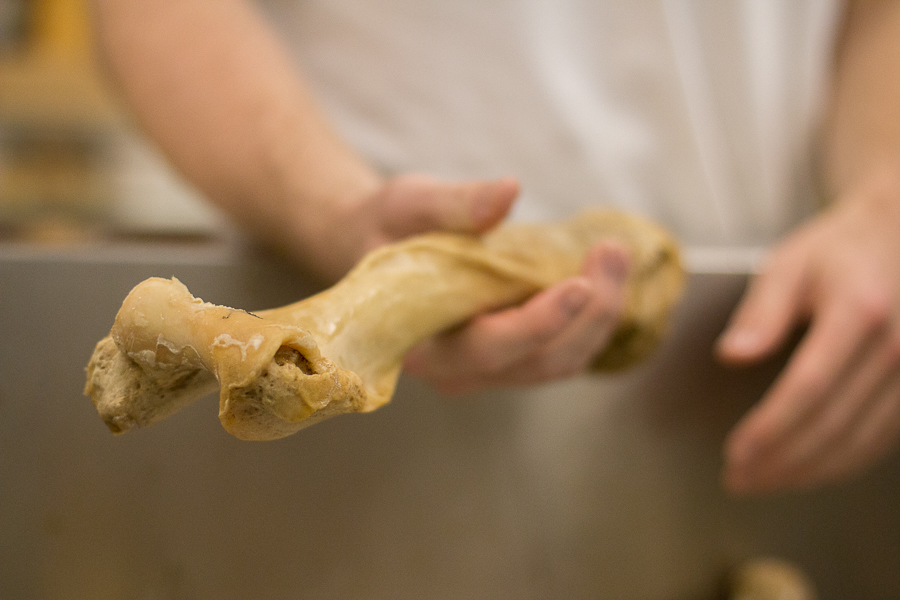
Bear bones are cleaned in UC Davis’ Zooarchaeology Lab.

Aside from cleaning your clothes, it turns out laundry detergent is useful in cleaning bear bones. This idea seems strange, but it is just another ordinary day in the zooarchaeology lab.

The lab’s current project is cleaning a bear skeleton that was donated by Girl Scouts Heart of Central California, the local Girl Scout chapter.

“It looks gross but it’s a lot of fun,” said Ryan Gallagher, a fourth-year physical anthropology major and an intern in the zooarchaeology lab.

The department hosts a collection of more than 1800 different specimens, which includes fish, reptiles, birds and mammals. They process about five sets of remains per year for teaching and research purposes.

Dr. Christyann Darwent is a zooarchaeologist at UC Davis and studies the animal remains recovered from archaeological sites.

These specimens are used to help identify animal bones from archaeological sites,” Darwent said.

Animal remains, such as skulls and bones, are donated to the department from various sources. Friends of the department have given roadkill or skeletons they have found while hiking. I worked as a counselor at the Girl Scouts’ summer camp and facilitated the transfer of the bear bones to the lab.

Maintenance staff came across the remains while inspecting a Girl Scout property near Placerville last February. The bear skeleton was then brought to the main camp in Calaveras County, so that staff members could use it as a teaching tool.

“Being able to touch and examine the bones gives girls who learn kinesthetically a chance to become engaged in the natural sciences,” said Kaitlyn Heb, a STEM specialist at the camp. “It gives the girls a chance to see something up close and personal that they would not be able to see in the city and get a point of view they might not get from a museum.”

All of the skin and muscle had decomposed from the bear, but the skeleton was covered in dirt, grease and fat. Despite camp counselors and campers being armed with unused toilet scrubbers and dish soap, the bones remained gross and little bit smelly.

To get dirt off the bones, I tried soaking them in warm soapy water a few times. The waste water was full of tissue and things I could not identify. One time, I was showing a group of campers what I was doing, and spilled the entire can of waste water on me. My socks, shoes- everything from the knees down was covered in bear juice. That was a mistake I never repeated.

I still used the bones as a teaching tool, and I showed the campers how the bones worked and fit together. The bear also had a really bad cavity, and we were able to get the children excited about seeing what tooth decay looked like up close.  

“I hope we can talk through what information the bones can give us about the life it lived, how people that study animal bones can piece together information and learn more,” said Leah Traina, the associate camp director.

When the summer camp ended, the skeleton sat in boxes in my backyard until early January when it was taken to the lab. The Girl Scouts will be getting the bones back once Darwent and her interns have cleaned the skeleton.

“We actually use laundry detergent- powdered laundry detergent,” Darwent said.

The skeleton is about halfway through its soaking period of two weeks. In this time, the bones are placed in a pot with water and laundry detergent. Once the pot is covered, it is left to sit on a hot pad. When the water is changed out during the two weeks, bits of fat and tissue are seen floating around from the bones. Gallagher has worked on similar projects in the past.

“I’ve done a horse and helped with some pigs,” Gallagher said.

The horse, in particular, had not been cleaned at all before heading to the lab, which meant that it arrived with all of its flesh and muscle.

After its soak, the bones will be ‘polished up’ by removing leftover bits of dirt with a toothbrush. The teeth that have fallen out would also be glued back in. Since the Girl Scouts would be used as a teaching tool, the skeleton would then probably be bleached to ensure its cleanliness.

Most of the bones were found, aside from its sternum (chest area) and most of its paw bones.

“Bears are usually found pretty whole, scavengers won’t take the bones far,” Gallagher said.

There are two other bear skulls in the specimen collection that have an obvious cause of death; the massive bullet holes on the sides of their skulls are hard to miss. However, this bear does not have any bullet holes, and Darwent and Gallagher have not yet determined how it died.

Already Darwent has been able to identify key facts that campers were asking about the bear.

Given it was found in California and based on the size of the skull I am certain it is a black bear,” Darwent said. “Sadly brown bears are extinct in California despite them being on the state flag. My guess [is it] would be female as no baculum [os penis] bone was recovered.”

Darwent estimates they will be done cleaning the bones before winter quarter is over. This will give the Girl Scouts more than enough time to establish the bear at its future home, the overnight camp in Calaveras County.

“It’s important to teach kids about nature so they feel comfortable interacting in the natural world,” Traina said.


Written by: Rachel Paul — science@theaggie.org