55.7 F
Davis

Davis, California

Monday, December 22, 2025
Home Blog Page 565

Forum held, selection for new UC Davis women’s athletic team draws closer

0

UC Davis athletics representatives held forum to discuss public’s questions, accept suggestions for new women’s athletic team

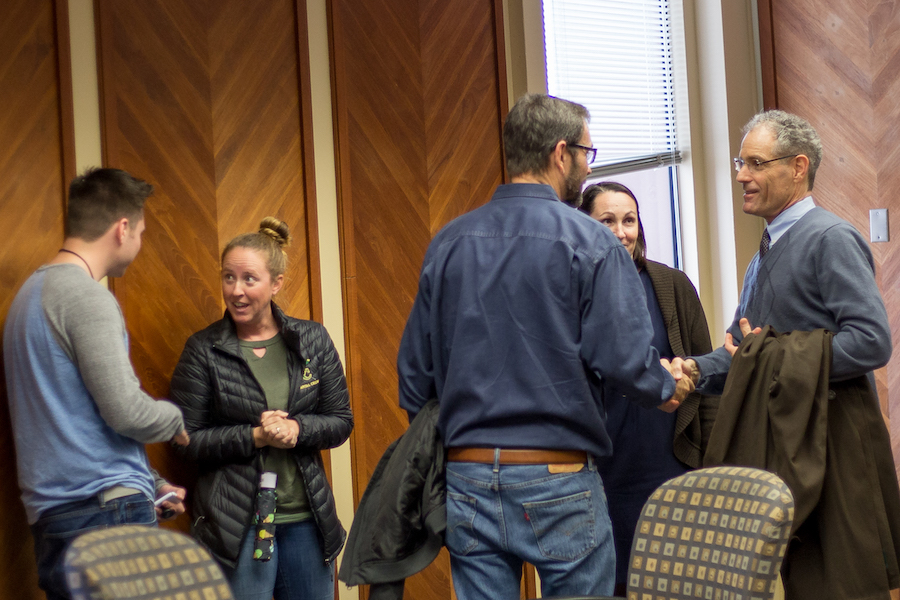
A forum was held in the Mee Room in the UC Davis Memorial Union by Director of Athletics Kevin Blue and Faculty Athletics Representative Scott Carrell on Jan. 9. The forum included a brief overview on why a women’s athletic team is being added at UC Davis, specifically with the adherence to Title IX, and to enhance the athletic participation opportunities for women undergraduates. Over the last few years, the percentages of women undergraduates have become significantly greater (55.1 percent women to 59.4 percent) in about a six year span compared to the percentage of male undergraduates at the university.

The forum opened with an initial statement by both Carrell and Blue on both the update of the nominations for the new team and the process of creating this team moving forward. Mentioned was the around 622 responses that have been received by the public online for nominations for new various women’s sports teams. In total, 14 new teams have been nominated: beach volleyball, curling, cycling, dance, e-sports, equestrian, skiing, stunt (also known as cheer), fencing, ice hockey, rugby, triathlon, rowing and wrestling. The deadline for all new team nominations is Jan. 19. Blue assured the attendees that any nomination made for a new team will be taken into consideration with analysis, regardless of how many of the same nominations are submitted.

After the nomination deadline, the selection committee will do a complete analysis of each team nominated to see which new team will be added. The four main criteria that the committee will be analyzing is the number of participation opportunities that the new team would add for women, the amount of philanthropic support for start-up and ongoing costs, the competitive opportunity at UC Davis for the new women’s team, and how the new team would fit within or complement the current existing conference affiliations. Blue mentioned that many different facets will be taken into account when choosing this new team, and it is not solely dependant on factors such as making sure the new sport is an official NCAA sport.

At the forum were current UC Davis students and faculty, as well as alumni, such as Sarah Puddicombe, formerly Sarah Whipple. Puddicombe attended UC Davis from 1999 to 2002, and was a coxswain with the UC Davis women’s rowing team. Overall, she was glad that the forum was held.

“It is exciting. The process is exciting. I loved the forum in terms of transparency and keeping it specific while keeping everyone informed,” Puddicombe said. “I like that they [athletics] took the step to include the community and to open it up to the public.”

The decision for the new team will be made by the end of Winter Quarter 2018, and the selection for the new team will be submitted to UC Davis Chancellor Gary May for approval. After questions about when the team would officially be formed, Blue discussed that the goal for the new chosen women’s team is to make the transition to start the new team as smooth and as quick as possible.

“We are still in the data gathering stage,” Blue said. “We are looking forward to moving forward and our intent is to continue to describe the decision making process to the public.”


Written by: Ryan Bugsch — sports@theaggie.org

The Shape of Water

CAITLYN SAMPLEY / AGGIE

An award-winning allegory about unexpected love

Director Guillermo del Toro shows us that love isn’t always pretty — literally. His poetic, Golden Globe-winning sensation, “The Shape of Water,” tells the story of a timid, mute cleaning woman named Elisa who falls in love with a mysterious water creature, who is captured for experimentation in hopes of gaining a strategic advantage over the Soviets amid the Cold War and the ongoing Space Race.

“The Shape of Water” reinvents the classic tale of a beauty finding her beast. It is a fantasy that shares wonderful truths about love — it’s often unexpected, and it’s not always conventional. Elisa is mute and the nameless fish creature is, well, a fish creature. Regardless, the two create a strong connection that stems from their unspoken and mutual understanding that they are deviants of the society in which they live.

Del Toro maintained his stylistic integrity by including horror aspects in a whimsically crafted visual production. The Cold War backdrop of the ‘60s is well thought out, and it makes the audience feel as if they are being submerged in the era. “The Shape of Water” strays from the usual direction that del Toro’s films take, though, because it centers around a love story. Well-known titles like “Pan’s Labyrinth” and “Crimson Peak” are darker and less heartfelt.

The narrative of “Shape of Water” is simple, but the emotions of the main character are expressed by Sally Hawkins quite well. It is quite common to find hidden symbolism in films by del Toro, which makes rewatching “The Shape of Water” a new experience every time. Del Toro also leaves the interpretation up to the audience so they may discover the themes relevant and significant to themselves.

Elisa is an isolated individual, trapped in an everyday routine of masturbating in the tub every morning and boiling eggs before she leaves for work. However, she has a pair of wonderful friends named Giles and Zelda Fuller — played by Richard Jenkins and Octavia Spencer. Giles and Zelda portray the hardships of minority groups during the time. Giles represents those forced to repress their sexuality, and Zelda addresses the unequal treatment of African Americans during that time. Despite their struggles, they remain loving friends to Elisa. Together, the three of them invent a plan to help the creature escape before he is killed and dissected by researchers.

Michael Shannon plays the villain of the film, Richard Stickland, an agent working for United States intelligence who unfortunately has no redeeming qualities, which made seeing his demise rather easy in the end. In fact, it spoiled it. Also, his rotting fingers that get progressively viler as the movie goes on don’t make him likeable.

I feel many UC Davis students can relate to some piece of this film. Whether they enjoy dark fantasies, romance or action, there is something for everyone to appreciate.

My favorite quote from the movie is this: “Unable to perceive the shape of you, I find you all around me. Your presence fills my eyes with your love, it humbles my heart, for you are everywhere.” A perfect ending that makes the audience (or just me) realize the irony that water has no shape, but takes the form of its unique environment.

“The Shape of Water” is showing at The Varsity theatre in downtown Davis. Showtimes are listed on their website.


Written by: Josh Madrid — arts@theaggie.org

Star Snores

CAITLYN SAMPLEY / AGGIE

Plot of “The Last Jedi” resembles Swiss cheese

This article contains spoilers for “Star Wars: The Last Jedi.”

To be fair, “Star Wars: The Last Jedi” does stand out as a unique addition to the franchise, yet many of the risks taken only harmed the film. These missteps are seen in Leia’s story arc, Finn’s subplot and the general lack of consequences for the characters. “Star Wars” is an easy franchise to watch, serving its role in cinema as high-budget, flashy entertainment. Unfortunately, such flash is bogged down with the script’s ineptitude to an unsalvageable degree.

Scripts should function a lot like Newton’s third law of motion: every action has an equal and opposite reaction. When they don’t function that way, scripts can have hard times making sense. The best example of this in “The Last Jedi” is when Leia is shown to have incredible force abilities. The arising issue is that her acquisition of such skill is never mentioned. Think back to “Episode V: The Empire Strikes Back,” when Luke spends much of the film training on Dagobah with Yoda and his powers are found after long scenes of training. Leia’s display of the force has no opposite reaction; all the hard-fought training other characters were put through didn’t apply to her.

This harms “The Last Jedi” in that it reflects onto other characters. Since Leia can perform impressive force feats without even the mention of training, all scenes with Luke, Rey, or Anakin training now come off as useless, since their accomplishments were outshined by Leia’s sudden, practically God-given abilities. The acquisition of force abilities has never been easy, so there is no good explanation for why Leia miraculously finds herself fully force-capable, diminishing the work of other lead characters.

Every main character in this film messes up and not one of them pays the price for it; even heroes cannot be free of consequences. While most film protagonists are invincible, “The Last Jedi” takes this to another level. My biggest gripe with this issue comes near the end of the film, when the protagonists are cornered in a base that is rumored to have no exit, with the First Order knocking on the door. While the specifics elude me, the gist is as follows: one character mentions how they’ve reached the end, they are all going to die and with them dies the rebellion; the next person cracks an awful joke and spurs laughter from all remaining characters. What?

These characters dedicated their lives to the Rebellion, and their lack of fear comes across as them knowing their own invincibility — as if they knew they couldn’t die. The protagonists act so nonchalant that I never feared for them, since they didn’t have the ability to fear for themselves. The whole film provided no sense of suspense since even the characters knew they would win against all odds.

Near the end of the film, Admiral Holdo, played by Laura Dern, sacrifices herself by running a large ship into the First Order at light speed, and this rips apart both the enemy fleet and the plot, exposing countless holes, the biggest plot hole being Finn and Rose’s useless adventure. In hopes of stopping the First Order, Poe sends Finn and Rose on an epic adventure, a classic high-risk, high-reward scenario. The contents of the mission don’t need to be acknowledged because, one, they failed, and two, their mistakes don’t matter since they escape unscathed. In essence, their mission was Disney’s way of pushing the runtime of “The Last Jedi” over 120 minutes; it helped move the main plot in no way whatsoever.

One positive aspect about “The Last Jedi” is that it took risks — it is its own movie. If they had only spent more time reviewing the script and patching the holes, perhaps it would have been a good movie. Much of “The Last Jedi” seemed to exist just to exist; no part of the story wanted to be told, and instead, scenes fell all over each other, making for two and a half confusing and misleading hours.


Written by: Nicolas Rago — arts@theaggie.org

Despite housing shortage, Nishi remains controversial

0
MICHELLE GORE / AGGIE

Nishi development project faces continuing environmental scrutiny

It’s no secret that Davis faces an extreme shortage of affordable housing. In November of 2017, The California Aggie reported that Davis has a rental vacancy rate of just 0.2 percent.

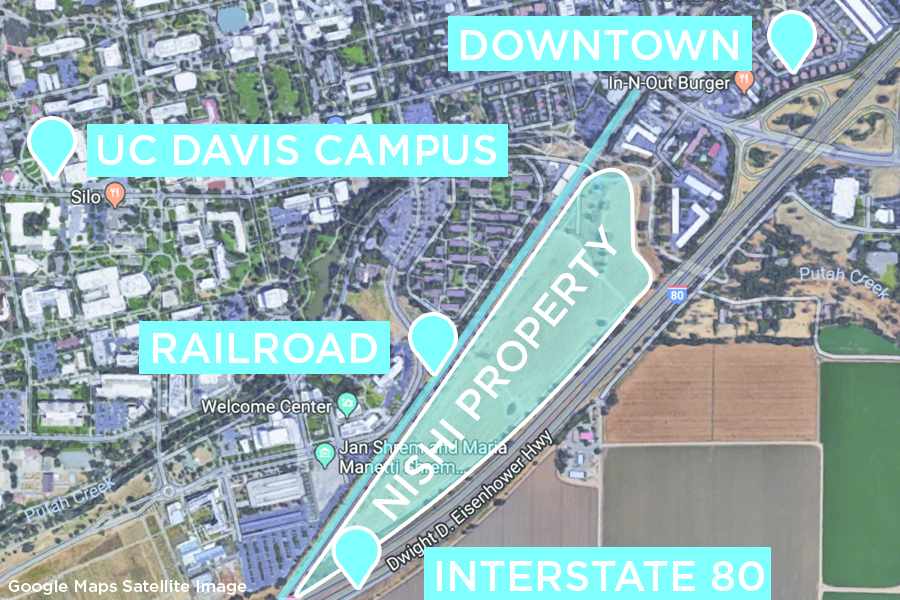
In June 2016, Davis voters narrowly rejected Measure A, which would have turned the Nishi Gateway property into a mixed-use development with residential apartments and an “innovation center” for research. However, a new proposal that only includes student rental apartments will likely be on the ballot this June.

“We have listened to the voters, reduced traffic and other impacts and are focused on meeting a dire housing need in this community,” said Tim Ruff, the prospective developer of the site. “Regarding traffic as the biggest issue, the new plan eliminated the car connection to Olive Drive and Richards Boulevard and removed the largest traffic generators from the plan: for sale housing and research space. The new project is focused on [students] who don’t drive as frequent (and don’t have to at this location) with vehicular access to UC Davis only.”

An Environmental Impact Report was completed in 2015 and indicated “significant and unavoidable” air quality problems at Nishi due to its location between the train tracks and Interstate 80, which may have been on the minds of some voters in addition to traffic. While Nishi was monitored over a short period of time for the EIR, there have not been peer-reviewed studies to show the degree to which exhaust, diesel and ultra-fine metals from brake pads impact Nishi over longer periods of time, all of which have been associated with a range of health complications.

Tom Cahill, a UC Davis professor emeritus of physics, helped prepare the EIR and recommended mitigation measures. In an op-ed for The Davis Enterprise, he said that these peer-reviewed studies need to occur before a vote on the new proposal is held, and suggested delaying the vote to accommodate the time frame that would be needed for adequate measurements to be taken throughout the year.

“The draft EIR [included] measurements […] of ultra-fine diesel exhaust, a known cancer-causing agent, but did not include new data showing that diesel from trains is six times more toxic than diesel from trucks, or data on ultra-fine metals from brake debris connected to a 35 percent increase in fatal heart attacks in Bakersfield,” Cahill said.

UC Davis philosophy professor Roberta Millstein, who specializes in environmental ethics and philosophy of biology, said that Cahill’s calls for additional and more thorough studies have her full support.

“The preliminary studies were very striking, but they were not performed at Nishi itself, they were done at a site on Olive Drive and they were only done for 10 days,” Millstein said. “Delaying the vote until we have more data is only prudent. Voters should be making an informed decision when they vote. The City Council should also be more informed before deciding to put this proposed project on the ballot.”

To make a point about how polluted Nishi may be, Cahill compared Nishi to a site near Highway 60 in Ontario, Calif. that is considered to be the most polluted near-roadway site in the nation. While I-80 near Nishi doesn’t experience as much traffic as Highway 60, Cahill identifies three different negative factors that set Nishi apart.

“The neck down of I-80 west of Nishi from six lanes to three forces heavy braking and stop-and-go traffic,” Cahill said. “No such lane reductions occur for Highway 60. An [LA Times] article states, ‘Ultrafine particles are suspected of causing some of the illnesses among people living near traffic.’ These include ‘dust from brake pads and tires that contain toxic metals, rubber and other compounds that are kicked up into the air.’”

Thus, Cahill believes that the lane reduction near Nishi could create adverse health consequences worse than what is seen near Highway 60. There certainly is some risk, but the degree of risk is not known because extensive studies have not been carried out.

“All that grinding to a stop upwind of Nishi is a recipe for several types of lung, heart and reproductive distress,” Cahill said. “And traffic accelerates south of Nishi as the clog breaks up, greatly enhancing truck diesel emission rates.”

Cahill also explained that Davis and other Central Valley cities experience winter stagnation events with shallow pollution inversions more frequently than Ontario, meaning that pollutants like car exhaust, diesel soot and ultra-fine metals are trapped closer to the ground for longer periods. Nishi also differs from the Ontario site in that train tracks run along the border of the property.

“Nishi has heavy train traffic on its north edge, with both idling and accelerating Amtrak trains, and heavy freight trains accelerating out of the Davis curve,” Cahill said. “Nishi is sandwiched between I-80 and the tracks, guaranteeing that on either north or south winds […] will impact the students.”

Because of these air quality concerns, Professor Millstein wrote an op-ed in The Davis Enterprise in November declaring that student housing at Nishi would be an environmental injustice, and elaborated on this in an interview.

“To offer students the ‘solution’ of housing at Nishi, given all of the environmental risks, is an environmental injustice,” Millstein said. “It’s taking advantage of a vulnerable population, making them choose between proper housing and their health. Or, even worse: future Nishi residents may not know about the health risks of living at that site, and so they would be exposed without even knowing it. UC Davis and the City of Davis can do better for students and other potential Nishi residents.”

On the topic of whether the potential negative health impacts at the site represent an environmental injustice, Ruff cast doubt on the number of people who share these concerns and described what he thinks is a worse injustice.

“Social injustice [is] living currently without the mitigation in substandard conditions because of the housing crisis,” Ruff said. “We are offering a state of the art healthy alternative and will have affordable rental housing. Why not similar concerns for all the other similar projects?”

Critics of Cahill’s argument, like toxicologist Charles Salocks, point to the fact that Cahill supported New Harmony, a smaller apartment development that on the south side of I-80 a few miles east of Nishi.

David Greenwald of The Davis Vanguard criticized Cahill for instead supporting using Nishi as research and commercial space for UC Davis, possibly a World Food Center.

“The reality is that he believes ‘the land is far too valuable for just student housing,’” Greenwald said. “That suggests that no answer he finds [by doing more research] will resolve the environmental disagreement because there are non-air quality reasons for his opposition […] At no time does [Cahill] attempt to reconcile his opposition even to short-term student housing, when he appears to support longer uses that might require employees to undergo greater levels of exposure.”

But Millstein believes that the people of Davis are thinking about the additional the air quality research that could be done and that not everybody’s vote would change to a yes simply because additional traffic sources were eliminated.

“I have gotten very positive responses to my op-eds and I think many people share my concerns,” Millstein said. “I think it’s important to know that future residents, who won’t be part of the discussion we’re having right now, will likely not know about those risks. We would in effect be making the decision to risk their health for them — including increased cancer, heart attack, and asthma risks — and that’s simply not ethical. I don’t think that anyone should have their health put at risk in order to satisfy a basic human need like housing.”

Millstein and Cahill both think that there are better sites in Davis for additional housing.

“Allowing students to live in what is certainly one of the most polluted near-roadway sites in the nation is not a viable answer to UC Davis housing needs, even assuming the students are forced to live in hermetically sealed boxes with no patios, balconies or windows that open,” Cahill said. “And there are better options. Open unpolluted campus space for student housing is in abundance west of Highway 113.”

While Professor Millstein and Cahill think that other sites are preferable, Ruff argues that there is no reason to think that other near-freeway sites across town, both developed and undeveloped, would have better conditions than Nishi, or rather that Nishi could be any worse.

“[Pollutants at Nishi] do not cause conditions different than all nearby properties in Davis […] where housing has none of the mitigation measures we have adopted and located just as close to the roadway,” Ruff said. “The elevated freeway is actually a benefit, dispersing any issues. At some point you have to wonder if it’s just political pollution.”

However, it is not possible to say with certainty that Nishi has better or worse air quality than other near-freeway apartment locations in Davis; the studies have not been done on every location, especially relating to the ultra-fine metals from brakes that may be a larger problem at Nishi. Despite the concerns from the data available, and uncertainty over what could be learned in additional studies, Ruff remains confident that the environmental mitigation measures in the proposal will suffice.

“[We will] fully mitigate as directed in the certified EIR — location away from the road, urban forest barrier/buffer, state of the art filtration systems, run on solar power, tree canopies,” Ruff said. “These are proven technologies to improve air quality (studies Cahill performed and mitigations he recommended) for residents and nearby properties. With these mitigations there is no risk. People want to live here, without a car [and] expenses, and commute and walk to campus and downtown. It’s urban and sustainable.”

The new housing-only Nishi proposal will likely be on the ballot in June.


Written by: Benjamin Porter — features@theaggie.org

Parcel Tax toward social service proposed for next bill

CAITLYN SAMPLEY / AGGIE

Effect on local taxpayers

A 2015 census of homeless individuals revealed that 131 people in Davis are living in shelters or on the streets. In order to combat growing numbers of those in need of social services, Mayor Robb Davis suggested a parcel tax — a property tax based off of certain property characteristics as opposed to the value of the property itself — on homeowners. However, the June 2018 ballot has three proposed parcel taxes that the council thinks may unnecessarily weigh on voters. The tax itself has been delayed and may resurface on the Nov. 2018 ballot along with larger issues.

“People liked the idea in a vague sort of way,” said Mayor Pro Tempore Brett Lee.

The term “social services” encompasses meals, shelter, counseling and a whole host of healthcare needs. With several issues competing for attention, Lee is focused on improving access to clean water, showers and laundry. The board has also experimented with paying those in shelters and those on streets to clean the city themselves.

“We wanted to wait and have the specifics of [the tax] more clearly stated,” Lee said. “We would be charging taxpayers an extra $50, and we need to justify where that would go.”

Currently, many organizations help the residents of Davis overcome crises. The Yolo Food Bank provides emergency meals as well as consistent, nutritionally varied food to low-income families. The Short-Term Emergency Aid Committee, funded by approximately 2,000 donors, provides meals and shelter for those in need. Although many companies are competing for the tax revenue, the city may contribute if the proposed tax is passed.

“It would give us more freedom to extend our programs if it were channeled through nonprofits,” said Katy Zane, the executive director of STEAC. “It doesn’t seem like we’ll be seeing much though — it may be difficult to raise a large fund from a small tax.”

The current estimate of those living on the streets or in shelters in the city of Davis is 110 to 145 people. Bill Pride, the executive director of Davis Community Meals and Housing, explained that, during colder months, many people are forced to make accommodations.

“During the 2007 temperature drop, a lot of folks found places to stay and were not counted as homeless,” Pride said.

Lee explained that the tax itself needs definition, without which there may be little hope of passing a two-thirds approval. Lee also explained that if they charged a tax specifically earmarked for social services, the allocation of funds would need to be thought out beforehand.

“I would say it’s a step in the right direction,” Lee said. “There are many reasons people are without homes — mental health is one, as well as economics and personal choice.”

Projects such as installing public bathrooms, lockers and showers were debated during a council meeting on Tuesday, Jan. 2. Counselors to aid individuals with mental health issues were also an important point, but they are more costly for taxpayers.

“They can have humane access,” Lee said. “For not much money, we can improve these people’s lives.”


Written by: Genevieve Murphy-Skilling — city@theaggie.org


UC Regents to vote over proposed increase to student tuition

BRIAN LANDRY / AGGIE FILE

Proposed increase of $342 for in-state, $978 for out-of-state students

On Jan. 24 and 25, the University of California Board of Regents will meet and vote on a proposed increase to tuition costs and Student Services Fees. According to the Los Angeles Times, there could be a 2.7 percent increase for in-state students — an additional $342 for a total tuition cost of $12,972 — and an additional cost of $978 for non-resident students for a total tuition cost of $28,992, if approved.

These increases would be effective in the 2018-19 school year and mark the second consecutive tuition hike.

According to a summary of the budget plan, UC officials said they would use the additional funds for expanded financial aid, mental health services, technology upgrades, graduate fellowships and additional courses amid an increase in applicants.

The increased fees would result in an additional $137 million in funds. Critics are urging the UC Regents to collaborate with students in encouraging Governor Jerry Brown and the California State Legislature to subsidize and fund the UC rather than unloading this financial burden on students.

Low-income students and historically marginalized communities are disproportionately affected by growing debt. According to an article from The Washington Post, four out of five black graduate students take out loans for college, while less than two-thirds of white students will have accumulated debt. Nationally, college tuition has been raising at a rate six percent higher than the economic inflation.

Dexter Hampton, a second-year sustainable agricultural major, is the president of Students for a Democratic Society, a student advocacy club on campus that strives to dismantle institutional greed and discrimination. He spoke about how low-income students like him are continuously obstructed from accessing higher education due to climbing costs.

“Unfortunately, as an out of state student, my dream of fighting climate change [when I first came to UC Davis] has been turned into a sacrifice of my financial well being,” Hampton said via email. “By the time that I graduate, I will be over [$]100,000 in debt. I’ve managed to narrowly avoid homelessness by renting a literal closet to sleep in.”

Hampton said other students like him have faced financial and housing insecurity while administrative salaries steadily inflate.

“Meanwhile, our chancellor Gary May [who] has a fully staffed mansion is payed five times more annually than the entirety of my student loans,” Hampton said. ”The university didn’t always cost this much, but the huge increases to size and pay of the administration comes at huge cost to students like me. I’m sick and tired of this blatant corruption.”

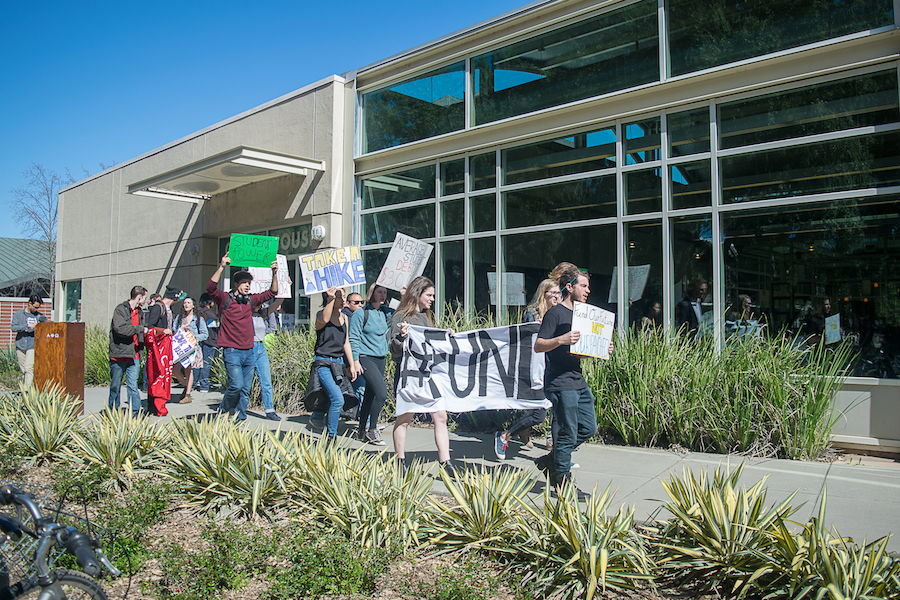
Students for a Democratic Society sent a statement regarding a rally that will take place on Jan. 23 at 11:50 a.m. to The California Aggie. The club said it is committed to fighting the growing student financial burden with student activism and recognize how raising costs prevents access to higher education.

“Each time the tuition is raised, there are more students and workers who can’t afford housing, more students and workers who have to cut down on their meals, and more students who are forced to drop out because of financial problems,” the statement said. “Marginalized students struggle to find resources and representation as funding cuts gut the cross cultural center. In the UC system 42 percent of students and 70 percent of workers say they have low or very low food security and yet tuition continues to rise. Tuition needs to be rolled back, the outrageous salaries of the administrators needs to be redistributed to our critically underpaid staff and faculty, and our university needs to be restructured to put students and workers that run the university in charge, rather than the unelected billionaires and CEOs on the board of regents.”

According to the LA Times article, Gov. Brown opposes any hike in tuition and some UC Regents have asked that the vote be delayed. Brown has proposed an increase in UC funding by three percent for the 2018-19 year.

Stephanie Beechem, a spokesperson for the UC Office of the President, responded to Gov. Brown’s education budget plan, mentioning the cut in expected funding from a 4 percent increase to a 3 percent increase for the 2018-19 year. According to the UCOP, tuition increases are required to support increased enrollment and financial aid will protect most in-state undergraduates. The expected fate of out-of-state students is not addressed in the statement.

“UC today educates more California students than ever, a commitment we have maintained through severe cuts in state funding and a six-year tuition freeze,” Beechem said via email. “While UC is pleased that Governor Brown’s preliminary 2018-19 budget proposal provides a funding increase to our core educational budget, it is less than the amount outlined in a multi-year framework established with the governor in 2015, which anticipated modest, predictable increases roughly tied to the inflation rate. The proposed adjustment is less than the rate of inflation and because of financial aid, most California undergraduates will not have to pay it. The campuses have asked for this increase because they need it at a time when California undergraduate enrollment is at an all-time high. Additional revenues will go toward maintaining UC’s academic excellence through more faculty, additional courses, better technology, improved student services and other campus-tailored priorities.”


Wrriten by: Aaron Liss — campus@theaggie.org


Seagrass in coral triangle grows better together

DR. DALE TROCKEL / COURTESY

More diverse transplants can help marine restoration projects succeed

An experiment performed by UC Davis and Hasanuddin University scientists in the Indonesian Coral Triangle demonstrated one method of improving restoration outcomes. The results, published in the journal PNAS in November 2017, indicate that multiple seagrass species grown together are more successful and survive longer.

The Coral Triangle is a large area of the Pacific Ocean, famous for being one of the most diverse ecosystems of seagrasses, corals, and mangroves in the world. Marine plants create areas where fish, mammals, and birds can live and breed, in turn creating industries for human nourishment and trade. The efforts of conservation and restoration of the crucial natural environments in the Coral Triangle is important for millions of people who live on the thousands of islands in the area.

“Indonesia is the best place to look at this question because they have so many different species, whether you’re talking about fishes, seagrasses, or coral,” said Susan Williams, a distinguished professor in the Department of Evolution and Ecology at UC Davis and the former director of the Bodega Bay Marine Laboratory.

The project involved planting nearly a hundred plots of seagrass in groups of one, two, four or five distinct species. The number of surviving plants and the total area covered by the grass meadows was measured periodically for more than a year.

“The main result was planting more diverse assemblages of seagrass species helped plants get established and grow in our restoration study,” said Jessica Abbott, who served as a Ph.D. student in population biology at UC Davis during the project and currently works as a research ecologist at the Institute for Wildlife Studies.

In the Coral Triangle, many species of seagrasses naturally coexist together in the clear, shallow waters. The different types of plants serve unique roles as safe havens for fish, food sources, and nutrient transformers.

“We developed a method to restore more than one species of seagrasses,” said Rohani Ambo-Rappe, a professor in the marine sciences department at Hasanuddin University in Indonesia. “This is an important finding due to the nature of the tropical seagrass near Indonesia, which are mostly multispecies [ecosystems].”

The scientists reviewed some of the common practices in current marine restoration projects. The historical trend has been to plant only what is considered the single most important species, without considering the broader ecosystem in which that species thrives.

“We looked at restoration in general and if anybody was considering biodiversity — whether species diversity or biological diversity,” Williams said. “We found there was a big gap between the base of knowledge and what people are practicing.”

An important threat to any restoration project is human interaction. Debris from human settlements, activity from boats, and algal blooms from pollution were all present in the research plots used during the experiment.

“I think that we definitely learned that human disturbance was something that needs to be addressed in this area,” said Christina Sur, who was a master’s student in ecology at UC Davis during the project and currently works as a Sea Grant Knauss fellow. “We also saw that some of the seagrass plots persisted, despite the disturbances.”

When attempting to restore natural areas from a degraded state, the tendency has been to plant many specimens of the same species of interest. The outcome from this partnership between UC Davis and Hasanuddin University suggests planting multiple species together could have better results in restoring certain degraded marine environments.


Written by: George Ugartemendia — science@theaggie.org

My Sister’s House Reaches out to Yolo County

0
MICHELLE HUEY / COURTESY

Culturally-sensitive support and resources for Asian Pacific Islanders, other sexual violence survivors

Executive Director Nilda Valmores of My Sister’s House recounted meeting with a client who had been denied sexual assault services at another location. However, Valmores, being Filipina like the client herself and understanding Tagalog, noticed the woman’s shifty gaze and hesitance to describe her situation. Valmores invited her to share her story in Tagalog and the woman’s pauses and erratic behavior became clear. To a culturally insensitive organization that helps victims of sexual abuse, this woman could easily be misunderstood as untruthful.

“If I wasn’t culturally sensitive, I would have thought that she was lying too,” Valmores said. “It’s hard enough if you’re born and raised in English […] to get the help you need to tell the story that you need to tell. And to have to tell it with different words and in a different language to someone who may not understand, that’s even harder.”

The core of the mission of My Sister’s House, which provides resources and services to residents of Sacramento and Yolo Counties to counter domestic violence, sex trafficking and sexual assault, is to maintain a culturally sensitive approach. People like Valmores and Sexual Assault Prevention Specialist Michelle Huey understand how cultural positionality affects the way people process and cope with trauma.

“Dealing the the trauma [of sexual abuse] effectively means dealing with the cultural piece,” Valmores said. “And when you don’t […] you’re going to neglect serving a significant group of women.”

This preliminary understanding of culture as part and parcel of processing trauma is critical to the services that My Sister’s House provides and to the organization’s ability to provide those services to those who need them.

“She’s not supposed to be talking about sex in the first place,” Valmores said. “She’s not supposed to be talking definitely badly about her husband. She’s not supposed to be talking about what’s happening in the relationship especially in regards to the sex piece. She’s not going to have great eye contact because she’s not supposed to.”

Valmores spoke about other cultural differences that can pose barriers to accessing care.

“It’s also about delivering services differently,” Valmores said. “For example many times mainstream organizations say a training starts at two o’clock. If you’re not there at two o’clock, then the door is closed on you. But for people who have a different sense of time […] two o’clock is when they get there.”

Asian Pacific Islander women make up one eighth of the population. It is precisely this huge, albeit minority status that allowed My Sister’s House to receive a federal grant to fund Project REACH (Reaching Each Asian-Pacific Islander Community with Hope). These funds have enabled the organization to expand to Yolo County in the hopes of reaching Asian Pacific Islander women who may also be survivors of sexual assault and domestic violence. Numbering among their programs for these women are a Sexual Assault Survivor Support Group and a Friends and Family of Sexual Assault Survivors support group, both staffed by professional therapists.

The utilities of My Sister’s House are coming directly to the UC Davis campus on Wednesday, Jan. 17, in cooperation with SAFE and CARE. Meeting in Room B of the Student Community Center from 6:30 to 7:30 p.m., My Sister’s House will be leading a discussion about sexual violence and harassment, specifically in the Southeast Asian community.

Representatives of My Sister’s House were also present at Monday’s Martin Luther King Jr. march in Sacramento. For Valmores, their presence there was essential.

“Sex trafficking is modern day slavery,” Valmores said. “And sex trafficking begins with sexual abuse.”

On Tuesday, My Sister’s House held its yearly conference on sex trafficking, one of the key issues that the organization aims to address. However, there are upcoming ways to learn more about My Sister’s House. It leads monthly volunteer trainings. It also offers bi-yearly training sessions on identifying the signs of sexual abuse and working with domestic violence survivors, and will give free presentations on the issues that face the Asian Pacific Islander community regarding sexual violence.

All of these outreach programs are in addition to sheltering women and children who have faced domestic and sexual violence. These shelters operate in coordination with their program Women to Work, which empowers and enables women to become self-sufficient after leaving violent relationships.

Michelle Huey, who is an alumna of UC Davis in addition to her position with My Sister’s House, remembers a time on campus where sexual assault wasn’t part of the public discourse.

“Back then […] it was only a few years ago, nobody was really talking about sexual assault,” Huey said. “Even now we don’t talk about how it happens in the Asian Pacific Islander community.”

This may be in many ways because of some cultural norms that Huey identifies in the Asian Pacific Islander community like “saving face.”

“The topic of sex isn’t really talked about in the Asian Pacific Islander community,” Huey said. “That makes it even harder when sexual violence is involved.”

Huey recounted a story not so different from Valmores’ in which a Mandarin-speaking women visited My Sister’s House flanked by law enforcement, completely shell-shocked. When a staff member addressed her in Mandarin, Huey says that her relief was palpable.

“I almost cried because of seeing her reaction,” Huey said. “That moment absolutely stands out in my mind.”

Third-year Asian American studies and psychology double major Pryanka Narayan, who works with My Sister’s House, also had a story to share reflecting on the time she has spent with the organization since high school. She spoke over the phone with a client who was new to the country and didn’t know where to go with her story of domestic violence.

I did the best that I could, I kind of gave her hope that there is a new beginning and there is a way to get out of the situation that she was in,” Narayan said.

Narayan also reminded readers that while My Sister’s House is culturally sensitive to Asian Pacific Islanders, it is in no way exclusive.

“We are culturally sensitive,” Narayan said. “But we are open to any genders and anyone at all.”


Written by: Stella Sappington — features@theaggie.org

WRRC launches mentorship program for women in STE

IAN JONES / AGGIE

WiSE kick-off event included speech from LeShelle May

On Jan. 11, the kick-off event for the UC Davis Women in Science and Engineering program took place at the Student Community Center.

According to Sara Blair-Medeiros, the assistant director of outreach at the WRRC, “The WiSE Program at the WRRC was established in an effort to promote a mentorship opportunity centered on those with marginalized gender identities in the fields of science, technology, engineering and mathematics.”

“WiSE aims to provide a supportive, gender positive environment in which mentees work together with their mentors to achieve their academic and professional goals,” Blair-Medeiros said. “In doing so, the program aspires to help improve gender equity in these fields. We believe that the recruitment and retention of students of underrepresented gender identities is essential to promoting gender equity in STEM and is a pillar of the gender equity work we engage in at the WRRC.”

Through the program, female students in STEM are paired with experienced mentors with whom they can meet up periodically for advice on such topics as job-finding and resume preparation.

The event started off with a speech by LeShelle May, a highly-accomplished computer engineer recognized for her leadership and innovation in the development of software and web applications.

According to May’s biography on the UC Davis website, her “projects include the 2014 launch of the CNNgo app that offers live news coverage to online viewers and enables them to scroll back to see what they missed” as well as “the development of a video content management system that instantaneously delivers stories to hundreds of newsrooms worldwide.”

May started off by talking about her beginnings in science, where she was the only female student in many of her AP classes. She then presented several slides on how social media is changing the landscape and how biotech and engineering are coming together — showing the abundance of opportunities in STEM fields.

“Remain steadfast. You can do it,” May said to attendees at the kick-off event.

In the next part of the conference, the attendees were asked to break into small groups to discuss what gender equity means to them and how their social identities affect their careers in STEM.

May summarized the points brought up in her group, including lack of equal pay for women, lack of encouragement that women have in STEM, stricter assessment for women and the fact that women are often not trusted on high-profile projects.

Other points brought up were bias and the patronization of female graduate students as well as women not receiving credit for their work.

In the next segment of the event, WRRC staff presented the definitions of common social justice terms such as genderism, privilege, intersectionality and mansplaining. They also introduced a number of other programs and events offered by the WRRC, including the Davis Feminist Film Festival, Black Futures Month and the Janet Mock Book Club.

Marisol Wolf-Ochoa, a second-year neuroscience graduate student in attendance at the WiSE event, found it to be worthwhile.

“There are a lot of lessons to be learned from other people’s journeys,” Wolf-Ochoa said. “It makes you feel you’re not alone.”


Written by: Clara Zhao — campus@theaggie.org


Tapingo’s ties to private prison company Aramark

KAILA MATTERA / AGGIE FILE

New dining service app’s partnership with corporate giant sparks discussion

In the past two years, UC Davis and the UC system have been actively divesting from organizations directly linked to private prisons. These private prisons, or for-profit prisons, are facilities in which individuals are confined by a third party company that is contracted by a government agency.

In October 2017, Student Dining Services introduced Tapingo, a mobile ordering app, to various locations on campus including the CoHo, the CoHo South Cafe and Biobrew. The goal of Tapingo was to reduce wait times and lines at these popular campus eateries, in order to lessen crowding and increase business.

However, concerns have been raised regarding Tapingo’s partnership with Aramark, a corporate food service giant that has clients in education and healthcare as well as contracts with privatized correctional institutions.

ASUCD Senator Marcos Rodriguez initially raised concerns about Tapingo after reading an article online published by American Friends Service Committee.

An article published by Medium states: “Sodexo actually operates private prisons and immigrant detention centers around the world.” 

According to the article, Aramark “works in over 600 correctional institutions across the United States and Canada […and] serves more than 1,000,000 meals to prisoners each day.”

Aramark has been subject to various protests, strikes and lawsuits by employees, community members and inmates in the past including an inmate suing the prison for “price-gouging gourmet food”.

Director of Dining Services at UC Davis Darin Schluep stated that Tapingo’s ties to Aramark did not play a role in his decision to establish and promote the app on campus.

“I’m not necessarily working with Aramark, which is of course in the prison industry, so to me there was no correlation between providing a service to our customers through Tapingo, who doesn’t work directly with the prison industry,” Schluep said. “I don’t see the link there. I don’t see the connection by which me working with Tapingo directly supports the prison industry or Aramark.”

According to the San Francisco Chronicle, Tapingo “has also partnered with food-service operators like Aramark and Sodexo.” In response to the development of a partnership between Aramark and Tapingo, Schluep said, “that wasn’t really part of my decision-making process.”

Andreas Godderis, a second-year economics major and ASUCD senator, works regularly with Tapingo as an employee at the South CoHo.

“My knowledge of the app comes from the experience I have with it from working at the South CoHo,” Godderis said. “We installed Tapingo earlier Fall Quarter and it was kind of going through a test run and it should be going through the mainstream in the winter.”

Godderis responded to the news of the existing partnership between the two companies and expressed his views on the privatized prison industry.

“I was not at all aware of that [partnership], and that’s deeply disturbing,” Godderis said. “I am going to be looking into that, because private prisons are not at all democratic and horrible to society. This is the first time I’m hearing of this. I use Tapingo on a daily basis as an employee, and that’s not very fun to hear.”

Godderis said he plans to reach out to other ASUCD officials and, eventually, Tapingo’s developers.

“Given this information, I’m going to talk to some of the other senators and hopefully email or get in contact with Tapingo and the developers and see why they use that service,” Godderis said. “If it is indeed tied to the private prisons, I believe that the majority of the student body is vehemently opposed to that and they will take a stand on that issue and make a public [statement] that if Tapingo doesn’t change that, there will be some sort of student backlash. Hopefully students are willing to protest the use of that, but first I will start by contacting and reaching out to Tapingo and seeing what their side is.”

Godderis responded to the claim that there is no link between supporting the private prison industry and doing business with Tapingo.

“For my personal opinion, if they are at all part of a network that supports private prisons then I am absolutely opposed to it regardless of how small those ties are,” Godderis said.

Tapingo did not immediately respond to a request for comment.


Written by: Priyanka Shreedar — campus@theaggie.org

Correction:

A previous version of this article incorrectly quoted ASUCD Senator Marcos Rodriguez. The quote has since been removed.

alt-J and BØRNS to perform at UC Davis in April

ENTERTAINMENT COUNCIL / COURTESY

Entertainment Council announces another campus concert

After ASUCD’s Entertainment Council announced Khalid was to perform at UC Davis in May, it seemed like the “big artist” for the year had been finalized. But EC has once again partnered with Another Planet Entertainment to bring not one, but two well known musicians to the Davis campus.

EC announced this afternoon that both alt-J and BØRNS are to perform at the UC Davis ARC Pavilion on Monday, April 23. Students can use the access code INCOLDBLOOD to access early-release tickets for $49.50 during the pre-sale that begins Wednesday, Jan. 24 at 10 a.m., and lasts until 10 p.m.

And while alt-J is an established alt-rock group compared to the newer works of BØRNS, both bands share a discography of catchy hit tracks, distinct vocals and a memorable fusion of playful, electro-rock. alt-J released its third album, “RELAXER”, at the end of 2017, and BØRNS has been touring his 2018 release, “Blue Madonna”.

Students have been making the trek to the Bay Area to see these musicians — so maybe the short bike ride to the ARC is well-worth your time and money.


Written By: Ally Overbay — arts@theaggie.org

Humor: Applying to things other than college: what to leave off your resume

KAILA MATTERA / AGGIE

Not just the obvious stuff

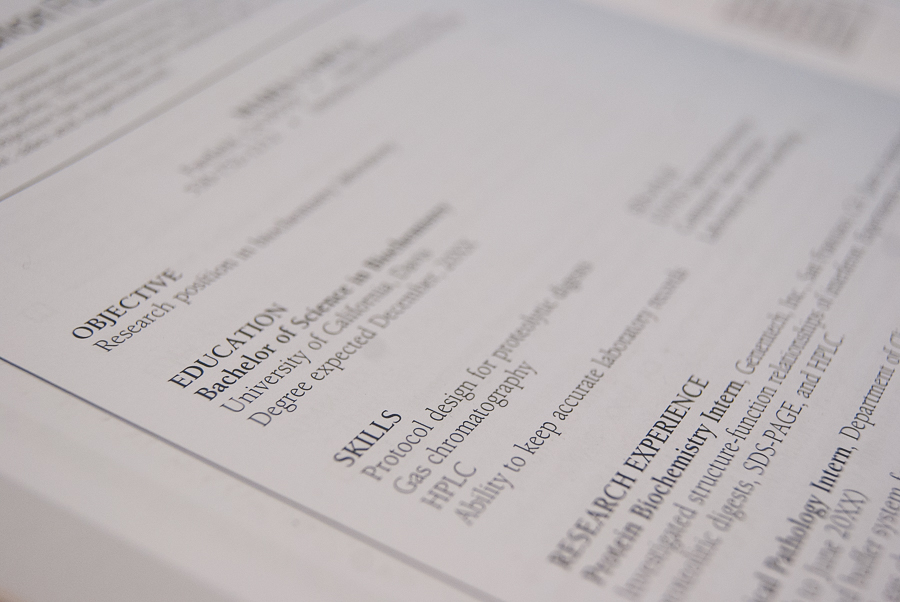
As some of you lucky students begin to think about what it’ll be like to escape this problematic sub-system known as college and enter a lifetime of working for other problematic sub-systems, you might want to consider making something called a resume. Resumes can be complicated in your 20s, when jobs and internships are just disguised as manual labor for more important people (I don’t know if that ever changes). However, it’s important to know what to exclude from your resume when continuing the trend of how you lived the last four (or seven) years at Davis with full consideration of your future.

I’m assuming most people know the obvious things to leave off. So following the lead of my professors, I’m just going to jump right into the specifics without giving any background information. Instead, what I’ll warn you against is including things that you might see as positive assets to your personality. But I assure you, they are not.

How communicative you are/Attachments of desperate emails you sent your professors at 4 a.m.: One thing people seem to be really proud of is when they convince their professor to round their 79.89 to an 80, etc. While this is a great table topic when you’re bragging about how little work you did while still managing to escape with the grade you wanted, keep in mind that you might not want to disclose how desperate you can be. While it shows commitment and lack of self-respect, your future employer probably could go without reading how your cold during week one lead to your overall academic decline.

How adaptable you are: This is generally a good trait. But when applied to day-to-day Davis life, adaptability is more of a test of your willpower than anything else. Examples can range from how long you were able to wait in line at the CoHo to how okay you became with sitting in class sopping wet all winter, or maybe even to how desensitized you are to being accidentally elbowed all class by the two toxically masculine figures sitting on either side of you. However, these all just show how okay you’ve become with the un-okay during your time at college. And in the adult world, where none of this will change, I suggest it might be time to raise your standards.

How much perseverance you have: How close you were to almost dropping out might be your proudest story of perseverance that you laugh at after you graduate. But to future employers, this cute little story of being beaten down by the system just shows that you might not be able to handle the continuation of extended stress that never seems to disappear. So I would just quit while you’re ahead and explain how you persevered through the quarter even after you got that horrible cold during week one.


Written by: Rosie Schwarz — rschwarz@ucdavis.edu

(This article is humor and/or satire, and its content is purely fictional. The story and the names of “sources” are fictionalized.)

Making a quantitative educational system a qualitative one

MEENA RUGH / AGGIE

The opportunity to show ourselves as human is a privilege not all students share

Unlike the educational systems in many countries, the United States strongly believes in second chances. There’s not one defining exam a teenager must take. Students need not choose their career goals in high school. And in the instance that a student takes a wrong turn, makes a bad choice or has a hard year, the consequences are not life-changing. There’s freedom to change and evolve as human beings, a chance for redemption and rewards for getting back on one’s feet. That is something uniquely American.

The system that we partake in is mostly qualitative. To get into degree programs (surprisingly at both the undergraduate and graduate levels), most students must submit multiple pieces of information, including GPA, standardized test scores and essays. They also look at recommendation letters from professors and supervisors. No student is a number — they’re fleshed out humans on paper. This is an incredibly qualitative system, which ideally should reduce pressure on students. But it doesn’t.

Sadly, when it comes down to it, people like numbers — even in the activities they enjoy. They want to know how many experiences they should write about, how long they should stay with an opportunity, the number of awards they should receive to be considered accomplished. Suddenly this qualitative system has become quantitative again. There’s the desperation to do more, more, more — and what was made to make students look three-dimensional on paper pathetically backfires.

Whether we like it or not, fellow students who have been successful in their future pursuits set the bar for “magic numbers.” While many students realize early on that there isn’t one fixed way to achieve a similar goal, others quickly try to make a checklist of experiences and start ticking them off the list item by item. Two years in a lab, three papers, four years in a club —  the numbers quickly seep back into the lexicons of the ambitious, whether they have perspective or not.

There’s no clear solution. In an ideal world, students would pursue only the things they are passionate about, giving their time only to activities that provide them with purpose and enjoyment. But the world is not ideal, and we all know at least one person who doesn’t want to be where they are or doing what they’re doing — such is life. At the same time, it’s not fair to claim numbers are the cause for the increasing competition to perform outside the classroom. As American as our educational system is, it’s also intrinsically capitalistic. The best and most talented rise to the top, and the rest follow suit.

But competition need not be sour.

“Knowing I have competition strongly motivates me to do my best work,” said Sara Vacanti, a third-year chemical engineering major. “I enjoy working with my peers, and UC Davis is a great environment for teamwork — everyone is rising to meet the challenge.”

This mindset is why our education system chose to be qualitative in the first place. “Rising to the challenge” is not for everyone, but “rising” is. The goal is to have resilient people in the workforce and in the community. Competition is but a springboard. And that’s why a qualitative language matters. It’s not who has risen to the challenge in the past, but who is most likely to rise to the challenge in the future.

Very rarely can one claim that the system is trying to give us the best shot — but the qualitative nature of the American education system is trying to do just that. Allowing us the opportunity to show ourselves as humans is a privilege, and the frantic need to put numbers into the equation shows how dire competition in our society has become. As students, we must step back and realize that this is our chance to be passionate and involve ourselves in what makes us happy. Because if one dares to claim they are more than their GPA, they must also have strong conviction about what they would like to define them.


Written by: Samvardhini Sridharan — smsridharan@ucdavis.edu

Disclaimer: The views and opinions expressed by individual columnists belong to the columnists alone and do not necessarily indicate the views and opinions held by The California Aggie.

Humor: Research finds that impending nuclear war could actually be good for average already-dead American

SAMANTHA COHEN [CC BY 2.0] / FLICKR
Praise be to the Great Button

The button sits on the desk of Our Leader, its extremely cliche red glow throbbing in the darkness of the Oval Office. How big is this button? Very, very big. In fact, it would be more accurate to say that the big boy button sitting on the desk of a very good boy was in fact the size of the Oval Office. That’s right, our Great Leader expanded his desk to the size of the entire Oval Office, and the button eclipses even this desk. No one can actually go into the Oval Office because of this big-ass button.

Now you may say that this is impractical, excessive, even insane. But is anything too big for America? No, I don’t think so.

Everyone, especially our Wise Leader, understands that the size of one’s button reflects one’s power. A small button? Perhaps you are puny Iceland, or weak Canada. A medium button? Now we are approaching Britain, a nice country whose ass needs to be whooped by America every so often. A big button? Only a very Big Boy could have a Big Button. And you know who’s a Big Boy? Kim Jong Un. But you know who’s even Bigger Boy? DONALD TRUMP (PRAISE BE TO HIS NAME).

So have no fear when the nuclear war evaporates absolutely everything you love. If you’re already dead, this shouldn’t be a problem. There are so many pros to this if you’re already dead. Trust me, the administration’s very own Donald Trump Research Department has found that, in fact, if you’re already dead, this nuclear war could be a very nice thing indeed. And if you’re conservative, you’re going to heaven anyways, so what do you have to worry about?

Written by: Aaron Levins — adlevins@ucdavis.edu

(This article is humor and/or satire, and its content is purely fictional. The story and the names of “sources” are fictionalized.)

The Execution of Foreign Language Study: Its benefits are striking, but only if we stay enrolled

JESSE STESHENKO / AGGIE

Personal experience reveals passions and exasperation in Russian courses

There aren’t a lot of folks who can say their educational lives changed after they visited a Wikipedia page. I can say without a doubt that mine has. The story goes like this: I was 17 years old, and one day I was bored. I hopped on the computer, one thing led to another and a blue hyperlink bearing the words “Trans-Siberian Railwaypulsed before my eyes. I opened the link. The next thing I knew, Russian nesting dolls and statues of Lenin’s head ballooned on the screen. It was my first real exposure to Russia and its wonderful language.

I enrolled in a Russian class at the local community college. The professor was originally from Russia but had immigrated to the United States to escape persecution for being Jewish. This fact alone was intriguing. Russia seemed to mirror my own country with its mixed record on human rights and a history of discrimination. Yet at the same time, its authoritarian streak and blend of Eurasian culture appeared so different from the U.S.

I couldn’t quite grasp whether Russia and the United States were lukewarm siblings or strangers on the street. I needed to understand more, so learning Russian made perfect sense. I finished the community college class and decided I liked it — white tank tops and tracksuits were in my future after all. After enrolling at UC Davis, I scrolled through the course listings for a Russian class. Check.

Many readers know just how mind-numbing learning another language is — especially as a monolingual adult. Statistically, committing to learn another language is difficult. In a study of 150 language-learners using software as a self-studying method, only one person actually completed the 200-hour program. Most dropped out after 10 hours of study.

The data from actual college classrooms — as opposed to self-study groups — reveals a similar, if less potent, dropout rate in foreign language courses. A study using enrollment figures from 2006 shows how only 20 percent of foreign language students take upper-division courses in their chosen language. Most students fail to advance more than one or two years.   

This isn’t hard to imagine. Data from 2015 published by the Modern Language Association, for example, revealed an 18 percent enrollment decrease in Russian courses since 2009, the third-largest drop seen in language courses besides Ancient Greek and Modern Hebrew.

Year after year, I witness similar attrition rates in my own college Russian courses. What began as a waitlist-only introductory class my first year quickly became a smattering of Russophiles and begrudged upperclassmen that could be counted on two hands. Our numbers only dwindled, so my second year courses consisted of a handful of “originals” and a few heritage speakers looking for an easy A.

People like the idea of learning another language. It’s a subject of fascination for those who aren’t multilingual and a mixture of pride and nonchalance for those who are. The benefits are plenty, and they include anything from conversational flexibility with people around the world, a heightened understanding of our own native tongue and better memory and multitasking skills.

There’s just one problem — language learning is tough to do and easy to quit, as shown by the epidemic of dropouts. Many tenable solutions are out there, like improving our teaching methods. We could bypass the hurdles of adult language acquisition and start the process in elementary school, like much of Europe does. But for now, the pitfalls and rewards of studying a foreign language are here to stay — one click at a time.


Written by: Nick Irvin — ntirvin@ucdavis.edu

Disclaimer: The views and opinions expressed by individual columnists belong to the columnists alone and do not necessarily indicate the views and opinions held by The California Aggie.