53.8 F
Davis

Davis, California

Saturday, December 20, 2025
Home Blog Page 567

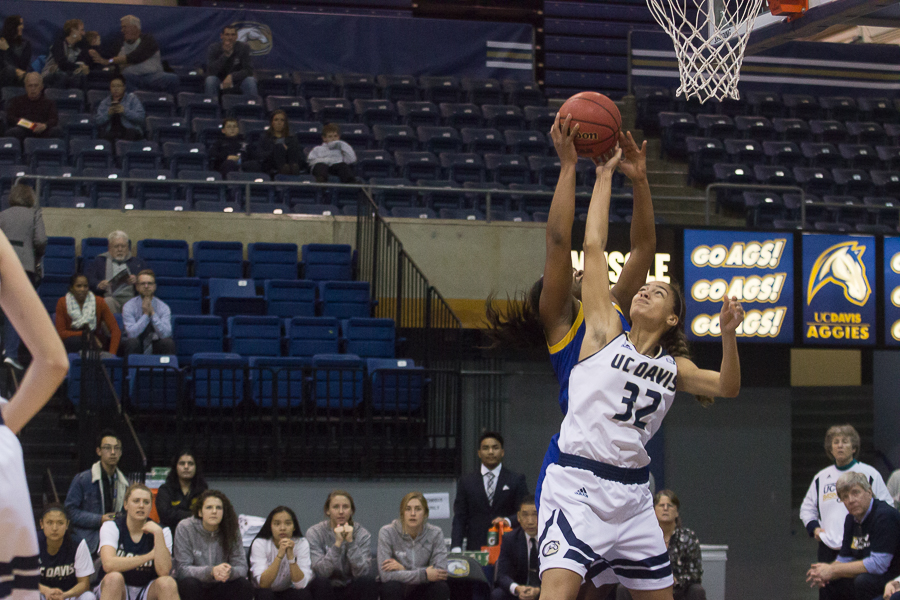
UC Davis women’s basketball keeps conference streak alive

MACLEAN HARTFORD / AGGIE

Aggies now 3-0 in conference, 7-1 at home

On Thursday, Jan. 11., the UC Davis Aggies beat the UC Riverside Highlanders 74-63. The Aggies entered the Pavilion coming off a 76-52 win against Hawaii. This triumph over the Highlanders gave the Aggies their 13th consecutive Big West Conference win.

After a rough first quarter and a notable absence from junior point guard Kourtney Eaton, who was caring for a pulled hamstring, the Aggies were down 13-8, only having shot three for 18, but a comeback in the second and third quarters secured the win. The third quarter saw five straight three throws from four different players.

“The good news is, we can’t play much worse,” said head coach Jennifer Gross. “That’s the thing about a veteran team […] you’re going to have some days where things aren’t going to go your way […] I was really proud of our composure and how we just kind of stuck with it. We relaxed a little bit and knocked down a couple of shots.”

At half-time, senior guard Dani Nafekh lead the team with 10 points and finished with a season-high 18 points. Breakout freshman forward Cierra Hall had already earned herself a career-high rebounds, totaling 12 by the final buzzer. Hall now has the most number of rebounds by a player this season.

“I think it’s incredible,” Hall said of her current record. “I feel like when I came here I needed to find my place on the team and if rebounding is it, then that’s it and I’m just happy to be able to do whatever I can to help the team.”

Gross also made sure to comment on the freshman’s performance.

“I thought Cierra was remarkable […] really playing the point-forward for us,” Gross said. “In a game like this, she’s able to bring the ball up under pressure and the composure she has as a freshman is pretty unbelievable.”

Leading by just three points, the Aggies hit their stride in the second half and shots really started falling. Senior guard Rachel Nagel scored the first trey, quickly followed by senior forward Pele Gianotti with an assist by junior guard Karley Eaton. Redshirt junior forward Morgan Bertsch scored a field goal assisted by Nafekh, and a three-pointer by Eaton forced a timeout by the Highlanders. The clock started again and Nagel secured a 14-point lead with back-to-back threes.

“That was the first time, that I can remember, that we’ve been doubled really hard, almost every possession,” Nafekh said of the game. “It was awesome seeing our post be so calm and collected […] passing out and getting us open shots. And it was exciting to see us hit all those threes again. It’s been a while since we’ve hit a bunch.”

The Highlanders didn’t let the Aggies keep that lead so easily. Twice the Highlanders managed to get their score within five points of the Aggies’, but another lengthy run of consecutive points by the Aggies in the final quarter secured their victory. In the final seconds of the fourth quarter, the fans began chanting for one more basket at the hopes of winning free pizza, but the bench who had just come in couldn’t quite get a handle on the ball.

“We talked about how this was the ultimate team win,” Gross said. “I thought every single person contributed.”

The Aggies will hit the road this week in hopes to keep their winning streak alive with games against UC Santa Barbara and Cal Poly. Gianotti, in particular, will be looking to score just four points in order to reach a career 1,000 points.


Written by: Liz Jacobson — sports@theaggie.org
Space Archeology: Mapping the Past from Above

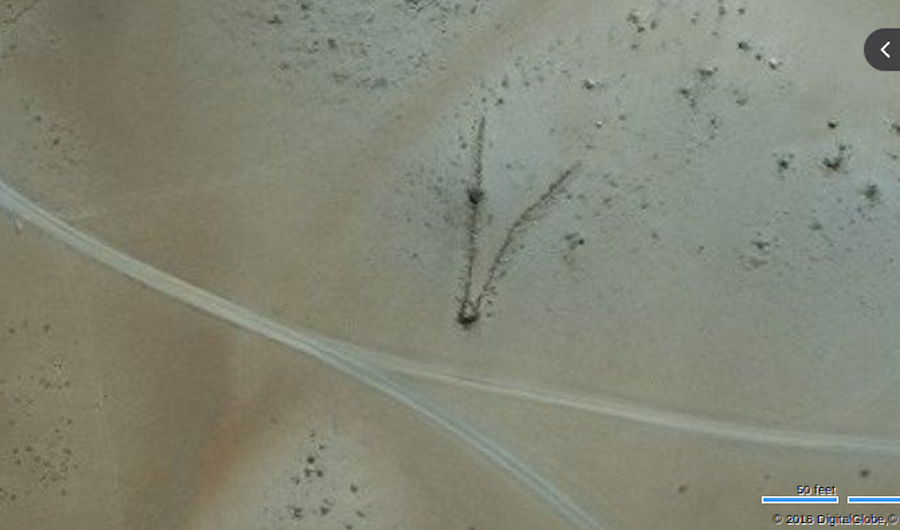
DR. RANDY HAAS / COURTESY

Satellite technology allows anyone with a computer to aid archeologists in unearthing new discoveries about ancient civilizations

Satellite technology has given rise to what is known as space archeology — using high-resolution imagery to detect unknown objects hidden beneath the Earth’s surface. Sarah Parcak is a pioneer of this field, and she wants us all to become space archeologists.  

“I have a passion for finding things,” Parcak said in her 2016 TED Talk. “Seeing with the naked eye alone wasn’t enough.”

Starting with a search for sand dollars on the beaches of Maine as a child, now Parcak unearths ancient cities beneath the sands of Egypt.  

Parcak began using this digital map in 2011 and now shares it with the public. Using high-resolution satellite imagery, Parcak’s online platform GlobalXplorer uses infrared and image processing to detect chemical changes in the landscape caused by hidden objects beneath the surface. It’s like Google Earth for archaeologists.

Randy Haas is an archaeologist at UC Davis utilizing this satellite technology.

“I am indeed an advocate of the method,” Haas said. “Sarah Parcak’s excellent work has certainly inspired me to explore crowd-based satellite image surveying for archaeological discovery.”

Probing the Andes Mountains from 400 miles above the Earth, Haas noticed V-shaped structural patterns in the high-resolution satellite imagery. Further examination led to the inference that the ancient indigenous people may have used this geometry as a barrier to herd vicuña, a wild ancestor of the alpaca, for wool. Haas now turns to his students to help him further his research.

Teaching for his first quarter at UC Davis, Haas is allowing students in his ANT 3: Introduction to Archaeology class to become space archeologists themselves.

“Students will be surfing satellite imagery in the Andes Mountains of Peru to help me find archaeological sites that I suspect are related to ancient wild animal roundups,” Haas said.  

On the first day the assignment was released, 34 new sites were found, and five have been confirmed thus far. Now, Haas can return to Peru using a newfound map with the potential to unearth untold history, giving new insight into human behavior.   

This summer, UC Davis’ Institute for Social Sciences will fund an archeological field effort using this satellite technology for ground-based operations.  

The use of satellite technology is revolutionizing the world of archeology. In the Egyptian delta alone, archaeologists have excavated less than 1/100th of 1 percent of the total volume of sites in Egypt. Using NASA’s topography data and an army of newly-trained space archeologists, countless numbers of archaeological sites will be discovered. This will lead to clues that have been hidden for thousands of years.

“Satellite imagery will play an increasingly important role in archaeological discovery and preservation, especially as new detection algorithms and satellite systems are developed,” Haas said.

Parcak’s goal is to launch space archeology worldwide, giving anyone with a smartphone or computer the ability to unravel the mysteries of the past.  

Naturally, sharing this technology with the world has some consequences. Thieves loot archeological sites and sell parts of history for personal profit.  From miles above, looting sites look like small craters from Mars. In the wrong hands, the GPS data could increase looting universally.  

“Every archaeologists has had to cope with looting,” Haas said, who has witnessed looting firsthand at one of his own digs in Peru. “It is a harsh reality.”

Bryna Hull, a second-year Ph.D. student specializing in California prehistory, is a TA for Haas’ anthropology class and explains why looting is so harmful.   

“Many people don’t realize that it destroys the scientific value of the items they take when they remove them from their context and fail to document anything,” Hull said.

Contrary to popular belief, looting has been increasing worldwide. And at its current rate, according to Parcak, all of the archeological sites in Egypt will have been looted by 2040.  

That is why Parcak masks the information, and keeps the GPS coordinates secret — just like a doctor protecting a patient’s medical records.

Today, NASA has a specific program to train future space archeologists. The next major discovery in archeology could be mapped from anyone with access to the internet.


Written by: David Madey — science@theaggie.org

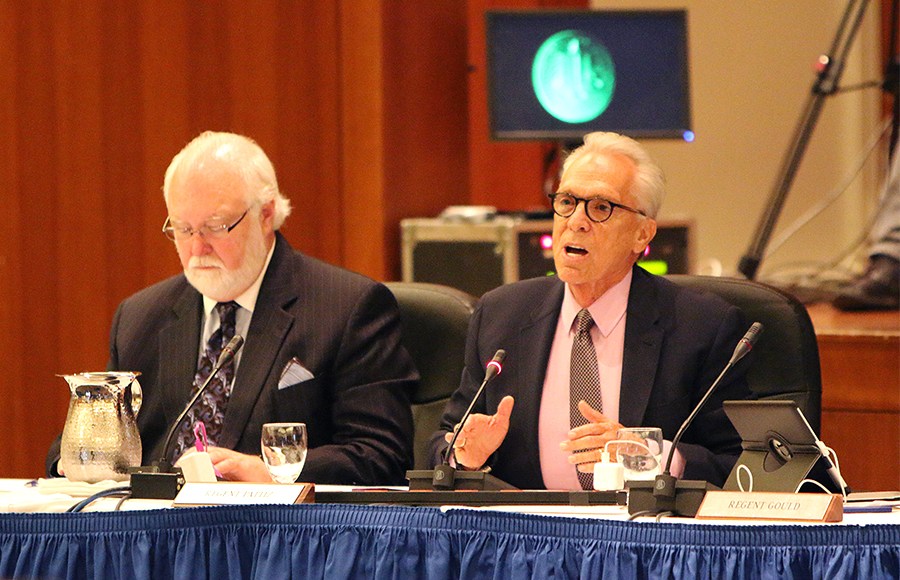
UC Regent Norman Pattiz resigns amid sexual assault allegations

MICHAEL DRUMMOND / THE DAILY CALIFORNIAN

Pattiz steps down after year of pressure from student organizations

Radio mogul and UC Regent Norman Pattiz submitted a letter of resignation effective Feb. 16 one year after sexual assault allegations against him initially surfaced.

Last October, podcast host Heather McDonald accused Pattiz of sexual misconduct on a podcast segment and released an audio recording of Pattiz asking to hold her breasts. Pattiz confirmed that it is his voice on the recording according to an article from HuffPost. McDonald also said that Pattiz joked about following her into the restroom, among other incidents of sexual harassment and misconduct.

The second allegation against Pattiz came from Ji Min Park later in 2016. Among other comments, Park mentioned that Pattiz referred to her as the “hottest Asian” in a Huffington Post article.

Although the UC Board of Regents was pressured to act in response to the allegations, the Board does not have the capacity to remove a Regent, only to accept their resignation.

“He wasn’t conducting UC business at the time,” the UC Regents stated in an official statement.

Despite not officially representing the UC at the time of the allegations, Pattiz has faced pressure to step down from the UC Student Association Office of the External Affairs Vice President at UC Berkeley, California Lieutenant Governor Gavin Newsom and others. The ASUC Office of the External Affairs Vice President released a copy of its call for Pattiz’s resignation on its Facebook page.

“This has been a matter of deep concern at many levels of the University of California especially in light of systemwide work we have done to address sexual harassment and assault,” Newsom said in an official statement. “These students — some of whom are survivors of sexual assault and harassment themselves — deserve to be heard, not silenced or told to be ‘ashamed.’”

Pattiz’s letter of resignation did not mention any of the sexual assault allegations.

“One of the main reasons I accepted an additional term on the Board was to provide enough time to find a successor at the laboratories and allow for a reasonable transition,” Pattiz said. “The period of transition at the laboratories will end in February.”

In response, George Kieffer, the current chair of the UC Board of Regents, also did not specifically mention the allegations.

“After so many years, you deserve a break,” Kieffer said in response to Pattiz’s letter.

Pattiz formerly served on the Academic and Student Affairs, Governance and Compensation and Public Engagement and Development committees on the Board of Regents.

Following his letter of resignation, the University of California Student Association released an official statement. Although the eventual resignation is noted as a “victory” in the press release, UCSA brought attention to what it refers to as a systemic failure to address the issue of sexual assault cases by the UC.

“The Board of Regents have continually failed to act for the full year between when the allegations first broke and when Regent Pattiz announced his resignation,” the release said. “The Board of Regents as a collective body ignored the comprehensive list of demands from the UC Student Association that would have showed an active commitment to UC’s expressed will to end sexual violence.”


Written by: Ally Russell — campus@theaggie.org


The Celebrity President

CAITLYN SAMPLEY / AGGIE

Reality check: Oprah Winfrey is not a qualified 2020 candidate

At this year’s Golden Globe awards, Oprah Winfrey received the Cecil B. DeMille Award, an honorary Golden Globe bestowed annually by the Hollywood Foreign Press Association for “outstanding contributions to the world of entertainment.” She is the first African American woman — and only the fourth African American in the award’s 66-year history — to receive this award.

Winfrey gave an acceptance speech that quickly went viral; in it, she recounted watching Sidney Poitier become the first African American to win the Best Actor Academy Award in 1964 and touched briefly on her mother’s struggles as a domestic worker. But the crux of her speech — the part that brought the audience to its feet and many to tears — was her rousing oratory against sexual harassment and abuse and her call to arms for “leaders who take us to the time when nobody ever has to say ‘Me too’ again.” She told the shamefully little-known story of Recy Taylor and reminded watchers that Rosa Parks was an NAACP investigator and an activist who led a nationwide crusade against the sexual assault of black women before she was the lady on the bus.

In Winfrey’s words: “We all have lived too many years in a culture broken by brutally powerful men. For too long, women have not been heard or believed if they dare speak the truth to the power of those men. But their time is up. […] I want all the girls watching here, now, to know that a new day is on the horizon!”

Her speech was bold and stirring, suited to the social and political moment, a manifesto for the era of #MeToo and #TimesUp.

More than a few Americans thought it sounded presidential.

More than a few Americans need to think again.

One of the more persistent myths of American politics is that there’s really not that much to elected office — a lot of shaking hands and giving speeches. This is the side of politics that voters see, and we’ve come to believe that the part we can see is the only part that exists. Most if not all of us have forgotten that politics is — or should be — primarily about policy. This means that politicians need to understand law, policy, political theory and governance first and charm the vox populi second. If you cannot explain, in detail, the limitations of counterinsurgency doctrine in Afghanistan, or the ramifications of expanding drone programs to the CIA or make a coherent fiscal argument about health care policy, you have no business being commander-in-chief.

Responding to the presidency of a crass, racist reality-television star with the candidacy of a big-hearted, loveable daytime-television star is a half-hearted response to the problem of woefully unqualified celebrity candidates. It’s perfectly possible to like someone — to find them thoughtful, kind, well-intentioned — while recognizing that they would not make a good president.

All lack of political experience aside, there are other reasons to be concerned about the possibility of President Winfrey. She has a long history of enabling and promoting all manner of cranks, hucksters and quacks. Her promotion of anti-vax proponents and The Secret are troublesome for an electorate that already struggles with even the most rudimentary fact-checking and is easily taken in by even the most improbable of fish stories. (See, for example, the fact that 40 percent of Americans believe “somewhat” or “completely” in conspiracy theories about chemtrails, or the 2013 Public Policy Polling survey that found 15 percent of respondents believe that secret mind-control signals are added to broadcast television.)

The Editorial Board begs the electorate to get its head on straight and find a real candidate for 2020.


Written by: The Editorial Board

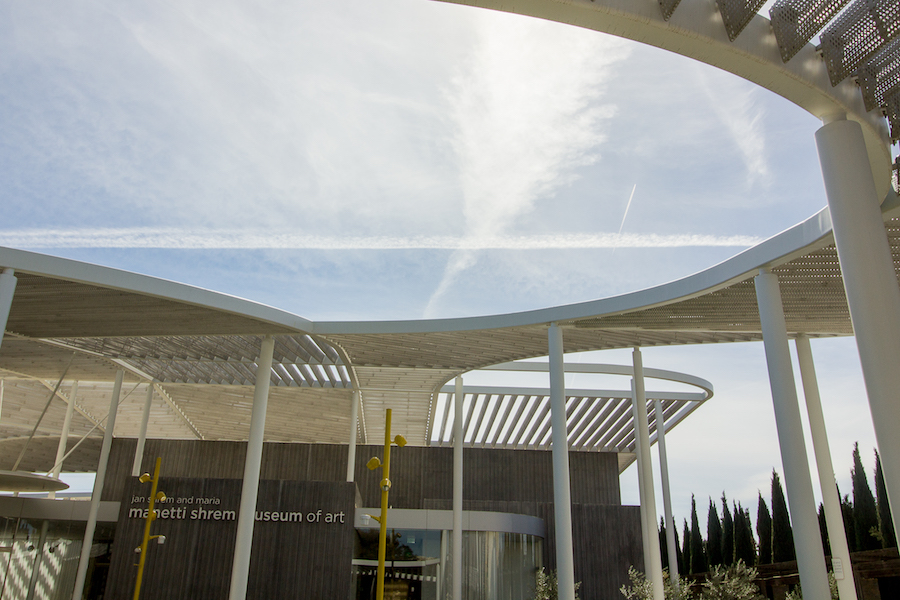
Manetti Shrem Museum Introduces New Exhibitions

BECCA RIDGE / AGGIE FILE

New exhibit explores legacy of Davis professor Wayne Thiebaud

The work of Wayne Thiebaud, a renowned painter and former UC Davis professor, lives on with the Manetti Shrem Museum’s latest exhibition, “Wayne Thiebaud: 1958-1968.” In addition, Tacita Dean’s “Day for Night” is being added to the Manetti Shrem collection. Conveniently located on campus, the Manetti Shrem often features several artists of special significance to the Davis art community.

Thiebaud is known for his unique and recognizable style. From colorful works of pies and ice cream cones to bright landscape pieces, Thiebaud utilized the decade of 1958 to 1968 to effectively revolutionize his own personal genre of painting. Currently, “Wayne Thiebaud: 1958-1968” focuses on Thiebaud’s formative period as a painter, described as a “period of newfound clarity” by Manetti Shrem deputy director Randy Roberts.

“Thiebaud is so well loved in our community,” said Manetti Shrem founding director Rachel Teagle. “This exhibition is the first to ever focus on his formative period. While his paintings are very recognizable, people don’t really understand where that signature style came from. How did it come to be? [The answer] is a huge part of this exhibition.”

After nearly three years of curating the exhibition, “Wayne Thiebaud: 1958-1968” has finally been brought to life in celebration of the professor’s distinguished accomplishments as a painter.

“Thiebaud is such a big part of the legacy of the Davis art department, so we’re really proud to have him be a part of that here,” said Audrianna Escobedo, a Manetti Shrem employee and second-year art history major.

In conjunction with Tacita Dean’s exhibition of “Day for Night,” a film inspired in many ways by the works of artist Giorgio Morandi, the two exhibitions complement one another in contrasting, innovative ways. Similarly to Dean’s homage to Morandi, Thiebaud also drew a large part of his painting inspiration from Morandi’s works. Beyond that, both Thiebaud and Dean are so fiercely dedicated to their chosen forms of artistic expression, as a painter and as a filmmaker, respectively.

“I think these paintings really help to understand that a work of art has a lot to offer if you just spend a little bit of time,” Teagle said. “If you spend more time to challenge yourself and really look at something, even for just 60 seconds, you’ll be rewarded with so much detail.”

Teagle also said she hopes that more students take advantage of the extensive and remarkable selection of artworks available at the Manetti Shrem.

“I think that having a modern art museum on our campus gives students an opportunity to broaden their horizons and learn about something less typical than what can be learned in a lecture hall,” said first-year psychology major Nicole Goldberg.

These exhibitions will be on display at the Manetti Shrem Museum of Art from Jan. 16 to May 13. Admission is free. For more information, visit the Manetti Shrem’s website.


Written by: Sydney Odman — arts@theaggie.org

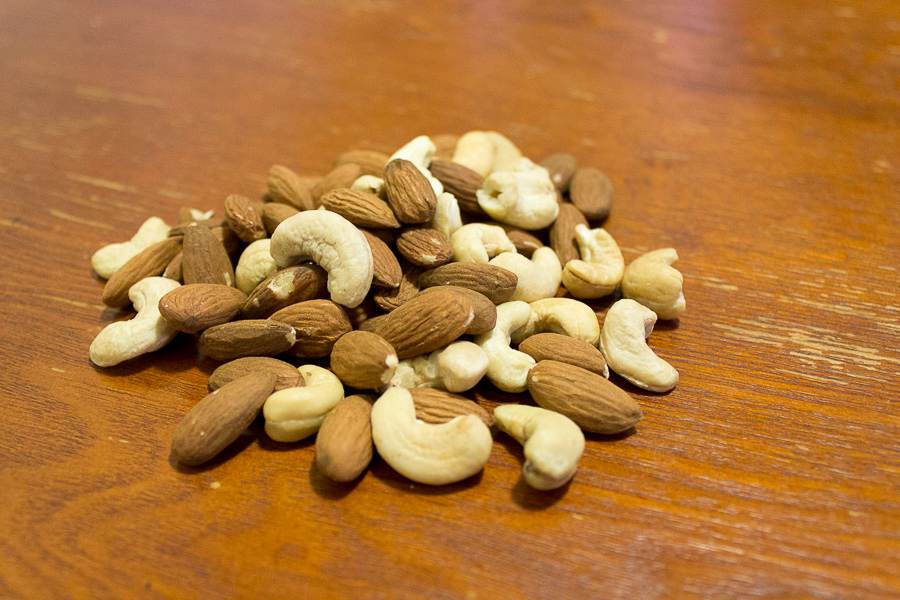
Humor: Trump to end nut neutrality as eugenics program rolls out

VENOOS MOSHAYEDI / AGGIE

Or does he mean crazy people?

After a public spectacle during which President Donald Trump and Vice President Mike Pence openly argued about their perceptions of Nut Neutrality, two things were made manifest: Both have wildly different understandings of Nut Neutrality, and both most certainly have Americans’ interests at heart.

“I thought this was about getting rid of nuts, like crazy people?” Pence said.

“No, this is the eugenics program you’d talked about prior to the election,” Trump replied.

“Trump, can you elaborate on the eugenics program?” Drew Hanson, avant-garde reporter of the truth, asked.

“The main problem with our [huge] government is that we often end up in a state of gridlock,” Trump said. “This can be fixed through our two-policy combo: One child is allowed per family, and the other gets to work the coal mines. And with eugenics, we will only allow for conservative children to be born.”

“As a side note, I heard that you were cutting health benefits for miners affected by black lung. Can you explain that?” asked Drew Hanson, decimator-of-alternative-facts.

“We don’t talk about black lung,” Trump said. “It’s a racist term. Roy Moore had sex with a minor. You know what he got from Santa? Coal. Which means jobs.”

“How do you plan on rolling out this eugenics program?” Drew Hanson asked, curious yet full of despair.

“Most liberal young men go to college, so we’re planning on killing their sex drive through monotonous coursework,” Trump said.

“I think I’ve been affected,” said Drew Hanson, a student with good grades and a dying libido.

“The program has been in place since the ‘90s — we’re just ramping it up,” Trump said.

“I believe our other Nut Neutrality program may conflict with this,” Pence said. “We plan to kill off all of the crazy people, but that would eliminate most of the consumer base.”

“You mean Twitter followers?” Trump replied.

“Trump,” Drew Hanson started, “I was told that we’d know about aliens once you became president since you can’t keep your mouth shut about anything. Any thoughts on that?”

“Let me ask you something, smartass,” Pence said. “Have you ever noticed that most adults seem to die right as they are at the end of their time in the workforce? Cancer, heart attack, stroke in their ‘40s — that’s what I call a Pence-sion Plan.”


Written by: Drew Hanson — andhanson@ucdavis.edu

(This article is humor and/or satire, and its content is purely fictional. The story and the names of “sources” are fictionalized.)

Police Logs

NICKI PADAR / AGGIE

‘Tis the season of taking

Dec. 24

“Smoke from above location is entering yard that reporting party is currently at, causing her discomfort.”

“Reporting party’s mother hit her and not letting her leave the house. Mother knows police department has been called.”


Dec. 25

“Approximately 5 subjects in front of a white SUV in the parking lot talking loudly and using sparklers.”

“Vehicle taken overnight from residence.”

“Barricades for construction in the area have been removed and drivers are going through restricted areas.”


Dec. 26

“Occurred on 12/17 reporting party wallet was taken from business and credit cards were charged. ID theft packet complete.”

“Ongoing problem with neighbor blowing chicken waste with industrial fans into reporting party’s yard.


Dec. 27

“Reporting party advised her son’s bike was stolen on Christmas night.”


Dec. 29

“Two hour parking sign fell down across sidewalk.”


Dec. 30

“Possible illegal campfire.”


Jan. 1

“Loud explosion sound in the area of the park. Possibly a transformer.”

Two new high-rise office buildings coming to Sacramento

KYLA ROUNDS / AGGIE

State begins largest Sacramento building project to replace old structures

The Department of General Services in Sacramento has announced the commencement of construction for two high-rise state office buildings downtown, on O Street and P Street. The state hopes that both buildings will provide continued success and prosperity for the city and improve working conditions for state employees.

The O Street Project will include the demolition of an existing building and the construction of an 11-story building that will house staff from the Health and Human Services Agency, which includes the Department of Developmental Services and the Department of State Hospitals. The P Street Project includes a building of approximately 20 stories that will house staff from several different state departments, including the California Natural Resources Agency and the Department of Water Resources.

“The state’s largest Sacramento area building project of the new millennium is in motion,” said the Department of General Services in a press release. “The replacement of aging state office buildings represent[s] an important step in the state becoming a full partner in the downtown renaissance currently taking place in Sacramento.”

The O Street Project has already been assigned a design team, Rudolph and Sletten, which is partnering with ZGF Architects. In order to effectively determine how to mitigate environmental impact, studies are taking place in order to assist in the construction process and make it as efficient as possible.

According to Mike Meredith, the program manager, the high-rise projects resulted from recognition that these buildings would improve the working conditions and overall state of the city of Sacramento.

“There was a master plan done that basically was trying to identify a systematic evaluation of a condition rating,” Meredith said. “Several buildings were evaluated and ranked. There was ultimately support by the legislature and the governor’s office to have a plan in place to deal with these work spaces to deal with these agencies and departments that occupy them going into the future.”

Meredith explained that the government employees would be moving into these new buildings from other decrepit buildings that are also in need of improvement in order to enable further construction and remodeling in the city.

Meredith also recognizes that the process of construction can often disrupt the neighborhood, but he explained that measures will be taken in these projects to minimize any problems.

“We’ll definitely be in constant communication with the neighbors,” Meredith said. “We want to have a lot of self-awareness that we are building in someone’s neighborhood. Neither project is going to have driven piles, so none of that constant banging and loud noise and vibration. We’ve come up with a different structural foundation system that mitigates that, so we think that’s a real plus. We’ll also be accessible to the neighbors if they have any questions. We expect to be well received in the area because we’re going to execute what we indicated we intended to do.”

The projects are aimed to benefit those involved, including the community as a whole. The city hopes to see an increase of jobs, since the project will create jobs for construction and design. Additionally, retail and food service will be included in the buildings and open to the public.

“I think it would help tremendously because the building that is being replaced is dated and is not contributing to the area at all,” said Rafat Alafranji, the former project manager. “The building also would add significant square footage to the immediate area, which would probably contribute to the local businesses in the area.”

The buildings are also slated to be among the most efficient structures in Sacramento, using the latest techniques to maximize energy and water efficiency.

“We’re maximizing the benefit of state-owned property, so I think that’s really positive,” Meredith said. “It contributes to all of the development that’s going on in downtown Sacramento and certainly creates a more energized urban area.”


Written By: Hadya Amin — city@theaggie.org


An eclectic variety of local shows

BRIAN LIBBY [CC BY 2.0] / CREATIVE COMMONS
From pop stars to circus stars, the options are endless

With the Golden1 Center being a 20-minute ride away and the Mondavi Center right at our doorsteps, these are some of the most accessible venues for UC Davis students. Winter is the time to bundle up, but here are a few concerts to entice homebodies to go out.


Golden1 Center:

Katy Perry — Witness: The Tour

Coming to Sacramento on Jan. 31 at 7 p.m., this concert will follow the release of her new album, “Witness.” Tickets range from $50 to $800 depending on seating.


Miranda Lambert — Livin’ like Hippies Tour

For all the country fans, this concert follows Lambert’s double-sided 24-song album with special guests Jon Pardi and and Lucie Silvas. It will take place on Feb. 8 at 7 p.m., and tickets are still on sale.


Jeff Dunham — Passively Aggressive

Anyone looking for some comedy in their life is in luck. On Feb. 28 at 7 p.m. America’s favorite ventriloquist is coming to Sacramento with his band of characters.


Lorde — Melodrama World Tour

Tickets are on sale now for this concert, which will take place on March 12 at 7 p.m. This concert will showcase her second album as well as fan favorites from her first album.


Mondavi Center:

The venue will host three circus performances over the course of Winter Quarter.

Circa II Ritorno

This company has found a way to combine cirque and modern dance that is exciting for all. Accompanied by a string quartet and two singers performing excerpts of Monteverdi’s “Il ritorno d’Ulisse in patria,” seven dancers all work together to make boundless movements and emotions. This show will be held on Jan. 26 at 8 p.m., and tickets are on sale now.  


Circa Carnival of Animals

This company includes seven acrobats, two singers, four musicians and delightful animations of animals from both land and sea. Based on Camille Saint-Saëns’ beloved musical suite, “Carnival of the Animals” will be an amazing show for all the animal lovers out there. You can catch this performance on Jan. 28 at 3:30 p.m., and tickets are still on sale.


Cirque Éloize Saloon

This cirque show is a little different from the others, as it is a combination of theater and circus. Set to live folk and fiddle music, this western cirque show is as entertaining as it sounds. Meant for the whole family, this show can be seen on Feb. 11 at 3:30 p.m., and tickets are on sale now.


Written by: CaraJoy Kleinrock — arts@theaggie.org

A Closer Look at the Silo’s New Eateries

ALEXA FONTANILLA / AGGIE

UC Davis’ attempts to bring diversified food options to south campus

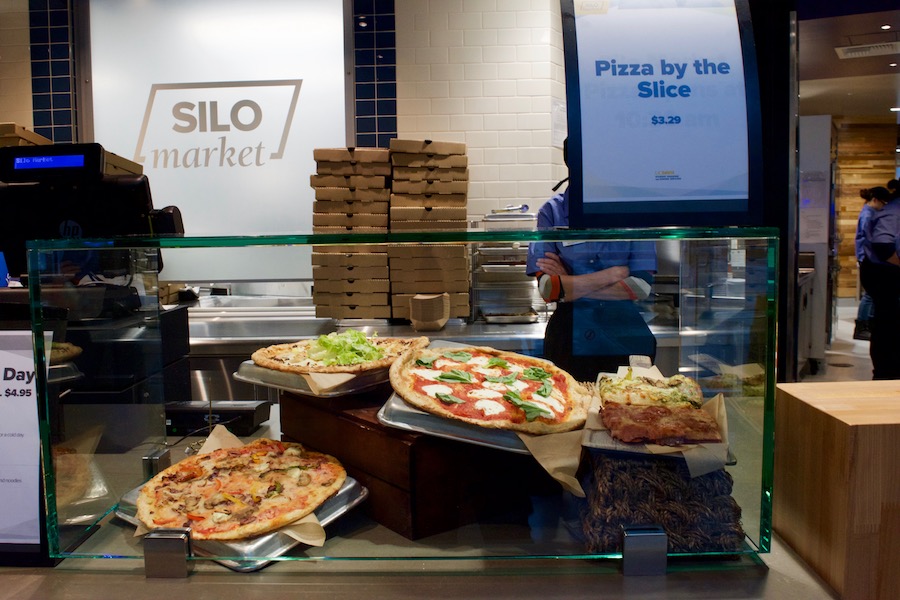
As students slowly acclimated themselves to the 2017-2018 school year during Fall Quarter, many discovered drastic changes since the last time they stepped foot on campus. Toward the end of last spring and into the beginning of summer, UC Davis launched multiple construction projects, one of which was the complete renovation of the Silo area and its accompanying restaurants. With the anticipation of these new restaurants resonating throughout the summer, eager students rejoiced when they finally got the chance to try out these new eateries as they opened their doors for fall 2017.

The newly renovated south campus dining joints include Spokes Grill, Crepe Bistro, The Gunrock and the Silo Market. UC Davis’ Student Housing and Dining Services carefully selected these restaurants in accordance with its ultimate goal of delivering a varied array of dining options to students.

“We launched a new program here at UC Davis and created all the concepts from scratch,” said Charles Irvin, the retail supervisor of Spokes Grill. “Spokes Grill was our quick-burger concept. With Spokes Grill, we try to get people in and out as fast as possible with simple but still quality food.”

Spokes Grill tries to cater to students’ increasingly hectic schedules by offering a wide range of quick, hassle-free food options that can be eaten on the go. Starting this quarter, the restaurant will launch a breakfast extension to its menu.

“Throughout the returning week into Winter Quarter, we’re going to be handing out coupons for $1 off our breakfast items,” Irvin said. “We have a fun breakfast menu that includes chicken and waffle sandwiches and other delicious ideas.”

All these efforts are made to ensure that students have stress-free dining experiences, especially taking into account the already mountainous pile of stress students handle on a daily basis.

“We understand that students have busy school schedules,” Irvin said. “We’re just trying to create a welcoming environment where students can come in, relax and enjoy their study time. Our primary goal is to make the Silo area feel more student-friendly and student-personalized.”

In addition to the opening of the brand new Spokes Grill, UC Davis also revamped one of its most well-loved restaurants, The Gunrock. Formerly known as The Gunrock Pub, The Gunrock has undergone several major changes, including its interior design and overall ambience, menu variety and hours of operation.

“We had our wood floors refurbished, we got new carpeting, new tables, new lighting,” said Keith Luke, the manager of UC Davis Retail Dining. “We are working on new artwork — our design team is working on new interior design concepts to make [the restaurant] a little bit more new-aged and modern.”

Alongside changes to its interior design and decor, The Gunrock has altered its menu to focus on more local and seasonal flavors.

“Our menu has definitely changed,” Luke said. “We’re very focused on using our student farms here on campus and utilizing as much fresh produce from those student farms as possible. We’ve definitely focused in on the sustainability aspect as a whole, kind of moving in the direction that the entire campus is moving in. Rather than having the fast food chains that aren’t necessarily offering the healthiest food options, we wanted to focus on health-oriented, better-quality food.”

Having The Gunrock be a student-staffed, student-friendly eatery is imperative to Luke and his team, which is why they made it a priority to create a no-stress environment when they renovated The Gunrock.

“In the past, there has been a lot of staff and faculty, which is fine because we love our faculty members,” Luke said. “But a lot of students didn’t know we were here, and if they did know that we were here, they didn’t really feel welcome. We changed our service style to be a lot more casual. We want to get more students coming in.”

In past years, Gunrock Pub has received critique, from both staff and students, for its brief hours of operation, 11 a.m. to 3 p.m. from Monday to Thursday, and then 11 a.m. to 2 p.m. on Friday. Taking this concern into consideration, The Gunrock management team extended the restaurant’s hours to accommodate to its customers’ requests.

“From 11 to 2 we are going to be [providing] full service, where servers will come to your table, take your order, and provide the full dining experience,” Luke said. “From 2 to 5, we’re going to be changing our dynamics [to create] more of a casual feel. We want [The Gunrock] to be a place where people can hang out and enjoy the afternoon, kind of creating a happy-hour feel.”

The Silo’s close proximity to Bainer and Kemper halls makes it a prime dining location for students who have class in either halls, especially engineering students. Max Herrenbruck, a fifth-year mechanical engineering major, spends much of his time on campus in or around Bainer Hall and appreciates the convenience of the Silo restaurants.

“I probably go to the Silo around two to three times a week for food,” Herrenbruck said. “I go [to the Silo] so often because of the convenience, and also because it’s got variety. If I want to grab something [to eat] around lunchtime, I have something.”

Herrenbruck especially finds himself gravitating toward Spokes Grill

“Especially for Spokes Grill, I would say that the cost-for-quality ratio is great,” Herrenbruck said.


Written by: Emily Nguyen — features@theaggie.org

Senator term review: Rahi Suryawanshi

NICOLE WASHINGTON / AGGIE FILE

Reflecting on her time in office, Senator Suryawanshi discusses original platforms, successes, struggles

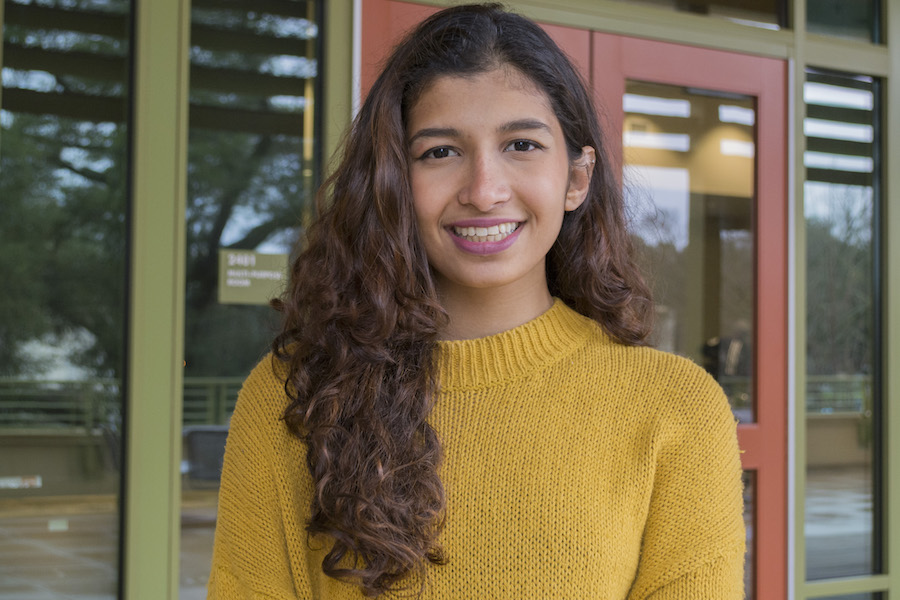
Senator Rahi Suryawanshi, a fourth-year international relations major, was elected as the fourth vote-getter during the 2017 ASUCD Winter Elections. Suryawanshi received an endorsement from The California Aggie for her experience with ASUCD as well as for her tangible platform.

As part of her platforms, Suryawanshi aimed to develop allyship workshops in first-year dorms and host free self-defense classes on campus. Suryawanshi also hoped to establish a scholarship for other international students, like herself.

During her time in office, as Suryawanshi learned more about her reach and tangible capabilities as a senator and her original platform has adapted — something she said she is proud of.

“What I came in with, my ideas, have really evolved,” Suryawanshi said.

Suryawanshi shifted her focus toward tackling larger institutional issues working against students during her time as senator.

“When you’re running for Senate, the easiest thing to do is look at campus and ask, ‘How can I make it better?,’” Suryawanshi said. “But when you work a little longer, you realize if you add microwaves or something like that, how many people will it really impact? And you start thinking, ‘What can I really do that will truly impact even ten people?’”

With regard to her original platforms, Suryawanshi said she encountered many setbacks.

“[Allyship workshops are] something that has been installed in orientation now, which is good, but I think I obviously wanted to go beyond that,” Suryawanshi said.

Suryawanshi worked with Brandon Pettit, the director of the Office of Student Development, but the two could not feasibly figure out a way to make the workshops mandated events.

Similarly, Suryawanshi encountered issues working to implement her free self-defense workshops at the Experimental College. Issues of liability prohibited the Experimental College from offering classes without paid instructors. In the future, Suryawanshi mentioned that if funds were allocated to pay instructors, but keep classes free for students, the classes could still become a reality.

“I started working on other stuff, but I made sure I was working,” Suryawanshi said. “It’s very easy to get discouraged and not work on things.”

Suryawanshi said she hoped to foster a more transparent relationship between students and administration.

When asked what she felt her biggest accomplishment has been during her time as a senator, Suryawanshi immediately spoke about her long-term goal to add 115 blue emergency lights to UC Davis’ campus.

Currently, UC Davis, despite being the largest UC campus, has the fewest number of blue emergency lights — currently, the number of lights on campus is eight.

Beyond this, true to UC Davis’ commitment to environmental sustainability, Suryawanshi has created a tangible plan to ensure the blue emergency lights added to campus are sustainable. Working with Vice President Adilla Jamaludin and the Davis Police chief, Suryawanshi has given the administration a clear plan of action to add blue emergency lights to campus by the end of the 2017-2018 school year.

Furthermore, through her capacity as senator, Suryawanshi held an event last year titled “Decolonizing the Arts.” Suryawanshi, who is Indian, spoke about how hurtful it is to see people do Henna tattoos or other culturally symbolic art forms and who fail to recognize the significance of these art forms to Indian culture.

This year, Suryawanshi is working alongside the student directors of the Whole Earth Festival.

“We are really working on making Whole Earth Festival more inclusive this year,” Suryawanshi said. “If we do that, we will make that space open for so many more people.”

Additionally, Suryawanshi was one of 24 co-authors of Senate Resolution #2, which was presented and passed at the Senate meeting on Nov. 30. The resolution addressed the “It’s Okay to be White” posters left around campus, labeling the act a hate crime. SR #2 also works to establish consequences for instances of hate crimes at UC Davis in the future. The involvement from members of the student body outside of ASUCD in the creation of SR #2 made the resolution distinct.

“I think it was beautiful, because we really tried to get more community support and I think this is how we should write every resolution,” Suryawanshi said. “We, ASUCD, represent students, but we do not represent their thoughts, their voices and their styles. We don’t, we can’t, we don’t have that capacity. And so I think one thing we should always do when we’re writing resolutions is truly to go up to the SCC centers and actually make an effort to have community workshops like we did.”

Suryawanshi also worked with the StartupHub to hold a startup panel for students last quarter. This upcoming Spring Quarter, Suryawanshi said she is looking forward to holding a second Startup Summit aimed specifically at giving marginalized communities a platform for their ideas.

“The Startup culture I think is really important,” Suryawanshi said. “We need to benefit marginalized communities as best as we can. Last year, we didn’t market it solely to marginalized communities, but they will this year.”

Looking back on the year, Suryawanshi reflected on the highs and lows during her time in office.

“I had so much on my plate,” Suryawanshi said. “My hands were overflowing.”

At the beginning of her term, Suryawanshi was juggling her roles as the Artistic Director of a Japanese drumming group, Bakuhatsu Taiko Dan, organizing the first Startup panel in addition to accepting a fellowship to present her social entrepreneurship at the Youth United Nations in Europe.

Despite Suryawanshi’s critical view of her own performance as a senator, her ASUCD peers hold her in high regard.

ASUCD Vice President Adilla Jamaludin worked closely with Suryawanshi on many of her platforms, including plans to add blue lights to campus.

“[Suryawanshi] has yet to deliver on some of her original platforms due to institutional changes,” Jamaludin said. “Something to keep in mind: [Suryawanshi] has been instrumental in initiatives outside of her platforms. Much of this work involves building coalitions, a skill that many senators have yet to nurture. I definitely think she is one of the most competent and hard-working senators of her cohort.”

ASUCD President Josh Dalavai also spoke very highly of Suryawanshi.

“Senator Suryawanshi was a warm, inviting presence to all visitors of the Senate and was extremely efficient in her pursuit of her student advocacy and outreach,” Dalavai said.

Dalavai also commented on Senator Suryawanshi’s ability to reach communities on campus otherwise left out of ASUCD.

“She has been a valuable member of ASUCD in regards [to] international student outreach,” Dalavai said.

With her time in the Senate coming to an end this quarter, Suryawanshi plans to continue many of her projects she began with in her capacity as a senator. When asked what she would like to be remembered for accomplishing, Suryawanshi pushed back.

“This whole perspective that we should do things to be remembered, that’s not the point,” Suryawanshi said. “It doesn’t matter what people remember you for. Your work matters. Your passion matters.”


Written by: Ally Russell — campus@theaggie.org

Former President of Poland gives speech at UC Davis

JESSE STESHENKO / AGGIE

Honorable Bronisław Komorowski’s lecture focused on impact of Brexit on EU

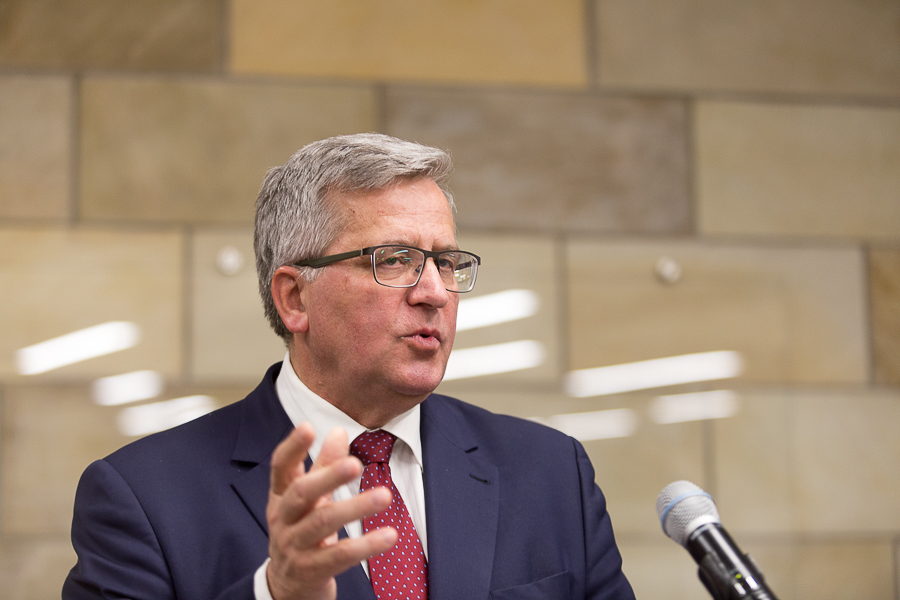
The Honorable Bronisław Komorowski, the former President of the Republic of Poland, spoke on the impact of the United Kingdom’s exit from the European Union and the wider impact on unity within the European Union. The speech took place at the International Center on Dec. 7.

Komorowski spoke through a translator about the issues of integration facing the EU in the Brexit era. Komorowski began by giving a perspective of Poland’s history under the former Soviet Union as well as background on Poland’s transition into democracy and entry into the EU.

“The East Central European perspective also inevitably grows out or inevitably consists in an acute awareness and acute sensitivity to Russia’s attempt to rebuild its sphere of influence and hinder the attempts of other countries to look toward the West to develop themselves according to Western world values,” Komorowski said via translator. “We have to recall that, according to Russian geopolitical thoughts, the integration of the West and the strengthening of ties with the West is seen as a threat.”

He said that the now-obsolete League of Nations managed international relations through cooperation and agreement rather than by force and domination.

“Today we are faced with threats that are quite similar to that of the disappearance of [the] League of Nations albeit addressed in different political garbs, the main international institutions that are under threat today are specifically the European Union and the North Atlantic Treaty Organization,” Komorowski said. “Today, in order to defend itself against similar threats [in] the future, the European Union’s goal is to strengthen its interior ties and its processes of integration.”

Komorowski then moved onto discussing the consequences of Brexit.

“Brexit, despite based on misinformation, disinformation, demagoguery and a profound lack of responsibility [of all of] England’s politicians, has come about and will lead to an overall weakening of the European Union’s collective power,” Komorowski said. “On the other hand, somewhat paradoxically, Brexit can also allow the remainder of the European Union to strengthen its ties even more so especially at levels of defense, military and regional security.”

According to Komorowski, Poland’s “society is remarkably pro-European,” with “over 80 percent of Poles satisfied with European Union integration.”

In a subtle reference to the United States, Komorowski said “we know that in a world of giants, you also have to act like a giant and not like a Lilliputian.” He also discussed how the U.S. was handling Brexit.

“One thing remains clear, and this is worth stressing: […] the weakening appeal of the common European project in the eyes of Europeans is directly linked to a weakening of the West [and what they call] the Western project,” Komorowski said. “But also, as noticed, the cause of Western unity is by no means served by the current politics coming out of Washington, D.C., particularly the politics vis-a-vis the American politics with regards to the European Union.”

Komorowski mentioned that Brexit is, in part, due to the immigration crisis of refugees entering Europe.

“The problem of European identity made itself especially clear in the fallout of the European migration crisis [which began in 2017],” Komorowski said. “We saw then the collision of two very divergent perspectives on the future of European culture. Without a doubt, for some people ways of migration were seen as a chance to deepen the project of multiculturalism and the integration of cultures. On the other hand, the other part of this collision of political ideologies involve people who saw in the immigration crisis threats to their national identity.”

In conclusion, Komorowski critiqued the American influence on Brexit.

“We can see very strong weaknesses in the American government for supporting tendencies, political tendencies, in Europe aimed at Europe’s disintegration,” Komorowski said. “Two examples I think will suffice. The first is the strong and frequent support given to Brexit and the attempt to withdraw the United Kingdom from the European Union and thereby inevitably to weaken it. The second was the complete abandonment of the challenging and difficult but perhaps decisive […] Transatlantic Trade and Investment Partnership. We are concerned by the fact that the current American administration seems to be more concerned with personal profits and good deals than with large scale visions of global strategy.”

When asked what brought him to UC Davis, Komorowski, speaking through a translator, talked about his trip to California.

“I am here in my capacity as former president as part of a larger research trip in California,” Komorowski said. “It blends research and pleasure. As part of this trip, I have organized […] several meetings and day trips to various universities in the area, and one of them [is] UC Davis. Apart from that, it is very nice to be in California in December because you guys have nicer winters than we have summers.”

Vice Provost and Associate Chancellor of Global Affairs Joanna Regulska, who is of Polish heritage, spoke about her connection with President Komorowski.

“My father used to work for him, so I know him from the past,” Regulska said. “I met him many times when he visited [the] United States when he was president, but I also participated in conferences [with him].”

Regulska spoke about how Komorowski’s lecture will benefit the UC Davis community at large as well as impact international students in Europe.

“International students and visitors from the European countries who live [and] work there [do] not know what is going to happen,” Regulska said. “Can they stay? Or, if they have to leave, if they will have work permits.”

Davis Mayor Robb Davis introduced Komorowski before his speech. The California Aggie spoke with Davis over the phone about his reaction to the speech.

“I don’t get the opportunity to attend a lot of speeches like that […] from a really respected statesperson who really was given charge of navigating an entire nation,” Davis said. “It was refreshing in the sense [of] taking [in] the big picture of what we see happening in Poland. It is really fascinating to have a man [here] in our community who lived through […] the effects of the Cold War [and the] Soviet domination of Eastern Europe and to have his perspective on the value of European integration and the value of states like Poland and other Eastern European countries.”


Written by: George Liao — campus@theaggie.org


UC Davis microbiologists analyze microbes on International Space Station

ALLYSON KO / AGGIE

Microbiologists analyzed swabs taken by astronauts, found similar microbes to houses on Earth

Microbiologists from Project MERCCURI, a collaboration between SciStarter, Science Cheerleader and UC Davis, among other groups, sent swabs up to the International Space Station for astronauts to collect samples. The goal to increase public awareness of microbiology and research on the ISS was shared by the NASA scientists that Project MERCCURI teamed up with.

In general, Project MERCCURI consisted of several parts,” said Dr. Wendy Brown, one of the scientists who conceptualized and designed the study. “We solicited the help of Citizen Scientists to help collect microbe samples from all over the United States. 48 of those microbes were selected, flown to the ISS, and grown in microgravity. Those same 48 microbes were also grown on Earth in Dr. Eisen’s lab.”

The DNA from the samples gave the scientists an idea of the bacterial community present on the ISS. While the scientists found that the ISS has a similar community of microbes to homes and people, there were some species that varied between the habitats.

We were perhaps a bit surprised that there were so many species on the ISS […] we expected to maybe see fewer types of bacteria since the environment is so enclosed,” said David Coil, a project scientist. “We were not surprised that it looks like homes because in both cases, people are probably the primary source of bacteria in the space.”

Coordinating with the ISS proved to be a challenge, especially considering that the scientists weren’t able to meet the scientists they collaborated with at NASA.

“Crew time is very precious, “ said Dr. Russell Neches of Jonathan Eisen’s laboratory. “Seemingly simple operations, like opening and closing a ziplock bag, must be carefully scheduled. If you watch videos of people on ISS doing things like making lunch, you’ll see that it’s a very slow, tricky process. If you move too quickly, or bump into something, or set something down for a moment, you can send everything zooming and bouncing around the room. It’s very inconvenient! We take it for granted that things stay where we leave them. Many everyday activities, like making lunch, or writing a note on a label, or opening a ziplock bag actually involve myriad steps that all depend on small objects staying pinned to a work surface by gravity.”

Despite the difficulties, the beneficial results from Project MERCURRI reinforced NASA’s understanding of the sources of microorganisms aboard the ISS and the data is currently being evaluated.

“The data from the Project MERCCURI experiment in combination with other NASA research and operational data are being evaluated to determine what other experimental questions should be answered on ISS to help prepare for future spaceflight missions to the moon and Mars,” said Dr. Mark Ott, the lead microbiologist at the Human Health and Performance Directorate at NASA Johnson Space Center. “This knowledge will be used to develop better spacecraft designs and understand the proper microbial control precautions to take for these future missions.”

The data collected from Project MERCCURI creates an understanding of how our environment on Earth correlates with that of space.

“The results from Project MERCCURI experiment represent the type of excellent scientific experimentation and reporting that advance our understanding of spacecraft in a way that benefits both spaceflight programs and our understanding of our environment on Earth,” Ott said.


Written by: Kriti Varghese — science@theaggie.org

Bay Area bowl game full of local faces

0

CHRIS MARTIN [CC BY 2.0] / FLICKR
Foster Farms Bowl homecoming for players, coaches alike

The 16th annual Foster Farms Bowl took place on the evening of Dec. 27 at Levi’s Stadium in Santa Clara, as Purdue captured its first bowl victory since 2011 with a 38-35 comeback win over the University of Arizona in a thrilling finish. After being shut out for the entirety of the second half, the Boilermakers scored the game-winning touchdown with 1:44 left in regulation on a 38-yard reception by senior wide receiver Anthony Mahoungou.

Trailing 31-14 at halftime, Arizona clamped down on defense in the second half and tallied a pair of touchdowns midway through the third quarter to get within striking distance. The two sides traded punts back and forth until late in the fourth quarter. Arizona grabbed a late lead when sophomore quarterback Khalil Tate connected on a 24-yard touchdown throw to junior wide receiver Shun Brown with under three and a half minutes remaining in the game.

Purdue raced 75 yards down the field in just over 90 seconds to take the lead on Mahoungou’s touchdown catch, capping an eight-play, game-clinching drive.

Wednesday night’s victory marked the culmination of an incredible turnaround for the Purdue football program, led by first-year head coach Jeff Brohm, a former San Francisco 49ers quarterback in the mid-1990’s.

“That’s a memory you’ll cherish for the rest of your life and they definitely earned it because they’ve put in the hard work and gone through the adversity,” Brohm said. “It’s a proud moment to be the coach of this football team and I couldn’t be happier.”

Brohm stepped in and led the Boilermakers to a 7-6 overall record, their largest win total since 2011, ending a stretch of four consecutive seasons of three wins or less. The season-ending win was significant for Purdue because it clinched a winning record for the season and now allows the players to go into the offseason on a high note.

“It’s huge,” said Purdue sophomore quarterback Elijah Sindelar. “It sets the tone for next year. Guys are in good spirits. They’ll be excited to go into spring ball instead of kind of moping around because we lost. We won, we got a winning record, we really flipped it around from last year, and I couldn’t be more excited.”

Tate garnered much of the attention leading into this game due to his breakout regular season. The young phenom took the nation by storm this fall with an incredible run of performances from the month of October through the end of the schedule. Tate became the first quarterback in Pac-12 history to rush for over 1,000 yards and will be remembered for his unreal showing against Colorado in October when he ran for 327 yards, a FBS record for a quarterback in a single game.

Arizona was able to limit Tate to a mere 58 yards on the ground, forcing him to hang in the pocket and make plays downfield with his arm. He threw for a career-high five touchdowns, but ultimately fired an interception on the team’s final possession to seal the victory for the Boilermakers.

Throughout the years, the Arizona football program has largely been comprised of players from the state of California, the university’s most heavily recruited region, and this season was no different. A grand total of 45 players on this year’s roster call California home, and the incoming recruiting class for 2018 has 10 new California natives. It’s fitting that the team would be selected to play in the Foster Farms Bowl, one of only three bowls in the state and the only one in Northern California.

There was a trio of players with ties to Northern California that all made an impact on the offensive side of the ball for the Wildcats, not only in this game but throughout the entire season.

Redshirt junior wide receiver Tony Ellison is a Granite Bay native, just a little under 40 miles from Davis. Ellison has endured quite the tumultuous journey to get to where his today. After tearing his ACL a mere four games into his senior season of high school, his prospects of playing at the next level took a sudden turn. Despite the injury, Arizona kept his scholarship offer on the table, giving the young receiver a chance to rehab and still play at a Division I program the following year. After a couple of up-and-down seasons, Ellison enjoyed a breakout campaign this year, showing off big-play ability from the slot and averaging 15 yards per reception, which ranks him fifth among Pac-12 players.

“I’m so happy for him because he works so hard, and he’s been injured so many times,” said teammate Jacob Alsadek, a redshirt senior right guard and team captain. “He’s pushed through it and done really well.”

Ellison played the best game of his college career on Wednesday night, hauling in four receptions and two touchdowns for a total of 102 yards. Despite the tough loss, he has a lot to look forward to in the upcoming season at Arizona, as the majority of the young offense will be returning for at least another season or two.

Redshirt sophomore Cody Creason, from nearby Folsom, split time at right tackle this season for the Wildcats. He has appeared in every single game the past two seasons, racking up four starts last season and three this year.

“He’s done very well for himself,” Alsadek said. “He plays hard and he’s so athletic. Hopefully he can have a good spring and continue doing well next year.”

In addition, redshirt sophomore Alex Kosinski saw action in six games this season, mainly at the right guard position. The Marin County native has shown versatility for the Wildcats, capable of playing multiple positions along the offensive line.

Both lineman were instrumental in paving the way for the top scoring team in the conference, which averaged over 41 points per game. Arizona’s offensive line, a dominant and experienced unit, also allowed the fewest number of sacks in the Pac-12.

Levi’s Stadium will be at the center of the college football universe exactly 12 months from now, when the Santa Clara venue hosts the 2019 College Football Playoff National Championship. Over the last few years, the Bay Area has continued to become more and more of a destination for high-profile college football games. The Foster Farms Bowl, previously held at San Francisco’s AT&T Park until 2013, has been the region’s lone bowl game since its inception in 2002. Starting in 2014, Levi’s Stadium has been the host of the annual Pac-12 Football Championship Game every December. Overall, hosting the sport’s most anticipated game of the year next January will only further contribute to the emergence of the Bay Area as one of the premier college football markets in the nation.


Written by: Brendan Ogburn — sports@theaggie.org

Aggie basketball enters conference with a bang

0
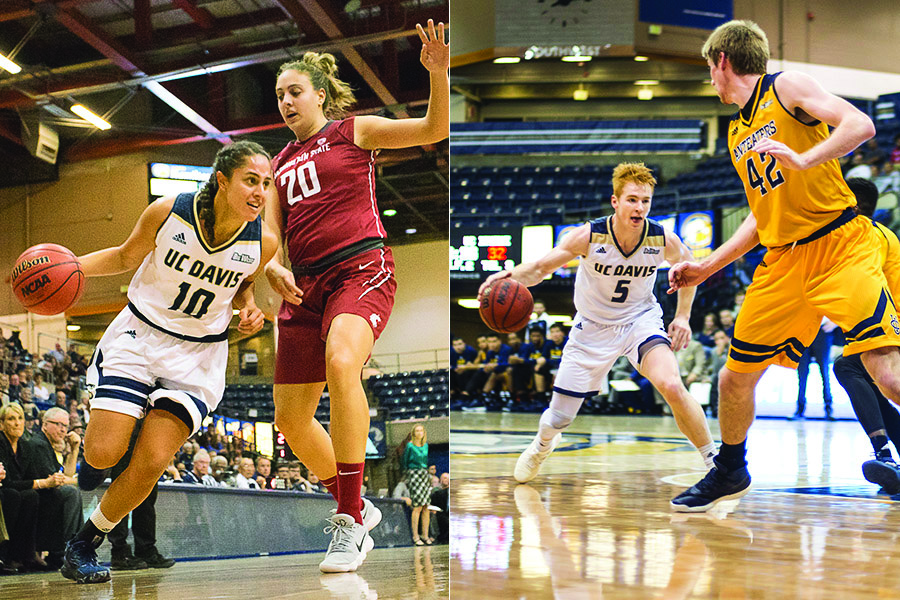
NICHOLAS CHAN / AGGIE FILE (left), DIANA LI / AGGIE FILE (right)

UC Davis men’s (10-5) and women’s (12-3) basketball teams begin season strong in Big West Conference play

It has been a strong start to the season for both the UC Davis men’s and women’s basketball teams, continuing to improve and flourish due to the hardworking coaching staffs and players on the court.

The men’s basketball team is performing well out of the gate this season, currently holding a 10-5 overall record and a 1-0 conference record after defeating UC Irvine at the Pavillion on Jan. 4 for its first game of Big West Conference play. Currently, the men’s team holds a 16-game winning streak at home, five of those home wins coming from its current 2017-18 season.

However, before the season even began, there was one player in particular on most people’s radar: senior forward Chima Moneke. Collegeinsider.com added Moneke to its Lou Henson preseason watch list, the second Aggie ever to earn this recognition. Moneke has not disappointed the Aggies this season, earning his league-high nine double-doubles on the year. He has also been named the Big West Player of the Week for the weeks of Nov. 20 and Dec. 4, 2017, while also being named the Lou Henson Player of the Week for the week of Dec. 4.

The UC Davis men’s team defeated the Washington State University Cougars on Dec. 2, the first time in 12 years that the Aggies have defeated a Pac-12 team. During this season, the team posted a program-high RPI by the NCAA when ranked number 20 on Dec. 3. The Rating Percentage Index is used to rank teams based on their wins, losses and strength of schedule. Currently, the Aggies are ranked 63 in RPI rankings. Also announced for the week of Dec. 5, the Aggies earned their way to be the 25th-ranked team in the nation by College Insider on its Mid-Major Top 25 Poll.

It is no secret that the men’s basketball team is here to compete this season and will continue to look to improve and capture another Big West Championship. The Aggies continue their conference play tonight at 7 p.m., as they play an away game against UC Riverside. The game can be viewed on ESPN 3 live.

The UC Davis men’s team isn’t the only Aggie basketball team that has shown up to compete this season, as the UC Davis women’s basketball team came out of the gate firing on all cylinders, winning its first 10 games of the 2017-18 season, the second season in a row the team has had a 10-game winning streak. This was the best start to the season that the Aggies have had since moving to Division I. They currently hold an overall record of 12-3 and a conference record of 2-0 after defeating UC Irvine away and Hawai’i at home on Jan. 4 and Jan. 6, respectively.

As far as impressive player performances for the women’s team this season, senior forward Pele Gianotti was the first Aggie this season to record a double-double with 18 points and 10 rebounds on Nov. 20 against Pacific University. Junior forward Morgan Bertsch and senior guard Rachel Nagel earned Big West Conference Player of the Week honors for the weeks of Nov. 13 and Nov. 27, respectively, due to their outstanding performances on the season. This was Bertsch’s second career Player of the Week honors and Nagel’s first. Bertsch currently has nine different games this season where she has scored at least 20 points.

On Nov. 10, the women’s team played Washington State and sunk 17 three-pointers, tying the school record in a single season game. They are currently ranked as the number 12 women’s team in the nation on the College Insider Women’s Mid-Major 25 Poll and ranked number 51 on the NCAA RPI women’s rankings, earning a ranking as high as number five on the week of Dec. 12.

The UC Davis women’s team continues its Big West Conference play tonight as well at home in the Pavillion against UC Riverside at 7 p.m. The Aggies will surely look to continue to dominate the season and earn a Big West Conference Championship.


Written by: Ryan Bugsch — sports@theaggie.org