57 F
Davis

Davis, California

Monday, December 22, 2025
Home Blog Page 571

Societal norms teach men to ignore emotions rather than seek help

ALEXA FONTANILLA / AGGIE

Men remain silent on their mental health due to lack of resources

Mental illness can affect anyone regardless of age, race, socioeconomic status or background. It doesn’t strongly target one group over another, making every case equally important. However, it’s easy to recognize that there are groups that don’t get the same amount of attention as others. Specifically, I’m talking about the lack of awareness for men’s mental health. Men are acknowledged for their mental health issues in statistics, but there are hardly any such stories shared from men’s perspectives. Due to society’s constructed gender roles and stigma on mental health, men are less likely to open up about their illnesses and seek help to better themselves.

Men suffer from mental health issues at a rate similar to women, but they often refrain from seeking professional help. Max Birchwood, a professor of youth mental health at the University of Warwick, states that the biggest barrier stopping men from speaking up is that they don’t feel comfortable discussing their emotions with anyone. Gender roles set men and women up with societal norms to follow, and when it comes to acknowledging feelings and emotions, men aren’t “supposed” to reveal themselves. They are taught to remain tough, independent and have control of their emotions, but when mental illness strikes it’s harmful to force oneself to maintain this composure. Boys are told to “be a man” and “suck it up” as they mature, which damages their mental health. These sayings deter them from sharing their thoughts because they recognize it as unacceptable behavior for men.

Due to the lack of personal testimonies from men online, I turned to a few of my male friends, asking for their thoughts on the issue of gender roles influencing the lack of attention on male mental health.

“A large part of the societal norms I’ve experienced growing up as a male is accepting the fact that, when things get hard, you have to suck it up,” said Erich Baur, a fifth-year mechanical engineering major. “Crying, venting and other emotional outletting is seen as weak and feminine.”

Such statements support the idea that masculine conditioning contributes to men not acknowledging their emotions — let alone their mental illnesses.

If men are just as likely to be affected by mental illness as women, then why aren’t there resources for them as well? Although evidence suggests that males are less likely to utilize mental health services than women, it’s still important that they have the option. Of course, there is the standard resource of professional therapy, but there aren’t organizations dedicated to helping men. If you search women’s mental health, several links provide access to resources. But when you search the same for men, most of the information that comes up is statistics for mental illness and suicide in the male population.

Creating more places for men to turn to for guidance could make a huge impact for them. Men are careful about whom they choose to open up to, but sometimes that’s still not enough to make them feel accepted.

“I was sent to therapy, which helped ease the tension in my life, but I received no such help from my family or friends,” Baur said.

“Coming to terms with my mental health issues, there were a lot of people in my life [who] sort of just dismissed what I said,” added Anthony Aviles, a third-year undeclared student.

This concern demands more attention. Fortunately, the National Institute of Mental Health developed a project to do just that. They launched the Real Men, Real Depression campaign to educate society with stories from men about their experiences with depression. The campaign ran from 2003 to 2005 and became one of the nation’s first organized public efforts to build awareness on the dangerously silent issue.

No one is immune to mental illness, so why does society fail to recognize that men go through it, too?


Written by: Jolena Pacheco — mspacheco@ucdavis.edu

Disclaimer: The views and opinions expressed by individual columnists belong to the columnists alone and do not necessarily indicate the views and opinions held by The California Aggie.
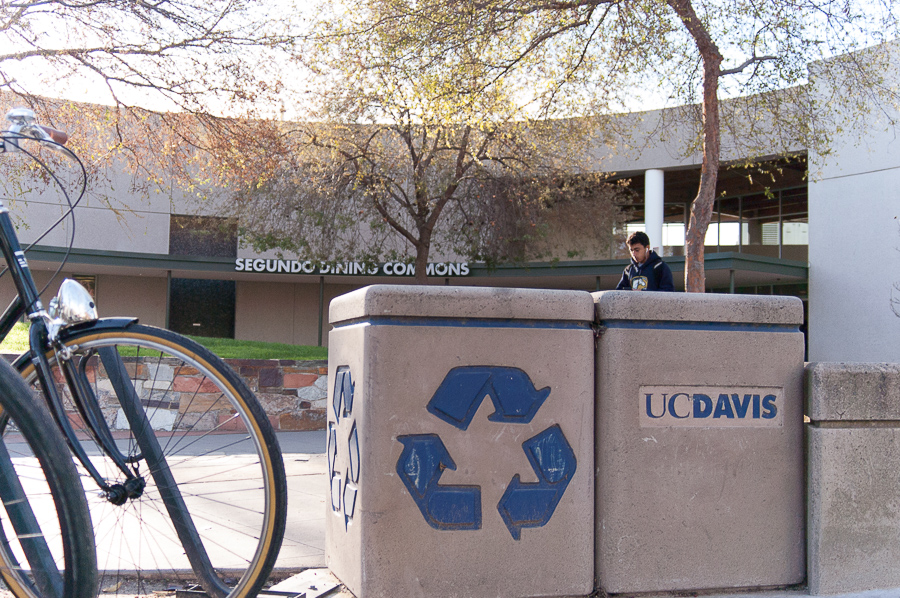
Humor: Allegations arise that Dining Commons puts food in its garbage

ZACK ZOLMER / AGGIE

Rats found in trash cans reveal that students have been wasting good meat

Allegations have arisen that the Dining Commons puts food in its garbage.

“I went in expecting the usual,” first-year Christian Romero said. “But instead of used hypodermic needles and baby diapers, Tomato Street Grill was serving mostly real meat.”

“We found some rats in the trash cans,” said the Head of the Tercero DC, who is literally just a floating head. “If students don’t plan on eating the rats, then they shouldn’t take them in the first place.”

A recent environmental leak from the Tercero DC killed all of the Tercero cows, which led to steak for dinner every single night. The downside was that many students reported radioactive diarrhea, which was drastically different from the usual toxic diarrhea.

“We plan to destroy Cuarto,” the Head said. “Their meals are actually pretty good and pose a threat to our customer base.”

“We’re always following behind Tercero,” said the legs with a face for a butt that runs the Segundo DC. “Which is a problem since they’re like way behind Cuarto. You’d think we would be in second place because of our name, but we’re like fifth place since some students prefer raiding dumpsters for scraps over coming here.”

“We were really going for the Ikea vibe with Tercero,” said hero-of-the-people Linda Katehi. “Segundo was basically just to meet a quota. Cuarto was supposed to be a homeless shelter, but it turns out that the people that feed the homeless actually really care about food quality. Cuarto is an elitist hipster place like Whole Foods, which is why it needs to be destroyed.”

“I worked as a prison chef, and they kicked me out for making terrible quality food,” Chad Tucker said. “They called my prison food ‘death row’ because I successfully killed more people than the lethal injections. The DC is alright, but I miss having better ingredients to work with.”

“I believe that the quality of my life diminished ever since I started eating at the DC,” said a horribly mutated student whose name we could not understand through their guttural groans. “Something has gone horribly wrong with my life. I think I’m dying. They wok’d all over me.”

“Most of this article is filler,” said writer Drew Hanson. “Just like the food at the DC. The difference is that my writing won’t give you the shits.”

“We like to be environmentally friendly here at Davis,” the campus overseer said. “The water is poison. The walls are made of asbestos. The roads look like they just suffered an earthquake, especially near Wellman. We like to rebuild things that don’t need to be rebuilt and let important things like the arts facilities rot and decay. Ever noticed we only rebuild things that will allow us to rake in more money? The MU. The Silo. Our reputation as a respectable administration. We’re very progressive.”

“I think the dining commons are great,” said second-year political science major Richard Hicks. “If you feed people trash, they will just keep eating it up. Just look at my hero, Trump. That’s what he does.”


Written by: Drew Hanson — andhanson@ucdavis.edu

(This article is humor and/or satire, and its content is purely fictional. The story and the names of “sources” are fictionalized.)

UC Davis Coffee Center developing research, curriculum

0
MACLEAN HARTFORD / AGGIE

Interdisciplinary approach, global awareness could make UC Davis number one in coffee science

The average UC Davis student has likely had at least one experience of a peer trying to pressure them into taking ECM 1: The Design of Coffee. This course is iconic not only because it fulfills the Science and Engineering general education requirement for non-science students, but also because students get to drink their weight in coffee.

Grace McClintock, a current teaching assistant for the Design of Coffee course and first-year masters student in material science and engineering, explained what a student unfamiliar with the sciences may garner from the course.

“A lot of the people come into the coffee lab without a science background and a lot of science is being able to communicate your ideas,” McClintock said. “[The students] work in groups of three and they have to write their lab reports together, they have to do their final projects together, so they have to learn how to delegate different jobs, how to work together to clean up the space, to divvy up tasks during the coffee lab because multiple things have to happen over the course of the class to finish on time. So those are really important skills for science but they’re also important for life.”

The course is also outstanding to students because of the breadth of science and interest surrounding the study of coffee. Beginning students’ astonishment with the world of coffee may also be the result of a historical truth noted by chemical engineering professor and co-creator of the course William Ristenpart.

“Because coffee is not grown here, there was never any agricultural impetus or push for government supported research,” Ristenpart said. “And without that funding base through the USDA and other entities there was just never any academic research, no academic professors, no curriculum, no classes. We saw this as a big need in the coffee industry and the coffee industry has been extremely supportive.”

The support to which Ristenpart alludes has led to the birth of the UC Davis Coffee Center — the first of its kind and the future home to academic research and education which will speak to the geographical tendency to overlook the study of coffee. Ristenpart draws parallels, or rather perpendiculars, between the study of wine and coffee on this campus and in the world.

“If you look at UC Davis we have a whole department for viticulture and enology,” Ristenpart said. “There’s a whole department of food science and technology with a beer program that’s world famous. If you look around campus there’s basically nobody focused on coffee.”

Although the Coffee Center is still in its development stages, it is receiving a great deal of funding from Peet’s Coffee as a result of the interest of the Specialty Coffee Association. Ristenpart already understands the ways in which research and curriculum will intersect with its ultimate mission — to be the leading site for coffee science in the world.

“What I envision in the long term is a whole curriculum based on coffee,” Ristenpart said. “If you scroll through the online course catalog you’ll see in the wine program there’s a couple dozen courses that undergraduates can take, [and] I can imagine easily many different classes [in coffee science] — all the chemical reactions that take place in roasting, all the physical chemistry of brewing, the stuff I’m doing research on right now.”

Ristenpart’s research is both disjointed from and integral to the study of coffee. He understands chemical engineering to be an ideal lens through which one can consider coffee because the roasting and brewing of the beans change the states of the molecules due to physical reactions.

“My research area of expertise is in transport phenomena and when you think about the act of brewing coffee […] you’re moving molecules from one phase to the other and the final flavor profile depends on which molecules move at which rates,” Ristenpart said. “It’s all tremendously complicated and it’s a lot of fun for people to focus on that.”

While one of Ristenpart’s research projects involves re-evaluating a chart used to optimize dissolved solids in coffee and its flavor, one of the many unique aspects of the Coffee Center is the broad collection of faculty associated and the breadth of research they pursue. Irwin Ronaldo Donis-Gonzalez, an assistant cooperative extensions specialist in post-harvest engineering from the department of Biological and Agricultural Engineering, focuses primarily on the drying of coffee beans.

“The Coffee Center will allow us to do multidisciplinary state of the art research, where we are working with chemical engineers, working with mechanical engineers [and] working with post-harvest engineers with physiologists,” Donis-Gonzalez said. “We’re combining all this expertise to try to enhance how coffee is grown, harvested and stored and everything from now on.”

Donis-Gonzalez’s experience as a coffee certifier in Latin America coupled with his focus on coffee drying efficiency in an era of climate change makes him essential to the Coffee Center and insightful about the challenges faced by small coffee growers.

“The problem now with solar drying is that it is, in certain cases, people can’t even do it,” Donis-Gonzalez said. “With all this global warming and global climate change […] it’s just different patterns of weather throughout the whole world. So in places where people would exclusively rely on drying their coffee with the sun right now they’re getting [more rain]. So they are unable to effectively or efficiently dry their product.”

Donis-Gonzalez understands the Coffee Center to be both a project relevant to UC Davis and to the global community. Noting the interdisciplinarity of the center, the international aspect of the coffee trade and the impact of climate change everywhere, he thinks that the Coffee Center has the potential to make an impact on the world.

“This is the world market,” Donis Gonzalez said. “Coffee is an economy for many small families throughout the world so we can only highlight the importance of the Coffee Center because of the impact it might have on the world and it would be very, very positive. If we better one technology here and we can help a small family of five that are working very hard to produce coffee in Guatemala, the world would be a much better place.”

In addition to a heightened awareness of the growers of a product UC Davis students consume everyday, there are many exciting developments in coffee research and coffee study to which the community can look forward. The UC Davis community, outside of research, can also expect potential expansion of coffee courses and coffee study available to students.

“So we’re in the process of setting up a field station there in the northern highlands of Nicaragua,” Ristenpart said. “I’m actually working on a proposal to make kind of a summer abroad or a study abroad type of course where students here could go spend a few weeks down at origin and actually learn about how coffee is processed down there because the vast majority of the work is done at origin and not here.”

The Coffee Center, is also seeking funding for some limited coffee growing greenhouses, already having secured large-scale roasting equipment. The facility will cater to both research and educational opportunities.

“Long term, I think there’s a tremendous opportunity for UC Davis to be a world leader in coffee science,” Ristenpart said. “We already are in wine, we are, depending on who you talk to, at least in the top three for food science, we’re already one of the best for beer. What I’d really like to do is have UC Davis be globally recognized as the place to go to do serious research in coffee science.”


Written by: Stella Sappington — features@theaggie.org


First Generation Initiative Project continues UC-wide mentorship effort for first-generation students

JEREMY DANG / AGGIE

Leading and Breaking Barriers lecture series part of initiative

The Office of Undergraduate Education’s First Generation Initiative Project is associated with the Undergraduate Research Center’s Leading and Breaking Barriers series, which is being held at UC Davis through March of 2018. The series continues the UC-wide effort to reach out to first-generation students, who make up over 40 percent of all undergraduate students in the UC system.

The Leading and Breaking Barriers series began with a talk from Chancellor Gary May and his wife, LeShelle, sharing their backgrounds in STEM research and development. Young entrepreneurs Ridhi Tariyal and Stephen Gire, inventors of the “smart tampon,” spoke on Nov. 13 about their work in women’s reproductive health. In the coming months, Dr. Rebecca Calisi Rodríguez, Dr. Talithia Williams and Dr. Oscar Dubón are scheduled to speak on their accomplishments in their respective STEM fields.

Lolita Adkins, the creator of the speaking series and a program manager in the Undergraduate Research Center, talked about the effect of the series on first-generation students at UC Davis.

“What I’ve found is a lot of students, especially first-generation students and students of color, […] don’t see themselves as researchers,” Adkins said. “We thought it would be helpful if they saw people who look like them who have gone through research and done it and think, ‘Okay, maybe that is for me after all.’”

Students may recall some professors wearing T-shirts identifying themselves as first-generation students during the first week of Fall Quarter — this act, an introduction to the First Generation Initiative, occurred across all 10 UC campuses. UC Davis introduced the initiative to faculty in April of 2017.

Carolyn Thomas, the vice provost and dean for Undergraduate Education, said she was pleased by the enthusiasm expressed to help first-generation students assimilate and excel in college life.

“Before we even knew it, we had 200 faculty in the system […] — we have 400 faculty now,” Thomas said. “There was this huge outpouring of interest from our faculty to participate.”

Since its implementation at UC Davis, Thomas said the desire of staff to identify as first-generation and to serve as mentors for students was an effort to increase the amount of contacts available to first-generation students across majors and communities on campus.

Don Roth, the executive director of the Mondavi Center and a self-identified former first-generation student, talked about his experience.

“I definitely felt more isolated,” Roth said. “My parents really had no familiarity with the experience. I found college pretty challenging […] my first year. I think it would have been nice to have a cohort of people who were in the same boat, but there was nothing like that at the time.”

First-generation students across years and majors, from STEM to the arts, are sought after by the initiative.

“I was definitely one who needed help,” said Alberto Davalos, the transfer opportunity program coordinator and a UC Davis first-generation alumnus. “[First-generation students are] an example to people who’ve gone through the whole process and graduated successfully. If they ever need to reach out or want to talk to somebody, there are potential mentors on the campus for them.”

The Leading and Breaking Barriers series, and the increasing number of first-generation mentors on campus, are steps forward in the university’s ongoing pursuit to increase inclusivity.

“First-gen students come to UC Davis and because it’s so big, it can feel overwhelming and sometimes you can feel really discouraged,” Thomas said. “You can really feel like you maybe don’t belong here, but every file for admissions gets read multiple times. Everyone who’s here belongs here.”


Written by: Elizabeth Mercado — campus@theaggie.org

Video Games Provide Opportunity for Varied Research

0
JORDAN CHOW / AGGIE

Professors in different departments work to explore games from new angles

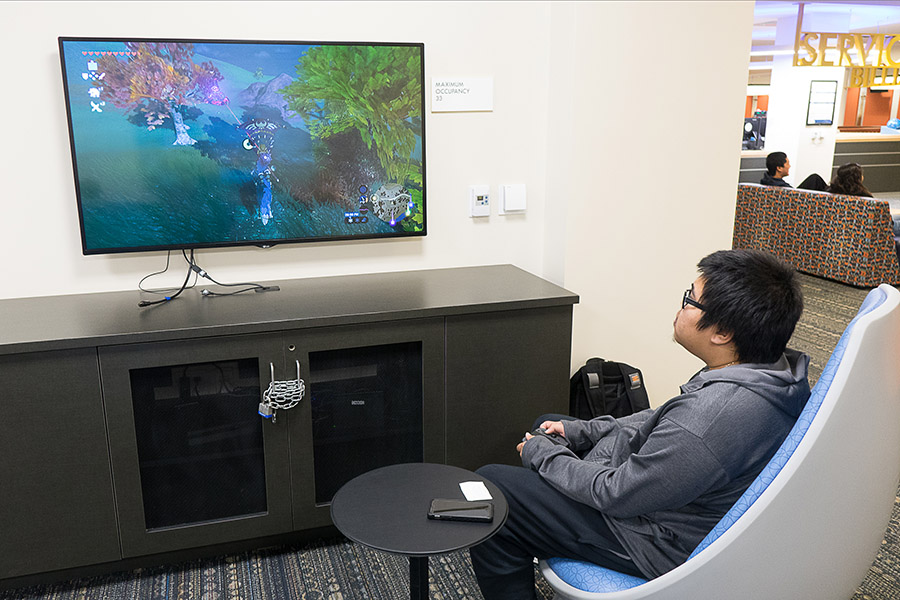
By their nature, video games mean different things to different people. To some, they’re simply toys; to others, they’re objects of technical interest, a means of showing advancements in computer graphics or computing power. But the possibilities of video games are much broader. Here at UC Davis, professors in several disciplines are exploring the potential interests of this technological art form.

Colin Milburn is a professor of English and cinema and digital media as well as science and technology studies. His research into the relationship between literature, science and technology has often involved video games.

“I’ve been studying games and gaming culture for about 12 years now,” Milburn said. “Recently, I’ve been looking at the role of games and gaming culture in shaping political attitudes, particularly around the politics of technology and the politics of science […] everything from hacktivist groups like Anonymous or LulzSec who may use video game technologies or software as part of some of their protest operations, to the role that video game imagery and motifs and memes have played in shaping political communities and online discourse.”

Milburn became deeply interested in the possibilities of video games when he realized the extent to which certain games were addressing the issue of nanotechnology, another one of his research interests.

“I had been interested in games for most of my life, but I hadn’t actively pursued them as a research topic until that point,” Milburn said. “Then as I started looking into them I discovered that a tremendous number of commercial games were grappling with some of the social implications of nanotechnology. That was really my first research interest, and then I became convinced that games were a hugely important way of communicating technological and scientific issues [and] of engaging citizens in larger social questions and ethical debates.”

Milburn is also the director of the ModLab, an on-campus research group that focuses on the intersection of technoscience and society, and has studied and developed several video game projects.

“One of our major projects has been a Shakespeare-focused video game called ‘Play the Knave’ which uses motion-capture cameras, Kinect cameras, to map players’ body movements onto avatars and asks people to put on performances of Shakespeare plays,” Milburn said. “It’s a way of getting people to engage with Shakespearean language and the conventions of theatrical performance, while also coming to address their own relationship to the computational interface by their engagement with the form of theater.”

Patrick LeMieux, an assistant professor of cinema and digital media and a member of the ModLab, has been involved in game design for over 20 years, making games like Speculation, an alternate reality game about Wall Street banks.

“Overall, I’m interested in the way in which play reveals the material histories and community practices of different discourses — from conceptual art to finance capital,” LeMieux said.

LeMieux has collaborated with Stephanie Boluk, an assistant professor of English, on both research and teaching. LeMieux and Boluk recently published a book called “Metagaming: Videogames and the Practice of Play,” and they co-teach Cinema and Digital Media 172: Videogames and Culture, which is cross-listed for English, cinema and digital media and science and technology studies.

Rather than treat video games and culture as two distinct categories that play off one another, in this course we examine how play has evolved alongside video games as a mass medium, cultural commodity and digital technology,” LeMieux said. “And even though it’s a large lecture with about 200 students, we also put these theories into practice by close playing video games like Braid and Portal, learning how to speedrun retro games on Twitch TV, recording audio reviews of audio games designed by and for players who are blind or have low vision and commenting e-sports competitions together.”

Jorge Peña, a communication professor, has a lab which approaches video games from a different perspective than the ModLab. The Virtual Interaction and Communication Technology Research (VICTR) Lab focuses on the more immediate effects of video games on players.  

“The work that we do at the VICTR Lab is looking at how exposure to video games, virtual environments, avatars, et cetera, can change people’s attitudes and behaviors in the real world,” Peña said. “For example, I was interested in whether randomly assigning people to thin or obese avatars would change people’s amount of physical activity as they’re playing a virtual tennis game; for that, I used the Wii Tennis game, in which I was able to modify the appearance of the participants and their virtual opponents.”

As with LeMieux and the ModLab, much of Peña’s work also involves collaboration, with students who work in his lab and with students who help design some of the games he uses for experimentation.

“In the laboratory I have the opportunity to work with students who are interested in building games,” Peña said. “I connect that to my own research interests, and I connect to students that are maybe communications students, that want to learn how to run experiments and how to do their own studies, so they help us in the laboratory to run the experiments […] essentially it’s a collaboration between faculty and students.”


Written by: Gabriel Mulcaire — features@theaggie.org

Police Logs

0
NICKI PADAR / AGGIE

Something wicked this way comes

Nov. 23

“Powerwashing from the shopping center — requested they be advised to start later.”

“Male subject inside store for past two hours, has been following customers as they leave.”


Nov. 24

“Group of teens playing near the fig trees and playground.”

“Sounds of female yelling.”

“Unknown subjects just broke open a whole unit of mailboxes and are now dragging it towards Wake Forest.”


Nov. 25

“Reporting party advised his wife was scammed out of $460 from someone offering to repair damage to her vehicle.”

“Open line — sounds like it’s in a pocket — no signs of distress.”

“Reporting party advised she received threatening text message from unknown subject at 0705 hours ‘you’re next.’”


Nov. 26

“Reporting party was moving items out of residence when threatened reporting party received text today saying he would set the apartment complex on fire.”


Nov. 28

“Dumped ATM machines behind business, negative surveillance.”

“Employee bought $10,000 in parts and paid with a check that bounced.”

2018 College Football Playoff Preview

0

PAULA R. LIVELY [(CC BY 2.0)] / FLICKR
Clemson, Oklahoma, Georgia, Alabama will play for national title

The 2017 college football regular season has come to a close, but bowl season now looms in the near future. For the fourth consecutive year, the NCAA postseason with be highlighted by the College Football Playoff. Once again, the near-impossible task of selecting the top four teams in the country was completed by the playoff selection committee. Filling the tournament’s first three spots appeared straightforward, while the debate surrounding the selection the final team was much more contentious. Ultimately, the committee made the decision to choose four 11-1 teams to compete for the national title.


Clemson Tigers

Showing no symptoms of a championship hangover, Clemson is poised to make a repeat title run this coming January. Last year, the Tigers defeated Alabama in stunning fashion to win the team’s first national title since 1981. This year, Clemson will get a chance to bring down the Crimson Tide again, as the teams are set to square off in the Sugar Bowl on Jan. 1.

Although several important players who were on last season’s championship team have since graduated or now play in the NFL (including star quarterback Deshaun Watson), head coach Dabo Swinney has proven to be resilient in his developmental and recruiting efforts. This season, Clemson is led by junior quarterback Kelly Bryant, who has established himself as a legitimate dual-threat offensive star. Bryant is among the most accurate passers in the nation, ranking sixth in completion percentage. In addition to his 2,678 passing yards, Bryant’s 646 yards and 11 TDs on the ground show that he can get things moving with his legs as well.

While Bryant has been up to the task offensively, the Tiger defense has held its own as one of the best defenses in the country. Clemson gives up the sixth fewest yards per game (278) and the second fewest points per game (12.8). When it mattered most this season, the defense has stepped up for Clemson. The Tigers allowed just six points to a talented Auburn team that fell just shy of winning the SEC, 21 points to the reigning Heisman winner, Lamar Jackson, in a victory over Louisville and just three points to Miami in last weekend’s ACC championship game.

Clemson’s one loss this season came on the road against a questionable Syracuse team, where the Tigers fell 27-24. Outside of this one blemish on their record, the Tigers have handled every other team on their schedule. Each of the team’s 11 wins have been decided by seven points or more, with an average margin of victory of 19.7. Still, critics question the strength of Clemson’s schedule and how the team will fare against mightier competition.


Oklahoma Sooners

Champions of the Big XII, Oklahoma sits at the number-two seed heading into the playoffs. The Sooners’ success this season can be largely attributed to the team’s prolific offense, quarterbacked by Heisman favorite Baker Mayfield. The passionate, energetic and often irreverent senior has flat-out balled this season, racking up 4,340 yards and 41 touchdowns through the air –– both of these numbers rank second in the nation. Mayfield and the athletic wideout duo of Mark Andrews and Marquise Brown have shredded opposing defenses, leading the nation in total offensive yards and offensive efficiency.

Averaging 44.9 points per game, offense has obviously proven to be an important asset to the Sooners’ success. Oklahoma’s defense, on the other hand, has shown flashes of greatness in certain games, particularly in victories over Ohio State and TCU in last weekend’s Big XII title game. Overall, though, the Oklahoma defense has been wildly inconsistent and will have much to prove as it matches up against a solid Georgia team.

Much like Clemson, Oklahoma has been able to take care of business against most every opponent. The Sooners overcame an early-season upset loss at home to Iowa State as they went on to secure a quality win at Big XII rival Texas, a shootout win at Oklahoma State and two separate wins over TCU. Oklahoma will now travel out to the west coast to play Georgia in the Rose Bowl on Jan. 1.


Georgia Bulldogs

As the one-loss champion of the SEC, Georgia has earned a spot in the college football playoff for the first time. The Bulldogs flew under the radar for most of the season, even after a one-point win at Notre Dame. Powered by a top-tier defense that ranks fourth in yards allowed per game and third in points allowed per game, Georgia rattled off nine straight wins to begin the season before falling to Auburn on the road. The Bulldogs were given a chance at redemption last weekend, though, as they dominated the Tigers this time around in Atlanta to secure Georgia’s first conference title in 12 years.

Georgia’s punishing defensive front and talented secondary has unquestionably carried the team into the playoffs, but the Bulldog offense has also vastly improved compared to previous seasons. The success of this offensive unit this season has been surprising, especially considering that the quarterback at the helm, Jake Fromm, is a true freshman. Despite his youth, Fromm has not shied away from the spotlight; his 168.2 quarterback rating is seventh in the nation and his confident performance in the SEC championship game make Fromm look like an experienced veteran.

Dominant defense and proficient quarterback play are not the only things that have helped the Bulldogs thrive. A healthy ground game, led by senior running back Nick Chubb, has been key for Kirby Smart’s team. After a breakout freshman campaign, Chubb was sidelined by a significant knee injury during his sophomore season. Since then, Chubb has run the ball with purpose, amassing 1,175 yards and 13 TD’s over the course of this season. After his 77-yard outing against Auburn, Chubb officially took his place as the SEC’s second all-time leading rusher. Now on the biggest stage, the Bulldogs will depend on a balanced offense that leans on Chubb’s skillset and Fromm’s steady passing style.


Alabama Crimson Tide

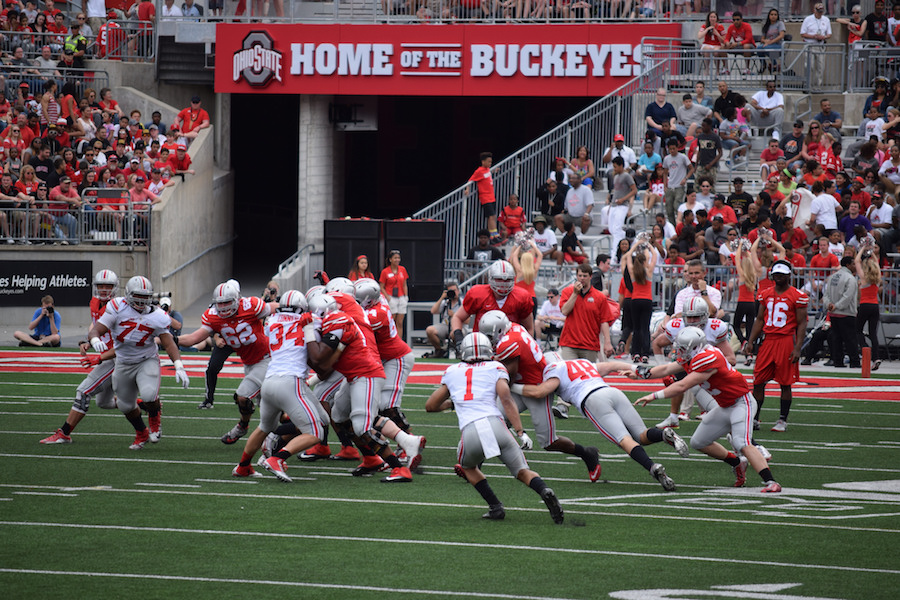
Rounding out the fourth and final spot is Alabama. Deciding who was going to fill this spot was a virtual toss-up between the Tide and the Ohio State Buckeyes. Alabama started the season with an impeccable 11-0 record but finally lost on the road to Auburn in its final regular season game. The loss sent Auburn to the SEC championship game to play Georgia. The Crimson Tide, therefore, did not get a chance at conference title. Ohio State, on the other hand, suffered two regular season losses but was still able to find its way into the Big 10 championship game where the Buckeyes took down Wisconsin. Despite winning their conference with a 10-2 record, the committee selected one-loss Alabama out of the SEC.

For the first time, the playoffs will feature two teams from the same conference. While Alabama is not a conference winner this year, the university’s football prowess is well established. The Tide have won four national titles since 2009, including their most recent one in 2015. Under head coach Nick Saban, Alabama is known for playing a physical style of football behind a typically enormous line on both sides of the ball. This year’s Alabama squad is no different; the Tide rank tenth in the nation in rushing yards per game and number one in total defense.

Outside of their one loss, the Tide has consistently out-physicalled their opponents. Dynamic sophomore quarterback Jalen Hurts has performed well through the air and on the ground, throwing for 15 touchdowns and running for eight. His one interception is the fewest among QB’s with a minimum of 200 passing attempts. Aided by a two-headed monster in the backfield, junior running backs Damien Harris and Bo Scarbrough have combined for nearly 1,500 yards rushing and 19 TD’s.

Many still question if the Tide’s schedule this season was strong enough to properly prepare them for the Playoff, but Alabama is still packed with veteran players –– like the ones mentioned above –– who have legitimate playoff experience under their belt. The experience and the physicality of Saban’s team may become a pivotal factor when the Tide takes on Clemson on New Year’s Day.


Allstate Sugar Bowl

#1 Clemson vs #4 Alabama

8:45 p.pm ET, Jan.1

National Championship

Monday, Jan. 8

Winner of Sugar Bowl vs Winner of Rose Bowl

Rose Bowl Game

#2 Oklahoma vs #3 Georgia

5 p.m. ET, Jan. 1


Written by: Dominic Faria — sports@theaggie.org

Humor: Trump’s wall will never be as tall as the emotional barrier between him and Melania

MARC NOZELL [(CC BY 2.0)] / FLICKR
And it could never cost as much as the collective American emotional turmoil, either

One glorious day we will look to the south and see upon the horizon a monolith which stretches far into the sky. On that day no man, woman or child seeking to escape poverty and find a better life will be able to do so any longer. On that wonderful, momentous day Trump will be able to say:

“My name is Trump, president of presidents;

Look on my work, y’all rapists, and despair!”

Of course, there will be no way for our wonderful god and leader to be able to construct a wall higher than the emotional barrier between him and his third wife. However, we may look upon both as monuments to two very important rich-American ideals: the first a monument to the security of our borders from a nameless and vague threat, and the second a great monument to the emotional estrangement that men have from their wives when they don’t see women as human beings.

Truly, this will be a wonderful and great display of American greatness: opulence, waste of resources that could be used to feed the poor and — most importantly — the incessant need of Americans to make America, a nation built from and borne of immigrants, an identity exclusive to white people.  

I await the day when I can buy a sandwich from a restaurant on the border wall while looking through the viewing window and laughing at everyone who does not have my very tasty sandwich made of fake meat and fake dreams.

Let us conclude this message with a prayer:

“Dear leader,

Give me the resolute nature,

With which I can block empathy,

And think spending $70 billion,

On a big-ass wall,

Is a good idea.”

This message was brought to you by American Aaron, soldier of the Great Trump Administration. Please report dissenters to the following email.


Written by: Aaron Levins  — adlevins@ucdavis.edu

(This article is humor and/or satire, and its content is purely fictional. The story and the names of “sources” are fictionalized.)


Sacramento expected to land Fortune 500 company

0
JEREMY DANG / AGGIE

Thousands of private sector jobs coming to the region

The City of Sacramento signed a preliminary agreement with Centene, a Fortune 500 St. Louis-based health insurance company, to establish a West Coast headquarters in Sacramento. The agreement is expected to bring about 1,500 new jobs to the region. Most positions will be in the fields of health care, information technology, accounting and administration.

“[Centene is] the single biggest private sector job recruitment in the city’s modern history,” said Sacramento Mayor Darrell Steinberg. “I believe this is just the beginning of growing a high-wage private sector economy to supplement and complement our public service sector here in Sacramento.”

On Nov. 28, Sacramento City Council unanimously approved an employment incentive agreement to attract Centene to Sacramento. Steinberg stressed that the employment incentive agreement was not final for the establishment of a headquarters in Sacramento.

“They [Centene] still have decisions to make,” Steinberg said. “We know, and I hope they know, their best choice. I think their signing of this agreement is a step in the right direction.”.

The headquarters is expected to be located in North Natomas. Although neither the company nor the city has indicated the exact location, it is expected to be in the vicinity of Sleep Train Arena.

“The area [North Natomas] is centrally located between the airport and downtown [Sacramento],” said Dan Trescott, the president of the Natomas Chamber of Commerce. “We have substantial infrastructure already in place […] and previous experience accommodating large facilities.”

The addition of 1,500 new jobs is estimated to bring in nearly $350 million in new annual labor income for the Sacramento region.

“There will be other businesses that will come in [to Sacramento] — it will activate the redevelopment of Sleep Train [Arena],” said Barry Broome, the president of the Greater Sacramento Economic Council, in a Sacramento City Council meeting. “It will catalyze the Railyards.”

Centene ranked 66th on the 2017 Fortune 500 list of largest U.S. corporations and 244th on the 2017 Fortune Global 500 list.

“Centene provides access to affordable healthcare plans to more than 12 million members across the country, and it delivers health insurance solutions for the underinsured and uninsured through Medicaid, Medicare, the health insurance marketplace, and other health solutions through its specialty services companies,” according to the Employee Incentive Agreement between the City and Centene. “Centene creates high-quality, full-time jobs by paying competitive wages and offering comprehensive benefits packages.”

The agreement is consistent with Sacramento’s Employment Incentive Strategy, which aims to attract large companies to the region.

“Adoption of the Centene proposal will not only assist with current recruitment activities, but will also set a tone for future attraction efforts in the capital region,” said Francisco Medina, the public policy manager for the Sacramento Metropolitan Chamber of Commerce. “The diversification of our region’s economy is a well-documented need for our prosperity.”

Sacramento was chosen as a preferred destination over the likes of Austin, Phoenix and Denver.

“This is a beginning, not only with Centene, but with other big companies that provide a potential future for so many of our kids here in Sacramento,” Steinberg said.

Centene’s Board of Directors is not expected to vote on a final decision until early next year.


Written by: Dylan Svoboda — city@theaggie.org

Cultural Holiday Recipes

CHRISTIE NEO / AGGIE

Recipes served at Christmas, Hanukkah, Kwanzaa

And just like that, Thanksgiving is over. Thus, the inevitable emptiness of a past holiday has taken hold. But don’t worry, the holidays are still in full force. As we move into December, a whole host of new holidays are coming our way. That means there will be more delicious food recipes to pair with the upcoming festivities.

To begin, we will start with a holiday classic: peppermint bark. Synonymous around the world with the Christmas season, these delectable shattered pieces of chocolate and peppermint are beloved by many. The New York Times featured a recipe by New Jersey native Tom Faglon, in which he pushes the boundaries of peppermint bark to incorporate seasonal fruit. Faglon’s dark chocolate and pomegranate bark is a must this holiday season. His use of fresh in-season pomegranate seeds elevates the bark to a new a level of flavor. He also adds candied ginger and sea salt, culminating in a delicious combination of sweet pomegranates, salty flecks and spicy ginger. Above all else, this recipe is simple and can be whipped up in minutes.

Next up we have another Christmas dessert: Bûche de Noël, aka Yule Log. A famous French Christmas dish, this dessert consists of a cake, rolled up, frosted and adorned to look like a wood log. The cake is traditional in many northern European cultures. The New York Times featured a recipe by famed baker Dorie Greenspan for a nuanced gingerbread bûche de Noël. While this cake is exceedingly complex, Greenspan’s version seeks to simplify the procedure while maintaining all the delicious taste. She implements new gingerbread-style flavors and a sweet texture, with a showering of candied pecans when finished. If you’re feeling up for it, this cake will be a showstopper for any holiday parties.

Whether you celebrate Hanukkah or not, odds are you’ve tried a delicious potato latke in your life. The famous potato patties are shredded, then mixed with onion, egg and spices all before frying in a hot oil. The result is a delicious fried patty that is crispy on the outside and soft on the inside. Martha Stewart’s recipe for sweet potato latkes is a new take on the potato latke. She uses both yukon gold and sweet potatoes, ensuring you don’t miss your original latkes too much. If you make these at your next holiday get together, they’re sure to please.

For a sweet dessert at Hanukkah, look no further than the traditional sufganiyot, similar to jelly donuts. These delicious treats are consumed every year during the holidays. Deep-fried and filled with jelly or custard, the donuts will leave a lasting impression on any guest lucky enough to try one fresh. Chowhounds has compiled a recipe for sufganiyot that is straightforward and beginner-friendly, so there is no need for big deep fryers. If you are looking for a challenge, you can always up the ante by making your own jelly for the donuts. Regardless, this recipe will have guests begging for more.

During Kwanzaa, a series of African recipes are eaten. Senegalese chef Pierre Tham provides us with a recipe from his own cookbook. The recipe for sweet potato mango spice cake implements many of the popular ingredients utilized during celebrations of Kwanzaa. Your guests will leave in a trance from the mangoes that impart a moistness to the cake — along with a spicy bite from the ginger.

Lastly, a more savory approach to African recipes is provided by Sanura Weathers. Her recipe for roasted sweet potatoes stuffed with spiced couscous and yogurt is a testament to the incredible flavors present in African culture. Couscous and yogurt brings to mind Moroccan and Egyptian tastes, while sweet potatoes round out the dish with a traditional starch. Weathers’ recipe is a delicious savory option to serve prior to a slice of Tham’s sweet potato mango spice cake.

Happy Holidays!


Written by: Rowan O’Connell-Gates — arts@theaggie.org

The Glute-Ins and Outs of Celiac Disease

JAMIE CHEN / AGGIE

About 1 percent of U.S. population suffers from Celiac disease, yet effects don’t receive much recognition outside afflicted community

Synonymous with carbs, weight-gain, faulty metabolisms, and bad skin, gluten is often regarded as something to avoid in a modern, health-conscious society. According to a study from the NPD Group in 2013, 30 percent of American adults are reducing or eliminating gluten from their diet, largely because gluten products are seen as unhealthy. Though the claim is unsubstantiated, the buzz around gluten and its supposed negative effects has overshadowed, or even totally ignored, those with actual gluten-related health problems, namely those with celiac disease and gluten intolerance.

Celiac disease is an autoimmune disorder, similar to type 1 diabetes and lupus, wherein the immune system attacks the cells and organs of its own body. In the case of celiac, the presence of gluten, a storage protein found in wheat, rye, and barley, triggers the immune response. This can not only result in the expected gastrointestinal issues, like vomiting or diarrhea, but a litany of seemingly unrelated problems. According to Justin Siegel, an assistant professor of chemistry, biochemistry and molecular medicine at UC Davis, someone suffering from celiac could expect osteoporosis, anemia, infertility and other disorders resulting from autoimmune reactions.

It is estimated that 3 million people in the United States suffer from celiac disease. However, only about 500,000 of those have been diagnosed. Celiac disease is notoriously difficult to diagnose owing to its wide array of symptoms. Kathryn Russ, an associate professor of economics at UC Davis who was diagnosed with celiac disease, suffered from recurring health problems most of her life and was misdiagnosed by several doctors for years.

“I had chronic respiratory issues, stomach pain and problems [going into college],” Russ said. “When I was in the peace corps [doctors] thought it was a parasite. They couldn’t find one, but I had the symptoms.”

Even when she had a preterm birth caused by HELLP syndrome (Hemolysis Elevated Liver enzymes and Low Platelet count), a pregnancy complication that more frequently happens to those with autoimmune disorders, Russ was still not diagnosed with celiac disease. Meanwhile, her health continued to decline after the birth of her son.

“I had an emergency appendectomy, I had these weird episodes of pneumonia for months in the winter, I was starting to lose my hearing,” Russ said. “In every aspect of my health, everything was going wrong.”

Taking the advice of a physical therapist who suggested she may have celiac disease into consideration, Russ decided to try a gluten-free diet, but waited a year to heed the therapist’s advice.

“At the time, I was approaching tenure, I had a child, I was travelling a lot, I didn’t know what celiac disease was, or that it could kill you,” Russ said. “You hear all these things in the press ‘demonizing gluten’, that it’s a just a fad, a fashion — so I was really skeptical about it, even though my physical therapist […] seemed to know [what she was talking about].”

Finally, she decided to give a gluten-free diet a chance. The change was almost immediate, with the majority of her health problems totally disappearing.

The current gluten-free trend, the one Russ was hesitant of being associated with, has been a double-edged sword for those with celiac disease, according to Talia Machlouf, the director of advocacy and research for the Celiac Disease Foundation. On one hand, it was not long ago when gluten-free options in grocery stores were limited or nonexistent. In addition, the term “gluten-free” as a label was not regulated by the FDA until 2014, when it was defined as a food having 20 parts per million or fewer of gluten. Before 2014, any food could claim it was “gluten-free” and still cause illness in those with celiac. The gluten-free diet has led to greater awareness of gluten labelling.                                                         

The increasing popularity of these diets has, on the other hand, contributed to the rising cost of gluten-free foods and a lack of legitimacy given to those with gluten intolerance. Russ’s own preliminary research shows that, as a whole, gluten-free households spend 242 percent more on groceries than gluten-consuming ones, in part due to the increased cost of operating a gluten-free production for food suppliers, but also in part due to price inflation of retailers. Adding to that, restaurant staff will often not take those with gluten-free requests seriously, putting celiac patients at risk.

“They think the gluten option is healthier, but then splurge on something with gluten,” Machlouf said. “[Celiacs get] generalized with the health eaters and their requests don’t get taken seriously. If you cook eggs on the same surface as buns, then someone with celiac could get sick from that.”

Organizations like the Celiac Disease Foundation are educating both the public and health care providers about celiac to prevent years of misdiagnoses common with celiac patients.


Written By: Dylan Hendrickson — science@theaggie.org


CoHo showcases gourmet food items

MARINA OLNEY / AGGIE

Student-popular eating spot adds new, fancier items to menu

The CoHo, a go-to eating spot on campus, just added new items to many of its menus. While these additions are not necessarily unorthodox, the new meal choices seem to follow a similar pattern: high-quality, more sophisticated dishes. According to Darin Schluep, the ASUCD Food Service director, such items include acai bowls being served all day at Swirlz, flakey pastries called “kouign-amann” also at Swirlz, poke at Chopstixx, more chicken breast in the hot sandwiches at Ciao and gourmet meat and veggie pizza options.

“I feel like there are more grab-and-go options, like sandwiches and wraps,” said Kathleen Pan, a second-year managerial economics major and frequent CoHo customer. “I’ve also noticed more quantity and options at the sushi section. I think they are also trying to keep up with current food trends”

The CoHo continues to strive to add more menu items in order to maintain student interest and appetite.

“We don’t ever want to get complacent with our menu,” Schluep said. “We know that we have a very loyal customer base that visits on a regular basis, so we want to be able to provide new options for folks to try that will hopefully keep them satisfied and coming back.”

Danny O’Brien, a second-year environmental science and policy major who used to work at the CoHo, agrees that having new items added to the menu is beneficial because “items can get old after awhile.” However, he does recognize the strain it can have on the student workers who make up the employee population.

“There was a big problem in the beginning of the quarter having a bunch of new people and a bunch of new items on the menu and a bunch of new work to do, so it made a bunch of veterans like me have to pick up the slack,” O’Brien said. “It would definitely impede the process to add more to our repertoire. They would kinda throw it at us out of nowhere.”

The CoHo staff considers these potential difficulties.

“The impact on our staff and the resources needed to make any menu addition is always taken into account with new items,” Schluep said. “There is always an adjustment period to new items, but we do our best to make it a smooth process for our employees. And we will constantly evaluate an item’s success to determine whether or not it is ‘successful’ or whether we may need to go back to the drawing board to make adjustments or try something altogether new.”

In addition, for many students, like Pan, the CoHo is an attractive eating spot on campus because of the cheap options available. By adding more fancy items to the menu, how the prices of items will change is brought into question.

“I understand why they are making these nicer items, but the CoHo is known as a cheap and affordable place for students,” Pan said. “But the poke bowls are pretty expensive in CoHo terms, where you can get a bagel for $2. I understand the pricing of it, and I guess it is up to the customer if they want to spend that much money. I don’t really even know how many people actually buy the poke bowls, so I don’t know if the demand matches the supply we are putting out. They are not necessarily replacing cheaper options but giving more options in general. But from an employee standpoint, it can put a lot on employees who have to make these items. It’s a weird balance.”

Time will tell whether or not the new items gain popularity and are worth the cost of adding them.


Written by: Caroline Rutten — arts@theaggie.org

Sandhill cranes are relying on us to provide their wintering habitat

PETER & MICHELLE S [(CC BY 2.0)] / FLICKR
Migrating cranes turn to farmlands and preserves to make up for wetland loss in the Central Valley

The Sandhill cranes start out as black strands on the horizon — just silhouettes against a hazy pink sky. They drift down into the flooded fields at sunset with their feet below them, like parachutists.
They stand in the water the same as they did thousands, even millions, of years ago. Only the vineyards weren’t there, or the houses, the road, the freeway, the cyclists or dairy farms. The water was full of life in their untouched habitat. The sky was clear all the way to Mount Diablo.


Several years ago, I came across a National Geographic social media post, which featured a photo of cranes in an open meadow at twilight. I was surprised to realize that the photo was taken in my hometown of Lodi, Calif.
I followed National Geographic to ogle over places like Holland and landmarks like the Iguaza Falls. Here, I was looking at cutesy “Livable, Loveable Lodi,” a small town known for its wine and unofficially titled “the Zinfandel Capital of the World.”
I grew up seeing the Sandhill cranes represented in regional art and poetry. I would watch them flying over the freeway at dusk on my long commute home from school. But it wasn’t until this year that I finally made it out to see the cranes at the Isenberg Crane Reserve.
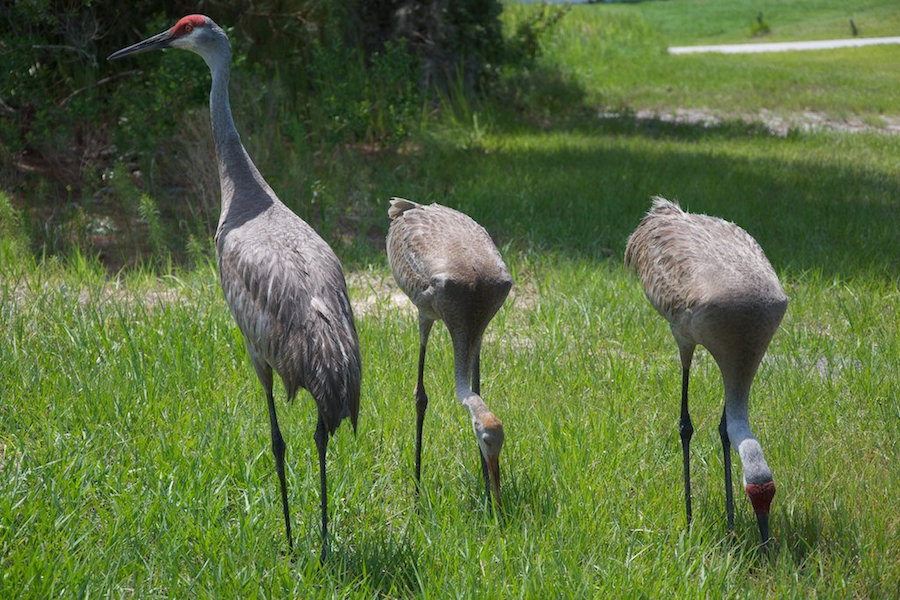
They foraged and called out to each other between the reserve and an adjacent field. A lone heron wandered between families of two and three birds. The cranes mate for life and usually travel with their young until they are 10 months old.

“The family unit is very important to Sandhill cranes,” said Jane Adams, a volunteer docent with the California Department of Fish and Wildlife. “They take parenting very seriously. The chicks are born in May or June, and they have to be ready to fly in September. […] Migration isn’t something instinctual. They have to be taught.”

“They’ve been on the earth for a long time, so I treat them kind of like a spiritual totem,” says Colleen Moss, a docent with the California Department of Fish and Wildlife who has lead crane tours for over 20 years.


According to the International Crane Foundation, a crane fossil found in Nebraska dated 2.6 million years old and could “be structurally identical to the modern Sandhill crane, making it one of the oldest known bird species still surviving.”
The Sandhill cranes vary in size, depending on their subspecies, says the International Crane Foundation. Lesser Sandhill cranes weigh 6 to 7 pounds and stand 3 to 3.5 feet tall. Greater Sandhill cranes weigh 10 to 14 pounds and stand 4 to 4.5 feet tall.
They are known for their unique song-and-dance routine, which attracts birdwatchers in droves to the Central Valley. They have a distinct call — kar-r-r-o-o-o — which has been compared to a bugle or a trumpet. Together, their voices form a chorus of prehistoric sounds. Mating pairs of Sandhill cranes sing together in coordinated duets.


“The Sandhill crane’s call is a loud, rolling, trumpeting sound whose unique tone is a product of anatomy,” said All About Birds, The Cornell Lab of Ornithology site. “Sandhill cranes have long tracheas […] that coil into the sternum and help the sound develop a lower pitch and harmonics that add richness.”

“That’s what gives [the call] its trilling sound,” Adams said.

They also perform elaborate dances — running, leaping, bowing and flapping their wings.

“They jump straight up in the air,” Adams said. “They dance a lot. […] They also will throw sticks up in the air.”
“They are large, vocal, spectacular birds with unique breeding displays and have become symbols of international cooperation for bird conservation,” said the U.S. Fish and Wildlife Service site.
Greater Sandhill cranes migrate exclusively to the San Joaquin-Sacramento Delta area, according to Moss.


“In 1940, there was five nesting pairs left — that’s the Greater Sandhill cranes,” Moss said. “By putting the land back in conservation, we’ve put the numbers back to 5,000.”


The Isenberg Crane Reserve land formerly belonged to the El Dorado Duck Club, until the property gained protection as an ecological reserve by the Fish and Game Commission in the 1980s, according to Moss.
“The Sandhill crane population declined sharply in California in Gold Rush days, when the birds were sold like turkeys in San Francisco butcher shops,” said Denis Cuff in the Contra Costa Times. “But in the past two decades, its population here has stabilized, with the help of new, crane-friendly farm practices that have helped preserve its habitat.”
They are threatened by other factors now.

“The once threatened Sandhill crane has made an inspiring comeback throughout much of its range,” said the International Crane Foundation. “However, despite this success, the species continues to be threatened by power line collisions and wetland loss.”
“California has lost approximately 90 percent of its natural wetlands areas,” said Kayla Webster in an article posted to the Natural Resources Conservation Service California site in July 2016. According to Peter Tira, the public information officer for the California Department of Fish and Wildlife, it’s 95 percent.
Areas once composed of wetlands have been converted to orchards and vineyards that disrupt the Sandhill cranes’ ability to land and forage for food.


“The Greater Sandhill cranes have a wingspan over five feet, and they can’t land in the grapes,” Moss said. “If they got scared or spooked, they couldn’t take off from there.”
Due to wetland destruction, “The Greater Sandhill crane population has diminished in California to a point where they were listed as a threatened species in 1983,” said the Woodbridge Ecological Reserve (Isenberg Crane Reserve).
In some ways, agriculture in the Central Valley has helped crane populations by providing residue crops of corn, grain and wheat.
“The farming really hasn’t been bad for them. They will eat the leftover grain,” Moss said. “The birds kind of help out because they are adding fertilizer to the fields and they’re eating pests. They aerate the soil with their beaks.”


In California, The Nature Conservancy works with wildlife preserves, like Cosumnes River Preserve, to provide habitats for wintering birds.
“The Cosumnes River Preserve consists of over 50,000 acres of wildlife habitat and agricultural lands owned by seven land-owning Partners,” said the Cosumnes River Preserve. “The habitat supports wildlife, including birds that migrate throughout the Pacific Flyway.”
“The Nature Conservancy partners with farmers, government and nonprofit groups to manage crops, grasslands and water to provide food and shelter for cranes and other birds on the Pacific Flyway migratory path,” Cuff said.

“They own Staten Island,” Adams said. “They practice farming that continues to provide habitat and water for cranes — as well as other birds.” Staten Island is an island on the Sacramento-San Joaquin River Delta and provides the wintering habitat for 15 percent of the cranes who migrate to the Central Valley.


“For decades, farmers burned their fields after harvest, a cheap way to destroy crop residue and control disease and pests,” said Liza Gross, a science contributor for KQED. “But the practice, which generated hazardous air pollutants such as hydrocarbons and sulfur dioxide, was banned in 1991. Farmers turned to post-harvest flooding to decompose husks and stubble in their fields with the happy albeit unintentional consequence of creating high-quality habitat for water birds like the crane — a result that may explain why millions of water-adapted birds still use the region each year despite the catastrophic loss of wetland habitat.”


“Generally, row and field crops as well as pasture land is good surrogate foraging habitat for cranes,” said Mark Ackerman, a biologist at the Bureau of Land Management Wildlife at the Cosumnes River Preserve.


The cranes typically arrive at Cosumnes River Preserve in early September and return to their breeding grounds in March.
“In general, the Preserve including the conservation easements provide all the necessary sheltering and foraging habitat needs for the cranes,” Ackerman said.


“[The Cosumnes River Preserve is] crucial for cranes. They come to the Central Valley to winter,” Tira said. “They need a place to rest and fuel up for migration. […] We’re lucky in the Central Valley to be able to experience the cranes in fall and winter […] We’re the epicenter of the Pacific Flyway.”
Tira said that most farmers enjoy seeing wildlife on their property. “It’s a win-win if we can all work together.”


Farmers may even be paid incentives for flooding their crops for migrating birds, according to Ker Than, a science journalist.
At the Isenberg Crane Reserve, less than 10 miles from Cosumnes, busloads of tourists visit the cranes annually during Lodi’s Sandhill Crane Festival.
“We’ve seen 3,000 birds come in at sunset,” Moss said.


“Open marsh, flooded pasture and grassland at site support Greater Sandhill cranes,” says Isenberg’s site. “Between late afternoon and early evening the ‘Crane Fly-in’ can often be seen as cranes fly into the surrounding flooded fields to roost for the night. The haunting sounds of the approaching cranes can be heard from miles off.”

“It was the most awe-inspiring animal spectacle of my life,” Adams said in reference to the first time she saw the crane fly-in.

“The Sandhill cranes are just amazing to go and watch,” said Lisa Sears, a Lodi resident who enjoys watching the crane fly-in with its amazing sunsets and views of Mount Diablo. “I look out and see all the birds, the cranes, ducks and egrets. All the birds share this space together without conflict. It’s very peaceful, and it’s a nice way to end the day.”


While farming in California has reduced wetlands and the cranes’ wintering habitat, in the Central Valley, smart farming can reduce the loss of resources by providing suitable surrogate habitat and food sources.
“Cranes and farms can co-exist,” Gross said. “But loss of habitat remains a concern, as the past decade has seen more vineyards and orchards move into grain fields historically used by cranes. With most wintering cranes concentrating on private lands in the valley, the future of this Pleistocene throwback will depend on the willingness of landowners to work with biologists to manage the land with wildlife in mind.”


Conservationists and biologists agree that supplying the Sandhill cranes’ wintering needs will be a cooperative effort.
Since agriculture has vastly changed California’s landscape, it’s important that farmers, scientists and the state government work together to provide for wildlife.
“I see it as beneficial to have the wetlands back,” Moss said. “I think the importance of having a natural space to go to, it benefits both the cranes and people. It’s like taking care of your soul.”

“We have to realize these birds have literally been coming to the Central Valley for thousands of years,” Adams said. “Conservation is so important for this bird species.”


Growing up in the Lodi area, I saw images of Sandhill cranes on local writers’ book jackets and posters for community events. But I never really saw the cranes until this year. They were only a vague concept, one I took for granted.
These ancient birds travel half the world to winter in my hometown, and I hadn’t yet made the 10-minute drive to meet them.
People often look to the distance for wonder and beauty. They scan social media feeds and subscribe to magazines to get away from the banality of everyday life. In the process, they forget to appreciate the value of the nature and history in their own backyards.
At least now I know. Long before “Livable, Lovable Lodi” became “the Zinfandel Capital of the World,” the Sandhill cranes migrated here. It was their home before it was mine.


Written by: Jessica Driver — jmdriver@ucdavis.edu

Disclaimer: The views and opinions expressed by individual columnists belong to the columnists alone and do not necessarily indicate the views and opinions held by The California Aggie.
What to expect from different living locations in Davis

0
KYLA ROUNDS / AGGIE

The tradeoffs of Davis housing spots

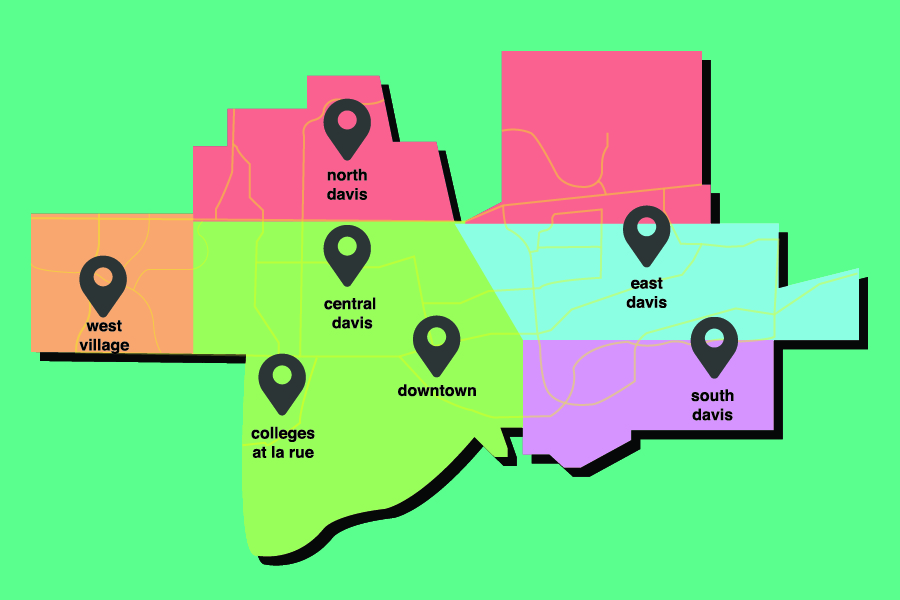
When it comes to housing, people find themselves worrying most about rent and who to room with, but it is also worth it to get to know the town, and yourself, well enough so you know what types of things you’d like to live near. Living in a location that best suits your habits can help you better manage your time. If you and your roommates can’t decide between several similarly priced places in entirely different settings, here is a look at some things to expect from living in some of Davis’s neighborhoods.


Downtown:

Living in an apartment or small house downtown is perfect if you want to be close to a variety of restaurants and cafes while also not being too far away from campus. Several bus lines run straight through downtown on Second and Third streets, so it is easy to get to the Silo or MU quickly. Of course, it’s also a very short bike ride.

If you are the type of person who likes to study in a busy public place with lots of hustle and bustle, then living downtown is quite convenient. You can study late at cafes like Mishka’s or Temple without having to worry about a long commute home.

Up G Street in the northwest corner of downtown is the Davis Food Cooperative, which, for downtown residents, is probably the most optimal place to do grocery shopping. It’s also not a far bike or bus ride from the Safeway on the south side of Interstate 80.


West Village:

Despite its relatively small area compared to some of Davis’s other neighborhoods, West Village has sprung up over the last decade as a mini city of its own. West Village has amenities like a gym and pools, and the relative quality of the construction is very nice compared to some of the older apartments across Davis. Getting to campus is quite easy by taking the V line to the Silo, or by biking on one of the sky bridges that go over Route 113. The ARC is the first main landmark you hit when arriving on campus, so it is convenient for students who like to work out at the start or end of their days.

One complaint about West Village is that it can feel quite isolated compared to some other areas of town. Since the majority of the population is students, it can also be easy to feel a bit detached from the outside world. Some students may prefer this and think it more conducive to focusing solely on their studies, while other students derive great energy from being immersed in the Davis community. Since the campus separates West Village from downtown, it can be quite a trek to get to restaurants or other downtown activities.


North Davis:

Anyone who lives in North Davis has at one point in time been asked the question, “Do you shop at Safeway or Savemart?” This is certainly a logical question — the sea of North Davis apartment complexes seems to revolve around the axis of Safeway and Savemart. Both grocery stores are located right along the routes of the J and G Unitrans lines, making it easy to fit a quick trip to the store into your busy schedule. Trader Joe’s is also conveniently located along the G/J Line route. Just be careful — it’s easy to mix up the G and the J since their timing is synchronized, so don’t get on the G to the MU when you have a midterm in SciLec.

If you choose to bike instead, you may prefer taking Oak, which is much less busy than Anderson. The never-ending trek up and down Anderson at least twice a day makes Anderson Road the ultimate Sisyphean nightmare for residents of North Davis.


South Davis:

South Davis is an interesting mix because it is still relatively close to the activity of downtown, but it feels more isolated since you need to cross Interstate 80 to get to class every day. There are bus lines that run along Lillard Drive that help make the commute easy, but some may prefer the peaceful bike ride along the Putah Creek section of the Davis Bike Loop. Davis’s other Safeway is located here along with some restuarants. This is also a good location if you’re looking to get hired or volunteer at the research centers in South Davis.


East Davis:

For people who enjoy spending time downtown, but don’t mind being further away at a lower price, East Davis may be the perfect place. Stopping downtown is easy since it’s on your route everyday for the bus or on your bike, but the further east you go, the more inconvenient it becomes to bike. If biking to and from campus everyday is important to you, you may want to live in a different area of town. That said, one major advantage of east Davis is being close to Target.


Central Davis:

The streets across from the north side of campus, such as Oeste and Parkside, are coveted areas that make up Central Davis. This area mainly includes residential houses as well as the popular Sycamore Lane apartment complex. If you prefer doing errands downtown, in North Davis or at the University Mall, try scoring housing in Central Davis.

This is a good area to live in if you want a more suburban feel with a mixture of students and families. This vibe can also be achieved as you move further east in South Davis, but Central Davis is more ideally located because it’s just about equidistant from most places you would want or need to go, especially campus.


Written by: Benjamin Porter — features@theaggie.org

Team of the Quarter: Men’s soccer

NICHOLAS CHAN / AGGIE FILE (left), MEENA RUGH / AGGIE FILE (right)

UC Davis men’s soccer wins division title, nearly makes NCAA tournament

After enjoying one of the most successful seasons in program history, falling just one win shy of reaching the NCAA Division I tournament, the UC Davis men’s soccer team was an easy choice for The California Aggie’s Fall 2017 Team of the Quarter.

The team captured the Big West North Division crown in the regular season and advanced all the way to the finals of the conference tournament, finishing with a record of 11-7-3 and a 7-2-1 mark versus Big West opponents.

The Aggies received a number of awards and accolades throughout the campaign for their performances both on and off the pitch.

Redshirt junior defender Roy Boateng was named the conference’s Defensive Player of the Year and head coach Dwayne Shaffer was honored as Coach of the Year. In addition, senior midfielder Onah Power, redshirt freshman Nabi Kibunguchy and Boateng were all selected for the All-Big West First Team.

Senior defender Chase Rhode and redshirt junior forward Matt Baringer were both selected for the College Sports Information Directors of America Academic All-District First Team, an award that annually honors the finest student-athletes across the country.

One of the most memorable moments of the season was the team’s dramatic victory over CSU Northridge in the Big West tournament semifinals. After squandering a 2-0 first half lead, the Aggies battled back and scored a pair of goals in the final 22 seconds of regulation to steal the win. UC Davis overcame a grand total of six yellow cards and two red cards, most of them in the late, critical stages of the contest, to move on to the finals.

After a slow start to the season during non-conference play, the Aggies hit their stride during the back half of the year and finished strong with five wins in the final six games of the regular season.

“We had some unfortunate results early in the year, but we rebounded and we stayed strong,” Shaffer said. “We had an unbelievable run. They should be proud of themselves.”

The turnaround can largely be attributed to the vast amount of experience on this year’s roster, which included eight seniors.

“Midway through the season, the eight of us all made a decision that we were going to be at this spot at the end of the season and we fought towards that,” said senior forward Noah Wilson. “We focused on every minute and every half, playing our game, and then the results came.”

Redshirt sophomore forward Adam Mickelson was the team leader in points, finishing with a total of 15, as well as assists with seven. Wilson, one of only five players on the roster to start all 21 matches, had a knack for coming up clutch in the most important moments, tallying two game-winning goals on the season.


Honorable Mention: Women’s Volleyball

The UC Davis women’s volleyball team wrapped up the season with an overall record of 16-14, including an 8-8 mark against conference opponents and a fourth-place finish in the Big Sky conference.

The Aggies played their best ball of the season in the middle portion of the conference schedule, winning seven out of nine games from October through early November. The team also enjoyed a hot streak in a couple of the early-season tournaments, going undefeated in both the University of Nevada, Las Vegas Invitational in Las Vegas and the UC Davis Invitational at home.

UC Davis was led by freshman outside hitter Mahalia White, who finished the season with a team-high 398 kills. She was rewarded for her efforts by being honored as the Big Sky Freshman of the Year and selected for the All-Big Sky First Team.


Written by: Brendan Ogburn — sports@theaggie.org