57.2 F
Davis

Davis, California

Monday, December 22, 2025
Home Blog Page 572

Geodynamo research breaks through surface of supercomputer analysis

TAYLOR LAPOINT / AGGIE

Working group involves collaborators from universities across the country

Imagine that one day, the electrical grids covering the earth malfunctioned. All technology powered by electricity went out, and it was impossible to access news sources and social media to find out what happened. What could cause this?

This question and others are being tackled by Computation Infrastructure for Geodynamics. The CIG, based in UC Davis, is home to a variety of working groups, one of which is the Geodynamo working group. This group is headed by Jonathan Aurnou, a professor of earth, planetary and space sciences at UCLA. The group was granted hours over a period of three years on the Mira supercomputer from the U.S. Department of Energy to run its computer simulations. The Geodynamo working group consists of researchers from UCLA, UC Berkeley, UC Santa Cruz, UC Davis, the University of Colorado, Boulder, the University of Alberta, and Johns Hopkins University.

The research focuses on the geodynamo, the self-sustaining process by which the earth’s liquid core maintains its magnetic field to protect the earth’s surface. Since a planet’s core is thousands of miles below its surface, researchers create simulations based on their observations to test different hypotheses as to what exactly is at the core of the earth. The supercomputer access expedites the information gathering by dedicating hundreds of thousands of processing cores to run simulations.

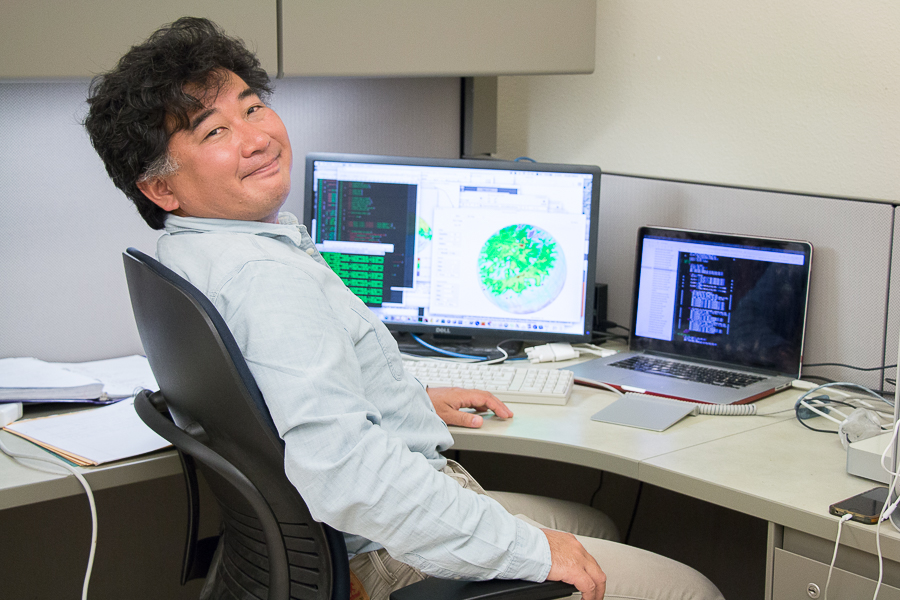
“That’s why we have to model such [a] process from the simulation results,” said Hiroaki Matsui, an associate professional researcher at CIG. “That’s also why we need big simulations and a lot of information.”

Though the magnetic field is not detectable by the human eye, it is important in daily life. It protects the earth from cosmic particles that are in constant contact with the planet, according to Bruce Buffett, a professor of earth and planetary science at UC Berkeley.

However, the magnetic field does sometimes reverse polarity, on average around four times during a 1 million year span. This means the north and south poles flip, which, in theory, would weaken the protection of the magnetic field, as well as affect the way society functions.

“Things like electrical grids would probably start malfunctioning — cell phones, satellites, things like that,” Buffett said. “Understanding what the magnetic field is doing, and the nature of the protection we get from it is, in some ways, a pretty important societal motivator. There’s no evidence that there are extinctions or anything, but from the point of view of a society that developed and relies on electrical infrastructure, it’d be a huge change to the way that we live.”

Buffett stated that the last polarity reversal was about 780,000 years ago, meaning the earth is likely overdue for another magnetic field reversal.

“The good news is we’d probably have lots of warning,” Buffett said. “Presumably with these sorts of models and a little more sophistication, we might be able to make forecasts of whether there’s reversal coming or not.”

According to Matsui, there isn’t a consensus on whether or not earth’s magnetic field helps foster life. Geomagnetic fields have many unknowns, but new information is coming in through seismology observations and other related research.

“All of the scientific software we develop at CIG is open source, and a big part of our mission is teaching students to develop and use high-quality scientific software in their own research,” said Louise Kellogg, a professor of earth and planetary sciences at UC Davis, as well as the director of the CIG, in an email interview. “Our students go on to a variety of careers in industry, government, research, and teaching, and they bring with them the technical expertise they learn here.”

Matsui’s code to model magnetic field and core simulations, called Calypso, was first developed when he was an undergraduate in Japan about 20 years ago. That code is still being used and updated today by Matsui. It can be downloaded by anyone, though people without access to supercomputers are limited in what simulations can be run. The Calypso code is being used in conjunction with Nick Featherstone’s Rayleigh, which will most likely be distributed by CIG in the near future.

“UC Davis is the headquarters of the Computational Infrastructure for Geodynamics, which is funded by the National Science Foundation to advance research using high performance computing for problems like the geodynamo, plate tectonics, and earthquakes,” Kellogg said. “These computer runs on the world’s 6th fastest computer were made through an allocation of computing time on the Argonne Leadership Computing Facility at Argonne National Laboratory. These are essentially a large experiment, generating very large datasets, and the team will be analyzing the results over the next year.”

Matsui is excited to get started on the next phase of research, which includes collecting more data and fine-tuning the results through the use of the supercomputer.

“If we know the solution and we’re going the right direction and everything goes well [from the start], it sounds kind of boring,” Matsui said. “[Research] not going well is pretty fun. But fatal results is almost impossible to make into a paper — who would want to read a paper on something not going well? But, honestly, such fatal results, yes, that teaches me lots of stuff.”


Written by: Jack Carrillo Concordia — science@theaggie.org
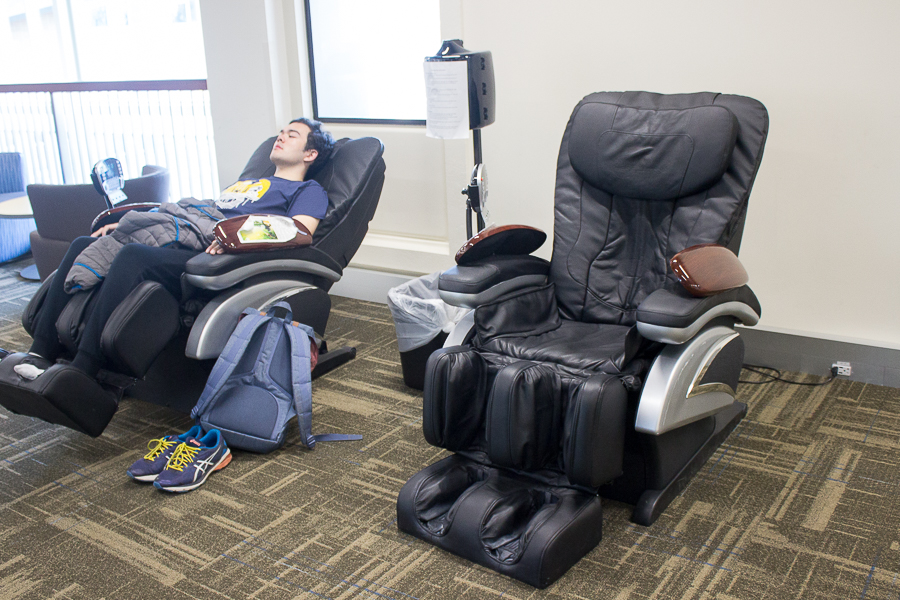
Humor: UC Davis apologizes for raising fees by gifting students two awkwardly-placed massage chairs in the MU

VENOOS MOSHAYEDI / AGGIE

Nothing says “I’m sorry” like an expensive gift

If you thought UC Davis didn’t care about you before, prepare to be proven wrong. Yes, the rumors are true: UC Davis has decided to gift its students not one, but two awkwardly placed massage chairs on the second floor of the MU.

You might be asking yourself, “What did I, a lowly student, do to deserve such an extravagant gift?” Though a very common question, not a lot of people know the answer: the university is giving back to its students because students have already given so much to the university.

At this point, you’re probably wondering what you’ve given the school other than your time and dignity. But that means you’ve forgotten that, while UC Davis has crushed your spirit, it has also depleted your wallet in the process.

Yes, you guessed it, UC Davis has actually been raising student fees in recent years and allocating the money to several causes, all without students knowing.

To be fair, a lot of the causes that students unknowingly pay for through their tuition fees bring a lot of societal benefits. For example, one of these causes just so happens to make sure that La Croix is always available at the CoHo, like, basically all the time. Think of all the possibilities. Pretty cool, right?

Well, the fun doesn’t stop there. Another cause students unknowingly fund is actually a very small cork at the end of the tunnel that was built for toads downtown. Ever noticed that there are, like, no frogs on campus? Now you know why.

You might be alarmed at this point, thinking, “I’m funding the cork to this very niche frog tunnel downtown that I didn’t even know existed?” You might even call this a “misappropriation of funds.” Well, what is a misappropriation of funds to the average student just so happens to be what UC Davis would consider a misappropriation of fun if it didn’t use your money to help the frogs.

So, the next time you think about being ungrateful for all the things UC Davis does for itself as a school and you as a student, remember this gesture of gratitude. Remember the massage chairs.


Written by: Lara Loptman — lrloptman@ucdavis.edu

(This article is humor and/or satire, and its content is purely fictional. The story and the names of “sources” are fictionalized.)

Local nonprofits receive $13,500 in Social Action Grants

0
NICHOLAS CHAN / AGGIE

Congregation Bet Haverim announces 11 recipients of Social Action Fund Grants

Yolo County nonprofit social services organizations that serve young children, the elderly, the homeless, the hungry and others in need will receive $13,500 in grants. Grants to 11 of these organizations are made possible by Congregation Bet Haverim’s Biberstein Social Action Fund and were announced in mid-November by Bet Haverim member Ernie Biberstein.

The Fund was established in 2002 by the Congregation Bet Haverim board of directors to honor Ernie and Hannah Biberstein, who were among the founding members of the synagogue and devoted much of their lives to community service and social justice in Davis and Yolo County.

“This is the 15th year for the awards program,” said communications specialist Joy Cohan. “It’s an annual program where the synagogue committee issues the call for proposals, reviews all of the proposals and recommends the grants, which are then ultimately approved by our board of directors […] The whole impetus behind the beginning of the fund was really to honor the deep commitment that both Ernie and Hannah have [had] toward social issues in the community.

Special consideration is given to new or innovative projects. It is approximately a four-month process, in which a call for proposals is released every fall. Grants range from $500 to $2,000 and are awarded each November. Current Biberstein Fund committee members are congregants Ernie Biberstein, Anne Gieseke, Amy Abramson, Sandy Jones, Joan Sublett and Shoshana Zatz.

“We go over all the proposals that we’ve received and identify the ones that seem to address the greatest need within the county and the ones that also seem to be using the funds that they’ve requested in the most efficient and innovative way,” Zatz said. “We also make sure that the requesting organizations are nonprofit organizations. We go through each of the proposals and discuss their merits. Generally, we have between $12,000 and $15,000 to distribute.”

Organizations receiving 2017 grants are: Ark Preschool, Citizens Who Care for the Elderly, Mercer Veterinary Clinic for the Homeless, Woodland United Methodist Church’s Personal Care Pantry, Yolo Community Care Continuum, Suicide Prevention of Yolo County, Yolo Interfaith Immigration Network, NorCal Tryker, Meals on Wheels Yolo County, Interfaith Rotating Winter Shelter and Make It Happen for Yolo County. A recognition gathering for the recipients will take place in the presence of the synagogue’s Religious School students in early 2018.

“We are very happy to make these awards,” Biberstein said. “We think they will make a meaningful difference to the organizations selected and to the Yolo County community. And it’s important to show our Religious School children the value of supporting the needs of their community.”


Written by: Prachita Chawla — city@theaggie.org

UC creates Title IX student advisory board

MEENA RUGH / AGGIE

UC seeks student input on sexual harassment policies

The UC Office of the President put out a press release on Nov. 14 announcing the creation of an “inaugural student advisory board” which will provide “input on UC sexual harassment and sexual violence issues.”

The board will be made up of nine undergraduate students and eight graduate students, one from each undergraduate UC campus. Board members will serve for 18-month terms beginning in January of 2018.

According to the press release from UCOP, the student board members will be expected to “serve as liaisons to students on their campuses and help advise the university’s system-wide Title IX office on its ongoing prevention and response efforts.”

Kathleen Salvaty, the systemwide Title IX Officer, stated her hopes for the input provided by the Student Advisory Board in UCOP’s press release.

“This board will play a crucial role by providing a much-needed student perspective,” Salvaty said. “I look forward to hearing students’ concerns and ideas, and leveraging their input so we can further improve university policies.”

Rebecca Nelson, the chair of the ASUCD Gender and Sexuality Commission, expressed her enthusiasm and support for the establishment of the Advisory Board.

“This was something that I was a huge proponent of,” Nelson said. “I think it’s really important, given that normally students don’t have access to that information or access to having […] their own voice in regards to how hate crimes or hate violence are handled, or even sexual assault.”

According to Nelson, the majority of information about hate crimes and sexual harassment situations is limited to a few select individuals and is closed off from students.

“A lot of hate crimes and sexual violence reports are completely confidential and sealed from students for the most part, so the only people who see those are the director of Title IX and the directors of the Harassment and Discrimination Assistance and Prevention Program,” Nelson said.

Nelson also discussed the impact this systemwide change may have on UC Davis, potentially leading to increased transparency in university processes when dealing with situations regarding sexual harassment and assault.

“We have tried, and so has the Sexual Assault Advocacy Committee, […] to ask for a task force that interacts with Title IX so students can get an idea of what’s happening on campus, [including] how frats are being held accountable,” Nelson said. “Title IX said no due to federal law and confidentiality. I don’t think that’s something that should bar students from being involved in issues that concern us and are being swept under the rug. I don’t think that administration has appropriately handled a lot of these cases and I think they keep the university’s public image in mind more, or [tend to] protect abusers more than hold them accountable.”

The application for the Title IX Student Advisory Board has been extended until Friday, Dec. 8. Applicants chosen for a seat on the board will be notified the first week of January.


Written by: Priyanka Shreedar — campus@theaggie.org

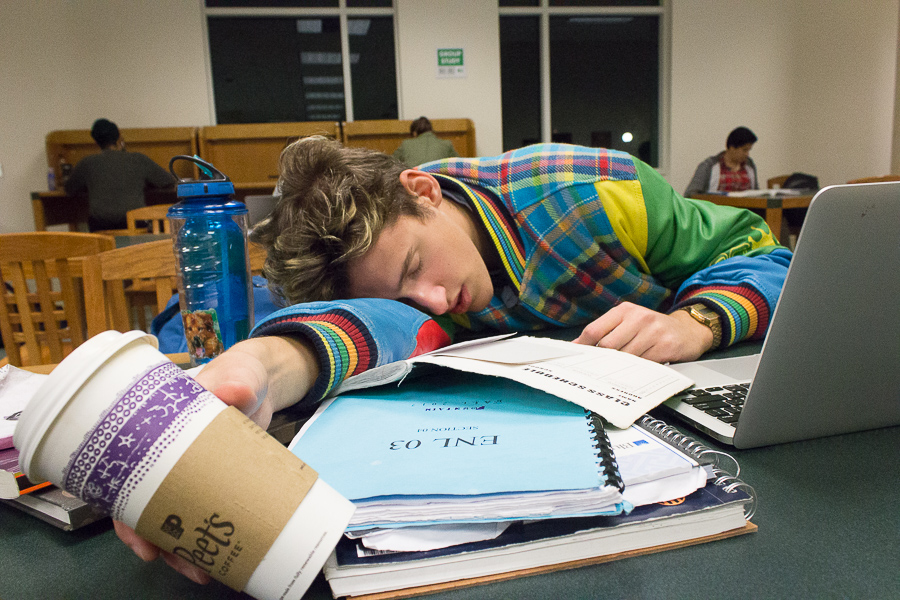
Humor: The proper etiquette behind an all-nighter at the library

RAUL MORALES / AGGIE

It’s that time of year again

If I calculated this weird system of weeks correctly, I believe finals are approaching. But I also could be wrong and might be missing a final as we speak. I don’t know. Anyway, it’s that time of year again when everything you’ve had no time to do actually has to be turned in for a letter that determines your intelligence. What does this mean for you? It’s time to get cozy with Peter J. Shields. It’s cuffing season, and by that I mean you should cuff yourself to the library because you have about three days to do two years’ worth of work. It’s all-nighter time, and I’m going to guide you through the proper etiquette to having a one-night (or one-week) stand with the library and leaving with your dignity intact the next day.

Staying overnight at a place you don’t know too well with people you don’t know at all can really throw you out of your element. And during this jolly holiday season with no time to spare, it’s important that you don’t let the cold and uninviting atmosphere of the library get to you. My advice: Make it feel like home. Bring that Chance the Rapper poster from your dorm and maybe your roommate and their annoying boyfriend, too. And please don’t hesitate to bring your Keurig into the library, because lord knows the CoHo will close before your all-nighter will even begin.

Toiletries are important, and if you’re going to make this work I suggest you bring them all. While there is no shower in the library (although there should be), there are sinks that you should utilize as best as you can. Instead of procrastinating by doing whatever it is you do, go wash your hair in the sink. Since the library is so cold, you’ll probably want to bring a blow dryer. Good thing the Main Reading Room has outlets! Trust me, this study break will leave you feeling clean and refreshed and ready to tackle that honors thesis you were supposed to be working on all quarter.

The thing about an all-nighter is that you’re not supposed to sleep. But if you’re doing this in the healthy and clean way, then you’ll probably want to take quick short naps to restore your REM cycle in intervals of 23 minutes. If you’re like me and can’t sleep on anything other than a Sleep Number mattress on level 45, it’s going to be rather hard for you to adjust to the stiff chairs and fake tile floors that most common folk usually sleep on during their all-nighter power naps. So you probably want to bring your mattress from home. Also, since this requires a strict timer, make sure you choose a proper alarm that will wake you up from your princess slumber calmly and effectively.

The final thing I suggest about an all-nighter in the library is that you try and avoid it at all costs. By all means, please partake in the “all-nighter” festivities of stress and bonding over said stress, but do it with the security that you already have everything done. It’ll be nice to feed off of how unprepared everyone else is, and you will get to partake in all the fun typical actions of not having an outlet or place to sit. But deep down you won’t even care — you’re a prepared student!


Written by: Rosie Schwarz — rschwarz@ucdavis.edu

(This article is humor and/or satire, and its content is purely fictional. The story and the names of “sources” are fictionalized.)

Gary May’s Christmas Card

JULIE TORRES / AGGIE


By: Julie Torres — opinion@theaggie.org


Disclaimer: The views and opinions expressed by individual cartoonists belong to the cartoonists alone and do not necessarily indicate the views and opinions held by The California Aggie.

There and Back Again: The political evolution of a white guy

JAMIE CHEN / AGGIE

I almost took the path to Trump. Here’s how — and what stopped me.

I almost voted for Donald Trump.

Not in the physical, cast-your-ballot sense. I proudly cast my real vote for Hillary Clinton on that fateful November day last year.

Following her election loss, I was angry at my neighbors for voting Trump into office. I was angry with overhyped email scandals and character defamations. I hated how the Trump camp offered a conciliatory hand to Clinton supporters and pulled it back once the confetti had settled.

It was obvious how, instead of bringing the country together, Donald Trump was accelerating its divide.

But my anger did not go away after the election shock had worn off. It changed forms instead. I began feeling besieged by what pundits think is mandatory for understanding Trump’s victory — scrutinizing disaffected white people.

Trump rode the waves of angry white voters. I somehow felt implicated, even though I’d voted for Clinton.

My anger morphed into the dubious haze of white, masculine grievance — the mindset that analysts generally ascribe to the huge section of flyover America that pushed Trump to the presidency. I am white, and I felt blamed.

In the weeks following the election, I began searching for answers about being white and male in America. I don’t fully know why I couldn’t extinguish these thoughts instead of fuelling them — but down the abyss I went.

My descent toward Trump had all the features of an angry white guy.

The online world helped fan the flames. I listened to bullies like Ben Shapiro who firebomb the feminist movement, LGBT community and minority groups with insults and intimidation. I tried to critically assess what I heard, but I failed. I didn’t fawn over these ideas. But I didn’t reject them, either.

In fact, I felt strangely validated when I found opinions online that countered my conventionally liberal values. A new world was opening up for me, and I couldn’t pull my eyes away.

The nadir of my downfall was the Milo Yiannopoulos rally here in January. At first, I was just curious to see the spectacle. That curiosity, however, slowly morphed into quiet indifference — even acceptance — for a man who didn’t seem to care if others thought he was bigoted and hateful. By this point, I’m ashamed to admit, I was almost ensnared by the vileness of Trumpism.

Looking back, this seems odd. The values I grew up with — and currently hold — are antithetical to everything Trump and his supporters represent.

Yet I was ready to cast my metaphorical vote for a man who had bragged about groping women, insulted disabled reporters, revitalized the racist birther movement and received a glowing endorsement from white supremacists.

I wish I knew exactly why I nearly took the path to Trumpism. My support for Clinton never really wavered throughout the whole ordeal. It’s as if I was drawn by the simple idea that one man’s victory doesn’t mean defeat for the nation.

Maybe it’s natural to buckle down and get defensive when arguments blasting Trump elicit the whiteness of America. Perhaps it was because I attend a university with students who abhor Trump, as if I could balance the ideological seesaw by myself. Boy, was I wrong.

In any case, that same university helped set me straight. UC Davis’ intellectual campus environment has the power to refute Trump’s close-mindedness. Professors teach, of course, but they also discuss and provoke. Students don’t just ask questions — they challenge conventional answers.

In such a place, bigotry and selfishness yield to critical thinking and compassion. At a place like UC Davis — and many other institutions of higher learning — Trump’s odious brand of politics is justly grilled and skewered.

Exposure to the diversity on campus — of people, of ideas, of future career paths, of backgrounds — stopped my descent into political and personal chaos. This school helped me refute the silly (and scary) idea that Donald Trump could be sincere and vaguely presidential.

I was able to come to my senses. I managed to reclaim the person I always was.

What worries me is how easy it is to fall prey to Trump’s dogma. I almost did, even as a Clinton supporter.

There is still a large segment of America that loves this man. Trump’s diehards will prod and prick our proper sensibilities until America’s true greatness fades away.

Leaders like Donald Trump tap into anger and malice. They unleash anchors of doubt and frustration into the minds of otherwise good people. And there are good people out there. Sometimes they just need a little help to figure it all out for themselves.


Written by: Nick Irvin — ntirvin@ucdavis.edu

Disclaimer: The views and opinions expressed by individual columnists belong to the columnists alone and do not necessarily indicate the views and opinions held by The California Aggie.

Student-athletes practice, compete during holiday break

0
CAITLYN SAMPLEY / AGGIE

No ski vacations for in-season UC Davis athletic teams

While most students pack their bags and head home after finals, UC Davis student-athletes continue to train and compete throughout December and January. Men’s and women’s basketball are right in the swing of their seasons.

“The teams in season certainly practice during the winter break,” said Mark Honbo, the assistant director of athletic communications, via email. “They do generally take a few days off for the holidays, but they will certainly be back in the gym by December 26. Bear in mind, the men’s basketball team has four games from December 19 through 30. Women’s basketball has a home game on the Sunday immediately after finals week, then a road game that Wednesday, plus two games in New York on December 28-29. So those two teams are very much in season.”

While they don’t get to spend a lot of time at home or hit the slopes in Tahoe, a few UC Davis men’s basketball players are looking forward to winter break because it’s an opportunity to log a lot of hours in the gym.

“Personally, I like winter break a lot,” said junior guard Siler Schneider. “You don’t have to worry about school and it’s just straight basketball and time to take care of your body and kind of relax.”

Senior forward Chima Moneke agrees.

“It’s just a lot of free time in terms of practice and shooting free throws, but not worrying about school is always a good thing,” Moneke said. “It gives us more time to stay in the gym.”

Women’s gymnastics trains a little lighter during the break, but because the season starts on Jan. 8, the team will be back in the gym right after the holidays. Women’s swimming and diving is also in season but will enjoy a break from training.

“That team has an unusual year: a bunch of meets in the fall, a championship-style meet in November, a long break, then meets in January and February (including the conference and NCAA championships),” Honbo said via email.

Winter break for student-athletes may be a break from classes, but it certainly isn’t a break from working toward their goals. UC Davis women’s basketball will be using its break to hone in on and focus on what they feel needs improving.

“[We will be] fine-tuning our habits and just making sure that we are going back and kind of focusing on the details,” said head coach Jennifer Gross. “And the fun thing about this team is we’re 7-0, but we’re still hungry and we still want to get better and have a lot of areas where we feel like we can improve, so this week is about improvement.”


Written by: Liz Jacobson — sports@theaggie.org

Female Richard III

SHEREEN LEE / AGGIE

Shakespeare on a Shoestring produces Richard III through a contemporary lens

Shakespeare on a Shoestring, a unique program at UC Davis, recently had its Fall Quarter performance. The program’s goal is to show Shakespeare through a contemporary lens, highlighting the aspects most related to modernity. The fall production was “Richard III.” While “Richard III” is Shakespeare’s second-longest play, its runtime was trimmed to around 90 minutes, enabling cast members to focus on their desired characters and arcs, specifically the role of women in “Richard III.” Elisabeth Mcgowan, a third-year English and theatre double major and an actor in the production, talked about the focus of the play.

“Our director from the beginning said, ‘I don’t want to concentrate on the male characters. I want to concentrate on the women this time,’” Mcgowan said.

Mcgowan mentioned the value this show and play has for a modern audience.

“[…] I think it’s important for modern audiences to know about it,” Mcgowan said. “Why shouldn’t we know what happened back then to affect us now?”

There is much to take away from the show even with a set not focused on the grandiose.

“It is more casual, that is a word I would use for this,” Mcgowan said. “We want to take the audience in with us […] We will be doing things that engage them.”

The simple design of the show allows its meaning to further resonate.

“It’s not as glamorous, but that’s what we want,” Mcgowan said. “As an audience member I won’t feel like I’m looking at someone on pedestal. It feels more real.”

Due to the large number of roles, most actors had to double or even triple up on roles. Rose Kim, a fifth-year theatre major and actress in the production, spoke to the advantages of this scenario.

“You see [Anne] in her first scene battle it out, she’s very aggressive with Richard,” Kim said. “I get to express, from the same body that plays Anne, the slyness of a murderer and the playfulness of a young boy. All that comes from my body. I think it’s cool for a woman to play not just the seductive scene of Anne.”

Kim also mentioned the interesting job of playing a male role.

“Most of our cast is women, playing most of the male roles,” Kim said. “We’re not hiding the fact that we’re women playing these roles. We’re also not putting [on] a female twist […] We get to flesh out different parts of our humanity through these different roles we get to play.”

The preparation required for this play, like all Shakespearean plays, was nothing short of rigorous.

“Sometimes the language is so thick it just feels like chains,” Kim said. “But we worked on the language and being able to speak Shakespeare without putting something on it […] Don’t do the work for the word.”

Karina Rodriguez, a third-year theatre major and an actress in the production, elaborated on the struggles she found with Shakespeare.

“The hardest thing is the language itself,” Rodriguez said. “It’s so hard sometimes to get what Shakespeare is actually trying to tell us. Sometimes because we don’t speak the language, we don’t get it. There might be a joke in there, but we won’t get it. But then when someone tells us, we can see it.”

Yet as with most projects, enough hard work leads to payoff.

“In rehearsal, I hear it, the work we’ve done,” Kim said. “It sounds like a person is saying it, not some character. And then it becomes interesting.”

Shakespeare on a Shoestring exhibits some of Davis’ best qualities: an enthusiasm to learn and the ability to locate meaning in places often overlooked by others. While they are done for the quarter, Shakespeare on a Shoestring will return with more exceptional looks at Shakespeare and his Elizabethan world.


Written By: Nicolas Rago — arts@theaggie.org

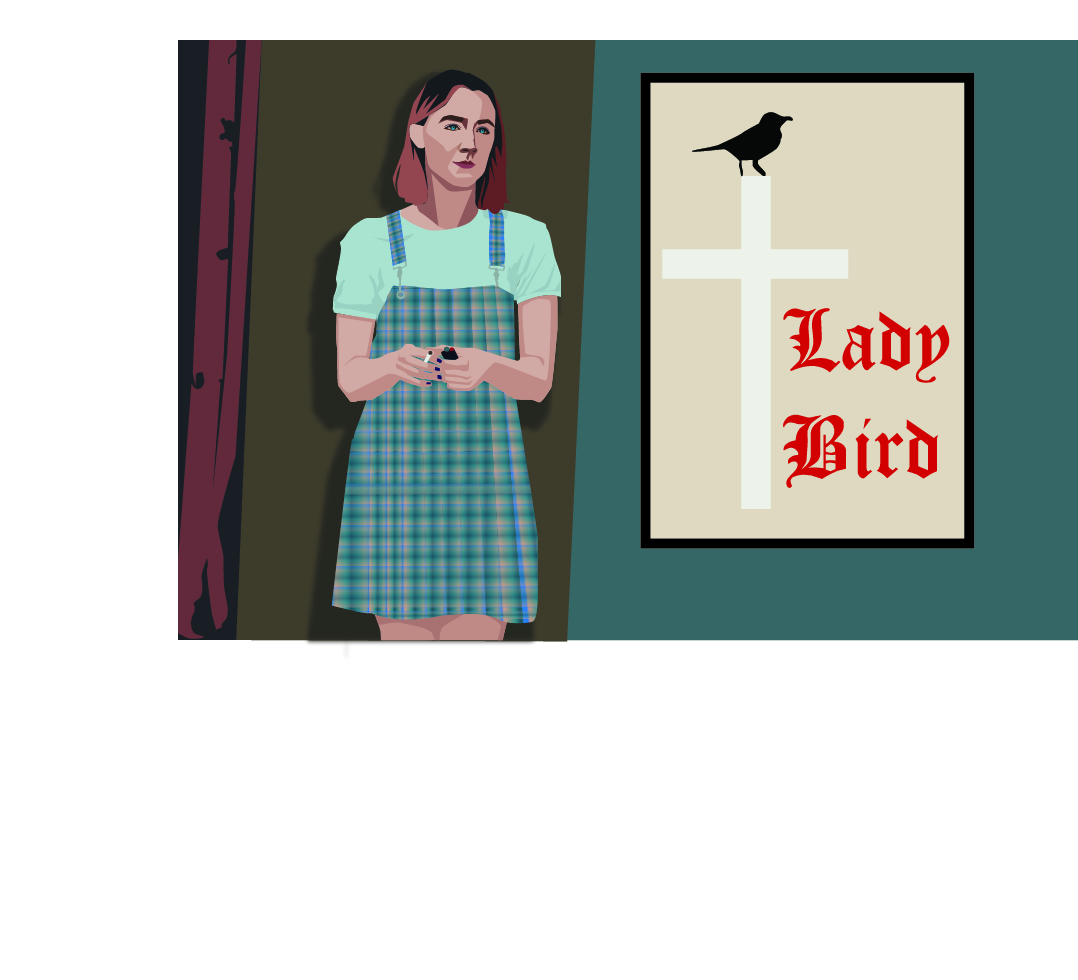
Lady Bird: A Review

ALLYSON KO / AGGIE

Love Letter to Sacramento

Set in the familiar city of Sacramento, Greta Gerwig’s directorial debut is astonishingly tender, unapologetically honest and hits almost too close to home. Gerwig’s writing is raw, with a comedic undertone that exhibits realness and authenticity, while successfully keeping you wrapped up in its story throughout the entire 94 minutes of the film. Additionally, as a coming-of-age story, “Lady Bird” accurately portrays what it truly feels like to be 18 — a trait many of today’s young adult films seem to be lacking.

Christine “Lady Bird” McPherson (played by Saoirse Ronan) feels trapped. Living on “the wrong side of the tracks,” Lady Bird itches to escape the dismal, boring town of Sacramento, which she refers to as “the Midwest of California.” Lady Bird wants culture, and she wants to be surrounded by an environment that accurately reflects her own lively boldness. She doesn’t have many friends, save the scene-stealing Julie (played by Beanie Feldstein), and her social skills are eccentric but wholly endearing. She continuously fights with her mother, who, like her, is fiercely passionate in all that she does. This brings up one of the centermost focal points of the film — the strained yet loving mother-daughter relationship between Lady Bird and her mother (played by Laurie Metcalf).

Ronan, playing a somewhat autobiographical version of Gerwig herself, brilliantly leads the film as she portrays its title character. She makes Lady Bird’s somewhat unreasonable antics fiercely believable, with an intensity and level of earnest naivete that can only exist in a real teenager.

Throughout the film, we follow Lady Bird through her senior year of high school. Gerwig expertly transitions from scene to scene and month to month as the story goes on, showing off her true strengths not only as a writer, but also as a director. From experiencing her first ever heartbreak to applying to her dream universities, Lady Bird lives through the anxiety-ridden transition period from teenhood to the adult world that resonates deeply with college students everywhere. When the odds are inherently stacked against you, how does one coincide dreams with reality? This is a question that Lady Bird constantly struggles with, as she yearns to go to New York, despite her mother’s wishes and her family’s struggling financial situation.

As an audience member, it’s easy to feel frustrated with Lady Bird, not because we dislike her character, but because her actions reflect upon our own lesser qualities. She’s selfish, naive, full of angst and self-centered at times. She screams at her mother, disregards her parents’ hard work, mistreats her best friend and changes herself for a brief time to impress a boy that she likes. And still, we root for Lady Bird, not in spite of her flaws but because she is genuinely kind and loving. She reminds us of ourselves.

For UC Davis students in particular, “Lady Bird” speaks volumes. Sweeping shots of  Sacramento highways, the Tower Bridge and rural skylines evoke some sense of pride for the surrounding area of our favorite college town. While Lady Bird resents the fact that she was accepted into UC Davis — for its close proximity to her home and its fame as an agricultural school — she still deeply appreciates her hometown, although she may not see it quite yet herself.

So do yourself a favor and go see “Lady Bird.” See it with your mom. Remind her that you love her and that you do miss home more than you care to let on. See it for the hilarious references to our beloved UC Davis. Remember the feelings that you felt when you were in Lady Bird’s exact place as a high school senior. Immerse yourself in all that Gerwig has to offer to the audiences of “Lady Bird.” Remind yourself that you are young, naive and probably a bit selfish, but that sometimes, that’s okay.


Written by: Sydney Odman — arts@theaggie.org

Environmental Justice comes into focus

0
KYLA ROUNDS / AGGIE

UC Davis on path to create environmental justice minor

The Civil Rights Movement was undoubtedly one of the most important movements of the 20th century. It was, however, more than a reclamation of ethnic identity and social power for minority groups, but also the catalyst of environmental rights awareness. Thus was born a movement to fight environmental racism that today has developed into a concept widely known as environmental justice.

“Environmental justice is a set of social movements [and] policies, and it’s an academic field,” said Julie Sze, an American studies professor at UC Davis. “It’s a pretty broad umbrella term that means lots of different things; it has lots of different examples. I think the most classic one is that there’s racial disproportionality in environmental exposure, pollution exposure, but also unequal protection from the state from that pollution.”

When Sze was an undergraduate student at Berkeley in the 1990s, she was enrolled in a class called “Race, Poverty, and the Environment.” She learned how interconnected all of these topics could be, and today her research is largely centered around environmental justice. She has published multiple books on the subject.

In 1994, President Clinton issued an executive order stating that federal agencies had the responsibility to address environmental justice. With today’s media culture, environmental justice has become a relatively intuitive concept for much of the general public. With the prominence of events like the Flint, Michigan water crisis and the Dakota Access Pipeline protests, many people seem to understand the presence of the environmental and social implications.

“It’s really easy to get these things on the radar, but it was also frustrating that while at the same time Flint was happening, we had [similar] water contaminant issues in California,” said Amanda Fencl, a fifth-year PhD candidate in geography. “[We’ve had] lead issues and arsenic and uranium and all these other water quality issues in our own backyard and we had celebrities sending bottles of water to Detroit but then nothing [to] Coachella Valley and the Central Valley, [which] have had these similar issues with similar people drinking bad water for years.”

Fencl’s current research strongly focuses on water quality issues in California, and she notes that there are whole branches of environmental justice scholars from all kinds of disciplines. Despite differences in field of study, Fencl recognized the importance of connecting people and the issues, which is why she established a graduate working group specifically for environmental justice.

“[My friends and I] are working in different fields but we all have this common interest and passion for environmental justice work, so three of us made an email list […] sent a Google form out to all the different graduate groups to ask questions like ‘do you think about environmental justice?’ and ‘are you interested?’ and ‘does it relate to your work?’” Fencl said. “We got maybe 60 plus graduate students to join this email list, so if there’s funding opportunities or research or meetings, we will use that as a resource. We’re trying to figure out that now that we have this coalition of graduate students that care and work on these issues, what’s next?”

UC Davis graduate students aren’t the only ones with environmental justice on their minds. In 2015, a group of undergraduate students approached the faculty connected with the Environmental Science and Policy Department in order to get more course content in environmental justice for the majors.

“[As] we started to talk to people as well as the students who were concerned, it became very clear that the issue is much greater than us as the department,” said Marcel Holyoak, the department chair of Environmental Science and Policy as well as an environmental science and policy professor. “I think we came to realize that there’s something that’s much broader on campus where’s there’s quite a lot of students that feel like they’re not getting the coverage of environmental and social justice […] in a way that they want.”

There are opportunities at UC Davis to gain snippets of environmental content in various courses like human and community development, history, English, sociology, environmental studies, American studies and Native American studies. However, there is no succinct pathway to a comprehensive education in environmental justice. This is what led to the idea of creating an environmental justice minor.

“Julie Sze teaches one of the most relevant [EJ] classes, but it has a small enrollment, and similarly Jonathan London at the Center for Regional Change teaches a human and community development class and has that content as well, [which is] probably the biggest class on campus that’s most directly relevant,” Holyoak said. “As a department we weren’t doing much, and it’s clear that something more coordinated was needed across campus.”  

A lot of work has gone into the preliminary steps of creating this minor so far. With a scoping meeting last spring and a significant amount of homework over the summer of what other college campuses are doing in the way of teaching environmental justice, a list of relevant courses at UC Davis and enough other information has been gathered to get the ball officially rolling. But Holyoak points out that the process of creating this minor is still in its early stages.

“We need to get some resources from the Deans in different colleges for things like some more undergraduate advising, some peer advisors [and] a faculty coordinator,” Holyoak said. “If we can get that kind of buy in and would seek letters of support from the relevant departments, and then we would submit it as a formal proposal to the academic senate as a minor […] we’re hoping we can get it done in a year.”

Consolidating the veins of science with community-led research into a comprehensive minor would create a platform for students to develop the proper interdisciplinary education needed to inform policy. Sze sees a number of other benefits to the creation of a minor, including catering to the desires of changing student demographics at UC Davis.

“Students are becoming more and more reflective of the demographics of California, and more and more are students who are first generation or Latino who are interested in these issues,” Sze said. “I’ve met a lot of people [in] the environmental sciences and environmental policy [fields] who are Latino and/or community college transfer students, [who] come in and want to do a certain type of engaged scholarship that’s connected to their communities, but they’re not getting that here.”

Another benefit Sze recognizes is how an environmental justice minor can give students the tools and knowledge they need to realize that they have a responsibility to face the issues exposed by environmental justice.

“I think a white, middle class environmental person also has a moral responsibility to understand environmental justice,” Sze said. “If you go and work in environmental fields, in environmental policy, say at the California Environmental Protection Agency, environmental justice is a real thing you have to engage with. So I think that’s really important to train that population.”


Written by: Marlys Jeane — features@theaggie.org


Social Services Commission meets to discuss West Davis Active Adult Community

0
SHEREEN LEE / AGGIE

Planning committees address Davis housing crisis

On Nov. 20, the City of Davis’ Social Services Commission came together for its monthly meeting in the Community Chambers at City Hall. Among other issues, the commission discussed the proposed West Davis Active Adult Community and listened to a presentation from David Thompson, a co-principal of Neighborhood Partners, LLC, concerning the Affordable Housing component attached to the project. This meeting continues a series of discussions about the project carried out by concerned citizens, potential residents and community developers that began earlier this year. According to the proposal, 150 of the apartments built for the community will be dedicated to housing seniors who need affordable housing, both in and around Davis.

“We want to make these viable for those who are between 30 to 60 percent of the median annual income in Davis, so let us say $8,000 to $20,000-plus would be eligible,” said David Thompson, who is developing the affordable housing component. “Basically, 71 acres is a series of different forms of market-rate housing. But the remainder of the site, four acres, will be for sale to people 55 and above.”

According to Thompson, the waiting list for senior affordable housing on Eleanor Roosevelt Circle is over 200 applications long. The list grows to over 400 applications when all of the retirement communities in Davis are considered. The project would be built on the empty field situated between the Sutter Davis Hospital and the University Retirement Community on West Covell and Shasta boulevards.

The Social Services Commission still had several recommendations for the proposal, including ensuring that the seniors in the affordable housing area would be comfortably integrated with the rest of the Active Adult Community. The commission also advised creating a sliding scale fee for occupants to take part in the homeowners’ amenities provided to the rest of the community, such as the proposed community center.

“The housing issue is definitely an issue that our city council is paying a lot of attention to and is looking for appropriate ways to address it,” said Kelly Stachowicz, the assistant city manager. “The rent will be identified and collected separately, and that’s income-based. […] They [the Social Services Commission] don’t want to single out the residents of the affordable housing project — they want them to be as integrated as possible.”

Stachowicz noted that the proposal will continue to be modified as it makes its way up to the planning committee, which will give additional recommendations to the city council. The city council will review the proposal and recommendations and then vote on whether or not to place the proposal on a ballot. Because the community is proposed to be built outside of the Davis city limits, the ultimate decision comes from Davis residents, who will vote on whether or not the developers should undertake the project.

“This is a great location, and I don’t think we’re ever going to get another opportunity like this,” said realtor and developer Dave Taormino, who is devoting four acres of the entire 75- acre adult community to the affordable senior housing, in the Social Services Commission meeting. “Davis seniors […] and residents are facing problems with housing […] This can help deal with some of those issues.”

According to Stachowicz, the proposal is scheduled to come before the Planning Commission in March or April of 2018. Thompson noted that the project, at its earliest, could be completed by 2022.


Written by: Ahash Francis — city@theaggie.org

Monsanto protesters allege violation of rights

0
CAITLYN SAMPLEY / AGGIE

Anti-Monsanto protesters seek discovery from Yolo Sheriff, District Attorney’s offices

The anti-Monsanto protesters who were arrested in May will go to trial on Dec. 4. The Anti-Monsanto Project consisted of over 30 people who assembled in front of the Woodland Monsanto on May 22 until the Yolo County Sheriff’s office arrived at the scene. Of the people who remained, approximately 10 were arrested.

Monsanto is an agricultural company specializing in sustainable agriculture solutions. Charla Lord, a senior communications manager for Monsanto, elaborated on the company’s work and contributions to agriculture.

“We produce seeds for farmers and growers, and we also manufacture some solutions like pesticides,” Lord said. “We are [also] connected to The Climate Corporation, which is a data information service for farmers where they can register their fields and have data from their fields put together so that they can determine what they need for their fields. It’s really an ag solution company.”

While some people are against Monsanto’s practices, Lord points out that the company is open to having others voice their opinions.

“This is an annual event for some people to protest — they call it the March Against Monsanto,” Lord said. “It’s been going on for several years, and I know it’s been going on outside of Woodland, too. We totally respect people’s rights to speak out and give people a chance to be a part of the dialogue.”

Lord also emphasized, however, that the company remains uninvolved with the protestors.

“After that event, I don’t see us being involved,” Lord said. “In fact, we weren’t even involved that day.”

Bob Saunders, a defendant to the case, recounted the protest at Monsanto.

“We are exercising our First Amendment rights,” Saunders said. “We were protesting because of the nature of Monsanto and their business. Several of us made a decision at that time to risk arrest. [The police] made a decision, gave us a warning and said ‘If you don’t leave the premises, we’re going to initiate arrest,’ and that’s what they did.”

Saunders affirmed that they will go to trial on Dec. 4. In the meantime, Saunders and the other protesters who were arrested have made requests to view any video footage, as they found out that Monsanto may have kept in touch with the Sheriff’s Office to deny them their civil rights.
“When we got to discovery, several of us found that what was missing was video footage, and we also learned that there was communication between Monsanto and the Sheriff’s department,” Saunders said.

Saunders also sent a letter of demand on Nov. 10 asking about any communication between Monsanto and the Sheriff’s department. However, the District Attorney’s Office and Sheriff’s Office have not yet responded.

“I wrote a letter of demand […] asking them about footage pertaining to the event and any other notes about reports and communication like phone, email and meetings with Monsanto and the Sheriff’s Office,” Saunders said. “I am also seeking some advice to see if I need to file a motion to compel because I believe it’s been 16 days.”

Saunders is still persistent about the case and plans to ask for continuance unless he receives the video footage and other proof of communication between Monsanto and the Sheriff or District Attorney’s offices.

“The DA’s Office sent me a card with a return receipt requested without a date, but I figured it’s Woodland,” Saunders said. “The sheriff’s department sent a green card back also — the return receipt card — and it said the date of delivery was Nov. 14, 2017. They haven’t called me back yet. Essentially, I have to decide by Friday, and the judge can approve or disapprove it. If we don’t get the information we requested — which they are legally obligated to produce — I will ask for continuance, and hopefully everybody else will do the same thing because they are looking to try us together.”

Jonathan Raven, a chief deputy district attorney for the Yolo County District Attorney’s Office, stated that the Yolo County Sheriff’s Office investigated this case and arrested the suspects. Its only part in the case, however, was to review the report to charge the protesters.

“Based on this review, we determined the alleged crimes were infractions and did not meet the threshold of misdemeanor conduct,” Raven said. Accordingly, the complaint was filed alleging the lesser crimes of infractions against the defendants.”

While Saunders submitted a letter of demand, Raven explained that the office is disassociated from the case.

“Our office has no role in prosecuting infractions — similar to traffic tickets — so we currently have no involvement in this case,” Raven said.


Written by: Stella Tran — city@theaggie.org


#FiercelyMuslim rally advocates for awareness

NICHOLAS CHAN / AGGIE

Muslim Student Association launches #FiercelyMuslim campaign

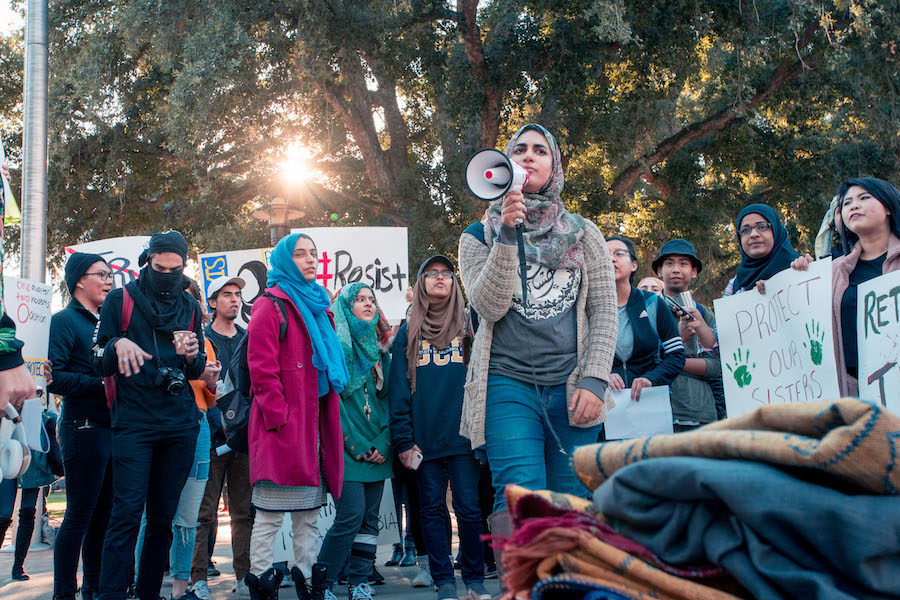
On the afternoon of Dec. 7, the Muslim Student Association launched its #FiercelyMuslim Campaign with a public rally. The event description on Facebook stated that the campaign is “a resolution to highlight and empower Muslim students to be proud and unapologetic in their faith.”

The rally began at the Student Community Center at 2 p.m.; the group of about 60 walked through campus and ended in front of the Memorial Union. The group chanted “Fearless we must live fiercely Muslim,” “Free, free Palestine” and “Two incidents, too much” — as well as other statements — throughout the rally.

At the MU, members of the MSA board and other students took part in an adhan, a call to prayer, and a communal prayer.

The campaign came in response to the second of two incidents against Muslim students on campus. According to a statement released by the MSA, the first incident took place on Oct. 26 when a female Muslim student was “forcibly pulled off her bike by an unknown assailant while riding at the Arboretum; [….] she managed to escape unhurt.” The second incident took place on Nov. 29 in Haring Hall with a second female Muslim individual.

“She saw a man following her with a knife — she managed to escape and report the incident to the police,” the statement said. “The operator on call repeatedly asked her if it was instead a marijuana pipe; it took the pressure of the Muslim Student Association to get the police to send out a campus wide crime report acknowledging the incident — three hours afterwards.”

MSA’s outreach coordinator Hasna El-Nounou, a second-year community and regional development major, described the association’s motivation to organize the rally.

“I think that the intended effect we were hoping to get was to really strengthen the pride and [address the] apologeticness of being Muslim within our own community and to stand in front of everyone on campus, Muslim or non-Muslim, and show them that we are fiercely Muslim, we are fearlessly Muslim, we are unapologetically Muslim,” El-Nounou said.

El-Nounou also described the student response as the rally marched through the campus.

“I felt that a lot of students came to join us or stopped to listen,” El-Nounou said. “A lot of people who didn’t know what was going on before were asking questions and they started to join us, so I feel like [a large] aspect was [that] a lot of people didn’t know about what was going on and that’s half the crime right there.”

MSA’s President Adnan Perwez, a third-year political science and history double major, cited the issue with Safe Rides, a service available to UC Davis students who prefer an alternative to walking alone or in a small group at night.

“Actually implement safety measures on campus,” Perwez said. “For example, one of the biggest issues [is] Safe Rides. [Safe Rides] is supposed to be something that is supposed to protect the student community but it’s constantly failed to do so — […] that has been something that has been asked by the undergraduate advisory to the chancellor [and] it’s been asked by the Black Under Attack movements that happened a few years back. We, as a community, have to rely on organizing our own Safe Rides and walking people back just to make sure Muslim students, especially sisters, are safe.”

Perwez elaborated further on the lack of administrational backing and action in response to these incidents.

“[The administration could] be more cognizant of the very real dangers that all our students face on campus and being much more serious about that,” Perwez said. “When people do report [an incident], taking it very seriously and taking it as your primary responsibility as an administration who is here to protect the lives of students. Those were the only two incidents that were reported to us as the MSA board, but there are many, many other incidents that happened every day against Muslims on campus that [the administration] continually ignore. When you remain neutral in those situations, you’re actually helping the oppression and you’re helping further the atmosphere of hate.”

Perwez discussed the impact he hopes the rally and the #FiercelyMuslim movement will have on Davis.

“This rally is really not an end, it’s the beginning of getting our Muslim student community, which are hundreds strong, actually mobilized and ready to be empowered and [refusing] to be victims of a narrative that has not just been spawned on a local level, but it’s being trickled down from a national level,” Perwez said. “You have the President who, last week, retweeted videos that did nothing more than incite open violence against Muslims. When that happens on a national level, you see it trickle down and happening everywhere — including Davis.”


Written By: Priyanka Shreedar — campus@theaggie.org

Deputy consul to Republic of Korea speaks at UC Davis

DIANA LI / AGGIE

Jimin Kim discussed Korean history, U.S.-Korean diplomacy, North Korean provocations

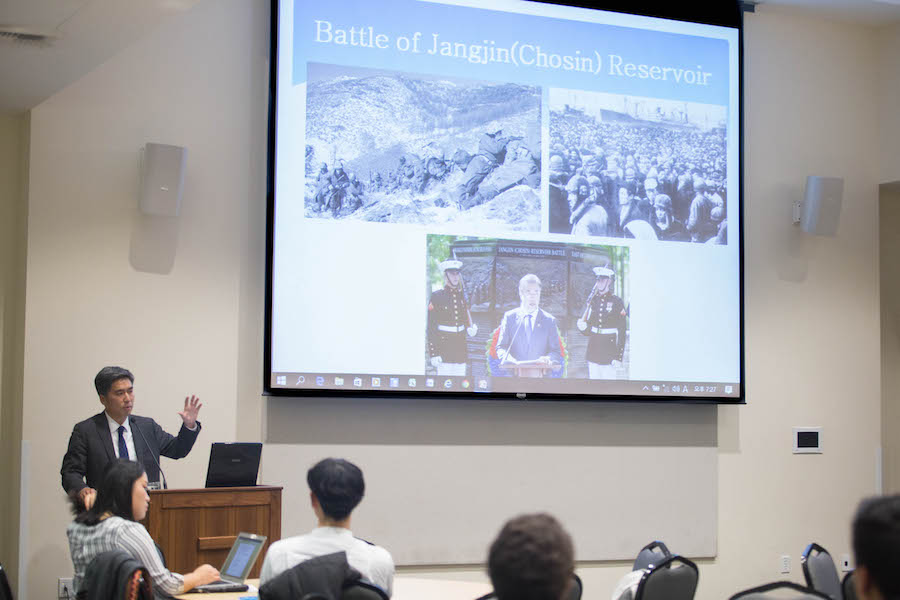
On Dec. 6, Jimin Kim, the deputy consul to the Republic of Korea in San Francisco, gave a presentation to students in the Multipurpose Room of the SCC. Kim’s goal was to educate attendees about Korean culture, discuss the Korean alliance with the United States and address recent tensions with North Korean nuclear testing.

“Our foremost mission is to protect our citizens who travel here, who study here and who come here,” Kim said. “Also, [our mission is] to promote the Korea-U.S. alliance relationship through exchanges, through public diplomacy where we come out and introduce our policies and also interexchange between the two countries on a grassroots level.”

Soo Kyeom Lee, the event’s host and a fourth-year mathematics major, introduced Kim and explained the motivation to accept Kim’s offer to visit UC Davis.

“This event began with a simple ‘yes,’” Lee said. “As soon as I received a call from the consulate general, I knew this was an opportunity that could not be missed. One of the remarkable things at UC Davis is that student involvement is valued. Though student involvement is important, I felt that we lacked an event that truly educated students about Korea and furthermore the relationship between Korea and the U.S.”

After Lee’s introduction, Professor Fadi Fathallah, the associate vice provost for global education and services at UC Davis Global Affairs, provided background information about the relationship between Korea and UC Davis, specifically.

“If you look at just the number of international students from Korea at Davis, we have over 300 — […] that’s almost 5 percent of all the international students,” Fathallah said. “We have 120 to 130 international scholars, visiting professors, visiting undergraduate students [and] visiting graduate students. In the past 10 years, we had almost 2,000 publications with Korean scholars — you see the depth of the record with Korean scholars at the cultural level and the academic level.”

Kim then began a 40-minute presentation, which included a PowerPoint presentation and a series of short videos. He started by discussing Korea’s 5,000-year history. Kim said that the U.S. alliance with the Republic of Korea (ROK) began in 1883. Following the end of WWII in 1945, Korea was separated into the communist North and the democratic South. The Korean War began in 1950, but the peninsula continues to be divided at the 38th parallel. Kim explained that, even after the devastation of the Korean War, which ended in 1953, South Korea has become “one of the most vibrant democracies and advanced economies in the world today.”

Kim then talked about the current state of the Korea-U.S. alliance and the joint effort to address North Korean nuclear threats.

“President Donald Trump recently visited Korea on an official visit,” Kim said. “[Moon Jae-in and President Trump] had very candid discussions about the steadfastness of the ROK-U.S. alliance. Moreover, they agreed to work toward resolving the North Korean nuclear issue in a very peaceful manner. Both leaders reaffirmed the principle that we must maintain a strong stance toward North Korean threats based on an overwhelming superiority power. They also reaffirmed the current strategy, which is to maximize the pressure and sanctions on North Korea until it gives up its nuclear weapons and comes to the table for dialogue on its own.”

In terms of South Korea’s individual efforts to manage North Korean threats, Kim said that his government is relying on continued sanctions that will eventually force North Korea to open a discussion with outside nations. He also said that South Korea wants to promote peace with North Korea, specifically with regard to the upcoming Olympics, and avoid another war on the peninsula.

“My government is also exerting great efforts to make the upcoming PyeongChang Winter Olympic games in February 2018 […] games of peace, which will ease the tensions on the Korean peninsula and create a favorable environment for inter-Korean dialogue, exchange and cooperation,” Kim said.

Kim then used a satellite image of the Korean peninsula at night to show the stark contrast between the North and the South. In the image, the southern area was vibrantly lit, while the northern area was completely dark, save for a small dot of light in the North Korean capital of Pyongyang.

Human rights issues in North Korea were also brought up, and Kim gave a recent example to highlight the struggles of North Korean citizens.

“Recently, a North Korean defected across the joint security area,” Kim said. “He had six bullets shot at him by the North Korean military, which is very illegal — according to the armistice agreement you are not supposed to shoot across the border. We had to take him quickly to the hospital for a surgery, and in the surgery they found twenty or so parasites; it shows the current dire situation of the North Korean people living.”

North Korea has conducted six nuclear tests since 2003, when it withdrew from the Treaty on the Non-Proliferation of Nuclear Weapons. It is the only nation that is no longer part of the agreement and is also the only nation to have conducted nuclear tests in the 21st century. Since 2011, when Kim Jong-un took power, there have been a total of 61 ballistic missile launches.

“North Korea argues that its possession of nuclear weapons is a righteous self-defense measure in order to defend its sovereignty against the U.S.’ hostile policy and nuclear threats,” Kim said. “It seems they are convinced that only nuclear weapons can provide the regime’s survival, enabling them to avoid the fate of other dictators like Gaddafi and Saddam Hussein.”

Kim said that since the most recent nuclear test on Sept. 3, 2017, a new resolution was passed by the United Nations Security Council to impose increasingly restrictive sanctions on North Korea. Sanctions include reducing 30 percent of the oil provided to North Korea, banning all North Korean textile exports, preventing overseas workers from earning wages that finance the regime and banning all joint ventures with North Korea to cut off foreign investment, technology transfer and other economic cooperation.

Kim believes that sanctions like these, combined with the joint power of outside nations, will help to ease nuclear tensions with North Korea.

“The close coordination between the Republic of Korea and the United States and the overwhelming superiority power that stems from the Korea-United States alliance will eventually make North Korea seize its reckless provocations and make North Korea come out to the dialogue for de-nuclearizaton,” Kim said.


Written by: Olivia Rockeman — campus@theaggie.org