58.6 F
Davis

Davis, California

Monday, December 22, 2025
Home Blog Page 598

Updates on California wildfires

FEMA PHOTO / ANDREA BOOHER

Raging Northern California fires spread, new fire sparked in Southern California

California Governor Jerry Brown has declared a state of emergency due to raging wildfires that began on Sunday night in Napa Valley. The initial causes of the fires are still to be determined, but dry weather and extremely high winds have contributed to the flames spreading over more than 50,000 acres of northern California.

At least 14 separate fires, some of the most destructive being the Tubbs fire and Atlas Peak fire, have ravaged through eight counties today, including Napa, Sonoma, Lake and Mendocino Counties.

Firefighters are working to contain the fires but red flag weather conditions due to dry weather, high temperatures and high winds are expected to persist until Tuesday, making it extremely difficult to prevent spread.

On Monday, a new wildfire in Anaheim, Calif. was ignited and a mandatory evacuation order has been sent in the Santa Ana area. As of 3 p.m., this fire has grown to more than 2,500 acres.

Fatalities resulting from the Northern California fires have been slowly increasing and at least 1,500 structures have been lost.

Find more information and updates by referring to the Cal Fire website.

Written by: Gillian Allen — features@theaggie.org

Letter from the Editor

It is my pleasure to welcome all those at UC Davis and the surrounding community back to school. For incoming first-year and transfer students: I hope you find joy and fulfillment at this university and in this delightful college town. For returning students: campus was lonely without most of you here this summer. (I assume, at least. I wasn’t here either.)



My name is Bryan Sykes and I am privileged to be The Aggie’s 2017-2018 editor-in-chief. Briefly, a bit about myself: I am a fourth-year political science major who has worked at The Aggie since my first year, when I started out as a sports reporter.

It is humbling to now be the editor-in-chief of an organization I respect so deeply.

This institution is over 100 years old, and has seen its share of ups and downs.

When I first started at The Aggie we were just publishing online, twice a week. But then during my second year a truly inspiring thing happened: my predecessor, Scott Dresser, mobilized our staff — editors, reporters, photographers, designers, copy readers — and, ultimately, the UC Davis student body, to vote on a small fee increase that brought this newspaper back into print. I saw the measure pass and felt the raw joy and excitement with the publication of the resulting print issue. It was the proudest moment of my college experience. The Aggie wouldn’t be what it is today without that collective monumental effort or the subsequent effort of The Aggie staff to maintain and grow the entire operation. Today, we print each Thursday and publish online five days a week.

I am so proud of the staff of The Aggie and would like to especially thank all those who worked through the summer months to ensure we had up-to-date and relevant content for our readers.

I can promise that we will continue working tirelessly to ensure that we bring timely, quality and reliable news to the UC Davis community. I am proud to lead and be part of a dynamic and collaborative work environment driven to provide an essential service to our readers.

We strive to bring accuracy and objectivity to any content published. We work to hold those in authority accountable while maintaining our journalistic integrity. By no means do we presume to be all-knowing and infallible — we try our best, knowing we will inevitably make mistakes. For any mistakes we make, I ask that you hold us accountable.

We encourage dialogue between Aggie staff and the community we serve, so if you ever have questions, comments or concerns, please do not hesitate to contact me at editor@theaggie.org.


Sincerely,

Bryan Sykes

Editor-in-Chief


Guest: How bipolar disorder II made me a better person

BOOYABAZOOKA [CC BY-SA 3.0] / CREATIVE COMMONS
Receiving an accurate diagnosis can stabilize everyday life

I received a diagnosis of bipolar disorder II this past June, shortly after I turned 20. It was the first ray of light that broke two dark, choking years of my life.

I was put on Prozac last October after being diagnosed with major depressive disorder — a common misdiagnosis for people with bipolar disorder, because who in their right mind would pay a psychiatrist $400 when they’re high on life?

The first week on anti-depressants was like seeing colors bleeding into a grayscale image. Even tears became tokens of hope. But Prozac precipitated my first hypomanic episode. I realized that I had spent a whole day last November staring at Gram-Schmidt orthogonalization while irrelevant thoughts and strong feelings avalanched with absurd intensity. The tragic magnitude of that moment surpassed any external event in my life. My mind became an alien place and certain goals seemed unreachable.

About 2.6 percent of the U.S. population, or 5.7 million adults, are affected by bipolar disorder every year, according to the National Institute of Mental Health. The behavioral markers of bipolar disorder include rapid mood swings from extreme lows to manic highs, racing thoughts and excessive energy during manic phases, difficulty concentrating and controlling impulses and suicidal thoughts during depressive phases. What distinguishes bipolar I from bipolar II is that people with bipolar I have at least one manic episode characterized by hallucinations and delusions, whereas people with bipolar II do not experience psychotic symptoms during hypomania. Bipolar disorder remains one of the most stigmatized and debilitating mental disorder of our time. Exactly two anonymous essays written by undergraduates with bipolar disorder showed up the last time I googled the keywords “bipolar disorder + Harvard Stanford MIT undergrad.” This is why I’m writing this article under “B. Ye” and not my full name — I’m worried that my future employer will decide to not hire me based on this article and that insurance companies will not accept my application due to liability issues.

Receiving the diagnosis of bipolar II this June was a godsend. The right medications (in my case, lithium and lamictal) restored order to my universe. I’ve been able to perform cognitively demanding tasks and remain emotionally stable ever since. Do I slip into days of low productivity? Yes, but not more often than your average Joe. The caveat is that medications relieve symptoms and help people make better decisions, but they don’t shift baseline cognitive functions or dramatically change personality traits.

Living with psychiatric disorder is easy if you’re disciplined and determined to do well. Every decision you make is a dot on a graph: Do you want an upward trajectory or a downward spiral? If an irregular sleep pattern has triggered manic episodes in the past, for example, then choosing to study in the library over going to a bar on a Friday night is a no-brainer. And if you struggle with a psychiatric disorder or experience difficulty optimizing your workflow, beware of the top ten mistakes of behavior change from Stanford Persuasive Technology Lab.

Life doesn’t happen to us — it happens for us. Resource constraint can be a good thing if it makes you more resourceful. Having wasted a big chunk of life due to unfortunate circumstances and poor judgments is a good thing if it fuels you with a sense of urgency and leaves you a better decision-making framework. It’s cliché but true: Life is a self-fulfilling prophesy.


Written by: B. Ye

Disclaimer: The views and opinions expressed by individual columnists belong to the columnists alone and do not necessarily indicate the views and opinions held by The California Aggie.

Cartoon: Financial Aid

JULIE TORRES / AGGIE


By: Julie Torres

Disclaimer: The views and opinions expressed by individual cartoonists belong to the cartoonists alone and do not necessarily indicate the views and opinions held by The California Aggie.

Humor: Five ways to ask a fellow Aggie if you can sit with them at the CoHo

TAYLOR LAPOINT / AGGIE

Solutions to the problem no one is addressing

It can be daunting to approach a stranger and ask to sit with them, but with the recent influx of admitted students to UC Davis, space at the CoHo has become rare and highly prized. If you’re lucky enough to get there at the right moment, which is mainly 8 a.m., then you might get a spot. However, if you’re like most of the student body who realized that acai bowls are served all day now, you probably don’t rush to get to the CoHo in the morning just for a seat anymore. After conducting a series of interviews, polls and statistical analyses, I’ve found the five most successful ways to ask somebody if you can share a seat with them at the CoHo.

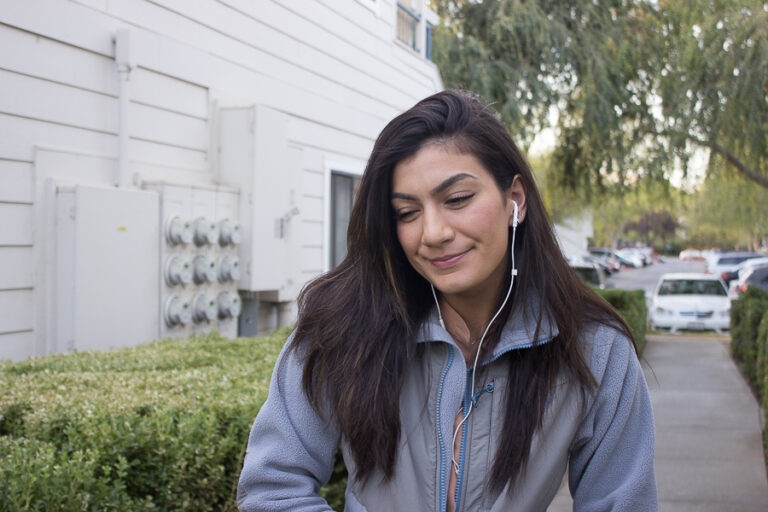
Ask if you can have a bite of their pizza or if you can borrow their computer, and when they say ‘no,’ ask if it’d be okay if you just share the table with them. While unconventional, this “Door in the Face Technique” allows for a shock factor — they’re so thrown off by your first request that they’ll let you sit with them because of how normal your follow-up request seems.

Pretend to be stopping by to tie your shoe on the chair, and then fake a phone call with your grandma and motion if it’s okay that you sit. While this method requires a drawn-out fake conversation on the phone, the chances that somebody will interrupt you and ask you to leave while you’re talking to a family member are very low. Make sure to use the phrases “I’m so happy that you called — some nice person just let me sit down, so now we can have a long conversation” and “Thanks for the birthday wishes, Grandma. It means so much.”

Go up and hug them from the back, and say something along the lines of, “Oh my god I haven’t seen you since freshman year, how are you? Do you mind if I sit here?” Their guilt in not remembering who you are will allow them to let you sit for as long as you want. Bonus points: Sometimes the awkwardness might even drive them to leave the table, and then you’ll have a table to yourself.

Spill coffee on them as you’re walking by and express sincere apology. Most likely they’ll get up to clean themselves, and you can promise to “watch their things” and get some rice for their phone you just ruined. Eventually if they come back, they’ll thank you for watching their things and probably just let you stay at the table.

While this is the most unconventional and rare method, if nothing else works, I suggest you approach them and ask, “Do you mind if I sit here?” and if they say no, pretend you heard yes and sit there anyway.


Written by: Rosie Schwarz — rschwarz@ucdavis.edu

(This article is humor and/or satire, and its content is purely fictional. The story and the names of “sources” are fictionalized.)

Guest: Learning how to fully maximize and appreciate the Davis experience

BRIAN LANDRY / AGGIE FILE

After three years at UC Davis, here are the most important lessons I’ve learned

As a fourth-year undergraduate, UC Davis is my second home because the people here are family. This school has presented me with so many opportunities for academic, athletic and professional growth, which wouldn’t be possible without the bright and welcoming people populating our campus. As I embark on my final year as an undergraduate student, I want to share with you all — especially incoming freshmen — the lessons I’ve learned from my three incredible years here.  

The beauty of UC Davis being such a prominent research institute is that most of your professors actually use what they teach you. I took econometrics with Professor Taylor last spring and was nervous going in because of its reputation for being difficult. What surprised me from the first day onward was his passion and visible desire for us to understand the material. It turned out that, during the summer following our class, Taylor was going to Rwanda to measure how Syrian refugees were affecting the country’s economy, using many of the data collection principles he’d just taught us. Knowing that the skills I had learned were about to help a society of people was a very powerful moment because it helped me value my education on a higher level and made me think really hard about how I want to use my skills post-graduation to make a serious impact.

Davis is a huge campus with an even larger student body. Coming from a high school of only 750 students that took up one suburban block, I knew I was in for a culture shock. I had to find a way to make a smaller community for myself so I wouldn’t feel lost in the bustle of campus life. Thankfully, my community came from athletics and getting involved in the Student-Athlete Advisory Committee. SAAC helped me break out of my comfort zone and meet people I normally wouldn’t have. I get to work with other campus organizations and people from different sports teams to improve the student-athlete experience and give back to the Davis community. I truly believe that the most important step you can take your freshman year is to get involved in smaller groups because it’s a way to bond with people who share your interests. Whether it be clubs, IM sports, Greek life or volunteering, please sign up for something this quarter, because in a 500-person lecture hall, it’s not as easy to get to know your classmates.  

Speaking of 500-person lecture halls, go to office hours and discussion — they really do matter. I was struggling in one of my first statistics classes freshman year because I couldn’t get my code to run for the life of me. I didn’t do anything to fix it for the first half of the quarter, either, because it failed to stand out on my to-do list among the workload for other classes and my competition schedule. Once I finally went, it took at most two minutes for my professor to figure out that I’d been writing semicolons instead of commas in every line of code, which the program didn’t accept. Please don’t make the same mistake I did; go to office hours for any uncertainty. Your professors are there because they want to help you, and it’s a way to get quick answers to questions you can’t ask in lecture.

Lastly and most importantly, I’ve learned to have fun at Davis. I know this is the cheesiest piece of advice I could give you, and your parents probably told you the same thing when you left home, but school is hard. It’s so easy to feel crushed under the high standards we set for ourselves. Having a good time with your friends is the best way to break up trips to the library and intense study sessions. You can take a day trip to Tahoe or San Francisco, grocery shop at the farmers market, have a picnic in the arboretum — anything. When you’re on the brink of graduation like myself, those are the parts you remember, not your perfect paper from ENL 003. As I begin what I like to call my Davis “victory lap,” I can’t help but be thankful for my coaches, professors and friends that have made my time at UCD so enjoyable. I’ll be doing everything I can to make this year pass as slowly as possible, and I hope you take the time to appreciate everything our campus has to offer as well.


Written by: Aislinn Dresel

Disclaimer: The views and opinions expressed by individual columnists belong to the columnists alone and do not necessarily indicate the views and opinions held by The California Aggie.

Introvert: The inverted side of the extroverted coin

VENOOS MOSHAYEDI / AGGIE

Introverts get the short stick, but misconceptions are slowly eroding

This is an age of social and identity stratification, and many groups are making their voices heard. Until recently, one such group has mostly avoided the limelight.

Its members make up between a quarter and a third of the American population, in a country inherently antithetical to their particular genetic code. They’re often found avoiding extra-large groups and overanalyzing last night’s social festivities. They’re introverts, and society has yet to adequately recognize them.

We can thank Susan Cain for attempting to move introversion awareness into mainstream conversation. Her book, Quiet: The Power of Introverts in a World That Can’t Stop Talking, signaled a potential shift in the dialogue about personality traits when it was first published in 2013. A lawyer by trade and a self-described introvert, Cain concocts a blend of narrative and exposition to demonstrate how introverts are perceived in the blatantly extroverted United States. For the introverts among us, it’s a welcome revelation.

As Cain illustrates, American classrooms are especially conducive to extroverted learning. Desks arranged in “pods” and an emphasis on group activities –– usually in elementary and middle schools, admittedly –– leave out the “oddball” kiddos who can’t function as well in such social learning environments.

Even in high school and college classrooms, biases toward extroversion can provide interesting case studies for personality differences. Class discussions in the United States tend to focus on answering quickly and smoothly, rather than allowing for introspection and a dutiful thinking period before the big question-answer session. This tends to favor the extrovert with a quick, clever answer (on the surface) as opposed to the more analytical tendencies of the classroom introverts. Both methods can be useful, but one often supersedes the other.

American business models piggyback off this classroom-based approach. Corporate meetings are often the extrovert’s domain, with an emphasis placed on articulating ideas and voicing opinions or strategies that can leave the more soft-spoken of us out of the picture.

This is not to say such classroom or business models are wrong or unnecessary. To the contrary, speaking up is vitally important in all facets of life. Yet there are misconceptions regarding introversion that are facilitated by these normative models of sociability — which is why Cain’s work could prove (and perhaps has already proven) monumental.

For example, the word “shy” is not synonymous with “introverted,” although some introverts indeed fall under this designation. The socially awkward guy at the dinner party could indeed be an introvert, but most introverts have normal-to-excellent social skills, despite the stereotypes. What distinguishes an introvert from an extrovert, then, is not the adequacy of social fluidity and conversation, but rather the amount each is willing to experience at a given time.

The typical introvert also requires more time alone to “recharge” than the typical extrovert, and it’s unfortunate that this byproduct of our unique personalities is often portrayed as anti-social behavior.

Since there are probably over a hundred million introverts in the United States alone, it’s important to recognize the implications of our most basic of personality traits. Susan Cain writes that introverts “listen more than they talk, think before they speak, and often feel as if they express themselves better in writing than in conversation.”

Perhaps that’s why many newspaper staffs are chock-full of introverts. And perhaps that’s why, if you’re an introvert looking for a place with similarly disposed people, this particular newspaper fits the bill. I hear we’re hiring.


Written by: Nick Irvin –– ntirvin@ucdavis.edu

Disclaimer: The views and opinions expressed by individual columnists belong to the columnists alone and do not necessarily indicate the views and opinions held by The California Aggie.

The Voice of Reason

JON MARCANTONI / COURTESY

UC Davis Writing Series and Hispanic Heritage Month

As tensions increase within the Latinx community, many feel called to protect and assist our citizens of the world. Likewise, many feel called to listen to their voices, which are louder than ever and have more to tell than just how they journeyed here. Overwhelmed by immigration stories, Jonathan Marcantoni, publisher and co-founder of La Casita Grande Press, set out to create an environment that would invite the world to see how diverse the Latinx community really is.

“I had worked in two other small presses and saw the lack of representation of writers of color but also the lack of representation of narratives from Latin America or Latin American-descended people,” Marcantoni said. “We seemed to only function as immigrants or as people facing identity crises […] most of these narratives were anti-Latin American, with the United States being depicted as the land of promise and progress, while Latin America was just a backwards desert of nothing.”

La Casita Grande Press comes at a time when the arts are often intertwined with politics (think Hamilton). Moreover, this company gives the Latinx community a chance to find home. This will be home for all of those that want to open up their minds, hearts and bodies to something bigger than what they know.

“There is obviously a very hegemonic perspective being represented in mainstream arts — white, cisgender, and heterosexual — [and] therefore I would make the claim that we [members of the Latinx community] are not well-included,” said Josiah Quirós, a fourth-year English major. “However, this also comes with a narrow geographic focal point. In the greater picture of national arts and discourse, Latinx voices are rarely, if ever, heard, but that shouldn’t stop us from creating and demanding our own spaces.”

Quirós went on to describe their vision for the Latinx community.

“We have to take matters into our own hands in order to be seen and respected,” Quirós said. “I don’t want commodified respect; I want true visibility.”

As it is currently Hispanic Heritage Month, it is a fitting time to celebrate the Latinx community. According to fourth-year sociology major Rachel Mayes, we need to see how we can be further educated.

“[Giving a voice to all types of people of color] acknowledges that people are already speaking and telling their stories, and it gives the proper attention to these voices,” Mayes said.

La Casita Grande publishing company aims to change perspectives about what Latinx people can do and think. Marcantoni wants them to all stand out. However, banding together does not mean grouping all parts of the Latinx community into one. La Casita Grande aims to show the flavor of Sofrito, Chicharrón, empanadas, salsa and more. Marcantoni wants to give a voice to every person of color. But the motivation goes beyond color; it is the person who is going to be made important.

“One must recognize that Latino is not a culture,” Marcantoni said. “It is a conglomeration of multiple cultures, and it dehumanizes those people by lumping them into a single group. We don’t treat European people as a singular culture.”

In celebration of Hispanic Heritage Month, Marcantoni has opened up his publishing company to UC Davis students by doing a series on UC Davis writers. The requirements: the submission can be a video, audio clip, short story (no more than 10 pages), poem (no more than three) or excerpts from a play or screenplay (no more than 20 pages). The topic can be anything. Videos can be films or music or performance. The deadline for submissions will be Oct. 30, and anyone can submit. Interested applicants may send submissions to publisher@lcgeditores.com with the subject line “CAMPUS SERIES.”


Written by: Akaylah Ellison — arts@theaggie.org

A Midsummer Night’s Dream in Davis

YARCENIA GARCIA / DAVIS SHAKESPEARE ENSEMBLE

Davis Shakespeare Ensemble recreates classic play inspired by City of Davis’ centennial

In celebration of Davis’ 100th birthday, the Davis Shakespeare Ensemble is presenting “A Midsummer Night’s Dream” using themes representative of Davis’ small-town quaintness. Taking place in the present day, this play transforms its characters into everyday Davis citizens — bikes and all. The Davis Shakespeare Ensemble, established in 2010 with primarily UC Davis students, continues to grow annually, expanding its programs to neighboring cities such as Sacramento. In light of the city’s big anniversary, Director Rob Sallas went all-out in the reproduction of this cherished play by appealing to the community while retaining the whimsical elements of the original story.

“To honor Davis, we were inspired by the city itself when coming up with the design of the show,” Sallas said. “There’s lots of Davis elements incorporated into it, and bringing in modern elements really brings the play to life. The mechanicals (sic) are working at different stores people may recognize from Davis and the lovers are inspired by UC Davis college students. We also wanted to capture the fun and quirky energy of Davis, and we show that distinctly through the bikes. Our fairy characters frequently ride unusual bikes throughout the play.”

The unconventional use of strange vehicles on stage certainly makes the show amusing, albeit extremely challenging. Kyle Stoner, the actor playing Puck, learned how to maneuver several eccentric vehicles during play rehearsals.

“We have about 25 bikes and had to create parking spaces in the wings of the floor on stage,” Stoner said. “It was a huge issue of figuring out the traffic patterns. We have one bike that’s a tandem bike, and we had to think of how to turn it around. I’m riding about six or seven different vehicles in the show, so I had to have my own parking lot backstage where I have all my things lined up, and we have to make sure we’re not parking anything in front of it. The bikes themselves are really fun and awesome, but the choreography of making everything fit and move in a tiny space in the dark with people running around was really difficult.”

Another challenge was finding a unique way to perform a play that most people are familiar with. Stoner had to somehow play a newer version of Puck while still exhibiting the character’s quintessentially mischievous traits.

“It was hard to figure out how to play Puck because I had to strip away all those notions I had of what people expect the character to be like,” Stoner said. “One of the things that’s great about Shakespeare in general is that he created characters that are relatable. In that way, playing Puck is not part of a time period […] In our version, since it’s set in present-day Davis, the fairies are city pedestrians. I wanted to figure out which modern-day person will most closely relate to the traits that Puck has, because Puck isn’t just a character. He’s a collection of qualities.”

Costume design was also an essential element in the making of this play. Fourth-year design major and assistant costume director Kaylee Pereyra believes that costumes are an essential component of a play like “A Midsummer Night’s Dream” — it can either make or break a crucial character.

“I think each costume has its own little flare for the character and overall a very cohesive and visual display,” Pereyra said. “Puck is actually one of my favorite characters in the show. He has one static costume, and the designer tried to make him David Bowie-esque. He has this shirt that has a cat eating pizza on it, and it’s the perfect outfit for him. I’m a big advocate of costumes, and I don’t think they’re appreciated. The costumes for this show totally complement the world that the director created and add to the attributes of the characters.”

Aside from the various bikes and set design in this rendition, A Midsummer Night’s Dream’s humor is what continues to make this play a crowd favorite. Using inside jokes relevant to Davis’ culture, the audience should expect to laugh incessantly throughout the show.

“The most rewarding aspect of the play is the humor,” Sallas said. “The play is consistently funny throughout, and we’re lucky that we have really great comedians in our cast. Our actor playing Bottom in the show is a professional actor from the Bay Area that we brought out, and he is very funny himself, which inspired us to up our game. The humor’s been the most enjoyable part.”

The Davis Shakespeare Ensemble will be playing “A Midsummer Night’s Dream” at the Veteran’s Memorial Center Theater from Sept. 20 through Oct. 15 at 8 p.m. Tickets can be purchased at the Eventbrite page.


Written by: Becky Lee — arts@theaggie.org

Thriving Pink in the fight against breast cancer

MARY LIU / COURTESY

Local nonprofit organization provides grants for breast cancer patients

In an effort to ease both the physical and emotional pain of cancer, Thriving Pink, a local nonprofit in Davis, set out to help those fighting breast cancer through grants and other support.

During the month of October, Thriving Pink hosts what it calls “Pinktober,” when the organization prompts the community to shop locally. Local stores in Davis, like the Davis Food Co-op, will be joining to contribute a portion of their sales toward these breast cancer grants.

Mary Liu, the executive director for Thriving Pink, expressed how much the organization means to her.

“Each of us has personal inspiration based on our relationships with others,” Liu said. “In our community alone, over 4,000 women are diagnosed in their lifetimes. This is an eighth of women. For us, that’s our mothers, sisters, our neighbors and our friends. For me, one of my very dear friends, Ann Murray Paige, […] passed away from breast cancer. She started a nonprofit, and I wanted to carry on her work and her spirit that she wanted to continue, which was so dear to her heart.”

Liu described how she has grown along with the organization as time went by. She was initially motivated by her friend who had passed, but the organization has developed to become something more for her and the community.

“I learned throughout the process,” Liu said. “For me, this has been a journey. It was devastating, not just for me, but for her and the whole community. For me, it was to honor and continue her nonprofit in a way I can do so. I started Thriving Pink to engage the community and other people so they can have the opportunity to give back as a thriving community in a direct way.”

Not only is this organization involved with grants, but the board also tries to help ease breast cancer victims’ suffering in whatever way they can.  

“This is actually our second year, and our mission is to help local breast cancer survivors thrive,” Liu said. “Our vision is to make sure no one goes through a diagnosis of breast cancer alone. What we strive to do is to support local women in our Davis community.”

The organization has grown so much already even though this startup is still rather new. So far, they have three core programs, one of which is the Granting Pink program.

“A highlighted program is Granting Pink, which provides individual grants to local women to help them and their families for up to $1,000,” Liu said. “Last year we provided $20,000 to 18 women, and we would like to double that in a few years. All our programs are free on a monthly basis.”

There will be room to grow as more people become involved by either helping through their local businesses or simply spreading the word and shopping locally.

“We try to be very visible, and we try to have a presence with a tangible and meaningful program,” Liu said. “We need to come together and try to make a positive difference any way that we can. Until there is a cure, we will continue to work together to make a difference.”

The grant has helped many people with breast cancer. One of the recipients was Chasity Balthazar, who recounted her experience with chemotherapy and her difficult times. While the worst has passed for her, Balthazar is still fighting her battle.

“I was diagnosed with breast cancer last year, and I applied [for the grant] because not all insurance covers all medical needs in regards to cancer treatments, aside from the fact that I was not working and my husband was not working because he took time off to take care of me,” Balthazar said. “It was such a difficult and dark time in my life, and Thriving Pink helped me through that.”

And the organization provided more than just the grant money. Balthazar, like other cancer patients, was going through emotional turmoil along with loved ones. Thriving Pink provided emotional relief by becoming more involved with each recipient.

“Not only did they just do the grants for me; Mary, the owner, then followed me. It was not like they just granted me to pay for medical expenses,” Balthazar said. “It was the little things; she gave me a gift certificate for a facial. I went in to get the facial and she was there and she had bought me lunch. She goes above and beyond in such a dark time in my life.”

Thriving Pink provided an intimate setting for Balthazar. This created a special bond between the recipient and the organization on a more personal level.

“Thriving Pink and [I] will always have a life long relationship because they made me feel so good during my darkest times,” Balthazar said. “I will always be there for women to help them feel the love that I felt.”

Her own diagnosis was not Balthazar’s first experience with cancer.

“My battle was tough,” Balthazar said. “My career was a pediatric oncology nurse. I knew what kids went through, and I saw how chemotherapy affected families. But being and going through it gives me a different perspective. It’s much closer to my heart, and I understand what my patients and families go through.”

Balthazar now has the drive to help others once her battle finishes. She is still facing treatments, but she now wants to help others experiencing the same fight.

“It was a double-edged sword,” Balthazar said. “It was scary since I knew what was happening, but it gives me the fight and the voice to help others, not just women, but families and patients. It gave me that drive and force to help people in similar situations because I know what it feels like and I know how the children feel. Now I can pay it forward and help others in that way.”

As a breast cancer survivor, Brelle Rohwer described her motivations for helping the organization.

Being a breast cancer supporter and survivor myself, I love to be able to pay forward,” Rohwer said. “I received a lot of support while going through treatment, and I’m trying to help in any way I can with women going through the same thing. They’re all strong and incredibly impressive women. I feel privileged to be able to work with them.”

Hospital bills can pile up, but Thriving Pink’s grants help with so much more than just treatment bills.

“Thriving Pink allows others in the community to support these women through our programs and through their direct donation,” Rohwer said. “That money can go towards anything they need like prescription medications, babysitting, groceries and anything at all. Last year, one of the recipient’s mother traveled back and forth from Florida so the money went to airline tickets for her.”

Thriving Pink works to lift a huge burden for those fighting breast cancer. Since October is here, there will soon be a number of activities for the community to join in and support the battle against cancer.


Written by: Stella Tran — city@theaggie.org

International Cycling Safety Conference held in Davis

BRIAN LANDRY / AGGIE

Researchers from around the world come to Davis to discuss bike safety

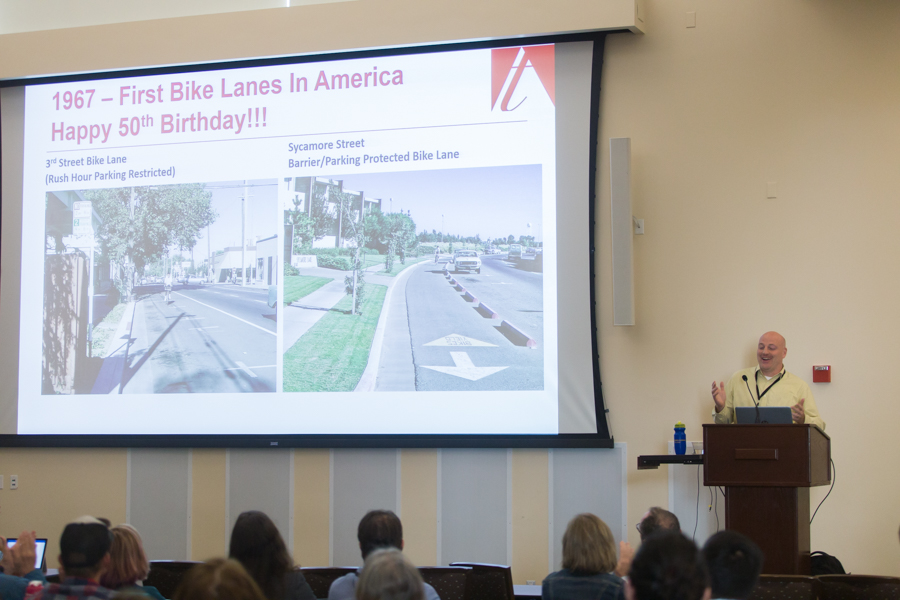
About 160 researchers, professionals and practitioners from around the world attended the International Cycling Safety Conference in Davis last week from Sept. 21 to 23. This year marked the sixth anniversary of the conference as well as the first time it was held in the United States. According to Professor Emeritus Mont Hubbard from the Department of Mechanical and Aerospace Engineering at UC Davis, one of the organizers of the conference, while the United States has a cycling rate of 1 percent, Davis has a cycling rate of 22 percent, making it a fitting host for the conference. This year also marks the 50th anniversary of the very first bike lane made in the United States, which is here in Davis. Participants in the conference came from 11 different countries, bringing together a variety of backgrounds and perspectives on the issue of cycling safety.

Professional academics shared their research in an effort to increase safety for cyclists, as well as promote awareness of the benefits of choosing cycling over other forms of transportation. The diversity of the researchers enabled different countries to learn from one another, particularly the United States being able to learn from European countries. Hubbard also explained that countries such as the Netherlands and Denmark have cycling rates as high as 30 percent nationally, forcing them to be more concerned about protecting the lives and safety of cyclists due to the much higher number of people cycling. Meanwhile, the significantly lower cycling rate in the United States has resulted in laws that are more concerned with drivers than with cyclists.

“The car has dominated our landscape,” Hubbard said. “The last two keynote speakers talked about that idea of how our previous policies of accommodating the automobile have really made it much less safe for what we call vulnerable users, which are pedestrians and cyclists. When they get run into they’re 85 percent likely to die. So they pointed out how much this vehicular cycling philosophy has distorted the guidelines and standards that exists in the U.S. for road constructions.”

The topics that academics presented encompassed a wide variety of issues, while also maintaining unifying themes. Katie Wittmann, a cycling urban planner from Toronto, expressed her excitement about the research.

The conference presentations struck a useful balance between common themes and variety,” Wittmann said. “Some studies revealed complementary results, and others offered unique perspectives or newly explored topics. We learned about everything from driver behavior to helmet legislation and testing to intersection treatments.”

While bringing together researchers is beneficial in sharing knowledge and furthering studies of cycling safety, being able to actually effect change has proven to be an entirely different issue. Practitioners attended the conference in an effort to encourage implementation of the research. Tara Goddard, a Ph.D. student at the School of Urban Studies and Planning at Portland State University and a former bicycle and pedestrian coordinator for the City of Davis, explained that the issue lies in translation between researchers and practitioners. However, efforts are being made to establish a stronger connection between the two.

“[We] as researchers are trying to be better at translating, and now there’s more opportunities such as social media to better translate what we’re finding to practitioners,” Goddard said.

The conference being held in Davis was a huge honor for the city, as participants all enjoyed the local ambiance while being here.

“I appreciated that the event was held in Davis, where I felt very safe cycling all around the city,” Wittmann said. “It wasn’t the simple painted bike lanes on many streets that impressed me, but rather the off-road bikeways and key connections between blocks, schools and parks. Seeing the number of students biking to school and to campus each morning put a huge smile on my face.”


Written By: Hadya Amin — city@theaggie.org

Six winners named in Chancellor’s Residence Interior Design Contest

IAN JONES / AGGIE

Gary and LeShelle May will incorporate all six design submissions into their home

Instead of choosing one winner, UC Davis Chancellor Gary May and his wife, LeShelle May, have decided to combine six of the submissions for the Chancellor’s Residence Interior Design Contest. The six winners, consisting of students, alumni and staff, were each awarded the first-place prize of a $500 Amazon gift card.

Due to the fact that Chancellor Emerita Linda Katehi moved her own furniture into the Chancellor’s Residence, the university distributed the old furnishings throughout campus buildings. Katehi’s departure in 2016 gave the Mays an opportunity to refurnish the house by using ideas from students and alumni.

The six design contest winners consisted of three alumni — Susan Garrison, who designed a living room, Lien Sanchez, who also designed a living room and Rose Cabral, who designed a study — as well as three students. The three students are Deanna Chung, a graduate student at the school of Veterinary Medicine who designed a living room, 2017 graduate Alyssa Fumagalli, who also designed a living room and third-year psychology major Francesca Francisco, who designed a study.

The Mays decided to incorporate all six plans into their redesign.

Additionally, Chung won a separate People’s Choice Award for her living room design. For this honor, she earned a $150 Amazon gift card and Aggie souvenirs on top of her $500 prize. Chung spoke about how this opportunity helped aid her adjustment to campus as a new student.

“I found the competition through the UC Davis Memes for Egghead Teans Facebook group,” Chung said via email. “I was taking an online class and learning how to use Adobe Illustrator and Photoshop. I wanted to put my skills into use for a real life project, and this seemed like the perfect chance! I […] am new to this campus, so learning about all the different facets of Davis life while preparing for my submission helped expedite the learning curve.”

The Mays hosted a celebratory dinner for the winners on Aug. 9. Expressing gratitude, LeShelle May explained the couple’s decision to amalgamate the six ideas as opposed to choosing only one first place winner.

“Each submission was carefully presented and we loved something from each of the design presentations,” LeShelle told UC Davis News. “The final results of how we incorporate aspects of each will be truly representative of the Davis community.”

The chancellor emphasized the importance of UC Davis students and alumni working with the UC Davis administration.

“We’re thrilled that we had students and alumni eager to participate in the contest,” Chancellor May said to UC Davis News. “We believe the Residence belongs to the UC Davis community, and it was important to us that the community could help shape the space.”


Written by: Aaron Liss –– campus@theaggie.org

Field hockey finds hope in loss to Cal

0
BRIAN LANDRY / AGGIE

Aggies get wake-up call in tough loss

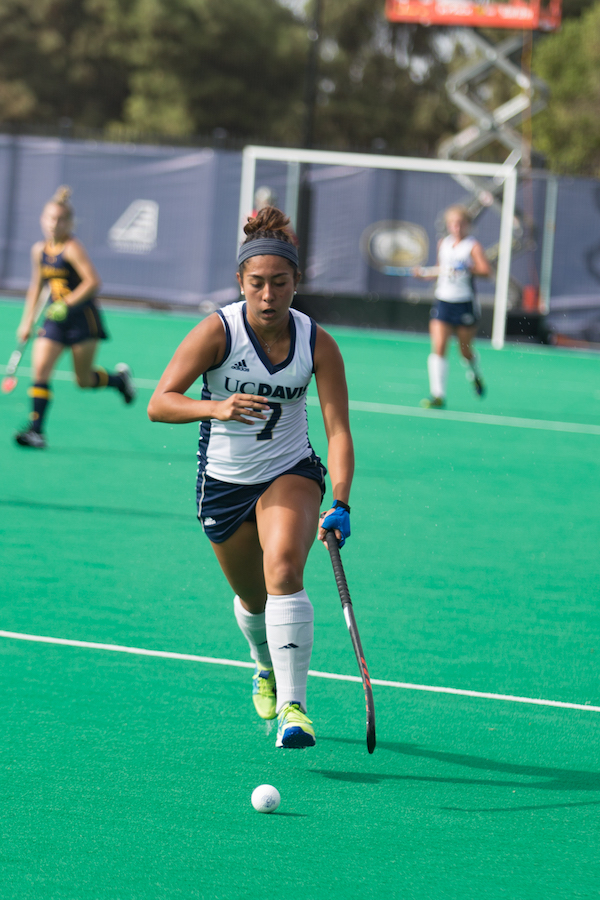
The UC Davis field hockey team went into its game against Cal on Friday, Sept. 29 sitting with a 1-7 record and looking for whatever boost it could. It has been an injury-plagued season for the Aggies, and Friday was no exception as the team took the field with only 14 available fielders and five fewer subs than it is used to. While UC Davis did not get the win, losing 3-2, the well-rounded Cal team was challenged by the Aggies in a strong effort.

After a rough start, including two goals from Cal forward Megan Rodgers in the first six minutes, the Aggies settled down and decided to let their play dictate the rest of the game. Sophomore goalkeeper Chelsea Bigelow had a full plate, amassing 10 saves and allowing three goals on 20 shots, enduring five corner penalty plays in the process.

BRIAN LANDRY / AGGIE

On offense, the Aggies had two goals themselves, with sophomore forwards Lauren Gengarella and Tatiana Arias each getting goals in the second half. However, the two early goals proved too much to handle. It is these early game lapses which head coach Britt Broady is trying to address with her team.

“We have been discussing how to figuratively ‘punch first,’” Broady said. “To attack first, rather than judging the game; judging, ‘Are we going to be in this? How are we going to play?’”

While they did get the victory, Cal had to work hard for the three goals, amassing 20 shots throughout the game, and scoring only one after the initial onslaught. Bigelow did not let the team’s early struggles get to her. She embraced the challenge.

“I kind of came out just trying to go full force,” Bigelow said. “But goals get by and I just have to shake them off, and I think they just just make me stronger.”

Broady expressed great joy with Bigelow’s goalkeeping, crediting her for going out there every game with a great attitude and work ethic.

“I can’t speak more highly of her maturity, and just her demeanor in the backfield is what we want,” Broady said. “She’s so unassuming and so level-headed in her communication, and is pulling these amazing saves out and really keeping us in the match throughout the game.”

Broady also gave special praise to junior backfielder Kelly Kramer, crediting her defense throughout the game.

“Nobody that was standing around her had an easy day today, and the team had her back today,” Broady said.

BRIAN LANDRY / AGGIE

All in all, both Broady and Bigelow saw the game as a positive step toward their ultimate goal: a goal that is not only focused on the remaining games, but future seasons as well, as many of the team’s players are first and second years.

“Going into the next practice we really need to prepare just like we did for this game,” Bigelow said. “Just have confidence in ourselves, and I think we finally we got the confidence we need in order to go forward.”

After losing to Ohio State Sunday 1-0 with the game on the verge of overtime, the Aggies will next take the field in Philadelphia at noon on Friday, Oct. 6, as they take on Saint Joseph’s. They will return home Friday, Oct. 13 for a match against Stanford at 4 p.m.


Written by: Bradley Geiser — sports@theaggie.org

Humor: Student starts club for cricket, fake sport made by globalists to push deep state’s agenda

DAVID SURTEES [(CC BY 2.0)] / FLICKR
CRICKET IS NOT REAL. FAKE NEWS.

Sidney James, a second-year communications major, has taken the initiative to start a club on campus in an attempt to bring together students of all backgrounds and passions for their mutual love of one thing: cricket.
The Aggie cornered James outside of her class at SciLec to get more information out of her regarding her plot. She talked briefly with us about her motivations for trying to uproot civilization as we know it.

“I’m starting a cricket club because it’s a sport I really enjoy, and I believe that it could really bring people together so that we can bond over something we all like,” James said. “Who do you write for again?”

James seemed shifty and uncomfortable while she was giving this answer, so we can only assume based off of the circumstantial evidence that she was lying.

You see, the answer to all this is really very clear: Cricket is a foreign invention by the globalists and communists to try to creep into America’s universities. It’s all a part of Hillary Clinton’s plan to infiltrate American politics and impressionable young American minds. But it’s not just Hillary, oh no. It’s the entire deep state that’s trying to attack Donald Trump, our great leader-in-chief.

Cricket is not a real sport. Come on, you think they would make a sport named after such a benign insect? Really? It’s obvious that cricket is a codeword of some kind, meant to activate sleeper agents who are now rising up to take our government. This is why we need to keep our borders nice and secure. Because of fake sports, like cricket.


Written by: Aaron Levins — adlevins@ucdavis.edu

(This article is humor and/or satire, and its content is purely fictional. The story and the names of “sources” are fictionalized.)

Winning when it counts

0
NICHOLAS CHAN / AGGIE

Women’s soccer gets first conference win against Rainbow Wahine

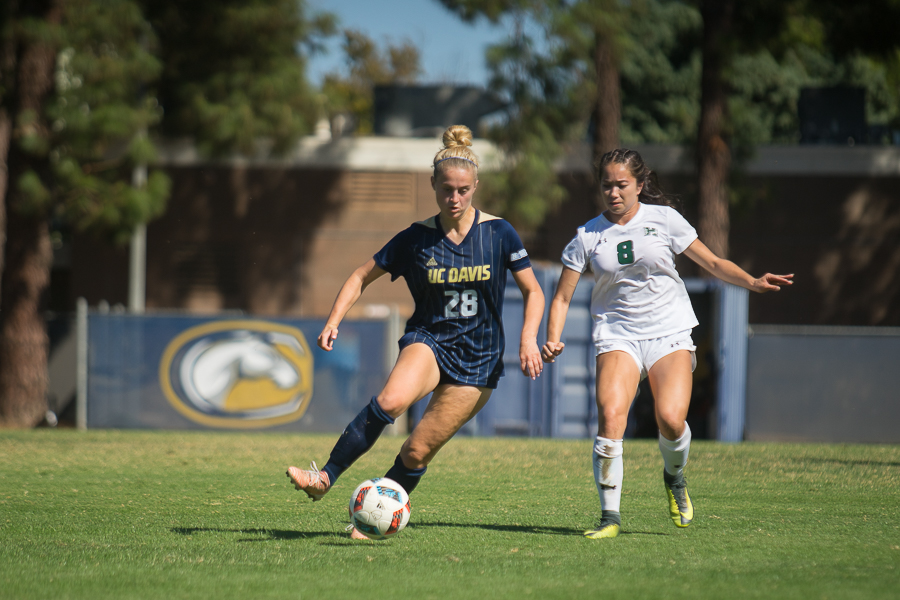
The UC Davis women’s soccer team took the field hours before the men’s team to start off the doubleheader last Thursday, Sept. 28. The team saw some firsts, including its first Big West Conference win to start its record at 1-0 in conference play, 2-9 overall.

NICHOLAS CHAN / AGGIE

Initially, the Aggies struggled to keep the ball at their feet with the Rainbow Wahine dominating the field with clear passes, control and communication. A total of six ideal shots on goal by Hawaii resulted in junior goalkeeper Alexis Smith’s first two saves of the game and set the pace for the rest of play. The Aggies fought hard to maintain possession long enough to get the ball close to the net, but luckily, one of the four shots on goal in the first half lead to the only goal of the game by sophomore midfielder McKenna Moriarty.

Moriarty’s first goal of the season and second career goal was enough to secure the game for the Aggies.

The win put an end to the five-game losing streak the Aggies were facing and accomplished what head coach Twila Kaufman called a “fresh start.”

Smith also proved vital to the Aggie’s success in accomplishing her 17th career shutout, tying the school record. Smith’s 11 saves were more than enough to stop the Rainbow Wahine’s total of 19 attempts on goal.

NICHOLAS CHAN / AGGIE

The second half saw more Aggie possession, but still the ball remained at the feet of Hawai’i midfielders and forwards, creating an intense game not only for Smith, but for the Aggie defense as well. Junior defender Kristie Braken-Guelke was the glue to the strong Aggie defense and was there to recover a one-on-one loss on either side of the field. Braken-Guelke’s speed matched that of Hawai’i’s determined forward Sonest Furtado and midfielder Raisa Strom-Okimoto.

The Aggies will continue their conference play today at 4 p.m. on Aggie Soccer Field against Cal Poly, looking to gain momentum toward a winning conference season.


Written by: Veronica Vargo — sports@theaggie.org