

53.8 F
Davis

Davis, California

Friday, December 19, 2025
Home Blog Page 623

Humor: 7 ways to say “Help, I can only speak in listicles”

LUCY KNOWLES / AGGIE

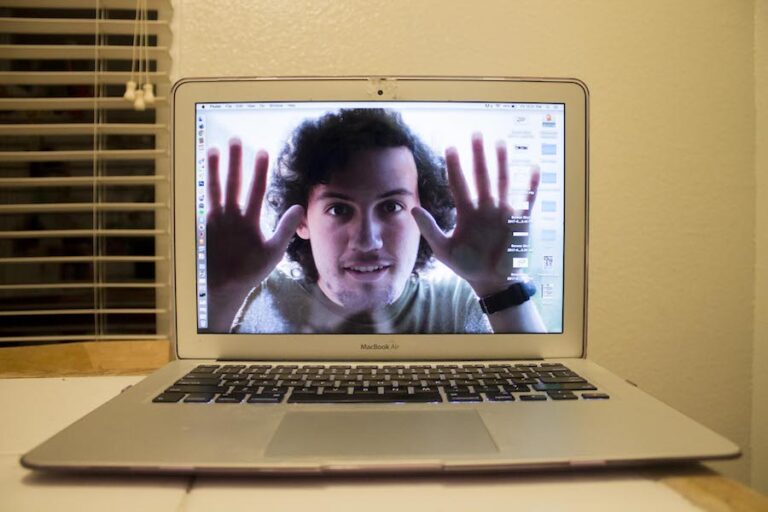
Please help me

  1. This is kind of like if Tron and Buzzfeed had a really ugly baby. Like Donald Trump Jr. ugly.
    1. Anyone who has been trapped in a computer before knows that Tron is actually not that far off in terms of depicting the computer world. Also Donald Trump Jr. is here with me. And trust me, he’s super ugly.
  2. I haven’t seen my family in two years.
    1. Relatable, right!? Gotta love estrangement and isolation. Anyone else know that feel? Emoji!  
  3. There is no God in this place. Only 0101010110.
    1. Once you have entered this cold computer world, God cannot find you. Only tween girls taking a quiz to find out which doctor from Doctor Who they are come to this pixelated wasteland. For reference, I got David Tennant.
  4. You will not BELIEVE how much I miss warm human contact!
    1. I miss the caress of another person. I miss the emotional connection you can have with another human being with a single glance. I long for a picnic day with a woman I love. We’ll gather our items in a basket and create a wonderful meal together that we can share. The birds will chirp a symphony for us as we skip through the beautiful fields of dandelions and lilacs. I miss talking for hours under the warmth of the sun, and deep into the night as the stars serve as our ceiling. I miss love.
  5. I feel like I’m perpetually trapped in horrifyingly bad journalism.
    1. This is like being trapped in a Tab article and having no way to get out. Can you imagine anything more horrific? Just article after article after article about falling asleep in class and “DOES ANYONE ELSE KNOW THAT FEEL?” God has forsaken me. God has forsaken us all.
  6. Oh shoot, I’m running out of ways to tell you I NEED HELP.
    1. I didn’t mean to waste that bullet point. Where is the delete button?
  7. I am TRAPPED. This format is like a house with no doors.
    1. I can’t communicate the severity of my situation because of this God-awful listicle format. Seriously, all I can say are really vapid, unsubstantial things and then plaster an eye-catching gif over it. Bonus points if the gif has a total of 10 frames. This is a serious issue, guys. There’s no food in here. I don’t want to fade into obscurity. Tell my family I love them.

Written by: Aaron Levins — adlevins@ucdavis.edu Twitter: @aronlevins

(This article is humor and/or satire, and its content is purely fictional. The story and the names of “sources” are fictionalized.)


Humor: I’m tired of PC culture

FARAH FARJOOD / AGGIE

It’s obvious that personal computing culture has gone too far

I’m tired of PC culture. That’s right. You heard me.

You see it all over the Internet. It’s everywhere, and it has been progressively infecting our society, especially the Internet. And if you ask me, it’s only going to get worse in the next couple of years. I’m exhausted of it. I’m tired of seeing it on places like Twitter, Tumblr, and Reddit.

And I know what you’re thinking. “Oh Aaron,” (whiny voice), “PC culture is essential for creating and sustaining a platform of communication and mutual understanding. It has helped bridge the cultural divides that have in the past been insurmountable.” Well, guess what? You sound like Bill Gates, who is a nerd, which means you are also in fact a NERD. Who you should  strive to sound like instead is Steve Jobs, who I think would agree with me regarding my feelings toward PC culture if he were still around.

See, the thing with Personal Computing Culture that bothers me isn’t really that it exists. If someone else wants it, that’s fine. Let them do their thing. America is great because you are allowed to say and post whatever you like. My point is that I don’t want anything to do with it. Stop shoving it down my throat. I just want to be able to go on Safari and conduct my usual Sunday routine: memes, some tea and perhaps a little bit of human target practice. But every time I boot up my laptop (it has that sweet skin on it that makes my computer look like marble) and hop onto the World Wide Web, all I see is an incessant obsession with PC culture. It’s all over Facebook. And frankly I’m just completely fed up.

Personal Computing Culture has, ever since Windows 98, just been getting more and more pervasive online. And now, coupled with the already annoying obsession with Bill Gates, we also have Personal Computer gaming, which has been unexpectedly much bigger than PC culture alone. You have these infernal devil games, like Call of Battlefield, or Hay-lo. Who knew kids would enjoy violence so much? That explains what’s wrong with the world, if you ask me. All these “gamers” have ruined memes for me, as they seem to have taken over and flooded the meme market.
Above all, what I can’t understand is why PCs are so much more popular and successful. I mean, Macs don’t even get viruses. How could you, a rational decision maker, even think of buying a PC if there were even a risk of getting a virus that could hack your life. Insanity. If you own an Apple device, all you have to do to keep viruses off your computer is erect a Steve Jobs shrine, pray at it every day and perform a sacrifice in the name of the great and mighty Steve.

So there it is. I’m tired of PC culture. I’m tired of seeing it on the Internet and in my daily life. I’m tired of all the people that don’t realize that an Apple is a better computer than a PC.
Written by: Aaron Levins — adlevins@ucdavis.edu

(This article is humor and/or satire, and its content is purely fictional. The story and the names of “sources” are fictionalized.)
Humor: TA’s tiny office doubles as portal to Narnia

ANH-TRAM BUI / AGGIE

Mr. Tumnus turns out to be a philosophy TA

Ever walk inside your TA’s office and get immediately washed over with a feeling of pity and disgust?

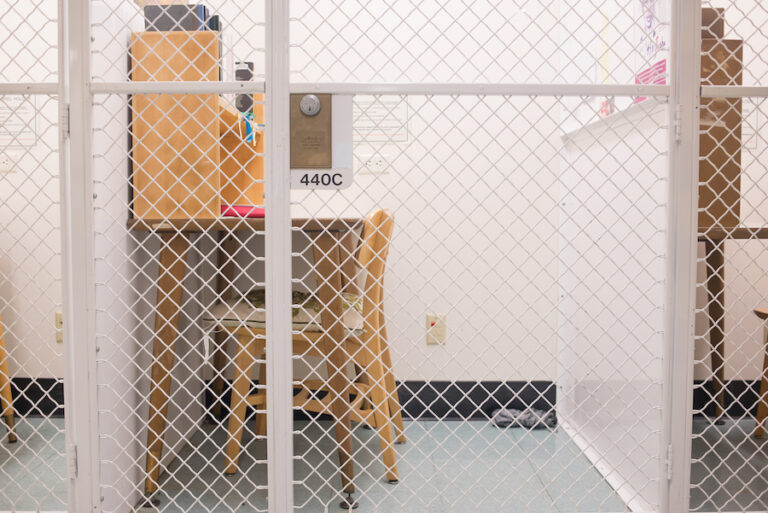
You see a dirty little room with three or four sweaty students stuffed together behind their wobbly desks. Immediately upon entry, your nostrils are hit with a wave of BO and take-out food. You can’t help but feel a little sorry for them, crammed into their tiny office for years, endlessly grading papers and doing the mindless grunt work of tenured professors.

Luckily one special TA, Julius Longbottom, had a nice surprise waiting for him when he arrived at UC Davis this year as a doctoral candidate.

“I had no idea what to expect, really,” Longbottom said. “I was the new guy, so my department put me in the tiniest little closet of an office in the most remote part of the Social Sciences and Humanities building. At first, I was upset. The office literally doubled as a closet for the English department. Having to do work between smelly clothes was annoying. But then, after a few months of practically living in a closet, I made a very special discovery.”

Julius had found an actual portal to Narnia. Yes, the magical land full of talking lions and beavers. That Narnia.

“It was pretty cool,” Julius said. “I was like ‘woah, that’s Narnia.’ I also had just taken a tab of acid while grading some philosophy papers, so the whole experience was pretty surreal.”

Julius, upon discovering Narnia in his office, spent a lot of time there.

“Yeah, I had walked in and then this crazy dude with goat legs was like, ‘What’s up dude?’ And I was like, ‘I don’t know, man.’ Then this talking lion was like, ‘Hey bro I need you to be the king of Narnia for a bit — do you have time?’ And I said sure because I wasn’t doing much else besides grading some papers. So one thing led to another and I became the king of Narnia. Then I got married to a wonderful woman, had some lovely kids, made some lifelong memories with some really cool friends and even waged war with an evil ice queen. Well anyways, my wife died, and then the talking lion was like, ‘Okay bro time to go.’ So then I walked out the way I came. Once I got back into my office, I was young again. Crazy.”

Julius had lived a long, fulfilling life in Narnia.

“Yeah, I miss my kids now and stuff, but it was a good run. It was kind of a letdown to go from being the admired king of a land full of talking animals to just another TA stuffed into a cramped sweaty office, grading papers until my eyes bleed. But I’m just chilling.”

Julius went back to grading papers. Mr. Tumnus joined him to help.
Written by: Aaron Levins — adlevins@ucdavis.edu

(This article is humor and/or satire, and its content is purely fictional. The story and the names of “sources” are fictionalized.)
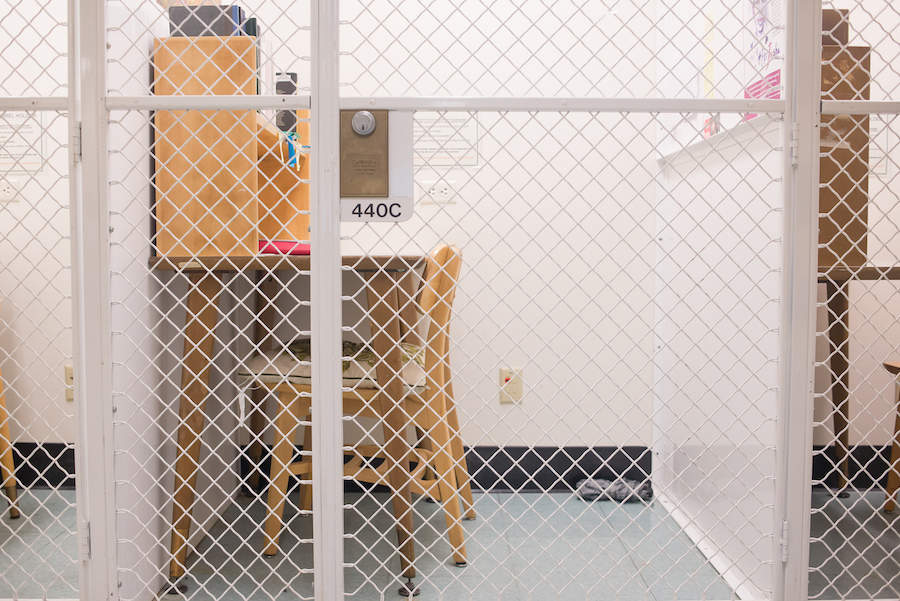
UC Davis student chapter of California Women’s List holds quarterly panel of powerful women

NICHOLAS CHAN / AGGIE

Event provides insight from professionals in racial justice advocacy, nonprofit work, state government

The Panel of Powerful Women event, a three person panel discussion, was hosted by the UC Davis chapter of California Women’s List (CWL) on April 26.

The panel consisted of Assemblymember Cristina Garcia (D-58), the director of public affairs for Planned Parenthood Cheri Greven and the diversity and inclusion director for The Greenlining Institute Danielle Beavers.

Briana Mullen, an official CWL representative, moderated the panel. Discussion topics included concerns about entering careers in politics and advocacy, involvement in local politics, the importance of mentorship and how to navigate as a female in male dominated fields.

Greven addressed the issue of the lack of diversity in government offices such as congressional staff.

“[When] we are lacking diversity, we need to be thinking about how we can do a better job of not just having women’s voices at the table but our LGBTQ and different faith community leaders also need to be involved,” Greven said.

The discussion expanded toward policies affecting employees from marginalized communities.

Greven explained how members of Congress have autonomy when deciding policies such as parental leave or establishing laws about parental leave at a federal level.

She further expanded on how autonomy has been problematic in the past as certain congresspeople, including progressive ones, have implemented parental leave policies with miniscule benefits which have affected women employees as they entered motherhood and even a legislative director of a congressional office, a gay male, as they adopted children.

“It was speaking up and having more voices is what was effective in getting those policies changed,” Greven said.

Garcia echoed the same notion with regard to actively speaking up about unjust issues.

“Sometimes you’re going to be the only one in the room speaking and you’re not going to have that support system […] but you have to have the courage to keep speaking,” Garcia said.

In her continuous efforts to address issues surrounding gender inequity, Garcia, in collaboration with Assemblymember Lorena Gonzalez Fletcher (D-80), has authored Assembly Bill 479, the “Common Cents Tax Reform Act,” in order to end the tax on diapers and female menstruation products and to recognize them as health necessities.

According to Garcia, eliminating the “tampon tax” would result in governments having a gender neutral tax code, since this is the only gender specific item that is taxed. Garcia claimed that the financial impact would be less than one one-hundredth of a percent of the state budget.

“This speaks to what our values are, do we value women’s health,” Garcia said. “I have talked to 300 women in my district […] that can’t afford hygiene products because they have to feed their family.”

Although the bill was a unanimous bipartisan bill, Governor Jerry Brown vetoed Garcia’s bill because of the financial impact it would have.

Next, Mullen asked the panelists about navigating male-dominated spaces when young women are entering professional fields and how to find mentors among teachers and peers.

“Connect with others with whatever facet of their identity, be vulnerable and learn from each other,” Beaver said.

Greven agreed that mentors can be found not only in professionals but also classmates and peers.

“Why reinvent the when you know there is people around you that have done amazing things,” Greven said. “Ask them how they did it, lean on your mentor […] they can be someone you’re in a club with, or play sports with and people you feel comfortable connecting with, a mentor shouldn’t judge you.”

Students in the audience asked about getting involved in local politics as university students.

“I recommend volunteering in a campaign,” Garcia said. “Even if you never go back to campaigns it’s important to see what that’s like or volunteer at the office of an elected official, there are non-profit […] it’s important to do what do you like […] first you have to identify what it is that you’re passionate about so that you can deal with the part [that is] tedious but [recognize] this is something that’s important so I’m gonna do it anyway.”

Greven also stressed the valuable experience that can be gained from campaign involvement.

“[In campaigns] you learn how to work collaboratively with people, how to meet really tight deadlines, how to adjust your priorities on a whim […] meanwhile you get to learn about serious grassroots advocacy and how to mobilize people around an issue or candidate [so] that is definitely a great way to get your feet wet in political advocacy and we are in good time [because] congressional races are every two years,” Greven said.

As a California-wide political action committee, CWL aims to bridge the gender gap in political office positions and elect Democratic pro-choice women to office.

Michaela Worona, a third-year political science and women, gender and sexuality studies double major and president of the Davis Chapter of CWL, expressed her goals for establishing the club.

“[In] our chapter at UC Davis we have been focusing a lot on increasing political literacy on campus […] we focus on voter registration and getting people out to campaign for state senate [through] fundraising and phone banking and [giving] candidates financial support,” Worona said.

Worona continued on to explain more goals that she has for the club.

“We also like to take advantage of the unique position that we’re in, in that we’re not just a student club, we’re an extension of a bigger organization that operates with a lot of professional and political organization,” Worona said. “One big goal of ours is to show people the importance of state politics [because] I think sometimes federal politics takes precedence in people’s minds, but really state and local politics affect our lives more than national laws do.”


Written by: Kimia Akbari — campus@theaggie.org

Police Logs

NICKI PADAR / AGGIE

Based on a true story

April 30

“Possible teens setting off fireworks in the fields, one talked about throwing them into people’s backyards.”


May 1

“Female speaking gibberish and being disruptive inside Subway.”


May 2

“Intoxicated subject walking in traffic and laying on the ground.”


May 4

“Subject refusing to leave the train and locked himself in the bathroom.”


May 6

“Male near carousel, yelling and waving a box of cereal.”


Written by: Sam Solomon — city@theaggie.org


UC Davis fights mental health stigma

NICKI PADAR / AGGIE

Mental Health Awareness Month strives to empower, educate college students regarding mental health

Mental health is a topic that people find difficult to discuss, despite its prevalence in our communities. Due to the large stigma around this issue, ASUCD Senator Sam Chiang established the UC Davis Mental Health Initiative in Fall 2016, which now collaborates with multiple organizations and on-campus resources such as the Community Advising Network, Student Health and Counseling Services and Each Aggie Matters in hopes of raising awareness and providing resources for college students who are struggling with their mental health.

Sasha Levin-Guracar, a second-year American studies and communication double major, knows how important it is to advocate for mental health in a university setting.

“I think mental health is really important and I wish it was talked about more,” Levin-Guracar said. “I think people don’t want to talk about mental health. People often feel like no one else is going through the same things they are. I think the important part of this month is to show people that you’re not alone. The purpose of UC Davis Mental Health Awareness Month is to destigmatize mental health and raise awareness especially for college students. The reason why we wanted to get so many clubs and on-campus organizations involved is to show that there’s support for mental health in all communities and try to promote that it’s necessary for mental health to be supported in all communities.”

Many college students who deal with mental illnesses are unaware of the resources available to help them push through those obstacles. Jacqueline Grady, a third-year global disease biology major, wants to makes these resources more available to her peers and emphasize the necessity for increasing counseling services.

“Mental health is a major issue among students, particularly college students,” Grady said. “We’re really catering to college students right now especially with the stresses that come with being a college student. Not a lot of people are aware of the resources that are available to them on campus, so we want to make them aware of those resources such as counseling so that they can get the help that they need. We also want to focus on bringing more resources to people on campus because we have a shortage of counselors and not much funding goes towards mental health. A lot of students actually end up dropping out because of mental health issues because they weren’t able to get the help that they need.”

With all the overlapping due dates and weekly exams, college is easily one of the most stressful environments. Being a transfer student from a small campus to a large university like UC Davis is a whole different story. Naeema Kaleem, a third-year sociology major, experienced this firsthand after transferring from De Anza College to UC Davis earlier this fall.

“As a transfer student, I felt alone with my anxiety and depression — I thought I was the only one going through that,” Kaleem said. “Balancing academics and then adapting to a new environment the last two quarters was very difficult for me. My anxiety and depression skyrocketed and was at its peak. However, being involved in the mental health initiative made me realize that I’m surrounded by a strong community going through the same exact thing. Yes, we all have different unique narratives, but at the end of the day, you’re not alone.”

Kaleem also realized that there is a large community at UC Davis that has a shared understanding of what it means to be a person of color at a four-year university.

“I noticed that systems of higher education were not made for people of color. When you think of marginalized communities, you realize there’s so much stigma involving mental health. We want to make sure that students from marginalized communities have access to mental health resources,” Kaleem said. “It took me a really long time to come to terms with the fact that this system of education was not built for me, but I’m surrounded by such a strong community that’s willing to celebrate the victories of students of color. I realized that I was surrounded by such empowering people that I actually have the motivation to get out of class.”

For more information on Mental Health Awareness Month, please visit the Facebook event page.


Written by: Becky Lee — arts@theaggie.org


Addressing food insecurity in the greater Davis community

NADIA DORIS / AGGIE

Putting power in the people and food in their bellies

Sundays are great for reflecting on the past week while preparing for the next as you unwind and destress — and then scrambling to finish work due the next day. They’re also great days to take a leisurely afternoon stroll around Central Park and observe the Davis community beyond the student lens. One such example is the weekly meeting of Food Not Bombs. The Davis chapter has been feeding vegan and vegetarian meals to the homeless and food insecure in Davis for 21 of the 37 years that its national counterpart has been feeding people worldwide.

Food Not Bombs had become a global movement sharing food and literature in over one thousand communities […] on every habitable continent on the planet,” according to a video commemorating the 35th anniversary of the organization. The movement was founded in Boston by Jo Swanson, Mira Brown, Susan Eaton, Brian Feigenbaum, C.T. Lawrence Butler, Jessie Constable, Amy Rothstien and Keith McHenry.

Davis seems to be categorized mainly by its campus events and affiliations, and the majority of food security and sustainability measures come from the university rather than the community. While university initiatives are necessary, their primary targets are students and those affiliated with the institution, which is a vast group that needs a lot of attention. But that leaves the greater Davis community underserviced. Yolo County currently has a homeless population of approximately 500, with 146 residing in Davis, according to a recent article in the Davis Enterprise. But community members have been quoted saying that the numbers don’t add up to how many they observe on the street and at the programs provided for the homeless.

How is the greater community upholding similar standards or practicing similar initiatives with this different target group? Or, more importantly, what is the greater community doing that’s different from the norm set by the university with which it shares a name? How does the Davis community distinguish itself from UC Davis on the matter of combatting food insecurity? I set out to answer these questions one Sunday at 1 p.m. in Central Park, the weekly meeting time and place of Davis’ Food Not Bombs chapter.

When I arrived, I waited for half an hour before Facebook messaging the group to see if they were coming this week or if they had decided not to meet. At that time the Yolo County Volvo Club was eclipsing the park with a beautiful display of vintage and restored cars ranging in different models and years. Having not heard back from the group another half hour later, I decided to explore Davis beyond my student and journalistic assignment lenses, to simply be a citizen of the greater Davis community and find people with whom to talk. I did this also to determine on an anecdotal level the impact and scope Food Not Bombs’ work has in the community.

I soon found myself talking to homeless individuals in Central Park and Downtown. After building up a comfortable repartee between myself and my interviewee, I asked each person if they sought out assistance through Davis’ homeless resources and, if so, whether one of those resources was Food Not Bombs. Of the 10 people I spoke to, six regularly seek assistance and three of those six go to Central Park on Sundays for lunch.

“Food Not Bombs is a blessing, but not a well known one, I fear,” said one woman who wished to remain anonymous. “I haven’t quite figured out if I like it that way or not. It works best for me because the resource isn’t being bled dry, but it also doesn’t serve the way it could if more people knew about it.”

The four who do not seek any type of assistance have varying reasons as to why not, but the unifying opinion on the issue is that support is not regular, substantial and organized enough at the moment to make a significant difference. If there was more direct action and less bureaucracy, then there would be better reception not only by the homeless groups that Food Not Bombs tries to service, but also by donors and community members such groups hope to recruit.

“A meal here and there, though appreciated, won’t help my situation,” said one man who requested anonymity. “I feel like the problem with the humanitarian non-profits or whatever else is that they don’t see us as people, just mouths to feed. There’s more to homelessness than feeding and housing people, though that is a big part of it. The main thing they’re missing or that they need to recenter to be their most important goal is seeing us as people before they see us as bums, and to get the government to do the same. Then real change will start happening, and then maybe I’ll consider them to have helped.”
Written by: Camille Chargois — cachargois@ucdavis.edu

Disclaimer: The views and opinions expressed by individual columnists belong to the columnists alone and do not necessarily indicate the views and opinions held by The California Aggie.

Courtyard oases

ALEXA FONTANILLA / AGGIE

Hidden study, relaxation spots on campus

As much as UC Davis students love cramming their brains in cramped classrooms and crowded study spaces, some have found that a little sunlight and nature can help their studies along. UC Davis’ numerous courtyards, conveniently tucked away in the center of or in between buildings offer benches, lush grass and carefully landscaped gardens for students to enjoy.

“It gets some of the load of studying off,” said Mick Tiago van Eck Dos Santos, a third-year environmental sciences major. “I’m not the kind of person who feels happy after spending three hours in a dark building with some artificial lights on, whereas outside there’s nice weather, some nice trees and plants.”

Though many students find studying in courtyards to be a pleasant change to their indoor routine, others are too absorbed in their studies to even consider the enjoyment. Christine Tech, a third-year computer science major, was studying inside Robbins Hall with a clear view of the Robbins Hall courtyard, but said she had never noticed it.

“I go straight from the parking lot to my class, to my next class, back to parking lot, back home,” Tech said. “Even during hours when I don’t have class […] I still have to study.”

ALEXA FONTANILLA / AGGIE

Though sometimes overlooked by the busy student, courtyards can reflect the nature of the buildings and, by extension, the studies they are attached to. Visible from the building but hidden behind a greenhouse at the end of a parking lot, Robbins Hall courtyard is a quaint, smaller space where a patio table and trellis offer a private spot surrounded by an eclectic garden. It echoes the offbeat, earthy style of the Robbins Hall building, which houses plant science classes and features mosaic columns on its mustard-yellow facade.

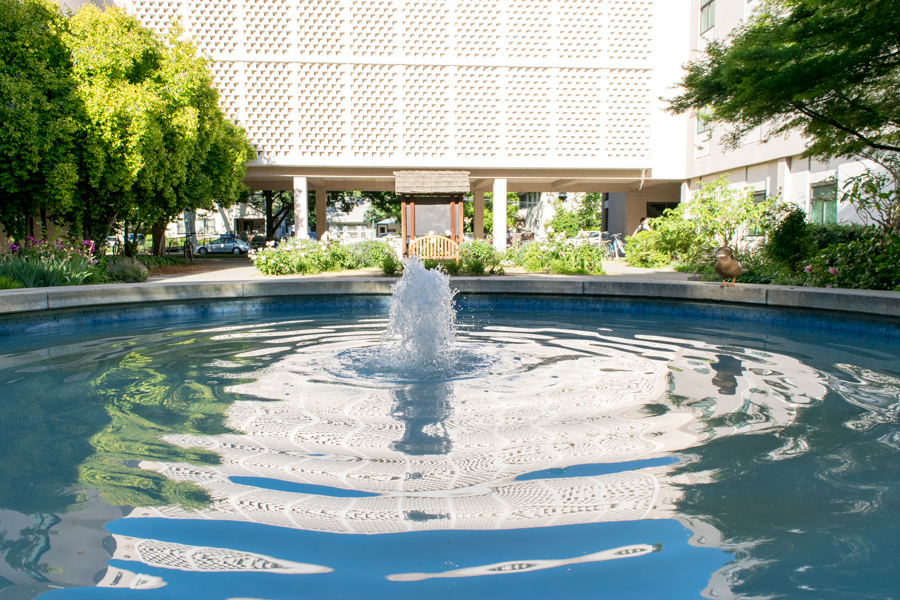
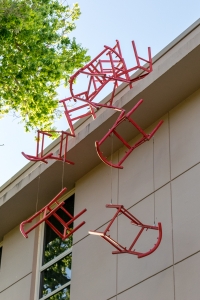
At Cruess Hall, a modern, quirky building that holds design classes, an art piece of chairs can be seen in the courtyard, balancing on a single leg or whimsically suspended in a perpetual fall off the roof. In front of the Plant Sciences Building, a “Salad Bowl” garden of vegetables can be found, neighboring a collection of labelled plants and a brick wall with ivy obscuring a mosaic sign that reads “University of California.” Repeating patterns of white-trimmed classroom windows surround the patio tables of the concrete Chemistry Building courtyard and juxtapose with the jumbled foliage of trees that both extend to the upper levels of the building and hang low to brush one’s shoulder while walking to class. Voorhies Hall encircles a beautifully landscaped space where a large central fountain splashes serene ripples through a circular pool, accompanied by delicate roses and trees — a sight so picturesque that entering the space gives one the impression of stumbling upon an undiscovered eden.

With such an abundance of open spaces at UC Davis, courtyards rarely have more than a few people in them at a time and allow for intimacy in a spacious setting.

“It’s normally pretty quiet,” said Katherine Kays-Hoepkes, a third-year math major, who frequents the courtyard in between the UC Davis School of Education and Sproul Hall. “That’s why I like it. It’s quiet and I can hide from people.”

The School of Education courtyard, where Kays-Hoepkes was, invites visitors to sit and relax on its wide grassy area or on the benches bordering it, with trees and patio covers offering shade from the hot sun. Kays-Hoepkes noted how the ample spacing between benches in the School of Education courtyard lent itself to quiet conversations and peaceful solitude.

Other courtyards create different atmospheres.The Hart Hall courtyard is simplistic, yet has its own charm. A lush grassy area, dotted with several trees providing shade, gently slopes towards a stucco portico painted a pale orange that contrasts the vibrant green grass. One of the more popular courtyards, students can often be found lying on the grass and enjoying the shade from the trees there.  

“There’s my friend the magnolia tree,” said Cristina Murillo-Barrick, a second-year community development graduate student, gesturing to a tree in the Hart Hall courtyard. “We hang out sometimes when I meditate.”

Murillo-Barrick finds herself outside enjoying UC Davis’ outdoor landscape almost every two hours. Her previous job had her working outdoors daily and she dislikes staying in her windowless office and stuffy classroom all day. The courtyards remind her of the world outside her office.

“It gets me out of my head and into a larger space where I can stop being so theoretical and realize I’m just a little organism in the world,” Murillo-Barrick said. “Things are happening! It’s spring, it’s summer, it’s winter.”

She has found that the courtyards not only help her, but also help her community and regional development and African American studies classes learn. She brings them outside for discussion regularly.

“I think conversation becomes a lot more organic once you’re in an open space. A lot of the classrooms in Davis are really crammed,” Murillo-Barrick said. “We discuss a lot of really charged issues […] and I think that the setting makes a really big difference. The desks are all crammed together and people can’t engage as naturally or separate if they wanted space from each other. So I think that bringing folks into a less formal space where it’s more open helps people have conversations in a more comfortable way.”

Since UC Davis’ courtyards are enclosed by the buildings where students have classes, they are convenient and easily accessible. Students like Kays-Hoepkes and Murillo-Barrick said they go to courtyards anytime they have breaks in their schedules.

However, despite the convenient enjoyment to be had from UC Davis’ courtyards, some students still find themselves too occupied with their studies to spend time in them.

Jean-Yves Merilus, a fifth-year Ph.D. candidate in geography, said his offices are right by the Hart Hall courtyard but does not spend time in the space very often. However, he made a remark on the benefits of being outside.

“I usually work in my office and I enjoy having two computers, but of course that’s a challenge in terms of [getting] sunlight,” Merilus said. “It feels good [to be] out and sitting on the grass — it’s relaxing.”

Written by: Kristen Leung — features@theaggie.org

UC partners with Vox for Climate Lab video series

HANNAH LEE / AGGIE

Six part UC-Vox collaboration explores solutions to environmental issues

The popular online media and news company Vox has collaborated with the University of California (UC) system to produce a Climate Lab six-part web series published on Vox’s YouTube channel. Four episodes of the six part series have been released, amassing a total of over two million views. Each of the first three videos has been featured on the “Trending” page of YouTube the day it was uploaded. The third installment, “Why your old phones collect in a junk drawer of sadness,” received over 400,000 views the first day it was released.

Researchers have partnered with Vox to advocate for climate change in an innovative and accessible way laden with anecdotes because, according to the show’s host M. Sanjayan, “we know that numbers numb and stories stick.” Sanjayan, an ecologist, UCLA visiting researcher and Emmy-nominated news contributor, hosts the six-part series.

“We need to change the way we talk about climate change,” Sanjayan said in the first episode, titled “Why humans are so bad at thinking about climate change.” “This doom and gloom messaging just isn’t working. A problem this overwhelming — it’s pretty easy to turn  away and kick the can down the road. Somebody else can deal with it.”

In the episodes, Sanjayan met with UC and non-UC researchers across campuses to explore climate change solutions in an innovative and creative way that can be accessible and relatable to a wide audience. Sanjayan interviewed researchers and thinkers in psychology, technology and food science, suturing environmental conservation science with other disciplines.

In the first episode, Sanjayan meets with psychologist Per Espen Stoknes, who explains climate change as a psychologically combative issue due to the fact that people become discouraged, overwhelmed and defensive when confronted with the issue.

In the same episode, Yale researcher Anthony Leiserowitz called climate change the “policy problem from hell” because it is so psychologically tenuous to grasp in present reality.  

“Many Americans continue to think of climate change as a distant problem,” Leiserowitz said. “That this is about polar bears or maybe some developing countries.”  

The second episode, titled “Going green shouldn’t be this hard,” features Lauren Singer, who can fit every piece of trash she’s accumulated in the past four years into a small mason jar. The third episode targets cellular and electronic waste, which is ridden with undegradable toxins and often comes to America overseas on archaic, polluting cargo ships. The remainder of the videos will be published every Wednesday.

Jon Christensen, an assistant professor and a journalist-in-residence for the UCLA Institute for Environment and Sustainability, spoke of his role in the Vox video series as well as UC President Janet Napolitano’s commitment towards climate research.

“I was senior editor on a report that was written by 50 researchers from around the University of California system, across all disciplines,” Christensen said. “It was called ‘Bending the Curve: 10 Scaleable Solutions for Carbon Neutrality.’ We know what it’s going to take to get to carbon neutrality by mid century, which is what we need to do to avoid the most disastrous consequences of climate change. One of the key findings is that that we’ve largely failed in communicating about climate change. I reached out to the UC Office of President to see if they would like to do a video series on climate change solutions. We reached out to Sanjayan because he’s such a fantastic science communicator. The series was produced by the UC Office of the President, and I stayed involved as an advisor and consultant on the research and stories.”

Christensen said that the final episode talks about how researchers can reach a maximum audience.

“Finally, we will have an episode about having diverse messengers,” Christensen said. “What’s really different about this series is that it’s playful and pithy, but you also get to meet people you don’t typically meet, from a tea party activist who cares about climate to an advisor to the pope, to young artists. What’s key about this is that we know a lot about the failures of climate change — we know it doesn’t work when it’s presented as a problem that’s too far away, too big, or too out of control for individuals to do anything about. That’s why it’s important to have different stories and different messengers.”

Sarah Risher, a third-year UC Davis environmental policy analysis and planning major and chairperson of the ASUCD Environmental Policy and Planning Commission, appreciates that the show attempts to bridge the gap between the public and scientists. Risher believes that there is an impending danger of climate change that must be subdued.

“I think this collaboration is a powerful tool to educate the public about climate science and climate change,” Risher said via email. “Climate change is the crisis of our lifetime and has not received the recognition it demands from our political administration and national media. I think these videos can help bring more people to the climate conversation and help them realize their individual agency to bring change. We really need all hands on deck to mitigate climate change’s destructive impacts.”

Stephanie Beechem, a member of the media relations team for the UC Office of the President, related Napolitano’s predilection to climate science with the new Climate Lab Vox video series.

“UC faculty have been deeply engaged in research and scholarship around climate change for decades,” Beechem said via email. “Climate Lab builds on the UC system’s longstanding commitment to addressing climate change, as well as our systemwide work on sustainability issues. UC President Janet Napolitano has made combatting climate change a key part of her agenda, pledging that the UC system will become carbon neutral by 2025. And at a time when the importance of federally funded research is being debated on a national level, as President Napolitano recently wrote, ‘It is more important than ever to stand up for science and research. Not only is it vital to our health and economic prosperity, but it’s key to our international competitiveness and to maintaining our country’s stature as a leader in discovery and innovation.’ The partnership is in line with other creative partnerships we’ve had in the past, including on the Fig. 1 video series with Discovery Digital Networks and the California Matters series with author Mark Bittman and the New York Times.”

Josh Dalavai, ASUCD president and a second-year political science and economics double major, believes that urgent action is required for climate change.

I think this is a great collaboration because many people discount the damage of climate change due to its seemingly long term nature,” Dalavai said via email. “This is dangerous because we could potentially put ourselves in a position where we are reacting at crisis point in the future instead of proactively curbing our behavior now.”
Written by: Aaron Liss — campus@theaggie.org

Humor: School installs BMX park for students to up their bike game

REBECCA RIDGE / AGGIE

Officials help students with bike-handling struggles, offer area to work on tricks

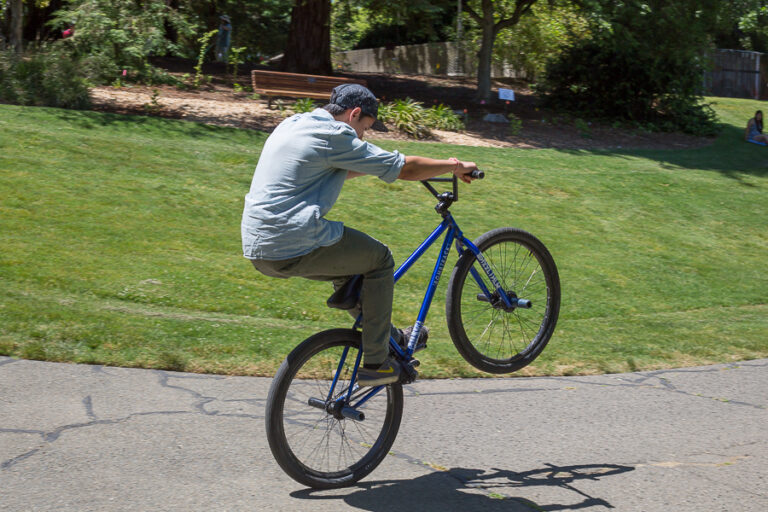
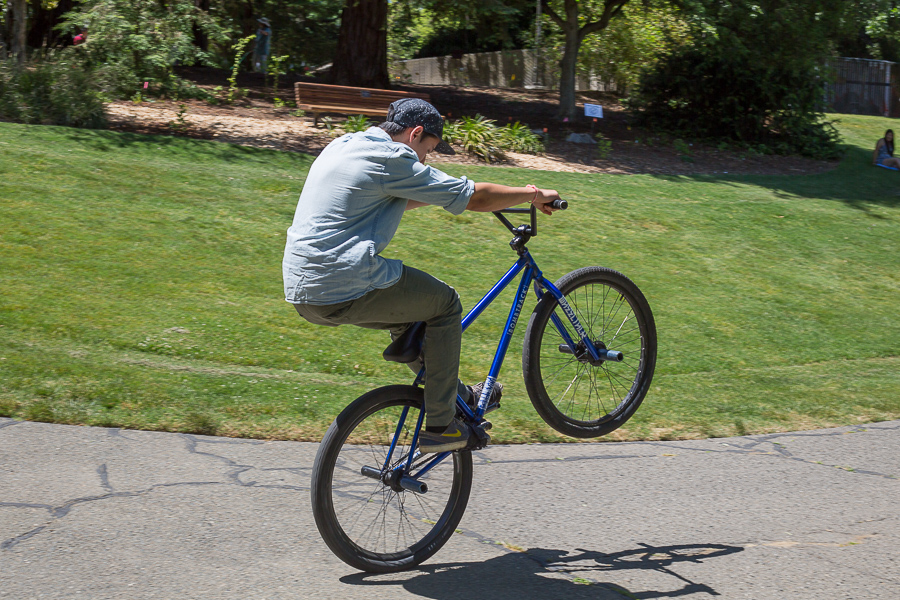
As the Memorial Union games area opened up to much fanfare earlier this month, UC Davis officials decided to bring even more fun to the campus with the creation of a BMX park. Students have acknowledged their struggles in riding bicycles, and the school has listened and will be promoting change in the upcoming years.

Construction is set to begin in Summer 2017 on the plot of land next to West Village and will cost the school $300,000. The park will have three half pipes, six flat bars and an obstacle course with cones, poles and small jumps that will simulate riding off curbs. A small classroom will also be built for safety courses.

“We want it to be like a driver’s test, but optional,” said Tony Lock, the head of development for Student Transportation. “We just want students to refine their skills and learn how to deal with hindrances on the road while having a good time in the process.”

Students have received the new idea well. The main concern has been that the location is relatively removed from campus. Otherwise, the community has initially given its approval. The park will also be open to students on scooters and skateboards.

“I like what we’re doing in emphasizing skilled biking habits,” said Mike Seat, an avid biker and Bianchi-rider. “I think it will benefit all of us and our ability to ride bikes. Practice does makes perfect.”

Seat echoes the sentiments of various students around campus. While bike traffic might be dangerous at the bike park, the risk is worth it. The lack of rain and start of what is traditionally thought of as Spring Quarter means fenders come off and riders tend to move more quickly.

A study conducted by TAPS from last year showed bike accidents increase by 30 percent in the spring and summer. Construction on the park is estimated to last only through Summer 2017 and will be available for students to use beginning Fall 2017 — just in time for Aggies to safely bike to Freeborn Hall’s opening.

The school will also be providing riding lessons and TAPS will be sponsoring bicycle safety courses, which include teaching students how to use hand signals, the importance of a bike light and traditional rules of the road that riders tend to forget. The BMX park serves as a reminder to students of the importance of bicycle safety. Courses will be free and, upon the completion of a class, students will receive five new bike lights, a helmet and a TAPS sticker.
Written by: Ethan Victor — ejvictor@ucdavis.edu

(This article is humor and/or satire, and its content is purely fictional. The story and the names of “sources” are fictionalized.)
Ann Coulter event at UC Berkeley mimics Milo Yiannopoulos

GENISIA TING / AGGIE

Right-wing journalist Ann Coulter cancels appearance at Berkeley, sparks debate similar to Milo Yiannopoulos at Berkeley and Davis

Conservative journalist Ann Coulter was invited to speak at UC Berkeley on April 27. However, after her event was cancelled, rescheduled and cancelled again, Coulter’s lack of presence re-sparked several debates surrounding free speech.

Coulter was invited by the Berkeley College Republicans, the same group who invited former Breitbart editor Milo Yiannopoulos to speak on Berkeley’s campus in February. Yiannopoulus’ presence was met with an intense show of violence by groups like the Black Blocs that left Sproul Plaza partly aflame. Coulter’s visit to Berkeley was expected to end similarly.

Amidst threats of violence against the university to prevent Coulter from speaking, Berkeley proceeded to cancel the event, but was admonished for infringing upon Coulter and her supporters’ free speech.

Coulter was rescheduled to speak again on May 2, but insisted upon speaking on the original date of April 27. She explained that she was concerned about audience turnout during a period so close to final exams, and she even threatened legal action if she was not allowed to speak on the original scheduled date.

A lawsuit was filed on April 24, centered around Coulter’s concerns about her right to speak freely.

“This case arises from efforts by one of California’s leading public universities,” the suit stated, “UC Berkeley — once known as the “birthplace of the Free Speech Movement” — to restrict and stifle the speech of conservative students whose voices fall beyond the campus political orthodoxy.”

The lawsuit utilized the example of Milo Yiannopoulus’ appearance in February in the attempt to cite previous “infringements” UC Berkeley has made on guest speakers. Yiannopoulos’s event was cancelled due to the same violence that threatened Coulter’s.

In response, UC Berkeley Chancellor Nicholas Dirks released a statement affirming Berkeley’s dedication to both free speech and the safety of its students. Coulter’s appearance had sparked enough “discourse” in their community that the goals of her appearance had become questionable.

“Sadly and unfortunately, concern for student safety seems to be in short supply in certain quarters,” Dirks said in the statement. “We believe that once law enforcement professionals determine there are security risks attendant to a particular event, speakers need to focus on what they actually want to achieve.”

UC Berkeley administration insisted upon the cancellation of the event after declaring that the venue to hold Coulter was “inadequately secure” and no other venues were available. Not soon after, conservative groups backing Coulter such as BridgeUSA and Young America’s Foundation pulled their support from the event.

“I’m so sorry Berkeley cancelled my speech,” Coulter tweeted. “And I’m so sorry for free speech crushed by thugs.”

In the wake of the event’s final cancellation, a “free speech rally” was organized the day following what was supposed to be Coulter’s appearance. Supporters of Coulter appeared across Berkeley’s campus and at nearby parks, amidst a high concentration of police forces expecting violence to explode at any moment.

Coulter commented in an email to The Associated Press that she might “swing by to say hello,” which helped to fuel tensions

“I’m not speaking. But I’m going to be near there,” Coulter said in the comment. “I thought I might stroll around the graveyard of the First Amendment.”

Amid heavy police presence the planned “free speech rally” yielded both discussion and violence. Several protesters were arrested for assault and for refusing to remove masks. Students and groups of peaceful protesters gathered to talk to their opposition, calling for “discourse, not force.”

Despite the changing narrative surrounding Berkeley and Coulter, and the even more evolving story around the idea of free speech, UC Berkeley remains adamant about protecting their students and their students’ rights.

“This university has two non-negotiable commitments, one to free speech, the other to the safety of our campus community members, their guests, and the public,” Dirks wrote. “This is a university, not a battlefield.”

Written by: Caitlyn Sampley — city@theaggie.org

The 39 Steps: A stage version of Alfred Hitchcock’s 1935 action-thriller

IQRA FAROOQ and NICHOLAS YOON / UC BOARD OF REGENTS

A rich blend of comedy, murder, mystery

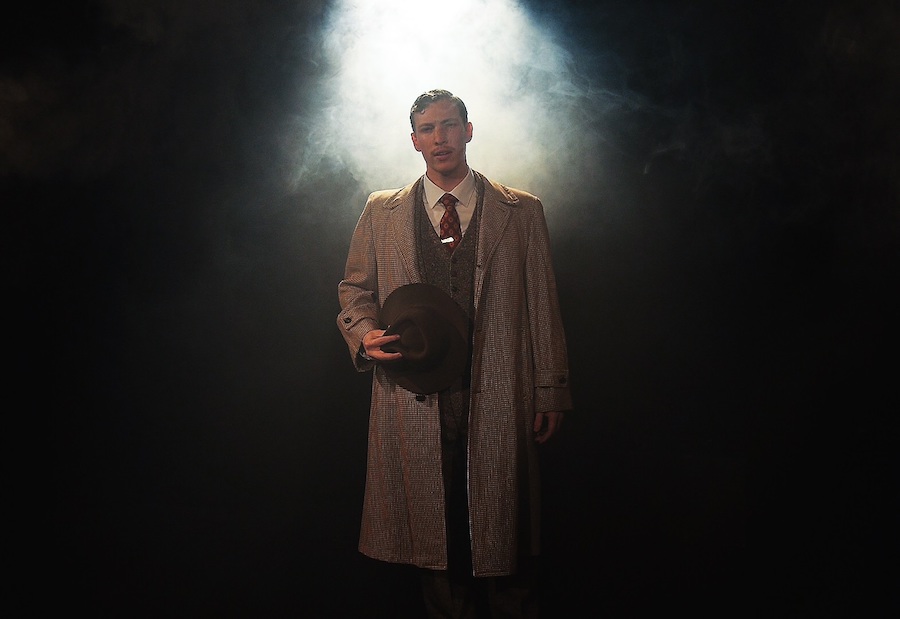
After an expedited four-week rehearsal process, five UC Davis undergraduate students from the Theater and Dance Department are ready to perform their version of Alfred Hitchcock’s The 39 Steps in the Wyatt Pavilion Theater. Starting on Thursday, May 11, audiences can watch these actors rapidly transform into different characters, perform melodramatic love scenes and execute intricate escape acts — all while speaking in a slew of European accents.

Based on Hitchcock’s 1935 film, which was adapted from the 1915 novel The Thirty-Nine Steps by John Buchan, what was originally an action-thriller has transformed into a work of comedy.

“It is written as a straight drama, but it is definitely a comedy because it hasn’t aged very well as opposed to Hitchcock’s other works such as Psycho,” said Cailtin Sales, a fourth-year theater and dance major who will be playing nine different characters in the show.

Besides the lead, each actor plays myriad different characters, going through rapid costume, accent and set changes constantly throughout the show.

“I am playing three different characters in the matter of one minute,” Sales said. “I play characters ranging from a trenchcoat thug-type to a German Nazi.”

Not only are actors physically jumping around on stage, but so is the set. Like the movie, the play bounces from location to location, a difficult scenic task to mimic, especially in Davis’ oldest building.

“Wyatt is interesting. There is not a whole lot of space backstage for such a prop and scene-heavy show,” said Bonnie Devon Smith, a fourth-year dramatic arts major and the stage manager for the show. “I am getting some exciting new toys though, such as cue lights and an infrared camera because the booth in Wyatt is really hard to see out of.”

Smith makes sure the show happens. From rehearsal reports to communicating with each department of the production, she keeps things running smoothly.

Matt Skinner, a fourth-year theater and dance major, literally keeps things running as the lead actor in the show. A charming Englishman accused of murder, the main character Richard Hanays weaves through obstacles to dodge a group of spies who are after him.

“He is good at escaping sticky situations,” Skinner said. “But he keeps his British charm throughout the show.”

Skinner got up from his seat to demonstrate the various physical actions he will perform on stage. From hanging upside down to running around the entire theater in a wool suit, he is drenched in sweat by the end of the show.

“There are parts in the show where I have to run a lot,” Skinner said. “I have to run through the aisles and everything. Oh gosh, I’m probably gonna step on people’s toes or something.”

Though it has been physically draining, these student actors are excited to showcase their acting abilities after a rapid and committed rehearsal schedule.

“When I’m not on stage, I’m running lines,” Sales said. “When I’m not on stage, I am still working on the show.”

The 39 Steps will run May 11 to 13 and May 18 to 20 from 7:00 to 9:30 p.m, with matinee showings from 2:00 to 4:30 p.m. on May 13 and 20. General admission tickets are $18.50, faculty/staff tickets are $17 and students/seniors tickets are $12. They can be purchased on the theater and dance website or at the box office before the show.


Written by: Myah Daniels — arts@theaggie.org


Companions and cultural identity: UC Davis’ various student associations

VRINDA GUPTA / COURTESY

Cultural organizations provide space for students to connect, make friends

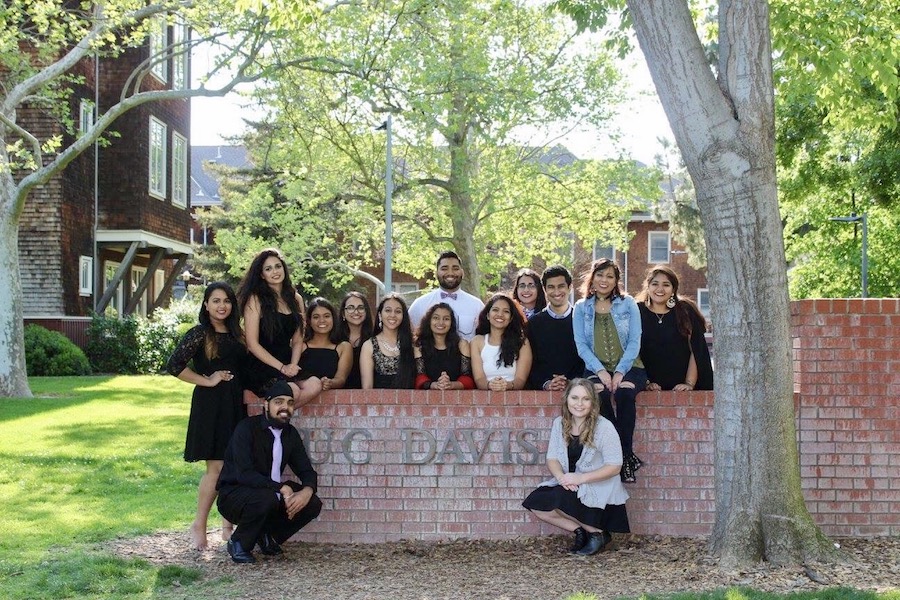
There are hundreds of clubs for the thousands of students at UC Davis, but joining a club doesn’t have to be about academic interests or shared hobbies. Whatever one’s background, culture, ethnicity or religion, there is most likely an organization on campus that offers an open space to call home, a space to identify with others.

“I love my culture and my heritage and I’m very proud of being Indian, so seeing something like the Indian Student Association was something that I was very excited about, something I was very drawn to,” said Vrinda Gupta, a second-year international relations and Asian-American studies double major. “The main reason I joined is because I wanted to really find a community of people that I could relate to and find my own little chosen family.”

Gupta is the director of community affairs for the Indian Student Association (ISA). Although ISA is a social club that provides cultural events for the Indian diaspora on campus, Gupta said the organization has been focusing on social awareness and social justice over the past few years.

“Just recently we had a sexual violence awareness workshop, things like that to help our community stay educated and keep us more involved,” Gupta said. “Every year we also have a philanthropic aspect to our organization [where] we donate to a charity or some sort of philanthropic organization. We have a Culture Show every year, so this year it will be on May 21st,, and the proceeds of that show will go to [the organization] Visions Global Empowerment.”

The main mission of ISA is to educate others on and celebrate Gupta and her peers’ South Asian identity, but Gupta points out that it doesn’t matter where someone is from or what their ethnic or religious background is — anyone is welcome to be a part of the organization. This is the case for many other cultural groups on campus as well, including the Taiwanese-American Organization (TAO).

“Our members are really diverse, it’s not just limited to Taiwanese or Taiwanese-Americans,” said Michael Ng, a third-year international relations and history double major. “TAO is mostly a social and cultural club [and] is a really diverse club.”

As someone born and raised in Taiwan, Ng describes his journey to joining the club as one of obligation to the greater Taiwanese community, but his decision was also influenced by the goal of finding a comfortable space with people he can relate to.

“I think the reason I joined this club freshman year had a lot to do with identity issues,” Ng said. “I felt like I was trying to get this sense of belonging because I I felt like I was too Taiwanese for Americans but too American for Taiwanese. So that’s one reason, just to see what I could find in this club, to find companions and cultural identity, which I successfully did. It’s basically my family now.”

One organization that bridges the gaps between multiple identities but connects on a common ground is Aggies for Israel (AFI). Israel itself is a central symbol for the three faiths Christianity, Judaism and Islam, and AFI works with the intention of educating students about Israel from multiple perspectives.

Arielle Zoken, a first-year undeclared humanities major and the programming chair for AFI, has family that lives in Israel and spent last year there herself. Many of the organization’s members’ identities are connected to Israel for different reasons, but despite the differences, Zoken feels very connected to the other members.

“Aggies for Israel has really connected me to the pro-Israel community here,” Zoken said. “Also making new friends across the board and having a space where I can dialogue. Because of Aggies for Israel and the connections I’ve made, I was able to kind of connect with those who understood the pain that I went through last year and how difficult it was, and that’s because Aggies for Israel had connected me to those people.”  

Another group on campus that serves as a social space as well as promotes education about their cultural past is the Armenian Student Association (ASA).

“Probably the biggest event would be the mock wedding that we host,” said Gayane Malayan, a fourth-year biological sciences major and music minor. “A big part of Armenian culture is the wedding [… as] it’s a very big formal religious ceremony, which we don’t really follow in the mock wedding because the main purpose is to have fun. At least half [of the people who come] are not Armenian and are just friends who get invited, so it’s a way for us to show them how we like to have fun.”

But the ASA isn’t all social events. One of the organization’s most notable events of the year is on April 24th, when members stand on the Quad and hold signs and chant in protest of the United States’ lack of recognition of the Armenian Genocide, a tragedy of the early twentieth century that affected the lives of Armenian students’ ancestors.

“[I like] being able to protest and have the same cause as other Armenians,” Malayan said. “Standing here and yelling things out, I don’t feel embarrassed, I don’t feel scared or nervous. I feel like I have the support of other Armenians, because […] our history is very rich and it has a lot of tragic things, but it has a lot of very important things.”

Being able to connect with other Armenians in college was not something Malayan anticipated she would want when she moved away from home, where she had been surrounded by an Armenian community. However, since becoming a part of ASA, interacting with people who share her heritage and her culture has been extremely comforting.

“[I appreciate] being able connect with those people, like Armenians, it doesn’t matter if they know you or not, they are going to treat you like you’re close, like you’re family,” Malayan said.

This situation is similar to the experience of Sasha Safonova, a fourth-year linguistics major and officer for the Russian Cultural Association (RCA).

“I grew up in Sacramento, so that’s predominantly Russian, so for me […] I wanted to see if there were different types of Russians in Davis,” Safonova said. “I met all these Armenians, Russians, from all over and who aren’t necessarily that cookie-cutter mold from Sacramento. I’m from a super Russian area, and I wanted to be a part of that but also see what else is out there, and that’s exactly what I’ve found here.”

Kristina Harmonson, a fourth-year Russian and sociology double major and the president of RCA, chose UC Davis partly because it offers the Russian major. Harmonson found the RCA as the perfect outlet to find people to connect with and expand her knowledge of Russian culture.

“I love the language, the culture, the people, the food, the everything,” Harmonson said. “I couldn’t be without it, and from the moment I met this club I felt like I was in a family setting. I felt so included, and that’s where most of my friends come from.”

Although it’s a fairly new club, like many other cultural organizations on campus, the RCA is predominantly social, but sometimes offers members lectures and other educational opportunities about history and politics. Some of the most popular events the RCA hosts are its cooking nights, where new faces even Safonova and Harmonson have never seen before tend to show up.

Harmonson said the best part of being in a cultural organization like RCA is the leadership experience and friendships.

“Although you could identify with a lot of people, just meeting people who come from similar cultural values [is nice],” Safonova said. “I’ve met a lot of Russians who are from all sorts of different religions, but just knowing that you have a lot of cultural similarities and that you can understand […] why people act the way they do, […] we can all identify with that. [RCA] is small enough where you can actually build lasting friendships.”


Written by Marlys Jeane — features@theaggie.org

Davis vs. food

CAT TAYLOR / AGGIE

Food competitions around town test endurance

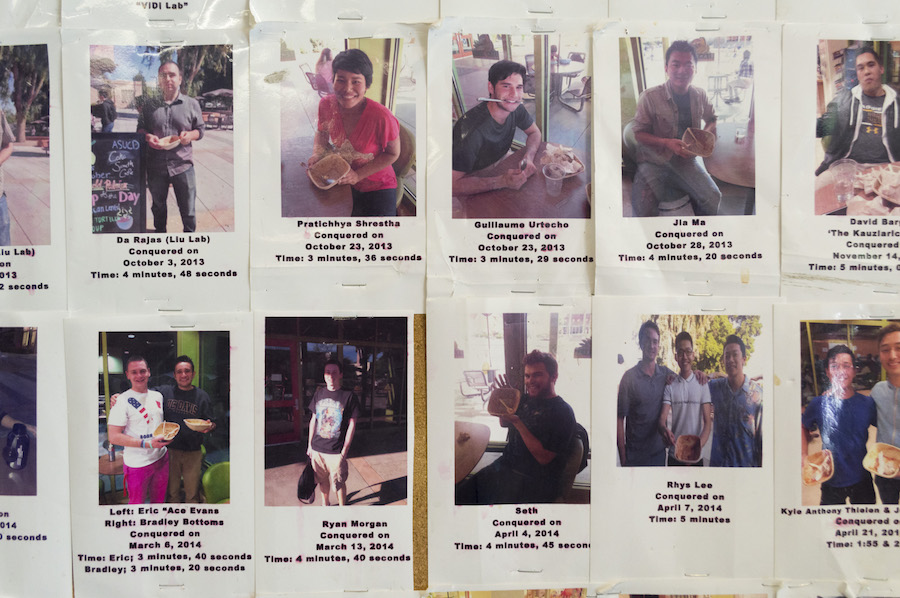
A myriad of beaming, proud faces fill up a wall at the CoHo South Cafe. These are the faces of daring challengers who have successfully completed the Quad Stack Challenge — a food challenge that requires competitors to eat around two pounds of cornbread and chili in five minutes or less.

“Someone orders the Quad Stack and then they have to say, ‘I want to do the challenge,’” said Hayley Rappoport, a student manager of the CoHo South Cafe and a fourth-year genetics and genomics major. “They can have a glass of water if they want but nothing else to drink. They have five minutes to finish it […] and if they do, we’ll take their picture.”

The Quad Stack Challenge at the South CoHo is one of several different food challenges that exist within the Davis community. The staple of the South CoHo is the Chili Stack which consists of two pieces of cornbread, two scoops of chili and optional toppings of cheese or onions all heaped onto one plate. Variations of the Chili Stack include the Triple Stack, three slices of cornbread and three scoops of chili, as well as the daunting Quad Stack, four pieces of cornbread and four scoops of chili.

Rappoport, who has worked at the Cafe for over three years, said she has seen about 30 to 40 attempts of the challenge, but has seen only between 10 and 15 successful completions. She also said she has witnessed a few challenges gone awry.

“I saw someone choke,” Rappoport said. “Her strategy was to pick up the cornbread and try to shove it in. I saw someone else who was trying to dig in and in the process they spilt their water with their elbow. We did pause the [clock] for him.”

Though Rappoport herself has not attempted the challenge, nor have any of her colleagues, she has seen successful competitors finish the Quad Stack Challenge in a couple minutes and ask, “Is that it?” According to Rappoport, the record time for the challenge is around one minute.

However, ambition sometimes gets the best of hungry customers. According to Redrum Burger owner Jim Edlund, newcomers to the restaurant who ask for the “biggest burger” on the menu are met with the one-pound Aggie Pack Annihilator burger.

The Aggie Pack Annihilator burger, which is four sizes larger than the average Redrum burger, can be purchased as a meal with a large side of fries and a large drink for $13.49. Edlund said the Aggie Pack Annihilator burger, named in support of the Aggie Pack, was first sold in 1997.

“It starts out as two half-pound patties [with] double cheese on it,” Edlund said. “We make it with the normal stuff we have — mayo, mustard, lettuce, tomato, onion [and] pickle. We also add bacon.”

Edlund said Redrum Burger serves around 15 to 20 Aggie Pack Annihilator meals a day on the weekends and five to 10 meals on a weekday, or around 3,000 meals a year.

“About 10 years ago, a man and his son came in […and] ate an Aggie Pack Annihilator,” Edlund said. “On his way out, his dad says, ‘Well I don’t think you can eat another one.’ I interjected myself into the conversation and I said, ‘If you can eat the second one and finish it, it’s free. If you only eat a portion of it, you’ve gotta pay for it.’ He ate both in 25 minutes.”

Redrum Burger used to hold the Fastest Beef Eater in the West contest, during which competitors would attempt to consume just the Aggie Pack Burger in the shortest period of time; the record time for consuming the one-pound burger is one minute and 57 seconds. This July, to celebrate its 31st year in business, Redrum Burger will bring back the Fastest Beef Eater in the West contest in the form of three competitions — one for females, one for males and one for those 50 years and older, according to Edlund.

“The winner will get one month’s free food, second place gets a week and third place gets a weekend,” Edlund said. “We’re trying to get belt buckles made.”

Edlund himself said he has successfully finished two Aggie Pack Annihilators, after which he “went right to sleep.”

Across town, Taqueria Guadalajara serves the arm’s-length, three-pound Super Giant Burrito, which has been a staple of the restaurant since 2002.

“A lot of our students were asking, ‘Do you have something bigger?’” said Rigo Hernandez, the manager of the business. “It first started out as a little game, [where] we would make this if you could eat it. We started making the Super Giant and we kind of started a little competition [where] you had to eat it in a certain amount of time and we’d take a picture and post in on a wall — a little wall hall of fame.”

The enormous burrito is available for purchase for $13.99.

“The Super Giant Burrito [is] two, 13-inch flour tortillas side by side and the fillings are rice, beans, guacamole, sour cream, cheese, pico de gallo and your choice of meat,” Hernandez said.

After polaroids of successful competitors were vandalized, the wall was taken down. Taqueria Guadalajara now holds a Super Giant Burrito eating competition once a year for their Cool Summer Days event in June.

“We throw a little party for the community, and that’s when we do a burrito challenge,” Hernandez said. “My cousin is in charge […] and he has a championship belt — like a wrestling belt – so whoever can finish it the fastest [wins].”

Woodland resident Carlos Bautista has won the competition once and placed second twice. The year he won, Bautista beat out five other competitors with a time of around four minutes. He will compete again this year with a new strategy.

“Someone told me to just open up the burrito and eat the meat first and then just roll up the tortilla,” Bautista said.

Many have taken on the Super Giant Burrito, but, for Hernandez, it’s “impossible” to eat in one sitting.

“I can barely eat the super burrito, but you’d be surprised,” Hernandez said. “We’ve had some petite, young ladies that would finish that burrito in one sitting.”

If the Super Giant Burrito seems an unconquerable feat, Hernandez said, “for parties, it’s a great idea.”
Written by: Hannah Holzer – features@theaggie.org

Highlights of the Whole Earth Festival Lineup

JAY GELVEZON / AGGIE FILE

The Big Poppies, The Five Thirty among local talent

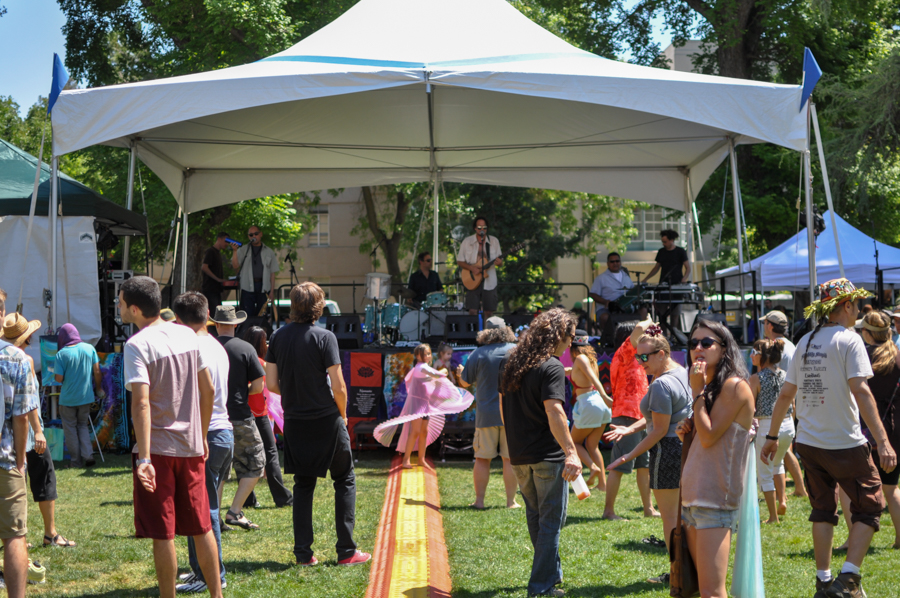
During Spring Quarter, entertainment isn’t in short supply — from Picnic Day to KDVS’ Operation Restore Maximum Freedom Festival, live and local music is around every turn. However, unlike the aforementioned events, Davis’ annual Whole Earth Festival draws larger, more established musicians as well as a more eclectic sound. That being said, local favorites — including The Big Poppies, Pastel Dream, The Five Thirty, Tempura and Tha’ Dirt Feelin’ — will still be performing.

Jessie Wong, a fourth-year psychology major and Liz O’Neill, second-year managerial economics and psychology double major, are this year’s entertainment directors for the festival. They selected this year’s performers from over 100 applications. In fact, O’Neill and Wong hosted a staff listening party with fellow Whole Earth Festival members and volunteers, giving them a chance to hear potential performers before they were booked.

“We are very happy to say we booked everyone ahead of schedule,” Wong said. “Usually in entertainment we’re working until the last second to get all the contracts done, but we’re around two weeks ahead of schedule in terms of booking.”

O’Neill and Wong have selected some of this year’s standout performances:


Geographer, Saturday 8:45 – 10 p.m. Quad Stage

As this year’s festival headliner, Geographer’s well-known dream pop sound is well-suited for Whole Earth vibes. His Saturday set will close the most well-attended night of the festival.


Nine Pound Shadow, Saturday 7:15 – 8:15 p.m. Quad Stage

This alternative rock group was recently booked at the local BFD festival. Hailing from Berkeley, Nine Pound Shadow will warm up the crowd before Geographer hits the stage.


Hibbity Dibbity, Friday 9 – 10 p.m. Cedar Stage

According to Wong, this self-defined “swamp funk” group is the so-called cousin of local band Big Sticky Mess. Expect some funky tunes and upbeat dancing.


Louise Benally, Sunday 1:35 – 1:50 p.m. Quad Stage

Benally will be speaking at the event, providing insight on Native American culture as one of the original resistors of relocation of the Navajo Nation.

“We were able to carve some money out of our budget to bring her here,” Wong said. “Everyone is really excited, especially old members who recognize her from past years.”


Tempest, Sunday 2:10 – 3:30 p.m. Quad Stage

This Celtic rock group is known for their large fanbase and for drawing large crowds. “I don’t think people realize how big they are; they have their own tab at Amoeba Records,” Wong said.


In addition to these directors’ favorites are standout local talent. Among them is the blues/funk/rock group, The Big Poppies, who are making their return to the stage after a year-long hiatus, and the up-and-coming blues/soul/rock trio The Five Thirty.


The Big Poppies, Saturday 2:15 – 3 p.m. Cedar Stage

As the band prepares for their second Whole Earth Festival performance, The Big Poppies have plans to play some of their older content — but with a new twist.

“There will be some new stuff, and some jammin’. We’re trying to get people to dance,” said Ryan McBride, a vocalist, guitarist and harmonica player for the band.

“Old songs but played new. You wouldn’t even be able to tell that they’re old,” added Ari Schwartz, the band’s back-up vocalist and bass player.

Lead guitarist and vocalist Max Van Dyke emphasized their excitement to be back playing together. “To the people that usually come see us, you’re going to be in for a big surprise,” Van Dyke said.

The Big Poppies are not only frequent Davis performers, but also Davis locals. The band grew up attending the Whole Earth Festival, watching local bands hit the stage as young kids themselves. For them, the festival is more than another venue; it’s nostalgic.

Make sure to check out their Saturday set and groove to some free-spirited funk.


The Five Thirty, Friday 6:05 – 6:50 p.m. Cedar Stage

Also born-and-raised Davis locals, The Five Thirty looks forward to kicking off the first day of the festival with their crooning melodies and soul-infused blues guitar. As brothers, Ben and Brian Simmons comprise the band’s vocals, guitars and drums.

“Even though we all came into it with the same interests, we had some of our own personal musical interests and styles because we had all played for a long time before forming the band,” said Brian Simmons, a student at American River College and the band’s drummer and backup vocalist.

The Simmons brothers met their bassist, Alex Timmons, during a recording session at their in-home studio, which they used for personal recordings as well as hosting other musicians.

“We turned the loft of our parents’ house into mini recording studio,” said Ben Simmons, a student at Sierra College and the band’s guitarist and main vocalist. “One of the people who came over was Alex. He was in a different band at the time. He was in a band called Audio Wave, and he came over and was doing stuff for them. And I was like this kid can play bass really well, so we asked him to play a Homecoming gig at Davis High, my senior year.”

Drawing influence from musicians like Jimi Hendrix and John Mayer, you can expect a similar variety at The Five Thirty’s set: some technical rock, some easy listening and certainly a good time.


View the full festival lineup and schedule.


Written by: Ally Overbay — arts@theaggie.org