55.4 F
Davis

Davis, California

Monday, December 22, 2025
Home Blog Page 640

Watermelon Music picks up its tempo

ALEXA FONTANILLA / AGGIE

Local business relocates to Lake Boulevard

Four days and 12 hours each day — that’s how long it took to pack up 17 years worth of business. After receiving a letter from its landlord in August of 2015, Watermelon Music was informed that the commercial property on which their business was located was going to be sold. Owner Jeff Simons had someone appraise the property, discovering that the value was well beyond what the business could afford. As a result, Simons began to look elsewhere for properties where Watermelon Music could relocate.

“As we were negotiating, a broker that I had been trying to talk to about buying other pieces of land had said that this building had just gone up on sale that morning,” Simons said. “When I went out and looked, it was absolutely stunning — an amazing fit for what I wanted to do. So we made an offer on it and purchased the building.”

Simons described renting the biggest U-Haul in town to transport instruments and products. With the help of family members, friends and customers, everything was out of the old store on Feb. 28 at 9:30 p.m., just four days after starting the moving process. It then took approximately three to four days to get everything settled into the new store. Watermelon Music opened its doors to customers on March 4, although the performance part of the store is yet to be finished.

This new performance part will include a 120-seat music venue to host concerts, clinics and open mic nights. In addition, the layout of the store is much more customer oriented, with each department clearly labeled. The repair space is also improved, allowing more complicated repairs to be done, and the building is humidity controlled. This is vital for an instrument store, as wooden instruments need to be kept at the correct humidity in order to prevent the wood from drying out and cracking.

Watermelon Music’s new location, although farther away from downtown, has its perks. The space itself is much bigger and also has parking. Since it is also not as centrally located, the people who come into the store are those who are serious customers and have the intent on purchasing something.

“The downtown location was like a combination of a music store and a playground,” Simons said. “So many of the people who walked in weren’t interested in buying anything, and just wandered in since it’s kind of a fun, hands-on thing; we’re going to have much less of that. It’s also easy to get to from any part of Davis.”

This also opens up room for other businesses in the old Watermelon Music location. Paul Wilbur, the manager of Armadillo Music, is excited to see what will occupy the former Watermelon Music store.

“Anytime an institutional business leaves the area, it definitely hurts, [but] anything that makes Davis unique is good — we like different types of businesses,” Wilbur said. “The more diversified, the better.”

The transition to its new location was a step forward and a way to expand their horizons, although owner Jeff Simons certainly was surprised.

“Commercial property in Davis never ever goes for sale, it’s a super rare thing,” Simons said. “So I think this group from out of town looked at it, and in the long run, I’m sure they’re going to do well with it — it’s prime location in the middle of downtown. But I’m not sure they understand the Davis dynamic — what makes it unique and interesting.”

For other stores and organizations in the West Davis area, the relocation of Watermelon Music is will have a positive impact on customers, as it will attract more business.

“I think it’s a great thing — I myself am a musician,” said Patrick Cain, a manager at Westlake Market. “I think it will bring more people from central Davis this way.”
Written by: Kaelyn Tuermer-Lee — city@theaggie.org

Lonzo Ball

TONYTHETIGER [CC BY-SA 4.0] / CREATIVE COMMONS
A star’s rise to college basketball fame

He is undoubtedly the biggest name in college basketball; he has transformed a UCLA team that, just a year before, had finished with a sub-.500 record (15-17) and missed the NCAA tournament; he’s a projected top-three pick in the upcoming NBA draft. And his name is Lonzo Ball.

Lonzo Ball’s rise to stardom has been nothing short of spectacular. Born in Anaheim and raised by two former college athletes, Lavar and Tina Ball, the spotlight has been on this family for a while now. Lonzo and his younger brothers, LiAngelo and and LaMelo, turned Chino Hills High School into a basketball powerhouse. Lonzo has since departed for UCLA, with LiAngelo to follow next year and LaMelo a couple years later. The Bruins got quite the catch by getting these brothers to commit to UCLA, and it is already paying off.

Lonzo Ball, standing at 6-foot-7 and weighing 190 pounds, has quite the imposing physical stature for someone of his position. His length at point guard will make him a nightmare for guys in the NBA to guard if his funky, unorthodox jump shot translates at the next level. Lonzo, a right-hander, currently begins his form on the left side of his body near his left shoulder and brings the ball to the top of his head and slings it away.

This form works, and he shoots 41 percent from three, but many speculate that NBA caliber defenders will make Lonzo suffer for his steadfast adherence to these mechanics as it doesn’t give him the ability to create much separation with his shot. Regardless, this is not the most important element of his game. Lonzo Ball runs the best offense in the country at UCLA: he is one of the best passers college basketball has ever seen. Ball averages 7.7 assists per game, and his offensive brilliance and basketball IQ will surely pay off well in the NBA. Lonzo Ball will one day be the orchestrator of a lethal NBA offense.

Despite his success in college thus far, Lonzo Ball still has much to improve on. His one-on-one defense can definitely be polished, especially when he’ll be forced to guard quicker and more athletic NBA guards. The most important issue with his makeup, however, is that Lonzo Ball has zero mid-range game. He exclusively shoots three-pointers, layups and dunks. Many see this as a way of minimizing inefficient long-range two point shots, but this may well be a ballast to his success as it will hamper his options in pick-and-roll situations.

The media train surrounding the Ball family has been non-stop since Lonzo entered college. I partially attribute a lot of Lonzo Ball’s popularity to his marketable name, funky and fun style of play and his other family members. Lonzo’s father Lavar has made many abrasive comments over the past few months about the inevitable success of Lonzo at the next level that have made many, like myself, cringe. He claimed he’s already better than Steph Curry and that Lonzo would only play for the Los Angeles Lakers. He’s definitely not one to shy away from the spotlight, and Lonzo, despite a less talkative approach, will definitely have a target on his back because of it.

As March Madness gets underway, I fully anticipate that UCLA will make a deep run in the tourney. Lonzo Ball, with all his quirks and oddities, has returned the UCLA basketball program to prominence, and with his brothers set to follow right behind him, it looks as if they might be back for good.
Written by: Michael Wexler — sports@theaggie.org

Mosquitoes’ biting preference revealed

JOHN TANN [CC BY 2.0] / FLICKR
UC Davis faculty, team of researchers discover mosquitoes’ preference in human genetics

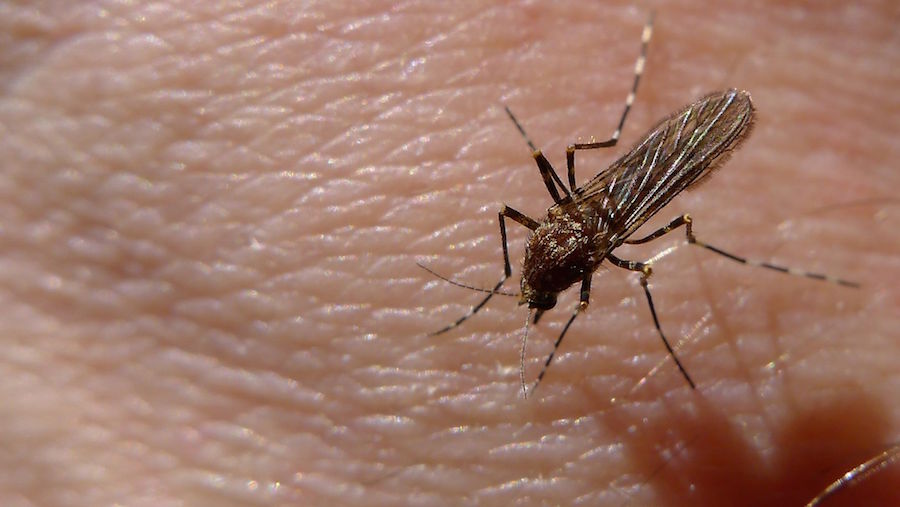
Mosquitoes serves not only as as a nuisance to humans, but also as carriers of multiple infectious diseases like yellow fever, malaria and Zika virus. Most recently, mosquitoes served as the catalyst behind the 2015 Zika virus epidemic, and are responsible for over one million deaths worldwide each year.

UC Davis faculty and other researchers have come together to look into the role of genetics in the feeding choice of Anopheles Arabiensis: a major carrier of malaria in East Africa. This species of mosquitoes is known for its broad range of hosts. It has the ability to adapt quickly to both outdoor and indoor environments.

Because of this and the frequent use of bed nets in Africa, these mosquitoes serve as a huge threat. Bed nets that are treated with pesticides in the area lead to the death of other species, which then in turn allow Anopheles Arabiensis to thrive.

By looking at the genetics of human-fed versus cattle-fed mosquitoes, the researchers were able to deduce whether or not there is a genetic basis rooted in the feeding preferences of mosquitoes. The process involved a field survey in which researchers visited and obtained data from East African cities.

“In the field survey we go into people’s houses, with permission, of course, and collect mosquitoes that have recently fed from people’s houses, goats, shacks and more,” said Bradley Main, a UC Davis postdoctoral researcher in the Department of Pathology, Microbiology and Immunology.

Once mosquito samples were collected, researchers ran through genome sequencing (a method used to determine the precise order of DNA in an organism) by looking into the mosquitoes’ diets. This process was used to compare cattle-fed mosquitoes to human-fed mosquitoes. While one of the main questions posed was related to the feeding preferences of Anopheles Arabiensis, the resting behavior (where mosquitoes would choose to land) was researched as well.

“We then looked at the genomes of the mosquitos to see if there was a connection between genetic variation and the host preference, either the mosquito prefers humans or animals,” said Eleazar Eskin, a professor of computer science and human genetics at UCLA.

The final results indicated that mosquitoes had a preference for feeding on humans versus cattle or other organisms. In the results, mosquitoes tested rarely indicated feeding on more than one host, illustrating mosquitoes’ preference to specific hosts.

The team of researchers also found that mosquito resting behavior was random, meaning there was no correlation between the resting behavior of mosquitoes and genetics. The results supported the fact that mosquitoes preferred feeding on humans, with higher feeding rates indoors.

“Results were based on analysis of individual mosquito whole genome sequences,” said Gregory Lanzaro, a professor in the Department of Pathology, Microbiology and Immunology. “We were asking the question: ‘Is mosquito host preference (human vs. cattle and other animals) determined genetically or do they simply feed on whatever mammal they come in contact with?’”

Through the analysis of this one species of mosquito, UC Davis faculty and other colleagues were able to deduce a relationship between mosquito feeding and genetics.

In the past, researchers have analyzed various species of mosquitoes and their relation to infectious diseases. Carolyn Mcbride, an assistant professor of ecology and evolutionary biology from the Princeton Neuroscience Institute at Princeton University, recently published a journal which analyzed the behavior of Aedes Aegypti, a mosquito that is known for spreading dengue and yellow fever.

In her journal, she mentions how the species of mosquito has evolved a preference for human odor, which later related to a genetic level.

With the results of the Anopheles Arabiensis research, Main and his colleagues aim to expand this research into a controlled experiment to find out why mosquitoes have a feeding preference for humans in particular. This could range from collecting a larger sample size that would cover more regions, or simply repeating the study.
Written by: Molina Hauv — science@theaggie.org

Purr-fect campus pets: The Physics Cats

KELSEY GREGGE / AGGIE

Stray cats taken in by physics staff bring comfort to students

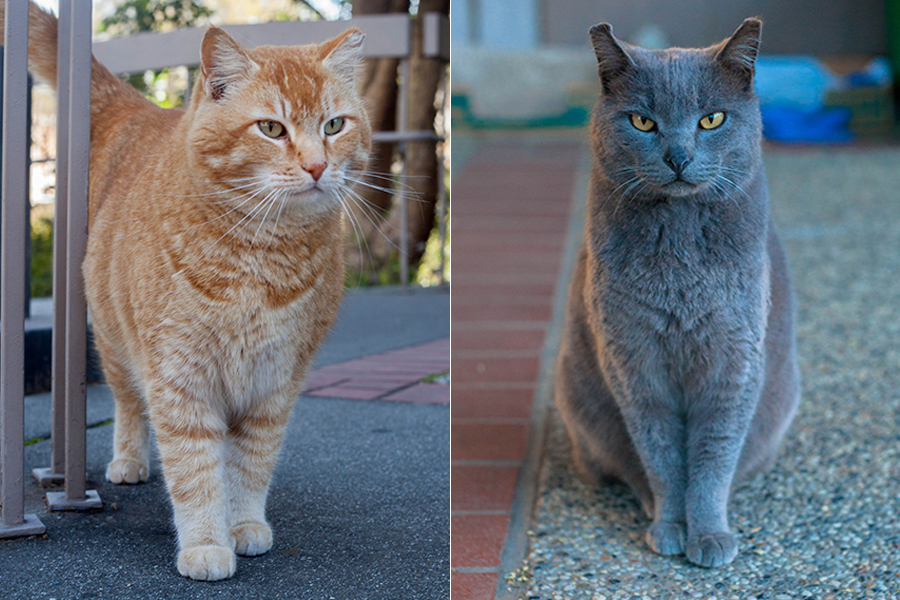
Around the northeast corner of the physics building, two stray cats can be seen playing a mischievous game of hide-and-seek in the shrubs outside, sunbathing on the concrete or enjoying the treats the physics staff leaves them.

“Sometimes we have tough days and it’s nice to come out and get some animal love,” said Danielle Fradet, a first-year wildlife, fish and conservation biology major.

Like many other students, Fradet comes to the Physics Building specifically to play with these cats every now and then.

These cats have been given many names over the years, but the ones that have stuck are Cheetoh, for the big orange cat who loves to laze around in the sun, and Grey Cat, who is always found in a visitor’s lap.

“I just like animals in general, and I have a dog, so it’s nice when I come to college to be able to pet something,” Fradet said.

Although Fradet is a dog owner, she doesn’t buy into the dog-cat dichotomy, and luckily for Cheetoh and Grey Cat, visits them frequently.

“I’ve actually been out here multiple times since the beginning of the year,” Fradet said. “There’s not that many dogs here on campus, and the cats are really nice.”

The ultimate “cat lady” award, however, goes to Laura Kemp, a financial assistant who works in the Physics Building. She has taken it upon herself over the past few years to care for the cats and make sure they are fed and sheltered.

“We have a lot of people [who] really like the cats,” Kemp said. “They think [the cats are] good therapy for the students when they’re real stressed out with courses and things. Any day I come out here, there’ll be at least one or two people sitting down with a cat on their lap. I think they almost get more attention here than they would inside a home.”

Fradet believes both of these cats are actually strays that have never had an owner before — until, of course, they found a family in the Physics Department at UC Davis.

“They’re both spayed or neutered, and that’s why they [each] have their ear clipped,” Fradet said. “It’s actually a thing […] for stray animals [to have their ears clipped] whenever they’ve been spayed or neutered, so that way if someone else finds them, they’ll know [if it was done].”

As the cats do not have official licenses, their names are up for debate. Fradet explained that her preferred name for Grey Cat is Garrison, which is actually an inside joke among her and her friends.

“My friends and I […] started calling him Gary, but we decided to elaborate on the name,” Fradet said. “I know the orange one’s called Cheetoh, but we don’t know what [Grey Cat] is called, so we made up a name.”

Grey Cat is generally friendly and approachable, and Fradet wonders if their friendship has progressed enough for him to recognize her.

“He kinda just sits in anyone’s lap whenever I walk by, so I don’t know [if he recognizes me], but I like to think so,” Fradet said.

Tanat Kissikov, a graduate student in the Physics Department, has noticed the cats growing plumper and more accustomed to people over the course of the past two years. Before he moved to a higher story in the building, Kissikov worked on the first floor and would often enjoy petting the cats.

“One or two years ago, they started off more reticent, but became more used to people — and fatter,” Kissikov said.

Students have worked with Kemp to create a feeding log spreadsheet in order to organize the cats’ feeding schedule, especially for the weekends. Despite all of this care, there has unfortunately also been some negative energy toward the cats.

“We’ve had some vandalism here about a year ago, where somebody kept throwing out the cat food dishes,” Kemp said. “I got upset, so that’s [when] I kind of became more of the cat lady. I posted the sign here asking people not to throw away the dishes, and that if they had a problem with the cats, to come see me. During the summer it was hot, and I don’t know if [the cats] can get water anywhere else, so I was more concerned about them just getting water.”

Lined up along the left-side wall of the building are little cat shelters built by anonymous donors. But of all the fancy shelters made, the cats only used the open boxes with a blanket.

“Last summer [Cheetoh] was laying out here, and I think she was just sleeping, and somebody called the […] town sheriff,” Kemp said. “He came out to check on her, and he was sitting in his truck out here writing notes.”

Worried and indignant at the possibility of having their cats taken away, many staff members working in the Physics building had taken it upon themselves to speak to the sheriff.

“It was funny because one of my coworkers said ‘Oh don’t worry, I talked to him — I’ll make sure he won’t take our cats away,’” Kemp said. “I started realizing that all these people would come up to [the sheriff] and get upset that he was going to take the cats away. And I thought, ‘oh my God, the sheriff will never come here again!’”

These cats are no longer strays, now considered a part of the UC Davis family.

“I think they’re happy,” Kemp said. “I think they like their life here.”

Written by: Sahiti Vemula  – features@theaggie.org

Vegan Eats at the CoHo

FARAH FARJOOD / AGGIE

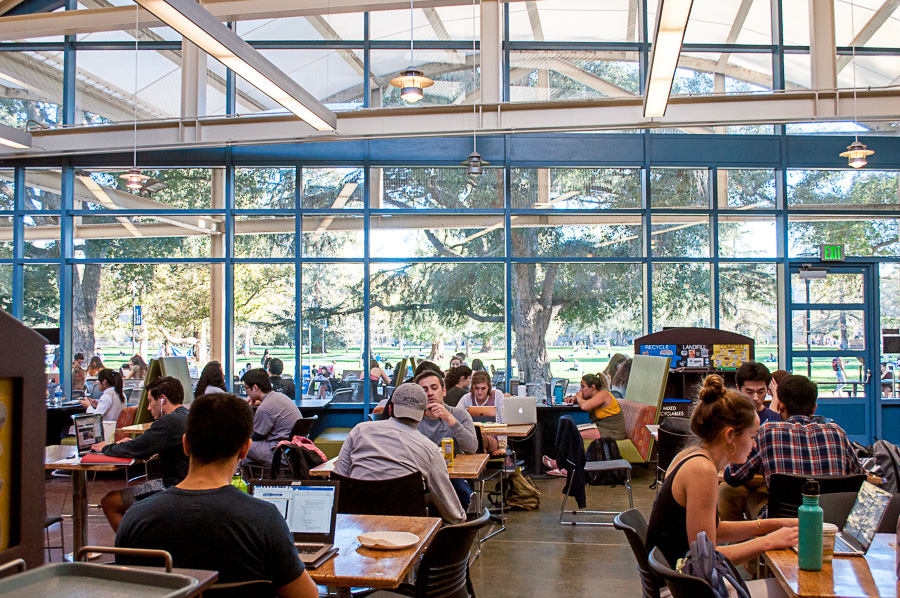
What’s available for vegan eaters at this quintessential UC Davis eatery?

“If I was a picky eater, I don’t think I could be vegan,” said Danny O’Brien, a vegan and first-year environmental science and management major. “Your options can be limited at times, but that comes with being vegan.”

Indeed, eating vegan restricts the variety of foods you can consume. Restaurant options and eating non-home-cooked meals can also become a hassle. And for busy college students, quick on-the-go options are a must. The popular Coffee House in the center of campus is often the spot for such meals, but what are the options for vegan students?

“At the CoHo, we have vegan options in every restaurant,” said Lily Johnson, a third-year sociology major and a CoHo employee. “Some restaurants have more options than others, but we are told in the training process what is vegan and what is not vegan. Everything we serve is labeled vegan or not. If we have any questions we can ask the supervisor, but all the information is provided to us.”

Johnson named specific vegan options at Swirlz including chocolate chip cookies, snowball cookies, almond shortbread, coconut fudge bars and cupcakes. One of the most popular options there is the vegan peanut butter Rice Krispie treats.

“Our deli bread is also vegan except for the greek yogurt bun, and you can put veggies on to make a vegan sandwich,” Johnson said. “The tofu salad is also vegan.”

In O’Brien’s opinion, TxMx is a good CoHo option for vegans.

“TxMx is actually good because you can substitute beans instead of meat, and the meal actually fills you up rather than just a salad at Croutons,” O’Brien said. “I also like the tofu chili at Cooks and bagels with avocado spread.”

Staple foods for vegans include beans, hummus and avocado, according to O’Brien, which can be provided and substituted at most restaurants in the CoHo.

“Really the only restaurant that is off-limits for vegans is the the pizza place, Ciao,” O’Brien said.

For vegan Samy Richards, a fourth-year design major who worked at the CoHo last year, staples like nuts, grains, beans and vegetables make up her diet.

“I either eat vegetable sushi, a vegetarian sandwich with dairy-free bread or a salad from Croutons,” Richards said. “I never have had a problem eating at the CoHo or accommodating for customers when I used to work at the CoHo.”

Johnson agreed that CoHo employees are eager to help vegan patrons navigate the different options at the CoHo — all one has to do is ask.

“We at the CoHo are all more than happy to help. It is never an extra hassle to accommodate for a vegan customer,” Johnson said. “I think we do the best we can, but we are always open to more suggestions to make things more welcome to vegan eaters.”
Written by: Caroline Rutten — arts@theaggie.org

Executive Office hosts farewell ceremony

NICHOLAS CHAN / AGGIE

Outgoing leaders honored, new leaders sworn in

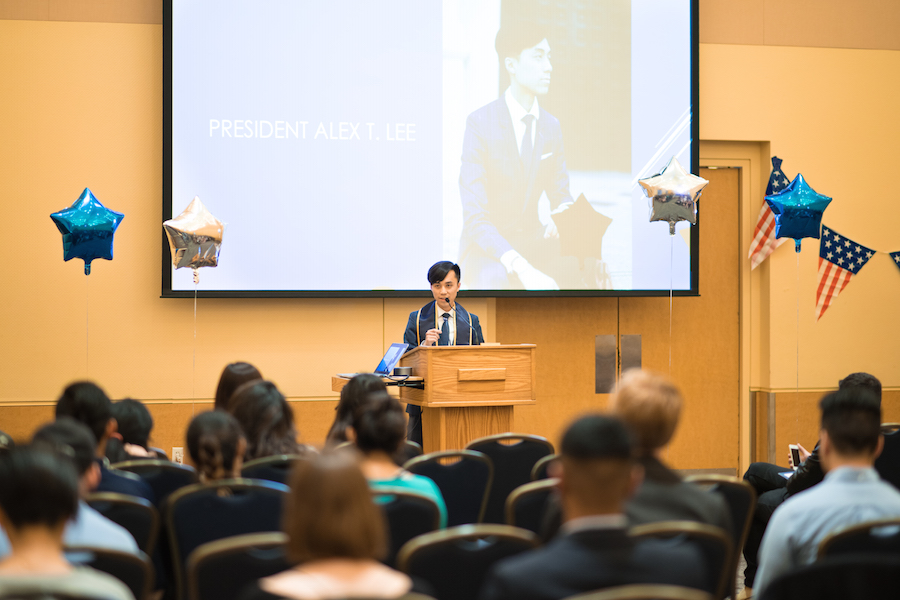
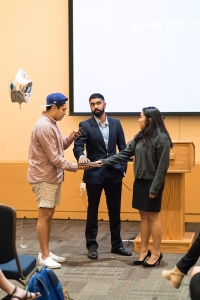
The ASUCD Executive Office hosted a ceremony on March 16 to honor outgoing President Alex Lee, Vice President Abhay Sandhu and controller Joe DeAngelo, as well as to swear in the new President and Vice President, Josh Dalavai and Adilla Jamaludin.

Lee, Sandhu and DeAngelo all gave speeches at the event, during which they discus

NICHOLAS CHAN / AGGIE

sed their experiences in ASUCD as well as the challenges ASUCD faces.

“The truth is, I always found ASUCD [to be] a very intimidating place, something that I think needs to be addressed by our future leaders in order to make it more accessible and welcome to people not getting involved,” Sandhu said.

The executive team’s decision to host the event in the Activities and Recreation Center (ARC) Ballroom faced criticism from some students who believed that too much money was spent on the event’s venue.

“It infuriates me that senate and other units are forced to scrounge for financial support from outside departments for projects related to mental health, food and housing insecurity, and cultural competency, when the Executive Office can spend over 300 dollars, without any oversight, on an event that does not benefit students, or even the association, as a whole,” said ASUCD Senator Sam Chiang via email.

In previous years, Executive Office farewell ceremonies were held at Gunrock Pub, the CoHo or the Mee Room.

NICHOLAS CHAN / AGGIE

“What is disturbing about reserving the ARC Ballroom is the large price tag that our association would be using student fee money to fund, for really no reason but self pride,” said ASUCD Senator Shaitaj Dhaliwal via email. “When executive farewells do happen outside the mee room, they typically are held at the Gunrock Pub which is about half the cost as the ARC Ballroom.”

The evening of the ceremony, Lee sent an email titled “My Farewell Address: The Challenges Ahead” to the undergraduate student body in which he urged students to be vocal in both local and student government.

“We are more intelligent, more diverse as a student body than ever before,” Lee wrote in the email. “We can think outside the box and find new solutions to problems administrators or faculty may be overlooking. Institutions and bureaucracies are slow to move, but it’s our youthful energy that pushes them along. This is why the student perspective is so important. We cannot be silenced, we cannot tolerate worsening conditions, and we should not underestimate our individual capacity for progress.”

Written by: Alyssa Vandenberg  — campus@theaggie.org. Lindsay Floyd contributed reporting.

Last week in Senate

HANNAH LEE / AGGIE

ASUCD Senate meeting was called to order at 6:17 p.m. on March 9 by ASUCD Vice President Abhay Sandhu. Senator Simran Grewal was absent and recorded as an abstention on all voting records. Senator Matthew Yamaguchi left before the meeting adjourned.

First, the creators of a new mobile app called Marble, which was pitched as a way for campus groups to have their events and happenings be more visible, spoke to the Senate members. The creators asked for a way to be able to table on campus without paying large fees.

After that, representatives from the Bike Barn came to give a unit report. They stated that the Bike Barn will be losing three managers this Spring Quarter, so they are working hard toward preparing employees for leadership roles. The Bike Barn also advertised its garage sale from May 8 to 10 and its orientation bike sales to parents and incoming freshmen.

The Office of Advocacy and Student Representation (OASR) then gave its report. One of its more recent projects has been placing sexual assault resource posters in bars downtown. Only two bars said no — KetMoRee and Beer Shoppe, with a representative of the Beer Shoppe claiming to OASR that a sexual assault would not happen at its establishment. The OASR officers ended their report by talking about the difficulty of finding funding and mentioning ASUCD’s low $8 student fee that has not been changed for decades. Other schools reportedly have student government fees closer to $50.

External Affairs then presented awards to Sandhu and President Alex Lee.

The Senate then moved on to discuss emergency legislation. The first bill urged the UC Student Association to call on the University of California to join the IIE Syrian Consortium. The IIE Syrian Consortium helps Syrian refugees attend university. The bill passed unanimously.

The next emergency bill, after amendments changing the allocation from $2,000 to $2,500 and finally to $2,280, apportions $2,280 for OASR to send students on a lobbying trip to Washington, D.C. The bill passed unanimously.

KDVS General Manager Olivia Henderson then gave her unit report. She said that KDVS has a Spring Quarter fundraising goal of $55,000. Senator Dhaliwal asked Henderson if she might be able to help other units with fundraising since Henderson always does so well. Henderson responded that there is not enough support for this, as all KDVS fundraising is run by a graduate student and the general manager.

EC Gardens then gave its unit report. Plot renewals began in March for $35 a year. The unit is currently in discussions deciding if it needs to explicitly ban cultivating marijuana in its contract with lessees.

The Senate then adjourned for a 10 minute recess.

After returning, the senators discussed three Memoranda of Understanding (MOU) from Lee. An MOU is similar to a treaty between ASUCD and another organization. The first regarded mass emails, with ASUCD now being able to send three per quarter. The second transferred control of Cal Aggie Camp from ASUCD to Campus Recreations and Unions. The final MOU allowed ASUCD to pass a bill permitting the allocation of $150,000 for renovating portions of the East Wing of the Memorial Union (MU). All three MOUs passed unanimously.

The Senate then took up more emergency legislation that allocated $150,000 for further MU renovations. This funding would be used to renovate ASUCD-controlled spaces for commercial food use. The bill passed unanimously.

The Club Finance Council (CFC) then reported to the Senate. 68 of its 79 grant requests were funded during Winter Quarter. The CFC reiterated that it tries to remain content-neutral when choosing which events to fund.

Next, two new members were confirmed to the Aggie Public Arts Committee.

Old Legislation was then considered. Senate Bill (SB) #60 requires the Student Government Administrative Office (SGAO) to ask unit directors to report on their adoptive senators and then post those reports online. Senators Dhaliwal, Molodanof, Ruttkay and Yamaguchi voted against the bill. Senator Martinez abstained. The bill passed.

SB #62, which clarifies the role of the Board of Unit Directing Students (BUDS) and places it in the ASUCD bylaws, passed unanimously.

SB #64, which allows the purchase $286.40 worth of pizza and CoHo gift cards for students who take the ASUCD housing survey, passed unanimously.

SB #65, which allows the expenditure of $334.80 on the UC Davis Tea and Meditation Group, passed unanimously. The allocation includes a $50 donation to the Shambhala Meditation Center.

SB #66, which takes the role of unit adoption assignment from the SGAO and places it in the hands of the Senate Pro-Tempore, passed unanimously.

SB #67, which allows for the purchase of $4,472 worth of cash counting and money handling software, passed unanimously.

SB #68, which allocates $3,000 to dispose of old refrigerators and microwaves, passed unanimously.

SB #20, which makes possible temporary monetary awards to ASUCD volunteers passed unanimously after debate. Chiang argued that this was an executive project and that Senate funds should not be used on the awards. She ended up voting in favor of the bill.

SB #69, which outlines the actual requirements for the awards authorized by SB #20, passed unanimously.

The meeting adjourned at 10:24 p.m.
Written by: Kenton Goldsby — campus@theaggie.org

Life with Tourette Syndrome

NICKI PADAR / AGGIE

Individuals with Tourette’s find success, identity, happiness despite daily challenges
At first glance, the East Bay support group for people with Tourette’s looked like any other friend group meeting for pizza on a Saturday afternoon. At Bambino’s Pizza in Concord last month, adolescents and adults mingled and discussed an array of topics, from the Jaws franchise to the video game “Five Nights At Freddy’s” to college courses. A few newcomers introduced themselves to the crowd of about 15 or so — all of whom were either individuals with Tourette Syndrome or family members. The ambiance was casual, friendly and, most importantly, empathetic. No one stared at another person’s involuntary actions — whether they were minor facial grimaces, verbal outbursts or something in between. Support groups like the one in East Bay provide a vital level of hospitality for those confronting Tourette’s, as doctors continue to search for answers about the disorder.

Tourette Syndrome (TS) is relatively common — affecting an estimated one in 160 children in the U.S. — but how the disorder manifests itself varies immensely throughout the population. TS is a neurological disorder characterized by repeated compulsory movements and vocalizations called tics. The impulse to tic is comparable to impulsive actions, yet people with TS still maintain complete authority over their actions, resulting in a syndrome that muddies the line between the voluntary and involuntary.

All individuals with Tourette’s experience at least two motor tics — from simple ones like excessively bobbing the head, blinking the eyes and tensing body parts, to more complex ones that require the orchestration of several muscles. Complex tics might evoke a sequence of simple tics or even entail more dramatic movements like twirling or hopping. In the rarest and most severe cases, tics can be completely debilitating.

TS is also characterized by the presence of at least one vocal tic — the aspect for which the disorder is most recognized — such as coughing, clicking the tongue and repeating the last word of a sentence like an echo. While Hollywood tends to depict people with Tourette’s as endless spewers of F-bombs, racial slurs and other obscenities — a symptom called coprolalia — only about 10 percent of individuals with the disorder actually express socially unacceptable verbal tics.

Former San Francisco support group leader Marcus de Cunha’s moderate childhood tics of head nods and eye rolls gradually became more drastic or evolved into entirely new tics. One of his current vocal tics constitutes a persistent gulping that sometimes leaves his throat so raw that he’s incapable of swallowing saliva (“Very good for diets,” he joked).

Although de Cunha has recently stepped back from his position as a co-vice chairman at the Tourette Association of America to focus more intently on his own condition, he still helps others overcome what he sees as the three main challenges for all people with Tourette’s: distraction, discomfort and embarrassment.

Distraction, the first obstacle, impacts everyone to varying degrees, depending on the severity of their tics. Jaleesa Jenkins, 19, of Union City, attended the East Bay support group. She talked about how, when she was suddenly afflicted by obtrusive tics at the age of 18, she had difficulty performing even the most basic functions. Jenkins’s tics were mild enough as a child to remain inconspicuous, but now her verbal tics range from interjecting words like “cat” or “fidget” into her dialogue every few seconds, to infrequently muttering swear words.

“There’s been times when I’ve had trouble eating, either actually getting food to my mouth because my hands would be moving everywhere — fidget — or [because I’d be] having so many uncontrollable vocal tics,” she said.

De Cunha recalled another woman — a student from MIT who moved to San Francisco in the summer to work for Google — whose TS hindered her education and employment during a period of heightened stress. Despite her intelligence, de Cunha says she eventually lost her internship with Google and was kicked out of MIT for being too disruptive during lecture. To return to her normal life, she took a few vacation months to clear her head — and now she’s back at college completing her degree.

Although schools grant accommodations to people with Tourette’s, instructors should also direct students toward resources — like counseling and therapy — that can help combat the added mental anxieties of the classroom. The best route for universities is to cooperate with individuals during their studies so that young adults don’t miss out on acquiring an education.

De Cunha asserted that the second major obstacle is the discomfort and sometimes serious pain that tics can inflict on bodies. “There’s a young lady in San Francisco who — it’s almost like seizures,” said Steven Wharton, the Sacramento support group facilitator also present in Concord. “She’ll be walking down the street and fall down. She breaks arms and legs and wrists all the time.”

The third challenge is the overall embarrassment of acting differently. De Cunha knows individuals with mild and severe TS who are too humiliated by their tics to step out in public. The fear of attracting ridicule or attention to themselves constrains them from making friends, enjoying hobbies and pursuing romantic relationships — spawning a vicious cycle of increased anxiety that further exacerbates tics.

Communities can help people with Tourette’s surmount these challenges by simply expressing support and understanding without drawing constant attention to their tics. The American Tourette Association also importantly advocates for less uptight work environments to counter the stressful environments that worsen tics — an important step in ensuring that employees with TS feel comfortable and productive in their jobs. And it’s vital for the general public to show empathy for those who feel like they negatively stand out in society.

“Nobody likes to be acting like a freak in front of other people,” de Cunha said. “Nobody.”


***


While the medical community is successfully conducting research on Tourette Syndrome, the potential cure, exact origin and comprehensive details of the disorder remain murky. Dr. Murat Pakyurek, a child, adolescent and adult psychiatrist at the UC Davis MIND Institute, has been studying Tourette Syndrome for about 10 years, along with many of its coexistent conditions.

Approximately 90 percent of patients with TS experience at least one other chronic disorder, according to a 2010 study. While Attention-Deficit/Hyperactivity Disorder (ADHD) and Obsessive-Compulsive Disorder (OCD) are the two most common co-occurring conditions, other comorbidities include anxiety, learning disabilities and mood, sleeping and behavioral disorders.

“[The] most important part [of the brain] that we feel is related to Tourette’s is basal ganglia […] which seems to play a role in body movements,” said Dr. Pakyurek. He added that TS tends to be a genetic disorder.

The natural progression of TS unfolds differently for everyone, with symptoms often tapering off during the transition from adolescence to adulthood. But for those whose tics don’t subside, medication and behavioral therapy can assist in curbing their repercussions. One promising option is Comprehensive Behavioral Intervention for Tics (CBIT), currently the only non-pharmaceutical treatment for TS and other tic disorders, said Rachel Pechter, a psychiatric occupational therapist who offers the treatment in San Francisco.

CBIT is typically a 10-week program that focuses on identifying environmental determinants that aggravate tics, and provides patients with stress management techniques to curtail their urges. Most importantly, CBIT utilizes Habit Reversal Therapy (HRT) to minimize a patient’s inclination to tic almost as effectively as medication, without the additional side-effects.

HRT first aims to increase patients’ awareness of oncoming compulsions to tic. Patients then engage in a competing response, a preventative exercise that initially deepens the yearning to tic, but ultimately diminishes its need and frequency over time and with more practice. Rather than relying on medication that merely suppresses symptoms, CBIT allows patients to utilize their own methods to tackle their tics head-on. Unfortunately, many doctors immediately rely on prescriptions, sending away their patients without the proper tools to confront the external factors of ticcing.

Just over a year ago, Jenkins was struggling with her diagnosis and was not receiving the answers she needed. She was forced to travel to Stanford for an official diagnosis because her first few doctors either dismissed her condition as a reaction to emotional stress or simply accused her of faking it.

“At the time, I was having full-body tic attacks, and I actually fell off the doctor’s table and hit my head,” Jenkins said. “And he just continued to talk to my parents and told them, ‘This is a cry for help!’”

Even though medical practitioners have acquired more training and knowledge about Tourette’s over the past several decades, the Tourette Association still has a long way to go in terms of educating doctors on the most effective ways to handle TS.


***


De Cunha maintains that TS is a defining, but not limiting, characteristic in a person’s life. “The first [step] is to accept Tourette Syndrome as an imperfection, and to remember that all of us, if we dig deep enough […] have a little imperfection — some more obvious, some less obvious,” de Cunha said. “But we all have something.”

One of the most important steps in fostering Tourette awareness is recognizing that the syndrome is a spectrum. The majority of people with TS experience very temperate tics that barely interfere with their lives, if at all. The American Tourette Association is working to destigmatize the syndrome so that communities realize that individuals with TS want to achieve their life goals just like everybody else. In addition to conducting scientific and medical research, the Association is striving to educate schools, employers, doctors, politicians and the general public about what Tourette’s is and isn’t.

Perhaps most importantly, individuals like Jenkins and de Cunha are actively defying and transforming any lingering public misconceptions. Despite the challenges her tics pose to her daily life, Jenkins remains optimistic and retains a sense of humor about some of her most amusing vocal tics — softly chuckling to herself when she spontaneously but assuredly ticced, “Make a franchise for your lemon tree.”

Although Jenkins is still figuring out the specifics of her future — she also has Fibromyalgia and chronic fatigue syndrome that present their own hardships — she ultimately wants to pursue music, especially since her tics cease altogether when she sings. Until then, she’s using her Youtube channel to vlog and educate others about her conditions.

“I think the main thing is to be open about it,” Jenkins said. “I definitely do let people have a period when they first get to meet me [to] just be able to ask anything — a long conversation or a short conversation or whatever they want — fidget. Because I want people to understand.”

Adults also play a vital role in the future of TS acceptance — especially among young adults with Tourette’s. By ensuring that support groups are as inclusive to adults as they are to children, the Association and older generations can showcase that tics don’t hinder success or happiness, and that a life with Tourette’s isn’t ill-fated. De Cunha knows engineers, cooks, politicians, stay-at-home mothers, surgeons and even a retired Formula One mechanic — all of whom have Tourette Syndrome. And de Cunha stressed that he himself has a job, a wife, friends, hobbies — everything he would want even without TS.

“The things I do, I do them with Tourette Syndrome, and so can you,” de Cunha said. “You have one shot at life. Once your number’s called, your number’s called, and that’s that. Don’t let Tourette be the thing that limited you.”


Written by: Taryn DeOilers — tldeoilers@ucdavis.edu

Hanging around with the Rock Climbing Club

IAN JONES / AGGIE

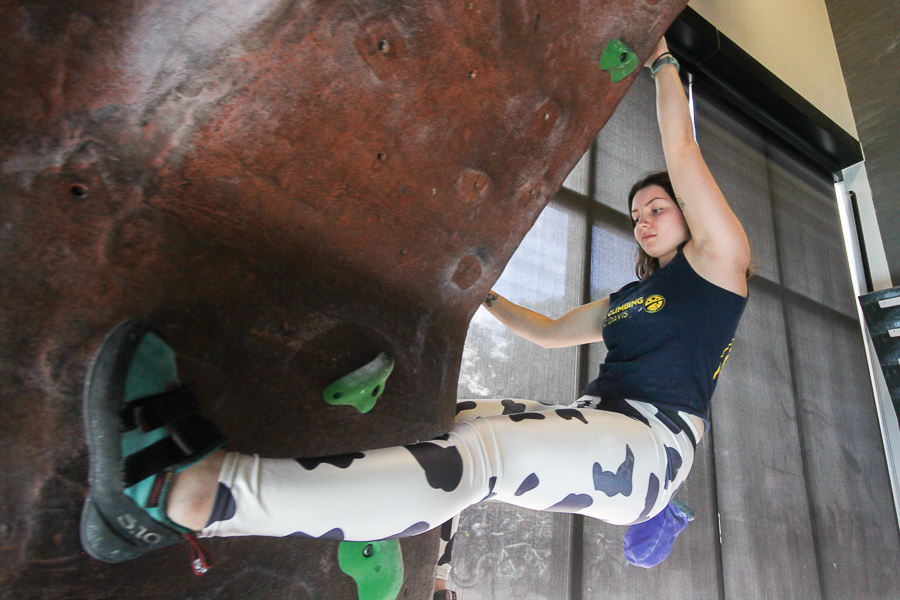
The Rock Climbing Club is one of the more recent additions to the clubs on campus, after a group of students decided to bring the rock climbing community back to Davis. Jonathan Hopkins, a second-year computer science and engineering and cinema and digital media double major, spearheaded its resurgence.

“When I started going to school here I came into contact with a former member of the club as well as an alumni who gave me a lot of club advice,” Hopkins said.

Hopkins, the president of the organization, wasn’t alone in the process for getting the club started. The summer before attending UC Davis, he had reached out to other rock climbing devotees, including Amanda Milici, a second-year environmental science and management major, and Emily Nguyen, a second-year French and neurobiology, physiology and behavior double major, over Facebook. Together, they came up with a collaborative plan to bring the rock climbing community back to campus. It wouldn’t be until the start of the following Winter Quarter in 2016, the start of competition season, that they would decide to seek official club status.

The club is part of the Northern California Region Collegiate Climbing Series, which allows them to compete with other colleges in the region.

Milici, the events coordinator for the Rock Climbing Club, explained that during winter competition, events are held on indoor rock walls. The walls are short enough for climbers to go without the use of a rope and the floors are padded in case of a fall.

According to Milici, the competition atmosphere tends to be laid back.

“Everyone just climbs together,” Milici said. “All of the other schools cheer each other on, and you never really feel like you’re competing.”

Members of the club enjoy the closeness and camaraderie of the rock climbing community within their tightknit group. That feeling of togetherness extends to competitions at other schools where hospitality is the norm.

“Just over a year ago we went to our Stanford University competition with just five members,” Hopkins said. “Watching other local colleges with teams of 15 to 20 was intimidating, but the collegiate climbing community is incredibly welcoming and encourages such a positive atmosphere, and we ended up having a great experience.”

Hopkins went on to say that at its following meet at Sacramento State in March of 2016, the UC Davis club had over twice as many members. It now has about 30 regular members.

“I hope to continue to establish our community among climbers at Davis so that we could continue to help connect people,” Hopkins said.

Ann Grotjahn, a second-year wildlife, fish and conservation biology major, joined the club in Fall Quarter of 2016.

“I have had such a positive experience so far, everyone has been so welcoming and encouraging,” Grotjahn said. “What I really love about this club is that whether you are serious about climbing or just want some people to climb with on weekends, there is something for everyone and everyone is welcome!”

The rock climbing club is still fairly new, but will continue to grow with a steady influx of both beginning and experienced climbers. Those interested in getting involved can visit the Davis Climbing Facebook page to find updates and information on the team. Another Facebook group called Davis Climbing Club is a forum in which people can post to arrange climbing meetups; those interested can directly message the page or contact one of the officers.

Written by: David Flores — sports@theaggie.org

Yolo County Library introduces ‘Pay it Forward’ program

SAHAR FOROUZANFAR / AGGIE

Program will help library patrons pay off overdue fines

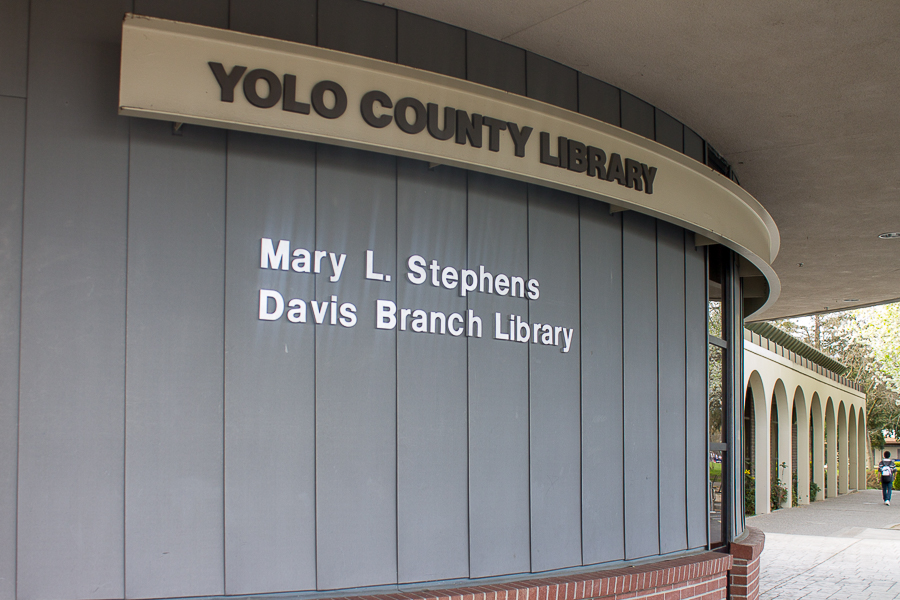
The Yolo County Library, comprised of eight branches throughout Yolo County, has introduced a new program to help its patrons pay off overdue books. The program is called “Pay it Forward,” and it collects donations that are put towards paying off late fees with the goal of increasing library usage for those who cannot afford to pay off their fines.

Patrons are encouraged to donate whatever amount of money they would like to the program, and in return, will receive a star-shaped note to write a message on. Once filled out, the stars will be on a board behind the circulation desks at Yolo county libraries. Patrons who cannot afford to pay off their library fines can then redeem those stars.

“We are so fortunate to be in a community that looks out for each other,” said Patty Wong, a Yolo County librarian, in a statement on the library’s website. “Through the kindness of others we can help continue someone’s lifelong connection with literacy and the library.”

Stephanie Li, a third-year managerial economics major, likes the “Pay it Forward”  program.

“I think it’s a good program because it encourages people who may not be able to pay their fines to continue to go to the library,” Li said. “If they can continue to educate themselves and have access to books, the program is really good.”

“Pay it Forward” aligns strongly with policy released by the American Library Association (ALA) in 2012 entitled “‘Library Services to the Poor,’ in which ALA directs libraries to remove late fees.

It is crucial that libraries recognize their role in enabling poor people to participate fully in a democratic society, by utilizing a wide variety of available resources and strategies,” said the policy statement on the ALA’s website. “The American Library Association shall implement these objectives by […] Promoting the removal of all barriers to library and information services, particularly fees and overdue charges.”

Hannah Kim, a third-year community and resource development major and employee of Shields Library, believes that sometimes late fines are justified — particularly for books from Shields Reserves.

“People take [books from reserves] for several hours and complain about how [the late fees] racked up,” Kim said. “[Without fees,] people wouldn’t bring books back, and people waiting in line wouldn’t get books. It would be unfair for the people waiting.”

Despite her belief that late fees are sometimes necessary, Kim is a fan of the ‘Pay it Forward’ program.

“It allows people to be a good samaritan, it’s a good opportunity,” Kim said.

Anyone interested in taking advantage of the program, or donating to the program, is encouraged to stop by the circulation desk of any Yolo County Library branch.
Written by: Raul Castellanos Jr — city@theaggie.org

Why the Syrian Civil War represents our greatest humanitarian crisis

BASMA [CC BY-ND 2.0] / FLICKR
How the Arab Spring contributed to Syria’s downfall
A boy lies face down on the sand, as the waves of a beach in Turkey wash over him. A police officer looks the other way, hollering at people we cannot see. The water moves back and forth, back and forth, but the boy lies still on the sand like a big doll that’s been abandoned by children who’ve grown bigger than their toys. At three, he hasn’t lived a life long enough to understand why he and his family had to leave home, or why they needed to cross perilous waters in shoddy lifeboats to reach a foreign land. All he can do is follow his parents, and all his parents can do is run from whichever danger faces them next. Bullets, bombings, ISIS, the Kurds — at this point, it doesn’t even matter.

But he’s not running anymore. The iconic image of Aylan Kurdi sparked international outrage and gave a face to the Syrian Civil War. Aylan Kurdi’s story helped humanize a crisis the UN characterized as the biggest humanitarian emergency of our era. The picture of his lifeless body on the beach, pasted on every newspaper around the world, brought the globe to a full stop, just for a second, as it focused its attention on the mass exodus of refugees from Syria.

It’s been five years since the Syrian Civil War began, and entire cities steeped with ancient heritage and historic sites have been laid to waste. About half the population has fled the country, and at least 386,000 people have been killed. The city of Aleppo, one of world’s oldest, lies in ruins. Still a civil war in name, the conflict has escalated into a proxy war for different countries, namely the United States and Russia. Every powerful nation in the world today plays a role on the Syrian battlefield, and diplomatic relations between countries have soured as a result. Turkey is in conflict with the EU, and the EU is in danger of breaking up due to numerous issues including the refugee problem. In this context, it seems impossible to believe that the story starts out with a fruit seller in Tunisia.

After being publicly humiliated, a fruit seller marched in front of a government building in Tunisia and self-immolated. Catalyzed by his act of desperation, protests broke out all over the city, standing up against the dictatorial regime and asking for a real democracy. Within a month, the President had fled the country.

The success of the non-violent protests in Tunisia sparked a series of demonstrations in many other Middle Eastern countries, leading to a movement now known as the Arab Spring. While these originated independently in each country, their demands were very similar. The common people were fed up with their oppressive and corrupt regimes, and wanted a government where they had a real say in the decisions made. Poor economies in these countries created mass unemployment that led to educated youth taking up jobs not suited to their capabilities. This led to widespread dissatisfaction among the large population of youth in the Middle East, and was a large factor in the popularity of the anti-government protests.

The Arab Spring had mixed outcomes in the various countries that it affected. Despite setbacks, Tunisia has been working hard to establish a strong foundation of democracy. Egypt seemed to be moving towards a state of progression, but has since relapsed into a system resembling the previous one — except it’s the military in power this time. On the other hand, the Arab Spring set off civil wars in Libya, Iraq and Yemen.

But nowhere have the consequences of civil war been as horrific as Syria.

Hafez al-Assad came to power in Syria in 1970, and set up the first organized government. As President of Syria for 30 years, he established much of the framework of modern Syria, but dealt with anti-establishment demonstrations with an iron fist. The current president of Syria, his son Bashar al-Assad, has carried on many of the same traditions as his father.

It’s perhaps this tradition of extreme repression that ultimately caused Syria’s downfall. When protests broke out in Syria in 2011 during the Arab Spring, Assad went against the established trend of dictators stepping down, and instead called in the Syrian Army to aggressively crush the rebels. After decades of being suppressed, the anger against Assad’s regime began to take on a very ugly form. The peaceful protests quickly escalated after the government’s violent crackdown. Armed opposition rebels began to fight back — at first to defend themselves, then to expel security forces from the neighborhood. As time went on, these rebel groups turned on each other.

The regional powers in the Middle East were drawn in when religion entered the fray. Mr. Assad belongs to the Alawite sect of Shia Muslims, a minority in Syria, while the majority in Syria are Sunni Muslims. This is part of the reason why the Assads have taken a tough stance regarding anti-government propaganda — they constantly fear being overthrown or ousted by the Sunni majority.

An added dimension to the crisis is supplied by the Islamic State, or Daesh, as they are called in Syria. The armed rebellion against the government has lost many of the secular moderates that started it and is now comprised of Islamists and jihadists belonging to ISIS. The radical Islamic group split from other rebels fighting Assad, and started preying on Kurds and other minorities in the region. Taking advantage of the chaos of war, they declared their own state and the creation of a “caliphate” in 2014. Their rise has been mysterious, to say the least.

As the Islamic State starts carrying out attacks overseas in Western countries, many international powers like France have been drawn into the war to defeat ISIS. Iran and Russia, along with Hezbollah (a Shia Muslim militant group) are fighting to uphold Assad’s regime. There is an interesting power tussle at play here between longtime enemies Russia and the U.S.

“The Russians know that if the current regime falls, the new state is going to be something like Egypt, a client state of the United States,” said Noha Radwan, a professor of Arabic at UC Davis. “So they are interested in supporting Bashar al-Assad.”

Syria had been on Russia’s side in the Cold War, and Russia wants to keep it that way. The U.S. sees an opportunity here to influence Syrian politics and bring Syria to their side. Russia and the U.S.’s opposing interests, then, only add to the conflict, with the former trying to display its military strength by supplying weapons to pro-Assad groups.

Many people living in Syria are not prominently part of any of the fighting groups, and wish to stay out of it. They may identify as Muslim, but most do not support the Muslim Brotherhood or ISIS ideology. They want a democracy and don’t really want Assad to continue with his reign. They have nothing to do with international powers who have entered the fray, and do not care for the foreign countries that aren’t concerned with them.

Caught between the proverbial rock and a hard place, many Syrians have been forced to relocate to safer places. Over 6.5 million people have been displaced in Syria itself, and more than 4.5 million people have packed their bags and fled. To make matters worse, Syria previously took in many refugees from the Israeli-Palestinian conflict, who have now been forced to relocate yet again. With their homes reduced to rubble behind them, the population of Syria has spilled over the borders to Lebanon, Jordan, Turkey and Iraq. Turkey currently houses the highest population of refugees in the world. Iraq faces its own ongoing civil war, while trying to cope with a rising number of internally displaced peoples there.

At first, when the Syrian Civil War started, most believed that it would be over in perhaps a few months, and sought refuge closer to home from where they could move back as quickly as possible. When that didn’t work, they moved into neighboring countries where they had families. As the war escalated, people started looking for more permanent housing with security and jobs. In most cases, immigrants in Jordan and Lebanon are not allowed to work, and this significantly disrupts their lives.

Soon, the line of refugees started to pass through Turkey, and knocked on Europe’s doors. European reaction have varied between hopeful and frightened. German Chancellor Angela Merkel has welcomed Syrian refugees with open arms and has promised to try her best to manage the crisis, but now faces opposition from her own party for her decisions. Sweden has also demonstrated a high standard of responsibility in dealing with the crisis, accepting the highest number of refugees per capita in the EU.

But this issue has severely polarized countries like the United Kingdom and France, where the refugee crisis has become a major part of political discourse. The U.K. has been sending a significant amount of aid to regions neighboring Syria in hopes that migrants will choose to stay nearer to their homes and not undertake the perilous journey across the sea. Moreover, it has become increasingly clear, especially after Brexit, that migrants aren’t fully welcome in the U.K. Many people from the older generations resent the growing number of non-native people who they believe are taking away jobs rightfully belonging to U.K. citizens.

Terrorist attacks in France have forced the country to wage war against ISIS in Syria, and President Hollande has promised to accept 30,000 refugees in the next two years. But judging from the favored predictions of the looming French elections, citizens there aren’t happy with his decisions. Instead, they have shifted their support to the far-right Marine Le Pen, who strongly opposes opening France’s borders to Syrian immigrants.

Immigration also proved to be a major issue during our 2016 Presidential election. Showcasing Orlando and San Bernardino as examples, Trump promised to halt Muslim and Syrian entry to the U.S. and create a Muslim registry. Looking at the results of that election, we can clearly say that he had support from the American people in his policies. Not long after becoming President, Trump issued a controversial immigration ban — in effect a Muslim ban — that barred citizens of seven Muslim-majority countries from entering the United States. After immense opposition, he signed a revised version of the order, but Syrian refugees remain prohibited from entering the U.S.

Countries which have chosen to bar or limit refugee entry have faced significant backlash online and in person alike. Governments around the world have been accused of having no compassion, no humanitarian feelings and have been labeled as xenophobic or racist. While this may be partly true, we must consider the fact that fears about terrorism, so prominent in Europe now, are grounded in reality. It’s easy to sit behind a computer and call out a government on their actions, but decisions like these are far more complicated than they seem and need to be thought through from many angles before they can be carried out. As a government elected by the people, it is their duty to make sure that their own citizens are taken care of first — economically and socially — before we extend our services to those of other nations. As citizens of a country, we have every right to be outraged at our government’s treatment of refugees — but we forget that there are others who elected them and the government is responsible to them too.

So why are countries so reluctant to let in refugees?

The first and most important reason is resources. Many European nations and the U.S. are still recovering from the crippling 2008 financial crisis and have been unable to employ the large numbers of people who lost their jobs and are struggling to find another. Syria’s neighboring countries, already poor and unable to provide for their own citizens, are struggling to provide refugees with the space, food and security that they need. Many refugees go on to Greece after Turkey and stop there before continuing to Europe. Greece’s economy, already one of the worst in the E.U. right now, is suffering from the population spike caused by refugees.

Simply providing accommodation to refugees is not enough. We must make sure they receive their basic rights as human beings. Each person should have access to food, shelter and basic medical care. About half of the refugee population consists of children, and they are missing out on education with every day that they spend in a refugee camp. This creates a vicious cycle, in which they never receive education, are unable to get a job and are never able to rise out of the poverty they suddenly found themselves in after the war.

The second reason — more specific to the Middle East — is the terrorist threat. If there’s one major reason why other countries are worried about Syria’s situation, it’s the rise of anti-West and Islamist and jihadist groups that threaten the security of every other nation. From Brussels to Paris to Dhaka, ISIS has slaughtered innocent civilians indiscriminately. Many believe that refugees entering Europe may secretly belong to, or hold the violent beliefs that ISIS propagates. This has led to a general distrust of all Muslims — possibly the worst reaction to the jihadist threat. ISIS has consistently tried to portray the West (and the rest of the world) as being anti-Muslim, and if we start to hate Muslims, their beliefs are validated. Hate breeds hate. When we don’t make Muslims feel welcome, they may start to feel that Islamist groups like ISIS were right all along. It’s worth remembering that the reason Syrians are fleeing their country in the first place is because of groups like ISIS — they fear them as much as we do.

Speaking in 2015 on the threat of terrorism, former President Obama said the Islamic State, “seeks to exploit the idea that there’s war between Islam and the West.” He said that, “when you start seeing individuals in position of responsibility suggesting Christians are more worthy of protection than Muslims are in a war-torn land, that feeds the [Islamic State] narrative.”

It may be years before peace returns to Syria. It will most certainly be decades before any scars heal and reconstruction can take place. Complex issues like this will never have a clear solution that satisfies everybody, but what we as global citizens can concentrate on is the plight of normal people in Syria, especially the numerous children who have nowhere to go. Our response to them in their moment of crisis decides how the next generation of Syrians turn out — as well-rounded human beings who give back to society, or to the religious fundamentalists that we work so hard to quell.

The United States is a nation built on immigrants. Most people living here have a history of immigration in their family. Refugees come here for the opportunity to work hard and create the life that they want for themselves. We, more than any other country, know firsthand how important immigrants are to the economy and well-being of a nation. It’s time we stepped up to do our part for such a vulnerable part of the global population.
Written by: Shohini Maitra — samaitra@ucdavis.edu

Disclaimer: The views and opinions expressed by individual columnists belong to the columnists alone and do not necessarily indicate the views and opinions held by The California Aggie.

Liquid Hotplates take home first place in a cappella competition

LIQUID HOTPLATES / COURTESY

A cappella choir to move on to ICAA semifinals

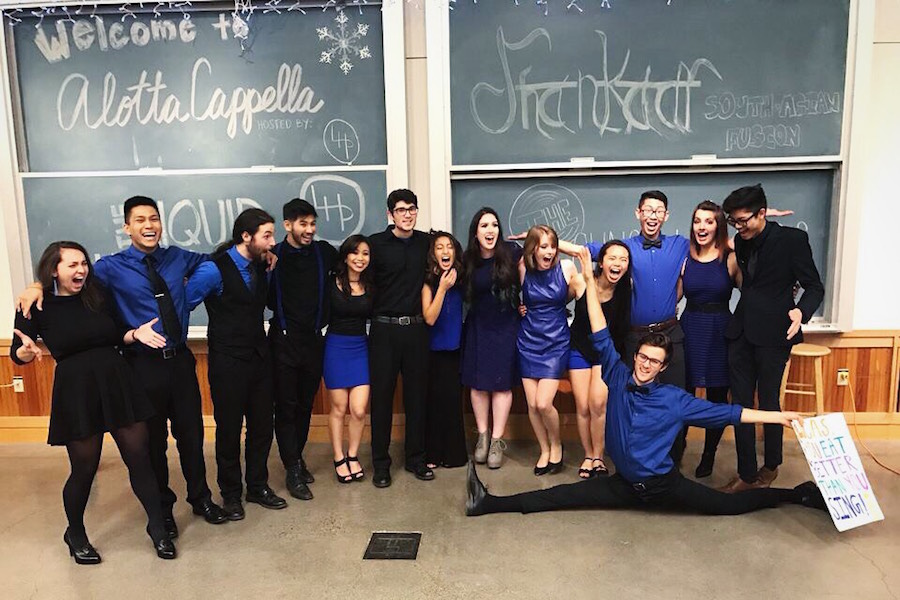
UC Davis’ very own a capella group, the Liquid Hotplates, has been chosen to compete at the International Championship of Collegiate A Capella (ICCA) Tournament on March 25. After winning the Northwest quarterfinal a few weeks ago, the group is now advancing to Salem, Oregon, where it will sing against groups from Stanford, Oregon, Utah and Washington. If they win the semifinals, they will advance to nationals in New York City.

“I think we have a really good chance,” said Calvin Htet, a fourth-year computer science major who won the award for outstanding soloist at the competition. “We scored among the top 5 out of 40-something groups in our region, so I think we have a really good likelihood of getting to the finals.”

The group has been putting in extra rehearsal time to prepare for its upcoming competition. They are focusing on micro-tuning fine details from their quarter final set.

“We are not going to change what works,” said Tristan Bonds, a third-year neurobiology, physiology and behavior major and co-music director of the group.

“The goal is to pinpoint the areas we need to focus on,” added Maddy Dufek, a fourth-year biological sciences major and the other outstanding solo winner. “We are really going to tailor our changes to the judges comments we got from the last competition.”

One notable aspect of the group is its unique sound, which is achieved by taking elements from several types of music and mixing them together.

“It is kind of jazzy, R&B and pop-style,” Dufek said. “Every group has different styles. The goal in a capella, especially when competing is to take a song and make it your own […] A lot of groups do traditional barbershop style which can be very cookie cutter and safe. It is fun to listen to, but not as exciting or stimulating.”

The Liquid Hotplates are a completely student-run group. The members do everything from fundraising to music rehearsals all by themselves. Music directors Cole Hofberg and Tristan Bonds frequently work off one another to come up with new arrangements for the group.

“We come from different genre backgrounds,” said Cole Hofberg, a third-year civil

engineering major. “I wanted to do more kind of R&B hip-hop kind of stuff, and [Tristan] wanted to do jazz.”

The combination of different styles seems to work well for the group. Their unique sound helps them stand out from the competition.

“We are doing a version of ‘Cocoa Butter Kisses’ by Chance the Rapper,” Dufek said.  “Our music director, Cole, made it a much more melodic edition. It has a really nice R&B sound. It is really different and really fun. By the end of the song we are all just belting.”

The Liquid Hotplates will be traveling over eight hours on March 25, the day after finals schedule ends, in order to compete in the tournament, which runs from 7 to 11 p.m. For more details, please visit the Liquid Hotplates’ and ICAA event pages.
Written by: Myah Daniels — arts@theaggie.org

Hiroshima atomic bomb survivor Takashi Tanemori speaks at UC Davis

DIANA LI / AGGIE

Tanemori relives Hiroshima attack

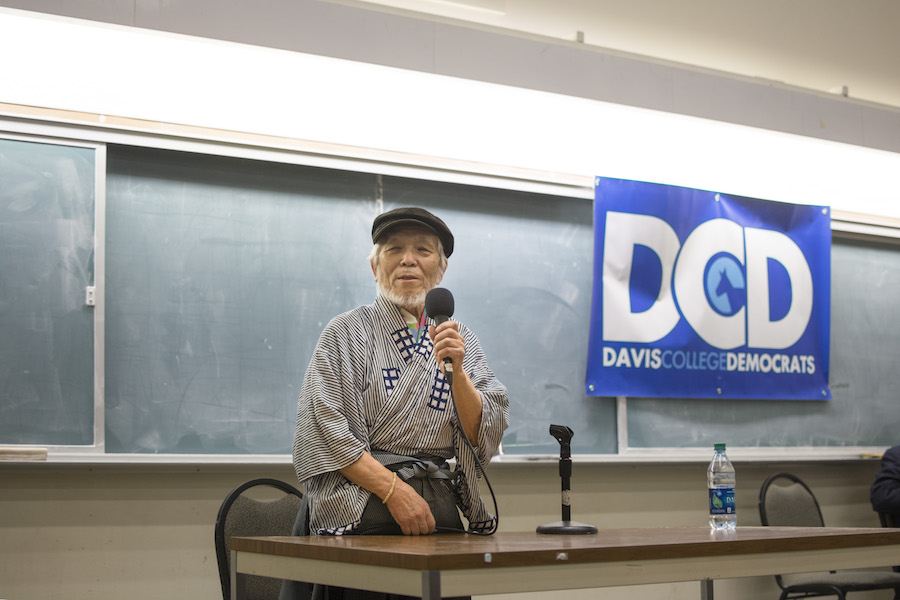
Takashi Tanemori, the only one of his family to survive the atomic bomb attack on Hiroshima, Japan, came to UC Davis on March 10 to discuss his experience as well as life after the attack. The Davis College Democrats (DCD) hosted the event in Haring Hall and sold tickets to community members and students.

Nearing the end of World War II in 1945, the United States dropped atomic bombs by plane over the Japanese cities of Hiroshima and Nagasaki on August 6 and August 9, respectively. Between 70,000 and 80,000 people were killed from the impact and resulting fires, and another 70,000 were injured. The uranium’s radiation continues to travel inter-generationally.

Tanemori, lost his vision as a result of being 0.7 miles from the American military dropping the atomic bomb, and miraculously sustained no other radiation injuries or diseases. He painted a vivid image of the Hiroshima tragedy from his perspective as an 8-year-old on the schoolyard, retelling his entire story through sobs.

“That was the last memory,” Tanemori, who was joined by his guide dog, said. “I saw the flash in the sky, pure white. I’ve never seen white as white before — all the color was confiscated. I want you to put yourself in the room. All you see is white. You cannot find yourself in the pure whiteness. I do not know how long later, but then an explosion took place. All the sound of the universe converged, exploding. Then you begin to smell the heat. The whiteness turns into pitch darkness. Almost a split second. Then you begin to smell the heat. You cannot see it. You smell the heat coming closer and closer and closer. I begin to hear the cry of my classmates, ‘Takashi! I am burning!’”

Tanemori emotionally recalled how soldiers saved him from the fire-engulfed rubble of his decimated school.

“I saw the reddish, orange, yellow, bluish fires leaping just like serpents,” Tanemori said. “And I cried ‘Daddy, come and help me.’ Somehow, these Japanese soldiers were on the campus. They came and they dug me out. One of the soldiers took me in his arms and he clutched me. He took me from the debris and went through the streets filled with fires.”

He spoke of an injured man on the brink of death and a woman carrying her deceased babies that he encountered while soldiers transported him to safety.

“[The injured man] said ‘Sir,’” Tanemori said. “I’m sorry — I can hear his voice right now in my mind. He said, ‘Sir, give me some water. Please.’ He was unrecognizable. And the soldier shook his head, and the man grabbed him and said ‘Sir, put me out of my misery.’ But the soldier moved on. I cannot erase this from my mind, my heart. There was a woman calling her children by name, as she passed by, just about two feet from the front of us. I saw the babies, she was carrying on her back. I wonder what she thought about this war. Why the United States and Japan had to fight, had taken my babies?”

Ten years later, Tanemori went through the legal citizenship process into America but was exploited by those who coordinated his travel. He ended up in California’s Delano migrant labor camp. Tanemori explained the value of proper treatment of immigrants and refugees as well as spoke of the injustices that happen to immigrants, even those who are legal.  

“18 years old, I thought I must go to America to avenge my father’s death,” Tanemori said. “Then 18 years old, June 24, I came to America without any penny in my pocket. All I knew was [I was] hungry. I trusted the Japanese man who told me America is a good Christian nation. I’m still glad I came to honor my heart. In the migrant camp, it doesn’t matter those who came through proper immigration channels or not. I was told America was a great, Christian nation, and to be brought to the migrant labor camp — it’s worse than seppuku [samurai ritual suicide].”

At the labor camp, Tanemori was poisoned by the staff feeding him food that he didn’t know was deliberately old and filthy.

“It was spoiled, and I got food poisoning,” Tanemori said. “I didn’t know any English and the next six months, they transferred me from hospital to hospital.”

Although doctors and nurses did not help him, he eventually befriended a woman who became his guardian, taking him out of hospital and mental ward care.

Tanemori carried resentment and was “anti-American” for a long while until he remembered his father telling him “revenge gets revenge,” which instilled in him a spirit of forgiveness and unity. Before his father died, he once told him, “‘The greatest way to avenge your enemy is by learning to forgive.’”

Tanemori finished his talk by explaining his road to making peace with America and forgiving the suffering inflicted on him. From the pain, Tanemori analogized how he discovered an opportunity for growth, understanding and selflessness.

“Lotus flower will not grow in the clean water,” Tanemori said. “They always grow in the dirty, muddy waters. Through this, comes out a beautiful flower. When you realize the life you have today, the air you breath, it’s a gift, a lotus. Isn’t that wonderful? The world gave me such terrible, horrible events in my own personal life. But through this, here I am standing before you, sharing with you the gift. My daddy said, ‘My son. A true samurai is always finding the way to live for the benefits of others first, then you benefit.’”

Tanemori delivered his talk for about 45 minutes before offering a period for students and community members in the audience to ask questions. Haring Hall contained about 70 students and community members.  

Haoyuan Li, a second-year materials science and engineering major, attended the event to learn about the Japanese reaction to the Hiroshima attack.

“[I was] interested in the historical facts that happened in Japan and also how the Japanese people reacted after the accident happened,” Haoyuan said. “Or, we shouldn’t call it ‘an accident’ — a tragedy.”

Christian Monsees, the director of finance for DCD, a coordinator of the event and a third-year political science major, tied together Tanemori’s talk and the modern American political trajectory.

“We were absolutely thrilled and honored to have Takashi Tanemori,” Monsees said. “Mr. Tanemori spent this time to talk not only about his experience on that day but also how he learned to forgive the United States despite all the anger, rage and hatred that he had for our country. Unfortunately, we now live in a country where anger and hatred are very relevant to modern day politics. This event is incredibly significant as a learning lesson of how we can improve ourselves based on the historical past. It’s always important to look to history when you’re making policy. Even though this event was apolitical, I still think it was very relevant to politics.”


Written by: Aaron Liss  — campus@theaggie.org

Grande Village lottery increases accessibility of affordable homes in Davis

GENESIA TING / AGGIE

Davis Affordable Ownership Housing Program offers diverse housing options

The new Grande Village neighborhood held a successful lottery the last weekend of February as part of Davis’ Affordable Ownership Housing Program (AOHP) in an effort to create diverse housing options who can’t afford current housing in the City of Davis.

The project’s inception began several years ago when the Davis Joint Unified School District (DJUSD) looked into putting the unused property on the market. Its aim was to increase the availability of housing for teachers and district staff members, especially those who are eligible for income-price restricted housing.

“Once the DJUSD decided that the site is no longer needed for a school site and that disposition of the site was necessary, it filed the necessary entitlement applications for the development of the site,” said Ike Njoku, a planner and historical resources manager at the City of Davis, in an email interview. “The goal was to generate the best and highest value for the site.”

Subsequently, Don Fouts, the owner of Fouts Homes and a developer of Grande Village, acquired the property from the school district. The development agreement for the real estate outlined that fourteen single-family homes would be sold at below market rates as part of the city’s AOHP; the remaining 27 homes will be priced at market value.

The below-market units would be sold through the lottery system set up by the city for price-restricted ownership properties. School district employees held priority in the lottery and were first in line for the property as outlined in the development agreement.

Eight of the homes are low-moderate income units for households that are no higher than 120 percent of the area median income (AMI) based on household size and annual gross income. Fouts will sell the other six homes as middle-income units for households that are no higher than 180 percent of the AMI.

Of the 14 homes available, 126 families entered the lottery, with the first 29 spots reserved for qualifying school district employees. David Achimore, a teacher at Davis High School, was the first name chosen in the lottery.

“I went into the lottery knowing that lots of people had applied,” said Achimore in an article from The Davis Enterprise. “It’s good to make the first step.”

In addition to the Grande VIllage development, two other projects are also underway as part of the AOHP: the Villages at Willow Creek and BerryBridge. The pre-application process for the Villages has ended; however, BerryBridge will be accepting applications until March 17.

We have a lot of interest in that type of product [affordable single-family homes] in the community,” said Kelly Stachowicz, an assistant city manager. “A lot of people would like to be able to live here, usually because they work here, but they aren’t able to afford a market-rate unit.”

For more information on the AOHP and the breakdown of the AMI for households, visit the city’s website.
Written By: Bianca Antunez —city@theaggie.org

Geophysical dance course to be offered next quarter

HANNAH LEE / AGGIE

Freshman seminar merges arts and science

Crashing tides, tsunamis and other fluids that move our world will be paired with dance in a freshman seminar offered next quarter in the hopes of creating a new way to approach science and the arts.

The course, Geophysical Dance, is a two-hour class offered on Tuesdays from 12:10 to 2 p.m. It has no prerequisites and is described by the lead professor, Ian Faloona, as being “light” in both science and dance elements. The class is interested in putting these two topics into conversation.

Faloona, an atmospheric science professor at UC Davis, has been dancing since he was an undergraduate and was encouraged by colleagues to develop a class that united his two areas of interest.

“I teach how the atmosphere moves and […] I have all these ideas about how the way we move is so similar to — in a lot of ways — what I am trying to teach about how fluids move in the atmosphere and oceans,” Faloona said.

The class will be a hybrid of lecture and applications, using students’ bodies to teach concepts of atmospheric science and to create new ways of thinking about science in general. Faloona has built the class around five basic concepts that are all based around fostering creativity through the combination of these two disciplines.

“We try to find elements in nature that then we can use to build movement pieces,” Faloona said.

He emphasized that there is not a formal dance component to the class, but rather that this is a way to use creativity to understand fluids of the environment. Topics for the quarter include understanding the summer fog of California, exploration of the physics of rotation and formation of thunderstorms.

“One of my main objectives is try to get us back to this level of pure creativity,” Faloona said.

With a planned field trip to a playground and a unique teaching philosophy, this class is a rare opportunity for UC Davis students.

Faloona is teaching this class with the help of Kevin O’Connor, a Ph.D. candidate in performance studies at UC Davis who holds an MSA in choreography.

“In the case of this class, we’re using the dance studio and our bodies as experimental laboratories to explore contemporary scientific understanding of weather,” O’Connor said. “Using the different practices [of art and science] to think through or imagine new ways of modeling the data, bodies can be used as models to think about scientific data with and in enacting the data, it creates new ways of thinking about the data.”

While Geophysical Dance is a fairly new class, Terry Nathan, a professor of atmospheric science, has been teaching a class that also combines the arts with the sciences in a course that pairs photography with atmospheric science.

In my course, students use photography to explore the common ground occupied by art and science,” Nathan said in an email interview. “Gestalt psychology meets Einsteinian physics in photographic composition; the geometric foundations of art and science; order versus disorder; and photographic interpretation of the environment.”

Nathan is one of the people who encouraged Faloona to create his own course. He also emphasized the unique experience that science and art provide each other.

“Despite the apparent dichotomy between art and science, they share the twin pillars of a university education — creativity and the quest for discovery,” Nathan said.

The seminar being offered next quarter highlights what Nathan discusses — merging “pillars of a university education.” The Geophysical Dance class is a way to use creativity and expression as a lens to describe the world.


Written by Emma Askea — science@theaggie.org