55.7 F
Davis

Davis, California

Monday, December 22, 2025
Home Blog Page 641

ASUCD proposes system to give GE credit for AP classes taken in high school

HANNAH LEE / AGGIE

Emails from two administrators show alleged obstruction of proposal by administration

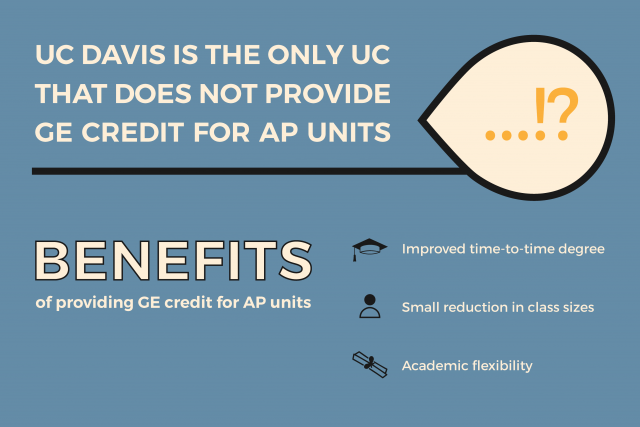
Currently, UC Davis is the only UC school that does not provide GE credit for passing AP scores. In response to this, ASUCD President Alex Lee proposed Senate Resolution #9, which requests that UC Davis award General Education (GE) credit for students who earned passing scores on Advanced Placement (AP) classes in high school.

The current proposal is a part of the platform that Lee campaigned on when he ran for ASUCD president. Only the ASUCD president can make proposals, such as Senate Resolution #9, to the Academic Senate, and they can only make that proposal once it has been approved by the ASUCD Senate. Then, the proposal is sent to the Academic Senate for consideration.

However, Lee has fears about the future of his proposal because of two emails which were obtained by The Aggie. These emails allegedly show an unwillingness of the administration and Academic Senate to cooperate with student requests for GE/AP reform.

“This is the fun case of, ‘you have to check who you are sending your emails to,’” Lee said. “[…] This kind of highlights in writing that [Academic Senate Chair] Rachael [Goodhue] has been kind of evasive of the student government and students in general. […] This [email from Vice Chancellor of Student Affairs Adela De La Torre also] shows in writing that they basically didn’t want to take it seriously in the first place.”

The first email Lee mentioned is an email from de la Torre addressed to Goodhue.

“Rachel [sic] I will ask Milt to manage Alex,” de la Torre said in the email. “He is no longer ASUCD President. A new one was elected last Friday so this may be the end of the conversation as well.”

De la Torre, when prompted on this email, stated that she was simply asking Vice Chancellor Milton Lang and ASUCD Business Manager Janice Corbett to manage the “transitional issue” between new ASUCD executive administrations.

“The issue is primarily a transitional issue,” de la Torre said. “When the president steps down, the issue really becomes one of, who you need to communicate with. The issues becomes, in the portfolio, Milt and Janice are the ones who manage the discussions and the meetings. […] We have to be very careful to ensure that the transition period is one where, quite frankly, Alex provides the information transfers to the new president and the vice president.”

The second email Lee mentioned is one from Goodhue.

“He’s been told that we need to manage workload, and that this is an internal request that doesn’t have an external deadline, unlike something from systemwide or the administration,” Goodhue said in the email. “It’s a request to change an internal Davis Division of the Academic Senate policy. I’m not responding to any more emails on this matter from Alex.  He’s wasting my time. If SA judges a communication to be important, please have him send it to one of you, and you forward it to me.”

Goodhue explained her email as simply an effort to control conversation and keep it, “productive.”

“I and the Senate office had explained to Alex, to President Lee, repeatedly that ASUCD’s request was under consideration,” Goodhue said. “At that point, communication had stopped being productive.”

Lee’s GE/AP proposal builds off of existing frameworks within the university. GE credit would be awarded to students based on already determined course equivalencies. Students who earn passing scores on AP exams are given certain numbers of units for each exam and barred from taking an equivalent course at UC Davis. Instead of just receiving units toward graduation, students would also receive similar or identical GE credit for those equivalent courses.

Without specifically talking about the merits of this proposal, Goodhue did speak about work toward reducing time-to-degree, among two other things.

“I would like to reiterate that time-to-degree is very important to the Senate and very important to campus,” Goodhue said. “I will also say that it was nice to get a concrete proposal from ASUCD. The last thing I’ll say is a plug — the ASUCD has places for representatives to senate committees. The ASUCD has struggled to fill them. I strongly, strongly encourage students who want to become more involved in how the university works to apply to participate in these committees. It would be great to see them at the meetings.”

This final point about filling ASUCD spots on Academic Senate committees was also brought up by Lee, who described some of the challenges students face on these committees.

“On their committees [they] have ex-officio, non-voting, basically observer seats, that ASUCD tries to fill,” Lee said. “I say try because they are very daunting for students. Not all committees are, but some committees are not very welcoming to students because they talk for three hours about tenure for faculty, or something. It’s not accessible. But we have student reps on there.”


Update (3/16/17, 10 p.m.): Since the initial publication of this article, the UC Davis Division of the Academic Senate released a timeline on how the ASUCD proposal will be handled. The Academic Senate will release a status update in June but expects to take through Fall Quarter 2017 to discuss the proposal fully and make a final recommendation.
Written by: Kenton Goldsby — campus@theaggie.org

Last week in Senate

HANNAH LEE / AGGIE

The ASUCD weekly Senate meeting took place on March 2 in the Mee Room of the Memorial Union. During quorum roll call, interim Senator Michael Chan was absent; however, he arrived later during the meeting.

Senator Daniel Nagey spoke about a constructed survey by the joint ASUCD-GSA Housing Task-force to be sent out to all UC Davis students, faculty and staff suffering from housing issues. He urged members of the Senate to take a few minutes to fill out the survey. Next, he introduced Donald Gibson, the co-chair of the Task-force, who had prepared a presentation about the importance of the data collected by the survey.

Gibson’s presentation addressed the projected increase in enrollment of students in conjunction with the stagnating population of Davis. He emphasized that the fundamental issue with housing units is the lack of supply.

Next, Senator Sofia Molodanof presented about the campaign “spread the word to end the word” regarding the use of the word “retarded” in addressing people with disabilities. She discussed how ASUCD has not addressed this issue and encouraged others to pledge to address people with disabilities as the human beings that they are rather than letting their disabilities define them.

ASUCD Entertainment Council Director Rachel Meyers presented on the unit’s past, current and future plans for events. She discussed plans for athletics partnerships for unconventional venues, implementing a sponsorship deck in order to generate revenue and a new video series to provide an additional platform for student performers. Furthermore, she discussed the unit’s income, with consideration of a possible discrepancy as a result of not receiving all of the funds the unit was owed from the Chance the Rapper concert.

Internal Affairs Commission (IAC) chair Nick Flores questioned the preparedness of Entertainment Council in future situations similar to the Chance the Rapper “Facebook incident” and Meyers responded that it has given them insight on how to tackle similar issues in the future.
Senate Resolution #49, authored by Senator Sam Chiang, was amended after meeting with campus legal counsel. This resolution condemns Interim Chancellor Ralph J. Hexter for allowing Milo Yiannopoulos, a far-right speaker, to visit UC Davis.

Molodanof believes that Hexter could not legally condemn Yiannopoulos because he is at the helm of a public university. Senator Anastasia Ruttkay mentioned that Hexter’s expression of disappointment showed his point of view on the issue, and Nagey stated that the chancellor could have sent out an email to notify and provide safe spaces for students who would be suffering as a result of the event taking place, but he did not do so.

Senator Jose Meneses discussed how Club Finance Council would have funded the event, regardless of the whether the full controversial name of Yiannopoulos’s tour, titled “The Dangerous Faggot Tour,” was included, because funding for club events is not politicized.

Gender and Sexuality Commission chair Alison Tam had spoken with Vice Chancellor of Student Affairs Adela de la Torre and said that “[the administration was] aware of the steps they could have taken and chose not to do anything.” Former senator and future ASUCD President Josh Dalavai suggested putting limits on controversial speakers and their interaction with the crowd so that individual students do not get targeted. Ethnic and Cultural Affairs Commission Chair Julienne Correa urged ASUCD to apologize to all communities affected by the Yiannopoulos visit, mentioning that often times “we are reactive rather than proactive.”

After facing an objection from Chan, who believed that the legislation was not explicit enough, SR #49 passed with 10-0-2.
For Senate Bill #52, the Sexual Assault Awareness and Advocacy Committee (SAAAC) Chair Rachelle Fishbin asked to change the SAAAC job descriptions to more accurately reflect the job responsibilities. The bill passed.
In response to the SAAAC effort, ASUCD Controller Joe DeAngelo composed a bill in order to make it easier for the SAAAC to receive money for its committee endeavors.

Campus Center for the Environment representative Helen VanBeck presented a unit report regarding compost workshops for UC Davis students as well as vermicomposting workshops for elementary school students.

Chelsea Hernandez, the Picnic Day chair, presented on the current affairs of the event as well as the unit’s long-term plan. This included a repealed Sodexo dining contract and several modifications to constituent events taking place as a result of construction. Following her presentation, SB #59 was passed in order to implement a new long range plan for Picnic Day.

SB #54, presented by Flores, calls to close session any voting or ex-officio member of the Senate who misses more than three Senate meetings in the same quarter. The bill was passed.

SR #10 was presented by CALPIRG and ASUCD Environmental Policy and Planning Commission, which urges the University of California to commit to adopting the goal of 100 percent renewable energy as an extension of the Carbon Neutrality Initiative. It was pointed out that the UC Student Association had already passed this bill; however, the table agreed it was necessary to sign it for symbolic reasons.

Scott Dresser, the editor-in-chief of The California Aggie, presented his unit director report. He mentioned that The Aggie hired a professional business development manager, and presented SB #58 to change the current title of the student advertising sales position at the newspaper. He also spoke of his plan and work to begin the process of digitizing the 102 years worth of microfilm archives of The Aggie, which would then become accessible to the general public online.

Senators asked questions and gave feedback regarding items like the diversity of The Aggie’s staff. Chiang suggested that The Aggie’s staff attend cultural competency trainings, and Dresser said that he plans to open those trainings up beyond just the paper’s managing staff to include reporters and columnists as well. Nagey asked whether writers are trained to ask interviewees of their preferred gender pronouns (PGPs), because he had previously not been asked. Dresser responded that The Aggie’s reporters are indeed trained to ask sources for their PGPs, and he asked members of the senate table to inform him if this is not the case moving forward. Correa asked whether there is a platform for The Aggie to receive feedback on its articles, and whether the paper has received negative feedback. She suggested a more accessible platform for receiving feedback on certain articles that may be triggering for students who may not be comfortable with being featured in The Aggie. Dresser said that readers have the option of writing letters to the editor in response to articles or with any other feedback, and he added that anyone may contact him through his own personal email with any concerns or suggestions.

Chiang discussed how “there is always that one rogue opinion article that goes viral,” which not only creates tension for students but also results in the work of one writer reflecting poorly on the entire newspaper. She also inquired about the vetting process for the staff. Dresser responded that the opinions of an individual columnist do not reflect the opinions held by The Aggie as an organization, which is written as a disclaimer after every opinion article.

Nagey suggested that The Aggie take steps to approach communities that may be targeted by certain opinion articles, and Ruttkay suggested that The Aggie collaborate with ethnically-themed campus newspapers.

Chiang also addressed the history of the shaky relationship between the newspaper and ASUCD. Dresser told the senate table that by no means is it The Aggie’s aim to act as the enemy to student government, but rather to keep the community informed, and he said that he hopes to work with student leaders to showcase their various efforts and endeavors to the student body.

Finally, the Disability Rights Advocacy Committee chair, Ian Rowland, was confirmed. Academic Affairs Commission chair Hemali Patel, asked Rowland about his plan of action. Rowland explained that since there is no actual system put into place for students with disabilities, it is important to first collect data regarding the needs of the student body.

Written by: Kimia Akbari — campus@theaggie.org

UC Davis Basement Gallery hosts exhibition dedicated to International Women’s Day

BRIANA NGO / AGGIE

Art of protest used to enact social change

Protest in today’s political atmosphere is not only necessary, but also an outlet for artists to use art as a form of social change. From the Dakota Access Pipeline protests to the Women’s March, art has been used as a powerful tool in protest for marginalized voices to be heard and remembered.

The UC Davis Basement Gallery, a student-run gallery located in Room 60 of the Art Building, accepts submissions from members of both the university and the Davis community to showcase in the gallery’s exhibitions. Their latest exhibition was titled She Persisted: The Art of Protest to celebrate International Women’s Day. The theme was focused on the Women’s March that occurred on Jan. 21, 2017. Although the gallery is small, each piece of art spoke volumes, and consisted of various mixed media and subject matters.

Seeing the paraphernalia from the Women’s March in person and all the handmade posters was deeply moving — with each stroke of the artists’ paintbrush creating words and images that made a permanent mark in history. These artists were able to convey messages that transcended traditional, mainstream feminism and used their creativity to address issues that are in many ways ineffable. As an artist myself, I understand art not only as a powerful method of self-expression, but also as an aperture to escape suffering and an opportunity for healing.

While the Women’s March became a topic of controversy regarding inclusivity and intersectionality, it was still a significant step towards greater change. My favorite piece from the gallery was a two-part embroidery piece — one using a tampon stitched with red thread and embroidered lettering and another using an empty birth control packet attached to it. The utilization of traditional embroidery with a twist struck me as innovative and almost brave. The meticulous details and needlework alone were astounding, but the use of these very intimate and oftentimes shamed daily objects that I depend on was empowering, to say the least.

Seeing memorabilia from and inspired by the Women’s March this past January reminded me of how much we need voice, agency and autonomy to represent all women, whether it is through art, speech, education or political action.

Helena Zittel, director of PR and marketing at the Basement Gallery, understands how important it is for us to use our voices to make a political and social difference.

“I think that protest is an opportunity to fully understand that we don’t have to be passive and that we have voices and that we have means of making them be heard and making real change,” Zittel said.


Written by: Becky Lee — arts@theaggie.org

Police Logs

NICKI PADAR / AGGIE

Finals week fever

March 6


“Male stating he was unable to get off the train.”


March 9


“Male subject dancing in the intersection.”


March 10


“Unknown subject … urinated on front window.”


“RP visited Davis March 4 and parked his vehicle before walking onto UCD campus. Since then, he does not recall where he parked vehicle.”


March 11


“Male was seen urinating against front of Safeway … wearing fedora style hat with shamrocks on it.”


“Male threw ice tea at RP while he was driving by.”


Written by: Sam Solomoncity@theaggie.org

Finals motivation playlist

LAURA LONG / AGGIE

Essential tunes to get you through week 10 and finals

  1. “Build Me Up Buttercup” – The Foundations

The anticipation of spring break is upon us; the days are sunnier, and, along with that, your mood a little brighter. It’s all fun and games at the end of winter quarter — that is, until week 10 hits like a freight train. Keep your spirits up with this catchy tune as you begin studying for what may seem like an eternity.


  1. “Four Five Seconds” – Rihanna, Kanye West and Paul McCartney

And so it begins. Whether it be at the library, the CoHo or your dorm room, you hole up in your favorite study spot and begin your downward spiral into a mass of flashcards and practice tests. As soon as you start, it feels as if it’s about time to give up. You “woke up an optimist,” but you’re not feeling so confident anymore. Don’t “spaz” yet, though — you can do this!


  1. “Stronger” – Kanye West

As the self-proclaimed “Yeezus” once wisely said, “now that that don’t kill me can only make me stronger.” In a strange way, your struggles leading up to finals week will only build you up! Your future self will thank you later for all your hard work.


  1. “Anna” – Will Butler

Despite what the memes may say, GPA is not forever. So don’t stress too much, “nail your worries to the cross,” and take care of yourself this finals week.


  1. “Ain’t No Mountain High Enough” – Marvin Gaye and Tammi Terrell

As the determined and studious UC Davis students we all are, there truly is no mountain too high for us to conquer. I always find that when morale is low, Gaye and Terrell’s iconic duet never fails to lift me back up.


  1. “Here Comes The Sun” – The Beatles

“It’s been a long, cold, lonely winter” but never fear, because the rising temperatures can only mean we’re that much closer to finishing winter quarter. Relax, take a break and de-stress with one of my favorite Beatles tunes of all time.


  1. “Finish Line/Drown” – Chance the Rapper

When it comes to motivational music, no one inspires quite like Chance. With his uplifting lyrics and gospel-esque beats, the entire Coloring Book album is the perfect soundtrack to push you through those last few days leading up to finals. We can “see the finish line!”


  1. “Baby’s On Fire” – Die Antwoord

Once you’ve successfully defeated all of your finals, and the blood, sweat and tears that were shed have finally washed away, it’s time to celebrate! After spring break comes Spring Quarter, which means that the greatest time of the year for UC Davis students is upon us. Jam to the eccentric beats of Die Antwoord and go get a tan — you earned it.
Written by: Sydney Odman — arts@theaggie.org

The universal language of health

MADELEINE SILVERSTEIN / COURTESY

Students intern abroad, prepare for medical professions

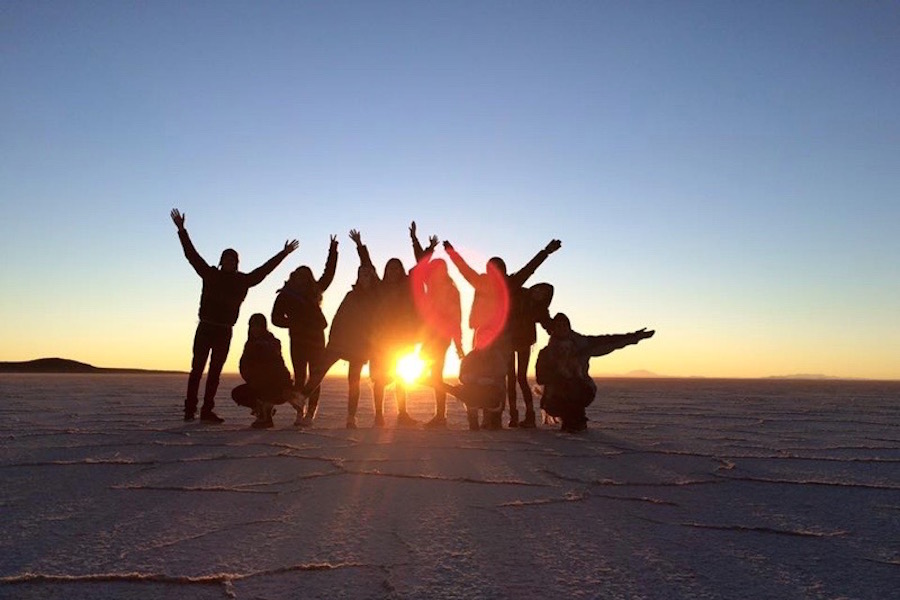
After driving through the desolate dirt roads of the Bolivian suburbs, third-year cell biology major Maddy Silverstein was welcomed by a hospitable family who would host her for a five-week medical internship. Through this once-in-a-lifetime experience, Silverstein was shocked to discover the difference in lifestyles between those in Bolivia and those back in Davis.

The UC Davis Global Health Internships Abroad provides students with study abroad opportunities that encompass educational, cultural and hands-on experiences geared toward students’ professional aspirations, while also allowing students to connect with their cultural roots and do good in the world.

Carisa Swason, a third-year animal science major, was able to explore her half-Filipino heritage while interning abroad in Manila, Philippines. Swason’s program, Philippines — Remote Island Medicine, taught her the importance of having a strong and accessible healthcare system.

“There are two hospitals in Manila; […] one is extremely wealthy and next door to it is the second, run down hospital,” Swason said. “The minute you walk into the second one you feel diseased, there is no air conditioning and people from other islands stand outside starting at four in the morning just to get into the hospital.”

In the Philippines there is an extreme divide in the social classes, making it difficult for the entire population to get health care due to the lack of funding for the lower class, seen in the state of their hospitals. There is no social mobility, and only the rich have the best health care.

“Most of their population is getting very minimal health care because the people have no knowledge about their health or diseases,” Swason said. “After going to the Philippines and seeing this I am now a strong believer in free health care because people shouldn’t have to be rich to be healthy.”

While the class divide is an obvious issue, Swason believes the root of the healthcare problem in countries such as the Philippines is in the lack of understanding of the importance of health. Cecile Msays, a fourth-year neurobiology, physiology and behavior major, spent this past summer as an intern for the Healthcare Challenges in Cape Town program in South Africa. She too blamed poor education for the extreme health concerns in this country.

“It was shocking to me that we were asked to go around to villagers’ houses to make sure they were taking their pills because in America we are expected to take the medication we are prescribed,” Msays said. “People will refuse to take their medication and are unaware of why it is important because nobody teaches them about it in school.”

Msays was sent to the Victoria Hospital in Cape Town, where she was put on a team of doctors, residents and other interns. While not every student in the program had the opportunity to get involved in medical procedures, Msays’ supervising doctor generously provided her with several opportunities to apply her pre-med undergraduate education to real-life cases.

“I got to do a lot of things that we would not have been allowed to do in America because we were students with no training,” Msays said. “My doctor let me draw blood and lean how the x-rays worked, and when we had a patient who had a collapsed lung she showed me how they were able to fix it.”

Msays stressed the importance of completing a medical internship abroad because as a student intern in America, there are not many opportunities for learning how to handle out-of-the box experiences, such as the isolation of children with severe cerebral palsy or the prominence of drug overdose.

“We saw people in front of us dying of tuberculosis which was shocking because this disease is [no longer] an epidemic in America,” Msays said. “Going to a [developing] country exposes you to many more disabilities and diseases than you would see at an American hospital. I was interested to compare healthcares of different countries and I now feel that I have a much better gauge on the American healthcare system having seen another country’s system.”

Teresa Fletchinger, a third-year nutritional biology major, embarked on the Pediatric Health in La Paz internship in Bolivia after her freshman year. According to Fletchinger’s account, due to the lack of economic and educational development, Bolivia is a very poor country and, in turn, the hospitals don’t have many of the tools imperative to success.

“The doctors were knowledgeable and had good training but many of them didn’t have the supplies that we do here so they didn’t have good accessibility,” Fletchinger said. “During one surgery I watched, someone died on the table only because the hospital didn’t have enough blood from the blood bank. Another time, the power went out in the hospital and while the backup generators were able to keep the person alive, the doctors had us use our iPhones to give them light to finish the surgery.”

While some of Fletchinger’s experiences may seem stressful, these are exactly the kinds of situations that help to better prepare students for careers in the medical field. Fletchinger noted that it is beneficial for UC Davis students to see repercussions of another country’s education and health care system first-hand.

“It is so easy to get caught up in the bubble that we live in here in America,” Fletchinger said. “We hear about poverty in the world and how there are so many people in need, but until you actually see it and experience it, you do not understand the gravity of the situation. Since going to Bolivia I’ve become more passionate about medicine and [it] has solidified why I want to help people in the world.”

Maddy Silverstein, a third-year cell biology major, did the same internship in Bolivia the summer after her freshman year. After five weeks living with a host family in the city of La Paz, Silverstein was able to perfect her Spanish, learn about culture and work at the hospital and local clinics every day.

“We worked in a women’s abortion clinic which was one of the most eye-opening experiences from the trip,” Silverstein said. “In Bolivia, abortions are illegal so working there made me realize what I wanted out of abortion laws in America. A country needs abortion as an option because we saw many women come in after using unsanitary self-methods secretly and illegally, which later causes more health problems.”

Silverstein recalled that at first, the women in the clinic were skeptical of the students. However, speaking Spanish with the people of Bolivia allowed her to connect with the patients and eventually gain their trust. This experience of helping other women inspired Silverstein to pursue obstetrics and gynaecology in her professional career and continue raising awareness for women’s health.

“We’ve come so far since Roe v. Wade and it’s clear that in order for a country to be more developed and ‘healthier,’ there must be access to safe abortion,” Silverstein said. “I was worried at first in the women’s clinic because I really didn’t know if I was making a difference or not, but I now know that the women at least got something out of it.”

The diversity within the UC Davis Global Health Internships Abroad prepares students for many expected and unexpected obstacles that they may face in their future professional journeys. Whether a student’s pre-med plans include becoming a doctor, physician’s assistant or surgeon, or simply a desire to help people of the world, these internships provide endless opportunities to become a more educated member of society.

“I don’t see myself doing anything else besides medicine,” Silverstein said. “I really enjoy the process of meeting doctors and going into the surgery room and now that I know I can work hard in school to meet the academic standard, I’ve found my path and I’m sticking to it. It’s the only thing I want to do for the rest of my life.”
Written by: Gillian Allen — features@theaggie.org

Trump is making journalism great again

How the president endangers and strengthens journalistic practice

Donald Trump’s animosity toward the press has been well-documented throughout the election campaign and his current presidency. From accusing the media of falsely reporting the size of his inauguration crowds to evicting reporters from the White House press room, President Trump has made one thing clear: he doesn’t want you listening to the news. Whether he succeeds or not could determine how people perceive the truth in the era of “alternative facts.”

“I have a running war with the media,” he said during a visit to the CIA headquarters, which took place on his first full day as president, and during which he remarked that “fake news media” journalists were “the most dishonest human beings on earth.”

It’s clear that Trump and his administration are at war with what they call the mainstream media, or the liberal media, which assumes that there’s a systemic bias within the press, and that these sources work in lockstep to discredit the president. That simply is not the case.

More recently he has declared these journalists “the enemy of the people” — a phrase with a fraught history behind it.

Over the course of the last century, it had been used by dictators to undermine foreign governments, political opposition and protesters. The phrase dates as far back as the reign of Emperor Nero, who had been called “an enemy of the people” by the Roman Senate. It reemerged during the French Revolution and was later employed by the German Nazi party to subjugate the Jews. It was most widely used by Stalin against any who opposed his Bolshevik government and eventual Soviet Union. Whether the historical use of the phrase is conscious or unknown to Trump, its invocation directly links him to a tradition of demogogy.

“When you look at somebody who makes a career out of demogogy, they need enemies, and it’s almost secondary who the enemy is,” said Sasha Abramsky, a UC Davis lecturer and journalist. “Trump’s encouraging a very venomous look at the media as traitors […] partly that’s just theatrics, but the danger is that you get violence at the backend of that. When you call a group of people the ‘enemy of the people,’ you’re essentially making them targets for anybody who’s angry and alienated.”

Abramsky explained that Americans have become increasingly distrustful of expert opinions, whether they come from politicians, policymakers, lawyers, scientists or journalists.

“When Trump comes in and says the media is promoting fake news, he’s trying to delegitimize people who are already viewed with suspicion by a large part of the public,” he said. Abramsky contends that Trump’s attack on the media has the intentional effect of inciting violence.

Indeed, the president uses the media like no other politician does and knows how to use it. He needs it. And he knows that every time he demonizes the media, he will receive more attention. Abramsky believes that Trump attempts to distract from other things including, but certainly not limited to, evidence that his entire campaign was in league with Russia. He said: “[Trump’s] a master of distraction, but I think the bigger issue, even in that, is that he’s a manipulator of the mob.”

The Aggie’s editor-in-chief, Scott Dresser, echoes this sentiment.

“I think any time an elected official or someone in power wants to silence journalists, it’s because that person is doing things that he doesn’t want the people to know,” Dresser said. “It could mean that he doesn’t want the general public to know that his administration is in a state of chaos or that there’s no real, centered leadership.”

Dresser believes that Trump’s attack on the media is done in part to appeal to his base — the people for whom he campaigned and to whom he derided the media as corrupt.

Needless to say, the president’s censure of journalists is just one of the things that defines his legacy as an abnormal president. Abramsky asserts that there hasn’t been a president with more to hide than Trump — even when you factor in President Nixon or any early 20th-century scandals, which included extramarital affairs and bribery schemes.

Just to give you a brief portrait: For president, we have a completely financially corrupted man who hasn’t released his tax returns to the public, with evidence suggesting that he hasn’t paid his taxes in over twenty years. We have a president with a network of financial conflicts of interest that span the globe. That he hasn’t disentangled himself from them means that his ownership of all these companies can procure him profits when he’s negotiating with other countries. At the very least, there are questions surrounding the legitimacy of the election results and the involvement of a foreign power in helping him win the presidency. And we have a president who is plagued with unresolved allegations of sexual abuse, rape accusations and speculation that he cohorted with the mafia when he was in New York real estate.

“You’ve got more allegations for wrongdoing than any other president in history has faced, which is a pretty good reason if you’re Trump to go after the press,” Abramsky said.

Journalism, to put it succinctly, is truth-telling that encompasses different perspectives. And when someone undermines that duty, something is lost. But more than that, journalism has been instrumental in informing, bridging understanding and rallying people together. It was a journalist, after all, who helped instigate the fall of Senator Joseph McCarthy in 1954, as Richard Murrow dedicated a televised report to bringing him down. He urged his audience: “We must not confuse dissent with disloyalty. We must remember always that accusation is not proof […] We will not walk in fear, one of another. We will not be driven by fear into an age of unreason …”

To a similar effect, Dresser said: “[Journalism is] important because it holds people in power accountable for their actions. It’s important to have journalists around to act as a watchdog to make sure that money is being spent as it should be and that people are not abusing their power.”

Even under Trump’s administration, he is hopeful for the future of the field, but stresses the need for “independent, legitimate journalism” in an age of modern media in which anybody can publish anything.

Abramsky has no qualms about the field being endangered, not as long as the media is “feisty.” He invokes himself when he said, “We don’t like being called ‘enemies of the people.’” He goes on to describe American culture as being fairly democratic and fairly committed to free speech. In this sense, he believes that the more the media is demonized, the more it actually does its job. He reckons that there has been a “dearth of good reporting” in the last 30 or 40 years. If anything he hopes that, in the face of this assault by Trump, the media bounces back.

While Trump’s attempt to censor journalists can effectively remove them from the White House press room from time to time, they will not be silenced. If anything, they will continue to speak out and usher in a stronger, more consolidated journalistic period.
Written by: Jazmin Garcia — msjgarcia@ucdavis.edu

Seeking advice? Check out this week’s horoscope

MORGAN TIEU / AGGIE

For those with a sense of humor, these readings are sure to bring some much-needed insight (plus a good laugh)

Aries: Has your mind recently been plagued by the incessant, inescapable thoughts about the inevitable passage of time? Do you feel that you have yet to find your purpose in life, that every waking second is a reminder that our precious time on earth is fleeting and that all we truly have are the connections we make with other living beings? If so, the stars say, “I feel you.” That’s all I got. I’m so afraid.

Taurus: Quick question for you, Taurus: What qualities do you look for in a romantic partner? I’m asking for a friend, so please email me immediately to share your input. Oh, I almost forgot — you’ll find a $100 bill on the ground, but it will be cursed, so just give it to someone you can’t stand.

Gemini: My lovely Gemini, if you have been seeking the advice of a higher power this week, keep your eyes on the ground, for the stars are telling me that an ancient rat will deliver a special message to you. His name is Great Albert, and you’re probably wondering if he will pass on a horrific disease to you as he whispers in your ear. The answer is: probably, but it will be worth it. Great Albert only accepts 7 ounces of brie cheese as payment, so make sure to have that on you at all times, just in case…

Cancer: Does the thought of the upcoming weeks terrify you to no end? If so, rejoice in the simple things in life, like nature! The famous turkeys of Davis have nothing but good intentions, and bonding with the usually ravenous squirrels will surely put your mind at ease. Just keep your distance and preferably cover your eyes at all times.

Leo: It’s bound to be a rough week for you when it comes to communicating with a housemate and please note that it will be your fault. Maybe you haven’t done your share of the dishes or taken out the trash? And when was the last time that you cleaned the bathroom when it was clearly your turn? It’s really not that difficult.

Virgo: It’s universally acknowledged that you are the superior sign of the Zodiac, and please don’t argue with me on this one, as this was confirmed by the late and great astronomer Carl Sagan. Anyways, I wanted to tell you that you are a ray of sunshine in this cruel and unforgiving world, and that you deserve to live forever and accomplish all of your goals in this life.

Libra:His palms are sweaty, knees weak, arms are heavy. There’s vomit on his sweater already: Mom’s spaghetti…” These moving and iconic words were written by none other than your fellow Libra, Eminem. You have artistic blood flowing through your veins, and the stars are telling me that you must sign up for the next rap battle in your town, regardless of talent and previous experience. Remember, this week’s goal is solely to make Marshall Mathers proud, so if you were planning to study for finals, just toss that idea out the window right now.

Scorpio: My otherwise sweet grandma is convinced that all Scorpios are the devil incarnate, so prove her wrong this week by donating all of your savings to her GoFundMe project, which is to build life-size iCarly character statues made of celery, homemade pesto and pure gold. The universe is sure to send you karma points for supporting her dream, and I can finally stop having to listen to ol’ Grammy talk about how all Scorpios should burn in the eternal flames of hell, so you’ll be doing us both a favor.

Sagittarius: My charismatic pal, your charm is sure to come in handy in the upcoming weeks, as an eclipse is rotating at the 90th angle of your solar plexus, transcending through Venus’ Achilles heel, making its rounds to Mars and finally stopping in your north node on the dark side of the moon. I’m an expert, so trust me when I say that this will be the ideal time to propose to the person who you’ve been dating for 2 months.

Capricorn: A black cat named Saint Roberta will touch you gently with her paw and you will feel instantly rejuvenated and ready to take on the brutal week ahead. Until then, take care of yourself, my friend.

Aquarius: Everybody knows you as the intellectual one of the group, so why not summon some courage this week, show up early to class and start to teach the day’s lecture? Your professor is bound to be impressed, and if not, look them deep in the eyes and announce your new found dominance with a “Look at me… I’m the captain now!” With this type of attitude, the whole world can be yours.

Pisces: If the haunting terror of being alive is getting to you this week, sit back, take a deep breath and take solace in your favorite memes. Can you relate to the quiet surrender and defeat of Pepe, or does the sheer panic portrayed in the Mr. Krabs meme make you feel like you are not alone? Either way, I’m told that memes are the stuff of stardust, so use them to your advantage in these difficult times.

UC Davis women’s basketball head coach awarded Coach of the Year

CAT TAYLOR / AGGIE FILE

Jennifer Gross named Big West Conference Coach of the Year, four Aggies honored

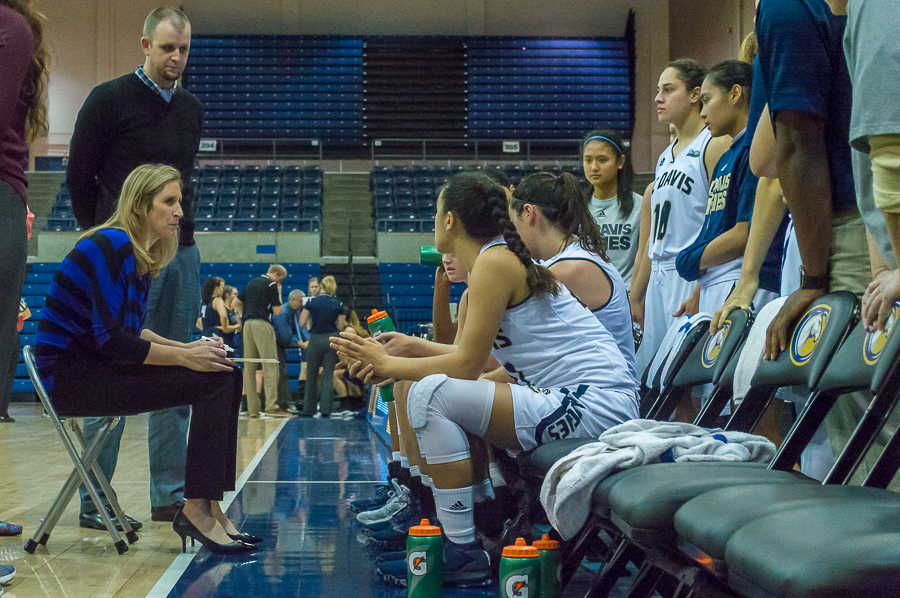
It was a tremendous regular season for the UC Davis women’s basketball team, which finished with a conference record of 14-2, overall record of 23-6 and a home record of 12-2. The team’s 23 overall wins for the season are the second highest in their Division I program’s history. UC Davis also earned the title of Big West Champions after defeating CSUN in its last regular season game.

This is the sixth time that the Aggies have earned a regular season title in the program’s history, and sixth-year head coach Jennifer Gross was named Big West Conference Coach of the Year.

This is the first time that Gross was named Coach of the Year since taking over the head coaching position for the program in the 2011-12 season. During the regular season this year, the Aggies’ win against UC Riverside on March 2 was the 100th win for Gross as head coach of the program.

Additionally, four student-athletes received honors that were voted on by the league’s head coaches. Sophomore forward Morgan Bertsch and junior forward Pele Gianotti were named to the All-Big West first team, the first time that there have been two Aggies on the first team since the 2011-12 season. With these two awards, UC Davis is the only women’s basketball program to have at least one first-team honoree since the program became a part of the Big West Conference in 2007-08.

This was the first time that Bertsch has earned first-team honors, after receiving second-team honors last season as a freshman. She led the Aggies this season by scoring 16.5 points per game, averaging 5.3 rebounds and 1.7 blocks per game. Bertsch also had eight games with 20 points or more this season.

As sophomore last season, Gianotti received honorable mention selection, but really showed spectators what she was capable of after an incredible junior year, averaging 11.3 points per game and leading the team with 5.9 rebounds per game. On top of this, she averaged 2.4 assists per game and helped the Aggies achieve an 82 percent free throw shooting percentage, only missing 11 times all year.

Junior guard Dani Nafekh received second-team honors and first-year forward Nina Bessolo was named to the All-Freshman team. Bessolo’s award was the third straight year and and the seventh time overall that the Aggies have had one of the league’s top freshman.

To go along with her second-team honors, Nafekh was also named UC Davis’ Big West Female Scholar Athlete of the Year, and her second-team honor was her first career all-conference honor. She finished the regular season with 11.6 points per game, 2.93 assists per game, ranking among the league leaders in both of these categories. She is currently ranked in the top 10 for UC Davis women’s basketball all-time career assists.

Bessolo averaged 4.6 points per game and 2.7 rebounds per game, appearing in 28 of the team’s 29 games off the bench. She also finished with double-digit stats four times in the regular season.

The UC Davis women’s basketball team hoped to continue its season’s success with the Big West Conference Tournament last Friday, March 10, in Anaheim, Calif. The Aggies’ first-place finish in the regular season allowed them to advance straight to the semifinals, as they were the first seed. Unfortunately, the team lost to the UC Santa Barbara Gauchos 73-59, ending their hopes of being Big West Conference Tournament champions.
Written by: Ryan Bugsch — sports@theaggie.org

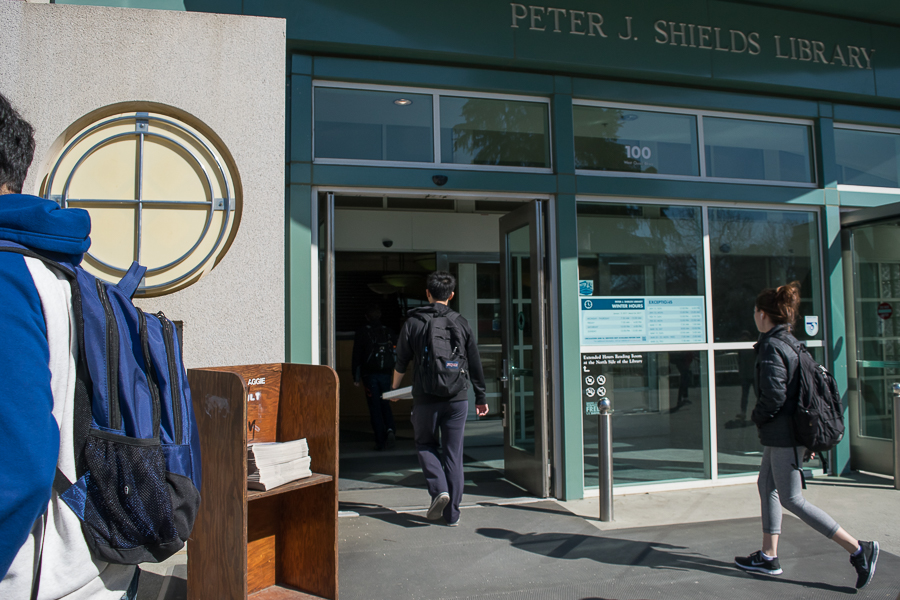
Humor: Shields Library doors not automatic, just repulsed by students

ALEXA FONTANILLA / AGGIE

Reveal of classified information sends shockwaves through UC Davis
In a shocking breach of classified information, Wikileaks announced Wednesday that it obtained damaging information about Shields Library at UC Davis.

The documents obtained revealed that although the doors at the library appear to be automatic, they actually open because of how repulsed they are by the students that walk through them. The California Aggie reached out to the doors for comment and, as you would expect, got one.

“We are extremely disappointed by this leak,” said the doors, who enjoy deep sea diving in their spare time. “We didn’t want all the students to know how gross we think they are. And let me tell you, they are gross. Some of them only shower three to four times a day, so they are really stinky. And honestly, we’re not judgemental, but these students are truly the worst people alive.”

The news sent shockwaves through the student body, who previously had no idea that the library doors were capable of making such harsh judgments.

“I had heard rumors about the library doors, but I never expected them to actually be true,” said Karina Tack, a second-year biochemistry and molecular biology major and background actor in season three, episode six of NBC’s The West Wing, the greatest television show of all time. “If the doors are alive, then what’s next? Are people going to start telling me that plants are alive?”

Some students actually found some relief in the news.

“I’m kind of glad to find out that the doors are judging me, because I’ve been judging them a lot lately too,” said Gabe Gape, a first-year mechanical engineering major and semi-professional dabber. “The other day the doors got so fed up with students that they just stopped opening completely in an effort to keep us out of the library. I had to physically push the doors open. I can never forgive them for the pain they put me through that day. It’s even worse than the pain I went through when I lost track of my son.”

The library doors are expected to continue at UC Davis despite the student body’s awareness of their true feelings. But this revelation has people talking about the true thoughts of the other automatic doors in Davis, and it’s unclear if the student body-door relationship will ever be as strong as it once was.
Written by: Brian Landry — bjlandry@ucdavis.edu

(This article is humor and/or satire, and its content is purely fictional. The story and the names of “sources” are fictionalized.)

Input forum held for cultural competency project

ASHLEY LUGO / AGGIE

Students share ideas on addressing issues faced by different communities

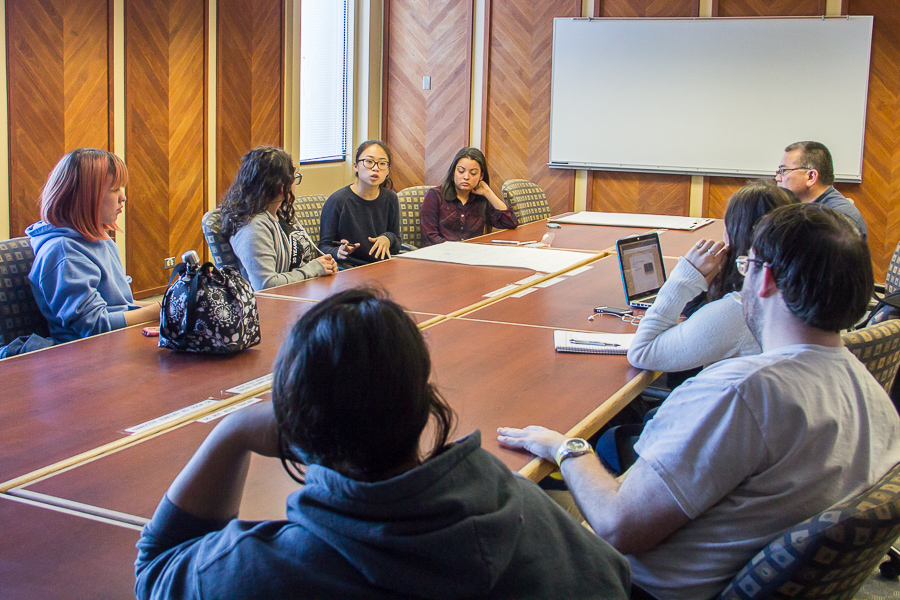
ASUCD Senator Samantha Chiang, a third-year English major, held an input forum on March 1 in the Mee Room of the Memorial Union for students to voice ideas for a new cultural competency project. The project will aim to provide cultural awareness training for freshmen and new students.

“The purpose of the cultural competency training is to use the current political climate to address underlying issues of marginalization and underrepresentation that have always been at the crux of our institution,” Chiang said.

Chiang contacted Adela de la Torre, the vice chancellor of Student Affairs, who then directed her to Rich Shintaku, the director of diversity and inclusion in human resources. Shintaku was interested in the subject and felt his job responsibilities and background made him suitable to work with students on the project.

“I have the honor and privilege of serving in a position that focuses on building, enhancing and supporting diversity and inclusive excellence at UC Davis,” Shintaku said via email. “I help develop, manage, support and guide a portfolio of diversity and inclusion projects, initiatives and processes.”

Shintaku has a background in teaching and served as a professor of education at Oregon State University. He and Chiang are working to explore and develop the necessary steps to achieve the goal of cultural competency training for new students.

“It is important for all members of our academic community to continue along the path of cultural competency development,” Shintaku said. “[…] it’s just that we can and should take advantage of this important transition point.”

Chiang felt it was important to hold an input forum to gather feedback to create a program for students that was designed by students. Students at the forum discussed currently available resources and the things that needed to be included in a model as well as how and when the program should be implemented. She believes that since many projects by administration and ASUCD are approached paternalistically, non-ASUCD student involvement is pinnacle to the success of the project.

“The pitfall of representative government is that we are expected as voices for the communities that we supposedly ‘represent’, but this is obviously not the case,” Chiang said via email. “Every single person carries different intersections and identities with them that contribute to their idea of what is necessary to educate other students about cultural awareness.”

Chiang particularly found value in the representation from the student centers on campus, such as the Cross Cultural Center, the Student Recruitment and Retention Center and the LGBTQIA Resource Center.

“The people come from the pulse of their communities and they can do a much better job of representing community concerns than anyone who is only in ASUCD,” Chiang said.

Sasha Levin-Guracar, a second-year communication and American studies double major, heard about the project as a member of Chiang’s staff and wanted to get involved.

“There are so many students here from so many diverse backgrounds other students aren’t aware of when they first enter the school,” Levin-Guracar said via email. “This project is aimed to change that and educate incoming students about how to be culturally respectful and competent when it comes to the treatment of their peers.”

Levin-Guracar believes that good ideas were shared at the input forum and progress was made, but wishes more students could have attended. She sees many students who are uncertain about their future in this current political climate, and hopes that the project will result in increased awareness and respect for students of all backgrounds and cultures.

As for Chiang, she hopes the project will train all students in cultural awareness at a base level as well as inspire them to learn more about being allies to marginalized communities that they are not already a part of.

“The truth is our world is ugly and discrimination is rampant even on a seemingly inclusive campus like UC Davis,” Chiang said. “Unfortunately, the onus is on us as students to ensure that our communities are safe and welcome in the years to come. This is not an end goal, but rather a beginning.”

Written by: Jayashri Padmanabhan — campus@theaggie.org

California Public Utilities Commission holds bi-monthly voting meeting at UC Davis

CAT TAYLOR / AGGIE

Members of the public raised concerns over rising PG&E costs

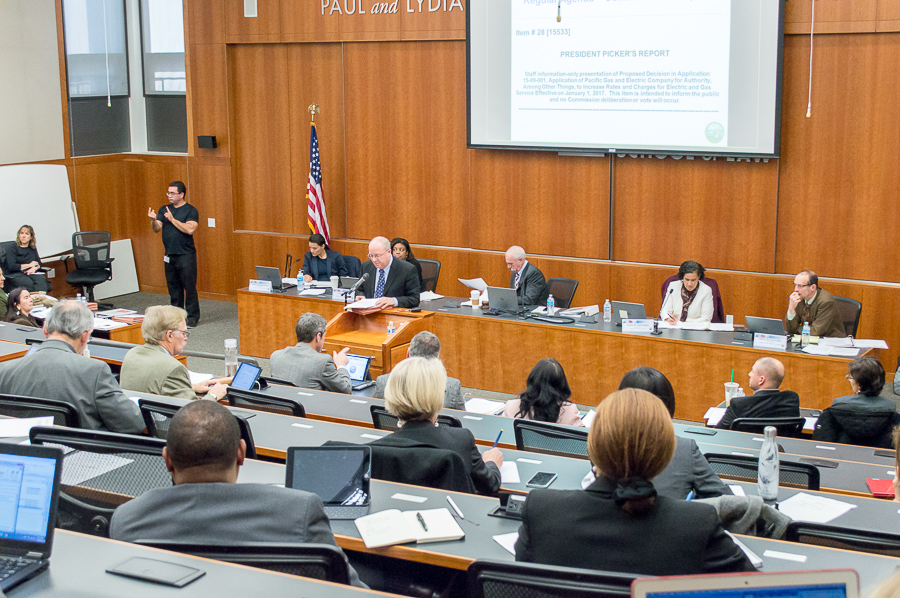
The California Public Utilities Commission (CPUC) held its bi-monthly voting meeting on March 2 at UC Davis to vote on a number of proposed policies. The meeting, which included a presentation on the implementation for the area code overlay for the 916 region, also gave members of the public an opportunity to discuss recent issues concerning rising utility rates in the past year.

“We have scheduled a number of Voting Meetings around the state this year in order to get into the communities we serve,” said Michael Picker, the president of CPUC in a press release. “Holding this meeting at UC Davis is of particular interest to me because it allows us to build a direct pipeline to students and let them know about the varied and important work that the CPUC does, how they can get involved and how they can join our team when they graduate.”

The meeting, which was held in the Appellate Courtroom of King Hall, began with a half hour of public comments. People wishing to express their concerns to the commission largely spoke about the rising billing costs concerning the Pacific Gas and Electric Company (PG&E), which rose in summer of 2016 and again in the winter.

Penny Manzo, a local resident who spoke during the meeting, said that the committee needs to better address the recent spikes in utility costs that have put a strain on consumers.

“You’re putting us in a bind, in this impossible bind,” Manzo said. “I want the PUC to keep us in mind, that as a regulatory agency, that’s what you need to be looking at. PG&E has a holding company. PG&E has resources. When a mistake is made, when maintenance is not kept up, when they have issues, they need to address it, but not on the back of consumers.”

Since last August, the CPUC has approved a series of rate increases. Because of the especially cold winter in California, consumers have seen sharp increases in their billing.

Earlier this month, the increased rates prompted State Senator Jerry Hill (D-13) from the San Mateo and Santa Clara Counties to call on PG&E and the CPUC to fix the utility company’s rate structure.

“The research showed that the most vulnerable are being hit the hardest at a time when they need heating the most,” said Hill in a staff report. “PG&E and the Public Utilities Commission need to prioritize customer heating needs in a way I have not yet seen.”

The CPUC, addressing Hill’s report on the rate structures for PG&E, said that they will take the proposals into consideration.

“There are many solid recommendations in Senator Hill’s report,” said the CPUC in a press release. “We will review the report closely to determine the best way to implement appropriate measures, such as adjusting the winter baseline. We thank Senator Hill for the report, as we all work toward ensuring utilities are educating and responding to their customers to help them understand their energy use and the changes in their billing, and the assistance programs that are available.”

The meeting also featured a presentation on the implementation of the area code overlay for the 916 region.

Suffering from a shortage of numbers for the 916 area code, a new number, 279, will be added to the region. The region includes parts of the Yolo, Solano, Sutter, Placer, El Dorado and Sacramento counties.  
Written by: Ivan Valenzuela — campus@theaggie.org

A look into the life of club sport athletes

LUCY KNOWLES / AGGIE

Sports reporter George McConnell discusses club sports’ impact on student life

It’s been a long day, and it’s not over yet. I look down at my right ankle as it lies motionless, wrapped in frozen peas and duct tape. My body doesn’t heal like it did in high school. As a club sport athlete, I’ve had to learn to be my own doctor, physical therapist and trainer. Most of the time, my medical practice begins by locating the source of the pain and ends with whatever items are in my freezer. It’s nearly 10 p.m. and I just got home from lacrosse practice. Club sports do not offer priority registration, and balancing 20-plus-unit schedules on top of limited field availability forces late nights.

Aside from a small stipend the university provides, the majority of club sports’ budgets are self-funded. As a result we must endure expensive dues, shameless fundraising emails to distant relatives and one-star travel accommodations with four people to a bed in a cut-rate motel on the seedy side of Humboldt. On top of being self-financed, the entire operation is largely student-run. From travel to equipment to hiring a coaching staff, members of the team are solely responsible for the organization and its operations. Many club athletes devote dozens of hours each week to logistical aspects of team management in addition to the time spent practicing and training.

The bottom line is you have to love the sport you’re playing. There are going to be late nights and long weekends and plenty of injuries along the way, but even with all of that, it’s easy to fall in love with the process.

Unlike many other activities on campus, sports offer a chance for competition in its purest form: university versus university, team versus team, me versus you. That internal need for competition drives athletes throughout campus to continue to pad up each day, through injury and exhaustion, in an effort to compete as long as possible.

“The competitiveness and pressure to be perfect on every play is something that is both fun and challenging at the same time,” said senior men’s rugby outside center Ari Wargon. “Playing in the National Championship game last season was one of the most challenging experiences of my rugby career and I definitely want to get back to that game this season because there is nothing like it.”

Participating in competitive sports also creates a unique opportunity for athletes to bond as a group in a common effort, resulting in powerful relationships with teammates and coaches.

“The team aspect [of basketball] is what I love most,” said senior women’s club basketball guard Madison Stewart. “My teammates are some of my very best friends […] we are together every weekend, either at practice or in games, and that brings us a lot closer.”

As teammates, we train together, prepare all off-season and collectively ride the ups and downs of a season together.

The typical club sport athlete wasn’t recruited to play here. Usually there’s no more than a handful of spectators at any of the games. There’s no free gear or priority registration or health care coverage. Nonetheless, club athletes continue to compete. It’s not Division I level or the most glamorous athletic career, but we are still able to represent our university through playing the sports we love with some of our greatest friends.


**George McConnell is an athlete on the UC Davis men’s club lacrosse team

Written by: George McConnell — sports@theaggie.org

The History of UC Davis Chancellors

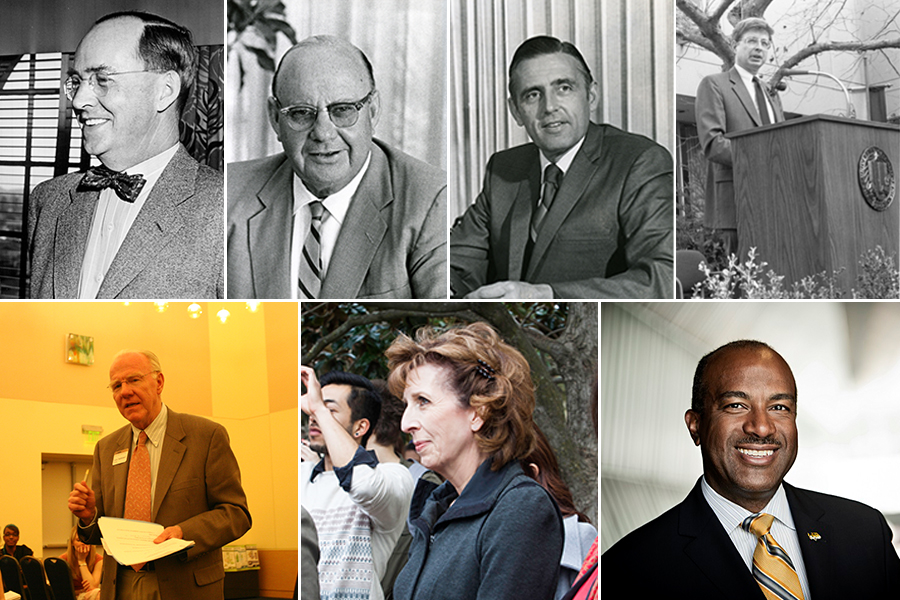
Top row (from right to left): Stanley Freeborn, Emil Mrak, James Meyer, Theodore Hullar; bottom row (from right to left): Larry Vanderhoef, Linda Katehi, Gary May (SPECIAL COLLECTIONS / UC DAVIS LIBRARY, SANJANA CHAND / AGGIE FILE, CIERA PASTUREL / AGGIE FILE, GEORGIA TECH / COURTESY)

Distinguished professors look back on six individuals who shaped the university

The University of California (UC) Board of Regents unanimously voted on Feb. 21 to select Gary May, a dean at the Georgia Institute of Technology, as UC Davis’ seventh chancellor.

Prior to the creation of the chancellor position, university affairs were managed by the deans of the College of Agriculture and the Agricultural Extension at the University Farm. In 1958, Stanley Freeborn, who had served as the chair of the division of entomology for ten years, was appointed as UC Davis’ first chancellor. According to “Abundant Harvest: The History of the University of California, Davis,” Freeborn was known for his friendly nature and also as the occasional timer for soccer games, due to his love of university sports.

After Freeborn’s retirement from the position in 1959, Emil Mrak, a food scientist and microbiologist, was appointed as the university’s second chancellor. During Mrak’s decade as chancellor, he oversaw the extensive expansion of the university, as the student population grew from 2,600 to 12,000. In addition to his determined attitude, “Abundant Harvest” writes that Mrak was also known for his hospitality and good relationship with the student body.

In 1969, James Meyer took over the chancellor position, where he remained until his retirement in 1987. Meyer, a former dean of the College of Agriculture, is responsible for the renaming to the College of Agricultural and Environmental Sciences.

“His biggest strength was his very calm approach [and] his very steady leadership,” said Alan Hastings, a distinguished professor of environmental science and policy who has been a faculty member at UC Davis since 1979. “His biggest fault was that, at a time when there were lots of resources, he did not aggressively pursue those for the Davis campus, as opposed to other campuses in the UC system.”

Meyer’s replacement, Ted Hullar, proved to be an extremely different leader than Meyer was. Unlike his predecessors who had previously worked within the university, Hullar served as the chancellor of UC Riverside before he was appointed chancellor of UC Davis.

“One [difficult factor] was having somebody from outside UC Davis who did not understand UC Davis,” said chemical engineering professor Robert Powell, a faculty member since 1984. “There was also a feeling of, […does] this devalue Riverside? People here were just calling all of their friends at Riverside and finding out that they were really happy for him to leave. That was a bad decision.”

Hullar was one of the most, if not the most, widely criticized chancellors among UC Davis faculty members, according to Hastings.

“His was a fairly short and tumultuous reign,” Hastings said. “I think he certainly was somewhat polarizing in a way. There was a sense that he did not do enough planning in order to carry out the programs he was working on.”

According to Powell, under Hullar, research became more monetized. However, Linda Bisson, a professor in the Department of Viticulture and Enology and faculty member since 1985, said that Hullar had an additional long-lasting impact.

“I’m a real fan of change agents,” Bisson said. “You have somebody coming, opening doors and windows and [saying], ‘This is what we’re going to do.’ You might not like what they say […but] now there can be a dialogue.”

After almost six years as chancellor, Hullar was transferred by then-UC President Jack Peltason to a temporary job in Oakland. Meanwhile, Larry Vanderhoef was appointed as interim chancellor in May of 1993 and officially named the fifth UC Davis chancellor in 1994.

“Larry was a real nuts-and-bolts budget [and] money guy,” Bisson said. “It was a change. He brought a practicality with him that was, I think at the time, welcomed. Not so visionary, but day-to-day, the place is going to run.”

According to Hastings, Vanderhoef enjoyed interacting with students and would meet informally with student body presidents and faculty members by taking walks with them. Powell, who served as the special advisor to the chancellor from 1996 to 1999, remembered Vanderhoef as having a more holistic perspective than Hullar.

“He was much more in tune with what was going on in the campus,” Powell said. “The year 1990 started the bad budget year, […and] Larry led this budget-cutting exercise that we had to go through. He led the beginning of the recovery from the budget cuts and how that would be structured. He had to play a much more organic role of leading the campus.”

Under Vanderhoef, the main entrance to the campus was shifted to the south side, and his goal to create a world-class performing arts center manifested into a reality with the Mondavi Center in 2002. Powell also said one underappreciated legacy of Vanderhoef’s was the addition of UC Davis to the Association of American Universities.
Vanderhoef retired in 2009 and was succeeded by the university’s first female chancellor, Linda P.B. Katehi. According to Powell, the majority of faculty members strongly supported Katehi throughout her time as chancellor because of her ability to understand “quality research.”

“One top priority [for Katehi] was definitely to increase the research profile of the university,” Powell said. “A priority that came out of necessity was to create a stable financial model for the university. She definitely wanted to increase the international profile of Davis [and] she wanted to increase the national profile of Davis. Definitely a priority for her [was] women in STEM [Science, Technology, Engineering and Mathematics].”

However, Katehi came under fire in November of 2011 when campus police pepper-sprayed student protesters under her reign. Ph.D. candidate Amory Meltzer previously served on the Graduate and Postdoctoral Scholar Welfare committee, where he became familiar with the Reynoso Task Force Report that assessed the pepper spraying incident.

“Reviewing some of the Reynoso Reports […] certainly made me very aware of the chancellor’s role or lack of a role,” Meltzer said. “That was my first moment of becoming aware of Chancellor Katehi’s presence, and it certainly wasn’t positive. I think, over the years, until she was removed, that definitely hung over her. I would say that for my part and for most other graduate students, I think she was often a non-presence. She didn’t seem to be part of the community [and] wasn’t directly engaged with students.”

After the incident, Katehi was met with mounting media and student backlash as details came out about her role in the usage of university funds to scrub the internet of photos from the pepper-spraying incident. Katehi also faced charges of conflicts of interest — including nepotism — and acts of poor judgment, which led to her resignation in August of 2016.

While Meltzer saw most students in support of her resignation, Powell said the majority of faculty were in support of Katehi and wanted her to remain chancellor. Elizabeth Picazo, a second-year neurology, physiology and behavior major and ASUCD representative for the Preparatory Education Committee, said tensions continue to run high after Katehi’s resignation, even almost a year later.

“[Her resignation] did leave a lot of grey area,” Picazo said. “It left a lot of anger and distrust of the people who are in charge of student academics and student affairs here. There’s still that distrust [for] a lot of students because that situation had gone on for so long with very little resolution during her time.”

Bisson, who worked closely with Katehi as a member of the Academic Senate, which assists in governing the university as part of the shared governance model, believes Katehi was the chancellor who understood “the heart and soul” of UC Davis the best.

“She had a lot of community support, far more so than I think any of the other chancellors,’” Bisson said. “I think [she] did a lot for the issues on campus — hate crimes, microaggressions, all of those discussions.”

Bisson, Powell, Meltzer and Hastings are pleased with the appointment of Gary May as the seventh chancellor of UC Davis.

“One thing which I think is great is that he’s spent his […] entire academic career at […] one institution, which is a commitment that’s very, very positive,” Hastings said. “He appears to have […] the right kind of personality — somebody who is going to be open, maybe willing to acknowledge different viewpoints and to really listen to the diversity of views across the campus, which is a real challenge. I’m really excited for the future.”

According to Powell, although the same sort of echochamber created during Katehi’s time as chancellor has already started to form around Gary May’s outside income, it is important that the university has an open mind in light of the transition to the new chancellor.

“I think he will bring a lot to the campus,” Powell said. “And we have to be accepting of what he brings.”
Written by: Hannah Holzer — features@theaggie.org

Brain tissue shortage prompts donation program

RUTH WEIR / COURTESY

UC Davis MIND Institute fuels crucial research needed to investigate neurodevelopmental disorders

The human brain is one of the most complex organs in the body, yet obtaining brain tissue samples to study neurodevelopmental disorders has proven to be a difficult task.

The UC Davis MIND Institute Brain Endowment for Autism Research Sciences, (BEARS) program was formed to acquire brain tissue in order for scientists to effectively study disorders such as autism and seek to advance human health.

The BEARS program strives to collaborate with scientists, communities and national advocacy organizations from around the world to foster new ideas about brain donation. The hope is for the collaboration to augment research and preventative treatments for brain disorders.

“In the field of autism research there is a chronic shortage of brains available for study,” said Dr. Ruth Weir, postdoctoral research fellow in the MIND Institute laboratory of Dr. Cyndi Schumann. “Fewer than one hundred brains from individuals with autism have been studied over the last three decades, compared with tens of thousands of brains affected by Alzheimer’s disease.”

A major challenge to the brain tissue donation process is the short time window available for recovery and the process it takes to prepare the brain for research.

“From the time of death to when the tissue has been processed and frozen, we only have about 40 hours, hence there is a need for quick and successful harvesting and transport of specimens,” said Alicja Omanska, staff research associate IV and manager of the BEARS tissue donation program.

Currently, the BEARS program is partnered with Sierra Donor Services, an organ procurement organization that serves Northern California as well as Nevada. This service processes and keeps track of registered organ donors, using strategies like putting the pink donor sticker on an individual’s driver’s license.

However, donation rules and regulations do not apply uniformly to all bodily organs.

“Lots of people are unaware that brain donation is a very separate process to organ donation,” Weir said. “I have spoken to many students about brain donation, and commonly hear ‘My driving license says I am an organ donor so my brain can go to science,’ unfortunately this is not the case.”

Near or at the time of death of an individual, relatives may notify an organ procurement center if they wish. The center then informs the family of the BEARS program. If they agree to have the brain donated for research, the MIND Institute is notified immediately and arrangements for tissue retrieval and transport are made.

“The brain donations that are collected by BEARS will facilitate a variety of types of research ranging from understanding causal genetic alterations, to appreciating the kinds of altered brain organization and connections that may be associated with disorders,” said David Amaral, Beneto Foundation chair and director of research at the MIND Institute.

The goal of the BEARS program is to acquire brain tissue from both individuals with a neurodevelopmental disorder and those considered to have typical development.

With these samples, scientists at the MIND institute and around the world can study differences between typically developing individuals and those diagnosed with disorders such as autism.

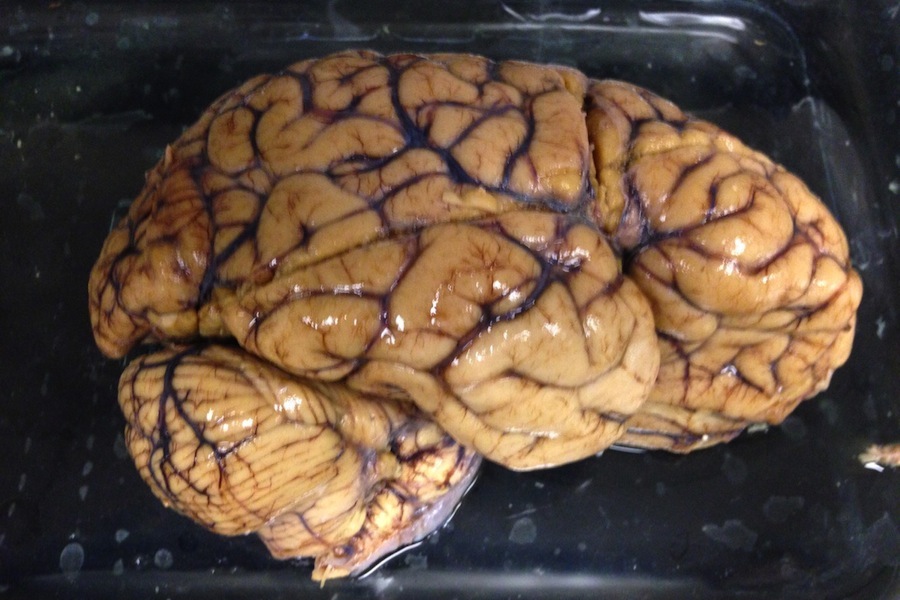
“To maximize the usefulness of each donated case, the two halves of the brain are processed separately,” Weir said. “One hemisphere is ‘fixed’ in the preservative formalin, and can be used for histological studies, looking at the cells through staining, whilst the other half is frozen and can be used for genetic studies.”

The hemisphere that is preserved and used for histological studies enables researchers to look at different areas of the brain to compare size and count of neurons. The other frozen tissue, used for genetic studies, allows scientists to look at gene expression, sequencing and other molecular studies.

“Without brains to study, we can’t find the cause, and without knowing the cause, we cannot move towards developing treatments,” Omanska said.

The BEARS program aims to reach more than just organ procurement centers. There are many community events, conferences and walks where BEARS representatives share information about the program in order to bring awareness to the importance of brain tissue donation.

“We also do a lot of outreach at Medical Examiner’s offices, and hospitals as it’s extremely important for doctors, chaplains and funeral directors to be aware that families have an option of donating their relative’s brain for research,” Omanska said.

The MIND Institute Open House on April 22 will have an information booth and a donor registry available for anyone wishing to learn more about the program.

The program also seeks to establish partnerships with other programs interested in promoting brain tissue donation, such as the Autism Tissue Program and the National Institute of Child Health and Human Development.

The need for brain tissue in neurological science research has also prompted the establishment of Autism BrainNet, a program that supports families through the process of brain tissue donation while ensuring the integrity of the tissue for research.

Both pre-registered and normal donations are accepted from anyone diagnosed with  autism or related genetic disorders, such as Fragile X syndrome or Dup15q.

“We hope that students and the general public will be ambassadors for BEARS and Autism BrainNet spreading awareness about the need for brain donations,” Amaral said.
Written by Shivani Kamal — science@theaggie.org