55.5 F
Davis

Davis, California

Tuesday, December 23, 2025
Home Blog Page 662

Drought clouds the fate of California’s water supply

0

drought3Despite popular belief, recent rains may not be enough to pull California out of aquatic state of emergency

In January 2014, Governor Jerry Brown declared a drought state of emergency in California due to record-breaking dry conditions that began in 2011 and have affected areas from San Diego to Modoc Counties. Despite stereotypes of Californians’ hatred for all things rain, winter storms over the past month have blessed the state with hopeful feelings of a farewell to the drought. While the arid and dusty vegetation needs it, this increase in precipitation may not sufficiently pull California out of its ecological state of emergency just yet.

“The water system in California is very articulated and the main source of water is the snowpack in the Sierra Nevada,” said Daniele Zaccaria, the assistant cooperative extension specialist at the UC Davis Department of Land, Air and Water Resources. “Snow melt fills the reservoir in the bottom of the mountains, and the water moves into different areas of the state based on needs. Not all of the state is connected to this supply grid because some coastal areas rely on groundwater.”

The drought conditions of the past five years have been so demanding that the state has had to rely more on its groundwater supply, which has seen drastic depletion. Groundwater is located in an aquifer underneath the earth’s surface and must be extracted using a well or drill.

“The drought impacted much of California’s groundwater because there was so much overdraft, especially in the San Joaquin Valley in central California,” Zaccaria said. “The groundwater there will be recharged very slowly over the years and will take many years to get the water to the level it was before the drought.”

Another main source of California’s water supply is its surface water, found on the earth’s surface in creeks, lakes or streams. According to Zaccaria, surface water supply is much more reliable than groundwater because if farmers use surface water, they do not have to spend energy and money to pump water from aquifers. This would create positive consequences down the line because farmers could theoretically cease drilling into the earth, which is expensive and harmful to the environment. Zaccaria said that recent increases in precipitation are a promising light at the end of the drought tunnel.

“From what I have seen, the snowpack in California is above the average quantity for the date,” Zaccaria said. “This January, there has been a long-term average precipitation index of snow and rain in Northern California above last year’s amount as well as the long term average from 60 years. The situation is the same in central California, where the amount of precipitation we are seeing is 225 percent above the long-term average.”

In terms of drought relief, Zaccaria said that conditions are much better than they have been in previous years. However, a lot of this precipitation is coming down as rainfall instead of snow because of global temperatures rising. This is unfortunate because the majority of this rain will run off the surface of the earth into the ocean, causing landslides and nutrient depletion.

            “A really wet winter is great, it doesn’t necessarily mean that the drought is over,” said Elise Gornish, a cooperative extension specialist in Restoration Plant Sciences at UC Davis. “Many of our water sources are being replenished but unfortunately since we’ve had drought for so long, vegetation has died in many areas and the rain is actually enhancing erosion.”

Gornish believes the climate is changing in a way that will increase and intensify instances of drought. In addition, the long-term conversion of perennial farmland, like the almond orchards in the Davis area, will change the way the state is now using water. This will become an even greater problem in the future if drought conditions prevail.

“The earth becomes so dry that the topsoil and nutrients wash away, and if there aren’t any plants to anchor the soil, this leads to immense erosion problems,” Gornish said. “If the soil becomes too dry, you lose a lot of the microbial communities that you need to maintain healthy soils which feeds the downward spiral. Long periods of drought can create a change that is so drastic […] to the point where you can’t actually get back to a healthy ecosystem even with a [large surplus of water].”

California’s Mediterranean climate makes it a drought-prone area, so the state is likely to see fluctuations between dry and and wet years. Due to this, Zaccaria explained that it does not make sense to consider the state of the drought an emergency since there have been fluctuations between bad times and good within the last 60 to 100 years. However, the ecosystem is not the only thing that must adapt to the oscillating cycles of drought in the California climate. Humans must adapt and make necessary changes as well.

“Any time you have instances of rain, even after four-year aggravated drought, it lulls people into a false sense of security so that they relapse into their unsustainable behavior of water use,” Gornish said. “We need to start changing the way we think about about water. There are cities in California that need their water brought in every day, which just blows my mind. I think there will be long-term consequences that may not be solvable with our current behavior and policies.”

Zaccaria agreed that residents of California must be conscientious of their water habits and usage no matter what part of the state they live in. He explained that the argument that Northern California, with its agriculture presence, is to blame for the drought is nonsensical. The California water system was created to support agricultural development, which now is so prominent that the state produces the majority of food for internal and external consumption.

Austin Jelinski, a second-year environmental science and management major, is a Southern California native who recently noticed the divide in northern versus southern attitudes regarding the water controversy. Jelinski hypothesizes that Southern Californians may not acknowledge or take seriously the drought simply because they have not been educated on the severity of it.

“In a metropolitan area such as Los Angeles where you get your water fast, it can be easy to take it for granted [because] you’re removed from the issue of water conservation,” Jelinski said. “It is hard to hold people accountable for their actions if they do not know [the] consequences.”

Studying environmental science at UC Davis will allow Jelinski to apply his passion for science to the public sector by solving environmental solutions and making improvements in how humans use natural resources.

“Everyone has that one environmental issue that speaks to them individually as the root of all problems, and for [me] that problem is water,” Jelinski said. “The question is, are we going to be forced to make the change, or are we going to make the change before it hits us? We should be conserving water but also realizing that we need a bridge between science and policy in order to do so.”
Written by: Gillian Allen — features@theaggie.org

Davis Celebrates MLK Day

GENESIA TING / AGGIE

The City of Davis hosts festivities in honor of Martin Luther King Jr. Day

On the morning of Martin Luther King Jr. Day, Jan. 16, the City of Davis gathered to celebrate the life and accomplishments of Dr. King.

The 23rd annual Dr. Martin Luther King Jr. Celebration was presented by the Davis Human Relations Commision and the City of Davis.

According to its website, the Davis Human Relations Commission works to “build a community where relationship among diverse peoples are valued by all, discrimination and hate are not tolerated, the voices of the voiceless are heard.”  

Members from all over the Davis community were invited to gather for this annual event. The festivities began at the Varsity Theater located in downtown Davis, where Mayor Robb Davis welcomed the community to the event.

“It’s an honor for us as a city to be able to host people from Davis and beyond to this event,” Davis said.

A keynote address was presented by Garth Lewis, an educator for the past 22 years and assistant superintendent of instructional services for the Yolo County Office of Education.  

In his keynote address, Lewis highlighted Dr. King’s beliefs in light of the bigotry seen in today’s political environment.

“Today’s theme, [Justice Everywhere:] Speaking Up for JUSTICE in a Climate of Intolerance, is a very appropriate call to action,” Lewis said. “For, when freedom and justice are taken for granted, they are threatened. These basic human rights are vulnerable to be abused by those with power with impunity. In the words of Dr. King, ‘Injustice anywhere, is a threat to justice everywhere.’”

Readings from the Parents of African American Children Davis Group and music by Marque Cass, Aleta Simone and the Davis Freedom Singers were also featured at the event. The event closed with the Davis Freedom Singers leading attendees in a symbolic “Freedom March” through downtown Davis, ending at the E Street Plaza. Participants performed classic peace and freedom songs throughout the concluding march.

The event was recorded by the Davis Media Access and video can be found on its website.


Written By: Dianna Rivera – city@theaggie.org

Local author, cyclist rides 2,300 miles

BRIANA NGO / AGGIE
BRIANA NGO / AGGIE

Douglas L. Waterman publishes ‘It Only Hurts When I Sit Down: A Bicycle Adventure on Historic Route 66’

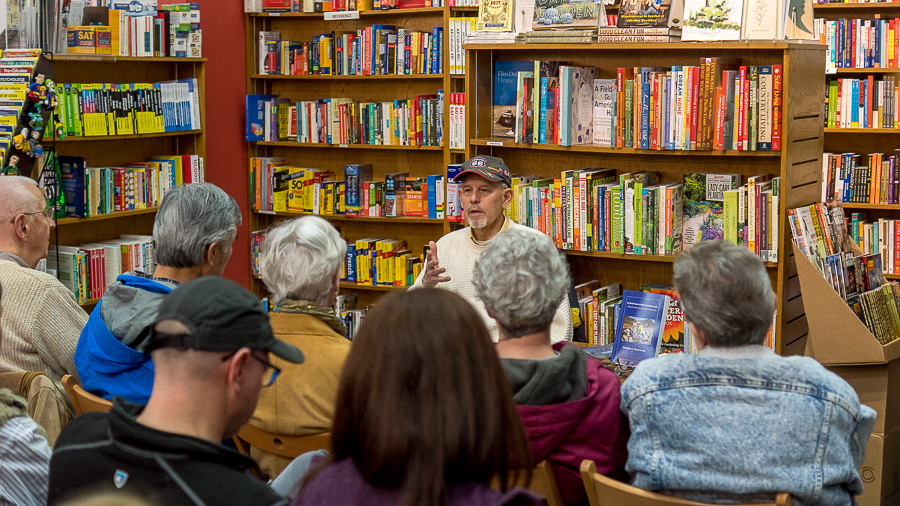
On Jan. 20, Davis resident Douglas L. Waterman presented his book “It Only Hurts When I Sit Down: A Bicycle Adventure on Historic Route 66” to a large crowd at The Avid Reader. Waterman, 66, is recently retired, and he rode all 2,300 miles of Route 66 on a bicycle in just 30 days.

“This was a memorable experience,” Waterman said during his presentation. “It was frightening, it was sad in some places, it was educational and it was even funny.”

Waterman said that his journey included many bottles of anti-chafing ointment, dangerous highways, a semi-truck tire exploding next to him as he rode and a run-in with Chicago state troopers amongst other things.

As soon as Waterman returned to Davis, he began to write about his adventure. Throughout the process, he made use of several resources available to authors in Davis.

Waterman said that writing became a major part of his life a decade ago, when he received writing mentoring from the local Davis Arts Center.

“About ten years ago, I decided I wanted to learn how to be a writer,” Waterman said. “So, the first thing I did was I joined the art center writing club.”

When Waterman’s manuscript was ready for publishing, he took it to local book publisher EditPros. EditPros, located on F Street and staffed by long-time Davis residents Marti Childs and Jeff March, provides traditional publishing services and, for authors like Waterman who prefer to self-publish, editing and publicity services.

“We initially started as a writing and editing business and eventually, in 2011, we got into book publishing […],” Childs said. “For the Route 66 book we helped them go through everything, get their ISBNs, helped them get their book signing at the Avid Reader.”

March explained that bookselling is incredibly competitive and that publicity is the hardest part of the process.

“Having a good network and working that network to the greatest degree that you can is really, really important,” March said.

For Waterman’s book, part of the publicity push was his book presentation at The Avid Reader. The Avid Reader hosts about 100 book-related events every year, both on-site at their store and off-site at locations such as libraries and schools. Alzada Knickerbocker, owner of The Avid Reader, said that she tries to support local talent through The Avid Reader’s events as much as possible.

“I’m very predisposed to local authors,” Knickerbocker said.

Waterman’s legendary bicycle ride is enough to make any Davis-ite proud, and his journey to becoming a published writer shows that, through all the resources available to writers, Davis is a supportive town for aspiring authors.

Written by: Raul Castellanos Jr — city@theaggie.org

UC system hires Title IX coordinator

GENESIA TING / AGGIE

Kathleen Salvaty to oversee implementation of UC policy against sexual harassment, violence

The University of California (UC) system announced in a press release that it hired Kathleen Salvaty as its first Title IX coordinator to lead efforts against sexual harassment and sexual violence throughout all 10 campuses. The position, which begins Feb. 6, is based at the University Office of the President (UCOP) and reports directly to UC President Janet Napolitano. Salvaty, a civil rights attorney, most recently worked as the Title IX coordinator at UCLA. At UCLA, she was responsible for designing and implementing education to prevent sexual violence and harassment and managed responses for reports of gender discrimination.

For the past few years, Napolitano and the UC system have worked to change the culture surrounding sexual harassment and violence and to improve timeliness and fairness in investigations of sexual misconduct.

“Hiring [Salvaty] is a critical next step in making sure our recently overhauled policies to prevent, adjudicate and sanction sexual misconduct at UC are properly, and consistently, carried out,” Napolitano said via the press release.

Napolitano expressed the importance of making sure each member of the UC community feels safe and respected. The UCOP Compliance program created a task force in 2014 to address prevention and response to sexual violence and assault. Salvaty will direct the UC system’s efforts to continue improving Title IX compliance and oversee local Title IX coordinators to ensure implementation of university policies.

Wendi Delmendo, the chief compliance officer at UC Davis, works on the Ethics and Compliance Risk Committee of the Office of the Interim Provost. Delmendo also serves as UC Davis’ Title IX officer and lead discrimination officer. Delmendo does not anticipate any administrative changes at UC Davis and acknowledges that the system-wide coordinator will be a resource to all the campuses.

“The systemwide Title IX Officer will serve as a resource to the campus when issues arise that the campus would like to consult about,” Delmendo said via email. “The systemwide office can also provide investigative resources when needed to support the campus.”

Delmendo believes that UC Davis has a strong program to respond to allegations of sexual violence and harassment. The campus offers a host of resources that are available for students.

“This team includes the Title IX Office, the Harassment and Discrimination Assistance and Prevention Program (HDAPP), the Office of Student Support and Judicial Affairs (OSSJA), the UC Davis Police Department and the Center for Advocacy Resources and Education (CARE),” Delmendo said.

The Title IX officer hiring is important for the continued support of students, especially in light of recent debate over the effectiveness of campus resources and the ways in which administration has handled past sexual harassment situations.

Anastasia Ruttkay, a fourth-year international relations major, believes that the Title IX process has not worked in favor of sexual assault survivors thus far.

It’s crucial for the UC system to hire a Title IX coordinator who can speak to the degree of sexual assault and who can rightfully advocate for sexual assault survivors,” Ruttkay said via email.

An ASUCD senator, Ruttkay’s platform focuses on sexual assault prevention within Greek life by providing resources and establishing a sexual assault prevention chair in every Greek chapter house. Ruttkay thinks that not enough students are committed to sexual assault prevention.

There is a huge stigma towards sexual assault survivors, for it is extremely common for perpetrators along with many others to victim blame,” Ruttkay said. “The best thing we can do to improve this issue is to educate others around us with the main intention being to break the stigma towards sexual assault survivors, support the reporting process and ultimately stop sexual assault from occurring.”

Written by: Jayashri Padmanabhan — campus@theaggie.org

Last week in Senate

HANNAH LEE / AGGIE
HANNAH LEE / AGGIE

The second ASUCD Senate meeting of the new year was called to order by Vice President Abhay Sandhu on Jan. 19 at 6:14 p.m. in the Mee Room of the Memorial Union. Senator Sam Park was absent during quorum roll call and arrived late.

Nisha Patel, a mental wellness student coordinator for Health Education and Promotion, started off the meeting with a presentation on the department’s current campaigns for consensual and safe sex. Patel also noted plans for a medical amnesty program to promote student wellness.

Next, Yolo County supervisor Don Saylor discussed how the county supports its low-income community members through the Calfresh pantry and provides health care by using the Night’s Landing community as a poster child.

After the presentations, the Senate discussed legislation. Aggie Public Arts Committee chairperson Suhaila Sikand proposed Senate Bill No. 32 to implement the downtown Davis piano project in the campus Quad. Senator Daniel Nagey suggested that the piano should have an ASUCD plaque since it will be providing the appropriate funds. The senators agreed and the resolution passed.

Senator Samantha Chiang announced Senate Bill 33, which calls for the mandatory participation by ASUCD Senate and ex officio members in the Safe Zone and PEACE training. With further explanation, the bill passed.

Scott Dresser, editor-in-chief of The California Aggie, introduced Senate Bill No. 34 to allow newspaper staff members to be paid in the form of weekly stipends, as opposed to hourly salaries, for the remainder of the 2016-2017 academic year. With no objections, the bill passed.

Mason Schmidt, the Student Alumni Association president, proposed Senate Resolution No. 4 to change the association’s payment plan and to thank ASUCD for its assistance. The bill passed with no objections.

The senate then moved into emergency legislation regarding the Milo Yiannopoulos event, hosted by the Davis College Republicans (DCR), during the previous week. Senators Chiang and Nagey discussed how ASUCD holds some responsibility for the event and the protests following since it provides support for the Club Finance Council (CFC), which funds the DCR. The senate emphasized that the CFC should not have given the DCR money for the event in the first place and that ASUCD condemns the DCR for violating the UC Davis Principles of Community.

“We should be taking responsibility for the part we had in this,” Chiang said. “Because of our funding, we have directly contributed to something that is harming our student body.”

Nagey also noted that interim Chancellor Ralph J. Hexter’s email to the UC Davis community was vague about the Yiannopoulos events. Nick Flores, the Internal Affairs Commission chair, added that the administration needs to be supportive of its students.

Chiang called a resolution to condemn the DCR into question. The motion was seconded and passed in a vote of 11-1-0, with Senator Matthew Yamaguchi in opposition.

The meeting then went into public discussion, during which student activists Sarah Shemery and Connor Gorman stressed their disappointment with senate members for not being present at the Yiannopoulos protest and for not showing support in response to the protest.

Following a break, the senate introduced new legislation, including a constitutional amendment to form the judicial council and oversight committee of ASUCD.

The meeting was adjourned by Sandhu at 9:30 p.m.


Written by: Jeanna Totah — campus@theaggie.org

Action Jackson — famous breeding donkey — dies at 29

COURTESY
COURTESY

Action Jackson known for quality breeding, extroverted personality

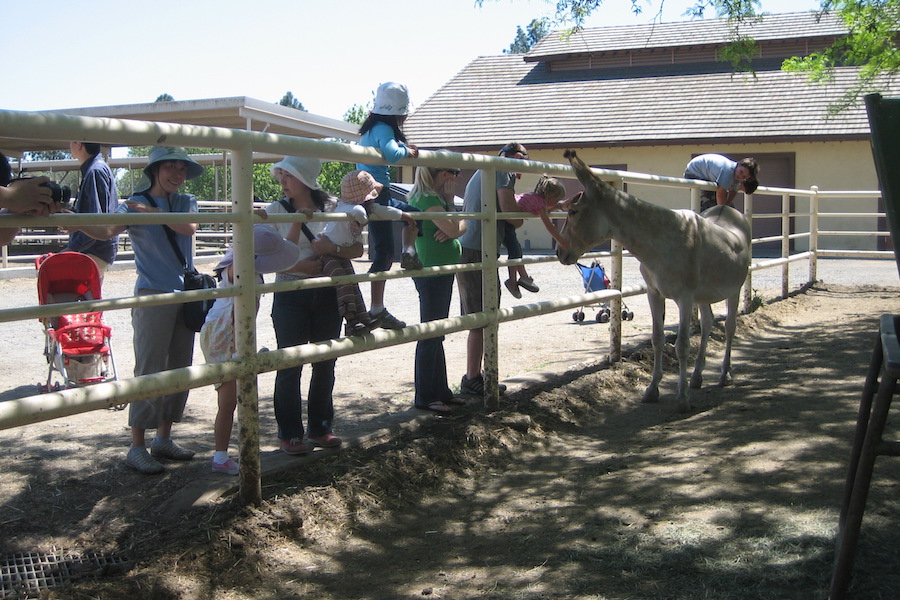
The UC Davis Horse Barn at the Cole Facility recently lost its famous breeding donkey named Action Jackson, who died on Jan. 6 at the age of 29 due to serious and chronic laminitis.

In recent years, he developed a sway back and his teeth began to fail him. He suffered from degenerative suspensory ligament desmitis (DSLD), a systemic disease of the connective tissue, according to his veterinarian. Arthritis stiffened several of his joints, and his feet were in pain. Toward the end of his life, Action Jackson lived on pelleted feed so that he could maintain his body condition in spite of his inability to eat hay.

Action Jackson, a light-colored Spanish mammoth donkey, was born in 1987. He came to live at UC Davis in September 1996, when Pat Downing of Tucson donated him to stand as stud in the Department of Animal Science’s breeding herd. During his 20 years of service to UC Davis, Action Jackson bred 500 mares and jennies and produced a new generation of California-bred mules and donkeys who compete in sports or pack supplies. According to Dan Sehnert, the facilities coordinator for the Department of Animal Science, Action Jackson got his name because he saw a lot of “action.”

Action Jackson’s first UC Davis offspring was born in 1997 and was the first mule born on campus in 60 years.

Action Jackson quickly attracted many who visitors who enjoyed his outgoing personality and his enthusiastic braying. He became such an icon that, in 2004, a bronze sculpture was created in his honor named “The Jack,” which was donated to be sold for the raising of funds to improve the department’s equine facilities.

Sehnert was well-acquainted with Action Jackson and said that he loved the attention, especially from children, as well as anything sweet.

“He had such a great and loving personality,” Sehnert said. “He really loved children. He also loved anything sweet. Donuts, Starbursts and peppermints were his favorites.”

Sehnert’s favorite memory of Action Jackson was seeing him interact with all of the visitors on Picnic Day.

Action Jackson also became well-known outside of UC Davis. At Mule Days, held every Memorial Day in Bishop, Calif., also known as the “Mule Capitol of the World,” Action Jackson was known for bringing quality mule breeding to the West Coast and distinction to the UC Davis breeding program.

Amy Mclean, the equine operations supervisor for the Department of Animal Science, said that Action Jackson’s death was a shock to staff and students.

“Action was a kind, warm spirit; I loved driving in every day and seeing him,” Mclean said in a statement for UC Davis News.

Nearing the end of his life, Action Jackson’s health care and maintenance was provided by Sharon Spier, DVM, Ph.D., professor of Medicine and Epidemiology at the veterinary school.

“He was loved and fondly caressed and fed horse treats until the end,” Spier said.

He was euthanized at his owner’s request, for humane reasons.

Action Jackson’s most recent offspring, two foals born last spring, will be offered in this year’s June production sale, and his final offspring is expected this year. The department’s student equine production team also hopes to breed several mares and female donkeys using frozen semen from Action Jackson.

Written by: Demi Caceres — campus@theaggie.org

Humor: School book club loses funding after asking Ayn Rand to come speak

ROMAN KRUGLOV [] / FLICKR
headshot_evDavis Campus Readers feel heat after inviting dead author to campus
Davis Campus Readers (DCR), a book club at UC Davis, has had its funding cut and will be forced off campus by the end of Winter Quarter after providing a platform for some questionable speech. The club asked Ayn Rand to come speak to its members, but failed to notice that the award-winning author is, in fact, dead.

The club of 40 members has asked speakers such as Ray Bradbury, Jhumpa Lahiri and Stephen King to come speak, all of whom declined due to the pointed books that have been on the club’s reading list, including former chancellor Linda Katehi’s upcoming memoir.

Rand, the author of Atlas Shrugged and The Fountainhead, is the founder of objectivism. The Atlas Society says of the belief system: “There is no greater moral goal than achieving happiness. But one cannot achieve happiness by wish or whim […] Politically, Objectivists advocate laissez-faire capitalism. Under capitalism, a strictly limited government protects each person’s rights to life, liberty, and property and forbids that anyone initiate force against anyone else.”

Though UC Davis does not agree with the beliefs that Rand or objectivists follow, the school allowed for Rand to speak — but neglected to mention to the club’s president that Rand is deceased.

“I told them that Rand could come to the school. I disagree with them giving her a platform, but I couldn’t stop them from bringing her to campus,” said Bryan Lewis, director of Campus Clubs and Circles. “I think, even though she’s dead, that she has every right to come share her beliefs. Shame on the club for providing such a soapbox in the first place. We can’t stop people from taking a stance, but we can do our best to stop the spread of such opinions.”

Lewis went on to say that there was no room for such speech on campus and that, while he feels that such values exist, there is no reason for the club to bring such a controversial and divisive figure to campus.

DCR president Logan Marx claimed that the club “would not be silenced and had every right to make their voices heard on campus.”

While Rand has unpopular beliefs, DCR should not provide the contentious figure with a platform to spread ideas based around a highly capitalistic and self-centered society. These beliefs are obsolete and ridiculous, and they have no place in an intellectual setting. UC Davis administration elected to go straight to the source by punishing the group that provided a platform for dangerous dialogue by preventing the spread of such rhetoric.
Questioning the credibility of ETHAN VICTOR? You can reach him at ejvictor@ucdavis.edu. Feel free to help with his followers-to-following ratio on Twitter @thejvictor, because it is pathetic right now.

ASUCD Senator Sam Park resigns

LUCY KNOWLES / AGGIE FILE

Interim senator to be appointed

On Jan. 19, ASUCD Senator Sam Park resigned from Senate. Park, a fourth-year political science major, stepped down due to personal reasons.

ASUCD President Alex Lee informed ASUCD members of Park’s resignation in an email on Jan. 27.

“A count-back election was conducted the week following and no candidate from the Winter 2016 election was able to pass the minimum threshold to be selected,” Lee wrote in the email. Per Article II, Section 11.2 of the ASUCD Constitution, I will be seeking to appoint an interim Senator for the remainder of Winter Quarter 2017 to serve till March 2017.”

Students interested in serving as the interim senator can apply now on UC Davis’ vacancy website.

Written by: Alyssa Vandenberg  — campus@theaggie.org

The self-proclaimed cure for racism

COMEDY CENTRAL / COURTESY

Hasan Minhaj Netflix special reflects on current political climate

“Once you go brown, lock that shit down.”

And with that, the entire auditorium went dark. Students exploded into cheers and applause as the multileveled stage lit back up in the bright yellow that began the show, on which only the words “Hasan Minhaj: Homecoming King” shone around the comedian’s silhouette. If one listened closely, the figurative drop of the microphone could be head through the tumult.

On Friday, Jan. 27, UC Davis alumnus Hasan Minhaj filmed his Netflix comedy special at the Robert Mondavi Center for the Arts. Backlit by an interactive stage, Minhaj established that his childhood in our northern California city was the reason for his success as a stand-up comedian and correspondent for The Daily Show on Comedy Central. In many ways, he was due for a homecoming.

Minhaj’s callbacks to the classic “Davis experience” — the art of biking while wearing a tuxedo and the fact that the closest mall, to current students’ dismay, has always been located across the causeway in Sacramento — all rang true for an audience that overflowed into a second showing that same night. His stage illustrated his thoughts and animated combinations of Nintendo characters to describe his little sister’s arrival to the United States, the white picket fences of Davis neighborhoods and the descending of stars and stripes of the American flag in Sam Spratt’s collection of Rockwell-esque vignettes, titled “New Brown America,” based on Minhaj’s life.

His attitude on the realities of growing up in an Indian-American family found a deep connection with an audience that rolled in laughter after a riff on a white television show called “The Slap,” a drama approaching a subject in a manner to which the majority of his fans of South Asian heritage could not relate.

In a coincidental occurrence, the show took place on the same day that President Trump signed the executive order banning immigrant entry from seven countries predominantly comprised with the those of Minhaj’s own faith. Minhaj even returned to New York over the weekend to find protesters, detained citizens and attorneys at JFK International Airport.

Many times in the performance as the camera zoomed in on his face, Minhaj would tell the true stories of his experiences with racism in America: How his family received a call that led to a hate crime in his front yard on Sept. 12, 2001, how his father disapproved of his marriage to a woman of Hindu faith and how, in an act of “mutual” understanding, his senior prom date’s mother turned him away at the door in favor of photographing a white boy with her daughter. These moments were personal and oftentimes unbearably relatable for a crowd of students who have experienced, and will continue to experience, similar circumstances.

But then, after subduing the audience with a monologue of personal heartache, the comedian would pelt his listeners with a tirade, phonetically critiquing the last name of his prom date’s current Indian boyfriend.

Upticks in energy like this kept the audience laughing, reflecting and responding to what Minhaj had to say, and mirrored the conversations students had with each other while in line for the show. Juxtaposing the seriousness of his father’s heart attack with his Pizza Hut commercial, of all things, inspired the audience to get up the next morning and fight the good fight, in preparation for whatever the Trump Administration could throw at them next. Minhaj was able to say what he needed to say and have it stick in a flux of humor and solemnity.  

Minhaj’s performance was more than appropriately timed: this tour — which he had prepared even before the election — responds to the current political climate as a perfect example of our generation’s feelings for the future. His look into the past, full of AOL loading screens and landline telephones, reminds us of how we far we have come in the past 15 years in terms of language and technology and yet how far we have dug our heels into the ground in terms of race relations.


Written by: Emilie DeFazio — arts@theaggie.org

Trump’s closed-door policy

HANNAH LEE / AGGIE
HANNAH LEE / AGGIE

New administration’s “Muslim ban” defies logic, morality

In a move unprecedented in its lack of clarity and human decency, President Trump issued an Executive Order on Jan. 27, banning travel to the U.S from Iran, Iraq, Libya, Somalia, Syria, Sudan and Yemen for 90 days — effective immediately — and suspending the admission of all refugees for 120 days. Syrian refugees are banned indefinitely.

The order seems to be an attempt to fulfill Trump’s campaign promise to ban Muslims from entering the U.S. While he has been careful to not call the order a “Muslim ban,” all seven countries listed are comprised of Muslim majorities, and Trump himself said that the order would “keep radical Islamic terrorists out of the United States of America. We don’t want them here.”

However, this order, which could keep up to 200 million people out of the country, is, without trivializing its fundamental lack of moral decency, wholly absurd and illogical if its sole purpose is to keep terrorists out of the U.S. A grand total of zero immigrants from countries included in the travel ban have killed anyone on U.S. soil in terror attacks in the last 40 years, and this number includes refugees. The CATO Institute claims that Americans have a 0.00003 percent chance of dying in an attack by a foreign-born terrorist. The numbers just do not add up.

What does add up, however, is Trump’s bigotry, compounded with a nationalist echo chamber created by his closest advisers, having direct — and distinctly dangerous — policy and national security implications. During his campaign, he called for a “total and complete shutdown of the entry of Muslims to the United States.” For extremist groups like the Islamic State, which recruit their members on the message that the West is at war with Islam, this sentiment, now channeled in the form of actual policy, helps push their marketing and recruitment narratives. Furthermore, this order could alienate leaders of Muslim nations across the world, who may now feel that the U.S. is openly denigrating their religion.

What’s more, Trump’s signing of the Executive Order on Holocaust Remembrance Day underscores his utter ignorance and indifference toward history. The U.S. refused to accept thousands of Jewish refugees from Europe on the eve of World War II, helping partially set the stage for the Holocaust. Today, Syrian refugees in particular are fleeing a horrific civil war that has left over 400,000 dead over the past five years. Considering that the U.S. already has a stringent vetting process for refugees to ensure that terrorists are not entering the country, entirely banning these refugees from entering the country is grossly inhumane.

This country is a melting pot of different cultures, religions and ethnicities. UC Davis, in particular, attempts to be a beacon of diversity and acceptance. On Jan. 30, interim Chancellor Ralph Hexter sent out an email to UC Davis students, writing that, “No matter where our community members come from or what religion they practice, UC Davis—in keeping with our country’s founding vision—welcomes and extends its respect to them.” According to the email, UC Davis has 53 students and 23 scholars from Iran; four students and one scholar from Iraq; and three students from Libya.

The Editorial Board hopes that the activism displayed by UC Davis students and community members over the past few weeks — including those who attended the national Women’s March on Jan. 21 and those who showed up at airports over the past weekend to protest the president’s immigration ban — will be a pillar of life under this new presidential administration, whose ideals are so disparate to those embodied by the UC Davis community. We also want to recognize the importance and courage of leaders of “sanctuary cities” across the country, including Davis, who have vowed to not comply with any federal orders to deport undocumented immigrants within the city.
The actions of the Trump administration since the inauguration are equally baffling and cruel, and the next four years could easily be more of the same. The Editorial Board is heartened by the activism shown by the UC Davis community thus far, and we thank the efforts of student activists, faculty members and school administrators for their role in standing up against immoral, abhorrent policies.

A feast for the ears — just in time for lunch

CIERA PASTUREL / AGGIE

UC Davis Department of Music hosts free noon concerts on Thursdays

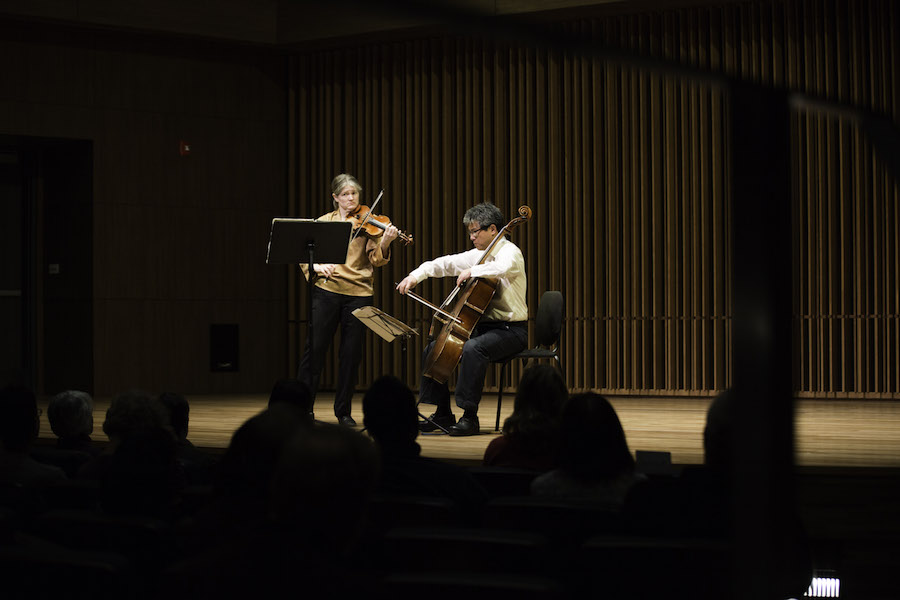
For those seeking some classical music to liven up their Thursday afternoons, they need not look further than the Shinkoskey Noon Concert series, hosted by the UC Davis Department of Music. The concerts, which are held at the Ann E. Pitzer Center each Thursday at noon, present various musicians and musical styles. Ranging from solo performances to ensemble performances, baroque music to electronic music, and featuring a range of student musicians and nationally-renowned professionals, the program embodies diversity.

“I was excited to attend this concert as this is my first time attending a chamber music performance,” said Teresa Won, a second-year computer science major. “[…]I never really think of the violin as a solo instrument before attending this concert, now I’m amazed with what it can do!”

Vincent Kaur, a third-year music major, appreciates the variety of music presented in this program.

“As a music major, I learn about abstract musical concepts in class, and it’s an educational experience when attending concerts just to see these concepts are put into practice,” Kaur said.

Perhaps the best part of these concerts? They’re free, making high-quality live music accessible to all in the Davis community.

“I was thrilled to hear the collaboration between the violin and electronic music,” said Jin Hu, a second-year managerial economics major, after attending her first noon concert at Pitzer Center. “I was not expecting such modernized sounds from the violin.”

Read below for a list of concerts that will be performed during this winter quarter. All concerts are held on Thursdays from 12:05 to 1 p.m.


Feb. 2 — Debussy Curiosities.

Debussy: En blanc et noir by Michael Seth Orland and Marilyn Swan, piano; Arthur Hartmann: Three Debussy Transcriptions by Dan Flanagan, violin, with Michael Seth Orland, piano; Debussy: La plus que lente, conducted by D. Kern Holoman.


Feb. 9  — Michael Sand, Baroque Violin, with Phebe Craig, Harpsichord.

J.S. Bach: Partita for Solo Violin in D Minor, BWV 1004, and J.S. Bach: Violin Sonata in G Major, BWV 1021.


Feb. 16 — Music of Antonin Dvorak.

Selections from Bagatelles, op. 47; Slavonic Dances for Piano 4-Hands, op. 46, no. 8; Piano Quintet in A Major, op. 81, with Chase Spruill and Roger Xia, violin; Robert Levine, viola; Susan Lamb Cook, cello;  Andrei Baumann, piano.


Feb. 3 — Daniel Stepner, Violin.

Selections from the Mixed Doubles recital program on Friday evening by violinist Daniel Stepner.


March 2 — Gamelan “Ledbo Budoyo”

This concert presents music from the Central Javanese repertoire called karawitan, performed by Phil Acimovic, a UC Davis composition student and an active performer of Javanese Karawitan.


March 3 (Extra Friday Concert) — Electronic Music at Davis, by Bob Ostertag and Philip Acimovic.


Those interested in more information about Shinkoskey Noon Concerts may visit the UC Davis Department of Music’s website.


Written by: Betty Wu — arts@theaggie.org

The collection on the corner

0
LUCY KNOWLES / AGGIE

The Red Dress Campaign addresses national health issue through design, collaboration

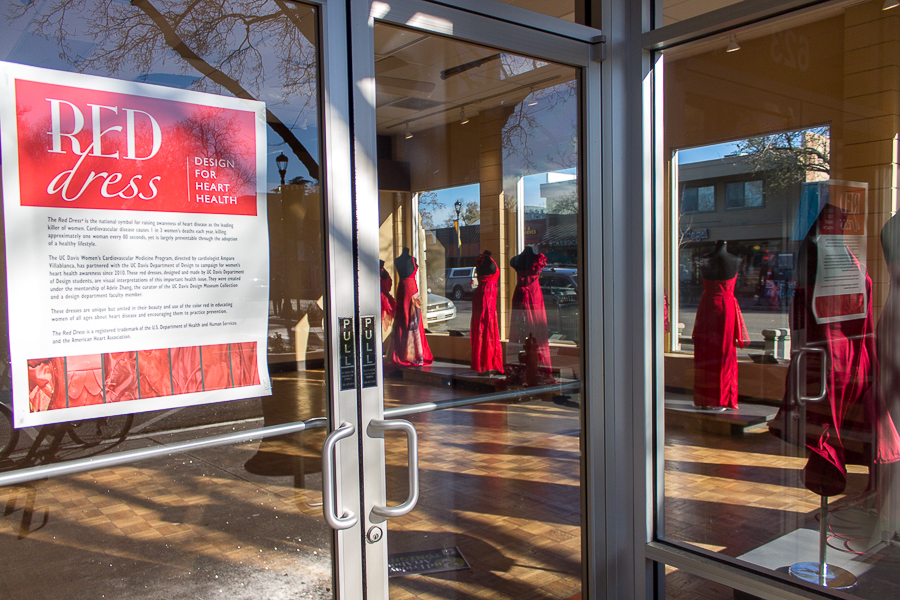
Strolling down 2nd Street in downtown Davis, large storefront windows catch the glances of passersby — not for trinkets or gadgets for sale, but for the stark pop of red dresses.

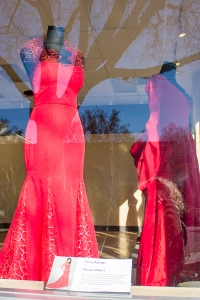
Upon a closer look, the red dresses do not appear to be average prom gowns. Each one is uniquely different, and some even evoke images and feelings of organs in the body. The way the fabric sits, folds and falls over itself on the mannequins resembles the anatomy of the human heart.

“The red dresses are an educational exhibit,” said Dr. Amparo Villablanca, a UC Davis faculty member and a cardiologist at the UC Davis Medical Center. “[The point is] to raise awareness that heart disease as the leading killer of women in America, so we want all women to know that they are not immune, it is not just a man’s disease.”

Designated as the national symbol of heart disease by the National Institute of Health and the American Heart Association, The Red Dress Collection is the result of a collaboration launched in 2010 between Villablanca and Adele Zhang of the UC Davis Department of Design and is showcased on an annual basis in downtown Davis. Together with Heather Caswell, the owner of The Wardrobe store in downtown Davis and member of the Women’s Heart Health community council, Villablanca and Zhang were able to secure adequate space for the display of the collection downtown. Every year, a new batch of Red Dresses are unveiled at Villablanca’s Women’s Heart Care Forum in Sacramento in order to raise awareness about the issue. Zhang, who is the curator of the UC Davis Design Museum as well as an instructor in fashion textile and design, wove this 2016 collection into part of her teaching materials.

“I learned a lot of things when I started to work on this project,” Zhang said. “This will be the eighth collection, and this is a very educational opportunity for everybody. Students need to learn what heart disease [is] and what the red dress [means].”

The students of Zhang’s advanced fashion design class have the option to design a personal statement or a dress for this campaign. They are required to have a deep understanding of heart disease in order to adequately convey that the Red Dress Collection is not just a creative design project, but also a national health issue and a social campaign.

“My inspiration came from [a] kaleidoscope,” said Rong Ben, a fourth-year design major and designer of one of the dresses in the 2016 Collection, in an email interview. “You never know what image [or] pattern you will see in there until you look closely into the kaleidoscope and turn it around. Same as heart disease, we all need to take the health issue seriously, look through it, care about it. In this way, we can find out the disease earlier and be able to cure it on time. My goal is to inform people that we all need to pay attention to heart disease and health issues. [We need to] discover it early and cure it early.”

Ben’s design is composed of a detachable outer layer and an inner dress. Once detached, the outer layer can be turned around in order for people to see the red mesh fabric underneath. Ben said that the pattern of the mesh is meant to mimic the pattern of arteries for visual experience and aesthetic appreciation of human hearts.

Heart disease in women has only been on the radar in America for roughly the last 25 years, with increasing focus in the last 10 to 15, according to Villablanca. Villablanca leads the Women’s Cardiovascular Medicine Program, which she began in 1994 and was, at the time, the only program in the nation dedicated to women’s heart health. Part of the reason heart disease was such an unknown issue for women was because scientists have mostly studied the male model of the disease.

LUCY KNOWLES / AGGIE

“We didn’t study women [before 25 years ago] the way we do now and women still don’t participate in clinical research at the rates we want them to,” Villablanca said. “Devices weren’t tested on women, drugs weren’t necessarily looked at for side-effects for both sexes, research was not required to include women. But now, there’s a requirement by the national institute of health, [which has] been extended to animals systems too in order to study [both] males and females. We’re gaining much more knowledge and information.”

The question as to why death rates from heart disease are higher for women than for men is a challenging one. There are various factors that come into play when evaluating the gap between these rates including lack of awareness, anatomic differences, physiologic differences, the fact that women’s blood vessels are smaller and different responses to treatment.

“Lots of people think that it’s all genetics, whereas genetics is a relatively small part,” Villablanca said. “Recent research has shown that even if you have genetic factors and predisposition, if you have a heart-healthy lifestyle you can cut that risk as much as 40 percent.”

The message of the Red Dress Collection is not simply to point out that heart disease is the leading killer of women in the country, but that it’s largely preventable. While 80 to 90 percent of heart disease is thought to be preventable through heart-healthy lifestyles, diet and physical activity, it affects everyone no matter what age.

Since the start  of the national campaign, death rates for both men and women have decreased significantly due to raised awareness and better prevention as well as advances in treatment. February is designated as the National Heart Month, and, for the past few years, UC Davis and the community have participated in the National Wear Red Day, which falls every year on the first Friday in February. Zhang and Villablanca hope that wearing red will become a powerful and recognized symbol no matter what time of the year it is.

“Every February […] people bring this subject up and are passionate about [it], but I wish it could be a year-round atmosphere for everybody,” Zhang said. “I think it takes time for people to pay attention, and not [just] during that specific month. It is a yearlong or lifelong campaign for our heart health, and that is something I wish […] can be achieved.”

On Friday, Feb. 3, the campaign will unveil a new collection of Red Dresses designed by the students in Zhang’s current advanced fashion class. These dresses will raise awareness for heart disease in the local community, and offer students the chance to become ambassadors of heart care.

“I really enjoyed doing this project because it made me feel the close tie between fashion and other concepts in the society,” Ben said. “Many people may think fashion is for beauty, trend and the fancy stuff, but I strongly believe in the magic power of fashion to discover problems and solve them. I feel honored to be able to participate in this red dress project, have the chance to raise people’s awareness on heart disease, and help to solve social issues.”
Written by Marlys Jeane — features@theaggie.org

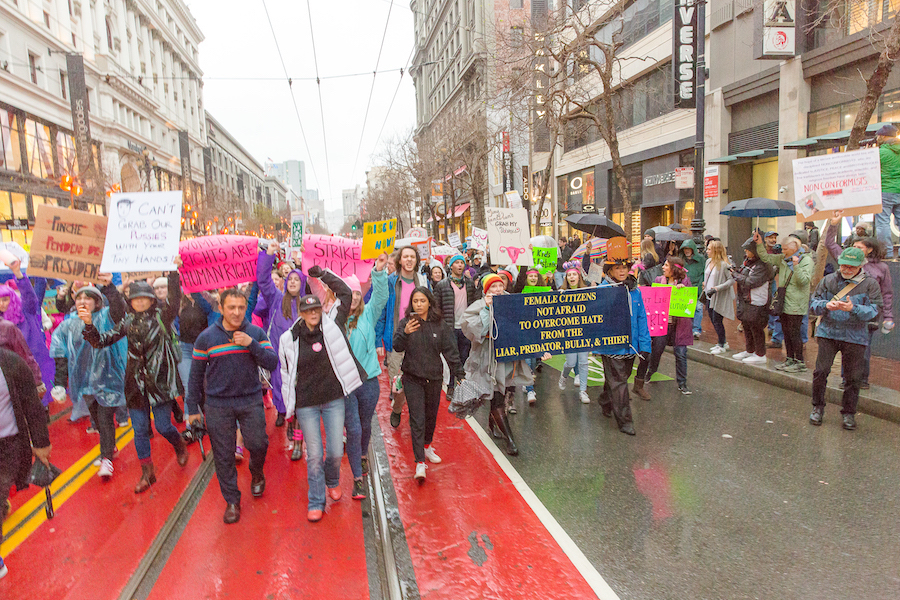
In Photos: Women’s march on Sacramento, San Francisco

0
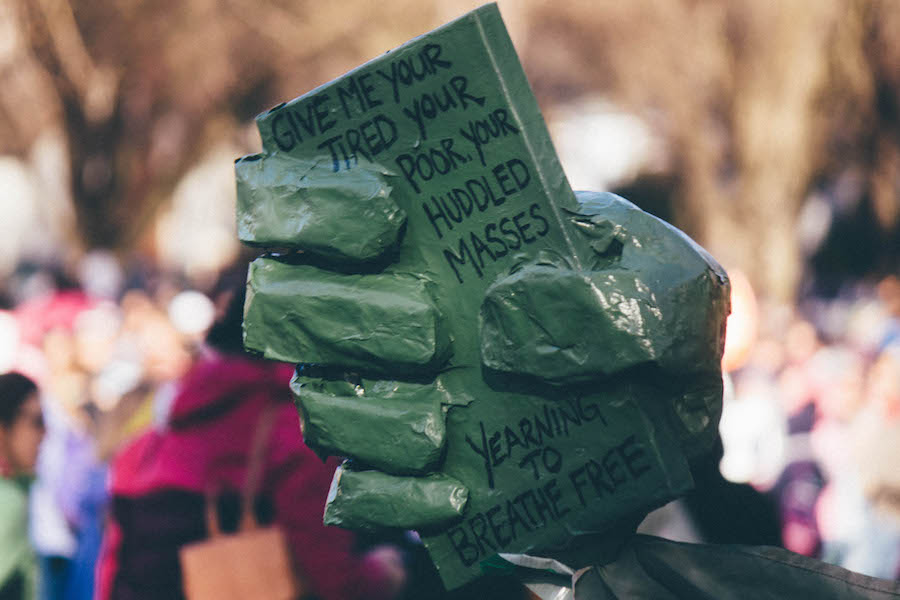
The lengths that people went through to include art into their protest was absolutely astounding. This person had fashioned a version of the Statue of Liberty onto themselves, and had even included the text that is actually etched onto the statue (BECCA RIDGE / AGGIE)
There was so many different signs at the rally. So much time and effort was put into everyone's message. It was hard to not want to take pictures of every one that I saw. (BECCA RIDGE / AGGIE)
There was so many different signs at the rally. So much time and effort was put into everyone’s message. It was hard to not want to take pictures of every one that I saw. (BECCA RIDGE / AGGIE)
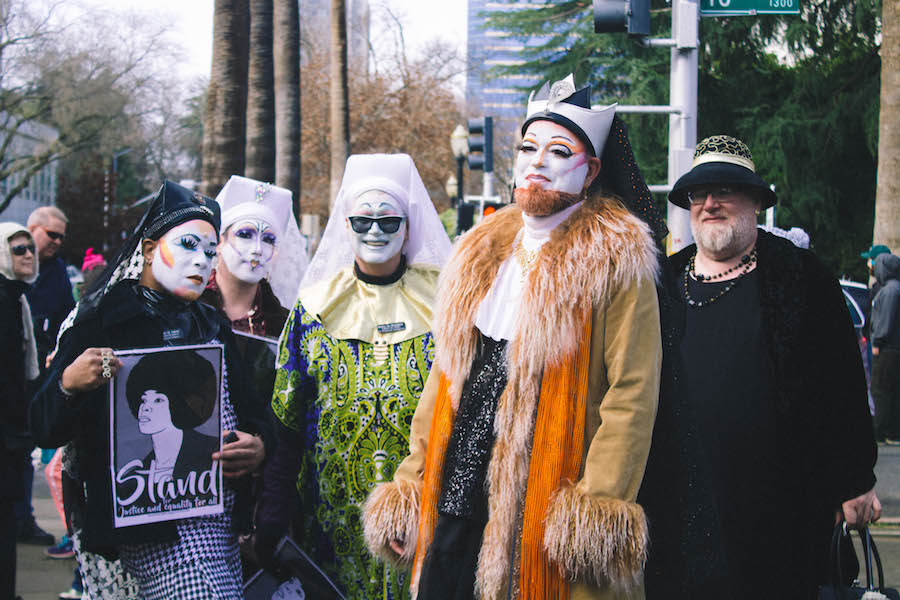
One of my favorite things about being at the march was the willingness of others to be photographed. Everyone was so kind and ready to share their presence with others. (BECCA RIDGE / AGGIE)
Demonstrators in front of the State Capitol Building lead chants and energize the crowd of supporters. (BRIAN LANDRY / AGGIE)
A young marcher shows another child her "Future Madame President" sign. (BRIAN LANDRY / AGGIE)
A young marcher shows another child her “Future Madame President” sign. (BRIAN LANDRY / AGGIE)
The area in front of the California State Capitol fills with people who watch on as people directly in the front of the building begin chants. (BRIAN LANDRY / AGGIE)
Crowds of people gathered in front of the capitol in solidarity, to support the fight for not only women's rights but overall equality. (BRIANA NGO / AGGIE)
Crowds of people gathered in front of the capitol in solidarity, to support the fight for not only women’s rights but overall equality. (BRIANA NGO / AGGIE)
As the marchers marched through the streets, an American flag can be seen in the distance while in the foreground protest signs linger, sending a silent message to Americans. (BRIANA NGO / AGGIE)
"Love not hate! Make America great!" (BRIANA NGO / AGGIE)
“Love not hate! Make America great!” (BRIANA NGO / AGGIE)
A man among the marchers marches to the capitol with a pride flag in hand. (BRIANA NGO / AGGIE)
Many men came to participate and march in solidarity with their female comrades. This man in particular can be seen holding a sign of how he believes America should be. (BRIANA NGO / AGGIE)
Starting from Civic Center Plaza, demonstrators walked down Market Street toward Justin Herman Plaza. (JAY GELVEZON / AGGIE)
Demonstrators even rode San Francisco streetcars. (JAY GELVEZON / AGGIE)

Compiled by: Jay Gelvezon, Brian Landry, Briana Ngo and Becca Ridge – photo@theaggie.org

HOTlanta Heats Up Houston

0
NICKI PADAR / AGGIE

February is not the greatest month. It’s the heart of winter quarter, you’ve failed a few midterms by now, and if you’re like me, you probably can’t afford to turn on the heat in your apartment, so you can see your breath when you exhale too deeply. It’s the way of the life for most college students trying to survive February in Davis. But in the midst of all the winter’s horrors, it’s easy to forget the one redeeming quality: the Super Bowl.

Super Bowl Sunday affords us all one day of devotion to the couch, quality football and multi-million dollar commercials, which combined somehow make up for an entire month of rain and heartache. And luckily for you, that one day is this Sunday. The wait is finally over. And for a city with five professional sports teams that have only won a single combined championship in 168 total seasons of competition, the wait is finally over for them as well. The Atlanta Falcons will uphend the New England Patriots, 34-27.

Let me start by addressing the elephant in the room. Michael Wexler is one column over doing his best to convince you that the opposite will happen on Sunday. I have not read his article prior to publication, but undoubtedly it consists primarily of obscure statistics and sarcastic comments questioning my credibility after predicting the last Super Bowl and World Series incorrectly. Like most people over the age of 20, there are things in my past for which I am not proud. Predicting the Panthers to win the Super Bowl last season was a mistake. But my past failures have only motivated me further to deliver for you this season. Nevertheless, I can understand your hesitation in blindly following someone who has previously wronged you, so I prepared five reasons to convince you why the Falcons will win Super Bowl 51:


  • Tom Brady vs. Matt Ryan


This Super Bowl marks the first time since 1984 (when Marino faced Montana), that the league’s two highest rated passers square off on the big stage. Like most Americans, I have a lot respect for Brady. He’s a Bay Area guy, lived out the underdog story, and at age 39 is still one of the best quarterbacks on the planet. Unfortunately for Tom, however, the fifth Super Bowl ring is going to have to wait. He will not be able to keep pace with Matt Ryan and the Atlanta offense (henceforth HOTlanta). Matt Ryan is the orchestrator of the seventh highest point scoring offense in NFL history, and the points will come in boat loads on Sunday.


  • Julio Jones, Atlanta Falcons wide receiver


The Alabama product is a God among men and will single handedly carry HOTlanta and the Lombardi Trophy.


  • Gisele Bündchen vs Sarah Marshall


Like I mentioned above, Matt Ryan outperformed Tom Brady on the field this season. But what many people fail to recognize is that Ryan also outperformed Brady in choice of signficant other. Yes, Gisele is one of the highest paid supermodels in the world, but her acting job in The Devil Wears Prada was subpar at best. Meanwhile, Ryan chose to settle down with Boston College point guard Sarah Marshall. Along with finishing second all-time in assists during her college years, Marshall consistently made the dean’s list and now works for the WNBA franchise the Atlanta Dream.


  • The NFL is fixed and Goodell won’t let it happen


It’s no secret that NFL commissioner/overlord Roger Goodell is anti-Brady and anti-Patriots. In the post-Deflategate world we live in, the Patriots are no longer golden child of the NFL. Brady spent the first four games of the season watching from the sidelines while serving his suspension from Czar Goodell. With his pride on the line, Goodell will rally Las Vegas to throw all its gambling support to the Falcons, delivering the final blow in the Deflategate saga.


  • Fate Exists.


A Madden 17 simulation predicted HOTlanta would win the Super Bowl over five months ago. Typically, I am hesitant to trust John Madden after he got me and half a dozen of my teammates sick when I met him after a high school football game. But the past is the past. And the virtual video game version of Madden is much more reliable than the actual person himself. Trust Madden, trust me, and most importantly do not trust Wexler; the Falcons will win Super Bowl 51.

Written by: George McConnell — sports@theaggie.org