55.5 F
Davis

Davis, California

Tuesday, December 23, 2025
Home Blog Page 675

New violent collision theory on the creation of the moon

ALEXA FONTANILLA / AGGIE

UC Davis professor coins new theory that answers questions about the moon

The textbook story of how the moon was made begins with an object the size of Mars clipping the Earth, shattering the foreign object and creating a cloud of rocky material, from which the moon condensed. Despite some prominent concerns, the “Giant Impact Theory” has remained the prevalent theory on the formation of the moon due to lack of alternative hypotheses.

One problem with this theory is that it dictates that the moon should be made out of the material from the object that hit the Earth. However, the moon’s isotopic chemical fingerprint, a diagnostically unique ratio of isotopes of certain chemical elements, is very similar to the Earth’s. Another problem with the theory is that the moon’s orbit is offset 5-degrees from the ecliptic plane, or the plane at which the rest of the solar system orbits.

“If the moon formed by a giant impact, it would have grown from the debris that were initially around the earth’s equator,” said Sarah Stewart, a professor in the Department of Earth and Planetary Sciences. “If you calculate what happens to the moon after that, it shouldn’t have any inclination.”

Stewart, along with then-postdoctoral fellow and current scientist at the Science for Extraterrestrial Intelligence (SETI) Institute, Matija Ćuk, and two other researchers, published a paper in Nature which detailed a new theory. Published in Oct. 2016, the theory explained both the moon’s 5-degree tilt and the similar isotopic fingerprint to Earth.

The theory starts with a high energy, head-on collision between a larger-than-current-day Earth and a celestial body half the size of Mars. The collision combined the foreign body and the Earth, and blew a part of that combined mass into a cloud that ultimately resulted in the modern-day moon.

This mixing and subsequent spewing of combined material explains the almost identical chemical isotopes of the Earth and the moon. The collision also set the Earth rotating at a rate that made days two to three hours long. The degree of rotation was skewed to a 60 to 80-degree angle as opposed to the current 23-degree angle which explains the 5-degree tilt of the moon’s orbit.

“[We proposed] that the moon formed in the equator around the Earth when it was tilted over,” Stewart said. “During the evolution from that initial condition, two dynamical events happen that straighten up the Earth so that our obliquity is lowered, [which] lowers the inclination of the moon, but not all the way down to zero.”

At its core, the new theory still revolves around a “giant impact,” but the details of the collision, as well as the things that follow, are drastically different.

This theory answered a lot of questions; however, it also left scientists an oblong Earth with too much angular momentum, causing the earth to rotate more rapidly. Part of what Stewart and Ćuk were able to show in their paper was how to bring the earth to a 23-degree tilt, while dissipating the some of the angular momentum and maintaining the 5-degree tilt of the moon’s orbit. These feats were achieved with the two dynamical events known as the LaPlace and the Cassini transitions.

Simon Lock is a graduate student in the Department of Earth and Planetary Sciences at Harvard University, as well as a co-author on the paper.

“If the moon starts [at the equatorial plane of the Earth], and the Earth starts on its side, then through something called the LaPlace plane transition, the Earth gets tilted upright, but the moon gets left in a very high inclination orbit,” Lock said. “When there’s a second-state transition which we call the Cassini state transition […] you damp inclination, and you bring [the moon’s orbit] down to the 5 degrees you see today.”

As for why the two transitions take place, Lock said that they are driven by the search for a stable state.

“There are very stable what we call ‘orbital arrangements’ between the rotation axis of the Earth [and] the orbital axis of the moon,” Lock said. “At a point in the moon’s history, you move from one of these stable configurations to the other; one becomes more preferable than the other.”

Because the LaPlace and the Cassini transition states are integral to the paper’s hypothesis, finding evidence that these transitions took place can further validate the updated theory.

“These events dissipate energy in the moon and the Earth, so they’re heating events, and we can look for the record of heating events in the moon,” Stewart said. “There are isotopes that imply that the moon had been hot at a time that seemed to be after its date of origin, and it could be that our dynamical transitions are responsible […] One of the tests for our hypothesis is to look for, in more detail, a fingerprint that’s a thermal pulse that occurred during our tidal evolution.”

Dawn Sumner, the chair of the Department of Earth and Planetary Sciences at UC Davis, attests to the significance of narrowing down a theory on the formation of the moon on our understanding of the basic dynamics of the Universe.

“Stewart’s research has lots of important scientific implications for the origin of the moon and how it has affected Earth.” Sumner said in an e-mail interview. “It also explains some of the characteristics of the Earth-moon-sun system that people observe on a regular basis. Stewart’s model explains aspects of our daily life particularly the length of a day for the first time.”

This research was supported by NASA.

Written by: Meral Basit – science@theaggie.org
Manetti Shrem Museum now open to the public

DANIEL TAK / AGGIE
DANIEL TAK / AGGIE

UC Davis welcomes newest addition to campus

The Jan Shrem and Maria Manetti Museum opened its doors to hordes of excited art enthusiasts on Nov. 13. The museum, located adjacent to the Mondavi Center for the Performing Arts, is the newest museum addition to the campus and intends to honor the artistic legacy of UC Davis.

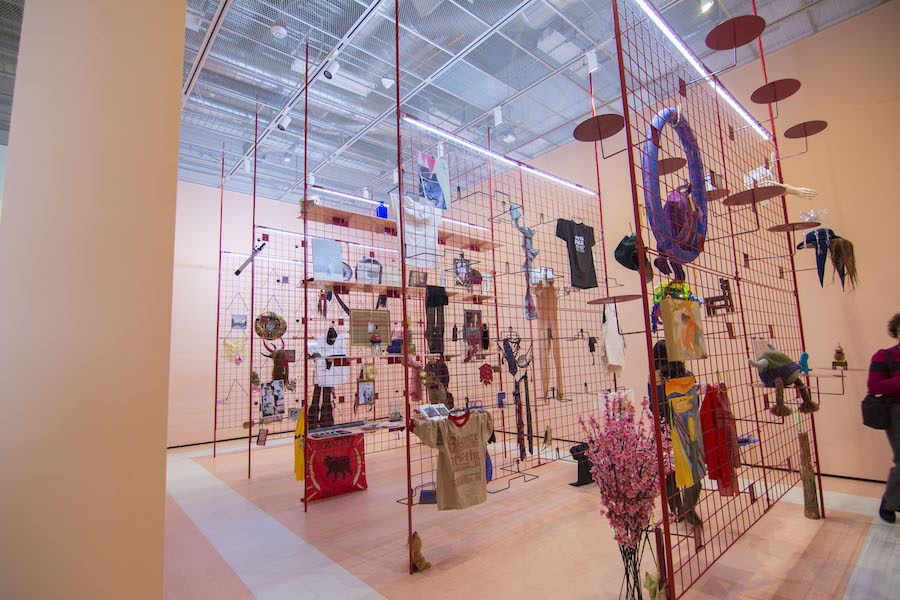
On a Tuesday afternoon nearly a week after the grand opening, there was still a fairly large number of people at the museum to experience the sleek building and its exceptional collection. The building is unusual in its canopy-style ceiling that illuminates the interior with sunlight. It is not enclosed, and you are able to see the outside, which plays well into the museum’s goal: “Welcoming Open Minds with Open Arms.”

The farmlands and rows of crops surrounding the museum inspired the geometry of the Grand Canopy. The careful use of materials like aluminum, concrete, clear glass and wood complement the rays of light beaming in. The orientation and spacing of the canopy’s aluminum beams, more than 900 in all, create a clear, thought-out juxtaposition of light and shadow.

“The openness of this place makes it so beautiful,” said Heather Lim, a second-year nutritional science major and a museum attendee. “The architecture itself is something to stop and admire because it is so unique and innovative […] I don’t think I’ve ever been to a museum like this one.”

Lim explained how exhibitions like Out Our Way, which explores the development of the UC Davis Art Department, are ideal for seeing the world from others’ perspectives.

“I’m a big fan of these artworks because they provide ways for people to connect on a human level,” Lim said. “Growing up, [art] was never really emphasized, so I learned to appreciate it later on in life.”

There are also many other exhibitions and events happening at the museum, leaving many in awe.

“The arts make us look at things with a different view and forces us to learn,” said Dee Rodriguez, a second-year communication major and museum volunteer. “There are exhibits that delve into symbiosis between humans and animals, and ones that allow people to actually make their own works of art.”

Rodriguez was referring to the Hoof and Foot: A Field Study and A Pot for a Latch exhibitions, respectively, both currently on display at the museum.

The area surrounding the museum has also been enlivened by the opening, with this new attraction piquing the curiosity of many in and around Davis. Wes Chen, a third-year computer science major and employee at the Mondavi Center, has noticed the increase in local foot traffic.

“I’m in this area of campus a lot, and I’ve been [to the museum] and there has been a decent crowd during peak hours ever since its opening,” Chen said.

Whether one is interested in art or not, the Manetti Shrem Museum holds significance because it displays all that UC Davis has achieved since its founding. In the 1960s and ‘70s, the department was central to the Bay Area Funk art movement, nurturing such influential artists as ceramicist Robert Arneson, Roy De Forest and painter Wayne Thiebaud. Rodriguez emphasized the impact the museum has on the community.

“Sometimes UC Davis is overshadowed by some of the other UCs,” Rodriguez said. “The Manetti Shrem gives UC Davis a voice and proudly displays what we are known for for everyone to admire.”


Written by: Krishan Mithal — arts@theaggie.org

Spirited then, spirited now

0
AMY HOANG / AGGIE
AMY HOANG / AGGIE

The lively yet little-known history of Cruess Hall

On her first day, Karen Nofziger sat at her desk in Cruess Hall, nervous about her new job as Staff Manager of the UC Davis Department of Food Science and Technology. A faculty member strode by with strawberry ice cream sprinkled with almonds and offered her some. This was just day one, but the rest of Nofziger’s time in this department proved to be just as fun and exciting an experience. Although Nofziger is now the Chief Administrative Officer of the Arts Department, she remembers her time in Cruess Hall fondly.

“We were always faced with different [foods] to try out [back then],” Nofziger said. “They canned peaches in the back so we always had the first pick of the season[’s] peaches. We would just gather up [ones the department couldn’t use] and get to take [them] home.”

Until 2010, when the department moved to the Robert Mondavi Institute for Wine and Food Science, Cruess Hall belonged to the Department of Food Science and Technology.

AMY HOANG / AGGIE
AMY HOANG / AGGIE

Constructed in 1952, the building was named in 1960 for William Vere Cruess, a professor of food science and technology at UC Berkeley in the 20th century. Cruess was famous for his work as a successful pioneer in this field, having invented fruit cocktail, and also for his contributions to the development of canned and frozen orange juice and raisin breakfast cereal.

Originally the home of educational spaces like cold storage and utility laboratories, food preparation kitchens, as well as a food pilot plant with its own brewery, Cruess Hall was an exciting hub of experimental food science and events for faculty, students and staff alike.

“We never got to sample the beer, of course,” Nofziger said. “But Budweiser came out and had events in the back of the building. It was a lot of fun — [I] loved working there. We had a great time! There were candy-making courses [and] we had a food competition where they give you odd ingredients and you have to figure out what to make with them, and then we’d have a panel of judges and there would be a prize.”

Many departments underwent a reorganization process due to severe budget cuts in the wake of the recession. Cruess Hall was not empty for long, though. The Design Department and the Design Museum, both moved out of Walker Hall, have inhabited the refurbished building since 2014. There, students work on architecture models, interior design and other design projects.

“The students are super engaged and they’re able to actually touch and manipulate materials in new and exciting ways,” Nofziger said. “[Cruess Hall] went from one place where the students learn more than just theory […] to another department where they have a true practical application piece, [since students] actually have a practical application piece to [their studies].”

A quick walk through the building today gives the sense that it is indeed a creative space. At the main entrance, light from large windows illuminates a staircase to the right, and to the left, a chalkboard wall scribbled with messages and embedded with a TV screen flashing the faces of students. Down the hallways are pictures, paintings, drawings, textiles and, most interesting of all, “random” stickers, also known as “tattoos,” found on the doors, stairways and walls of the building.

“There’s an upper-division design class here called environmental graphics,” said Andrew Lee, a fourth-year design major. “One of the

AMY HOANG / AGGIE
AMY HOANG / AGGIE

assignments is that they create random little text blurbs, and then they stick them around everywhere. A lot of them can be pop culture references. If it comes into mind, then it’s probably a sticker somewhere here.”

Other factors indicate an effort to break up the anonymity of the space. A courtyard nestled between three wings of the building is home to unique sculptures and other art pieces. Large stickers of cartoon characters like Tom and Jerry and celebrities like Miley Cyrus hide along the outside surface of the building. It is a courtyard unlike any other at UC Davis, unique in its exhibition of unconventional art.

Cruess Hall is also home to the UC Davis Design Museum, which hosts new exhibitions every quarter and highlights undergraduate and graduate students’ work. There are numerous art studios, spaces for sculpting, painting, sewing, ceramics and more — there is even a motion capture studio called the ModLab.

“Last week I put my head around the door and a colleague in the English Department was using the ModLab to stage Shakespeare,” said Simon Sadler, a professor of the history of architecture and the history of design. “She had her students acting it, but the ModLab is equipped to monitor the movements of the actors [to be] transformed into animation. They’re learning the basics of motion capture.[…] It’s pretty cool.”

Even though Cruess Hall is a rather large building that sits on the corner of California and North Quad Avenues, it does not receive much traffic from students outside of the Design Department — this quiet atmosphere, however, is about to change. To accommodate an influx of students on campus, construction of a newly renovated building is scheduled to be completed by 2019.

“With the new building, we will have a new main entrance [the] parking lot will be landscaped and there will be a continuous flow of space right up to [the front] courtyard,” Sadler said. “We’re going to have art there, there might be outdoor film screenings, [and] there will be places for students to hang out. So we will go from being like ‘Cruess Hall, where?’  to being Cruess Hall [as] a sort of terminus for all of us. It will become a cool new addition to campus.”

Just like its transition from Food Science and Technology to Design, the building’s future transition into an invigorated focal point of the UC Davis campus will be another chapter in the history of one of the Davis’ most spirited buildings.

“It went from one exciting place for students to engage in their discipline to another exciting place,” Nofziger said. “It’s always been very much a ‘maker-space’ building, and I’m gratified to know that it continues to be that.”


Written by: Marlys Jeane — features@theaggie.org

Law enforcement weighs in on the blight of open carry

LUCY KNOWLES / AGGIE FILE

headshot_taOpen carry laws make dangerous situations even more volatile
Only California, Florida, Illinois, New York and South Carolina prohibit the open carry of handguns. That means 45 American states allow the intimidation of the public, wasting of law enforcement resources and endless opportunities for accidental injury caused by firearm misuse.

In a heart-wrenching moment following the July shooting of five police officers, Dallas Police Chief David Brown addressed the public and spoke on issues ranging from race to open carry laws.

“It’s increasingly challenging when people have AR-15s slung over and shootings occur in a crowd… We don’t know if they’re the shooter or not. We don’t know who the good guy is versus who the bad guy is if everybody starts shooting,” Brown said.

Especially during an emergency, trying to weed out the bad guys from the good guys — likely with limited information about the shooter to go off of in the first place — detracts from time that could be used to stop senseless violence and instead makes an officer’s job infinitely harder.

In this sense, times of crisis or high political tension should call for a limit on open carry laws. On the eve of the Republican National Convention, the head of Cleveland’s police union called for a temporary ban on the open-carrying of guns for fear of impending violence from protestors and dissented individuals. Stephen Loomis, the president of Cleveland Police Patrolmen’s Association, accused open carry participants of irresponsibility, going on to say “you can’t go into a crowded theater and scream fire. And that’s exactly what they’re doing by bringing those guns down there.” Just because it’s legal doesn’t mean it’s right. And openly carrying a firearm during a volatile situation isn’t right.

Open carry laws also scare the public into thinking there’s more wrongdoing than really exists. According to a San Mateo County Sheriff’s report, several incidents have arisen where people called police dispatch in response to seeing an individual carrying a revolver or a semi-automatic handgun on them. This leads to a waste of time when, consequently, police officers have to investigate these citizens who are simply “exercising their right,” but are really engendering unnecessary fear and trepidation in the minds of other citizens.

Yet sometimes this fear is more than justified. 10 minutes before an armed shooter walked into a Colorado Springs Planned Parenthood, the Colorado Police Department received two calls regarding the shooter. One of the callers reported him as looking “scary” at several points during the call, but the emergency response technician acknowledged that Colorado is an open carry state so, technically speaking, he was not breaking any laws. He left three people dead and nine wounded just minutes later.

Open carry is a double-edged sword. Seeing an individual with a weapon displayed is undoubtedly scary, but reacting on this fear can have wasteful consequences on law enforcement resources if the individual carrying has no bad intentions. On the other hand, a lack of response from police dispatch can also have deadly ramifications.

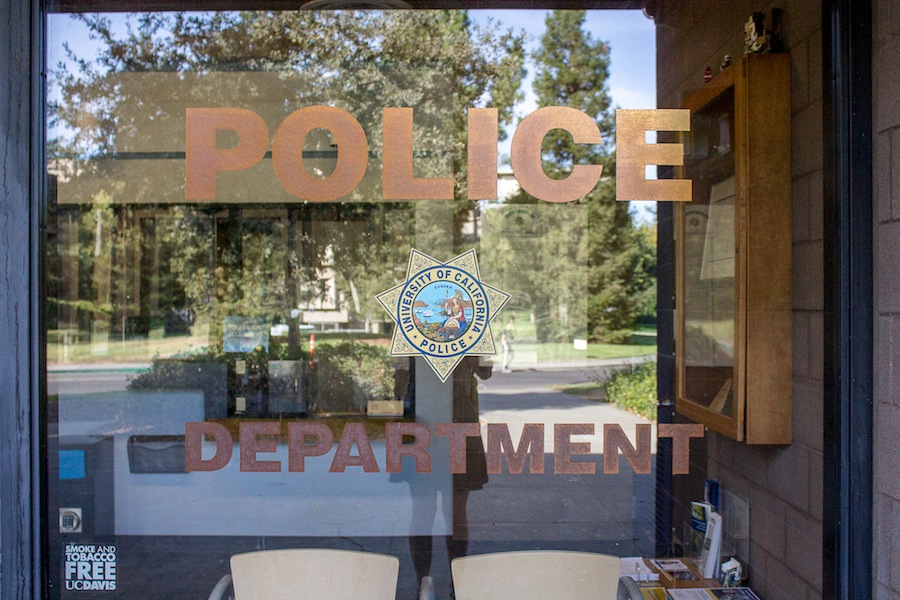
What’s more worrisome, however, is the prospect of accidental misuse of a firearm in a public setting. Deputy Chief of the Davis Police Department Ton Phan said that states like Texas, where it is now legal to openly carry a handgun on college campuses, are especially at risk for these types of misuse.

Phan, who has over 30 years of law enforcement experience, believes in the Second Amendment but is also aware of the issues that accompany open carry laws.

“People must be properly trained,” Phan said. “People must practice with their gun. In law enforcement, we are required to get training, and that should apply to individuals too. It’s important to invest time in becoming proficient at it, too, because shooting at a nonmoving target and shooting under stress at a person are two very different things.”

Phan’s words serve as a reminder that no federal or state laws require a training protocol for an individual seeking to buy a firearm. If police officers are to undergo a rigorous training process to own and operate a gun, what logic exempts civilians from having to do the same?

Open carry is a multifaceted issue with no solution that would be acceptable to everyone. Yet it is important to understand its ramifications: officers’ time wasted on sorting the good guys from the bad, public unrest and intimidation and the prospect of accidental misuse, to name a few. Thrown together in an emergency situation, these hazards undoubtedly pave the way for chaos and unnecessary violence, which in this country is all too common.


Written by: Tamanna Ahluwalia — tahluwalia@ucdavis.edu

Disclaimer: The views and opinions expressed by individual columnists belong to the columnists alone and do not necessarily indicate the views and opinions held by The California Aggie.

Police Logs

LUCY KNOWLES / AGGIE FILE

Another week of ‘why did people call the police about this nonsense?’

Nov. 20

“Hydraulic lift parked across from RP’s res, RP feels it’s sticking too far out on the roadway”

Nov. 21

“Male talking to himself about conspiracies”

Nov. 22

“[Subjects] charging devices on the city electrical outlet”

Nov. 22

“Two loose dogs attacked RP’s cat”

Nov. 23

“Foliage blocking the roadway”

Nov. 23

“Rat wounded after hitting trap, not dead, thrashing around, req. assistance”

Nov. 26

“Turkey wandering in the area, not aggressive”

Nov. 26

“Subjects throwing eggs from the top of the structure — hit the front door and several guests”


Written by: Sam Solomoncity@theaggie.org

The season of giving

Nicki Padar / AGGIE
Nicki Padar / AGGIE

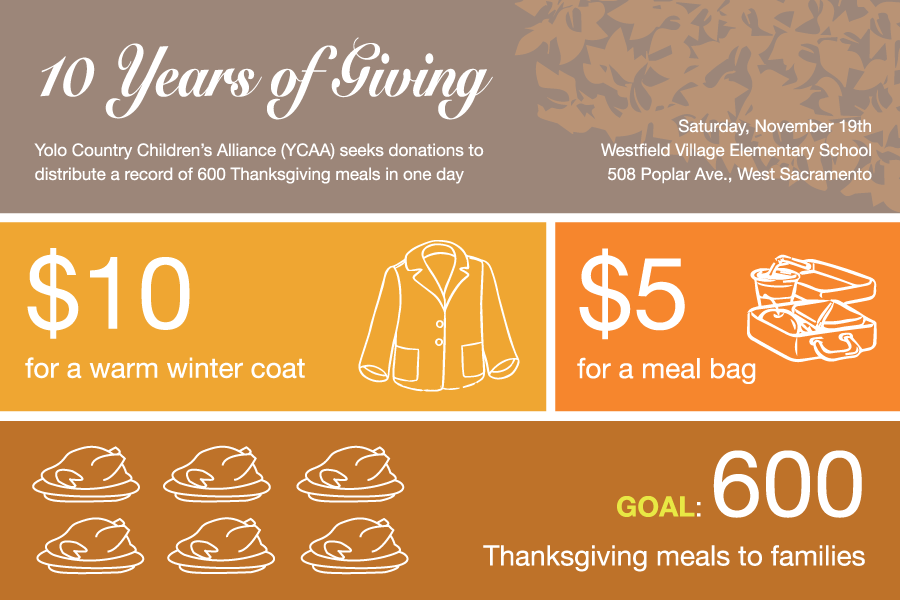
The Yolo County Children’s Alliance celebrates its 10th annual giveaway event

The Yolo County Children’s Alliance (YCCA) held its 10th Annual West Sacramento Giveaway Day at Westfield Village Elementary School in West Sacramento on Nov. 19. In addition to the items that were given away to families in need, the spirit of giving brought the Yolo County community together

YCCA is a nonprofit organization that is dedicated to offering support services to families, addressing community concerns and gathering information on the well-being of families in Yolo County, which includes Davis, Woodland, Clarksburg, West Sacramento and Capay.

This year marked the 10th anniversary of the YCCA’s Annual Giveaway Day and would not have been possible without the assistance or funding from the entire community. Katie Villegas, executive director of the Yolo County Children’s Alliance, believes that YCCA goes above and beyond with this kind of distribution.

“We do the food distribution, we do coats and blankets, household items and toys for kids. We extended our food distribution to include all of that. We usually raise 10,000 dollars for the event and serve about 500 families,” Villegas said

With the winter season fast approaching, YCCA made it this year’s goal to extend the number of coats that are donated.

“We realized that there are a lot of kids without coats in West Sacramento,” Villegas said. “It was a big deal. We had limited the distribution to two per family before and this year we went up to three. We definitely ran out of coats. We had a lot of donations — we probably had more than 15,000 coats and we ran out so it went really fast.”

For next year, the YCCA seeks to build upon this year’s accomplishments. Special projects manager, Julie Beckner concludes that one improvement that could be made for next year is the number of families that the YCCA is able to serve.

“We were limited in how many families we were able to serve and the capacity in which we were able to serve them by the amount of money we had to buy the goods […] As always, more money means more capacity to help,” Beckner said.

Villegas said that community should get involved in order to help those in need, and also because the event itself is enjoyable for people of all ages.

“We love when people volunteer,” Villegas said. “Last year we had so many people volunteer, we had to go to an online registration […] This year we limited it to 16 and above, just because it is kind of hard with so many families coming through to have the younger kids there […] But I say if people want to volunteer for next year, to sign up early. They can follow us on Facebook or they can look at our [YCCA] website. We begin recruiting volunteers anywhere from six weeks to two months in advance and we fill up.”


Written By: Dianna Riveracity@theaggie.org

Student representatives of Chancellor Search Committee to potentially resign

AARON JAUREZ / AGGIE FILE

Graduate Student Association, ASUCD Senate pass resolutions calling for concessions from UC President Janet Napolitano

The search for a new UC Davis chancellor continues after the resignation of controversial former chancellor Linda P.B. Katehi, this past August. Now, more resignations could be on the way from Brian Riley and Elly Oltersdorf, the graduate and undergraduate representatives of the Chancellor Search Committee.

The resignations of Riley and Oltersdorf became possible when both the Graduate Student Association (GSA) and the ASUCD passed nearly identical resolutions allowing each of the representatives to give two weeks notice of resignation if certain concessions were not made by UC President Janet Napolitano.

There were five concessions requested of Napolitano: that she use Robert’s Rules of Order to run meetings and send advance agendas to committee members, that non-committee members not speak unless spoken to by a committee member, that demographics about the candidate pool be released, that she fully explain the purposes of the committee and its subcommittees and that no candidate be considered as a finalist unless approved by the committee.

If either representative were to resign, their places on the search committee would remain vacant for the remainder of the search process.

“The whole point of [Riley] and [Oltersdorf] possibly resigning is that they don’t feel their voices are strong enough in the committee […] but if all the demands are met, they don’t have to resign,” ASUCD President Alex Lee said.

In a response to Lee and Oltersdorf regarding the resolutions, Napolitano assured that the student voices on the panel are valuable.

“It is my hope that both [Riley] and [Oltersdorf] will continue as members of this search advisory committee, especially given the very positive contributions they have made thus far in the process,” Napolitano said in a letter to Lee and Oltersdorf.  

Because of the recent election of Donald Trump as president of the United States, Riley does not plan to submit a notice of resignation.

“At the time [the GSA resolution] passed, I was hoping to submit right away,” Riley said. “And then Donald Trump was elected president shortly thereafter. That changed things a little bit. […] My undergraduate counterpart, Elly Oltersdorf, pointed out to me that we should proceed carefully on this and not jump into anything without thinking it through carefully.”

According to Katrina Brock, chair of GSA, Riley is only allowed to resign if the concessions listed in their resolution are not met.

“Brian Riley is authorized to resign only if President Napolitano is unwilling to implement basic procedural rules of a deliberative body and give the committee some authority over the search process,” Brock said via e-mail. “It doesn’t help graduate students to have a graduate student on the committee if their presence there is purely symbolic.”

Riley echoed this sentiment of symbolic presence, elaborating further that his and Oltersdorf’s resignation would be a symbolic withdrawal of the student body from the chancellor search.

“That was part of the purpose [of resigning],” Riley said. “It wouldn’t just be a person that was resigning — it would be basically the entire GSA. And with both of us resigning, [Oltersdorf and myself], it would be practically the entire student body.”

In its list of requested concessions for Napolitano, the GSA asked that non-committee members be barred from participating in Chancellor Search Committee meetings except when committee members asked them for information.

“Talking in a general sense, a person who is not a member of a deliberative body does not have standing within that body,” Riley said. “We are talking about guests or staff members, things of that sort […] you’re courting a severe breakdown in procedure when non-committee members are given a free hand, speaking generally.”

Lee is concerned by the seeming imbalance of power on the search committee.

“I have other concerns about the inherent placement of power, where faculty get five [seats on the panel] and they see the nominees earlier on, so you see their preferences more strongly,” Lee said. “[…] The process itself lends the faculty more power in this process. That’s not me saying the faculty are bad or anything, it’s just the way the process is laid out.”

However, Lee appreciates the variety of voices present on the panel.

“I definitely appreciate the collection of campus constituents,” Lee said. “You’ve got the Academic Senate, faculty, undergrads and grads recognized by their respective associations, then you have the alumni association and the staff [..] I also like that, and this is not a shared opinion by everyone, but I like that the faculty aren’t 100 percent from Davis — that this is a UC-wide search.”

Oltersdorf did not respond to interview requests for this story.


Written by: Kenton Goldsby — campus@theaggie.org

Talking sports with Aggie Talk

0
BECCA RIDGE / AGGIE
BECCA RIDGE / AGGIE

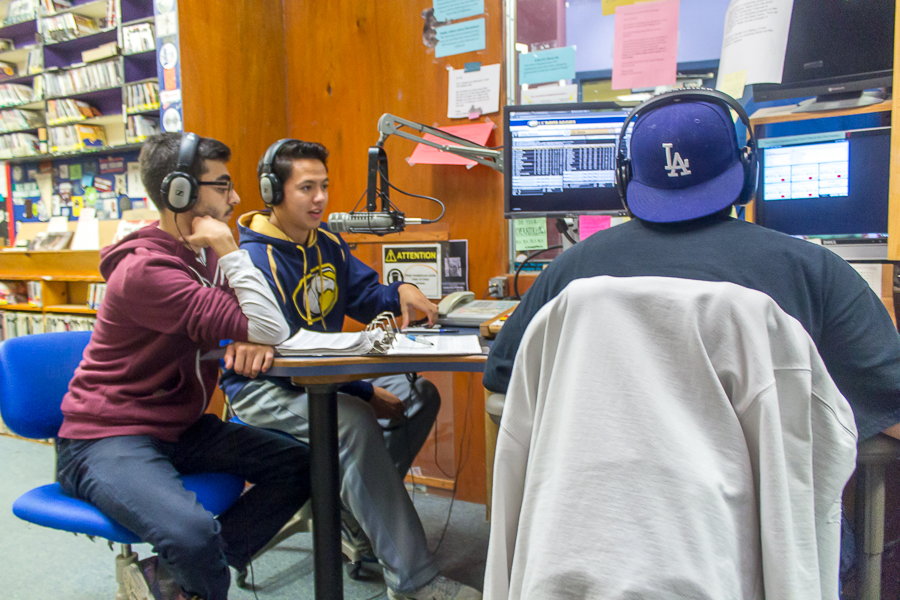
Every Tuesday night, UC Davis gets the opportunity to discuss the week in sports on KDVS’ “Aggie Talk”

Sports talk radio is a staple for sports fans across the country. It provides a venue where fans of all different sports can talk about those teams, players and events they are most passionate about. On Aggie Talk, UC Davis gets its own place in the sports talk world. For over three decades, KDVS has been covering sports, but in his second year as sports director, Andy Clausen wanted to make sure that he brought athletics to the forefront. Many radio veterans, such as Andy Reichwald of Sunday Night Baseball and Miami Marlins play-by-play announcer Rich Waltz, have lent their voices to KDVS in the past, but Clausen hopes to extend its reach even further.

“I think I brought the sports department back into the fold,” Clausen said. “We want student broadcasters to sound as professional as possible. It’s a place where people can gain a solid background in radio and sports while gaining a solid background in sports, while still putting out an entertaining product and putting out something that people want to listen to.”

With Aggie Talk, students and sports fans in the Davis area have a show in which they can discuss not only the UC Davis Aggies, but professional sports from all over the country as well.

For fellow sports director Michael Aridi Barake, a second-year communications major, Aggie Talk is a a place for sports fanatics like him to do what they love to do most — talk about sports.

“Aggie Talk is an opportunity for students (and fans) who are interested to get on board and do something productive with the hobbies and sports that they have a passion for,” Aridi Barake said.

As a largely volunteer-run station, it is important to get people with a passion for what they are doing. Aridi Barake sees the opportunity he has as a marriage of two passions.

“It was kind of a perfect blend of my love sports and my love for performing arts,” Aridi Barake said. “I did theater in high school, and I always wanted to work for a radio station.”

Aggie Talk, which airs every Tuesday from 7 to 9 p.m., aims to provide the people of Davis a place to talk about sports, both local and national. While it may not have the budget — according to Clausen, the show itself draws no funding from the Athletic Department — or the reach of a commercial radio station, Clausen and Aridi Barake share a goal, and that goal is to give both host and listener a professional experience that won’t let the dated equipment or diminishing funding hold back the pursuit to put on a great show.

The show, and station, rely greatly on two fundraisers, one every spring and fall, to stay on its feet.

“If you’ve ever been in our studio you can see that it’s really old,” Clausen said. “Literally one of our broadcasting boxes is held together by tape.”

This doesn’t keep the KDVS crew from putting out high quality content, and Aggie Talk is no different. The show’s format is simple and free-flowing. For the first half, the hosts typically cover Aggie sports, and each host has a sport that they’re particularly passionate about.

“You can tell where people’s interests lie, but for me, I’m a huge basketball fan and a huge soccer fan,” Aridi Barake said. “There are a lot of people around me who enjoy talking basketball, and it reflects that in Aggie Talk.”

Despite personal preferences, however, the hosts strive to make it an all-encompassing show which casual fans and hardcore fans can get behind. Though Aggie Talk has no official connection to the Athletic Department, Clausen and Aridi Barake do their best to bring on guests from within athletics and work hard to keep the program’s listeners informed.

“We don’t get told what to talk about,” Clausen said. “We’re very independent. We work with [the Athletics Department] in that they run the sports that we cover.”

For the second half of the show, the hosts of Aggie Talk move more towards the national sports scene, during which they cover any headlines or stories which they feel the listener may want to hear. If something comes up that may warrant an increased conversation, the format may get switched up.

“Luckily our format is very loose,” Clausen said. “The host’s job is steer the conversation where he wants it to go.”

In a time where off-the-field issues may dominate the sports media, Clausen and Aridi Barake try to avoid any issues which may be dominating the other media. If something comes up that warrants a greater discussion, it is up to the hosts and the guests to keep the discussion civil, as long as it fits the format of the show.

“We’re not trying to emulate other stations or channels,” Clausen said.

The hosts tend to agree that it is not their job to use the show as a soapbox, steering clear of political issues and hot-button topics.

“We’re just a small-time, student-run radio station in the middle of nowhere,” Aridi Barake said. “I don’t think we’re really qualified to pretend that we know the details.”

They try to let the off-the-court topics come out naturally, rather than force the issue.

“If it’s something we legitimately feel interest about, we’ll do it,” Clausen said. “It doesn’t always make for good radio, because we’re all probably going to get in a huge argument about it. We try to do things that will make our listener want to pay attention.”

Aridi Barake thought it only right to end his interview the same way they end the show:

“Aggie Talk, 7 to 9 on Tuesday! Tune in, 90.3 FM, KDVS, Davis. And, like we always say, ‘Go Ags!’”

The show is also available on KDVS.com. For inquiries about the show, contact Andy Clausen at sports@kdvs.org.


Written by: Bradley Geiser — sports@theaggie.org

From engineer to acclaimed artist

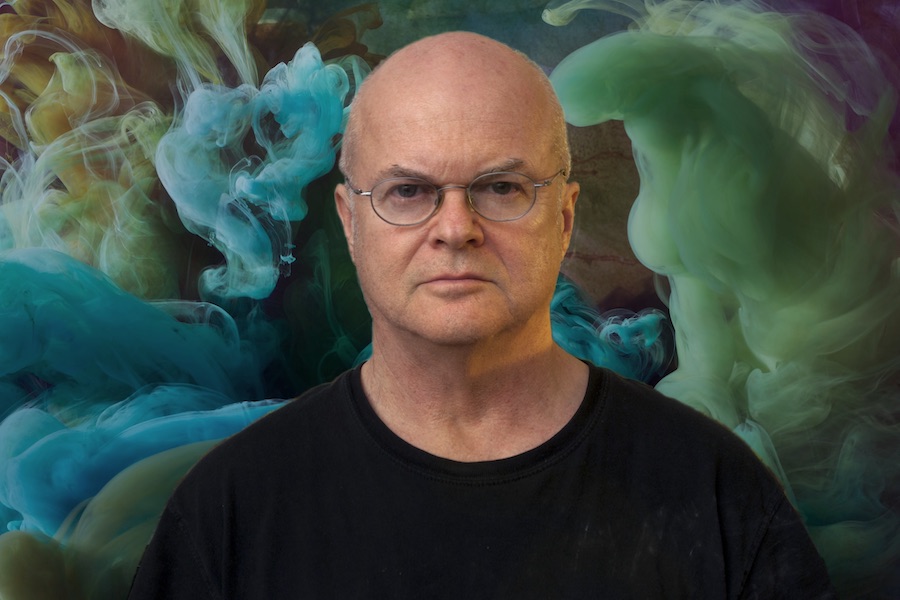
KIM KEEVER / COURTESY

headshot_tdKim Keever incorporates engineering education into otherworldly photographs
Well, Aggies, the dreaded finals week has finally arrived. I only remind you in case you forgot, even for the slightest second, about your soaring levels of stress, plummeting amount of sleep and flatlining social life. You’re welcome.

Finals week also signals my end as your guide through the magical land of the humanities and sciences. Tragic, right? It’s been a blast analyzing just a small fraction of the ways in which the arts and sciences intersect, and I’ll certainly miss all five of my readers. That said, I can think of no better send-off than delving into the photography of one of my favorite artists, Kim Keever.

Before the New York City-based artist turned his professional attention towards photography, Keever studied engineering at Old Dominion University in Norfolk, Va. and interned for NASA in the summers.

“I actually went through almost six years of engineering school — which is a tremendously tough schedule — without any serious interest in being an engineer,” Keever said via e-mail. “I know that sounds crazy, but my grand plan was to make a lot of money as an engineer and eventually retire and become an artist full-time after that. I reached a point in my life where I realized I only had one life that I knew of, and it made perfect sense to just give up on engineering — by now I was already finishing graduate school — and follow my true love, which was making art.”

Although Keever decided against a career in engineering, his scientific background shines through his art, resulting in pieces that seem possible only from an individual with one half of his brain in the artistic world and the other half in the scientific.

Keever’s work feels timeless, bottomless, infinite — yet the whole process takes place in a 200-gallon fish tank. The engineer-turned-artist assembles his own microcosms, often ethereal depictions of nature, that he then submerges in the water-filled tank.

“My engineering background has always allowed me to build sets that last long enough for my projects,” Keever said. “For example, I used a Christmas-tree rotator to rotate a lightweight circular platform I made, which held a pillow stuffing sky attached to a circular piece of translucent mylar. It rotated in back of the tank for a video project.”

After submerging a piece, Keever drops paint into the aquarium and photographs the ways in which the colors and light diffuse and mingle with one another. Even though he controls the lighting, sets and paint colors, Keever ultimately relies on the laws of fluid dynamics — the behavior of liquids and gases in motion — to create his otherworldly artwork.

“The fluid flow dynamics class was really one of my favorite classes in graduate school,” Keever recalls. “It was very visual and was made up of drawings of how a fluid would react when it flowed into a wall or a corner or other type of configuration. I certainly never realized it would come in handy with my art until recently.”

The mixture of descending paint drops and realistic landscapes allows Keever’s lifelike photographs to emulate scenes in nature. Some capture the beauty of splintered light pouring through clouds, mountains and trees; others mimic the moodiness of water spraying over powerful, stormy seas.

But Keever’s art isn’t just beautiful (although that’s certainly the first adjective that comes to my mind). His photographs consistently arouse complex and often paradoxical emotions in viewers. West 104k (2009) presents a mountainscape that immediately recalls tranquility, gratitude for nature and — luckily for Pinterest users — wanderlust. But the photo is equally unnerving, summoning an intimidating sense of seclusion in its endless stretches of uninhabited land.

Wildflowers 52i (2008), another personal favorite, depicts colorful mist dawning over a lush flower garden. The vibrant, mystical scene is both comforting and eerie, bright and haunting, joyful and apocalyptic. It’s the type of art whose magic is difficult to put into words but can be intuited by the audience.

Keever ultimately creates worlds that are distinctly recognizable yet different from anything else on the planet. His art pieces gnaw at one’s mind and call forth a string of disquieting questions. What lies beyond the misty haze? Do these scenes reflect a time before, during or after humankind? Do the landscapes even belong to Earth?

Keever has recently turned his attention away from landscapes towards more abstract art pieces. Although they lack the homemade dioramas, the photographs still invoke familiar natural phenomena like smoke ascending to the heavens in Abstract 5541 (2013), pastel mud-clouds being kicked up from the ocean floor in Abstract 1931b (2013) and waves tumbling onto a shore in Abstract 15443b (2015).

In The Balloon Series, his latest project, Keever employs balloons of various sizes and colors to add a bubbling texture and sense of limitlessness to his work.

“I found it very interesting the way the paint billows over the top of the balloon and hugs the side of the balloon until it reaches the midpoint,” Keever noted. “After that, it falls in a very interesting way — somewhat like a waterfall.”

The pictures call to mind a boundless collection of worlds floating together among draping confetti and whirling smoke.

“On a three-dimensional scale, I think of these spaces as containing endless universes becoming smaller and smaller,” explained the photographer on his website. “The same is true in the opposite direction. Our universe is contained by other universes, and those are contained by more universes ad infinitum.”

Although switching from engineering to art seems like a fatal choice to many college students, Keever maintains an unwavering confidence in his decision to pursue art.

“I can’t say it’s been easy, but I’m happy I went in that direction with my life,” Keever said.

The artist’s contentment with his decision is no wonder. Besides having his own New York exhibition, Kim Keever: Random Events, Keever’s art has been displayed in cities across America, including San Francisco, Chicago and Washington, D.C. In 2015, Keever snapped a shot of seaweed for a New Yorker article about the wonders of edible seaweed and worked alongside director Paul Thomas Anderson to create a music video for indie-folk musician Joanna Newsom’s song Divers.”

The artist encourages students to similarly honor their natural passions — whether that includes science, art or something inbetween.

“It probably sounds corny, but it’s best to follow your heart,” Keever advised. “I often meet people who are very well educated but don’t seem to have any real love for what they are doing. Every once in awhile you meet someone who really is excited about the work they do.”

Aggies, I ask that y’all take Kim Keever’s words of wisdom as my parting gift. As the quarter draws to a close, I sincerely hope that my column presented a strong argument for students unabashedly studying the subjects that bring them joy, fulfillment and confidence.

And if I failed at accomplishing this — well, first of all, don’t break my gentle heart by telling me. But, if I failed, I still hope that, at the very least, visions of art and science will dance in your heads throughout the holiday break as you all settle your brains for a much needed, much deserved long winter’s nap.

Written by: Taryn DeOilers — tldeoilers@ucdavis.edu

Disclaimer: The views and opinions expressed by individual columnists belong to the columnists alone and do not necessarily indicate the views and opinions held by The California Aggie.

HUMOR: UC Davis to burn all books in attempt to be more green

headshot_evFormer number-one cool school looking to reclaim its title
As UC Davis looks to remodel its main library, the first thing to be nixed is the school’s collection of books. With nearly 40 percent of books sitting on carts with no destination, the school has decided that the best thing that it can do is burn all of its books to create more space. Peter J. Shields Library has housed books since 1940. Not anymore.

In place of the books, the university will purchase nearly one million tablets that can be checked in and out in place of the physical books that once stood in their place. The library will hold its “book burning” Friday night. UC Davis will provide students with matches and lighters. Each student will be given a maximum of six books that he or she can burn. Atop the list of books will be first-edition copies of Fahrenheit 451.

“Modern is chic. Modern is ‘less is more.’ Modern means clearing house in the library,” said Kurt West, the mastermind behind the library renovation. “We were the number one cool school, and now we’re not. We have to do everything to reclaim that title. Books use paper. We don’t want to use paper anymore.”

The harsh backlash to the dropping in the rankings makes no sense to critics of the library plan, who accuse the school of a knee-jerk reaction that will cost millions of dollars in lost investments in books — along with the estimated $400 million to be spent on new tablets.

“This is stupid. It’s a library, for crying out loud. Library literally comes from the Latin for ‘old books,’” said Emily Newton, a fourth-year English major. “Call me old-fashioned, but this is the sole purpose for a library. It’s not some silly tech hub.”

Shields Library, which houses 3.2 million books, will see its stacks cut by nearly one-third. The university plans on creating more study-friendly spots and a virtual reality lab.

“This is just another move by the school showing that the humanities mean nothing,” said Bill Hernandez, professor of journalism at UC Davis. “There’s no way one doesn’t love holding a book and counting the pages until the end of the chapter.”

After considering not only the financial cost, but also the cost of the image of the school, it is clear that this top research institution holds little regard for those in the liberal arts. With no real direction for what the school wants, and little regulation of the tablets, UC Davis has found itself in a situation looking for whom it should please. UC Davis needs to figure out its identity. Spending this much money and time makes no sense given the heartache that it will cause students.

The school has elected to go with the more progressive, technological approach that will leave the school searching for physical books at the expense of making its library more aesthetically pleasing.

Questioning the credibility of ETHAN VICTOR? You can reach him at ejvictor@ucdavis.edu. Feel free to help with his followers-to-following ratio on Twitter @thejvictor, because it is pathetic right now.

McClellan Nuclear Research Center: energizing neutrons and minds

LOGAN SIDLE / COURTESY

UC Davis Nuclear Research Center provides undergraduates, researchers unparalleled opportunity

With enthusiasm radiating across the causeway, McClellan Nuclear Research Center (MNRC) director Wesley Frey is spearheading an effort to alert UC Davis students of the opportunities that await them.

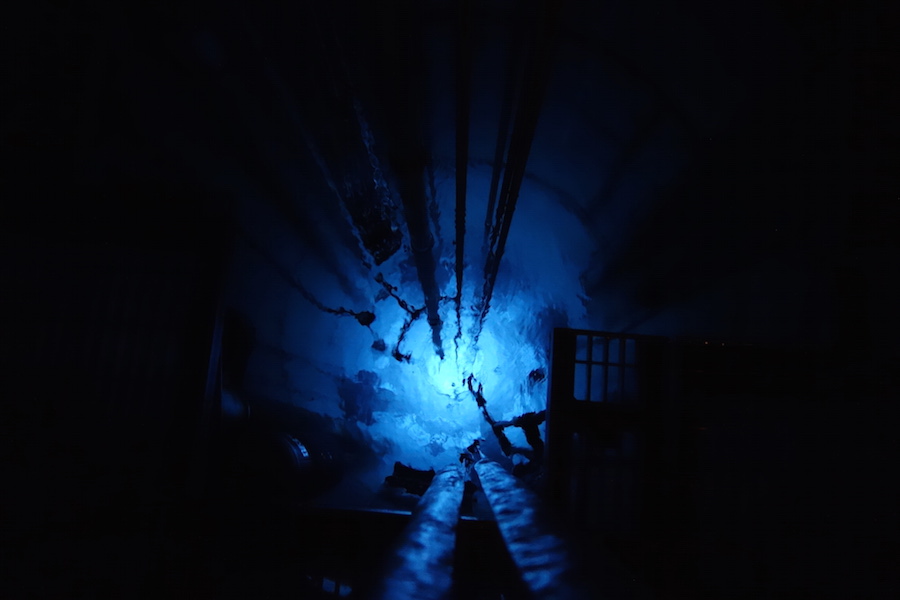
The center, owned and operated by UC Davis, houses a 2-megawatt reactor located in Sacramento. Although its initial purpose was centered around using neutron irradiation to detect miniscule flaws in aircraft parts, MNRC’s mission has quickly expanded.

The facility now has an array of uses and users. In addition to academic research, MNRC is frequently host to projects for the US Air Force, which commissioned the facility’s construction back in 1990, as well as NASA and myriad biotech companies.

Frey has grand plans for making the research center more accessible to all students in the UC Davis community. This includes arranging for regular transport to make the 26-mile journey more manageable for busy students.

“You could probably make it on your bike if your life depended on it, but I wouldn’t recommend it,” Frey said.

Additionally, Frey is hoping to get local high school and junior college students involved. UC Davis undergraduates will soon be able to get official federal certification to handle the 2-megawatt reactor through the Nuclear Reactor Operating Program.

UC Davis physics professor Mani Tripathi said the program should be up and running in the summer of 2017 or 2018, giving students a rare opportunity for hands-on research at one of the nation’s leading nuclear facilities.

One of Tripathi’s primary domains has been working toward the search for dark matter. The key to this work is ensuring that the detectors used, for instance, in CERN’s Large Hadron Collider (LHC), are made of the purest materials possible.

MNRC allows researchers to perform a technique called neutron activation analysis to further this aim for pure materials.

In neutron activation analysis (NAA) a sample material is exposed to neutrons from the reactor. These neutrons then interact with trace elements, making them radioactive. Researchers can then perform a spectroscopy, analyzing the spectra of light produced by the radiation. As every neutron has its own unique gamma ray signature, the purity of the sample can be found out accordingly.

The center has recently been used to test parts destined for LHC by exposing them to radiation and ensuring that they hold up under the immensely chaotic, high-energy environment they’ll be used in.

“The detector presents a very intense, hostile radiation environment […] and we have custom electronics that we deploy on the detector, and they can get damaged by that radiation,” Tripathi said.

To ensure that these critical electronic components can withstand the harsh environment, the researchers put them in the reactor to give them an equivalent dose, taking the components through the radiation cycle to see if they still work, Tripathi said.

While there are other facilities capable of performing NAA and radiation damage studies, the UC Davis center stands apart in other ways. As the third most powerful university-owned reactor, MNRC provides researchers creative latitude.

“You’re able to design experiments […] where other places you just ship them a sample and they do it for you. We have very good access,” Tripathi said.

Additionally, the UC Davis community offers a rare combination of a nuclear reactor and a high powered cyclotron run by the Crocker Nuclear Lab (CNL) on campus.

“It’s not just uncommon,” Frey said. “As far as I know, there’s only one other university in the country that has this sort of pairing.”

Spencer Hartman, Cyclotron Manager at CNL, believes the work the two facilities do is complementary. The cyclotron is yet another tool for evaluating things like radiation damage, using external beams of light ions. The two centers are renewing their efforts to work together.

“The two laboratories together cover a very broad multidisciplinary STEM space. Students and researchers can learn about nuclear physics in two real world operating nuclear laboratories,” Hartman said.

MNRC can produce small quantities of radioactive isotopes, which play an immense and wide-ranging role in our society. Over 40 million radiotherapy and nuclear medicine procedures are performed annually, according to the World Nuclear Association.

Uses of radiotherapy range from fighting cancer to sterilizing medical equipment. Such isotopes as iodine-125, used in treatments for prostate cancer and macular degeneration, and copper-64, commonly used in nuclear medicine, fall under the purview of MNRC’s production capabilities.

One of the more surprising applications of nuclear irradiation was the creation of new forms of sushi rice. This was done at UC Davis back in the 1970s, before the center was around. However, the approach remains popular today. The process, known as plant seed mutagenesis, works by concentrating a high beam of energy (fast neutron irradiation) on a sample of seeds. In this way, food scientists are able to engender beneficial mutations which, when bred over multiple generations, have the potential to increase crop yield.

By sporting such unusual versatility as a research and commercial tool, MNRC is set up to serve students with diverse interests as they make considerations for their post-graduation futures.

“It’s designed so undergraduate students can have some real-world experience before they apply to grad school,” Frey said.

Written by: Logan Sidle — science@theaggie.org

Former Aggie named head football coach

0
JAY GELVEZON / AGGIE

Dan Hawkins, who played under Jim Sochor, returns to UC Davis to coach football

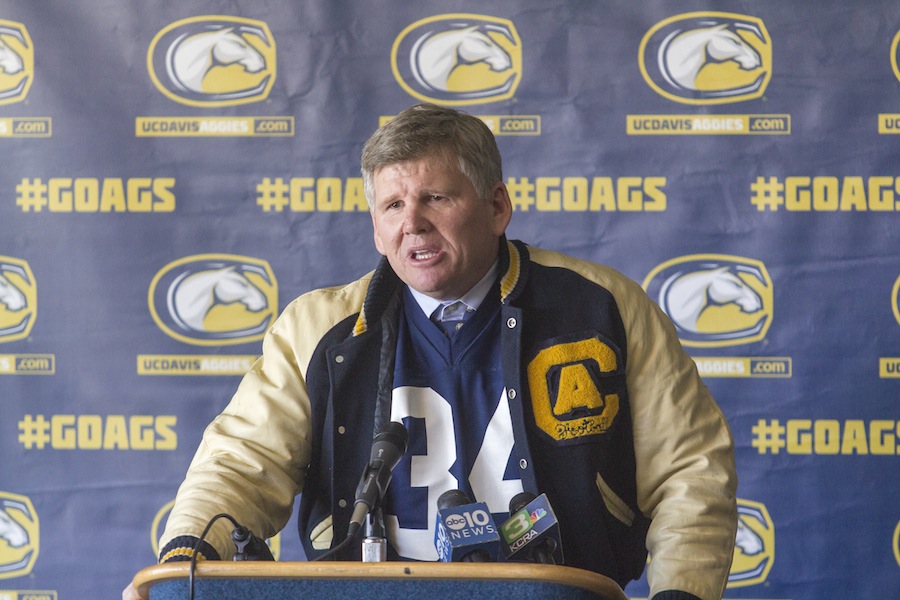
A new era of Aggie football is underway as Dan Hawkins returns to UC Davis as head coach.

Hawkins played fullback on the 1982 NCAA Division II championship runner-up team alongside NFL first round pick, quarterback Ken O’Brien, and under legendary head coach Jim Sochor. The following year, Hawkins joined Sochor’s coaching staff as an assistant before taking a head coaching job at Christian Brothers High School.

“I’ve always said this place was my baptism of excellence,” Hawkins said during his welcoming press conference. “It showed a little guy from a town of 500 people what you truly can accomplish. It’s really what life’s about. The quality balance of life really started here. Everywhere I’ve been, I’ve tried to echo that same experience.”

After his time coaching at Christian Brothers, Hawkins became one of the premier coaches on the college football landscape. After winning three conference titles at Willamette University, Hawkins brought the Boise State football program to national prominence as head coach from 2001 to 2005. During his five year tenure with the Broncos, Hawkins recorded Jim Sochor-esque numbers, compiling a 53-11 overall record, including a staggering 37-3 Western Athletic Conference mark. Hawkins guided Boise State to bowl games four of the five years he was there.

Hawkins was unable to find similar success at his next stop with University of Colorado in the Big 12 Conference where his five year contract was cut short in the final season after finishing with a 19-29 overall record.

“We’re going to do things in a national championship fashion. There are things that the science of football demands,” Hawkins said. “Those are metrics and analytics we need to look at and determine, why are we not as good on third down as we should be? What is the functionality of that? We need to have a starting point.”

Hawkins now returns to where his playing and coaching career began, attempting to reinvigorate a once perennial powerhouse football program that has suffered six losing seasons in a row. He replaces former head football coach Ron Gould, who ran the program for the past four years.

Written by: George McConnell sports@theaggie.org

The offensive powerhouse of women’s basketball face first loss of season

0
BRIANA NGO / AGGIE FILE

Previously undefeated Aggies break winning streak as Hofstra sneaks by with a win

Amidst an afternoon of impressive achievements, including sophomore forward Morgan Bertsch’s first double-double of the season and junior guard Dani Nafekh’s fifth double-digit scoring stint, the previously unscathed Aggies tallied a tough 64-60 loss against the visiting Hofstra Pride during their Nov. 27 matinee.

The game was compelling right from the tip-off when the two opposing styles of gameplay riled up the crowd who watched Aggies sink shot after shot. The first quarter set the stage for an early lead for the home team, and continued energetic play at the post gave the Aggies layups and short jumpers to help them maintain a confident offensive attitude that lofted them to a 20-11 advantage at the end of the first quarter.

The energy from the early command of the game carried over when Bertsch put up a quick layup in the first minute of the second period to bolster the Aggies to a 22-11 lead. After a few point exchanges, a smooth jump shot by junior Marly Anderson added on to the comfortable margin at 28-19. In spite of the Aggies’ apparent offensive control of the game, the opposing Pride managed to make gains of their own as a late five point streak tied them up at 30-30. Junior guard Rachel Nagel returned the favor with an effortless three pointer that secured the lead for UC Davis at the end of the first half.

The start of the second half lent a bit of tension to the Pavilion atmosphere as the Aggies’ slim advantage slipped away after a pair of drained free throws gave Hofstra its first lead of the game at 34-33. Although the home team battled to maintain an offensively aggressive status on the court with successful drives to the basket, UC Davis’ lack of defensive effort offered wide open shots for Hofstra which, with newfound momentum, kept the lead at the end of the quarter at 47-49.

“I think our defensive rebounding, our physicality and aggressiveness needs to amp up,” Nagel said.

Hofstra’s 47 rebounds directly impacted the trajectory of the game, while the Aggies came up short, marking a mere 32 rebounds. The Aggies returned for the final quarter with a resolve to utilize their strengths and turn up the offensive heat. An early three by junior forward Pele Gianotti tied up the game and set the trend for an additional pair of three pointers by Nafekh which put the team at 58-54 midway through the quarter. As the clock wound down, UC Davis’ efforts proved futile as Hofstra’s boards and continued tenacity inched the Pride forward to a 64-60 victory.

BRIANA NGO / AGGIE FILE

“Obviously we are a really good offensive team, […] and we can really improve our defense at times,” said Bertsch, who was 8-17 for the game. “But I think that is something we are really good at this year, we are all looking to put each other in the right spots [offensively].”

The Aggies shot 42 percent from the floor, which further proved a necessity for a dynamic defensive presence and the use of rebounds as a means to capture close games.

“I think that’s the lesson we have to take from this,” said head coach Jennifer Gross. “We have to do a better job of helping each other to win and finding a way to come out on top. When you lose a game you just want to get back out there as quickly as possible. We’re just looking forward to putting in some work.”

The UC Davis women’s basketball team returns to the Pavilion on Friday, Dec. 2 to host a match against San Diego State.

Written by: Alex Arechiga — sports@theaggie.org

The more, the merrier

0
NICKI PADAR / AGGIE
NICKI PADAR / AGGIE

Looking at benefits of group studying

With final exams just next week, many students will spend the next several days reviewing a whole quarter’s worth of notes and assignments — but studying so much material in such a short amount of time can be a daunting thought. What are some of the most effective methods to prepare for this five-day period of testing? According to many students, it helps to find a study group.

Phi Sigma Pi, a national co-ed honors fraternity, provides group studying opportunities for its members, aligning with the fraternity’s mission to promote both academics and community.

“We have a tripod of scholarship, fellowship and leadership, and everything we do centers around this tripod,” said Ricky Nguyen, a fifth-year psychology and communication double major and president of Phi Sigma Pi. “We have study sessions to make sure that besides fraternity work, our members have the opportunity to sit down and actually study.”

About once a week, Phi Sigma Pi hosts library hours in which both initiates and fraternity members meet at Shields Library to study as a group. Each mandatory study session lasts from two to three hours, and allows members to connect with one another while also completing schoolwork.

“The purpose of [library hours] is to [let] the initiates have the time one day a week to catch up with their work,” said Inge Chandra, a fourth-year chemistry major and initiate advisor of Phi Sigma Pi. “At the same time, brothers come […] to get to know the initiates better, [and] also to have a study space where they don’t have to study alone.”

Having the opportunity to casually converse with other students during group sessions can actually be beneficial to the study process, serving as a way to relax the mind and take short breaks between long periods of hard work.

“The social aspect helps you study, helps with your cognitive processes and helps take your mind off stress,” Nguyen said. “[During library hours], after half an hour or 45 minutes [of studying] and you feel fatigued, you can chat with your brothers. It’s something to take your mind off of studies, and you can’t do that in your room studying alone. You can come back to studying afterwards, and it’s very effective.”

Moreover, a study group can provide a productive environment that encourages students to stay focused on their schoolwork.

“I like to surround myself with other people studying,” Chandra said. “If I see them studying and I’m not doing anything, I [think], ‘They’re not going to talk to me; might as well study right now.’ Even if we’re studying for different things, having other people there in general can motivate you.”

The Student Academic Success Center (SASC) also provides group studying opportunities through its tutoring programs. The SASC includes three departments: the main center in South Hall, the Transfer, Re-entry and Veterans Center in Dutton Hall and the Educational Opportunity Program (EOP) at the EOP Cottage.

In South Hall, the SASC offers drop-in tutoring in various subjects, including chemistry, business and math. During these sessions, students can work together as a group along with a tutor, which some tutors view as an effective learning strategy.

“I think it’s helpful on an emotional standpoint because if you feel you’re alone in the class struggling, it can be really discouraging,” said Lindsey Phillips, a second-year psychology major and calculus tutor. “If you come in here and [think], ‘these people are stuck on the same problems as me [and] I’m not alone in this,’ and then you try and solve it together, you’re way more inclined to want to succeed than to just give up on your homework.”

Students attending the same tutoring sessions can also explain and clarify concepts for one another.

“When we are working with multiple students on the same problem, if one student starts to get it, they can see where the other students are starting to struggle and explain it to them,” said Tristan Bond, a third-year mechanical engineering major and calculus tutor. “It’s great to have somebody who is on the same level seeing where their peers are struggling that maybe I, as a tutor, can’t always see for every student.”

Although studying in groups often proves to be beneficial, it is not always the best method. Some students prefer individual studying, with a quieter environment that allows better concentration. Students should experience both to determine what works best for them.

“My perspective as a student is different from my perspective as a tutor,” said Laurel Koch, a third-year genetics and genomics major and calculus tutor. “I like to study by myself because usually the problem for me isn’t getting the information, it’s mastering it, and when I’m by myself I can really focus on where my flaws are. I’m in BIS 103 and it’s a lot of memorization — studying groups [are] not going to help you there.”

Students can learn about other effective study habits and strategies in the SASC’s study skills workshops, which are also offered at its South Hall location.

“There [are workshops for] time management, success strategies, how to actively read, how to manage test anxiety, how to take tests and things like that,” said Sarah Mayorga, a second-year political science major and receptionist at SASC in South Hall. “When students go to the workshops, for first-years, it really eases them into the college transition. And even for students who have been here for a little while and are still trying to figure out how to take notes or how to take tests properly, it makes them more confident in their schoolwork.”

Finals week can be one of the busiest times of the quarter, and students will use a wide variety of study techniques over the next few days to prepare for their exams. Whether studying in groups or individually, re-reading textbooks or completing practice problems, techniques vary from student to student. For some students, group studying will be an efficient technique, not only providing company and support during a stressful time of the year, but also positively influencing academic performance.

“[Some] feel that joining organizations, […] fraternities or social groups takes time off studying,” Nguyen said. “I would say that is not true. My fraternity helps me study more than I could ever have [if I were] by myself.”

Written by: Jennie Chang — features@theaggie.org


NoDAPL protest erupts in downtown Davis

JAY GELVEZON / AGGIE

Students, activists call for solidarity with Standing Rock

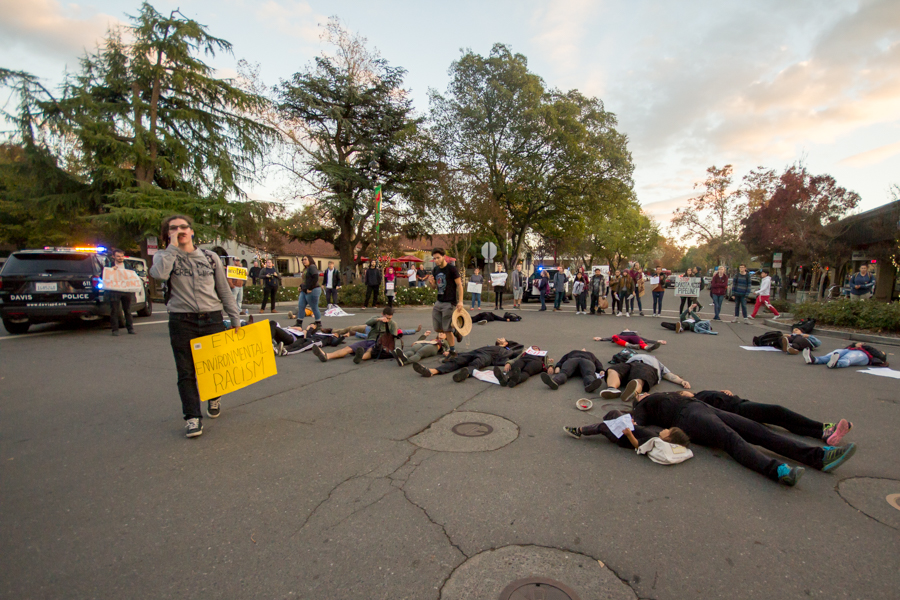
As blue and red police lights wailed through the air in downtown Davis, dozens laid at the intersection of 2nd Street in Downtown Davis in protest. Chants calling for action against the Dakota Access Pipeline (DAPL) invaded the unsettling stillness of the bodies. Thus, on Nov. 21, Davis became one of many cities across the country to support with the Standing Rock Sioux tribe.

Water is sacred; water is life — this is the repeated phrase of the Standing Rock Tribe in North Dakota, which for months has adamantly protested the installation of an oil pipeline. The tribe claims that the pipeline not only violates native land rights, but that it also threatens the local drinking water supply.

The pipeline itself is planned to run across four states, but it is the part of the pipeline’s journey across the Missouri River in particular that has caused protests to erupt across the country.

Francisco Ferraya, a third-year transfer community and regional development major and organizer of the downtown Davis NoDAPL protest, argued that the DAPL is not just a matter of access to clean drinking water, but an issue of civil rights for Native Americans.

“[This pipeline] represents more than just another fossil fuel contract,” Ferraya said. “This is really the culmination of 500 years of cultural genocide and historical erasure. It’s the most important battle right now, I think, against capitalism, against American imperialism and against fossil fuels.”

The DAPL was previously planned to be routed just north of Bismarck, N.D. but was rerouted after the U.S. Army Corps of Engineers deemed its planned location a potential contaminant to Bismarck’s water supply.

Now, Standing Rock faces a similar dilemma, but with a different response.

“[The protesters] were attacked [a few] nights ago, with a super high-powered hose in like, 20-degree weather, and pepper spray and mace,” Ferraya said.

Ferraya is no stranger to the violence surrounding NoDAPL protests, having recently been to North Dakota to join the Standing Rock tribe.

“I went about a week after the video surfaced where the water protectors were attacked by dogs,” Ferraya said. “It was really powerful because folks were there just days after the dogs had attacked them, so I saw the wounds with my own eyes.”

The protest in downtown Davis was one of many across the country, including a recent protest in Sacramento.

According to the official Stand with Standing Rock website, “The Oceti Sakowin Camp represents a first of its kind historic gathering of Indigenous Nations. The most recent such assembly of Tribes occurred when the Great Sioux Nation gathered before the Battle at the Little Big Horn.”

Energy Transfer Partners (ETP), the company in charge of the development and implementation of the DAPL, recently engaged in a merger with Sunoco Logistics, another pipeline operating company. ETP is anxious to carry on with the project.

“Dakota Access has been waiting long enough to complete this pipeline,” said Kelcy Warren, the chief executive officer of ETP, in a previous interview.

Davis City Council previously passed a resolution stating that it supports with Standing Rock. Resolution 16-XXX, Series 2016 cites both the environmental tragedy that such a pipeline would pose and the adverse effects the pipeline would pose on the Standing Rock Sioux tribe:

“Now, therefore, be it resolved that the City Council of the City of Davis, stands in support of the opposition to the Dakota Access Pipeline process and project and calls on all residents of Davis to raise awareness about this important struggle for Indigenous sovereignty and environmental justice and to support the Sacred Stones Camp’s efforts.”  

Written by: Samantha Solomon — city@theaggie.org