57.6 F
Davis

Davis, California

Tuesday, December 23, 2025
Home Blog Page 712

Honorees announced for Sacramento Walk of Stars

Sacramento Walk of Stars / Courtesy
SACRAMENTO WALK OF STARS / COURTESY

Four stars to be memorialized in Midtown Sacramento

After being approved for development in August 2015, the Sacramento Walk of Stars is finally underway, and the first four honorees were announced on May 9. Stars honoring LeVar Burton, Dr. Balazs “Ernie” Bodai, Gregory Kondos and Debbie Meyer will be the first placed into the ground.

“I’m more than humbled and honored to be the recipient of this incredible star,” Bodai said in a statement. “I hope it is the beginning of a long and valued tradition for the people of Sacramento as well as the state of California.”

The stars will be placed on L Street in Midtown Sacramento, where tourists and residents will be able to view the terrazzo and bronze monument stars awarded to each honoree.

Sacramento Walk of Stars chair and Crocker & Crocker co-founder Lucy Eidam Crocker first thought of the idea for the project while visiting Los Angeles and wished to recognize Sacramento’s best and brightest.

“It was my husband’s, who is also my business partner, idea and mine. Along with some friends […] we were down in Hollywood a couple of years ago, walking down the Hollywood Walk of Fame [when we thought of the idea],” Crocker said.

As Crocker states, the idea was to honor people who have made a positive change in the community, as well as to celebrate the achievements of the city of Sacramento.

“[The idea is] to boost community pride, to bring economic development to the restaurants and businesses in the area, to bring notoriety to the Sacramento region and celebrate the successes of the people who have gone on to great things, with their roots in Sacramento,” Crocker said.

The stars have garnered support from all areas of the community, including the Sacramento City Council and the Sacramento Convention and Visitors Bureau. Angelique Ashby, a councilmember for Sacramento District 1, supports the idea as a lasting way to honor the community.

“The Sacramento Walk of Stars is a great opportunity to celebrate people from our city who have made significant contributions to society in a variety of areas,”  Ashby said. “Our community is rich with talented, high achieving professionals. Any chance we get to honor the people who make us proud is an occasion to celebrate who we are as a city.”

The recipients of the stars were carefully chosen and had to meet a specific set of criteria. Recipients must have been born in or have spent a portion of their lives in Sacramento, have national or international recognition and have had a positive influence throughout their careers. Stars will be awarded to honorees within five categories: Entertainment and Arts, Business, News, Sports and Science and Technology.

“We wanted to make sure we were diverse in the categories, the types of people within the categories. There are some that still live in Sacramento and some who are living outside of the area. [We wanted to] have a well-balanced group that represent that Sacramento region as a full,” Crocker said.

All of the honorees except LeVar Burton were in attendance at the unveiling of the honorees.

Honoree Debbie Meyer, a three-time Olympic gold medalist in swimming, was overjoyed to be honored by the city.  

“The idea of a walk of stars in Sacramento is fantastic. Growing up in Sacramento was a true joy,” Meyer said in the statement.

Honoree Gregory Kondos, a nationally acclaimed artist, was also in attendance.

“Sacramento has always supported me beautifully and I am so grateful for what this community has done for me,” Kondos said in the statement. “I truly appreciate this wonderful tribute.”


Written by: Samantha Solomon – city@theaggie.org

Protect trans* bathroom rights

HANNAH LEE / AGGIE
HANNAH LEE / AGGIE

Obama issues ordinance to combat discriminatory bathroom laws

President Barack Obama issued an ordinance on May 13, demanding that public schools allow transgender students access to the bathroom that matches their gender identity. Any states that do not comply are at risk of losing federal funding.

This followed weeks of controversy surrounding North Carolina’s Public Facilities Privacy & Security Act, which states that individuals are only allowed to use bathrooms in legislative buildings that match the sex on their birth certificates.

The North Carolina bill, which narrowly defines sex as “the physical condition of being male or female, which is stated on a person’s birth certificate,” is one of the most anti-LGBT laws in the United States. Under it, transgender individuals are not considered the gender they identify as and are disallowed from using the bathroom of their choosing.

The Editorial Board stands with the Obama administration on setting the precedent to ensure students feel comfortable using the restroom. Although it might seem a ridiculous precedent to have to set in the first place, some social conservatives — such as North Carolina Governor Pat McCrory — claim, with unsubstantiated evidence, that the concept of bathroom access runs into issues involving security and the “expectation of privacy.”

“There’s an expectation that the only other people [in the restroom] will be the same gender as they are and that’s the way we’ve been doing things for a long time,” McCrory said in an interview with NPR. “[Transgender students are offered] alternative choices for this very complex situation in which there’s not a clear definition for gender identity or gender expression.”

For a cisgender, white male like McCrory, who likely has never thought twice about the repercussions of entering the men’s restroom, this statement might be a relatively easy one to make.

The assumption that men use the men’s restroom and women use the women’s restroom is not discredited by allowing trans* people access to their prefered bathroom. The problem lies in defining what it means to be a “man” and a “woman.”

According to McCrory and those in support of the bathroom bill, simply identifying as a gender does not mean a person is that gender. This, perhaps, is the most derisive part of the bill, for it invalidates the gender identity of all individuals who have not undergone transitive surgery or officially changed the sex on their birth certificate.

The bill makes it so that only cisgender individuals are allowed to enjoy the bathroom of their choosing and feel safe while doing so. These are just two out of countless privileges that many people take for granted and intuitively deem a non-issue. The same can not be said for many transgender people.

The statistics speak for themselves. A 2013 Williams Institute report revealed that “roughly 70 percent of trans* people have reported being denied entrance, assaulted or harassed while trying to use a restroom.” Whose privacy and security, then, is truly at stake?

The issue of bathroom access is not a new concept. The discussion flared up most notably in late 2015, when 16-year-old transgender student Gavin Grimm was denied entrance to his preferred bathroom at a high school in Virginia.

In response to this incident, the Department of Justice reinstated Title IX to include the protection of students’ right to use the restroom that matches their gender identity. Although the situation ended on a positive note, the fight for bathroom access in public schools is still nowhere near won. With the passage of North Carolina’s bathroom bill, we have taken steps backward.

Obama’s decree is now set in motion, and the most important step in moving forward will be educating public school students on the topics of bathroom access and gender identity. Obama spoke on the issue Monday, noting that hateful laws such as North Carolina’s bill increase incidents of bullying. To ensure that violence does not continue for transgender students, public schools must administer extensive awareness training. This does not mean the same sort of casual, incompetent discipline that many sex-ed programs teach in middle and high schools.

Teachers and administrators should put special, detailed educational programs in place to prevent bathroom violence during early years of schooling, so that students can bring an open-minded attitude to higher education.

With the conversion of all single-stall restrooms to gender-neutral ones already underway on University of California campuses, The Editorial Board hopes that large institutions, such as UC Davis, continue to foster a receptive attitude towards the forward-thinking policies Obama would like to implement. Only then can we ensure that all students, whether transgender, cisgender or otherwise, can focus on receiving the education they deserve.

Who is standout Ana Marija Sola?

KATIE LIN / AGGIE FILE
UC DAVIS ATHLETICS
UC DAVIS ATHLETICS

UC Davis soccer standout Ana Marija Sola graduates this year with impressive list of athletic, academic achievements

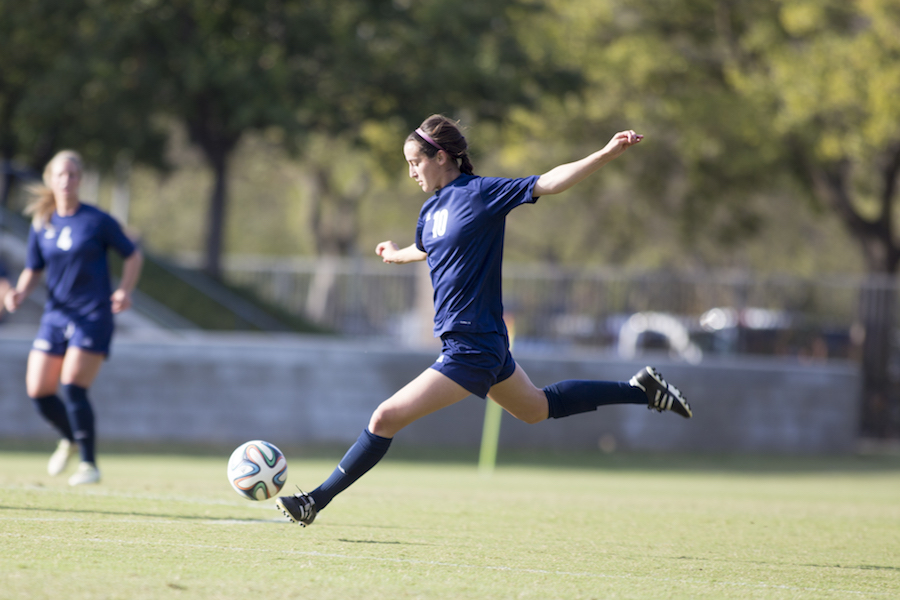
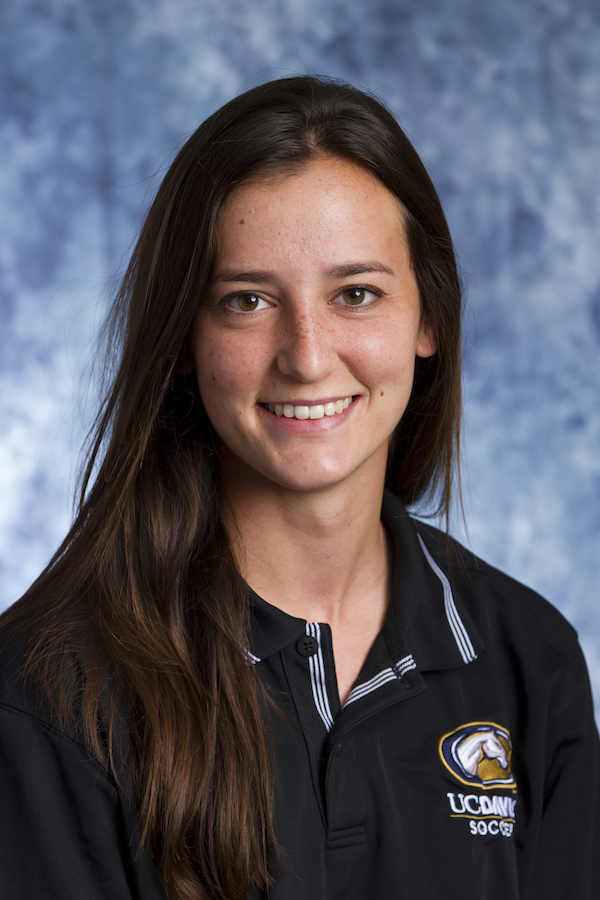
The question everyone seems to wonder before coming to college: how will it be possible to get good grades while also maintaining a strict and busy schedule? Just when finding this balance seemed impossible, Ana Marija Sola, a senior midfielder and defender for the UC Davis women’s soccer team, shows that anything is possible. Sola has set multiple career rankings in her years here at UC Davis, including this season’s records of number five in game-winning goals, number eight in assists and number two in games started. Her total for game-winning goals is the sixth-highest total in the program’s Division I history. Sola has achieved these career records all while maintaining a cumulative 3.985 GPA. So who is Ana Marija Sola?

Sola is a first-generation U.S. citizen born to Croatian parents. She came to UC Davis with one goal in mind: to play soccer. Not only has she succeeded in being a standout athlete, but she has also made her mark academically. Sola is a double major in English and neurobiology, physiology and behavior, and is graduating this spring with honors, with an impressive 3.985 GPA. She has earned recognition on the Dean’s List for 10 consecutive quarters, is ranked in the top one percent of all seniors in the College of Biological Sciences and is in the top one-half percent of seniors in the College of Letters and Science.

Because of her vast academic accomplishments, she is the first member of the UC Davis women’s soccer program in 12 years named to the College Sports Information Directors of America Academic All-District 8 Team. Sola is also the first student-athlete at UC Davis in 20 years to become a Fulbright Scholar semifinalist.

Outside of school and athletics, Sola volunteers at the Willow Clinic, a student-run organization that provides medical care to the homeless population in Sacramento. In the last three years, she has also participated in research under Dr. Hwai-Jong Cheng, a professor in the UC Davis Center for Neuroscience.

Sola has been a team captain for two years on the women’s soccer team, a three-time Big West All-Academic and a two-time All-Big West honoree, and she has started all but two of the 69 games she has competed with UC Davis.

The California Aggie sat down and spoke with Sola, who shared experiences of her years here at Davis, along with the way she has carried herself throughout her impressive athletic and academic college career.


How long have you been playing soccer?

I started playing when I was very young, around 4 years old. My parents are from Croatia and soccer is a big national sport over there. It was kind of weird for a girl to be playing soccer, so when I told my parents I wanted to play they were a little weirded out but they accepted it and I ended up having the greatest experience.


Do you think being a first generation U.S. citizen affected the way you went through these four years at Davis? Did you face any challenges as a first generation U.S. citizen?

Not so much challenges, as much of what I learned was motivating. In Croatia, girls playing soccer isn’t as accepted. Sophomore year, I was invited to go back there and play. I was shocked that the girls there weren’t getting the same opportunities as here in the U.S. Seeing that during my time in college really made me think about having so many opportunities to pursue in college.


How do you balance school and sports while also excelling in research and volunteer work?

Just time management. The important thing to mention is that so many girls on the team are also doing similar things, so when you have all of them around you, it makes it so much easier. It was normal for me because a majority of my team were doing these things. UC Davis athletics is unique in that way: academic excellence in addition to athletic excellence is not unordinary, it makes up what a UC Davis athlete is. I can’t separate it from that “culture.”


While having this busy life, are there any days when you get so stressed that you question anything? What did you do to persevere through those stressful times?

There were a number of those days. Me and teammate were talking about all the times we sat down together and thought we couldn’t do it. Each of those times, all that it really took was a phone call to my mom. Having that base of supporting parents, teammates and friends is the number one thing that motivated me to pursue whatever I was doing at the time.


What has been your favorite moment at UC Davis these past years?

There is nothing like the feeling of your team coming together and beating your opponent in the best way possible. I don’t know that I can point to a huge moment, but it would be those little moments chatting with teammates before practice or in the training room laughing.  


What are the plans, if any, after you graduate this year?

I will be applying to medical school this cycle and we will see where that takes me.


On a scale of 1 to 10 on how you think these four years went, what would you give your experiences and why?

Probably a 10. I have nothing to complain about. Davis is definitely a community you want to be in, which is the reason I would give it a 10. The sense of community here is unbeatable.


What is the feeling like when you see all the things you have accomplished academically and athletically, while captaining the team for two years?

I am just motivated to continue to do good things that help other people. I am proud of myself and I am glad that my family, teammates, and coaches can be proud of me. It motivates me to continue to be myself.


Sola attributed her comfort in being herself on and off of the field to the coaching staff that has encouraged her throughout her years at UC Davis.

The California Aggie also had the opportunity to sit down with women’s soccer head coach Twila Kaufmanhas, who has watched Sola’s progress on and off the field throughout her years at UC Davis.


What do you look for when choosing a captain for the team and why did you choose Ana this past season?

I prefer to empower the team by having players nominate and vote for their captains. We do a lot of talking before hand about what qualities a captain should have; the whole team picked her, [and] I believe they chose the right person.


Does anything about Ana stand out to you that you don’t normally see in players?

Ana has an amazingly high standards for herself. If you spend enough time with her coaching staff included you will challenge yourself to meet those standards.


Why do you think Ana has been so successful both academically and athletically?

In addition to the level of accountability she applies to herself, and others, it would be her grit and compassion for others. I have no doubt that when Ana studies, she is thinking about how she will apply that information later to help others and I believe that is a driving force in her life.


After Ana graduates, what are you going to miss most about not having her on the field?

Ana is one of the smartest soccer players I have ever coached. Her ability to solve problems on the pitch is exceptional. She deserves to be recognized for her athletic achievements just as much as her academic accomplishments.

This spring is the first time the team competed without Ana since I arrived to UC Davis, and it’s still hard to picture soccer here without her. The way she trained and played had a lasting affect on the people around her. Ana does everything with the intention of making a difference in the lives of others in a way that is sustainable even when she is not present. This is a mark of true leadership and it is very very rare.


No matter what happens for the UC Davis women’s soccer team or for Sola in the future, one thing is certain: Ana Marija Sola will be a name that will be engraved both athletically and academically in the UC Davis record books for many years to come.

Written by: Ryan Bugsch – sports@theaggie.org

Practicing gratitude: A review of Yo-Yo Ma’s performance at the Mondavi Center

RALPH DAILY / FLICKR

Yo-Yo Ma and Kathryn Stott play timeless pieces during their performance at Mondavi Center

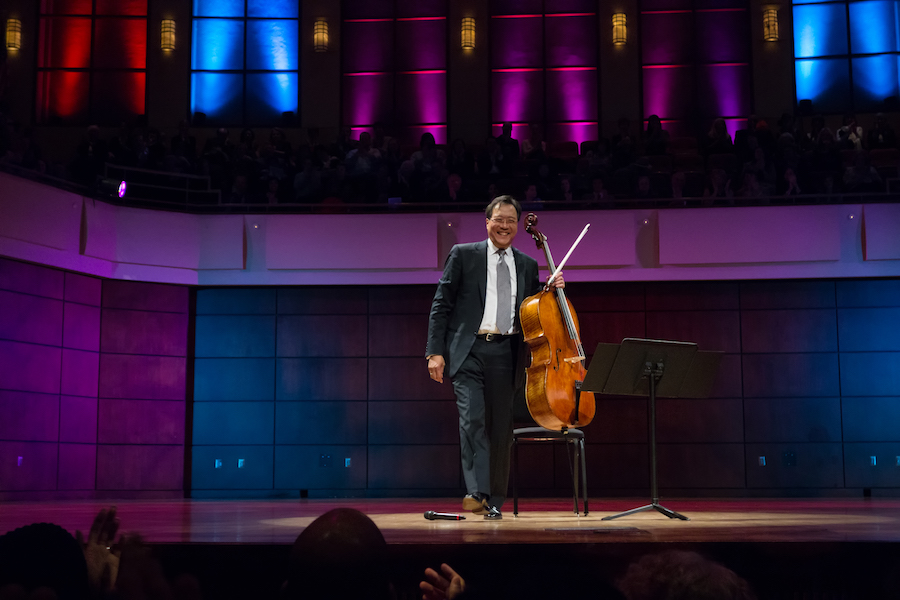
Yo-Yo Ma performed at the Mondavi Center last Wednesday, May 11, bringing with him an array of enthusiastic listeners and, of course, a selection of timeless cello music rivaled only by his performance companion, the renowned pianist Kathryn Stott.

But the night brought more than two world-class musicians; I was also granted the company of a season subscriber who chatted with me during intermission. Though her commentary on Ma’s increased waist size was entertaining, she mentioned more — she caught my attention by telling me about a side of Ma slightly more striking and pertinent to the night’s event.

She told me of the time he allegedly brought a middle school band onto the stage during one of his performances, granting them VIP seats in place of their absent tickets; of the respect he endows all musicians, regardless of their skill level; of the graciousness that, without him uttering a single word, is so abundantly apparent to anyone that listens to him play.

For the entirety of the performance, each stroke of his bow was only more noticeably graceful and elegant, yet with a sturdiness that both looked and sounded self-assured. He paused only after the first piece to say a few words regarding one of music’s powerful tools: remembrance.

Playing classic pieces like Debussy’s Beau Soir and Schubert’s Ave Maria, D. 839, it is not surprising that this is the message he chose to relate to the audience. With much ease, these timeless pieces brought about emotions and memories that only music could arouse; these songs brought the audience into the past without allowing them to forget their present situation — listening to the genius that is Yo-Yo Ma.

But it is no surprise that he, the child prodigy and musician of 56 years, could produce such a complex message that both excites and chills. His work with Kathryn Stott only made this more beautifully apparent.

His diversity of talent, however, is something that should not go unnoticed. Unbeknownst to most, Ma has also been involved in the widely successful bluegrass project The Goat Rodeo Sessions. Paired with world-recognized mandolinist and lead singer of Punch Brothers, Chris Thile, as well as the talented Stuart Duncan and Edgar Meyer, their album is best described (and recognizable by their Grammy win) as classical folk. Check out the tracks “Attaboy” and “Quarter Chicken Dark” to hear this immense collaboration of talent.

The show concluded with four encores, if I counted correctly. And as a few audience members trickled out, the ones who remained were more than abundantly grateful for a few more minutes of the two’s time on stage.

But perhaps we were just practicing the gratitude Ma had so skillfully demonstrated himself.


Written by: Ally Overbay – arts@theaggie.org

Riot.Strike.Riot.

JOE MABEL / COURTESY (Joshua Clover participating in the “The Worst Song Roundtable”, Saturday, April 18, 2015, Pop Conference 2015. JBL Theatre, EMP Museum, Seattle, Washington.)

Joshua Clover and student organizers discuss riot and struggle in bookstore panel

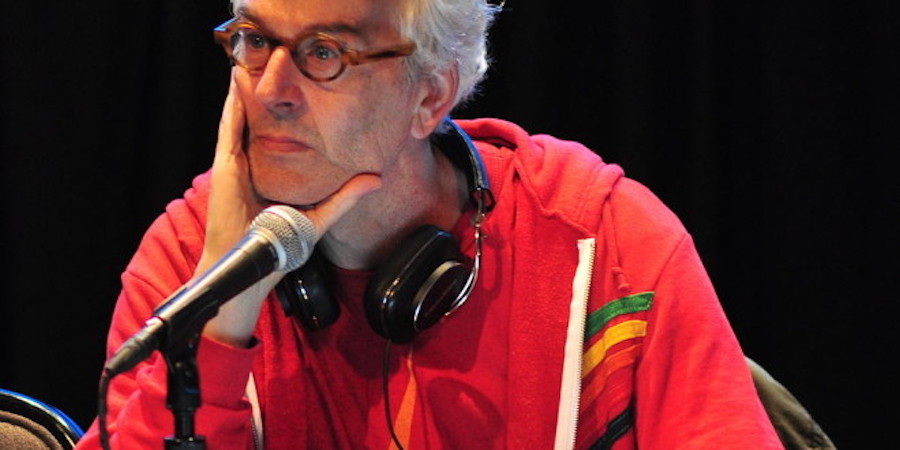
Today, May 17, the UC Davis Bookstore will be holding a panel with Joshua Clover, a professor of English at UC Davis and student organizers Brandon Buchanan, a fourth-year sociology graduate student, and Bernadette Fox, a fourth-year international relations and women and gender studies major. The panel, titled Forms Of Struggle: Political Conflict in the Long Crisis, will be held at 4 p.m. in MU II and comes following the publication of Clover’s new book, Riot.Strike.Riot: The New Era of Uprisings. Panelists will discuss forms of contemporary political struggles in relation to current events. A Q&A session and book signing will follow. The Aggie spoke to Clover about his hopes for his book, the recent student protest and the distinction between riots and strikes.


Kate Snowdon (KS): Let’s start with the basics. Can you tell me what your new book is about?

Joshua Clover (JC): No. But seriously, that’s a hard question to answer. It’s an attempt to rethink entirely what riots are. Its first question is why we’ve seen an increase in riots here in the West, and why we’ve seen a resurgence in the last 40 years. I start my history in 1347, renaming what riots and strikes are. They’ve been poorly defined historically, so I had to coordinate those new definitions and theorisations with a history of capitalism in the West, and all of that was necessary to explain the recent rise in riots and their nature, and what we’re likely to see in the future


KS: How do you define the differences between strikes and riots?

JC: That’s an important question, as that distinction has been given to us pretty weakly. The distinction that’s always made is the distinction between order and disorder. Strikes are ordered, almost aesthetically; they involve downing tools, marching in organized lines. Riots are defined as public disorder, a disturbance of the peace. The law defines them as three or more people acting in a disorderly way. That’s been the main distinction that’s been made, and it’s a useless distinction, not least because it ignores the incredibly violent history of strikes. It seems shockingly forgotten. This idea that strikes are passive events is absurd, and I wanted to argue that riots have their own logic. One of the aims of the book is to make these struggles over wage labour and prices relatable to the current struggles where we see a black kid getting shot by a cop, so there’s a riot, and then the cop is not given appropriate punishment, so another riot bursts forth.


KS: Do you find it hard as a white, middle-class male to write about these issues?

JC: I don’t know, because I’ve never come at it from another identity. Certainly I’ve had the experience in my life of having people tell me that I can’t talk about such and such because I don’t fit that identity. For a while, when I was a journalist, it seemed like people were being assigned stories based on their ethnicity. This seems dangerous, creating and separating communities in ways where they are forced to refer to themselves. However, the claim that everyone should be able to talk about everything clearly serves some people more than others throughout history. It’s a difficult question, but if I had to spend the rest of my life only having opinions about things middle-class males did or invented, it would be a real misery and not very good for anyone.


KS: What are your personal experiences with riots and strikes?

JC: I ended up doing union organizing in my second job, just before I started college, I made pizzas and rang the cash register. We signed a contract when we started that required us to dress presentably. A new management team came in and said we needed to wear white shirts and black pants, which I didn’t have the money to buy. I said it wasn’t in my contract, and the next thing I know I’m union organizing. I’ve helped organize some strikes in the UC system with clerical and sanitation workers. Most recently, after Michael Brown was killed in Ferguson, I was in Scandinavia, and I flew back to find out what was happening.


KS: Why do you hesitate to use the term race riots?

JC:  I’m of the tradition that believes that race is constructed. I think the term race riot has the effect of indicating who was what race and that’s somehow explanatory as to what they did, and that’s a whole set of problems. It also forgets that the history of racialized riots is attacks by white communities on black communities, Chinese communities, Latin Americans, the Zoot Suit riots. Riots were just white people murderously attempting to preserve the order. In the ’60s race riots started to resemble our contemporary understanding of them, often of black community response to police violence. The term race riots forgets the history of racialized rioting.


KS: How would you relate your work on struggle to the recent events involving Chancellor Katehi?

JC: I think there’s a close kinship between the occupation and the riot, and that’s what we’ll be talking about.


KS: Do you think that the tactics used by the protesters occupying Mrak were effective?

JC: I think in the short term, they were incredibly effective. #FireKatehi, the chosen hashtag, was very effective, Katehi is all but gone. I think the chances of her surviving this are basically none. I think the mindset however, or some of those students, is a more thoroughgoing change in the university’s running. I hope that’s successful, but it will take a lot of committed and fearless militancy. I can’t imagine anything more educational than entering into serious political antagonism while you’re in school.


KS: Why were your co-presenters chosen?

JC: Both have been deeply involved in campus struggles. Brandon is connected to both riot and organized Davis Stands with Ferguson. Brandon is also a steward for the union that organises graduate student teachers, so it seems like an obvious choice. Bernadette was chosen by the collective students occupying Mrak, and I trust their decision absolutely. Circumstance and campus politics have chosen them and I look forward to that discussion.


I want students to teach me things. I’m one person, I had an idea, I researched it, but it is very limited, and one person can only learn so much. My hope is that anyone who does engage with the book will want to add things and challenge things and hopefully I won’t be defensive when they do.


Written by: Kate Snowdon – arts@theaggie.org

Humor: Local bicycling superstitions

NICKI PADAR / AGGIE
NICKI PADAR / AGGIE

Like avoiding black cats, finding four leaf clovers and throwing salt behind you, there are many strange ways to enhance or damage your luck. Bicycling is no different, so here are a few ways you can score well with the omnipresent bike spirits of Davis.


  1. Never park your bike in the second to far right rack on the day of an important test. This will result in a poor grade. If you have no other parking options, place your bike upside down so the evil academia spirits will deem you crazy and leave you alone.
  2. Never bike under the bridge near Olson Hall at midnight. This happened in 2003 to a student named Ed Graham, who disappeared at the stroke of midnight while under the bridge. Folklore says that if you do go under the bridge on the anniversary of his disappearance, his ghost will shout “on your left.”
  3. Never talk to someone for more than five minutes while mounted on a bike. This isn’t because it’s uncomfortable, but rather because the soul that inhabits the bicycle will get bored and feel like “a third wheel.”
  4. A sacrificial rite never hurts. If you want your bicycle to have extra protection from the elements, try finding another bicycle that’s in good condition, then sacrifice it by setting it on fire in front of a shrine dedicated to Lance Armstrong. If he is kind and merciful, your bike will be blessed with an eternal repair warranty. If he is angry and wrathful, you’ll be charged millions of dollars for illegal doping.
  5. Never inflate only one of your tires. Always give the other tire just a little bit while you’re at it. If you only refill one tire, the other will get jealous and cause your bike to crash at an inopportune moment.
  6. Never refill your tires on a Monday morning before 9:00 a.m. Because nothing good happens on a Monday morning before 9:00 a.m.
  7. Never bike while drunk. Just don’t.
  8. There is a magic bicycle route in Downtown Davis. If you take a bike to 226 F St., 228 G St., then 217 E St. and wait 10 minutes, you’ll be met by an angry demon in the shape of a police officer because those addresses belong to popular bars and you clearly didn’t read #7.
  9. Never bike straight through the center of a roundabout. This is a matter of life and death. If you happen to bike through a roundabout, you’ll be haunted by the ghosts of people who died in bike crashes. The only way to break the curse is to draw a pentagram in the center of the roundabout, mutter phrases in Latin, strip naked in the center and sacrifice a drop of your blood to the evil bicycle spirits. Another alternative is to pay Transportation & Parking Services a $20 fine and everything will be cool.
  10. Wearing a helmet could mean the difference between the future and the past. Rumor has it that if you were to wear a helmet backwards and bike at 90 miles per hour, you would be able to travel back in time. Unfortunately, you can only travel back as far as the point when you started bicycling, so it’s more of a waste of time, really.
  11. Never order food from a drive-thru on a bicycle. This will upset automobile drivers, confuse the restaurant staff and will not even get significant attention on YouTube.
  12. It’s good luck to stop and say hello to a friend while biking. Not only will greeting a friend potentially brighten up their day, but rumor has it that your guiding angel will visit you in your dreams and say, “Wazzzup. Saw you there and thought I’d say hello.”
  13. Beware of Halloween. It’s bad luck to trick or treat while on a bicycle. If you do, you’ll be kidnapped by aliens who will not only think you’ve dressed up as ET and his earthling kid friend, but also demand all your Reese’s Pieces.

You can reach EVAN LILLEY at etlilley@ucdavis.edu.

A legen-dairy bucket list

AMY HOANG / AGGIE
AMY HOANG / AGGIE

Six things to do before Spring Quarter kicks the bucket.

Bucket lists are for people who have time — not only to complete them but also to first compile them — and everyone knows that time is a college student’s scarcest resource. The end of the school year is rapidly approaching (as is your deadline to make this year legendary), and so, just in case making a bucket list is in the same procrastination pile as doing your homework, here’s a list of possible adventures to help you out:


  1. Make a spontaneous change in your look

Now is the time to get the tattoo you keep saying you want — right before you go home to your disapproving mother and just in time to show it off during bathing suit season. Cut your hair, dye it purple, donate it if you’re feeling especially generous. If it goes badly, you have a whole summer to grow it back before your college friends (a.k.a. the important ones) see it.


  1. Take advantage of the hot weather

The infamous scorching Davis sun is the object of many complaints. But optimists (and really tan people) know that 90 degrees is the perfect temperature for a relaxing roast by the UC Davis Recreation Pool, located on the corner of Hutchison and La Rue. Poolside tanning may not be the most riveting adventure, but will you really be complaining when all your friends are jealous of your newly-bronzed skin? If pools are too unoriginal, you can also get your daily dose of Vitamin D by floating down the American River in Sacramento or visiting the nearby Winters Swimming Hole.


  1. Pursue something new

Working toward a goal will keep you feeling motivated, especially when finals roll around. Learn how to play a song on the guitar, take up a new sport or even ask out the cute girl in your chemistry class. For skills, you can use the university’s resources; the Activities and Recreation Center offers classes in various fitness abilities, and there are hundreds of clubs and organizations on campus that are always open to students who want to hone a new skill or interest. For dating advice, listen to your gut, or maybe your friends if your instincts have failed you previously.


  1. Go to the Drive-In

The West Wind Sacramento Drive-In is a great way to say you actually did something new with your Friday night (even though you still watched a movie in sweats and binged on caramel popcorn, and really only changed your location). And if you work up the energy to change out of your sweats, you can turn the drive-in into a night out with your friends, or even better, a date.


  1. Dance

On the Monday evenings when you’ve sat still too long, drank too much coffee, or both, grab hold of your energy, your cowboy boots and your friends, and make your way to the Davis Graduate for a night of country line dancing. Charge is free for students ages 18 and up with an ID. For non-country lovers, the Grad also offers salsa night on Tuesdays and Thursdays for $6 per person.


  1. Make a summer bucket list

Is there really any better way to finish a phenomenal school year than by starting a just-as-phenomenal summer?


Written by: Allie Tsuji — features@theaggie.org

Just Davis-y things

ALEXA FONTANILLA / AGGIE

Students discuss UC Davis-specific phenomena

Like most college campuses, there are some trends at UC Davis that are truly unique to Davis students. From petting the cows to the phenomenon that is ucdsnaps, most Davis students are aware of the popular sights on campus.

As a leading agricultural university, UC Davis is home to many animals, including the famous dairy cows that neighbor Tercero. Taking selfies with animals has become a UC Davis tradition.

“When you live in Tercero […] next to the cows, you have to take cow selfies — it’s [one of] the Aggie traditions,” said Keara Bergin, a first-year nutritional science major. “[When I first visited], I went over and took a selfie, and the cow started eating my hair. I have a picture on Instagram.”

Though the cows are a popular trend on campus, they are not the only animal phenomenon at Davis. Many students also report sightings of “the duck couple” roaming around campus.

“I heard of [the duck couple] from my friend,” said Yashodhan Kulkarni, a first-year computer science major. “Whenever I came back from class at night, I used to see them just walking randomly. They’re sort of independent; they just walk wherever they want.”

According to Kulkarni, the duck couple is often accompanied by a third duck.

“I think [the ducks] have their own group,” Kulkarni said.

The UC Davis Quad is another defining feature of the campus, perhaps because of a few familiar people that regularly walk its grounds, such as Casey Davis, penny whistle musician and Student Academic Success Center specialist. Davis can be easily recognized by his signature green cape and brown brimmed hat.

“I usually just hang out around the Quad if I’ve got some spare time during my lunch break,” Davis said. “I just go find a bench and sit down and start playing some tunes. People walk by, [and] some people stop to listen.”

Davis has been playing the penny whistle, a woodwind instrument similar to a flute, for approximately 20 years.

“My parents have been playing Irish folk music off and on for most of my life, and so I already had a whole bunch of the tunes bouncing around inside of my head,” Davis said.

He bought his first penny whistle on his way home from watching the Irish film The Secret of Roan Inish. Inspired by the movie’s Irish folk music soundtrack, Davis decided to teach himself basic fingering methods.

“I started playing some of the tunes I had heard my parents [playing],” Davis said. “When I got to college, I started performing at renaissance fairs and learning music there. I just keep getting more tunes and more styles.”

Davis currently performs at various Renaissance faires as well as for the English Country Dancers club on campus. He highly recommends learning the penny whistle to those interested.

Davis has one word of advice to students at UC Davis: “Be kind to people, never stop learning and make music.”

While the legend of the penny whistler resides on the Quad, the Activities and Recreation Center (ARC) is also home to a famous UC Davis trend: claiming a spot on the photo wall inside the ARC. Many students strive to get their photo added to the wall, which includes photos of club sports teams and intramural champions.

“There’s definitely a pride [factor] in getting [on the wall],” said third-year civil engineering major Jace Jackson. “It’s on every UC Davis student’s bucket list.”

Jackson made it onto the wall two years ago by winning the intramural table tennis tournament in a final match against his roommate at the time.

“It was cool because I got to get on [the wall] as a freshman,” Jackson said. “[It was] kind of an ego booster.”

In the same tournament, Jackson made the wall a second time in a doubles table tennis tournament.

“My mom came and visited me for the first time, [and] I didn’t tell her I was on the wall,” Jackson said. “[Then when] I was showing her around [the ARC], I was like, ‘Oh, check out that guy.’”

Another trending topic among UC Davis students is the unofficial UC Davis Snapchat account, “ucdsnaps.” The account is followed by a large population of UC Davis students and posts various Snapchat submissions, with subjects ranging from sunsets to naked body parts.

“I don’t think a lot of the stuff on “ucdsnaps” is even legal,” said first-year animal science major Nina Hahn. “People seem to use it as a means to find various drugs and hookup[s], which I guess is why it’s super popular.”

Hahn believes that the appeal of “ucdsnaps” is the anonymity of posts, which only last 24 hours.

“It’s easy and it’s fast and it can be kind of entertaining,” Hahn said. “Someone in Davis has a pet duck, which I like to see on “ucdsnaps” every once in awhile.”

Written by: Allyson Tsuji – features@theaggie.org

ASUCD Pantry to hold benefit concert

LEAH HAGER / COURTESY

Student dance groups will come together to perform at ASUCD’s first annual Pantry Benefit Concert

On May 20, The ASUCD Pantry will be hosting its first annual benefit concert featuring a variety of student performers. The Pantry is an on-campus unit located in Lower Freeborn where students can receive up to three free items a day (such as packaged foods and toiletries) just by showing their student ID card. Their mission statement outlines that The Pantry wants to “aid students in their pursuit of higher education by ensuring that no student ever has to miss a meal or go without basic necessities due to financial reasons.

This unit is a vital resource for UC Davis students here and the concert aims to bring more awareness to this resource and to raise funds so that The Pantry can continue to aid students. The proceeds will go toward scholarships that The Pantry administers.

Rosa Martinez, a second-year human development major and an intern at The Pantry, explains that the scholarships and the overall goal of The Pantry, are meant to ease the financial burdens faced by many students.

“The scholarship, as well as the service The Pantry provides, ensures that students do not choose between paying rent, tuition, books, child care service and meals for the month,” Martinez said.

The Pantry’s unit director and fourth-year human development major Erika Hapa explains that student hunger is a pertinent issue on college campuses.

“A statistic from the UCUE Survey conducted in 2014 showed that one in four students are skipping meals and so our campus has been making strides in addressing the issue,” Hapa said.

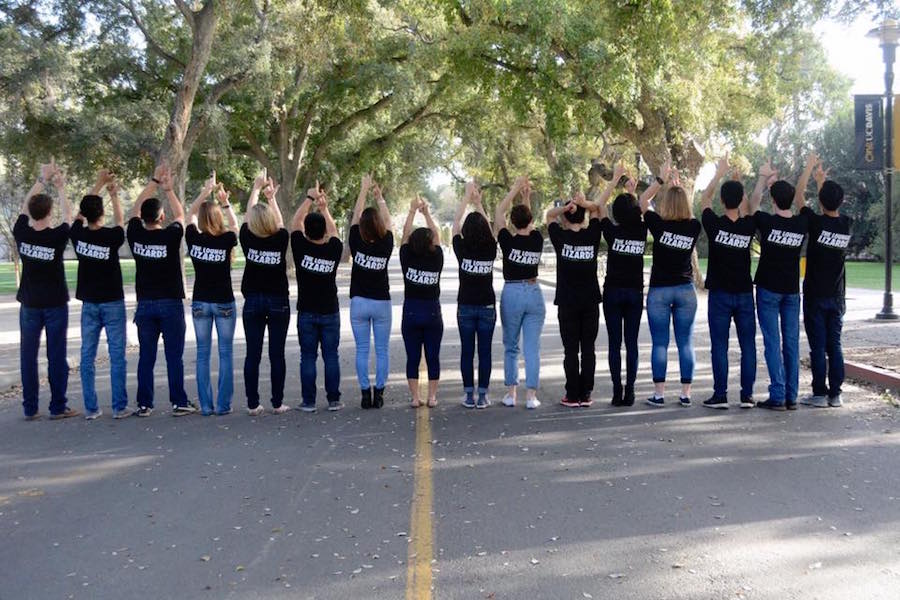
Martinez, along with a few other interns, have been working on this project for the last year. She affirms that they have been doing virtually everything to ensure the concert is a success, including bringing a wide range of performing groups. Sarah Poplack, a second-year psychology major and member of the Lounge Lizards, one of the a cappella groups performing in the concert, is excited for attendees to see the various groups performing.

“We hope those who attend the Pantry Concert will get a taste of the many talented groups that our campus has to offer and feel that they have contributed to a great cause,” Poplack said.

Other groups that will be performing include Birdstrike Theatre, Visione Dance Troupe and Bakuhatsu Taiko Dan. The concert promises to be a fun way to pass a Friday night, but more importantly, it brings attention an important issue that is easily overlooked and affects many college students: food insecurity. Martinez feels that combining entertainment with a good cause will bring more awareness to the issue.

“I am excited for the moment right after the event when we can reminisce the communal effort made between The Pantry, students, and our UCD community to address the growing issue of food insecurity,” Martinez said.

The concert will be held on May 20 at the Science Lecture Hall 123 from 8:30 to 10:30 p.m. Tickets can be purchased in person at the MU from 10 a.m. to 3 p.m. on May 16 to 20 for $5 or at the door for $8.

Questions about the event can be directed to rmsaiki@ucdavis.edu or answered on the Facebook event. If you would like to make donations directly to The Pantry, please follow the link.

WRITTEN BY: Krishan Mithal – arts@theaggie.org

UC Davis Medical Center nurses and parents shave heads in solidarity with child cancer patients

BECCA RIDGE / AGGIE
BECCA RIDGE / AGGIE

Head-shaving event raises over $25,000 for pediatric cancer research

On April 12, UC Davis Children’s Surgery Center’s nurses and parents shaved their heads in support of child cancer patients at the UC Davis Medical Center (UCDMC) in Sacramento.

The event was run by the St. Baldrick’s Foundation, a non-profit organization dedicated to raising money for children’s cancer research. UCDMC nurses and parents of cancer patients volunteered to become “shavees” and shaved their heads as a part of the fundraising event.

“St. Baldrick’s volunteers host head-shaving events where volunteers go bald to shave in solidarity with kids who have lost their hair during treatment,” said Cristine Lovato, the media and public relations coordinator at St. Baldrick’s.

Heather Sims, a registered nurse at the UC Davis Children’s Surgery Center, was one of the shavees of the event. She was inspired to take action after a 12-year-old cancer patient at UCDMC passed away in February.

DORSEY GRIFFITH / COURTESY

“We take care of children going through chemotherapy on a regular basis at the Children’s Center,” Sims said. “They’re very near and dear to our hearts.”

Sims reached out to fellow UCDMC nurses about planning a head-shaving fundraiser with St. Baldrick’s to show their support for the child patients undergoing chemotherapy. According to Sims, the nurses were eager to help run the event.

Among the shavees was a four-year-old boy who wanted to show support for his identical twin brother, who is currently undergoing cancer treatment.

Lisa Baker shaved her head in solidarity with her daughter who has B-cell acute lymphoblastic leukemia, a type of cancer affecting the body’s white blood cells.

“I think the moment you hear that your child has cancer is one of the rawest, most vulnerable moments you’ll ever feel as a parent,” Baker said in an interview with FOX40. “You feel out of control. So, really, fundraising for this cause is an answer to prayers of families like mine and many others.”

The event raised over $25,000, all of which will be used for childhood cancer research.

Sims reflected on the fundraiser, recalling the reaction the teenage patients had when they learned that she had shaved her head in support: a mixture of happiness and gratitude.

“It was a pretty enlightening experience,” Sims said. “It means a lot to all the chemo kids, how people are shaving their heads to look like them.”

Although the event is over, donations are still accepted at the St. Baldrick’s Foundation website.

Written by: Emma Sadlowski — campus@theaggie.org

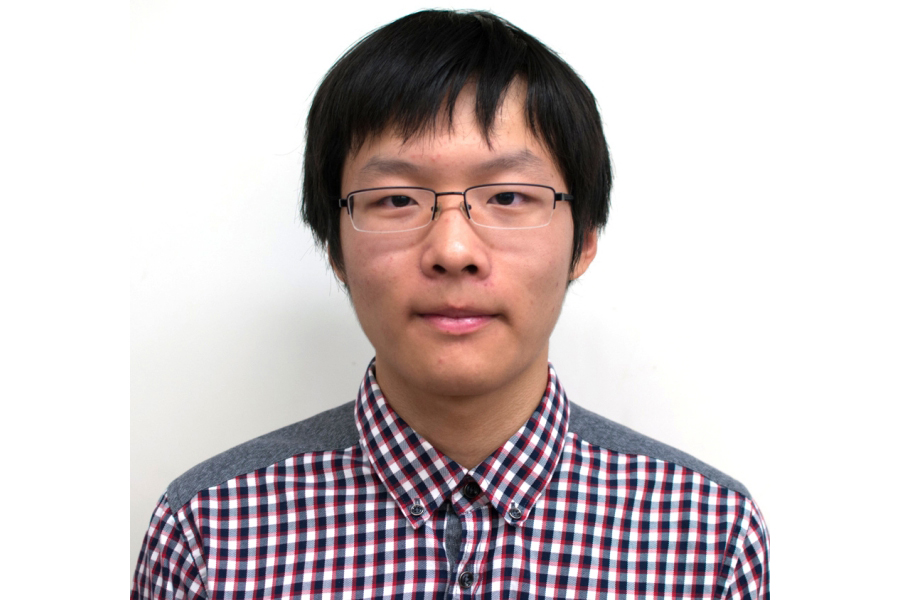
Adam Xu appointed as newest ASUCD senator

ASUCD Senator Zheng Xu. (JAY GELVEZON / AGGIE)

First-year computer science major Adam Xu was appointed Thursday, May 12, as the newest ASUCD senator following formersenator Mikaela Tenner’s resignation two weeks prior.

Xu, who ran for ASUCD Senate in fall 2015, was appointed by ASUCD Vice President Abhay Sandhu at last week’s senate meeting.

The platform that Xu hopes to work on during his tenure as senator focuses on relations between international students and native students.

“I am an international student, so I will focus on more activities and interactions between the international students and native students so that we can know each other better […] and know what our [international student] lives are like culturally,” Xu said.

Additionally, Xu hopes to increase international student’s involvement in student government.

“I want more international students to be involved in ASUCD, especially Chinese students and Asian students,” Xu said. “I was hoping us to bring us together.”

Aside from being an ASUCD senator, Xu is also a member of the International Chinese Students Club at UC Davis.

Written by: Kenton Goldsby – campus@theaggie.org

UC Davis engineering professor helps develop ultrasound motion-detection technology

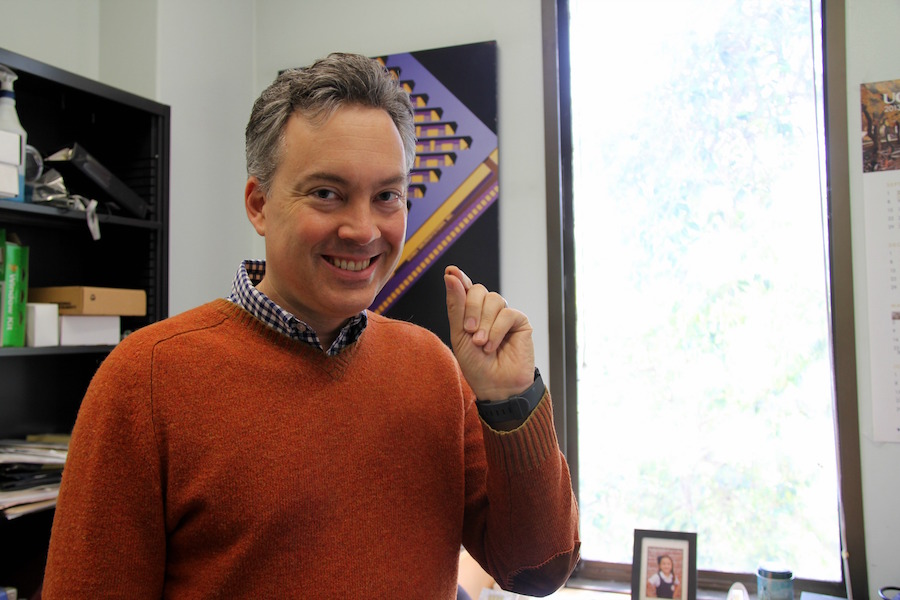
UC Davis Professor David Horsley holds the miniscule sensor chip used for motion recognition. (MONICA CHAN / AGGIE)

Chirp Microsystems creates 3-D sensing technology for electronic devices

Chirp Microsystems, a startup company based in Berkeley, Calif., has developed an ultrasound 3-D sensing technology for gesture recognition in the form of a small chip. The technology allows users to play music, check their home screens or check e-mails on their devices all with the wave of a hand.

Co-founded by chief technology officer and UC Davis engineering professor David Horsley, Chirp Microsystems created its technology to provide a sense of echolocation in electronic devices, similar to how bats and dolphins use ultrasound waves to detect where they are in their environments.

“We make these sensors that emit a little ‘chirp’ of ultrasound, and they listen to echoes from objects that are around them so they can see where the objects are in a three-dimensional space,” Horsley said.

The product can be used on a variety of electronic devices, including smartphones, tablets, Apple watches and even drones.

The company began as a research project between UC Davis and UC Berkeley to study ultrasound transducers. The project then evolved into a company in 2013 in response to the increased market demand for motion-detection technologies.

André Guedes, the co-founder and lead engineer in sensors and microelectromechanical systems of Chirp Microsystems, reflected on the development of the company.

“We have been working on this technology for many, many years,” Guedes said. “Throughout the time, the sensors and prototypes have seen many faces and iterations. Initially with very low performance and designed to be velocity and range sensors, nowadays they can do advanced gesture recognition and many other things. All this is possible because we have an incredible team syncing efforts in sensor development, testing, electronics, signal processing and software that make our ultrasonic sensor system an incredible piece of technology.”

After being featured in the “Electronic Engineering Times’ Silicon 60: 2015’s Startups to Watch” and most recently in the 2016 International Consumer Electronics Show, Chirp Microsystems looks to work with different electronic companies to have the sensor installed in devices by 2017.

“Chirp hopefully will keep growing, and we would love to see widespread adoption of the technology,” said co-founder and acoustic design and testing lead Stefon Shelton. “That will allow us to branch out into other markets and create slightly different types of devices.”

Written by: Emma Sadlowski –campus@theaggie.org

Student voices of TEDxUCDavis

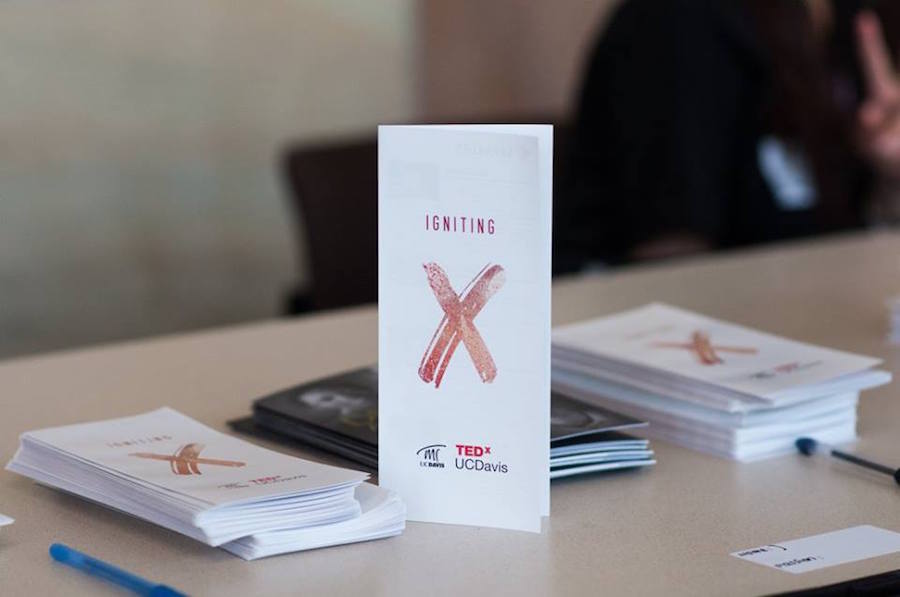
TEDxUCDAVIS / COURTESY

TEDx student speakers on the their time in the limelight

Every spring, thousands of guests fill up the Mondavi Center to witness performers and speakers step onto the stage for their time in the limelight. In the case of TEDxUCDavis on May 1, the speakers did so “in the spirit of ideas worth spreading” — the motto that drives TEDx forward.

The TEDx event does not only give speaking positions to high standing professionals, postdoctoral students and researchers, but also students.

Most students who come work for TED, including myself, are mainly interested due to TED talks they see online,” said Kevin Yu, speaker relations director for TEDxUCDavis. “It’s a really unique and amazing experience. Student-speakers come to TED because they have an idea they want to share. The team is all student-run so the environment is pretty fun and easy going.”

Students are often drawn to the notion of “ideas worth spreading,” and look to it as a chance to improve the world around them. This year’s theme, “Igniting X,” furthered the concept that novel ideas and interests are fostered and strengthened through spreading them.

For Rylan Schaeffer, a fifth-year computer science engineering and statistics double major, becoming a student-speaker was something that involved serious consideration, even with his previous experience in public speaking.

“I had previously volunteered for TED, but never thought to participate myself as I didn’t think I had a sufficiently far-reaching, nontrivial idea,” Schaeffer said. “This year, I realized that I was wrong, that I did have an idea other undergraduates could benefit from, and I wanted to tell them about the idea that their educational tracks aren’t static, that they can work with the Academic Senate and Administration to improve UC Davis’ educational programs for themselves and for others.”

Others, like fourth-year communication major Ellen Davis, spoke on behalf of a topic she felt passionate about — philanthropy.

“I have spoken in front of crowds since I was in elementary school, so I’m very used to [public] speaking,” Davis said. “I really enjoy talking about what I care about. So talking about philanthropy for my talk just made sense.”

Both Davis and Schaeffer have been able to expand their interests and passions as a result of becoming TEDx speakers. Something that TEDx strives for is the ability to talk about ideas that revitalize, encourage and inspire others to keep pushing new boundaries.

“I generally choose a topic, fixate on it for a while, and then move onto another,” Schaeffer said. “Recently I saw Ex Machina and read Murray Shanahan’s Embodiment and the Inner Life and couldn’t stop talking about what artificial intelligence is and how social systems would influence how artificial intelligence evolves.”

Whatever the case may be, the voices of UC Davis students added a new blend of ideas for audience members to consider. No matter the interest, person or background, TEDx students have made it clear that everyone has a story worth sharing.

Written by: Alan Castillo — features@theaggie.org

UC Davis men’s soccer falls to the Cardinal

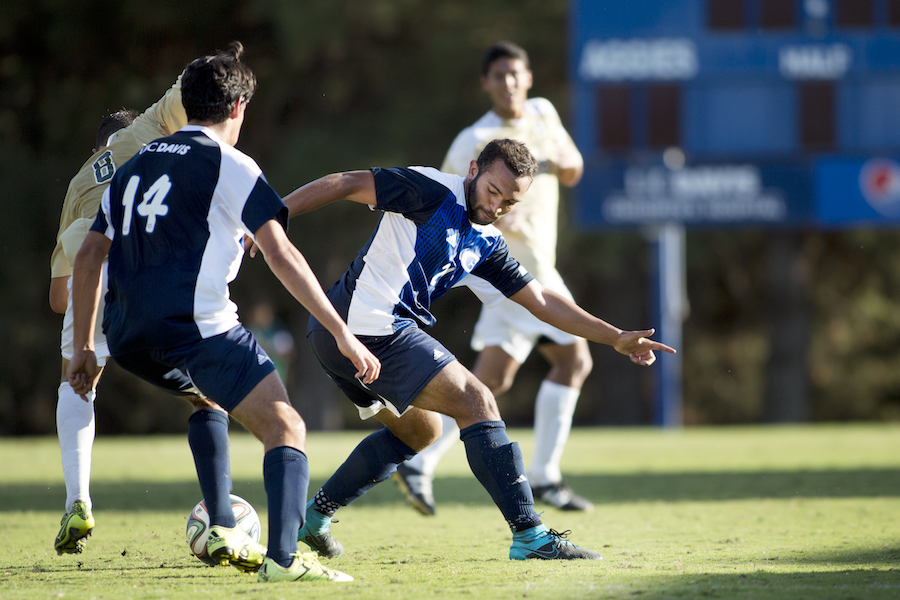
CIERA PASTUREL / AGGIE

Exhibition game excites students in May 14 matchup against Stanford

The sun wasn’t as hot in the full stands, where parents, students, friends and young athletes alike cheered on the Aggies in their exhibition battle against Stanford University. The field, however, was like black tar for the Aggies, who played an extraordinarily fast paced game against the Cardinal.

With the first point scored in the first five minutes of the match, it would be a long 90 minutes for both teams and the coaches, whose voices carried in the wind to the ears of their players.

“I got you coach, yeah I heard!” said one Aggie on the defensive line, signaling a high thumbs up to the men’s soccer coach Dwayne Shaffer. Shaffer still kept yelling, emphasizing the need for players to stay in their positions.

The Aggies played wide and kept the ball fairly on the opponent’s side of the field, taking multiple shots on goal that were stopped by the waiting goalie or the defenders who stayed on their toes at all times. Despite the Aggies keeping the ball on Stanford’s half, when the Cardinal got to the other side of the field, they too were a powerful force.

The Cardinal came out ahead, putting in one goal and winning the game 1-0, not making a single shot after that.

The crowd echoed a series of “oohs” and “aahs” as the ball went back and forth, in and out of possession, and referee calls were scarce on the physical play.

Redshirt junior forward Dashiell MacNamara was in an intense defensive position on a throw in, going head to head in shirt tugging and shoulder pulling as he and his mark awaited the throw. Neither got the ball and the ref made no reach for his whistle.

In the end, the pace that had sophomore midfielder Evan Barrett demonstrating his immense speed died down as he was subbed out of the game and the breath of each player grew heavier and heavier.

The announcer lead a 10 second countdown and every member in the stand followed as the Aggies and the Cardinal watched the ball roll out of the field with no intention of following after it. By the time the air was filled with the melody of “one,” both teams were making their way to the bench.

Written by Veronica Vargo – sports@theaggie.org

This week in sports

TIFFANY CHOI / AGGIE

UC Davis athletics from May 9 to May 15

Baseball (16-29)

UC Davis at Sacramento State (W, 7-1)

UC Davis at CSUN (L, 5-4)

UC Davis at CSUN (L, 11-8)

UC Davis at CSUN (L, 4-2)

UC Davis won against Sacramento State 7-1 on May 10. This is the first time the Aggies have won on the Hornet’s home field since 2010. Freshman catcher Logan Denholm hit a home run in the game, his third for the season. Junior right hander Justin Mullins struck out six while pitching for six innings.

The Aggies fell to the CSUN Matadors 5-4 on May 13. Senior outfielder Cameron Olson hit a home run in the game along with Denholm, breaking the 2-2 tie in the seventh inning, but the Matadors were able to rally in their half of the seventh and score three to take the win from the Aggies. UC Davis left 13 runners on base and eight of those were in scoring position.

The next day, UC Davis scored eight runs in the final four innings but could not catch the Matadors, who won the game with 11 total runs. With that, the Matadors won their first series against the Aggies since 2013. Senior outfielder Tanner Bily had five hits, an RBI and scored a run for the Aggies.

The Aggies fell to the Matadors 4-2 on May 15. After a single by senior left handed pitcher Spencer Henderson in the sixth inning, Olson was hit by a pitch and Denholm had a walk to try to get the Aggies on the board where they were able to cut the lead in half.  The Aggies were able to get runners on base in the last two innings but unable to get the tying run in. UC Davis plays at Stanford on May 17 at 5:30 p.m.  

Softball (15-35)

UC Davis at CSUN (L, 6-5)

UC Davis at CSUN (L, 3-1)

UC Davis at CSUN (L, 4-3)

The Aggies were able to pull within one point of the Matadors thanks to sophomore infielder  Ashley Lotoszynski’s double that scored a run. CSUN was able to get the final out of the game with an Aggie in scoring position, and the Matadors won 6-5.

In the second game of the afternoon, UC Davis scored a run in the first inning, and CSUN retaliated with two runs in the first and one in the second. No more runs were scored as the pitchers battled it out with neither giving way.  Both pitchers combined only allowed three hits after the third inning. The game closed out with a 3-1 CSUN victory.

The Aggies fell in the last game against the Matadors 4-3. Lotoszynski had a three run homer in the top of the fourth inning. In the next inning, a wild pitch gave CSUN the opportunity to tie the game. The Matadors broke the tie in the sixth inning with two doubles, allowing the winning run to score.

Track and Field

Big West Track and Field Championships

Day One

Senior distance runner Erika Barr won the 3000-meter steeplechase and the Aggie women earned first place on the first day of the Big West Track and Field Championship. Senior distance runner Trevor Halsted won in the 10,000 and freshman jumper Kyle Clancy won in the high jump to lift the men into second place. The Aggie women led with 62.5 points while the men had 57 points, just behind Cal Poly with 65.

Day Two

Junior distance runner Raina Goins won the 800-meter run, helping the Aggie women to win their fourth Big West Track and Field Championship in the past five years. The Aggie women scored 135.5 points to win the title over UC Santa Barbara, who came in second with 118.5 points. The Aggie men scored 113 points and won fourth place with one point separating them from Cal Poly in third place.

Written by Lindsay Yim – sports@theaggie.org