57.6 F
Davis

Davis, California

Tuesday, December 23, 2025
Home Blog Page 713

This Week in Senate

HANNAH LEE / AGGIE
HANNAH LEE / AGGIE

ASUCD Senate meeting: May 12, 2016

CONFIRMATIONS

First-year computer science major Adam Xu was confirmed as the newest ASUCD senator. Xu replaces former ASUCD Senator Mikaela Tenner, who resigned her post earlier this month.

Second-year political science and English double major Nick Flores was confirmed as the newest Internal Affairs Commission (IAC) chair. Flores served as the interim IAC chair after former IAC chair Abhay Sandhu was elected as ASUCD vice president in the Winter Quarter election.

LEGISLATION

Senate Bill #80

Language: ASUCD Senate Bill to liquidate a Kirkland by Whirlpool refrigerator through Aggie Surplus.

Result: Passed – 11-0-1

In favor: Puneet Dhindsa, Sam Chiang, Joshua Dalavai, Shaitaj Dhaliwal, Irveen Grewal, Adilla Jamaludin, Ricardo Martinez, Sofia Molodanof, Georgia Savage, Parteek Singh, Adam Zu

Against: None

Abstentions: Sam Park (Absent during vote)

Senate Bill #81

Language: ASUCD Senate Bill to allocate $260 from Senate Reserves to Scholar Promoting Education Awareness and Knowledge (SPEAK) for the cost incurred by the Family Day Conference, a culminating event for the Undocumented Students and Allies Awareness Week

Result: Passed – 11-0-1

In favor: Puneet Dhindsa, Sam Chiang, Joshua Dalavai, Shaitaj Dhaliwal, Irveen Grewal, Adilla Jamaludin, Ricardo Martinez, Sofia Molodanof, Georgia Savage, Parteek Singh, Adam Zu

Against: None

Abstentions: Sam Park (Absent during vote)
Our dearest Davis locations

Photographers of The California Aggie talk about their favorite Davis location

Photo taken by the Putah Creek Parkway. Just on the other side of Olive Drive lies the tree of life. (ANGELICA DAYANDANTE)
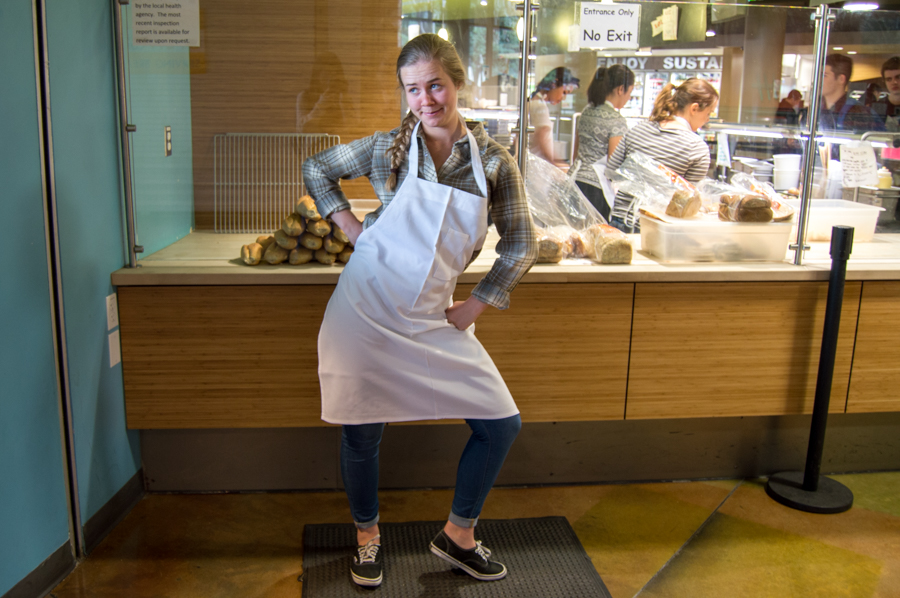
The CoHo is one of my favorite places in Davis because they don’t just serve food — they serve looks. (ARIEL ROBBINS)
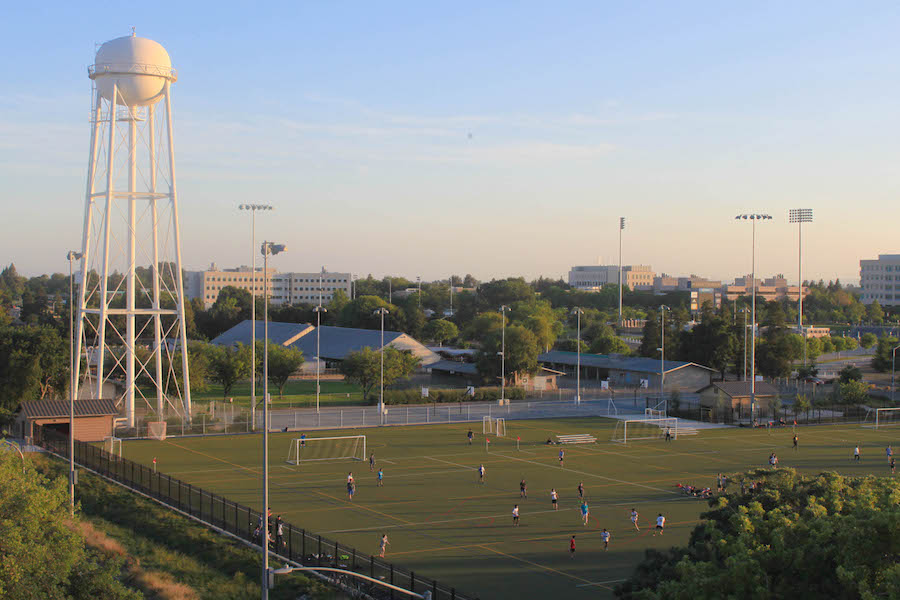
My favorite place in Davis is the Dairy Recreational Complex. I’ve played soccer my whole life so the field is naturally a second home to me. I’ve had fun moments, competitive moments, frustrating moments, and rewarding moments, all which coincide with the sport I love to play. (DANIEL TAK)
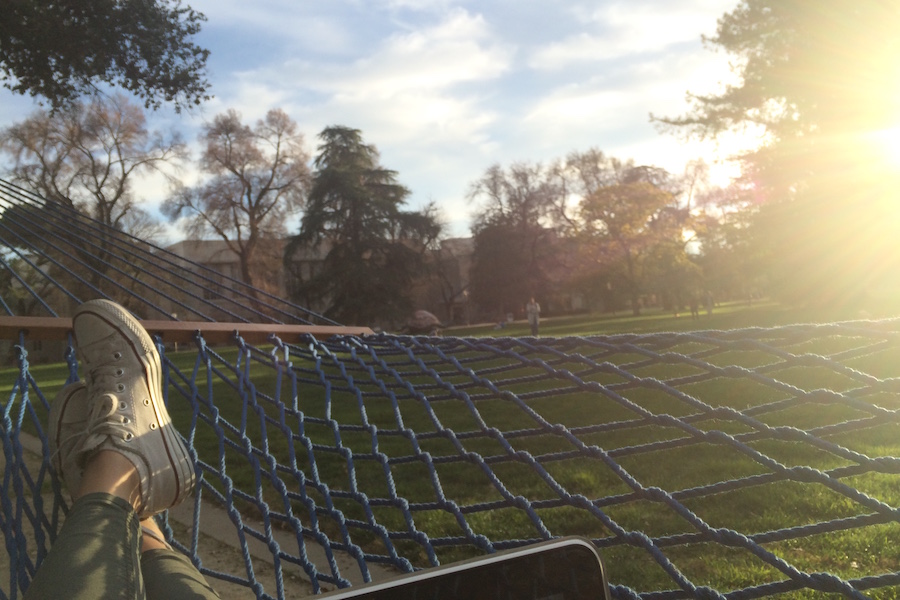
My favorite spot in Davis is the hammock area of the Quad. Getting one has developed into a skill. They key is to get there ten minutes before a class period starts since a lot of people leave during that time. (NICKI PADAR)
After living in my apartment near the end of Russell for one year, this part of the road is one of the first places where I gained a sense of home in Davis. I love walking from the bus stop and watching the seasons gradually change in the colors of the the trees. (ASHLEY LUGO)
Although they don’t smell the best, the cows at Davis bring something unique to the campus and they’re something I’ve grown to appreciate my first year here. It’s fun to just walk by at any time of day and see what they’re doing. (ALEXA FONTANILLA)

Compiled by: The California Aggie Photo Desk – photo@theaggie.org

A history of controversy: Ralph J. Hexter

BRIAN LANDRY / AGGIE

Exploring the reasons behind acting Chancellor Ralph J. Hexter’s resignation from former position at Hampshire College in 2010.

Amid accusations as serious as embezzlement and protests of unsatisfied students demanding for his immediate resignation, Ralph J. Hexter stepped down from his former position of president of Hampshire College in December 2010.

Now, six years later, Hexter has taken up the position of acting chancellor at UC Davis after Chancellor Linda P.B. Katehi was put on investigative leave on April 27. While the fight to remove Katehi as administrative leader may have been won temporarily, many, who are aware of Hexter’s past career in the world of academia, believe the fight for a responsible head of administration is only just beginning.

According to Ben Saucier, a 26-year-old alumnus from Hampshire College’s class of 2011, Hexter’s 2010 situation at Hampshire was scattered with controversy: Hampshire’s Students for Justice in Palestine challenging his noncommittal stance on the college’s divestment from Israel; Hexter’s on-campus paramilitary group of law enforcers, present for “public safety,” causing dissent amongst students; his inability to answer questions regarding the whereabouts of certain funds, specifically with regard to Hampshire’s massive budget deficit and plans to relocate several admissions offices.

These accusations led a group of almost 100 student protesters to stage a sit-in in Hexter’s Hampshire College office in the spring of 2010, demanding he face the group instead of hiding behind closed doors.

“The college was on the brink of even existing under his management,” Saucier said. “He had a big house outside of campus that he was keeping horses on; he was a socialite he had parties and he would schmooze up fundraising money, and people kind of felt like he was being [disingenuous] with the student body, like he was saying one thing to them and doing another thing behind closed doors.”

Saucier was a third-year when Hexter relinquished his position as president. Although his opinion has changed since, during his time as an undergraduate at Hampshire, Saucier said he felt “jaded” by the protests, and in fact, was a fan of Hexter.

“I thought he brought this Ivy League swagger to Hampshire which, at the time, I thought would be good for the college,” Saucier said. “I was like, ‘what are these kids so upset about?’ But in hindsight, seeing what [the current Hampshire president] has done — there are new buildings being built on campus, and the funding that [Hexter] said wasn’t there, all of a sudden [has started] to appear.”

Saucier studied narrative nonfiction and journalism at Hampshire and was present during the 2010 protests, during which put his writing skills to use. As he watched the scene unfold, Saucier wrote a firsthand account of the unrest, and published the article online in August of 2010.

“Outside, I noticed one student scribbling on a sign. He was writing: ‘Hexter nobody likes you but you’ while holding a bottle of champagne. He explained to me: ‘Hexter is a narcissist; he only cares about himself. All narcissists have their fall,’” Saucier wrote in the article.

In the time leading up to the sit-in, over a hundred of the 1,300 tight-knit students attending Hampshire College in 2010 spoke out against Hexter’s presidency, using tactics such as petitions, organizational meetings, public on-campus announcements and “the red armband.”

“The use of the red armband [by many students] became this symbol for anti-institution or anti-Hexter kind of regime,” Saucier said. “There was a whole series of events that led to this blowing over. After the graduation of the class of 2010, the ceremony was so anti-Hexter that they almost forced him out.”

During Hampshire College’s 2010 commencement ceremony, graduating student speaker Daniel Scheer called the administration “two-faced and corporate.” He solemnly questioned why he “stuck out” the past few years at the college, indicting Hexter and his administration as the reason for his unsatisfied departure.

“Staff cuts, budget cuts, administrators threatening student activists with disciplinary action, half-hearted promises to end institutionalized racism,” Scheer said during his commencement speech. “This is not how I want to remember Hampshire, but this is a Hampshire that we experienced together.”

UC Davis student activist groups, such as Davis Stands with Ferguson and Fire Katehi, have long called into question Katehi’s disregard of UC Davis’ own institutionalized racism problems.

With the past administration’s lack of transparency, Hexter hopes to “achieve a better sense of communication” with the UC Davis student body in the coming months, even if that means opening back up the contention that engulfed him in 2010.

“I have the highest respect for Hampshire College and what it stands for,” Hexter said. “But frankly, after a few years […] I really seemed to understand that [with] my values — really what made the most sense to me was to seek a return to a research university.”

Before his start at Hampshire, Hexter served ten years at UC Berkeley, seven of them as dean of the Arts and Humanities. Hexter attributes the 2010 situation at Hampshire to the little experience he had in working at a small liberal arts school.

According to Hexter, although Hampshire’s board renewed his contract as president in 2010, he was already planning the “appropriate exit” from Massachusetts to start as provost at UC Davis.

“It is true that on the Internet you will find a lot of dissent and protest,” Hexter said. “But frankly, from my perspective, that was more of a symptom of a realizing on everyone’s part that this wasn’t the perfect match.”

The Hampshire controversy seemed to live and die within the grounds of the small liberal arts campus, and Hexter was able to continue his career at UC Davis relatively unscathed. However, certain on-campus groups have recently called into question his uncontested appointment as acting chancellor. One such group of students is the UC Davis Cultural Studies Graduate Group.

“Hexter had to leave Hampshire as Katehi had to leave here,” said Evan Buswell, a graduate student in Cultural Studies Department, in an email interview. “By playing this game of musical chairs with administrators, the interests which govern the University hope to be able to confine our awareness of these problems to the people in whom they are embodied. But I think this time we — both graduate and undergraduate students at this university — are not willing to stop looking.”

The graduate students questioned the absence of student involvement in Hexter’s appointment, while also condemning his help in the implementation of policies to privatize UC Davis. The group stated in a letter that Hexter has been an instrumental force in “suppressing and criminalizing dissent on this campus,” including the 2011 pepper spray incident. According to the letter, Hexter is responsible for having acted as the “intermediary between the chancellor and the UCDPD.”

“While Katehi was seen and chastised, Hexter operated largely unseen to support her in both her suppression of dissent, and the de-democratization that accompanies sudden shifts of publicly administered resources to the private sphere,” Buswell said.

Saucier drew parallels between the tension among UC Davis students and law enforcement officers in the infamous 2011 pepper spraying and the tension between Hampshire students and Hexter’s on-campus paramilitary group present during his five years as president.

“There was a state of tension that existed between the [students and the Hampshire law enforcement officers], and I think we saw that happen at UC Davis with the [pepper spray too],” Saucier said. “The frustration for tuition increase is totally justifiable, [tuition] is totally ridiculous in this country. And I think the main problem with Hexter is he’s just part of that system that profits off tuition increases while trying to maintain the status quo.”

After a 36-day sit-in in Katehi’s office and 57 straight days of mobilization on the issue, the Fire Katehi protesters released a public statement on April 29 in response to Katehi’s paid leave, stating that the fight is not over.

“Although her 90-day leave is a partial victory, we recognize that unless it is accompanied by systematic changes these injustices will persist. We will utilize the momentum that we have built in order to move forward with the greater goals of this movement: to disentangle and to correct the undemocratic appointment of executive administrators to this public institution,” the letter stated.

Hexter stresses to the student body that “this great university” will continue to move toward future progress, but those such as Saucier and Buswell are not so sure about UC Davis’ growth under Hexter.

“The University of California has often been the resting place for those who were driven out of somewhere else,” Buswell said. “[Such as] cops who had to leave their districts, and administrators who had to leave their posts because they could no longer get away with whatever they were getting away with before.”

While it is possible that Hexter has learned from the string of mishandled events that led to his resignation at Hampshire, Saucier believes that for Hexter, the appointment as UC Davis’ acting chancellor is an “ego thing” rather than a chance to move the student body toward success.

“I don’t think he’s nefarious, I don’t think he has cruel intentions, I just think he’s kind of a puppet for this old-school, elitist mentality that exists in academia,” Saucier said. “I don’t think he’s an administrator because he cares about students, I don’t see him genuinely caring about the institution — I just see him climbing the ladder.”

Written by Ellie Dierking — features@theaggie.org

Takeaways from the first month and a half of the MLB season

©SAN FRANCISCO GIANTS / CIERA PASTUREL

Plenty has happened since the MLB season began in April. The first month and a half of the MLB season has been chaotic, and a lot of occurrences have raised eyebrows throughout the baseball world. Let’s examine the biggest takeaways in the baseball world thus far:

Chicago White Sox at the top of the AL Central

Last year Chicago looked like a team that could put it all together, but failed in the long run. This year, however, is another story. Chris Sale and Jose Quintana have been killing it on the mound. This success, paired with a solid bullpen, has lead to the second smallest team ERA in the American League.

Dee Gordon’s PED suspension

Gordon’s suspension has shaken the MLB’s entire foundation. Gordon, the reigning batting champ, was tagged with an 80 game PED suspension after testing positive for two banned substances — an externally derived testosterone and Clostebol, an anabolic steroid.

National League (NL) West Stumbles Out the Gate

The NL West looked like a three headed monster before the season, but the three top teams have all stumbled out the gate (Dodgers, Giants, DBacks) due to pitching struggles and injuries. The Giants and Dodgers have had major back rotation and bullpen concerns, and the DBacks top two pitchers Zack Greinke and Shelby Miller have yet to get it going.

Jose Altuve and Robinson Cano Home Run totals

Through the first 31 games, Altuve and Cano have already surpassed half of their home run totals from last season. Cano already has 12 while he only hit 14 in 2014 and 21 in 2015. Altuve has 9, and he only totaled 15 HRs in 2015 and had never reached double digits before that.

Clayton Kershaw’s streak of Double 10+ K’s and less than one BB

He is the second pitcher since 1900 to have accomplished this feat. The dude is untouchable; is there any debate about him being the best pitcher in baseball?

The Hot Start of Kenta Maeda

There were several questions about Maeda’s elbow this summer as he made the leap from the Japanese league to the MLB, but concerns have been offset by his dominant start. In 38 innings, the 28 year old has a 1.66 ERA with 35 Ks.

Trevor Story

Trevor Story’s name is the first one that comes to mind when thinking of the most impressive rookie thus far. A domestic violence incident with Jose Reyes opened up an opportunity for Story to take control of the starting SS, and he has yet to look back. In 32 games, Story has a .269/.331/.612 slashline with 11 HRs and 27 RBIs.

David Ortiz Farewell Tour off to a Great Start

David Ortiz saw the mess that was Kobe Bryant’s Farewell Tour and decided to do the exact opposite. In his final season, Ortiz has nine HRs with a slashline of .321/.402/.688. Additionally, the Red Sox have been playing some great baseball as they have once again established their relevance as a contender for the first time since 2013.

Jordan Zimmermann dominating, David Price, Not so Much

Zimmermann’s success thus far has come as a huge shock not just to me, but to the baseball world as a whole. After a down season in 2015 in which he compiled a 3.66 ERA in 201.2 innings, Zimmermann was questionably given a five year deal worth $110 million. Zimmermann has proved the doubters wrong so far as he pitched to the tune of a 1.10 ERA in in 41 Innings. David Price on the other hand, has compiled an ugly 6.75 ERA in 41.1 innings after signing a gigantic seven year deal worth $217 million in the offseason.

Angel’s Double Whammy

The Angels didn’t have a great season outlook to begin with and they also have what many would consider to be the worst farm system in baseball. To put the cherry on top, they just lost their ace Garrett Richards to Tommy John surgery, and their number two Andrew Heaney might have to undergo the same procedure. But of course, as I was writing this they also lost their starting SS Andrelton Simmons to thumb surgery. Things are looking horrible for them not just now, but in the future as well, I think it’s time to trade Trout and rebuild. We will all rebuild.

Bartolo Colon’s Home Run

The 42 year old mashed a home run on Saturday against the struggling James Shields for his first career homer. Why should you care? Well, this is what he normally looks like when going up to the plate. He’s a big boy.

While we shouldn’t put too much stock into the events of the first month and a half (aside from injuries and suspensions), it’s pretty amazing to see how unpredictable this game can really be.

UC Davis club ABIDE kicks off Great Jeans Giveaway

ALEXA FONTANILLA / AGGIE

Students donate old jeans and celebrate positive body image

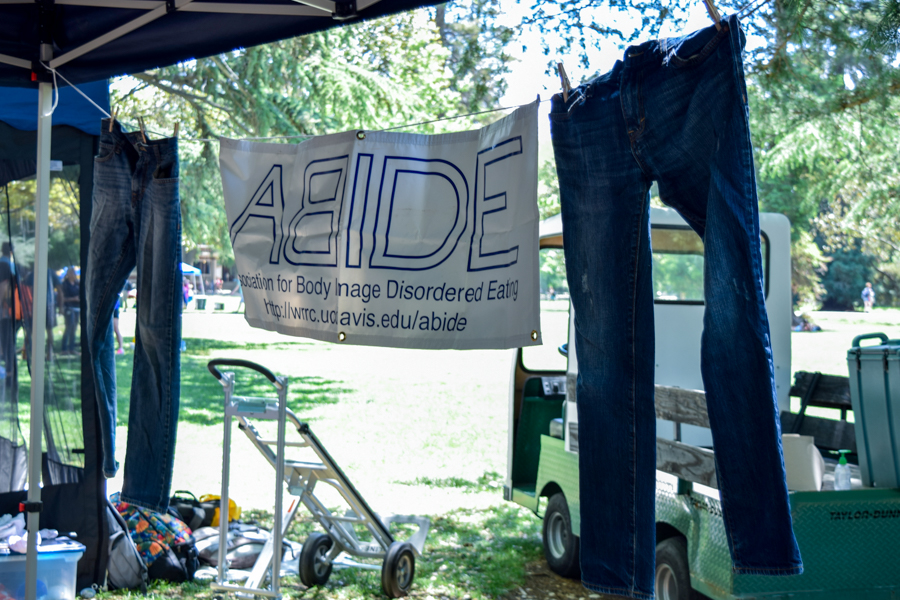
UC Davis’ Association of Body Image and Disordered Eating (ABIDE) kicked off its annual Great Jeans Giveaway event on May 11 with a Yoga-thon on the UC Davis Quad. ABIDE will host a series of activities throughout the giveaway event, including free yoga, fingerpainting and kickboxing to celebrate positive body image.

“We’re all about promoting body positivity,” said third-year human development major and ABIDE member Shannon George. “What the Great Jeans Giveaway does is encourage you to donate old jeans that you might not fit into anymore. It encourages you to love your body now.”

Throughout the month of May, students can donate old jeans and receive a 25 percent off coupon to Gap in return. All the donated jeans will be given to Women Escaping a Violent Environment (WEAVE), a non-profit organization in Sacramento that supports women who are experiencing or have experienced sexual or domestic violence.

The Great Jeans Giveaway began on Wednesday, May 11 with a free yoga class led by a certified Fitness and Wellness yoga instructor. The giveaway will continue with an arts and crafts event hosted at the LGBTQIA Center on Friday, May 13 and cardio kickboxing at the ARC on Monday, May 16.

Allie Fafard, a second-year sustainable agriculture and food systems major and officer of ABIDE, expressed her excitement for the giveaway activities.

“All of our events really focus on body positivity, taking a stand against the way that the media portrays body image and how it’s unrealistic and unhealthy for college students to focus on,” Fafard said.

The giveaway concludes on Friday, May 20 with Love Your Body Yoga led by a yoga instructor at the ARC, but jeans donations will be accepted all month. Donation bins can be found in the ARC, the SCC and the third floor of the Student Health and Wellness Center.

“Our general goal is to help people accept the size they’re at,” said Katie Hamlin, a counselor at the UC Davis Counseling Center. “We want them to appreciate their body and be in touch with it as it is rather than striving towards some ideal image that might be really difficult or impossible to attain. The yoga or athletic events are really to help you get in touch with being in your body right now and taking care of it in a way that feels sustainable and good.”

More information about the giveaway can be found at the Great Jeans Giveaway Facebook event page.

Written by: Emma Sadlowski — campus@theaggie.org

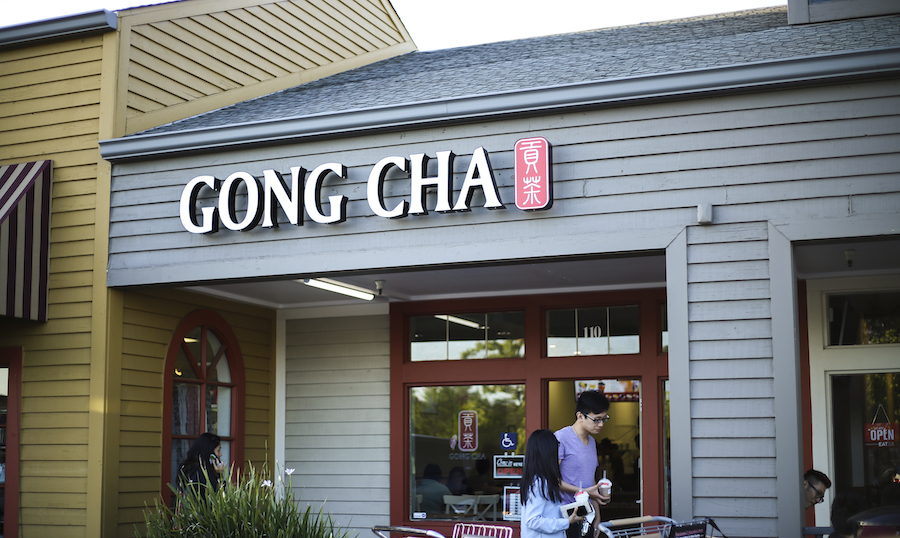
A strong competitor in the Davis boba scene

CHARLES MIIN / AGGIE

A Review of Gong Cha

Getting boba at a new place can be terrifying, especially for someone who isn’t all that familiar with the drink. One of the best things about boba restaurants is the customizability — choosing the type of tea, flavors and toppings as well as sweetness and ice levels. However, all of these choices can be hugely overwhelming for someone who is relatively new to boba (a.k.a. me).

During my first few months of drinking boba, I stuck to things that were familiar: peach green tea and mango black tea.  Basically the same thing I got at Starbucks, but with sweet, chewy balls at the bottom. I had just started to get away from these ‘safety drinks’, but when I went to Gong Cha, located in the Davis Marketplace on West Covell, and saw yet another menu set up for customization, I got overwhelmed and reverted to my comfort zone, mango black tea with pearls.

Yet, somehow, Gong Cha managed to make my boring drink anything but. The tea was strong, the mango flavoring wasn’t overwhelming (I got 70% sweetness) and served as a deliciously sweet accent to the tea, and there were chunks of mango mixed in with the pearls at the bottom. It was fantastic and made me feel like I could trust Gong Cha; whatever I ordered, it was probably going to be really good. So during that week I went three more times (for the sake of this review, obviously, not because I have no self control when it comes to boba) and decided to branch out.

Thankfully, Gong Cha has a “Dream Top Ten” menu, so I wasn’t fumbling around in the dark trying to figure out where to start. From that menu I picked the QQ passionfruit green tea and the earl grey milk tea with 3J. The QQ passionfruit green tea came with coconut jelly, which I was a tad nervous about. But it was really good and the mix of passionfruit and coconut gave the tea a tropical, piña colada feel. The earl grey milk tea with 3J was very sweet, with an interesting, indescribable flavor that I didn’t quite like. I figured out that I didn’t like the herbal jelly, because when I got plain earl grey milk tea with pearls I absolutely loved the drink. It was creamy, sweet but not overly so, and really satisfied my craving for a milky tea.

Having found both a fruity and a milky tea that I liked, I decided to branch out even further and try the one thing I had heard friends raving about — the milk foam — so I ordered wintermelon tea with milk foam. The milk foam drinks come with a lid, not the usual plastic seal, and instructions to first take a sip of the tea through the milk foam, and then to mix it in. Since I had no idea what I was doing, I decided to play it safe and follow the directions. The milk foam was sweet and light with an interesting salty flavor. It’s hard to describe but, trust me, it’s delicious. Also, fun fact, wintermelon tea doesn’t taste like wintry mint or melon. It’s delicious, but difficult to describe because I’ve never had anything like wintermelon tea with milk foam, so, I guess you’ll just have to trust me that it’s good.

Thanks to Gong Cha’s easy “Dream Top Ten” menu, my fear of unusual drinks is gone. Everything I ordered, no matter how odd it seemed at first, was utterly amazing. All of the drinks have really nice flavors that pair nicely with the flavor of the tea. Their bobas and jellies are chewy and flavorful without detracting from the flavor of the tea, and their milk foam is fantastic. The Davis boba scene has a strong new competitor, and it’s Gong Cha.

WRITTEN BY: Sofie Bates — arts@theaggie.org

UC personal statements to offer eight prompts as opposed to previous two

VENOOS MOSHAYEDI / AGGIE

New application requires incoming applicants to respond to four of eight shorter questions

Beginning this fall, applicants to the University of California will have a new set of essay prompts to respond to for their applications.

The new essays deviate from the old essays by asking applicants to respond to four shorter prompts as opposed to two longer statements. Each essay has a 350 word limit, which means that there will be a new maximum total word count of 1,400 to replace the old limit of 1,000.

According to Claire Doan, a media specialist for the UC Office of the President, the new essays provide prospective students an opportunity to present a more holistic view of themselves to the university and will help move students away from the former rigid personal statement structure.

“Over the past couple of years, we’ve received feedback from high school and community college counselors, and we felt that a new format would not only be helpful for new applicants but also instrumental in making admissions efficient,” Doan said. “We wanted to ensure that the personal statement prompts gave insight to the students’ strengths and background rather than just giving them a blank slate. This is a more focused platform for them to express themselves that wasn’t necessarily represented in the previous essays.”

The new prompts ask students to write about topics such as their leadership experiences, their creative sides, their greatest talents or skills, an educational barrier they have overcome, their most significant challenge and how it impacted their academic achievements, what they have done to make their school or community a better place and what sets them apart from other UC applicants.

Transfer applicants will be asked to respond to three of seven available prompts. However, they will have an additional required prompt which asks them to discuss how they have prepared for their major.

Freshmen applicants are also offered an eighth prompt of describing their favorite academic subject.

According to John Raftrey, a member of the Higher Education Consultants Association (HECA) and the Western Admission for College Admissions Counseling (WACAC), the new essay prompts are a mixed bag. He believes that there are some pros to the new essays, but there are also some serious cons.

“I’m glad they got rid of the poorly worded prompts they had been using,” Raftrey said in a blog post about the new essays. “[However,] in an era when colleges are looking to make it easier to apply to college, the UC’s just made it harder. It’s not because of the word count, it is because instead of having to brainstorm two essays, students will now have to brainstorm four essays. Picking a theme and figuring out what to say is the hard part, not the actual writing. This will lead to some wild admission decisions, making it even harder for students to figure out if they have a shot at a particular UC.”

However, Leilah Lockett, an incoming transfer student at UC Davis, believes that these new essays will provide students with a better opportunity to explain who they are to the admissions board.

“I’ve applied to UC Davis twice now, and even though I was successful the second time, I always felt like I had trouble expressing myself with the narrow prompts I was given before,” Lockett said. “I feel like it may be more difficult, but I also think it might give students who may have had a bad year in high school for whatever reason, a chance to explain themselves. In that way, I think it could lead to a more diverse campus, which is a good thing.”

Written by: Sangeetha Ramamurthy – campus@theaggie.org

DJ Sleepy Tom performs at UC Davis to help raise awareness for domestic abuse

THE MANC PHOTOGRAPHER / COURTESY

Alpha Chi Omega hosts benefit concert

Want to help a good cause while attending an awesome EDM concert right here in Davis? On Saturday, May 21, Alpha Chi Omega (AXO) will be hosting its spring philanthropy event “Shatter the Silence: a Benefit Concert Featuring Sleepy Tom” at the Alpha Epsilon Pi (AEPi) house.

Sleepy Tom, a rising Canadian-born DJ, has produced songs with Diplo, Zeds Dead and Martin Solveig amongst others, bringing his catchy, pop-style club beats to their tracks. He has been rising in popularity recently, with this date coming as part of his U.S.-wide tour, which also includes major cities such as San Francisco and New York.

The benefit concert is intended to raise awareness and support for victims of domestic violence and abuse. Although the members of AXO are incredibly excited for the event, they want to stress that it is a philanthropy event before a concert.

“I saw [Sleepy Tom] at an event on New Year’s Eve and thought he was a good up-and-coming DJ that had a respectful reputation and attitude toward women,” said Melissa Cayne, a third-year environmental science and management major and the event coordinator.

Cayne used Twitter as a networking tool to bring Sleepy Tom to UC Davis because she believes he will be a fun act that will attract many people to the event.

Each ticket costs $12, part of which will go to the Empower Yolo Women’s Shelter in Woodland, AXO’s local philanthropy. Of the total proceeds, $350 will go to Promoting Awareness Victim Empowerment and about $100 will go to the AXO Foundation, which supports the national initiative and scholarships for financially dependent members.

“As a woman and a member of Greek life here at UC Davis, I am excited and proud to support the sisters of AXO and their charitable cause,” said Klara Wong, a third-year communication major.

To emphasize the philanthropy and educational aspect of the event, there will be interactive booths at the concert to inform attendees about the AXO’s philanthropies and how to assist survivors of domestic violence and abuse. The sisters of AXO will be handing out educational materials until Sleepy Tom performs.

“The most exciting part for me is working with everyone involved and being able to do it with my friends who have given me so much support. I want to have a successful event where everyone is safe and has fun,” said Kelsey Pitman, a third-year psychology major and member of AXO. “More significantly, I want everyone to take away how important [issues like] domestic violence and sexual assault are, and how many of our peers are really affected by it.”

The event will start at 2:30 p.m. at the AEPi house, located on 101 Russell Blvd.

“[AEPi] wants to pair up with [AXO] because we love them and we want to support our greek sisters in their effort to raise money against domestic violence,” said Jonah Korchin, a third-year political science major and a member of AEPi.

Tickets can be purchased from members of AXO and AEPi as well as at the MU tables. For more information, please visit the Facebook event.

Written by: Sami Bass – arts@theaggie.org

Humor: Entertainment Council books Drake for Lawntopia

JULIEN (THEFUNKYMAN) / FLICKR

Rapper says it’s “time to come home”

After many years of attempting to get a headline artist, ASUCD Entertainment Council (EC) has booked the artist they have been looking for. Drake will be performing in the UC Davis Quad today as part of the annual Lawntopia concert.

Drake is making his stop in Davis after just launching his new album, Views. His album received much scrutiny among college-aged students, and his visit has been interpreted as an attempt to win over his frustrated fan base after widespread critical panning.

“I’m ready to come back to where I was before I made it big. Davis will always have a place in my heart,” the rapper said in an exclusive interview with The California Aggie. “I think it’s time to come home.”

Local artists will be asked to open for Drake. Applications to perform can be sent to the EC. KDVS is working with EC in handling the talent portion of Lawntopia.

You can reach ETHAN VICTOR blah blah blah email blah blah blah ejvictor@ucdavis.edu and blah blah blah Twitter @thejvictor.

Out of the Darkness holds second annual walk for suicide prevention

LUCY KNOWLES / AGGIE

Event will raise funds for the American Foundation for Suicide Prevention

On Sunday, May 15, Out of the Darkness (OOTD) – Students Against Suicide will be holding its second annual campus walk to raise awareness for suicide prevention. The funds raised for the event will go to the American Foundation for Suicide Prevention.

Briana Megid, the co-president and co-founder of OOTD, said that the event will help create a space for people who have been affected by suicide.

“We want to create an atmosphere on campus that says that it’s okay if you feel this way and you’re not alone if you are reeling from a loss, if you are dealing with depression yourself or if you just feel desperate and don’t know what to do,” Megid said. “You have an opportunity, at least on Sunday, to show up and see a crowd of people who understand that. You don’t have to talk to them about it, but you understand that there is a common thread between all of you that gives you a sense of community.”

The event will include a 5K walk, an honor bead tent and prize giveaways. Savannah Downey, vice-resident of OOTD, said that she hopes that events like this one can start a dialogue within a community that might not always get the opportunity to do so.

“It’s really having the courage to ask somebody how they’re doing and not being afraid of getting into that conversation,” Downey said. “I think one of the biggest things to help is to show people that it’s not just one or two people out of a hundred that feel this way. It’s a lot more people who feel this way.”

Sam Alavi, Office of Advocacy and Student Representation director, talked about how events like the Out of the Darkness Walk can help students dealing with the issue of suicide.

“I think it helps build a community,” Alavi said. “These events are to remind students that there’s a community who cares about their well-being and who cares about preventing suicide. A lot of times the people who attend these events are people who have been impacted by suicide. And so, not only is it an event to raise awareness but it’s an event to build a community so that people struggling with it have people they can call on. These events are really good at building that sense of community where you’re not alone.”

Second-year English major Sofia Molodanof, an ASUCD senator elected last winter, talked about how students can get help from finding a community like OOTD.

“Life has its ups and downs, you’re not always going to feel okay, but it’s not always about being okay, it’s about being able to get through it,” Molodanof said. “It brings together a community of people who really care about these issues, who have dealt with these issues that are so hard to talk about and I think that it really just opens up and lets people feel different things and realize that they’re not alone in this.”

When talking about the event, Megid said that she hopes that students will come out with a knowledge of the resources available to them when it comes to mental health.

“I think Sunday is a really good example of what we want to do in the long term,” Megid said. “The thing that’s most scary about depression or suicide is that you don’t see it. It’s not something that is clearly visible, but it is extremely prevalent. One of the highest populations suffering from suicide deaths are college students.”
For more information or to attend the walk, visit OOTD’s Facebook page.

Written by: Ivan Valenzuela — campus@theaggie.org

Humor: Engineering buildings to get churro carts

ILA-BOY / WIKIMEDIA COMMONS

John Wiley and Sons, a well-known publisher of extremely expensive textbooks and BFF to Chancellor Linda P.B. Katehi, has graciously offered to sponsor a project on the UC Davis campus to benefit the growing minds of our future leaders.

This project will see the installation of several churro carts inside of the engineering buildings on campus. In addition to churros, the carts will offer blended coffee drinks. These churros will be given exclusively to STEM majors, who will need to show their OASIS account before they can grab a gratis treat.

The California Aggie wanted to know if humanities majors were welcome to eat this sweet snack as well, so we reached out to Craig Mitchell, a representative of John Wiley and Sons. He had this to say:

“No.”

His partner, Jared Pilar, expanded on Mitchell’s answer.

“It’s just that humanities majors aren’t as valuable. Is an anthropology major going to contribute anything of significance to this world? Absolutely not,” Pilar said. “Will someone in the STEM field? Yes. That’s why we’re pouring all of our money into these churro carts — to reward them.”

Bainer Hall will be the first engineering building to get a churro cart. This bougie hall already has long tables with plugs for students to work on, and cushy chairs with swivel desks. The churro cart will be an added perk.

Miranda Chen, a second-year engineering major, was excited about the churros, but had this to say about the coffee.

“I mean, don’t get me wrong, I love coffee,” Chen said. “It’s just that coffee always makes me have to pee, and there is only one stall in the women’s bathroom compared to the five stalls plus urinals in the men’s.”

You know what goes great with misogyny? Churros!

Third-year psychology major Milo Harden was upset to hear about this exclusive cart.

“Have you ever been to Young Hall? It looks like a clown with a knife could be around every corner. That’s how creepy it is,” Harden said. “Now I’m not saying we need a churro cart, but maybe some more windows, or desks that aren’t from the ’70s.”

We spoke to ASUCD senator Kelly Freedman who ran on the platform of beautifying buildings on campus, because ASUCD senators always do the things they set out to do.

“Um, yeah, it turns out I don’t have the power to do anything,” Freedman said.

A harsh reality that could be better stomached if she had a churro in hand. Too bad she’s a sociology major.

(P.S.: The bathroom situation in Bainer actually exists, and desperately needs to be fixed.)

ALEX GUZMÁN is a proud anthropology major and lover of churros. You can reach her at almguzman@ucdavis.edu and on Twitter @cactasss.

The Middle

BRIAN LANDRY / AGGIE

The term “1.5 generation” has become increasingly popular, perhaps even more so than “first generation” as a way to describe immigrants whose parents did not grow up in the host country. It was first coined in 1999 by Kyeyoung Park, a Korean anthropologist at UCLA. The 1.5 generation refers to a specific age group of young immigrants, usually 12 to 15 years old. While they are adapting to the host country’s culture, they nonetheless hold strong ties to their home country’s culture.  

I first heard of the term in high school when my friends were discussing how the “FOBs” (fresh off the boat immigrants) are a completely separate Asian category from the ABCs (American Born Chinese). I moved to California when I was 10, so my friends always expected me to be the link between the FOBs and the ABCs. I knew fluent Mandarin and understood Chinese culture, so there was little distance between me and the students who had just immigrated from Asia. But I also adapted to American culture, and the ABCs in my neighborhood accepted me. Somewhere down the line, I transcended from simply “first generation” immigrant to “1.5 generation” immigrant. The 0.5 seems innocuous, but it has created a lot of tension within the Asian middle-class.

Wanting to make a point about cultural conflict, my AP Chinese teacher told us a story about a Chinese student getting in a fight with a Mexican student in the hallway because he was talking rambunctiously in Mandarin, and the Mexican kid told him to “go back to China.” The confrontation triggered a fist fight involving the police and an ambulance. My first reaction to the story was disgust. I was disgusted at how the Chinese kid, someone who shared the same background and lineage as me, could be attracting negative attention in a host country.

Growing up, I was always the “fobby” one out of the friend group. When I was younger, it didn’t occur to me that it was derogatory. I rocked my culture — I always had homemade Taiwanese lunches, and I’d share my favorite Taiwanese artists’ songs with my friends. I held that identity dearly, and I’d get offended when my friends teased me for failing to enjoy the Backstreet Boys or Britney Spears. Therefore, my initial reaction to the news surprised myself. I should have been sympathetic to Asian immigrants, but I wasn’t. I felt removed from the first generation group that I had identified with, and I had started considering myself as one of the ABCs.

Why is there a divide between immigrants? The term 1.5 generation was not to marginalize any immigrant group, but it surprisingly brings out more negative effects. Prior to the introduction of 1.5 generation, first generation was a loosely comfortable term that brought immigrants together. But now a new hierarchy exists among first generation immigrants and immigrants who spent most of their childhood in a host country. The term branches beyond just Asians. Latinos have also used the 1.5 generation to classify themselves. It’s become a widespread term, but does it bring any benefits? According to Ana Lucia Gonzalez, a writer for the BBC, many 1.5 generation immigrants still face discrimination from both the host and the home country. Dan Moffett, an immigration expert, says the term has no definite meaning and is often left ambiguous. This ambiguity fuels discrimination and further divides the 1.5 middle.

You can reach SANDY CHEN at sichen@ucdavis.edu

Davis City Council reviews The Cannery bike path options

HEE-AH YOO / AGGIE
HEE-AH YOO / AGGIE

Safety, economic feasibility considered for construction

At the May 3 Davis City Council meeting, the council reviewed proposals for a new bike path starting from The Cannery, located at 1550 Cannery Ave., and extending throughout the city. In addition to a recommended plan, Bike Path Option 1, the council also reviewed The Cannery’s grade-separated crossing options feasibility study, which consists of six bike path alternatives.

Brian Mickelson, assistant city engineer, recommended the council to adopt Bike Path Option 1, which has an estimated cost of $1.4 million. He also said that city staff should be directed to coordinate with The Cannery developer to begin construction on the bike path.

Option 1 includes a path from The Cannery that runs South, parallel to the railroad tracks, and eventually connects to the bike path on Covell Boulevard.

The Cannery residents expressed concern with the recommended option and asked the council to consider alternatives.

“The proposal before you for Option 1 suggests that we send our children…over the overpass which for an 8- or 10-year-old is going to be quite a hike, down the other side dumping onto a very busy street to a crosswalk that just last week was the result of a very serious pedestrian versus motor vehicle collision,” said Craig Blomberg, a long-time bike commuter and resident of The Cannery, at the meeting.

Niall Gutierrez who recently bought a home at The Cannery urged the council to evaluate other bike path options and said he didn’t believe Option 1 would be a useful solution.

“I just can’t see having [my children] go over that overpass, I’d much rather them cross by J Street,” Gutierrez said at the meeting.

Councilmember Lucas Frerichs agreed with members of the public saying that Option 1 is not the correct plan for the community.

Mickelson also presented six possible alternative crossings at the city council meeting. Alternatives 1, 2, 3 and 4 include overcrossings of the Union Pacific Railroad near Covell Boulevard while Alternatives 5 and 6 include under-crossings.

Alternative 1 and 2 would cost $7.3 million, Alternative 3 would cost $7.9 million while Alternative 4 would cost $6.4 million.

Alternatives 5 and 6 have an estimated cost of $10.7 million and $10.4 million, respectively.

The Cannery is only required to cover $1.4 million of the costs for bike path constructions and development. If the city chooses a more expensive alternative, it would be responsible for paying the difference.

Councilmember Brett Lee explained he preferred Alternative 4 because, unlike most of the other alternatives, it involves no backtracking.

“Rather than spend $1.4 million, if we’re going to spend the money we might as well spend a little more and actually get something better,” Lee said at the meeting.

Lee emphasized the importance of considering the 20 to 30 year long-term effects of the implemented infrastructure.

“The difference between 6.4 and 1.4 [million dollars] is not fully borne by the city that actually it’s a shared cost increase. The Canney will benefit because it will be a superior option and benefit the residents there. For the the city it will be a superior option it’ll benefit the residents,” Lee said at the meeting.

The council concurred that the costs should not only be carried by the city but should be shared between the city and the developer, above the $1.4 million currently agreed upon. “Not only should The Cannery folks be in the room but I actually agree they need to be helping to fund this,” Frerichs said.

The council unanimously passed a motion to send the item back to the subcommittee to allow time to meet with the landowners involved and with The Cannery. Other options will be discussed brought to the bike and transportation committee before the item returns to the council.

Written By: CARLA ARANGOcity@theaggie.org

#NeverTrump

HANNAH LEE / AGGIE
HANNAH LEE / AGGIE

The Editorial Board encourages students to exercise their right to vote

It took Donald Trump less than a week as the presumptive Republican nominee to thoroughly embarrass himself. From an incoherent foreign policy speech in Washington D.C. to a Cinco de Mayo tweet on taco bowls, the Donald has proved that he is uniquely unqualified for the presidency in both experience and temperament.

Trump’s remaining opponents in the primary contests — Ted Cruz and John Kasich — dropped out last week after primary results in Indiana made a contested convention, in which one of them could have potentially won the nomination, all but impossible. The effort to stop Trump now transcends the Republican party. It must be an effort made by all, including college students.

Trump has proved an adept politician, dispatching a field of 16 candidates to reach his current position, but his ability to remedy internal strife among Republicans will be his greatest challenge moving into the general election. The New York billionaire is meeting with Republican leadership today in Washington D.C. He should treat this meeting as an opportunity to listen and consider in earnest what are likely to be appeals for him to tone down the bombast and unite his party.

As it stands, Paul Ryan, the Speaker of the House, has not endorsed Trump, a move that will allow fellow Republican congressmen to withhold their support as they feel appropriate. And they should follow Ryan’s lead by refusing to endorse a man who has repeatedly called for a ban on Muslims entering the country, an infeasible wall along the Mexican-U.S. border and, most recently, an insane plan to ease America’s debt through default or asking creditors to accept smaller payments.

Trump may think of himself as an expert negotiator (he did manage to bankrupt a few of his casinos) but his plans are so entrenched in fantasy that no serious policymaker would even think to come to the table.

Trump has already harmed America’s world standing, and will continue to do so in what is sure to be one of the nastiest general election fights in recent memory. With a nominee as disliked as Trump, that’s only inevitable. It’s incumbent on candidates like Hillary Clinton and Bernie Sanders, and on the general electorate, to demand much more substantive policies from the reality television star.

Make no mistake: the Republican party has effectively nominated a racist, xenophobic demagogue to lead its party. It’s something many Americans thought impossible just months ago, and the reality is crushing and scary. But if his nomination ultimately sobers the public to the prospect of electing a possible authoritarian, the country might be better off.

It’s absolutely necessary that all students vote in the upcoming primary, regardless of party: even if that means voting for a candidate who has suspended their campaign. A voter who supports Trump out of a sense of inevitability doesn’t compromise: they enable hate and a candidate who does not hold the basic values of inclusivity that should be required of any presidential candidate.

Democrats should vote to show the strength of a party that reflects the new America — one that includes Latinos and blacks; the downtrodden and economically isolated — the America Trump doesn’t represent and can never serve.

The California primary will be held on Tuesday, June 7. For students registered to vote in their hometown, mail-in-ballots are accepted until May 31, and registration itself must be completed by May 23.

Once again, California has been deprived of the ability to significantly shape a nominating process, but that doesn’t mean it has no influence. California looks like the new America in demographics and attitude. With a resounding affirmation of “Never Trump,” this state can send the message that it’s part of an America that rejects what South Carolina Governor Nikki Haley aptly called the “siren call of the angriest voices.

Humor: Best of Davis: Soap dispensers least aesthetically pleasing item on campus

soap_op_DayandanteIn a poll released by The Aggie, the bathroom soap dispensers were voted the least aesthetically pleasing items, both big and small, on campus. Driving this result were the plaques on the dispensers that read “UC Davis” in bright yellow. They beat out Olson Hall in its entirety, Social Science’s enormous staircase, the first floor men’s bathroom in Shields Library and the very small roundabout near Rock Hall that serves no function.

The soap dispensers, the smallest item on the list of finalists, come in the biggest numbers as they exist in every bathroom. Students and faculty members are confused as to why they are even around. Many even suggest that the removal of the plaque from the dispensers would be the best option.

“I have been told that I need to specifically polish the plaques on the dispensers,” said Ron Beckett, a janitor at Shields Library. “I hate going into the first floor men’s room. It’s so ugly, and I hate polishing something so stupid and small. It makes me sick.”

Other students are fans of this look, but feel as though the plaques could be a little bit nicer in their general aesthetics.

“Honestly, I like that the soap dispensers are particular to Davis, I just wish that there wasn’t so much blank space on the plaques,” said Peter Lang, a fifth-year economics major. “I’d like to see less white and some more navy.”

The plaques’ 50-point landslide victory in defeating the rest of the least aesthetically pleasing candidates shows that students have strong opinions toward the emblems. Olson Hall looks like nothing more than a large piece of cement. The stairs at Social Sciences look like they were built for the Big Friendly Giant. The bathroom at Shields has ugly tiling and the stall doors are falling off. The roundabout near Rock doesn’t even exist: it’s about six feet in diameter, has yellow barricades that are far too bright and don’t match Aggie Gold and has zero purpose. None of these, however, hold the same combination of both lack of practicality and ugliness as the bathroom plaques. The font is just slightly off, and so are the colors.

The school has yet to decide if they want to change the plaque design, whether through color changes or complete removal. UC Davis administration has announced that something will differ by the start of the 2020 school year, but is waiting on research results on the subject.

You can reach ETHAN VICTOR at ejvictor@ucdavis.edu or read the nonsense he posts in the Twittersphere @thejvictor