55.5 F
Davis

Davis, California

Tuesday, December 23, 2025
Home Blog Page 747

Gravitational waves make their impact

0
SIMULATING EXTREME SPACETIMES / COURTESY

Discovery of astronomical phenomenon makes waves for science community.

For most of the past century, Albert Einstein’s ideas have shaped and transformed the world of physics. His greatest impact on the field was through one of his later works, the theory of general relativity, in which he reimagined everything previously understood about gravity, space and time. Since the publication of his research in 1915, scientists have dedicated their efforts to testing his famed theories and seeing how they hold up in the field of physics today.

On Feb. 11, 2016, scientists confirmed the existence of gravitational waves — one of the key factors predicted by Einstein in his theory of relativity. The waves were detected last September, but were not confirmed until just recently. The waves’ impact can even be felt at UC Davis, where the physics department is excited about the news.

We knew that it might be possible to observe something like that — [two black holes],” said Steven Carlip, UC Davis physics professor. “But I was expecting something much more ‘ordinary,’ like a barely detectable merger of two neutron stars. I was thrilled.”

Simply put, the theory considers space as a large malleable sheet. Objects that have mass (such as planets and suns) will cause space to bend — the heavier the object, the more space it bends. This is why planets orbit around the sun.

“An object acted on by gravitational force is really just following a straightest possible path in curved spacetime,” said Veronika Hubeny, UC Davis physics professor. “Massive objects actually curve spacetime, so when two stars are orbiting each other, they cause ripples in the spacetime fabric and these ripples then move outward.”

That is when gravitational waves enter the picture; a gravitational wave serves as a change in the curvature of spacetime, or a ‘ripple’ in space and time.

In this case, two black holes were detected closing in on each other, and together distorted spacetime as they moved faster towards each other. The impact was detected by the Laser Interferometer Gravitational-Wave Observatories (LIGO) in Louisiana and Washington.

“The LIGO observations match these [general relativity and waves] predictions extremely well, giving us a new test of general relativity in a place that it’s never been checked before,” Carlip said.

The black holes detected by LIGO were said to be 29 to 36 times the mass of the sun, with the event having taken place 1.3 billion years ago. In a fraction of a second, the holes became the gravitational waves, and their power shone throughout the universe. When the two holes combined, the resulting energy was massive enough to create bursts of gravitational waves that were detected here on Earth. The accuracy and implications of this detection have surprised researchers and physicists at UC Davis.

“Usually a black hole is formed by a supernova that occurs as a giant star dies,” said UC Davis physics PhD student Emily Quinn Finney. “But LIGO suggests that black hole binaries are almost certain to exist, and that gives new information to those who study supernovae and black holes.”

The discovery and confirmation of gravitational waves is being heralded as one of the most groundbreaking recent discoveries in physics, on par with the 2012 discovery of the Higgs boson. This is mainly because it confirms everything that Einstein’s theory predicted and allows the physics field to push forward.

“It’s the piece of the theory that was there, but it would’ve been more surprising or disrupting if it wasn’t found,” said Andreas Albrecht, a physics professor and department chair at UC Davis. “It makes you stop and think: science progresses. An event like this makes you stop and appreciate that things are moving forward — that Einstein’s ideas over a 100 years ago are giving us a picture of this all hanging together.”

Even on the day of the event, scientists had been pushing forward their own knowledge and implications for the waves.

“Indeed, on the day that LIGO made its announcement, there were dozens of papers released about the implications of the study and about results of follow-up observations from a variety of different telescopes,” Finney said.

Others, like Hubeny, think that indirect changes are more likely to happen first, as the discovery turns people’s attention to the world of astrophysics. This curiosity in science will spark interest and questions among those fascinated by the phenomenon.

“The greatest immediate impact of the gravitational wave detection will probably be within astrophysics, but overall it will also get more people excited about general relativity and other branches of theoretical physics,” Hubeny said. “We know that astrophysical black holes are enormously powerful objects, underlying the most energetic processes we observe in our universe, but that’s just a tiny aspect of how fascinating black holes actually are!”

Regardless of what’s ahead for the world of physics and cosmology, the discovery has entranced students and faculty alike: that something so finely detected at the right time could cause a wave all on its own. For those wondering what lies beyond the stars, it is what Albrecht calls “a whole new window to the universe.”
Written by: Alan Castillo — features@theaggie.org
Davis African Diaspora students halt ASUCD Senate CoHo debate

JAY GELVEZON / AGGIE

Demonstrators demand accountability, action from ASUCD following recent hate crime against female African American student.

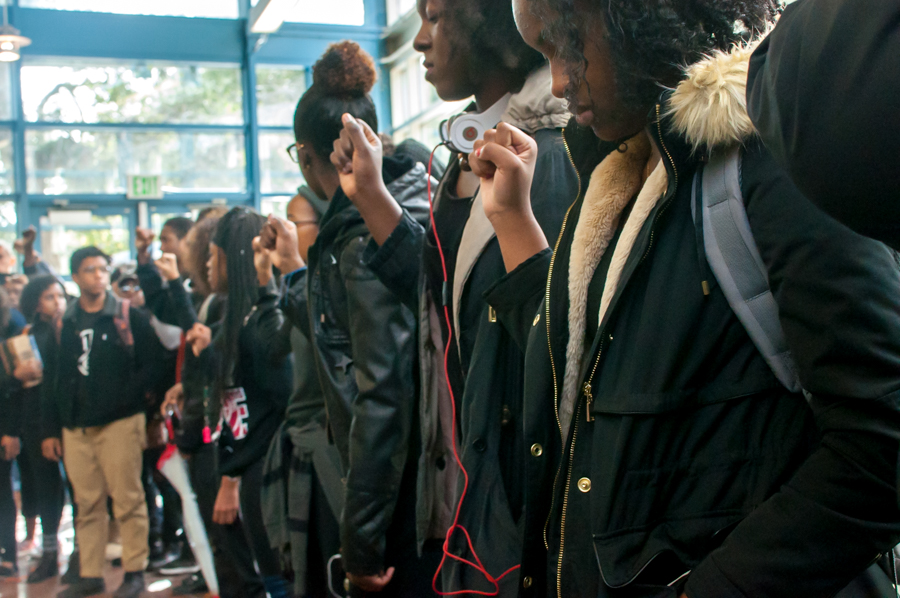
At around 12:45 p.m. on Feb. 17, members of the Davis African Diaspora halted the ASUCD Senate debate at the ASUCD Coffee House (CoHo), demanding accountability and action from members of the association following the recent hate crime against a female African American UC Davis student at West Village on Feb. 15.

The demonstrators entered the CoHo and formed a line in front of the table where the Senate candidates were seated. Kamaal Thomas, current ASUCD Senator and member of the group, posed questions to the candidates on various topics related to Black Aggies.

The group of students sought to bring this instance to the forefront of the debate. Thomas, a fourth-year international relations and Chinese double major, explained that the protest was relatively spontaneous.

“I decided to do it five minutes before it happened,” Thomas said. “I completely blanked that the meeting was going on today, but I stepped in to grab a napkin while I was eating and noticed that the debates were going on, and I realized this was a perfect opportunity ask real questions that affect real students here at UC Davis- questions that that often go unasked during these debates.”

Thomas pointed out that only one candidate had made a statement condemning the hate crime, and demanded answers from all Senate candidates about how they plan to respond to this and future issues in the Black community. The protest was a moment of clear visibility for a community that often goes unseen at UC Davis.

Davares Robinson, a first-year cognitive science major, was one of the demonstrators standing in front of the candidates’ table. He said that while the experience may have been empowering, it was also indicative of the larger problem of lack of visibility for the Black community on-campus.

“[The protest] felt empowering, but the fact that it isn’t on the minds of the students on this campus, students who are going to be affected by the decisions that these Senators make, bothers me. Why is our going in there almost like a pop quiz to them?” Robinson said. “I am happy that we had the sense of agency to go in there, but I feel like having to do it in that way is indicative of the nature of the issue in general. It isn’t a primary issue. It is secondary.”

Carli Million, a first-year political science major who was in the CoHo while the demonstration took place, was unimpressed with the candidates’ responses to questions asked by the protesters.

“I felt a little emotional after hearing what everyone had to say. I definitely agree that the candidates need to focus less on their own platforms for this issue,” Million said.  “I understand that the elections are an important time for them, but this is an issue that needs to be talked about on its own.”

Laura Lopeman, a first-year chemistry major who was also present during the protest, said she was glad these issues were brought to the forefront of the debate.

“I found out about the hate crime through the Chancellor’s email. Like [the demonstrators] pointed out, though, I never received a WarnMe notification, which doesn’t make any sense,” Lopeman said. “The demonstration was powerful.”

by SARA WILLIAMS

University of California shows its presence on Forbes’ ‘30 under 30’ list

Henry "Hoby" Wedler, chemistry graduate student. (GREG URQUIAGA / UC DAVIS)
Henry “Hoby” Wedler, chemistry graduate student. (GREG URQUIAGA / UC DAVIS)

40 people with UC ties were named in the annual list of up-and-coming changemakers

On Jan. 4, Forbes Magazine presented its 2016 installment of its annual “30 under 30’ list a selection of “young entrepreneurs, breakout talents and change agents” from 20 different fields in the world today. Of the 600 that made the list, 40 people had ties to the University of California (UC), including one recent alum from UC Davis.

Showcasing youth for its increasingly important role in business, art and social life, Forbes screened 15,000 men and women to find this year’s class, the fifth one since the magazine’s initial list in 2011.

When asked about the involvement and large presence of UC students on the list, the UC Office of the President (UCOP) acknowledged the delight that the accomplishment brings.

“These are very talented young people who are finding success and making a difference in many arenas,” said Rebecca Trounson, a representative for UCOP, in an email. “We are proud of their accomplishments and of their connections to the University of California.”

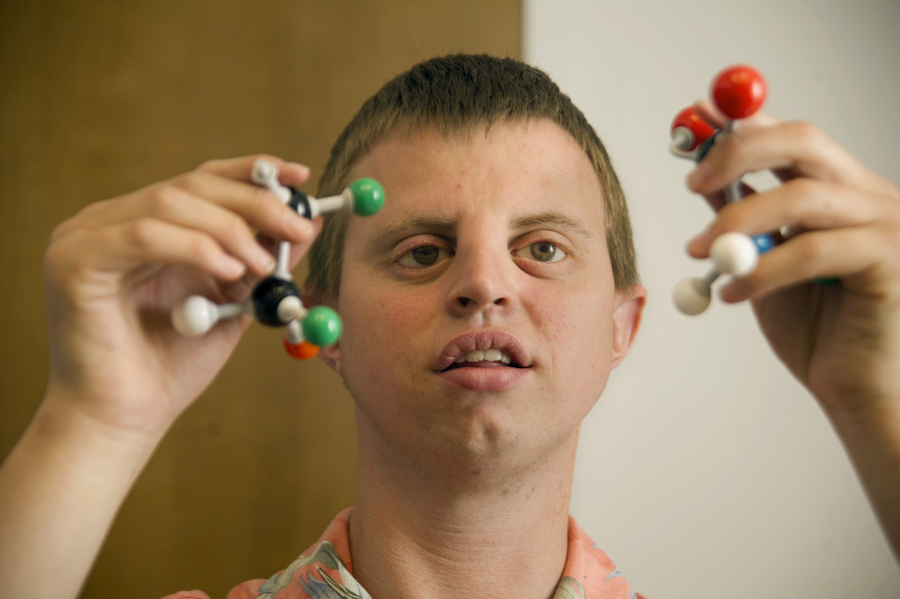
Henry “Hoby” Wedler, a UC Davis alumnus, made the list in the Food & Drink section as a flavor scientist and wine educator at Francis Ford Coppola Presents, a lifestyle brand including wineries, cafes, films and a literary magazine. Wedler, who has been legally blind since birth, has inspired students at UC Davis through his work.

“Putting in the hard work and going to Davis, which is such a great school, doesn’t just show [Wedler’s] hard work, but it shows all the teachers’ hard work,” said Joseph Brooks, a first-year political science major. “I think it’s just fantastic to see where he is at and it inspires every other student to see that they can be a part of something as great as this list.”

The list of 600 includes many big names in categories such as Sports & Entertainment, including NFL player Cam Newton and Oscar-nominated actress Brie Larson. Categories in which the UC made headlines include Science, with seven current students and alumni, and Energy, with five.

Also included in the list are NBA star and UCLA alumnus Russell Westbrook, UC Santa Barbara alum Shane Stanger, who co-founded Southern California ice cream and sandwich chain The Baked Bear, and UC Berkeley alum Kevin Chan, who is the founder of Maderight, a manufacturing company that helps designers ensure their clothing is not manufactured in factories using child labor.

Cecelia Marsh, a second-year animal biology major, talked about the opportunities that the UC system gives to people of different backgrounds.

“The UC system brings in a lot of people from everywhere and it really diversifies the culture around here,” Marsh said. “It allows people from everywhere to bring in their skills and allows them to use them in whatever field they want to be in. The fact that 40 people were able to make that list really shows that there’s a lot that you can do with the experience that you get, anywhere in the UC system.”

Other sectors in which the UC system was represented include Finance, Consumer Tech, Sports, Hollywood & Entertainment, Retail & Ecommerce, Education, Games, Venture Capital, Manufacturing & Industry, Enterprise Tech, Social Entrepreneurs, Law & Policy and Marketing & Advertising.

Forbes also accounts for some of the aspects and details that each member brings to the list. The data that was presented shows that 69 percent earned college degrees, 50 percent have zero college debt, 63 percent identify as growing up middle class, 36 percent are immigrants or first-generation Americans, and 84 percent are single. The top cities of residence are, in order, New York City, San Francisco, Los Angeles, Boston and Chicago.

When talking about what the list represents for universities like UC Davis, Brooks said that it shows the school’s ability to provide different avenues for its students.

“When people are looking for universities to attend, we’re right on the top of the list because we’re so diverse in all the opportunities that we have and I think that’s just phenomenal,” Brooks said. “We’re not just known for one thing — we’re known for many things. We’re a friendly campus that allows a lot of intellectual growth.”


Written by: Ivan Valenzuela – campus@theaggie.org

Davis City Council rejects soda tax

VENOOS MOSHAYEDI / AGGIE

Council voted 3-2 against initiative to tax sugar-sweetened beverages.

On Feb. 2, the Davis City Council voted to halt plans to put a soda tax initiative on the June 2016 ballot for the municipal elections. The council voted 3-2 against the proposal.

The tax was modelled on the soda tax in Berkeley, which was approved by voters in November 2014, making Berkeley the first city in the nation to implement a tax on sugar-sweetened beverages.

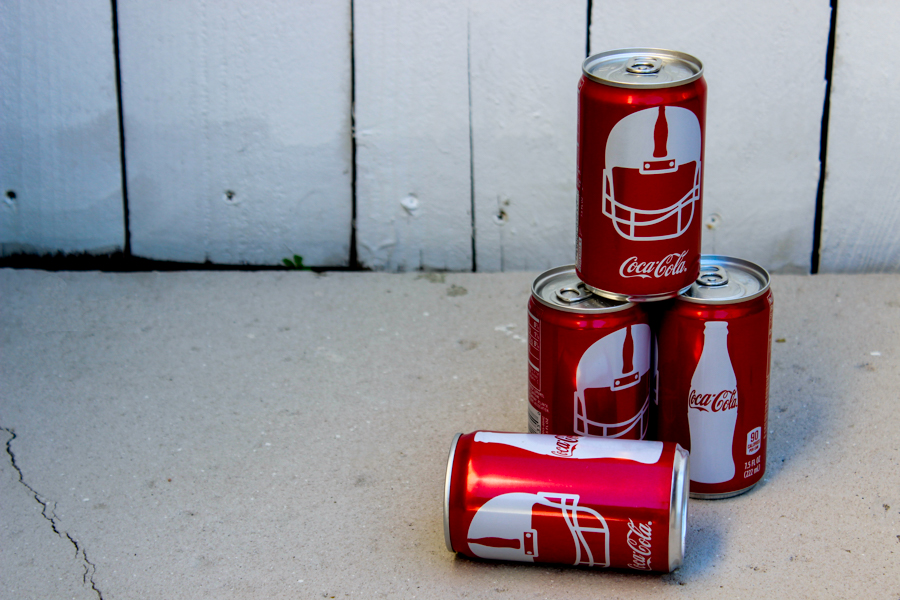
The proposed tax would have been $0.01 per ounce on all sugar-sweetened drinks and would have excluded diet sodas, such as Coke Zero. It would have been applicable wherever these beverages were sold, including cafes, restaurants, vending machines, supermarkets and convenience stores.

Davis Mayor Pro Tempore Robb Davis supported the tax but was left disappointed when the measure failed to get the four votes needed for the tax to proceed to the ballot. He emphasizes that, while the City Council may not have seen the measure favorably, Davis voters were ready to embrace the idea.

“It’s disappointing for me that we weren’t able to get it onto the ballot, especially because Berkeley has already done it […] I thought there was no problem in getting the community to vote on it […] I think [the tax] could have easily passed with the voters. We are a community that is concerned about health,” Davis said.

According to Davis, while it is unlikely that the tax will appear on the June ballot, a petitioning effort to make the city hold a special vote on the initiative is underway.

However, many small businesses, including Froggy’s Grill and Posh Bagel in Downtown Davis, spoke up against the measure, arguing that it would place administrative burdens on them and force them to absorb the cost of the tax in order to keep prices competitive.

The California Restaurant Association (CRA), an organization which represents restaurant owners across the state, lobbied against the tax after being contacted by local businesses.

Javier Gonzalez, senior legislative director at the CRA, explains that the tax would have hit small businesses that already have a very thin profit margin of between four and six percent.

“Every penny matters and so this would drive the cost up […] The restaurant is going to have to increase prices or, in order for them to remain competitive, absorb that cost and it’s going to affect their bottom line,” Gonzalez said.

Gonzalez strongly believes that the tax would hurt businesses, citing recent hikes in costs due to government measures such as the Affordable Care Act, paid sick leave and an increased minimum wage.

Gonzalez also disagrees that the measure was necessary in order to combat obesity and help promote a healthy diet. He believes that the restaurant industry is already doing its bit to help out health-conscious consumers.

“Restaurants offer an array of healthy options, low caloric or non-caloric beverages […] I know that our industry has been very responsive to consumers wanting additional healthy options; we are offering caloric information to consumers when they are making [drink choices],” Gonzalez said.

The CRA has been lobbying against the tax for the past few months. The organization sent out letters to both Mayor Wolk and the City Council, articulating its position and urging its members to speak out against the initiative.

Despite those concerns, Councilmember Brett Lee still believes the initiative would be beneficial and argues that the tax itself is not sufficient enough to deter consumers from frequenting certain establishments.

Lee finds many of the arguments against the tax, including those from the CRA, to be based on false grounds and argues that the initiative’s opponents have exaggerated its consequences.

“If the [CRA] thinks that the soda that used to be $2 and is now going to cost $2.12 […] is going to put restaurants out of business, I don’t share that view,” Lee said. “I think that’s a bogus argument.”

Many have also argued that the tax would be regressive and that the higher prices would disproportionately affect the poorest in society. However, Lee rejects that argument.

“What’s interesting is that when the polling is done, […] it’s the people who earn the least that are most supportive of the tax because they understand that by paying a little bit more, there are benefits to society. They are the ones that are on the frontline of the obesity issue and the lack of knowledge of what a healthy diet is,” Lee said.

Although the measure was rejected, Lee is confident that the proposal will return in the next municipal election in 2018.

“I think it is one of those things where Davis was hoping to be on the forefront,” Lee said. “It’s kind of a novel concept, whereas I think two years from now it will be much more commonplace.”


Written By: JUNO BHARDWAJ-SHAH – city@theaggie.org

Gallery 1855 presents ‘Davis Shopscapes’

0
Ben Tuason, artist. (KATIE LIN / AGGIE)

The evolution of an unpretentious small town.

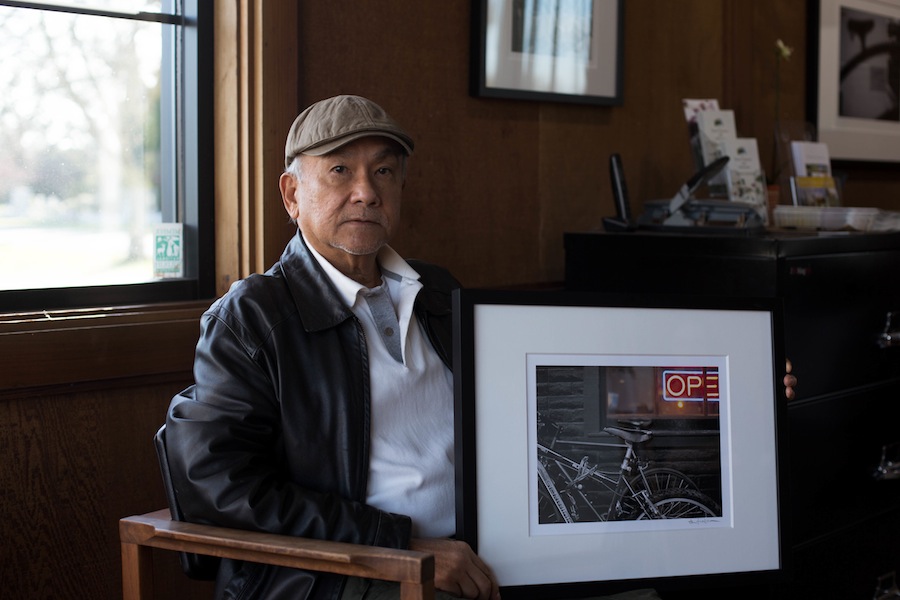
From Feb. 2 to 27, Gallery 1855 at the Davis Cemetery will present Davis Shopscapes, a photography exhibition by Manila-born artist Ben Tuason.

The collection consists of black-and-white photographs that capture the character of Downtown Davis’ cityscape. However, Tuason does not use photography to simply display urban architecture. Rather, he uses art to encourage his audience to appreciate their day-to-day environment and urban culture, and to see beauty in the most ordinary of things.

“Most are those everyday images which people may consider mundane but are elevated to the interesting, fascinating or even sublime when seen through the lens and artfully photographed,” Tuason said. “It satisfies me more to exalt the unnoticed than to merely document what is obviously pleasing to behold.”

Having lived in large metropolitan areas most of his life, Tuason found the modest atmosphere of Davis quite alluring. From the small inscriptions of a business shop window to monochromatic murals on exterior walls, he focuses on often overlooked details that give Davis its unique atmosphere.

“They don’t belong to the typical street photography characterized by the presence of chance-encountered street life, but I still consider them street photography,” Tuason said. “Ultimately, they’re about how the people live.”

While Davis Shopscapes sheds more light on the urban aspect of a small town, the collection of black-and-white street film images is reminiscent of a past era of major cosmopolitan cities such as New York and San Francisco. Gallery 1855 Superintendent Joseph Catterin remarked on the exhibit’s iconic imagery of the City of Davis.

“[Tuason] really gives the city of Davis the big city treatment,” Catterin said.

Gallery 1855 Curator Kristi Dvorak is excited to have traditional film photography within the gallery, as well as other mediums.

“I prefer having a kind of variety, because I feel like month to month, it’s nice to use the space to show off different artworks and different mediums for a wider audience to appreciate,” Dvorak said.

If you are interested in seeing Davis Shopscapes, visit their website. More information about the artist is available on his website.

Written by: MEGAN TOY – arts@theaggie.org

Set the Lights Low with The Afterglow

0
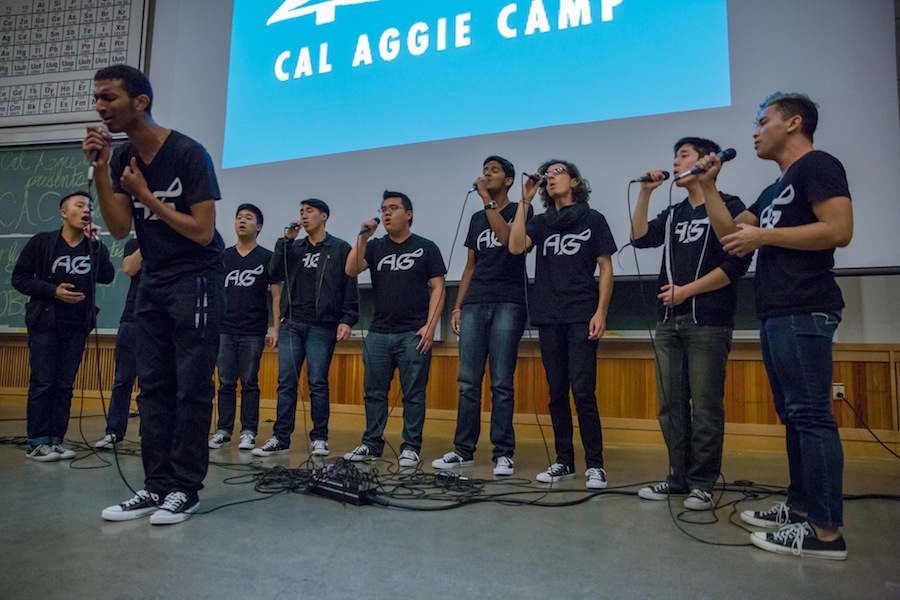
The Afterglow performed previously at Cal Aggie Camp's CACella. (JAY GELVEZON / AGGIE)
The Afterglow performed previously at Cal Aggie Camp’s CACella. (JAY GELVEZON / AGGIE)

The Afterglow, The Spokes and many others come together to bring you this romantic treat.

The fifth annual Lights Low with the Afterglow performance is set for this Friday, Feb. 19. The all male a cappella group The Afterglow, will be joined this year by the all-female group The Spokes, UC Santa Cruz’s the Hightones and The California Golden Overtones from Berkeley. Beginning at 8 p.m. in Science Lecture Hall 123, The Afterglow’s show promises to be as sweet as ever.

Henry Le, a third-year computer science and English double major, and social media manager for The Afterglow, explained why their annual show is held around Valentine’s Day and centers around love.

“Each group organizes a show every year, and our theme speaks our all-male, romantic brand,” Le said. “We usually invite all girl-groups so we’re the only guys.”

The Afterglow and The Spokes have a special connection on campus. Anya Stewart, fourth-year political science major and co-president of The Spokes, has been with the singing group for about three years.

“[The Afterglow] try to center the show around Valentine’s Day so they can do their ‘boy thing’ and get all the girls excited in the audience,” Stewart said. “They’re all super fun guys.”

Whilst the boys play up to their romantic image, The Spokes like to have fun with the theme too.

“[We] wear as much pink as we can to that particular show because it falls around Valentine’s Day, so we like to have fun with it,” Stewart said.

Traditionally, The Hightones and The Afterglow always invite the other to perform at their shows. Kathryn Coulombe, activities director of The Hightones, sees the Afterglow as their brother group in the far-off land of Davis.

“It’s a show we look forward to performing in each year because we get to see groups from other universities,” Coulombe said.

With The Hightones recently placing first at the International Championship of Collegiate A Cappella (ICCA) quarterfinals, and The Spokes placing second, be prepared for an all-star line up.

“Our win at ICCAs was a shock for all of us. We went into it as uncharted territory and were just excited to be going to quarterfinals. We never expected to place at all, especially first place,” Coulombe said. “We all agreed to go into the competition with a positive, non-competitive attitude. We were doing it to see what we could accomplish together and really stressed having fun. So even until the last moments before heading on stage, we were having a great time and supporting each other.”

Away from the heady competition of the ICCAs, all the groups are looking forward to having a good time at Lights Low.

“We sell raffle tickets for a serenade at the show. If we pull your number, we’ll bring you up for a serenade on stage. Last year we had 50 tickets bought for this one girl, and all her friends were screaming her name,” Le said. “We’re opening with ‘Dead and Gone,’ and closing with our traditional song, ‘Killing Me Softly,’ and if there’s any alumni in the crowd, which there usually are, we’ll invite them up onstage to join us, which is amazing.”

The Hightones setlist includes a Michael Jackson medley, as well as a mashup of the Taylor Swift songs “Blank Space” and “Bad Blood,” while The Spokes will be debuting a brand new song.

Tickets are now available for $7 presale or $10 at the door, and can be purchased online or at the MU tables. Check out the event page on Facebook for more information, or visit The Afterglow’s Facebook page.

WRITTEN BY: Kate Snowdon – arts@theaggie.org

The Elephant in the Room: Educational Inequity

0
DEBPARNA PRATIHER / AGGIE

There is no equality in the American system of education. The task of learning is an effective equalizer, but to get to institutions of higher learning now depends upon so much more than being a stellar student. Inequalities are systematic — preying on the underprivileged, targeting their families and dooming young children.

Getting a good education starts before grade school. First, students must be lucky enough to find themselves in homes in good school districts. Parents who are pressed for money often compromise by settling in subpar districts. Some parents don’t know that certain schools score better and therefore receive more funding to employ better teachers, obtain excellent technology and prepare their students more effectively for higher education. Until recently, struggling students who couldn’t make good grades were punished with less funding for their schools, resulting in an uphill battle for success.

School is more difficult for some students than others. To combat this, schools put students on tracks in which they are virtually bolted to their entire academic career. The tracking principle groups children by ability levels. Those with above average abilities are put on tracks that reflect higher levels of achievement. In poor schools with less funding (and often high levels of minority students), many are placed on low-achieving tracks early on. These students are more neglected by a system that does not provide them with equal resources. This follows them through high school and leaves them fundamentally unprepared to complete college coursework. Frustrated, many students take fewer classes and up the work hours they need to support their education, but, still not seeing the value in school, ultimately drop out.

What about the kids who beat a system stacked against them? On the chance that a student is able to overcome those odds, they first must work obscenely hard to move into a track with the appropriate college preparatory coursework. Second, they must devote extra time and effort into extracurriculars that will allow them to compete with their privileged counterparts. Things like unpaid volunteer work and captaining mathletes are much harder to fit into the schedule of a student with a struggling family. If they do overcome these hardships, and are able to put together a competitive application, still only about 56 percent of Americans finish a four-year degree.

So what’s the problem here? Even students who are able to overcome the odds and secure financial aid still drop out. A third of middle class students who leave college prematurely cite financial considerations as the reason. It’s often not their finances they are concerned with, but their family’s.

Lots of these students contribute to their households in big ways. These responsibilities are often worrisome. Students take on the large task of having to subsidize income or take charge of childcare. Often laden with the guilt of abandoning their family and frustrated with school, students quit. They go back home, only to reenter the workforce with a minimum wage job. Once they have kids, the cycle starts again, and the suppression continues generation after generation. In this way, the educational pursuit systematically oppresses the impoverished.

How ironic is it, that a system which focuses on intellectual liberation is actually subtly enslaving. While there have been efforts to improve elementary school tracking practices, the availability of high school extracurriculars and college retention, the problem doesn’t go away. Those are only bandaids for the larger issue of wealth inequality across America. Educational affordability isn’t just a matter of school, but also affordable living.

Economic class largely determines opportunity and success. America was founded on the principle that those who work hard will be able to achieve the most. I cannot think of anyone who works harder than the single mom working two minimum wage jobs to make ends meet and simultaneously attempting night classes. A pay-your-way education system impedes the efforts of hardworking Americans. Right now, with the system set up as it is, an affordable education is an illusion for millions of Americans.


You can reach KATELYN COSTA at kcosta@ucdavis.edu or on Twitter @costaaak.

Humor: Davis local recieves terminal diagnosis via Sweethearts

0
BECCA RIDGE / AGGIE
BECCA RIDGE / AGGIE

A not so sweet surprise

Davis local Bob Wiley went in for a scheduled check-up at his doctor’s office on Valentine’s Day and left with news that he would soon die of the bubonic plague. But it was the particular way he received this news that attracted our attention.

The check-up was normal: the doctor examined Wiley’s ears for spider colonies and took a urine sample that he would later drink as an after supper spritzer. But then the unusual occurred — the doctor handed Wiley a box of Sweethearts. Wiley recalls being bewildered at the offer.

“[The doctor] said ‘Happy Valentine’s Day’ to me and told me to open it, so I did,” Wiley said. “I love those little conversation hearts. Although, they’re always a little stale, don’t you think?”

The doctor had customized the Sweethearts with Wiley’s diagnosis from a fecal sample Wiley’s wife sent in January. Each of the hearts read: “U have 3 months 2 live. Sry.”

“I’m like, pretty upset I’m going to die,” Wiley said, “It was so hard to read. The font was so tiny. I wasn’t sure it was real. Three months is so soon! Ah! Dangnabbit — I have tickets to a Nickelback concert in July!”

We reached out to the doctor’s office for a comment and to see if he had any Sweethearts left because we were a little hungry, but they had given their last box to Wiley. Damn you, Bob.

“It’s Valentine’s Day, you know?” Dr. Grim said. “People are always sooo upset to hear they’re going to die. I just wanted to make it a little sweeter.”

Wiley won’t be making it to that concert as he’ll be dead. We hope you enjoyed those Sweethearts. Happy Valentine’s Day, Bob. We h8 u.

You can reach ALEX GUZMÁN at almguzman@ucdavis.edu and on Twitter @cactasss.

In defense of the dog

0
KATE SNOWDON / AGGIE

UC Davis research explores genetic effects of purebred versus mixed breed canines

Which is better: a purebred or a mixed breed dog?

Although the choice is that of owner’s, Dr. Thomas Famula, statistician and UC Davis professor of animal science, can help to impartially determine a dog’s genetic makeup which in turn might influence this end decision.

His research focuses on animal genetics ranging anywhere from livestock to topics such as Guide Dogs for the Blind. Since the ongoing debate between purebred and mixed breed dogs centers around the basis of the mating practices and health implications associated with inbreeding, Famula’s research is especially helpful in this field.

“Inbreeding does […] not make animals sick, [as] it’s just a mating strategy. What it does is genetically […] expose disease,” Famula said. “The reason people are against purebreds is because the population’s closed you are mating relatives, increasing the homozygosity [of the genes]. They still have health issues […] but they have that uniformity and that’s what the breed created.”

Some of Famula’s data collection of guide dogs focuses on creating better companions to assist the visually impaired. From this first-hand experience, Famula has been able to see the phenotypic (visual) and genotypic (genetic) effects in the breeding industry, which determine the health and concerns of the individual dog as well as influence the rest of the breed.

“The hope for dogs is that the genetic information will be useful, so that’s why our research is mostly on [if we can] find the genes,” Famula said. “[Right now], for a few genes in a few places, you can do that in dogs. Then, you don’t have to keep track of all the dogs [because] you’ve got DNA.”

As there is no current data set for the entire population of dogs in the United States, the hope is that molecular genetics could, one day, be more accessible in order to determine the health of a future companion.

“With all this world of nanotechnology, if I could take a sample […] and then look at that DNA and [find out] if they have the bad genes for epilepsy or the bad genes for heart disease, that’s something that would help a breeder,” Famula said. “They’ll have some information, but […] for most traits, we’re not there and other traits are never going to be there.

Dr. Anita Oberbauer, chair of the UC Davis animal science department, has worked with Famula on a number of papers concerning the effects of dog breeding. Through her work, she has seen that genetics could drastically improve the outlook for canine health, but emphasizes that the issue is more complex than that.

“If we knew the consequences of every single gene and every single nucleotide alteration, then we could predict the outcome of every genetic combination,” Oberbauer said in an email interview. “There are health improvements that can be done to reduce the incidence of deleterious conditions, [but] one must be mindful to avoid unintended consequences.”

Oberbauer is realistic when it comes to greater accessibility of genetic testing for all dog breeders to preserve the health and outlook for the individual dog.

“Knowledge and a willingness to improve the health of dogs must be applied to improve the overall health of the entire canine population […] and should enable wiser breeding decisions,” Oberbauer said. “Implementing genetic testing must be cost effective, [but] it is unlikely that genetic testing would be incorporated into the random bred dog population.”

In a 2013 study that collected over 27,000 dogs’ health records from the UC Davis Veterinary Medical Teaching Hospital, Oberbauer and Famula were able to statistically determine the probability of specific diseases when comparing all mixed breed dogs directly to all purebreds. According to a probability ratio of certain diseases in purebreds over mixes, purebreds were more likely to contract specific cardiac and orthopedic diseases, though 13 of the 24 disorders had no significant difference.

“The general belief [is that] purebreds are sick and mixed animals are healthier –– it was an everyday assumption, but [there was] never any data on it,” Famula said. “[These results don’t] mean mixes are totally healthy. Mixes got [aortic stenosis] too, but [they] are three times more likely [to contract it] if [they’re] purebred. The mixes were more likely to be hit by a car and […] to have ruptured crucial ligaments.”

Sergeant Michael Nevis, supervisor of Animal Services at the Yolo County Animal Shelter, discussed the different types of canines seen in shelters in the Davis area.

“Most animals that come here are mixed breed type animals. Very seldom do we get a purebred type of animal ––  [but] unfortunately they go a lot faster than a lot of the others,” Nevis said. “Part of the reason is that […] you spend quite a bit of money to get that purebred animal, so you have to take care of it more because you have more invested in it.”

Famula understands the potential moral concerns one may have in adopting a purebred over a mixed breed dog, but just like each individual dog’s health is dealt with on a case by case basis, no assumptions can be made about a human’s choice in companion.

“Breed is a human invention, created by people [and] maintained by people. People’s egos are wrapped up a lot of the time in the pets they own; that’s a moral quandary for other people to discuss, not animal breeders,” Famula said. “There’s no perfect animal that doesn’t have any disease, that’s ridiculous. There’s no perfect person, there’s no perfect animal.”
Written by Emilie DeFazio features@theaggie.org

African American UC Davis student assaulted at West Village

0
NICKI PADAR / AGGIE
NICKI PADAR / AGGIE

UC Davis police arrests two suspects for suspicion of committing a hate crime.

At around 3 a.m. on Feb. 15, a female African American UC Davis student was assaulted near her home in the West Village apartment complex.

UC Davis police officers arrested three men: Lonny Lee, 24, of West Sacramento and Justin Sheppard, 22, of Sacramento, for suspicion of public intoxication, assault and committing a hate crime, as well as Jake Lee, 22, of West Sacramento.

“All information is being released when it is legal to do so,” ASUCD President Mariah Watson said. “The victim has requested to remain anonymous, but we have been assured that they are [receiving] the necessary care and support from administration.”

Chancellor Linda Katehi also released a statement via email to the UC Davis campus community reaffirming the importance of creating a university free of hate crimes.

“We cannot stress enough that those who commit hate crimes in our community will be held accountable for their actions,” Katehi said. “Acts of bigotry and discrimination have no place in a civilized society and they have no place on our campus. A hateful incident directed at any one of us is an unacceptable affront to all of us.”

More information regarding the incident to follow.

Written by: Alyssa Vandenberg – campus@theaggie.org

Annual Vagina* OurStories production returns at the end of February

0
WRRC / COURTESY
WRRC / COURTESY

WRRC-sponsored show will feature student-written and performed pieces on the topic of gendered experiences.

Vagina* OurStories, an annual production inspired by Eve Enseler’s “The Vagina Monologues,” will take place at the Davis Veterans Memorial Theatre during the weekend of Feb. 27. The Women’s Resources and Research Center (WRRC) sponsors the annual event, which allows performers and audience members to engage with topics that are often considered to be taboo, such as gendered violence. The experience of discussing what is often unmentionable is cathartic and empowering for both audience members and performers.

The performance includes female-identified people who hope to share their gendered experiences with others, allowing themselves a moment of empowerment and healing. Though Vagina* OurStories has been an annual campus event for quite some time, the name of the performance has gone through a few changes in the last few years to make it more inclusive for non-binary and Trans* folks. According to the Facebook event page, the asterisk was added with the intention of making both the event title and the space more visibly inclusive to folks with marginalized genders or identities, not just those who have vaginas.

Camille Iman, a fourth-year English major, performed her own piece in Vagina* OurStories two years ago and is a co-director of this year’s show. When asked about the name of the performance, Iman explained that “Vagina” is used as a tool of empowerment.

“When people talk about the penis or ‘male’ genitalia, it is used in everyday culture. It is not stigmatized in the same way; it doesn’t get the same reaction as the ‘feminine’ genitalia,” Iman said. “So they named the show Vagina* OurStories to put the show in the light of that stigma and to say that [it is the same] around marginalized genders and marginalized bodies. The show is here to address this stigma, to give people access to healing around those stories and to raise awareness on these topics.”

Bernadette Fox, a fourth-year gender, sexuality and women’s studies and international relations double major, used Vagina* OurStories to aid in her own transitionary period, as she adjusted to being a transfer student at UC Davis and learned to address and find empowerment in her gendered experiences.

“[Vagina* OurStories] was a transformative, healing and emotional process for me. Knowing that process for me was also overlapping with other people that were having the same experience and going through the same process was very empowering,” Fox said. “The whole weekend of performing was kind of like everybody’s chance to put it all out there for the community and the crowd, but also for ourselves. We got to show everyone everything what we, personally, had been working through.”

Georgia Savage, a third-year political science and gender, sexuality and women’s studies double major, has been involved with Vagina* OurStories for two years now. Savage feels strongly that the performances are positive and empowering experiences for both the performers and audience members.

“People do not get the opportunity to speak about these issues. It is not socially acceptable to just bring up sexual violence or just bring up sex positivity every day,” Savage said. “All these people want to do, the only reason they are there, is because they have been ignored and have not been able to voice their stories. I think you can really make an impact simply by listening.”

Vagina* OurStories is, at its very heart, a community-building event. The performance is powerful in its originality; the performers are real people who have experienced real events, and are discussing them in front of hundreds of people.

Tickets for the performance can be purchased at the WRRC in North Hall as well as the Lesbian, Gay, Bisexual, Transgender, Queer, Intersex, Asexual Resource Center (LGBTQIARC) on a sliding scale of $5 to $10. You can attend a showing at Davis Veterans Memorial Theatre on Feb. 26 from 6 to 8 p.m., or on Feb. 27 from 2 to 4 p.m. or 6 to 8 p.m. More information can be found at the Facebook event page.

WRITTEN BY: Sara Williams – arts@theaggie.org

Davis’ hidden gems

0
LUCY KNOWLES / AGGIE

UC Davis students discuss the most underappreciated parts of Davis.

What is the most underrated part of Davis (campus or town)?

Stegi Ilanthiraian, second-year microbiology major
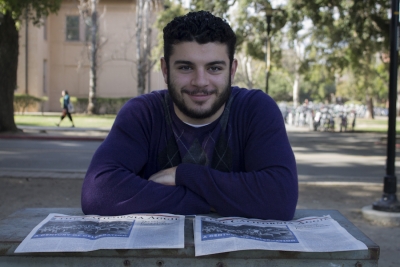
“The fourth floor of the [Peter J. Shields] Library — it’s really cool and there’s a lot of great books to read there.”


ahmad_karzoun_rovingreporter_fe_KnowlesAhmad Karzoun, first-year nutrition major
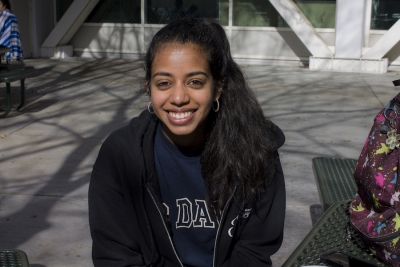
“[A thing] that’s really underrated is the spicy chicken burgers at the Silo because they’re $1.90 and they’re pretty big and they taste so good!”


anjali_wignarajah_rovingreporter_fe_KnowlesAnjali Wignarajah, second-year cognitive science major
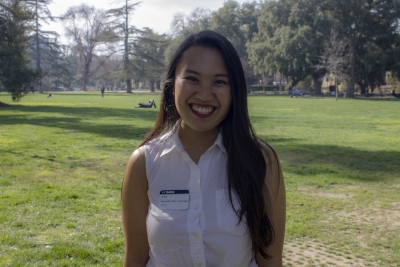
“The top floor of the Memorial Union parking lot where it’s just an open floor. If you go there at night, the sky looks really pretty.”


daniellemae_santiago_rovingreporter_fe_KnowlesDanielle Mae Santiago, fourth-year political science and philosophy double major
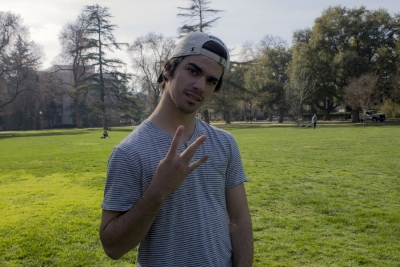
“I think Wednesday night [Davis] Farmers Market downtown. Not a lot of students know about them and they’re probably one of my favorite things to go to all time — it’s definitely something that’s a nice mid-week break. I think it’s very exclusive to Davis that there is a Wednesday night farmers market, so it’s definitely a nice hybrid of student life and the community coming together and enjoying Davis in general.”


emile_rappaport_rovingreporter_fe_KnowlesEmile Rappaport, first-year theatre and dance major
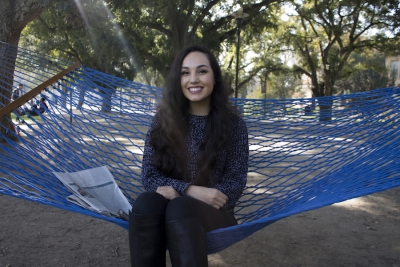
“In Segundo, right next to the dining commons, there’s that bike path […] and it goes under a little tunnel and comes back up on the other side and you don’t have to cross the road — it’s a fantastic little thing because you don’t have to wait at the stoplight.”


alaa_abukhazneh_rovingreporter_fe_KnowlesAlaa Abukhazneh, first-year nutrition major
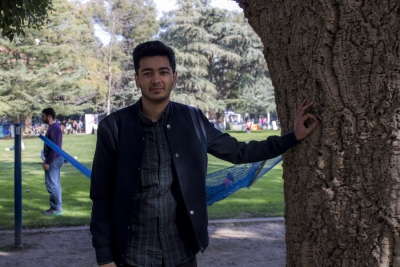
“The sixth floor of the [ARC] Pavilion parking structure at sunset — it’s beautiful.”

Angela Nguyen, third-year biological sciences major

“The Arboretum.”


syed_asad_ali_abidi_rovingreporter_fe_KnowlesSyed Asad Ali Abidi, first-year international relations major  
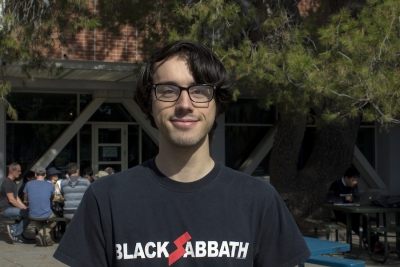
“The [Cal Aggie Christian Association] House Multifaith Community. It’s a great place to converse with fellow Aggies of different faiths.”


truman_williams_rovingreporter_fe_KnowlesTruman Williams, fourth-year comparative literature and Japanese double major
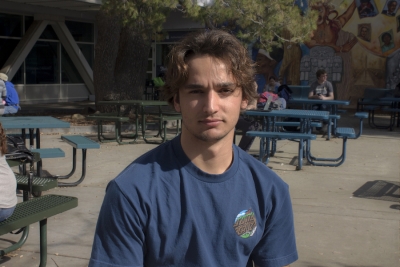
“I would say the local art and music scene because it’s actually really thriving, but it’s not something that anyone just visiting the town would realize. I had to be a student here for a year or two before I realized how many poetry readings, art gallery viewings and local concerts there are — so I’ve really come to appreciate that.”


charlie_schwartz_rovingreporter_fe_KnowlesCharlie Schwartz, first-year sociology major
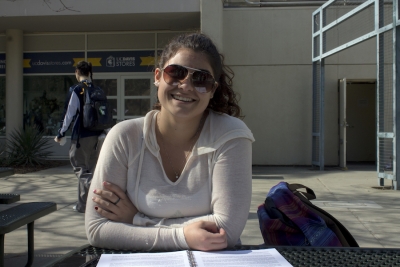
“I think the student organizations because they play a large part in getting students involved and sometimes they’re not as visible as they can be. I think that’s really a thriving part of the community.”


shayna_weiner_rovingreporter_fe_KnowlesShayna Weiner, second-year biochemistry and molecular biology double major

“I think the campus is fantastic in and of itself. I think it doesn’t get as much notice because people just think, ‘Oh it’s flat, boring, empty and it has cows,’ but I think it’s a beautiful campus and that’s one of the reasons I chose to go here specifically.”


Written by: Fatima Siddiqui – features@theaggie.org

The Good Scoop to host grand opening in late March

0
The Good Scoop logo was designed by Unseen Heroes, a Sacramento-based PR firm. The ice cream store is expected to open this March. (ASHLEY LUGO / AGGIE)

Family-owned business will bring Tara’s Organic Ice Cream and Stumptown Coffee Roasters to Davis.

Sibling team Marnie and Stephen Layton will fulfill a lifelong dream when their shop, The Good Scoop, opens next month on 130 G St. in Downtown Davis.

Along with Stephen’s wife, Azure, and their baby, Jackson, the family team aims to create an atmosphere in which friends can appreciate each others’ company while enjoying Seattle’s Stumptown Coffee Roasters and ice cream supplied by East Bay-based Tara’s Organic Ice Cream.

Tara’s Organic Ice Cream is created in small two-to-four gallon batches, uses no emulsifiers or stabilizers and is known for unique flavor options including avocado, saffron, sage, Turkish coffee and even Yerba Mate. Because Tara’s uses seasonal flavors and spices, not all flavors are available year-round.

“We will have classic flavors including chocolate chip, coffee, strawberry and a few others, but we hope to have about six interesting flavors at once such as germanium and strawberry rose,” Stephen said. “We will also carry Tara’s signature classic and black sesame cones, which will be made fresh in the store.”

Anthony Ruebner, the owner of The Good Scoop building, has attempted to bring Tara’s Organic Ice Cream to Davis in the past, but was unable to partner directly with Tara’s.

“Tara’s uses creative ingredients and is organic and sustainable, so it’s really popular here in the Bay Area,” Ruebner said. “I’ve always wanted to bring Tara’s to Davis, and I always thought it would be direct. Having Marnie and Stephen bring Tara’s to Davis through The Good Scoop is better than I could have imagined.”

Stephen also noted that The Good Scoop will accommodate special diets. For vegan customers, Tara’s menu offers sorbets, lightly sweetened with agave nectar, which will be featured in the store.

For its coffee offerings, The Good Scoop is partnering with Seattle-based Stumptown Coffee Roasters. Organic pour-over drip coffee and bottled cold brews to-go will be available in addition to organic teas and boxed water. The Good Scoop will also feature Stumptown’s nitrogen cold brew, which is brewed in a process that mimics Guinness beer.

According to Marnie, the team designed the The Good Scoop in order to create a community-based and student-friendly space.

“We will have 50 indoor seats and eight to 10 outdoor tables with room to expand. There will be a smaller dining area with booths designed for friends getting together, and a larger space with moveable tables and chairs that accommodate studying and working,” Marnie said.

The Good Scoop will also have free Wi-Fi and extended hours for late-night customers. The shop will be open until 10 p.m. from Sunday to Wednesday and until midnight from Thursday to Saturday.

Stephen currently works as an environmental scientist and the Laytons are designing their business to be environmentally sustainable.

“Environmental values are very important to us,” Stephen said. “We want everything to be compostable and we will be offering boxed water instead of bottled to reduce environmental impact.”

In order to foster a sense of community at The Good Scoop, Marnie and Stephen will ask local artists to showcase their work in rotating art exhibits inside the shop. They also plan to partner with local bluegrass bands to have live music on weekends.

Finally, Stephen and Marnie are donating 1 percent of the funds from each scoop of ice cream sold to benefit World Bicycle Relief. This nonprofit organization provides bicycles to students, healthcare workers and business owners in Zambia and Zimbabwe. The Laytons’ first goal is to provide 10 bicycles to the organization.

For more updates about The Good Scoop’s grand opening, see them on Facebook or at their website http://www.thegoodscoopdavis.com/.

Written By: CAROLINE STAUDENRAUS – city@theaggie.org  

City Council reaches out to ASUCD for recommendations on improving Davis nightlife

(AARON BURBANK / AGGIE)
AARON BURBANK / AGGIE

ASUCD sends out survey to gauge students’ feelings towards Davis nightlife.

A rise in violent incidents in Downtown Davis has led the Davis City Council to consider new ways of keeping the Davis nightlife environment safe, with one recommendation for all downtown establishments to close at midnight.  

This past September, Downtown Davis was the site of a fatal stabbing at KetMoRee. In a staff report released by Davis Police Chief Darren Pytel, Assistant Chief Paul Doroshov and Assistant City Manager Mike Webb, the city found that the violent crime incidents around Downtown Davis entertainment venues, such as nightclubs and bars, have increased over the past five years, from 162 reported violent incidents in 2011 to 209 incidents in 2015.

“The KetMoRee incident was a crime that shook Davis quite hard,” said Shaitaj Dhaliwal, ASUCD Executive Office chief of staff.A death is nothing to go unnoticed. It is a safety issue and we want to help [the] Davis Police Department figure out ways to improve our students’ nightlife safety.”

In an effort to capture the voice of the study body for City Council, ASUCD President Mariah Watson, along with her fellow ASUCD leaders, issued a survey to the UC Davis student population asking a variety of questions on a range of topics from safety concerns to preferred bar closing times.

During the Davis nightlife discussion last Thursday, Watson shared that the overwhelming majority of survey respondents had expressed that they

AARON BURBANK / AGGIE

preferred a 2 a.m. bar closure time, and that less than 5 percent of respondents reported wanting an 11 p.m. or midnight bar closing time.

“I think it’s a little unreasonable for bars to close at [midnight],” Watson said.

According to Watson, since ASUCD is recognized as the official collective voice of the undergraduate student body, City Council will be looking to ASUCD to make recommendations on behalf of the UC Davis students.

“It is our hope that the survey will help City Council be steered in the best direction in regards to their measures on downtown,” Watson said. “We’re confident that our voices and opinions will be valued enough to not have something too drastic occur.“

In addition to ASUCD, Chief Pytel is expected to present a recommendation before City Council for an ordinance that would require defined entertainment venues to have entertainment operating permits.

An entertainment permit would require establishments that have certain entertainment offerings such as a nightclub to meet additional security requirements.

“The entertainment permit would not allow the city to say, ‘You cannot serve alcohol after midnight,’” said Diane Parro, chief innovation officer at the City Manager’s Office. “However, if an establishment had certain concerns or certain instances that happened, they could get a requirement that says, ‘You cannot allow new entry after midnight.’”

Parro explains that this is just a suggestion that is to be proposed and all the details are not yet established. In addition, Parro notes that City Council could also decide they do not like the suggestion, and could instead consider a zoning code revision.

“Were [the council] to choose a zoning code revision or a combination of permitting and a zoning code revision, then they could re-zone the whole downtown and say nothing downtown can be open after midnight,” Parro said. “They have the power to do that. They could require a closure. So they cannot say, ‘You cannot serve alcohol after midnight.’ That’s not in a city’s purview that’s a state ability. But they do have the power to say, ‘You cannot stay open after midnight’ if they do it as a zoning code.”

City Council will hold a meeting today where they will address the Downtown Davis nightlife issue. This meeting is open to the public and the audience is invited to give public comment at the beginning of the meeting. The meeting is scheduled to start at 6:30 p.m. with discussion about Davis nightlife slated to happen at around 9:45 p.m.

Students and members of the Davis community are invited to attend the meeting and share any thoughts, opinions and suggestions they may have with City Council. The meeting will take place at the Community Chambers located at 23 Russell Blvd.

For more information, visit cityofdavis.org.

Written by: Jennifer Puza – campus@theaggie.org

Davis Stands with Ferguson hosts weekly teach-ins in honor of Black History Month

NICKI PADAR / AGGIE
NICKI PADAR / AGGIE

Teach-ins to address Black inequality at UC Davis

Davis Stands with Ferguson (DSF), a UC Davis club that challenges racial inequality, will be holding weekly teach-ins throughout February in honor of Black History Month. Held at the Memorial Union (MU) flagpole, these teach-ins aim to intersect structural and interpersonal experiences of violence that Black students face on the UC Davis campus.

Organized by fifth-year environmental science and management major Kyla Burke and sociology graduate student Brandon Buchanan, the weekly teach-ins address the lack of representation Black students experience at UC Davis.

“We wanted to do something to honor Black History Month,” Burke said. “We wanted to focus on different issues and aspects of being Black that keep the count of Black students on campus so low.”

According to DSF, the Black undergraduate population makes up only 2.1 percent of the UC Davis student body.

Since the first meeting on Feb. 1, the teach-ins have discussed topics including racism in the police state and Black queerness. Future teach-ins will discuss economic racism and injustice, tuition reform and solidarity with other communities.

Charlie Anderle, a third-year African American and African studies major and a member of DSF, presented on Feb. 8’s teach-in on Black queerness and sexuality. Anderle shared their thoughts on the impact of Black representation.

“With Black folks being such a small piece of the student and overall population in Davis, I think it is important that we support one another in having our voices heard,” Anderle said. “I hope that folks can take the opportunity to recognize what it takes to keep a community alive, to stay engaged in a struggle by holding one another accountable and to pour one’s energy and resilience into something that is larger than one’s self.”

DSF has also recently published a list of demands that they want the university to implement. These demands include an ethnic studies requirement for undergraduate students, the abolition of campus police, the admission of more Black students to UC Davis and the creation of a UC Davis Afro-House for Black students. DSF believes that UC Davis fulfilling these demands will support a more welcoming environment for Black students.

Fourth-year English major Camille Iman, who participated in the Black queerness and sexuality teach-in, shared her thoughts.

“It’s something that needs to be brought to mainstream conversation,” Iman said. “I wanted to show up to show some support and get myself educated. I would say that showing support is an understatement; this is more of a solidarity thing.”

The DSF teach-ins are open to the public and take place next to the MU flagpole. More information about the events can be found on Davis Stand with Ferguson’s Facebook page.

Written by: Emma Sadlowski – campus@theaggie.org