57 F
Davis

Davis, California

Monday, December 22, 2025
Home Blog Page 757

UC Davis study finds calico, tortoiseshell cats to be most aggressive

0
CIERA PASTUREL / AGGIE

Online survey of 1,200 cat owners reveals aggression tendencies among various coat colors.

Recently, veterinarians at UC Davis discovered a possible correlation between feline behavior and fur color. In the research from experts in the UC Davis Veterinary Medical Teaching Hospital, the researchers discovered that cats with calico and tortoiseshell coat patterns tend to be the most challenging and aggressive cats compared to those with less flashy, single-color coats.

To determine this, the researchers collected data from an online survey of more than 1,200 cat owners. The survey asked these cat owners about their felines’ behaviors, and requested that they choose a color category and written description that fit their pets best. They used a scale from zero to five to assess the frequency of behaviors, such as hissing and biting.

The study showed that cats with calico and tortoiseshell coat patterns tended to challenge their human companions more and exhibit more signs of aggression.

“We undertook this research to explore a long-standing assumption among veterinary professionals and cat owners that calicos and tortoiseshells are somehow different,” said Dr. Liz Stelow, a behavioral expert in the UC Davis Veterinary Medical Teaching Hospital. “We looked specifically at aggression and friendliness. They were significantly different from most other coat colors for aggression toward humans, but not for friendliness.

The study found that cats with these types of fur color are more likely to hiss, chase, bite, swat or scratch when interacting with humans.

“I have had Nala [a calico cat] for two years now and she’s feisty, but she’s also very lovable and just as good as a companion as my other cat,” said Sarah Ellen, a third-year animal science major who owns a calico cat and a black-coated cat.

The data also suggests that cats with gray and white or black and white coats are slightly more likely to engage in those behaviors compared to cats of other colors. The research found that cats with solid black, gray and white coats display less aggressive personality characteristics.

But this discovery does not intend to portray calico and tortoiseshell cats in a negative way. Dr. Stelow said the findings should not discourage people from adopting a tortoiseshell or calico cat; she owns one herself and believes they are great companions.

“Just because they have a higher incidence [of aggression] does not mean they are a problem,” said Melissa Bain, veterinarian and associate professor of clinical medicine and epidemiology, who worked with Dr. Stelow on the study.

Written by: Demi Caceres – campus@theaggie.org

500 balloons scattered across quad to raise mental health awareness

ARIEL ROBBINS / AGGIE

Nonexistent clear balloon representative of common mental health struggle on college campuses.

On Tuesday, Jan. 12, nearly 500 colored balloons were scattered across the Quad and Memorial Union. The true mystery: where was the clear balloon? Students were challenged to locate the one balloon void of color among the hundreds of balloons, many of which displayed messages prompting students to attend an event later that evening where the location of the clear balloon was to be unveiled.

Later in the day, many students and faculty attended the Student Resiliency and Mental Health Fair at the UC Davis Conference Center. The event was spearheaded by Caitlin Isobe, an intern at the Behavioral Health Center of Excellence. At the beginning of event, Active Minds President Brenna Williams announced that the notorious clear balloon did not exist.

“The clear balloon represents a college student that is unaffected by mental health issues,” Williams said.

The balloons were set up to pique students’ interest and direct them to the fair later that evening. According to Isobe, each balloon color represented a different mental illness, with the balloon colors corresponding to the percentage of those affected on college campuses.

According to Williams, a majority of the balloons were light and dark blue to represent anxiety and depression — two mental health challenges that she said are extremely common among college students. The absence of the clear balloon was meant to demonstrate the fact that a college student unaffected by a mental health challenge does not exist.

Active Minds, a campus club that seeks to change the conversation about mental health by raising awareness and educating others about mental illnesses and issues, was one of many student clubs present at the Student Resiliency and Mental Health Fair. Representatives from the ASUCD Office of Advocacy; the Center for Advocacy, Resources and Education (CARE); the Student Health and Wellness Committee and the Women’s Resource and Research Center were also present and provided students with tips and tools to reduce stress as well as to raise awareness for various mental health issues.

Multiple guest speakers at the event highlighted the importance of reducing the stigma around mental illness, both on college campuses and in surrounding communities. Sierra College student Jordana Steinberg was the primary speaker at the event and spoke about her personal challenges with mental and behavioral health. She is the daughter of former California State Senator Darrell Steinberg, a long-time champion of mental health for the state of California and the current director of policy and advocacy at the UC Davis Behavioral Health Center of Excellence.

“Rock bottom for me was the moment that I landed myself in juvenile hall,” Jordana said. “My behavior was so out of control that it became apparent to those who loved me that I needed more intensive care to get back on my feet.”

Jordana spent the next five years at four different residential treatment facilities and struggled with many obstacles. The chaos of her teenage years not only led her to experience significant emotional stress and turmoil, but to also fall behind in her academic life.

“All my life I had felt this sense of shame for not being where everyone else was and for struggling in such a way that no one else could understand,” Jordana said.

Jordana expressed the importance of having a peer-based support system for dealing with mental health issues on college campuses. She asserted that the negative stigma associated with mental health would be lessened if college students had resources to become educated on mental health issues as well as learn how to provide peer-based support to those struggling.

Prior to Jordana speaking, her father spoke to the significance of the mental health conversation on college campuses.

“It’s a labor of love,” Darrell said, with regard to his legislative accomplishments for mental health in California. “Mental health on the college campus is a crucial issue because it involves, in my opinion, a leading strategy for prevention and early intervention in our mental health system.”

In 2004, Darrell authored Proposition 63, otherwise known as the Mental Health Services Act, which called for the raising of taxes to provide additional funding for county mental health programs. Prop. 63 passed and has since provided many California counties with additional means to augment services for those struggling with mental illnesses; it now generates $1.8 billion a year.

According to Darrell, 20 percent of the funds gathered through Prop. 63 has to be spent towards prevention and early intervention programs.

“While 20 percent of the money must be spent on prevention and early intervention, our […] goal is to ensure that 80 percent of the public investment is spent on prevention and therefore only 20 percent has to be spent on back-end services,” Darrell said.

He emphasized the necessity of ensuring that a portion of the funds reach college campuses to help develop services for students.

“If we don’t invest in mental health services for young people, we are never going to ultimately solve the problems of the criminalization of [the] mentally ill, the plight of the homeless mentally ill, all the monies that are spent on full service partnership and on the back-end of our failure to invest in prevention and early intervention,” Darrell said.

Written by: LAURA FITZGERALD – campus@theaggie.org

Lend a helping hand

0
NATIONAL ALLIANCE ON MENTAL ILLNESS / COURTESY

UC Davis NAMI holds first aid training to help students cope with mental health emergencies.

The UC Davis National Alliance on Mental Illness (NAMI) began quarterly Mental Health First Aid Training in February 2015 to help students struggling with mental health issues.

“I attended the first one in February,” said Karishma Sethi, a third-year neurobiology, physiology and behavior major and publicity ambassador for NAMI. “It is a training in which students can learn mental health literacy and how to better themselves and the community through those skills.”

Students can utilize the Activities and Recreation Center (ARC) to take care of their physical wellness and some work part-time jobs to ensure that they stay financially stable. Yet amidst busy college days, mental wellness is all too often overlooked.

For some, this may result in high stress levels, anxiety and even depression. According to the National Institute of Mental Health, approximately 15.7 million adults 18 or older experienced one or more major depressive episode in 2014.

Making sure that friends and peers get the proper help or reassurance in order to make it through difficult times is the purpose of NAMI’s training. The training is provided free of charge by trained volunteers through the NAMI Yolo chapter. NAMI Yolo hopes it will benefit students by exposing them to a variety of mental health literacy skills, including the risk factors and warning signs for mental health problems, understanding mental illnesses, having an action plan for helping someone in crisis and finding professional help.

“It’s an opportunity to talk about something that not many are willing to talk about, especially with a group of peers,” said Sam Drexler, a fourth-year sociology and communication double major and the president of NAMI. “The event has a max capacity of 35 students per quarter for the event. There is always a wait-list; a lot of people are interested in this profession [and] want to get educated on it.”

Although the event is fully booked each quarter, club members assure that the volume of people in attendance does not distract from the value of the experience for each individual. Students come out at the end of their two-day training certified in Mental Health First Aid.

“You’re prepared on how to act appropriately when you see someone in distress,” said Jackie Leonardo, third-year cognitive science and neurobiology, physiology and behavior double major and NAMI publicity coordinator. “A lot of people know the gist of what to do logically, but this teaches you the little specifics on how to approach a person in distress.”

The training is set to take place later this quarter, with final preparations currently being made. As the events continue, NAMI hopes to aid others in their struggles with mental health.

“I came in not knowing a whole lot about how to be prepared for mental health crises,” Sethi said. “This training has been very beneficial for me and my well-being. It allowed me to realize that everyone is fighting their own battle.”
Written by: Alan Castillo – features@theaggie.org

Photo of the Week: 1/20/2016

It almost ate my homework. (NICKI PADAR / AGGIE)

Women in Athletics: Dr. Melita N. Moore

0
MELITA MOORE / COURTESY

UC Davis is home to 23 different sports and hundreds of student athletes. A fleet of staff works behind the scenes to ensure that every aspect of each sporting event runs smoothly on a day-to-day basis. An essential part to the athletic operation is the health department that cares for injured athletes, helping them get back on their feet in as short a time and in as safe of a manner as possible.

A recent addition to the UC Davis Athletics Sports Medicine Department is Dr. Melita N. Moore, who became Head Team Physician for the Aggies in June 2015. Dr. Moore is the first African American female in the country to hold this position in college athletics.

An Ohio native, Dr. Moore grew up around sports and always dreamt of becoming a doctor in sports medicine. She was a three-sport athlete in high school and moved on to play collegiate volleyball at Hampton University in Virginia. Being active in sports, as well as being the only girl on her baseball team as a child, Moore was familiar with living in a “man’s world.”

Moore said that being a female in the “man’s world” of sports medicine, however, comes with even greater challenges.

“There are a lot of roadblocks that come when you are a woman representing a professional team or a collegiate team, in the perception of how you can take care of an athlete, in the perception of how you should carry yourself as a woman being in a male-dominated field,” Moore said. “I don’t pay attention to any of that. I choose to wear whatever colored shirt I want, wear lipstick, and wear nail polish. I’m still my authentic self, which is sometimes hard to do as a female in sports medicine.”

Throughout the course of her career, Dr. Moore said she has not faced any serious issues in dealing with male patients or coworkers. After her fellowship at the UC Davis Medical Center, Dr. Moore said she was fortunate enough to have a great career in sports medicine without encountering any sort of gender discrimination.

“At UC Davis Sports Medicine, my mentors have set the tone that everyone is on an equal playing field, whether you are a woman or a male, regardless of race,” Moore said. “They have created this inviting environment. They created this culture, which has made my transition to sports medicine not as hard being a female. At UC Davis, our athletes have always been respectful because of the culture that the coaches try to establish as well.”

Although she knew that women in her field can face discrimination, Dr. Moore persevered, fulfilled her dream and made history in sports medicine.

“It didn’t stop me. It shouldn’t stop anyone,” Moore said. “It’s not a barrier; it’s just a small road block.”
Written by Patrice Yap – sports@theaggie.org

Women’s Gymnastics beams through competition at home meet

0
Jamie Yamashita scored a 9.150 on the balance beam on Friday night, contributing to the Aggies' total score of 49.025 in that event. (AARON BURBANK / AGGIE)
Jamie Yamashita scored a 9.150 on the balance beam on Friday night, contributing to the Aggies’ total score of 49.025 in that event. (AARON BURBANK / AGGIE)

The UC Davis gymnastics team opened their first home meet by welcoming competitors Boise State and Division II team Seattle Pacific to the ARC Pavilion on Friday, Jan. 15. The Aggies received a combined score of 194.325, which put them in second place behind the Boise State Broncos, who had a score of 195.700, and ahead of the Seattle Pacific Falcons.

“I don’t think that we’ve ever done 194 [in week two of the season],” Head Coach John Lavallee said.

Now at his tenth year of coaching the gymnastics team at UC Davis, Lavallee is confident in his team’s potential to succeed.

AARON BURBANK / AGGIE

“You should be looking out for all of these girls this coming season,” Lavallee said. “Any one of them can come out with an amazing performance.”

There were certainly standouts on Friday night. Senior Stephanie Stamates led the Aggie sweep on the individual beam event with a score of 9.850, while freshman Kara Jones, sophomore Alexis Brown and junior Katy Nogaki all scored 9.800. The total score combined for the beam was 49.025, a rousing success for the Aggies.

“We changed our approach today and it was about going in and being aggressive, and knowing what we were doing,” Stamates said.

The vault event was highlighted by Brown’s performance of 9.700 and Nogaki’s 9.750. The combined score for UC Davis was 48.375.

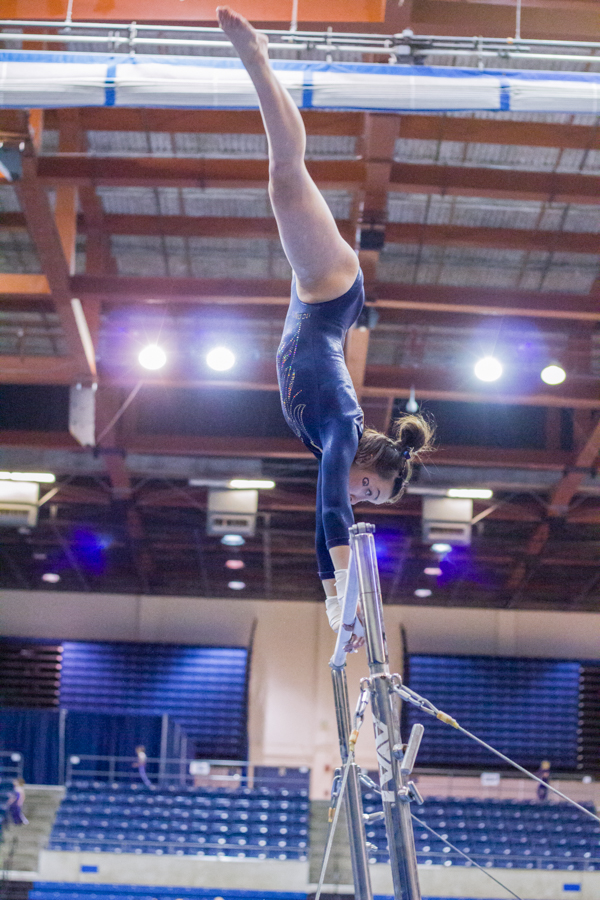
On the uneven bars, senior Dani Judal placed third with a score of 9.800, while junior Yonni Michovska scored 9.775 and Brown scored a 9.700, contributing to the total score of 48.325.

The final event of the night was the floor routine, and despite some minor hiccups the Aggies stuck their landings and performed well overall.

AARON BURBANK / AGGIE

Freshman Yasmine Yektaparast led with a score of 9.800, an impressive achievement for her second collegiate meet.

“As a freshman, [Yektaparast’s] tumbling passes are world class,” Lavallee said. “Once she really gets comfortable in this environment, she is

really going to raise the roof.”

Sophomores Miranda Holder and Amanda Presswood followed with scores of 9.775 and 9.750. The total score for floor was 48.600.

“We hope to get back to the ranking of 34th in the nation this year,” Lavallee said.

With such a promising start early on in the season, the Aggies have their eyes set on climbing to the top.

The Aggies will be heading to Provo, Utah to compete against Boise State and Brigham Young on Jan. 22.


Written by Julia Wu – sports@theaggie.org

The stars look very different today

0
ASHLEY PAE / AGGIE
ASHLEY PAE / AGGIE

A retrospective on the life and achievements of David Bowie.

It’s a hard thing, to grieve for someone you never knew. Because David Bowie was the only artist my parents could agree on, I grew up with his music around the house constantly. Yet hearing of his death was still a bigger gut punch than I expected.

I think most of us thought that someone as legendary and exceptional as Bowie couldn’t possibly succumb to mortal ills like the rest of us. After all, anyone who’s ever been a goblin king should really be exempt from death.

Some of the things I remember about Bowie will never leave me. I can still recall the first time I encountered Ziggy Stardust. I was six and confronted with this strange and wonderful man wearing makeup. Although baffled, I admired his flamboyance, though I didn’t know the word at the time. Everything about Bowie’s alter ego screamed excess, fun and irreverence, which, as a 6-year-old, I wholly identified with.

I’m also pretty sure my massive love for dance was partially instilled by Bowie. Anthems like “Let’s Dance” and “Dancing in the Streets” loomed large in my younger and present years, and always make me want to move.

And these are the things I’ll treasure about this fantastic human. I’ll always remember those times at home, watching Mum and Dad reminiscing about the one time they saw him live, hearing “Rebel Rebel” as an angry teenager and watching my little brother dance for the first time. Bowie’s ability to create moments like these won’t stop just because he has passed on, and that, more than anything else, is an achievement he would have been proud of.


WRITTEN BY: Kate Snowdon – arts@theaggie.org

Aggie Style Watch

0
HANNAH WODRICH / AGGIE

A comfortable approach to style.

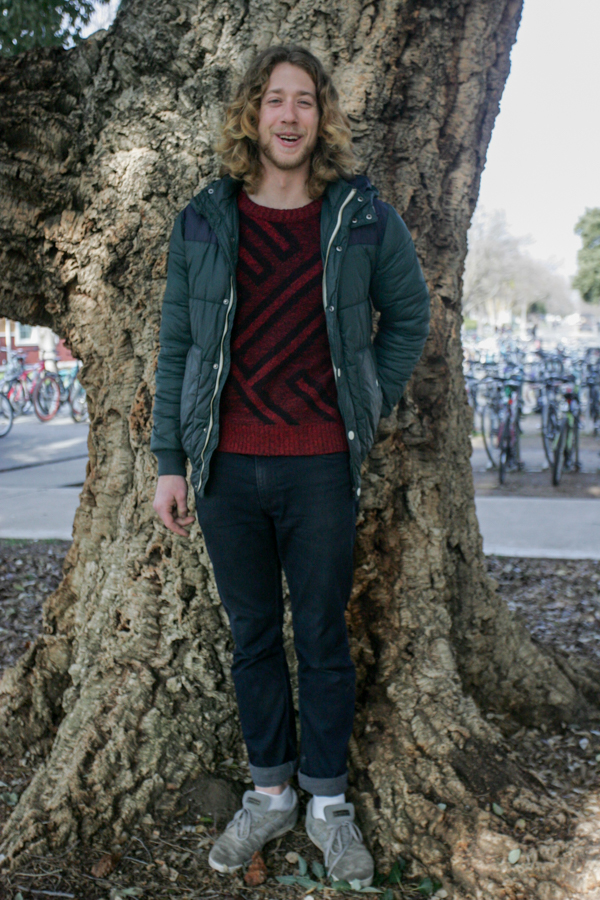
For those who enjoy hiking, rock climbing and other outdoor activities, it can be difficult to find the balance between fashion and practicality. However, fashion does not need to mean pain, and who’s to say you can’t look good in a comfortable sweater? Ellis Anderson, a fourth-year genetics major, proves that style and utility can go together.

ASW: Is fashion important to you?

Anderson: Yeah, kind of. It’s definitely been toned down the past few years. I have less money to invest in it, but I pick up some sweet finds at

HANNAH WODRICH / AGGIE

thrift stores.

ASW: How would you describe your style?

Anderson: That’s an interesting one. I haven’t categorized it in a while. I really like sweaters and button-ups. I try to be comfortable for the most part. I like wearing stuff that I can also be outdoors in.

ASW: Has your style evolved over the years?

Anderson: [There was] a pretty rapid shift. I used to wear really oversized T-shirts and basketball shorts but then I started wearing jeans. It started with bootcut style jeans, which aren’t too fashionable now, and I started realizing how things should fit.

ASW: Have you had any inspirations?

Anderson: Studying abroad in Sweden was pretty influential — they’re really fashionable. Everyone in the street looks good. At the airport in the U.S., everyone tries to dress as comfortable as possible, [but the Swedish airport] was the first time I’ve seen anyone pull off harem pants. Their fashion is a mix of conservative and modern.

ASW: Do you have any advice for students trying to build a wardrobe on a budget?

Anderson: I shop at H&M a lot. It’s a really good place to find staples. I also buy things out of season. [I like to frequent] thrift shops too. It’s good not to take yourself too seriously [when it comes to fashion].

ASW: Do you have any article of clothing that you can put on after a really bad day and it makes things a little better?

Anderson: I have a pair of fleece Adventure Time pajama pants. I definitely feel a lot better sitting in bed and drinking hot chocolate in them.


Written by: DIMITRA LOUMIOTIS – arts@theaggie.org

Food: Why eating with dietary restrictions will be easier than ever in 2016

0
HEE-AH YOO / AGGIE
HEE-AH YOO / AGGIE

versman_opI was born with severe food allergies. After 20 years of rejecting milk, egg, fish and nuts, I grew out of my dairy and egg allergies and finally started eating foods that come out of animal’s butts (I clearly did not do well in biology). Given that I’ve been restricted to half of the food groups for almost my entire life, it’s amazing that I would even entertain the idea of writing a food column. But it’s 2016, where columns like this are allowed to exist. So strap in and listen to my two cents about eating with dietary restrictions.

Because of my allergies, I know every trick in the book that will ensure what I’m eating won’t hospitalize me. Maybe you’re like me, or maybe you give up foods for moral, religious or political reasons. Whatever the reason, there is good news out there for you — I believe we’re living in the midst of a food revolution. It’s a sign of the times, really. Just 10 years ago, accommodating those with dietary restrictions was a surface-level concern in the culinary community. It used to be that your vegetarianism or your lactose intolerance or your obscure vitamin deficiency set you apart from everyone else. Obviously, restaurants would take your nut allergy seriously, but it was your job to scour menu ingredients, ask questions and double-check with the chef to make sure you wouldn’t leave the restaurant in a stretcher. And in many ways, it’s still like that. But everyone is so much more aware of the different ways in which we all eat nowadays. Restaurants, chefs and business-owners alike are taking note. And Millennials won’t judge as hard when your order takes longer than Hank Madsen’s Saturday night Snapchat story. To an allergy-prone foodie, it’s a wonderful site to see how it’s unfolding.

But how does this translate to Davis dining? Well, let me tell you. Here are the most accommodating places to eat in Davis, hyperlinked for your convenience:

Burgers & Brew: Portobello mushroom burger—Vegetarian/vegan. This burger is every bit as filling as its meat-filled counterparts and every bit as good.


Chickpeas: Halal/gluten-free. As far as American falafel goes, it’s not half bad. And you can put as much of the salad bar on top of your food as you want. It’s a fairly impressive salad bar too, complete with pickles, onions and different colored cabbages. Their meat is confirmed Halal, and better than Shah’s in my humble opinion.


Raja’s Indian Buffet: Vegetarian/vegan. Raja’s has tons of great vegan options. I personally love their dal and deep fried carrots (dip the carrots in the dal). Also pair their Naan bread with their vegan coconut curry. Plus, it’s all-you-can-eat for $6 and it’s across the street from campus (near the corner of 3rd and A).


Ali Baba: Vegetarian. If you get sick of Raja’s, Ali Baba is across the street and has a killer veggie breakfast burrito (make sure you get the BREAKFAST burrito, not the normal burrito. Huge difference). It may be the best breakfast burrito in Davis. Their secret? They put honey and Tapatío sauce in it.


Farmer’s Kitchen Café: Gluten-free (or any dietary restriction, really). This is a gluten-free bakery and restaurant in Davis. They clearly mark what’s in all their meals (and more importantly, what’s not in them). Give it a try if you don’t do bread so good.


Ding How: Vegetarian. Ding How is a Chinese food restaurant with an entirely separate vegetarian menu that includes vegetarian meat. I’ve tried it, and it isn’t half bad! (Pretend that wasn’t patronizing).


Mr. Pickles Sandwich Shop: Gluten-free wraps on all their sandwiches! They love it when you chant, “Mr. Pickles! Mr. Pickles! Mr. Pickles!” as you enter the restaurant with your friends.

“Now you’ve got a friend in the dinin’ business”
JONAH VERSMAN is third-year communication and economics double major. He can be reached at jiversman@ucdavis.edu.

Humor: Letter from the tangerine rotting at the bottom of your backpack

0
DANIEL TAK / AGGIE
DANIEL TAK / AGGIE

guzman_op_headshotDear human,

Remember me? That sweet little ball of citrus you carelessly threw in your backpack three weeks ago? I know, I know, I know. You’re all like, “How did you type this letter? Do tangerines really have consciousness? Oh God!”’ With my MacBook Pro. Duh. And no, I’m not God — I’m a tangerine.

First off, it reeks in here. Which is really saying something considering half of my once beautiful body is moldy. I think it’s Mr. Cheese Stick. You tossed him in here last week and I don’t think he’s doing so hot. Consider throwing a sachet in here or something, seriously, it’s bad.

Second, it’s filthy! Have you ever cleaned out your backpack? I’ve been staring at a Starbucks receipt from last December (nice choice of drink by the way; I also enjoy gingerbread lattes) every miserable day I’ve lived in this hellhole.

At night it gets cold. I’ve been using gum wrappers and used tissues as blankets. Do you realize how pathetic that is? As a young blossom I was handsome and respected. And this was my time to shine! Orange is finally the new black! That’s revolutionary! Also if you’re wondering, I’m team Crazy Eyes. Piper makes me want to gag with all that whining. Back to the point — now I’m resigned to live out my days covered in fuzzy mold and a mysterious crumb I’ve yet to identify. Get me out of here!

But first I have several questions for you: what’s a Yeezy? Who is this Donald Duck guy that’s running for president? And what’s all this hype over Making a Murderer? Why are you trying to make murderers? Humans, I swear! I feel so detached from reality; And please, for the love of orange juice, stop singing that ridiculous new Adele song. If anyone should be singing “Hello from the other side,” it’s me!

I’m writing you to request that you let me out. You don’t have to eat me; even I think I’d taste horrible at this point. So please, lay me to rest in a compost pile and let the worms have me. If I had arms I would wave a little white flag.

Sincerely,

The best tangerine you never had.

P.S. Does Ross end up with Rachel? I never got to finish Friends.

You can reach ALEX GUZMÁN at almguzman@ucdavis.edu.

The Daily Calendar

0

DailyCalWED., JANUARY 20

Improv Jam

6 p.m.

Olson Hall, UC Davis

Join UC Davis’ favorite improv group, Birdstrike Theatre, for a free evening of laughter in Olson 6!

Trivia Night

8 p.m.

KetMoRee Thai Restaurant, Downtown Davis

Compete against other teams in answering the hardest trivia questions! Free and open to all ages.

Unofficial Scrabble Club

5:30 to 11:30 p.m.

Crepeville, Downtown Davis

Play everyone’s favorite word game and compete with local Scrabblers! All levels welcome.

JumpStart Davis

6:30 to 8:30 p.m.

Sophia’s Thai Kitchen, Downtown Davis

Come join the local startup community of Davis, meet entrepreneurs and expand your networking skills!


THURS., JANUARY 21

Trivia Night

9 to 11 p.m.

Woodstock’s Pizza, Davis

Join teams of three to six people to answer unique and challenging trivia questions. Prizes, fun and pizza are in store.

Poetry Night Reading Series

8 to 10 p.m.

John Natsoulas Gallery, Davis

Poetry night hosted by Dr. Andy Jones with a featured guest at 8 p.m. and an open mic starting at 9 p.m.


FRI., JANUARY 22

The Producers

8 p.m.

Davis Musical Theatre Company, Davis

Come see a downtrodden Broadway producer make it big in this Mel Brooks musical tale! General admission tickets are $18, while students and seniors pay $16.

Stelth Ulvang

8 p.m.

Third Space, Davis

Enjoy a night of folk music for only $5.


SAT., JANUARY 23

Local Live Music

9 p.m.

Woodstock’s Pizza, Downtown Davis

Enjoy a fun night of live music free of charge!

The Producers

8 p.m.

Davis Musical Theatre Company, Davis

Come see a downtrodden Broadway producer make it big in this Mel Brooks musical tale! General admission tickets are $18, while students and seniors pay $16.

Workshop: Fruit Tree Pruning

11 a.m. to 1 p.m.

Farm 2.6, Davis

Learn how to care for fruit trees, and in turn help feed low-income and homeless locals in Davis.


SUN., JANUARY 24

Food Not Bombs

1 p.m.

Central Park, Downtown Davis

Enjoy free vegetarian meals with the fellow food lovers of Davis.

International Folk Dancing

7 to 10 p.m.

Davis Arts Center, Davis

Enjoy a night of dancing from all around the world. Your first time is free!

The Producers

2 p.m.

Davis Musical Theatre Company, Davis

Come see a downtrodden Broadway producer make it big in this Mel Brooks musical tale! General admission tickets are $18, while students and seniors pay $16.


MON., JANUARY 25

Performers’ Circle

6:45 to 9 p.m.

Village Homes Community Center, Davis

Come enjoy some music, dance and poetry in this free monthly open mic!

Pub Quiz

7 p.m.

de Vere’s Irish Pub, Davis

Free quiz night hosted by Dr. Andy, with teams of up to six players. Arrive an hour early to secure a table.


TUES., JANUARY 26

Salsa Tuesday

9:30 p.m.

The Graduate, Davis

Dance lessons with Cori from ‘Barbara’s Dancing Tonight,’ hosted by DJ Miguel. Tickets are $6.

Trivia Night

9:30 to 11:30 p.m.

Sophia’s Thai Kitchen, Downtown Davis

Compete against other teams in answering the hardest trivia questions! Free and open to all ages.

Spring quarter’s top seven

0
ARIEL ROBBINS / AGGIE

The best general education classes to take this spring.

With pass times just around the corner, freshmen are looking to lighten their class load while seniors are hoping to satisfy their remaining requirements, with everyone in between frantically searching for interesting General Education (GE) courses to add to their spring schedules. Unfortunately, not every student has the time, energy or desire to scroll through Schedule Builder for hours on end to find the perfect match. Save time and check out this list of seven GE classes to consider taking this spring.


ENL 5F – English 5: Fiction & ENL 5P – English 5: Poetry

GE credit: AH / WE

Units: 4

Students looking to channel their inner J.K. Rowling or Shakespeare can do so by taking English 5F or English 5P. These four-unit classes offer students hands-on experience with reading and writing fiction or poetry. Students have the chance to become authors themselves in a small classroom environment that encourages discussion and collaboration. Fiction and Poetry are introductory courses that are accessible to students of all majors, and are meant to encourage students to express their creativity. For this reason, they are great class choices for those who see writing as an intimidating task. One last thing for those who still need convincing — this class has no final exam!


ANT 003: Intro to Archaeology

GE credit: SE / SL / SS

Units: 4

$5 services fee

Ever wondered how generations lived before the dawn of iPhones, CoHo food and student housing? If so, consider taking Intro to Archaeology. During lecture, learn how archaeologists use excavation sites to piece together human history and prehistory. During discussion, look at various excavated artifacts, and even get the chance to hold and touch some extremely old items. This four-unit class is a great fit for students looking to fulfill GE credit and learn about something that may be new and unfamiliar, from professors who are extremely passionate about the subject.


SOC 025: Popular Culture

GE credit: SS / VL

Units: 4

How exactly did Beyonce become “Queen B?” Why is Instagram so wildly popular? What influences media culture? These questions are explored in Popular Culture, but students who take the class are guaranteed to gain knowledge of cultural expressions by studying different forms of art, music and more. This class captures aspects of everyday life in art and media through the lens of sociology, making it a great class for students looking to add a bit of uniqueness to their schedule.


ENT 001: Art, Science, World Insects

GE credit: AH / OL / SE / SS / VL / WE

Units: 3

$65 services fee

Entomology 1 fuses the worlds of humans and animals by blending art with the study of insects. This class fulfills a variety of GE options, meaning that students of all fields have the chance to experience a unique subject that they might not have seen in their course of study. Art, Science and World Insects includes two lectures a week and one lab. In selecting which section of lab to enroll in, students have three options to enroll in: graphics studio, ceramics studio or multimedia studio. While there is a $65 dollar services fee to accommodate the course materials, this class is one of the most unique in the course catalog and is definitely worth the experience.


AST 10G: Introduction to Stars, Galaxies and the Universe

GE Credit: SE / SL / VL

Students wanting to surprise their friends, families, lovers or pets with an abundance of knowledge about the universe should definitely consider taking this introductory class. This interactive class is highly popular each quarter, and students can expect to learn about the world beyond the Milky Way. While this class does use physics to explain concepts, it is an introductory course and physics is not a prerequisite, making it accessible to students of all majors. Students who are interested can selectively enroll in AST10L (lab class) for one unit, allowing them to put their knowledge to the test and observe the night sky through telescopes!


ECM 1: Design of Coffee

GE credit: SE / SL / VL

Units: 3

$25 materials fee

Outsmart your coffee date by learning the science behind every college student’s favorite drink. Students in Design of Coffee will learn a “non-mathematical introduction” to the science behind coffee. This class teaches students how to think like chemical engineers, without requiring them to pursue an engineering degree themselves. With both a lecture and a lab, attendees have the opportunity to learn the science and practice the methods themselves. Past classes have completed Coffee Design competitions as a final exam, meaning students will be caffeined-up and ready to go for the remainder of finals week.


ABT 049: Field Equipment Operation

GE credit: SE, VL, QL

Units: 2

$26 materials and services fee

What better place to learn to drive a tractor than at one of the top agriculture schools in the world? In addition to learning how to operate a tractor, students will learn how to use field equipment, along with the basics of cropping and planting. This two-unit course can only be taken for P/NP, so students looking to enjoy the experience do not have to worry about getting that perfect A! Offered only in fall and spring, many Aggies recognize Field Equipment Operation as a must-do before graduation, so those interested should sign up quickly.

So, while El Niño continues to dampen the spirit of Winter Quarter, look forward to spring by planning a schedule full of one or more of these great GE classes. Students can find a comprehensive list of course descriptions online, and can also refer to their Schedule Builder to search for additional courses. Pass times will be released on Jan. 25, and registration will span from Feb. 1 to 12.


Written by: LINDSAY BILLINGS – features@theaggie.org

For your post-party cleanup needs

0
KATIE LIN / AGGIE
KATIE LIN / AGGIE

UC Davis students team up to create cleaning company Red Solo Cleaners.

In Fall 2015, two third-year UC Davis students teamed up to create Red Solo Cleaners, a post-party cleaning service for college students.

“Basically, somebody hosts some social event here in Davis and they go on our website and they fill out a form,” said third-year business economics major and Red Solo Cleaner cofounder Quentin Karn. “Then there are people who have already signed up [as cleaners] and we match the two together.”

Third-year international relations major and Red Solo Cleaner cofounder Josue Garcia first came up with the company idea last fall. As members of Greek life, Garcia and Karn were vaguely familiar with each other, and Garcia ended up approaching Karn with the idea.

“There wasn’t one moment where I was like, ‘Oh, I wish there was a business to do this,’” Garcia said. “I have a passion for everything business and entrepreneurship — I knew by the end of college I was going to start my own company, so I started to think of pain points in college students’ lives and how can I meet those needs.”

The company exists solely to serve as an after-party or after-event cleaning service, not as a general cleaning service. Cleaners will clean common areas like front yards, backyards, living rooms, kitchens, restrooms and garages, but do not go into bedrooms.

“We’re very specific for after-party cleaning because we want to create a brand and a personality to the business,” Garcia said.

Students who wish to become cleaners or request a clean can do so by filling out forms through the company website. Red Solo Cleaners also guarantees to pick the cheapest payment option for their services, since the company was created for college students.

“Our payment method is essentially: we can do per person that lives there, or per room,” Karn said. “So if you have a four-bedroom apartment, we can do $15 per bedroom or $12 per person — we automatically pick whatever’s cheapest.”

Fourth-year economics major Quan Dao recently hired Red Solo Cleaners after an event.

“I heard of [them] through Facebook, and they’re a reliable source,” Dao said. “Their service was excellent and they will definitely be contacted for future service.”

In the future, Garcia and Karn hope to expand the company to other college campuses.

“When you’re on one campus you limit your outreach and that means you have no growth, [which is] the worst thing [for] a company,” Karn said. “Right now we have all the growth to expand within Davis but when you bring it to different areas you’re really opening up your market reach, so that’s what we’re planning on doing.”

However, currently both Garcia and Karn are focusing on making a name in Davis.

“I want to make my presence known in Davis,” Garcia said. “I want this to be something every student at UC Davis knows about.”

Written by: Fatima Siddiqui – features@theaggie.org

California Department of Education publishes list of state’s lowest-performing schools

0
ASHLEY LUGO / AGGIE
ASHLEY LUGO / AGGIE

41 Sacramento schools, 7 Yolo County schools included on the list.

After an initial controversial decision to withhold the list, the California Department of Education (CDE) published a list of its lowest-performing schools in December 2015.

Under the 2010 Open Enrollment Act, state law mandates that the CDE publish the list. The act states that parents with children in open enrollment schools have the choice to move students into higher performing schools when space is available.

The open enrollment schools list included seven Yolo County schools; among them is Marguerite Montgomery Elementary in Davis. A total of 41 Sacramento schools from 12 districts were also included on the list.

On March 11, 2015 the CDE released a statement on its website stating that the 2014-2015 open enrollment list would not be published due to a transition out of STAR testing, the measure previously used to judge school performance. Instead of using one statewide test to measure school performance, California will now use multiple tests based off of Common Core standards. As a result, the CDE did not have readily available data for the 2014-2015 school year.

“One of my top priorities is developing an accountability system that meets California’s needs by looking at a broad range of measures defining student and school success, rather than relying on just one test,” said Tom Torlakson, state superintendent of Public Instruction, in a news release on the CDE website. “This will give us a complete picture rather than a narrow view.”

Critics and education advocacy groups immediately reacted to the news that the open enrollment list would not be published. Among these critics was Republican Senator Bob Huff from the 29th District, which includes large portions of Los Angeles and Orange County. Huff has been a prominent education reform advocate, pushing for parent’s choice of schools and greater options for parent intervention in low-performing schools.

Senator Huff and school improvement group EdVoice threatened a lawsuit over the CDE’s decision to not publish open enrollment data for the 2014-2015 school year, citing that the list was necessary to allow students to move to higher performing schools. Days before the Jan. 1 deadline, the CDE published the list of California’s 1,000 most underperforming schools using the most recent available data from 2013.

“The law required the publication of the list regardless of data used. The legislature created this statue in 2010 saying that kids were entitled to be informed of their school’s low performance and transfer to a new district in a higher performing school if it had room,” said Bill Lucia, president of EdVoice with a masters in economics from UC Davis.

Lucia notes that the Open Enrollment Act gave students the ability to leave schools within their assigned residential districts, which was not a feasible option before the act was in place.

“Without the statue and the publication of the list, if a student tries to transfer, the presiding district can veto the request and view the child as an ATM machine for their property taxes,” Lucia said. “This law gives parents a choice and puts them in the driver’s seat.”

Student advocates feared that without publication of the list, students already living in high-poverty areas would be disproportionately harmed because California law does not guarantee school or district transfers. Students are guaranteed free public education, but school assignments are based off of residential district areas.

“Children don’t have a shelf life. If adults need to take years or decades to fix school problems we created, they can go ahead and do that, but children deserve a better education,” Lucia said. “More affluent parents can pay tuition and actually go to private schools or just move to a better zip code in a more affluent neighborhood with higher performing schools. Families in poverty in historically low-performing districts don’t have that kind of flexibility.”

In response to the criticism, the CDE noted the need for accurate and updated information.

“We faced the dilemma of producing a list based off a test that no longer exists. The state now files a lot more money into lower performing schools than it did in the past. The new funding may have pumped millions of dollars into these schools, which might not have been on the list if we had accurate data. We did not want to mislead parents; however, we had pressure to update the list,” said Peter Tira, public information officer for the CDE. “We complied with the law while putting in some caveats, noting that the data is three years old for parents to take into consideration before making any decisions.”

Katie Coyne, special education teacher at Prairie Elementary in Sacramento and UC Davis alumna, explains some of the challenges faced by schools in high poverty areas. Prairie Elementary was not on this year’s open enrollment list, but it is a Title 1 school, meaning that it receives additional funding from the federal government to improve education in low-income areas.

“Many factors play into the performance rankings of schools. My students struggle to get through the day sometimes because they can’t bring a snack. Some don’t have shoes or enough clothing. Others have parents who [have been] murdered — these are extreme situations. Needless to say, these kids act out and it affects their education,” Coyne said. “If we can’t meet kid’s basic needs, they can’t access critical thinking skills. We have to view educational success as holistic instead of just using these measurements.”

Local underperforming schools have taken steps to increase resources for students. In 2010, the Sacramento City Unified School District identified six schools as “priority schools”; the six schools had very high poverty rates amongst students, with 100 percent of students at the poverty threshold. Rosa Parks Middle School was added as a priority school in June 2011.

In these schools, teachers were given specialized training on learning and assessment strategies. Priority schools have an additional administrator and full-time curriculum specialist employed. Teachers in priority schools with specialized training have unique protection against seniority-based layoffs.

In the 2012-2013 data, three of Sacramento’s priority schools were labeled as open enrollment schools. The data published in December 2015 only identified one of the original priority schools as an open enrollment school, showing that Priority School measures had changed the school’s state rankings.

“In terms of improving school rankings, it comes down not just to funding, but also to smart spending. Test scores and having the choice for open enrollment matters, but just because a student is poor does not mean a student will get a bad education,” Coyne said. “Some of the most dedicated teachers want to help these families and invest more time in the students.”

Written By: CAROLINE STAUDENRAUS – city@theaggie.org

UC Davis breaks applications record with 86,041 applicants

LUCY KNOWLES / AGGIE

UC Davis to accept more in-state freshman, transfer students for Fall 2016.

UC Davis received 86,041 undergraduate admissions applications for Fall 2016, making it the highest number of applications on campus record.

The number of freshman applicants grew by 6.1 percent from last year, totaling to 68,519 applications, and transfer student applications rose by 14.2 percent, for a total of 17,522 applications. Overall, UC Davis saw a 7.6 percent increase in applicants compared to 2015.

UC Davis also received a 4.5 percent increase in applications from California residents this year, with 80 percent of this year’s freshman applications coming from in-state, and more than 81 percent of transfer applicants coming from California community colleges.

“We are really pleased that UC Davis has attracted so many excellent applicants truly representative of our state and the world-class university we are,” Chancellor Linda P.B. Katehi said in a statement.

For the 2016-2017 academic year, the UC Office of the President asked UC Davis to enroll 1,000 more California residents. This request is in accordance with a state legislature enrollment plan that provided the UC with $25 million in an effort to increase the enrollment of California undergraduates by 5,000 for the upcoming school year, including an additional 5,000 by 2018.

In addition to receiving more California applicants this year, UC Davis also saw an increase in historically underrepresented students for Fall 2016. African American, American Indian and Chicano/Latino applicants now represent 35.1 percent of California freshman applicants, and 32.2 percent of California community college transfer students.

“UC campuses attract so many applicants each year mainly because of their top academic quality and excellent value,” said Rebecca Trounson, UC Office of the President media specialist. “Year after year, UC campuses are at — or near — the top of various rankings, whether those are measuring academic excellence, research quality and reputation, public service or other areas.”

For Gabe Mendez, a third-year engineering major, it was more than just the quality of the engineering program that led him to choose UC Davis.

“I felt like if I went to school in a big city, there would be a lot more distractions,” Mendez said. “I chose Davis because it’s a little more homey — a little college town.”

Whether it is for education quality, school rankings or a college-town feel, a record-breaking 206,339 people applied to the UC system this year for Fall 2016 admission. Aiding this record-breaking number was UC’s extension for transfer applications, which bumped the deadline from Nov. 30, 2015 to Jan. 4, 2016, allowing an additional 2,183 transfer applications from California residents to be received.

Last year, UC Davis enrolled 5,385 new freshmen and 2,971 new transfer students — one of whom was Mendez, who transferred from Mission College in Santa Clara, Calif.

“I am happy with my decision to attend Davis because I noticed that they love transfers here,” Mendez said. “I felt like it was very welcoming here, and something that stood out to me was that a lot of people in Davis were nice.”

For Fall 2016, UC Davis expects to have an undergraduate class of about 9,500 — a 13.5 percent increase over 2015 with the addition of 1,100 new undergraduates.

UC Davis will release all freshman admission notifications on March 11 and all transfer notifications on April 22.

Written by: JENNIFER PUZA – campus@thaaggie.org