60.8 F
Davis

Davis, California

Wednesday, December 24, 2025
Home Blog Page 776

The Millennial Age: Millennials and politics

0
JENNIFER WU/ AGGIE
JENNIFER WU/ AGGIE

prokos_opWith the presidential election only a year away, a discussion on Millennials’ role in politics becomes increasingly important. Every day, UC Davis students sport paraphernalia with certain political overtones. For example, notebooks and laptop stickers supporting the liberal Senator Bernie Sanders (D-Vt.) have become prevalent. I’ve often wondered what this says about Millennial political values. On which side, if any, do we tend to stand?

I wasn’t all too surprised to learn nearly all Millennials agree that reproductive rights and marriage equality are of utmost importance. As one of the most compassionate generations, Millennial promotion of social equality is essentially a given. What did surprise me was that we generally identify less with political parties, are less concerned with politics and vote less frequently than preceding generations.

According to a poll by the Pew Research Center, a measly 19 percent of Millennials agree that most people can be trusted, compared to 31 percent of Generation Xers and 40 percent of Baby Boomers.

In a Harvard study of 18 to 29-year-olds, only about 50 percent of respondents said they trusted the military and 42 percent expressed faith in the Supreme Court. The numbers were more dismal for institutions such as the federal government and the United Nations.

Sad, right? These studies suggest that Millennials don’t like to be categorized or side fully with one specific party, especially when they are distrustful of such prominent institutions. This skepticism also negatively impacts our level of political involvement.

In an article for the Washington Post, Mindy Romero, founding director of the California Civic Engagement Project at UC Davis, argues that we don’t trust political parties because of our upbringing in a period of extreme partisan bickering and economic hardships from the Great Recession.

Our generation just doesn’t see evidence that our government is helping us.

Many liberal Millennials have a disdain for the GOP because of their belief that this party brought on multiple wars and a dreadful recession in less than 10 years.

Democrats clearly have an advantage with Millennials,” said David Gergen, a political commentator and former presidential aide to Nixon, Ford and Reagan. “But they can lose it if they can’t get the economy moving or are beholden to the same old interest groups that younger people are rejecting.”

While Millennials tend to be socially liberal, we also care about a balanced economy. We want jobs after college so that we can pay our student loans (the average debt of a 2015 college grad amounts to $35,000). Eventually, we’d like to see the cost of education and the need for student loans diminished. Perhaps this is why many of us are counting on Democratic candidate Sanders. He appeals to our ideals and overall values regarding directness and accessibility.

In May, Sanders proposed the “College for All Act” to eliminate undergraduate tuition altogether. The bill would eliminate the $70 billion tuition expenses at all four-year public colleges and universities.

Still, the fickleness of Millennial opinion and low voter turnout make me doubt that this will be a Millennial-dominated election.

The other side of the barrel

BRIAN NGUYEN / AGGIE FILE

UC Davis responds to recent spike in campus shootings.

On Oct. 10, the topic of campus shootings hit closer to home when this year’s homecoming rival, Northern Arizona University (NAU), suffered from a tragic campus shooting that left one student dead and three others injured

NAU is part of a growing list of academic institutions that have fallen victim to gun violence. Eight days prior, a mass shooting in Umpqua Community College in Oregon left 10 dead and nine wounded. Texas Southern University (TSU) locked down its campus after a gunman opened fire and killed one individual shortly after the NAU shooting. This is TSU’s second campus shooting since 2009.

This recent spike in campus violence has incited several reactions within the Davis community. Chancellor Linda P.B. Katehi released a statement over email on the matter.

“I ask you to please take a moment to think of the victims of this hateful violence in Roseburg and in our country, and reflect on what we all can do to help them heal,” Katehi said in the statement.

Just recently, the state of California passed Senate Bill No. 707. Unlike the Gun-Free School Zone Act of 1955, Senate Bill No. 707 would prohibit firearms from any kind of academic institution, including universities, instead of just K-12 school zones.

For UC Davis Chief of Police Matthew Carmichael, more can be done to better educate students during events like this.

“After Virginia Tech, one of the resounding things we realized was that we [officers] do nothing for the community,” Carmichael said. “We don’t teach you, or impart upon in our community, what you should do during such a horrible event.”

Carmichael, alongside other officers, created the Active Shooter Survival Workshop as a way for individuals to learn how to better defend themselves in the event of an active shooting. The workshop is one of the first educational tools in the country to be implemented for students to better defend themselves in the event of an active shooter scenario. With the recent string of campus shootings, Carmichael’s workshop has been featured on several news and media platforms, including The Los Angeles Times.

The workshop is based on three pillars: run, hide and fight. With the aid of Rocky Randall Twitchell, a well-recognized martial arts expert, student volunteers help demonstrate tools that any individual can use to defend themselves. In a video posted in 2011, parts of the workshop and its exercises are briefly featured. As seen in the video, students are taught these tools through realistic simulations of a campus shooting.

Carmichael’s main concern is being able to reach students with this practical knowledge. Unlike cities and suburban communities, the university police department’s main priority is its students. However, being able to communicate to students can be difficult due to the certain social barriers in place between students and police.

“What we have found is having students communicate to students. Students can translate what we are trying to say so that [other] students are more accepting of the message because it is being presented in a relevant manner,” Carmichael said.

Carmichael’s workshop opens up the conversation of the campus policies and education that can be, and should be, in place for students.

When asking several students about their response to the workshop, many felt that the implementation of this kind of education is also crucial to encourage the wider discussion of gun violence on campus communities. According to first-year human development major Julia Yu, more should be done from the university’s standpoint to better educate students about gun safety.

“I think it would be really great if schools did a [workshop] because it would teach students how to protect themselves in a safe manner,” Yu said.

Carmichael plans to hold the first Active Shooter Workshop of the year this quarter. For more information concerning the Active Shooter Workshop, visit the UC Davis Police Department’s website.

U.S. Department of Agriculture awards UC Davis $4.5 million grant to study lettuce

MONICA CHAN / AGGIE
MONICA CHAN / AGGIE

Grant focused on research program for sustaining, improving lettuce crops

This month, 11 UC Davis researchers were awarded a specialty-crops grant of $4.5 million from the U.S. Department of Agriculture’s (USDA) National Institute of Food and Agriculture.

The grant’s purpose is to improve lettuce crops by supporting a multidisciplinary research program that will leverage new technologies to sustain the supply of lettuce in spite of changes in climate. It is a five-year renewable grant from the USDA’s Specialty Crop Research Initiative funding program made available through the 2014 Farm Bill.

The research team will consist of specialists in plant genetics and breeding, food technology and agricultural economics.

Research will focus on identifying plant genes that are key to developing important stress-resistance traits in lettuce. The money from the grant will also help the researchers fine-tune imaging technologies that will allow growers to remotely assess the status of their crops in the field.

“We will be exploiting genomic technology to address the needs in all areas up and down the lettuce production chain,” said Project Leader Richard Michelmore, a plant geneticist and director of the UC Davis Genome Center.

Maria Truco, assistant researcher and project scientist at the Michelmore lab, stresses the importance of the grant and study’s impact to help the environment.

“This grant will supply more abiotic stress-resistant and more water-efficient and nitrogen-efficient lettuce genotypes,” Truco said. “More nitrogen-efficient and water-efficient lettuce will reduce the environmental impact of lettuce production at the field level and reduce post-harvest waste with improved shelf-life types.”

Fifth-year doctoral student Miguel Macias, who works in the Michelmore lab, expressed his love for working with plants. Macias specifically noted his affinity for lettuce because of the many tools to assist with the study of lettuce genetics such as a sequenced reference genome. He believes this grant will not only help in the field of lettuce, but will help many other different crops as well.

“[T]his grant will allow important research on developing tools to monitor crop development and production,” Macias said. “The research done with the help of this grant can be extended to the growers to assist them on deciding whether it is necessary to apply more fertilizer or water to their crops.”


Two UC Davis professors join the California Academy of Sciences

0
VENOOS MOSHAYEDI / AGGIE

Professors discuss research, fellowship

This October, UC Davis professors Dr. Walter Leal and Dr. Lynne Isbell were both honored as the newest fellows of the California Academy of Sciences for their contributions to the natural sciences.

The California Academy of Sciences, located in San Francisco, is one of the world’s largest natural history museums with over 26 million specimens. It has evolved into a main source of public science education with original research contributions.

Every year the Academy’s Board of Trustees chooses a maximum of 15 distinguished scientists for their work in the natural sciences. The chosen scientists then become fellows for life, with goals to extend the Academy’s positive impact on research, public engagement and education through collaborative work with the researchers and staff.

Leal, a College of Biological Sciences professor, is looking forward to the outreach services that he will take part in. As a well-renowned scientist, he is fully aware of the divide between the scientific community and the general public, and has set his sights on closing that gap.

“There’s a mentality in the Academy of Sciences that asks, so what?” Leal said. “In other words, how is our research going to benefit the public? It’s very important because people aren’t here in the lab, so we have to tell them how the university and Academy works and how they can help us to make them better.”

Leal is currently studying mosquitoes to find a strategy that is more advanced than sprays and repellants to keep these pests away from humans, since they can lead to the spread of diseases like the West Nile virus. His team is working to figure out which compounds attract mosquitoes in order to trap the insects and use them for studies.  According to Leal, the long-term goal is to make a repellant that is non-toxic to animals and can safely manipulate the mosquitoes enough to control their population and contain the diseases they carry.

Among Leal’s team is Peter Choo, a postdoctoral researcher from South Korea who focuses on molecular biology. Choo looks at what olfactory receptors respond to which compounds for the traps.  He has worked with Leal for four years and said he was not surprised when he heard of his supervisor’s latest honor.

“[Leal] is highly recognized in the U.S. and overseas as one of the top entomologists in the world,” Choo said. “He gives me chances to learn totally different things, like bumblebee venom, which is completely unrelated to olfactory systems. He wants me to learn a lot of things before I go back to Korea next year, which is really good for me and my career.”

The second UC Davis professor elected as a fellow of the California Academy of Sciences is Dr. Lynne Isbell, a professor in the Department of Anthropology. Julie Linden, a former graduate student of Isbell’s and current doctor in the department of anthropology at UC Davis, credited her teaching success to the guest lecture opportunities that Isbell gave her .

“[Isbell] is a wonderful adviser and absolutely deserves her nomination,” Linden said. “She has contributed so much to a wide range of related disciplines. She is not only a leading researcher in the field of primate socioecology, but also an all-around great person who honestly cares about her students.”

Isbell studies ecological bases for the diversity of social organizations seen in primates.  Her latest project is in Kenya, where her team studied leopard-primate interactions using GPS collars and has recently sent the data back to Davis to be analyzed.

“What we want to find out is how often leopards and primates interact,” Isbell said. “Can we tell from the movements of the monkeys if they detected the leopard or not? [M]onkeys give alarm calls when they see one, so what does that alarm call do? Does it affect the leopard’s movements? It’s basic stuff that we still don’t know.”

Using the data that her team collected, Isbell has similar goals to Leal — both are looking to apply their findings to humans. Isbell hopes to discover ways in which the results can answer questions about how our ancestors dealt with their own predators, and how the gradual evolution of our bodies helped or hindered that ability.

In her 2011 book The Fruit, the Tree and the Serpent: Why We See So Well, Isbell suggests a new theory for the origin of primates and argues that humans’ superior vision is a result of the predation pressure from snakes. Through her research she found that venomous snakes only arrived in the New World after monkeys were there and had started speciating, thus making each new species adapt to the predation in slightly different ways. Those adaptations, Isbell said, explain the variation in neuronal wiring seen in New World monkeys, as opposed to the lack of variation in Old World monkeys, and was a critical aspect in human evolution.

Dr. Isbell’s book, which won the 2014 W.W. Howell’s Prize given by the Biological Anthropology Section of the American Anthropological Association, garnered attention from many different fields and has lent itself to further research regarding the link between snakes, primates and the evolution of humans.  She is currently working with an international team of neuroscientists to explore how sensitive the human visual system is to snakes alongside her research on leopard-primate interactions.  Both of these projects are reasons for her recognition as a lifelong fellow of the Academy.

“One of the jobs of the fellow is to work closely with the Academy’s museum duties and functions,” Isbell said. “We serve as experts for people who want to know more about certain topics and give guest lectures.”

Sharing experiment details have not always been on scientists’ radars in the past.  Many researchers used to believe that scientific jargon was too complicated for the general public and did not translate them into the vernacular.

“People outside don’t really know what we’re doing but it’s not their fault; it’s our fault that we didn’t explain,” Leal said. “I like to communicate with the public and I believe that since we use taxpayers’ money, we have to show the receipt.”

Although she does agree with Leal’s perspective, Isbell does not believe that the vocabulary difference is as prevalent in her area of research. As an anthropologist, her research focuses more on behavior and social activity of primates, which she considers to be more straightforward than understanding what is happening at a molecular level inside animal bodies.

However, she said she is aware that her definition of “straightforward” could be biased through her years of extensive research and is open to clarifying any technical terms her audiences are confused by. Both she and Leal agree that sharing scientific knowledge with the public is important as everyone deserves to have a say in what happens in the society, especially when it is their money that is funding the experiments.

“When I came to Davis, we were not very good in the [communication] department, but it became much better,” Leal said. “There’s still room to improve, but we translate to people in journals why this research is important now. Not all research can immediately be translated into something useful, but it lays the foundation for other things to build up. We need relationships with the public sector to transfer the information so it can be used.”

UC Davis researchers to build world’s first total-body PET scanner

JOE PROUDMAN / UC DAVIS

Researchers, radiation expert, office of research discuss implications of total-body scanner.

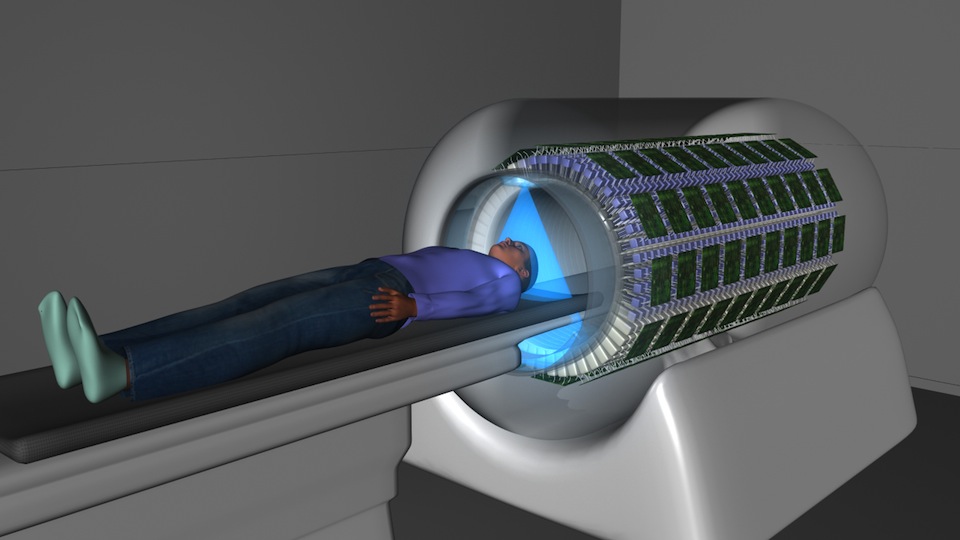
Researchers at UC Davis recently received a $15.5 million grant to build the world’s first total-body positron emission tomography (PET) scanner, an advancement in medical technology that researchers predict will revolutionize the health field.

After 10 years and 14 grant proposals, researchers were able to lay the groundwork for their “explorer project.”

“I feel elation and tremendous excitement when I think of the things we can do with this scanner,” said Ramsey Badawi, lead researcher and associate professor in the department of radiology at the UC Davis Medical Center. “I think we’re really going to change the way that we approach human imaging science, medicine and healthcare. There have been PET scanners before, but not great, big, long ones like this that [will be] so incredibly sensitive and capture the entire body in one go. That’s never been done before. This isn’t an incremental change — we’re going to make a really, really big change.”

PET scanners are already used clinically; however, they do not encompass the whole body. This leads to blind, or off-the-chart areas, that make it difficult to view how drugs affect the entire body or map the spread of disease.

“The ring of detectors in the typical PET scanner is maybe only about 20 centimeters big, and people are typically quite a lot bigger than that,” Badawi said. “Most of the person is actually sticking out of the end of the scanner, [and] it then looks like the marker is going nowhere. If you want to image the whole person, you have to step the person through the scanner which would take a bit of time. Now with a two-meter scanner, you can fit a whole person right through. This leads to a huge increase in the amount of radiation signal we can pick out.”

While magnetic resonance imaging (MRI) and computed axial tomography (CAT) scans look at body structure, PET scans look at the function cells are carrying out. In PET scans, a small amount of a radioactively-labeled probe is injected into the body. This chemical compound is designed to find a specific target in the body. This radioactively-labeled material emits radiation, which the PET scanner detects and measures. Doctors can track where the chemical compounds accumulate to determine whether the cells are alive and dividing, dividing excessively or dying out. A mathematical algorithm is used to create 3-dimensional maps of the body.

“By changing the chemical compound, we can look at different aspects of the biology going on,” said Simon Cherry, lead researcher of the study, distinguished professor in the department of biomedical engineering and director at the Center For Molecular and Genomic Imaging. “One of the things it’s used to look at is glucose metabolism. Glucose is a sugar the cells of the body use to produce energy. In many diseases, the metabolism of glucose is altered, so it goes up or down. It goes up in cancer. [I]n some neurological disorders, like Alzheimer’s disease, cells are dying off so they have a lower use of the radioactive glucose.”

Like MRI and CAT scans, the PET scan in current use only shows one part of the body at a time. Having a total-body scanner would allow doctors to see all the organs and tissues of the body at the same time.

“This is important because a number of diseases involve the whole body,” Cherry said. “Cancer is one obvious example because when cancer spreads, you don’t know where exactly it’s going to spread. Infection and inflammation can also occur in many parts of the body.”

With the whole patient enclosed in the scan, researchers can take “movies” of how radioactively-labeled material moves around the body. This is particularly important in drug trials. By attaching radioactive material to small samples of drugs, researchers can track a drug’s movement through a patient’s body and determine if the drug will go to other organs and cause any toxic side effects.

“This is quite a big deal because it costs billions of dollars to bring a drug to the market and a lot of the drugs fail when they’re doing wide-scale testing, which is very expensive,” Badawi said. “If we can weed out the bad drugs that are going to fail earlier, we can save a lot of money. We’ve got to get really good at making drugs cheaply and this kind of technology can really help.”

This opens up many possibilities in the healthcare field. Environmental toxins are another area of concern that require more research. By introducing toxins to the body at very small, non-harmful levels, researchers can track their movements and effects in the body.

Using a total-body scanner, as opposed to the current scanner, can also significantly reduce radiation levels.

JOE PROUDMAN / UC DAVIS

“We can do scans for 40 times less radiation with the new scanner,” Cherry said. “That’s about the same as the radiation dose that you get flying at high altitude in a plane from San Francisco to London and back again. The radiation dose with the current scanner is 40 times the dose you’d get on a transatlantic flight. One of the ideas of this new scanner is that the radiation doses are very low and in the range of things we experience in everyday activities.”

With the current PET scanner, the radiation dose is approximately equal to the amount of radiation people in the U.S. receive in two years from just living with radioactive materials in the soil and from outer space according to Jerrold Bushberg, clinical professor of radiology, radiation and oncology at the UC Davis Medical School.

“The normal risk of developing cancer in the U.S. is 44 percent,” Bushberg said. “The current PET scan can increase that by 0.1 percent to 0.5 percent depending on the gender of the patient and the age at which they were scanned. This is a very low dose, and it takes pretty high doses to increase cancer risks substantially.”

While the radiation risk associated with current PET scans isn’t high, according to Bushberg, the risk does increase for lower-age patients.

“Cancer has a time latency in development,” Bushberg said. “That’s about 20 years. Old individuals would likely succumb to other disease processes first, so the benefits of a PET scan dramatically outweigh the risks. Even for younger patients, if they do need a medical imaging procedure that is well justified and will play a role in their care, the radiation risk is secondary.”

One of the benefits of the lower doses of radiation with the new scanner has to do with giving children a less risky health method.

“PET scanning in adults has produced some pretty important results and many important advances in health care,” Badawi said. “It’s less available to kids because kids are more radiation-sensitive. So we don’t do the kind of research we do on adults on kids. If you’ve got a scanner with a much less radiation dose, now we can do science that can lead to cures that the adults would have to take drugs for.”

Because radioactive material has a half-life, meaning it decreases in quantity over time, materials with shorter half-lives can only be used for a short amount of time before they’re gone. A regular PET scanner works for approximately three half-lives, allowing for about six hours of imaging. The new PET scanner would work for eight half-lives, allowing imaging for 16 to 18 hours.

“Some agents that last for three days, we should be able to trap them in the body for a month,” Badawi said. “We can look at disease over a long period of time without really putting them at any radiation risk. […] If you get an ACL injury, you’ve got a pretty good chance of getting arthritis in 10 years following that. We can start to do PET scans on patients to look at arthritis development, or how that injury progresses.”

According to Cherry, the full-body scanner allows researchers to take the image in one-fortieth of the full time (or 30 seconds) while still using the full radiation and achieving high quality images.

Current estimates predict building of the scanner will be finished in two to three years. After that begins the long process of research and collecting data. If the project is successful, researchers hope the scanners will reach other major research institutions on a global scale.

“The goal is to show the impact of this technology on medicine and medical care,” Cherry said. “Building the scanner is really just the first part. What matters is how we’re going to use it. The goal is to get into doing studies in humans as quickly as possible, doing better cancer imaging, tracking an infection, helping to develop new drugs. We see this as being mostly research in the beginning. Before it can go to hospitals, we have to prove the value it can bring to modern medicine.”

While Badawi and Cherry are principal investigators in this project, the research also involved teams from a multitude of departments and was a joint effort with the University of Pennsylvania and the Lawrence Berkeley National Lab. Cherry and Badawi credit much of their effort to the Research Investment in Science and Engineering (RISE) program at UC Davis.

“[This] project really epitomizes our hopes for the RISE program,” said Paul Dodd, associate vice chancellor in interdisciplinary research and strategic initiatives at Office of Research. ”This project stood out as perfectly fulfilling our desire to stimulate high-risk, high-reward interdisciplinary research with a potential to have significant societal benefit. It was one of the outstanding concepts from our faculty selected as one of 13 proposals funded from 119 applications after a rigorous review process.”

While the process will be long and a great deal of responsibility, Badawi and Cherry both look forward to exploring the applications of their project and leaving immensely positive impacts within the medical field.

Raising awareness for domestic violence

HANNAH WODRICH / AGGIE

Students, staff discuss October theme of domestic violence awareness

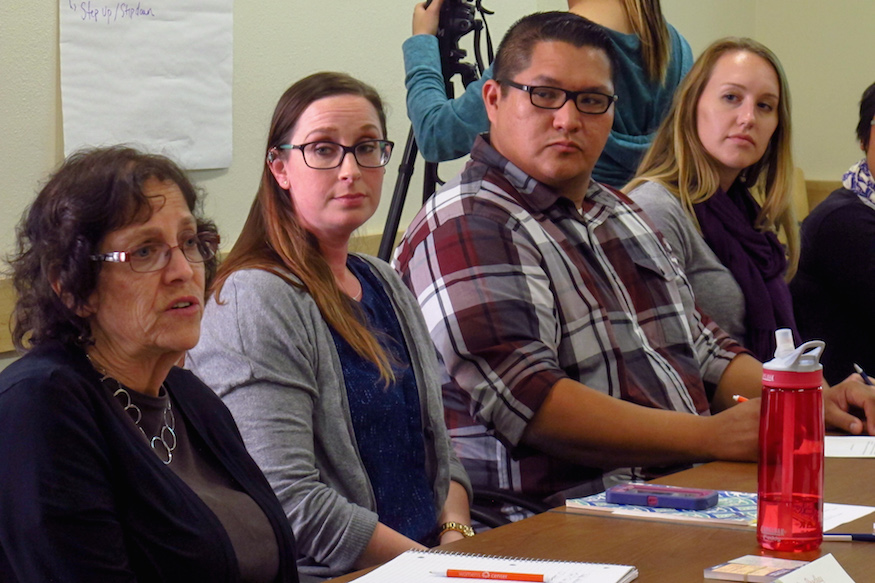
Every year since 1989, U.S. Congress has passed a public law designating every October as National Domestic Violence Awareness Month. On Oct. 23, students at the UC Davis Women’s Resources and Research Center (WRRC) held the university’s first-ever panel on the topics of dating and domestic violence.

According to President Barack Obama in a presidential proclamation published on Sep. 30, the month is intended to “reaffirm our dedication to forging an America where no one suffers the hurt and hardship that domestic violence causes.”

WRRC community organizer and fifth-year Chicano/Chicana Studies major Liz Lopez is normally tasked with organizing programs centered around gender equity, intersectional feminism and social justice. When the WRRC announced the idea of a panel for Domestic Violence Awareness Month, Lopez embraced the opportunity to help raise awareness about domestic violence.

For her, the decision to take on a project like this was inspired by her personal life. Lopez comes from a Mexican family and as she explained, the Mexican family structure is historically patriarchal, with males often asserting their dominance over females.

“I’ve seen friends and family go through some verbal abuse and a lot of the time it can be very hard for someone,” Lopez said. “Growing up, I didn’t really understand what a healthy relationship looked like, just because these issues weren’t talked about in my household. It doesn’t mean that there were only unhealthy relationships, but sometimes I didn’t know when to speak up and say something was wrong or right.”

Lopez invited speakers from both UC Davis departments and community organizations to the event. Representatives came from the Harassment & Discrimination Assistance and Prevention Program (HDAPP), the Center for Advocacy Resources and Education (CARE) and the Center for Student Involvement (CSI). The WRRC, the Lesbian, Gay, Bisexual, Transgender, Queer, Intersex and Asexual Resource Center (LGBTQIARC) and Empower Yolo were also involved.

HANNAH WODRICH / AGGIE

All departments are considered resources for survivors of violence or their friends, though some — like the WRRC, the LGBTQIARC and CARE — are considered a confidential resource.

“We are strictly confidential when it comes to these issues,” CARE Director Sarah Meredith said. “We do have to disclose when somebody is suicidal or homicidal, and we do usually ask what kind of support [a survivor has]. But we never want to make the assumption that their friends and family are supportive.”

Because survivors may not know where to turn when they feel ready to discuss their experiences, the majority of the discussion at the panel focused on how survivors of violence could find support in their community and resources available to them. Students and staff participated in the discussion, showing their support by wearing purple — the designated color for Domestic Violence Awareness Month.

It’s important to raise awareness about [domestic violence] because there is a lot of stigma against it,” said WRRC community organizer and fourth-year gender, sexuality and women’s studies major Julia Viramontes. “There might be students that are going through these things and they might not know that there are resources available to them on campus. They might not know that there’s a nationwide effort to raise awareness about this problem in order to change the negativity surrounding it.”

According to Meredith, these nationwide and campus-wide efforts to raise awareness about intimate partner violence should happen year-round, not just October — especially given the misconceptions surrounding this type of violence. Misconceptions includes the myth that domestic violence only occurs between married couples and not young people.

In fact, according to the National Coalition Against Domestic Violence, nearly 20 people per minute are physically abused by an intimate partner in the United States equating to more than 10 million women and men annually. College-aged youth are among those most at risk for domestic violence. WRRC Director Leilani Kupo agrees that these misconceptions need to be deconstructed.

“When we talk about sexual violence on campus, I think that there’s this misconception that domestic violence doesn’t happen on college campuses — that it’s only sexual assault,” Kupo said. “That is wrong on many levels. Domestic violence happens to college students, to staff members, to faculty — it happens between all of those communities as well.”

According to Lopez, the process of learning about domestic violence, red flags and resources has helped her heal, and she believes it was her perfect chance to take action against it. However, she said that the work of the WRRC is never finished.

Besides the panel, the WRRC uses other outlets and resources to raise awareness for domestic violence. Vagina* OurStories is a student and community-run performance that aims to draw attention to gender violence, which extends to domestic violence. The WRRC also runs the Davis Feminist Film Festival, which uses alternative media to draw consciousness to social and gender justice issues, sometimes extending to domestic violence as well.

“If we don’t talk about it, nobody’s going to really talk about it,” Kupo said. “It’s important that we talk about domestic violence, interpersonal violence and sexual violence, and that we do it not only in October, but throughout the year — and that we talk about it in different ways.”

UC Davis Medical Center releases stabbed American hero from care

0
UNIVERSITY OF CALIFORNIA, REGENTS / COURTESY

Hospital treats injured airman Spencer Stone for collapsed lung, lacerated heart

On Oct. 15, injured Air Force airman Spencer Stone was released from UC Davis Medical Center (UCDMC) care after he was victim to a brutal stabbing the week prior.

Stone suffered multiple injuries, including a lacerated heart and collapsed lung, after he was stabbed outside a bar by two men in Sacramento at approximately 12:30 a.m. on Oct. 8. The incident came only two months after Stone was lauded as a national hero for thwarting a potential terrorist attack on a train headed to Paris in August.

Stone was admitted to the UCDMC for immediate care and arrived at the center’s Level 1 trauma center at approximately 1 a.m. with stab wounds to his torso and internal organs. He was subsequently admitted to the hospital’s intensive care unit where he underwent heart surgery, the mending of a collapsed lung and treatment for additional stab wounds in his liver and back.

Although Stone’s family has been relatively quiet about this incident, his mother Joyce Eskel provided some brief commentary to thank the medical center’s staff for their care.

“Our family wishes to express our deepest gratitude to the staff and providers at UC Davis Medical Center,” Eskel said in a public statement. “I’m especially grateful to [trauma surgeons] Dr. Ellie Curtis, Dr. Garth Utter, the entire trauma team and the ICU nurses who treated Spencer so well. We’ve been overwhelmed by the support from our family and friends, the Sacramento area, the Air Force and people around the world. Thank you all.”

Stone provided a public statement showing his gratitude as well.

“Thanks very much to the first responders and the team here at UC Davis Medical Center for taking such good care of me,” Stone said.

Stone continued on to say how his friends and family have provided him with love and support during this life-threatening situation. He affirms that he is focused on recovering and hopes to live his life peacefully.

“Thanks, also, to my amazing family and friends for their love and support,” Stone said. “And thanks to everyone who has sent encouragement during this challenging time. I’m focused now on healing and recovering and look forward to the next part of my journey.”

UCDMC Executive Officer Ann Madden Rice commented on Airman Stone’s visit to the university’s hospital. She expressed her empathy for the hospital’s unexpected guest.

“I am thrilled that Airman Stone is doing well and proud that our Level I Trauma Center was here to help,” Rice said in a public statement.

After the altercation, the two men suspected for attacking Stone fled in their vehicle. Stone’s assailants have not been caught and remain at large, although the incident was caught on video by local security cameras.

Students for Justice in Palestine hold demonstration at UC Davis quad

JAY GELVEZON / AGGIE

Demonstration a part of International Campus Day for Palestine

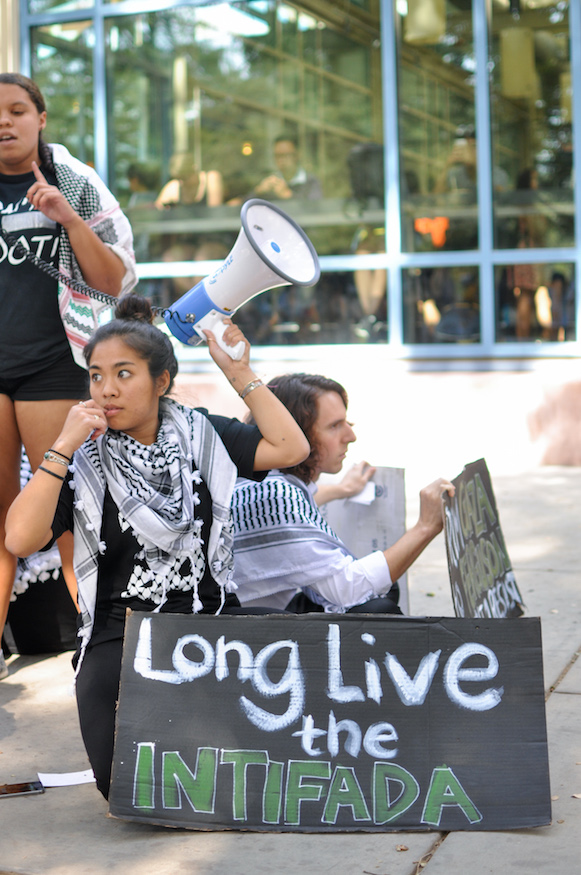
Members of Students for Justice in Palestine (SJP), along with members of Jewish Students for Peace and Davis Stands with Ferguson, held a demonstration on Oct. 14 at the UC Davis Quad for International Campus Day for Palestine.

The date commemorates the anniversary of the 1953 Qibya massacre, when Israeli troops killed 69 villagers in the West Bank of Palestine.

Campuses across the country participated in an effort to raise awareness for the Palestinian struggle.

Elly Oltersdorf, a third-year history major and vice-president of Jewish Students for Peace, talked about what it meant for her group to come out and join SJP in their demonstration.

“A lot of people really either have no information or a lot of misinformation on [Israeli occupation in Palestine], so a big part of it was just showing that this is a movement on campus,” Oltersdorf said. “We want to show support and solidarity with the Palestinians who are suffering under military occupation and showing how that comes from multiple groups.”

JAY GELVEZON / AGGIE

Ever since the occupation in Palestine, tensions have risen as college students around the country have sought campaigns for Boycott, Divestment, and Sanctions (BDS) against Israel, including SJP’s success in getting the ASUCD Senate to pass a resolution for divestment last spring. Oltersdorf described the resolution as “a nonviolent movement to put pressure on Israel to change its tactics of military occupation and sort of brutal violence.”

When asked about the demonstration, Associate Director of News and Media Relations Andy Fell said in an email to The California Aggie that the campus is a place for all students to have a say.

The UC Davis community includes a wide range of opinions and beliefs and we hope that the campus is a place where students can debate important and controversial topics while respecting each others’ views,” Fell said in the email.

Kyla Burke, a fourth-year environmental science and management major and central organizer for Davis Stands with Ferguson, was asked by SJP to speak at the event as well.

“Getting involved in the Black Lives Matter movement was kind of how I ended up learning about Palestine,” Burke said. “Personally, what I spoke about that day was the connection between and the similarities between the Palestinian struggle and the black American struggle, living in systems of oppression. There are some similarities, but that’s mainly what I spoke about — standing in solidarity for each other.”

When asked about what she hopes the university can do in addressing these issues, Oltersdorf noted the ongoing efforts toward divestment.

“In terms of what the university can do, I really think that, in the end, it’s a long-term goal but we are pushing for the university to divest from companies that are profiting off of military occupation in Israel,” Oltersdorf said. “Right now, the vote is just a symbolic victory. But looking to the future, we see it as a physical victory that could actually happen, where you see all the UCs taking their money and taking their support away from military occupation.”  

Traffic delays expected due to city construction projects

DEBPARNA PRATIHER / AGGIE

Surface Water Pipeline, Paving Rehabilitation projects to cause road delays in coming months

Expect heavier traffic in Davis throughout October and into November as a result of two major construction projects. The Surface Water Pipeline (SWP) project will install water transmission lines to better the reliability of Davis’ water supply, while the Paving Rehabilitation (PR) project will make roads safer.

“The Surface Water Pipeline [will bring] a water pipe down from Woodland into the city. The goal is to get away from wells for potable water and try to deliver [surface water to Davis] instead,” said Roxanne Namazi, Davis’ senior civil engineer.

According to Namazi, the contractors for these projects are required to submit traffic control plans to document road closures and detours, which are then approved by the city to ensure road safety.

“[Construction for SWP] is mostly on Pole Line and Covell Boulevard. [We also] have the Street Rehabilitation Project in progress that is [taking place] on 8th Street and Lake Boulevard,” Namazi said.

These construction projects are impacting both Yolobus and Unitrans bus routes. Yolobus routes 42A, 42B, 34 and 242 will experience delays as a result of the SWP and Unitrans lines L, P and Q will be rerouted.

“[During construction], we try to accommodate as many bus stops as possible. We look at different routes, different streets and try to reroute the entire system [while also attempting] to change it as little as possible,” said Vivian Nguyen, a Unitrans employee. “Our goal is to get as many customers and as many riders on the buses as possible.”

According to Nguyen, Unitrans gets early notices from the city about construction in different areas and uses dispatch to communicate rerouting and traffic.

Mike Luken, the Yolobus deputy director of Operations for Planning and Special Projects, said SWP has influenced the bus routes on Covell Boulevard and Pole Line by increasing trip times. PR, however, has caused bus stops to be temporarily closed.  

“What we’ve done is we’ve reached out to our riders via an email service that they subscribe to, as well as Facebook and Twitter, [to] make them aware that this is happening and to expect delays,” Luken said.

Unitrans publishes ride delay information on their website. Nguyen suggests that riders look online every day before boarding the buses to plan out their trips.

Namazi explains that the PR project will end within the next few weeks while SWP will take more time.  

“The Rehabilitation project will be wrapping up in a couple of weeks,” Namazi said. “They are nearly finished paving and will be striping [the roads] in the next two weeks.

For alternate route information, visit unitrans.ucdavis.edu or yolobus.com for updated information.


Written By: OLIVIA ROCKEMAN

city@theaggie.org

The Ethical Wallet: The weight of a dollar

0

greenburg_opOne dollar weighs roughly one gram. That means that about 454 dollar bills in the palm of your hand would weigh about one pound. One pound is nothing, and it makes you wonder how many thousands of dollars would you need to hold to really feel something. Yet, one dollar carries more weight than a simple measurement in grams can even begin to cover.

Allocation of resources is the idea that markets use the most efficient means to target whatever population will bring the most profit. If you’ve ever taken an economics class, you probably know the basics. Supply and demand rule the market, naturally monitoring what consumers want and need. They regulate prices based on what people are willing to pay for particular resources. At times the market feels mysterious. So much of it can’t be physically identified because it sits among data and percentages that many of us can’t understand.

However, we could achieve more transparency through spending our dollars in the right markets.

The organic foods industry is a great example of the people’s vote making an impact on the market. After the discovery of pesticides and health-threatening chemicals used in the production of crops, people became more and more concerned about the potentially adverse health effects of pesticide use. In the ‘60s and ‘70s, farmers began using more organic methods to meet the demand for a population of people who wanted clean food. At first, this movement was decentralized and there were no standards regulating what was and was not truly ‘organic.’ Because of the movement’s growth, the Organic Foods Production Act was passed in 1990, mandating a national standard. Twelve years and many grams of dollars later, those rules were finalized.

Another form of speaking with the dollar is boycotting. I have never directly encouraged the boycott of any specific brands or companies, but by advocating sustainable markets and ethical brands, one could argue I am encouraging the boycott of all other unethical companies. In the past, boycotts have been extremely successful. The Tuna Boycott of 1986 forced fisheries to implement new fishing practices that didn’t involve dolphin netting. Because yellowfin tuna like to gather in schools beneath groups of dolphins, millions were killed in the process of catching the tuna. After the procedure was filmed and exposed to the world, the movement grew, grabbing the attention of fishing companies everywhere. By 1990, the three largest tuna companies had agreed to stop selling tuna caught through the use of dolphin netting.

Boycotting and natural economic forces will both result in the same goal: sustainability. The way many companies run their business today isn’t sustainable, but I’m confident that change will eventually arrive. I would prefer to see these changes sooner rather than later. McDonald’s is one example of a company that will either have to to continue to undergo major changes, or become obsolete. The company only began offering salads after Americans began giving their dollars to healthier alternatives.

Putting our money towards ethical consumption is the equivalent of living in the future. We are preparing for what is next, and supporting the companies that are doing the right thing now, before it is normal and easy. If everyone bought organic food, it would be less expensive and more available to farmers. If everyone bought clothes from local crafters, the materials would be more affordable and workers would be paid better wages. I strongly believe that all these things will happen eventually, but I worry that when they do, it will be too late. How many more workers have to be killed in factory fires? How many more children, little potential Einsteins, have to sacrifice their education in order to pick cocoa beans in the forest? I am not comfortable taking part in the cheap benefits of many others’ struggles until we see a change. We must invest in our future, both vocally and economically. The weight of the dollar rests in your hands.

You can contact Martha Greenburg at mzgreenburg@ucdavis.edu or on Twitter @marthazane94

New housing coalition seeks to improve renters’ situations in Davis

DEVIN McHUGH / AGGIE

Group calls for regular housing inspections, lower housing prices

Davis Renters Alliance, a new advocacy group for renters, met on Oct. 12 in Wellman Hall to discuss the renter rights of UC Davis students and community members.

The group aims to deal with the rising housing prices and low-vacancy rates. The alliance is also trying to pass a new ordinance with the city, including a demand for regular housing inspections every three to four years.

Matthew Palm, a third-year graduate geology student, started the group after he noticed the lack of resources for tenants in the Davis area.

“When I tell people they are supposed to get a deposit back within 21 days, they almost always universally laugh and note that this never happens,” Palm said.

Palm encourages students and community members to seek out spaces to share their housing experiences in order to implement effective change.

“In Davis, there’s just not a lot of student presence and not a lot of people advocating for students as well as renters,” Palm said. “To get the program passed, we need people who are willing to come forward and tell their story.”

Veronica Beaty, a land use policy director for the Sacramento Housing Alliance, has also helped in introducing the new ordinances to the Davis City Council.

“Landlords know that they can get away with rent increases, they know that they can be a little lackadaisical in fixing up property problems and I think that a proactive rental housing inspection program will address a lot of that,” Beaty said.

The group has also gotten help from ASUCD officials, including Senator Roman Rivilis, a fourth-year political science and economics double major, who has been involved with voicing student and community concerns for the group.

“Over the past few years in Davis, we have seen rents rise pretty considerably, which is an indication that the landlords in the city of Davis have affected political bargaining power, but students haven’t been able to vent their concerns,” Rivilis said. “I believe that dynamic can be displaced by students being able to organize, by going to city council meetings and expressing their experiences.”

Rivilis noted the responsibility that ASUCD has in being a voice between student renters and property managers in the city of Davis.

“We are responsible for engaging our constituents on matters affecting city issues and making it relevant to student life,” Rivilis said. “So when issues of renters rights arise, ASUCD is responsible for educating and being a resource for those students.”

John Whitcombe, a partner at Tandem Properties, has discussed some of the ways in which he has tried to alleviate student housing issues, including his involvement in Nishi Gateway, a proposed $300 million project in South Davis that Whitcombe says would add 1,500 new rooms for students.

“Over the years, we’ve established policies and procedures to make sure that we’re taking care of our customers,” Whitcombe said.

Whitcombe, who noted that approximately 80 percent of Tandem’s residents are students, encourages open communication between renters and their property managers in order to better their living conditions.

“Apartment owners have always been at the forefront of trying to get the community to provide more housing,” Whitcombe said. “Partly because we invest in that housing ourselves, but also because it’s just so much better for our business to have people that have choices. You have a lot more problems with your customer if that customer feels that they don’t have a choice. There’s always a threat that somebody who is not particularly responsible will take advantage of that.”

Whitcombe also notes that, as a no-growth community where very few new homes are being built, the values of people’s homes rise as vacancy rates in the city of Davis drop; subsequently, rent increases.

“Growth control hurts everybody, except the people who have a house, and that’s where Davis is at right now,” Whitcombe said.

The alliance has been looking into moving from a relatively small UC Davis group to a community-driven coalition. A Town Hall meeting is scheduled for Nov. 2 at the New Harmony Community Center, with Councilmember Brett Lee set to speak.

“The next steps will definitely be to maintain correspondence with the Davis Renters Alliance as it moves from UC Davis to the city of Davis to make sure that it’s not losing student participation and to engage members of the municipal leadership on housing issues that affect students,” Rivilis said.

Inside the game with Brady Stuart

JAY GELVEZON / AGGIE

bradystuart_sp2Record tied for career field goals

This week, The California Aggie joined Brady Stuart, a down-to-earth kicker with his head held high. Since the interview, Stuart has broken the UC Davis record in field goals, set by Eddie Loretto (1985-88). The senior, an all-time field goal kicker with a new personal best distance, does not show any signs of stopping as he enters into his final collegiate games.

When did you start playing football and why?

I started playing football my freshman year of high school, and really with no intention of being a kicker. I figured maybe I would do it on the side; I’d play a receiver and corner. My dad forced me to play football my freshman year because I wanted to play just soccer the whole way through and continue with club. My dad forced me to play, and at first I didn’t like it, but then I started to.

I played [football] my freshman year [of highschool]. I was a receiver and I didn’t do too well actually. I played corner as well, I think I was second string. I did decent, but not great.

Then they had the kicker tryouts and I totally blew it! I was terrible. I was like, where is my place on this team, what am I going to do? So the quarterback was taking the kicks the rest of the year. Then he got tired or something happened – I don’t really remember – where I had to come in and start kicking. I just kind of took [over] that job. It just started from there [and] I became the kicker.

So you just put in more work and started practicing?

In the off-season I played soccer, but during football season obviously I was just kicking the football. So sophomore year came around, I played a little corner, but nothing happened with that. So I just started kicking and it just went all the way through high school.

So you didn’t apply to all the schools?

I did apply, but I didn’t turn in some things that I was supposed to turn in. So I got rejected from everywhere. Honestly, no one knows that side of the story.

So I have four older brothers and an older sister. Three brothers went to UCSB, both my parents went to UCSB, my oldest brother went to UCSD and then my sister went to [University of Arizona]. So everyone basically stayed in California, and I’m really close with my family.

I knew football was going to become an option, and I was going to use it to my advantage. I figured if I had a chance for football, I would want stay in California so I could stay close to my family, and if I could get into a UC it would be great.

Coach [Bob] Biggs gave me a call after a few kicking camps that I went to. I got picked up through him, it kind of worked out completely in my favor.

For everybody’s favor really.

Yeah, really! My family is super stoked about it. And it’s a great school. At first, I wasn’t the biggest fan. I was in California, but I was in Northern California.

You’re far.

Yeah, I was away from home. But now I love this place and I love the people. It kind of worked out. I chose Davis because it was honestly the best option that I had. Why turn this place down?

When you chose UC Davis, did you know specifically you we going to go into football, or were you thinking of still doing soccer?

Oh yeah. I was done with soccer my junior year of high school because I broke my collarbone. A lot of my time was invested in football at that point. Soccer was just something fun I could do — it wasn’t so serious anymore. I wish it had been, but football has worked out so well for me.

So when I came to Davis, I didn’t even think about the chances of soccer. I just thought, I’m playing football and here we go.

What are some of the changes on the team you’ve seen while you were here?

That’s a good question. I mean Coach Gould has made a big difference with getting us a lot of gear, which has been pretty cool. That’s definitely a big change and pretty sweet to have.

Personally I’ve gotten way closer with a lot of the coaches here than I ever have in the past. I’m a kicker. I’m not a safety or a linebacker, so being able to be close to all of those coaches, that’s incredible.

As for the whole team, I don’t really know how to answer that. We’re working hard out here, we’re giving everything we got. The record’s not the greatest right now, but I know that we’re going to continue pushing it, keep working it. Hopefully, things [turn around].

What has been the key to your personal success on the team?

I got to give a lot of [credit] to [my teammates]. It sounds cliché as a kicker, [but it’s true]. I got to give it up to my long snappers, I got to give it up to my holders.

While I have been here, my long snappers have been Joey Waters and Grant Hilton. My holders have been Randy Wright, Corey Galindo and Colby Wadman.

Of course I’ve got to give it up to Coach [Jeff] Copp, too. He really got [me to focus on] my mental side of the game. I had a hard time of that. I would miss and just get in my head. He would always be there to pick me up, but refocus me. Get me back on my feet and stuff.

I’ve got to give it up to them, those guys have been working with me the whole time and they never gave up on me. And my family, too. Those guys have stood by me and supported me the whole way.

What was it like for you leading up to the moment, in terms of getting this record? Was it something that you anticipated, going into college?

No, I had no idea.

Did it just kind of sneak up on you?

Yeah really! Of course I’m always shooting for it. I am always trying to do the best I can. It hasn’t really hit me yet. I think it’s super cool that [I] beat a record [at UC Davis]. I’m not freaking out about it. You know, whatever happens, happens. My main focus is trying to have fun out here in my last few weeks of football in college.

But shoot, I’d say it just snuck up on me!

What does the record mean to you then?

I think it’s totally cool. I was actually talking to my brothers about it the other day, and they were like, it means so much to [our] parents that I am the last kid going through school and they have done everything they could to help me out, and this is kind of a way that I am giving back to them. To put my name in the record books for however many years to come, that is totally cool right there.

I think the record books show the top ten. So say the guys beat me in the future, well I’m still on there for a while. I never thought that I would make such a big difference. Just being a little kicker out here — I never had an experience like that before.

To say I’m first at something is unbelievable. It’s incredible.

What are your plans for the next year?

I don’t know. My mom asked me about that last weekend. [She] just said, “Hey, have you started to think about what’s to come?” I haven’t so much, [but] I know I’m going to once the season ends.

I’m trying to just get through this season and have a good time with the guys around me. Really, appreciate what has been given to me and the people I’m around. I’m only here for six more weeks and I’m trying to soak it all in right now.

I’ve talked to Sac Republic, the soccer team, not even about working for them, but just kind of keeping in touch with them since I have worked with them in the two past years. Brent Sasaki just keeps on saying, “Just live it up, have a good time. You know, you’re in a dream right now. Worry about that after, when you graduate.”

So I don’t know yet, if anything comes up with football, then that would be sweet. If not, then I’ll just keep fighting and I’ll go on to the workforce. We’ll see where I go from there. It’s kind of scary, but it will be cool!

Aaron Sellers can be reached at sports@theaggie.org.

My culture is not a costume

0
CROSS CULTURAL CENTER / COURTESY

Cross Cultural Center to present fashion show

Between choosing a Halloween costume, juggling midterms and attempting to try every pumpkin-flavored item on the shelf, October can be a busy month for a UC Davis student. However, no matter how you celebrate the month of October, it is crucial to do so with respect toward different cultures.

As a response to the culturally insensitive outfits that some people choose to wear for Halloween, the Cross Cultural Center (CCC) is hosting a “My Culture is Not a Costume” fashion show on Friday at 7 p.m.

This event is open and free to all members of the UC Davis community and intends to highlight both traditional and modern fashion from different cultures. The Chicanx, Filipinx, Native American, Southeast Asian, Pacific Islander and the Black Diaspora communities are some of those who plan on taking part in the fashion show.

Elly Oltersdorf, a third-year history major and one of the coordinators of the fashion show, pointed out the importance of being respectful of others’ cultural dress.

“People underestimate what it means to feel at home on this campus,” Oltersdorf said. “It is easy to paint a picture that we have moved past that, but we do not live in a post-racial society.”

Oltersdorf continued to explain how many of the cultural groups whose cultures are appropriated and mocked during the Halloween season have historically been ostracized from the United States. It is difficult for students to feel comfortable in the university because seeing their culture mocked creates an unwelcoming atmosphere.

Erica Perez, a fifth-year community and regional development major and another main coordinator of the fashion show, hopes that this event will be an empowering experience for both those who participate and those who attend.

“I want allies [in other communities] to realize that our culture is not a costume. This is especially important on a university campus where you don’t see many people who look like you. Why do certain people think that [wearing a culturally insensitive costume] is okay?” Perez said.

If you would like to show your support for the different communities on campus and to celebrate fashions from all over the world, come out to the CCC this Friday.

Omar Abdel-Ghaffar, the third coordinator of the event and third-year political science major, has high hopes for the educational and proactive influence this event will have on the campus community.

“It is important for students who may wear an offensive costume to realize that what they’re doing is hurtful to people who share their campus,” Abdel-Ghaffar said. “This is someone’s history and it can’t be simplified and commodified in this way.”

The show begins at 7 p.m in the multi-purpose room of the Student Community Center. For more information, please visit the CCC’s Facebook event page.

Students, faculty evacuate Young Hall following chemical spill

JAY GELVEZON / AGGIE

Laboratory remains closed until further evaluation

On Oct. 26, faculty and staff were evacuated from Young Hall after the UC Davis Fire Department responded to a chemical spill in one of the hall’s labs at approximately 5:00 p.m. The chemical spilled was acrolein.

Following the evacuation, hazmat teams went into the hall to evaluate and deal with the spill. One person was evaluated for injuries and was released. No other injuries have been reported. The fire department and hazmat team left the scene at approximately 6:30 p.m.

Young Hall will remain open with the exception of the lab where the spill took place. The lab will be inspected by the university’s Environmental, Health and Safety department before reopening.

Further details surrounding the incident to come.

Tolerating Free Speech

0
HANNAH LEE / AGGIE
HANNAH LEE / AGGIE

The Wesleyan Argus, the school newspaper of Wesleyan University in Connecticut, drew criticism last month for publishing an opinion column that questioned whether the Black Lives Matter (BLM) movement created an atmosphere of hostility that deligitimized its purpose.

Unsurprisingly, a large backlash against the paper ensued. Some activists called for boycotts. Other students reacted by throwing out and burning the paper at its distribution sites.

These protests culminated on Oct. 18, when the Wesleyan Student Assembly (WSA) caved to outside pressure from members of the student body and voted to slash the paper’s budget from $30,000 to $13,000.

The actions taken by WSA are not consistent with the basic principles of free speech. For a campus newspaper to function properly, student governments must understand that the paper should be granted as many degrees of journalistic freedom as possible.

Ostensibly for the purpose of “reducing paper waste,” the WSA’s resolution — by reducing The Argus’ print run — will effectively cut a large stream of the newspaper’s revenue. In this way, the WSA is literally squelching speech by making it less available and visible to the public.

The Aggie Editorial Board, while disagreeing with the arguments of The Argus column in question, denounces the WSA for supporting such an obviously political revenge scheme.

BLM is an important movement that strives to end institutional racism and support a system by which law enforcement can be held accountable for prejudiced policing tactics. Its actions are both commendable and controversial, and will naturally invite criticism. It’s in the interest of both sides of the debate that this criticism is allowed to be vocalized.

It’s a disappointing reality that many students would now give up free speech for the reason that it might offend or marginalize certain communities. Campus communities should remember Mario Savio and the 1964 Free Speech Movement he led at UC Berkeley. Those demonstrations were instrumental in establishing and expanding how students and faculty can express their politics.

Students who burn newspapers should keep in mind that given a different set of historical circumstances, they could have found themselves crushed by censorship.

Of course, none of this means that anything and everything should be published, and that journalism is allowed to be needlessly offensive. But that was not the case in the BLM article, which did not resort to stereotyping or use of hateful speech.

It’s evident then, that resolutions like the one the WSA passed reinforces the fears of many students that they will be penalized for voicing their opinions on controversial matters. Colleges should facilitate the opposite kind of reactions to these issues. To Wesleyan’s credit, its President, Michael S. Roth, did issue a statement warning against, “ideological conformity” at the university level.

UC Davis should learn from Wesleyan’s experience, and continue to hold debates in a way that doesn’t pretend there is one solution to every problem in society. As a campus that has an active BLM presence, and a history of divisiveness in general, preserving the right to dissent will ultimately strengthen our community.