56.6 F
Davis

Davis, California

Thursday, December 25, 2025
Home Blog Page 804

Did the flash go off?

mag_disposable1

At a party while my friends are looking away, I pull out a Rite Aid brand disposable camera, wind it and press the gray button at the top. They look over at the bright flash in confusion while I laugh. Instantly I am taken back 10 years, looking into a crowd where I heard the whirr of a camera being wound and a white flash blinded me as I stood smiling, holding a certificate of graduation. That was my mom, always making herself known in my elementary school audiences with her disposable cameras, which made me want to hide in fright because of how noticeable they were. While other parents were switching to digital, my mom stuck with the disposable, pointing out that I was her daughter at every big event, with the bright flash and the loud wind. I never thought that as an adult, I would be the one visiting friends and showing up at work with a disposable camera in hand.

I love pictures, but I don’t know a lot about film or aesthetics. Part of this is because I’m too lazy to learn, and too cheap to buy a real film camera (although developing disposable cameras is not very economically friendly). I could just truly hone my skills with a digital camera or my camera phone; however, something that I’ve learned to appreciate as I’ve gotten older, perhaps something that my mom has known for a long time, is that there is a lot of fun in snapping one picture and having that be it. On a disposable camera,mag_disposable4 there’s no taking multiple pictures, standing around to get the perfect shot unless you want to waste your film. Your friends can’t ask you to see the preview and make you retake it if they think they look bad. You take one picture and you’re done. If it looks good in the end then that’s great and if it looks bad then at least you have the fuzzy memory to prove you were there.

After getting a bunch of pictures back from Rite Aid, Costco or Walgreens (wherever will develop them), I get the best sense of excitement. I get to look through all of the moments of a birthday party, a retreat or a big event like Picnic Day and remember each one exactly as it was when I took the picture. Even the pictures that are blurry or dark evoke a sense of emotion – I remember seeing that the flash didn’t go off after I took the photo, that the room was especially dark, or that my friend took it while she was running toward me. These are raw moments that I can’t easily edit or change – and that I don’t want to edit. Coming to this revelation in the age of iPhones and digital cameras has been exciting for me, and it makes me look back with a new appreciation for all those years when my mom made herself known in a crowd with the flash and the wind of her disposable camera.

mag_disposable6
Melissa Dittrich is a third-year English and Sociology major, The Aggie’s Opinion Editor and an all around pretty okay person! For questions about where to get your disposable pics developed, she can be reached at medittrich@ucdavis.edu.
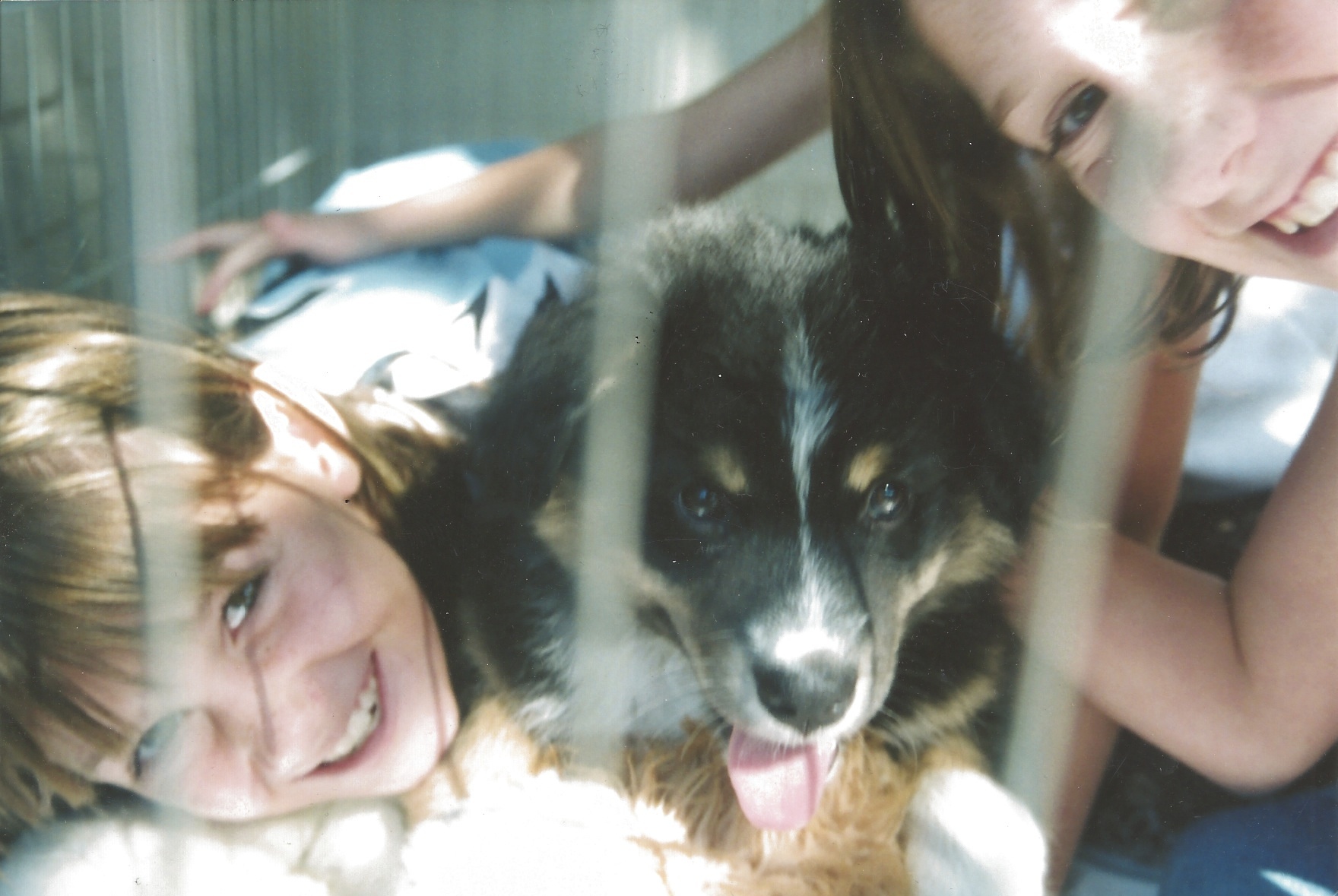


Jake, You Damn Dog

mag_dog

No. No. No. No. My eight-year-old self had been all too accustomed to hearing the word no, but I could not help but to continue whining, “Dad, can we please get a puppy? Pleaseeeeeee?”

My heart pounded as I proceeded to jump up and down. Every time I touched the floor my favorite new tennis shoes lit up blue at the rims. I gave my dad a look I thought he could never refuse, widening my eyes and smiling big, as if the word “yes” would keep me happy forever, or at least shut me up. But his only response remained, “No way, Melissa. Do you know how much responsibility a dog will be? And guess who will end up walking it, feeding it and taking care of it every day? Huh? I’ll tell you. ME!” I desperately tried to refute him, saying I was perfectly capable of the responsibility since I was older now and could handle it. Of course, my father saw right through my naive intentions. However, this was not the end of the argument. In fact, it was just the beginning of the story about my dog, Jake.

A couple months later my parents made a big mistake. It all started when they took me and my sisters to a charity event for Multiple Sclerosis (MS) disease in Half Moon Bay. The event was hosted at a ranch, where we paid for a meal, musical entertainment and a petting zoo. All the proceeds went to helping find a cure for and fighting MS disease.  The mistake was exposing their obsessive daughter to a pen full of available puppies without the intention of getting one. In my parent’s defense, they were unaware that the host’s Australian Shepherd had just birthed a litter of eight adorable babies. Immediately, I ran inside the pen and would not leave for the next four hours until it was dark and time to depart.

The puppy pen was big with multiple hay stacks inside, all surrounded by a metal fence at least four feet high. Kids and families swarmed around the puppies, most coming in for a brief moment, admiring their cuteness and then leaving without further interest. Not me, I was in love. I planted myself in the middle of them all, petting and playing with them, believing that I would go home with one in my arms.

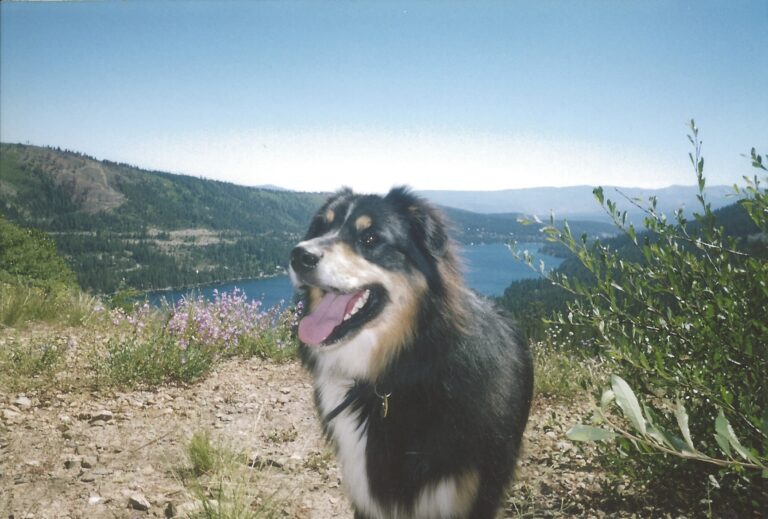
I strategically talked to the owner who told me that six of the puppies had already been claimed and pointed me towards the two that were left: one male and one female. Both had similar coloring, all black except for hints of white and brown markings throughout their fur. I gravitated towards the little, clumsy male who had a big white spot behind his neck, contrasting with the blackness of the rest of his fur. He was one small ball of fluff, running frantically and biting softly at everything that touched him. When he got excited, he tried to run around in circles. During this motion, his hind legs were often faster than his front legs, so he ended up gradually turning sideways and tripping over himself. I played with him and held him for hours. When I picked him up his big brown eyes looked at me with innocence and immediate love while he stuck his tiny pink tongue out to lick the entirety of my face. I did not even notice the grossness of his slobbery kisses; I was in heaven.

“Time to go, Melissa.” Both of my parents waved me outside of the pen, refusing to step inside.

“Dad, just come in and take a look at him. I promise, then I’ll leave.”

After a 30 minute argument between the entire family, my dad signed some papers and paid the original owner. We were allowed to pick up the puppy, who we named Jake, the following week after he grew a bit bigger. My dad still teases me to this day, saying he will never forgive me for that trick I pulled.

mag_dog2From that moment on, Jake was a part of the family and not to mention, just as my dad had warned me, a daily responsibility. Whenever he could escape the house he would sprint down the street, eager to chase down any cat or squirrel in sight. He often managed to break free from our backyard by digging a hole beneath our wooden fence. The main concern was he did not see cars as a threat. A couple of times I found him sitting or lying down in the middle of the street, stopping oncoming cars. Most dogs would run away from an approaching car, but my stupid dog would not move a muscle, even as the driver honked repeatedly at him. Jake would stare at the car blankly, as if to say “Actually, I’m pretty comfortable here so you should go around.”

Jake maintained this prince-like attitude for his entire life. My dad had a very strict rule that Jake could not sleep on the furniture; however, the couch became his bedroom. His other rule was against feeding Jake “people food,” until Jake was given steak and chicken leftovers on a weekly basis as a result of his insistent begging. Yes, my father could not resist spoiling Jake. Slowly, as previously predicted, my dad became the primary guardian of “my” dog. My father was the one who fed, walked and looked after Jake.

Though my dad said he did not want this responsibility, he loved taking care of Jake. The two of them became inseparable due to their routine morning strolls and nightly TV time together, where my dad would sit in his armchair and Jake would lie at his feet. The dog was the only family member who could pretend to like any boring news show my dad put on. They were best buds. Jake was all of our best buds.

Our dog became much more than just a dog. He became the person we could go and rely on when we needed to vent, when we needed a furry cuddle session after a hard day, when we wanted to go on a walk or hike but no one else was interested and when we wanted to jump and run around celebrating.

Over the years both Jake and I both grew up. I went from a scraggly, awkward grade schooler to an adventurous college student while he went from an active young pup to a greying, slow dog. My first two years of college, I watched him get excited and jump onto me when I arrived home. At a certain point, he could only look up and wag his tail, struggling to stand and greet me as usual. Though I noticed the signs of his aging, I continued to believe he was invincible, that he would always be there beside me.

It was May and I was back at school in Davis. I was taking detailed notes during my Politics of Inequality lecture when my mom called, so I did not pick up. I got a text that said: Can you call me when you get a chance? I had various tasks to complete after class so I did not call right away. Then she called again. I picked up the phone this time and my mom was in tears. She told me that Jake had a stroke and that she found him in the bushes, his face buried beneath the leaves. “I have no idea how long he has been out there all alone. Your father and I are taking him to the vet. He seems to be okay now, though….No honey, don’t come home yet. Just wait to see what the vet has to say.” I had some hope.

An hour later my phone rang again; I picked up immediately. “Sweetie, he’s not going to make it.” My heart stopped, my body shook convulsively and tears streamed down my face. “Mom, I’m coming home. I’ll find a ride, let me just ask my friends to borrow their car.”

She responded with the painful words: “Melissa, I’m so sorry, there is no time. The strokes are happening more frequently and they are getting worse. The vet said waiting for you to put him down would be cruel in his condition.”

“What? No. I can get there I’m just going to ask my friends for a ride, okay?” My voice was shaking. I barely realized I had been screaming into the phone. My mom kept repeating that there was no time while I desperately looked for a ride. I hung up on my mom and called everyone I knew explaining the situation; that I needed a car right now. A couple people said their cars were broken and some said they could give me a ride. I was gathering my stuff when I got a yet another call.

This time it was my dad. He was crying and said, “Melissa, listen to me, I know you want to say goodbye in person but it is not possible. Jake needs you right now to say goodbye. If it can’t be in person then you must do it over the phone.”

My heart sank and I cried harder. I dropped the random items I was carrying to pack for home, sat down on my floor and put my head in my hands. I sobbed over the phone until I could catch my breath.

“I’m putting the phone up to him now,” my dad said.

My lips trembled as I imagined my childhood friend strapped to a cold, white table. I pictured Jake lying there, incoherent and in pain, desperately waiting for it all to go away. There was nothing that could be done.

“Hi Jake. It’s me, Melissa. Aw buddy you have terrible timing,” I laughed in between sobs. “Remember all the times I tried to get you to play fetch and you would just catch the ball, run away and bury it somewhere where I could never find it? I would eventually give up and just chase you around the backyard until we got tired and lied in the grass together. After a fleeting, relaxing moment, you would gain more energy and jump on top of me until I went to find the ball for you again. I just want one more of those moments with you.”

I paused, knowing whatever I said next would be the last words he heard from me, if he could even hear me. I like to think he did. Finally I managed to say: “Don’t be afraid now because everything is going to be okay and I will see you again someday. I love you.”

mag_dog3

My family all said their goodbyes into the phone for me. All of it was a blur. The next few days I woke up with a pain in my chest, feeling the loss of him. When I eventually arrived home, I went out into the backyard. My dad was outside and I looked over at him; all I could manage was a shoulder shrug. We both had tears in our eyes, so he came over and hugged me. “It’ll get better,” he said.


No one thinks losing a pet will be as difficult as turns out to be in reality. However, it did get better with time. Many days pass where I do not think of him at all; other days little things randomly remind me of him. When I think back on our times together, I rarely feel sadness, but instead cherish all the memories we had together growing up. The memories alone keep his spirit and our childhoods alive.


To this day my dad still says: “Melissa, if only you hadn’t tricked me into getting that damn dog. Then we never would have loved him as much as we did.” We both know we would never trade the experience of owning, loving and losing Jake for a life without him.

Melissa Gaherty is a Centennial Magazine contributor. You can reach her at magazine@theaggie.org.

The Paradox of American Friendliness

How foreigners interpret the friendliness that Americans show strangers

mag_paradox

Pierre Noro, a French international student, felt like an idiot. He must accidently have given the girl the wrong number. A week had gone by, and she still hadn’t called him.

He had met the dark-haired American girl in front of Dutton Hall which she was drawing for a landscape architecture course. He gave her some advice, and they ended up talking for three hours. When they parted, the girl asked for his number.

Pierre worried she thought he was one of those persons who just gives a fake number in order to escape further action and decided to find her contact information through the university directory.

“I only knew her first name so I bothered a few people with my emails before I found the right person,” Noro says. “We texted, and I asked her if she wanted to go out for a drink. There was an awkward text silence – the amount of time where you know it is impossible that the person has not checked her phone – and in the end she texted me and said she wanted to be my friend.”

Friendliness v. the intention to be friends

Like many other international students, Noro had encountered a friendly American who at the end of the conversation asked for his number; and like many other international students, Noro was surprised to learn that Americans don’t expect a conversation with a stranger to lead anywhere – that Americans ask for strangers’ numbers without the intention of contacting them.

“Americans exchange numbers and Facebook and never hear back from each other. It’s puzzling but they do it to show openness,” says Moira Delgado, the Outreach Specialist for Services for International Students and Scholars. “For Americans, when they ask for your number, they are expressing a possibility of a friendship, more than a promise to be in contact.”

Delgado is used to dealing with the different culture clashes that occur when international students arrive in Davis, and she recognizes Noro’s confusion. In America, there is a paradox because an American showing friendliness does not necessarily mean that he/she has the intention to become friends. Meanwhile many internationals assume that the exchange of phone numbers will lead to some kind of follow through.

Peaches and coconuts

An analogy that has struck a chord with many exchange students is the comparison of Americans to peaches and many other nationalities to coconuts. A colleague of Delgado once described how Americans are peaches – they are soft on the outside, easy to approach, but the pit is harder – it’s harder to get to know an American really well and to create a real friendship. In contrast, many other nationals will be like coconuts. It is hard to get inside, but once you are there, it is pleasant and you are real friends when you have gotten through the tough exterior.

Jeehye Choi, a 20-year-old chemistry major from South Korea, agrees with the peach analogy. She wants to build close relationships, but she doesn’t feel she can do that with Americans. They are peaches to her. It is too hard to get close to them. She also thinks that the analogy describes Koreans:

“It fits a 100 percent. Koreans are definitely coconuts. If a Korean stranger smiled at you in the streets of Seoul, you’d think he was really weird.”

Choi prefers that people are genuine, and that they only smile if they mean it. In America, people smile at strangers, but it is often not genuine:

“Americans are nice, they smile, and they try to help. They pretend to be friendly,“ Choi says. “They have an obsession with being nice to everyone, but I can see if it is a fake smile. I’m not stupid. When Americans ask me how I am and I answer, they have a certain smile. It’s big, but it’s bored if my answer is too long or if the answer is not great.”

The origin of friendliness

Many foreigners are surprised to discover how friendly Americans are when they arrive in America. Strangers talk to each other, the cashier at the supermarket asks how your day has been, and you strike up conversations with people who are standing in line with you. For Europeans, who tend to keep a certain distance from strangers, this at first is a welcome change, but when they realize that “how are you?” only means “hi,” they often see it as a lack of genuineness from Americans.

Delgado points out that there is a historical reason why Americans are friendly towards strangers. Americans are a mobile people. Historically, they have had to move around a lot, and they have needed to make connections quickly, but also to be able to let go of those connections. It also has to do with their deep sense of being independent and not relying on other people because once you have a deeper relationship, you also become dependent on that person.

The ability to let go easily is not something that goes unnoticed by international students.

“People are very nice and I like them but I know the relationships won’t go any further. Americans don’t care after you split up,” says Tina Rodriguez, a 23-year-old law student from Switzerland. “Americans appreciate the moment, and when they are there, they are there. They listen to you, but the next day they have forgotten your name.”

The definition of friendship

An important factor is also how Americans and internationals define friendship. Americans call other people their friend very easily. It is a term used loosely – perhaps because the English language does not offer any viable alternatives. According to Delgado, “acquaintance” sounds too cold and too remote. Especially among college students.

Evelyn Alper, a 21-year-old American national and food science major, somewhat agrees. Her definition of a friend is someone who loves you for who you are, who would help you in any situation, and someone you have fun with, but she realizes that she probably uses the term differently because most Americans use it for both intimate friends and for acquaintances.

“Americans use the word ‘friend’ for someone they would say hi to and have a casual conversation with,” Alper says. “Generally, Americans would call somebody a friend even if they know the person is not somebody who would be there in situations where a real friend is needed.”

At first, many international students feel happy that they so quickly become “friends” with Americans, but the enthusiasm fades when they get to observe Americans for a longer period of time and see how easily Americans deem somebody their friend. Quickly, the feeling of inclusiveness loses value.

“Sometimes I’m confused,” Choi says. “Americans are always being nice so I don’t know if we’re close or if there’s still a distance between us. I prefer that people say honest things. If there’s something they don’t like about me, I wish they would just say so. Americans are obsessed with being nice.”

What to do?

How do Americans and internationals tackle culture clashes in the best way? One thing Delgado points out is that a good idea is for both sides to consider how they phrase their questions when they ask questions about other cultures. Asking “how” questions and not “why” questions allow conversations about any culture – like asking “How do you show friendship in your country?” while “why” questions limit the conversations and often sound accusatory even if they were not meant to – like Why do you say I’m your friend when you don’t mean it?”

Delgado points out that you also have to think in the framework of a particular culture. It might be true that asking a stranger “how are you?” in a supermarket in France would be superficial because nobody cares about the answer, but in America it would be considered rude if you didn’t say hi. Instead of feeling affronted, people should realize that the characteristic they are looking for, for example friendliness, might be missing in a person in a particular situation, but that it is often possible to find that characteristic in the same person but in another situation.

“If Americans analyze the French from their American cultural reference, it is true that the French appear cold and snobby, that they don’t engage in conversation in public,” Delgado says. “If you go back to America, it is true that somebody with that behavior is rude, but in France it is not necessarily so. Beware of what framework you are judging from.”

According to Delgado both Americans and foreigners can learn from each other. Foreigners have to realize that they have to take the initiative. If an American says “we should go to a movie sometime,” the foreigner should follow up and be specific. The foreigner should ask which movie and which day. Otherwise, it likely will not happen.

At the same time, Americans should learn not to be afraid of taking part in deeper conversations which they often refrain from because they don’t want to cause conflict. In some cultures, it is okay to discuss politics but Americans tend to be more guarded.

“Internationals complain that Americans only want to talk about sports and the weather, and it’s not because they’re superficial, Americans just don’t want to upset the balance,” Delgado says. “It’s okay for some people to talk about politics.”

For Noro, who was rather disappointed by the outcome of what he saw as a profound conversation, his perception of Americans is somewhat pessimistic:

“I think Americans feel sociable by talking and asking for a phone number. They are satisfied with that. They connect over banalities that don’t lead anywhere, and it becomes boring.”

Not all internationals are deterred by Americans and their easy-going friendliness. Tina Rodriguez is in America for the third time and has realized that Americans rarely keep in contact, but she has accepted that and now quite likes their behavior:

“I think I prefer the American way even though it is fake. I like to see everybody smiling and happy even though I know it is not possible that everybody is.”

KRISTINE NØDGAARD-NIELSEN is a contributing writer for The Centennial Magazine. 

Graphic by Jennifer Wu.

The Centennial Magazine PDF March 2015 Edition


The Centennial Editor Gabriella Hamlett. Layout by Jennifer Wu.

Frontpage Photo by Angela Willis.

I used to be a good christian woman

I used to be a good christian woman

By Camille Iman Woods

I used to be eve

I used to be mary

or maybe I was delilah


I used to be a rib

I used to be a virgin

or maybe I was a liar


I used to be a piece of a whole

where pregnancy was my purpose


I used to be silent for the men, the public, and the church walls

and politely dressed in the pews.


I used to be subjected to the word of the ordained

but never in robe.


I used to be a good christian woman

but now

I am just good.

God is good.

all the time.

and all the time.

I am Good.

Camille Iman Woods is an undergraduate at UC Davis interested in advances in medicine through the arts. Camille would like to do graduate study in linguistics to examine the impact of Art therapy – poetry, dance, etc. – on the autistic brain and social  interactions. Camille is the creator, editor and facilitator of aggieANGELOUS, UC Davis first poetry column. She loves to laugh and has a newfound love for Afro-Cuban salsa dancing. 


Judaism FAQ

The satirical guide to some of the most Frequently Asked Questions regarding Judaism. 

bar mitzvah 2

Question One: Are Circumcisions Barbaric?

On September 13th, 1995, I was born to Sammy Spinner. It was a very rude awakening. The womb had been fantastic. Room service three times a day. Warm weather. Quarters were a little cramped. But it was for naught, because, on September 13th, 1995, I was literally vacuumed out of my mother.

She was pushing hard for many hours, but it was futile. I know, because I was stuck in this very awkward position, somewhere in the birth canal. I heard a slurp! and suddenly my head was affixed to a rubber vacuum, the head of which was not unlike that of a toilet plunger. It was hot, and it left a temporary burn on the top of my head. That was the first of my traumas.

They kept me prisoner for around thirty hours. This was to be expected, and, frankly, it was kind of nice. They applauded when I pooped and coddled me when I was able to make a fist. I waited, and waited. An hour is a long time when you’ve yet to have more than a week’s collection of them. But it was not long before Sammy was waving my arm for me, and the doctors were waving back. I was free.

But what to do with my freedom?

It was not long before I fell into a deep depression. I slept all the time, sometimes up to eighteen hours. The waking hours were spent gorging myself with the same bland, corporate formula. I hated myself. I broke out into fits. Sometimes it was because I had gas, other times it was because I was too hot or too cold. Sammy would burp me, give or take covers. But more often than not I cried because I knew the best days of my life were behind me. I rued my birth. It was as if I had gone to sleep in Manhattan and woken up in New Jersey. How displaced! How adrift! In these cases, there was no consolation. Sammy could never know what I felt.

Endless heaps of visitors. They all looked different, but equally frightening. Some would offer their fingers and I would grasp, but it was automatic at this point. When I did indulge them, they would look at each other, gasp with adoration, hug with all the strength in their bodies. I felt none of it.

It got so bad that, on the seventh day, I considered rolling over on my face while I slept. One last noble deed, before sending my body into the Earth. The night I was to do it, some rational thinking emerged from an odd, backward logic. I believed that there was another way. But it had to be something as equally traumatic as my birth. I needed to be jump-started, so to speak. How? I did not know. My dependence on the formula had become absolute. Sammy was no help. There was a great despondency within me, as real as bone and flesh, that I believed resulted in an utter inability to make a move on my own.

The next day I was awoken by Sammy. She was dressed nicely. She fed me, and I slept for several hours. When I woke again, I was surrounded by a group of unfamiliar men. They smiled, and were comforting. And though they looked quite different than me, they wore pieces of cloth on their heads that reminded me of my own, now faded, burn mark. One of the men chanted over me in calm rhythms. I cooed.

And then he cut part of my penis off.

It was a physical kind of pain that was quite different from the mental pain I had gone through. Though I had to admire these men for their conviction. They certainly saved me.

Question Two: What’s the Difference Between a Reformed Jew and an Orthodox Jew?

One of my earliest memories was our house lit up in Christmas lights. Sammy had hung them up all by herself. She worked quickly, but was careful to include everything: wreaths of green and red over the doorway, a whole medley of colors lining our house so that it looked like a hand-drawn cartoon. When she was finished, a great grin came over her. She waddled over to me and scooped me into her arms. Said, “Looks good, huh?” Rocked me up and down until I said, “Yes”. Gave me a red-lipstick kiss right on the nose. “My little Rudolph.”

We walked across the street to the house opposite our own. It was a small Colonial that my mother had been trying to sell since its owners got into financial trouble and killed themselves six months prior. Why don’t they just kill me? is what my mother had said at the time. Six months later, dust had begun to accumulate in between her crow’s feet. She paced back and forth in her pantsuit. Dusted herself. Licked her thumb and cleaned my nose, which was awful.

A mini-van pulled up to the curb of the Colonial. A woman got out.  Her name was Linda, and she was looking to buy a home on behalf of the Rebbe Judd Oppenheimer, the infamous and enigmatic leader of the Hollywood Jews. Linda wore a long skirt, and her hair, which was parted from the middle, drew back into her neck, forming the shape of an onion. According to Sammy— this ugly hairdo, with the van and the seemingly desperate avoidance of schlump—this was the informal liturgy of the Orthodox Jews.

“Shalom, shalom,” Sammy said. She was almost clapping her hands in excitement.

“I’m sorry, the Rebbe couldn’t be here,” Linda said. She looked at me. “Oh, but you brought your son?” She didn’t seem very enthused about it. I didn’t like her.

“He’s learning the business,” Sammy said. “Plus, we were going to go on a walk after this. Believe me, we need the exercise.”

“This does seem like a nice neighborhood for walking.”

“Let me tell you— this is the best neighborhood for walking. Oak trees. Sidewalks paved. Come Sabbath night, and Saturday, there are so many people to enjoy it with too. It’s really awesome.”

“Have there been any problems?”

“Problems?”

“Are people comfortable with Jews here? I mean, I know, it’s Los Angeles. But still. I’m asking more for the Rebbe. He is very concerned about such things. And this is where he wants to set up shop.”

“Well, I’m sure you have nothing to worry about,” Sammy said. She gestured to her house. “The only problem you’ll have is having to live across from the kind of gentile who still has Christmas lights up in July.” Linda laughed, but Sammy laughed harder.

You see, by laughing, Sammy proved that she was above all this— able to adapt to the times and stay in touch with culture. That was the Reform way.

Question Three: Why Do Jewish Conspiracy Theories Spread?

Inky dark nights. They met only when there was a new moon, and talked in the Colonial’s lounge:

“Gentleman, our time is close. Soon, the world will know our fury.” This was Artie Goldberg. He was from UTA (The United Talent Agency). A representative from each major Hollywood agency was in attendance: from CAA (Creative Artist Agency), to WME (William Morris Endeavor) and finally to JCC (Jewish Community Center). The Rebbe Oppenheimer presided over all. He was the one who invited Sammy. Out of courtesy for the Sabbath deal she offered when the Linda had finally decided to buy the house. Sammy brought me in case the group needed the blood of a virgin.

The Rebbe never spoke during these meetings, but it was his will that was done. .

“Starting in the New Year, we will be remaking Hollywood classics,” The man from CAA said. “No one doubts the power of film to change the world. So it is of utmost importance that these remakes must carry a pro-Jew message. But it must be subtle. I cannot stress this enough. If we are successful, we can finally usurp our power. Even the most cold-hearted anti-Semite will be singing Fiddler. Now, do we have suggestions for the movies?

The Unnecessarily Loud Sound of Music,” recommended UTA. Everybody nodded in agreement.

Lawrence of Miami,” suggested WME. Handshakes all around.

The Passion of the Christ (The Man),” exalted JCC. Heaps of praise.

“Well done, Gentlemen. I’ll have Harvey Weinstein on the line shortly,” said UTA.

But before the Manischewitz could be poured, a pattering of footsteps came from a nearby window. A man’s eyes poked slightly into the frame.

“A spy!” yelled the Rebbe. Everybody got up. The man in the window revealed himself to be Mel Gibson. Caught, he looked left and right for his escape route.”

“Ach! This is the third time!” said JCC, “You get now!” Gibson made a break for it, jumping over fences, patches of flowers. JCC turned around to face his companions. “I am sorry, gentlemen. This is my fault. Just a reminder for us: do not use the Lord’s name in vain. Gibson will appear and he will ruin us. Fortunately, I don’t think he heard anything. We got lucky this time.”

Years later, the Rebbe explained this night to me. According to him, to be a Jew is to have fear. It could be a fear of anything— pogroms, assimilation— in the tortured history of the Jews, there was much to choose from. But he told me, that above all else, I should fear the failure of his plan for world domination.

The Rebbe was an odd man.

Question Four: What is Assimilation?

It was the day of my Bar Mitzvah. For months, I had been studying with the Rebbe, gaining an understanding of my people, but when I got to the synagogue, it all seemed hopeless. There were so many people, and I was trembling very hard. At best, I would stammer a few words of the Torah. At worst I would measure on the Richter Scale. The amount of people here was Sammy’s fault. I had only invited twenty friends, about five of whom were gentile and had never been to a Bar Mitzvah before. Considering this, they were appropriately amazed by the fact that every man and woman over the age of sixty was Billy Crystal. The rest of the congregation was all Jewish, and abuzz with the anticipation of watching me become a man.

The Rebbe had made his opening remarks, and offered me the stage. I had only said half a dozen words before my legs and hands started to violently shake. This caused the synagogue to wobble. Chairs and tables started to collapse. People lost their balance and fell down. A portion of the ceiling caved and blocked the exit. There was screaming, but that was only because nobody wanted to get dirty.

We were trapped.

I climbed over people, trying to make my to my friends so I could explain to them the great fortune and relief of not having to speak the Hebrew language. They were pinned right by where the exit was. A heavy piece of drywall blocked the way.

“That’s it, we’re goners,” I said, noticing this. My good mood had left me.

“We’ll be in here forever,” a friend whined.  In fact, the whole congregation whined. I suspected that, if heard from the outside, we would have sounded like one large droning insect.

“It’s not too bad,” said one of the gentiles. “I think I can lift this drywall if I use my legs, and if I got some help.”

“Don’t,” I said. “Please, no— you’ll hurt yourself. My cousin once injured himself on a construction site.”

“Oh, yes,” cried my cousin from somewhere among the rubble, “It was a terrible, terrible splinter.” Suddenly the whole congregation grew frenetic, telling my gentile friends not to lift the wall. But the gentiles insisted they could. To prove it, they easily lifted the wall an inch. But everybody went mad, so they gave in and put it down.

“What do you all suggest we do then?” asked the gentile. “We’ll never get out of here.”

“We’ll wait for help!” someone yelled. And we did.

Three hours later, the rescuers had started to lift the rubble with a crane. But for so many it was already too late. Dozens had perished. They had starved to death. Prison hymns had been written, sung, and gone out of fashion.

Of course, there was no hope for the gentiles. Surrounded by so many Jews, they had little choice but to say, ugh, and give in. To have held on to their beliefs would have assured their death by lecture. We must have been trapped fifteen minutes before they too were kvetching with everyone else. In these troublesome times, our world was confined within the collapsed synagogue, and these gentiles, deprived of any other option, were forced to make amends with Hashem. It wasn’t necessarily bad for them. Just a natural process. Troubling? Perhaps a little. But I can say without hesitation that they entered the synagogue as gentiles, and left as disappointments to their sports teams.

It was a dream come true.

Eli Flesch is a contributing writer for The Centennial Magazine. He can be reached at magazine@theaggie.org.

Photo Courtesy of Creative Commons. 


First born screw up

mag_screwup

It was the first time I saw true disappointment in their eyes. My vision was hazy but I could still see it clearly. I could feel heartbeat in my eyes and in my knees, the tips of my fingers began to feel hot from coming into the warm car too quickly from the frigid street. I was drunk, I was a liar, I was 16.

I sat silently in the front seat of the car as my dad navigated the quickest route back to our house. The only thing that glowed were puddles of light cast by the sporadically spaced street lights. Everything else was black, almost dirty looking, like the sky had sprayed a layer of soot over everything. The five minute car ride felt like I had driven from my Bay Area home to Tahoe and back again by the time we pulled into the driveway. All I wanted to do was crawl under my covers and never come out; surprisingly my parents obliged my desire to disappear without me even saying it out loud. Both my parents told me they would deal with me in the morning; I cried the whole night. Too scared to leave my room, I didn’t even shower, I just let myself lie awake in my bed, skin and hair reeking of beer.

They ended up grounding me for two weeks, pure isolation and shame for two whole weeks. Worse though was the silence. The air almost felt solid in my house, stiff with tension. It’s odd to say that it took 16 years to truly disappoint them, but it really had.

My parents used to get TIME Magazine sent to our house, they had caved to my magazine selling fundraiser for school and picked one of the only good magazines from list I was peddling from neighbor to neighbor. I had read an article in TIME about birth order. The article stuck with me for years because I was the realization of the first child they described. The first born was responsible, eager to please, had three more IQ points on average than the child born after them and was usually taller and heavier at birth than later-born siblings. In contrast later-born siblings were more willing to take risks and unafraid of disruption. That was me, eager to please and responsible. It had become an expectation that I would always do the right thing, that I would always over achieve, that I would always set a good example. It being an expectation, I played into it. I killed myself to stay on honor roll, to balance three extra curricular activities, to have an impressive SAT score, and in the weeks leading up to my grounding I started to question what it was all for.

It began to feel like too much, the expectations and the pressure that came along with fulfilling them. Just once I wanted to do something selfish, something detrimental. I never intended to get caught though. Even though I was sick of the expectations, I still couldn’t shake them loose. I still wanted to be the image of the perfect, responsible child they had in their heads.

My grounding passed. I got very well acquainted with the cracks in my ceiling and I had probably painted my nails a different color every hour of my “prison sentence,” which, like most things, also passed. The tension passed as well. The frozen air thawed, the busy-ness of my parents’ lives eased in the erasing of their anger. I returned to my striving state. Reaching to fulfill expectations above and beyond.

Then I was so mad at myself for letting myself slip up. Looking back on that moment, I wouldn’t change the situation. Feeling like a disappointment was truly awful, there’s no denying it, but slipping up and coming out alive taught me that not being the person everyone expects you to be isn’t the end of the world. I am far from conquering my need to please and unburdening myself for taking the responsible route 99.9 percent of the time, but I am getting closer. There’s so much value in the achievements, but there can be equally as much in the screw ups.

Sydney Cohen is a Staff Writer for The Centennial Magazine. She enjoys lime flavored tortilla chips, the Jack Johnson Pandora station, and spending time in the woods. Her favorite pastime is being #basic with her #basic friends. You can reach her at sjcohen@ucdavis.edu, find her on her instagram account  @thesquidney —because she just looks better with a Valencia filter, or shoot her a tweet @sydnoosh #shamelessplug.

Photographs by Jennifer Wu.


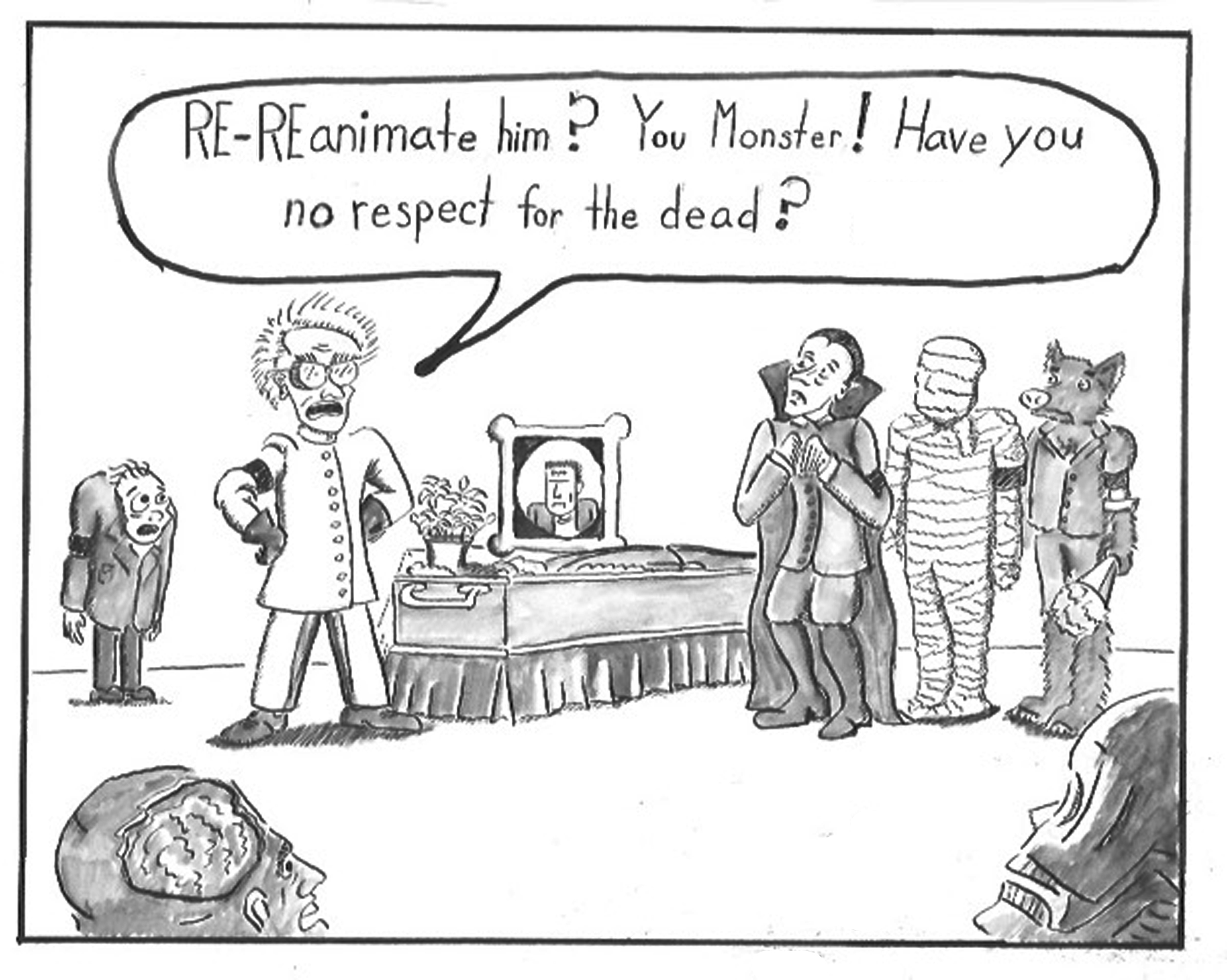
Re-Reanimation

Cartoon by Evan LileyMag_

Male Team of the Quarter: Men’s Basketball

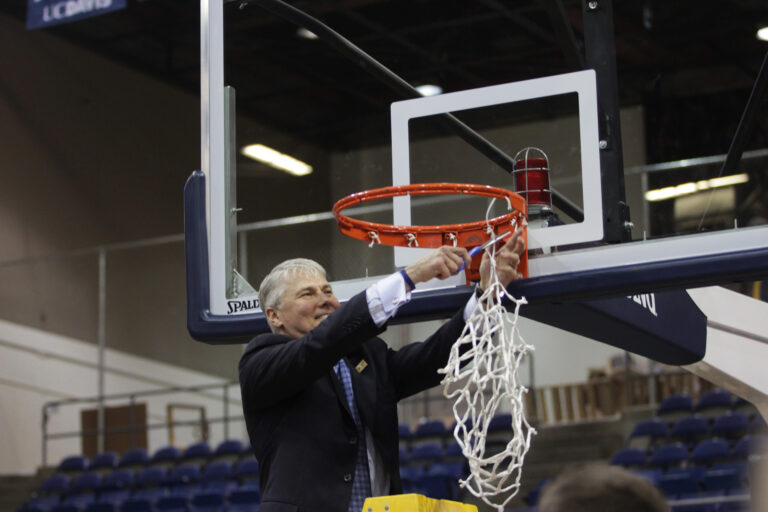
29 games into the season and the UC Davis men’s basketball team found themselves in the winner’s circle as they capture the Big West regular season title.  With an outstanding 24-5 overall record and a near perfect 14-2 conference record, basketball is the California Aggie’s Male Team of the Quarter.

A basketball temple of perfection, fans visiting the Pavilion never experienced a loss during this season as the Aggies notched a perfect 14-0 home record.  Protecting the Pavilion is easier said than done, yet the Aggies completed this feat with poise, confidence, and unrelenting determination.  Going on winning streak after winning streak, UC Davis never seemed to lose steam.  In addition, of the 24 regular season wins, 14 were won by a 10 or more points. Winning three overtime games as well, two of them being conference match-ups, the Aggies proved they have no problem playing with pressure.

Statistically this season, UC Davis was outstanding.  There are no obvious weak points in their game and the team has a knack for having guys step up when they are needed.  With season averages over 45 percent from beyond the 3 point line and 49 percent total, the Aggies do not take many bad shots on the court.  It is obvious that shooting from beyond the arc will be an important part of UC Davis’s game plan in the Conference tournament.

In his final year as an Aggie, senior guard Corey Hawkins led the team in almost every statistical category and was a clear leader on the court.  Hawkins set a standard for his fellow teammates with a 20.4 points per game average and 49 shooting averages.

Despite the array of emotions as Hawkins stepped off the Pavillion court for the last time as an Aggie, his determination for the future was clear to see.  “It’s a matter of staying true to ourselves,” said Hawkins regarding the Big West Conference Tournament.  Hawkins’ leadership will be very important in the post-season.

Fellow senior guards, Tyler Les and Avery Johnson as well as senior forward Josh Ritchard also finished their last seasons as Aggies strong.  Les and Ritchart’s confidence from beyond the arc has critical to spreading the floor to allow an outstanding slasher like Johnson to have successful games.

Les was emotional when asked about playing his last game in the Pavilion. “A lot of different emotions.  The biggest one I felt was happiness.  I couldn’t be happier to be leaving with this group of guys, this entire team, this coaching staff, these fans, at this University.  It’s a perfect ending.  I’m happy we got the win but now we’re excited for the next chapter and post-season play.”

Ritchart, a part of UC Davis’ dominant presence in the paint, felt a combination of relief and satisfaction with his ending at Davis.  “When we all decided to come here, this was what we all envisioned as what we wanted to do.  There were some tough stretches but we persevered and to be where we are now makes it that much sweeter.”  This season was a perfect send off for these players who have given so much to the UC Davis Basketball Program.

Despite the great season, the Aggies have one more hurdle to overcome.  They won their quarterfinal Big West tournament match-up against the sturdy CSUN Matadors and they will now play Hawai’i in the semifinals. Johnson expressed the team’s determination by confidently saying, “We’re ready to go on a run, and we’re not finished yet.  We’re ready to go to this tournament and shock the world.”

Undoubtedly, the Aggies are eager to prove to the world that they are truly the best in the Big West.

Photo by Jian Gelvezon.

6 Things to Do on a Staycation

0

If you’re stuck at home this spring break, you might as well try to have some fun.


If you’re not headed towards Hawaii, Mexico or some other tropical paradise this upcoming break, don’t fear. Sure, you might not get to drink and dance with your friends on a beautiful beach, eat foreign delicacies or mingle with new and attractive people, but you can always have a little fun at home. The key word here is “little.”


Here are six ideas help you get started in case you’re bored out of your mind:


1. Make a list.

Make a list of the things you could be doing, but aren’t. This article is an example. If you’re feeling adventurous, try tackling a few of the items — you might get a rush of adrenaline when checking one off the list.


2. Set up a lemonade stand.

The broke college student in you will thank you next quarter for making yourself look like a child again. You can welcome the warmer weather with a cool drink and earn a little pocket money while you’re at it.


3. Binge-watch your favorite shows on Netflix everywhere.

Yes, you might have already done this while school was still in session, but now you can do it guilt-free.Watch Netflix inside. Watch Netflix outside. Watch Netflix on your couch, in your bed, in the kitchen and maybe even in the shower. When you get tired of watching TV in your own house, watch it at a friend’s. There’s really never a bad place and certainly never a bad time.


4. Sleep.

Some of us who pull all-nighters like to tell ourselves that “sleep is for the weak.” But after all that binge-watching and junk food you’ve been eating, you might need to catch up on sleep — for a week.

5. Eat Oreos. Lots of them.

There are over 25 types of Oreos in existence — with flavors as bizarre as “Watermelon” “Creamsicle” and “Marshmallow Krispy.” Try a few that you’ve never seen before, and soon you’ll be able to tell your friends that you tried some exotic foods. You can also vary the way you consume your Oreos: just the cookie, just the cream filling, or both.


6. See all the sights at your staycation destination.

Your hometown may be familiar to you, but that doesn’t mean you can’t pretend to be a tourist and enjoy all the attractions it has to offer. Once you’ve exhausted any cool museums or art galleries nearby, try the park. Maybe you’ll find a corner of a bench you’ve never sat on before and try it out.


Studying for tests with ethical restraints

0

UC Davis Student Judicial Affairs, professors weigh in on appropriate test ethics


With an exam or two approaching quickly, students at UC Davis are often open to creative and convenient ideas for studying. In the search for that next piece of relevant material that might make the difference between passing, failing or getting an A, there are few practical limits to what can be used to study. Social media has aided in the access and sharing of study materials, but it has also raised a number of legal and ethical issues.

If you’ve ever studied for an exam on a group study guide online, the term anonymous koala might be familiar to you. Google Docs allows users to share and edit documents online and includes options for how it can be shared. It can require a sign in or it might only be accessible by a link with no sign in necessary. Google will then designate you some form of anonymous animal.

Ahmed Suboh, a fourth-year political science major, regularly uses Google Docs to create community study guides.

“I had actually formed the idea from peer to peer file sharing,” Suboh said. “The concept is, I have a part of the file, you have a part of the file, somebody else has a part of the file, we will combine together and download all of each other’s sections so we can get one whole document, one whole file, at a faster rate than it would take for us to take from one person, take from another person.”

As a commuting student with a job, Suboh admitted that he was not able to attend every lecture. Instead of continuously asking his friends for the notes he was missing, he decided a mass exchange would help him fill in the gaps.

“What’s really interesting is that I formed the idea out of selfish need,” Suboh said. “That’s what humans do; that’s what we are conditioned to do. I did it because I had a piece of my notes missing, and I needed to complete them. However, I was willing to share what I had in order to achieve that. And that’s where it’s not selfish anymore.”

To keep students from possibly using his study guide to cheat, Suboh has begun disabling the document right before the test. Other than possibly viewing it during an exam, sharing and using a group study guide is not generally considered cheating or illegal.

“Students are encouraged to study together,” said Donald Dudley, director of Student Judicial Affairs (SJA). “For graded assignments, students can only work together to the extent permitted by the instructor.”

Dudley suggested that if students are not aware of the degree to which they are allowed to work together, they should asked the professor or work independently to be safe.

Although Suboh commented that the guide is generally efficient and effective, one of the issues with the idea is a lack of willingness by some people to contribute.

“Typically people who already have their own comprehensive study guide will never contribute because they believe that they have nothing to gain,” Suboh said. “The study guide is not intentionally meant for people who don’t have a complete one, but it ends up being so, because the people who seek it out don’t have the complete document. They need assistance. And so they end up being assistance to someone who also needs assistance.”

Another possible issue has to do with the idea of a shared study guide in general, and what effect it might have on how the class is graded. Suboh commented that oftentimes people will come up with different answers to the same question, but argues that this contributes to discussion and gives a broader answer to the question.

One of the concerns with a comprehensive, effective study guide shared by everyone is the possibility of exploitation.

“I’ve made myself give over my phone during exams when I go to the bathroom,” Suboh said.” Which makes me feel more comfortable myself for being more academically honest because I don’t want to have the power of a whole study guide on my phone that I can access.”

According to Dudley, there could be potential legal issues with the use of online group study guides, depending on the source of the material and how it is distributed. If it is a transcript of audio recorded without the professor’s permission, if it is verbatim from slides that were photographed without permission, or if questions from a previously unreleased test show up on the guide, in many cases that material legally belongs to the professor. However, any material given to students by the professor is fair game.

“If an instructor distributes an exam and students are allowed to keep it, it is up to [the students] what to do with them,” Dudley said.

Jeffery Williams, chair of the undergraduate council and an agricultural and resource economics professor at UC Davis, said the academic senate is currently beginning discussion on the issue of ownership when it comes to professors’ material, as several professors are starting to find their own tests and problem sets online, posted by students without their permission.

“It’s certainly having the effect that you can’t as a professor reuse any material you’ve previously done, which means you’re always starting from scratch with new exam questions, new problem sets,” Williams said. “That’s a lot of work to always have to have something new and not be able to recycle something from three or four years before.”

Although the illegality of sharing copyrighted material publically online is clear, students stumbling upon the material creates an ambiguous issue which Williams is reluctant to consider cheating.

“I can see how it can be called [cheating],” Williams said. “The professor should be making this available to everybody if some get it. It’s an unfair advantage. I think it’s cheating if we make clear that you should not have that advantage.”

Williams said his personal method of avoiding this unfair advantage was to change the style of his tests to be based more on reading recent articles, but this has increased his workload, as he must continuously come up with new testing material.

On top of this ambiguity in unfair advantages, Williams mentioned that UC Davis has seen a rise in individual instances of cheating. Williams and Dudley both commented that faculty should bring instances of cheating to the attention of SJA.

“It’s a lot of work to get a case strong enough that [SJA] can handle, so as an individual faculty member it’s often much simpler just to ignore the problem,” Williams said. “I’m sure there have been cases that I’ve not caught, I’m not hunting for them, but whenever I’ve had one I’ve given it to [SJA]. I think that’s important as a faculty member.”

Williams said the academic senate is not looking for a universal solution for all the problems of unfair advantages and instances of cheating, but one reasonable expectation is that students will not use unpermitted electronic devices during tests. Dudley pointed out also that a students work is expected to be unique to the class they are turning it into.

Although there are certainly legal consequences for cheating, Suboh pointed out that the ultimate consequence is a lack of education.

“I find it a little bit sad,” Suboh said. “You had every opportunity to study, you had every opportunity to ask questions, you had every opportunity to write down notes and you chose not to. And then at the end, you chose to cheat, which, yes, comes at a great benefit to yourself, but then at the end you’re telling yourself that being in this class was not worth your time. Learning was not worth your time. What was worth your time was finding all the answers at the end and then dumping them out of your brain five seconds after you walk out of the room, which is really scary to me. What concerns me is people not caring about their education, because there’s something completely lost by cheating.”

Short-Term Emergency Aid Committee hosts its annual scout food drive

STEAC collects canned food and staples

On March 7 the Short-Term Emergency Aid Committee (STEAC) and local Davis scouting groups paired up to collect canned foods and staples for STEAC’s food pantry on the curb of Fifth and D Street.

According to executive director Tom Martens, STEAC is a local non-profit that aims to provide short-term assistance in the form of rent, utilities and food, to families and individuals in Yolo County below the poverty line.

“[The] food drives…were primarily an all-volunteer operation. STEAC didn’t have a staff, they didn’t have money and so everything that they did was all donated. It started right away and has been going on ever since,” said Martens.

Martens went on to explain the different kinds of food drives, including the scout drive. When asked about how STEAC was founded in 1967, a particularly rainy year, in order to support Yolo County migrant workers. Born out of a volunteer’s kitchen table, it has since expanded.

“[Many migrant workers] didn’t have food because they couldn’t pay their rent, so many of them were without housing, they were living in their cars. [There] became a need in the number of residents, and Davis kind of saw that STEAC could provide emergency assistance for them. Then it grew from there,” Martens said.

Mark Wong, the Yolo district chairman of Golden Empire Council: Boy Scouts of America, attended the event.

“I’m here representing the boy scouts…We’re partners with STEAC specifically for this drive,” said Wong.

According to Wong, the scout drive occurs once each year.

Dina Allison, the Davis Scouting for Food coordinator, explained the partnership between STEAC and the Scouting for Food program, a nationwide program. The scouts in Davis, however, have chosen to support STEAC as it aids the local community.

“One of the primary tenets of scouting is service and all scouts are required to put in service hours to advance in rank….We have been associated with [STEAC], as far as scouting working with [STEAC], since before I joined scouts seven years ago,” Allison said.

Will Benware, a board member of STEAC, whose wife is president of the board, explained his beginnings in STEAC.

“I started back around 1980 with the Holiday Program, and that’s been around since the late seventies sometime, and that’s how a lot of people get into it,” Benware said.

According to Martens, the STEAC food drives have a wide impact on the local community. On average they serve approximately 3,600 individuals per year and around 53,000 meals per year.

“For the most part, probably 90 percent of our food is donated…we do get grants to buy food…but it’s [spent on] stuff that doesn’t get donated like meat and cooking oils, those are things that we run short of. We also get fresh vegetables donated and we get the leftover vegetables from the Farmers’ Market downtown on Saturdays. That comes to us and gets redistributed,” Martens said.

Allison mother runs a food and clothing closet in Sausalito as well.

“It’s just how I grew up,” she said. “[You] took care of your community.”

Aggie Daily Calendar

0

Thurs., March 12

Shorts N Longs: A Davis Storytelling Thing

7 to 9 p.m.

Third Space, Davis

Experience the entertaining, emotional and original stories of people from all walks of life!

DJ Smilez

11 p.m.

Our House, Davis

Dance floor opens up for a free night of dancing!


Trivia Night

9 to 11 p.m.

Woodstock’s Pizza, Davis

Join teams of three to six people to answer unique and challenging trivia questions. Prizes, fun and pizza are in store.


Fri., March 13

ArtAbout

5:30 to 8:30 p.m.

Downtown Davis

View some of the best art in the Davis community at this free, monthly gathering which includes refreshments and the opportunity to meet new and upcoming artists and musicians.

Live Music with Bob Wren

5:30 to 8:30 p.m.

Monticello Seasonal Cuisine, Davis

Traditional and international live music featuring instruments including the violin, banjo and mandolin.

Folk Music Jam Session

Noon to 1 p.m.

UC Davis Wyatt Deck, Davis

Join your fellow Davis musicians for some good, old-fashioned folk music at this impromptu musical gathering.

Sweeney Todd

8:15 p.m.

Davis Musical Theatre Company, Davis

Enjoy a night in the gutter of London city with the murderous Sweeney Todd in this chilling and heart-wrenching musical. Tickets are $16 and $18.


Sat., March 14

Garden Work Day

10 a.m. to noon

Central Park Gardens, Davis

Spend a beautiful morning helping the gardens of Davis! All tools and training provided.

Stories on Stage Davis

7:30 to 9 p.m.

Pence Gallery, Davis

Listen to original short fiction stories acted out on stage for only $5.

Mulan

2:15 p.m.

Davis Musical Theatre Company, Davis

Come and enjoy this fantastic, action-packed musical for only $8 a ticket!

Local Live Music

9 p.m.

Woodstock’s Pizza, Davis

Enjoy a fun night of live music free of charge!

Sweeney Todd

8:15 p.m.

Davis Musical Theatre Company, Davis CA

Enjoy a night in the gutter of London city with the murderous Sweeney Todd in this chilling and heart-wrenching musical. Tickets are $16 and $18.


Sun., March 15

Yoga in the Arboretum

1 to 2:30 p.m.

UC Davis Arboretum, Davis

Find your inner peace with this 90-minute yoga session open to all ages and ability levels. Make sure to bring your own towel/yoga mat and water bottle!

Live Irish Music

4 to 7 p.m.

De Vere’s Irish Pub, Davis

Enjoy drink and food specials while listening to traditional Irish music.

Sweeney Todd

2:15 p.m.

Davis Musical Theatre Company, Davis CA

Enjoy a night in the gutter of London city with the murderous Sweeney Todd in this chilling and heart-wrenching musical. Tickets are $16 and $18.

International Folk Dancing

7 to 9 p.m.

Davis Arts Center, Davis

Learn how to folk dance, first time free! All levels welcome!


Mon., March 16

El Circulo Espanol

7:30 to 8:30 p.m.

Logos Books, Davis

Free gathering for all Spanish speakers the third Monday of every month to discuss a  selected topic. Check logosbooks.wordpress.com for further information on this week’s topic.

Pub Quiz

8:00 p.m.

Third Space, Davis

Listen to various types of rock, punk-rock and instrumental music for only $5!

Female Team of the Quarter: Swimming & Diving

0

On Feb. 21, UC Davis women’s swimming stroked their way to a second place finish at the Mountain Pacific Sports Federation (MPSF) Championships. At the event, 16 members of the squad earned a combined 37 all-conference honor roll awards, adding five more awards to their achieved 32 last year.

Continuing a legacy of hard work and determination, highlights of the swimming season include an over 40 point win against Pacific University in late January, and their never trailing 148-144 triumph against UC Santa Barbara earlier the same month.

But it’s the consistency that Aggie swimming maintains outside of the pool that truly sets the team apart from others this quarter. As of Feb. 26, UC Davis swimming is one of only 149 swimming teams in America to maintain an overall team grade point average of 3.0 or above. The Aggies earned, for their third straight term, academic team honors by the College Swimming Coaches Association of America.

For their achievements both in the water and the in classroom, Aggie swimming is recognized as UC Davis’s female team of the quarter.

Led by head coach Barbara Jahn, Aggie swimming was not short of guided expertise this season. Coaching for her 40th year at the UC Davis program, Jahn aided senior swimmers Samantha Shellem and Hilary Hunt to five and three award titles respectively at MPSF. Sophomore Hilvy Cheung also earned three awards at MPSF, which included two conference titles in the butterfly events

Four divers also took home MPSF awards, including juniors Lucy Lafranchise and Audrey DeNeffe. The duo represented UC Davis at the NCAA Zone E Championships from March 9 to 11. Lafranchise finished No. 43 in the 1-meter dive and No. 54 in the 3-meter dive while DeNeffe finished No. 49 and No. 55 respectively.

Graphic by Jennifer Wu.

Male Athlete of the Quarter: Corey Hawkins

0

In 2012, the UC Davis men’s basketball program was recovering from its worst season in years; the Aggies recorded five wins and a .161 winning percentage. The arrival of senior guard Corey Hawkins would forever change the basketball landscape in Davis. Hawkins had a tremendous impact, helping improve the Aggies to a 14-win season and garnering national attention after ESPN broadcasted a home game against Long Beach State in the following season.

This season, Hawkins averaged 20.6 points per game, 3.5 assists per game while shooting at 49.8 percent from the field and 49.7 percent from beyond the arc, all career highs. He also leads the team with 5.1 rebounds per game, although not a career high, still impressive for a 6-foot-3 guard.

The rise of UC Davis basketball led to a high level support and appreciation from the Davis community. It also included various national television appearances on ESPN and Fox Sports. The Aggie’s success on the court brought the attendance average up from 1,712 attendants per game last season to 2,484 attendants per game. The support from the UC Davis community fueled the Aggies throughout the season.

“Coach [Les] tells us about all the support that we have and it really goes a long way,” Hawkins said. “It makes us want to get better when we have that many people looking up to you and supporting you. You don’t want to let them down.”

With large support of the Davis community the Aggies accomplished a rare feat, going undefeated at The Pavilion.

“In this league you need to protect home court to have a chance at winning the conference,” Hawkins said. “We knew that was important, we wanted to fans a reason to keep coming back.

The success that Hawkins achieved in his first year as an Aggie was just the beginning, as he continued to grow as a player under the guidance of head coach Jim Les. There is a long list of accolades that Hawkins has earned throughout his career, including this year’s Big West Player of the Year and being named into the All-Big West First-Team for the second time in three seasons.

But Hawkins and the Aggies have other goals in sight, including winning the Big West Tournament and a potential bid to the NCAA Tournament.

“Obviously, [the NCAA Tournament] is on the back of our heads,” Hawkins said. “I think we are more focused on winning the conference tournament right now. And more specifically we need to take it one game at a time, we can’t get too far ahead of ourselves.”

Hawkins has demonstrated time and time again that he can play continuously at a high level throughout the season. Several NBA scouts have seen Hawkins play and are hopeful of his future’s career at the next level. Hawkins is aware of the future opportunity to play in the NBA, but his mind is still focused on the Big West Tournament.

“I’m not focused on that right now. I’m focused on winning the conference tournament right now. It would be a disservice to focus on things that are out of my control right,” Hawkins said. “I’ll focus on what I can control, and help out [my teammates] in any way I can because they deserve it; we deserve it. We need to continue this dream season that we’ve been having.”

This season, not only did Hawkins place his name in the UC Davis record books, but he made his way into the NCAA record books. Hawkins and his father, Hersey Hawkins, are the second highest-scoring father-son duo behind the Dell and Steph Curry duo.

And although he won’t admit it, Hawkins has had a huge role in bringing an exciting brand of basketball to UC Davis, and should be accredited for the Aggies recent success.

The Big West Tournament begins today as the Aggies take on the Cal State Fullerton Matadors at the Honda Center in Anaheim, Calif. at noon on Fox Prime Ticket.

Photo by Jian Gelvezon.