44.5 F
Davis

Davis, California

Monday, January 12, 2026
Home Blog Page 931

Column: You’re Majoring in What?

401953_3535238053709_817574071_n
Editor’s note: You’re Majoring in What? is a new Aggie column that features students of UC Davis’ lesser-known majors.

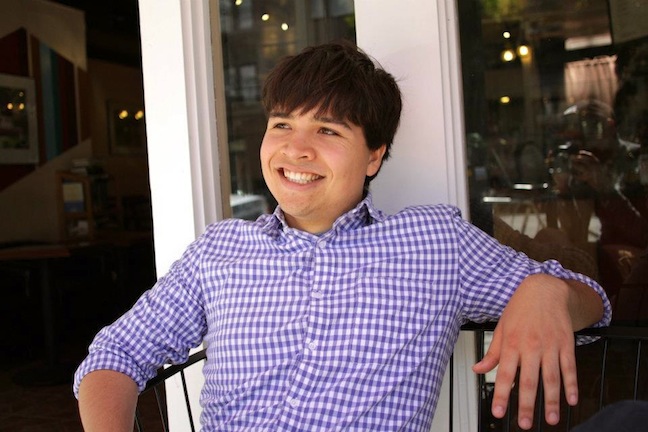
Tristan Leder is a third-year technocultural studies major.

What is technocultural studies (TCS)?
Technocultural studies sits at an interesting crossroads between media, art, humanities and, of course, technology. The major focuses on both the critical theory behind all of it, as well as the production side of things. Students are given the opportunity to make music, sound pieces, electronic art installations, documentaries, short films, 3D animations and many other forms of physical and digital art.

Why did you choose TCS as your major?
I came into Davis with extreme interests in Web 2.0 and social media. Specifically, what it was, how it did what it did, and how I could better understand it. Over the past three years, my interests have changed, focusing more on community-based media and independently-developed video games.

What jobs can you get with TCS? What do you plan to do?
To be quite honest, I could not tell you. Most TCS majors have aspirations of going into either the film, television or music industries, from what I have gathered. The program definitely prepares you for the creation of these various media, but it’s really hard to find a job in those fields. I’ve considered going on to grad school and potential professorships, but who knows. I’d like to make video games too. That’d be chill.

What has been your favorite TCS class that you have taken this far? Any you’d recommend?
So there are three kinds of kids in TCS: the kids who like to make things, the kids who like to write about the kids who make things, and the kids who like to do a little of both.

I’m a kid who likes to write about things, so you’ll have to take my response with a grain of salt. TCS courses are really split down the middle between production and critical studies.

TCS 155: Documentary Studies provides a very interesting view at the history of documentary and all of its styles. TCS 151: Topics in Virtuality, is a course that fluctuates topics depending on professor. When I took it, it was called Ghost in the Machine, and focused on the trippy things that happen when humans interface with machines and media. If I see the world through the camera lens of someone’s phone, what does that mean both philosophically and practically?

If anyone is interested in taking TCS I would highly recommend checking out TCS 1 or TCS 5. Intro to Technocultural Studies provides a good background on the off-beat topics you may encounter in your classes. Media Archaeology begins to get into the quirky historical and mechanical aspects of media that the upper division courses explore.

Who is your favorite professor in TCS?
I’m not exaggerating when I say they are literally all so cool. What other department can brag that one of their professors was a prominent journalist reporting on Central American political revolutions, while also being a major player in the experimental music scene? How about making a documentary about the politics of country music? The TCS department has such an interesting group of people teaching its courses that it’s really hard to say.

As I mentioned before, I’m more of a studies guy, and I like to study indie games. The courses that I have taken from Kriss Ravetto-Biagioli have really allowed me to pursue my interest from a theoretical perspective. She’s a super smart woman who knows a lot about a lot.

What have you learned as a TCS student?
I think TCS forces its students to become self-starters. Look at most humanities majors. Sure, you have this cool degree that you enjoyed getting, but what are you going to do with it? Compare that to a neurology, physiology and behavior, engineering, viticulture or animal science major. Sure, you may not want to go into that field, but at least you have a degree with some practicality. I’m not gonna get a job by telling someone about how they should apply the concept of diegesis to video games.

However, the coursework in TCS really teaches students how to self-start and teach themselves the skills that they feel relevant. The teachers give students instructions on how to do certain things, but past a certain point, the students are forced to take the reins and direct their own studies.

LILIANA NAVA OCHOA can be reached at campus@theaggie.org.
College students donate gametes to earn money, help others

Scholarships and financial aid are among many traditional methods students use to fund their college educations. But there is one option that is becoming increasingly popular among college students that may pay much more than any scholarship would. You wouldn’t be competing with other applicants by grades alone or with essays, but rather with your genetics.

Many sperm and egg donation programs are recruiting college students, offering high monetary rewards for giving the gift of life to families who cannot conceive on their own. While a donation gives students an opportunity to change a family’s life, it also helps students pay their way through college. However, the specific requirements for who may donate bring into question several responsibilities and whether this process translates into a procedure to create super babies — those with the genes for high intelligence, excellent health and physical attractiveness.

Colin Frederick, a third-year economics major, recently considered becoming a sperm donor.

“I thought [the concept] was interesting, especially because I don’t know what will be happening with the rest of my life — so it’d be cool to [say] I potentially had kids but without actually having personal kids,” Frederick said.

Because one thawed sample may contain 20 million motile sperm, there may be concern for sperm donors fathering too many children. However, some programs, such as the Sperm Bank of California, limit sperm donors to 10 families. This ensures that there will not be too many children with the same DNA in the same geographic area.

While eggs are produced over longer periods of time, the egg donation process looks quite different. One procedure generally involves removing six to eight eggs.

This idea of passing on genes for future generations, without necessarily having to raise kids, gives some students a sense of accomplishment. It also appealed to Kaleigh Robinson, a fourth-year animal science major, who decided to register to become an egg donor.

“I realized that … as a smart person and generally healthy person, I felt there was some sort of responsibility to pass those genes on, and if I didn’t want to do that myself I could still have my genes in the next generation,” Robinson said.

Robinson initially felt attracted to the idea because of the monetary incentive, but in the end her primary desire to become an egg donor was to help families unable to conceive.

“I think it’s really terrible for people who would be great parents to be unable to have their own children,” Robinson said.

While Robinson registered with the Davis Fertility Clinic, which offered a set price of $5,000 to egg donors, other programs offer up to $10,000 and others even compensate the donor for more than that.

The fertility drugs that egg donors take cause about a dozen of the thousand recruited eggs to become ready for ovulation, instead of just one egg. Thus, the eggs donated are some of the eggs that would normally die during that menstrual cycle, not eggs that would be used in the future for a pregnancy.

Sperm donors make more based on how often they go into the facility to donate. The Sperm Bank of California, for example, pays a minimum of $800 along with a bonus of $750 after a referred friend has been in the program for six months.

Jezzie Zimbardo, who is a community counselor at the UC Davis Student Health and Counseling Services, has been an egg donor and surrogate herself, and has a partner who donated sperm. Zimbardo notes that very few donors ever regret their decision.

“Most donors are screened pretty carefully up front, and have a very thorough understanding of what they are getting into. They are encouraged to think pretty hard up front about whether they will feel disturbed by having biological offspring they may never know,” Zimbardo said.

Frederick decided not to become a sperm donor just yet because he did not feel ready to be a biological parent.

“If I do make the decision [to become a sperm donor] I would want to be a potential support figure for that kid if something ended up happening, but am I prepared to do that? No, so I don’t think I want to donate yet,” Frederick said.

Donors are given the option to either remain anonymous, to have their information available to the biological child upon the child’s 18th birthday or to have information always available to the family of the intended parents.

Zimbardo believes that giving the intended family the option for contact is the best option.

“It is generally best for offspring to have some information about their biological origins, as secrets in this area often lead to damaging fallout. However, whether there should be personal, ongoing contact with a donor is going to vary depending on the people and circumstances involved,” Zimbardo said.

Unlike Frederick, Robinson opted to remain anonymous to any receiving family.

“It’s not my kid,” Robinson said. “If I’m going to give this gift to someone, I want them to understand that this is their child, and they don’t have to worry about me butting into their lives.”

Zimbardo states that the donors are not legally the parents, even if they share DNA with the offspring of the intended parents.

Although donors are not held responsible for contact with their biological offspring, the question of eugenics and super babies still remains.

Different programs vary on their specifications — some offer more compensation to donors with certain physical characteristics, such as being taller or having a rare eye color. Robinson approaches this argument with the idea of natural selection and said that in the end, donors give genes to families who may have weaker genes, specifically in the case of fertility.

“I think that’s a really great way to approach it ethically, to keep the genetics of our species at a better level,” Robinson said.

ALYSSA KUHLMAN can be reached at features@theaggie.org.

This Week in Science

Cancer:
How do we stop ovarian cancer? We bling the ovaries, obviously. Researchers from the Mayo Clinic have recently discovered that gold (nano) particles can prove quite effective in killing cancerous ovarian cells. By limiting the uptake of calcium into the ovarian cells’ mitochondria, the gold particles become far more toxic than normal, killing the normally resistant cancer cells. Do not take this as an excuse to go stock up on Goldschlager.

Climate and Culture:
According to researchers at Cardiff University’s School of Earth and Ocean Sciences, the University of Barcelona and the London Natural History Museum, early human cultural innovation increased exponentially during the Middle Stone Age about 80,000 years ago — a period of massive climate change. By measuring the dates of these climatic events and correlating them with archaeological finds, the researchers found that there were major societal changes around the same time that rainfall dramatically increased and when rainfall dramatically decreased. This indicates that it is not just humans that affect the environment, but it is also the environment that affects human evolution.

Type 1 Diabetes:
Type 1 diabetes is a condition in which the body’s immune cells attack the body’s cells that produce insulin. The insulin cells, or islet cells, are killed by a specific immune cell. Researchers from the Hall Institute of Medical Research in Australia have found that the immune cells, or T-cells, that attack the islet cells are in turn regulated by a different immune cell, called a regulatory T-cell. By increasing the activity of these regulatory T-cells, the researchers limited the number of normal T-cells in the system, and in turn dramatically reduced the lost number of islet cells.

Alzheimer’s:
This prevalent disease is caused by neuron death in the brain. Researchers from Cambridge’s Chemistry Department have been able to identify the mechanism that causes this neuron death, which has brought them one step closer to a cure. The researchers are focusing on how proteins in the brain “misfold,” causing aberrations that cause many neurodegenerative disorders, including Alzheimer’s.

Regeneration:
Salamanders are fortunate in that when a predator takes a limb, or two, or three, or four, those limbs can grow back and be perfectly functional. Salamanders are the only vertebrate that can repair their heart, tail, spinal cord and brain. This ability is essentially the “holy grail” of human longevity. Researchers from Monash University in Australia have recently identified a “scavenging immune system cell” that helps salamanders accomplish this amazing feat. By identifying the cells and process responsible for regeneration, we are now closer to developing this ability for human medicine.

Tornados:
Back in the 1980s, tornado hotspots only had about five minutes of warning before the tornado struck. Nowadays, that alert time has increased to 13 minutes, giving people invaluable extra time to prepare or escape the tornado’s path. By analyzing weather and satellite data from hundreds of past tornados, meteorologists from the Severe Storms Research Center have developed prediction algorithms that compare current conditions to those that existed before other tornados, and can determine an accurate timeframe in which the tornado can occur.

HUDSON LOFCHIE can be reached at science@theaggie.org.

Judge to rule on March 10 hate crime case

Today, Judge David Rosenberg of the Yolo Superior Court will decide whether there is enough evidence for Clayton Garzon to stand trial for the March 10 beating of Lawrence “Mikey” Partida on I Street. Authorities have classified the beating as a hate crime.

According the The Davis Enterprise, Garzon pleaded not guilty to multiple charges against him, including felony counts of assault, battery and criminal threats. All the charges additionally carry hate crime enhancements.

Witnesses have testified that Garzon yelled out what appeared to be homophobic slurs at Partida and his cousin Vanessa Turner. However, according to The Davis Enterprise, defense witness Brigham Young University linguistics expert William Eggington said that such slurs tend to be used to challenge masculinity and aren’t always used in terms of homophobia.

Partida was hospitalized for two weeks after the beating, suffering fractures to his skull and rib cage, and undergoing surgery to remove a piece of wood from his right eye socket.

Garzon’s arraignment is arranged for May 31.

— Claire Tan

An open letter to the DJ at the ARC: a review of “DuFlocka Halftime Show” by Waka Flocka Flame

To whoever is in charge of the music at the ARC,

I am writing to suggest that, for one day, your establishment should simply play Duflocka Rant: Halftime Show, the new mixtape by Waka Flocka Flame, over the stereo. This choice will only improve student fitness.

Sure, Top 40 or whatever gets the blood pumping perfectly fine, but Duflocka Rant is in a league of its own. These songs could power an apartment complex on their own. They feature lots of shouting and gunshots. In fact, eight of the 19 tracks BEGIN with a gunshot or a gun being cocked, similar to a race.

Waka Flocka Flame is also as energetic as a racer. Waka doesn’t rap as much as he shouts, and this keeps the energy at peak levels. Even the ballad, “Red Ferrari,” has Waka singing (more like autotuned speaking) about sex, Ferraris and being turnt up over an ominous melody and 808s while he shouts “SQUAAAAD” and “BOW” in the background (since this is a ballad, however, he does not say those things as much as usual).

I’m not a science major, but I believe this energy will flow directly from the speakers into the blood vessels of anyone working out.

However, the lyrical content may turn people off. Waka Flocka Flame is violent and misogynistic music. There’s a 100% chance of a hundred-man melee erupting in the ARC if you were play this mixtape. He raps about murder, drugs and money. I happen to love music about those things, but I can see that it wouldn’t be everyone’s cup of lean.

Still, it’s fun, energetic music. Waka is the perfect soundtrack to a workout or a party. And the best part? Totally free.

Please consider my proposal. If you do this just once, our student athletes will get so pumped up that the football team would win every bowl game, the basketball team would destroy the Miami Heat and the MLB would admit our baseball team into their league. This isn’t an exaggeration. Just consider it.

Sincerely,

John Kesler

California Aggie

RATING: 4 out of 5

CHECK THIS OUT IF YOU LIKE: Gucci Mane, EDM, gangsta rap released since 2010

DOWNLOAD AT http://www.datpiff.com/Waka-Flocka-DuFlocka-Rant-Halftime-Show-mixtape.484840.html

https://www.youtube.com/watch?v=3zWwvVs1S_8

ASUCD Senate Briefs

ASUCD Senate meetings are scheduled to begin Thursdays at 6:10 p.m. Times listed are according to the clock at the May 2 meeting location, the Memorial Union’s Mee Room. The ASUCD president is not required to attend senate meetings.


Meeting called to order at 6:10 p.m.


Carly Sandstrom, ASUCD president, present

Bradley Bottoms, ASUCD vice president, present

Liam Burke, ASUCD senator, present

Armando Figueroa, ASUCD senator, present

Maxwell Kappes, ASUCD senator, present

Pamela Nonga, ASUCD senator, present

Felicia Ong, ASUCD senator, present

Alyson Sagala, ASUCD senator, present

Amrit Sahota, ASUCD senator, present

Miles Thomas, ASUCD senator, present

Tal Topf, ASUCD senator, present

Reuben Torres, ASUCD senator, present

Ryan Wonders, ASUCD senator, present

Yee Xiong, ASUCD senator, present


Appointments and Confirmations

Sean Guerra and Amanda Trieu were confirmed as members of Aggie Public Arts Committee (APAC).

Tanzi Jackson was confirmed as a member of Campus Center for the Environment.

Noelle Patterson was confirmed as a director for Project Compost.


Unit Director Reports


Experimental College

Director of Experimental College Peter Neely stated that numbers are rising. He discussed the demo class that they had this quarter and that they want to institutionalize it. They are working on outreach to freshman so that they are informed about what is going on with the unit. He also stated that they are looking into moving to where the bike barn is located now.


Cal Aggie Camp

Anni Kimball director of Cal Aggie Camp reported that they trained new staff members. They are having an event at Whole Foods in June and are partnering with Whole Earth Festical to make tie dye shirts.


Lobby Corps

Karan Singh director of Lobby Corps reported that they are working with assembly members to draft bills. The application for unit director position closed and interviews will take place afterwards. Applications for remaining positions will be left open.


He said that once a bill packaged is finalized, they will host a lobby workshop.


Coffee House

Darin Schluep director of the Coffee House reported that they are either going to come ahead or break even. He reported that during Picnic Day their sales increased by 2 percent in comparison to last year; they had over 4000 transactions in four hours. They broke the $3000 plateau for CoHo South and will remain rent-free for at least one year. They are negotiating having the CoHo South continue to be rent-free in the future too. He said the new CoHo hot dog cart was well-received and they are exploring new locations such as Aggie Stadium and the farmer’s market. They are also looking for vegan hot dog options. On August 19 they will be posting vacancies for CoHo employees. They are looking for 60 to 100 new employees depending on this years graduation rate.


Public Discussion

There was a discussion about the presence of Aggie Hosts at was was supposed to be the Ethnic and Cultural Affairs Commission meeting on April 30 regarding Senate Resolution 30. Some senators and commissioners expressed discomfort at their presence, while others felt their presence to create a safer environment since the topic being discussed was contentious.


Consideration of Old Legislation

Senate Bill 86, authored by Spencer McManus for the ASUCD Senate to adopt the Long-Range Plan for Cal Aggie Camp. The bill passed in an  8-0-4 vote.


Senate Bill 87, authored by Sagala to allocate $1,132.98 for a 16-channel mixer board for Entertainment Council because the mixer board they were using belongs to a unit director who is graduating and they need a mixer board for future events. It passed unanimously.


Senate Bill 88, authored by Rivilis to remove binary gender references from the ASUCD bylaws passed unanimously.


Senate Bill 94, authored by Sagala to increase funding in the community-specific graduation ceremonies. SB 94 originally asked for an allocation of $5,100 from Senate Reserves, but after administration agreed to fund $3,800, they were asking for $1,300. Members of the public in support of the bill attended the meeting and discussed the importance of community-specific graduations for marginalized and underrepresented students. Members of the public in favor of this bill expressed that they felt as if senators against this bill were questioning the merit of it. Senators opposing the bill wanted to see numbers in the budget before voting on the actual bill. After approximately four hours of discussion and with a vote of 6-5-1, SB 94 was re-referred to the Business and Finance Commission.


Senate Bill 84, authored by Kimball to allocate $161.51 from Capital Reserves to purchase a banner for Cal Aggie Camp was passed with a 10-2-0 vote. Thomas and Kappes opposed because they felt that it was too expensive in comparison to previous banners that were purchased.


Meeting adjourned at 3:55 a.m.


Open positions within ASUCD can be found at vacancy.ucdavis.edu. LILIANA NAVA OCHOA compiled the Senate Briefs. She can be reached at campus@theaggie.org. XXX
ASUCD Senate Briefs

ASUCD Senate meetings are scheduled to begin Thursdays at 6:10 p.m. Times listed are according to the clock at the May 16 meeting location, the Memorial Union’s Mee Room. The ASUCD president is not required to attend senate meetings.


Meeting called to order at 6:16 p.m.


Carly Sandstrom, ASUCD president, present

Bradley Bottoms, ASUCD vice president, present

Liam Burke, ASUCD senator, present

Armando Figueroa, ASUCD senator, present

Maxwell Kappes, ASUCD senator, present

Pamela Nonga, ASUCD senator, present

Felicia Ong, ASUCD senator, present

Alyson Sagala, ASUCD senator, present

Amrit Sahota, ASUCD senator, present

Miles Thomas, ASUCD senator, present

Tal Topf, ASUCD senator, present

Reuben Torres, ASUCD senator, present

Ryan Wonders, ASUCD senator, present

Yee Xiong, ASUCD senator, arrived late, 7:50 p.m.


Appointments and confirmations


Kristie Wu was confirmed as the director of the Aggie Reuse store and this will be her second year in the position.


Susan Alkadri and Danielle Mae-Santiago were confirmed to the Sexual Assault Awareness Advocacy Committee (SAAAC).


Unit director reports


Campus Copies/Classical Notes explained their new interactive website where students can access and add to the notes online. They said this is proving to be a very valuable resource for students. Also, they plan on reaching out to more professors and get them to use classical notes.


Project Compost said they had a busy quarter and participated in events such as Music on the Green, a backyard compost workshop and the Whole Earth festival. They have also expanded compost pick up,  and are in the process of building a lock box for donations. Their vehicle, The Lion, is old so they are in talks to get a new vehicle for next year.


Pantry is in the process of hiring directors for next year and they have had good outreach this year and hope to continue that.


Consideration of old legislation


Senate Resolution 33, authored by Hackney, which moves to support California Assembly Bill 1285 (AB 1285) as proposed by Assembly-member Paul Fong. This bill expands student access to Cal Grant funds because currently first year students who get Cal Grants can only use two percent of the money for tuition. The resolution passed unanimously.


Senate Resolution 35, authored by Hackney, supports California Assembly Bill 1162 (AB 1162) as proposed by Assembly-member Jim Frazier. The bill calls for more regulations in place for campus debit card programs in order to protect students. The resolution passed 9-1-2.


Senate Resolution 36, authored by Hackney, supported California Assembly Bill 166 (AB 166) as proposed by Assembly-member Roger Hernandez. The bill advocated for more financial literacy and education for students. The resolution passed unanimously.


Senate Bill 102, authored by Herskovitz, is a bill that defines who deferments can be given to. The bill passed unanimously.


Senate Resolution 31, authored by Kappes, encourages the student government of University of California, Berkeley (ASUC) to change its name to “Associated Students, University of California, Berkeley (ASUCB).” Members of the table said that the resolution also aimed to prevent people from misinterpreting the status of that association. ASUC remained the name of the UC Berkeley student government because it was the first UC campus. Sandstrom said this resolution may change the way ASUCD is viewed, if it is passed. The resolution passed with a 7-2-3 vote.


Senate Bill 92, authored by Kasliwal, would establish the marketing special committee to actively promote ASUCD and the services it offers to the UC Davis campus and surrounding community. Internal Affairs Commission chair Sergio Cano said this bill would change the dynamics of how students view ASUCD. The bill passed unanimously.


Senate Bill 90, authored by Cano, would establish AggieTV as an ASUCD Unit. The bill passed unanimously.


Senate Bill 93, authored by Cano, would establish procedures for creating and dissolving ASUCD units. The bill passed unanimously


Senate Bill 103, authored by Cano, would outline procedures for closed sessions of the Senate’s subordinate bodies. Cano said that this would mainly concern litigation, investment or personnel matters. The table discussed having non-voting members be voted in. Thomas said he believed that closed session is not the appropriate forum for additional perspectives, and including more people in the closed session would make it less private. The bill passed unanimously.


Senate Bill 104, authored by Cano, would outline procedures for the ASUCD Scholarship Committee and the Champagne Committee.


The table unanimously passed a Memorandum of Understanding (MOU). Sandstrom explained that the Center for Student Involvement (CSI) began increasing payment to Creative Media by $12,000 because the unit increased the amount of services they offered to CSI. The bill states that CSI would check the progress of Creative Media quarterly.


Consideration of urgent legislation


Public discussion


Gender and Sexuality Commission chair Chucha Marquez discussed a hate crime that occurred recently and urged people to be more aware of the issue. He said he sent out an email and wanted more response to see that the senators were aware. Ong asked about the Campus Safety Coordinator’s role in bringing awareness to hate crimes and Marquez said he spoke to the Campus Safety Coordinator but hopes to do more in addition to that.

Figueroa suggested that everyone needs to be discussing the issue, not just the people and groups affected.


Thomas announced that he has come up with an alternate plan for the budget, which he will present at the budget hearings on May 17-19.


A decision of the ASUCD court was presented, which stated that the court ruled it was unconstitutional for the Business and Finance commission to hold a closed hearing and vote on bills not directly related to ASUCD funds. Many senators questioned how to distinguish between university and ASUCD investments and finances. Bottoms said that there is overlap between the two.


Public announcements


Outreach Assembly chair Karan Singh talked about a campus rally on student debt crisis.


Sandstrom and Bottoms announced that there will be a reception held for the ASUCD Scholarship recipients May 30 at 5 p.m. in the Griffin Lounge.


Sagala said she is working with and encouraging units to create Wiki pages that outline how that unit functions.


Torres said Black Family Day is Saturday, May 18.


Meeting adjourned at 11:23 p.m.


Open positions within ASUCD can be found at vacancy.ucdavis.edu. PAAYAL ZAVERI and MUNA SADEK compiled the senate briefs. They can be reached at campus@theaggie.org XXX

Students close Dutton Hall in support of Nakba Day

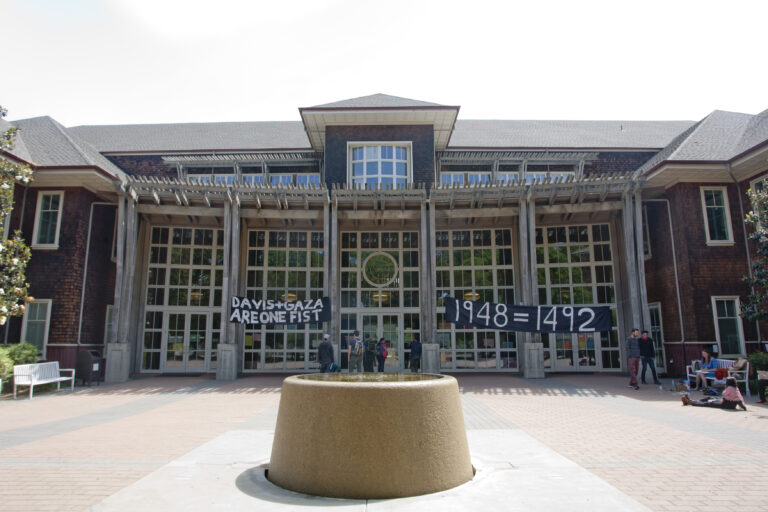
Dutton Hall is currently being occupied in a 24-hour sit-in, which began yesterday, to commemorate Nakba Day.

The annual remembrance day commemorates the displacement of Palestinians, that came about following the Israeli Declaration of Independence in 1948.

About 20 students are present, discussing the Nakba. Walls of the building’s lobby are plastered with small colored signs highlighting phrases in support of Palestine. Another sign outside reads “Building is closed. One day occupation.” Chairs are also blockading the exterior doors of the building.

Students also expressed their disapproval in ASUCD’s recent vote failing Senate Resolution 30, which urged for a divestment from companies that profit from the Palestinian occupation.


— Muna Sadek


EDITOR’S  NOTE: Updated for accuracy 05/17/13

Regents evacuated after union workers interrupt meeting

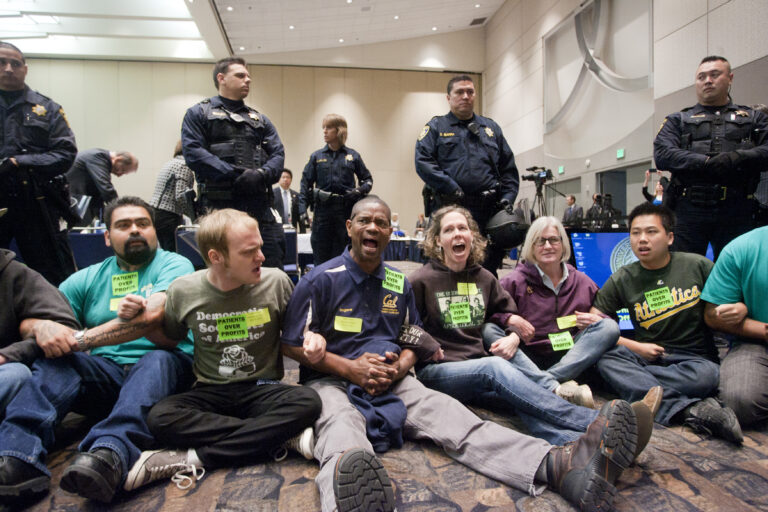
The UC Board of Regents meeting at the Sacramento Convention Center was momentarily interrupted on May 15 after union healthcare workers from AFSCME 3299 began chanting loudly during a sit-in.

Thirteen arrests were made and AFSCME 3299 president Kathryn Lybarger was among the group. The protesters, wearing stickers reading “Patients not profits,” chanted phrases such as “What’s this about? Patient care!” and “Whose university? Our university!”

The building was heavily patrolled by Sacramento police.

The meeting reconvened after approximately 25 minutes.

The demonstration follows a UPTE (University Professional & Technical Employees, CWA 9119) announcement that UC health care workers at all five UC health centers will participate in a strike calling for retirement security and fair wages.

AFSCME 3299 has also scheduled a strike at the UC medical student health centers on May 21 and 22.

“This strike is about standing up for the students, patients and taxpayers the UC Medical System was intended to serve … We will not rest until UC gets its priorities straight,” Lybarger said in a press release.

Members of the public also addressed the Professional Degree Supplemental Tuition vote in the July Board of Regents meeting and online education.

UC Student Association President Racquel Morales spoke at the meeting as well, discussing the UC-wide campus climate survey that was distributed in the winter and what will come about from the data.

The Board continued to discuss the recent May Revise 2013-14, which calls for a four-year tuition freeze.

The meeting will continue Thursday, beginning at 8:30 a.m.

— Muna Sadek


EDITOR’S  NOTE: Updated for accuracy 05/17/13

Cities move toward more efficient parking meter models

0

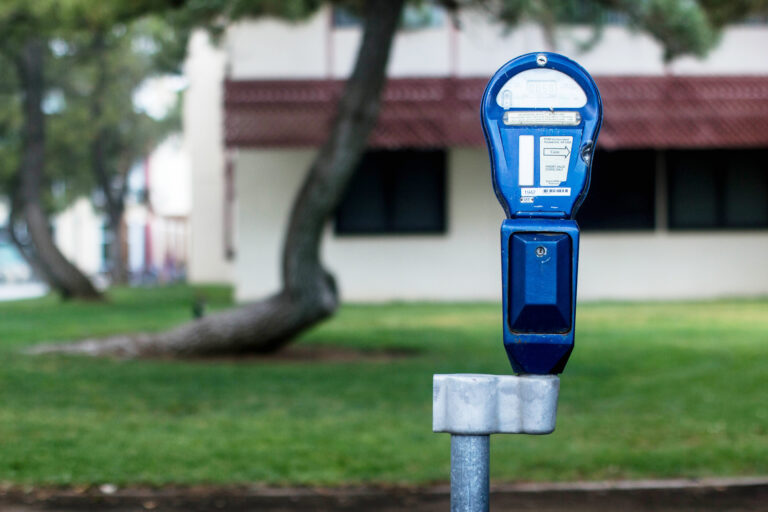
Parking in downtown Sacramento will soon undergo a change to move toward a more consumer-oriented, efficient and green model. This summer, they will see upgrades across the board to move away from older parking meter models by installing an estimated 6,000 solar-powered meters that consumers pay for using cell phone technology.

“It’ll reduce operating expenses and improve the customer experience. These are key for us to make it easier for people that come to our downtown and midtown area,” said Sacramento’s City Parking Services manager Howard Chan. “Parking is a small part of the city’s operations and the goal is to retain current business and attract new ones. The bigger picture focuses on the fact that parking is just a cog in the wheel because customer parking should be transparent, not a source of anxiety.”

Though currently one-third of the parking meters downtown are run with solar power, the other two-thirds are still using the old, environmentally unfriendly model.

“The single-space meters are all run by nine-volt batteries. There’s about 5,700 meters out there but, as you can imagine, those nine-volt batteries running need to be changed every six months. That happens everywhere you go with single-space meters,” Chan said. “In fact, Midtown Old Sacramento — a higher demand area — could be choked down to have to replace [the batteries] every four months. The customer has no way of paying if they aren’t replaced. The benefit of the solar-operated tolls is that they would be good for five years.”

Sacramento is looking at models in cities like San Francisco to promote space availability turnover through demand-based pricing.

“There are an infinite amount of models where you have higher demand to create vacancy,” Chan said. “Demand-based pricing will form part of [our model], but we’re focused on getting the technology upgraded first.”

Cities are attempting to move toward higher parking efficiency due to the increasing demand of being more environmentally friendly, technologically advanced and economically proficient.

Likewise, this issue is being addressed in Davis. In fall of last year, the city created the Downtown Parking Task Force (DPTF) consisting of 11 members.

“There was general agreement that our downtown system wasn’t working. One of the original motivations came from a proposal over 10 years ago to construct a parking structure, and as that moved further along in the process, we started to reconsider if we are maximizing the use of on-street parking to its full capacity,” said Davis Transportation Planner Brian Abbanat. “Generally, the [Davis City Council] felt we needed to establish a [DPTF] to more closely see if we can improve the management of public parking supply.”

The DPTF has met six times, most recently on May 1. At the last meeting, they looked at two different parking-case scenarios. The first was to tighten the time restriction core of downtown’s First, Third, D and G streets from two-hour restricted parking down to 90 minutes. The second case was to expand paid parking essentially in that same area. Currently, the E Street Plaza fee is $1 per hour.

“We would only price it to achieve a performance objective [of] 80 percent occupancy. There could be one fee during peak hours and a different fee at other times,” Abbanat said. “Speculating that fee isn’t advisable right now but I don’t think it would need to be at its current rate. Peer communities with a similar pricing scheme have rates at 25 to 75 cents an hour, which is enough to accomplish what they’re trying to achieve.”

The city has recently attempted to improve pedestrian safety through the addition of stop signs at the Second and C, Third and C as well as Fourth and D intersections, which were all previously two-way stops. Changes to the configuration of parking won’t have significant effect on pedestrian safety, according to Roxanne Namazi, senior civil engineer for the Davis Public Works Department.

“I don’t think adding parking would necessarily increase safety. We are waiting to see what the task force finds out. We don’t know if we need an additional parking structure — we are looking [to see] how we are doing with [the] existing supply,” Namazi said.

Students from UC Davis who drive to school utilize downtown parking while they are in class because it is so close to campus and provides a cheaper alternative to parking permits.

“I usually find downtown parking to be helpful because you can park for two hours for free. I’ve lived in East Sacramento this year so I’ve had to commute to school. It would be really hard for me to find parking during class if the two-hour limit was any shorter,” said sixth-year managerial economics student Elizabeth Johnson.

With these deliberations in progress, the public can expect to see changes in the near future.

“Eventually it comes down to a council decision,” Namazi said. “[The] council will have to decide if parking is the top priority and they will allocate funds accordingly.”

GABRIELLA HAMLETT can be reached at city@theaggie.org.

Davis Farmers Market features local vendors, restaurants

Every Wednesday evening and Saturday night, Davis residents flock to downtown Davis for the Davis Farmers Market. The market is located at Central Park between Fourth and D Streets. It is a beloved tradition for the City of Davis and is known for selling various types of food and drink.

People of all ages attend to try naanwiches from Raja’s Tandoor, hot dogs and lemonade from The Hotdogger, Fat Face popsicles and many other diverse dishes.

Vendors from Davis and the surrounding areas set up stalls to sell their various produce and goods. In addition to the numerous stalls of fresh fruits and veggies, certain vendors sell wine, almonds, honey and breads.

The Aggie profiled the most popular and unique vendors from the Farmers Market and asked them what motivates them to continue coming back.

Henry’s Bullfrog Bees
Henry’s Bullfrog Bees is a family-owned business located in Winters known for their PURE honey products. They sell honey at both the Wednesday and Saturday Farmers Market and the UC Davis campus market.

Doneice Woody, daughter of owner Henry Harlan, said they have four natural varieties, two infused varieties and two sauces made with honey.

“I love the energy of the people [at the market],” Woody said. “[The food is] visually pleasing and very nutritious.”

Henry’s Bullfrog Bees also sells their products in the Davis Food Co-op and Nugget Markets.

Heringer Estates: Family Vineyards and Winery
Heringer Estates is a family-owned winery and vineyard located in Clarksburg. They have been attending the Saturday Farmers Market for the past three years and just recently started at the Wednesday market.

Cara Manich, Farmers Market coordinator for Heringer Estates, said the winery sells a bottle called Hope’s Thread which benefits breast cancer awareness. Ten percent of the proceeds from each bottle goes to “Lump to Laughter,” a ministry that provides support and raises awareness of breast cancer.

Additionally, they are known for being a sustainable winery and vineyard.

“We have a bottle called the Eco Flask,” Manich said. “It’s a refillable red wine that we produce sustainably, and each time you refill the bottle, you get a discount.”

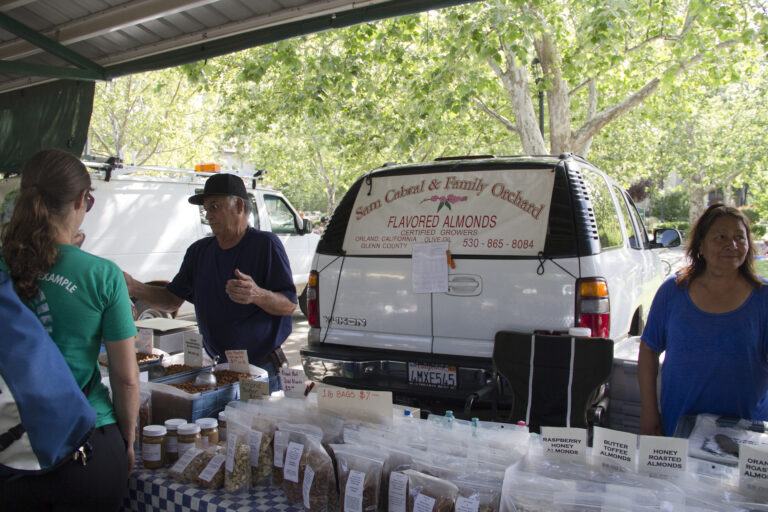
Sam Cabral & Family Orchard
Almonds are a popular commodity at the Davis Farmers Market. Although there are many vendors that sell almonds and almond products, Sam Cabral & Family Orchard are notable because they have been selling their goods at the market for about 20 years.

Owner Sam Cabral said they have eight different varieties, but they only sell three in the market.

While many attend the Davis Farmers Market for the fresh, local goods and produce, they also keep coming back for the wide variety of food served. Local restaurants set up stalls and sell their most popular dishes.

The Hotdogger
As a hole in the wall restaurant on E Street, it’s easy to miss The Hotdogger amid all the other restaurants nearby in downtown Davis. However, at the Davis Farmers Market, The Hotdogger often has one of the longest lines. People can be heard praising their food every week.

In addition to their diverse hotdog menu, which features a veggie dog and corn dogs as well, they are known for their lemonade. In the hot spring and summer months, this is a favorite among Davis residents who attend the market.

Raja’s Tandoor
Another crowd favorite are the naanwiches from Raja’s Tandoor. Raja’s is conveniently located right off the UC Davis campus at 207 Third Street. and is a student favorite.

On both Wednesdays and Saturdays, their naanwiches are among the most popular items at the Farmers Market. They have two vegetarian varieties, chickpea and cauliflower, in addition to the chicken naanwiches.

Sugar Daddies
Sugar Daddies, located at 113 E Street, is present at the Wednesday market serving Davis Creamery ice cream. This is their second year at the Farmers Market as Sugar Daddies. They usually have about four flavors for customers to choose from.

“The people and the music are great,” said Ashley Howatt and Stacie Hoyt, Sugar Daddies employees. “It’s a really fun atmosphere.”

Soroptimist International of Davis
Some vendors are from local organizations and sell food and drink to raise money for their cause. One such vendor is Soroptimist International of Davis.

It is a nonprofit organization that provides programs that can improve social and economic conditions for women and girls. They have a stall at the Davis Farmers Market selling wine and beer to raise money for their organization.

They are in collaboration with Sudwerk and serve beer from their brewery.

Crystal O’Hara, a member of Soroptomist International of Davis, said they have been attending the Wednesday Farmers Market for about 15 years and the money they make helps create grants for local organizations relating to women’s social and economic health.

The Saturday market is from 8 a.m. to 1 p.m all year. From March to October, the Wednesday market is called Picnic in the Park and is from 4:30 to 8:30 p.m. During the winter months, it is from 2 to 6 p.m. Additionally, the UC Davis Farmers Market is located at the Silo during the Fall and Spring quarters.

PAAYAL ZAVERI can be reached at city@theaggie.org.

MU, Silo renovations bring reorganization of ASUCD units

The ASUCD Unit Relocation and Space Allocation Committee (URSAC) will be making an unprecedented number of decisions in the coming weeks, as imminent renovations to the Memorial Union and Silo spur displacement.

“It’s new territory. Our spaces are completely changing,” said ASUCD President Carly Sandstrom, a voting member of URSAC along with ASUCD Business Manager Anne Myler, Controller Eric Evans, Senator Miles Thomas and Senator Maxwell Kappes. URSAC determines office space allocation for units.

The third floor of the MU, which is where many units are housed, will be completely rearranged. Sandstrom envisions having ASUCD Student Services and its receptionists closer to the elevators — currently they’re hidden in the back — and creating an open space called the Bullpen, with couches and the ability to house informal unit events. Sandstrom hopes student government officials utilize the space as well.

“I would love to see senators more in the bullpen than in their offices where the doors might be closed,” she said.

Sandstrom also hopes to hold ASUCD Senate meetings in different locations every quarter, as opposed to in the Mee Room, which will likely be converted into office space.

This is all part of the general MU renovation project, which is costing roughly $19.5 million. ASUCD is contributing $500,000 — though Senate still needs to vote on this — of which $250,000 would go toward renovating the Bike Barn space.

Renovations to the Silo will involve two phases, according to Michael Sheehan, the director of Facilities Services for Student Housing.

Phase 1 will include the redesign of the South Silo — where the UC Davis Store Silo, Whole Earth Festival and Experimental College are currently located — along with new landscaping and redesign to allow for four food trucks. Phase 1 construction is slated to begin in spring 2014.

Phase 2 will be focused on the west side of the Silo, including the food vendors and Gunrock Pub. This phase will focus on dealing with mechanical issues of the building and increased seating.

“The overall goal of the Silo project is to improve and expand the retail food operations in that neighborhood, thus providing better service to the campus community particularly, as the campus plans to grow during the next few years,” Sheehan said in an email interview.

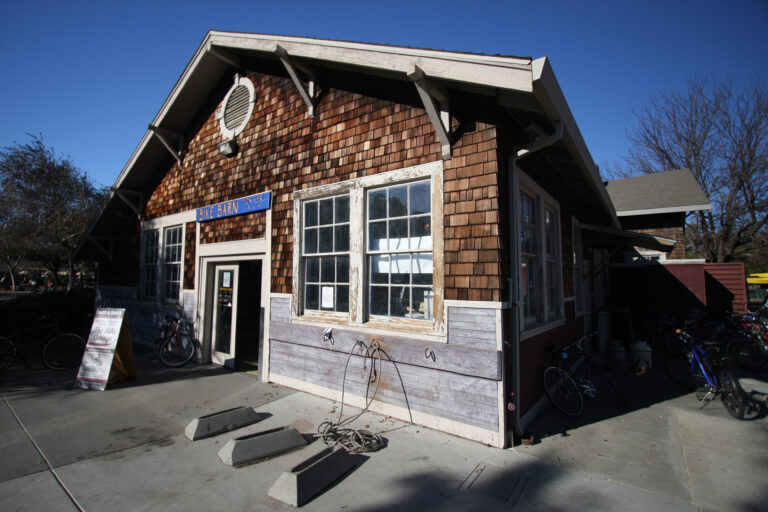
Changes to the Silo also include a reorganization of the ASUCD units that currently occupy these spaces. The Bike Barn currently occupies about a third of the barn space, with Outdoor Adventures using the rest. According to Sheehan, there are plans for Outdoor Adventures, under Campus Recreation as opposed to ASUCD, to move to the Rec Pool Lodge. This would then provide the Bike Barn more space and make room for the Experimental College to move in.

The Bike Barn management is excited at the prospect of expanding.

“We are one of the busiest shops in the country … expanding our footprint is going to be a huge step,” said Basile Senesi, the Bike Barn’s business manager.

With more space, Senesi said the Bike Barn will be able to hire more students to meet the high demand — 10,000 to 12,000 repair items a year. Currently the unit has eight work stations, and with renovations, Senesi hopes they can have 10 to 14 and hasten turnaround times.

Having more square footage will also allow the Bike Barn to bring over the Bike Garage — the unit’s free, do-it-yourself shop currently buried in the North Parking Structure — and make it easier for students to buy parts to do their own repairs.

Senesi also said the Bike Barn is more than willing to share the barn space with other units — namely the Experimental College and Aggie Reuse — and give them both storefronts. Plans are still tentative, but Sandstorm agreed that the Experimental College could greatly benefit from the added foot traffic, as the unit has lost money year after year since at least 2008.

Hannah Moore, office manager of the Experimental College, also hopes the move, which is still tentative, will help increase exposure.

“We’re a little bit hidden, and if you’ve never been here it can be a little bit difficult to find the office,” Moore said. “Moving into either end of the Bike Barn space would afford us tremendous visibility and get more people interested in and knowing about the Experimental College.”

According to Moore, the Experimental College and ASUCD have been discussing ways to increase the unit’s visibility for quite sometime, and the Silo renovation offered them a solution to the problem.

But Sandstrom acknowledged that not all units will be happy with URSAC’s decisions.

“In this case, space is like money. Everyone wants at least the same space they have now, if not more,” she said.

Of particular concern is the Whole Earth Festival (WEF), which has been occupying the same office in the Silo for 25 years. It’s shared with the Experimental College, with WEF utilizing two staff offices, a library, a meeting room and storage space for 44 years worth of archives. Brett Lemke, co-director of WEF, said that he’s been largely left out of conversations about his unit’s relocation.

“We were all expecting a remodel and were going to go with the status quo, but that’s not what the university had in mind,” he said, referring to being abruptly offered an option between two much smaller spaces of roughly 300 square feet. “We just want to be treated like all the other units.”

Ideally, Lemke wants WEF moved to a space that’s currently being underutilized, that they can convert to be zero-energy and that is a similar size to what the unit is accustomed to.

“We just want to make sure we have the space we need. We’re ready to negotiate,” he said.

JANELLE BITKER and HANNAH STRUMWASSER can be reached at campus@theaggie.org.
Eating on a budget in downtown Davis

0

While many fellow college students would consider themselves to be broke, this stigma doesn’t mean your dining experience has to suffer. The City of Davis has many authentic, economical places for students to eat off campus that fit a wide range of tastes.

The following restaurants are all located in downtown Davis, locally owned and offer lunch for under $7, while some even offer dinner for less than $7 as well.

For the student looking for more traditional American cuisine, The Hotdogger on E Street is a great choice. The restaurant has been open for 30 years and under the management of its current owners for the past 20 years.

Cheryl Frank, the owner of The Hotdogger, purchased the restaurant 20 years ago from a friend, and now serves a variety of old-fashioned hot dogs that suit many different taste buds.

“Our hot dogs are made with real meat, and we offer vegan hot dogs as well as hot dogs made of chicken sausage. [We] have a huge variety of toppings,” Frank said.

The Hotdogger can also be found at the Davis Farmers Market on Wednesdays and Saturdays, with fresh-cut garlic fries available on Wednesdays. Classic hot dogs start at $4 and can increase up to $6 for the most decorated dogs.

Dot Island Grill, on Second Street, offers fresh fish to patrons daily. They have specials from Sunday to Thursday that feature items such as the Grilled Fish Wrap, Chicken Katsu and the Salmon Bowl.

Dot Island Grill offers a healthy approach to dining out, as most of their dishes come with steamed vegetables and rice. Their weekly specials range between $5 and $6, while their regular priced entrees cost about $9.

If you’re after Chinese-style dumplings, look no further than the Dumpling House on E Street. The Dumpling House has been open for eight years, and approximately 2,000 to 3,000 dumplings are handmade in the restaurant each day.

“We give 12 dumplings per order while other restaurants normally only give six. We also have more than just pork dumplings — we make chicken, seafood, beef, vegetable and kimchi pork as well,” said owner Linda Liu, who can be found at the entrance of the restaurant making dumplings.

An order of dumplings costs $6.99, while the other entrees range from $4 to $9. The Dumpling House also serves London-style fish and chips.

Located next to the Dumpling House is Davis Noodle City, which is also owned by Liu.

“I have been all around China, Hong Kong, Japan and Taiwan when I realized that we didn’t have a noodle shop in Davis. Every town needs a noodle shop,” said Liu, who is originally from Taiwan.

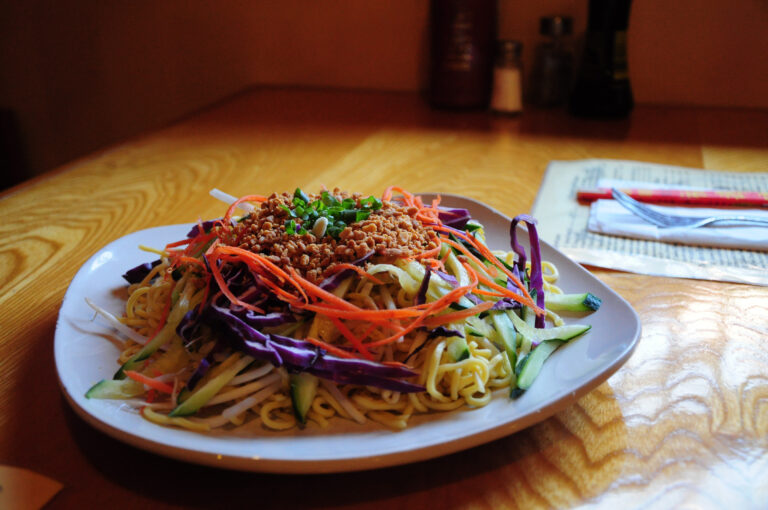
Davis Noodle City has been serving Davis residents Chinese noodles for the past 11 years. In addition to noodles in broth, they also offer a wide variety of chow mein and fried rice. Their entrees range from $6 to $8 for lunch.

Also available for Chinese dining in Davis is Open Rice Kitchen on G Street, which has been open for a little over a year. They serve dim sum, soup, noodles and fried rice all for less than $7. Their “over rice” option consists of your choice of sauce and protein over rice.

Open Rice Kitchen is locally owned and offers a variety of milk teas in addition to their regular menu, as well as slightly more expensive signature entrees. Open Rice Kitchen also accepts Aggie Cash.

If you’re out and about for lunch, consider stopping by Raja’s Tandoor on Third Street for their all-you-can-eat lunch buffet. For $5.95 plus tax, you can eat your fill of Indian food that comes with vegan naan bread. Their food is made peanut-free and with limited amounts of oil.

“We really focus on making healthy food that is fresh for every order,” said owner Taranbir Chowdhury. The restaurant has been open for 10 years and has a variety of vegan and non-vegan entrees priced between $7 and $9 and that are available for purchase with Aggie Cash.

Also on Third Street is Sam’s Mediterranean Cuisine. They have been open since 1995 and serve Mediterranean fare such as shawarma and kabobs, as well as turkey burgers and cheeseburgers.

Sam’s also features a vegetarian menu that has falafel, hummus and a Greek veggie sandwich. They have a daily special available from 11 a.m. to 3 p.m. Monday to Friday, and they serve baklava as well. The restaurant accepts cash only and prices run between $5 and $7.

Near Sam’s is Ali Baba, a Persian restaurant with a diverse menu. They serve gyros and kabobs, as well as hamburgers and cheeseburgers, sandwiches, breakfast omelets and breakfast burritos.

“Our menu is very versatile, so it’s a good place to go with large groups and lots of friends. [We] can customize orders to find something for everyone,” said Ai Phi, a cashier at Ali Baba.

The restaurant has been under its current management for the past five years and has a daily special Monday through Friday for under $6, while regularly priced menu items cost between $5 for a gyro and $11 for a salmon platter that comes with a side of your choice.

If you’re downtown between 11 a.m. and 3 p.m., be sure to stop into the pizza place, Woodstock’s, for one of their four lunch specials, which vary from $4 to $7. Woodstock’s has been open in Davis since 1986, and has seven other locations near college campuses in California.

The initial planning for Woodstock’s was done by Chuck Woodstock and Mike Chew; however, before the restaurant was set to be opened, the two men died in a plane crash. They had already hired a general manager who then opened the restaurant.

“Work hard, play hard is still our motto,” said Woodstock’s assistant general manager Kaitlin Ashley.
The restaurant is known for its campus involvement, something that won’t be changing anytime soon. They also accept Aggie Cash.

For thin crust-style pizza, head over to Uncle Vito’s Slice of N.Y. on Second Street. They offer a lunch combo for $6.95, which includes a side salad, a slice of pizza and fountain drink and is available Monday through Friday from 11:30 a.m. to 4:00 p.m., as well as all-you-can-eat pizza for $6.95 from 11:30 a.m. to 1:30 p.m.

Sunrise Restaurant on G Street has been a favorite place to go for Vietnamese food in Davis for the past nine years. They offer Vietnamese sandwiches and entrees for approximately $6, as well as a wide selection of shakes, tea and other beverages.

“[We have attracted] people of all nationalities in to try Vietnamese food,” said Sunrise Restaurant owner Hao Au.

If you’re interested in locally sourced food, Delta of Venus on B Street is a great fit. They have been open since 1993, and have a relaxed vibe that is popular in Davis.

They offer full and half-sized sandwiches and soup, as well as a variety of salads and bagels at lunch. They are also open for breakfast and offer traditional Caribbean cuisine for dinner on weekdays.

Lunch costs upwards of $6 for a full sandwich, while breakfast costs about $8 and dinner is available for between $10 and $15.

For those with the occasional late night food cravings, many of these restaurants also offer extended hours.

TAYLOR CUNNINGHAM can be reached at city@theaggie.org.

The abandoned hot dog stand

What do a warehouse in Reno and a corgi dressed in a hot dog costume have in common? If you’ve visited the Memorial Union (MU) in the past few weeks, you might already know the answer to this question.

A new hot dog stand has joined the ranks of the many on-campus dining options, located on the ASUCD Coffee House (CoHo) patio.

Open from 11 a.m. to 2 p.m., the stand offers many options, including $1 hot dogs, $3.25 Hebrew National dogs and other amenities like chips and soft drinks.

Darin Schluep, the food service director for the Associated Students Dining Services, was approached by a sales representative from Hebrew National last summer who was hoping to bring the old, unused hot dog stand out of storage in Nevada and give it a home where it could be used to its fullest potential.

“ASUCD Dining Services tries to offer as much diversity in menu options as we can,” Schluep said.
While the new stand is the only place on campus that currently sells hot dogs, its claim to fame stems from its new mascot, Rodney the Corgi.

Dressed from head to paw in complete hot dog regalia, Rodney captured the attention of many students when his owner Nycole Copping, a fourth-year neurology, physiology and behavior major and employee at the CoHo, brought him to campus to advertise for the stand.

“I had just recently received Rodney and was bringing him to campus every Friday for all my co-workers at the CoHo to see him and play,” Copping said in an email interview. “He became such a little socialite that people started asking for him all the time!”

Rodney’s frequent presence led the staff to dub him “The CoHo Dog.” When the new hot dog cart was established outside, the staff joked about dressing Rodney like a hot dog. A few more jokes and one hot dog costume later, Rodney became the new mascot for the fledgling cart.

Taking easily to the crowds of customers hoping to take their picture with this one-of-a-kind pup, Rodney melted the hearts of his fans.

“People would try to pet his stomach because he tried to roll over, but the costumes’ buns got in the way, so he couldn’t turn over completely,” Copping said.

The new cart now competes for customers with The Hotdogger, residing in downtown Davis on E Street.

With a starting price of $3.50 for a regular hot dog, the restaurant is both an upgrade in price and in options, boasting six different types of mustard and a myriad of add-ons to accent your chosen weenie.

Ivan Franks, along side his wife Cheryl, owns the Hotdogger and has been running the restaurant since 1984. Franks assures the community that his store is here to stay and there is certainly space for both storefronts to flourish.

“The more the merrier,” Franks said.

The Hotdogger caters to a range of clientele, from the hungry freshman to the hot dog aficionado. Regardless of the competition, the Frankses continue to focus on the important things — the franks.

“Our job is to make the best dog we can,” Franks said.

MARK BURNSIDE can be reached at features@theaggie.org

Editorial: UC survey

0

The UC Office of the President (UCOP) sent out a press release on Monday boasting that 82 percent of current UC students are satisfied with their college education, despite the decline in state funding and rise in tuition costs.

The number comes from the 2012 UC Undergraduate Experience Survey. We were surprised, and upon further examination, found the figure to be highly misleading.

About 36 percent, or 63,500 students, of the UC undergraduate population participated in the survey, which asked a variety of questions, including level of overall satisfaction. The 82 percent figure includes students who selected “very satisfied,” “satisfied” and “somewhat satisfied.”

In our opinion, “satisfied” is quite different from “somewhat satisfied,” and not that different from “somewhat unsatisfied.” And if we took out the 30 percent of students who marked “somewhat satisfied,” we are left with an actual 52 percent of students who are satisfied with their educations.

This means about half of the UC undergraduate population feel their education is lacking, and this should be distressing to the folks at UCOP.

In fact, UCOP should be distressed over many of the study’s findings, particularly related to finances.

Student satisfaction with their education for the price they are paying is down to 60 percent from 71 percent in 2006. Moreover, 21 percent of students marked “very dissatisfied” or “dissatisfied” — that’s 11,664 students who don’t feel they are getting the education they are paying for.

Nearly 63 percent of surveyed students said they were “somewhat concerned” to “very concerned” about their accumulated debt. Seventy-one percent reported concern about how to pay for their education, while only 4 percent said expenses were not a problem.

We hope that UCOP fully understands the magnitude of their findings and will take concrete actions in response to the survey results, despite brushing details aside in the name of good PR.