59.2 F
Davis

Davis, California

Friday, December 26, 2025
Home Blog Page 522

Introducing Aggie Compass

THOMAS MA / AGGIE

Basic needs center in newly-expanded MU

Aggie Compass, a UC Davis Basic Needs Center for students, will open later this spring in the east wing of the Memorial Union. Aggie Compass will open up shop as a center for students to obtain help concerning food, housing and other basic needs.

Aggie Compass will be an aggregation of several resources already on campus, including Fruit & Veggie Up!, The Pantry and Aggie Food Connection, as well as the incorporation of the federal program CalFresh.

“We can help more students if we bring these resources together, network them and create relationships between students and between the resources and make it available,” said Leslie Kemp, the director of Basic Needs Services and Aggie Compass. “The real value here is in creating a network and relationships around these resources and the students. It’s like the saying, the total is greater than the sum of the parts.”

Aggie Compass is run by the UC-wide Global Food Initiative which aims to promote food security, health, and sustainability on all 10 UC campuses.

“I believe we are the first UC to open a brick-and-mortar basic needs center, but we won’t be the last,” Kemp said. “Berkeley is hot on our tail and expects to open one this summer. Right now our focus is the global food initiative, all of our efforts are directly directed at food, but we will expand after this year to basic needs.”

The space that Aggie Compass will be occupying is part of the newly-expanded east wing of the MU. Former ASUCD president Josh Dalavai explained the delegation of this space.

ASUCD was promised four retail locations, or retail properties if you will, for us to rent or delegate as we saw fit,” Dalavai said. “We decided these during my time as ASUCD president, and one of the spaces we decided upon was to allocate space to the Aggie Compass.”

Dalavai went on to explain the MOU, or written agreement, which was a collaboration between ASUCD, Leslie Kemp and the executive director of the Center of Student Affairs Assessment, Timo Rico.

“When my vice president Adilla Jamaludin and I were deciding how to allocate the space, a large emphasis and priority for us was to highlight the issues of food insecurity and disabilities justice,” Dalavai said. “The Aggie Compass wants to address issues of food insecurity by pointing students to different food resources on campus, and that’s why we entered a partnership with them.”

The center in the MU will be a community-oriented hub where students can pick up food and supplies as well as seek help from student interns and volunteers.

“The real compass team is all student interns,” Kemp said. “It’s exciting because this group of students will be the founding staff of the center and it’s really up to them to set the tone for the space. Setting the strategy for how we are going to reach out to students, how we are going to make the space work and how are we going to be effective in helping students.”

Kemp strives for the center to be a collaborative process with her staff, allowing students to pick their own roles and projects. The objective of the center is to create a supportive community with the goal of students helping students get the help and resources they need.

“Our priority is feeding students today, and sometimes there are policies in place that would make that difficult, so I’ve talk to the staff about how this can be frustrating,” Kemp said. “My role is to help navigate some of the business professional aspects and navigate some of the relationships with admin, but this is really about the students and the students taking ownership of the space.”

In addition to the student staff, The Aggie Compass will provide a desk for Yolo County’s CalFresh Public Assistance Specialist Maxwell Vaca.

“I work for Yolo County and I come to campus as much as possible,” Vaca said. “Right now I’m here four days a week at various locations to assist individuals, specifically students, helping them apply and making the daunting process a little simpler.”

Vaca explained that in Yolo county there are a lot of individuals eligible for CalFresh, mostly students, who are unaware of its benefits or how to apply.

“And that’s where I come in, to clear up any misconceptions they may have and to make the process easier for students,” Vaca said. “What they’re going to do is have a space for me so I can be on campus full time helping students with their applications and interviews to enroll in CalFresh.”

Aggie Compass will be hosting events during the Basic Needs Fair on May 14 on the MU patio. As its official brick-and-mortar opening, there will be a soft rollout on June 1 and a  grand opening event on June 14.


Written by: Grace Simmons — features@theaggie.org
 

Armenian Genocide remembered at UC Davis

VENOOS MOSHAYEDI / AGGIE

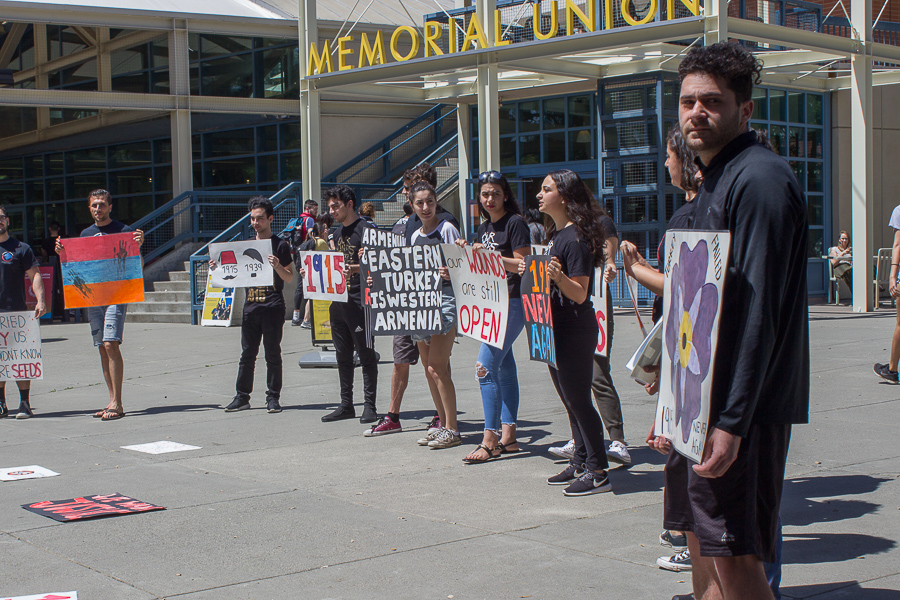
Armenian students holds die-in at MU

On April 24, the Armenian Students Association at UC Davis held a “die-in” on the Quad for an annual commemoration of the Armenian Genocide that occured in 1915. This year is the 103rd anniversary of the tragedy.

At 1:03 p.m., students peacefully lay down on the Quad with signs in a silent remembrance of the 1.5 million Armenians killed during the genocide. Signs were later held to the chest by the protesters to inform students of the bloodshed.

On April 19, an emergency ASUCD resolution, Senate Resolution #12, was passed to recognize the anniversary and provide support to the ASA and the Armenian community in Davis.

ASUCD President Michael Gofman, a second-year economics major, spoke about the work it took to bring the resolution to a vote via an email interview.

“I felt incredibly proud to be a part in making this happen,” Gofman said. “As someone who comes from a marginalized community which has been the victim of genocide, I felt honored in recognizing the Armenian Genocide and supporting this community and helping unite communities around campus.”

Gofman said collaborations like SR #12 can bring students together.

“The response from ASA has been amazing,” Gofman said. “They feel included in ASUCD. Supporting student events and club events could be a way to make ASUCD more relevant on campus, especially for relatively apolitical issues like this.”

SR #12 was authored by Senator Atanas Spasov, a third-year economics and mathematics double major.

“My family is Bulgarian, so as a result we have a lot of Armenian friends and family because there is quite a [large Armenian] population in Bulgaria that escaped the genocide back in 1915,” Spasov said. “I grew up with these influences around me, and I heard a lot about the historical events. Coming to college, I realized that nobody actually knew [about] the Armenian Genocide or took the time to recognize it. As the day of recognition was coming up, I reached out to the Armenian Student Association to help me co-author this resolution to allow more people to be aware of the atrocity.”

Spasov shared his feelings on the completed resolution, which passed unanimously.

“I was actually quite ecstatic,” Spasov said. “I was very excited by the fact that it passed unanimously.”

On the day of the commemoration, Anais Stepanian, a fourth-year neurobiology, physiology and behavior major and a member of the ASA, said the event is “very important” to her.

Stepanian said she has been involved in the Armenian cause since she was a child, when she would go with her parents to “march on the streets and fight for this cause to be recognized.” She has partaken in the annual commemoration since she “first got on campus.”

“Hitler used the Armenian Genocide to justify the killing of the Jews in the Holocaust,” Stepanian said. “He said […] ‘Remember the Armenians.’ This stuck with me. If this injustice is not recognized, this will continue happening in history over and over again.”

Arpi Deirmendjian, a second-year neurobiology, physiology and behavior major and an ASA member, offered a brief recounting of the history behind the Armenian Genocide.

“The genocide was a time when the Ottoman Empire came into Armenia and forced people to leave their homes and their families [to] march in deserts and systematically attempted to massacre the race,” Deirmendjian said. “They ended up killing one and a half million Armenians. A small percentage of the population were able to escape and create the diaspora that we have today.”

Deirmendjian talked about the meaning of SR #12 in support of the remembrance.

“I think that it says a lot about how much our UC Davis Senate [cares] about their students,” Deirmendjian said. “They really want to make an effort to reach out to all the student organizations on this campus and make everyone feel welcomed, appreciated and acknowledged for their history.”

Raffi Samurkashian, a third-year biomedical engineering major and a member of ASA, supported Deirmendjian’s response to the Senate resolution.

“I think it is spectacular that all the way out here at [a] university in Northern California so far away from our homeland that we have people who are dedicated to recognizing the truth, dedicated to rejecting the lies of denial and really setting the record straight,” Samurkashian said. “They were the ones that came to us. They were the ones that invited us to be there with them. We were not the ones that pushed for this to happen.”  

Deirmendjian also expressed what it means to have a peaceful protest. He described “a particularly dark time for the Armenian people” when children were sent to partake in violent protests without knowing “what the future of the cause was going to be.”

“Recognition of the Armenian Genocide has been something that the Armenian people have been working toward for the better part of [a] century,” Deirmendjian said. “It was not always peaceful. There was a time when we considered the only way to get the world to recognize what happened to us was through violence. We decided it was inappropriate to try to continue this campaign of recognition through violence. We made it a collective transition to more peaceful protests.”

Gardenia Nahigian, an ASA alumna who studied under the human rights program at UC Davis, added to the commemoration by expressing the importance of learning about human rights. Nahigian said it’s important for “students to be educated about crimes against humanity and it is also bringing a lot of unity among students.”


Written by: George Liao — campus@theaggie.org


Power imbalances in academia open door to abuse

CAITLYN SAMPLEY / AGGIE

UC Davis conductor faces few consequences for sexual misconduct

Christian Baldini, the UC Davis symphony conductor who was put on unpaid leave after sexual misconduct toward a female undergraduate, has returned to campus. Though he received a disciplinary letter from Chancellor Gary May, the letter will not be placed in his academic review file and he will face no further sanctions. His explanation for kissing a student on the cheek, pressing up against her while teaching the tango, calling her a “bad girl” and requesting private meetings with her was that it “never occurred to him” that such behavior could be construed as sexual.

Those in positions of power must be more aware of the possible interpretations of overly friendly behavior. The excuse of “I didn’t realize my behavior would be interpreted in a sexual way” no longer cuts it amid the ongoing onslaught of news stories about similar or identical behavior being interpreted in a sexual way. Ignorance is no excuse.

For those who lead performance ensembles or artistic groups, being friendlier with students than a typical classroom professor may be or seem more acceptable. In such settings, where the pressure on victims to not report or make a fuss for fear of “breaking up the band” may be stronger, instructors have a particular duty to pay close attention to their interactions with their students.

With story after story of women being denied promotions or sidelined at their jobs after turning down a boss’ advances — and more dramatic headlines about girls being stabbed after turning down promposals — young women are acutely aware of the risks of saying no.

Particularly in the academic or artistic worlds, where careers and futures can be highly dependent on letters of recommendation and personal connections, it can be extremely difficult to give a clear, direct “no” to a well-known, well-respected professor. There are benefits to knowing a mentor on a personal level and cultivating a relationship with them, but such closeness can also open the door to abuses. Women go to great lengths to squirm their way out of private meetings and uncomfortable interactions or simply grin and bear it, hoping that career success will eventually be worth the emotional distress or, in extreme cases, the physical abuse.

It’s worthwhile to note that while nearly all university students are legally adults, there is still an extreme imbalance of power between students and faculty members. Students’ grades are at the discretion of the professor, and some may feel that they may suffer retaliation if they rebuff unwanted advances. Members of performance ensembles, whose future careers may depend on their success in the ensemble, may feel that they have to suffer in silence, lest their chances at a first-chair or soloist position be compromised.

Those on the receiving end of unwanted attention must figure a complex social calculus: If I say no, will he still write me a letter of recommendation? If I don’t accept his attention with a smile, will I suffer for it? When the boss asks you for a favor, it can feel like it’s less of a request and more of a demand. It’s time the academic world recognizes that too.


Written by: The Editorial Board

Humor: Painter offers dirty brush water to desperate sculpture student

ZOË REINHARDT / AGGIE

A quick and easy way to get started with charitable work

When looking into ways to do charitable work, it doesn’t take much to start. Sometimes, you already have the resources to help someone. One art student decided to take matters into their own hands.

“I couldn’t help but feel sorry for them,” Asher Rodriguez said. “I would see them in the studio all night long with nothing to eat or drink but their own tears. One day I was carrying my canvas along and saw someone with a marble assignment staring at me. Oh, how they craved their soft bed. To be able to pick up your work and take it with you is a great privilege they will never get to know. That’s why I, being blessed with such fortunes, decided to give back.

“Every night, when I’m finished working on my acrylic still life, I make sure to save the brush water I would normally throw out and hand it to one of those poor sculpture students on my way back home. The slight glimpse of hope in their eyes is worth the extra effort.”

Rodriguez claims that anyone can stop by the art building with food they were about to throw out — the last crumbs of a SunChips bag, the last swigs of a Gatorade bottle, even an old tissue would help these students clean up the mess that is their lives.

“You, too, are able to make a difference,” Rodriguez said. “By saving all of your soda cans, a student like Sandra Porter can have access to sculpture materials. They will spend days crocheting the soda can into metal scarves so that other art majors can keep warm while working on their finals deep into the cold, crisp winter.”

Rodriguez has a Kickstarter that uses donations to buy coffee for these sad souls. It’s usually splashed directly into their faces to wake them up, but a little bit gets into their mouths, too. One can only assume that the grumbles they make after such a charitable act are ones of happiness and gratitude.


Written by: Beck Nava — rnavamcclellan@ucdavis.edu

(This article is humor and/or satire, and its content is purely fictional. The story and the names of “sources” are fictionalized.)

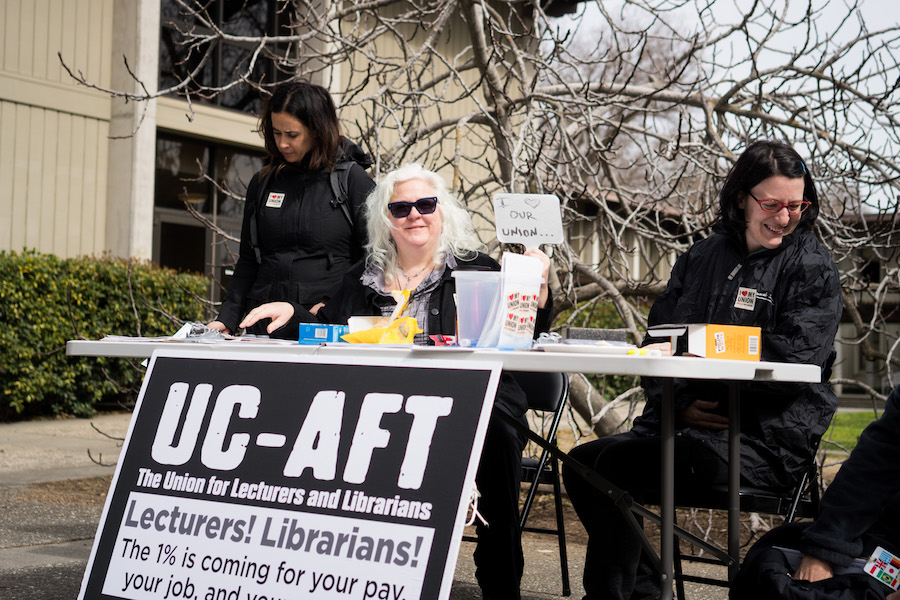
UC librarians enter contract negotiations

NICHOLAS CHAN / AGGIE FILE

Salary, workload, academic freedom on table

UC-AFT Unit 17, the union that represents UC librarians, entered into contract negotiations on April 17 at UC Berkeley. Current negotiations will work toward finalizing a new contract to begin on Oct. 1.

The areas under negotiation are salary parity with other public universities and colleges, professional development funding, recognition of academic freedom, the inclusion of sabbatical leave and access to housing support programs currently being offered to faculty.

Adam Siegel, a biographer for languages, literature and performing arts at Shields Library, identified some of the major negotiation points in the current contract.

“We want to address the salary gap,” Siegel said. “We are woefully underpaid compared to any institution you want to compare us to. The institutions that the University of California itself compares faculty salaries with, the types of public institutions that University of California compares administrative salaries with, and of course our counterparts at the Cal State campuses and the community college districts, we lag substantially behind them in all sorts of areas [with] salary foremost among them.”   

Jennifer Harbster, a subject specialist at Shields Library, spoke about her work as a librarian.

“There are certain subject areas in which I am most knowledgeable in,” Harbster said. “I work mainly with the physical sciences and engineering. If a physics faculty member needs help [and] there are some books they really need for their research projects [that] we do not have […], they can contact me.”

Harbster said she has a budget which allows her to buy books and spoke about her ability to select books and journals that faculty may not have and might need — “I can do journal subscriptions, I can try to get databases, so faculty can come to me and ask me for help in doing purchases.” Additionally, Harbster works on the library’s collections to further research and scholarship.

“That is my collections development aspect of my job,” Harbster said, “I am also always aware [of] what research is going on campus. For example, [in] computer science, we have an incredible cybersecurity program, so I make sure that the library has material that will support that program — all the way from the faculty down to the graduate students [and] the undergraduates.”

Harbster said that salary was her biggest concern in the current negotiations.

“For me, because I am a mid-career librarian, I have just started the UC system, so I have not been vested in the UC system,” Harbster said. “I have not spent my whole career thus far in the UC system. For me, it is about salary, it is about having parity with our community college librarians and our state college librarians. They get paid anywhere from 20 percent to 30 percent more than we do. We have a few slogans for this bargaining campaign and one of them is ‘world-class institutions require world-class librarians.’”

Harbster spoke about the shortage of librarians and how this has affected their ability to do their work.

“I feel like it is hard for me to give my attention on a few of those big departments,” Harbster said. “We are talking about workload issues. There are some campuses that have been experiencing the same thing, because there are people that have been retiring and those positions are not filled.”

Siegel added to Harbster’s sentiments on the librarian shortage.

“There are fewer of us,” Siegel said. “There are fewer librarians — maybe 200 fewer in the UC system than there were 35 years ago. Whereas 35 years ago, the campuses were substantially smaller. All of us at this campus […] do far more than we did when we were first hired.”

Siegel commented on the frequency of librarian contract negotiations.

“We are at the end of a five-year contract,” Siegel said. “We started negotiations for this contract probably in the winter of 2013, so this is what they call a very long-term contract that expires in September. The contract are as long as we can negotiate them.”

Siegel said negotiations will continue into the summer.

“The first day of bargaining was this Tuesday,” Siegel said. “It was at Berkeley [on April 17] three days ago. We are now officially in bargaining, and our next session will be at the Irvine campus on Tuesday. We will be bargaining in Davis in June and then into the summer [at] other campuses.”

Siegel said that the last contract took effect on Oct. 1, 2013 and that negotiations for that contract lasted six or seven months.

Academic freedom is another key point in the negotiations.

“We are advocating for an acknowledgement of our academic freedom,” Siegel said. “Our rights as academics to be able to pursue and seek the truth as we see it in the course of our scholarly, academic and other kinds types of pursuits in service to the university. That is something that we are very, very concerned about.”

Siegel further detailed the importance of acknowledging academic freedom.

“The university has always recognized that there is this concept called academic freedom and that people in the academic titles [such as librarians] have it,” Siegel said. “Because we have had people in positions of authority in various UC campuses that have not necessarily gone along with that and have attempted to sort of control and discipline the behavior of some librarians we have.”

Siegel pointed out that even though librarians have academic titles, they do not have sabbatical leave to do outside research and gain professional development.

David Michalski, a social and cultural studies librarian at Shields Library, spoke about the librarian shortage and how that can affect the procurement of books and services for the library.

“In order to entrust the money is being used wisely, you need to hire employees that can look at the products that are being pitched to us and marketed to us all the time from Proquest, Sage or Elsevier and to look at them objectively and say how well are they really meeting,” Michalski said.

Michalski said that librarians have to make sure that the different facets of the library run properly so that “you can have the best sociology departments, the best anthropology departments that we can.”

“[We are] checking on how we are spending the money, checking [that] we are getting the resources, checking that we are not failing students and their understanding of how to do their own research,” Michalski said. “[As well as] helping students get their degrees [and] making sure we have the resources and not just taking in the money from the state and spending it without any type of checking.”


Written by: George Liao — campus@theaggie.org

Warm-weather poetry

SHEREEN LEE / AGGIE

Collected poems to welcome in the spring

Last month was National Poetry Month, but there is no reason not to read poetry throughout the year. Poetry is a wonderful way to condense the human experience into an accessible medium that transcends time and space. Here are a few spring-themed collections of poetry that might speak to you:


“Poems of The Laughing Buddha” by Jane Marla Robbins

Robbins truly is a poet of laughter. This intimate collection of poems reminds us all to take a brief moment to treasure the small pleasures in life, almost like gazing at a flower for a brief moment. Humorous, insightful and eccentrically wise, these small poems are perfect for daily reading. Two particularly thought-provoking and recommended readings from this collection are “Welcome” and “Painful Indecision.”


“This Connection of Everyone with Lungs” by Juliana Spahr

Juliana Spahr’s collected poems contain an examination of the interconnectedness of life. In a season of abundant growth, Spahr’s elegant words reveal just how dependent living systems are upon one another. Examining the connections between ostensibly disparate events, such as 9/11 and environmental pollution, these works remind us that life is a cycle of which we are all a part.


“The Collected Poems of Sara Teasdale”

After laughter and life, inevitably, comes stillness. The poet that comes to mind is Sara Teasdale, a classic lyrical poet. Her words are measured, her gaze reflective as she moves through the inner world with a grace not unlike wind blowing on the surface of a placid lake. The imagery in her works is so delicate and fleeting; it leaves you haunted for days to come.


Written by: Isaac Flores — arts@theaggie.org

Police Logs

NICKI PADAR / AGGIE

Quit “egging it on”

April 19

“Solo vehicle into building, cosmetic damage.”


April 20

“Subjects by the pool playing music loudly.”

“Subjects being loud in the hot tub.”

“Reporting party was also hit by truck twice. Then witness truck hit a parked vehicle, causing extensive damage. Driver stopped and started talking to vehicle owners but left abruptly. No victim at this time […]”

“Spray paint over ‘No’ on the ‘No Parking’ signs in the area.”


April 21

“Four vehicles parked facing the wrong way in a no-parking zone — reporting party no longer in the area, unable to give vehicle information.”

“Several female subjects running around naked near Girl Scout cabin, urinating in the park — reporting party states there is a large party at the park. Concerned for children in the area.”

“Two subjects currently in physical fight and other subjects egging it on.”


April 22

“31-year-old got angry over video game console and started yelling at reporting party, she was concerned for her’s and her younger kids’ safety and left, requesting he be removed from apartment.”

The perfection of St. Petersburg

OLGA [(CC BY-SA 2.0)] / FLICKR
How Russia’s northern capital tops the bucket list

If you’ve ever read Fyodor Dostoevsky’s “Crime and Punishment,” you’ll be familiar with its rather famous opening line, which goes something like this: “On an exceptionally hot evening early in July a young man came out of the garret in which he lodged in S. Place and walked slowly, as though in hesitation, towards K. bridge.” 
S. Place and K. bridge are real locations in St. Petersburg, and their existence helps solidify the city as a place built using culture as its centerpiece and people as its backbone. St. Petersburg inspired many of the great Russian writers and poets, and that inspiration hasn’t been lost even in the 21st century.

It doesn’t hurt that St. Petersburg hosts more palaces than you can count, close to 300 museums, dozens of canals and waterways with bridges spanning their banks and a thriving street-music scene that inspires pedestrians to ditch their headphones as they cross places as varied as, yes, S. Place and K. bridge.

When searching for inspiration, the city’s natural spaces cannot be beaten. The blue hem of ponds and small canals in Tavrichesky Park and the tide of green in the Botanical Gardens serve the soul well against the cityscape.

During the winter months, slap on a pair of skates at the ice rink at New Holland Island, named for its resemblance to Amsterdam’s canal and shipbuilding architecture.

This city is a history geek’s paradise. History of the violent kind, or of the majestic, can be found in droves. Visit the Yusupov Palace for an exhibition on Rasputin’s murder. Enter the Church of the Savior on Spilled Blood, a luminous cathedral built on the spot of Alexander II’s assassination.

Peter and Paul Fortress plays sentinel over the Neva River and was founded as the city’s first bulwark against the threat of a Swedish invasion in the early 18th century. Inside stands the Peter and Paul Cathedral, the burial place for many tsars and tsarinas and home to the tallest Orthodox bell tower in the world — visible for miles around the center of St. Petersburg.   

But in case history favoring the armed and armored isn’t your cup of tea, there are plenty of other places that celebrate the cultural heritage of Russia itself. Watch a Tchaikovsky ballet at Mikhailovsky or Mariinsky theaters or order pelmeni with tea at one of St. Petersburg’s hip cafes.

If the cultural vibrancy of St. Petersburg hasn’t left you wanting more, perhaps a visit to the Hermitage will kick things back into proper order. This museum-within-a-palace is the second-largest in the world, housing 3 million works, ranging from Leonardo da Vinci to Rembrandt and ancient Egypt.

Take a walk down Nevsky Prospekt, the most famous street in Russia. You may indeed find any manner of souvenir or restaurant down this 5-kilometer artery through the heart of the city’s historic center. Magnificent views span the Kazansky Cathedral and its environs. A perfect selection of bars and clubs await on the side streets beyond, and there’s enough of an eclectic mix of tourists and specialty shops to remain occupied through snow, rain and the occasional blip of sunlight.  

Beneath the grandeur of St. Petersburg is a humbler side that balances its colonnades and finery with the people moving between them. When the weather is nice (usually mid-to-upper 40s and above with a half-cloudy sky) street musicians line the pavement, playing rock music or traditional trumpet tunes. The sounds of artists haggle their wares, elderly ladies singing advertisements into microphones and children laughing in courtyard playgrounds simply add to the city’s splendor.

As with any urbanized area, St. Petersburg has its down moments, but the blend of cultural expertise and general revelry make this one of the world’s premier cities. Russia sometimes gets a bad rap from American tourists. Don’t listen. If you can manage the visa process, sign up for a trip. Russia’s northern capital awaits, and it will never disappoint.


Written by: Nick Irvin — ntirvin@ucdavis.edu

Disclaimer: The views and opinions expressed by individual columnists belong to the columnists alone and do not necessarily indicate the views and opinions held by The California Aggie.

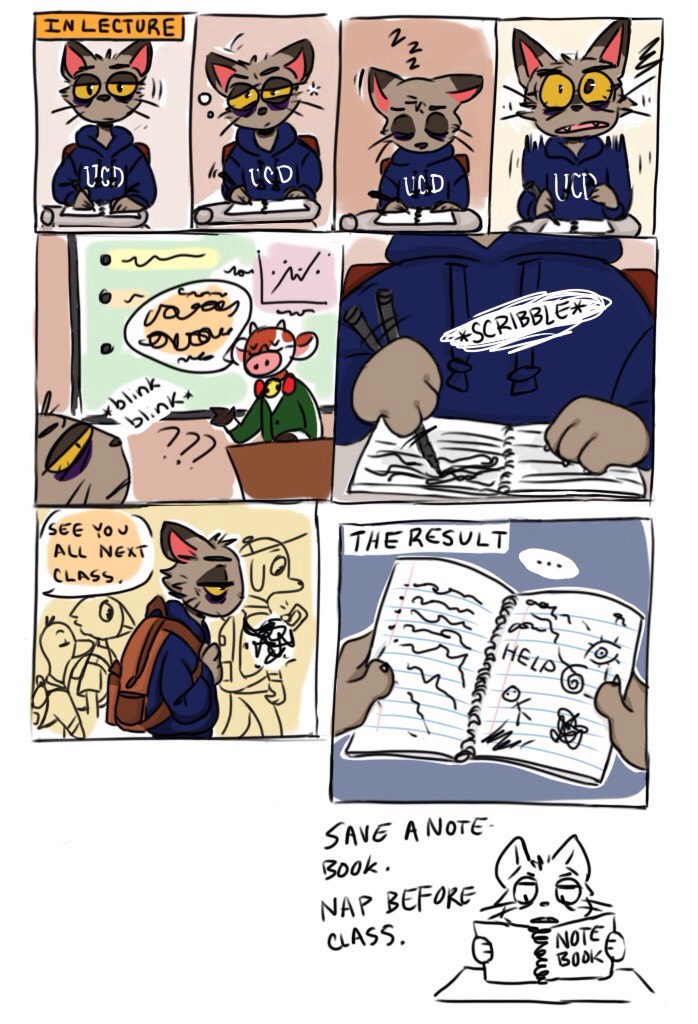
Cartoon: Cat Nap

Written by: Diana Olivares — deolivares@ucdavis.edu

Disclaimer: The views and opinions expressed by individual cartoonists belong to the cartoonists alone and do not necessarily indicate the views and opinions held by The California Aggie.

U.S. assistance may not always be perceived as assistance

PHOTOGRAPHER’S MATE 1ST CLASS ARLO K. ABRAHAMSON / UNITED STATES NAVY (LICENSE UNKNOWN)

The Iraq War casts a shadow over future U.S. intervention in the Middle East

After 9/11, the U.S. was more unpopular in the Middle East than in any other part of the world. While this is largely no longer true today, it doesn’t necessarily imply that U.S.-Middle Eastern relations have developed smoothly, as with Iran and the U.S. Tensions, however, are not entirely without justification, as the U.S. has a decades-long history of involvement in the Middle East. From Lebanon to Baghdad, the U.S. hasn’t entirely learned its lesson when it comes to the consequences of intervention — which are devastating and long-term.

The U.S. invaded Iraq as an immediate response to the attacks on September 11th, with the intent of deposing a violent dictator, Saddam Hussein. The goal was to seize his alleged stocks of weapons of mass destruction while simultaneously affording the nation a democratic government. Rather than a successful democracy, the result of the Iraq War was an outrageous death toll of Iraqi citizens, a prevalence of militias and an unsettled population numbering in the thousands. Devastation, as is the usual outcome of war, did not exclude Iraq. Iraq had no role in 9/11 yet was forced to pay a heavy price for an attack in which its people had no involvement.

Addressing accusations of hypocrisy only furthers the controversy over U.S. intervention. The U.S. assisted Hussein in seizing power in 1963. In the ‘80s, the U.S. backed Hussein in the Iran-Iraq war, supplying arms, money, satellite intelligence and chemical and bio-weaponry. He is not the first dictator whom the U.S. has propped up. What, then, affords the U.S. government the right to delegate who leads and who falls? Many wonder whether these interests were backed by the patriotic love of democracy or an economic dependence on oil. Much of the War on Terror is perceived by Middle Easterners as the latter. But regardless of intent, the result of U.S. intervention was catastrophic.

What, then, are Iraqis to think about a nation that punished them for an act of terror that they didn’t commit, whose cache of weapons and spent, depleted uranium bullets ended up in the hands of ISIS, a terrorist group that would later be known as the world’s most dangerous? It’s not unreasonable then that U.S.-Middle East relations would be riddled with tension. After all, Iraq is not the only country that has suffered the consequence of U.S. assistance. But what has the U.S. learned from years of unsuccessful intervention? Apparently, very little.

More recently, chemical attacks conducted under Bashar al-Assad’s regime against Syrian civilians warranted international outcry. As such, the U.S., UK and France responded with airstrikes intended to take out a sizable figure of Assad’s weapons supply while also deterring further use of inhumane military practices. Reports following the attacks labeled the mission a “success,” while other officials stated that the strike would delay Syria’s development of chemical weapons by years. These measures in no way successfully destroyed the entirety of the government’s chemical weapons supply, nor will it deter further use of military violence —  this incident was played out similarly about a year ago. U.S. reports also failed to note the number of civilian casualties, while some Syrians claim four people died. Damascus, a city of 1.7 million, was attacked at night, without warning. Now imagine if this occurred on U.S. soil. Would that not instigate another version of the Iraq War? The answer to this may be that the U.S. air strikes were committed in response to the atrocities of this Middle Eastern government. But was that not also their justification for the Iraq War — which, as we now know, was an utter failure?

Air strikes are a signature battle strategy in overseas war, and they usually guarantee casualties. Part of the post-airstrike reports reveal that the result is the death of civilians ranging from lesser numbers to the near-hundreds, amounting to a total that’s still growing. While a civilian life in exchange for that of a terrorist might be an easy trade-off for U.S. officials, it isn’t for those who must mourn a daughter, mother, wife or other loved ones.

The U.S. hasn’t fought a war on American soil since the Civil War, so when we engage in war today, it isn’t necessarily of much consequence for those at home. But those abroad pay a heavy price for U.S military presence. When we intervene, it may give some a sense of satisfaction — that we’re doing enough to help others — but we fail to recognize that much of our assistance is unwanted. Intervention can and has rendered whole cities devastated. But this is not a reality that Americans have had to live with; it’s one that Iraqi citizens had to address and solve.

After decades of interference in the Middle East, it’s abundantly clear that U.S. foothold in the region fails to assist anyone but rather brews Middle Eastern hatred for the U.S., perpetuating the cycle of violence, terror and death. If history has taught us anything, it’s that colonialism, imperialism and unjustified intervention, such as the Lebanese Civil War and the propping up of dictators, serve only those intervening. If the U.S. objective is peace in the Middle East, then we must find a different strategy.


Written by: Hanadi Jordan — hajordan@ucdavis.edu

Disclaimer: The views and opinions expressed by individual columnists belong to the columnists alone and do not necessarily indicate the views and opinions held by The California Aggie.

Studio 301 presents “Heathers”

RYAN GERBERDING / COURTESY

Student theater group puts on second spring show

Studio 301 presents the musical rendition of the 1988 high school hit movie “Heathers.” The predecessor to “Mean Girls,” this comedy has bigger hair and thicker shoulder pads. The good girl teams up with the bad boy in a plot to kill the popular kids because if you can’t join them, get rid of them — right?

This musical touches on several relatable social issues are relevant today. Alicia Coca, a third-year theatre and dance major, is playing the role of Veronica.

“I think Veronica is the ‘everywoman’ character,” Coca said. “She’s very unsure of herself, but she really wants to be cool. She’s learning what lengths she’ll go to [to] get there […] I think it’s her insecurities that make her relatable. I get to channel high school me and what that would be like. The only way she’s not like every woman is that she’s tied up in murder.”

She addressed the need to be mindful of recent gun violence across the country.

“We’ve been talking about gun violence a lot more lately, and we picked to do the show a while ago,” said Coca. “We wanted to be respectful when talking about the topic at the same time. [The musical] humanizes everyone, which makes it so [much] more complicated, and it opens up a dialogue surrounding the issue that would be helpful.”

Coca is graduating a year early and expressed her bittersweet feelings about leaving.

“This is my final show, and it has a sentimental value to me. I want it to give the audience a fun experience that they will enjoy.”

The director of the musical and recent UC Davis graduate, Jill Price, provided some insight on the show’s production, particularly the meaning behind all the murderous comedy.

“It’s a show about high school and especially clichés,” Price said. “It’s pertinent in the world that we live. It couldn’t have come at a more relevant time. There’s this connective anxiety that we all experience as humans. Fear can divide us but also bring us together.”

The director ended with an optimistic note that speaks truth to the human experience.  

“The biggest takeaway from the show is that life gets better,” Price said. “The play doesn’t want you to be a martyr. It wants you to understand that change begins on a personal level. Bullying is like this medusa’s head because you don’t have control over [bullies’] behaviors.”

For Price, comedy softens the blow when it comes to the hard truth.

“It creates some cognitive dissonance, but it’s a little easier to digest,” Price said. “It makes you think, but you’re still having a good time.”

Quan Huynh, a fourth-year biological sciences major, shared his anticipation for the performance to come.

“I recently watched the movie with a few friends, and I thought it was really cool,” Huynh said. “I’m really looking forward to see how it transitions into a musical form.”

Heathers will be performed May 4 to 6, with student tickets at $10 and non-student tickets at $15. More information is available on the Studio 301 Facebook page.


Written by: Josh Madrid — arts@theaggie.org

Profile: Rogue Wav Colectiv

JOSE CARMONA / COURTESY

A different type of music group

The concept of Rogue Wav Colectiv is much more abstract than it seems at first glance. They make music together, but they are not a band. Their sound most resembles hip-hop, but members hesitate to define it as such.

The best analogy to describe the group of 15 male musicians in the collective is Young Money Entertainment — yes, the record label created by Lil Wayne that frequently featured Nicki Minaj and Drake among others on tracks like “Bedrock.” They are similar not in terms of sound but rather in its member collection.

The original conception of the group started with UC Davis alumni Courtney Williams, Alex Cannon and Tavior Mowry, who wanted to create a “blog about music and to share music.”

“They were interested in different music, different from people’s commercial taste and type of music,” said group member Sean Johnson, a fourth-year cinema and digital media major. “From there it turned into those homies expanding and asking more people to work together. Next thing you know, it turned into something more than the three people at the start.”

Social capital seems to be the recipe for member growth. Johnson, for example, was introduced to the group during his official visit for the UC Davis football team, where other members also heard of the group.

There are no formal roles in Rogue Wav, making room for members to experiment with new instruments, engineering or producing. Members are even located across California, from the Bay to Los Angeles to Davis. Moreover, each member offers a different perspective and musical background — one can imagine the creative capacity with 15 members to bounce ideas off of.

“Everyone has a lot of different tastes and foundations,” said group member Rudy Lopez, a 2016 UC Davis alumnus. “That can be pretty inspiring. Someone might know a jazz drummer I never heard of and bring inspiration from them. You can run through so many different ideas.”

“The foundation of our sound is hip-hop and rap, but when you delve into your art you want to cross borders,” Lopez said. “That’s what innovation is. Everyone has their own sound that they are expanding, and even hip-hop has its own sub genres. When we think of the group in general, it is hard to define.”

For Xavier Griggs, a 2017 UC Davis alumnus, Rogue Wav Collective gives him a forum for expanding his musical experience.

“When I joined, I had the idea of us all out there making music and people can get together to make music,” Griggs said. “We’re all doing different types of things, but it is pretty easy to communicate and bounce ideas off each other. It’s really comfortable even though we all have different vibes.”

Foundational fluidity — musical anarchy, for a lack of a better term — creates the unsolidified structure of the group, and this is where the Young Money analogy comes into play. Rogue Wav Colectiv is simply a community: close friends with similar styles of music, creative gears and a willingness to contribute their talents to one another. But Lopez clarified it is not “artists and suits, but artists and artists.”

“Sometimes someone will send me a three-piece beat pack and I’ll write to it,” Lopez said. “There are other people down in L.A., and we made a visit and went to a kickback and made a track then. As a group, we have our goals and a standard we want to meet, but not everyone always performs together. We recently did the Santa Cruz Music Festival, and we had people from L.A. and San Diego come up. It’s a matter of who is pursuing what at that time and who is down and ready to perform. We play with each other when the vibes and the gigs stick right.”

The group is like a music social network, with members willing to provide opportunities and advocate for each other. Not anyone can join the group, but not out of exclusivity: An emotional pact needs to be in place for the dynamic to function.

“We are brothers,” Johnson said. “This is going to be multi-generational; it will run through our kids. I may have a service for him, and he may have a service for me. Someone may need something mixed, now I can plug him with the opportunity because I know he will do well with it. Rogue Wav has been my rock; these have been my brothers. If we can’t rock with you, we can’t rock. We discuss ideas with each other, and if you can’t listen it’s not a smooth operating working environment.”

This think tank has added a new element to the Davis music scene — one of genuine connection, brotherhood and talent.


Written by: Caroline Rutten — arts@theaggie.org

A vision for 40 acres

ANH-TRAM BUI / AGGIE

Students work to improve Davis land while preserving SLLC spaces

The heart of west campus is home to over 40 acres of land belonging to the groups in the Sustainable Living and Learning Communities. Over the years, students and faculty have worked side-by-side to envision designs to improve the infrastructure of the SLLC while maintaining the natural integrity of the land.

The SLLC is composed of several of Davis’ sustainable organizations, including the Student Farm, Project Compost, the Domes, the Ecological Garden, the TriCoop Cooperatives and the D-Lab. These organizations have collectively provided students with the opportunity to gain hands-on experience in agriculture and design projects.

The SLLC organizations offer students the opportunity to work outside of traditional classroom-based learning environments and within a more experiential and experimental learning style.

As the years progress, the university will continue to expand, thus the students involved in the SLLCs intend to preserve its land and remain a relatively undeveloped part of campus. In doing so, the members hope to make improvements when necessary while preserving the 40 acres as a beautiful green space where individuals can express their creativity. This initiative is called the Vision Project.

David De La Pena, an assistant professor of landscape architecture and environmental design, has been a part of the Vision Project for the past two years. Pena’s role in the project is to help guide students through the envisioning process of the SLLC sites.  

“I think this is a really special part of campus,” Pena said. “These 40 acres (which is a lot of land) is getting increasingly central to campus and for the last 20 to 30 years it’s really been left to the imagination and creation of students to help shape it.”

The idea of the Vision Project is to show the surrounding community how the SLLC land can continue to provide the academic environment as it always has. Nevertheless, the students and faculty of the SLLC are determined to preserve and expand the opportunities of the 40 acres.

“We think about the Domes as a historic place to preserve,” Pena said. “But then we build from the idea to give us the opportunity to design and build new sustainable housing maybe even more sustainable than the Domes while preserving these ‘historic’ sites.”

Pena also explained what makes the 40 acres a wonderful part of the Davis campus.

“There [are] a bunch of little secret places that are wonderful moments in the landscape,” Pena said. “When you’re walking down this dirt road through the olive trees you can sort of imagine you’re at the edge of some rural farm somewhere in the Sacramento Valley, it just has that kind of feeling, which is so special and we’re trying to enhance that feeling so that it can be a place that is loved by more people.”

Each week, a group of 15 SLLC students meet and discuss their plans for the vision project. These students conduct interviews, focus groups and even parade around campus with a mobile design cart to think about the parcel of land more critically.

Helen Vanbeck, a third-year environmental policy and planning major and resident of the Domes, explained what started the Vision Project.

“The idea started in 1989,” Vanbeck said. “All the communities had already been individually running and that part of campus was slated to be a part of Aggie Stadium but there was a lot of student pushback. That was the first year that Bob Seger had the position as campus planner but there was a lot of pushback from students to keep the Student Farm, the Domes and the Ecological Garden and protect them from that expansion.”

Officially started by students in the sustainable agriculture and food systems major, the Vision Project was a capstone assignment. The goal of the assignment was to increase collaborations and communication between the SLLC organizations, which remains a goal of the project to this day.

Geoffrey Mangalam, a fourth-year agriculture and food systems major, is a member of the documentation team of the Vision Project. Mangalam’s role is to integrate old design documents with information from the project workshops to create a new document to submit to campus planning.

“The piece of land as it sits is pretty undeveloped,” Mangalam said. “There’s not a lot of cohesion between each of the spaces and the groups that occupy them, so the SLLC has created this project to increase the cohesion between the groups and operating as one unit and advocating for the space as unit.”

On Feb. 22, the SLLC members held their first workshop, during which the students asked the community what improvements they wished to see within the 40 acres. After collecting the ideas from the public, the members of the SLLC created designs to fulfill these requests. On May 1, the SLLC members held their second workshop, during which the team presented its ideas and designs for the space.

“The design team has been working very hard to generate proposals on how the space should undergo development,” Mangalam said. “The design team has made amazing and really sort of inspiring designs. I think they struck a really good balance between improving the built environment while preserving the natural features of the area which is key [to] all the SLLC groups.”

The SLLC and Vision Project team will continue to work towards innovating projects and creating an identity of the 40 acres to show its value to the campus and to its subsequent visitors. Mangalam invites all students to get involved with the initiative.

“We are open to anyone — you don’t need to be a design or ag major to get involved,” Mangalam said. “The SLLC is a great way to find friends and a community. When you show up to this gigantic campus and you don’t know anyone, we are a very accepting group and the SLLC spaces are great spots to hang out. The ‘domies’ have free dinners Mondays through Thursdays and hang out. The space is there so come by and check it out.”


Written by: Sneha Ramachandran — features@theaggie.org


Weather and winning: how climates can affect sports games

JEREMY DANG / AGGIE

UC Davis athletes comment on how they see weather playing into their sport, performances

For the sports required to play outside the protection of covered arenas, teams can sometimes find themselves battling the elements just as much as they battle their opponents. With temperatures beginning to rise in Davis and spring sports entering into their second month of play, the weather has proved to be both an advantage and disadvantage for the Aggie teams.

Freshman Chethan Swanson reflected back on his first year with the men’s tennis team and shared an instance in which his team beat the University of Hawai’i when the Aggies had the home advantage, but lost when they traveled to their opponent’s island courts.

“It was a tough loss for our team, but it definitely goes to show you how home court advantage can play a big part in college tennis,” Swanson said. “They probably struggled with the lack of humidity here in Davis, the time change, and low temperatures, but felt more at home when they played us in warm, 80 degrees, and humid conditions the next week.”

Sophomore community and regional development major Mitchell Iwahiro added to his teammate’s thoughts and shared how the different climate causes him to change how he prepares for matches.

“In some cases when it gets windy, I definitely take that into account and try to aim more through the middle of the court and adjust using different spins when necessary,” Iwahiro said. “Also, during the colder months, I string my racquets looser, and vice versa during the summer. Something about the hot air just seems to make the ball fly, so the tighter tension gives me more control.”

With both the debate of climate change on the rise and the record-setting temperatures that the sports world has experienced in the past decade or so, weather has found itself on the forefront of some of athletics’ biggest concerns. In the 2015 U.S. Open for tennis, played in New York City, the temperatures exceeded 90 degrees with 40 percent humidity just during the first round, and 10 players retired after the event was over — an all-time high for the sport. The speculated reason for the high retirement number was the heat stress these athletes experienced. The Australian Open for tennis even changed its heat policy for the 2015 season, due to multiple players experiencing hallucinations, vomiting, fainting, burns and damaged equipment due to temperatures passing triple digits in 2014. Heavily-padded sports, such as football or the catcher’s position in baseball, are forced to be cautious of players overheating during the warmer seasons.

Colder weather sports also come with their fair share of difficulties due to the climate. A study from the University of Waterloo in Ontario, Canada found that nearly half of the past host cities of the Winter Olympics would most likely be too warm for Alpine sports competitions. The 2014 Sochi Olympics experienced temperatures in the 50 and 60 degree range, making the conditions both unpleasant and unsafe for the athletes competing. Sports that are typically played in outdoor rinks, such as outdoor hockey, have seen significant decreases in the length of their seasons as well due to the gradually rising temperatures the globe has faced in the last few decades. Even American football teams have seen negative dips in their players’ statistics during exceptionally cold games in the early winter.

However, multiple studies have also been conducted to find a relationship between the weather and how different sports teams play. A search study conducted by a reporter for the Star Tribune in 2016 focused on the 10 coldest football games ever reported in the National Football League’s history. The study found that the majority of the wins were earned by the teams whose home cities’ average temperatures were colder than their opponents,’ suggesting that the teams’ familiarity with the freezing numbers was on their side. On the other hand, a study played out by Bet Labs looked at the weather data available for the seasons between 1990 and 2013, and a direct correlation was found between higher temperatures and more runs scored. Batting averages, slugging percentages and isolated power percentages all rose as the weather warmed up, hinting at an advantage to the warm weathered seasons that the baseball season is found in.

Women’s tennis’ first-year Sara Tsukamoto has experienced this advantage firsthand, but she also recalled an instance during her rookie year in which Davis’ weather was on her team’s side against the University of Hawai’i.

“During the springtime, we play schools that still have snow at their schools, and coming here to play us […] is very different, and it is very hard to go from freezing cold to 80 degrees,” Tsukamoto said. “During the winter, it got very windy during our match against [Hawai’i]. No one on the [Hawai’i] team was playing very well [… so] we had the advantage because we always train in the Davis wind.”

Swanson mentioned why he prefers playing his sport in the climate California is famous for.

“My favorite climate to compete in is the spring time because the weather warms up and favors my aggressive style,” said Swanson. “The summer favors me as well, but, as most of my fellow Sacramento area kids would tell you, nobody ever gets used to playing tennis in 100 degree heat. Tennis is an interesting sport in a sense that weather plays a major factor in gameplay.”


Written by: Kennedy Walker — sports@theaggie.org

Student-athletes take initiative, club athletes drive team decisions

JEREMY DANG / AGGIE

Clubs talk leadership, getting started

Two years ago, a group of students set out on a mission to create an opportunity for other students to compete in high-level cross country and track events. XCT officially became a club sport in 2016.

They added their sport to the roster of club sports at UC Davis, which today has nearly 40 clubs and around 2,000 active participants. UC Davis’ club sports compete in Region IV of the National-Intramural Recreational Sports Association.

Before leading the charge into the world of club sports, this track and cross country group started an informal running club where students could train and socialize with other members. It was registered under the Center for Student Involvement and had nowhere near the level of organization it does today, which is now under Campus Recreation and Unions.

Going from an informal club to official club sport was no walk in the park, according to fourth-year mechanical engineering major and current XCT president Kiara Breadmore.

“That was a bit of a transition,” Breadmore said. “Members weren’t used to all the paperwork we had to fill out, you have to fill out insurance paperwork just to come out to the club and pay dues.”

Being an official club sport comes with the benefit of being able to access earmarked funds from CRU’s budget and a host of resources provided by CRU. Breadmore has noticed a sharp uptick in membership since becoming a club sport.

“We are still growing,” Breadmore said. “It’s pretty much grown exponentially since we started.”

Without the luxuries of Division I athletics, club sport athletes must keep in mind the business side of sports in addition to competition.

Officers play a critical dual role of athlete and manager in their clubs, organizing and coordinating virtually all team activities including securing equipment, practices, coaching, travel to competition and anything else that the team might need.

XCT now has 12 officers, up from five officers when it first became a club sport. This has helped with recruiting and smoothing out operations, according to Breadmore.

Third-year civil engineering major Andrew Lewis rose to his role as XCT’s travel coordinator out of a sense of duty.

“It’s necessary if you really enjoy what the organization provides,” Lewis said. “You really want to be proactive in making sure that’s able to continue.”

Before adding XCT, archery and women’s basketball in 2016, CRU hadn’t added any new clubs for 10 years. A combination of budget, resources and risk management make it hard to add new club sports, explained sport club coordinator Michael Dominguez.

CRU seems to be breaking this trend of slow growth with the current application cycle. Applicants can submit to become a club sport until mid-May.

Dominguez says that clubs could be added every couple years but it is at the whim of their budget and staffing.

Clubs are responsible for their own finances and use it as they see fit, and essentially compete with other clubs for allocation money.

Fourth-year nutrition major Emily Curcio and treasurer of the Hunter Jumper team has enjoyed her role and thinks the skills she has developed will serve her well in the future.

“Being treasurer this year has been a huge learning experience,” Curcio said. “I had to make a budget for the team which was new for me, and it’s all about the horses which we all love and that makes it even more enjoyable.”

Fourth-year genetics major and Hunter Jumper president Kendall Hyde found herself in unfamiliar territory when last year, most of the officers left the club, leaving key leadership positions unfilled. Hyde would have never imagined herself in the top role of the club. She was apprehensive at first.

“I don’t see myself as an extroverted leader type of person,” Hyde said.

After some reflection, Hyde bit the bullet and decided to run for president.

“Last year all the other officers left and I was the only one,” Hyde said. “So I kind of had to become president and I was very nervous at first.”

Encouragement from the team and coach helped ease Hyde’s nerves and eventually grow into her role as club president.

“I found comfort in knowing that it was still a team that I liked,” Hyde said. “I just found it really easy to step up to a leadership position because [previous members] in the past created a nice environment to allow people to open up and push their boundaries a little bit.”

Some club members are passionate about teaching their craft to others and watching how them learn and improve.

Second-year evolution, ecology and biodiversity major Brittney Thibodeau coordinates lessons for UC Davis’ Archery club and recognizes the extra work that comes when you choose to take on an officer role. She explained her role as she helped set up targets for a Tuesday practice on Howard Field.

“It’s definitely a lot more work but it’s also definitely worth it,” Thibodeau said. “Because we get to manage a lot of our aspects.”

This autonomy makes the extra responsibility worth it for Thibodeau — she enjoys being part of the process that trains a beginner into a medal-winning archer.

Everyone moves at their own pace, and club sports accommodate this — this is something that Division I sports cannot provide, as limited spots make securing a spot on a team extremely competitive.

Club sports are becoming more popular as Dominguez sees it, offering an alternative for athletes who want robust competition but cannot keep up with the intensity of Division I athletics

“Best of all, these are student-run clubs,” Dominguez said. “They’re the ones scheduling the games, practices and fundraising. It’s an amazingly unique opportunity.”


Written by: Bobby John — sports@theaggie.org


Editor’s note: A previous version of this article incorrectly stated that Curcio is a third-year. She is a fourth-year and the article has been updated to reflect this change.