48.3 F
Davis

Davis, California

Saturday, December 27, 2025
Home Blog Page 537

Can Diet Diminish Climate Change? See Video.

SHEREEN LEE / AGGIE

UC Climate Video Questioned by UC Researchers

According to a video called “The diet that helps fight climate change” released by the Office of the UC President, everyone — including the 238,000 students across the UC system — can help combat climate change on their own. But not everyone is celebrating.

On Dec. 12 of last year, the University of California and Vox Media released an episode in a multi-video series describing one solution that everyone can do to help combat climate change: converting to a Mediterranean diet. This diet entails eating less meat and more vegetables. The research claims that the decision alone would reduce greenhouse gas emissions by up to 15 percent by 2050. The evidence for this conclusion has been questioned by multiple experts within the UC community.

“[The video] recommended for the global population a diet that only the top one percent can afford,” said Dr. Frank Mitloehner, a professor and air quality specialist at UC Davis. “We could not even satisfy a Mediterranean diet for the entire United States population today.”

With over two million views online, critics claim that the video hurts the UC brand because the piece lacks objective evidence and uses conflated methodologies to give audiences a false sense of reality. The scientists featured in the video, however, say that their research was peer reviewed and confirms previous studies on diet and climate change.

Each interviewee in the Climate Lab series is a volunteer, including the host, Dr. M. Sanjayan, a UCLA visiting researcher and CEO of Conservation International. The scientists in the video, Dr. Benjamin Houlton and Dr. Maya Almaraz, are aware of the criticisms.

Almaraz, a postdoc in Houlton’s lab, received her B.S. in conservation and resource studies and her B.A. in public health at UC Berkeley.

“We define the Mediterranean diet as being similar to the vegetarian diet, in that it is a diet that is heavy in plant based-foods.” Almaraz said, “The difference is that the Mediterranean diet allows the consumption of red meat and pork once a month, and poultry and fish once a week, whereas the vegetarian diet does not include meat consumption. While the world adopting a uniform Mediterranean diet is unlikely, it would benefit not only global health but also the climate –– and implies a fully nourished global society.”

According to a similar study in the Proceedings of the National Academies of Science, if every American went vegan, it would reduce GHG emissions by only 2.6 percent nationally –– compared to the 14 percent globally that the video mentions. And that is one of the main points of contention: when is it appropriate to draw conclusions based on global data?

“Diet doesn’t have to be a divisive issue,” Houlton said in a previous interview with The California Aggie. “Instead, there’s a symbiosis between people and the planet, that a healthy diet can go a long way toward reducing greenhouse gases.”

According to UCOP, the episode was developed in part because of viewer feedback. The partnership with Vox allowed the UC to reach Vox’s four million YouTube subscribers, two million Facebook followers and 50 million website visitors each month. In total, the Climate Lab videos have over 20 million views. The Climate Lab series itself was inspired by a 2015 report from the United Nations Climate Summit, in which 50 UC researchers presented at the conference.

Since the video series began in 2016, $152,000 has been spent to produce all nine Climate Lab episodes, which include the cost of researching, writing and editing each video. Episode eight, “The diet that helps fight climate change,” cost $6,067 to create. It is aimed to inspire engagement on climate change solutions on an individual level, but multiple researchers from UC Davis and across UC campuses are questioning the methods in which the speakers reached their conclusions –– even those working within UCOP.

Dr. Glenda Humiston, the vice president for the UC Division of Agriculture and Natural Resources, wrote in a public letter to UC colleagues, “[The video] states that if the world was to reduce its meat consumption, that decision alone could offset the emissions from a billion cars on the road by 2050. For the U.S., however, this contention is misleading, as the impact would be considerably smaller.”

For the entire U.S., livestock are responsible for 3.8 percent of GHG emissions, and transportation accounts for 26.4 percent, according to the EPA. In California, livestock are responsible for 5.4 percent of GHG emissions, and transportation makes up 37 percent according to the California Air Resources Board. These numbers are regionally based, and GHG percentages vary greatly from state to state and country to country.

For example, in 2010, agriculture contributed to 85 percent of Ethiopia’s GHG emissions, and livestock contributed to 40 percent of those emissions, while livestock emissions from the EU make up only 9.1 percent. Other GHG emitters such as transportation and electricity consumption explain the differences in percentage. In other words, Ethiopia does not have as many cars as France, which is why the percentages are so different.

Globally, however, the video says that livestock contributes to 14 percent of all greenhouse gases according to the UN Food and Agriculture Organization, and another 14 percent is from transportation according to the UN Intergovernmental Panel on Climate Change. Houlton’s model shows that if everyone on the planet switches to a Mediterranean diet, then that would reduce global greenhouse gas emissions by 15 percent, almost directly offsetting the emissions from transportation. However, the FAO and IPCC used two different metrics to reach their statistics: a life cycle assessment for livestock — including all feed, fertilizer production, land-use change, heating/cooling, manure — and a direct emissions assessment for transportation, including only tailpipe pollution.

“It’s a simple apples to oranges comparison,” said Dr. Frank Mitloehner, who served as chairman for an FAO partnership committee on livestock emissions. He is the expert in measuring and assessing the environmental impact of the livestock industry.

In 2006, a similar juxtaposition was made when a UN FAO global report claimed that the livestock industry contributed more to GHG emissions than transportation. According to Mitloehner, emissions from all aspects of caring for livestock were considered, but the same was not done for transportation.

“I must say honestly that [Mitloehner] has a point,” said FAO’s Dr. Pieer Gerber in 2006.

The report was deemed flawed and later corrected because of the unbalanced comparisons. Mitloehner was at the helm of the 2006 correction, and now he is concerned that the research presented in the UCOP video also used a derivative approach.

“This is not something the University of California should endorse,” Mitloehner said.  “Maybe something like this can be put out as an opinion piece by a faculty member, but not be produced by the University of California for the world to see.”

In 2012, as chairman of a global FAO partnership committee, Mitloehner helped create a program called the Livestock Environmental Assessment and Performance. LEAP developed a global gold standard for measuring the environmental footprint of livestock and, according to Mitloehner, those guidelines were ignored in the study.

Dr. Alison Van Eenennaam, an expert featured in “Food Evolution” from UC Davis, also claims that the Climate Lab video is misleading. With a combined 2.1 million views on YouTube and Facebook to date, Van Eenennaam expressed concern that the public is led to believe that diet is twice as important as transportation effects –– which is not true at all, she said.

“It’s not simple, and that video made it simple,” Van Eenennaam said.

According to the EPA, electricity contributes 29 percent of GHG emissions nationally and 25 percent globally.

“Our video states that reducing meat intake can offset emissions from all the cars on earth –– that’s one billion cars,” Almaraz said.

Critics of the video also said that the research did not fairly represent the data as it pertains to dietary choices in the U.S.

“The easy things [like diet] are more appealing to people, and overemphasizing that gives people a false security,” Van Eenennaam said.

Public institutions are obligated to present conclusions and data in an objective manner, but researchers are also entitled to academic freedom.

“Our study is global and that’s the context in which it should be considered,” Almaraz said.

Most viewers believed the U.S. was the intended target, including Molly Spencer, a second-year Ph.D. student in the UC Davis Food Science Department.

“I felt like the audience was targeting Americans,” Spencer said.

The video shows footage of planes, congested highways, freighters, mid-1900 family dinners and delis, large farms, ranches on the American-West and more. The video also mentions that the U.S. has one of the highest meat footprints per capita.

“Most of the images in here are U.S. images,” Mitloehner said. “I have not seen any images from Africa or from South America or Australia or Asia.”

Houlton’s study describes the effect of GHG emissions that would occur by 2050 if the entire world were to adopt a Mediterranean diet uniformly. Though unlikely, Almaraz said that the choice would not only improve global health but also the climate.  

“Our work implies that all people have access to food equally by 2050, something that is a major goal for the human race,” Houlton said.

According to U.S. News & World Report, the Mediterranean diet was voted to be the healthiest diet in the world.

“Not only does [the diet] provide adequate nutrients, but it reduces your risk of disease, prolongs your life, improves cognition, and hey, it also reduces greenhouse gas emissions,” Almaraz said. “So, eating in a way that is good for your health is also good for the health of the planet.”

Dr. Daniela Chifor and Dr. Alfredo Tura, physicians at the Washington Park Medical Clinic from British Columbia, both recommend the Mediterranean diet for their patients or ask them to consider at least these three aspects of it –– using olive oil as a method of fat reduction, balancing diet without taking extreme measures and avoiding fast food.

“I don’t believe there is a single accepted definition for the ‘Mediterranean diet,” Tura said.

Usually, the diet is high in fruit and vegetables, including whole grains, beans, nuts and seeds, with little red meat. Olive oil is a defining component for the diet since it is the main source of fat.  

“The public does not realize that in a typical Mediterranean diet there is hardly any other fat other than olive oil,” Tura said.

The diet is known to lower cholesterol levels by replacing saturated fats with olive oil, and was believed to help people live longer, but the latter claim was recently proved otherwise.

The 1962 National Diet Heart Study was the baseline for tracking the health benefits of the diet, and is considered to be one of the most rigorous diet trials ever conducted to date, monitoring over 100,000 people. Using controlled clinical trials where one group of people ate their normal diet and the other ate a Mediterranean-based diet, the National Diet Heart Study followed these two groups over their lifetimes to see what would happen.

As reported by The New Yorker’s Malcolm Gladwell, the patients who used olive oil for their diets did have lower cholesterol, but they did not live longer. In fact, the diet actually increased the risk of death for seniors –– which puzzled scientists. People over 65 years old who were on the Mediterranean diet for more than a year were the most vulnerable. A similar trial in Sydney, Australia also reached the same conclusion. Now, portions of the National Diet Heart Study are undergoing re-evaluations.

Dr. Ermias Kebreab specializes in ecological modeling and works with the IPCC. He said that it would be impossible for the world to fully adopt a Mediterranean diet even if we wanted.

“You cannot assume that everybody in the world has the same access to food,” Kebreab said. “That is just not feasible. It really depends on where you are and what you can grow.”

Almost 60 percent of the world’s agriculture is grazing land, which is unsuitable for producing crops. Various types of food are grown based on the agricultural resources in each country.

“Solutions are very much tailored to the region. There is no one fix-all approach,” Kebreab said.

Climate change is a complex issue, and one challenge is identifying regional methods that cumulatively reduce emissions without disrupting people’s culture and lifestyle. That is what Kebreab hopes to accomplish.

“What we have done in Vietnam, for example, is helping farmers balance their nutrition for animals that would lead to a significant reduction of greenhouse gases emissions per unit of product they are producing,” Kebreab said. “For the same amount of emission, they could double their productivity.”

The problem in many agricultural-based nations is that productivity is low because farmers are not feeding their animals effectively. In California, one cow produces six to seven gallons of milk per day, while a cow in a developing nation produces about half a gallon of milk per day.

In response to the criticisms, Stephanie Beechem, a UC spokesperson and member of the UCOP Media Relations team, said, “The intent of this video, and all UC Climate Lab videos, is not to explore every industry or behavior that contributes to global climate change, or to provide an overview of all research available on a certain climate-related topic, but rather to explain in an approachable and conversational way how individuals might make everyday changes to reduce their carbon footprint.”

Kebreab would like to see another video produced on diet, featuring people with backgrounds in nutrition and animal science. Since UC Davis has one of the best animal science and nutrition programs in the country, one does not have to go far.  

Months after the original video’s release, even some critics say the option seems unlikely.

“They’ve got themselves in a situation where there is no simple solution out of this problem,” Van Eenennaam said.

In the end, viewers watching this video don’t have the luxury of having comparable facts and figures, knowing whether or not these studies are global or regional.

“The few times they have used citations, they have conflated methodologies,” Mitloehner said. “You have to decide for yourself [as the viewer] whether or not the evidence that was provided justifies the statements that were made.”

Mitloehner and Van Eenennaam emailed Janet Napolitano, the president of the UC system, on Jan. 2 regarding their concerns over the UC endorsement of the research, requesting a correction be made. They have yet to hear back from Napolitano, but instead received UC Vice President Humiston’s public letter, also criticizing the research presented in the video.

“Encouraging people to focus on livestock, rather than on much larger sources of GHG emissions, can lead to policies that slow our efforts to develop more effective climate change solutions,” Humiston said.

Intellectual freedom lies at the heart of any research institution, and sometimes the same data can be interpreted differently.

“The discussion of findings and methods is an integral part of the scientific process,” Almaraz said. “Being able to have respectful and productive discussions about research findings related to climate change is key in progressing towards a more sustainable future.”

Conclusions have changed in the scientific community before. In the Time Magazine edition, “Eat butter and why they were wrong,” scientists showed that consuming margarine and butter had virtually the same effects. Previously, it was believed that margarine was healthier and, due to the updated study, there is now a butter shortage in France –– everyone wants to consume butter again.

“We don’t view this as the final word –– science is an ever evolving process and every study has uncertainty –– but our global model and data pointed to a large footprint of food production on greenhouse gases, something that really confirms what’s already known,” Houlton said.

According to Houlton, his results are similar to at least 18 other published studies, including papers from the National Center for Biotechnology Information, El Sevier’s Food Policy, The European Journal of Clinical Nutrition and others.

So what can individuals do concretely to help combat climate change? Besides reducing energy usage, selling your car and installing solar panels, the best way individuals can mitigate the effects of climate change, according a study in The Guardian, is to have fewer children. That solution has the greatest impact. While this idea may not be as popular as changing diets, the evidence is clear.

“What would really be good is if everybody ate less of everything,” Van Eenennaam said. “Whatever you are going to have, eat less. That would have been a simple thing to say.”

Critics hope that future UCOP outreach pieces are reviewed by specialists with expertise on the specific topic before release to ensure that the information presented to the public is objective and fair.

Previously, Mitloehner, Van Eenennaam and Kebreab spoke with Houlton and reached out to UCOP requesting a correction, a suspension, or at least a disclaimer be shown before the video. They want to indicate to the public that the conclusions presented in the video were based on global data. Neither Houlton nor UCOP wanted to make any changes. As of March 19, the UC researchers wrote a letter to UCOP calling for a full removal of the video.

“This is really a masterpiece with respect to teaching us how deceiving a video can be,” Mitloehner said.


Written by: David Madey — science@theaggie.org

 

In Photos: March for Our Lives Sacramento

Aggie Photographers capture March for Our Lives event in Sacramento

At the Capitol building, organizers gathered to hear speeches from organizers and community members and chant for reform. A booth was set up near the steps to encourage young people in attendance to register to vote. (TAYLOR LAPOINT)
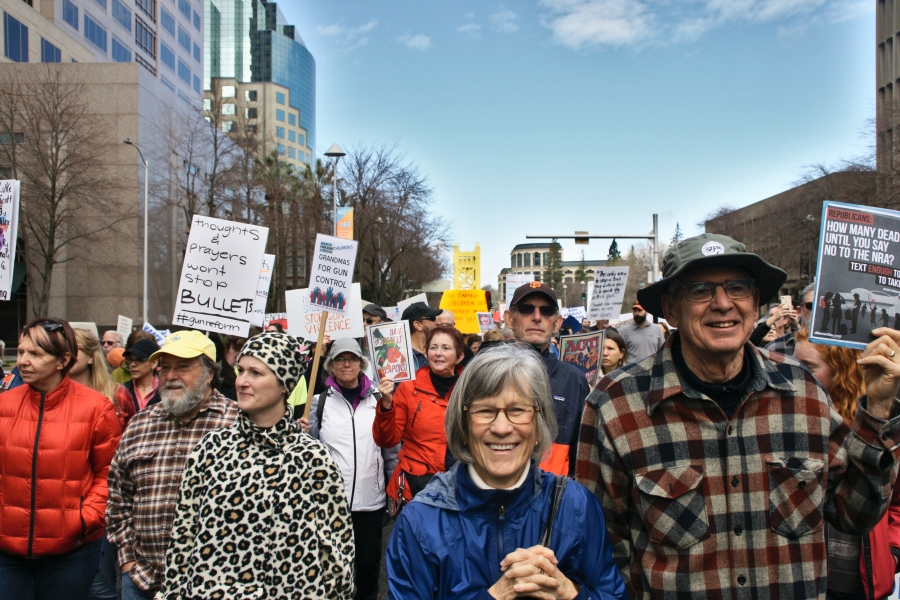
Demonstrators varying widely in age, gender and ethnicity march to the California State Capitol down Capitol Mall. (JESSE STESHENKO)
Thousands gathered in Sacramento and called for increased gun control on March 24, about a month after the mass shooting in Parkland, Fla. (JESSE STESHENKO)
The Mayor of Sacramento, Darrell Steinberg, addressed the anxious crowd gathered on the steps of the Capitol. In his speech, Steinberg applauded the efforts of those before him and encouraged participants to continue fighting for gun control. But his words were cut short as the crowd began to chant the name of Stephon Clark, an unarmed black man who had been shot to death by the Sacramento Police Department a few nights prior. (JESSE STESHENKO)
A local 14 year old high school student shares his anger and frustrations surrounding the recent Marjory Stoneman High School shooting. (JESSE STESHENKO)
(JESSE STESHENKO)
High school students led the crowd gathered in front of the Capitol building in anti-NRA and pro-gun safety chants, as well as calls to “vote them out.” (TAYLOR LAPOINT)
The Sacramento Police Department estimated that more than 6,000 people gathered to march for increased gun regulation. Some marchers played 1960s Vietnam protest music, while others reached out to the youth present. One man came up to me and encouraged me to continue documenting events like this — he said he had boxes of protest images dating back to the 1968 Democratic National Convention protest against the Vietnam War. (TAYLOR LAPOINT)
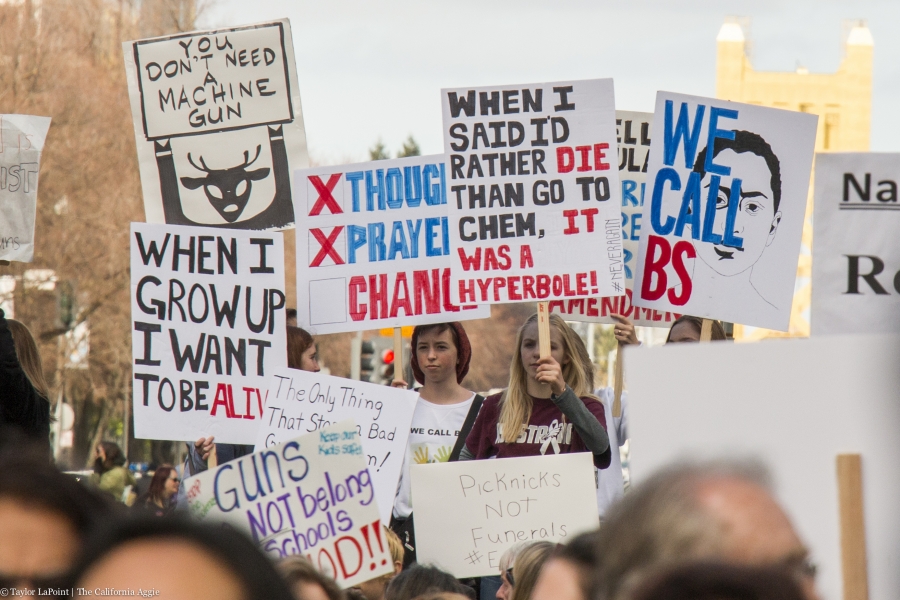
High school students from around the Sacramento area gathered to have their voices heard in protest of gun violence, leading the way for people of all ages to follow. (TAYLOR LAPOINT)
As with any march, protesters brought an array of signs, ranging from simple declarations like this one to demands for change and rallies to vote. (TAYLOR LAPOINT)


Compiled by: Taylor LaPoint and Jesse Steshenko — photo@theaggie.org

Humor: English major realizes everything can be a phallic symbol if you think hard enough

MACLEAN HARTFORD / AGGIE

8=====D (What does it mean?)

Now let’s just think for a minute. What is a penis?
This is not a rhetorical question. Seriously, what is a penis? What do you use it for? Is it a kind of trout? Perhaps a writing utensil? An eating utensil? Please write your answer to the following email because I’m too scared to ask Mommy for the truth: adlevins@ucdavis.edu.

Anyway, today we are gonna talk about phallic symbols, which, as we all surely know, is a fancy way of saying that something that’s not a dick does, in fact, look like a dick. What kinds of things am I talking about, you ask? What? You’ve never seen a dick? Hah.

Things like pencils, crayons, spaceships, bananas, zucchinis, solar eclipses, the extreme tippy top of Mt. Everest, the sword that Beowulf holds in the 2007 movie adaption “Beowulf” that Angelina Jolie (who is Grendel’s Mama) is stroking and then melts, and it’s kind of uncomfortable (no doubt compounded by the fact that Ray Winstone is playing Beowulf and also that everything inexplicably looks super CGI and did not age well).

ANYWAY, another indication that something is a phallic symbol is if any given English professor arbitrarily decides it is a phallic symbol. This could be anything: your Dad’s bald head, or perhaps your 2012 Subaru Impreza, even a slice of Hawaiian pizza. Anything can be a phallic symbol if you so choose to pretend it is. Think about it.

Is this saying that phallic symbols make me roll my eyes because of how overused they are? Oh certainly not! I like dicks!

(Mom, I’m sorry I wrote this article).


Written by: Aaron Levins  — adlevins@ucdavis.edu

(This article is humor and/or satire, and its content is purely fictional. The story and the names of “sources” are fictionalized.)


UC Davis participates in National School Walkout

BRIAN LANDRY / AGGIE

After Parkland shooting, walkout memorializes victims

UC Davis students, staff and the wider Davis community participated in the National School Walkout at the MU on March 14 to remember victims of gun violence in Parkland, Fla.

17 minutes were dedicated to remember the 17 individuals who died in the shooting. Over 80 people gathered to memorialize the dead and injured from the gun shooting at Marjory Stoneman Douglas High School on Feb. 14.

At 10 a.m., participants gathered in a circle at the MU flagpole for a recitation of the names of the shooting victims. This was followed by speeches from concerned members of the UC Davis and Davis community about gun violence, the emotional impact of past school shootings and a recent school lockdown at Harper Middle School in Davis because of a gun threat.

Alexander Fisher-Wagner, a second-year cinema and digital media major at UC Davis, organized the UC Davis walkout through a Facebook event page. Wagner was asked about his motivation for coordinating the event.

“About a week after the shooting, something hit me emotionally,” Fisher-Wagner said. “I do not understand exact what. But I felt that, as a student, this can happen to me. This can happen here. This can happen to my friends. And there was something that I can do. The lack of response from UC Davis […] was concerning for me. I went ahead and said that I was going to do something myself.”

Susan Lovenburg, a representative from the Yolo County chapter of the Brady Campaign, a gun violence prevention organization, attended the event and spoke about the growing youth movement against gun violence.

“I think it is really important to remember the number of people who have been affected by gun violence, which is part of the objective today, and the other is to advocate for the reform of our gun laws in the United States,” Lovenburg said. “I see a really significant shift in a younger population of students getting involved in this issue. And I am hoping it is going to help push through some legislation at the federal level.”

Carly Kilpatrick, a fourth-year political science student at UC Davis, spoke about why she attended.

“I think that there should be stricter gun control laws,” Kilpatrick said. “And more specifically, honor the people who died in the shootings in Florida a month ago today.”

When asked about what she thinks will come out of the walkout, Kilpatrick said she thinks “in general, since [the shooting] happened, there has been a lot more talk about gun control.”

“There [have] been so many shootings,” Kilpatrick said. “They happen and then it is on the news for a little bit and then it stops. And this has carried momentum for a while. I would hope today that this just continues to carry on momentum for this movement to not have guns in schools and especially not have teachers with guns.”

Julia Hagelberg, a second-year sociology major, spoke about what the youth-driven anti-gun violence movement means.

“Us being college students […] just shows that it is about all students — not just about one particular age range,” Hagelberg said. “But it affects all of us because we just want to better our education and be able to control our lives without being fearful of a thing that is our human right to education.”  

Hagelberg spoke about arming teachers in schools.

“I don’t think that teachers should be armed with weapons,” Hagelberg said, “I [think] that you are supposed to be educating us, and I don’t want to be fearful that you are going to pull out a gun. I don’t want to even hear that you think you need it in case someone comes to shoot the school. Why should we be preparing for that? That should not be a thing we think about when going to school.”

Cassidy Kays, a third-year sociology major, said the ongoing student anti-gun violence movement is “acknowledgement of what is happening” which is “not coming from the government.”

“We are seeing this whole generation of kids, teenagers and college students speaking out and I am so proud of being part of a generation that is actually standing up for students’ rights [and] children’s rights,” Kays said. “It is so important. Schools should be a place that is safe and students should not be afraid for their lives when going to college and going to school. That is crazy.”


Written by: George Liao — campus@theaggie.org

ASUCD and Eye to Eye hold Disability Awareness Week

IAN JONES / AGGIE

Events include open forum, resource fair, film screening

ASUCD’s Disability Rights Advocacy Committee and the UC Davis chapter of Eye to Eye hosted the first-ever Disability Awareness Week from Feb. 26 to March 2. The student-led initiative encouraged students, faculty and administrators to confront and disassemble the stigmas surrounding mental and physical disabilities through three primary events on campus.

DRAC is composed of members of the UC Davis community who aim to raise awareness about students with disabilities. Eye to Eye is a national organization that works to connect young students with learning differences with university student mentors who have similar experiences and difficulties.

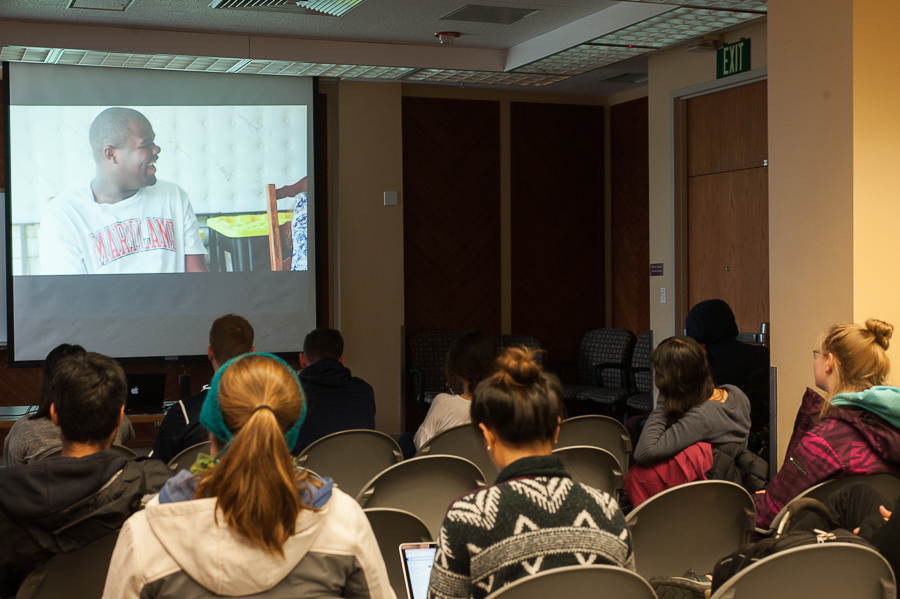
The two organizations held an open forum about how to improve UC Davis for the community of students with disabilities on Feb. 27. The next day, the groups organized a resource fair with information about on-campus support systems. On March 2, the documentary “Being You” was privately screened in the Memorial Union. The film is about three young students who learn to believe that their disabilities are not flaws, allowing them to positively change their perceptions of their own differences.

At the open forum, titled “Discussing the Future of the Disability Community at UC Davis,” audience members expressed thanks to members of the committee and the club for their efforts in raising awareness for students with learning disabilities. They also asked questions regarding the current wellness and number of students with disabilities at UC Davis.

“There’s a pressure, sometimes, for students with disabilities to not come forward because they’re feeling like it’s a really competitive campus,” said Jennifer Billeci, the director of the Student Disability Center. “We have a relatively low number of students registered for [disability] services on this campus.”

One audience member questioned if students with disabilities had access to additional or superior facilities and support at other universities. She postulated that students with disabilities have difficulty learning at an institution that follows the quarter system, and concluded that UC Davis should change its academic calendar to be more inclusive of these students.

One panelist, Ben Gurewitz, a founder of Eye to Eye and a second-year political science — public service major, noted another significant problem that students with disabilities at UC Davis face: difficulty in communicating with administrators and the university. He mentioned that it might be beneficial to increase communication with this community of students.

“I don’t think that a lot of students have that — have the background or training or the skills afforded to them to engage in that kind of dialogue,” Gurewitz said. “I don’t think that really affords a response, but just to kind of consider how to provide a voice when students don’t have a voice.”


Written by: Jacqueline Moore — campus@theaggie.org

Are you playing enough “Fortnite?”

JAMIE CHEN / AGGIE

Why playing video games isn’t a bad thing

You’re skydiving; you’re free-falling at top speeds until your parachute deploys. Except, once you land, panic sets in, as you need to find a gun before someone kills you. It’s called “Fortnite,” and everyone’s playing it.

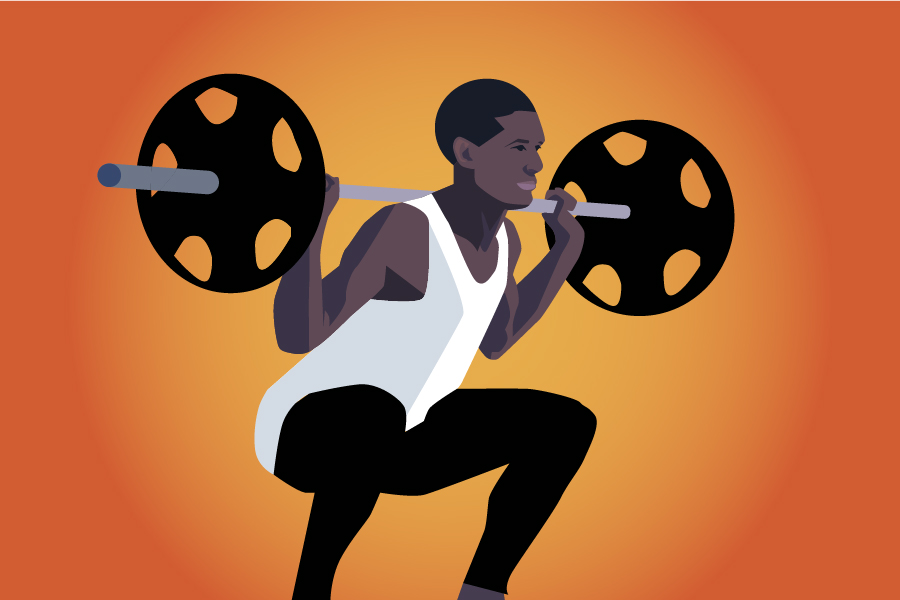

Imagine if someone took “The Hunger Games” and turned it into a video game — that’s “Fortnite.” It’s somewhat of an epidemic that has swept the nation, and for good reason. As of Jan. 2018, the game has been played by over 40 million people in the U.S. and has even broken gaming records, with a peak of 3.4 million concurrent players. The game is not only free to play, but also extremely fun, frustrating and addicting.

Yet there is still negative stigma associated with video games, even though there have been countless studies showing their beneficial qualities.

Video games are mainly portrayed in the media as a non-social activity. However, video games are highly interactive, as they allow you to play and communicate with people all over the world. Nonetheless, the main reason most people play video games is because they are fun and a wonderful source of enjoyment.

Social interaction is an important aspect of video games because it is the perfect environment to create and maintain friendships. Playing video games with others in a team setting promotes teamwork and designates responsibility. Moreover, video games give players the option to creatively express themselves in ways they otherwise may not feel comfortable doing in the real world.

For the most part, video games are also seen as time-wasters with no inherent value or positive qualities. It is unusual to think that video games could have positive effects on the brain since it’s a very popular idea that video games turn your brain to “mush.”

But video games that require a lot of thinking and decision-making exercise the area of the brain called the orbitofrontal cortex. In this case, fast-paced games require players to think critically about their in-game actions and decisions to react quickly and creatively to different challenges.
In short, the skills honed while playing video games can translate into the real world. For instance, in a video game, the player has to maneuver through a world of obstacles and other demanding challenges in split-second timing in order to avoid failure. This applies to activities like biking to campus or class. When biking, the biker is faced with many obstacles, like pedestrians, other bikers and vehicles on the road. It’s therefore necessary to be aware of one’s environment because it’s constantly changing and uncertain.

In a video game, the gamer is immersed in the computer-simulated world and is responsible for controlling and making decisions; thus, video games have a metacognitive function also built into them. In brief, metacognition refers to the ability to think about your own thinking. In this case, video games offer gamers an insight into their own thought processes and as a result reinforce critical thinking skills.

It’s no surprise that gamers also have an advanced capability to multitask because they can focus on more objects without getting confused. Gaming’s repetitive nature hones in on gamers’ fine motor skills in games that require a high degree of accuracy and precision because, in order to become better at any game, it’s instrumental to keep learning and practicing.

Video games are becoming an increasingly popular educational resource in today’s technologically-dependent world. Video games are incredibly cheap and can be readily dispersed to people all over the globe who have access to a computer. According to Forbes, 74 percent of K-8 teachers implemented digital games into their curriculum in 2013.

One of the many advantages of teachers using video games in the classroom is that they can utilize various math, language and science games to further develop children’s language proficiency, counting skills and literacy. In addition, when children play video games with others, it teaches them important social skills, such as sharing and how to work together effectively.

Nevertheless, games like “Fortnight” are still privy to the negative stereotypes of videos games. Good Morning America, for example, recently presented a segment: “‘Fortnite’ frenzy sparks parental concerns.” Even though it’s a popular misconception that video games are harmful, people of all ages should become aware of their positive potential.

I play “Fortnite” because it’s fun. The game is simple with just the right amount of difficulty. It’s incredibly challenging to win since the odds are stacked against you. So when you finally do win a game, it’s incredibly rewarding. At their core, video games are fun stress relievers. They offer gamers the option to freely express themselves and get lost in a virtual world of immense possibilities.

Today, video games have become routine and a regular part of daily life. Thus, it’s important to embrace all of video games’ positive qualities and applications. Video games are already being used in schools and the workforce. After all, despite there being a few studies that illustrate the negative effects of video games, there are innumerable other studies that show the tremendous and wonderful benefits that they have on a person. In essence, it’s no doubt that video games are not only a popular source of entertainment, but are also hugely beneficial to a person’s mental health and well-being.


Written by: Alejandro Lara — amlara@ucdavis.edu

Disclaimer: The views and opinions expressed by individual columnists belong to the columnists alone and do not necessarily indicate the views and opinions held by The California Aggie.

Bitcoin for your thoughts

JEREMY DANG / AGGIE

Davis’ students uncover “mystery” behind Bitcoin, other cryptocurrencies

Artificial intelligence, robotics, automation and nanotechnology are a few of many innovations that have paved the way for the technological future within the past decade. Another technology that came into the public eye in 2009 was cryptocurrency. These cryptocurrencies use blockchain technology to keep the currency as well as the technology safe. On first look, the process of understanding the purpose and technology of cryptocurrencies may seem daunting. However, because it could be a leading technology in the future, it may be beneficial to understand what cryptocurrencies and blockchain are and how they can be implemented to solve societal problems.

Cyrus Goh, a third-year cognitive science major and the lead frontend developer of Trust Wallet, explained how cryptocurrencies may be explained to a fifth grader.

“Let’s say I’m sitting next to a fifth grader and I have candy,” Goh said. “I pass the candy to a fifth grader and the fifth grader receives the candy. There is no middleman or parents involved in the process […] I don’t need to store the candy with the parents or the ‘bank,’ but rather a straightforward one to one transaction of candy in this case.”

In essence, these cryptocurrencies are a way to pay for things electronically without having to use a middleman such as a banker. Goh explains how cryptocurrencies are maintained by numerous coders and run on an open and decentralized network rather than allowing government institutions or banks to handle money.

“Cryptocurrencies work the same way as trading” Goh said. “Buying and selling cryptocurrencies is very much like trading stocks.”

Essentially, these cryptocurrencies or contracts are embedded in a digital code and stored in a transparent, shared database and are protected from deletion, tampering and revision due to the various levels of encryption. Every process, task or payment has a digital signature that can be identified or verified in some way. The trust for this technology is established by mass collaboration and a complex code, which ensures integrity between strangers and makes it nearly impossible to cheat.  

Daniel Lundberg, a fourth-year biochemistry major, detailed how cryptocurrencies can be compared to the current use of the U.S. dollar or any other form of fiat money.

“You can use a computer algorithm to make transactions to and from a person but on a computer screen, not using something issued by the government,” Lundberg said. “I think that blockchain and cryptocurrencies will be something that has a higher demand in the future and that’s why I am interested in cryptocurrencies because it’s like a different type of currency that you can use and people are starting to gain trust in it.”

Right now, the leading cryptocurrencies include Bitcoin, Ethereum, Ripple and Litecoin. But how exactly do these cryptocurrencies work in terms of investment and how are they created?

“Bitcoin, Ethereum and etcetera are decentralized currencies and basically there are thousands of them in the market today and anyone can create these decentralized currencies,” Lundberg said. “If it is legitimate enough and if the market recognizes it as a legitimate thing to invest in, more and more people will go into it and start mining their own coin.”

Cryptocurrency’s intended purpose is to transact directly and exchange funds peer-to-peer without the involvement of a middleman. However, the technology supporting these cryptocurrencies, namley blockchain, is far more promising, explained Andreas Godderis, a second-year economics major with a minor in computer science.

“The way that blockchain works is that you have a series of equations that are nearly impossible for humans to do, meaning that they are lengthy and complex and so you need a computer to solve all those equations,” Godderis said. “When a computer can solve these equations it essentially opens up a new piece of paper or new ‘ledger’ that could record transactions and that’s called mining, when you dedicate computers and processing power to creating new ledgers to keep track of, like, debts.”

So in theory, anyone could take their laptop or computer and start mining for a cryptocurrency, and these miners would get a small fee. These ledgers are public and the identities of the coin owners or the people involved in the transaction are encrypted by a system that uses cryptographic techniques. The ledger is open to anyone and the database that runs on millions of devices contains information ranging from money, deeds, music, art, intellectual property, votes and more.

The name “blockchain” comes from the system of linked blocks. When one of these ledgers are completed it forms a block which is dependent on the time period it is created in. This block forms a link with another block in the future which has its own separate list of transactions. Once the so called “block” is completed it allows for another block to be added, hence, blockchain.

“You can always go back and look at those [ledgers] but there is no way for you to ever manipulate them simply because once they are on the blockchain they are essentially stored on every other computer in the network,” Godderis said. “Every other computer in the network can check and make sure that data is the same that it was five minutes ago or ten minutes ago or an hour ago or last year which eliminates any possibility of fraud.”

Safety is a another primary concern among many people who are beginning to familiarize themselves with blockchain or cryptocurrencies in general because the process is completely digital.

“There is this notion of ‘okay it’s on a computer there will be hackers,’ but the general consensus in the computer science world is that this technology is way safer than anything we use right now,” Godderis said. “Right now, if you wanted to engage in voter fraud in the U.S. elections, all you would need is someone’s driver’s license number, [so] fraud is possible in the current system we have, and that risk is way lower on a blockchain.”

Cryptocurrencies such as Bitcoin and Ethereum have been broadcasted on news platforms since 2009. Blockchain, the technology behind these cryptocurrencies can also be used for more innovative ways in any field.

“I totally see digital voting moving to a lot of third world countries in the next five or 10 years,” Godderis said. “If you want to monitor any sort of election and make sure that’s transparent and accurate this is the perfect way to do it. You can see every person who has voted and you can keep track of that data anonymously. In a lot of third world countries, citizens are left to kind of trust the incumbent in the election [which] gives one candidate a 98% vote, [this] probably isn’t accurate.”

Estonia is one of the only countries that relies on internet voting in national elections. The process of online voting has proven to be a huge success for the country and a security interest to people in the technology industry.

“One of my favorite applications of blockchain is in voting,” Godderis said. “Estonia actually has one of the most innovative governments and they run their government like a start-up. In the last election I think they had two-thirds of people voted online so the people could sit in bed and using their laptop, they could log into a voting system run by the government.”

Godderis expanded on how digital voting could potentially be integrated in the U.S. elections. Voting online could make it more feasible for people to vote because the process would be more accessible. Rather than the current voting turnout of 60 percent, you could get voting up to 80 or 90 percent. In doing so, politicians running for office would be accountable to meet the needs of the general public rather than focusing on special interest groups that usually guarantee them the majority of their votes.   

Blockchain technology serves as a platform for bookkeeping that is incorruptible, transparent and avoids censorship. Using this technology in other industries can possibly resolve issues regarding institutional, financial or political corruptions, which could potentially protect the rights of individuals and push toward social changes.

“I want to make a distinction between currencies and blockchain applications and often times they are lumped into the same group which is fine,” Godderis said. “Personally I am not a fan of Bitcoin at all. Bitcoin is old, it’s slow, useless and not scalable, it will never be adopted as a mainstream currency, and I don’t want to give investment advice, but buying Bitcoin now is not a bright idea.”

It’s entirely possible that through the decades, blockchain will continue to help technologists solve societal problems and cryptocurrencies may be something left in the past. In other words, the general public universally adopting an online currency may be less plausible compared to people using the technology for other projects.

“People in the 80s and 90s thought that fax machines would send things faster and that was like their scope of what the internet could do and look at what it has turned into today, it’s gone way beyond fax machines,” Godderis said. “I hate the word cryptocurrency because that puts all these [blockchain] projects in such an inaccurate and bad light almost and it labels these really innovative things that are totally unrelated to currencies as something that is just a bubble in speculation.”

On first glance, fully comprehending what blockchain is and how it can be utilized in various fields may seem time-consuming. Godderis explained how because the technical aspect of blockchain is so complex there is no “easy” way to learn about cryptocurrencies.

“I think the best way to do it and the way that I have done it is by looking at all of these different projects and going to their websites and reading what the companies or projects want to accomplish or what problems in society they want to solve, and then you start understanding how all these blockchain networks work and why they can be incredibly beneficial to society,” Godderis said. “You just need a little bit of curiosity […] anyone regardless of major or age or interests or what they want to do in their career, learning about blockchain will open your mind to innovate in your industry in anyway possible, there are blockchain applications for everything and the world is going to adopt it at some point it is just a matter of when.”


Written by: Sneha Ramachandran — features@theaggie.org

Lifting competition draws alumni, students

ALLYSON KO / AGGIE

Powerlifting is on the rise at UC Davis

Powerlifters tested the limits of their strength at the second annual powerlifting competition at the UC Davis ARC on March 14. This was the first time a UC Davis powerlifting event featured all three of the events typically offered in professional level competitions: the bench press, squat and deadlift.

This isn’t your typical day of pumping iron — competitors pushed or lifted as much weight as possible and judges decided if it was a good or bad lift. Competitors were given three attempts at each event; their strategy is to build up to their maximum weight on the final attempt.

Running a powerlifting competition can be tough if you don’t know what you are doing. Graduate student Andrew Saarni competed in last year’s event and noticed how well it was run.

“Everything was way beyond my expectation,” Saarni said. “I think that partially had to do with Super Training and other sponsors being so involved.”

Saarni was not sure how strong the competition would be this year, but he has been powerlifting for four years and thinks his experience gave him an edge.

“I’m just going to go out there and try to hit some [personal records],” Saarni said.

The competition attracted gym-goers from various skill levels. Antoine Nguyen, a UC Davis alumnus, trains at the ARC, and when he heard about the competition, he created a specific training program to prepare.

“I had to switch gears pretty quickly,” Nguyen said. “I normally try to train a bit more recreationally. My training in the past few weeks have been only sticking to the competition lifts.”

Training for powerlifting is simple but intense. Closer to a competition, powerlifters will stick to one lift per training session as their bread and butter. Saarni’s training prior to the competiton was just that. But building up the strength to be able to peak for a competition requires more than just getting stronger.

“I go through hypertrophy blocks, then strength blocks and then a peaking cycle,” Saarni said. “Then you get ready for a competition and then it starts all over again.”

Steve Frediani teaches the small group training powerlifting course at UC Davis. According to him, powerlifting has become more popular in the past 10 years.

“It really used to be more of an underground sport,” Frediani said. “It’s cool to see a lot of college students involved in it, maybe 10 years ago you wouldn’t have seen anyone using a squat rack at all, now everyone is squatting because they’re training for meets.”

When Frediani first started training for powerlifting, he competed to test the waters before investing his time in the sport. Frediani was intimidated at first because the competition can be really strong — literally.

“You see some monsters there squatting 800 pounds,” Frediani said.

Despite not having as much experience or strength as other competitors, he felt welcomed.

“I totally loved it, people are typically really supportive at meets,” Frediani said. “Especially if you’re new, a lot of people were giving me tips and encouragement.”

If you have not worked out before, or don’t have much experience, powerlifting can be that incentive to get you to keep going, according to Frediani. Going to the gym for a workout can be really vague, but with a specific goal in mind, people will workout more and be healthier overall.

“If people are training toward something, like powerlifting, they’ll have a gameplan,” Frediani said.

Competitors began lifting at 6 p.m. Results can be found on the Campus Recreation and Unions website.


Written by: Bobby John — sports@theaggie.org


Humor: Linda Katehi or Lizard Katehi?

MICHELLE GORE / AGGIE

A date

“Just back here in what’s thought to be the cold barren recesses of the Shields Library is where we keep the souls of our students,” said Lizard Katehi, Chancellor of the Underworld — not to be confused with Linda Katehi, the former chancellor of UC Davis. Lizard nonetheless bares a passing resemblance to Linda while in human form — a result of being of a clone of Linda created by the lizard people. A roll of dry yet surprisingly pliable human flesh sagged from her tail onto the floor. She was in the midst of shedding, and it was rare to find in her lizard form, so this was indeed a special opportunity that I would not take for granted.
As she strode down the hall, the human flesh drooped ever more, further revealing her beautiful reptilian scales. The shedding seemed to start somewhere near the top, with her arm flesh flopping down on the floor behind her. I accidentally stepped on one of her hand skins, and as she pulled forward, the entirety of her human appearance pulled off onto the floor. There I stood, on top of her finger flesh, the rest of her skin piled up on the floor at the base of her tail. I blushed slightly, then let out a slight laugh. She began laughing too, very amicably and with a slight hiss. It was an honest mistake. I’m sure someone else had stepped on part of her and pulled off all of her shed flesh in a single moment.

To make the situation more humorous, I wore her face as a mask. It fit surprisingly well. She didn’t seem to mind, presumably because as long as I held her appearance I’d be the object of public scorn and post-modernist witch-hunting, much to her relief. We continued down the hallway. Shields was much bigger than I expected, especially this part.

This was where she made her move on me. I wasn’t uncomfortable with the situation, but I said that it would be moonlighting since I do much of my sex work outside of school and rely entirely on “tips.” She said that there was no potential for pregnancy since she was asexual and reproduced through parthenogenesis, and when questioned on STDs, she said that the only diseases she spread were occasionally plague in her human form, when afflicted by fleas, and sometimes anthrax when moonlighting for the United States’ chemical weapons deployment team in South America. That last one she only did around Christmas, though — for extra gift money, mainly.

Lizard took a moment, possibly embarrassed, and checked if she had any food in her 73 teeth (one tooth was lost in a rather strange accident involving lots of money and textbooks). I didn’t mean to offend her, and, quite frankly, I’m not sure if that’s what I’d conveyed. She squirted herself with some perfume which turned out to actually be pepper spray, and her confidence suddenly returned.

I told her that I preferred to bond over deep conversation before such intimate matters, but that I wouldn’t be opposed to the idea after a stressful day of mostly just existing. She took “deep conversation” literally, which is often a thing that lizard people do, and offered to show me her lair deep within the earth’s crust.

It was at this point that I realized I was late to a meeting, but I told her that I’d like her phone number for a follow up. Lizard gave me her business card from a company that turns trees into student debt, and I laughed since I didn’t read or buy textbooks. Realizing that she had meant to give me her business card for her professor position, she quickly swapped them out with a slight blush that I could hardly detect on her scales. I could tell that she was invested in me, and after this meetup I can finally say that something good actually came out of Tinder.


Written by: Drew Hanson — andhanson@ucdavis.edu

(This article is humor and/or satire, and its content is purely fictional. The story and the names of “sources” are fictionalized.)

College basketball under scrutiny with allegations of illegal compensation

SHEREEN LEE / AGGIE

Latest allegations could have lasting repercussions

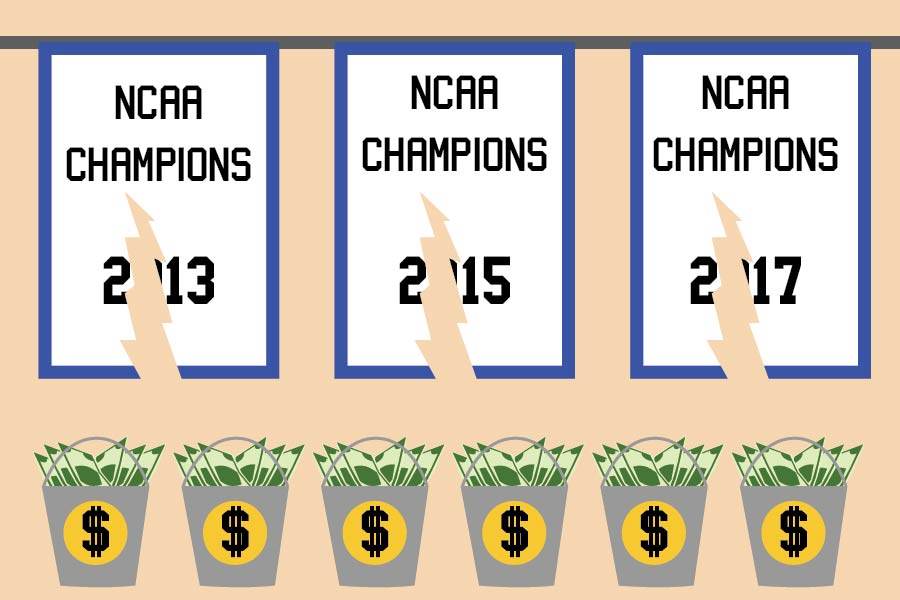
Recruiting violations are nothing new to the NCAA, with all-too-common allegations of financial misconduct by schools, coaches, and athletes dominating the headlines every few months. Fresh off of the high-profile allegations of corruption and taking bribes against former Louisville men’s basketball coach Rick Pitino, which led to his dismissal and a forfeiture of the team’s 2013 national title, the NCAA is once again entrenched in scandal, this time stemming from an FBI investigation into under-the-table payments made to players.


The latest allegations, which were first reported by Yahoo Sports’ Pat Forde and Pete Thamel, highlight a series of under-the-table payments which were allegedly made to players through a network that included agents and shoe companies in order to secure their commitments to the schools. Several big-name schools across the nation found themselves included in the report, including Duke, Kentucky, North Carolina and Texas. The players who are alleged to have participated in these deal include NBA rookies such as Philadelphia 76er Markelle Fultz and Dallas Maverick Dennis Smith Jr.


Also included in the scandal is current Arizona center and Pac-12 Conference Player of the Year Deandre Ayton, who, along with head coach Sean Miller, denied accepting any money despite claims that Miller was caught on wiretap discussing the alleged payments. Miller was suspended one game as a result of the situation, with further punishment pending the results of an independent investigation.
Should the allegations prove true, the NCAA would be forced to crack down on many of the biggest schools in the nation. While countless scandals have come and gone throughout the years, none have been this widespread. NCAA President Mark Emmert addressed the controversy in a statement.


“These Allegations, if true, point to systematic failures that must be fixed and fixed now if we want college sports in America,” Emmert said. “Simply put, people who engage in this kind of behavior have no place in college sports. They are an affront to all those who play by the rules.”
Consequences for financially dubious practices vary, depending on the scope of each individual situation. Schools can face anything from fines, sanctions, and loss of scholarships, to the dreaded “death penalty,” where the school is banned from competition for at least a year at a time. The current controversy continues a long history of similar allegations against schools both small and large.

Every time a controversy like this hits, a similar debate rages on over the ethics of the NCAA’s policy of not allowing players to accept any money for their services. Despite the fact that students across the nation find ways to get paid for student work, the NCAA strictly prohibits its players from accepting any money for their services to the school. Among countless complaints, opponents of the NCAA’s strict adherence to this policy point out the salaries of coaches, who often make millions, and the revenue which the high-profile sports such as football and basketball bring to the schools.


Investigations such as this can drag on for years, but if the evidence is proven, the NCAA could face the largest crisis it has ever seen.


Written by: Bradley Geiser — sports@theaggie.org

UC Davis alumnus releases debut EP

Nate Hernandez is Kisos

UC Davis alumnus Nate Hernandez, known by his stage name Kisos, released his debut EP, “Voices,” on Feb. 16. He also started a public relations firm that represents those who identify as queer, people of color or both. Currently residing in New York, Hernandez talked about his new music and his journey that led to his big release.

Prior to his time here at UC Davis, Hernandez had no experience singing live in front of an audience. Opportunities presented to him in college helped to bring out his inner performer — with full confidence.

“I never sang in front of people, but then as I went through college, I started to get a little less shy, and my girlfriend thought I should try joining an a cappella group,” Hernandez said. “That was my first experience with music at UC Davis.”

Hernandez mentioned that although he had a girlfriend in college, he now proudly identifies as a queer gay man.

He had his fair share of embarrassing moments that are enshrined on the internet.

“We performed on stage on Picnic Day, and I hope they’ve hidden those videos from YouTube because let me just say, it was a windy day, I was nervous and my throat was dry,” Hernandez said. “You could probably find them if you try, but I hope you don’t.”

Living in New York has never been an easy task. Hernandez willingly slept in a hammock in a living room. Turns out the price of admission is a kink in your neck from the lack of a mattress.  

“My boyfriend at the time, whom I’m still really good friends with, saw the idea on Reddit to put a hammock in the living room to save $300 on rent,” Hernandez said. “I  turned it into a bit of a studio by putting up a curtain […] I could survive on a lot less money than I thought.”

However, the seeds of his hard work have started to sprout. Hernandez collaborated with another artist named Demoda in New York, which gave him some attention and recognition.

“That was something that wouldn’t have happened if I hadn’t been in New York,” Hernandez said. “Someone I knew at the company I was working at ran an indie music blog, and then he started an indie music label and marketing company. DeModa was one of his first artists, and he reached out to me because I was releasing more original pieces as well as covers. He asked me if I was interested in writing the lyrics to his track. At first, I didn’t know if it is really my thing, but then I wrote some stuff and I really liked it. That was something that opened a lot of doors for me.”

He was willing to share the inspiration behind the title of his EP, “Voices.”

“I know it’s a bit basic, but there are so many voices in your head all the time,” Hernandez said via email. “Your own voices, voices from friends and family giving their opinions, voices from society speaking up when they should shut their mouth, voices from random self help gurus or writers/philosophers that mess with your mind and make you feel like you aren’t living right. This album is rising above the cacophony, and only focusing on your own voice and what you choose to value.”

He described his music as being introspective, vulnerable and rebellious. He further explained what he meant by “rebellious.”

“Being yourself is rebellious because everything in society is literally telling you not to be yourself,” Hernandez said. “Every marketing message for everything is saying you’re doing something wrong.”

Hernandez also shared the secret origin of his stage name.

“I ended up getting the K-I from the first two initials of my elementary school, and the S-O-S is the first three letters of my area code (707),” Hernandez said. “At the time, I didn’t like it as much, but now I love it.”

His conscious lyrics bring realness to the human experience. Tracks like “Symmetry” put Hernandez’s raw emotions on full display — a trait present throughout the EP.

In the track, “Symmetry,” Hernandez sings, “We’re afraid to make mistakes / Fear has us writing in white so we don’t make mistakes / We’re writing in white all over the page […] The voices from within block out all the noise.”

Hernandez’s work as Kisos has benefited from the big-name artists who have protested against streaming their music on apps such as Spotify.

“Overall, I think it’s good that some of these bigger artists are protesting,” Hernandez said. “I think it’s a step toward getting more compensation [as a small artist] for the work that we are putting in, the money that we’re spending and just valuing our art.”

Miller Place is the public relations company that Hernandez founded because he wanted to give back and support others like him on the same journey. The name is inspired by the street that he grew up on.

“I call it more of an artist collective,” Hernandez said. “The artists I work with are pretty early in their careers, and I help them with social media and branding. I also like to call it a collective because there wasn’t a whole lot of collaboration going on at the public relations firm I worked at […] I wanted to be able to create a tight-knit community because that’s what we all need — we all need each other.”

He showed his appreciation for the contributions and experiences that Davis provided him with.

“[UC Davis] provided the catalyst for me,” Hernandez said. “I had an amazing experience, and I met so many people. The fraternity that I was in, Alpha Sigma Phi, gave me an opportunity to learn how to be extroverted and meet people. It really helped me break out of my shell to network and talk to people […] I think the most obvious was gospel choir. Choir made me more comfortable with singing and being in front of people.”

Now that he’s made it this far, Hernandez reflected on what’s next for him and his music.  

“I feel like right now isn’t even the beginning for me, it’s still the prologue,” Hernandez said. “I’ll revel in voices for a while, continue to find ways to bring it to new audiences. I worked on it for two and a half years, so I want to give it the proper run it deserves before flying into the next thing.”

From Davis to the Big Apple, Kisos encompasses it all in perfect symmetry. “Voices” is available on all major streaming apps as well as Apple Music.


Written by: Josh Madrid — arts@theaggie.org

King Hall Speech Focuses on White Nationalism and Immigration

JORDAN KNOWLES / AGGIE

Recent anti-immigration rhetoric abetted by white nationalism threatens state of immigration

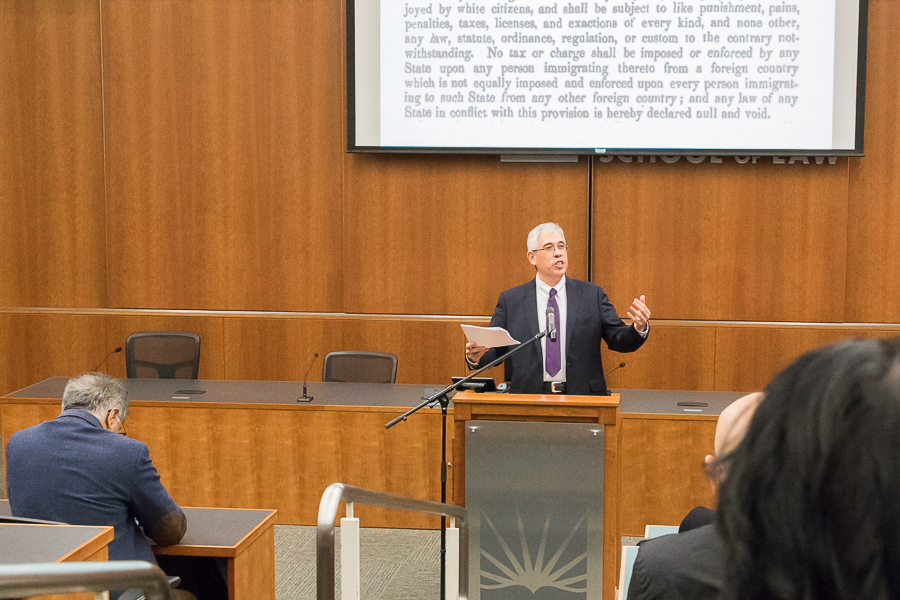
A speech titled “Is the United States a White Nation” was given by Professor Gabriel J. Chin, a UC Davis law professor, on March 1 in King Hall. The speech traced the history of civil rights and immigration laws and the attitude Americans have had on immigration in the past compared with the current anti-immigration movement in the United States.

Kevin Johnson, the dean of UC Davis School of Law, introduced Chin as an activist and scholar and provided a background of his work.

“He and his students worked to repeal Jim Crow laws and successfully petitioned the Ohio legislature to ratify the 14th Amendment,” Johnson said. “A few years late, […] but better than never — it was only 136 years after the state had disapproved it. Professor Chin and his students also worked to repeal Anti-Asian land laws that were still in the books in Kansas, New Mexico and Wyoming. In that vein, Professor Chin’s lecture today, which is especially timely, addresses the question, ‘Is the United States a White country: a problem of immigration policy.’”

Chin began his speech by immediately identifying the current white nationalist problem.

“I want to talk to about where we are in immigration policy today through the lens of history,” Chin said. “In my view, white nationalism enjoys a respectability and influence now that it has not in other point in my lifetime. Many people believe, as I suspect as I do, that the white nationalist and extreme proposals for immigration restriction are as un-American as they are unwise. I believe that this country is, as it should be, a nation of immigrants, a nation of nations [and] the first universal nation. Immigration has always been the goose that has laid the golden eggs for the United States. It’s also served as a moral model for the rest of the world.”

He outlined legislation passed through history which included the Declaration of Independence, laws adopted after the Civil War, the Civil Rights Act of 1964, the Voting Rights Act of 1965 and the Immigration and Nationality Act of 1965. One issue Chin mentioned was how immigration rights applied to Asians.

“I believe what we see in immigration policy, particularly with respect to Asians but with respects to other groups, is evidence that there is something less-than-meets-the-eye to our anti-racist legal changes that many of us celebrate,” Chin said.

Chin analyzed the civil rights and immigration laws enacted through history and omissions purposefully enacted in this laws that allowed bias in the areas of citizenship, voting and property ownership rights to persist.

Specifically, Chin talked about opposing opinions present when the 14th Amendment was being enacted. These opinions gave racist criticism of Chinese immigrants. Chin referenced the Burlingame Treaty of 1868 between the United States and China.  

“It promised the Chinese People could immigrate to the United States on the same basis of all other foreigners except that the Burlingame Treaty, at the insistence of the Senate, contained an exception for naturalization,” Chin said. “Chinese [people] did not have the privilege of naturalization under the treaty.”

Chin said that while legislating the 15th Amendment, the western states allowed non-citizens to vote if they declared their intent to become citizens and in turn they received the right to vote and economic privileges. But Chin revealed that these rights did not apply to the immigration and naturalization of the Chinese population. In the end, the 15th Amendment allowed exclusions of ethnic groups which were adopted differently between states.

“This is what the framers of the 15th Amendment understood: […] that states were permitted to draw these lines among non-citizens,” Chin said. “They knew the franchise was not going to be divided between citizens and non-citizens. It was going to be divided on the basis of race at least among non-citizens.”

Asian immigration restrictions continued into the 20th Century. Chin supported this argument by highlighting Congressional testimony that disavowed the rights of Asians.

Chin spoke on the particular importance of the Immigration and Nationality Act of 1965 in comparison to other civil rights and voting rights laws.

“In 1964 and 1965, the second reconstruction, the Civil Rights Act of 1964, the Voting Rights Act and the Immigration and Nationality Act of 1965,” Chin said. “I call the Immigration and Nationality Act of 1965 the most effective civil rights law of the twentieth century.”

Chin explained how the Immigration and Nationality Act increased non-white immigration and how the immigration status quo was currently under threat.

“But in regards to immigration before 1965, 80 percent or more of the immigration stream were Caucasian by design by racial classification,” Chin said. “Since 1965, without racial preferences, with no affirmative action, with no preference for people from the third world, 80 percent or more of the immigration stream has been Asian, Latino [and] African. As a result, the 1965 [Immigration and Nationality Act] is a target of white nationalists who believe that it was either unintentionally or intentionally designed to destroy the United States by bringing undesirable races to the country.”

Chin then said that the Immigration and Nationality Act of 1965 was not popular with people at the time it was enacted and related this sentiment to today’s current climate.

“What President Trump has said simply reflect the views of the average American 50-something years ago,” Chin said. “As a result of the 1965 Immigration Act, groups like the Census Bureau and the Pew Research Center have predicted loudly and repeatedly that the United States will be a majority minority nation by the middle of [this] century. But it is not inevitable. It’s not inevitable if legal immigration is slashed as some have proposed the demographic future of the United States will change.”

In closing, Chin gave a warning on the anti-immigration movement supported by white nationalists.

“My study of the topic has led me [to the conclusion] that at founding we were clearly a white country,” Chin said. “During reconstruction, we became a black and white country [and] in 1965, the elites [asserted] that we were no longer to be a white country, but this moment now the Trump era is the first time in which the American people as a whole and there are lawmakers in Congress are simultaneously compelled to address the issue of whether race is an essential part of the American nation. And I hope that the decision comes out the right way.”

Kyle Edgerton, a third-year UC Davis law student, commented on Chin’s research.

“I think it is part of [Chin’s] scholarship to ask these questions and to share his insights with people,” Edgerton said, “I guess that [his] preliminary objective is to let people know about his research and where he stands. I don’t know to what extent a message like that gets beyond the four walls of the law school.”

Robert Irwin, a professor in the Department of Spanish and Portuguese at UC Davis and the co-leader of the Humanizing Deportation project, reflected on the anti-immigration stance in relation to DACA.

“DACA is a program that aims to avoid what many would interpret as a human rights abuse by giving a protected migration status to undocumented young people who arrived in the US as children,” Irwin said via email interview. “Many believe that the only ethical way to treat these young people is to grant them a path to citizenship, but the current presidential administration has sought to end the program, and Congress has been unable to reach an agreement on what protections or options to offer this group.”

A full video transcript of Chin’s speech can be accessed on King Hall’s website.


Written by: George Liao — campus@theaggie.org

Boozy berries

ZOË REINHARDT / AGGIE

Cocktail recipes for spring

With the end of Winter Quarter approaching, the rejuvenation of spring break is close. For some, that means taking a smaller load of classes. For others, it means more excuses to enjoy a refreshing cocktail. So, in light of spring break — and eventually, Picnic Day — here’s a list of drinks that are sure to make you feel like spring is in full bloom.


Berry Breeze

(2 oz of vodka, 4-5 blackberries, .25 oz lime juice and ginger beer)

This first cocktail utilizes one of the best things about spring: berries. With a name like “Berry Breeze,” only good things can come from it. To make this delicious concoction, begin with muddled blackberries, then add vodka and lime juice. Shake over ice, then strain into a ice-filled glass and top it off with ginger beer.


La Paloma

(1 oz grapefruit juice, 0.5 oz orange juice, lime juice, 1.5 oz grapefruit jarrito, 2 oz tequila, tajin spice)

This second drink has a bit of a kick and is my personal favorite. The best way to start off this drink is to rim the top of the glass with tajin spice and then begin by adding the non-alcoholic items first. Mix the grapefruit juice, orange juice and lime juice (just a splash) in the cup you will be drinking out of, and don’t forget to add grapefruit jarrito as well. Once stirred, add tequila and let seep into the cocktail.


Best in Show

(strawberry, orange, mint, syrup, orange bitters, 1.5 oz vodka, rose champagne)

This drink contains two ingredients that are incredible even when standing alone: rose champagne and strawberries. By far one of the most appealing-looking drinks in this list, the “Best in Show” is definitely a drink for spring. To start this drink, muddle one large strawberry, one slice of orange and a mint leaf. Add a dash of simple syrup and orange bitters and then shake with ice and vodka. Once shaken, pour into a glass with ice and top it off with rose champagne.


Raspberry mojito

(handful of mint, 3 raspberries, 1 lime, 2 tsp sugar, 1.5 oz spiced rum, club soda)

A classic with a twist, this is the most refreshing drink of the bunch. Again, muddle the mint, raspberries, lime juice and sugar in the glass. This entails a handful of mint leaves, three whole raspberries, juice of one lime and sugar. Then in a shaker, add ice and spiced rum and shake for 15 seconds. Then pour into the glass that contains the other ingredients and top it off with club soda.


And remember, drink responsibly.


Written by: CaraJoy Kleinrock — arts@theaggie.org

Students gather at SCC to protest tuition hike

RAUL MORALES / AGGIE

Protesters rallied, came together for teach-in

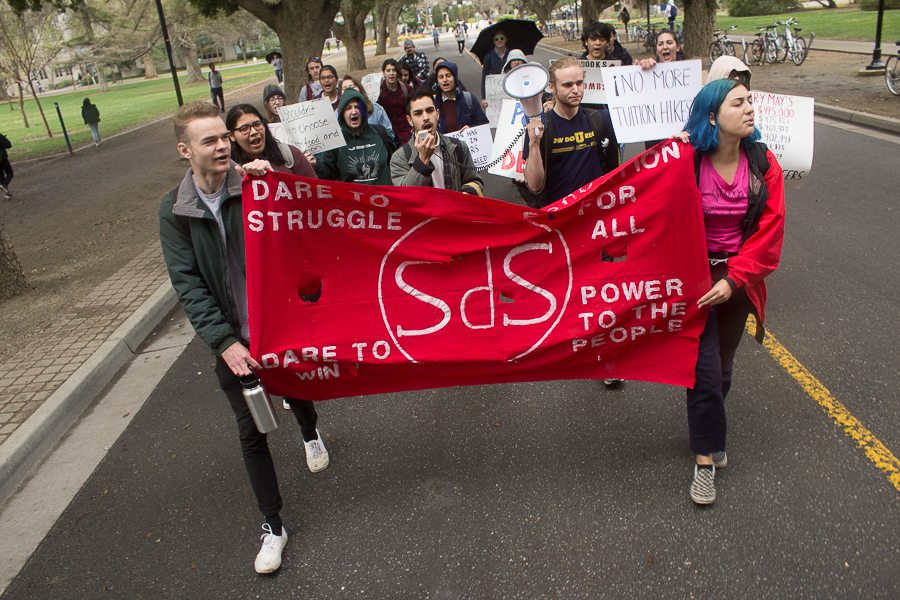
On March 14, while the UC Regents met at UCLA to discuss raising nonresident tuition, a group of UC Davis students gathered in front of the Student Community Center to protest the tuition hike.

The event, titled “Rally & Teach-in to Save Public Education,” was hosted by the student group Students for a Democratic Society.

“I’m here today because we’re seeing increased privatization and the cost of going to college and getting an education is becoming more and more inaccessible to working class and middle class families and it’s just not fair,” said fourth-year technocultural studies and English double major Becca Payne. “Education is a human right, and it’s something that everyone should have access to.”

According to flyers the students distributed across campus, a UC student faces an average of over $20,000 in debt and over 40 percent of UC students and workers face food insecurity.

“At the same time, the amount of faculty UC-wide has remained stagnant and student enrollments have increased, negatively impacting the quality of education of undergraduate students,” said first-year community and regional development major AJ Ballesteros, who was one of the speakers at the rally.

Around 20 protesting students then marched toward the Memorial Union. Along the march, they chanted slogans expressing their displeasure with the UC Regents.

At the MU, sociology Ph.D. student Duane Wright led a teach-in on increased privatization of universities.

“While it’s true that funding to higher of education had been cut, the idea of a shared sacrifice is a complete myth,” Wright said. “The number of full-time administrators had exponentially grown and the salaries of top executives had also been skyrocketing.

As of March 15, the UC Regents approved the tuition hike on non-resident students.

The 3.5 percent tuition increase will increase nonresident tuition by $978 — from $28,014 to $28,992 for the 2018-19 school year.

In defense of the hike, UC officials claimed that the $35 million they expect to raise from the increase will help reduce class sizes and support more academic support and counseling.

“In May [the UC Regents] will be deciding whether or not they’re going to increase in-state tuition,” Payne said. “So we need to have activism and demonstrations now and in May as well.”


Written by: Clara Zhao — campus@theaggie.org

The school of challenge chasers

VENOOS MOSHAYEDI / AGGIE

UC Davis School of Engineering renowned, diverse, close-knit

UC Davis consistently rakes in merits across a number of disciplines. In 2017, U.S. News & World Report ranked UC Davis 17th in the Top 20 U.S. public universities, Best Undergraduate Engineering Program. What’s more, Davis is ranked number one in the percentage of female faculty among the top 50-ranked Engineering Programs.

“[Davis has] role models and faculty that you can turn to,” said Laila Hassen, a fifth-year civil and environmental engineering major. “I’ve noticed in the past few years there’s much more female engineers or faculty that are actually teaching, so that way we can actually get to know them more, interact with them, and talk to them in ways that they can share experiences that your male engineer professors may not have that experience. It helps a lot seeing what a female engineer looks like in research, […] especially a diverse female engineer in research in higher education as a professor.”

For the past few years, Hassen has been involved with the Society of Women Engineers, a national organization founded in 1950. Hassen has served in leadership roles in the Davis chapter, which was established in the 1980s, including president, vice president and secretary. This year she is the presidential advisor.

SWE currently has more than 150 members from every engineering major offered at Davis. In addition to various social events and intimate career fair-dinner hybrids, the group hosts Project Aspire, an event where club members invite local middle and elementary school girls to participate in STEM activities.

“I think that’s important, especially when it comes to younger girls,” Hassen said. “They’re not going to care at the end of the day what process management is or what projectile motion is, they’re going to care that they had a positive experience with that, and so when they’re older and they’re choosing more of what they’re interested in, they will have something positive to look back on.”

Growing up, Hassen was drawn to the liberal arts and wanted to be an artist. However, she wanted to do something she considered more practical with her life. In high school she was exposed to a number of internships through a high school program she participated in known as the Green Engineering Academy, she realized she was interested in renewable energy and green engineering, both of which fall under civil engineering.

“Everyone says that engineering is problem solving, which to me I don’t think is the greatest explanation or description of it because in any field you’re going to have to do problem solving,” Hassen said. “Engineers are the ones who connect the theory and concepts and calculations to practical applications, so I would say engineers are like the ‘doers.’ The way I see it, at least with civil engineers, they’re the jack of all trades, they do everything that is needed to sustain human life, like building stuff for humans to survive like buildings and bridges, transportation, even transporting water, waste.”

Linda Lan Phung, a fourth-year biomedical engineering major and vice president of internal affairs for SWE, was interested in the macroscopic concepts taught in her physics classes in high school, which ultimately influenced her to choose her major.

“Like when an ambulance passes by, why does it sound louder and more high pitched when it approaches you and softer as it goes away?” Lan Phung said. “I really liked physics and then I also liked the medical aspect because I interned at Kaiser and I was torn between choosing which one, and then I found biomedical engineering.”

Although Lan Phung enjoys her studies at UC Davis, she believes that the university could do more to offer career exploration opportunities for engineering majors that focus around biological and agricultural engineering.

“I think the engineering is good, but career-fair wise, they don’t have a lot for biomedical I’ve noticed,” Lan Phung said. “There’s a lot more companies that come for CES or chem-e or mechanical and electrical, but the other engineering fields like civil and biomedical, materials science, […] they don’t have much for those fields.”

According to Lan Phung and Hassen, it’s a slight misconception that a student has to excel in or really enjoy math and physics to be a great engineer. Hassen herself is not the biggest fan of calculus and statistics. Although a background and understanding of the subjects are required for the various fields of engineering, there are certainly differences among them.

“All engineering majors at UC Davis require the same two years of math and physics, and a little chemistry,” said Rosalind Christian, a biomedical engineering advisor, in an email. “Other than that some majors like chemical engineering require lots of chemistry. Biosystems engineering requires a lot of biology. BME requires biology and chemistry in addition to the physics and math. In the last two years, the coursework and applications differ more and create the differences between the majors.”

UC Davis has 12 undergraduate engineering majors, including aerospace science, biochemical, computer and materials science engineering. Like Christian said, it’s often the differences between the applications of the different fields that leads students to picking one major over another.

“Engineering is based on applied science and so while much of the science can be similar, it is often the differences in applications that are where students should focus,” Christian said. “For example, civil engineers work on the civil structure — roads, buildings, bridges, sewers, water supplies. Sometimes they work outside. If working on those types of projects interests a student, then that would be a good choice. Biomedical engineers support the medical field, from lab work to working on computers to designing and building medical devices. If one really wants to focus on improving the quality of human health, then this would be a good field.”

Hassen described civil engineers as jacks of all trades, but said that mechanical engineers fit that category as well due to the fact that they are also involved in a little bit of everything. According to Hassen, mechanical engineers work in fields including the car industry, designing, testing, manufacturing and more.

Chemical engineers have a structured approach when learning chemical engineering, which enables them to design, manufacture and test. Whether they’re working in the oil and gas industry or in food science, Hassen claimed that chemical engineers have a set of skills that will fit any real-world chemical engineering job.

“I feel like [UC Davis engineering] is such a large and close-knit community, and it’s not as hyper competitive as a lot of other universities,” Hassen said. “That’s actually one thing that really surprised me. I came into college expecting it to be very competitive, very cut-throat, but the engineering community is very close-knit and everyone is super friendly and helps each other out.”

Despite differences among the various engineering majors offered at UC Davis, each one has a robust set of resources and organizations available to students. At the end of the day, Hassen recognizes that UC Davis engineers have more in common with each other than they might think.

“The similarities between the engineering fields is that we all have a very analytical mindset and in fact that when it comes to problem solving, when we graduate from Davis, we’ll all have the same approach in tackling a problem into understanding it, no matter what that is,” Hassen said. “I’ve noticed that in my own mindset. Whether it’s civil engineering, mechanical engineering, they all have very strong analytical skills.”


Written by: Marlys Jeane — features@theaggie.org