
55.4 F
Davis

Davis, California

Sunday, December 21, 2025
Home Blog Page 553

Education in Trump’s America

MICHAEL VASON [CC BY 2.0] / FLICKR
You can’t be anti-education — or so I thought

Stomachs all over the country drop when President Donald Trump makes headlines. Personality notwithstanding, his policy divides his own party, confuses Americans and often works against his base’s interests. Despite his polarizing views and divisive actions, there are some things that are not partisan issues — and the right to high-quality education is one of them.

Jan. 30 marked Trump’s first State of the Union. As with many things relating to his presidency, the expectations were low. The president spent a significant amount of his speech promoting his “America First” campaign — and about halfway through one of the longest speeches in SOTU history, it hit that a huge talking point was missing: education.

Former President Barack Obama always made it a point to address the cost of education and promote his ideas (even if they didn’t come to fruition) on how to make college more affordable. In his 2013 State of the Union address, he said the word “education” 13 times. 13! Trump didn’t even mention school choice — something he and U.S. Secretary of Education Betsy DeVos promoted to the moon and back.

All Trump could comment on about our education system and its students was, “Let us open great vocational schools so our future workers can learn a craft and realize their full potential.” I would have thrown him a bone on that one — vocational training is something deeply ignored and vastly underfunded — but this statement is inconsistent with his plan to cut vocational training in his 2018 budget. Sad!

The president is so detached from his constituents that he doesn’t know what it means to receive higher education. A theory is that he views the liberal slant of universities as a personal affront and to address that population would do a disservice to himself. If that’s the case, he’s right: Many graduates tend to have liberal leanings, but that shouldn’t change the fact that the cost of tuition rises annually, students are drowning in debt after graduation and some families still can’t afford to send their children to college at all.

But how would this president understand what these issues even mean? He’s never had to face the consequences of debt. He didn’t have to work part-time when he went to college. He didn’t even need merit to get himself into Wharton. This is the same man who got a “small loan of a million dollars” from his father — a million dollars few parents have. His cabinet is the richest in American history, his children paid their way into the Ivy League and he has no concept of what it means to fight an uphill battle to change one’s circumstances. Any battles he faced were resolved monetarily. Ours, on the other hand, are resolved through education.   

Not only does Trump’s entitlement present itself in the most unbecoming way, he’s also severely out of touch. For him, education was an experience to check off a box — for us, it’s the ticket to a better life. Trump does not understand this, and he resents any American who strives to better their life through higher scholarship.

No matter how long one has stayed in this country, education is a right — it’s what makes America great. The dream of good education is often the driving force for many immigrants and refugees. These people are willing to leave everything behind, take great personal and financial risk and start over — just for what this country’s institutions of higher education have to offer.

And education is not just something new folks who come to this country strive for — American families who’ve lived here for generations understand the value of high-quality education and bend over backward to make sure their children go to the best schools and have the best opportunities. Good education is not a partisan issue, and it worries me that our commander-in-chief doesn’t believe it’s worth even a few minutes of his time.

Since his inauguration in 2017, the American public has understood that sensationalism and drama seize our president’s attention. As students, we wonder what the future has in store for us. But the struggle of the future writers, doctors, lawyers and teachers of America is not as exciting as nuclear warfare or insulting political commentators on television. Why would our President care for these silent homefront battles? His address signals that he does not have our interests at heart — they’re barely on his mind. If he has one.  


Written by: Samvardhini Sridharan — smsridharan@ucdavis.edu

Disclaimer: The views and opinions expressed by individual columnists belong to the columnists alone and do not necessarily indicate the views and opinions held by The California Aggie.

HB-Obsessed

CAITLYN SAMPLEY / AGGIE

Helping to avoid studying for midterms

We interrupt your regularly scheduled program of studying for midterms to inform you that it’s time for a TV break. HBO has a wide variety of shows that are ripe for binging.

Westworld

A mind-boggling spaghetti western show that plays on the potential level of sophistication that artificial intelligence may reach in the not-too-distant future. In the midst of emerging consciousness and self-awareness, Delores, a humanistic robot created for the guilty pleasures of the rich, begins to question the nature of her existence and the invisible line between her reality and the reality around her. The breathtaking cast is made up of high-profile names such as Thandie Newton, Anthony Hopkins and Ed Harris. Hopkins plays the creator of the western world and introduces fundamental questions of the human existence and our raw nature. Season 2 is on the way, which means the show withdrawals from Season 1 won’t be long-lived.

Game of Thrones

Set in Westeros, a world that looks like it’s about the size of California, kings and forgotten queens fight for power over seven kingdoms. If you are uncomfortable around blood, then this is not the show for you. This show probably has more fandom than any other HBO show because it’s a fully submersive world that’s great for getting lost in. One episode is budgeted at $10 million, so it’s safe to assume that the visual production and quality is top tier. The cast is ever-changing, which is a breath of fresh air and great for those like me that don’t mind inconsistency or have learned to deal with it.

Big Little Lies

Winner of four Golden Globes, including Best Television Limited Series and acting awards for Nicole Kidman, Alexander Skarsgard and Laura Dern, Big Little Lies sails mom feuds over uncharted waters. First-time television actresses Nicole Kidman, Reese Witherspoon and Shailene Woodley play a range of moms represented in society today (tropes like the stay-at-home mom or the career mom). The show also highlights issues involving domestic violence by addressing real-world scenarios of women debating coming forward in the face of being condemned as a liar.

Sex and the City

I couldn’t help but wonder: what’s an iconic HBO show that everyone must watch? Sex and the City is always relevant because sex will always be around — as well as the complications that come with it. Carrie Bradshaw, played by Sarah Jessica Parker, is joined by her three friends Samantha, Charlotte and Miranda, all with quite distinctive personalities. The four share their sex-capades with one another and try to manage their busy love lives while living in the city. Also, the show is very ‘90s (Millennials’ favorite decade right now), even though most of us were too young to remember it.  

Veep

Veep is a political comedy that fixates on the struggles of Selena Myer, the vice president of the United States. Sounds fun to be second in command, right? Not really, but Myer does her best to push the envelope under the door of the office of the President — who is never seen on camera. Full of dry and witty humor (my favorite kind), Veep is filled with hidden one-liner gems. Constantly met with public disaster, the relatable Selena Myer, played by Julia Louis-Dreyfus, is a real knee-slapper. Other cast members include Tony Hale, Matt Walsh and Anna Chlumsky.  

HBO is offered through Xfinity on Campus as part of your tuition, so take advantage because when you graduate you may no longer get the most expensive TV network out there — for free. When the Word document has been properly adjusted to MLA format and the header is set up, it’s time for a study break. You deserve it.


Written by: Josh Madrid — arts@theaggie.org

UC Davis analysis of USMLE questions reveals gaps in pain competency

1
CHRISTIE NEO / AGGIE

Focus on pain assessment over pain management linked to opioid crisis

Last month, UC Davis pain experts published a study analyzing pain-related questions on the United States Medical Licensing Examination, revealing significant gaps in how medical students are evaluated in their understandings of pain management.

The USMLE is a three-part test that all medical students must pass in order to practice medicine in the United States. According to its website, it “tests the ability to apply knowledge, concepts, and principles, and to demonstrate fundamental patient-centered skills.”

“This is the most important test of people’s careers,” said Dr. Scott Fishman, the chief of pain medicine at the UC Davis School of Medicine and the leader of the 2018 study, titled “Scope and Nature of Pain- and Analgesia-Related Content of the United States Medical Licensing Examination (USMLE).”

“I’ve been in this field for 25 years and we’ve been looking to improve education around pain for some time but have been failing,” Fishman said. “The public would probably be surprised that pain isn’t taught well. Pain gets forgotten like an orphan. No one ever really established what we want with pain education, the outcomes regarding pain knowledge that we want for someone coming out of medical school.”

Since no official learning outcomes regarding pain management exist, Fishman also worked to publish a set of novel core competencies for pain management that were developed with other medical professionals at an interprofessional consensus summit in 2013.

“A while back, Dr. Fishman and I started looking at the idea of having competencies in pain,” said Heather Young, another senior author of the recent study, an associate vice chancellor for nursing and the dean of the Betty Irene Moore School of Nursing at UC Davis. “What do people need to know about pain to do a good job?”

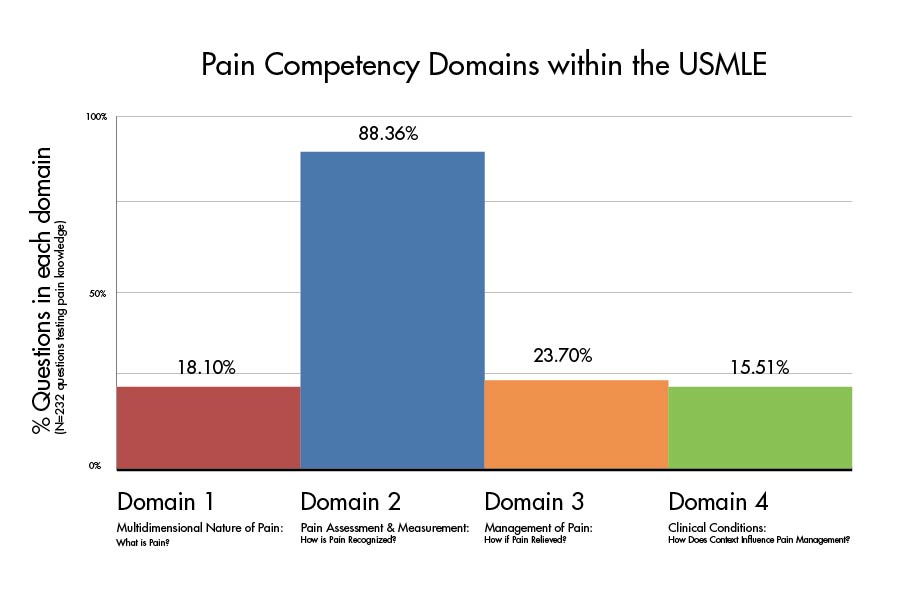
The method of organization they developed at the summit breaks down pain knowledge into four domains: Multidimensional Nature of Pain: What is Pain?; Pain Assessment and Measurement: How is Pain Recognized?; Management of Pain: How is Pain Relieved? and Clinical Conditions: How does context influence pain management? Each domain is then broken down into more specific competencies.

The 2018 analysis of pain-related questions on the USMLE used these core competencies to organize and keep track of where the exam’s questions were focused. After a group of raters in secure conditions reviewed 1,506 questions from four randomly selected exams, it was discovered that 28.7 percent of the questions included the word “pain.”

“At first I thought there would be fewer questions related to pain,” Young said. “For roughly a third of the questions to involve pain is quite significant. It was nice that pain was there, but what stunned me was the fact that almost 90 percent of the questions only focussed on assessing and recognizing pain rather than on managing it.”

The results showed that 88.4 percent of the pain-related questions fit into Domain 2, focusing on how pain is recognized, with only the remaining 11.6 percent of the questions focusing on the treatment, context and nature of pain.

“We discovered that pain was all over the test, but largely as a descriptor,” Fishman said. “The test reflects the bigger problem. We raised awareness about pain and taught doctors to recognize pain but not how to safely treat it.”

Both Fishman and Young said that that they were pleased to have been granted access to the usually confidential exam forms. Fishman added that he hopes the findings will help to catalyze tangible change in pain education, starting with changes to the USMLE.

“This study is really the first of its kind,” Fishman said. “The test has committee after committee looking at it and modifying it every year, but has never had an outside group. I’m sure that the USMLE will be revised based on our findings.”

The USMLE is produced by the National Board of Medical Examiners, based in Philadelphia. The NBME’s interim communications director Luise Moskowitz discussed the process of how the exam is written and annually reviewed in committees composed of hundreds of scientists, physicians and medical educators from across the globe.

“All ‘item writers,’ as they are called, receive item writing training by NBME before they do work as part of a committee,” Moskowitz said. “The questions are vetted again by an internal review committee, made up of content experts who are also among our most experienced item writers, before being finally approved for inclusion on the USMLE. Existing questions are also regularly reviewed to make sure they are still relevant and accurate.”

Moskowitz also noted that she thinks the UC Davis study will cause some changes to be made in how the test deals with pain.

“As for the [Fishman 2018] pain management study specifically, recommendations were generally favorably received and most of the topics they recommended will be incorporated into future item writing assignments,” Moskowitz said.

Despite the thorough and rigorous USMLE question writing and review process, outside researchers were able to make discoveries about the content of the test of which the NBME was not previously aware.

Fishman’s 2018 study operates under the premise that identifying areas in which the competency level demanded of medical students is lacking is an effective way to tackle the opioid crisis. Young said that she is surprised at how frequently people are quick to simply identify opioids themselves as the biggest part of the problem without looking further “upstream” at other factors, like how medical students are conditioned to conceptualize, recognize and manage pain.

Young acknowledged that even with reforming pain curricula to better reflect the core competencies, there are still additional challenges that can make it difficult to solve the opioid epidemic.

“Big pharma has had a lot of power over the years with so much marketing to doctors and patients,” Young said. “I think people deserve to have knowledge about possible medications, but I think it’s an industry that clearly needs to be looked at every step of the way.”

Young also explained that not every patient’s pain is best treated with pharmaceuticals.

“Sometimes people will think that medications are the only things that can help them, but we are now seeing the benefits of other forms of treatment, like biofeedback therapy,” Young said. “Pain gets in the way of people being able to do their daily life. Often, people who are in a lot of pain are also quite depressed and [pain and depression] can feed each other, so it can be difficult to know which one to target.”

From speaking with her coworkers, Young has learned that it can be difficult for physicians to properly identify and treat patients.

“I know from colleagues that it is very frustrating when you see someone in pain and you don’t have the tools to help them,” Young said. “Pain tends to slip through the cracks. Knowing how to deal with people who are in pain is so important because almost half of the people who come to a hospital emergency room are there because of pain.”

Young discussed some of the solutions that she hopes will help tackle the problems associated with poor pain education.

“We’ve been developing learning activities to practice working with a team and doing assessments and develop a strategy to manage the pain,” Young said. “For example, there are situations when patient’s pain may be better addressed if the issue is also brought to a psychologist.”

Young also explained how consulting with specialists in other areas has had many benefits in the process of developing better guidelines for teaching pain competency.

“We have had help from people from the vet school to better understand non-verbal communication,” Young said. “This can be crucial with patients who have trouble communicating the nature of their pain, like with people with dementia.”

Allowing medical professionals with different areas of specialization has been an effective way to address existing knowledge gaps. Dr. David Copenhaver, the director of cancer pain management at UC Davis, facilitates Project ECHO (Extension for Community Health Care Outcomes). For a little over four years, this program has been conducting video mentoring sessions every week, connecting with about 30 clinics across northern California.

“Project ECHO is a program originally out of University of New Mexico,” Copenhaver said. “A physician who was a liver specialist there essentially wanted to work himself out of a job, so he developed a telementoring program to teach others what he knows.”

The idea of “working oneself out of a job” reflects the goal of the program, which is to increase the number of people with specific competencies.

“This study on the USMLE validates the idea that there is awareness of pain, but that we never taught anybody how to treat it,” Copenhaver said. “Most medical schools currently devote little time to pain medicine in early years of medical school. This changes the landscape because you can offer better access and more care [and] teach other people to become pain experts.”

Copenhaver explained why he thinks it’s so important for people to be more knowledgeable about pain in order to avoid over-prescribing pain medications.

“In addressing the opioid crisis, one of the things frequently suggested is to just prescribe morphine products more responsibly, but this often translates to just not prescribing it at all, leaving patients without a solution for treating their pain,” Copenhaver said.

In order to avoid these situations and to ensure that the next generation of medical professionals becomes proficient in the core pain competencies, Fishman and Young think that there must be top-down rather than bottom-up change. They expressed their thoughts on driving change in pain education by co-writing a journal article on the topic in 2016.

“Testing competency in pain management is not part of the fundamental examinations required by state agencies for the licensure of health professionals,” Fishman and Young wrote.

Because of this fact, Fishman and Young argue that more educational institutions and medical bodies need to endorse and adopt their core competencies so that they can be enforced from the top down.

“If the external bodies that regulate and direct curricular requirements of professional health schools adopt these goals, then they will be integrated into the curriculum at each health science education institution,” Fishman and Young wrote.

They also argue that there must be some form of accountability to ensure that medical students meet the pain competencies.

“Schools must know that graduates without competency in pain management will struggle to pass their boards and become licensed professionals, as well as jeopardize accreditation for their program or institution,” Fishman and Young wrote. “Individual schools or programs will design their own educational content, training methodologies, and assessment methods as they strive for institutional accreditation, and individual certification and licensure of their graduates.”

Fishman, Young and Copenhaver all made it clear that they think pain is not a topic that can simply be taught thoroughly in a course or two; it needs to be taught alongside all other subject areas.

“It’s about making sure pain is spread across the curriculum,” Young said. “Pain presents different challenges in different contexts.”


Written by: Benjamin Porter — features@theaggie.org

Rachael McKinney appointed new CEO of Sutter Davis Hospital

0
IAN JONES / AGGIE

New leadership, health care experience at Sutter Davis

Sutter Davis Hospital recently announced a new CEO, Rachael McKinney, who assumed the position on Nov. 27. McKinney replaced Jennifer Maher, who was the CEO of Sutter Davis since 2014 and was recently named CEO at Sutter Roseville Medical Center.

McKinney is a fellow of the American College of Healthcare Executives and has had experience in both leadership and healthcare. She was the chief operating officer for VEP Healthcare and served as the regional executive for neurosciences at Sutter Health’s Sacramento Sierra Region leadership team for four years. During her time there, she was involved in the design and implementation of construction projects as well as raising philanthropic donations to improve the care of the patients.

“I think anybody that comes into Sutter Davis Hospital is coming to a unique situation where they have a great, strong culture and a lot of great services that are offered to the community, so I think it’s going to be a positive change,” said Angela Borchert, the communications coordinator at Sutter Health Davis. “Jen Maher was a well-respected leader, and Rachael has stepped in and already has done a great job in the short time that she’s been there. I think it’s going to be seamless, and I think she’s going to fit right in.”

In 2013, Sutter Davis Hospital received the Malcolm Baldrige National Quality Award, the nation’s highest Presidential honor for “performance excellence through innovation, improvement and visionary leadership.”

“We are excited that Rachael has decided to return to Sutter Health to lead the highly engaged team at Sutter Davis Hospital,” said Grant Davies, the CEO of Sutter Health Valley Area Hospitals. “She will fit right in, and we have all the confidence that Sutter Davis will continue to be the high-achieving hospital that it is under her leadership.”

McKinney’s experience also extends to her contributions to the Sacramento area, where she currently resides, as she has been involved in and led community and professional organizations. Her educational background includes a bachelor’s degree from Gustavus Adolphus College in Minnesota and a master’s degree in health care administration from the University of Minnesota.

“McKinney is a dedicated leader who has a strong understanding of the healthcare market,” said Sutter Davis Hospital in a press release. “She is a champion of community based health care and devoted to delivering care at the highest level.”


Written By: Hadya Amin — city@theaggie.org

Revamping Sacramento International Airport

0
ALLYSON KO / AGGIE

Sacramento International Airport pushes for new lounges, incentives for nonstop airlines

Sacramento International Airport will be revamping its programs and facilities, procuring new lounges and incentives for nonstop airlines to provide flights to destinations like Europe. Since the Board of Supervisors approved the incentive program on Jan. 9 for its 2018 agenda, the airport is pushing to provide more beneficial services to travelers.

Laurie Slothower, an airport spokeswoman, mentioned that the airport has been looking for new ways to provide and improve its programs. Ever since 2003, the airport has had an incentive program to add enhanced-landing fee waivers that are up to $400,000 in marketing support for international flights.

“Sacramento International Airport is continually advocating for new destinations, new carriers and additional carriers into markets where only one airline flies,” Slothower said in an email interview. “Offering economic incentives and marketing support to make new routes successful is one way to do it.”

Seth Kaplan, a managing partner of Airline Weekly, explained how nonstop flights would be appealing for businesses.

“For businesses, in particular, there is an ease of doing business that goes along with having a nonstop flight,” Kaplan said. “Time is money for businesses — if they’re able to fly directly to a city in Europe, they’re going to find it a lot more attractive. They’re more price-sensitive for a nonstop flight, rather than a connecting flight, rather than connecting somewhere or driving to San Francisco or Oakland for a nonstop flight. That’s a huge benefit.”

According to Sacramento Business Journal, John Wheat, the county’s airport director, stated that low-cost carriers like Condor and Norwegian Air Shuttle are planning to expand their flights.

“We’ve seen that growth mount in the last year and a half, and they’re also coming into secondary cities like Sacramento,” Wheat said.

The airport is considering a wide range of opportunities.

“It’s not just Europe: There are enhanced incentives for intra-California domestic routes, too,” Slothower said in an email interview. “Our customers have requested transatlantic and transpacific service. When we see an opportunity, we do our best to make a business case for it with the airlines.”

Air service development is able to gain profit by gaining traction for different airlines.

“Waiving landing fees is not enough to get an airline to offer service if they aren’t enough passengers willing to buy tickets on a regular basis,” Slothower said.

Kaplan described the logistics of the airport providing international flights.

“They have to make the case convincingly using data,” Kaplan said. “It’s typically what airports do. Airlines do their own analysis but airports will help them understand more about the community, like the kinds of local businesses that would use the new flight, [such as] a particular company that travels a lot to Europe, let’s say. They’ll try to educate the airlines about that from the perspective of the airport.”

In addition to pushing for nonstop flights, the airport is currently looking for developers to implement new lounges. The deadline for submissions is March 16.

“If a developer or developers apply, proposals go through an independent evaluation and selection process which concludes when the selected proposal is approved by the Sacramento County Board of Supervisors, most likely in summer 2018,” Slothower said. “It is unknown when the facility would be completed.”

Slothower added that airline lounges could be beneficial to the airport.

“An airline lounge could offer a variety of services: complimentary food and beverages; a private bar; a quiet area to for business travelers to work; comfy sofas and chairs,” Slothower said in an email interview. “Any passenger can use it if they pay the fee. It is up to the developer to select a menu of services and the fee.”

The new lounges and destinations could also offer new travel amenities to customers.

“Many customers tell us they would rather fly out of Sacramento International Airport than competing airports, because Sacramento International Airport is so easy to use,” Slothower said in an email interview. “We hope to increase the number of passengers flying out of Sacramento International Airport, offer customers more destinations to fly to, and surprise and delight customers with the services offered by a new common-use lounge.”

According to the air service proposal, which was approved Jan. 9, the airport considered the customers’ best interests.


Written by: Stella Tran — city@theaggie.org

“Coco” Offers Accurate Exploration of Culture

CHRISTIE NEO / AGGIE

Disney got it right for the Mexican community

As children, we are often blind to the cruel realities of the world and how they shape our lives. The underrepresentation of diverse stories in the entertainment industry and, in general, the lack of diversity across other media platforms, is one such reality.

Until more recently, I didn’t realize such underrepresentation contributed to the my dislike of my brown skin, the language my family spoke or the inerasable culture my roots were grounded in. Comparatively, it might not seem so cruel. However, it breeds not only false expectations about who we will interact with but also — especially for people of color — an inescapable feeling of degradation. The critically acclaimed, spirited and endearing Pixar animated film “Coco” helps alter these typically white narratives.

“Coco” follows Miguel, a young boy conflicted by his love of music and his family’s deep aversion to anything remotely related to music. He aspires to follow in the footsteps of his idol and become a successful musician, too, ending up in the Land of the Dead during the celebration of Day of the Dead to prove himself and uncover his family’s history. Miguel is misguided and doesn’t realize what his kin already know and try to push: the ultimate importance of strong familial relationships over individual pursuits, which take away from that.

The movie has been applauded for its stunning visuals, particularly for scenes of the Land of the Dead, but this is to be expected of a Pixar film. What really captured me was the less outwardly vibrant but just as detailed scenes set in the fictional town of Santa Cecilia, Mexico. It brought me back to when I, too, would run through the streets of a small Mexican town like Miguel during summer visits to my family’s city. From the tamales to the cobbled roads to the zapateria to el jardin, “Coco” stayed true to its country of inspiration.

Elena, Miguel’s eccentric grandmother, is a source of laughs. She is the overbearing, extra-loving grandma many can relate to, but she also embodies attributes of a stereotypical Mexican grandmother, making her especially poignant to members of the broader Latinx community. For example, she uses her chancla (sandal) as a weapon. If you offend grandma by not eating all the food she puts on your plate, beware of a flying chancla headed your way.

The enchanting music magnified by the theater’s speakers and the magical imagery on screen made me want to get up from my seat and dance throughout the film. It was delightful just to hear the correct pronunciation of Spanish words and the slight, natural accents the characters held when speaking English. This can be attributed to the all-Latinx cast and, again, demonstrates the crew’s commitment to staying true to culture.

The storyline teaches the audience about the Mexican holiday, the Day of the Dead, while neatly balancing topics of family, heritage, life and death. This combined with the animation quality, music, attention to detail and inherent liveliness of Pixar productions makes “Coco” an uplifting breath of fresh air in a heavy world atmosphere.

But it’s quite possible, however, that the greatest gift “Coco” has to offer the Mexican, Mexican-American and Latinx communities, is the accurate portrayal of our community and lives — more than most films have offered us. In this way, our people get to bask in a glamorous light we have not often had the opportunity to experience and to expand our culture to a broader, more visible dimension.


Written by: Cecilia Morales — arts@theaggie.org

Director of Counseling and Psychological Services terminated after raising concerns about allocation of mental health funds

DIANA LI / AGGIE FILE

Sarah Hahn said she was threatened, intimidated, told not to talk to UCOP

On Feb. 9, 2018, Sarah Hahn, the director of Counseling and Psychological Services, was made aware that Margaret Walter, the director of Student Health and Wellness, intended to terminate her from her position. Hahn was presented with a letter from Walter stating that her termination would be effective on Feb. 23. Until that date, Hahn has been placed on paid administrative leave.

The letter comes on the heels of mounting criticism and concern expressed by Hahn to both her superiors and administrators at UC Davis, as well as officials from the UC Office of the President, that an increase in student fees for the ongoing $18 million mental health initiative from UCOP was not spent to hire 12 additional counselors at UC Davis, as the money was intended to do. A recent investigation published by The Aggie confirms that UC Davis has not hired an additional 12 counselors and that a portion of the money was not spent as it was meant to be.

“You have failed to demonstrate the professionalism, tact and diplomacy required of your position,” Walter stated in the letter. “This intended action is in response to serious and substantial deficiencies in the execution of your duties, namely your failure to provide effective leadership to Counseling Services. This is evidenced by your failure to provide the expected and necessary level of administrative oversight, an inability to support a positive team environment, and a lack of proficiency in college mental health service delivery.”

Hahn has served as director of Counseling and Psychological Services since 2013.

The letter was delivered one day after Hahn filed an official Whistleblower Retaliation Report — which protects those who have come forward with concerns of improper governmental activity and feel they are being targeted for doing so — with the Office of Campus Compliance. Hahn said she filed the report after learning “that an HR investigation” which targeted her “was being conducted in a manner, and at a time which [she feels to be] consistent with possible retaliation against [her] for protected disclosures.”

I was concerned that I had been retaliated against for reporting issues related to the limited number of counselors in Counseling Services,” Hahn said via email. “I was concerned that I would be terminated as a result of these disclosures. I had expressed, multiple times, that Counseling Services was not growing its staff as we should be, given the new Mental Health Fee which is specifically earmarked to hire new counselors. When I have brought up such concerns I often felt intimidated.”

Hahn said she was unsure as to why she was given the letter on Feb. 9, but then remembered a Management Corrective Action outlined in a recent internal audit of UC Davis Counseling Services performed in late 2017. The action states that SHCS will consult with Budget and Institutional Analysis “to determine a level of access to, or specific original output from financial systems that is appropriate to the Counseling Services Director’s responsibilities.” Hahn would have been granted access to financial information on Feb. 15 — six days after she received notice of her termination.

In response to news regarding the intent to terminate Hahn, the Facebook page “Stealing From Students: Our Mental Health Matters” stated that Hahn “had been in contact with students about the 12 missing counselors and advocating to upper administration for transparency regarding the lack of promised hires.” The post received close to 120 shares and around 100 likes and reactions.

“When I inquired about the status of counselor hirings in late 2016, Sarah Hahn reiterated that she would do her best to find all necessary information and advocate for the counselors students had already paid for with our fees,” said Samantha Chiang, a fourth-year English major and the director of the UC Davis Mental Health Initiative. “Now knowing that the other administrators in Student Health had been deceiving us all along, I’m not surprised in the slightest that they have chosen to silence Sarah and make her the scapegoat for all of their appalling errors.”

Recently, on Feb. 13, a Mental Health Town Hall was held by SHCS to discuss UC Davis mental health and was attended by around 200 students, faculty and community members. During the hour-long audience Q&A, Katrina Manrique, a fourth-year English major, asked the panel of administrators, including Walter, about the termination of Sarah Hahn.

“[Hahn] has been a consistent advocate for the 12 missing counselors,” Manrique said. “And now that that audit has been released and she has filed for whistleblower protection, she has been fired. Many students have expressed immense displeasure in this decision. You made it very clear that you all want to work with students, but how can you all take away the one person who’s advocated for our demands? We don’t want apologies, we want answers.”

Manrique’s comment was met with loud cheers and snaps from the audience, and a chant of “shame, shame on you, shame on you, Margaret” from one audience member.

“We want to be accountable to you,” Walter stated in response to the comment. “It breaks my heart you thought you had one contact, I want to be a good contact to you. We can’t comment on any confidential personnel issues related to what you just mentioned, but we all want to be contacts for you and advocates for you.”

Chiang then responded that Hahn was “the one who didn’t lie to our face about counselors being hired.” At the end of the event, there were chants of “bring back Sarah” from multiple students in attendance.

In the chronology of events Hahn provided to Chief Compliance Officer Wendi Delmendo as well as The Aggie, she stated that she expressed “concerns that earlier financial agreements were not being met, that some decisions about Counseling had been made” without her knowledge and “that there was a lack of transparency” with her administrative supervisors, including current Assistant Vice Chancellor for Divisional Resources of Student Affairs Cory Vu in an email in January of 2017.

According to Hahn’s chronology, in April of 2017, she emailed Vice Chancellor of Student Affairs Adela de la Torre after letting Vu know she would be doing so, to remind de la Torre that “as she knew, the Regents had agreed to raise student fees to support hiring 85 mental health clinicians systemwide, growing the counseling center’s clinical staff by 43 percent.” Hahn said she told de la Torre that “by next year, the UCD Counseling Service will only have increased by one counselor over a three year period. The one additional counselor is due to externally funded satellite positions. There is no increase in counselors which is attributable to new funds.”

Three hours after she sent this email, Hahn said Vu contacted her telling her “not to communicate” her “concerns to UCOP.”

A meeting was held in May with Hahn, Vu and other UC Davis officials. Hahn shared an email she received from Vu in May of 2017 with The Aggie. In it, Vu referenced this meeting, held to discuss Hahn’s “concerns about Counseling Services’ (CS) funding and staffing levels.” Vu then outlined the expectations he required of Hahn.

“Follow the chain of command protocol when you need consultation or to address some other matter such as a complaint,” Vu stated in the email from May of 2017. “Comply with the Vice Chancellor of Student Affairs’, Associate Vice Chancellor’s , and Executive Director of Student Health and Counseling Services’ requests, instructions, or directives. Stand behind the campus’, division’s, and organization’s decisions and work ardently toward their realization, even if you would have chosen a different direction.”

In her statement to The Aggie about the letter, Hahn said she “was accused of violating communications protocols/procedures (inaccurately), or making others uncomfortable with the information.”

There seemed to be no way to make queries about financial matters related to the Mental Health Fees that was not met with criticism,” Hahn said. “But it was my job to be a steward of allocated Mental Health funds; I did not of course have the option to ignore this responsibility.”

In an email to Vu and former Associate Vice Chancellor of Divisional Resources John Campbell — the position Vu currently serves in — Hahn discussed her inability to obtain financial data.

Despite the fact that I am the Director of the Counseling Services and a member of the Executive Team and the Governing Body, I have not been able to successfully obtain clarifying financial data about my area,” Hahn said. “Such requests have yielded the response, for years, that I am not being a team player or am not fostering good relationships with my colleagues, which I have been told is a performance issue. This had effectively shut down my ability to get information for the past 3.5 years out of fears that my job will be threatened. Just yesterday I was told that my questions about finances was creating a divide in our organization. I find these comments threatening. I find them to be an indication, again, that requests for financial clarity will be used against me.”

Hahn said she believes the May meeting with Vu “was an effort to intimidate” her “into silence and be part of a cover up.”

“I was told that concerns had been raised that I was talking to CS staff regarding budgetary issues and my concern about lack of growth in our counseling department,” Hahn said in her whistleblower chronology. “I was told that my communication about these matters was a professionalism issue and had to stop immediately. I was told that I was insulting members of the Budget staff by asking questions, and upsetting the HR manager when I asked about delayed hires.”

In June of 2017, Hahn said she received a below-average yearly evaluation from Vu.

“I indicated to Cory [Vu] that it was not appropriate that he downgrade me, because my performance only became problematic in his eyes once I reported concerns about how the monies were being spent,” Hahn said. “My performance had not changed in any way since before I reported concerns. He cited my relationships with HR and the Administrative Director of SHCS. I indicated that my communications with the HR department were in the context of asking them to initiating hires as we were expected to, and my communications with the Administrative Director and team was related to raising concerns about funding. My downgraded performance was clearly causal to retaliation for my asking appropriate questions and concerns about stalled hires and lack of clarity about funds.”

In June, Margaret Walter was hired as the new UC Davis director of Health and Wellness, replacing Vu in directly overseeing Student Health and Counseling Services. Hahn said she sent an email response to university and UCOP officials stating that “it was hard to ascertain if we were receiving the funds.” Later in June, Hahn said Walter referred to the email as unprofessional, perpetuating what Hahn says is “representative of a pattern” that if she discussed the mental health fund, she was accused of unprofessionalism. Walter cites Hahn’s professionalism issues in the intent of termination letter.

One of the findings of the audit showed a low number of clinical sessions per day per counselor. Counseling psychologists have expressed concerns with the numbers published.

In October of 2017, Hahn said the findings of the audit concerning low productivity data were discussed. According to Hahn, there was an agreement that “counseling should not be allowed to hire more counselors until this matter was looked into.” Hahn said she was not in support of this agreement.

“I explained again that delay was not an option, and the funds are not set up to be held back by campuses,” Hahn said. “That is not the initiative. There was agreement around the table (not by me) that there was neither a mandate by UCOP nor a mandate from the Provost to follow [UCOP’s] recommendation.”

Hahn sent an email to UCOP officials in November of 2017.

“We need outside help; it is apparent [to] me that, at this point, it will take a VERY clear and powerful voice to reverse the current,” Hahn said she stated in her email to UCOP. “There needs to be unequivocal clarity that current, future, and past MH Fees need to be allocated to Counseling, without condition or delay, in order to immediately hire licensed clinicians to serve the students. I think this would need to be communicated at all levels of leadership on our campus.”

In December, Hahn said she asked Walter whether productivity was an area of improvement, but Walter said “‘not to worry about it.’” Hahn said she was worried because productivity would be in her yearly evaluation and said she felt she “was being threatened without being given information or opportunity.”

Walter did mention productivity issues in her letter of intent to terminate, stating that “clinical productivity has been alarmingly low for several years under your leadership.” Walter also stated that Hahn had “described the productivity data in the audit as ‘inherently flawed.’”

Katie Fuller, the UC Davis Human Resources manager, Vu and Walter all responded with the same decline to comment — “Unfortunately, I am not permitted to comment on confidential personnel matters.” Vu and Walter also did not respond to any of the aforementioned claims which allegedly involved them.

Hahn said she hopes to be able to “continue to serve” the “amazing students” of UC Davis.

Anyone who is trying to uphold our commitment to the students deserves to be protected from retaliation- not walked out of the office the day after they ask for that protection,” Hahn said. “I have faith that mistakes have been made, and will be quickly corrected. We are better than this.”


Written by: Hannah Holzer — campus@theaggie.org

Counseling Services is failing students

CAITLYN SAMPLEY / AGGIE

Audit finds mismanagement; town hall fails to address student concerns

Student Health and Counseling Services held a town hall on Tuesday, Feb. 13 to discuss mental health at UC Davis. The forum included Executive Director of Health and Wellness Margaret Walter, Assistant Vice Chancellor for Divisional Resources Cory Vu and Director of Multicultural Services for SHCS Paul Kim. Before a question-and-answer session and public comment session that ended in uproar when the panelists gave unsatisfactory answers to students’ questions and demands, Walter announced that the university had made public an internal audit of UC Davis Counseling Services performed in December of 2017.

The university released the internal audit after it was referenced in this paper, posting it online mere hours before the town hall was scheduled in an attempt to regain control of the story.

Perhaps the university seized the chance to reframe the discussion because the audit is pretty damning.

According to the audit, “in January 2016 […] the Provost documented an agreement with the Vice Chancellor for Student Affairs to add 11 new [full-time equivalents] by the end of FY 2017. In response, SHCS hired approximately 10 counselors on a contract basis. […] Only one of the 10 employment contracts was renewed past June 2017.”

The audit found that, among other issues, “Leadership has not articulated a strategic plan for Counseling Services,” “Agreements made with senior leadership for Counseling Services staffing levels have not been accomplished,” “Some current uses of [Mental Health Fee] funds may not be consistent with the rationale for the fee increase” and “Counseling Services’ appointment scheduling policy may present a barrier to some students.”

Simply put, the audit found that Student Health and Counseling Services is failing students.

In response to the shortage of counselors that falls far below the guidelines for clinician to student ratios, Vice Chancellor of Student Affairs Adela de la Torre said, “We don’t necessarily need to hire more counselors.”

Make no mistake — SHCS absolutely needs to hire more counselors. A lack of clinical staff and scheduling problems make it so that students are not getting the help they need and have already paid for. Mental health issues are on the rise among college students, and for them to go untreated because SHCS and the university are mismanaging funds puts students in harm’s way.

Shame on administrative staff at SHCS for throwing clinical professionals — who are underpaid and working with a skeleton crew of unfilled positions in an extremely taxing job — under the bus, attempting to redirect the conversation to clinicians’ “low productivity” rather than the systemic issues plaguing management and administration. Shame on university leadership for letting students’ critical medical care fall by the wayside while administrative bloat consumes the college and student fees continue to rise. Shame on the administrators present at the panel who evaded students’ questions or failed to address their very real concerns in a substantive way.

Students are hurting, deeply, and those tasked with helping them are twiddling their thumbs.


Written by: The Editorial Board

Letter to the Editor: Chancellor May: ICA’s alleged violation of student fee initiatives

CAITLYN SAMPLEY / AGGIE

To the Editor:

Re “Dear Chancellor May — It’s time for ICA to stop playing games with student fees” by Paul Medved (guest opinion, Jan. 30):


I’m a big fan of UC Davis athletics and proud of our student-athletes’ stellar performance, both on the field and in the classroom. Intercollegiate athletics is where we interact most with the public, galvanize our alumni and supporters and burnish our reputation.

Sometimes misconceptions arise that threaten to tarnish our great reputation. When that happens, I need to respond.

A recent guest opinion suggests that our intercollegiate athletics program violates the student fee initiatives that help support it. The piece indicates that the university violated these initiatives when it cut four sports teams in 2010, during the Great Recession, and then mishandled $3 million in student fee revenue.

These are old claims. Missing from the piece is the crucial fact that two well-publicized, independent reviews found these allegations unsupportable. A 2011 investigation of the sports cuts found no misconduct, and a 2016 investigation found no policy violation or management concerns related to use of student initiative fee revenue.

The piece also misrepresented the university’s commitment to Title IX, the federal law that prohibits gender discrimination in schools that receive public funds.  

Every year between 2008 and 2015, the proportion of women and men in our intercollegiate athletics program has closely matched that of our undergraduate population, thus meeting the “substantial proportionality” test of the Title IX athletics regulations. In the recent years, however, the proportion of women in the undergraduate population has risen significantly, from 55 percent in 2012 to 59 percent today.

To adjust for this demographic change, we will add a new varsity women’s team in the 2018-19 academic year. I am excited about this opportunity. The decision on which team to add is still pending. We have a set of FAQs online that details the selection process.

Finally, the piece claims that UC Davis spends more on administering intercollegiate athletics than two of its rival schools combined. I am not sure where this information is derived, but it sure appears to be comparing apples and oranges.

At UC Davis, all of the compliance activity and academic advising for student-athletes is charged on the intercollegiate athletics budget, while many other universities cover these services in their student affairs budget. Our administrative costs encompass far more than administrators’ pay. More than half are for student-athlete services, including sports medicine, academic advising and strength/conditioning training and coaching.

UC Davis has thoroughly addressed and moved beyond the years-old claims revisited in the letter. We are operating in a new era with new leadership, and I have complete confidence in the leaders of our intercollegiate athletics program. They tirelessly support our student-athletes, provide great entertainment for our community and work closely with student leaders to address concerns.

Go Ags!

GARY S. MAY, DAVIS

Gary May is the chancellor of UC Davis.


Disclaimer: The views and opinions expressed by individual columnists belong to the columnists alone and do not necessarily indicate the views and opinions held by The California Aggie.
Humor: The USSR decides to get the gang back together for one last go at the Olympics

CAITLYN SAMPLEY / AGGIE

American Aaron on a mission

Vladimir Putin, wearing compression shorts with the flag of the USSR, lathers himself up in butter and grease as he explains to me what is about to happen.

“You see, when I do the skeleton race, I do not simply ride the skeleton thing. That thing makes it too easy for me. Instead, I lather myself up,” he said, picking up a stick of butter and rubbing it on his chest, “and then I go down the mountain on my body alone.”

Putin then turned from me, ran toward an ice tube and jumped in headfirst, careening down the hill at speeds probably too fast.

“I’m getting the gang back together. It’s been so long,” Putin said at the bottom of the hill, sweating but oddly looking unscathed considering he just went flying down the hill at 60 mph wearing nothing but compression shorts and copious amounts of butter. After he said this, he smiled and blushed, turning away from me, obviously trying to contain how happy he was to have all his friends back together.

He walked away from me up the hill. That was when I pulled out the weapon. I had a job to do, and I had to do it for America.

Putin shouted down from the top of the mountain, “Look at me this time! I’m gonna do a better one!” And I told him I was looking. He then poked his head up from the top of the mountain, and I could barely see his beet-red shiny forehead, and he shouted again “No, but are you REALLY looking?” I again responded yes, and he giggled to himself, a particularly loud giggle I could hear all the way from the bottom. It echoed through the barren Siberian landscape, bouncing back from tall, sharp snowpeaks that passively and disinterestedly looked down, waiting to see what would happen. He was excited to see his friends again, but I had a job to do…


Written by: Aaron Levins — adlevins@ucdavis.edu

(This article is humor and/or satire, and its content is purely fictional. The story and the names of “sources” are fictionalized.)

Achieving a balance between two separate identities

SHEREEN LEE / AGGIE

The exclusion of immigrant parents from their children’s lives creates a significant rift

Growing up, my family friend, an older girl I had always looked up to, imparted upon me the knowledge that we were ABCDs — American-Born Confused Desis.

Desi. Any Indian, Pakistani or Bangladeshi person living abroad can be labeled a Desi, a term with a positive connotation that I’ve identified with my entire life. The Bollywood song “Desi Girl” has played at countless New Year’s Eve parties with the same Indian family friends I’ve known since I was a baby, and I’ve incessantly ranted about the Desi struggles I face to my other brown friends. “Desi” brings vivid memories of Indian culture melded with an American lifestyle to my mind: celebrating every Indian festival as a child, heavily clad in traditional dresses, only to break off from the adults to go play Super Smash Bros. and watch Nickelodeon shows with my friends. It reminds me of visiting New York City, Chicago, Disney World, Lake Tahoe and Yosemite — yet all of those trips pale in comparison to flying back to India to see my relatives. Nothing beats the thrill of meeting my enormous extended family that greets me with all the Indian food I love and takes me to extravagant, week-long Indian weddings where we dance for days on end.

Let’s visit the phrase “American-Born.” I was born in Fremont, Calif. in 1999, and I lived in Fremont until 2017, when I came to Davis. I could not imagine my life without having lived in the U.S, and my American identity is something that is so deeply rooted within me that it shapes my aspirations, goals, lifestyle and choices. Some people have asked me to identify as either American or Indian, but I’m open-minded enough to hold the cultures and values of more than one place in my heart.

Finally, “Confused.” Why is “Confused” used to describe Desis, a large population of people who seem to have it all together?

When I first told my mom I liked a boy, she didn’t react with pure cheerfulness or just unhappy concern. She was overjoyed that I was taking a big step in my life, but she immediately became wary of what my relatives and Desi friends would think if I started dating. Dating before your 20s faces no stigma in the U.S. but is concerning in India, where everyone believed I was too young for that sort of thing. My mother has been an incredibly supportive figure for me throughout my life, and so has my dad, but growing up Desi meant I had to consider both the values of my American identity and my second life back in India.

I recall the many arguments I had with my mother when I was a feisty teenager in high school and self-expression was my first priority. Every time, she worked hard to guarantee that I was happy, but she would not give up the culture she had grown up with her entire life — and I would never want her to. As I’ve grown older, I’ve started to understand how difficult it is to balance two different sets of values.

The U.S. is relatively progressive, and India is getting there, too. Today, my female cousins live very similarly to me — we all make our own choices in college, such as deciding how to have fun and making decisions about our education. They are valued the same as the men they meet, and they have never been treated in a misogynistic way by anyone in our family. However, stigma is still very prevalent in India, especially toward women. There are some individuals who choose to judge women who date, dress a certain way or make any other choices of which the individual doesn’t approve, and the gossip that ensues essentially defames the reputation of the girl.

I see my mother’s perspective. She does much more for my happiness than many other parents I’ve seen — she wants me to live based on only my own choices, but I also shouldn’t tarnish my reputation in our home country by irritating a handful of conservatives who don’t understand or respect the decisions I make.

This spans many different cultures in the United States — immigrant parents are left out of the narrative of the American feminist movement. They were raised through a different culture and made the huge decision to move to a completely different country, and there is no particular formula outlining the acceptance of one country’s culture over the other. This burden falls upon their children, too, and specifically affects young women, who grow up often restricted by the values of their parents’ cultures and religions and feel liberated by American culture.

But that’s doesn’t mean it’s always justifiable to reject one’s upbringing and scorn the advice of experienced parents. It’s up to us as the first generation to understand both sides of the issue. We have the freedom to make choices, but only through communication with our parents can we express our needs as children with two identities. When parents decide to treat a daughter differently than a son — handing out more chores, keeping her from wearing certain clothes or restricting her choices — she should try her best to speak up and communicate with them while rejecting the initial anger she may feel. Sometimes, significant change can come from one conversation.

It’s time we start celebrating our different backgrounds while recognizing them as one hybridized identity. There’s no need to differentiate and alienate the different cultures we come from. Instead of letting a rift form between us and the previous generation, we should try our best to understand the different perspectives and work to create an environment where we can live within our own control while also respecting our rich histories.


Written by: Akshita Gandra — agandra@ucdavis.edu

Disclaimer: The views and opinions expressed by individual columnists belong to the columnists alone and do not necessarily indicate the views and opinions held by The California Aggie.

New era of women’s lacrosse kicks off with close loss to Cal

0
KAILA MATTERA / AGGIE

Suzanne Isidor makes head coaching debut for UC Davis in 11-9 loss

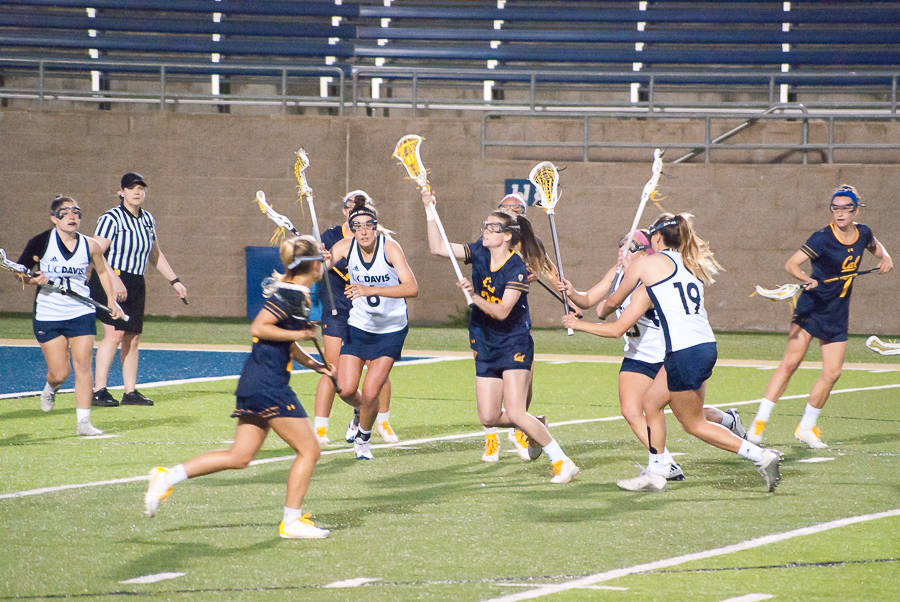
A new era of UC Davis women’s lacrosse began on Friday evening at Aggie Stadium as head coach Suzanne Isidor made her debut as the leader of the Aggies. She is the third head coach of the program in the last six seasons.

On the field, it was a tightly contested, back-and-forth affair for the majority of the evening until visiting California rattled off five consecutive goals midway through the second half, leading to a 11-9 season-opening defeat for UC Davis.

“There were a lot of positives and we did a lot of great things,” Isidor said. “I think we had our opportunities and maybe didn’t capitalize on as many as we should have.”

The Aggies were led by junior midfielder Taylor Cuenin and sophomore attacker Amanda Outcalt, who combined to score all nine of the team’s goals.

“They did a great job,” Isidor said. “They weren’t being stopped, so they had the green light to keep going. Now we need a few more people to step up.”

The game got off to a very physical start, as both teams had a pair of free position attempts in the opening five minutes. The result was a goal for each side, including one from Cuenin, who received a pass in front of the net and quickly fired a shot in traffic to the bottom-right corner.

The Aggies grabbed their first and only lead of the night three minutes later when Outcalt scored on a breakaway to make it 2-1.

California scored two consecutive goals in a span of eight minutes to jump back in front, before Cuenin countered with her second score of the night to tie things up with just over 10 minutes remaining in the first half.

After the Golden Bears scored on a second-chance shot, Cuenin once again netted the equalizer on a quick look in front of the net.  

It was an action-packed final minute of the first half, starting with a California goal on a free position shot and a UC Davis goal by Outcalt on the same exact play. The Golden Bears snatched the lead on a goal right as the buzzer sounded to signal the end of the half, stealing the momentum heading into the break.

Less than four minutes into the second half, Cuenin tied the score at 6-6 with an unassisted goal.

The Golden Bears went on a tear for the next 16 minutes, scoring five unanswered goals to take a commanding 11-6 lead with 10 minutes to go in regulation.

“They would score and gain the momentum, and then we would come down and get a shot, but not capitalize or turn the ball over,” Isidor said. “We couldn’t get that momentum back. Had we put one of those goals in, we would’ve stopped the run but we just couldn’t quite get it going.”

A desperate comeback effort by the Aggies in the final seven minutes came up short, despite a pair of goals from Outcalt and one from Cuenin to cut the deficit to two.

“We’re disappointed that we lost, but it’s over and we’re going to take what we can from it and get better,” Isidor said. “If we can keep getting better each game, then we’ll be successful.”

The Aggies will return to action on Friday afternoon in Eugene, Ore. to take on the Oregon Ducks.


Written by: Brendan Ogburn — sports@theaggie.org

Effects of California’s minimum wage law

1
SHEREEN LEE / AGGIE

UC Davis eatery raises prices in response to minimum wage increase

In January, the minimum wage in California increased from $10.50 per hour to $11 per hour for businesses with 26 or more employees. This change, though it may seem minute, does have significant effects on UC Davis employees.

The CoHo, a well-loved campus dining staple managed by the Associated Students Dining Services, employs over 250 students. Darin Schluep, the food service director of ASDS, projects that because a majority of the Coho employee base is comprised of students, the minimum wage will have a substantial impact on the CoHo’s overall labor operations.

“The new minimum wage has not changed the way the Coho is being operated on a day-to-day basis, but it is impacting our labor cost,” Schluep said in an email. “Because a vast majority of our employees are students, whose pay is directly tied to the minimum wage figure, a $0.50 per hour increase in the minimum wage equals approximately $150,000 more in labor costs over the course of a year.”

The CoHo management team decided early on that it needed to slightly modify the prices on many CoHo products this year in order to reflect the higher minimum wage.

“We adjusted the Coffee House, the CoHo South and BioBrew pricing at the beginning of January to offset the costs of the increased minimum wage,” Schluep said. “This was a fairly across-the-board adjustment, but a few items, such as coffee and tea, were not included in the price increase.”

According to Schleup, the CoHo’s consumer base, which consists of mainly students trying to dine on a tight budget, has responded quite positively to the price increases.

“The customer feedback that has been gathered up to this point has been fairly understanding,” Schluep said. “I think it helps that our prices are still, even with a modest increase, extremely competitive and budget-friendly.”

California’s law is set to raise the minimum wage $1 each year until it progressively reaches a minimum wage of $15 per hour by 2022. In response to this law, Schluep and the CoHo management team expect to institute major changes over the next few years in regards to revenue, pricing and overall efficiency.

We are taking a multi-faceted approach to the increase in minimum wage over the next four years,” Schluep said. “We are not only looking at gradual price increases, but also [at] how we can better maximize efficiency in the kitchen, leverage some of our buying power and take advantage of some labor-saving technology to keep our costs down. We will attempt to balance these opportunities with our guiding principle of employing as many UC Davis students as possible.”

Kelli O’Day, a production manager and sustainability coordinator for the Associated Student Dining Services, believes that CoHo products are still reasonably priced despite the minor price increases.

“All of the CoHo products are still fairly priced, especially compared to other food operations on campus,” O’Day said. “The management team considered the heavy impact of price changes on students and put a lot of thought into which items would increase. You’ll notice that we only increased items that were necessary and opted to keep our drip coffee the same price.”

Some students, however, disagree with this sentiment. Jacqueline Allen, a fourth-year psychology major, argues that the price increases can and will have detrimental effects on students who are barely getting by as it is.

“I think that we’re all struggling college students for the most part, so I don’t necessarily think it’s fair to increase prices when a lot of us are going off a limited income,” Allen said.

Allen said that if future price increases become too taxing, she will have no choice but to turn to dining alternatives.

“The [price increases] are definitely discouraging,” Allen said. “I might have to find options elsewhere if it starts to impact me financially.”


Written by: Emily Nguyen — features@theaggie.org


Preview: “Pippin, The Musical”

AUTUMN WARD / COURTESY

Broadway classic comes to Davis with modern twist

The Broadway classic “Pippin, the Musical” is coming to UC Davis starting Feb. 22 through the Department of Theater and Dance, telling the famous story of a man in search of his identity. But it’s coming with a twist.

“Pippin usually takes places in the Holy Roman Empire, but this one takes place today,” said director and choreographer Mindy Cooper.

Cooper had the idea to adapt the play after using “Pippin, The Musical” as an example in a class. The original production, directed and choreographed by Bob Fosse in 1972, was later revived in Broadway with a circus setting. Cooper based the show off this revival, but has added a political twist.

“I realized that one of the main characters is a tyrannical leader, power-hungry, doesn’t care about people and is much more into wealth and power than humanity — rings a bell,” Cooper said. “I realized I wanted to do Pippin but to explore the political environment we are in today. I have realized within the last year that our politics is the best theater we have going right now.”

However, to accomplish her own change in setting, Cooper only changed one line in the script to incorporate a modern-day headline. The characters from the original script speak for themselves.

“We’re not impersonating Trump,” said Charlie Lavaroni, a second-year English and theater double major who plays Pippin. “We have someone who is playing Charlemagne who is like the Trump figure. It’s not impersonations, but we are pulling from this cultural iconography and symbols and mixing that into the story.”

Cook also made sure to add another more modern and progressive directorial decision.

“I have found out how heteronormative the play is,” Cook said. “I know how forward-thinking UC Davis is, and it was created at a time where men put women on pedestals, so I have played that down a lot and tried to make it a little more equal, especially the love story. What’s written I can’t change, but I can change how they are equals in the relationship.”

Even with the changes to the original setting of the production, the main themes have remained the same.

“Pippin is basically, to put it simply, the story of a young man’s journey into adulthood and finding himself,” Lavaroni said. “It’s an anecdotal tale, so he goes along different paths along the way and learns different lessons and by the end he learns that it’s okay to settle, it’s okay to find happiness in a contained space. It’s about the dangers of this grandiose exceptionality that we all face.”

These themes become especially applicable within the college setting.

“One of my close friends is going through that same crisis of what do ‘I do with my life,’ and we all manifest this in different ways or even suppress it,” Lavaroni said. “It’s really interesting as an actor to be going along with the journey of this character, kinda learning from him and his lessons.”

The fact that it’s a musical production assists in conveying such concepts through its design — there is significance in the emotional juxtaposition, the heaviness of emotion under the flair of song and dance. Cook explained it this way: Musicals sing what you can’t speak.

“Bob Fosse musicals always have a spin of darkness in them,” Lavaroni said. “The song and dance is often used as tools for acknowledging the superficiality of the political world. It’s definitely ironic. I think musicals are in their inherent state frivolous, but there is this heightened reality that brings truth to musical theater.”

Such a play has its inherent challenges within the script that the actors and director need to be aware of.

“It’s a big cast, and there is only one of me,” Cook said. “I am both the director and choreographer, and I’ve done this a lot before, but I usually have more time. There is never enough time. We rehearse from 6 to 10 p.m., but I get them at the worst time since they all have so much going on, so you have to cheerlead a little.”

In addition, the script calls for a young boy to play Theo, Catherine’s son. While this could have been viewed as a dilemma in a college setting, the role has been filled by Django Nachmanoff, a 10-year-old boy from Davis.

“I get to go into a world that’s not my own and I get to find myself in someone else,” Nachmanoff said. “I love getting parts and finding out what’s realistic from this part to myself.”

According to Lavaroni and Cook, Nachmanoff has been an asset to the production.

“We put a casting notice out into the community […] and the beauty about Django is that I just knew,” Cook said. “He is wicked smart and loves the theater. I do this table work at the beginning of a process where we talk about the piece and take it apart and ask a lot of questions. I ask them to be smart actors, to bring questions and comments. And every day the first hand that was up was Django’s, and he always had something smart to say and interesting questions.”

Django, too, seems to be learning from the production as much as it benefits from him.

“I’m a man of one emotion,” Nachmanoff said. “When I feel an emotion it is usually a superlative emotion; I’m feeling either really happy or really sad. In this character, he is a mix of emotions in some scenes so I have to practice mixing my emotions into the different parts of my body and facial expressions and body language. I’m going to take away that there is nothing to be afraid of in theater. Face your fears and follow what you really want and delete the obstacles.”

“Pippin, The Musical” will be playing in Wright Hall Main Theater Feb. 22 to 24 and March 1 to 3 at 7 p.m. and on Feb. 24 and March 3 at 2 p.m. Tickets can be purchased on the Davis Department of Theater and Dance website.


Written by: Caroline Rutten — arts@theaggie.org

Sacramento area museums hold annual Museum Day

0
JAMIE CHEN / AGGIE

Free or discounted admission for all ages

Over two dozen Sacramento area museums offered free or discounted admission for the city’s annual Museum Day on Feb. 3.

The event was coordinated by Sacramento Area Museums and Visit Sacramento. The event was sponsored by Sutter Health and California Family Fitness. FOX40 and Studio40 Live, KSEG 96.9 FM, 106.5FM The End, Outword Media and Sacramento365 provided media coverage of the event.

“Our continuing goal for Museum Day is to introduce the community to the amazing array of arts, culture and museum offerings available in the greater Sacramento region,” said Sacramento Area Museums chair Lynda Walls.

Sacramento Area Museum officials warned the public about how busy they expected the day to be, but some left disappointed about the crowds.

“I’d rather just pay admission tomorrow and beat the crowds,” said Julie Aguiar, a Sacramento resident and Museum Day visitor. “I didn’t realize how crowded it was going to be.”

Some destinations offered special exhibits and activities. Sacramento History Museum offered an interactive gold-panning activity for kids. Powerhouse Science Center Discovery Campus guests experimented with some of the hands-on engineering design activities offered in Design Lab and saw live critters and insects up close in the Nature Discovery Area.

“I went to the Crocker Art Museum in Sacramento,” said Fran Keller, a professor of biology and zoology at Folsom Lake College and a Davis resident. “I stared at art for over three hours — brush strokes, paintings — so wonderful. But what excited me most [were] these dishes from 1740 with beetles and other insects on them.”

Several local restaurants, such as The Firehouse Restaurant, Ten22 and Steamers Bakery and Cafe, offered guests with a Museum Day sticker a discount of up to 25 percent off their bill.

Sacramento Regional Transit offered free rides on all buses and light rail trains for those with a SacRT Museum Day flyer.

“I wish museums were free every day,” said Danielle Bond, a Marysville resident. “I think it’d really good for community education. It’s disappointing museums are only available to those with a disposable income.”

Some venues, such as the Sacramento Zoo and Fairytale Town in Land Park, offered half-price admission rather than free admission due to their proximity to residential neighborhoods and the need to offset parking costs.

Regular admission can be upward of $10 for popular museums such as the Crocker and the California State Railroad Museum. Most museums regularly offer discounts for students, children, military and seniors.

Officials estimated 68,469 people attended Museum Day this year, with the most-attended locations being the California State Railroad Museum, Aerospace Museum of California and the Sacramento Zoo. In 2017, officials estimated 43,262 people attended the event. In 2009, Museum Day attracted more than 80,000 visitors, the most ever.

Sacramento’s Museum Day convenes annually on the first Saturday of February.


Written by: Dylan Svoboda — city@theaggie.org