55.4 F
Davis

Davis, California

Sunday, December 21, 2025
Home Blog Page 576

Local protesters attend public comment

ANH-TRAM BUI / AGGIE

‘Justice for the Picnic Day 5’ organizers make voices heard

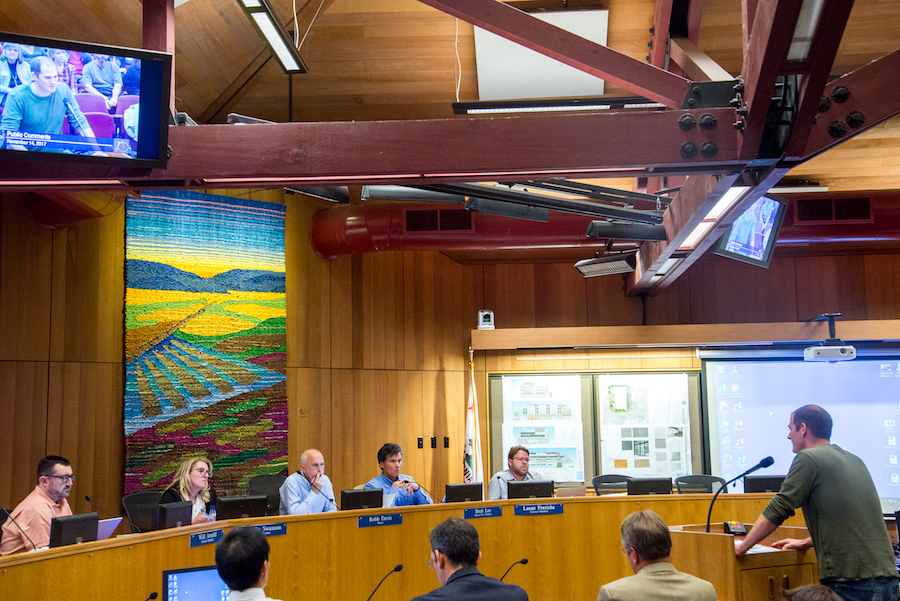
On Nov. 14, the Davis City Council held its bi-weekly public comment session along with their general meeting. Among attendees at the comment session were the “Justice for the Picnic Day 5” movement, a protest group dedicated to defending the five men and women who were charged with felony assault of an officer after a fight that occurred on Picnic Day this past April. Several citizens attended the meeting, with 11 taking turns standing behind the podium to speak to the council.

“Maybe six months from now — or a year from now — we could have a system that could prevent incidents like this,” said William Kelly, a local activist, during the public comment session. “But what are you going to do about what’s happening right now? Paid consultants and independent investigators are a useful tool, but you are elected to govern.”

The brawl took place on Apr. 22, leaving two plainclothes officers injured. All five of the accused, ranging in age from 19 to 22, took a plea deal in September to avoid jail time and were forced to take part in a restorative justice program as a part of the plea.

“The issue of trust between the police and the community is very important to me,” said Joshua Gonzalez, a UC Davis law student and supporter of the movement. “It’s a really strong indicator of the health of the community.”

City Council and the Davis Police Department have taken measures to manage the police oversight issue such as hiring police oversight consultants.

“The city council has hired these consultants so that they can figure out what the best oversight plan is for the city,” said Stephanie Parreira, an organizer and spokeswoman for the Justice movement. “So because they’re trying to slowly work toward this oversight body that will eventually exist, they think they don’t need to do anything about these officers and they think they don’t need to do anything about picnic.”

The city council has hired paid consultants and independent investigators to assist in monitoring and adjusting the police department as needed, and has also been working on a police oversight plan. The California Aggie reached out to Davis Police Chief Darren Pytel to comment on these plans but did not receive a response.

“I don’t think this is the first instance of this kind of thing happening in Davis,” said Greg Lang, a UC Davis law student who attended the council meeting. “I think it happens more often than people like to admit […] I think everyone just wants the police, public and the university as well to be on the same page.”


Written by: Ahash Francis — city@theaggie.org
Students rally in response to threat against Temporary Protected Status

BRIAN LANDRY / AGGIE

CENSOCA group organized in face of potential TPS eliminations

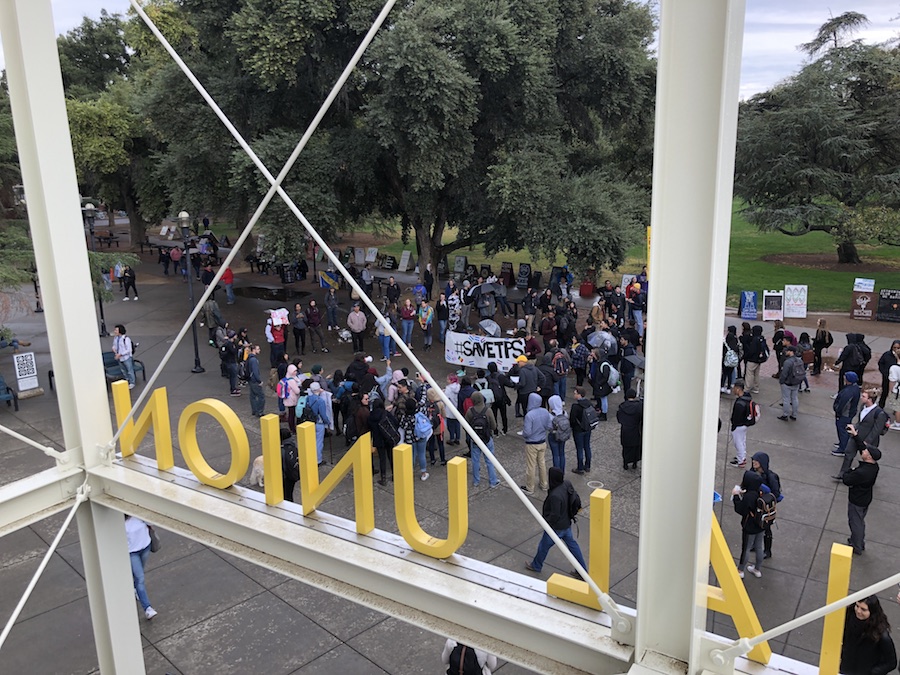
On Nov. 15, about 30 students held a rally on campus to show solidarity for beneficiaries of Temporary Protected Status. TPS currently provides temporary protection for immigrants from El Salvador, Haiti, Honduras, Nicaragua, Somalia, South Sudan, Sudan, Syria, Nepal and Yemen.

According to a recent CNN report, TPS currently grants “temporary work authorizations and protection from deportation to immigrants, including otherwise undocumented ones, from certain countries where life remains dangerous.” While the name of TPS implies that the program is temporary, financial and social unrest in the recognized countries has remained tumultuous, resulting in thousands of individuals remaining in America for the last few decades.

On Nov. 6, the acting secretary of the Department of Homeland Security, Elaine Duke, announced the decision to “terminate the Temporary Protected Status (TPS) designation for Nicaragua.” In the next six months, the Trump administration will be forced to decide whether to continue TPS for the 440,000 people in the U.S. currently benefiting from the program, or to eliminate it.

Most recently, on Nov. 20, Duke announced new plans “to terminate the Temporary Protected Status (TPS) designation for Haiti.” According to The Washington Post, 60,000 Haitians live in the U.S. with TPS.

On Nov. 14, the day before the rally, the Central/South American and Caribbean Student Alliance (CENSOCA) and the Afro-Latinx/Chicanx Club created “posters to bring visibility and fight for #TPS,” according to an event Facebook page.

Carmen Paola Palao is a third-year sociology major and the co-founder of CENSOCA. Paola Palao helped organize the event in collaboration with other on campus organizations.

“The event was very empowering,” Paola Palao said. “It allowed us to bring visibility to issues that are affecting our families and community.”

Paola Palao encouraged students to reach out and learn more about TPS.

“Many families are here because of civil wars, natural disasters and other extreme circumstances in their home countries,” Paola Palao said. “Many of them don’t have a home to go back to and now they’re being told they have to leave.”


Written By: Ally Russell — campus@theaggie.org

Style Watch: Winter wear

MARINA OLNEY / AGGIE

Adapting L.A. fashion to Davis style

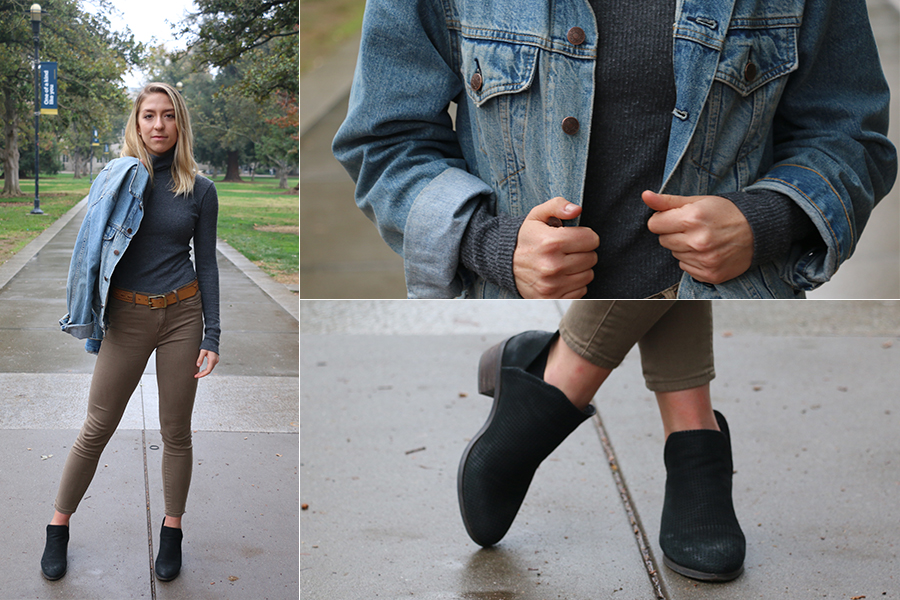
Grace Simmons, a third-year communication major, tends to lean toward a more athletic style. Raised in Los Angeles, Simmons’ style has been heavily influenced by her hometown, but coming to Davis proved a culture shock in terms of her style. Nevertheless, she has managed to adapt her L.A. style into an athleisure look suitable for Davis.


ASW: Can you describe your style?

Simmons: Definitely I lean toward athleisure. Coming from L.A. where style is such a part of the culture, you want to dress to impress and dress to go out and be stylish and get inspired by all the people around you.


ASW: How did you find your style?

Simmons: I get inspiration from Instagram models. When you walk into a clothing store or online, they have suggested ways to wear things. And over time I was able to mesh it all together to find my style.


ASW: Where do you shop mostly?

Simmons: I love Urban Outfitters, which is a very typical response. I also like athletic wear, so LuLu Lemon and Nike. I’ve gotten more into thrifting lately, like Goodwill and Buffalo Exchange to find unique pieces. There are some good thrift shops in L.A., and that’s where I find my recycled unique finds.


ASW: What is your biggest fashion regret?

Simmons: I have plenty. I think it would be pattern mixing, like too many patterns or conflicting colors. I used to be all over the place or wearing the same thing over and over. I used to be really into Aeropostale and graphic tees, and I would wear them every day.


ASW: Do you have any advice for people who want to find their own style?

Simmons: No matter what, be comfortable. Find something that makes you happy to put on and to wear and that makes you feel confident.


ASW: Where did you get your outfit?

Simmons: The jean jacket is from Urban Outfitters, the turtleneck is from Brandy Melville, the belt is from Buffalo Exchange, the pants are from Pac Sun and the shoes are Steve Madden booties.


Written By: CaraJoy Kleinrock — arts@theaggie.org

UC Davis women’s basketball sinks Viking ship

0
RAUL MORALES / AGGIE

Aggies end three-game homestand with decisive win

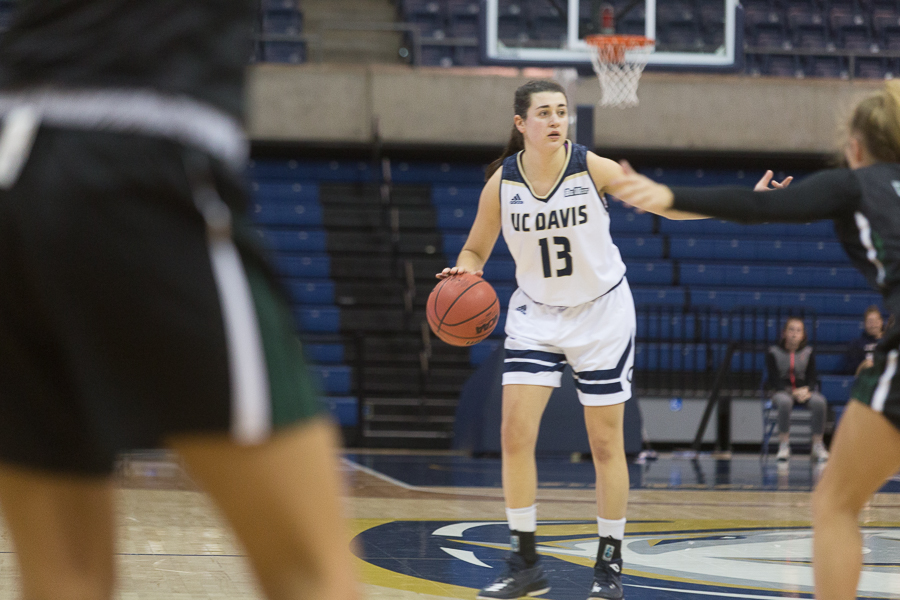
Heading into the final game before its first three road games, the UC Davis women’s basketball team hits the road with a third straight home win under its belt. With 0-2 Portland State coming into town, the opportunity was there to begin the road trip on a high note, and after a close first half the Aggies hit the pedal and cruised to a 79-67 victory.
Despite Portland State’s 0-2 record, UC Davis head coach Jennifer Gross knew that the team would need to bring their A-game in order to come out ahead. To Gross, Portland State presented a unique threat which the other teams had not yet posed on the defensive end of the court.


“[Portland] State is a challenging team to prepare for,” Gross said. “Obviously they play a lot of zone. Their offense has a lot of action and they shoot the ball extremely well, so they present different challenges. And so our focus this week was on continuing to get better, ourselves, but also making sure that our team was as prepared as possible.”
It took some halftime adjustments to break the game wide open for the Aggies, but once they built a cushion at the start of the second half, the game was where they wanted it, and the team began to hit its stride from the three-point line, where they shot a blistering 15-28 from the field. Senior guard Rachel Nagel led the team with six three-pointers on 11 attempts en route to her team-high 20-point performance, a total which she shared with junior guard Morgan Bertsch. Senior forward Dani Nafekh also played a role in the victory, hitting three of her six three-pointers in her 12-point performance.


While the shooting certainly helped the team get where it wanted to be, Nagel was much happier with the work of both herself and of her teammates on the defensive end of the court.


“I’m a defense fan,” Nagel said. “I mean, to me, threes will come and go. Offense, you’ll have ups and downs, but defense is something you can bring to every game, so I rely on that a lot to bring myself energy, and the rest of the team energy.”


While the Aggie starters did their best to dictate the game, the bench provided a balanced effort that helped to spark the second-half flurry that would ultimately decide the game. Sophomore forward Sophia Song and senior center Marley Anderson led the bench with six points each, while sophomore forward Nina Bessolo added five points. According to Song, it is important for the bench to prepare for every game, regardless of the minutes that they may or may not play.


“We know we’re ready to play,” Song said. “However many minutes we get, we’re going to go in there and make a difference, make a spark on defense, and hit shots, and I think we’re all comfortable with our role.”


This added depth is huge for the team’s prospects. Gross praised the bench’s performance when comparing to the others in the past.


“This is the deepest we’ve ever been. Sophia is a lights-out shooter. She can come in — especially against the zone, I thought she gave us a nice boost, hit a couple shots and she’s also a very good defender, and so I think — our bench — everybody has their strengths. I thought Nina [Bessolo] changed the game today. She came in, brought some great energy, got a tip in the press, hit a shot. So everybody has something just a little bit unique, and depending on the game, we can go with different lineups and bring people in for different sparks and so far they’ve done a great job with that.”


While the team is off to a perfect 3-0, both coaches and players know that competition, environment and the feeling of the game can be quite different when the team plays on the road. Gross is working with her team to make sure that they’re ready for that aspect of the season.


“We did a tremendous job in protecting our home court,” Gross said. “Now the challenge changes a little bit, so our focus, we have to be really dialed in. We know that in order to win on the road, you’ve got to defend, so we’re really focused on continuing to improve our defense and our rebounding and making sure that we’re really locked in there, and then, offensively, we’ve just got to stay loose and play to our strengths.”


The players know that they need to stay focused and work toward their ultimate goal, and while it’s easy to get ahead of oneself, Song intends to keep her eyes on the prize.


“We’re going to win championships!” Song said. “That’s our mindset, and we’re going to attack every team with all we’ve got, and I’m very confident in my teammates and what we’re going to do this season. I’m very excited for what is to come.”

The Aggies have since gone on to play University of the Pacific, Southern Utah and Seattle on the road and return home with an undefeated 6-0 record. The team aims to maintain this record in its game today against Sacramento State in the ARC Pavilion at 7 p.m in this year’s Causeway Classic. A full game recap of tonight’s game will be made available in the next print edition.


Written by: Bradley Geiser — sports@theaggie.org

Votes tallied for uncontested election

IAN JONES / AGGIE

Unprecedented voter turnout at only 4.4 percent of student body

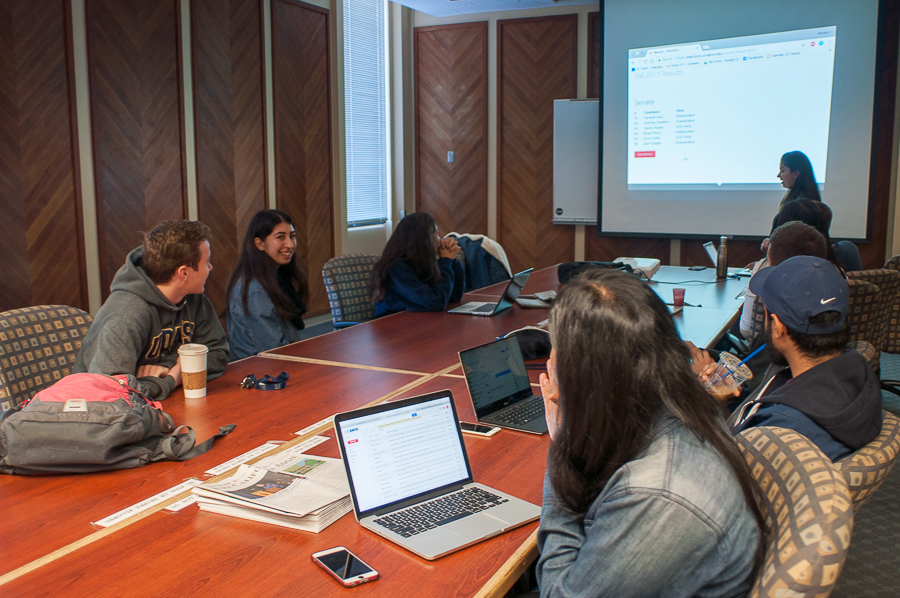
Votes counted on Friday, Nov. 17 confirmed all six uncontested candidates who ran for Senate in the Fall Election as ASUCD senators.
With a total undergraduate population of around 30,000, only 1,289 students voted this year — a 4.4 percent voter turnout. With the historically low average voter turnout ranging around 8 percent, this election’s turnout was especially disappointing.
ASUCD President Josh Dalavai, a fourth-year political science major, was disappointed with the voter turnout.


“It was abysmal and I can’t water that down,” Dalavai said.


The newly-elected senators were able to attend the fall ASUCD Summit that usually conflicts with candidate campaigns.


“The only positive thing about the election being uncontested was that we had time for more in-depth training,” Dalavai said. “I actually think they’re going to be better equipped.”
Dalavi also said that he did not necessarily believe that the uncontested state of the Fall Election will carry over into the Winter Election. Dalavai said that many students have already reached out with serious interest in running during the Winter Election, partially because of this uncontested election.


“It was somewhat of a rude awakening, with promise for the future,” Dalavai said.


Gaven Kaur, a second-year psychology and communication double major, came first in the Fall Election, with 344 votes. Kaur is one of the only candidates who has previous experience working with ASUCD, working as a Senate staffer last year. Her platform focused on advocating for self-care, improving freshmen resources on campus and creating a streamlined letter of recommendation program for students.
Along with her experience with ASUCD, Kaur was also the only female candidate running.


“For me, I think getting the highest number of votes is an achievement for all the women on campus,” Kaur said. “As the only woman running, I hope that I represented our female population well.”


Kaur is already looking forward to her first few weeks in office.


“When my term begins, I’ll be meeting with organization leaders on campus that are supportive of my platforms so that I can potentially collaborate with them to implement my ideas,” Kaur said.


After Kaur, second-year economics major Andreas Godderis received 321 votes. Danny Halawi, a second-year applied mathematics major, received 225; Bryan Perez, a second-year managerial economics and political science double major, received 167; Jesse Kullar, a second-year chemical engineering major, received 133 and Jake Sedgley, a third-year economics and environmental policy analysis and planning double major, received 99 votes.
Kaur, Godderis, Perez and Sedgley ran as independent candidates while Halawi and Kullar ran on the UCD Unite slate.
Godderis, who came in second place in the election, campaigned on his desire to bridge the clear divide between ASUCD and UC Davis students.


“To be totally frank, most students don’t know and don’t care about ASUCD,” Godderis said. “It’s a senator’s job reach out to student groups and organizations and encourage the best leaders from those places. I will personally be reaching out and I encourage other senators to look beyond ASUCD and do the same.”


The newly-elected senators terms will begin in January, at the beginning of Winter Quarter.


Written By: Ally Russell — campus@theaggie.org

Recap of UC Regents November meeting

ZOË REINHARDT / AGGIE

UC Regents gather for bi-monthly meeting at UCSF

From Nov. 14 to 16, the UC Regents met for their regular bi-monthly meeting at UC San Francisco. Throughout the week, the Regents discussed a variety of topics, including student affairs, university and admissions policies and university interaction with the public.

One of the main focuses of the Nov. 14 meeting was approving investments related to pension and retirement and the improvement of policies on investment matters. The Investments Subcommittee is responsible for assisting the Board of Regents in overseeing the UC system’s endowment, planning and investment guidelines.

The Nov. 15 meeting agenda included presentations of topics by the following committees: public engagement and development, compliance and audit, governance and compensation, academic and student affairs and finance and capital strategies.

During the Compliance and Audit Committee meeting, Rachel Nava, the executive vice president and chief operating officer of the UC Office of the President, introduced the meeting’s goal.

“The purpose of our conversation this morning is just [to] provide you on an update on where we are with our audit implementation efforts related to the UCOP Audit of Administrative Expenditures that occurred earlier this year,” Nava said.

Matthew Hicks, the systemwide deputy audit officer for the UC Internal Audit Offices, provided an overview of the six-month status report on independent recommendations from the California State Auditor.

“As members of the committee will recall, the audit report contained 33 recommendations to UCOP, and UC agreed to implement all the recommendations,” Hicks said. “Ten of the recommendations to UCOP will be due for completion in April 2018. Based on the target dates designated by the state auditor, the University believes that it is on track to implement those recommendations by that date, and four of the ten are already reported as completed.”

The Academic and Student Affairs Committee mainly discussed the Academic Verification Task Force. According the a press release from UCOP, the Task Force will be responsible for evaluating  “current procedures and recommend policies and best practices in order to standardize and make UC’s academic verification process more effective, efficient and student-friendly.”

UC Provost Michael Brown began with a presentation of the three main findings from the initiation of the Academic Verification Task Force.

“I would like to highlight three major findings of the task force’s work,” Brown said. “The first finding [is] verifying students’ academic qualifications for admission [to] the University of California is important to ensure integrity and fairness within an admissions process that is highly competitive and to help ensure that students are properly prepared for the academic rigor of the university.”

The next two primary findings, according to the presentation slides at the meeting, were that “campuses have invested interest in admitted students and want to enroll them” and that “verification may inadvertently communicate the opposite of a welcoming message.”

The Finance and Capital Strategies Committee discussed the budget and financing for new arts, sciences and housing buildings at UC San Diego. The committee also addressed the delay of a partnership with Pioneer Hi-Bred International, Inc. — a producer of hybrid seeds — due to risk. It also approved the campus-wide 10-year capital financial plan and discussed the future implementation of UCPath — a campus-wide system for managing payroll.

The general meeting of the Regents on Nov. 16 comprised reports from the UC Student Association and approval of items from the Governance and Compensation Committee and National Laboratories Subcommittee, the Financial and Capital Strategies Committee and the Health Services Committee. An increase in philanthropic donations to UC campuses and public involvement with the UC System were also discussed.

During the general meeting, UCSA President Judith Gutierrez brought up the recent allegations against Regent Norman Pattiz and the current lack of UC action.

“I will respectfully ask you to revisit a critical issue regarding the actions of one of your own,” Gutierrez said. “As you’ve seen, it is the opinion of many students that as long as Regent Pattiz is on the board, the UC cannot stand by its commitment to end sexual violence. It has been alleged and, in some cases, recorded on audiotape that Regent Pattiz engaged in sexual violence and brandished a gun at his employees. Survivors of sexual and workplace violence have to go through the trauma again and again knowing that a man voting on their critical decisions affecting them at their university is an assailant.”

Gutierrez continued to elaborate on this issue from the perspective of a UC student.

“We do not take this lightly,” Gutierrez said. “It has been 11 months since the news of the allegations broke. We understand you cannot remove Regent Pattiz outright, but you can care about what this means for the university and for those affected. On behalf of all of us, and those who have spoke up against this, I ask you to act now.”

In addition to the general board meeting that took place on Nov. 16, a special meeting was held in which UC President Janet Napolitano faced backlash from Regent Chair George Kieffer regarding her recent approval of a plan that interfered with a state audit of her office. According to the Los Angeles Times, Napolitano has previously defended her actions and apologized for the impression that her actions have caused.


Written by: Priyanka Shreedar — campus@theaggie.org

New women’s sports team to join UC Davis Athletics

0
MARK HONBO / UC DAVIS ATHLETICS

Compliance with Title IX, disproportionate gender ratio encourages advancement

An increase in the percentage of women at UC Davis has urged UC Davis Athletics to begin the process of adding a 15th varsity women’s sport. Outlined in a letter by Athletics Director Kevin Blue, the addition of this team is in compliance with Title IX requirements that require “fair and equitable athletic opportunities for male and female students.”

Given the increase in enrollment at UC Davis from 2011-12 of 55.1 percent women to 59.4 percent women currently, Blue noted in the letter that “The number of varsity athletics opportunities for female student-athletes has not changed as swiftly, this is why we are taking action to increase opportunities.”

Blue commented on the women to men ratio at UC Davis and what it means for the future of athletics.

“The substantial increase in female undergraduate students reflects a larger national trend,” Blue said via email. “UC Davis has been a historical leader in Title IX as it applies to intercollegiate sports, and we are proud that our leadership in this area will continue into the future.”

Blue added in the letter that the addition of a 15th women’s team exceeds “the national average of nine and Big West average of 10.”

With the addition of another team, UC Davis Athletics has assured that existing private and philanthropic support will continue to fund the programs to which they are directed to. In a Frequently Asked Questions page following the announcement with Blue, he said that “A primary criterion for selection is the amount of philanthropic support committed to support the addition of a new team.”

Blue also said via email, “We have been increasing the amount of private support for all of our teams, and we are expecting that a significant amount of private support will help launch the new team as well. There will also be institutional funds available to assist the new team and ensure that our university remains in compliance with Title IX, even after the significant undergraduate enrollment shift.”

The new women’s team is expected to begin operating with the start of the 2018-19 academic year following the decision of which sport will be added that takes place in Winter 2018. A committee that includes Blue, Campus Title IX Coordinator and Chief Compliance Officer Wendi Delmendo, Faculty Athletics Representative Scott Carrell, Campus Counsel Sheila O’Rourke, Interim Lead of Finance, Operations and Administration Kelly Ratliff and ASUCD President Josh Dalavai will decide which team should be added.

It is too soon to determine which teams will be the most appropriate candidates,” Blue said via email. “Any member of the UC Davis community or public, including students, may nominate a team for consideration.”

Suggestions may be made online at a link provided in the online version of this story and on the FAQ page and can be submitted until Jan. 19, 2018.

“We will also be conducting a public forum for discussion on this topic at a date and time that will be determined in the next few weeks,” Blue said in his response to an FAQ.

UC Davis Athletics is currently home to 23 varsity sports that include nine men’s programs and 14 women’s. The addition of a sports team will be the latest amendment to the number of sports programs UC Davis has since the discontinuation of women’s rowing, wrestling, men’s swimming and diving and men’s indoor track in 2010.


Written by: Veronica Vargo — sports@theaggie.org

Perspective in Politics: The failure and impact of the Arab Spring

ALLYSON KO / AGGIE

Why removing dictators doesn’t guarantee peace or democracy

Seven years ago, hope resonated through the Arab world. In what became known as the Arab Spring, millions of people took to the streets of their towns and cities and demanded change. These demands usually revolved around desires for democratic reforms and an end to political corruption and repression.

Now, in 2017, it seems as if the Arab Spring has truly become the Arab Winter, as many commentators dub it. Most Arab leaders have been unwilling to relent to major reforms. This has led to civil wars and failed states such as Libya, Syria and Yemen. The weakness of these governments have also allowed for extremists like Al-Qaeda and the Islamic State to grow wherever possible.  

Hundreds of thousands of people have died. Millions still remain displaced in their own countries. Even greater amounts of people clamor for safety, stability and well-being in a region often fraught with chaos and suffering.

Civil wars, such as those in Syria and Yemen, see almost no end in sight. The incredible amount of foreign actors involved in these conflicts make it even harder to come up with a sustainable peace agreement.

What the U.S. has largely done to encourage the removal of dictators has been unplanned, hypocritical and wrongful at best.

The U.S., for example, largely supported Egyptian president Hosni Mubarak between 1980 and 2010, despite unfree elections and single-party rule. Once former President Barack Obama expressed his support for the end of the Mubarak regime, all seemed to go well. Elections were held and an Islamist became president.

No one would have expected after pretty much supporting the Egyptian Revolution that the U.S. would betray it. But the U.S. did renege on its words when it didn’t stand up strongly against the military coup that forcibly removed a democratically-elected leader from power.

Now, the U.S. wholeheartedly supports Egyptian President Abdul Fattah al-Sisi, despite him being an undemocratic leader. And it’s hard for the U.S. to claim to support human rights when the U.S.-backed Egyptian government under Sisi committed the Rabaa atrocities in 2013 — largely against political opponents and dissenters.

The approach of “regime change,” the removal of a dictator at all costs, is the main problem. Obama even admitted that the Libyan catastrophe remains one of the worst mistakes of his presidency. When Libya got rid of its repressive leader, Muammar Gaddafi, and held elections for representatives, everything seemed hopeful. But when the Islamic State appeared throughout the Arab world and the so-called Libyan rebels splintered into warring factions, all unified national order in the country collapsed.

What the U.S. did to enforce regime change at all costs, not knowing what the actual outcomes would be, ended up being a severe lapse in judgement and a disservice to the millions who now suffer in the Arab world today. Encouraging and actively attempting to take down dictators doesn’t change the bad reputation the U.S. has for meddling in other countries’ internal affairs and leaving them worse than they were before.

Good intentions may have come with intervening militarily in Libya and Syria, but the suffering has been magnified considerably. There is no doubt that the repression under the undemocratic repressive governments in the Arab world has been utterly terrible. But the effects of U.S. interference, as well as the actions of many in attempts to topple governments, brought about much more pain than ever imaginable.  


Written by: Justin Chau — jtchau@ucdavis.edu

Disclaimer: The views and opinions expressed by individual columnists belong to the columnists alone and do not necessarily indicate the views and opinions held by The California Aggie.

Humor: Man holding bloody deer in Tinder profile pic probably totally sane

MICHELLE GORE / AGGIE

Local charmer is on the hunt for love and blood

You’re scrolling through Tinder. Nothing is standing out to you. Profile after profile, you just see pictures of dudes hiking with some bio about how they have a dog. It’s cliche, and you’re sick of it. You want a man’s man. The kind of man who screams, “I punch walls when I’m angry!” That’s when you find him: the man holding a bloody deer in his profile picture.

Do you swipe right? Is this the time for a “super like?” No one can be certain, but one thing is for sure: Even though four out of five of this guy’s pictures are of him displaying a dead animal in the same fashion as a preschooler displaying their macaroni picture frame, he is probably totally sane.

Nothing screams sanity like the glazed-over eyes of a dead animal. We have learned this from famous romantic comedies like “Psycho” and “Old Yeller.” I’ve read several love-advice books (too many love-advice books), and they all state that the most attractive trait in any human is just a sheer drive for killing. Sure, I found these books in an old chest buried in a haunted cave, but anything on paper is factual. If I can type it into EasyBib, it’s real.

There are several reasons why the man with the bloody deer is probably your match made in heaven. For one, he can clearly hunt for food in order to provide for your family, a problem that everyone encounters in 21st-century America. I haven’t eaten in weeks! These little, chubby girl hands can’t get me anything. I ate one ant, and I found it already dead. If only there was a man in my life who could just, I don’t know, shoot down like 40 small doves. Then I’d be happy.

Secondly, this means that he probably has access to guns. Guns are absolutely necessary for pretty much every single day of the year. You can also never be sure of when the zombie apocalypse might break out or when you might need to scream at some little rascals to “get the flim-flam off yer lawn!” Going steady with a man with access to guns will ensure that no meddling tweens are trudging through your peonies. Justice. Will. Be. Served.

Lastly, a man who can kill a random woodland creature is probably real strong. As every woman knows, the most intimate thing you can do with a man is arm wrestling. You’re going to want to find a man who will give you a run for your money. Little Danny-Deer-Destroyer is probably your toughest match, so it’d be wise to pursue.

Here’s to all the dreamboats on Tinder who are looking for love. You might have shot Bambi’s mom, but Cupid shot an arrow right through my heart.


Written by: Olivia Luchini — ocluchini@ucdavis.edu

(This article is humor and/or satire, and its content is purely fictional. The story and the names of “sources” are fictionalized.)

Alottacappella travels back to the 20s with a Gatsby Winter Night

JAY GELVEZON / AGGIE FILE

The Liquid Hotplates host annual a cappella show

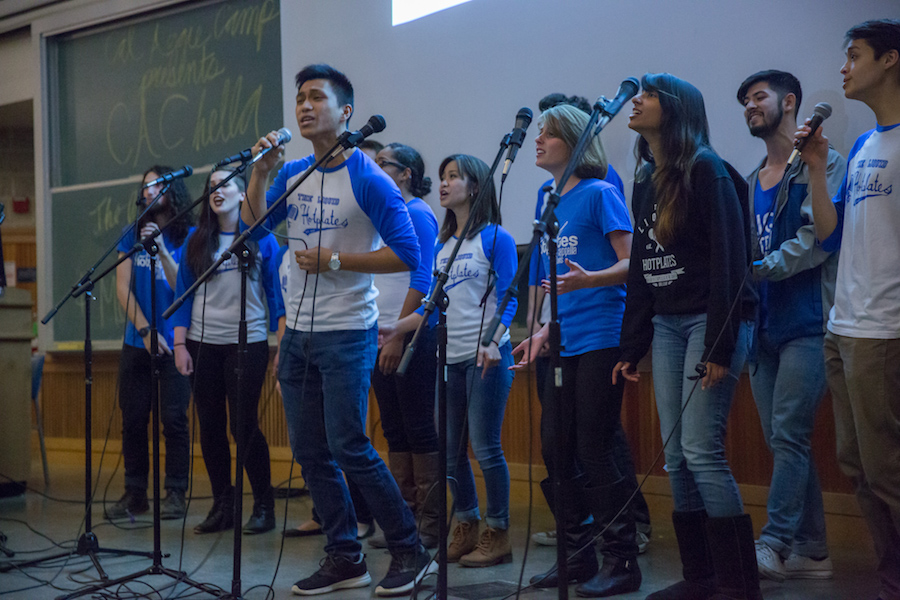
With Fall Quarter coming to a close, a cappella group The Liquid Hotplates will once again host its annual Alottacappella event on Dec. 2 at 8 p.m. The show will feature other on-campus groups including The Spokes, The Lounge Lizards, The Afterglow, Cleftomaniacs, Levels of Vocal Expression, Cloud 9 A Cappella, Acquire and GGN.

Brendan Caskey, a third-year genetics major, is performing in the show with the oldest a cappella group on campus, The Lounge Lizards. According to Caskey, there seems to be an unspoken rule in the a cappella world that original music should not be the central focus; however, there is a variety of genres that the group performs.

“In the future we might have originals. As for now, most of our repertoire is pop, rock, R&B and a little bit of rap and country,” Caskey said.

Kiersten Allison, a fourth-year animal science major and member of The Liquid Hotplates, believes that covers aren’t necessarily limitations on musical creativity. The group always takes its own twists to the songs. The most important part of being in an a cappella group like The Liquid Hotplates is the shared love of music.

“Everyone here comes from a musical background, but it’s all different,” Allison said. “Some people are more familiar with playing instruments, and others sing well but can’t read music. There are so many talents in the a cappella scene. We’re not really competitive with each other. It’s really just one big community of singers [who] help each other out.”

Anikka Altura, a fourth-year food science major in the newer a cappella group Cleftomaniacs, also loves the community and musical aspects of a cappella culture. Like The Lounge Lizards and The Liquid Hotplates, Cleftomaniacs also has a lot to offer in the upcoming show.

“Music is a very large part of our lives, and we invest a lot of time in the music, but we also invest a lot of time in each other,” Altura said. “We’ve been preparing this show since the beginning of the quarter for about four hours a week. You’ll see a lot of pop and R&B and something a little unexpected as well. It’s our first show of the year, and we want to show people how hard we’ve been working on our music and to just have a lot of fun.”

Through months of practice and involvement in Cleftomaniacs, Altura has realized that the biggest obstacle in a cappella music is also its greatest beauty: it requires many people and many voices. It brings everyone together and makes each session a little different.

“A cappella isn’t going to be the same every time because at the end of the day, we’re all people singing,” Altura said. “We’re all going to make new mistakes each time, and we work to minimize that by working cohesively, but there is a variability that happens in acappella.”

Allison predicts the show will be ‘a lotta’ fun for the audience.

“We’ll have some pretty funny MCs for sure, and all of the groups are incredibly talented and it’s not something you want to miss. It’s also going to be cool to see the Sciences Lecture Hall transform into a concert venue,” Allison said.

Tickets for the event are $8 presale and $12 at the door. Tabling for tickets and information will take place at the Memorial Union from 10 a.m. to 2 p.m.


Written by: Becky Lee arts@theaggie.org


Sexual harassment in the newsroom

CAITLYN SAMPLEY / AGGIE

A disgrace to the field of journalism

Over the past two months, sexual harassment claims have toppled the careers of numerous media titans, with the most recent allegations directed at the Today Show’s Matt Lauer and Public Radio’s Garrison Keillor. The list of men in journalism who are accused of committing acts of sexual misconduct or abuse is growing by the week — and sometimes by the day. Among the high-profile men who have faced repercussions are Charlie Rose, the longtime host of “CBS This Morning” and correspondent of “60 Minutes”; Glenn Thrush, a White House correspondent for The New York Times; Mark Halperin, a contributor at NBC News and MSNBC; Michael Oreskes and David Sweeney, two of NPR’s top editors; Hamilton Fish, the publisher and president of The New Republic; Bill O’Reilly, a host at Fox News; and Lockhart Steele, the editorial director of Vox Media.

In most cases, these men have wielded staggering amounts of power and influence over the direction of their news organizations and the national discourse. Lauer, arguably the most powerful member on Today’s editorial staff, reportedly shot down stories about sexual misconduct for years. Thrush, who covered allegations of sexual harassment against President Donald Trump about a year before being accused himself, is considered a leading voice in political journalism. Rose was once labeled “one of the most important and influential people in journalism” by Michael Bloomberg, the former mayor of New York City.

In short, a group of openly misogynistic men have shaped the way we see the world through their stature in journalism — deciding which stories to pursue, which to ignore and how to tell them. This of course asks the question: How can we trust reporting on sexual violence and harassment when the very individuals reporting the news have themselves committed the same atrocities?

This string of powerful men in the media threatens integrity and the commitment to telling the raw, ugly and uncensored truth on the topic of sexual assault. Many of the contributions these men have made to journalism are undoubtedly marred and diminished by the shadow of their transgressions. These misdeeds automatically damage the industry as a whole. The allegations knock down the credibility of some of the most-trusted media companies in America — and without objectivity and reliability, journalism is nothing.

Perhaps most infuriating are the media conglomerates that have protected these men after, in some cases, decades of allegations. It’s unacceptable when news sources are less willing to sacrifice their sexist cash cows than they are their consciences and journalistic integrities.

These widespread allegations shine a much-needed spotlight on the deeply-rooted misogyny still infecting and shaping media output. Media organizations must reckon with the ways it has historically allowed such despicable behavior to go unaddressed for so long.

As with all cases of sexual harassment and violence, the victims remain the primary concern, and the Editorial Board commends those who, despite a culture stacked against them, have bravely come forward with their accounts. We demand that news outlets finally prioritize the safety of their employees, hold their reporters accountable for their behaviors and honor their journalistic commitments to factual and trustworthy reporting.


Written By: The Editorial Board

Five alpacas dead from oleander poisoning

NICKI PADAR / AGGIE

Unattended brush pile source of deadly July accident at Antibodies, Inc.

Five alpacas died at Antibodies, Inc., an immunochemistry products and services provider in Davis, over the summer due to oleander consumption. The final investigative report from the company was recently made available by Stop Animal Exploitation Now!.

“We obtained the documents through the Freedom of Information Act,” said Michael Budkie, the co-founder of SAEN. “It was in the possession of the Office of Laboratory Animal Welfare at the National Institutes of Health. We routinely file Freedom of Information Act requests with the federal government to obtain documents like this for every registered research facility in the United States.”

According to the official report from Antibodies, Inc., an employee collected leaves and trimmings into a brush pile near a pasture where the alpacas are allowed time outside. Eight alpacas were able to browse the pile for food on a Friday, and ate enough material that four were dead by Saturday morning. A fifth was euthanized later by a veterinarian after it was determined to be too sick to recover. A sixth alpaca survived the poisoning with kidney damage.

The animals were treated at the UC Davis Veterinary Medicine Teaching Hospital. The dead animals were examined and necropsied at the California Animal Health & Food Safety Laboratory, where oleander consumption was confirmed.

Antibodies, Inc. has alpacas at its facility to collect antibodies from their blood for research purposes. Although oleander is normally not accessible to the alpacas in their pasture, the report indicates the trimmings were collected “from an off-site location” into a nearby pile.

“Oleander is very common all over Northern California,” said Dr. Julie Dechant, a UC Davis associate professor in equine emergency surgery and critical care who serves as the designated camelid medical expert. “It’s in the roadway medians. It’s often a border around pastures.”

All parts of the plant, from the roots to the leaves, are poisonous. Oleander is appreciated for its pleasing appearance and use as a windbreaker. The leaves are bitter, but since the poisonous dose may only be a few leaves, foraging animals can become seriously ill. The heart and kidneys are the organs most severely affected.

“Palatability varies among livestock species,” said Dr. Pam Hullinger, the director of the California Animal Health & Food Safety Lab at UC Davis, in an email interview. “While oleander may not be as attractive to animals as hay or grain, livestock still will consume it on occasion.”

The symptoms of oleander poisoning in livestock are subtle. If an animal is suspected of having consumed oleander, only a few treatment options are available.

“Treatments are usually supportive,” Dechant said. “There is a potential antidote, which is actually for digoxin overdoses, but it’s cost-prohibitively expensive. We don’t stock it, because it is so expensive and clients can’t afford it. Often, we’re giving them activated charcoal, because that will bind the toxin in their intestinal tract. We’ll give them IV fluids because oleander affects the heart, kidneys, and intestinal tract. There are a few other treatments that are also supportive for the heart.”

The best way to keep animals safe from oleander poisoning is to keep the shrubs away from areas where animals can roam. Uprooting existing plants can be proactive.

“As with all plant intoxications in livestock, prevention is the best approach,” Hullinger said. “Unless an owner directly observes their animal eating oleander, oleander poisoning can only be diagnosed by testing for the toxin in the animal (serum, gut contents), animal tissues (after death) or in plant material.”

Allowing animals to die due to negligence in a research facility is a serious issue which requires immediate site changes. Training employees about the dangers of oleander, inspection of the pastures before releasing animals into pens, and sign installations are some of the changes made following the alpaca poisonings. More penalties may follow for Antibodies, Inc.

“The first thing that will happen is the USDA will investigate this incident, and they should issue at least one, if not multiple, citations under the Animal Welfare Act,” Budkie said.


Written By: George Ugartemendia — science@theaggie.org

NFL Postseason Predictions

0
ALLYSON KO / AGGIE

A look at which teams are poised to make a Super Bowl run


With the final month of another NFL season looming, it’s time to take a closer look at the teams hoping to make a run into the postseason. This year of professional football has been as unpredictable as ever, as major injuries and impressive performances from some unexpected players have made for an exciting season. Through 12 weeks, five teams that finished in the bottom half of their division last season now currently claim first place. Needless to say, the road to Super Bowl 52 will be full of captivating storylines and new heroes.

The half of the league that has experienced the most change from last season is the NFC, as all four of the current division leaders were bottom finishers last season. The most surprising division leader among them is the Minnesota Vikings, sporting a 9-2 record despite suffering key injuries at the quarterback and running back positions. When quarterback Sam Bradford went down with a knee injury following the team’s week one victory, sixth-year quarterback Case Keenum emerged as the Vikings’ starter. After a rocky start in a week two loss at Pittsburgh, Keenum has since led the boys in purple to an 8-1 record while sporting career numbers across the board: nearly 2,500 yards and 14 touchdowns through the air, coupled with a 66.1 completion percentage.

The biggest factor in Minnesota’s success, however, has come on the defensive side. Head coach Mike Zimmer –– well known for his impervious defensive schemes –– has the Vikings ranked second in the league in stopping the run and fifth in yards allowed per game (total defense). Defensive end Everson Griffen, who is tied for a league-leading 12 sacks, anchors Minnesota’s defensive front that has contributed greatly to the team’s knack for interfering with opposing offenses. With a full three-game lead atop the NFC North, the Vikings will battle three of their last five games on the road. The offense may face adversity in the final stretch, but the Vikings defense will carry them through the hostile trips to Atlanta, Carolina and Green Bay.

Much like that of the Vikings, the success that the Los Angeles Rams have had this season has surprised most NFL critics. The Rams are led by second-year quarterback Jared Goff, who, despite a dismal performance in his seven appearances for the team last season, has shone under a revamped offensive system constructed by rookie head coach Sean McVay. The youngest head coach in NFL history, McVay has been making waves with his balanced offensive style that features Goff’s methodical passing attack alongside running back Todd Gurley’s punishing ground game. Goff’s 2,964 pass yards are the sixth most in the league while Gurley’s 865 rushing yards rank third. Fresh off a statement win over New Orleans, the 8-3 Rams are rolling into week 13 with high confidence. Los Angeles will also be on the road for three of its final five matchups, including a divisional showdown in Seattle a week after battling the Eagles at home.

Coming off a week 12 loss in Los Angeles, the New Orleans Saints are still leading in a tightly-contested NFC South. In his 17th NFL season, quarterback Drew Brees has thrown for 3,029 passing yards –– the third most in the league –– but New Orleans is used to benefitting from this seasoned gunslinger. What’s notable is that Brees is finding the fountain of youth by way of a more balanced offensive workload. The Saints can finally run the football successfully, thanks in part to an improved offensive line and rookie running back Alvin Kamara. The athletic youngster out of Tennessee has proven to be a powerful new weapon for head coach Sean Payton’s offense. Kamara has racked up nearly identical rushing and receiving totals, with 546 yards and five TDs on the ground and 548 yards and four TDs through the air. The 8-3 Saints will be continue to be tested in their final five games, two of which are contests against the reigning NFC champion Atlanta Falcons.

How could we discuss the NFC without mentioning the team with the NFL’s best record?

At 10-1, the Philadelphia Eagles have been one of the most dominant teams this season, taking care of business in all phases of the game. The Eagles have the league’s best run defense –– which has been improved thanks to veteran defensive lineman like Fletcher Cox and Chris Long –– as well as the league’s third best offense in terms of yards per game. Second-year quarterback Carson Wentz is the centerpiece of Philadelphia’s prolific offense, as the man out of North Dakota State has vastly improved upon last year’s performance. Wentz has thrown a league-leading 28 touchdowns and just five interceptions through 12 games, as opposed to his totals of 16 touchdowns and 14 INT’s in 16 games in 2016.

The Eagles have won by 10 points or more in seven of the team’s 10 wins. Even in close games, Philadelphia has found a way to persevere. The grit of this team will come into play down the stretch as the Eagles will play on the road in their next three games –– traveling to Seattle, Los Angeles and New York –– until they return home for the final two weeks to take on playoff hopefuls in the Raiders and the Cowboys.

Moving across to the AFC, we see that the usual suspects continue to rule atop their respected divisions. The powerhouse New England Patriots, still led by head coach Bill Belichick and his reigning Super Bowl MVP quarterback Tom Brady, are 9-2 and possess a healthy three-game lead in the AFC East. Brady leads the league in passing and has helped the Patriots rattle off seven straight victories after beginning the season 2-2. The Pittsburgh Steelers also boast a 9-2 record and a solid grip on the NFC North. The Steelers offense is one of the most productive in the game, which is not difficult to believe when it is led by the NFL’s leading rusher (running back Le’Veon Bell) and receiver (wideout Antonio Brown).

The Kansas City Chiefs have also found themselves once again leading in the AFC West, although narrowly so. The 6-5 Chiefs opened the season with a hot 5-0 start, but have since cooled down to only win one game in the last six contests. Despite a beat-up defensive secondary, expect the Chiefs to remain competitive with an above-average defensive front captained by expert pass-rusher Justin Houston and a rejuvenated rushing attack led by the speedy rookie running back Kareem Hunt. Still, Kansas City will face daunting divisional matchups in three of its final five games, including a home battle against a surging Chargers squad who whooped the Cowboys in Dallas on Thanksgiving.

Perhaps the most surprising teams this season are the two that are fighting for the lead in the AFC South. The Tennessee Titans and the Jacksonville Jaguars both hold 7-4 records and have displayed flashes of brilliance at several points during the season. The Jaguars, for instance, have had several dominating, blow-out victories, including one over the Steelers in week five. The Titans, too, have collected a handful of signature victories, like wins over the Jaguars and the Seahawks. Both teams, however, suffer from inconsistency. Poor play in several games against relatively weak opponents has cast some doubt on whether or not these clubs are ready to return to the postseason. Nevertheless, one of these two franchises is very likely going to win the division. The question of which team will make the most of the opportunity remains to be answered.

For now, Jacksonville has found enormous success behind a defense that has allowed the fewest per game passing yards and total offensive yards. On offense, no team in the league runs the ball better, as the Jaguars’ rushing attack has been bolstered this year by rookie running back Leonard Fournette. For Tennessee, defense has also been a bright spot. The Titans are fifth in rushing defense and have the league-leader in interceptions, Kevin Byard, lined up for them at free safety. The teams will meet in Nashville for a week 17 game that could decide the winner of the AFC South.


Written by: Dominic Faria — sports@theaggie.org

Graduate Student Instructors: More than TAs

JESSE STESHENKO / AGGIE

Associate instructors connect with students despite administrative challenges

Some say that the best way to show your understanding of a concept is to explain it to someone else. That might be part of the reason why, for many graduate students, part of the path to their degree involves teaching.

Many graduate students at Davis lead discussion sections and assist professors as teaching assistants. Others, known as associate instructors, teach entire classes on their own. A high volume of courses taught by graduate students is sometimes seen as a negative for a university’s reputation, but not all students necessarily prefer classes taught by professors; graduate students may in fact have certain advantages as teachers.

“[Classes taught by graduate students] feel more personal, in the sense that they are typically not as big as classes taught by professors and in my opinion, the grad students come off as more approachable than most professors,” said Anthony Garcia, a fourth-year comparative literature major.

While teaching is a requirement for certain degrees, many graduate students relish the opportunity. For some, it’s even a primary goal of their studies, and some also believe that graduate students might have advantages when it comes to interacting with students.

“I think the fact that we’re younger, and that we probably identify and sympathize more with the undergrads, tends to level [the relationship] out,” said Duane Wright, a Ph.D. student and associate instructor in sociology. “Speaking for my department only, I think because this is a research university, the professors are here mostly to do research […] whereas a lot of the grad students that end up in this program, because it’s not top-ranked, [are] not coming here expecting to end up in a research position. A lot of us, not everybody, but a lot of us want to go into teaching, so I think that orientation to research and teaching varies too, and that might affect our relationships with undergrads.”

Wright has been at Davis for seven years, but this quarter he’s teaching his first class, Sociology 1 — Introduction to Sociology. He’s happy about the opportunity, and surprised at the freedom he’s been given.

“There were absolutely no restrictions for me,” Wright said. “There was nothing like, ‘hey, these are the minimum requirements of what you should cover’, or ‘make sure you have this many papers’, or anything like that. It was just sort of like ‘hey, you’re hired, you’re teaching this’, and since then I’ve not heard anything, so I’ve been surprised at the level of autonomy. It’s pretty cool, actually, because sort of my hope has been to teach my own course, so to be able to do that already is kind of cool.”

This level of freedom is not shared by all associate instructors. In Spanish classes, for example, instructors have to follow a syllabus that is shared between all sections of a class.

“We do have less freedom, because they give us the days we have to give exams, we can’t switch any days around,” said Lani Lopez Bastidas, a Ph.D. student and associate instructor in Spanish. “We can’t say ‘I didn’t cover this in class yet’, we just need to cover it. If you don’t have time, you still need to do it somehow.”

These restrictions can make it difficult to provide a learning experience that is tailored to particular students.

“I think it does make teaching more difficult, because every class is different,” Lopez Bastidas said. “Maybe we should be given more freedom to change the syllabus, because sometime you’ll take more time explaining certain stuff, maybe it’ll take you less time to explain something else, and only the instructor knows.”

The UC Student-Workers Union exists to protect the workplace rights of graduate students, including instructors. Wright, who used to be the Davis unit chair of the union, said that the union works to make the teaching experience better for instructors.  

“We advocate for things in the classroom,” Wright said. “With our recent contract we won the ability to meet and discuss issues of class size with the university, because class size does affect teaching, despite the fact that an administrator from UCLA was kind of shocked when we made that assertion when we were bargaining.”

The rights provided to instructors by the union are meant to improve instructors’ quality of life, but also to improve the quality of education for students.

“As TAs, we spend roughly half of our employed hours grading,” Wright said. “Issues of class size, issues of workload sort of impact the kind of feedback and the quality of feedback that we can give to students. If I’m grading for 80 students and there’s the same number of assignments as when I’m grading for 50, then obviously I’m gonna have to cut back on the feedback and things like that […] we’d like to give attentive, quality feedback and quality education and not just sort of push everybody through.”


Written by: Gabriel Mulcaire — features@theaggie.org


Editorial Board meets with Chancellor May

CAITLYN SAMPLEY / AGGIE

Gary May answers questions about first quarter in office

The Editorial Board sat down with Chancellor Gary S. May last week to speak about current plans for UC Davis, challenges he faces and the future of the university. The following interview has been edited for length and clarity.


You’ve been meeting with people throughout the UC Davis community over the past few months, and through that you’ve also been meeting various legislators. Could you tell us about what you hoped to accomplish?

As a newcomer, I think it’s incumbent upon me just to listen in my first few months here and not come in thinking I know all the answers. I wanted to get a feel for what the campus community and the surrounding community thought about Davis, where we stood and where we should go, things they like, things they didn’t like. I’ve set up this listening tour and it started this summer with mostly the non-academic administrative units, and then after classes started I’ve been doing the academic units, and then sprinkled in there have been student organizations, alumni, clubs, government officials, et cetera. So, basically just to hear what people think and try to shape the agenda.

And can you tell us a little bit about your recent trip to DC and what you specifically hoped to accomplish with that?

I was at the American Association of Universities presidents and chancellors meeting. AAU is the 62 top research universities in the country and that’s a regular meeting. As it so happened, while we were there, some of the DACA stuff was bubbling up, and we got a request from Senator [Chuck] Schumer from New York to be part of a press conference about DACA. He asked the UC system and he asked the SUNY [State University of New York] system in New York, as two of the states that are most significantly affected by the rescission of DACA. Since this other AAU meeting was ending, I think I was the only chancellor who was staying and I was asked to be a part of the press conference, and I was happy to do that. Basically, we reiterated our support for our DACA students and called on Congress to take some action and then took some questions from the press.

One of the goals you’ve spoken frequently about is raising UC Davis’ prominence on the global stage as well as the national stage. What factors are you thinking of when you’re talking about global prominence?

There’s a lot of ways to define that, but essentially I think we want the students to have an appreciation for the global context in what they’re learning and that we want to be a sort of a thought leader and a voice and a place where people ask what are we thinking, what are we doing. I think we’re already a voice […] in agriculture. You can’t go to any farm in the world without finding some UC Davis connection. But we want to kind of formalize that a little bit more, so we’re thinking about things like remote campuses and research alliances and collaborations and exchange programs, and a lot of that’s going to happen through [UC Davis] Global Affairs and Vice Provost Joanna Regulska’s operation. We have this big idea that you may have heard of called “global education for all.” She’s leading, along with several faculty, but I’m interested in supporting it.

While working with projects like remote campuses and research collaborations, how does that intersect with raising our prominence while still maintaining student experience by things like teacher-to-student ratio and class sizes?

Those two things aren’t directly related, but I think I will say that participating in some of these activities — study abroad, work abroad, service abroad — are definitely what we have in mind for student participation and broadening the whole educational experience at Davis. The student-to-faculty ratio is most closely related to our ability to hire more faculty and staff to meet the enrollment growth, and those two things don’t necessarily intersect. We like the global activities to be what I’ll call revenue neutral, in that we don’t want to do anything that’s going to end up costing us money. We’d like to find a few things that would generate revenue, but I don’t anticipate that those two concepts will intersect too much.

Speaking of hiring faculty, there’s somewhat of a national issue that’s also impacting the UC with dwindling numbers of tenure track positions and universities increasing their dependence on both adjunct faculty and contingent positions. They tend to offer low pay and little job security and lots of faculty turnover. Do you think this is a problem or is it just the natural direction of universities?

I don’t think it’s a problem. Not yet, anyway. I think one of the ways you mitigate the workload and reduce the ratio is by hiring non-tenure track instructors, and those are a little bit easier to identify and to hire. Those are not what are called “tenure-track,” or “ladder-faculty” I think they’re called here. They tend to be more temporary and less expensive and those sorts of things, which I think is usually okay because in many cases folks like that are not necessarily looking for a permanent role, and if they are they certainly can apply for a different status as their situation evolves. The idea is to leverage presence of such individuals to help with the teaching and with some of the other activities that would benefit the educational process of the students.

Do you at this time have a plan to address Davis’ housing crisis?

You know, we’re still working on it. We have three projects underway right now. At the Regents meeting last week we got the Emerson project onto the next step, and our goal is to affordably house as many of our students as we possibly can. We’re hoping that the city of Davis will be a good partner for us.

Many STEM students find that they’re unable to register classes or get the classes they need because of people wanting to graduate in four years and these departments being so overcrowded. How much influence do you have over finding solutions for that problem?

Not as much as you’d think. The curriculum and everything associated with the curriculum, including scheduling, is really the purview of the faculty senate. And I can certainly express my opinion and try to exert influence, but it’s really not in my decision-making power, with exception of how we allocate resources for budgets and things to hire. I do want to at some point have a bigger discussion about the graduating in four years thing, because I came from a place that was very STEM-focused and the average graduation time was around 4.8 years, almost five years. That was okay, because students were doing co-ops, internships, studying abroad and doing these other things that were enriching their experience. I think four years is a good goal. I have my daughters, I told them four years was a good goal, but if it spills over a little bit I don’t think that’s a disaster, because I think the main thing is to have as positive an educational experience as you can. At some point, when you’re looking for a job, you’re employer’s not going to ask you, “How long did it take you to graduate?” They want to know, “What do you know, how good are you and are you ready to contribute to my company?”

A question about your “To Boldly Go initiative”: In addition to what measures are being taken so students are aware of the initiative, what would be the incentive for fourth years to be involved if the changes are more long-term?

Student involvement is pretty straightforward: We have a couple of graduate students and a couple of undergraduates on the steering committee. It’s not going to necessarily impact you if you’re graduating this year, but we hope you’re always going to care about what happens at Davis and what happens in the future. 10 years from now when you have your diploma and you look back, however Davis is doing at that time will impact you. If Davis has moved up from ranked number 12 in the U.S. News, if we’re up to number three, you can say “I graduated from the number three public institution,” and so I think hopefully we’ll still be important to you. And also I’ll be asking you for money — [laughs] — for years and years and years, so look forward to that.

How do you think that the UC system justifies its strong stance in support of sexual assault prevention and awareness while remaining silent on UC Regent Norman Pattiz’s recorded sexual harassment allegations?

The truth is the Regents have no way of removing each other. They’re all appointed by the governor. They have limited ways they can censure each other, so if any action is to take place, it really has to take place at another, higher level. The sexual harassment, sexual violence and all those sorts of things […] have been condemned by the Regents and actually by all the campuses individually as well. His particular case, I don’t have enough details. I will say he’s pretty adamant that it’s being mischaracterized. I’m not saying I believe it or not believe it, but he certainly feels that way. I don’t know what will result in the long run from the complaints about him, but I certainly feel that there’s no place for sexual harassment or in any part of the university system.

What do you foresee as your biggest challenge in the near future and in the long term?

The biggest challenges always revolve around resources. I hate to boil everything down to money, but the truth is, and I may have said this in our last meeting, although the state has tried to become more supportive in recent years, the reality is that they’re writing about 9 percent of our overall budget, and if you add the tuition in, it’s maybe 20 percent. So we’ve got to do other things to make up for the other remaining 80 percent, and that includes research, that includes philanthropy, fundraising, it includes other initiatives, auxiliaries in the state and various other things. We’re going to have to get more involvement and more success in raising the resources we need to be prominent. In a microcosm, on a small scale, I just had a meeting with a donor in athletics, where basically the gist of the conversation is, “If you want to be a Division I program we need Division I donors,” and I would extend that to say if we want to be a top five university we need top five donors. Right now, our alumni participation in giving is about 7 percent. Even the best public universities are up in the twenties. So it’s going to be hard to get much higher than that. But you look at the privates, they’re at 80, 90 percent. So we’ve got to somehow get over this hurdle that prevents you, when you graduate, from wanting to continue to be a participant, financially and otherwise, in the success of the university.

You mentioned that state support has dwindled for quite some time, but especially now. Do you see that as a natural direction that the university will move to having very little state support?

I really hope not. We do have various efforts through the Office of the President and various other government relations people, and we are in this constant mode of asking our elected officials to continue to help us to get better. So we’re in this box where tuition increases are not looked favorably upon, and yet we need to provide the best possible experience for the students, and so we don’t have many other degrees of freedom. And so we hope that the legislature will be responsive to that.

If the state isn’t amenable or taxpayers aren’t amenable to funding the UC at higher levels and you don’t want to raise tuition, do you think there are ways that either the UC as a whole or campuses on their own can reallocate money in different ways?

Well yeah, we have to make some decisions ourselves. We have to be mindful of costs and efficiency and make some tough choices. We can’t do everything and be all things to all people, and so that’s another part of this planning process. In addition to deciding where we’re going to focus on where we’re going to be great, we’re going to have to, in parallel, decide where we’re going to choose not to be great. I’m not going to predict what those are going to be, but those are going to be tough decisions.

What do you think are possible steps that could be taken to address [the “It’s okay to be white” fliers recently found on campus], because we’ve seen this across the country.

I’m not sure. I struggle with it. You know, even when I wrote that article for you guys, my internal debate was whether to respond at all, but I decided that I should have some kind of response, and a measured, thoughtful response, not sort of an emotional, over-the-top response. Because I think that’s kind of what the provocateurs want, is the emotional, over the top response. But at the same time, I realize students want to hear from the leadership when things like that happen, and I need to make people feel that we have your best interests at heart and there’s no place for white supremacy or whatever type of negative sentiment that’s being expressed. I’m bringing this up so that you can tell me if you think that there are different things that we could or should do.

Do you feel that, as chancellor, you’re more inclined to be reserved in putting some kind of emotional input into responses to sensitive topics?

It’s a tough call. I’m, by nature, not very emotional. Spock is my favorite character, so someone has to push me to do that if it needs to be done, usually. I’m much more methodical, logical, what we’re going to do as opposed to catering to feelings. But I know that some people want that or need that, and so I do struggle with that. At the same time, I want students to understand that when you go out into the workforce these things are going to happen, and there’s not always going to be someone to make a statement condemning something or to make you feel warm and fuzzy. I don’t want to sound like I’m a cold and unfeeling person, but sometimes you just have got to be tough. I’m a person that’s been called names. Racial epithets have been hurled at me in my life, and my family, and I try not to let those things stop me. It’s been a good approach for me, this strategy, and I think it’ll be a good strategy for others [who] are impacted by it.

We’ve received several guest opinions expressing that UC Davis hasn’t been vocal enough against some of the cases of anti-Semitism in the community recently. How would you respond to this criticism?

That one puzzles me too, because when the incident happened at the [Islamic Center], we responded within a week. I think it was a couple days. I guess some people want a stronger response. I’m not sure what form that would take, but I think it was pretty clear that we have no patience or tolerance for anti-Semitism on the campus. That particular institution is not part of our campus, so I don’t know that we should be in the box where we have to respond to everything anybody says anywhere in the surrounding area. We’d be doing that every day, all day. It would be helpful if those people that are critics would elaborate and specify what they want and what they think the result would be. I don’t think we should be in the business of responding to every single thing that happens. I think we should be in the business of education.


Written By: The Editorial Board