54.2 F
Davis

Davis, California

Friday, December 19, 2025
Home Blog Page 626

Students call for Napolitano’s resignation

PHILLIP DOWNEY / THE DAILY CALIFORNIAN

Petition demands sweeping reforms at UCs

Student groups are calling for the resignation of the University of California (UC) President Janet Napolitano in response to the recent UC audit revealing $175 million hidden in UC reserves.

According to the audit, the Office of the President (UCOP) “has amassed substantial reserve funds, used misleading budgeting practices, provided its employees with generous salaries and atypical benefits and failed to satisfactorily justify its spending on systemwide initiatives.”

The audit report also accuses the UCOP of deliberately interfering with the auditing process. Among the deceitful actions of the UCOP was its inability to come forward with a complete list of UC systemwide initiatives, costs and their benefits to campuses.

Students and California lawmakers alike are demanding immediate remedial action from the UCOP.

California Assembly Speaker Anthony Rendon and Lt. Governor Gavin Newsom, who is running for governor, have demanded that the UC system reverse recent tuition hikes.

“While we believe we did things appropriately, it is clear in retrospect that we could have handled this better,” Napolitano said during a legislative hearing. “I am sorry that we did it this way, because it has created the wrong impression and detracted from the important fact  that we accept the recommendations in the audit report.”

UC students are calling for more drastic consequences for Napolitano’s mismanagement of funds. Students have organized a petition online calling for the rollback, redistribution and restructuring of the UC system as well as for Napolitano to personally take responsibility for her failure to work as an advocate of UC students.

“I think Napolitano’s actions are atrocious and have proven to the UC student body that once again, UCOP severely mismanages their money and unjustly asks for tuition increases,” said Daniel Nagey, a second-year managerial economics and psychology major, the legislative director for the Office of Advocacy and Student Representation and an ASUCD senator, in an email interview.

The petition demands that the tuition hike be rolled back. Furthermore, students demand the UC’s begin paying livable wages to students and workers, lower class sizes and build more affordable on-campus housing.

Students are calling for Napolitano’s resignations among other reforms across UC campuses.

“We believe that the administration is incapable of holding itself accountable,” the petition states. “Unfortunately when students try to hold it accountable, the administration has a history of repressing student activists including but not limited to: beating them with batons(15), pepper spraying them(16), drawing loaded guns on unarmed peaceful students(17), and pressing trumped up charges on them(18).”

To address this apparent disregard for student voices in the offices supposedly dedicated to representing students’ interests, the petition demands an increase in the number of student regents, an addition of union representatives to the board or the abolition of the regent system entirely in favor of a more democratic system of governance.


Written by: Ally Russell — campus@theaggie.org

Triathlon triumph

UC DAVIS TRIATHLON TEAM / COURTESY

UC Davis club triathlon team places 11th at nationals

The men and women of the UC Davis triathlon team are pretty talented at what they do, and what they do is a continuous race that consists of a half-mile swim, a 12-mile bike ride and a 5,000-kilometer run — this being considered the shorter race. Not surprisingly, constant training and stamina-building are essential to running these triathlons which, depending on the athlete, can take upwards of three and a half to four hours to complete.

The triathlon team is one of the many successful UC Davis club sports programs and one that arguably requires the highest level of raw endurance. On April 21 and 22, 16 of its members traveled to Tuscaloosa, Ala. to compete in the national championships, where the team placed 11th overall.

“[Nationals] were awesome,” said Simone Federici, team president and a fourth-year communication major. “We got second at regionals, and we are known to have the strongest conference out here on the west coast. So second [place] was a big deal for us–”

“–Second by two points!” interjected Michael Brooks, third-year biomedical engineering major.

The team indeed nearly placed first in the West Coast Collegiate Triathlon Conference (WCCTC) in the race at Cal Poly, San Luis Obispo back in late March. Two fourth-year neurobiology, physiology and behavior majors led the way for UC Davis: Meghan Nesbit and Jeremie Showa. For the women, Nesbit finished in sixth place with a time of 2:16:21, and Showa placed 14th overall with a time of 1:58:55 for the men. Showa and Nesbit’s performances in the Olympic-distance events — 1500-meter swim, 25-mile bike, 10-kilometer run — were combined with points from the three next-best finishers in each gender, placing UC Davis second overall.

“[At nationals] our girls team got sixth and our boys team got 14th, so it averaged out to 11th, which is the same place that we got last year,” Federici said. “We’ve been consistently moving up as our team evolves, so we were really hoping for top 10 [this year]. I don’t think we are that far off but as we’re developing as a team, other teams are also developing, so we’re happy with 11th.”

It’s the goal of any team to continue to improve upon past finishes, but 11th in the nation is not so bad a place to be, especially considering the fact that there are over 100 teams competing. On the individual level, Showa and Nesbit were again the stars of the team in Alabama. Nesbit finished 10th in the nation among all female athletes and Showa finished 28th among all male participants. Even more remarkable was that UC Davis battled larger teams like Cal, which brought over three times as many athletes.

“For us, we always bring 16 people,” Federici said. “There’s four scorers, four displacers [in each gender]. It’s not necessarily predetermined who is what, but you kind of know. Other schools – like Cal brings 54 people. We don’t do that just because travel logistics are insane even for 16 people, so 54 people – we don’t even want to go there. But [schools that bring more athletes] do have an advantage because they have way more people displacing.”

The club’s continued success on the national level is even more impressive, considering how the team is formed. What makes the triathlon club so unique is that it draws athletes from diverse sporting backgrounds, the majority of whom are not experienced triathletes. New members can be swimmers, like Nesbit, or cross country and track athletes, like Federici, who was introduced to triathlon by one of her high school coaches. There are only a few members, like Brooks, who have competed in triathlons prior to attending UC Davis.

“Here’s the thing with triathlon: everyone comes in with different skill sets,” Federici said. “I am not a swimmer, so in a triathlon, I’m not very good at the [whole] triathlon, but I can bike and run pretty well. So each type of workout that we do will bring out people’s skill sets.”

On top of the varying athletic skill sets, there is also a wide range in terms of the level of involvement in the club. During the regular season, which begins in September and lasts until March, the team holds one-hour swim workouts every weekday, coupled with two-hour runs on Tuesdays and Thursdays. On the weekends, the team does what are called “brick” workouts, a combination of biking and running, that last nearly half of the day.

“We cater to people of all different levels,” Federici said. “We have people who pay dues but we never see, or maybe they’ll come to a swim practice or two or a track practice or get on the bike once — all the way up to people who are trying to go pro. You get out what you put in. We have lots of practices — you can come to all of them, you can come to none of them.”

Flexibility is a key element of the club, and members can train as hard or as often as they would like. The team has no set diet or meal plan, either, although the athletes tend to enjoy one meal in particular when it comes to fueling up before a race.

“Half our team eats chicken, potatoes and broccoli,” Nesbit said. “It’s so weird.”

Triathlons are quite lengthy, so maintaining a high level of energy during competition can be challenging for the athletes. In order to keep energy running high during the races, the team harbors a strong preference for eating Gu – packages of sugary energy gel.

Sharing similar tastes in cuisine is just one aspect that binds the team together. The triathletes also possess a deep love for racing and for each other.

“I went to the first campus run-around and I met like eight other freshman girls that wanted to join too,” Federici recalled. “A lot of us came from running backgrounds and we just had no idea what we were doing. Sometimes I still feel like I don’t know what I’m doing. But I liked it, and I just started doing it and then you start buying all the equipment and then you get invested, and then you love it. I joined right away and I’ve never looked back.”

Brooks also shares Federici’s affinity for racing.

“You do one race and you just fall in love with it, which is pretty universal across the team, I think,” Brooks said. “You do that first race and you’re like ‘Okay, let’s see how this goes,’ and then you’re like ‘Okay, I wanna do another one. When’s the next one?’”

For Nesbit, her interest was sparked by a lot more than just the racing; it is the people she has met and the friendships she has made that really drew her in.

“I definitely was not going to join the swim team here, but I grew up swimming so I didn’t want it all to go to waste,” smiled Nesbit. “I met Simone and all my really close friends on literally the first day of school, so I haven’t really branched out much. We’re a really tight-knit team.”

The races are just the centerpiece around which the members of the UC Davis triathlon team have built a solid community of friendship, as well as a talented core group of athletes.


Written by: Dominic Faria — sports@theaggie.org

Soul food: epidemic vs. epicurean practice

ARNOLD GATILAO [(CC BY 2.0)] / FLICKR
As soul food evolves, so does its essence

I made my very first pot of gumbo with an abridged set of ingredients in my boyfriend’s kitchen here in Davis, miles away from the family kitchens and recipes I grew up with. I compensated for the lack of okra, fresh seafood and other essentials I couldn’t find — it was rather disheartening just how little selection there was in three whole stores — with love. The key ingredient of love fueled by nostalgia and heritage was even more essential in this particular pot than it would be at cookouts back home because it was so different from what I am accustomed to. My spirit needed this nourishment to get through my first winter away from home, but what I didn’t anticipate after eating and conversing with the friends I fed was that my soul needed a little searching too. It made me really think about what soul food has traditionally meant, what it’s evolving to be in the advent of new social changes and how the two will coincide to define the future of soul food. In reflecting upon my particular relationship with soul food, I started thinking about the already established opinions of it that polarize the discussion around soul food as either an epidemic or epicurean practice.

Soul food is something I and many African Americans and Southerners have grown up with in their households, folklore and media. It’s a ritual that preserves family history while passing it on to the next generation — a bond through food that transcends time. It’s so damn good, yet so damn life-threatening. The juxtaposition between the delicacies and dangers of soul food influences the conversation around it as society and culture change. Some argue that continuing to eat such rich and fatty food is hurting the community’s health, while others raise the point that, if soul food is abandoned, then so is the tradition that accompanies it.

This discourse is nothing new, yet in a strange sense it feels like the conversation has only begun. This is mainly because it’s a personal subject rooted in pains and pleasures kept secret out of either shame or half-knowledge about the consequences associated with eating unhealthily. Is soul food an inherently destructive aspect of the culture or an irreplaceable component of it?

For many it’s something existing simultaneously between both of these realities. This, along with the representations of soul food and the people who eat it, are dynamic ideas that are not new but are continually being presented in new ways. Analyzing past and present manifestations of soul food will define how we will come to know it in the future, whether by the same traditional means or by new, healthier alternatives. Soul food consumption is a house divided in a struggle between communion and congestive heart failure.

Vegan soul food is an option that over the years has started to gain traction as a viable alternative. This is especially true in the case of Stuff I Eat, a vegan soul food restaurant in Inglewood established in 2008 by Babette Davis, known as Chef B. Her restaurant was featured in a BuzzFeed video two years ago which described her as someone “inspiring the community to understand food they love in a broader context” by providing healthy but familiar dishes. Her food is uniquely hers with a touch of tradition. On top of that, Chef B continues to serve her community with healthy foods that otherwise would not be readily accessible in the neighborhood.

Establishments like these, along with “neo-soul food” cook books, are the future of soul food. New ideas should constantly be created to help further the progress already accomplished. Davis is big on sustainability and health consciousness, yet it seems that these initiatives take a back seat to efficiency. For all the vegan restaurants in Davis, not one specializes in vegan soul food. This is a huge market being missed out on by restaurateurs and one that can help maintain tradition in innovative ways for the Davis community, just as Chef B did for Inglewood.

As UC Davis Professor Kimberly D. Nettles-Barcelon concluded in her article “Saving Soul Food,” “We must begin to work collectively to bring about changes in the food system that will enable us to reclaim our food cultures in ways that honor our roots. Only in this way can we feed both body and soul without causing harm.”


Written by: Camille Chargois — cachargois@ucdavis.edu

Disclaimer: The views and opinions expressed by individual columnists belong to the columnists alone and do not necessarily indicate the views and opinions held by The California Aggie.

Police Logs

NICKI PADAR / AGGIE

Live from Davis, California

April 23

“Loud party with subjects urinating in RP’s backyard.”


April 24

“Female stealing recyclables from the complex.”


April 25

“RP’s housemate locked RP out of the apt and keeps threatening him with pepper spray every time he tries to come back inside.”


April 26

“Large geyser of water near the #11 hole.”


April 27

“Swarm of bees on a tree.”

“Group of […] male 50-60 year-olds wearing suit blazers aggressively handing out bibles.”


April 29

“Male […] was refusing to leave, got upset and threw cup of ice on vehicle and threw trash.”


“Unknown subject sitting in front lawn.”
Written by: Sam Solomon — city@theaggie.org

Throwback Thursday: Important songs from the past

MORGAN TIEU / AGGIE

Songs from the mid-20th century that still have merit today


Reflection often comes in the form of music, a sentiment as true today as it was in the past. Indeed, impactful artists from past decades spoke words of wisdom that have influenced the motions, the rhythms and the messages of music today. Certain songs’ universality is how they transcend generations. Lessons can be learned from past music, and the best songs imbed themselves in timeless melodies and righteous guitar notes. Here, in no particular order, are significant and ever-relevant songs from the past.


“A Change is Gonna Come” by Sam Cooke

The famous belting note at the start of the song alludes to the power that this song holds. Released in the midst of the Civil Rights Movement, Cooke speaks honestly to the viewer, giving the details of a rustic birth “by the river,” confessing a fear of a very possible death for African Americans and even a questioning of the humanity and existence of God. The intimacy and candidness shared gives light to the dangerous struggle of African Americans during a time of explicit racism in America. Moreover, the relevance of struggling race relations continues to bring the message that change, a better future for American black bodies, is on its way.


“Starman” by David Bowie


David Bowie had a knack for bringing far-out glitter rocker messages of equality, uniqueness and creativity down to earth. His alter ego Ziggy Stardust was the man of the hour who would bring and teach earthly mortals the ways of a better future: “There’s a Starman waiting in the sky / He’s told us not to blow it / because he knows it’s all worthwhile.” Bowie, the middleman between interspace, humans and Stardust himself, sings of the power resting in the next generation, calling for the children “use it,” “lose it” and “boogie.” The better future that he envisions rests in the children who are hopeful enough to believe the same.


“Take Me Home, Country Roads” by John Denver


John Denver is legendary for his appreciation and admiration for nature. As an advocate for environmental rights, he sings blissfully and respectfully of the nature that surrounded him — after all, one album was written solely about his Rocky Mountain euphoria. In this song, though, West Virginia is specifically “almost heaven.” And in a time when the very future and well-being of the earth is at risk, speaking of landscapes that can bring a “teardrop in my eye” is advocacy worth fighting for. The earth is our home, and Denver takes us to those not-so-distant landscapes.


“Vienna” by Billy Joel


“Vienna” encaptures Joel’s experience visiting his estranged father in the city of Vienna, who left and started a new family in Austria when Joel was eight. In 2010, he claimed to not necessarily know the full meaning of this song until later in his life. But, ironically, that’s the point of the song: “slow down you’re doing fine.” Genuine intimate relationships, a college major, a concrete future cannot be solved in a day — “you can’t be everything you want to be before your time.” Problems encountered in a lifetime indeed take a lifetime to be figured out; growing up takes a lifetime to be accomplished. No matter what one dreams of, “Vienna,” the blissful uncertainty, “waits for you.”


“Hotel California” by The Eagles


In a time of sex, drugs and rock and roll, California stood as a mecca for sin, fame and materialism. The mystical Hotel California that The Eagles speak of is a metaphor for California itself and the deception of the American Dream — the glitter and warmth California pictures, yet the stagnated opportunities and heavy competition for a slice of the American Pie. It is the loss of themselves the band faced after they moved to Los Angeles — “we’re all just prisoners here, of our own device.” Criticism of their own craft and the American Dream and the mystery that surrounds the song is what has brought it to fame — the honesty they speak of concerning their country is what makes it memorable.


“Let It be” by The Beatles


“Let It Be” comes from The Beatles’ final 1970 album — the band was beginning to fall apart, and thus the future of the most famous band was unclear. This song stood as their acceptance of the ending: the conclusion of something beautiful, of something masterful. In their comforting “words of wisdom,” John, Paul, George and Ringo say goodbye to their loyal fans, reassuring that change itself is not bad. These master lyricists who altered a generation with their powerful voice conveyed a simple yet poignant point: “let it be,” welcome the uncertainty and difficulty of change with open arms.


Written by: Caroline Rutten — arts@theaggie.org


Safety first during Distracted Driving Awareness Month

HANNAH LEE / AGGIE

City of Davis tackles Distracted Driving Awareness Month, brings attention to resources

Although Distracted Driving Awareness Month has ended with the passing of April, the importance of road safety for cyclists, pedestrians and drivers within the community is still of the utmost importance.

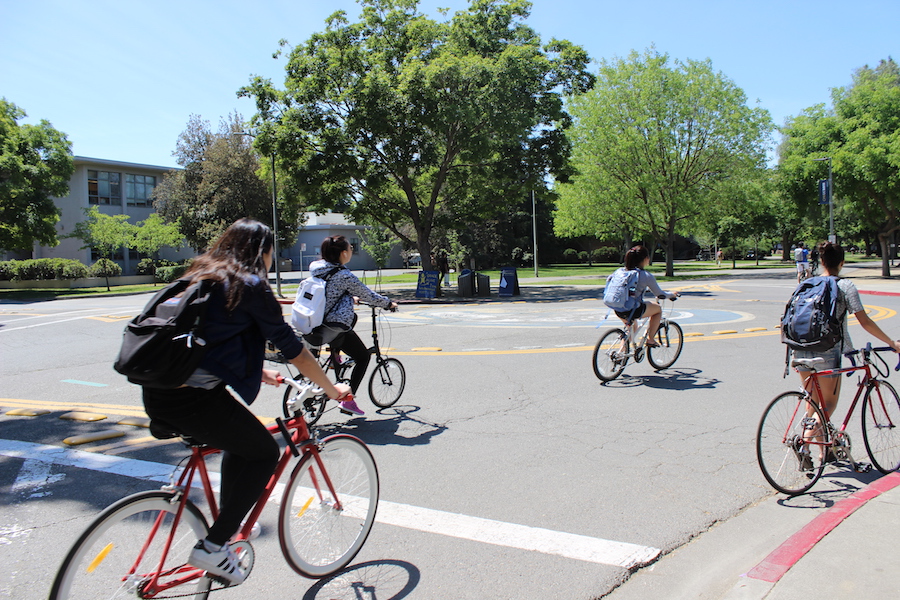
Davis, also known as the “Bicycle Capital of America,” is also home to the U.S. Bicycling Hall of Fame and was the first to establish the country’s first true bike lane in 1967. It continues to distinguish itself as a unique college town and the most populous city of Yolo County.

As the Davis community grows every year with university students and residents, safety is one factor that remains the same in terms of significance, improvement and awareness.

“Let’s face it, you’re going to have more fun on a bike if you’re not getting hit by a car or another cyclist,” said Maria Contreras Tebbutt, a Nationally Certified Cycling Instructor and the founder and director of The Bike Campaign and Bike Garage.

Tebbutt began her nonprofit organization, The Bike Campaign, back in April 2012 with the main purpose of helping to educate people about bicycling and encouraging more people to ride their bikes.

“Every year, hundreds of UCD students end up at the Student Wellness Center with concussions because they were simply not paying attention,” Tebbutt said. “Always focus on what you’re doing, whether it [is] by walking, [biking] or driving without multi-tasking.”

The campaign’s main goal is to reduce car trips to school as it advocates for all bike safety. As it was the anniversary of the organization’s founding this past April, Tebbutt celebrated its success and plans to continue working with volunteers, city governments, school districts and community service groups to make Yolo County “a cleaner, healthier, friendlier, more prosperous place through bicycling.”

As the biking population increases, UC Davis’ implementation of a free online Bicycle Education Program provides students, faculty and residents a resource to learn more about how to stay safe and become accustomed to the biking community and its surroundings.  

As UC Davis continues to advocate for road and bike safety, the UC Davis cycling team is a great example of bike safety advocates as it continues to consistency rank among the best on a state level as it is an all-inclusive, co-ed club open to all students.

“Take off the headphones, [as] all senses are essential for effective and safe riding. Wear a helmet [because] helmet hair shows one actually cares about protecting the noggin’ that got them into UC Davis,” said Scott Cohen, a third-year materials science and engineering major and the president of the UC Davis cycling team, in an email interview. “Use lights [at night], [and] if you can’t see […] without lights, imagine how shocked a driver would be to have a cyclist as a hood ornament.”

Cohen humorously insisted that individuals have to be aware of their surroundings, interact with traffic without fear and ride predictably.

I think Davis is an incredibly safe place to ride as there’s bike lanes and paths pretty much everywhere,” said Ross Kelly, a fourth-year statistics and managerial economics double major and the treasurer of the UC Davis cycling team, in an email interview. “As long as you’re not being reckless, there’s not much to worry about. If you feel uncomfortable on busier roads like Anderson/Covell/Mace, [take] a quieter route.”

Both students and residents of must acknowledge their place in the community and work to contribute to the safety of the City of Davis, as the city in turn works to maintain safety, regulate and enforce laws,.

“The laws for driving a car are the same as they are for riding a bike,” Tebbutt said. “Cars/bikes drive in the same direction, [one should] obey all street signs, use hand signals, smile, and make eye contact in all directions.”

Both the UC Davis cycling team and the Bike Campaign offer other resources and helpful advice on their respective websites. More information about what the NSC is doing to bring awareness and encourage safety everywhere can be found on the NSC website.

Learn more about cycling safety from the UC Davis TAPS website, and make sure to pledge to be an attentive driver and biker on the NSC website in order to bring awareness to and practice effective strategies in staying safe all year long.


Written by: Ray Ruano — city@theaggie.org

The grading curve: redefining the standard

MORGAN TIEU / AGGIE

Students discuss their experiences with curving grades

A 40 percent under “Grades” on UC Davis Canvas typically wouldn’t elicit a positive response. However, for students who are graded on a curve, it might end up being a passing grade.

“The average for the [Economics Department] has to be a B-, a 2.75 gpa,” said Thomas Smith, a fourth-year economics major and a teaching assistant in the Economics Department. “So as long as [the professor is] within that standard, it doesn’t matter how many A’s and B’s or C’s or D’s or F’s [they] give as long as the average is a B-.”

The Economics Department uses a bell curve to average the scores of a class, in which each student’s letter grade depends on their performance relative to the rest of the students in that class. Once the class average is found it typically becomes a B- and the rest of the grades are assigned depending on the width of the distribution of scores. The professor can give out more A’s and F’s and fewer middle grades, or have a wide B range and few A’s and F’s for top and bottom-scoring students, just as long as the class average remains at a B-.  

Not every department at UC Davis grades on a curve as each one has a different grading policy. Some departments adhere to a strict curve, while others are at liberty to give out grades based on a preset scale, regardless of what the class average becomes. Tommy Schultz, a third-year material science and engineering major, finds most of his classes have been graded on a curve.

“I think [professors curve grades] to challenge people and see who actually knows the […] hard material,” Schultz said.

According to Schultz, engineering professors set the curve depending on how the class is responding to the material.

“One class, the average was a 40 percent overall,” Schultz said. “So [the professor] set that at a B-, so an A became a 53 percent.”

While students in these departments depend heavily on this grading scale, other subjects rarely grade on a curve. Stephanie Whitworth, a third-year English major, has only experienced one of her major classes curve the grades.

“For my English class where they curved the final, they took the highest score which was a 95 percent and made that 100 percent,” Whitworth said. “So basically everyone got five extra points. I’d say this is a fair way of grading.

The curve tends to be used more in classes where grades depend on students’ test performance. Classes that are not test-based but value a process, like in a University Writing Program course, tend to grade without a curve.

Some students like Ann Ogihara, a third-year economics and international relations double major, appreciate when professors grade on a curve.

I think [the curve] is really helpful because economics classes can be really hard,” Ogihara said. “If the professor isn’t really good — if they don’t grade [the class] on a curve — then everyone’s going to get a bad grade and that’s not fair, so I think the curve really helps to have fair grading.

Like Ogihara, Schultz also believes grading on a curve is helpful because he feels it pushes students to study harder.

“I feel like the curve is a good thing,” Schultz said. “It kind of evens out everything and lets you know where you stand in the class […] so I like it, it lets you pass the class while still being challenged.”

Schultz and Ogihara believe that the curve allows professors to test students on more difficult material while still giving students a fair chance to succeed in the class.

I definitely want [professors] to give harder tests and grade on a curve,” Ogihara said. “Because I don’t think the teachers always know what’s easy. The professor might think the test [they are] making is easy but I don’t think [they] really know what the student considers easy.

Unlike Ogihara and Schultz, Smith does not believe grading on a curve is a fair way to grade students.

“I’ve always been an avid objector of the curve because it creates a disincentive,” Smith said. “If a majority of the class doesn’t do well then they get curved to a passing grade. So it’s almost dissensentivising to study hard because […] if a part of the class does poorly then [they] can get curved to […] a very decent grade.”

Smith finds that even at times he does well in a class, the curve has brought his grade down because of how the grades were distributed.

“So when you are at the top of the distribution you have to raw score an A to get the A,” Smith said. “If you’re at a 93 or a 92 […] you usually get an A- even with the curve but the people you were beating by 15 to 20 points end up getting a B or B+.”

According to Smith, the curve can be unfair as it does not always accurately reflect a student’s individual academic performance but does so relative to their peers’.

“It’s like my grade is supposed to represent my knowledge,” Smith said. “It’s almost being dampened because the people that scored really lower are getting boosted up and I’m not getting boosted up. It’s kind of like an unfair distribution if you’re at the top of the curve, which sucks.”

Smith has also found that students are more competitive with each other in classes that are graded on a curve.

“If you try to study with one of the top students they don’t want to study [with you] because your grade depends on how well they do and vice versa,” Smith said. “They don’t want to help you achieve anything.”

From Smith’s experience, students are less willing to help each other understand the material, which can ultimately hurt the learning environment.

“When there’s no curve you’re up to your own devises and it doesn’t really matter what the other [students score],” Smith said.  


Written by: Elizabeth Marin  — features@theaggie.org


UC Davis celebrates bike month in May

On campus events held to encourage biking

This May is bike month in the Sacramento region, meaning transit agencies and air quality organizations will be encouraging people to ride their bikes all throughout the month and on. UC Davis will be partaking in bike month as “the bike capital of America,” according to The Guardian.

UC Davis has many bike related events lined up for the month of May. One event is the Helmet Hair Don’t Care (HHDC) Bike Helmets and Bagels, which will take place on May 23 at 10 a.m. in the Bike Barn. This event is recruiting students, staff and faculty for a photo to be used as part of the 2017-2018 HHDC campaign material. Free bagels and Aggies Ride shirts will be available and funded through Transportation and Parking Services (TAPS).

“We are hoping to get a large gathering of the campus community wearing bike helmets to show that bike safety is a community wide effort,” said Shantille Connolly, a UC Davis wellness educator and creator of HHDC, via email.

Connolly started the HHDC campaign last fall in order to increase bike helmet access at UC Davis. HHDC allows students to receive a free helmet from the Bike Barn if they sign a pledge to wear a helmet while biking.

“Student Health and Counseling Services began focusing on bike helmets, because our ACHA-NCHA data from Spring 2015 showed that only 7.9% of students usually or always wear bike helmets,” Connolly said via email. “The national average for college campuses is around 39%.This huge gap represented a need for bike helmet promotion at UC Davis. Given the number of bikes on our campus on a daily basis, bike helmets are essential for unintentional injury prevention. Students are here to learn and expand their knowledge, but one bad accident can have deleterious effects to their academic success.”

The HHDC is also hosting a Bike Helmet Crafternoon at the LGBTQIA Resource Center on May 5 from 12:30 to 2 p.m. There will be glow in the dark puff paint, glow in the dark stars, decals and reflective tape available for decorating purposes. Students can receive a free helmet at Crafternoon.

One of two annual UC Davis bike auctions will be held on May 6 in the UC Davis Pavilion Parking Structure. The bicycles can be viewed from 7:30 to 9 a.m. with bidding beginning at 9 a.m. until all bikes are sold. TAPS disposes of abandoned, unclaimed bicycles at these publicly-held bike auctions. Over 400 bikes will be available for sale to the highest bidder.

“The auctions provide a way for Transportation Services (TAPS) to return abandoned, unclaimed bicycles to the community,” said Leslie Mancebo, the TAPS transportation demand and marketing coordinator, via email. “285 bidders participated in the Fall 2016 auction where we sold 422 bicycles. The average price per bike was $43.44.”

Jamien Bergstrom, a third-year mechanical engineering major and a Bike Barn manager, highly recommends that student bikers wear helmets.

I know many don’t consider it fashionable but it could mean the difference between having just a dented helmet or traumatic brain injury,” Bergstrom said via email.

Bergstrom included additional tips, encouraging riders to use front and rear lights, ride predictably, signal when turning and avoid cell phone use while biking.

[Not signaling] is the number 1 cause of crashes on campus,” Bergstrom said via email. “I’ve watched a group of friends take each other out in a bike circle because each one was trying to go in a different direction […] I can’t stress this enough, no one likes the [unpredictable] person that thinks it’s a good idea to make a sudden left turn from the far right hand side of the bike path during rush hour.”

Additional events during bike month are the Bike to Work Day Block Party and the Bike Party Davis. The Bike to Work Day Block Party will take place on May 9 from 11 a.m. to 1 p.m. The first 100 people who show that they signed up for the bike commuter challenge will receive a free lunch at 3rd Street from UC Davis to University Avenue.

The Bike Party Davis event will be on May 26 at 8 p.m. at the Ken’s Bike-Ski-Board in downtown Davis. People can decorate their bike with lights, and the route and theme will be posted on the Bike Party Davis Facebook page.

Written by:  Yvonne Leong — campus@theaggie.org


Former California Aggie editor-in-chief wins Pulitzer Prize

JANE TYSKA / BAY AREA NEWS GROUP

Matthias Gafni wins prize for work at The East Bay Times

What started off as a dream to play football morphed into the beginnings of a journalism career that took off and landed on a Pulitzer Prize. Matthias Gafni, a 1998 UC Davis alumnus, hoped to play football his freshman year, but ended up pursuing journalism after realizing that football was not the right fit.

After seeing an ad in The California Aggie stating that sports writers were needed, Gafni applied and got a position. His first assignment on the sports desk was a feature on a men’s soccer player. Gafni continued with the paper as a sports writer for his first two years, Assistant sports editor his third year, sports editor in the fourth year and editor-in-chief in the fifth year.

“I owe a ton of my journalism career to the CA Aggie,” Gafni said. “That’s how I learned to become a reporter.”

Upon graduating from UC Davis, Gafni had big aspirations to further his journalism career, applying to several big newspapers.

“I applied to The New York Times, The Washington Post and all the big newspapers, thinking, who wouldn’t want this former EIC of The California Aggie on their staff,” Gafni said. “I don’t think I got a single response from any one of those. The only one I heard back from was Donrey Media Group, and I don’t even know if they still exist to be honest. I got a call from some woman in Arkansas, which was their headquarters, saying they were interested in hiring me to one of their papers.”

After landing a copy editing position there, Gafni moved his way up to become a reporter and eventually ended up at The East Bay Times, where he wrote his article on the Ghost Ship fire investigation in Oakland. Gafni had taken the early Saturday morning shift for the paper, and received a call from one of his colleagues saying there was a really serious fire that his editor wanted him to cover. Gafni recounted rushing out to the scene, standing across the street at a Wendy’s parking lot amongst the fire chief and a couple other reporters.

Following the incident, Gafni and a few of his colleagues kept pursuing the topic, trying to find out more about what had started the fire, getting statements and official documents from the Oakland Fire Department and the City Attorney’s Office. In addition, the news team also went to several press conferences and talked to victims and family members that were at the scene.

“Interviewing is obviously an important part about [journalism]. Making a source comfortably is really important. As an investigative reporter, you find a lot of sources who don’t want to talk to you,” Gafni said. “For me, what I love about journalism is the chase. I’m an investigative reporter and I get a rush from investigating things and tracking things down and making changes for the good and write stories that have an impact and shine a light on the darkness and bring it out.”

Since Gafni was able to get to the scene almost immediately, The East Bay Times ran the story in a very timely fashion, much earlier than other news companies. This story, along with other articles published, was what helped The East Bay Times to win a Pulitzer Prize. Of course, staff members all recognize Gafni for his tremendous work and effort.

“[Gafni] is awesome; he’s such a good reporter,” said Angela Ruggiero, a Bay Area News Group reporter and also a former Aggie staff member. “[He] and the other team, as investigative reporters, are still working to this day on the Ghost Ship fire investigation, and are still covering things left and right. You know that they’re working on something important and big. And of course, it’s a plus that he’s a fellow former Aggie.”

Cecily Burt, deputy metro editor of The East Bay Times, shared a similar sentiment.

“[Gafni] is our go-to reporter whenever there’s any kind of a big breaking story,” Burt said. “[He] is always one of the first, if not the first, to know about things, whether he’s seen it on a tweet or email or google alerts. He finds out about these things that are happening, often times before the editors do. He’s always one of the first to volunteer to cover big stories. In addition to always being one of the first, he is always really good at digging up odd stories or obscure stories that turn out to be really fantastic reads for our subscribers […] he is a really amazing person in that way.”

Although having received much praise for helping The East Bay Times receive a Pulitzer, Gafni still describes the process as a team effort. As for his journalism career, he attributes it to The California Aggie, which was the basis for his newfound love in a difficult, yet rewarding field.

“[I have] so many good memories at The Aggie […] My best memories are the people I worked with––they become like a second family,” Gafni said. “You hang out together, you go on trips together and you work together, and it’s just such a fun experience and really was the highlight of my career at Davis.”


Written by: Kaelyn Tuermer-Lee — city@theaggie.org

13 Reasons Why promotes problematic narrative

GENESIA TING / AGGIE

There are alternatives to talking about mental health

Content warnings: suicide; depression and anxiety; sexual assault

13 Reasons Why. I know everyone and their mother is talking about it. Except me. I will never watch 13 episodes of a show that promotes a problematic narrative, and here’s why…

I have struggled with depression and anxiety my entire life, and I know I could never watch the show. Most of the information I utilize in this article about plot points I found online or overheard in my friends’ conversations. I could never watch it because the content is far too triggering. And the show often goes without content warnings for subjects such as depression, rape and bullying — all facets of each episode. Furthermore, in the final scene, the main character, Hannah Baker, commits suicide via self-harm — another extremely triggering subject. This is ironic since the show explores mental health, yet is problematic for those who actually suffer from these disorders because it does not provide trigger warnings and shows extremely graphic content. This means that many vulnerable viewers may be caught off-guard by the show’s content.

Additionally, the way that Hannah commits suicide is glorified, romanticized and almost glamourous. The blood they show and the way it is done in a bathtub is a trope that has been utilized in the entertainment industry to depict mental health with a very broad and often inaccurate paintbrush. It seems like it’s been done since the beginning, with Romeo and Juliet, who both take their lives for love. So maybe 13 Reasons Why is simply following that narrative: that depression can only end in graphic tragedy.

The show’s target audience is teenagers and young adults who are most vulnerable to mental health struggles. This show leaves a message that is not positive; when Hannah seeks advice from the school counselor, even detailing her suicidal idealization, the school counselor tells Hannah he can’t do anything unless Hannah gives him the name of the classmate who raped her hypothetical friend, and that she should try and move on. From a realistic standpoint, this would never and should never happen.

Realistically, the counselor would have referred Hannah to therapy, even hospitalizing her if her suicidal thoughts were deemed severe enough. Being able to confide in trusted adults — especially licensed ones — is necessary. It is important for the audience to know that they should get help if they experience symptoms of depression and anxiety. Therapy is a great resource that I continue to utilize, and no one should be discouraged from that.

The fact that Hannah even records tapes to those who wronged her and sends them out before her death romanticizes suicide. It depicts her death as the perfect revenge, and that those who bullied her will live in a lifetime of guilt. In all actuality, when someone is considering suicide they would never stage it in the framework of revenge, but more because the emotional pain they endure is too much. With mental health already facing so many barriers due to stigma, romanticization of it only adds fuel to the fire.

Many of my friends have watched the show, so I’ve overheard their conversations about it. But what frustrates me is they have never talked to me as openly about my mental health as they do about Hannah’s. The argument that the show opens doors to conversations about mental health is inaccurate because no one since watching that show has approached me to even ask for my opinion on it.

So, I’m far from satisfied about the dramatized perspective 13 Reasons Why gives. It is, however, a good conversation starter to ask more from the entertainment industry.

But should our mental health even be considered entertainment? According to The Jason Foundation’s website, there are an average of 5,240 suicide attempts per day by people in middle school and high school. And suicide is the second leading cause of death for those ages 10 to 24. How’s that for an accurate portrayal of mental health in the U.S.?

There are other ways to use your time than binge-watching a problematic Netflix show. How about donating to The Trevor Project, which works on suicide prevention with LGBTQIA youth? Or talking to those closest to you about their struggles with mental health?

Who knows, you might even learn about a real narrative surrounding mental health, and one that doesn’t need 13 reasons why.  


Written by: Abigail Wang — arts@theaggie.org

Women’s water polo places fourth in Big West Conference Tournament

CAT TAYLOR / AGGIE

Hawai’i edges out UC Davis in last seconds of match, wins 10-9

Coming off a 14-2 loss in the semi-finals against UC Irvine, the UC Davis women’s water polo team finished its season with a loss to the University of Hawai’i Rainbow Wahine on Sunday, April 30. Hawai’i beat UC Davis 10-9 in the third-place game of the Big West Conference Tournament. The Aggies left the Schaal Aquatics Center ranked 11th nationally and ended their season with a record of 16-18.

The first quarter was a defensive battle that began with UC Davis winning the sprint. Senior goalkeeper Avery Dotterer didn’t let anything past her, blocking every attempt. Junior attacker Sammy Preston skipped in a lone goal in the final five seconds of the quarter.

CAT TAYLOR / AGGIE

The second quarter saw each team step up their offense. Hawai’i managed two goals in the first two minutes of the quarter, taking a 2-1 lead. That lead didn’t last long against a goal by junior utility Paige Virgil. Hawai’i responded with another two goals, but once again, that lead didn’t last. Sophomore utility Annie Kutt scored for UC Davis, followed by another Aggie goal from Preston. Junior center Greta Kohlmoos gracefully lobbed a goal in, evening out the score after another Hawai’i point. In response to Hawai’i’s sophomore attacker, Irene Gonzalez’s second goal of the quarter, Preston barred in another point, ending the quarter tied at 6-6.

“This was the best we’ve played in a while,” Kutt said. “Hawai’i wasn’t expecting that from us.”

The Aggies and the Wahine each racked up two more goals in the third quarter, with junior center Jill Bushman and Kutt each scoring once. The Rainbow Wahine came back in full force during the second half of the quarter, scoring twice.

The fourth quarter was truly the deciding quarter of the game. At the top of the quarter, the Aggies and the Wahine were tied at 8-8 and remained neck and neck until the last minute. After a power play goal, Hawai’i took the lead. Virgil scored a tying point in response. Despite Dotterer’s aggressive defense at the cage, where she had four saves following the most recent Hawai’i point, the Rainbow Wahine managed a winning goal and brought the final score to 10-9.

CAT TAYLOR / AGGIE

“It was an exciting game, obviously,” said head coach Jamey Wright. “It’s always a little more fun to win those exciting games than to lose them, but really we played such a poor game [Saturday], I was glad that the energy was so much better, the effort was better, the execution was better. It was really more reflective of how good of a team we are. It was just a super effort. It was a good way to send the seniors out. We want to finish on something that’s memorable.”

Following the tournament, the Aggies are already looking ahead to next season.

“I think we need to just keep doing the things that work well for us,” Wright said. “We were able to swim with [Hawai’i], our fitness level is good. I think we need to improve our shooters. We had a lot of opportunities, especially yesterday, that we didn’t finish off. A lot of shooting, a lot of offense, and maybe a little more legs. Getting ready for next year, legs are a big thing.”


Written by: Liz Jacobson — sports@theaggie.org

City to hold public hearings on styrofoam ban ordinance

AARON KEOKHAM / AGGIE

Davis will be the 100th municipality in California to accept the ban

The City of Davis plans to hold a series of public hearings regarding enactment of a proposed ban on polystyrene foam, or styrofoam. The ban will be applicable to all businesses and restaurants that serve food and beverages starting September 2017, according a City Council meeting held on the evening of April 25.  

“This ordinance basically requests restaurants to use compostable or recyclable utensils or containers,” said Richard Tsai, the environmental resources manager for the Public Works Department of the City of Davis. “[This ordinance] is a very educational piece and important piece for our environmental program.”

It is not the first time that this ordinance has been considered by the City Council of the City of Davis. The ordinance was first proposed back in 2011 when the Council passed the Zero Waste Resolution Program, requesting staff to develop zero waste programs and was discussed again in 2013 in connection with the city’s updated Integrated Waste Management Plan. Tsai argued that passage of the styrofoam ordinance would not have been prudent until an organics program was implemented, like the one in 2016, which made composting certain food and beverage containers possible.

“Right now, there is 70 percent compliance voluntarily by restaurants in Davis that are already using non expanded polystyrene containers,” Tsai said.

Community members and local groups like the Natural Resources Commission (NRC) in Davis have pressed City Council for passage of the ban for years. Those who are pro-ban are supportive of the environmental benefits from using alternative types of food packaging products.

“I’m delighted to see this item finally coming before council,” said Alan Pryor, a resident of Davis. “Since then, however, we have heard every possible excuse given to us as to why this could not be moved forward.”

Pryor argued that it was the implementation of the plastic bag ban and compost programs, overextended staff members and CEQA law issues that pushed the ban on styrofoam back from the time a draft was introduced to the city by the NRC in 2011.

Throughout the state, many municipalities have already implemented bans on polystyrene because of the amount of waste generation that ends up in landfills due to environmental damage, which has negatively impacted oceans and marine life.

“According to the staff report, [we’ll be] the 100th jurisdiction in California to enact such an ordinance, so we are certainly not alone,” said Lucas Frerichs, a Davis councilmember. “There’s strong public support, not only in our community, but in many places in California for this same policy.”

During council deliberations, Frerichs defended the staff for their tireless work on other critical environmental projects implemented in the city, such as the plastic bag ban and integrated waste management plan.

“Yes, it’s taken a bit of time for the staff to bring this item forward to us, but it’s not for a lack of working on other priorities identified by this body, as well as previous city councils,” Frerichs said.

Nearing the end of discussion on the issue, two motions were made and passed unanimously by all council members. The first motion was to put the polystyrene ban item out for public hearing and to accept the negative declaration, while additionally altering the effective start date of the ordinance from July 1 to Sept. 1 of this year.

The second motion was made by council member Rochelle Swanson, requesting that an amendment to the ordinance be made, providing that restaurant owners shall not provide single use straws except upon request by the customer, with exemption to drive through and to go orders.

“500 million straws end up in the ocean all the time; it’s the number one piece of litter that’s picked up on beaches, so that’s why I specifically wanted to bring it up as part of this ordinance and part of our entire educational piece,” Swanson said.
Written By: Anya Rehon — city@theaggie.org

UC Davis softball bounces back from extra inning defeat

LUCY KNOWLES / AGGIE

Freshman pitcher shuts out Mustangs en route to 1-0 victory

The UC Davis softball team concluded its weekend series on Sunday against Cal Poly with a 1-0 win. On Saturday, the Aggies and Mustangs played two of the three games in the series in doubleheader fashion. In the first game, the Aggies were up against the Big West conference’s all-time strikeout leader, right handed pitcher Sierra Hyland. Hyland mowed down the Aggies on her way to a complete game shutout and an 8-0 Mustang win. Game two was much more competitive, as the two teams combined to break the Aggies’ Division I record for longest home game, at 13 innings. The Mustangs walked away with a grueling 8-7 victory. On Sunday, the Aggies came out determined to salvage the series and delivered a dominant pitching performance and a 1-0 victory.

Freshman right handed pitcher Katie Kibby started for the Aggies, while another Cal Poly heavyweight right handed pitcher took the mound in the form of Lindsey Chalmers. Both pitchers battled back and forth for the first four innings, with Kibby throwing three and two thirds perfect innings and Chalmers matching her with three innings of two-hit softball.

“Personally, I get very [competitive]. If [Chalmers is] going to do that, then I’m going to do it better,” Kibby said. “With Sierra Hyland, [when] she’s hitting, I even want to dig in more and have an ‘I’m going to get you out’ [mentality].”

In the bottom of the fourth, the Aggies’ bats came alive, and freshman left fielder Marissa Jauregui turned on the first pitch of the inning for a massive solo shot over the left field wall.

LUCY KNOWLES / AGGIE

“We talk a lot about being aggressive and attacking our pitch, so going [to the plate] I knew that I was going to take my best swing on the best pitch that I got,” Jauregui said.

Freshman center fielder and third baseman Isabella Leon followed suit with a line drive triple that flew just over the Cal Poly right fielder’s outstretched glove. However, the Aggies were unable to score Leon and left her stranded on third base.

In the top of the fifth, Cal Poly began a furious rally with a leadoff single and a walk. The Aggies were able to work themselves out of the jam with great defense, but ultimately made it out of the inning thanks to a Cal Poly baserunning miscue by Cal Poly’s Hyland, who forgot to tag up on her way to home plate.

One run turned out to be plenty for Kibby, as she finished out the game with a complete game shutout, her third of the year.

“I just had the mindset of doing better than we did yesterday, and then I just took it inning by inning,” Kibby said. “I know my defense has my back and they made great plays today.”

The win snapped a three-game losing streak for the Aggies. The bounce back from Saturday’s extra-inning loss set the tone for a positive end to the season.

“On a day like yesterday, we have to have a short memory, we have to do whatever we can overnight to recover our bodies,” said head coach Erin Thorpe. “We basically played three games yesterday, [we need] to go out and get our minds and our bodies recovered and do whatever we can to show up the next day.”

LUCY KNOWLES / AGGIE

The Aggies head south next weekend for a series against UC Santa Barbara before returning for their final homestand from May 12 to 13 against Cal State University, Northridge.

“We’re not really looking at our opponents as any specific opponents, we’re looking at them as opportunities to continue to grow as a team,” Thorpe said. “[Even] our seniors are still working to get more consistent, come out here every game and compete, and our young ones are looking at it as another game to gain more experience.”


Written by: Rowan O’Connell-Gates — sports@theaggie.org


Last week in Senate

HANNAH LEE / AGGIE

Last week in Senate

Vice President Adilla Jamaludin called the April 20 ASUCD Senate meeting to order at 6:10 p.m. at the Memorial Union. All 12 senators were present.

The meeting began with the introduction of Jin Zhang, a third-year economics and international relations double major, who was recommended by President Josh Dalavai to fill the open controller position. Although Zhang has not worked with ASUCD before, she had an impressive resume, according to Dalavai. She has worked with the treasury department in Washington, D.C. and investment firms in Sacramento. Zhang was confirmed with no objections.

Next, Daniel Feinberg, a third-year environmental policy major, and Daniel Graves, a first-year genetics major, were confirmed as Environmental Policy and Planning Commissioners with no objections.

Dalavai gave a short speech commending the previous Controller Joseph DeAngelo, a fourth-year economics and political science major, for his exemplary work in the Senate.

Dalavi announced the status of legislation previously passed by Senate. Everything was signed except for Senate Bill #76, which does not require the American flag to be in the room during Senate meetings, which Dalavai said will be seen next week.

Senate discussed Bill #81, which would amend the bylaws to specify when ASUCD unit directors are hired. The amendment’s purpose is to clarify the specific time of year unit directors are hired. The bill will set the precedent of hiring ASUCD unit directors (except that of Picnic Day, Office of Advocacy and Student Representation and Whole Earth Festival) no later than the fifth week of Winter Quarter. Senator Daniel Nagey called the bill into question. The bill was passed with no objections.

The Senate voted on Senate Bill #82 which would amend sections 705 A and B of ASUCD’s bylaws. The amendments will ensure there will be Senate representation in the interviewing committees for ASUCD representatives at Academic Senate and Administrative Advisory Committees. Currently, senators are not regularly assigned to committees. This amendment will increase Senate representation and eliminate potential time conflicts between senators and committee schedules. The bill passed with no objections.

Next, voting took place on whether to allocate $1638.48 of Senate reserves for UC Mental Health Awareness Month stickers and programs. This May will be the first time ASUCD is coordinating efforts to commemorate Mental Health Awareness Month, championed by Senator Samantha Chiang, who organized UC Davis’ first Mental Health Conference last Winter Quarter. The bill originally allotted $449 for 2000 3” x 3” stickers and the remaining $1189.48 to cover 5” x 8.5” programs. Chiang’s request would remove 20 percent of the remaining Senate reserves.

After questions regarding the necessity of so many pamphlets and the potential to find a more reasonably priced supplier, Chiang admitted to not having the time or energy to thoroughly look into other suppliers. Chiang urged the senators to make a decision tonight so pamphlets and stickers could be ordered promptly. After a lengthy discussion the bill was amended to cover only 700 programs and the amended bill passed with no objections.

Students representing Environmental Justice for Underrepresented Communities (EJUC) gathered and implored senators to pass their resolution, which demands the topic of environmental justice become a required part of the environmental policy and planning major curriculum at UC Davis. Their resolution demanded short-term actions to make environmental justice classes more accessible to students and to develop an environmental justice track within the major. Additionally, the EJUC highlighted its long-term goal of establishing an environmental justice major at UC Davis.

“I don’t think I want to learn how to derive economically efficient ways to quantify people and the environment without critical discussion on who profits from doing so, which communities will be most affected by these equations and discussions and without recognizing the historic and continued marginalization and oppression of certain groups of people in the U.S. and abroad,” said Evan Steele, a fourth-year environmental planning and policy major and treasurer of EJUC.

The resolution was passed with a vote of 9-0-3.

Rosy Martinez, a third-year human development major, was confirmed as the Pantry unit director with no objections.

During public discussion, Mayor Robb Davis came to speak to senators about their successful turnout at the Davis city council meeting regarding the housing crisis and difficulty for lower income students to secure housing. Davis applauded senators for bringing the issue to the council and expressed confidence in the city’s relationship with the Senate.
Written by: Ally Russell — campus@theaggie.org

Dive into the deep side

VENOOS MOSHAYEDI / AGGIE

MFA’s “Field Notes” exhibition showcases eight first-year students’ artwork

The eight first-year students pursuing a Master of Fine Arts (MFA) degree whose work will be featured in the upcoming “Field Notes” exhibition were brave enough to indulge their talents and pursue a post-graduate education in studio art.

While the first year of their two-year degree is coming to an end, they assure that they have learned so much about their craft and simultaneously learned about themselves.

“I was working several years in marketing, and I came to [the] realization that that’s not what I want to do for the rest of my life,” said Ryan Meyer, a first-year student in the MFA program. “This other curiosity had to manifest itself.”

As he engaged more in his art and education, Meyer found himself “always bouncing from one idea to the next [because] there’s so much beauty in life and curious things that happen all day long, all around us — I can’t imagine sticking to just one thing.”

The program’s first year also impacted Doug Loree, a first-year MFA student, who started out painting but, because UC Davis’ MFA program is interdisciplinary, was able to shift gears and try something new. He is very excited by the way the program encourages students to be artists without monetizing their work. Loree is also grateful to be a part of a program which allows him to view his art without exchange-value and focus on the exploration of his heart.

“We’re not making art as product,” Loree said. “We are allowed to be experimental with our work. We do what we feel is true to ourselves.”

For Tavarus Blackmon, post-graduate education was always on his mind. Coming from a family in which his mother has a doctorate in education, he knew that he wanted to get a terminal degree. Blackmon believes that it melds the practical with his passion.

“MFA education provides the opportunity to establish myself as a professional in the field,” Blackmon said. “I’ve had a lot of jobs, but having a studio practice is the only time when I want to go to work every day.”

These artists have very different relationships with their art, but all of them try to attend to the human perspective.

Meyer “[tries] to get a better understanding of the world through the aesthetic.” Loree’s art explores the digital age, and his current project is to identify the relationship between the online life and real life. He is looking to explore the concept of control in the context of our very digital time, and he wants to know how much power is given to the online parts of life.  

When asked where he draws his inspiration from, Blackmon responded, “the world: sunshine, flowers, beautiful people, sadness, elation, curiosity — I would say a lot of curiosity because if I knew what I was doing or what it’s supposed to be, I probably wouldn’t even do it.”

And Blackmon’s advice for potential MFA students?: “Make it, do it, be it, live.”

The UC Davis first-year Master of Fine Arts students will exhibit their work at the “Field Notes” exhibition, held from May 5 to May 25 at Beatnik Studios in Sacramento. For more information, please visit the UC Davis art studio website.

Written by: Akaylah Ellison — arts@theaggie.org