55.6 F
Davis

Davis, California

Saturday, December 20, 2025
Home Blog Page 631

$175 million found in hidden reserves at UC Office of the President

UC DAVIS / COURTESY

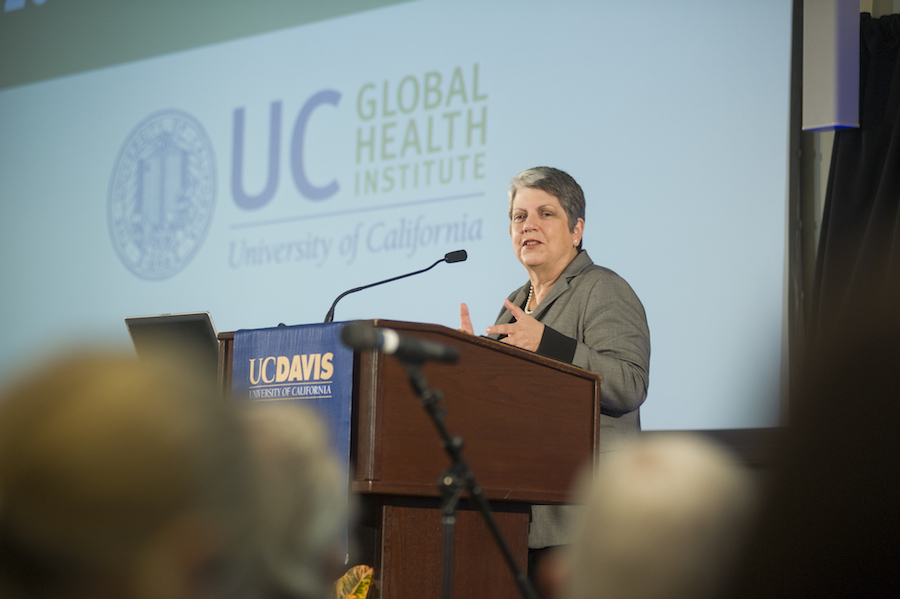
UC President Janet Napolitano paints California State Auditor report as mischaracterizing

The University of California Office of the President (UCOP) hid over $175 million in reserves, some of which could have been used on campuses, said a report released by California State Auditor Elaine Howle on April 25.

“Specifically, the Office of the President did not disclose to the regents that it had amassed more than $175 million in reserve funds as of fiscal year 2015-16,” the report reads. “[…] In effect, the Office of the President received more funds than it needed each year, and it amassed millions of dollars in reserves that it spent with little to no oversight from the regents or the public.”

In addition to hiding funds, the report claims that UCOP was uncooperative in auditing procedures, including tampering with the results of surveys sent to campuses.

“This conclusion is based on the fact that it intentionally interfered with our audit process, which hindered our ability in addressing certain aspects of our audit objectives,” the report reads. “Specifically, we administered two surveys to the campuses seeking their perspectives on issues such as the quality of the Office of the President’s services and programs. However, correspondence between the Office of the President and the campuses shows that the Office of the President inappropriately reviewed the campuses’ survey responses and that campuses subsequently made changes before submitting them to us.”

UC President Janet Napolitano responded to claims of budget mismanagement in a letter included in the report.

“The report falsely claims that UCOP failed to disclose ‘tens of millions in surplus funds’ and that UCOP’s’ budget practices are misleading,” Napolitano said in her letter. “In fact, UCOP’s budget and financial approaches reflect strategic, deliberate, and transparent spending and investment in UC and State priorities.”

Napolitano, in her letter, corrects the state auditor, claiming that the correct budgetary figure should be $170 million. Napolitano continues by further explaining the allocation of the funds, including a list of the use or planned use of the funding for each category.

“Of that $170 million, $83 million are restricted funds and $87 million are unrestricted funds,” the letter reads. “The $83 million in restricted funds supports a range of programs and initiatives, many of which are related to the systemwide and Presidential initiatives.”

Lieutenant governor Gavin Newsom, a UC regent, condemned UCOP and requested in a press release that the recent tuition increase come back before the regents for another vote.

“While respecting the constitutional autonomy of the University of California, I support the spirit and intent of the State Auditor’s prescriptive solutions and in particular, the recommendation for a third-party corrective action plan,” Newsom wrote. “Finally, it is outrageous and unjust to force tuition hikes on students while the U.C. hides secret funds, and I call for the tuition decision to come back before the Board of Regents for reconsideration and reversal.”

ASUCD President Josh Dalavai expressed his thoughts regarding the audit report.

“I am upset but not shocked by the findings from the audit,” Dalavai said via email. “I applaud State Auditor Elaine Howle for her efforts in exposing UCOP as a detriment to student well being instead of the perpetual help which that office should be.”
Written by: Kenton Goldsby — campus@theaggie.org
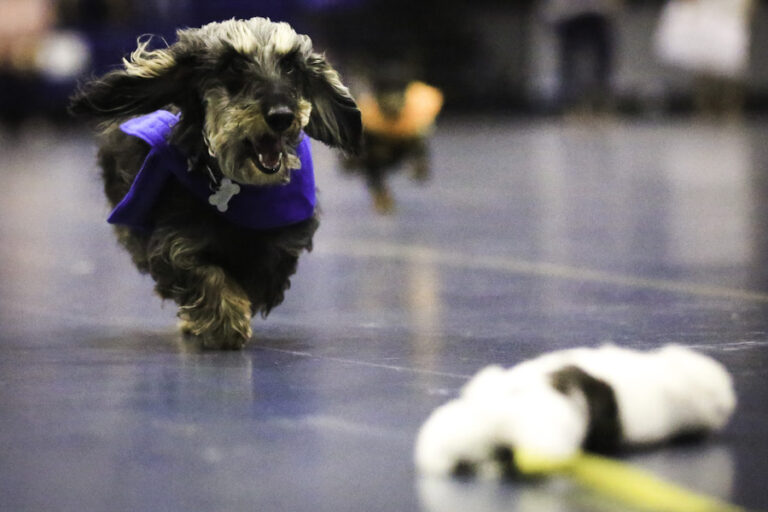
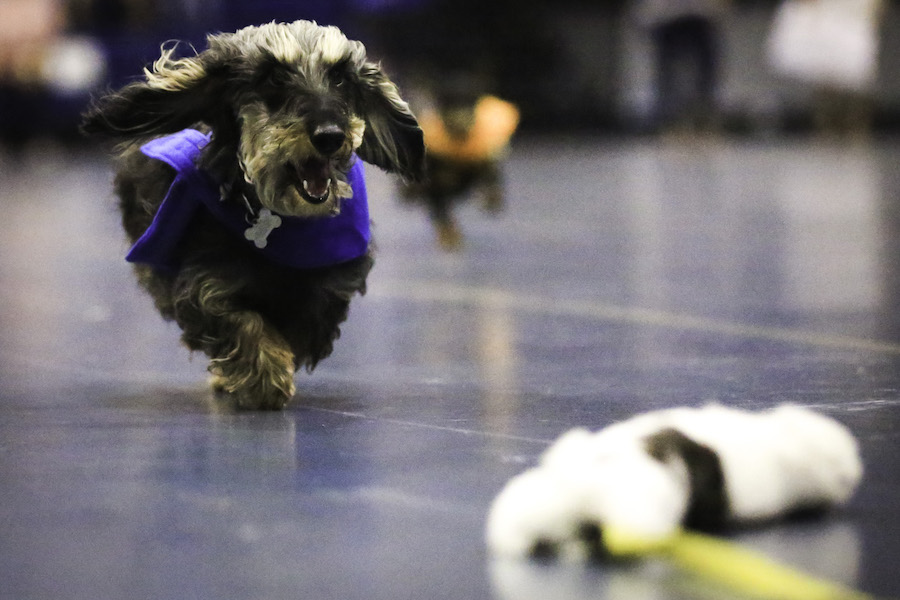
In Photos: Picnic Day 2017

Franck, Doxie Derby all-around wi(e)nner, races to the finish line to secure first place. (CIERA PASTUREL / AGGIE)
The song “Beginnings” is all about living it up. (LAURA LONG / AGGIE)
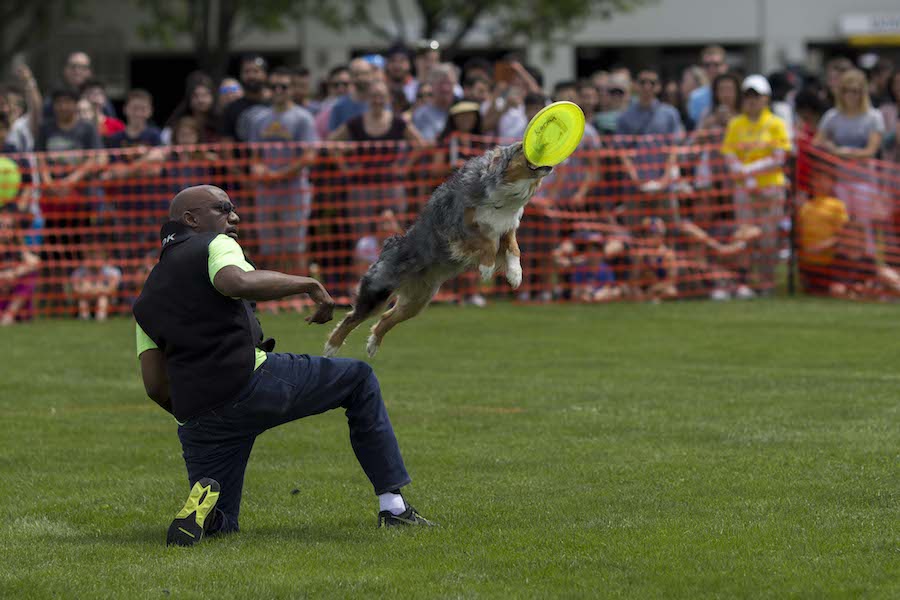
Disc Dogs of the Golden Gate is definitely a must-see at Picnic Day. (LUCY KNOWLES / AGGIE)
Learning how to preserve our ecosystems. (ZOË REINHARDT / AGGIE)
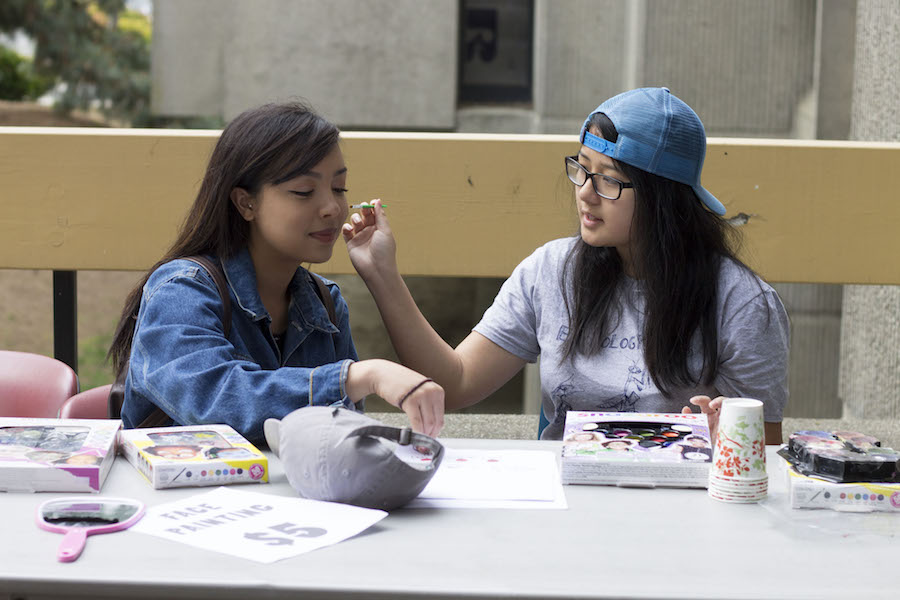
It’s not Picnic Day without face painting! (MEENA RUGH / AGGIE)
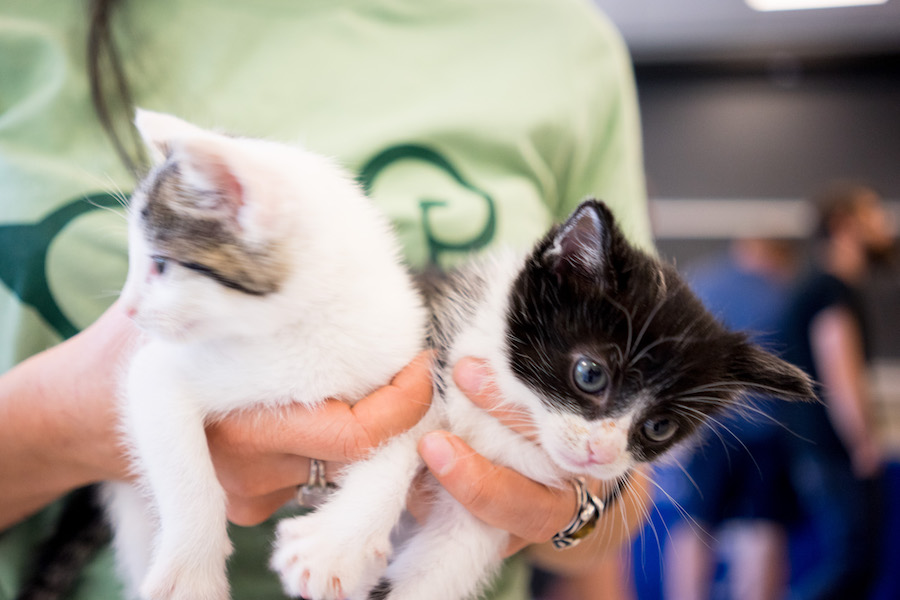
Confused kittens of the feline rescue showcase. (NICHOLAS CHAN / AGGIE)
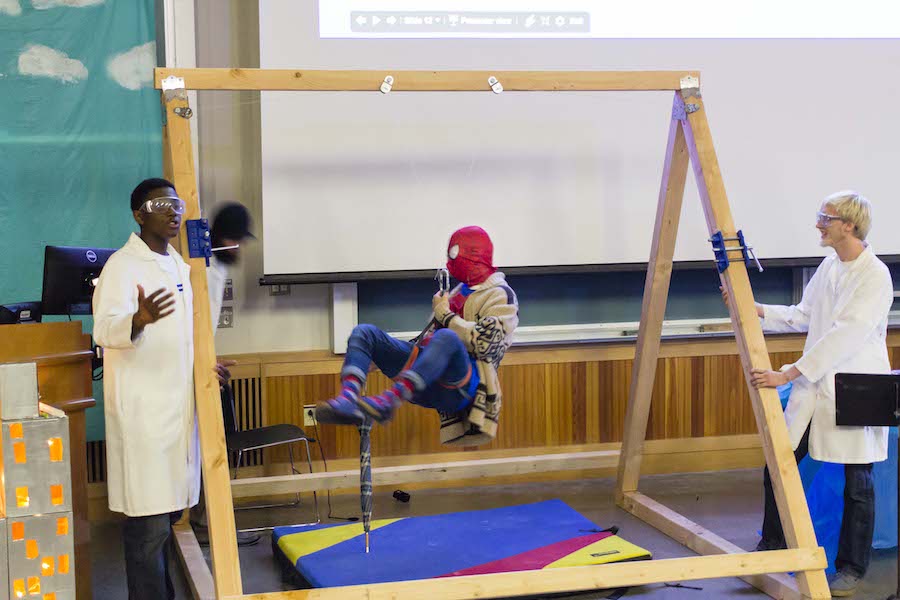
Spider-Man shows us the tensile strength of his spider web at the Materials Magic Show. (JERO REAL / AGGIE)
Head to the Cole Facility on Picnic Day for an udderly unique experience. (ANH-TRAM BUI / AGGIE)
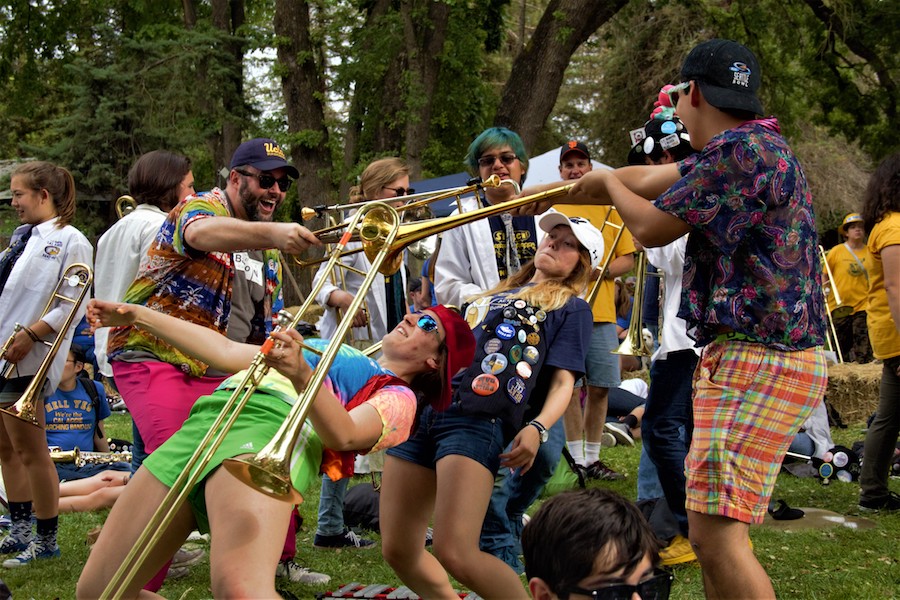
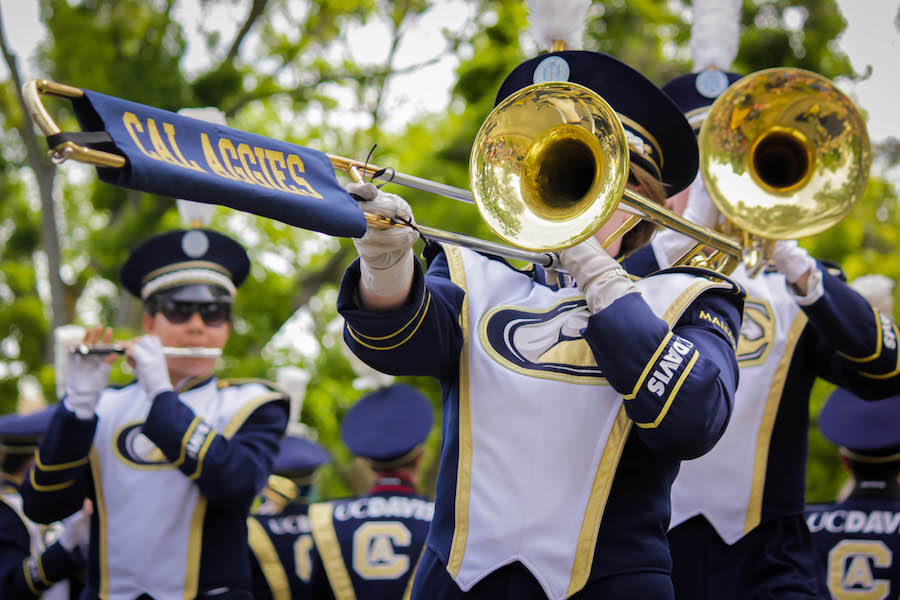
The Cal Aggie Marching Band-Uh! starts the day off right with a musically captivating performance. (KELSEY GREGGE / AGGIE)
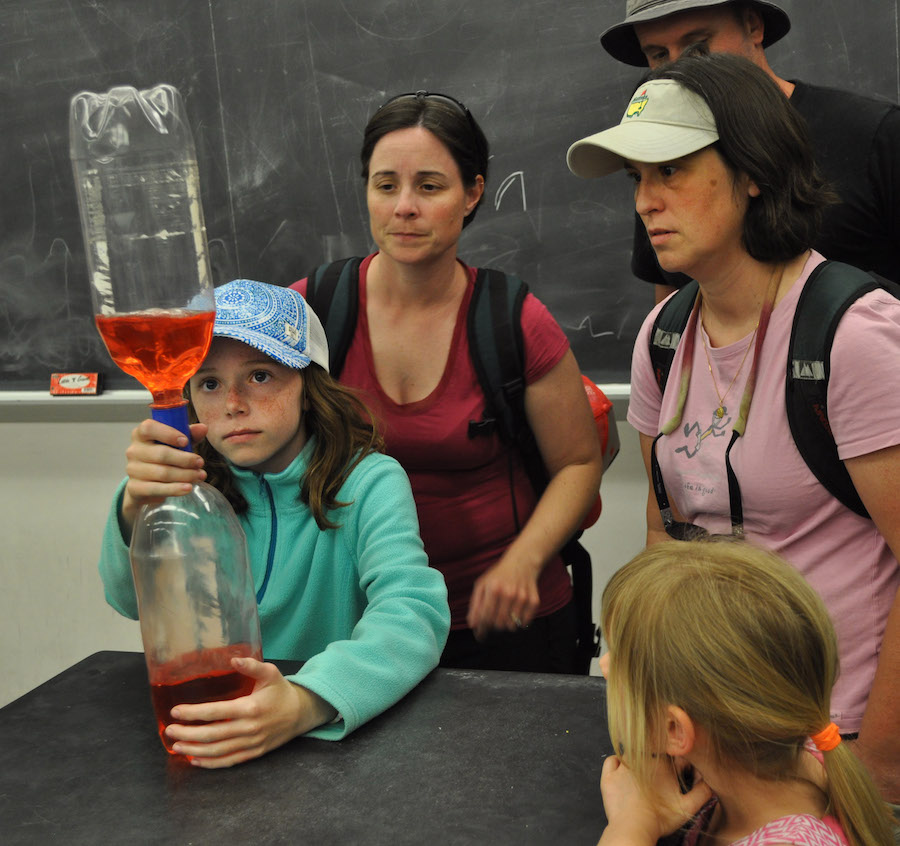
Families observe basic physics principles at work with a hands-on display. (JORDAN KNOWLES / AGGIE)
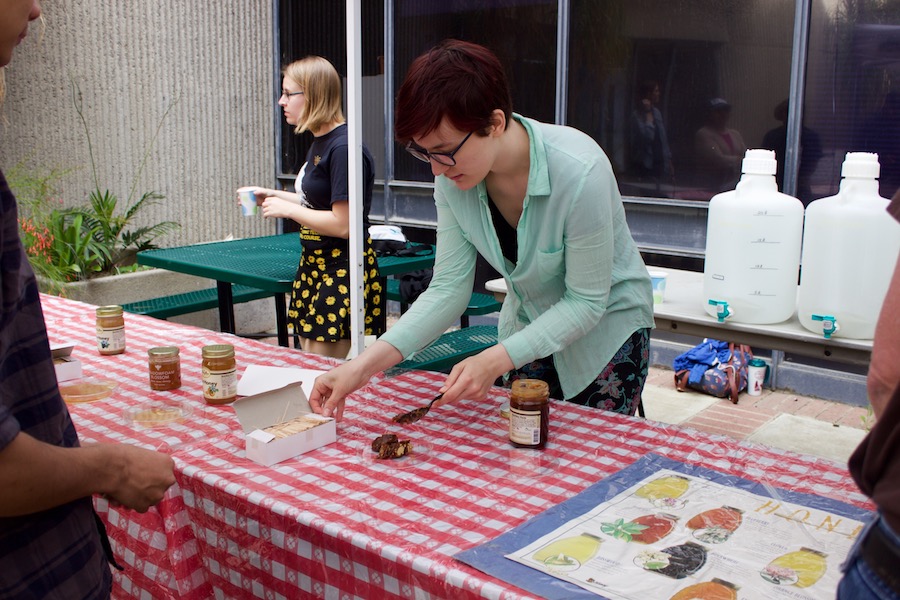
Parents, children and students experienced the various types of honey at the Honey Tasting Booth during Picnic Day. (VENOOS MOSHAYEDI / AGGIE)
Bird’s eye view of downtown parade. (FARAH FARJOOD / AGGIE)
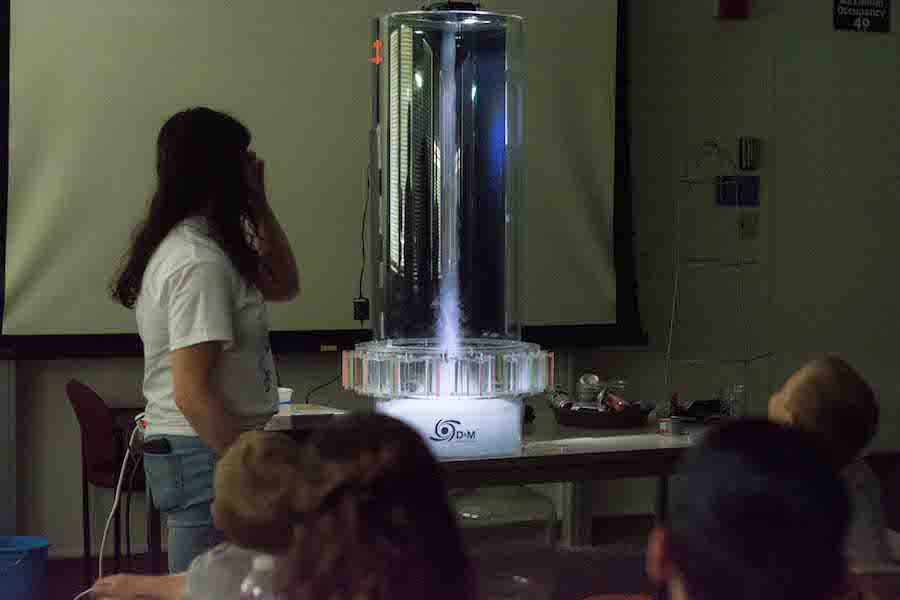
Creating an artificial tornado. (AARON KEOKHAM / AGGIE)
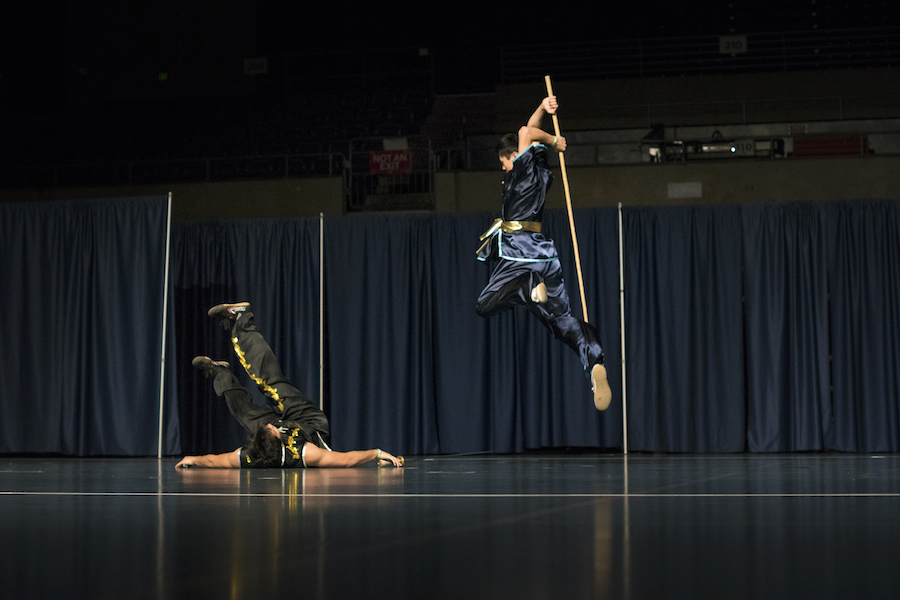
Davis Wushu puts on a thrilling performance at the annual Picnic Day Davis Dance Revolution. (BRIANA NGO / AGGIE)
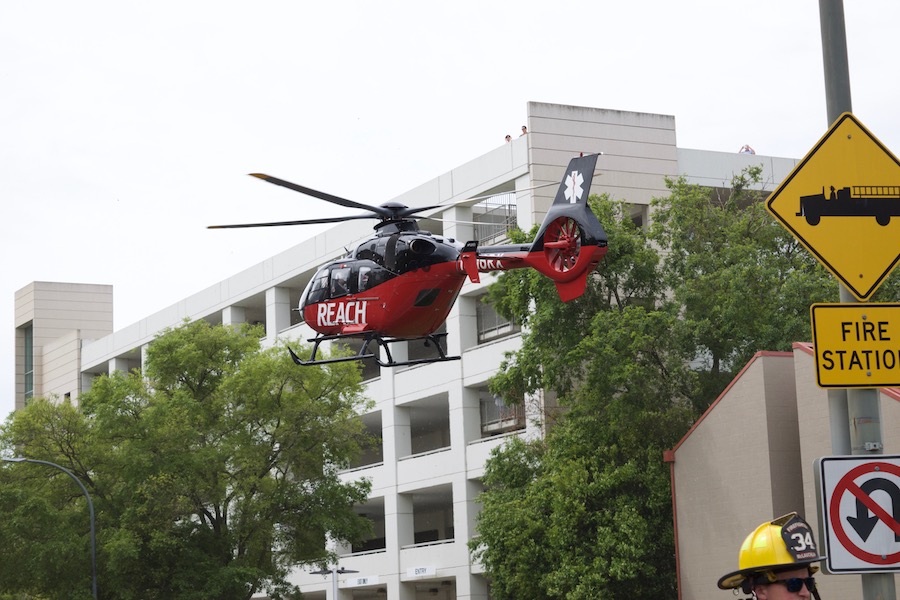
UC Davis lands a helicopter on campus. (ALEXA FONTANILLA / AGGIE)
Members of the UC Davis polo team lead a demonstration of the sport during Picnic Day. (BRIAN LANDRY / AGGIE)
The Cal Aggie Marching Band-uh! jams out at Battle of the Bands. (DIANA LI / AGGIE)
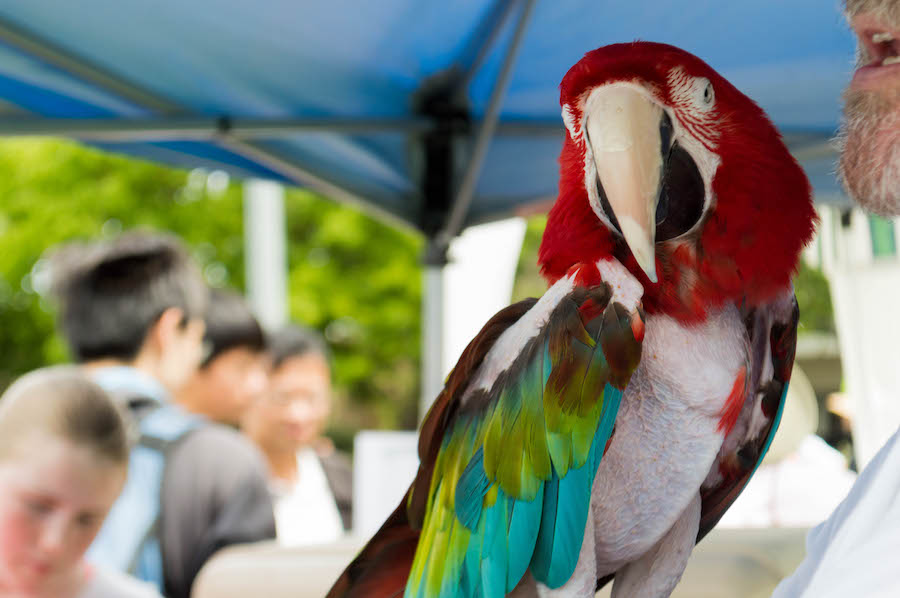
Meet Baby, the 9-year old macaw of Mickaboo Companion Bird Rescue. (CAT TAYLOR / AGGIE)


Compiled by: The California Aggie Photo Desk — photo@theaggie.org


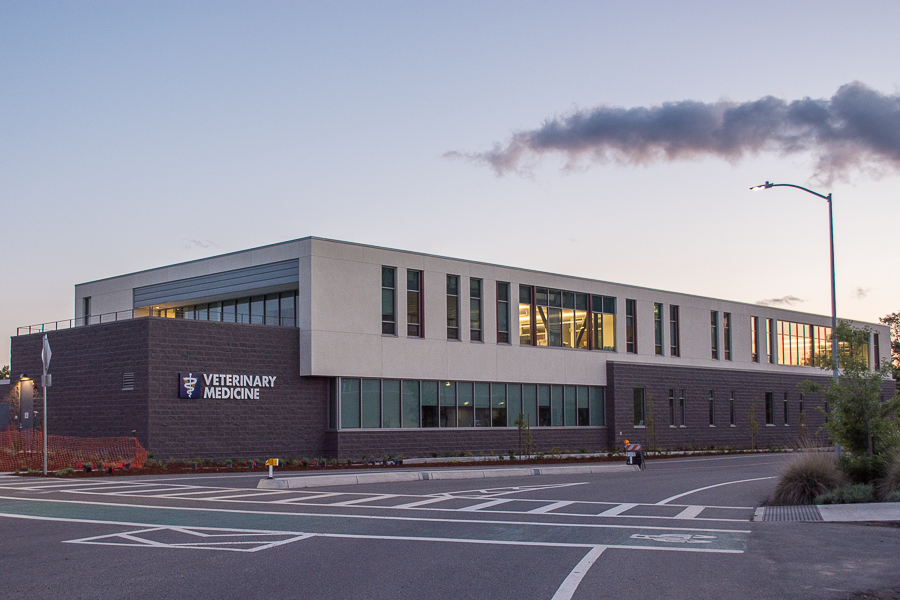
Veterinary Medical Center set to begin $508 million renovations

NICOLE WASHINGTON / AGGIE

UC Davis’ Veterinary Medical Center to undergo 10-year process of upgrades, additions

UC Davis’ Veterinary and Animal Science departments rank number one in the world, due in large part to the state-of-the-art Veterinary Medical Center (VMC) and its staff. However, with such prestige comes great demand, and in recent years the workload and student population of the VMC has overwhelmingly exceeded its holding capacity. The Veterinary Medical Teaching Hospital, located within the VMC, opened in 1970 and had around 74 students per class and saw around 3,000 cases per year during its inception. In 2016, those numbers were 145 and 51,000, respectively.

David Wilson, an academic administrator and director of UC Davis’ Veterinary Medical Teaching Hospital, began noticing a need for more space around 1996. He and other school administrators developed a plan for renovating the VMC, but it never materialized. Since then, the VMC’s overcrowding issues have been direly exacerbated.

“We have a very big shortage of exam rooms, so exams were being done in hallways,” Wilson noted. “Confidential conversations with owners were also being held in hallways, and students were forced to conduct their rounds in makeshift spaces. Essentially we ran into a problem of not only facilities becoming old and less functional, but also not having enough room to meet our current programs, let alone handle future expansion.”

In 2011, another plan was developed, and the directors are currently in the midst of raising funding for its $508 million budget. Wilson, who is overseeing the project, has already raised $65 million through foundations, corporate support, school fundraising and most of all, individual donors.

“We have a lot of individuals who bring animals into the hospital and really appreciate the care that we give to the animals,” Wilson said. “They become friends with the school and want to give back.”

The overhaul, which is expected to begin in 2018, is not solely an effort to create more space. New facilities are being planned that would extend the educational capabilities of the center as well as allow for better and more precise care for its animal patients.

The project will be separated into 17 main projects and nine minor ones. Some of the main projects include an equine performance center, a large covered arena which would allow horses to be examined while being ridden under saddle; an All Species Imaging Center, which would hold a centralization of advanced imaging capabilities (CT, PET CT, MRI and nuclear scintigraphy) and new surgical suites intended to improve safety and efficiency for patients and personnel.

The renovations will also aim to improve the accessibility and efficiency of the center. Plans include clustering the small animal services that require anesthesia in adjacent areas in order to reduce the need to transport anesthetized patients over long distances, as well as relocating the small Animal Emergency Service adjacent to the new east door of the Small Animal Clinic, which will allow clients to drive right up to the front door when unloading their ill or injured pet.

Consequently, the extensive amount of construction necessary in order to build the new facilities and renovate current ones will lead to a lengthy developmental period — 10 years to be exact. One of Wilson’s main concerns is ensuring that the continuous construction does not disrupt the natural ongoings of the VMC.

“Maintaining a hospitable, client-friendly and work-friendly environment is the biggest challenge I see,” Wilson expressed. “Having high quality patient care and excellent instruction of students and residents during this prolonged process is of utmost importance.”

Since its early days, UC Davis has had a reputation as one of the premiere universities for those looking for a career in the veterinary field, attracting students such as Michelle Higuera, a first-year animal science major.

“I’ve known I wanted to work with animals since I was in second grade, and when choosing colleges Davis was the only one I considered because it’s just that much better than the rest when it comes to animal science,” Higuera said.

According to Wilson, avoiding complacency is vital in order to stay on top, and revamping the VMC is one way to ensure that UC Davis will stay on the cutting edge of the veterinary science field while also maintaining its elite status.

Tanya Marotta, a first-year animal science major, believes that the VMC can become a prominent part of Davis’ attractiveness to future students.

“I think [the new Veterinary Medical Center] will definitely have a big impact on potential animal science students who are on the fence about which college to go to,” Marotta stated. “If they hear about the high tech veterinary medical center that we have then they may be more inclined to chooses us.”

Renovating the VMC will also be an opportunity to increase resources for students.

“The new facilities they are building [at the Veterinary Medical Center] will open up new research opportunities for students which is definitely a big plus,” Higuera said.

If Wilson’s ambitious plans for the VMC are realized, the potential impact could reach past the bounds of the veterinary science fields. As Wilson explained, many medical fields such as oncology often use comparative studies with animal cases. Many diseases found in animals are parallel to those found in humans, so a breakthrough in animal medicine can very well mean a breakthrough in human medicine.

“We contribute to animal health, human health and environmental health, and we’re interested in all of those,” Wilson explained.”That defines the concept of ‘one health,’ and the hospital plays an important role in our advances in ‘one health.’”

In the long term, Wilson hopes that the new and improved VMC can continue UC Davis’ longstanding pursuit of excellence in the field of veterinary science.

“UC Davis’ veterinary program is recognized worldwide currently, and our goal is to have that continue,” Wilson stated. “We’ve got outstanding professors, outstanding residents and outstanding students, but over time if we want to continue to attract the best we need to have facilities that can match their standards.”


Written by: Eddy Zhu — campus@theaggie.org
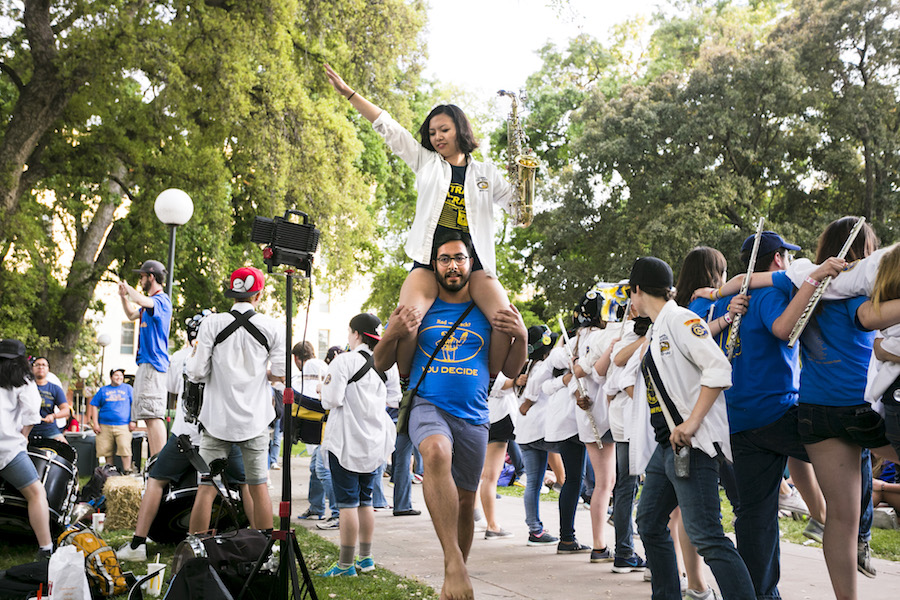
Nuclear sound

BRANDON GIESBRECHT [(CC BY 2.0)] / FLICKR (changes made)
UCLA musicology professor to give talk at Davis

Music offers its listeners a chance to revel in its emotional experience by way of sonically reproducing the heartbeat, the timbre of the soul or the lyrics of the mind. Jessica Schwartz, an assistant professor of musicology at UCLA, will be giving a speech that shows music is more than just sound; it can highlight our history and our humanity.

At the age of 15, Jessica Schwartz was introduced to the punk music scene, which helped her develop a framework to understand and think critically about the music she was listening to. Later in her college years, as an American Studies major, Schwartz started to examine the rise of nuclear testing in the 1950s.

“I became both fascinated and disturbed that I was unaware of the massive nuclear testing that the United States had conducted in the Marshall Islands,” Schwartz said.

Her interest grew out of this new knowledge, and in 2008, she moved to the Marshall Islands to learn more about the effects of nuclear testing.

“Given the current political situation between North Korea and the United States, an examination of the stories of the survivors of nuclear testing seems both timely and imperative,” said Katherine Lee, an assistant professor of ethnomusicology at UC Davis.

Schwartz’s speech will in part discuss these global effects of nuclear war.

“War doesn’t just happen and then there’s a clean slate,” Schwartz said.

Although her speech will also examine war’s relationship to music and the cost of nuclear testing, Schwartz believes that her speech is relevant to today’s political situation.

“As I’ve been seeing, under the current administration, tensions have been heightening; all of this pain and fear and our entanglement with the nuclear [suggests] the struggle still continues for nuclear justice,” Schwartz said.

Schwartz is visiting the UC Davis campus with the hopes of giving a speech that will illuminate to her audience that “through music people find voice literally and figuratively.”

However, speeches like Schwartz’s are not rare.

Philip Daley, the events and publicity manager at the UC Davis Department of Music, stated that “we put on the Valente lectures on a regular basis […] we try to represent equally the three disciplines we study music in: Musicology, Ethnomusicology and Composition.”

Schwartz’s speech is primarily centered on the ethnomusicology aspect, but there are other speeches throughout the year that will represent the widespread disciplines that the Music Department focuses on.  

“Nuclear violence is a form of intersectional violence on a global level,” Schwartz said. “What I’m hoping to do is share some of those stories and route that through my other perspective of someone who learns and explores the world through music; my hope is to bring people together.”

Her speech will discuss the way music allows people to heal themselves and deal with the harsh realities of our world.

The Valente speech will be held in Room 266, Everson Hall on April 27 from 4 to 5:30 p.m.


Written by: Akaylah Ellison — arts@theaggie.org

Student and local musicians hit Picnic Day stages

NICKI PADAR / AGGIE

Band-Uh!, Keni and katgrüvs among music showcases

It’s uncontested that Picnic Day is the largest and most well-attended event on the UC Davis campus. But between morning mimosas and the obligatory afternoon nap, many student picnickers miss out on the day’s abundance of local performers. From the intricate acoustics of fingerstyle guitarist katgrüvs to the folksy melodies of singer-songwriter Keni, Picnic Day is a rare opportunity for student musicians to showcase their talent to a diverse audience.

After watching the Weiner Dog races and grabbing a much-needed solid meal, stop by the Quad, the Pavilion or the lawn in front of Rock Hall and discover some new tunes by Davis musicians.


  1. katgrüvs: Quad stage, 12:20 – 12:50 p.m.    

Kat Gallardo, a third-year mechanical engineering major, is the brains behind the fingerstyle guitar project katgrüvs. This will be her third performance at a Picnic Day event, and she anticipates hitting the stage one more time — now with more experience and new content.

“I’m gonna bring out the classics like ‘The Deedle Leedle Song’ and ‘Down to the Wire,’ and I’ll probably be introducing a couple new ones that I’ve been performing lately during the quarter,” Gallardo said. “I’m probably gonna pull out a really new one, actually, that I debuted at the Cherry Blossom Festival.”

Gallardo looks forward to performing at an outdoor stage and seeing both familiar and new faces in the crowd. The sheer size of Picnic Day attracts large crowds, and with large crowds comes a high-energy audience.

“You just feel the sense of community. You see people just walking around — families, students, all sorts of variety of people,” Gallardo said. “The environment all around you is just different on Picnic Day. There’s a lot of events happening; it’s not just performances. You can really just feel the energy because the Davis spirit, the Davis community is there.”


  1. Keni: Pavilion stage, 2:25 – 3:10 p.m.

With Picnic Day drawing people from outside the Davis community, performers have the opportunity to share their talents with a larger sphere of fans. Fourth-year neurology, physiology and behavioral science major Kendall Frisoli is the acoustic singer and guitarist behind the musical project Keni. She emphasized that it is this diversity that draws her to the Picnic Day stage.

“These venues are outdoors, so that’s something unique about [Picnic Day], and just the diversity of people from families to little kids to the students — and then my dad surprised me last year,” Frisoli said. “It’s such a well-known event that you kind of hope you get unfamiliar faces that don’t come to open mic nights.”

In fact, Frisoli experienced a similar situation at last year’s performance. Days after her performance, a nurse from the Student Health and Wellness Center approached her explaining she had attended Frisoli’s show.

“I perform, and I kind of see in the distance a familiar face, and [they] had a camera and I didn’t think anything of it,” Frisoli said. “Then I had a doctor’s appointment at the Student Health Center a couple of weeks later, and it was one of the nurses I had seen so many times, and she brings me printouts of photos she had taken. Like how sweet! So she’s gonna come again this year.”

Similar to Gallardo, she hopes to see a few fellow friends among the sea of unidentifiable Picnickers.

“You don’t know who’s going to be there — it’s like seeing people and teachers in a different setting; that is what I find fun about Picnic Day.”


  1. Cal Aggie Marching Band-Uh! at Battle of the Bands: Mrak Hall, 2 – 10 p.m.

Among classics like the Doxie Derby and the parade, Battle of the Bands is a Picnic Day staple. In attendance this year are the UC Irvine Anteater Band, the UC San Diego Pepband, the Cal Band and others.

“Picnic Day is a really big deal because it’s a full-day event,” said Rina Haack, a fourth-year comparative literature and biological sciences double major and the PR manager for Band-Uh! “At 6 a.m. we meet to get ready and then do the parade. We rally with the alumni at Wellman Hall, which is always fun because you get to see friends maybe you haven’t seen in awhile.”

The rules are simple: you can’t repeat a song, the last band to play their fight song wins, and the last song played must be the Aggie Fight Song. Simply put, Band-Uh! Is always the winner.

“We do battle for about eight hours,” Haack said. “We get to see the work we put in really come together.”


Make sure to also check out these student musicians performing at Picnic Day:

  • CryWolffs Violin: Quad stage, 2:30 – 3 p.m.
  • Tempura: Rock Hall Lawn, 3:20 – 4:05 p.m.
  • Samantha Sipin: ARC stage, 11:20 – 11:50 a.m.


Written by: Ally Overbay — arts@theaggie.org


International applications drop for first time in 12 years

ANH-TRAM BUI / AGGIE

Drop in international applicants coincides with recent presidential election

University of California (UC) international applicants are falling for the first time in 12 years. International students applications for the fall of 2017 dropped by one percent from the prior year to 32,647, a decline of 353 applicants.

Prior to this year, international applicants were rising by 21 percent a year, or an increase of more than 2,500 applicants annually.

The last time there was a drop in UC international applications was in 2004 and 2005 during the Iraq War. According to the San Francisco Chronicle, this drop in international interest for the UC’s coincides with the election of President Donald Trump.

Applications from Mexico plunged by 30 percent, from 140 last year to 98 applications this year. Countries with large Muslim populations, such as the United Arab Emirates, Turkey, Malaysia, Indonesia, Saudi Arabia, Pakistan and the Philippines collectively sent in 10 percent fewer applications, from 1,727 to 1,561.

“The perception is that this administration wants to keep these students out,” said Melanie Gottlieb, the American Association of Collegiate Registrars and Admissions Officers deputy director, in the San Francisco Chronicle’s article.

Dr. Wesley Young, the director of services for international students and scholars, believes there are many factors as to why international applications for UC’s are dropping, but that President Trump’s actions do concern many students.

“There are probably a number of factors at play here, but it’s too soon to know for sure about the details,” Young said via email. “However, it’s no secret that many students are concerned about visas, personal safety, and a general sense of unwelcome, as a result of President Trump’s recent executive orders and negative statements about people from various parts of the world.”

Young reassured incoming international applicants to UC Davis that campus leaders are devoted to welcoming and supporting international students.

A number of campus leaders, including the Acting Chancellor Hexter, and the Vice Provost and Associate Chancellor for Global Affairs, Joanna Regulska, have made public statements reminding the community of the campus’ commitment to welcoming and supporting international students and scholars,” Young said via email.

Lennon Zhang, current UC Davis international student and a third-year biological sciences major, is worried about the trend because it could also reflect his personal situation.

“[The drop in international applicants] make[s] me anxious,” Zhang said.

He believes there is a decreased desire because of the legal difficulties and economical struggles of being an international student, which is exacerbated by the election of President Trump. Zhang cited anecdotes of difficulty with his visa and frustration of attaining a job after college.

Young also confirmed that UC Davis staff are travelling abroad to reassure families and students that UC Davis is welcoming all students.

“Undergraduate Admissions staff who are travelling abroad are taking this same message to newly admitted students and their families,” Young said. “The Vice Chancellor for Student Affairs, Adela de la Torre is traveling abroad, also with the purpose of reassuring students and families that UC Davis is committed to welcoming all students.”

Young believes the faculty and staff working directly with international students on the UC Davis campus are welcoming and supportive.

“Staff and faculty are also working daily with current international students in ways that should demonstrate that they are welcomed and supported here,” Young said via email. “We hope this message will make its way to incoming students.”
Written by: Yvonne Leong — campus@theaggie.org
The journey to earthquake preparation, awareness

NICKI PADAR / AGGIE

New earthquake warning technology may reduce damage, increase understanding of hazards

Although residents of California continue to be daunted by the threat of earthquakes, one can easily ignore the risks of such a natural disaster and act as if it will never occur. However, as California is home to one of the most dangerous faults, the San Andreas Fault, Californians must be able to ultimately prepare for the event of an earthquake.  

Davis is unlikely to experience a major earthquake, but is still susceptible as it will likely be affected by neighboring cities’ post-earthquake shaking.

The 2017 United States Geological Survey (USGS) forecast, the only federal agency responsible for nationwide earthquake recording and reporting, identified new, potential ground-shaking hazards. These new USGS maps include both human-induced and natural earthquakes, but despite the overall seismic hazard decrease from the 2016 forecast, there continues to be a significant likelihood for ground-shaking damage.

“While we know much more about earthquakes than we did 40 years ago, and our data is vastly better, we still do not know how to precisely predict earthquakes,” said John Rundle, a distinguished UC Davis professor of physics, civil engineering and geology and the board chair of the OpenHazards Group, in an email interview. “And given what we have learned, it does not appear that deterministic prediction will be a reality in the next decade or more.”

“Through the science of complex systems and internet technology, we can make the world more resilient to losses from catastrophic events,” according to the OpenHazards Group, an earthquake forecasting and hazard analysis website.

The website advocates that groups of individuals work together, combine expertise and focus on the development and use of “tail-risk analytics to assess, forecast, and mitigate catastrophic events.”

Rundle recommended that residents of Davis should be prepared for an earthquake no matter the likelihood.

“While it is highly unlikely that we would have a major earthquake within, say, 10 miles of Davis, there have been magnitude 6+ earthquakes in Winters and Vacaville in 1892,” Rundle said. “The best way to deal with these disasters is to seismically strengthen buildings to modern standards.”  

In terms of preparation, Rundle stated that the City of Davis meets current seismic building codes, in the wake of the earthquake threats during the construction of infrastructures.”

Through the advancement of technology, the development of programs, and data analysis from computational methods, scientists can begin to further understand earthquakes as improvement remains a part of progress.

“Civil engineering, in particular, geotechnical engineering, is a relatively young profession, and with regards to earthquakes, one of the challenges is that we are learning more after the damage has happened rather than already being prepared for it,” said Katerina Ziotopoulou, a UC Davis professor in the College of Engineering.

There are several early earthquake alerting, warning and tracking systems, such as the MyShake/MyQuake app, created by the Berkeley Seismology Lab, which maps and tracks earthquakes through phone sensors. Another app is “QuakeWorks,” developed from the OpenHazards Group, which not only forecasts earthquakes and estimates their damage but also gives information of other hazards via their website.

These free and useful smartphone apps help the public learn more about natural hazards through collected data.

The implementation of an early warning system, ShakeAlert, will eventually provide public warnings seconds before the shaking occurs as stated on the USGS federal website.

All the same, Ziotopoulou emphasized the need for preparation and states two components: “In being prepared, [one] must react [and] protect ourselves, [such as] going under [a] door, desk or having a whistle […].”

The Bay Area Rapid Transit conducted and completed a system-wide vulnerability study in 2002 that indicated if the BART system was not retrofitted, the restoration process after a major earthquake would take years.

“It is always a function of the decision variables that we have — dollars and downtime, and our understanding of what the consequences are, and if it is going to be more expensive to fix [the damages] beforehand or afterwards,” Ziotopoulou said.

Written by: Raymond Ruano — city@theaggie.org

5 must-watch comedy specials on Netflix

COMEDY CENTRAL / COURTESY

Some favorites when you’re in need of a laugh

Netflix and I have a love-hate relationship. Although I am forever indebted to this streaming service for its endless amount of television and movies available at just the click of button, sometimes the amount of content is overwhelming. There’s so much good TV to watch and so little time. In order to avoid the commitment and heartache that inevitably come along with binge-watching Netflix and emotionally investing myself in a series, I often turn to comedy specials for entertainment. There are so many stand-up specials to watch on Netflix, you’re bound to find some that you like.


Donald Glover — Weirdo

Whether you know him as Childish Gambino or as Donald Glover, there is very little that he can’t do. He raps, he sings, he acts and he can make you laugh — hard.  His standup routine is one of my all-time favorites. Glover delivers a hilariously animated performance equipped with quirky stories and an unparalleled energy. He truly showcases himself to be the “weirdo” that the title proclaims. It’s relatable, it’s funny, and it will make you love Childish Gambino’s music even more knowing that this is the guy behind it all.


Aziz Ansari — Buried Alive

As a diehard Parks and Recreation lover, I had to make sure Aziz Ansari’s stand-up special made an appearance on this list. I’ve watched all of Ansari’s comedy specials on Netflix multiple times, and after long and hard deliberation, I determined that Buried Alive is my favorite one, with his performance at Madison Square Garden coming in at a close second. Ansari’s style of comedy is unique in that it completely encapsulates his dorky charm. His commentary on marriage, parenting and adulting in general is relatable and exactly what you need to lift your spirits on a bad day.


Louis CK — Live at the Beacon Theater

As one of the more prominent comedians of the modern era, Louis CK never disappoints. I always end up laughing out loud, sometimes even with tears streaming down my face. His comedy is distinct, vibrant and sometimes it can make you a little uncomfortable. Louis CK takes taboo situations and throws them in your face with explicit detail. In this particular special, CK describes his experience as a father and his struggles dealing with his middle age.

Cristela Alonzo — Lower Classy

As a woman of color rising in the comedy industry, Cristela Alonzo breaks all typical molds in her stand-up special. Alonzo covers it all in her set, discussing topics from Donald Trump and immigration to her childhood obsession with New Kids On The Block. Alonzo often laughs at herself throughout her comedy, and you can’t help but laugh along with her and the rest of the audience.


Trevor Noah — Afraid of the Dark

When South African-born comedian Trevor Noah stepped up to fill Jon Stewart’s shoes as the host of The Daily Show on Comedy Central, many were unsure of how he would perform living up to such high standards. However, Noah has proven himself time and time again with the continued success of The Daily Show with Trevor Noah, and now again with his newest Netflix comedy special, Afraid of the Dark. Noah addresses his experience adjusting to life in New York City and America in general, as well as real-life issues in regard to immigration policies, the current political climate and more. Noah’s comedic commentary on things happening in the world is perfectly stated and unfailingly hilarious.

Written by: Sydney Odman — arts@theaggie.org

Outdoor cannabis cultivation legalized in Davis

HANNAH LEE / AGGIE

What this means for the city, residents

Talk of legalizing outdoor cannabis cultivation has been lingering in the air, and the Davis City Council finally approved it with a unanimous vote of 5-0 at the council’s April 4 meeting. This enables residents to grow up to six plants outdoors, as long as it does not surpass the height of their fence or 6 feet, whichever is lower. Within the next few months, the city will undergo another set of ordinances to discuss the other issues such as if medical or adult retail sales will be allowed. The three phases that will be dealt with include the growing of cannabis, all commercial elements that are not retail, such as product development, and retail outlets.

“I think that I’m in support of the council’s move here –– the council has been very diligent in its effort of data collection and community outreach, ensuring that it reflects the needs of the community while understanding the complexities of the policies themselves,” said Eric Gudz, the chair on the board of directors for the Students for Sensible Drug Policy (SSDP). “Specifically, I was very very impressed and happy to see the ordinance had utilized marijuana but the new one replaced the word with cannabis, understanding how the term marijuana is a very contentious term and is conceded with racial undertones from the war on drugs in the ‘30s.”

Gudz works with the SSDP to fight the “war on drugs,” in which there are discussions on how to change peoples’ outlook on drug policies and the way in which they frame the discussions pertaining to it. In many cases, cannabis and other drug policies are seen as statements of criminality, in which criminal sanctions would be imposed on students who overdosed calling for help, rather than being sent through the public health and safety education route to receive the proper care they need.

“It begins to change those conversations and focus in on the core of drug policy –– these are issues of public drug policy, these are issues of addiction –– the roots of the problems are not at the drugs themselves; really understanding the depth of that is what we do,” Gudz said.

As for the how outdoor cannabis cultivation will affect the residents, city councilmember Rochelle Swanson doesn’t predict many repercussions.

“I expect little to no impact on the residents,” Swanson said. “Typically, neighbors aren’t even aware that other neighbors that are growing. And, for the economy, that is honestly unknown. We of course will be collecting sales tax –– there probably won’t be sales tax on medicinal, but there will be business licenses so there will be licenses. We’ve only regulated a small amount of it. We’re working with people who have a history on this so that we do the very best by our community, that’s really important.”

Since this is the first time the City of Davis will encounter such an allowance of cannabis, it will have to be regulated and accommodated to fit the needs of the city.

“It’s hard to tell [how cannabis will affect the city], what we’ve said is that this is a new era––no one has been in a situation where scheduled drug prohibited substance has gone past prohibition,” Mayor Robb Davis said. “We’re in the process of having our police go and give us info on a regular basis on complaints and our clients. There doesn’t appear to be an increase in clients, but we’ll adjust as necessary.”

The allowance of outdoor cannabis cultivation has been disputed and discussed for quite some time, with many making the argument that growing cannabis will enable its misuse or cause problems for the community. However, rules and regulations have been set forth, and additional meetings and ordinances will take place as well to ensure that safety is maintained. The city will take the necessary measures in order to make certain the best possible outcomes for its residents.

“Overall, I think it’s going to have a direction that it gives the greater community –– a more upfront introduction to cannabis that frankly is already been existing in the community for a long time,” Gudz said. “This is sort of the next step in that policy that we’re seeing across the state. One of the big things is looking at ensuring that social justice remains a cornerstone of those discussions. We orient these policies around social policies and ideals. The war on drugs has impacted permanently scores of communities across the globe.”
Written by: Kaelyn Tuermer-Lee — city@theaggie.org

Two new breweries build roots in Davis

KELSEY GREGGE / AGGIE

Davis soon to be home to four unique breweries

Beer enthusiasts: Is Davis finally making the map in the brewing industry? Those who think not may soon be proven wrong. In the next couple of months, two new Davis breweries, Dunloe Brewing and Super Owl Brewing, will be ready to open their doors for people to grab a barstool in their taprooms.

While Sudwerk built its roots in Davis in 1989, the brewing industry is just starting to pick up in town with Three Mile Brewing Co. opening in 2016 and the two new breweries in construction, both with connections back to the City of Davis and UC Davis.

Brennan Dunloe, the owner of Dunloe Brewing, grew up in Davis; he enjoyed and understood the town and wanted to come back. He traces his interest in brewing back to his youth.

“It started in my backyard,” Dunloe said. “I didn’t really know what I wanted to do and figured out I could go to school for brewing, so I moved back to Davis and finished up community college. I actually started working at Sudwerk somewhere in there and got accepted into UCD as a transfer student and UCD’s Master Brewers program on the same day. I started going on campus and withdrew so I could do the Master Brewers program and then went back to finish up food science in 2014.”

His experience at Sudwerk and at the UC Davis program prepared him for what he may encounter at his own brewery. While Sudwerk often focuses on its lagers, according to Dunloe, he said he wants to take a different route and have fun more brewing. Much like Three Mile, he hopes to have a rotating style of beers and less of the traditional side of things.

Dunloe has already began production on his first brew and hopes to open the tasting room within a couple months.

The new breweries in town could also help improve UC Davis’ Master Brewers program. Dunloe remembers the scarce number of internship opportunities available nearby and hopes that the new breweries can increase that type of real-world experience.

“Day-to-day you can get away with not having that kind of education [UC Davis Master Brewers Program] but on a bad day it’s really nice to have it so you can get out of whatever situation you are in,” Dunloe said.

While Joe Vida, owner of Super Owl Brewing, doesn’t have the same type of formal education in brewing as Dunloe, he is far from an amateur. His wife, Rachel Vida, who helps run the legal and business sides of the operation, remembers him talking about opening his own brewery since they met in college.

Rachel graduated from the UC Davis School of Law, and the two wanted to move back to the area to start the business and raise their family. Joe increased his involvement with the Davis home brewing club, Greenbelt Brewers’ Association. He began to get to know other beer enthusiasts in the area until he finally decided to make the transition to professional brewing.

“[The brewers in Davis are] a very friendly group of people who share information and want to see everyone succeed,” Joe Vida said. “I couldn’t be more grateful for all the help they’ve given. It’s a really good learning community for the brewing industry.”

Super Owl hopes to focus more on American and English-style, like ale-style beers, but also some big IPAs, robust stouts and dark strongs, too. The brewery expects to incorporate local farmers and local fruits for seasonality with its beers.

“We like to incorporate organic produce, and having worked for a recycling lobbyist, sustainability is really important to me,” Rachel said. “We want to give our spent grain to farmers to use for goats or cows and have as little waste as possible.”

Super Owl hopes to take a more community-based approach for its brewery, with a kids area and open patio. It will be picnic-style, in which people can bring in their own food, and local eateries in West Davis, like Lamppost Pizza, may even deliver to the brewery.

Whatever the two breweries have working in their midst, Davis is an up-and-coming locale for those in search of a good brew.
Written By: Bianca Antunez — city@theaggie.org

Aggies dominate Riverside in regular-season finale

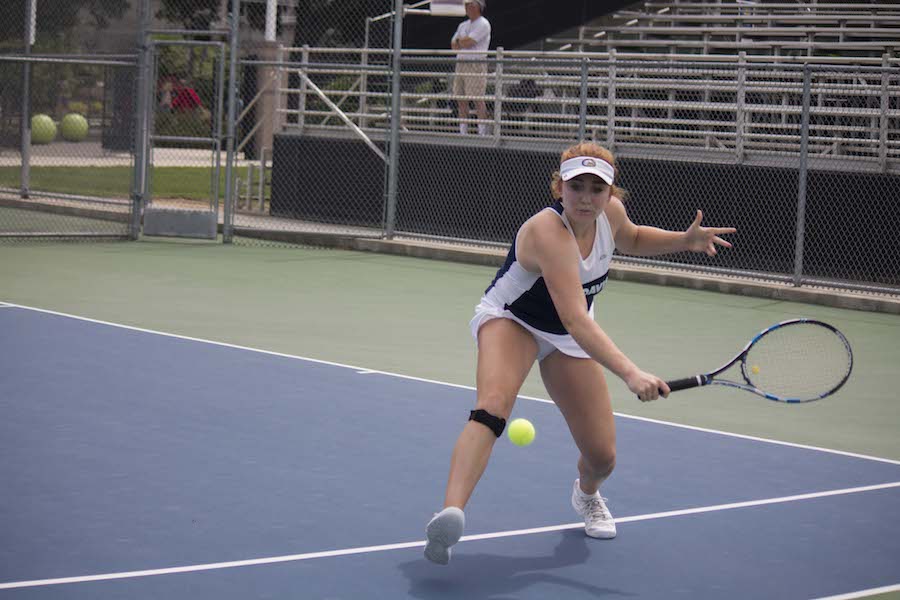
LUCY KNOWLES / AGGIE

UC Davis women’s tennis cap season off with 6-1 victory

The UC Davis women’s tennis team played their last match of the year on Saturday, April 22, with seniors Kamila Kecki and Samantha Martino being honored for Senior Day and UC Davis Picnic Day in full swing as well. Amidst a busy day, the team looked to finish off strong, doing just that with a 6-1 victory over UC Riverside.

It was an emotional game for those who are not returning next year to the courts, but head coach Bill Maze applauded the team’s duo of outgoing seniors, noting that their impact does not simply end when their playing career does — it stays long after they are gone.

They’re certainly great tennis players, but it’s really more about how they treated everybody day in and day out,” Maze said. “Considerate, kind young women. Kami and Sam: We were very lucky to have them.

Right from the get-go, the Aggies sent a message to UC Riverside by dominating in doubles. According to Maze, it was an easy game to prepare them for, despite all the would-be distractions around them.

“I think that they all wanted to play great in the last match of the year and Picnic Day,” Maze said. “These are not the types of matches where I need to give an inspiring speech. They’re all just reeling to go.

In singles, the Aggies gave UC Riverside zero margin for error, winning five out of six matches in a decisive fashion. All five victories came in the first two sets. The victory was the perfect way to end the season, though Maze was not going to let them dwell on it, as there is still more tennis to be played.

“We celebrate the win today and then we get back on Monday and get back to work,” Maze said.

The Aggies will enter the Big West Tournament in Indian Wells, Calif. with a 15-9 record overall and 3-5 conference record. The six-seed Aggies will face Long Beach State, the third seed, on Friday, April 28. Their middling conference record has matched the Aggies against a team with a stronger record, but the seedings will mean nothing once the first serve is in the air. Until then, preparation will be key as the UC Davis women’s tennis team looks to extend its season for as long as possible.

Written by: Bradley Geiser — sports@theaggie.org

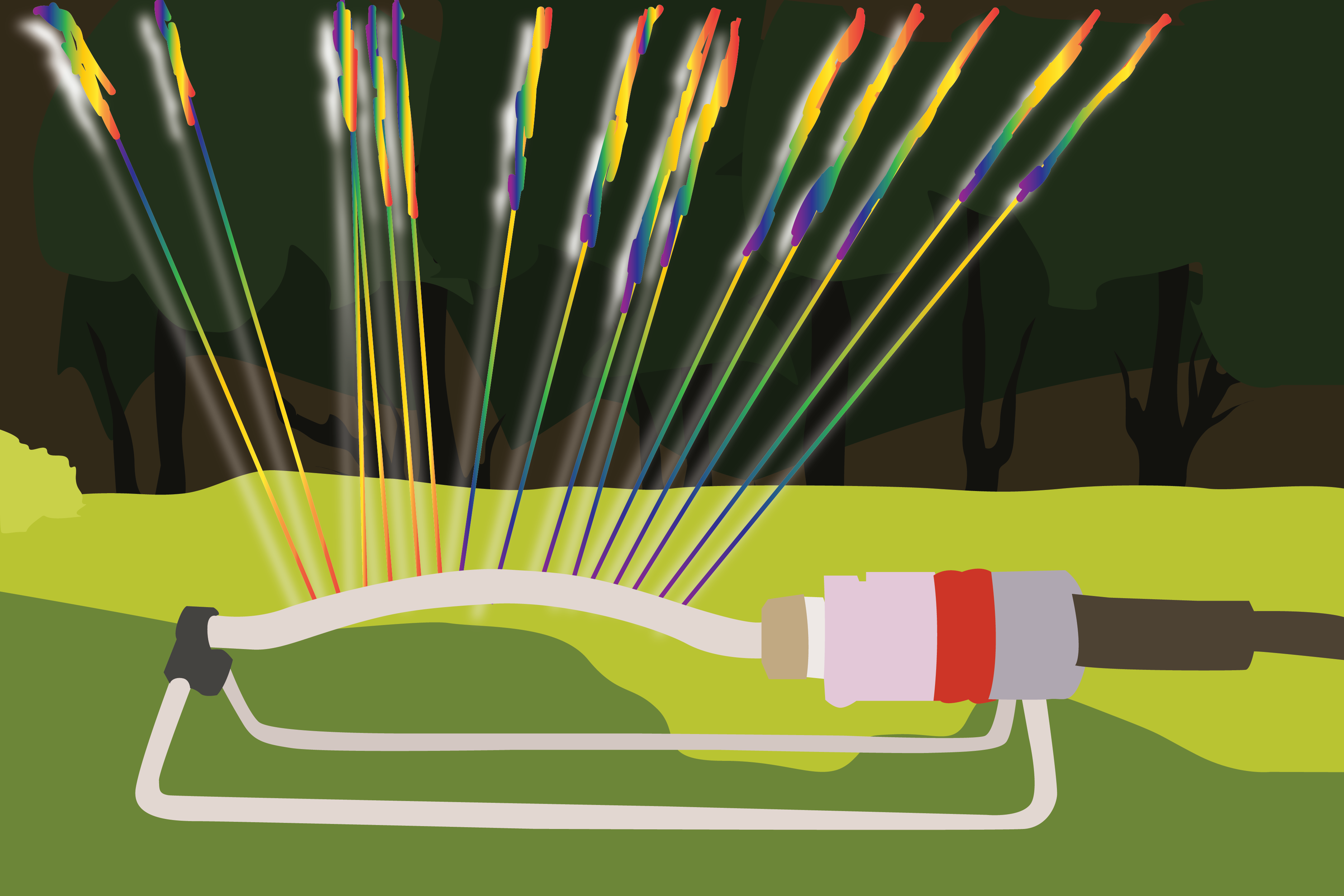
City of Davis pledges to conserve water

GENESIA TING / AGGIE

Mayor of Davis joins 180 other mayors in taking the Wyland National Mayor’s Challenge for Water Conservation

The month of April is Earth Month, meaning now is the time to go green. During Earth Month, the City of Davis hosts many events with the goal of challenging citizens to make the Earth a greener place. One of those events is the Wyland National Mayor’s Challenge for Water Conservation. The Mayor’s Challenge is a pledge taken by the mayor and citizens of cities across the nation to conserve water for the month of April. At the end of the month, the citizens who took the pledge in the city that saves the most water are eligible for various prizes, including a new Toyota Prius. Davis is currently ranked 14th.

While this is Davis’ first year taking the pledge, the Wyland National Mayor’s Challenge for Water Conservation has been around for six years, having started from humble beginnings.

“We started it almost as an experiment, as part of a living green fair in South Florida,” said Steve Creech, the executive director of the Wyland Foundation. “It had a water footprint calculator that we had come out with, that was designed to accompany one of our museum exhibits. We were at this eco fair and we were talking to the mayor of the city where we were having the fair and he said ‘hey, I love what you guys are doing, and I love that calculator you have. Is there anyway our whole city could get involved and we could count up all the pledges people make, and then challenge another city…’ Everybody had such a good time with it and they were all learning, that we just decided to grow the program.”

The project started small, but it has grown to a much larger scale, with around 180 mayors taking the pledge this year.

“Every year it grows,” Creech said. “This year we have more mayors participating than ever and, I think, we’ve had 1.2 million pledges over the course of the whole program.”

The program started as a friendly competition between a few cities. While this friendly competition remains, Creech made it clear that the purpose of the pledging is for the environment.

“The mayors are really designed to lead in their communities and remind people how important water conservation is and managing our resources is,” Creech said. “The point of all this […] is that we are trying to ensure a reliable, steady supply of water that serves all the needs in our country.”

Robb Davis, Davis’ mayor, held similar sentiments toward the challenge.

I don’t think we are trying to ‘move up’ [in the competition],” Davis said. “We will keep promoting conservation and lead the way by converting more city turf to low water usage”

Davis also mentioned the respect he had for the people of Davis in their response to the drought.

I think Davis residents have been responsive to public information on the drought and many have taken action on their own,” Davis said. “Perhaps most importantly, the City Council proposed and passed water rates that are focused on encouraging conservation.”

While the Mayor’s Challenge encourages the mayors of towns and cities to push for water conservation, Creech said that the real conservation comes from everyday people.

“We love to have the mayors, but we actually find that the most participation just comes from random people all throughout the United States,” Creech said.

Regardless, the struggle to conserve water falls into the hands of everyone, not just the mayor.

“The most important thing people can do is reduce their waste, just buy only the food you need,” Creech said. “If you can do that you can conserve massive amounts of water.”

Kate Smith, a first-year Environmental Science and Management major at UC Davis, has been conserving water for quite some time.

“My family and I made a big effort to take quick showers (use a 2:50 minute timer to make sure) and we wash dishes using like, a sink of water rather than letting it run the whole time,” Smith said. “Also, we stopped watering our lawn and I set up a drip irrigation system in our garden at home and at my school garden, which is much more efficient.”

Even though Earth Month is nearing an end, conserving water won’t stop when May begins. It’s never too late to make the pledge to conserve water.
Written by: Nicolas Rago — city@theaggie.org

LGBTQIA Resource Center holds biweekly “Cuppa Tea” program

VENOOS MOSHAYEDI / AGGIE FILE

Program offers discussion space for issues facing LGBTQIA community

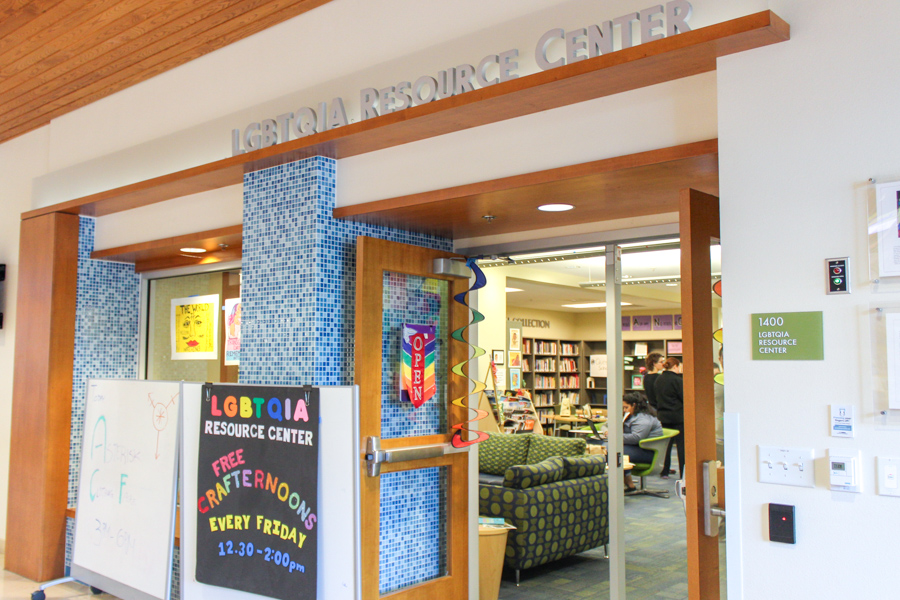
Every other Wednesday, the LGBTQIA Resource Center holds a discussion space called “Cuppa Tea,” in which members of the LGBTQIA community and other minority groups come together to discuss current events relevant to their communities.

The program started in the fall of 2015. The idea for the discussion space came from fifth-year Chicana/o studies and sociology double major Bee Curiel, who has been working at the LGBTQIA Center since 2015.  

“I wanted to create a space where people can come and just talk about something […] just have a couple snacks and tea,” Curiel said.

According to Curiel, the title “Cuppa Tea” has its roots in colored and transgender communities. The phrase “cuppa tea” meant “what’s going on” or “what’s the 411,” which corresponds to the program’s goal of helping members of the LGBTQIA community stay informed and up-to-date with the current events.

Topics discussed in past “Cuppa Tea” sessions include cultural appropriation, police brutality, the media’s representation of queer people and other minorities, desirability and sexual assault and awareness.

The program also works with the Middle Eastern and South Asian Week and Sexual Violence Awareness Month programs.

“I think it [Cuppa Tea] is great because it’s a space where things are talked about that are not talked about at all in mainstream media,” said Rosie Romick, a fourth-year plant and biology major, who has been to several Cuppa Tea discussions in the past. “It’s a space where people are sharing and marginalized voices are uplifted.”

“I really like talking about current issues about the queer community with my peers […] just getting different perspectives and staying up to date on what’s going on in the world,” said Dante Williams, a fifth-year mathematics major who has also taken part in several Cuppa Tea discussions. “I’m able to express my opinions on what’s happening in the world in a space that is conducive to making tangible changes instead of just theorizing.”

The biweekly Cuppa Tea discussions are just one of the many support programs offered for minority groups by the LGBTQIA Center. In addition to events like Pride Month and queer leadership retreats, the center organizes many awareness events including awareness for trans, asexual, intersex and bisexual identities. The center also holds “Crafternoons” every Friday in which people can make arts and crafts like pride bracelets, which Curiel described as a “de-stressing event.” Recently, a community coordinator at the center also held a clothing exchange closet, because, Curiel explained, “oftentimes trans and nonbinary folks face violence when they shop for clothes.”

The center welcomes diverse members of the Davis community to participate in the Cuppa Tea and other upcoming events.
Written by: Clara Zhao — campus@theaggie.org
Take a flyer: Student perspectives on tabling

JAY GELVEZON / AGGIE

A look into the tabling culture at UC Davis

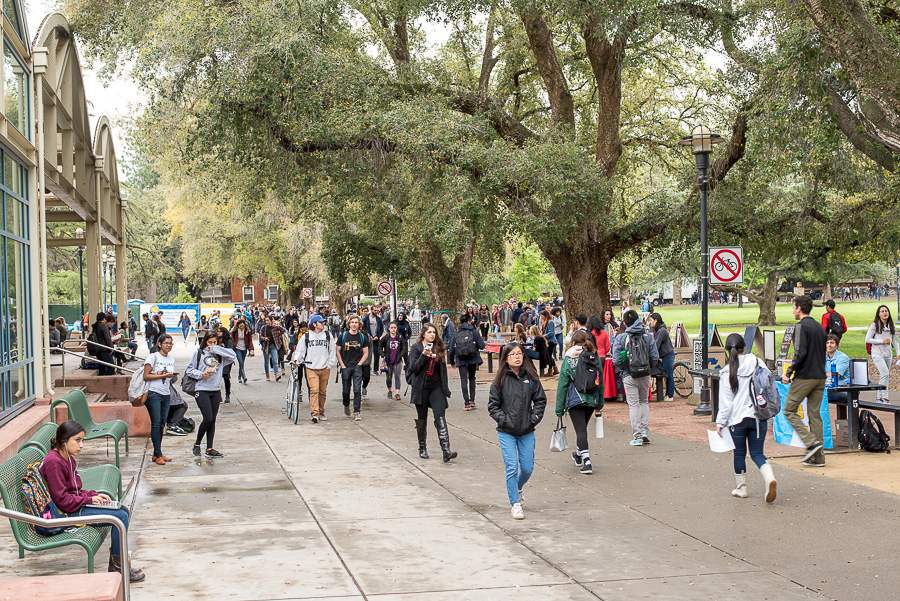
The Quad is always full of students passing through on their way to class and hanging out on the lawn eating lunch. Other students, however, are out tabling to promote student clubs and organizations.

On the first Friday of Spring Quarter, what would normally be a bustling day at the Memorial Union (MU) was quieted by a heavy downpour of rain — but this did not stop students like John Sung, a third-year chemical engineering major, who was promoting Koinonia Christian Fellowship and publicizing an event later that evening. According to Sung, tabling is an effective way to connect personally with other students.

“We get people to think about what we are about,” Sung said. “And we get to learn about other people too, it’s nice.”

Through rain or shine, members of Koinonia tabled throughout the first week of the quarter. Although sitting at a table and talking about an organization may seem simple, there is a lot more planning that goes into tabling.

“You’re supposed to reserve the tables four weeks in advance,” Escareno said. “And [when we tried to], they were all taken. If you want to get on the waitlist you have to go upstairs of the MU and try to […] get on the waitlist.”

For those who do not sign up for a table right away, there is still hope that an organization that did sign up might not show up to claim its table. According to Escanero, the waitlist can be long, and it may be difficult to get a table that way.

“Usually in the first two weeks it’s […] really packed,” Escanero said. “But then after that, it’s relatively easier to get a table.”

The Quad is a bustling area, full of students heading off to the next activity on their to-do list. It seems like the perfect location for an organization to publicize, but many students do not want to stop and listen.

“I’ve had people with headphones [pass by],” said Jasmine Osmany, a third-year environmental policy major. “You know that they hear you and they just walk the opposite direction.”

Even with this obstacle, students like Alena Dinh, a second-year neurobiology, physiology, and behavior major, have picked up some tricks to get the attention of students passing through.

“First thing is a smile,” Dinh said. “If you approach [students] very seriously then it’s going to be intimidating. Some ways I’ve heard it done is like ‘are you interested in a pre-health internship?’ or some people go more outrageous just to catch attention. If you can keep them for the first three seconds then you have a conversation.”

Even when executed well, these strategies for tabling do not work perfectly every time. According to Dinh, some students are more difficult to reach.

“[Students] just walk away [from the tables],” Dinh said. “I mean, I’ve been on that side too, so I know what it’s like.”

The tabling process is different for organizations that are not directly a part of UC Davis. For example, Marble Mosaic is a social media application created by UC Davis students for UC Davis students, but it is independent of the university itself. Outside organizations like Marble can table at the MU, but there are more requirements in order to get approved, according to Ted Mumford, a recent UC Davis graduate and a founder of the app “Marble.”

“As an outside organization you can’t necessarily just show up and table,” Mumford said. “But […for outside groups, ASUCD] can say, ‘okay, we’ll reserve the table for you’.”

The tables are lined up along the walkway that cuts through the MU and the Quad. This area is a central location on campus that Mumford found to be a perfect area to reach many different students. When at the MU, his organization took a different angle at first — something they call “backward tabling,” that is, approaching students instead of waiting to be approached.

“Today is our first day of tabling,” Mumford said. “[Before today,] we’ve been doing backwards tabling, which we find to be great because we are trying to reach groups who are looking to reach other students.”

According to Dinh, printing handouts with information is another effective way for students to publicize their organizations.

“You’re publicizing your [group],” Dinh said. “It’s kind of like, ‘please take this [flyer]’ and take the time to listen to us. You’re trying to sell yourself and your cause.”

Like Dinh, Escanero handed out flyers while tabling as well. She found that people were more willing to take a handout rather than stopping to talk.

“Rarely someone comes up to us,” Escanero said. “I feel like people are usually shy to come up and talk or we will just go up to them and hand them a flyer. ”

Unlike Escanero and Dinh, Mumford did not create flyers for his group, which led to difficulties during his first week of tabling.

“We are trying to do this without any flyers, which is a little bit tricky,” Mumford said. “Everyone is just like ‘oh let me take something’ and […] we don’t want to waste paper.”

While there are difficult aspects of tabling that make it seem like it may not be the most effective way to reach a large quantity of students, some groups find that it is actually useful. According to Dinh, even if it only reaches a small number of students, it may just be the students they need.

“I think for the vast majority of people, [they] pass us by,” Dinh said. “There are people who are interested and do come in and that’s actually how I heard about our clinic so it was successful for me. I still think [tabling] is useful.”
Written by: Elizabeth Marin  — features@theaggie.org

Why science fiction is the genre of the 21st century

MATTINGLY23 [(CC BY 3.0)] / CREATIVE COMMONS
The genre helps contextualize and reflect current anxieties, problems

It’s inarguable that science fiction is one of the most dominant genres of our time. Though it has been popular throughout the last 50 years, it hasn’t had as great of an influence on culture as it has today, and though this can be traced back to the development of special effects technology, it’s in large part due to the current moment we live in. Though sci-fi can be brushed aside as fantastical, I feel it represents the cultural moment of the 21st century better than any other genre, and that its influence will only continue to grow as we live in this ever-complicating world.

The definition of science fiction can be a little slippery, but I’ll define it as a form of fiction involving advanced technology or different worlds that has a more futuristic vibe, as opposed to fantasy, which generally has more elements like dragons and magic and bases itself on the medieval past. This makes Marvel movies science fiction, but not Harry Potter movies. The definition also excludes historical dramas about space like Apollo 13. The three operate in similar realms, but I’d like to focus purely on science fiction.

Science fiction has historically been a beloved genre, but not always an accepted one. It has its origins in pulp fiction from the turn of the century, and even after years of development and proliferation, it still carried that stigma. It was a genre that many thought was mainly for nerds, or one that was largely brushed aside when considering high art of the time period. People still flocked to science fiction movies and TV shows like Star Wars, the Batman franchise and Star Trek, but at no point did it take over the market in the way it has in the new millennium.

Science fiction has exploded since the year 2000 and particularly in the last ten years. According to filmsite.org, 11 of the 20 top domestic grossing movies of the 2010s were science fiction, with a sci-fi movie being the top grossing film four out of the last five years. And in the past two decades, there have been 21 top-grossing sci-fi movies, compared with 24 from every other decade combined.

This has also been reflected in the Academy Awards. Before 2009, the only two sci-fi movies ever nominated for Best Picture were E.T. and Star Wars, neither of which won. Since then, there have been six, though none of them have won either. Part of this is due to the Oscars expanding the number of Best Picture nominees, but it also reflects the growing impact of science fiction on the film market and a growing acceptance in the art world and popular culture.

One thing is clear, however, and that’s that in the 21st century, science fiction sells and it’s more popular and more accepted than ever.

A lot of this has to do with advances in special effects that allow new worlds and technologies to come to life in ways previously not possible on screen. It also can be linked to the franchising of Star Wars, Marvel and DC because of the loyal fanbases these series have built. At the same time, it’s not an accident that the rise of science fiction has coincided with the developments of the modern world, and it’s more reflective of our time than any other genre.

Science fiction as a genre has a history of representing the unrepresentable. It’s no secret that the original Godzilla is a metaphor for the atomic bomb, and that all the alien invasion movies in the 50s and 60s were allegories for a Soviet invasion and nuclear war. Part of what sci-fi does is take modern trends and ask, “what’s next?” The genre tries to contextualize these issues in some fictional future or far-off planet to tell us something about our present.

We live in a world marked by rapid changes in technology, climate and society. Less than 10 years ago, the iPhone was the latest and greatest innovation the world had to offer, and now it’s on its eighth iteration, and it’s less common not to have one. Sea ice is melting at rapid rates, and yet the world’s response is stagnant because the change happens too slowly to be seen and felt on an everyday basis. The social and economic conventions that have reigned supreme since the end of World War II are starting to look more and more fragile with the rise of the far right in 2016.

None of these changes are minor, and it’s because of the almost incomprehensible vastness of their impacts that we need a medium to process them through. Science fiction offers this medium and allows us to better process the world around us instead of confronting these heavy, complex issues head-on. And as the world grows more rapid and complicated, sci-fi’s role will only increase.

“I feel like if you’re going to write realism about our time, science fiction is simply the best genre to do it in,” said renowned sci-fi novelist Kim Stanley Robinson in an interview with The Guardian. “This is because we’re living in a big science fiction novel now that we all co-write together.”
Written by: Noah Pflueger-Peters — napfluegerpeters@ucdavis.edu

Disclaimer: The views and opinions expressed by individual columnists belong to the columnists alone and do not necessarily indicate the views and opinions held by The California Aggie.