53.7 F
Davis

Davis, California

Saturday, December 20, 2025
Home Blog Page 630

SFA Oceana: Below the Surface Fashion Show

STUDENT FASHION ASSOCIATION / COURTESY

A charity event like no other

This year’s theme for the Student Fashion Association’s (SFA) annual fashion show is “Oceana: Below the Surface,” which incorporates both light and dark aspects of the ocean. The proceeds of the show will be donated to the organization “Charity Water,” which helps build clean water projects in rural communities around the world.

Jeanette Chiu, a fourth-year design and communication major, is the president of the Student Fashion Association (SFA) as well as the head of the marketing committee for the show.

“We have been working on this all year long and it is a celebration of all the arts,” Chiu said.

The night will begin with a performance by The Spokes followed by a performance from Popping Club, which will raise the crowd’s energy and get everyone ready for the fashion show to start. After the first act of the show there will be a small intermission, and at the beginning of the second act there will be a raffle with $1 tickets that can be purchased at the door. Then, to kick off the second half, Afterglow and Vision Dance Troupe are set to perform, and the night will end with a showcase of the rest of the designers’ work.

The show consists of local designers from UC Davis and other schools in the Bay Area and Yolo County. There was a casting call for models, most of whom are from UC Davis and were selected by the designers.

Yvonne Dang Lee, a fourth-year managerial economics major, is the historian for SFA.  She is also the co-partner for the talent committee, which finds talent for the show.

“We made flyers looking for costume designers, hair and makeup and the actual designers,” Lee said. “We had all the committees hand these out and publicize, which made it a huge success. Our club worked really well together in getting the word out and everyone supported each other.”

Elizabeth Chang, a second-year textiles and clothing major, is the secretary for SFA and acts as the other co-partner for the talent committee.

“Winter Quarter we had a fashion planning class where we split our club into five committees,” Chang said. “The marketing, talent, stage design, fundraising and decorations committees […] each had their own responsibilities.”

The planning process was an organized chaos, but the organizers stated that they managed to fulfill their vision for the show.

The fashion show will be held at the UC Davis Conference Center on April 29 from 6 to 8 p.m. The doors open at 5:30 p.m. Tickets are $10 presale or $12 at the door.
Written by: CaraJoy Kleinrock — arts@theaggie.org

Crossing the finish line

SAHAR FOROUZANFAR / AGGIE

UC Davis seniors finish their college experiences with capstone projects

For UC Davis’ graduating class of 2017, the time of year has come for a multitude of pressures. Along with putting the final touches on their GPAs, searching for jobs or graduate schools and living out the end of their undergraduate careers to the fullest, many graduating seniors are also faced with the responsibility of completing a senior project.

Although not all departments require students to complete a capstone project, some do require it as a part of the curriculum. The College of Engineering, for example, requires all engineering majors to complete a senior design capstone course and holds an annual design showcase for students to present their work.

“[Students] spend a lot of time working on these projects,” said Alin Wakefield, an advisor in the College of Engineering Dean’s Office and a coordinator for the Engineering Design Showcase. “This just brings them all together under one roof. I call it a really cool science fair, almost.”

SAHAR FOROUZANFAR / AGGIE

This year’s showcase, which will take place on June 8 in the Pavilion, features the posters, prototypes and programs of close to 700 students, divided among their respective departments into teams of two to 10. Past projects have included a redesigned strawberry picking cart, model aircrafts, an electric-powered wheelchair and more.

“They get a chance to take the knowledge that they’ve learned from the classroom and actually apply it,” Wakefield said. “A lot of students […] want to get their hands dirty, building something, doing something, and the senior design project is the opportunity to take three plus years of classroom work and actually turn it into something tangible.”

On the other side of the academic spectrum, the humanities departments also have similar opportunities for students to show off their undergraduate work. Both the English and Comparative Literature Departments host senior thesis programs for honors students.

“Many students […] do a lot of short little papers, but they don’t have a chance to extend their interests in a broader scope,” said Margaret Ferguson, a distinguished professor of English and director of the 2017 honors English seminar required for theses candidates. “The thesis […] let’s them propose a topic, talk to an advisor and then […] work on this project.”

John Pitre, a fourth-year comparative literature major, recently finished a 50 page research essay on how North African authors write about their own identities in the form of the novel, an originally French style of literature that was introduced to North Africa in the wake of French colonization.

“I thought it would be fun, rather naively,” Pitre said. “It really required a lot of effort on my part. You do get a thesis advisor, […] but a lot of the legwork comes from you. As an undergrad, I’d never written anything that […] long. I learned a lot.”

While Pitre and other seniors complete their capstone projects through their departments, many students find other ways to leave their final marks at UC Davis. Cynthia Chong, a fourth-year design and art studio double major, plans on presenting a culmination of art pieces at the Art Studio Senior Show, an ongoing gallery of senior art projects that will be open to the public through June.

SAHAR FOROUZANFAR / AGGIE

Although Chong’s pieces focus on painting and drawing, other students at the show will present sculptures and various other kinds of artwork with many different mediums and styles, from watercolor to oil. One of Chong’s favorite works in her collection is a striking gouache painting of a polaroid camera in which the lens depicts a full moon, while the printed photo reveals the same moon in a different phase.

“[This piece] is actually something that I imagine in my mind […], inspired from my own story,” Chong said. “We […] usually assume something is perfect or we want to be perfect for something. Usually things do not turn out perfectly, but there’s still another beauty in the same thing when you look at it in a different way.”

While Chong looks forward to presenting her work to an audience, she also faces the challenge of finding inspiration for her work and deciding how to best convey her message.

“I don’t want to just copy from a photo,” Chong said. “I want to do something more unique. Also, I want the piece [to be] related to myself. It’s […] personal artwork, so the audience will have their own [interpretations]. I’m interested to see how the audience will react to my pieces.”

Similar to Chong, Pitre and many other students working on senior projects find that a capstone venture is not an easy task. In fact, most projects are started as early as Fall Quarter and are not finished until spring. Jeanette Chiu, a fourth-year design and communication double major, president of the UC Davis Student Fashion Association (SFA) and director of the SFA Fashion Show, has been preparing for the show for nearly a year.

“My biggest challenge was definitely figuring out the timeline,” Chiu said. “[With] leading my fashion class and then […] also directing the fashion show at the same time, […] I think I had three schedules going at once.”

Whether students are casting models, changing the world of science, brandishing a paintbrush or pouring their literary analysis into writing, most seem to find that the senior capstone experience is, as Pitre called it, “an intellectual adventure.”

“I wish it were an experience more students at UC Davis could have,” Ferguson said. “It’s sort of a way of rounding out your four years. I think the people who do it really benefit from it. [It’s a] chance to stretch your wings.”
Written by: Allyson Tsuji — features@theaggie.org

Last week in Senate

HANNAH LEE / AGGIE

Last week in Senate

ASUCD Vice President Adilla Jamaludin called to order April 13’s Senate meeting in the Memorial Union’s Mee Room at 6:10 p.m. All senators were present at quorum call.

The Senate began with a presentation from Darin Schluep, the food service director for the CoHo, who reported that the unit is continuing to work with the Manetti Shrem Museum on a CoHo cart and CoHo-To-Go, an on campus convenience store, which will soon be established. The CoHo recorded increased sales from the finals week library cart from Fall Quarter earnings of $39 per day to Winter Quarter earnings of $89 per day. Lastly, Schluep reported on the availability of açaí bowls all day and efforts to make horchata, poke bowls and more authentic sushi.

Next, Chief Information Office (CIO) Executive Advisor Carolyn Nordstrom presented a report on CIO. The report summarized the complexities of Information Technology governance and requested a student representative from ASUCD to sit on the committee. Controller Joe DeAngelo mentioned that there was a Campus Council for Information Technology (CCFITT) representative, but Nordstrom said that position has been defunct.

Two confirmations were made in the meeting. Stacey Wong was confirmed as the Experimental College unit director and Nicole Karine was confirmed as the Campus Center for the Environment unit director. There were no objections to either candidate.

Sexual Assault Awareness Advocacy Committee (SAAAC) chair Rachelle Fishbin presented a report on SAAAC. Fishbin requested more ASUCD representation at SAAAC events and meetings. SAAAC has also been working on an anonymous tip box on its website to share information to the university. Fishbin voiced concern that fraternities have never been fully investigated for sexual assault on campus.

Disability Rights Advocacy Committee (DRAC) was confirmed during the meeting. There were no objections to the committee.

ASUCD President Josh Dalavai then clarified to the packed audience that Senate Bill #76 was not made because of ideological reasons, but to protect ASUCD from legal risk.

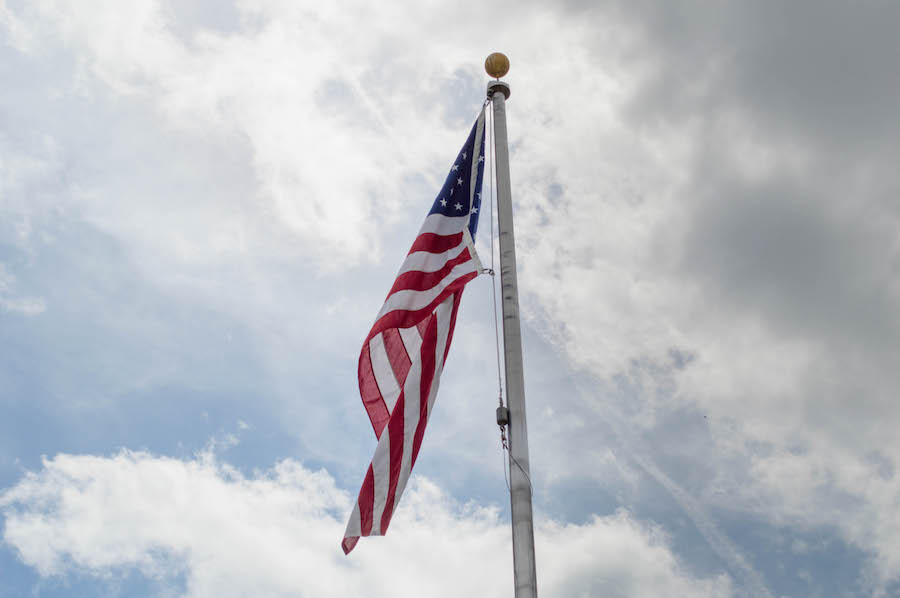
Senate Bill #76 concerns the American flag not being compulsory at Senate meetings. But senators or ex-officios may request the flag by petitioning the Senate President Pro Tempore 24 hours in advance. During this meeting, no American flag was present in the Mee Room.

Many of the audience members were concerned with how this could put the Senate at legal risk and the cost of the flag. Others felt that the flag was necessary because their family members fought for the symbolism of the American flag.

One audience member who supported the bill said that the flag embodied an America of misogyny, genocide and sexual assault.

Senate Bill #76 was passed with seven saying yes, two saying no and three abstaining. Senator Matt Yamaguchi and Senator Michael Gofman voted no. Three members abstained to speak with public audience members outside of the Mee Room.

Senate Bill No. 61 concerns the scholarships to ASUCD volunteers for their service. The Student Government Administrative Office did not have record of the bill being voted on last quarter. The Senate introduced the bill as an emergency bill and it passed with no objections

Senate Bill #75 concerns changing the required amount of weeks the commissions have to meet from nine weeks to 10 weeks. The bill was amended and passed with no objections.

Senate Bill #79 concerns requiring the Interfraternity Council and Panhellenic to provide giant posters for sororities and fraternities with contact information for sexual assault help lines. The bill passed with no objections.
Written by: Yvonne Leong — campus@theaggie.org

Inside the Game: Greta Kohlmoos

ANH-TRAM BUI / AGGIE

UC Davis water polo star discusses record-breaking season

Some call her “Greta the Great.” Others call her “Greata.” But you can just call her Greta. For junior center Greta Kohlmoos, scoring goals is almost second nature.

Netting an explosive 62 this season, Kohlmoos has tied her goal total from her first two seasons combined and is currently the seventh all-time goal-scorer in UC Davis water polo history. With plenty more games left in her career, she still has the potential to climb even further up the record ladder to potentially become one of the most prolific players to compete in a UC Davis uniform.

Kohlmoos possesses all the tools that make for a terrific water polo player. In the pool she is aggressive and gritty on the attack, penetrating deep into the heart of the opposing team’s defense while using her strength and savviness to hold her threatening position close to the goal. She is fierce and intelligent on and off the ball, demonstrating an excellent feel for the game. She is a decisive swimmer, knowing exactly where to position herself to get the ball, where her teammates are and, of course, where the net is.

On dry land, Kohlmoos is approachable, outgoing and downright friendly. Her radiant positivity and amiable personality makes it impossible not to smile and laugh along with her, making it easy to forget her level of intensity when in the water. She is a prime example of a team leader, one who always praises her teammates and is committed to the success of her team.

With one final game to play, Kohlmoos and her squad are 15-16 this season. The team is set to compete as the fourth seed in the Big West Championship Tournament that will be hosted at Schaal Aquatics Center in Davis, starting on April 28.

The Aggie sat down with Kohlmoos to ask her about the stellar season she is having, her journey as a player and how she feels about the team this year.


You have caught a lot of attention in the athletic world for the career year you are having. Has this season so far been a blast for you? Or have you found it to be more of a challenge with all of the talented teams you are facing?

I think it’s been fun because it’s been more challenging. I’ve gotten a lot more experience in games as opposed to the last two years I have been here, so that’s helped a lot. Every day is so much fun and I learn so much every day.


You’ve been a consistent scorer for this team over the years, with 30-plus goals in each of your first two seasons. How have you made the jump this year to scoring over 60 goals now? What do you think made the difference?

Like [I mentioned] in the last question, being on the team for two years, I learned a lot and I didn’t play as much as I have been playing this year, so the playing time [this season] has definitely helped with that. But gaining the experience the last two years and going up against these tough opponents has really prepared me for this year and playing against the tough competition we’ve faced so far. And also my teammates are amazing, and they’re so strong, so just playing against them every day [in practice] has made me a lot better.


How did it feel to be awarded Big West Conference Player of the Week back in February for your incredible performance at the Aggie Shootout? What does that award mean to you?

It felt really good. I had no idea I was even nominated that week, so I got a text from my coach on Wednesday. She’s like, ‘Congrats!’ and I was like ‘For what?!’ So I had to actually go look. So that felt really good. It’s definitely really nice to get acknowledged by the conference for something that I have been working toward every day in practice, and it’s just also something that really helps me visualize and see how my hard work is paying off.


Scoring a lot of goals is something that is not all that new to you – you scored 152 back when you were a senior at Granada. Do you think that the skills you harnessed in high school have helped you find success here? Or has it been a completely different game at the college level where you have had to alter your play?

High school really helped prepare me to be ready to fill a leadership role, in that sense. The girls I was playing with — it was a whole mix — it taught me to adapt to certain situations being on that high school team and really be creative with how I played. So coming here, it was definitely kind of a shock to be on a team with some of the best girls in the country. Being at Granada really prepared me mentally to come here. But physically, I would have not gotten to where I am today without the girls that have been on this team the last three years.


Your fellow junior, Paige Virgil, is close behind you in goals scored this season and was also a conference player of the week. Do you guys have any special relationship as leaders of this team and as offensive threats?

She’s a badass. Paige and I get along really well outside the pool as well as inside the pool, so that really helps translate. I think it’s super important where, if you’re friends with someone outside of the pool, the chemistry shows in the pool. I think Paige and I, as soon as we got here, we kind of clicked offensively. She’s such a big threat outside that she can draw defenders to her like that. But at the same time, if I’m working and digging down at set, it really helps to open her up too if they’re trying to drop back on me.


I know the conference championships are coming up fast. How is the team and how are you specifically preparing in order to finish this year off strong?

Two days a week we’re coming just for an hour of conditioning and that has been a tremendous help at getting us physically in shape for that tournament. Also, just going into it we’ve been watching a lot of game film and seeing what the patterns are with some of our opponents. It also helps that we can look back on our conference games from the last couple weeks and see how we can attack certain teams in different ways to gain the advantage in the conference tournament play. And also, we’ve been really focused on trying to maintain positive attitudes in the water because positivity goes a long way. We have to approach this tournament like we’re going to win it. We can’t go into it thinking, ‘Uh… I don’t know, maybe…’ No, we have to go in like, ‘We got this. We’re gonna going to NCAA’s,’ which is what we really want.”
Written by: Dominic Faria — sports@theaggie.org

13th Annual HellaCappella Showcase

DIANA LI / AGGIE

A cappella premier showcase features West Coast’s best college choirs

The Spokes, UC Davis’ first all-female a cappella choir, held their 13th annual HellaCappella showcase at the Mondavi Center on Friday, April 21. The night featured several well-known college choirs from Stanford, Berkeley, USC, UC Santa Cruz and Oregon.

The nearly sold-out 1,800 seat show took several months of advanced planning to put on. The Spokes spend most of the year fundraising and practicing for the show.

“We start planning in September as far as reserving the Mondavi Center goes,” said Amanda Beardsley, a fourth-year psychology major and president and choreographer of The Spokes. “We also try to find groups we want to perform, as well as find a repertoire of songs we want to perform for this year’s show.”

Between singing, dancing and coordinating the event, the past few weeks have been extremely chaotic for the group.

“The past two weeks has been a lot of cramming all of the choreo we have learned,” said Mary Grafilo, a fourth-year neurobiology, physiology and behavior major and the musical arranger of The Spokes. “I think we’ve been losing sleep, but as much as we are scared, we are having lots of fun.”

The Spokes is made up of 13 female singers, all of whom juggle academics and extracurriculars along with preparing for this annual showcase.

“I’ve had at least three nightmares about HellaCappella and it’s my first one,” said Sarah Kadlec, a first-year undeclared humanities major and new member of The Spokes.

Students, faculty, staff, families and friends from all over Davis and surrounding areas attend the event every year.

“We work really hard to get a lot of the student population to see our show, and also the Davis community,” Beardsley said. “That is one of the cool things about HellaCappella, we are able to have so many people come, and at the same time we are able to do it with just 12 to 14 girls year after year.”

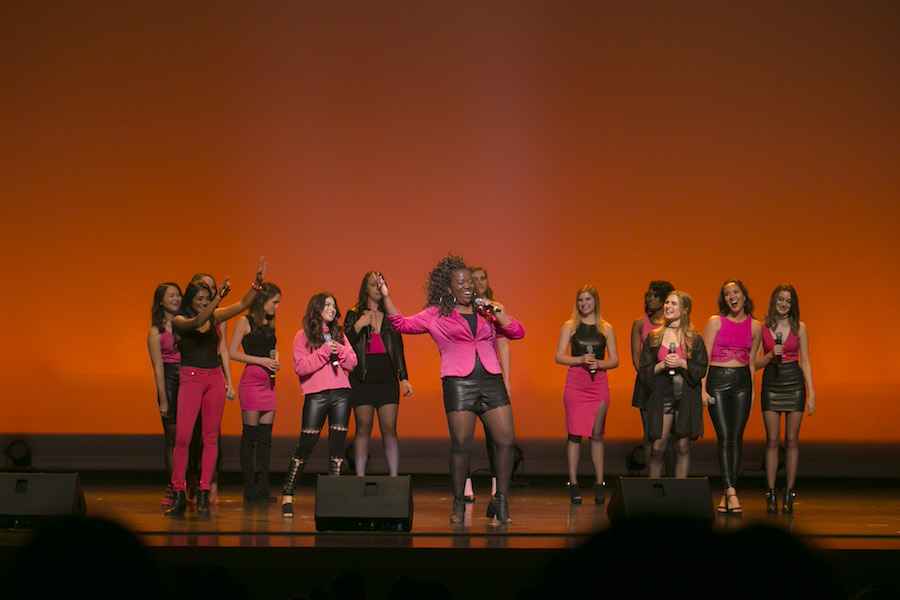
Two of the Spokes’ boyfriends M.C.’d the night. After opening with a few jokes, the female powerhouses took the stage, wearing their signature black and hot-pink attire. Starting in a tableau, the group opened the night with a version of “Move Like U Stole It,” originally done by ZZ Ward. The crowd went wild with clapping, screaming and cheers.

With The Spokes’ saucy take on modern hits, Berkeley’s classic jazz tunes, Stanford’s original compositions taking stabs at Cal, Oregon’s rendition of Earth, Wind and Fire, Santa Cruz’s quirky takes on indie tunes, and USC’s Indian twists, it was a night full of variety. Even within The Spokes’ set, styles varied from song to song.

“This year we have four different arrangers, so each song you hear a different kind of style,” Grafilo said. “Not only in genre, but with the person arranging it.”

After intermission, the show continued with more amazing back-to-back performances from each group. The Spokes ended the night with a sweet farewell to their senior members. They rejoiced about the good and bad times they have gone through over the years, and how they have been there through it all. They made it apparent just how close the group is.

The Spokes finished the night off with a performance of “Freedom” by Beyonce, arranged by senior member Mary Grafilo. It was a strong performance full of confidence and enthusiasm.

This year’s HellaCappella performance brought energy, passion and love to the stage. The night portrayed just how close and hard-working the college a cappella community is on the West Coast.
Written by: Myah Daniels — arts@theaggie.org

Black American students’ success rate higher when taught by teacher of same race, study finds

GENESIA TING / AGGIE

UC Davis professor helps to publish “The Long-Run Impacts of Same-Race Teachers”

Cassandra M.D. Hart, an education policy professor at UC Davis, along with Constance A. Lindsay and Seth Gershenson of American University and Nicholas Papageorge of Johns Hopkins University, published “The Long-Run Impacts of Same-Race Teachers” in March. This groundbreaking study highlights the importance of having Black teachers in the school system. The study, which looked at data collected from the records of 100,000 Black students in North Carolina, found that the academic progress of Black children heavily hinged on having teachers of the same race. The study showed that having at least one Black teacher in third, fourth or fifth grade decreased the probability of Black students dropping out of high school by 39 percent. The paper emphasized that teachers are more than just educators — they are role models as well.

“Teachers are some of the most influential adults that children encounter,” Gershenson said in an email interview. “They directly impart knowledge and academic skills, but also teach social skills, judgement and a sense of fairness, civic values, and so on. Students often confide in teachers and share things that they might be uncomfortable sharing with the adults in their households.”

For the Black community, which has been historically, and continues to be oppressed by educational institutions, having an authoritative adult that they cannot only confide in, but also relate, to is absolutely crucial in their development, according to the study.

“Economically disadvantaged black boys may lack role models and might thus conclude that high educational attainment is somehow not meant for them,” Papageorge said via email.  “Spending a year with an educated black professional might provide them crucial evidence that such outcomes are indeed for them.”

The presence of just one Black teacher in the lives of Black children proved to have an all-around beneficial effect academically. A second study conducted in Tennessee school systems showed that Black children who had teachers of the same race were not only more likely to graduate high school, but also were more likely to take college entrance exams and had stronger expectations to go to college. Racial stereotypes and the presence of negative adult figures often negatively influence Black children and skew their perceptions of what they can accomplish. Having Black teachers helps to counteract the effect.

Seeing race-congruent teachers may help alleviate things like stereotype threat, and may help shape students’ goals for educational attainment,” Hart said in an email interview.

Giving Black children the initiative and confidence to succeed bodes well not only for their academic futures, but possibly for their professional futures as well.

“This study provides novel evidence that access to same-race teachers impacts Black students’ outcomes not just in the same year that they are in that teacher’s class, but down the line as well,” Hart said. “We’re definitely curious to see whether these benefits in the educational trajectory extend past high school; looking to see whether this extends to improving college outcomes or earnings in adulthood would be very interesting.”

Ultimately, the study conducted by Hart, Papageorge, Gershenson and Lindsay revealed that having Black teachers present and active in schools is absolutely vital.

“The pipeline for African American teachers is leaky at a number of spots: African American students are less likely than their white peers to go into teaching, less likely to pass licensure exams, and more likely to leave teaching than their white counterpart,” Hart said.

The researchers hope that their study can launch long term changes in school systems and spark important conversations regarding race and education in the United States.

“I think [our study] has already started some important discussions about how to better serve students of color, particularly those from socioeconomically disadvantaged backgrounds,” Gershenson said. “In particular, it raises the question of how to strategically assign students to teachers. It has also shone a spotlight on retention problems among teachers of color, and the longer-run importance of getting more black students into, and through, college.”  
Written by: Edward Zhu — campus@theaggie.org

48th Annual Native American Culture Days held from April 10 to 15

BRIAN LANDRY / AGGIE

Weeklong program builds connections, addresses issues concerning Native American communities

The UC Davis Cross Cultural Center held its 48th annual Native American Culture Days (NACD) from April 10 to 15.

The NACD is a weeklong program filled with various events and workshops designed to help local Native communities build connections and collectively address the social, cultural, historical and political issues concerning their communities.

The theme of this year’s NACD was “Honoring All Our Relations: Protecting Land and Water.” This theme was chosen because many indigenous communities are currently fighting to protect their land and water around the world.

“Native American Culture Days honors the culture, traditions, contributions and hemispheric unity of Indigenous people of the Americas,” said Karli Quintana, the coordinator of the NACD, via email. “The NACD also helps provide the campus community some knowledge about Native Americans and seeks to demystify some of the stereotypes surrounding Indigenous and Native American People.”

This year, the culture days coincided with the grand opening of the Native American Academic Student Success Center (NAASSC) located at the University House. The program started off with the Sunrise Ceremony, in which participants joined in song, prayer and reflection for the week, and ended with the powwow event.

A variety of other events took place over the course of the week. On Tuesday, April 11, Michelle Villegas Frazier, the director of the NAASSC, held a workshop teaching students how to cook and eat well as part of the effort to retain Native American scholars on campus.

The Cross Cultural Center held a film viewing of When Two Worlds Collide followed by a discussion on April 12. The film depicts the journey of an Amazonian leader who confronts the rules of the globalization game created by developed countries.

The next day, the sixth annual Native American Studies Graduate Symposium took place with the theme: “Currents of Resistance, Activism and Justice: Indigenous Response to Neoliberalism.”

On the last day, there was an indigenous arts market on the West Quad featuring indigenous arts and crafts vendors, food and live performances from student dance groups.

Other events included a silk screening workshop, hoop dancer demonstration and a workshop on making traditional medicine bags.

“The culture days provide visibility for native community and a way for us to talk about the different things that are going on in our community,” Frazier said.

Many Native American students found the culture days to be a rewarding experience.

“I got a very good sense of what struggles [Native Americans] are facing and the ways in which they’re able to come together as one and have conversations about what is university life, what kind of home lives they have and how the way I identify impacts me in all different aspects of life,” said Kealani Beltran, a third-year psychology major and a student assistant at the NAASSC who participated in the culture days.
Written by: Clara Zhao — campus@theaggie.org

Humor: CoHo to start charging one punch in the face for every açaí bowl order

MEENA RUGH / AGGIE

New policy is “unsafe” and potentially “illegal”

The Coffee House has begun to run things a little differently this Spring Quarter. With its recent groundbreaking announcement to serve açai bowls all day, demand for this food has changed the entire way the place is run, with student employees now forced to toil over a hot blender to satisfy the masses at UC Davis.

The açaí bowl (pronounced: keen-wa) is an enigma of a meal consisting of blended açaí berries, granola and the last shred of hard-working students’ patience. Because the bowl takes an excruciating 5 to 7 minutes to make, the CoHo has decided to implement a cover charge for anyone who dares to order one: a punch in the face.

“The charge was supposed to deter students from ordering açaí,” said Eli Tresh, a CoHo employee and avid açaí hater. “But we did not anticipate how desperate students would be to have a melted smoothie covered in oats in a cardboard bowl.”

When asked why most CoHo employees can’t stand to make açai bowls, Tresh admitted, “This is honestly my first time working a blender.”

Tresh isn’t alone. Other CoHo workers came forward with similar issues. A majority of employees said they didn’t want to make the bowls because, as one worker put it, “pronouncing açaí correctly is more work than we are paid to do.” Others staffers were uncomfortable with carrying out the cover charge, questioning whether such a fee is even legal.

While this new cover charge may seem slightly harsh to some, a lot of students are jazzed about the new policy.

“I’m just excited for the human contact,” said Grace Hackie, a first-year student with no concept of personal space. “This will be my first interaction with another person since my roommate moved out.”

Clearly, everyone is really excited about this new charge, and there are absolutely no problems with it. Seems like the CoHo has really got it all figured out.


Written by: Lara Loptman — lrloptman@ucdavis.edu   Twitter: @lllawra

(This article is humor and/or satire, and its content is purely fictional. The story and the names of “sources” are fictionalized.)


Davis Rebekah Lodge to hold Annual Bollywood festival

GENESIA TING / AGGIE

Festival proceeds will be donated to local charities

The Davis Rebekah Lodge will host a Bollywood night, which includes Indian food, music and dancing, on May 6. While the night serves as a way of bringing residents of Davis together, it also helps those in need; all proceeds are donated to Empower Yolo, a local charity.

“Bollywood is different and it’s fun,” said Diana Schmiegel, the event organizer, via email. “The Rebekah’s [Lodge] looked to bring something different to our community that other organizations are currently not doing. The Bollywood Night dinner and dance party certainly is different.”

Schmiegel made it clear that while the night is highly enjoyable, it is made better knowing that the proceeds from the event are being donated to local charities.

“We hope to raise money this year for the Empower Yolo’s Family Violence Coordination Pilot Program,” Schmiegel said. “We hope people will have a good time and gain greater appreciation of South Asian culture while knowing they’re helping a good cause in our community.”

The festivities at the event include a lively performance from Prashant Kakad, the founder of Bollywood Dreams Entertainment, and his troupe of dancers.

“We are going to present a lot of different dance performances –– my dance troupe will [perform] –– but also have interactive music and dancing for people to get involved […],” Kakad said. “So people will end up learning some really fun and infectious Bollywood […] dance moves. And they will learn about the culture, a little bit, as well.”

Prashant believes the night will be different from what attendees initially expect.

“Everybody that is going to come, is going to dance way more than they expected they would and we get that constantly,” Prashant said. “People saying ‘my husband never dances, for three decades! Now look at him!’ So definitely, we are planning to make sure that this is the wildest dance party Davis has seen in a long time to come.”    

This is not Prashant’s first time performing in Davis.

“We went [to Davis] last year and we absolutely loved it,” Prashant said. “We loved being there for the fundraiser.”   

Schmiegel shared a similar positive attitude regarding the night.

“[I like] the step by step dance instructions,” Schmiegel said. “It’s easy and made fun by our Bollywood Dance Troupe.”

Alissa Beall, a first-year biology major, has never been to a Bollywood event, but is very interested in attending.

“[The event] seems like something I’ve never experienced before,” Beall said via email. “I think a major upside to hosting a Bollywood event is the different culture being introduced to Davis. We don’t have many events like that, and cultural immersion is an integral part of any community.”  

For those who wish to try out their dancing skills at the Annual Bollywood festival, tickets are available at www.eventbrite.com/e/davis-rebekah-bollywood-night-tickets-33050335443.


Written by: Nicolas Rago — city@theaggie.org


The essentials of time management


Forming better academic skills can help to decrease stress, increase success

Time is not on our side in the rapidly-progressing quarter system, and bad time management could be harming both our mental health and academic performance. The best-rehearsed line students repeat is often “I don’t have enough time,” and it speaks to the problem of poor academic planning — a key factor in creating academic stress.

Victor M. Garcia, a retention advisor at the Academic Success Center, said that being at UC Davis “requires students to be skillful and [to be] able to manage their time” because “academics require quite a bit of commitment.”

Research has found that students have an increase in academic stress when they feel short on time and cannot contain all of the required information given within a course. The same study also found that students who prepare for an exam with the feeling of having “not enough time” saw an increase in stress, which impaired students’ physical and psychological performance.

Time management has been defined in terms of clusters of behavior deemed to facilitate productivity — something we all want and should have at UC Davis. In the book Essentials of Managing Stress, Brian Luke Seaward, an expert in stress management, provides tips which could be used to better facilitate time management, thereby reducing stress.

Seaward talks about the importance of breaking up assignments and rotating through them one by one. This is obvious, but most honest students would say we don’t give equal time and priority to all of our assignments. The key is to not only get through the bigger assignments first, but to have enough time and energy left for other assignments. Set a schedule, a time of devotion that will give equal time to each subject matter and start a rotation. Hopefully, it will prevent burnout.  

Next: Prioritize. Seaward reminds students to determine what’s important and identify the work needed to complete a task at hand. Students have to be able to consciously determine and distinguish between things of high and low interest. For many students, school is of low interest, and hanging out with your friends is far more interesting. Think about the times you were out having fun with friends, only to later face the dreadful work due next week and the accompanying low motivation as you sat down and struggled to start your assignments. Try to change this habit. Use potential leisure time as an incentive to get your work done. Fully commit and treat yourself only after you are satisfied with the work you have completed. Remember you’re a student first and foremost.

Finally, create a schedule. Once you have identified that schoolwork is important and takes priority over leisure time, then you can have fun. Schedule what needs to be done in order of importance and set a goal to accomplish each task. Take time to reflect on your personal productivity level by noticing when you’re most tired, most awake and most efficient and schedule your responsibilities around those times. Also remember to finish your work all the way to the end. Don’t let yourself off so easy.

Wondering where to start? Begin by checking out the Student Academic Success Center here on campus. It has workshops to help students with time management, procrastination, test taking and other helpful study skills. By developing skills like time management, students will have a greater sense of control over their lives, leading to better performance, increased satisfaction and decreased stress. Garcia has personally encountered the “great positive impact” a student gets from improving their skills, saying that “When you feel that you are more in control of your education, it’s a very positive thing for students.”


Written by: Marisol Beas — mbeas@ucdavis.edu

Disclaimer: The views and opinions expressed by individual columnists belong to the columnists alone and do not necessarily indicate the views and opinions held by The California Aggie.

The UC’s deceitful budget tactics

HANNAH LEE / AGGIE

Hidden reserves should be reinvested in student services and programs

A blistering audit released Tuesday showing $175 million in hidden University of California (UC) reserves reinforces the rightly-held belief that the UC Office of the President (UCOP) has not been transparent in its budgetary dealings. Though the reserves likely wouldn’t be able to cover the costs students will pay for a scheduled tuition hike, the message here is clear: Students are being stiffed by an increasingly opaque University of California.
The most disturbing aspect of this audit is the pattern of subtle deception it reveals.
The audit showed that UCOP failed to disclose over $75 million in its budget each year since at least 2012-13. UC President Janet Napolitano’s claims that these funds were never secret are ridiculous. The audit found $32 million in funds set aside for combating food insecurity and strengthening cybersecurity that were never spent.
The Editorial Board believes these funds should be invested in UC student services and programs.
And, most egregiously: UCOP reportedly tampered with surveys sent to each UC campus that were meant to evaluate the central administration’s value to the schools. But auditors realized that the surveys submitted by the universities were changed by UCOP to offer a more positive appraisal. Such meddling only furthers the perception that the UC puts its own interests above those of the students.
So what are the consequences of a deceitful UC Office of the President?
Some California lawmakers have called to give the state legislature more power over how the UC budget is determined. But it’s important that the UC maintain its relative independence from a political body like the legislature. A better solution might be to bring in a third party to ensure that the funds in this hidden reserve are properly allocated moving forward.
In light of the audit’s release, California Assembly Speaker Anthony Rendon and Lt. Governor Gavin Newsom, who is running for governor, have both called on the UC to reverse its decision to increase tuition. Rendon is the second member of the UC Board of Regents to take up the position, indicating the severity of the issue at hand and possibly setting the stage for a rehashed tuition debate.
But scrapping the tuition raise could be a headstrong course of action. While this editorial board has strongly advised against making tuition increases inevitable, the UC at this point in time needs the extra funding to be able to maintain the quality of its education.
It doesn’t matter that the salaries for UCOP officials may not bust the budget. High compensation and abnormally large benefits indicate a larger problem in UCOP of bloated spending at a time when students are struggling financially — in many cases to pay for basic needs like housing and food. Optics matter, and today they show an out-of-touch UC.
If the UC administration wants to regain the trust of a long-maligned student population, it should agree to third-party oversight and admit its role in interfering with the audit process. Anything less would be grossly irresponsible and would only engender further conflict.

ASUCD rules presence of American flag optional during Senate meetings

CAT TAYLOR / AGGIE

Senate Bill #76 creates controversy surrounding patriotism

In order to keep ASUCD practices consistent with bylaws, the Internal Affairs Commission (IAC) created Senate Bill #76 to amend Section 1410 of the ASUCD bylaws, no longer mandating that the American flag be in the Mee Room during meetings. Instead, ASUCD senators will have discretion over whether or not to fly the American flag. The flag is not currently in the room and has not been for several years. The vote passed majority seven to two at a Senate meeting on April 13.

Itamar Waksman, a third-year international relations major and vice chairperson of the Internal Affairs Commission (IAC), authored the bill, amending Senate bill Section 1410. National news and media outlets have painted this legislature with a political brush, accusing it of being “unpatriotic.” Although Waksman maintains that this was apolitical and procedural, many major news organizations, including Fox News and Breitbart, have charged his bill with harnessing a political narrative or conviction due to its language about differing patriotism.

“In accordance with the understanding that the concept of United States of America and patriotism is different for every individual, and it should not be compulsory that the flag is in view at all times during Senate meetings,” the bill states. “Considering that the flag is seldom present at senate meetings, it should not be mandated by the Bylaws as a codified practice.”

On April 16, Fox News’Fox & Friends” ran a segment titled “Trouble With Schools: Fight Against Old Glory,” which featured the ASUCD bill. The following day on Fox News’ “Tucker Carlson Tonight” live program, Carlson told viewers that “two UC Davis student senators,” referring to Waksman and ASUCD Senator Jose Meneses, who introduced the bill to the Senate, “backed out last minute and stopped returning any of our phone calls” about talking on-air. On the program, radio host Tammy Bruce talked about how Waksman “is also a naturalized citizen […] they’ve come here not to become part of America, but to punish it.”

Waksman stated that Tucker Carlson “used the segment to bash me and [Meneses]” and was repeatedly calling Waksman that night asking him to talk on-air.

Previously, Section 1410 made it mandatory for the Senate meetings to fly a U.S. flag, yet there is no flag displayed in the Mee room, where the ASUCD meetings are held. Waksman views this amendment as a non-partisan and apolitical decision that solely corrects existing bylaws, keeping the ASUCD practices consistent with the codes.

“We many times have had to change the bylaw itself so that our actions are consistent,” Waksman said. “And that’s really a question of the legitimacy of an association. With that in mind, we were going through all the chapters of the bylaws and different inconsistencies in them, and then section 1410 came up, the one that said the flag shall be up at every Senate meeting. There has never been a flag there since 2005 or 2006. With that fact, I said I’m just going to change the language of this portion on the bylaw so we weren’t constantly breaking it. I just reformed Section 1410 to say that it should not be compulsory that the flag is at every Senate meeting. In ASUCD, we have our bylaws, and our issue is that there are a lot of inconsistencies between our practices and the bylaws themselves. And there are many, many examples of this. So, what IAC has been doing, because we deal with the institutional makeup of the ASUCD, we’ve been kind of scrubbing the bylaws for the last year plus.”

Waksman said that news stations and ASUCD members have pushed a bill that was aiming toward procedural legitimacy into a political narrative.

“I want to say that most of the articles that have been written so far are huge misrepresentations of what I did, what the bill is and my intentions,” Waksman said. “It’s clear that mostly right leaning media sources have been covering this, and they’ve definitely been adding a spin to it. The right seems to really have taken this, and certain individuals in the ASUCD Senate have used this for their political gain, in my opinion, and so have the other right wing media elements. However, this originally was really not over this kind of political debate over the flag and what it represents. It became that after individuals starting using it for their own political gain.”

Waksman said he understands that this bill cannot be completely apolitical for every person, even if it is for him.

“Don’t get me wrong, everyone has their view of the flag,” Waksman said. “Personally, I applied to be an American and I went through the process — it wasn’t just given to me at birth. I love this country, and I have very positive feelings associated with the flag, which is why it’s been sort of strange that I’ve been framed as this sort of ‘flag-hater.’ However, I do acknowledge, and I acknowledge in the bill, that certain people because of their experience in the country, or there people’s experiences in this country,  have a different view of the flag and symbols of this country. I didn’t want to take a side in this debate, and I didn’t want to use legislation to force the victory of one side over another.”

Michael Gofman, an ASUCD senator and a first-year political science and economics major, believes that Itamar’s decision was charged by political motivations.

“In my opinion, and what the author himself stated in multiple TV interviews, is that this bill had to do with patriotism,” Gofman said. “That patriotism means such different things to different people, and that the American flag can be found offensive to certain kinds of people.I think it’s great that there’s been so much attention put to this at a local level, national level, state level. I think a lot of it is very one-sided, and in reading articles, there’s so much misinformation in what’s going on, but I think it’s good that this makes people upset, because this bill made me upset and it’s good to see that a lot of Americans feel the same way.”

While Waksman assured that the decision was solely procedural, Gofman views this as a copout.

“This bill was proposed within Senate as if it was a logistical issue like the whole purpose is correcting a bylaw, like there’s some kind of misunderstanding within bylaws, and that’s the not the case,” Gofman said. “As I mentioned earlier, when talking with outside news agencies, when talking about it in any other format, all parties involved agreed that this was a political bill  and that’s why I was against it. I was against it from a political perspective.”

Gofman said that once the bylaw has been officially edited, he will submit another resolution, effectively to supercede the resolution that that Itamar authored. Gofman’s re-resolution will maintain optionality of the flag and allow any student to put the flag up in the Mee room.

“Once the bylaws are edited so that I can then submit a new resolution about them, I’m going to submit a new resolution which will sort of be a compromise,” Gofman said. “It will maintain the optionality so that if no one wants it there, it won’t be there. However, any student can, of there own volition, go up there and put the flag up on their own. And I actually have a few groups that are interested in paying for a new flag for Senate, because we already have a flag pole, we just need to get the flag back.”

When asked about why he didn’t uphold Section 1410 to physically place a flag in Senate until hearing about Waksman’s amendment, Gofman explained the multitude of bylaws. Gofman also asserted that Waksman brought this issue up first, not him.

“I am a brand new senator; I’m brand new to the school,” Gofman said. “I’m a freshman. This is going to be my third week right now of Senate. We have two-and-a-half-ish thousand individual lines of bylaws that I’ve read through from start to finish before. I will actually cite the fact that I actually just had not known this rule existed. Had I known — had I had more time to read the bylaws more carefully —I would have brought this up and said  ‘Let’s get the flag up there’. If I had read it, maybe I would have started pushing to bring the flag there, but I hadn’t. The only people that were pushing for this were people who were trying to get rid of it, and that’s why I think there’s a political agenda tied to this because this is so insignificant and inconsequential to anything on campus. If you’re focusing on the flag, that means you have a reason to focus on the flag.”

Waksman said that his intention was never to incite political polarization and that it is  unfortunate that “certain individuals in ASUCD used this for their own political gain.” He sees this ASUCD infrastructure adjustment as something minor and non-partisan that has been spun and narrativized.

“This is also an example of this amazing machine that exists in this country of fake news,” Waksman said. “They took this, which really isn’t a news story — a very localized, isolated event. On a national scale, it really gained traction only from right wing media sources including Fox News, and that’s because their spin machine decided ‘Wow, this is another great way to rile up our viewers and use it for our gain, and to ferment more outrage and polarization. What me and my friend [Meneses] have gone through in last few days with this article, and with the interviews we’ve done, they basically took it and turned it into fake news. It’s been amazing on a personal level to experience this incredible, incredible fake news machine in this country.”

ASUCD President Josh Dalavai understands the flag controversy’s sensitive nature.

“It’s the Senate’s decision and I’ll support what they do,” Dalavai said. “I will comment on the misinformation that’s been going on and has spiraled into something much larger than it actually is. People hear the word ‘flag,’ and it’s a symbol. It represents something, it holds value and because of that is very sensitive — understandably so. The ASUCD did not vote to take down the American flag; all they did is say that it shall not be mandatory to fly the flag.”

At the April 20 Senate meeting, Dalavai vetoed Itamar’s bylaw, which required that the Senate pro temp approve of a request in advance to display the flag. Dalavai will introduce his amended resolution, which gives any senator the instantaneous right to fly the flag, at the April 27 Senate meeting. The flag was flown at the Senate meeting on April 20.

Outside of ASUCD members and nationwide news, community members have also expressed anger towards what they view as anti-American counter-patriotism, even using threats and xenophobia. In an email with the subject title “Itmar,” one person named “RP McMurphy” emailed the ASUCD Senate.

“Your behavior is despicable,” the email said. “What you don’t understand, is that without the Flag and everything it stands for, you would not be here. Someone will grant you the wish. Suggestion: m—– f—–, keep your head down and your mouth shut. You are in the wrong alley.”
Written by: Aaron Liss  — campus@theaggie.org

UC Davis’ excellent Plan B

HANNAH LEE / AGGIE

Wellness To Go machine provides affordable emergency contraceptives to students

UC Davis has made strides in sexual health and reproductive rights with the installation of a Plan B vending machine in the Activities and Recreation Center (ARC) on March 31. The “Wellness To Go machine” offers tampons, lubricant, condoms, various other forms of birth control and, most controversially, morning-after pills. The project was led by former ASUCD senator Parteek Singh, with help from the Student Health and Wellness Center (SHWC) and Student Health and Counseling Services (SHCS).

The Editorial Board commends Singh, the SHWC, the SHCS and all others who were instrumental in bringing this vending machine to campus. While many ASUCD senators enter and leave office without making much of a dent in any of their platforms, this was never the case with Singh, whose knowledge of ASUCD and forward-thinking platforms (one of which was Plan B vending machines) impressed members of the Editorial Board back in fall 2015 when they made him their number-one endorsement.

The two years of hard work, planning and dedication on behalf of Singh and those involved was well worth it, as UC Davis is now one of only four campuses in the U.S. to provide students with this level of access to emergency contraceptives (EC).

The placement of the Wellness To Go machine in the ARC means students have nearly 24-hour access to EC on almost all days of the week. This is a huge improvement considering that prior to this month, the only other on-campus facility that offered EC was the SHCS Pharmacy, which extends extremely inaccessible hours (8 a.m. to 5:30 p.m. on weekdays and closed on weekends) that can make these resources unattainable for busy students in need. Singh also ensured that the machine would offer students Plan B at the lowest price possible, $30 — a considerable feat seeing as the pill’s price can reach up to $65 at local drugstores.

This accomplishment could not have come at a more crucial time in U.S. history. The Trump administration seems hell-bent on risking decades worth of progress made in women’s health and reproductive rights with recent threats to defund Planned Parenthood, an organization that provides sexual and reproductive healthcare to “nearly five million women, men, and adolescents worldwide” each year, according to its website.

However, taking away an organization that provides outreach and resources to millions of people nationwide won’t change the facts — a 2015 study found that 87 percent of U.S. college students reported having had sexual intercourse, with “a third of sexually active college students [reporting that] they have used EC.” Additionally, 56 percent of college students said they know someone who has had an STD, and 62 percent of students reported having known of another person who’d had an abortion.

Teenage pregnancies in the U.S. decreased 42 percent from 1990 to 2008 as a result of improved contraceptive use. The statistics speak for themselves.

While it’s both impractical and impossible to try and stop young adults from having sex, providing them with the proper resources to practice safe sex is entirely achievable — something Singh proved this past month.

The Editorial Board hopes that other student leaders can follow in the footsteps of ASUCD senators like Singh, with his most recent success, and Samantha Chiang, who founded UC Davis’ first ever mental health conference in February. It is because of the leadership of determined students, like Singh and Chiang, that UC Davis will continue to advance in the areas of mental, sexual and reproductive health.

Humor: How to make a LinkedIn account

LINKEDIN / SCREENSHOT

Quick and easy tips from Aggie Humorist Aaron Levins on how to get a job
Dear Aaron,

I recently made an account on LinkedIn, and I have no idea what I’m doing. My mom told me I needed to do this to get a job after college. She said that this was the only way employers would ever see my resume and hire me. She told me that if I screw this up I will never get a job and then die alone with no wife or money — childless, no one to carry on the bloodline. I must carry the bloodline to do right by my ancestors. My mom’s words, not mine. So what’s your advice so that I can be successful and make a ton of money and have a super nice polished profile?


— I will do right by my father and his father before him


Hey “I will do right by my father and his father before him,”


I have some great advice for you. Having a good resume is the key to getting a job in today’s competitive market. However, that alone won’t set you apart. Building skills and knowledge and learning words and phrases like “synergy” and “Ponzi scheme” are really going to help. But like you said, you need to have a flashy online profile.

First off, you must pay hundreds of dollars for some nice headshots. I mean the cool kind where you sit in that “thinking man” pose and stare wistfully at the camera. Maybe with an overlay where you are staring off into the distance. That sounds good to me at least.

Honestly, that’s kind of boring. I think we can do better than that. I’d probably throw your stupid resume in the trash where it would belong. You’re not trash, are you? No? Well then listen to my advice.

Go to Goodwill or a sword shop and buy two massive broadswords. I’m talking like the kind from Braveheart. These will be really heavy, but I’m assuming you’ve already put on some gains because weak people don’t get jobs. I mean, if I was a employer I wouldn’t hire someone unless they can bench at least 200 pounds. How else will you know if you are protected?

Now paint your chest and face blue, like the Blue Man Group with less rhythm. Now you’re going to need to hire a photographer, but one that needs to be on board with, like, snuff films and stuff.

Now get in your living room with those broadswords and that blue body and stare at the camera. Look like you’re super mad (think about the bees who are disappearing at an alarming rate — this should get you all riled up). If you scream something at this point, like “freedom!” or “top-down management strategy!” I think that will add the extra little pizazz you’re looking for.

And SNAP, the photo should be complete. Bonus points if you have your anime waifu body pillow in the background.

LinkedIn is pretty easy if you know how to play the system. How do you think I got this job writing columns to hopeless people like you? I sent in a resume with a picture of me holding a samurai sword (like the one in Kill Bill) while I was standing next to a lifesize cardboard cutout of Uma Thurman. No employer would dare cross a guy that badass.

If you did absolutely everything I’ve said, I promise the job offers will roll in.

Oh, I almost forgot: Put “FBI: Federal Boobie Inspector” in your biography. Yeah, that should do it.


SIGNING OFF

-Aaron
Written by: Aaron Levins — adlevins@ucdavis.edu

(This article is humor and/or satire, and its content is purely fictional. The story and the names of “sources” are fictionalized.)

Humor: Humorists create fight club to determine whose articles make print paper

IAN JONES / AGGIE

Makeshift boxing ring in the basement of Freeborn dictates what jokes you see

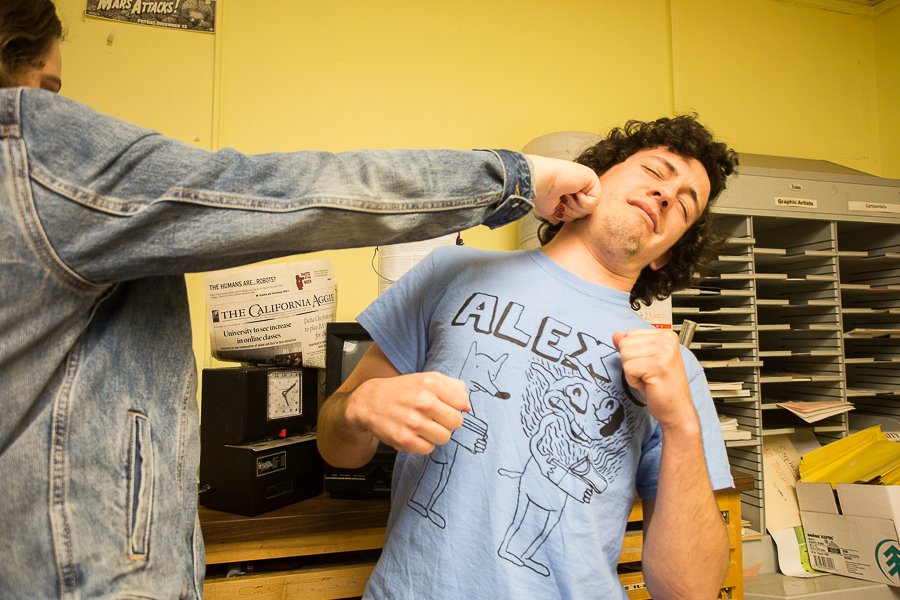
Five humorists shuffle down the stairs to Lower Freeborn every Monday morning in search of two things: laughs and blood. When the print paper can only showcase three humor articles a week, this handful of serious journalists has no option but to get those mouthguards in place and kick some rump.

“They, uh, didn’t really tell us that this was part of writing for The Aggie when we did the initial interview,” new member Aaron Levins said. “I thought it was going to be more about jokes and less about chokes.”

Older members are used to this kind of competition. One of them has been fighting since his freshman year. And members of The Aggie’s staff have mixed feelings about this trend.

“Honestly, it’s a little extra,” one editor said. “Each humorist has an entry song. This one dude enters to ‘I’m Like A Bird’ by Nelly Furtado every time and one of the girls enters to a ten minute compilation of didgeridoo solos. You don’t want the weirdest people on this paper fighting. It’s just cringe-worthy.”

The final three standing get to be in the paper, but the other two must only exist on the fragile Internet that can’t even be accessed without WiFi. Tragic. Additionally, no one can react with the sad face option on Facebook if the article is in the paper, so your ego is safe for at least a week.

“All of my teeth are fake now and this is only my second quarter writing here,” I said, because I can. “I’m thinking about investing in a gold grill.”

The main desire is this: when UC Davis is in ruins in the far future, and Lower Freeborn is finally located by a group of archaeologist cockroaches who survived another end of the world, we want them to find the one thing that describes our 21st century complex society in the best possible way. And that one thing is fake news peddled by college students in a basement.

“Sometimes I’ll slip the editor-in-chief a gift card to Subway in an attempt to have an advantage,” one humorist said. “Honestly, that’s why I’m broke now. I bought Subway gift cards with all of my rent money just to get immortalized in print. It was worth it.”

This writer now lives in a hut constructed out of newspapers that he has been featured in on the top level of the MU parking garage. However, he is happy because he knows that his silly words, which are the finest kind of art, will live forever.


Written by: Olivia Luchini — ocluchini@ucdavis.edu