55.4 F
Davis

Davis, California

Sunday, December 21, 2025
Home Blog Page 633

The American dream: A costly endeavor

MORGAN TIEU / AGGIE

The cultural, financial divide of studying in the United States

The American dream is an all too familiar concept. From its definition as the ideal suburban lifestyle to its deconstruction as a fallacious beacon of hope, this notion has evolved to mean different things to different people. Today, the American dream is still very much alive and endearing for many international students, but it can come at a cost — sometimes quite literally.

Sergey Lyubyatinskiy, a fourth-year economics major, is an international student from Russia. Lyubyatinskiy pays for his tuition by wiring money across the seas — a process that can be quite cumbersome.

“In short, it’s very expensive,” Lyubyatinskiy said. “In Russia from this year on, they charge you 1 percent for a wire transfer. When transferring a good amount of money, 1 percent becomes a substantial amount. I take my debit card, go to a bank and withdraw money; the maximum amount of money you can withdraw at once is $800, [and] usually Bank of America only lets you withdraw three times. So after that, you just go from one ATM to another, or you spread it into a month, withdrawing like once a day.”

In addition to these monetary inconveniences, Lyubyatinskiy experienced a culture shock to which other international students can relate. He had to grapple with the transition from being surrounded by fellow Russians to not interacting with anyone with a similar background.

“Because I want to learn English, I tried to sort of guard myself away from [other Russians],” Lyubyatinskiy said. “From a learning perspective, it was definitely a good thing. You get rid of accent and everything […] but sometimes you just miss your culture. I just sometimes want to speak Russian to someone. Locals don’t really understand sayings that international [students] may have.”

This estrangement from a familiar culture, in addition to the financial burden of attending school out of one’s home country, can cause some international students immense stress. Lyubyatinskiy’s feelings of frustration in terms of financing a college education also resonate with Shambhavi Gupta, an international student from India.

“The tough part comes after you get in,” said Gupta, a first-year economics and international relations double major. “You have to check if you have a medical insurance that matches with the college or not, and you don’t want to miss any deadlines or fees. I don’t get why international students — or for that matter any out-of-state students — have to pay so much tuition. We still have to buy books. We still have to pay for everything else. Then what are we paying extra tuition fees, $60,000 a year, for?”

Gupta also found it stressful to convert the cost of an item between dollars and Indian currency. With the current exchange rate of 1 dollar to 64 rupees in mind, Gupta feels guilty and stressed when she thinks about her living expenses here in terms of rupees.

“If you’re buying anything and you start converting, it’s going to mess you up,” Gupta said.  

Regardless of the financial hoops they are forced to jump through, there are still many international students who continue to value studying at an American institution for a wide variety of reasons. These incentives range from economic opportunity in America to escaping government oppression in their native countries.

Cunqiu Shao, a first-year psychology major, is an international student from China. She believes that America has served as her escape from China’s administration. She has found that people in China considered “beautiful” often have easier avenues to making money, whereas earning money through merit, such as academic pursuit, is a much more difficult endeavor.

“If you are beautiful [in China] you can make money very easily,” Shao said. “Using the Weibo app you just need to show the audience what you do everyday and the audience will send you gifts, and the gifts mean money.”

According to Shao, depending on where one lives in China, their potential economic growth is almost predetermined. With the same amount of hard work, someone in the bigger cities such as Shanghai, Beijing or Hong Kong can rapidly make progress, whereas someone in other smaller areas will not be able to see such success.

“I live in a not very big city in China,” Shao said. “It’s near Shanghai, but the price of a house [is worth more] in Shanghai. My mom thinks she did pretty hard work but she doesn’t gain the money she wants to. She thinks it’s unfair, [and that] I need to come to America.”

The Chinese government has a very tight grip on its people, closely monitoring their actions and controlling what media and news outlets say. This makes transferring money for student tuitions all the more difficult.

“The Chinese government asks people not to transfer lots of money from yen to dollars, because they think the economy of China is not very good,” Shao said. “The government doesn’t want us to take our money to America. My mother needs to change money from yen to dollars to give me the tuition, but the bank thinks it’s a large number of dollars, so they will doubt the use of this money.”

There is a cap on the amount of money one can exchange or transfer, an amount that is insufficient for student expenses. In order to pay for her tuition, Shao’s mother, father and grandparents all pitch in to transfer enough money.

In addition to all these stresses international students deal with, the Trump administration has created further anxiety in some.

“Trump will decrease the number of H1B’s — it’s like the F1 Visa, so lots of international students, especially from China, cannot immigrate to America” Shao said. “The [Chinese international students] here are confused and worried. If Trump stays president, I think the number of opportunities will decrease for international students.”
Written by: Sahiti Vemula — features@theaggie.org


Last week in Senate

HANNAH LEE / AGGIE

The ASUCD Senate gathered on April 6 at the Memorial Union for its first meeting of Spring Quarter. The meeting was called to order at 6:12 p.m. by ASUCD Vice President Adilla Jamaludin.

The meeting began with a presentation by the External Affairs Commission (EAC). Sara Williams, the chair of the EAC and a fourth-year history and political science double major, and several members of the commission touched on different topics including city government, the UC Davis Long Range Development Plan and Davis housing.

Next on the agenda was the senator committee appointments. In order, the appointments were: Senators Julie Jung and Michael Gofman for the Aggie Public Arts Committee; Senators Jose Menenes and Marcos Rodriguez for the ASUCD Scholarship Committee; Senators Menenes and Simran Grewal for the Champagne Committee; Senators Daniel Nagey and Samantha Chiang for the Council on Student Affairs and Fees; Senator Yajaira Ramirez Sigala for the DREAM Committee; Senator Rahi Suryawanshi for the International Undergraduate Student Committee; Senator Jung for the Internet and Networking Committee, Senators Gofman and Chiang for the Marketing Committee; Senator Suryawanshi for the Media Board, Senator Anastasia Ruttkay for the Sexual Assault Awareness and Advocacy Committee; Senators Khadeja Ibrahim and Suryawanshi for the Student Health and Wellness Committee; Senators Nagey and and Rodriguez for the Unit Relocation Space Allocation Committee; Senators Menenes and Gofman for the Underwriting, Sponsorship and Advertising Committee; Senator Nagey for Housing Advising for Undergraduate Students; Senator Chiang for the Disability Rights Advocacy Committee.

After the appointments, Chris Ortiz, the unit director of Refrigerator Services, gave a presentation.

Next, the presentation appointments were made for several ASUCD units including Entertainment Council, the Aggie Reuse Store and Specialized Transportation Services/Tipsy Taxi.

Two pieces of emergency legislation were also introduced. Senate Bill #73, authored and introduced by Menenes, moved to allocate $75 to reserve the Memorial Union Patio for Denim Day 2017. The bill passed unanimously with a vote of 12-0-0.

Subsequently, Senate Bill #77, authored by former ASUCD Controller Joseph DeAngelo, was introduced by Senator Grewal. The bill moved to clarify the purpose of the Entrepreneurship Fund Committee.

“The ASUCD Entrepreneurship Fund Committee has long functioned without a coherent structure,” DeAngelo wrote. “This bill clarifies the scope and purview of the committee.”

Senate Bill #77 passed unanimously with a vote of 12-0-0.

Afterward, consideration of old legislation began with Senate Bill #78, which was authored by Nick Flores, the Internal Affairs Commission chair. The bill moved to define “Board” in the ASUCD bylaws.

“The purpose of a Board shall be to serve as a collaborative and advisory body in ASUCD, comprised of no fewer than five (5) undergraduate students created through legislation,” Flores wrote. “The specific structure, purpose, and hiring practices of the Board shall be defined through legislation hereinafter enacted, appropriately addressing these areas.”

The bill passed unanimously with a vote of 12-0-0.

Shortly after, confirmations were made for the Ethnic and Cultural Affairs Commission.

The meeting adjourned at 9:20 p.m.
Written by: Ivan Valenzuela — campus@theaggie.org

UC Davis celebrates its 103rd Picnic Day

JAY GELVEZON / AGGIE FILE

An Aggie Tradition for everyone

One of the most iconic and popular Aggie traditions is finally here: Picnic Day. This year, April 22 is a celebratory day that honors not just this UC Davis classic, but also the City of Davis’ Centennial as well as Earth Day.

To encompass the significance of these events and holidays, this year’s Picnic Day theme is “Growing Together.”

“We wanted to honor that it’s on Earth Day and the commitment this university has to sustainability,” said Chelsea Hernandez, a fourth-year design major and chair of the Picnic Day Board of Directors. “We also really wanted to incorporate the City of Davis Centennial — I mean, that’s not going to come around obviously any other time — so that was really important to us, especially because […] the relationship that the university has with the city is very unique. There’s also […] all the construction going on around campus, and just seeing the university grow — I feel like that’s something we also reflected on.”

Picnic Day started more than 100 years ago in 1909, only a year after the university was established, when the Student Farm showcased the new dairy barn to the community.

“In 1912 it became student-run and has been student run since,” Hernandez said. “It’s grown immensely since then, […] it’s really just to showcase what UC Davis has to offer. We publish it as a UC Davis open house. What I love hearing are the little stories that people use it as a family day as well — we have families coming back and using this day as a family reunion opportunity.”

Only about 2,000 people showed up that first year with their picnic baskets to enjoy the exhibit, coffee and milk provided by the university, but Picnic Day has evolved over the century into one of the largest student run events in the nation — hosting roughly 70,000 people last year.

“The only year I’d really gone around was my first year. I remember walking and seeing the plant sciences when they were doing the plant giveaway,” Hernandez said. “I think I was just amazed that it was so big. Stepping out your dorm and all of the sudden seeing thousands of people at your school is pretty cool.”

The Picnic Day Board of Directors is made up of 16 students, and Hernandez estimates there are between 200 and 300 volunteers for the event. No matter their major, all students are encouraged to be a part of Picnic Day preparation, an endeavor that begins about a year in advance — new board members are elected after the last Picnic Day ends.

“Just like [Hernandez], I began [volunteering] freshman year,” said Noeru Sasaki, Hernandez’s assistant and a second-year communication major. “I actually found out through the ASUCD fair, and I really wanted to get involved with the community and the school, and I heard about Picnic Day and how it’s a huge tradition, so I decided to sign up for the assistant director position.”

Together, these students coordinate both Pre-Week, the week of events leading up to the notorious Saturday, and the day itself. Picnic Day is packed with fun events for people of all ages, with some of the most popular ones being the Battle of the Bands, the Fashion Show, the Chemistry Magic Show and the Doxie Derby Race.

“Honestly, my favorite part of Picnic Day is just going from side to side of campus and having there literally be an event at every corner and turn,” said ASUCD president Josh Dalavai, a third-year economics and political science major. “But if I had to pick, it’s the Doxie Derby. I’m a classic man, it’s the Doxie Derby.”

Classic indeed — even first time Picnic Day attendees have heard about the Doxie Derby race and can’t wait to see it, including Shireen Olyaie, a third-year transfer student and clinical nutrition major.

“I’m pretty excited, I heard that there’s fun events going around the campus,” Olyaie said. “I think the Doxie Derby sounds really cute. I am going with a few friends, [we…] might just walk around and explore campus and see what it has to offer. I’ve heard it’s like a giant open house and that always sounds fun.”

One of the highlights of Picnic Day that has grown in its hundred years is none other than the parade. Every year, the Board of Directors selects Parade Marshals who are special members of the community and who embody the spirit of the chosen theme. This year’s marshals are UC Davis professors Bryan Enderle and Isao Fujimoto, who are both active and inspiring members of the Davis community.

One of Enderle and Fujomoto’s responsibilities will be to judge and vote on the best float from the parade. For Rahi Suryawanshi, a third-year international relations major and ASUCD senator, riding on the float of her Japanese drum team Bakuhatsu Taiko Dan will definitely be one of this year’s Picnic Day highlights.

“We perform usually at Picnic Day and we will be performing this Picnic Day too,” Suryawanshi said. “We will be in the parade as well, and I’m very excited to perform, it’s a lot of fun. This year is the first year we’re doing the parade actually — we built our own float! It’s super exciting.”

Whether on the Board of Directors, participating in the Parade or simply walking around campus as an attendee, there is something new to learn about this vast university for everyone.

“I think my favorite thing changes each year,” Hernandez said. “There’s also so many things that I don’t know are happening because there’s so many events. I learn more about the campus, I think that’s the craziest thing for me. I think I know, but then there’s so many opportunities at this campus that I had no idea of until Picnic Day.”
Written by Marlys Jeane — features@theaggie.org

Bernie and the Bird: How Millennials failed to show up to the polls and elect Clinton

KELSEY GREGGE / AGGIE

Bernie and the Bird: How Millennials failed to show up to the polls and elect Clinton
For the first time in history, the Millennial generation surpassed the Baby Boomers in size among the world’s population. So nearly two years after they take the world by the reigns, what’s the worst that can happen? Brexit and Donald Trump happened. A message of isolationism and nationalism will be written in the history books as the first string of events Millennials helped put into motion. Future generations will wonder why.

Shortly after Great Britain historically decided to move away from the European Union in an act of defiance and propel itself into an economically independent direction, it was America’s turn to write history. The first important concept to remember regarding Millennials in the 2016 presidential election was the fact that their previous champion, Barack Obama, was leaving office. Now, Obama’s personal choice on who should follow him — Hillary Clinton — was clearly not preferred by a significant amount of Millennials.

Clinton arrived on the scene with a lot of baggage, none of which young people were willing to carry for her during this election. Ultimately, one might point to Benghazi, her email scandal or even the massive amounts of money that Middle Eastern countries poured into the the Clinton Foundation as reasons why Millennials wouldn’t vote for her. But Millennials were concerned about different flaws. Let’s start with Clinton’s back-and-forth support for the LGBTQ community since the early 1990s. Something a more accepting, progressive and liberal group of people should be able to understand, right? No. She was immediately considered a traditional “Washingtonian” by most young people. Second, her defense of her husband’s three-strikes rule and her use of the term “super predator,” coined by former President Clinton, didn’t alleviate Millennials’ concerns that she didn’t care for the welfare of “all Americans.”

So where would the now “majority” generation find their hero? On the set of a former number one NBC reality TV show? Or maybe in a 74-year-old man from Vermont who whispers to birds and sings folk songs? Clearly, the result of the election should tell you that in surpassing the Baby Boomer generation and getting ready for their “first day on the job,” so to speak, Millennials ultimately failed, showing up drunk and two hours late.    

What people fail to realize is how the message of “Bernie or Bust” may have cost Clinton the election. Senator Bernie Sanders conceded the Democratic nomination to Clinton amid allegations of voter fraud and corruption on part of the Clinton campaign. The former head of the Democratic National Convention (DNC), Debbie Wasserman-Shultz, stepped down after it was revealed the DNC was giving preferential treatment to Clinton. Now what’s important is that no one took the time to examine what “bust” meant when the champion of the Millennial generation in this election finally bowed out. After Nov. 8,, 2016, we learned what those “Bernie Bros” meant when they chanted “Bernie or Bust.” They simply didn’t show up to the polls, and too many that did failed to bubble in or select the name “Hillary Rodham Clinton.”

So why must the world deal with a young generation whose whining, crying and calling for shenanigans has become everyday news? Because they are stereotypically portrayed as self-entitled, privileged crybabies. It’s not rocket science to figure out that all those young people who currently stain the office of the president could have prevented Trump from being in office if they simply showed up to vote. A presidential election hadn’t seen a lower voter turnout since the year 1994. So instead of crying over spilled milk, Millennials, only about half of whom turned out to vote, should look in the mirror when looking for someone to blame for a Trump presidency.

It would be inaccurate and unfair to forget about the amount of young people who chose the current president as their champion: a complete outsider to Washington who runs for the people and against big business deals with neighboring countries. Those are some of the most prevalent qualities that young people look for in a candidate. Needless to say, I’m not including the majority of young Latino voters and minorities. Although Trump did manage to win with white, college-aged males and females, it seems like it was Bernie and the Bird who flew away with the Millennial vote in the 2016 presidential election.  
Written by: Brody Fernandez — bwfernandez@ucdavis.edu

Disclaimer: The views and opinions expressed by individual columnists belong to the columnists alone and do not necessarily indicate the views and opinions held by The California Aggie.

UC Davis Medical Center recognized as a “Leader in LGBTQ Healthcare Equality”

NICKI PADAR / AGGIE

Health facility upholds nondiscrimination policies, practices for a seventh year

The UC Davis Medical Center has proven its devotion to lesbian, gay, bisexual, transgender and queer (LGBTQ) patients for seven consecutive years, as it was once again designated as a “Leader in LGBTQ Heathcare Equality” by the Human Rights Campaign Foundation (HRC) on March 29.

Every year, healthcare facilities across the United States participate in a survey by the HRC that allocates leadership status to those who demonstrate equal care toward LGBTQ communities. The HRC then publishes its combined findings in a Healthcare Equality Index (HEI), honoring the participants and giving LGBTQ patients and their families a tool to find inclusive health care institutions.

“We’re honored to be nationally recognized for our longstanding commitment to a welcoming and inclusive environment for our patients, their families and our employees,” said Ann Madden Rice, the Chief Executive Officer of the Medical Center, in a press release. “Equity and inclusion are among our top priorities, and we are dedicated to leading efforts to eliminate health disparities.”

The purpose of the Healthcare Equality Program is to provide health care facilities with the proper resources for implementing the best policies and practices for LGBTQ patient care. Tari Hanneman, HRC director of the Health Equality Project, said participants in the survey were evaluated based upon four new criteria in the HEI 2017: nondiscrimination and staff training, patient services and support, employee benefits and policies and patient and community engagement.

Of the 590 applicants surveyed, 303 earned perfect scores out of 100 to receive leadership status and the special HRC logo as a stamp of approval. Six UC-affiliated facilities, housed across UC San Diego, UCLA and UC San Francisco, are also among the 77 California institutions honored.

“The more hospitals that we have participating, the more they’re going to change policies and practices which will help all LGBT patients,” Hanneman said. “Hospitals are competitive, so if you have one hospital in a community doing something, the other hospitals are more likely to jump on board and also be seen as […] welcoming and inclusive.”

Edward Callahan, the associate vice chancellor for Academic Personnel at the Schools of Human Health Sciences, said that the institution engaged in the HEI when it realized that LGBTQ patients needed a hospital to consider as a welcoming and safe space for their health needs.

“Health care provided for LGBT patients was not as good as what it should have been, so we made a commitment to improving that health care,” Callahan said.

Callahan said that the facility got a jumpstart on its goal by encouraging physicians to wear rainbow flags on their badges to make all patients feel immediately welcome no matter their sexual orientation.

Additionally, Hanneman said that the UC Davis Medical Center stood out from the other leaders by having an excellent transgender patient care policy that was used as a model for other health care institutions. The facility also hosted an Improving Outcomes Conference centered around enhancing health results for LGBTQ patients by bringing leaders and experts together to share ideas and skills.

Director of Institutional Culture/Climate and Community Engagement Adrienne Lawson-Thompson, Ed.D., said that she is proud to be a part of the LGBTQ-friendly UC Davis Medical Center.

“It really affirmed that we have a commitment with our hospital policies,” Lawson-Thompson said. “[It is important] that they feel safe, [are] treated with respect and dignity and feel welcomed.”

Lawson-Thompson stressed the significance of training and informing the institution’s staff to provide equitable care in the future. She added that the hospital has unisex room assignments and bathroom access.

“I believe that we align ourselves with the best practices in the field and show how we are reducing our biases and insensitivities [by addressing] our key issues such as confidentiality,” Lawson-Thompson said.

Though a record number of health care facilities applied for leadership, the HRC is dedicated to the long “battle” ahead for LGBTQ-friendly health care facilities.

“It is crucial that institutions continue to demonstrate that the march toward full equality is not slowing down,” HRC President Chad Griffin said in a press release. “For the past decade, the HEI has been the roadmap to closing the gap in ensuring equal care to LGBTQ patients and their families, and we urge every health care facility to join us in this continuing effort to provide inclusive care to all.”

The HRC website offers support for LGBTQ patients to find health care providers, assistance for coming out to their doctor, resources for transgender patients and more. To find a LGBTQ-inclusive health care facility, please view the HEI 2017.


Written by: Jeanna Totah — campus@theaggie.org

DAMN. provides insight into important messages

GENESIA TING / AGGIE

Lamar tackles subjects of anti-blackness, religion, politics

DAMN. Definitely my first reaction to hearing Kendrick Lamar’s latest album, released on April 14. Lamar gives nothing less than expected in his work. The album follows similar themes as his other works, tackling right-wing politics, anti-blackness, religion, mental health and even feminism. And this is what makes Lamar so brilliant. His album is nuanced and the layers are complex, with jazz interludes and audio bits, all intertwined with his impassioned messages.

Right off the bat, Lamar doesn’t hold back, calling out Fox News for its criticism following his performance of “Alright” at the 2015 BET awards. He uses an audio sample from Fox News commentator Geraldo Rivera, who states that “hip-hop has done more damage to young African Americans than racism.” Lamar hits back at the disapproval on his third song “YAH.” as he raps, “Fox News wanna use my name for percentage.”

Throughout the album there is also a focus on the juxtaposition of struggles Lamar faces in addressing his identity as a Black man and how the world views him. In “YAH.” Lamar says “I’m a Israelite, don’t call me Black no mo’ / That word is only a color, it ain’t facts no mo’.”

Through this biblical reference Lamar tackles the theme of anti-blackness and the labels that have been placed as barriers to how he feels he personally identifies. He follows this up in “XXX.” as he references Little Johnny, a character that represents a child who gets caught up in the violence and “street life” surrounding him. Lamar speaks on this by saying Little Johnny “said books aren’t cool no ‘mo/Johnny want to be a rapper like his cousin.”

In “FEAR.” anti-blackness is again touched upon as Lamar delivers the chilling predictions of how he’ll die. Reasons he gives are “because these colors standin’ out” and later “I’ll prolly die from one of these bats and blue badges,” as he references police brutality.

This duality continues with Lamar’s struggle to remain humble in a world of fame. Three tracks — “PRIDE.,” “HUMBLE.” and “LUST.” — accurately capture Lamar’s internal struggle to both acknowledge his success and remain modest. In the second stanza of “PRIDE.,” Lamar asks “happiness or flashiness?” alluding to his grapples with materialistic items over true happiness. In the following song, “HUMBLE.,” Lamar references his “humble” beginnings by saying “I remember syrup sandwiches and crime allowances” and then follows this by saying “now I’m countin’ this parmesean where my accountant lives.” In “LUST.” Kendrick raps about “wak[ing] up in the mornin’ / thinkin’ ‘bout money kick your feet up.” Throughout the song, he creates the image of a stereotypical “rapper lifestyle” full of drugs, money and women. Yet at the end of the song Lamar speaks on a deeper subject: the recent election of Trump. He urges his listeners to resist, as he says, “parade the streets with your voice proudly,” and after times passes “revertin’ back to our daily programs, stuck in our ways; drones.”

Lamar features a variety of artists including Rihanna, Zacari and U2. Each brings their unique sound to the album. Rihanna on “LOYALTY.” adds depth to the song as she backs Lamar up and ends the song with a powerful message: “It’s so hard to be humble.” Zacari is an up-and-coming artist and his feature on “LOVE.” is definitely one of the most notable. The track brings all the feels, and Zacari’s smooth vocals compliment the song perfectly. U2’s contribution to the album was one of the most anticipated, and “XXX.” does not disappoint. Its unique sound is nicely accompanied by Bono’s voice in the second part of the song, as it slows down.

In the last song, “DUCKWORTH.,” Lamar’s legal last name, Lamar talks about how “Top Dawg,” who signed 15-year-old Lamar, almost robbed his father at a KFC drive-through where Lamar’s father worked many years prior. But Lamar’s father wins him over by giving him free chicken. Through this personal history, Lamar illuminates a greater lesson: one of compassion and forgiveness. “Who would have thought the greatest rapper would be from coincidence?”

Throughout this album, it is clear that Lamar rightfully owns the title of best rapper alive. The layers that are provided both musically and lyrically reveal sentiments that are so important to acknowledge. Lamar gives us much more than music — he provides audiences with a way to heal and a lense to criticize the institutions that defy us. All hail King Kendrick.
Written by: Abigail Wang — arts@theaggie.org

UC Davis Picnic Day fashion show

BRIANA NGO / AGGIE FILE

Put this show on that Picnic Day to-do list

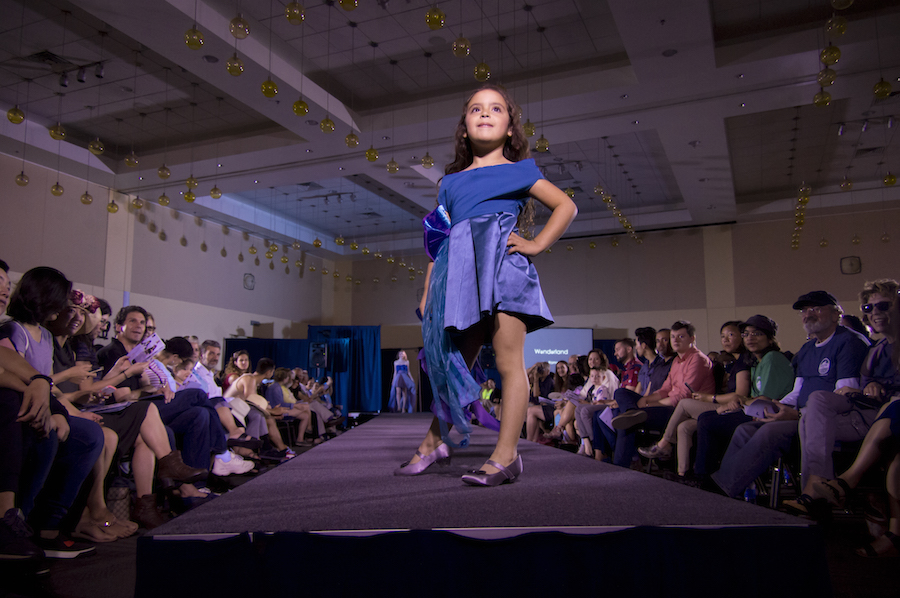
On Picnic Day, the Fashion and Design Society will host the Picnic Day Fashion Show, with this year’s theme being “Aspire.” This annual event showcases the work of the talented students in the Design Department at UC Davis.

Lisa Lo, a fourth-year design major, explained the layout of the fashion show.

“There are four components of the fashion show,” Lo said. “It starts with the red dress, then single garment, then senior thesis and ends with the signature collection.”

The red dress section is designed by members of the Design 107 class in support of Women’s Heart Disease Awareness. The single garment section is a competition in which judges from the fashion industry will participate, including a designer from Levi’s. Each of the two categories, sustainability and personal expression, which will have one winner, and any UC Davis student is free to submit a design for this section. The senior thesis component will feature the work of one senior design student who has prepared 14 garments. Lastly, the signature collection features 17 designers who will each showcase four to six dresses. These pieces were created during senior collection class in Winter Quarter.

Colleen Smith, a fourth-year design major, helped create the design and layout of the pamphlet for the show. In addition to her work organizing the show, she is also a designer and her work will be featured in the signature collection section.

“My theme is Nector and it is inspired by California wildflowers, and each dress is a different flower,” Smith said.

Marielle Ednalino, a fourth-year design major, is one of the designers for the show and is taking part in the signature collection.

“I help garner attention for the show, as well as participate in it,” Ednalino said. “I also helped other designers, inspired them and inspired myself along the way.”

Her designs are inspired by the amethyst crystal, which includes hard edges, layering, shades of purples and geometric shapes giving it a romantic feel.

There will be professional photographers and videographers along with a professional emcee. The event will be held in the ARC Ballroom with two showings, the first at 11 a.m. and the second at 1:30 p.m., and the doors will be open a half hour prior to the show starting. Each show is an hour long and is a great way to take a break from the heat of Picnic Day. Additionally, there will a video showing how the designs were made during the half hour before the show starts. Tickets are $10 for students and $12 for adults, and are available online at http://arts.ucdavis.edu/event/aspire or at the door.

For those who cannot make it to the show, the 1:30 p.m. showing will be live-streamed on the Fashion and Design Society Facebook page.
Written by: CaraJoy Kleinrock — arts@theaggie.org

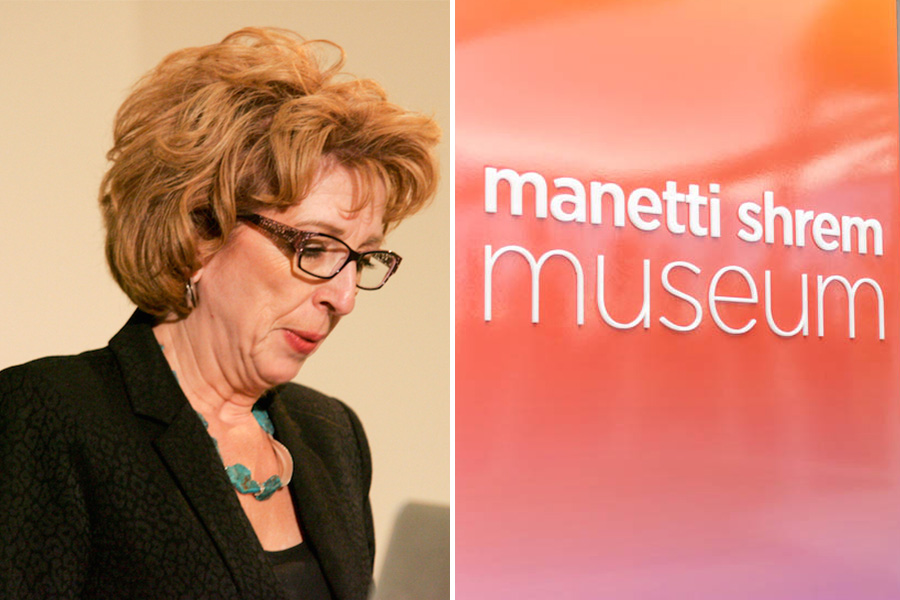
Humor: Remnants of former chancellor Katehi’s dignity to be displayed at Manetti Shrem Museum

JAY GELVEZON / AGGIE (left), SAHAR FOROUZANFAR / AGGIE (right)

Earth-shattering exhibit to open this June


They say if you love something, let it go, because if it was meant to be, it will come back to you. Unfortunately, sometimes things are just too far gone. The UC Davis community learned that lesson Thursday when some local history majors dug up an ancient artifact from former Chancellor Katehi’s regime: the last shred of her dignity.

For those of you who may not remember a simpler time, Chancellor Katehi once had what resembled an intact reputation and a healthy sense of pride for rocking the name Linda Katehi.

You may be thinking, why would Chancellor Katehi ever pride herself in anything but her iconic hairstyle and killer fashion sense? Well, there’s more to this ex-chancellor than meets the eye.

When this relic was unearthed yesterday, it was unclear whether it should be put on display or given back to Linda to ease her return to the faculty this fall. However, UC Davis’ very own Manetti Shrem Museum unanimously decided to turn the piece into an exhibit. It concluded that not displaying Katehi’s last shred of dignity would be a crime “worse than Katehi’s own.”

Eli Mesh, the museum director, was ecstatic when he heard about the discovery of the fossil.

Mesh claimed that even though the Manetti Shrem Museum is, in fact, an art museum, “there is nothing more artistic than the remains of a disgraced chancellor’s legacy.”

“We’re really excited about this exhibit,” Mesh went on. “We think it will fit in really well with the rest of what we have to offer.”

The exhibit will be set up right in between a dented, empty can of pepper spray from 2011 and a deflated, lone basketball that survived UC Davis’ short-lived March Madness hype.

A ribbon-cutting ceremony is scheduled to open the display this coming June. Katehi was originally invited to participate, but couldn’t muster up the strength to show her face in public.
Written by: Lara Loptman  — lrloptman@ucdavis.edu   Twitter: @lllawra

(This article is humor and/or satire, and its content is purely fictional. The story and the names of “sources” are fictionalized.)

Razo dazzles at Raley

CAT TAYLOR / AGGIE

UC Davis baseball blanks Cal Poly 3-0 in important conference win

In front of the beautiful sunset backdrop of Sacramento’s Raley Field — home of the San Francisco Giants’ Triple-A affiliate, the Sacramento River Cats — the UC Davis baseball team shut out its conference rival, the Cal Poly Mustangs, in a 3-0 victory on Friday, April 14. The change of scenery proved to be beneficial for the Aggies, as the team ended its five-game losing skid and responded in winning fashion to Thursday’s 4-1 defeat at the hands of the Mustangs.

Junior pitcher Orlando Razo stole the show, tossing a complete game while only allowing two hits and striking out 10 batters. Razo finished the night with six one-two-three innings and, at one point, retired 15 Mustangs in a row.

“Establishing the fastball early” was the key to the night’s success, according to Razo.

“We made a point to do that since the beginning of the season, establish fastball in the bottom half of the zone and then work off-speed after,” Razo said. “Today the curveball was working well from the beginning so I was throwing more of those. I’m fortunate to be able to have two off-speed pitches that I can rely on and throw for strikes.”

CAT TAYLOR / AGGIE

Razo’s off-speed and curveball pitches were untouchable for most of the night. After walking two batters in the first inning, Razo turned up the heat to pitch four straight three-up, three-down innings, utilizing his drop-off changeup to strike out six batters over that span. Despite this impressive individual performance, Razo gave all the praise to his teammates.

“We were able to establish a good rhythm tonight and Ignacio Diaz did a great job behind the plate,” Razo said. “Just putting [his] fingers down and blocking the ball because we were going out of the zone a lot. He just did a phenomenal job and the defense did a phenomenal job as well.”

UC Davis came alive offensively in the second inning. After senior first baseman Cameron Olson reached on an error by the Cal Poly third baseman, senior catcher Ignacio Diaz singled to put two Aggies on base with no outs. Next up to bat was junior center fielder Alex Aguiar, who connected on a pitch and lined the ball to right center for a two-run double that put UC Davis ahead. Later in the inning, junior right fielder Ryan Hooper added another run on a sacrifice fly that scored Aguiar.

The Aggies tallied six hits on the evening and stayed ahead 3-0 throughout the rest of the contest. A three-run lead was plenty to work with for Razo, who had a no-hit bid through five innings that was eventually broken up when a ground ball squirted into left field with two outs in the sixth. Even though the chance for a no-hitter was lost, the game certainly was not. Razo remained in the game until the very end, holding the Mustangs scoreless en route to pitching his first complete game as an Aggie and earning his fourth win of the season. Again, Razo hailed his teammates for having his back defensively in each of his nine innings of work.

“It’s just being able to trust your teammates,” Razo said. “Being able to know that there is a good defense behind you, throwing strikes, and getting ahead [in the count]. It’s really tough to pitch behind in the count, when [the other team is] zeroing in on one pitch, so you keep them guessing the whole time, getting ahead and just being aggressive.”

CAT TAYLOR / AGGIE

With the win, the Aggies improved their record to 9-17 on the season. That is still not where the team wants to be, but head coach Matt Vaughn believes the victory is important for starting the Aggies off on the right foot for the second half of the season.

“It feels really really good,” Vaughn said. “Based on the way we lost a couple games last weekend, we needed something big, and Orlando delivered it for us. For me, he put this team on his back and said ‘come on you guys, I’m gonna get this one.’ And he did. He’s a bulldog, he’s tough and I think our guys feed on it a little bit. We can still do some things better offensively and we have to figure that out as we go, but hopefully we have time and we can build on his effort today. [He’s] just a really really tough kid. He’s a leader.”

The Aggies finished the home series against Cal Poly the following day, when the Aggies lost 9-6.

“There is a lot of season left,” Vaughn said. “I’m hoping that our guys are seeing that we’re competitive all the time and if we can just eliminate a mistake or two here and there, we can get back in this thing. I know it’s boring and I know it sounds cliché, but it’s a one pitch, one game at a time deal.”


Written by: Dominic Faria — sports@theaggie.org

Where we’re at with weed

STEVE MORGAN [[CC BY-SA 4.0] / CREATIVE COMMONS
Undocumented immigrants at greatest risk of federal enforcement of marijuana policy


Today marks the first 4/20 Californians of age will celebrate entirely legally. It’s been a long time coming for the state that was first to approve the medical use of marijuana in 1996 — and it’s surely only the start of what will be a national march toward the end of a modern prohibition. But there’s one big roadblock facing tokers everywhere: the Trump-era Department of Justice.

Helmed by Attorney General Jeff Sessions, a former Alabama senator and early Trump supporter, the Justice Department will likely have an outsized role in determining how the federal laws that still classify marijuana as a Schedule I Drug as dangerous as cocaine and heroin are enforced.

Even though Sessions has recently indicated to U.S. senators in private that he will not crack down on marijuana, he has ordered a review of Obama-era marijuana enforcement policy and is known for his long-held and staunch opposition to a drug that he has said “good people don’t smoke.”

There are other troubling signs. Sessions appointed Steven H. Cook, a federal prosecutor and hard-line enemy of criminal-justice reform, to help roll back key provisions of the Obama Justice Department. That could include reimplementing the failed tactics of the War on Drugs.

The evidence that the Justice Department is gearing up to clamp down on pot raises an obvious question: Why?

A Quinnipiac University poll found in February that 59 percent of Americans are in favor of legalizing marijuana, and 71 percent say the federal government should not interfere in states that have chosen to permit recreational or medicinal use of the drug.

As it happens, enforcing federal marijuana laws may have the added benefit to Sessions’ Justice Department of fulfilling a key Trump promise: cracking down on illegal immigration.

Because immigration to the United States is considered a federal issue, the possession or use of marijuana by undocumented immigrants can, in some cases, be grounds for deportation. Sessions has responded to sanctuary cities like Davis that have promised not to turn over undocumented immigrants to federal authorities by threatening to withhold critical grant money.

In such an environment, it seems eminently possible that a rehashed War on Drugs could be an excuse for Trump to target unauthorized immigrants, even here in California. At UC Davis, where the number of undocumented students totaled about 200 when the AB540 Undocumented Center opened in 2014, that poses a potential danger to the campus community. As college students increasingly choose to smoke marijuana, they should be informed as to how the use, sale or possession of pot can adversely affect them or their colleagues.

While the harm that Sessions could create by going after pot is huge, there’s still a lot of uncertainty as to how the administration will actually act. In marijuana we see another example of Trump’s lack of leadership creating rifts within his own administration. Contradicting Sessions and Cook last week was Department of Homeland Security Secretary John Kelly, who said “Marijuana is not a factor in the drug war.”

So what’s the bottom line? Does all this confusion precede the end of weed? Not quite.

It’s possible that the slow way recreational marijuana has been adopted in the United States has created a situation that makes it more difficult for a knee-jerk reaction from the Justice Department. This is especially true for medicinal marijuana — which has been rolled out over the United States for over 20 years — and is now being put under serious consideration in deep-red states like West Virginia, where it was approved by a Republican legislature earlier this month.

All this is to say: Don’t panic yet, man. Even though ambiguity over the Trump administration’s position on weed has caused states like Colorado to reevaluate how they regulate the drug, it’s unlikely that pot’s acceptance among a growing share of Americans will suddenly go up in smoke.

Of the eight states that have legalized recreational marijuana, all have done so through ballot referendums rather than through state legislatures. It’s an indication of how perceptions of weed have changed from the ground up, and for the better. That should give some hope to users on this 4/20 that Trump and Sessions may not get their hellish return to draconian drug policy.
Written by: Eli Flesch — ekflesch@ucdavis.edu

Disclaimer: The views and opinions expressed by individual columnists belong to the columnists alone and do not necessarily indicate the views and opinions held by The California Aggie.

Show Review: Oh Wonder — simply wonderful

JAY GELVEZON / AGGIE

London-based duo brings simple melodies to Sacramento

Across the pond, British based duo, Oh Wonder, recorded one track every month for a year in their home studio in London. Each song was released on Soundcloud on the first of every month. Initially, it was dismissed as a gimmick, but it caught on garnering numerous streams on Soundcloud and now on Spotify. The creation of their self-titled, debut album was described by the duo as an album containing 15 singles, and it is now a viral sensation. Headed by Anthony West and Josephine Vander Gucht, they performed to two sold-out crowds inside the quaint venue, Ace of Spades, in Midtown Sacramento. They even performed on both weekends at Coachella proving that they can take on a hectic tour schedule.

The duo took the stage with two giant letters — an O and a W — which lit up the background of the stage. The backing band knew their cues and played along with Vander Gucht’s and West’s amazing stage presence. Every now and then, Anthony would close his eyes and get lost in the music, whether he was on keyboard or playing his guitar. Josephine’s innocent smile garnered screams from the crowd as she jammed on her own piano. The duo’s vocals were simply breathtaking as they transitioned from “Drive” to “Technicolour Beat.” Their latest single, “Ultralife” was upbeat, but gave a calming aura to the audience.

JAY GELVEZON / AGGIE

Throughout the show, West and Vander Gucht would take turns speaking to the crowd. It sounded like the duo thoroughly enjoyed their visit to California’s capitol as they told stories about strolling through Sacramentos’ many parks. Josephine even made a comment on how it’s possible to have rainy weather plus palm trees all in once place.

The talented duo is a must-see, and I’m sure they will make a return to Northern California where there probably perform at a bigger venue. For more information about Oh Wonder, please visit their website.

A toast to the 103rd Picnic Day

HANNAH LEE / AGGIE

Picnic Day, Picnic Day, Picnic Day, Picnic Day, Picnic Day

Picnic Day is approaching, and, with it, so are the morning mimosas, afternoon mimosas, evening mimosas and bedtime mimosas. Kidding aside, Picnic Day is Davis’ unique opportunity to showcase exactly what makes the city and community special: the eccentric (and boozed-up) student body, the animals and the innovative ingenuity that underscores campus life and the day itself.

The Picnic Day staff has done its absolute best to put on a day that engages and entertains tens of thousands of people who will make the trek to Davis on Saturday, April 22. Their work is especially impressive this year, considering that ASUCD cut the entirety of its $5,000 subsidy to the Picnic Day unit from last year. Instead, Picnic Day has a negative subsidy this year, as the unit will give an estimated $11,500 in generated revenue back to the student association.

Nonetheless, the day will be chock-full of Picnic Day favorites, such as the Picnic Day Parade, the Doxie Derby and the Battle of the Bands, among hundreds of other events, performances, open houses and more. The Editorial Board commends the Picnic Day staff for putting in countless hours and setting up a day that is sure to be memorable, exciting and full of interesting events that will showcase our campus and community.

Students, a warning: BE SMART. The City of Davis has enacted a “Safety Enhancement Zone,” in which fines and penalties will be increased for legal violations. The campus and city will be swarming with law enforcement. Plus, you don’t want to be belligerent when you run into your professors or co-workers (looking at you, Aggie staff) on campus. Uphold the Principles of Community, enjoy the sunshine and make sure to experience all that the historic day has to offer. A full list of events can be found online at https://picnicday.ucdavis.edu.

For reference: https://www.youtube.com/watch?v=4anL9DzRn9s

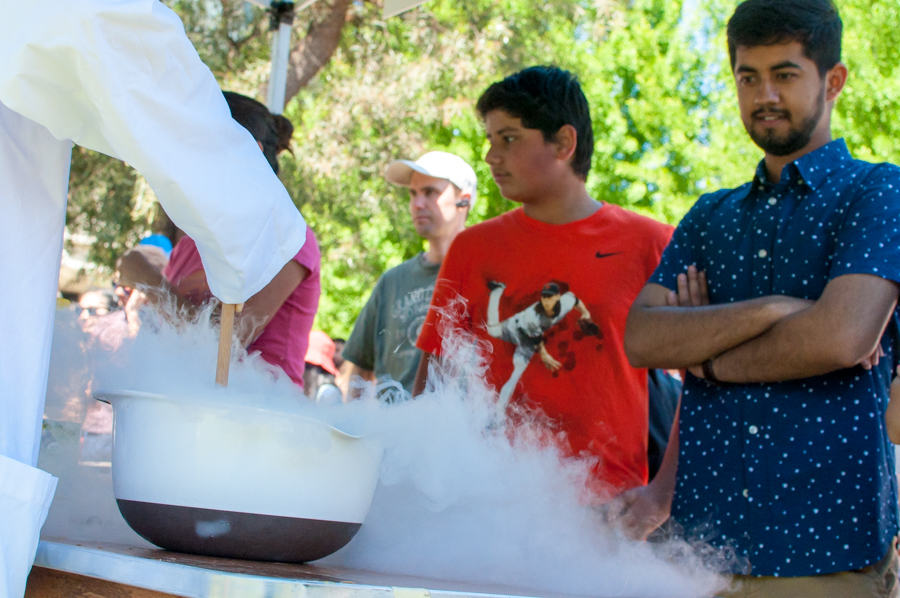
Liquid nitrogen ice cream not to be offered at Picnic Day 2017

JAY GELVEZON / AGGIE FILE

Environmental Health and Safety denies approval of liquid nitrogen ice cream stand

The UC Davis Student Chapter of the American Institute of Chemical Engineering (AlChE) will be unable to provide its staple liquid nitrogen-frozen ice cream at this year’s Picnic Day due to lack of approval from UC Davis Environmental Health and Safety (EH&S).

Although the AlChE has distributed ice cream and sorbet frozen with liquid nitrogen for the past 13 years, the organization was unable to secure the approval of the EH&S as a result of a safety protocols change.

Randy Xie, a third-year chemical engineering major and the AlChE’s president, said that even though the club will be unable to provide its product, they are working to make a related substitute for this year’s Picnic Day.

“While our association and the engineering department worked closely with UC Davis Environmental Health and Safety to approve this event, we were unable to pass this booth this year despite having done this event for over 13 years at Picnic Day,” Xie said via email. “I, along with my officers are working to have an ice-cream related substitute for this booth in time for Picnic Day that abides with their sudden changes in safety protocol.”

AlChE declined to discuss the reasoning behind the EH&S’s disapproval, as they are still involved in negotiations to bring back the liquid nitrogen treats next year.

To be frank, I am hesitant to speak out at this time about the decision by EH&S to not approve the activity this year,” said Tonya Kuhl, a chemical engineering professor and the club’s faculty advisor, via email. “We fear that EH&S will continue to ban liquid nitrogen in the future and are in on-going discussions to ensure the activity can be held in the future.”

Karen Gonzalez, a fourth-year political science and history major, expressed disappointment regarding the absence of this Picnic Day tradition.

Really, [it] sucks that out of nowhere that would happen,” Gonzalez said. “I know we’ve had it for a long time; it is very upsetting to see a tradition end!”
Written by: Emily Shintani — campus@theaggie.org

UC Davis participates in UC-wide Global Poverty Action Day

HANNAH LEE / AGGIE

UC campuses come together to combat poverty

Students are uniting across University of California campuses during the week of April 17 to bring attention to the multifaceted issue of poverty and inequality. Cross-campus initiatives will be held throughout the week to commemorate Global Poverty Action Day.

On April 19, the UC Davis Blum Center is showing a screening and discussion of Poverty Inc., a documentary that more closely examines the problematic aspects of the foreign aid industry. Students can view the documentary and take part in an interactive discussion with staff members at 5 p.m. in the Plant and Environmental Sciences Building room 3001. The documentary works “to uncover the ways in which the traditional systems of development assistance by the West can stifle economic development and reinforce cycles of poverty in developing countries,” according to the event’s website.

In the six years since its founding, the UC Davis Blum center has funded over 140 student projects and contributed almost $250,000 in support.

“The Blum Center is an on campus entity that seeks to engage the student body on campus to develop scalable and sustainable solutions to poverty both domestically and globally,” said Funke Aderonmu, a fourth-year international relations and economics major. “We accomplish this mainly through global poverty courses the Blum Center staff teach each year and our annual travel grants programs for undergraduate and graduate students.”

As UC Davis’ Blum Center outreach coordinator, Aderonmu works to inform and connect the student community to events and programs organized by the Blum Center that are happening on campus.

“With a focus on excellence, our mission is to engage UC Davis faculty and students in finding tangible, sustainable solutions to alleviating global poverty,” the UC Davis Blum Center’s website states. “This multi-disciplinary, cross-campus initiative engages undergraduate and graduate students, faculty, researchers and local community partners abroad through education, applied research and outreach,”

Each of 10 UC campuses has its own Blum Center focused on a specific aspect of combatting poverty. While UC Davis and UC Berkeley Blum Centers are dedicated to research and education surrounding developing economies, other campuses like UCLA tailor resources toward addressing poverty and health in Latin America. Each campus is uniquely qualified and to tackle certain areas the issue of poverty locally and abroad.

“This will be the first convening of the Blum Centers as a federation,” said Richard Matthew, faculty director of UC Irvine Blum Center for Poverty Alleviation, in an interview discussing cross-campus efforts to hold events to raise awareness for Global Poverty Action Day.

Events unique to each campus held during the week of April 17 will form a united front to educate and combat the issues of poverty and inequality.

“The events taking place during this week will highlight themes that resonate with each campus and community, ranging from the role of technology in tackling the Syrian refugee crisis, to addressing local and global food insecurity, to the relationship between healthcare and inequality, to how students can drive sustainable production and consumption practices individually and collectively,” Aderonmu said.

During this weeklong initiative, all 10 campuses will combine their expertise and unique resources to further educate UC students about the multifaceted issues of poverty locally and abroad.

“As a public research university we are uniquely positioned to look for innovative approaches to intractable issues like poverty,” said UC President Janet Napolitano in an interview announcing the cross-campus initiative.

Beyond raising awareness of the multifaceted issues of global poverty, economic and social justice, these centers work to expand research and educational opportunities for students to get more involved.
Written by: Ally Russell — campus@theaggie.org

Photo of the Week: 4/19/2017

Lighting up the night on Chinese New Year in San Francisco. (KELSEY GREGGE)