57 F
Davis

Davis, California

Monday, December 22, 2025
Home Blog Page 645

California drought conditions improve

CHELBERT DAI / AGGIE

Oroville dam ruptures, flooding reported on Yolo Causeway

Water levels have been on the rise with what is so far one of the wettest years in California on record. The Oroville Dam began to overflow, with a sizeable hole in the spillway, which emergency crews began to fill with 1-ton bags of rocks. The emergency spillway, which is only used in extreme cases, was used for the first time in 48 years. Over 180,000 people were advised to evacuate due to the dangerous levels of water.

“Alert-Alert-Alert — Yes, an evacuation has been ordered. All Yuba County on the valley floor. The auxiliary spillway is close to failing. Please travel safely. Contact family and friends. Help the elderly. Take only routes to the east, south, or west. Do not travel North toward Oroville!!!!!” a Facebook post by the Yuba County Office of Emergency Services read.

Governor Jerry Brown took action to repair the dam’s infrastructure damage and ensure public safety by announcing a four-point plan to bolster dam safety and flood protection. This included requesting a $387 million proposition appropriation from the legislature to go toward emergency responses, creating emergency plans with maps of dams, improving inspections of dams and requesting more funding to improve the overall safety of dams. Congressman John Garamendi also met with farmers and flood control agencies as he tried to plan the rebuilding of levees and provide federal relief.

After the emergency spillway flowed over and a great deal of soil erosion occurred, a large release of approximately 100,000 cubic feet per second had to be made by the California Department of Water Resources. Many parkways and other areas were flooded, including the Yolo Bypass.

The Yolo Bypass is performing as designed, to direct much of flooding across I-80 & I-5,” said Boone Lek, a senior engineer at the California Department of Water Resources. “It caused us to slow the release, which resulted in having to go over the emergency spillways for the first time in history.”

However, infrastructures and residents were not the only things uprooted due to the rupture of the dam and subsequent flooding –– fish hatcheries were put in danger as well.

Today, we’re in areas checking out salmon and steelhead that are all trapped and will die within the day,” said Harry Morse of the California Department of Fish and Wildlife. “We had to move approximately five million young baby chinook salmon from one portion of the hatchery to the satellite area. We’ve had tremendous amounts of silt from erosion, and have had to close down about half of our hatchery to save fish. We’ve been significantly affected.”

The Yolo Bypass Wildlife Area was closed due to flooding, as well as many other areas in the Sacramento region. As residents from Yuba County evacuated as advised, businesses, gas stations and towns were deserted. Many residents loaded up their cars, anxious to get out of potential danger. However, officials and emergency crews worked on controlling the situation as quickly as possible.

“The concern was losing the gated spillway –– that’s why the operators of the reservoir made a decision to reduce flows so that they can go in and evaluate that initial damage,” Lek said.

Brown visited the Incident Command Post to see areas affected by flooding, as well as to determine how the spillways can be enhanced in the future. On March 3 at 10 a.m., the Hyatt Power Plant at Lake Oroville resumed its operation to remove eroded soil and debris from the water. The emergency crews and other officials worked hard to reduce the water flow and, as always, make public safety their top priority.


Written by: Kaelyn Tuermer-Lee — city@theaggie.org

A UC Davis student’s guide to spring break

MORGAN TIEU / AGGIE

Avid hikers, backpackers weigh in on best places to explore before Spring Quarter

Abbo Nathan, a second-year sustainable environmental design major, wakes up one morning and tries to get herself and her friends out of the door by 7 a.m. The day’s destination is Yuba River, a personal favorite of Nathan’s. With backpacks stuffed with towels, peanut butter and jelly sandwiches and swimsuits, the group reaches the river by 10 a.m. and starts to hike along the bank.

The farther the group hikes, the fewer people on the trail; Nathan and her friends hike until they reach the perfect spot to spend their day hanging out on the white rocks and jumping into the cool water. Before heading home, as per tradition, the group stops in Auburn for burritos.

The best day trip is Yuba River in Placer County,” Nathan said. “During spring, the snow is melting and rushing down — it’s so cool.”

Nathan, president of the Ski or Snowboard Club at Davis, is no stranger to the outdoors. She spends much of her free time out in nature.

I don’t remember a weekend — definitely not this quarter — […when] I [have] stayed in Davis,” Nathan said. “I really like going out.”

According to Nathan, the best place to go during spring break is Yosemite National Park.

“If you make a trip to Yosemite, it’s amazing,” Nathan said. “During spring, you don’t have the summer crowd, all the waterfalls are going, [and] wildflowers are blooming.”

A little closer to Davis, another popular location to visit to is Lake Tahoe, especially for those who want to see snow. Tahoe is also home to long hikes with elevation gain. According to Nathan, the Pacific Crest Trail offers great views of the lake along the rim of Lake Tahoe, making it a good choice for those who want to do a backpacking trip over spring break. The Lake Tahoe area is also great for students who aren’t in the mood for hiking. Nathan believes Truckee and Tahoe City are “really cool towns”.

“If you’re not into outdoorsy stuff, [they have] docks [where] you can just sit by the lake and watch the sunrise and sunset, and [there are also] thrift stores and stuff,” Nathan said.

For students who prefer a drive rather than a hike, Sonoma and Napa are the way to go. The drive provides a scenic view of vineyards and hills for those who want to take it easy over the break.

“You can drive through that and then get to Bodega Bay area,” Nathan said. “If you’re not super down to hike you can just get the scenic drive and hang out by the water on the cliffs. If you go somewhere, stuff your car with as many people as possible so you can split gas, that’s a pro tip.”

Lake Berryessa lies about a half an hour away from the City of Davis and is perfect for students who don’t want to venture out too far. According to Nathan, hiking the trail to the peak of Berryessa gives hikers a view of all of Northern California.

Paige Dougherty, president of The Hiking Club and a fourth-year neurobiology and physiology major, has also had a lot experience with great outdoor spots and trails. For students who don’t have access to cars for very long, Dougherty recommends Stebbins Cold Canyon Reserve. Owned by UC Davis and right by Lake Berryessa, it’s a little steep but offers great views.

“What I love most about hiking, especially here, is that we have such a great group of people we wouldn’t be able to do this without,” Dougherty said. “I don’t think there’s anything better than going out on a hike with [a] new group of people. It’s such a beautiful thing that we can get people out of the confines of Davis and into nature.”

Dougherty and the Hiking Club plan about nine group hikes per quarter. Dougherty’s favorite place to go is Big Basin Redwoods State Park, about two and a half hours away in Santa Cruz County. According to Dougherty, the Meteor Trail at Big Basin is great way to see waterfalls and redwoods on the way to the summit, from which one could see the ocean.

“It’s a little bit far away but you get so much bang for your buck,” Dougherty said. “This trail is just gorgeous and you really see everything northern California has to offer in one loop.”

Students looking to get out of California can get involved with Outdoor Adventures at UC Davis, which offers a guided trip to the Grand Canyon during Spring Break. For a fee, Outdoor Adventures provides food, transportation, group gear and the option of renting out individual gear like sleeping bags and head lamps, for an additional cost. The trip is guided by student guides from the university.

“It’s a cool way to meet new people,” said Kevin Townsend, a second-year geology major and employee at Outdoor Adventures. “You can sign up with your friends or you can sign up by yourself and meet 14 new people for a week. Everyone’s super nice and it’s a really good time.”

For those who would prefer to explore on their own rather than going on a guided trip, Outdoor Adventures can help with that as well.

“If people do want to go outside and try something out we have a bunch of rental gear that we can rent out to students like tents and sleeping bags,”  said Amanda Bauer, a first-year microbiology major and Outdoor Adventures employee. “That definitely makes it easier for people to go out if they can have someway to get gear.”

Students who don’t have access to a car can visit Putah Creek, which is only a short bike ride away and offers various turnouts and hikes around the creek. Nathan and her friends often bike to a rope swing on Putah Creek, sometimes after class on really hot days.

“It’s kind of a secret but I’m revealing it to The Aggie,” Nathan said. “If you can find it, it’s a 10 to 15 minute bike ride. It’s really cool [and] when it’s not cold you can rope swing into Putah Creek and it’s really refreshing.”

Probably the closest for any UC Davis student, the UC Davis Arboretum is another place to destress, relax and enjoy the spring weather without having to go too far. Nathan emphasized  that if a student wants to get out of town, though, it’s incredibly easy.

“Davis […] [is] the best location because you’re two hours from anything super cool,” Nathan said. “There’s no other feeling quite like seeing something awesome for the first time. There’s a lot of opportunity to do that [here].”

Written by: Fatima Siddiqui  – features@theaggie.org

Double Take: Should hate speech be protected under the First Amendment?

GENISIA TING / AGGIE

YES — Taryn DeOilers


The ongoing battle between alt-right firebrand Milo Yiannopoulos and left-leaning university students encapsulates the national debate on whether hate speech should continue to be safeguarded in the United States. While it’s critical to denounce the vile sentiments Yiannopoulos belches out on campuses across America, the preservation of free speech for all individuals remains paramount to our democracy.

The exceptions are, of course, cases in which insults lurch toward explicit, deliberate threats of violence called “fighting words.” Otherwise, Americans can freely ridicule people based on characteristics like religion, gender and race without fear of being legally punished. Although this seems immoral, the First Amendment has existed to protect speech that’s controversial, aggravating and inflammatory — not speech that’s comfortable, ethical and well-liked.

It’s crucial to recognize that silencing even the ugliest words would set a precedent for future lawmakers for permissible censorship. Because laws can be twisted and reinterpreted as time progresses, the same legislation that strips rights from those who spew offensive rhetoric could easily revoke the protection of more moderate speech.

Most importantly, unsavory expression is merely a symptom of the underlying concern, and those who espouse it wouldn’t vanish with the swipe of a pen. Concealing hate speech wouldn’t eradicate the hate — it would just attempt to hide the speech. We must confront the source of evil if we wish to witness true change, and how can we successfully fight what we cannot see with perfect clarity?

John Stuart Mill argues in his philosophical work On Liberty that the free exchange of ideas — even despicable ones — is essential to arriving at a “clearer perception and livelier impression of truth [that can only be] produced by its collision with error.” For all of us who detest bigotry, living in a country where love, hate, truth and falsehood are equally provided a podium can be distressing and disheartening. But as Mill declares, tolerance and reason, when given the opportunity to exhibit their veracity over ignorance, will ultimately transcend and irrevocably disprove the cowardly hate behind which fools like Yiannopoulos stand.


Written by: Taryn DeOilers — tldeoilers@ucdavis.edu


NO — Jazmin Garcia


Allow me to clear up what this argument isn’t. This stance does not endorse the persecution of those who perpetuate hate speech, nor does it advocate censorship. It simply answers the ethical implications of tolerating hate speech and the demoralizing effects of this speech insofar that it divides and endangers people.

While adverse opinions are necessary for fruitful discussion and for understanding different points of view, hate speech normalizes antagonistic depictions of marginalized people. After all, hate speech is defined by the American Bar Association as “speech that offends, threatens, or insults groups based on race, color, religion, national origin, sexual orientation, disability or other traits.” Often, those who defend hate speech have some degree of privilege, so this defense does little in bridging the divide and fostering understanding between communities.

It would be fallacious to say that those who believe in protecting hate speech are hateful. But the argument hangs itself on the word “speech.” We’re more likely to unanimously agree that vandalism and acts of violence are terrible, but when it comes to similarly spirited language, hate suddenly becomes a matter of opinion.

One does not have to look further than Milo Yiannopoulos to assess the effects of hate speech. The alt-right agitator recently fell from grace when a video of his pro-pedophilia comments resurfaced. When someone defends his constitutional right to spew racist, misogynistic, transphobic and Islamophobic speech, but draws the line at pedophilia, is the issue really about free speech? This suggests that only certain kinds of speech merit a platform.

And sadly, this type of speech demonizes the marginalized. After the election, many Muslim and Hispanic Americans have been taunted by Trump supporters telling them that their “time is up.”

Many of those who defend hate speech do so out of a desire to be ideologically consistent in their defense of free speech. But they don’t recognize the need to tailor laws to new situations and circumstances. Progress does not come from looking to old documents. It comes from challenging authority or, in this case, language that subjugates others.
Written by: Jazmin Garcia — msjgarcia@ucdavis.edu

Disclaimer: The views and opinions expressed by individual columnists belong to the columnists alone and do not necessarily indicate the views and opinions held by The California Aggie.

A review: Disney’s Live-Action Beauty and the Beast

GENESIA TING / AGGIE

Film features same beloved songs but offers few changes

Disney continues to feed our need for nostalgia by releasing yet another live-action version of an iconic classic, and, this time, it’s Beauty and the Beast. Looking back, it’s easy to see some problematic issues with the princesses we may have worshipped as kids: Jasmine marries the guy who’s been lying to her for the vast majority of the movie, Ariel turns into a different species to be with a guy she’s never spoken to, and Sleeping Beauty is… well, asleep for most of the action. However, seeing the films this simplistically discounts some of the important messages that we may not have picked up on, and, so far, the live-action versions of some of the Disney classics have drawn out certain “explanations” that we may have missed before.

For example, the live-action 2015 Cinderella focused on the message to “have courage and be kind,” something that would be tremendously difficult to do after years of neglect and abuse. The Cinderella in the newer film has gone through the same hardships as the 1950s Cinderella, yet by repeatedly including that motto in the newer film, the audience is reminded that maybe Cinderella was not “rescued” by a prince, but instead managed to survive and find love after having been denied it for so long.

And that’s where the magic comes in with live-action recreations. Sure, it’s nice to see everything played by real actors, but it’s even more interesting to see a different perspective on certain storylines and characters that may not have been explored before. In the case of 2017’s Beauty and the Beast, the villain Gaston’s sidekick, LeFou, receives a flamboyant makeover and an expanded storyline. Director Bill Condon stated that LeFou will have an “explicitly gay moment” in the film, yet after seeing the film, I feel that there’s much left to be desired. Although the movie focused some time on the character, I left slightly disappointed. Even the actor, Josh Gad, had stated previously that “there was nothing in the script that said ‘LeFou is gay’,” only to later rescind that comment, which makes me feel as though the character’s sexuality was added last minute to halfheartedly attempt to pander to the LGBTQIA audience. Regardless, it’s a first step for Disney and one that will hopefully pave the way for even more diverse characters.

In terms of Belle’s motto, there was no specific phrase, but the overall theme seemed to be “fearlessness,” as it’s brought up several times, with Belle owning the term by stating that she is “not afraid” when she takes her father’s place as the Beast’s prisoner. The film explores Belle and the Beast’s budding friendship and affection very similarly to the original film, but focuses slightly more on what they have in common, such as their love for reading. Clearly, there was an attempt to make it believable that someone could possibly fall in love with someone who is holding them against their will, and it was lightly touched on when Belle tells the Beast that no one can truly be happy if they are not free.

Those looking to relive the nostalgia of this Disney classic won’t be disappointed, since it features all of the same songs in addition to some new ones, and it is a very close replica of the animated film, especially compared to the other recent live-action Disney films. This in itself has its flaws and strengths, as it feeds directly into what the audiences may be looking for, but at the same time, leaves little room for new material and side stories. Emma Watson’s Belle is exactly what we expect: bookish, intelligent, innovative, strong and kind, all of which is wonderful, but really did leave me feeling like I watched the same exact childhood film. So, if nostalgia is what you are looking for, I’d give this movie a shot.
Written by: Pari Sagafi — arts@theaggie.org

UC to collaborate with Israel Innovation Authority

MORGAN TIEU / AGGIE

Memorandum’s goal to foster technological advances

The University of California (UC) signed a memorandum of understanding with the Israel Innovation Authority in February. The goal is to increase cooperation between the two institutions in order to foster technological advances and increase environmental and technological development and research.

The Israel Innovation Authority is responsible for the country’s innovation policy. It operates for the betterment of the Israeli economy, advises the government on innovation policy and analyzes and monitors innovation advancements.

The memorandum outlines the objective of identifying partnerships, projects and collaborations between UC and Israel Innovation Authority that can potentially lead to cutting-edge technologies and products that may be commercialized in the global market.

“This agreement aligns with UC’s larger efforts to build relationships with state, national and international partners to propel the many discoveries and innovations from our campuses, labs and medical centers into the world economy,” UC President Janet Napolitano said in a UC press release.

Napolitano emphasized the role of the UC, as a public institution, in global technological development.

“Developing groundbreaking technologies that can be put to practical use around the world is central to our mission as a public institution, and we’re delighted to have Israel’s Innovation Authority as a partner in this mutually beneficial endeavor,” Napolitano said in the press release.

Avi Hasson, chairman of the Israel Innovation Authority, believes this collaboration with the UC will improve both their market values.

“This is a great opportunity for bilateral research and development projects that will combine state of the art technology from the UC system with the capability of Israeli companies,” Hasson said in a press release. “The economic fruits of collaboration with this large and impressive California environment will certainly play an instrumental role in helping these companies to increase their competitiveness and accelerate commercial success in global markets.”

As part of the agreement, UC and the Israel Innovation Authority will increase cooperation through information sharing and increased bilateral meetings.

Ricardo Vasquez, the director of media relations for the UC Office of the President, paralleled the UC-Mexico Initiative with the UC-Israel Innovation Authority collaboration.

“[The] UC routinely partners with the state and other nations to address issues of common concern,” Vasquez said via email. “The UC-Mexico Initiative is one such example — where we’re collaborating in areas such as the arts and cultures, education, energy, environment and health. The agreement between UC and Israel’s Innovation Authority is based on the same principles.”
Written by: Yvonne Leong — campus@theaggie.org

José González delivers multi-dimensional musical experience

BRIAN LANDRY / AGGIE

Orchestra heightens José González performance at Mondavi Center

Indie-folk music is known for its characteristic soft acoustics and rich vocals. For Davis concertgoers, this is precisely the mellow sound that fans anticipated when José González took the stage at the Robert and Margrit Mondavi Center for the Performing Arts on Friday, March 3.

Contrary to the typical indie music performance, however, González’s vocals were amplified by the Göteborg String Theory, a 20-piece orchestra that added a unique, faster-paced melody with each song. Every sound was produced live — violins, guitars, cellos and percussion instruments all contributed to the music’s authenticity and took each song to a level above the studio-produced sound that can be heard on Spotify or iTunes.

The performance started out in complete silence as González and the orchestra prepared on stage for over a minute, building up the crowd’s excitement and anticipation. González opened the night with “Every Age,” a song from his latest album Vestiges & Claws. The lyrics emphasized inclusivity and belongingness, the perfect beginning to an evening of musical depth and emotion that was shared by the whole audience.

As the performance went on, each new song delivered one-of-a-kind acoustics that took the music to genres beyond the indie category. The orchestra produced everything from rock to tribal sounds which combined with González’s soulful voice for a musical experience like no other. The songs resembled a mix of Bon Iver’s lyrics and the more upbeat music of a band like Fleet Foxes, but were further elevated by the pure notes composed by the individual musicians.

BRIAN LANDRY / AGGIE

The evening continued with a series of songs from Vestiges & Claws, and González also performed a crowd favorite, “Down the Line,” from his 2007 album In Our Nature. When the performers exited the stage after only an hour and a half, the audience was not yet satisfied — delivering an enthusiastic standing ovation followed by an encore, warranting three more songs from González and The String Theory. Much to my enjoyment, González opened the encore with a personal favorite, “Heartbeats,” followed by instrumental performances by The String Theory.

Although the audience was diverse in age, everyone in the room was mesmerized by each new melody — not a single person around me bothered with their cell phones, not even to take pictures or record video. The concert was more about enjoying and embracing the emotional experience produced by the music rather than documenting every moment on social media; refreshing in a time when most performances are swarmed with bright iPhone screens. The unique combination of sounds invoked feelings of nostalgia, anguish and happiness, making for an unforgettable night.

Thanks to the musical talent of The String Theory and José González’s soulful vocal abilities, I left the Mondavi Center feeling both relaxed and enlightened — ready to embrace a wider array of classical-inspired indie music.
Written by: Olivia Rockeman — copy@theaggie.org

Support UC Davis student- athlete’s protest of police brutality

HANNAH LEE / AGGIE

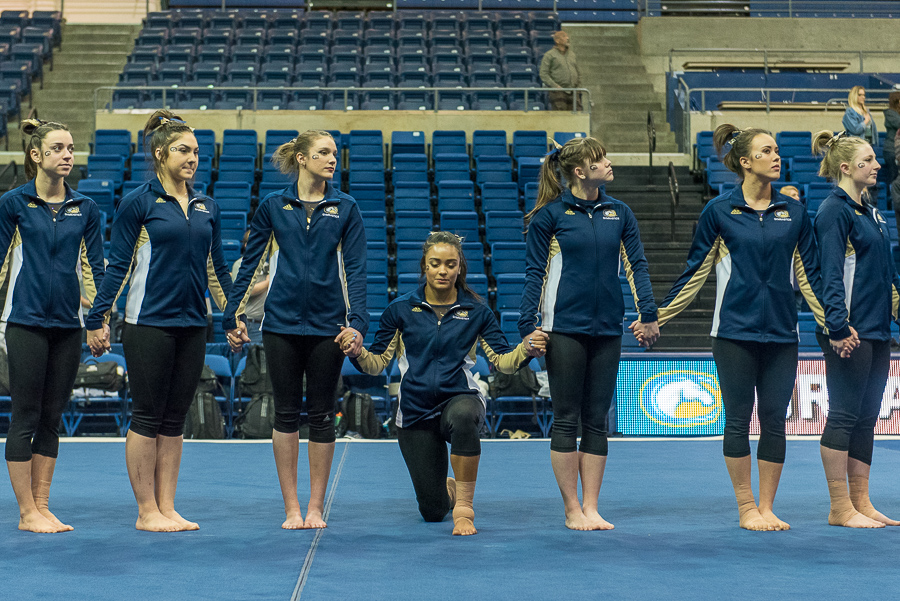
Alexis Brown, Black gymnast, kneels during national anthem

Alexis Brown, decorated UC Davis women’s gymnast, has been protesting the police brutality against black and brown people by taking a knee during the national anthem preceding meets. With this gesture, Brown is resisting the implications of our nation’s anthem, a song rooted in white supremacist institutions that allow law enforcement to systematically target and

execute black and brown bodies.

On Feb. 14, Brown was awarded the Mountain Pacific Sports Federation (MPSF) Gymnast of the Week honors for the second time this year and the third time in her overall career. In addition to copious other awards and distinctions, Brown’s performance at the Feb. 11 meet earned her a career-high score, tying the second all-time highest score in UC Davis history.

Accolades aside, Brown’s actions during the national anthem have garnered a disquieting lack of support from her coach and teammates and have resulted in harassment from fans. Brown also believes that judges at a recent meet discriminated against her because of her beliefs, according to a letter of support the ASUCD Office of Advocacy and Student Representation (OASR) released on Feb. 17, and later confirmed to The Aggie by Brown.

Kevin Blue, UC Davis athletics director, addressed that he, as well as the rest of the athletics program, are in full support of Brown and have been since she began her symbolic protest.

Brown’s narrative as a black athlete parallels the controversial story of Colin Kaepernick, a black quarterback for the San Francisco 49ers who similarly protested by refusing to stand during the national anthem before games in 2016-2017. Kaepernick’s reasoning was the same as Brown’s: How can he celebrate a country that structurally oppresses and murders people of his community and other communities of color?

Backlash for both Brown and Kaepernick’s acts of resistance spell out a grim reality in which Americans care more about the integrity of a non-sentient song than they do about the lives of black and brown people.

In a country in which over 250 black people were killed by law enforcement in 2016, the Editorial Board is in solidarity with Alexis Brown, Colin Kaepernick and all those in communities of color who are disproportionately targeted by police. Black students like Brown comprise a population on campus that barely reaches over 3 percent, and they — as well as other marginalized communities at UC Davis — deserve better.

The Editorial Board implores students and community to show their support for Brown by attending her upcoming meets at the ARC Pavilion, including one this Friday, March 10 at 7 p.m.

A routine for representation

JAY GELVEZON / AGGIE FILE

Highly-decorated UC Davis gymnast Alexis Brown continues to use athletic platform to advocate for marginalized communities

The Pavilion was held in an embrace of palpable energy — a near-collective held breath — as the audience awaited the announcement of the gymnastic meet’s individual all-around victor. The four teams that convened for the Feb. 24 competition lined the mat in neat rows, the athletes’ eyes fixed on the scoreboard above. And in first place…

…Alexis Brown of UC Davis, with a score of 39.300. She rose to gaze at the crowd, and right after a victorious smile spread across her face, she raised her clenched fist in the air as onlookers applauded her win.

For the past eight meets, Brown has engaged in a peaceful and symbolic protest at competitions. Brown kneels during the national anthem. She continues to hold hands with her standing teammates as she casts her eyes downward during the Star Spangled Banner. Brown raises her fist with pride whenever she is announced as the winner in an event. She has a cause, puts on a consistently-excellent performance and is unapologetic, sticking steadfastly to her convictions as firmly as she sticks her landings.

Though Brown’s protest has been peaceful and symbolic to its core, she has been vocal about the reasoning behind her adamant refusal to stand during the national anthem. Through her actions, she hopes to bring awareness to the systemic oppression of and police brutality against Black and Brown bodies.

“The protest means that I want to bring awareness and bring knowledge to people that otherwise wouldn’t have thought about [police brutality] due to their own life experiences that they’ve had to go through,” Brown said. “Everyone has a different way that they look at life and because I feel like in the world of gymnastics, a very white-dominated world, not many people get the chance to think about these things that are happening. If I can just use this platform to reach a community that otherwise wouldn’t have thought about that, I feel like I’ve done my job, and I have an obligation to stick to that no matter if there’s negative or positive comments.”

Brown’s protest echoes the movement of the San Francisco 49ers quarterback Colin Kaepernick, embodying similar tactics of refusing to stand for the national anthem in advocacy of victims of police brutality in communities of color. Kaepernick’s protest began to seep into the mainstream watch, and his protest was reflected nationally in high school, collegiate and professional teams across the country.

“I thought what [Kaepernick] did was so powerful and amazing,” Brown said. “How can you stand up for a country that does not stand up for you personally and as a community? Although I love this country, and I’m so fortunate to be here in every single way, it’s my obligation to use this platform to help people that don’t have a voice but do need help. [Kaepernick] is right. We have an obligation as people, not just as athletes, to not turn a blind eye to things that we know are inherently wrong.”

In a statement of support issued by the ASUCD Office of Advocacy and Student Representation (OASR) that was released following a Feb. 11 meet at Air Force Academy in Colorado, Brown claimed that she was given a much lower score than what she expected. The low scores, coupled with incessant heckling from the audience, contributed to an unsettling atmosphere for Brown, who is usually unfazed in her protest.

I think [the low scores] had a little bit to do with the protest, because I saw that the judges looked at our team a little bit differently because of it, and the backlash from the crowd was […] astonishing,” Brown said. “They were mocking me in the crowd and mouthing disrespectful things to me.”

In addition to the sentiments of support, OASR wrote that Brown had not felt supported by coaches and teammates, a statement that was later denied by head coach John Lavallee.

“I am totally fine and comfortable with her making her statement,” Lavallee said. “When we found out about it, we made it perfectly clear to her and the team that we support her doing that. Alexis is a very intelligent, articulate individual. She is a great performer in gymnastics, and she has a great opportunity to make her stand and help people.”

Kevin Blue, the UC Davis director of athletics, reiterated the athletics department’s institutional support for Brown and her protest.

JAY GELVEZON / AGGIE FILE

“We, in our athletics program, believe strongly in the right to free expression, and we have supported that free expression and will continue to support that free expression unconditionally as we move forward,” Blue said. “There should be no ambiguity about that.”

Shortly after the OASR letter was released, Brown commented on how her coaches and teammates had been handling her protests.

I just think that when people show their support, it’s not as apparent as what I would like to see,” Brown said. “I haven’t really been met with open arms, in certain ways.”

In a later interview, Brown clarified her statement.

“I don’t think that anyone in my coaching staff or teammates are trying to be malicious,” Brown said. “Some of the people who aren’t in this sphere don’t really know how to handle what is happening [….] because they were never exposed to it. I will never hold that against them and I still love them.”

This lapse in understanding from those outside the social sphere that Brown references makes apparent the lack of diversity in gymnastics which is neither new nor coincidental. The recent backlash that Brown has faced is not an isolated incident, and the pattern of homogenous demographics among gymnastics dates back throughout the history of the sport and is still prevalent today. A 2007 study by USA Gymnastics found that 74 percent of gymnastics athletes at the amateur level were white, in contrast to 6 percent of African American athletes and 3 percent for Latinx-identifying athletes. These numbers underscore the importance of representation for historically marginalized communities.

Brown recognizes that her participation as a UC Davis gymnast goes beyond her athletic performance, and she encourages fans to pursue their passions and stand up for their beliefs.

“A lot of little girls from the surrounding areas have come to my meets to support all of us, but it made such a great impact on me because all the little brown girls, all the little girls in general, really look up to us,” Brown said. “Setting an example in every way that I can, whether that be through succeeding in gymnastics or through my protest, I hope that they can see that anything is possible if you never give up and never give in. I hope that when they do get to an age where [race] is going to be an issue or that’s going to come up, in their minds that they maybe remember and take something from what I’m doing.”

Regardless of the reactions to Brown’s protest, numbers do not lie; she is consistently one of the highest performing athletes in the Mountain Pacific Sports Federation (MPSF) conference, in which the UC Davis women’s gymnastics team competes. Brown has captured two consecutive MPSF Gymnast of the Week awards this year, carries an MPSF championship title on uneven bars and just recently hit a 9.900 on balance beam to tie the school record — not once but twice consecutively — in addition to other accolades. Her athletic prowess and graceful showmanship have made her competitive presence and social justice advocacy difficult to ignore.

“Regardless of what other people are saying, at least they’re saying something,” Brown said. “They’re opening their minds to what I’m trying to get across. So if that angers some people, if that saddens some people, if it makes people happy, at least they’re thinking about it. This [feedback] makes me want to work even harder out on the floor so that people can’t ignore the protest. So when I have the headlines, like having first place after first place scores, they can’t ignore what I’m doing anymore.”

As the UC Davis women’s gymnastics team approaches the end of its regular season competition, Brown is still in the running to become the first Aggie to qualify for the NCAA Division I National Championship. As postseason competition nears, Brown has been faced with the decision of whether or not to continue her protest or focus strictly on her athletic performance. At this point, she feels obligated to carry the torch as far as she can, and she no longer has any qualms about doing so.

“More than anything, I have to stick with what I think is right, and even though I might be scared, change is scary,” Brown said. “It’s not in my personality to back away from something that might be difficult, so I will definitely keep kneeling and keep doing everything I can to bring awareness.”

Alexis Brown competes in the Aggies’ final home meet of the season on Friday, March 10 against Air Force Academy at 7 p.m. in the Pavilion.

“I hope that my kids and grandkids and great-grandkids won’t have to deal with the small things,” Brown said. “I know that change is not fast, but [is made up of] little things that change over the course of decades. If [future generations] don’t have to deal with ignorant comments by their peers and only receive love, and hopefully understanding… If this [protest] comes with the little changes, then it will all have been worth it.”


Written by: Alex Arechiga — sports@theaggie.org

Give the World Baseball Classic a shot

KEITH ALLISON [CC BY-SA 2.0] / FLICKR
Why the United States should turn its attention to international baseball

In recent weeks, I have been lambasted by my friends for trying to drum up some excitement for the 2017 World Baseball Classic. The sixteen-team tournament has become a major sporting event worldwide. The tournament does very well in countries like Japan, South Korea, the Dominican Republic and Puerto Rico, but its popularity is lacking here in the United States.

For some reason, nobody cares about the World Baseball Classic at all, and I’m here to tell you why you should. Rumor has it that because of the lack of popularity in the United States, this could very well be the last go for the tourney, because most of the sponsorship comes from within the U.S. I sincerely hope this is not the case.

I was first exposed to the World Baseball Classic by one of my middle-school friends who invited me to attend the championship game between South Korea and Japan at Dodger Stadium in 2009. I have a limited recollection of the game itself, but I know it went to extra innings and Japan ultimately defeated South Korea by a score of 5-3. While I don’t remember the details of the game, I remember that the atmosphere was absolutely unreal. To this day, I still believe that there was more life in Dodger Stadium during that game than I have ever seen. I went to the famous Dodger game in which Steve Finley hit a walk-off grand slam to clinch the division against the Giants in 2004 and I went to Clayton Kershaw’s no-hitter in 2014. Both are considered to be two of the top five Dodger games since the turn of the century, but I will tell you now that the atmosphere in these two games pales in comparison to the World Baseball Classic championship. If American baseball fans can rally support for our national team and go all in on this tournament, then maybe there’s a chance of saving it.

The two other two national tournaments that generate significant excitement amongst sports fans in America are the FIFA World Cup and the Basketball Olympics. The World Cup is transcendently amazing and the most popular sports tournament in the world, but the U.S. Men’s National Team is on the outside looking in. Soccer hasn’t immersed itself into our culture like it has in other countries and it is pretty widely understood that it will be years before the United States is a legitimate contender on the world stage, if ever. On the other hand, the Basketball Olympics are simply a breeze for the United States, and watching it is more of a chore than anything else. The U.S. disappointed this past summer in Rio with abysmal play at points, and they still won every game and took home the Gold with ease. Our soccer team is fine, but not a contender by any means, and our basketball team is so dominant that it’s not even fun anymore –– why not turn our attention towards baseball?

This year, the United States has some of the best guys in the game competing on the behalf of our nation. Buster Posey, Chris Archer, Andrew Miller, Jonathan Lucroy, Giancarlo Stanton, Andrew McCutchen, Paul Goldschmidt, Daniel Murphy, Nolan Arenado and Adam Jones will all be sporting the red, white and blue this month. Despite the presence of the aforementioned stars, the Dominican Republic is still the team with the target on its back after its victory in 2013.

This is what is so beautiful about this tournament: it will be very competitive. The Dominican Republic, U.S.A., Venezuela, Japan, Puerto Rico, South Korea, Mexico and Cuba will all have real shots to win. Baseball might traditionally be America’s pastime, but our infectious love of the game has spread to Latin America and Asia. This is why you should watch the tournament. We’re not out of the picture like our soccer team, but we are also not the inevitable victors like our basketball team. We are right in the fray, and that is where our support is needed the most. The United States’ first challenge will be to take on Colombia, headed by José Quintana and Julio Teherán, on Friday, March 10 at 6 p.m. Eastern time on the MLB Network.


Written by: Michael Wexler — sports@theaggie.org

Aggies continue winning streak in sweep of Grizzlies

MEENA RUGH / AGGIE

Women’s tennis defeats Montana in fourth shutout victory

The UC Davis women’s tennis team opened up its three-game weekend homestand with a 7-0 sweep of the Montana Grizzlies last Friday, giving the team its 10th win of the season in 13 games.

Each of the eight UC Davis players who participated in the match contributed to the team’s victory, starting with the three doubles matches. In the number-one spot, junior Kristy Jorgensen and sophomore Kelsie Bryant played fiercely, but ultimately came up short against the superb tandem of the Grizzlies’ Hannah Sulz and Catherine Orfanos. Jorgensen and Bryant looked impressive early, winning each of the first three games. But the Grizzlies battled back; they took the next four games and ultimately held on for a 7-5 win.

“We were up at the start, but I think we just got a little bit too loose,” Jorgensen said. “We really should have just stayed on them, kept hitting [the ball] hard and go for our shots. We started to get a little nervous. We should have just stuck with our game. But that’s what we’re going to do tomorrow [against Cal Poly], so I’m stoked for it.”

MEENA RUGH / AGGIE

The lone doubles’ loss, however, was the only blemish on the day’s contest for the Aggies, as victories in each of their remaining two doubles spots secured the first point for the Aggies. The tandem of Texas natives, senior Samantha Martino and freshman Nikita Pradeep, along with the second-spot pairing of sophomore Isabella von Ebbe and freshman Kristina Breisacher, both won their matches six games to two.

In singles play, the Aggies solidified their victory by winning all six matches. The team’s two freshman, Breisacher and Pradeep, both earned straight-set victories at the three and five spots, respectively. Also winning in straight sets was junior Jessie Lee, who vanquished her opponent 6-3, 6-2 in her match at the number-four spot.

Fresh off their intense match in the doubles, Jorgensen and Montana’s Sulz were pitted against each other in the number-one singles contest. This time the Aggies came up victorious, as Jorgensen beat Sulz in straight sets to earn her team its decisive fourth point of the afternoon.

“It feels really good,” Jorgensen said. “It’s a good way to start the weekend. I was hitting my shots a lot better than I have been and my serve felt good. Everything felt good. I’m excited for the matches this weekend.”

The most thrilling match of the day, however, was the number-two singles contest between junior Lani-Rae Green and the Montana’s Lidia Dukic. Dukic took the first set with a 6-4 victory, but Green evened the match in the second by locking-in a 6-4 victory of her own, thus forcing a final tie-breaker set. Despite the fact that both players knew that this match had no influence on the outcome of the overall contest, both sides continued to play with high energy and flaring passion. In the end, Green held on to win 11-9 in an intense final set to earn the seventh and final point for the Aggies.

“For me, I was playing more for the team at that point,” Green said. “I looked up at the scoreboard and [saw that] everyone else had a pretty good time out there, so I was like ‘I want to win for the team today.’ I wasn’t playing my best, especially in the first half and I really wanted to turn in around. I think I just found a way to win it. That’s my thought process: stick it out, throw some more stuff at [my opponent] and see what can happen.”

As two juniors who have been around UC Davis tennis for some time, Green and Jorgensen reflected on this year’s team in general.

“It’s my third year, so I’ve seen three different squads,” Green said. “I think the energy this year is completely different from what we’ve seen in the past. We’ve had some great wins and some close losses [this season], but every day at practice and every match I’ve seen, all the girls are out here working really hard and fighting to improve every single day. I think that’s an amazing thing to have on a team. We all have the same goal in mind, and we are all working hard to support each other, and not only to make ourselves better, but to make the overall team better.”

Jorgensen had positive things to say about the team as well.

MEENA RUGH / AGGIE

“I honestly think that this is the best team that I’ve been on since I’ve been here,” Jorgensen said. “The team vibe; everyone just loves tennis, and we love training hard. Every match, you look down, you look at your teammates and you know that they are going to fight. I just love this team.”

Friday’s victory over the Grizzlies was both UC Davis’ fourth shutout win of the season and its fourth consecutive win. So what is going right for the squad in this sudden hot streak?

“Everything,” said head coach Bill Maze. “You just sort of get on these rolls sometimes, and we’re on one, so don’t jinx it. I think today’s match was really great preparation for tomorrow, we have a big one against Cal Poly. I’m glad that everyone won because the way to gain confidence is to win. I think [the team is] going to feel good going into tomorrow.”


Written by: Dominic Faria — sports@theaggie.org

Humor: Trump’s been Venmo-requesting us for attention — decline it

Treat Trump like the bigoted preacher on the quad


There’s a Westboro-esque character on campus who shows up every day at the quad to preach. His sermon never changes. He tells us that we’re all going to hell.

He takes out a Bible and shouts vile things. That we’re all adulterers and sinners. That our lifestyles deserve the wrath of God, that judgement comes for all of us and we college students, specifically, are screwed.

When I was a first-year, crowds would form. It was a spectacle. There’d be well-meaning tall white kids in checkered button-downs and Sperries who tried to have a rational conversation with him. There’d be misanthropic frat boys wearing backwards hats who preferred to Snapchat and draw phalluses on him. I was the second type.

But over time, the crowds dwindled. Today, he stands and reads passages aloud by himself. He paces and shouts and waves his hand. While he used to get engagement, he now gets, at best, some passing glances. The man tried to gain the superpower of influence but instead gained invisibility.

We used to pay him. Now, we’ve cut him off. He’s starved of the one thing that gets him up in the morning: attention.

I view 45 the same exact way. His one area of competence in life is getting attention. If he had business acumen, a man of his resources would surpass Warren Buffett and Bill Gates. If he had intelligence, a man of his prominence wouldn’t have won the election by a quirk in our electoral process. If he had decency, his children would have given him the love and affection he so clearly desires.

No, he only got where he is because of his ability to agitate emotional reactions. Over the course of his life, he’s developed an almost subconscious filter to find who’s empty enough, damaged enough or miserable enough to buy what he’s selling. Those of us that had more going on in our lives had the privilege to wave him off. Now that he’s the leader of the “free” world, we believe that we need to pay attention to him. That we need to give him what he craves: our anger, our misery, our irritation, our hot-blooded emotion.

I played football in high school, and I learned that there’s a difference between focus and awareness. When someone has the ball and they’re running at you, you only pay attention to their hips. It doesn’t matter what they’re doing with their arms or shoulders or head. The hips don’t lie. So when you’re on defense, approaching the ball carrier, you focus on the hips. Meanwhile, you’re aware of everything else going on — the other players, potential blockers who’d get in your way, where the ball carrier just went — but that’s in your peripheral. You’re focused on the hips.

Taking Trump down is going to take focus. That’s not the same as awareness, because his method is to throw as many stories at you as possible, so you can’t figure out what’s most outrageous or infuriating. That’s by design.

Everything he says is meant to throw you off from what he does. Just like a running back fakes his head to the left but darts to the right, he’ll make spectacles for us to tweet about while he’s making personal business deals with foreign governments behind the scenes. He wants us to read about him from the tabloid column when he’s actually in the business section. He wants us screaming in his face or approaching him calmly for “dialogue,” a futile exercise in affirmation — just so you more quickly exit the Trump Tower.

He’s a vulnerable man. He has plenty of holes to exploit. His flurry of spectacles is meant to confuse us so we don’t attack him where it’ll actually hurt. His biggest weakness is the Russia story, as that can most easily turn his Republican Congressional firewall against him. And his voter base will give this issue much more thought than anything else — Bob in Indiana who lost his factory job doesn’t give a damn about the EPA, I can promise you that. But our President making shady backroom deals with America’s historical nemesis? That’ll move the needle.

By the time this story gets published, anything could happen. But whatever happens this week, next week, every week— we need to maintain focus, not just awareness.

Awareness without focus means he’ll be just another bigoted preacher on the quad. We can’t ignore him as easily as the preacher because Trump’s presidency is actually consequential, but we need to maintain focus on what matters while keeping everything else in our peripheral. We need to stay on our toes, but not dive into the traps he lays out for us. Eyes on the hips.


Written by: Yinon Raviv — ravivyinon@gmail.com

Witnessing the country’s switch in administration

SHELBY MCMICHAEL / COURTESY

UCDC Washington Program students reflect on inauguration, working in D.C.

This past quarter, Colin Giacomini, a fourth-year political science major, worked as a Middle East research intern at the American Enterprise Institute, a public policy organization that performs research and advocacy for political, social and economic problems in Washington, D.C. In addition to analyzing how the United States can more effectively provide aid to the Middle East and combat extremism, Giacomini’s job required him to keep up with President Donald Trump and the erratic climate of the capital in the first few weeks of his administration.

Each quarter, UC Davis undergraduate students embark for a term at the UC Washington Center (UCDC) to combine course work, research and internship experience in the nation’s dynamic capital. However, UCDC students this Winter Quarter have experienced Washington in a climate unlike anything previous interns have ever seen.

“The buzz around the office is nothing like I’ve ever experienced before,” Giacomini said. “Everyone is watching the daily press briefings and closely paying attention to every speech that [Trump] gives so we can stay informed and get as much understanding of the situation as we possibly can.”

Experiencing D.C. and the current administration firsthand has allowed Giacomini to understand what it would really be like to pursue his future goal of working on Middle East policy at the State Department. Despite the instability of politics recently, Giacomini appreciates the opportunity UCDC has given him to experience history in real time and connect with unique and passionate individuals across Capitol Hill.

“When the travel ban was enacted, my boss spent the whole weekend at the D.C. airport translating Arabic for the people that were stranded there,” Giacomini said. “Whenever you go out around here you can find people directly involved in what’s going on which adds a different perspective to your knowledge about politics.”

According to Giacomini, the sentiments in the capital are somewhat evenly split between those who support this transition and those who do not, which makes for a very unpredictable climate, even for D.C.’s most in-the-know.  

“Many of the scholars that I work for, who have been in this business for years, can’t even make predictions for what will happen next week,” Giacomini said. “There’s a clash between the old guard and what Trump’s bringing in, for better or for worse, but this is an environment of uneasiness and unsurety [with] very erratic behavior.”

Since arriving at the beginning of Winter Quarter, Giacomini has seen several protests, perhaps the most interesting taking place on Inauguration Day.

Devon Moreland, a third-year political science major, spent his quarter interning at Angerholzer Broz Consulting, a political consulting group which does fundraising for members of the House of Representatives. Moreland attended both Barack Obama and Trump’s inaugurations and observed the differences in spirit, recalling an underlying sense of apprehension throughout the city during the days leading up to Trump’s inauguration.

“Many outsiders came to watch and it was interesting to see the dynamic between Trump supporters and other people that were there, as well as Trump’s divisiveness in his rhetoric and the responses he got from the crowd,” Moreland said. “It was a historical moment that most people don’t get to see, and it was especially interesting to witness the peaceful transition of power when Obama and Trump shook hands.”

In comparison to Obama’s inauguration in 2009, Moreland noticed differences in the energy of the crowd in 2017. Regardless of personal beliefs, Moreland noted that inhabitants of D.C. make it a habit to stay informed about the ever-changing political sphere.

“Any given day walking down the street you will hear people having intense conversations about Trump and his appointees,” Moreland said. “It’s all very up in the air still. Even though Trump has signed a lot of executive orders, most of these haven’t been actual policies, so not too much has happened yet.”

While he has had the opportunity to meet several members of Congress and attend fundraising events through his internship, D.C. was at first a culture shock to Moreland.

“D.C. is very professional all of the time and it’s a whole other level than in California,” Moreland said. “Everyone’s in a rush, it’s very fast-paced and everyone’s dressed very professionally and conversations are very professional.”

Moreland’s internship is about two blocks away from the Capitol Building, which allows him to go on Hill runs and check out different congressional buildings, all while bumping into congresspeople along the way. Shelby McMichael, a third-year communication and sociology major, has also appreciated D.C.’s diverse community while working at Active Minds, a mental health awareness nonprofit.

“There will be protests and things like that, but when you’re living here you have to be informed about politics because it’s usually a topic of conversation,” McMichael said. “I don’t think you can ever feel overwhelmed by the politics of the city because it’s such a liberal demographic and the people are friendly and kind.”

As the UCDC quarter comes to a close, students reflect on the knowledge they have gained from their experiences, in which they met motivated and hard-working individuals and pursued their political endeavors.

“Everyone here has their priorities together and knows what they want out of their career and lives, so it’s a really refreshing place to be,” McMichael said. “You walk around here and pass by all kinds of organizations and groups representing anything you can ever imagine, and it makes you want to do more and be a part of something bigger than yourself.”
Written by: Gillian Allen — features@theaggie.org

Dietary accommodations discussed

NICKI PADAR / AGGIE

A variety of experiences on campus for students with food restrictions

Stopping by the CoHo one evening, Arev Markarian scanned the menu for a vegan option. Markarian, a fourth-year environmental science and management major, was surprised to find that Ciao offers a burger for vegetarian and vegan customers. When she ordered, the server said that she herself was not aware that vegan burgers were an option.

“On campus, […] you have to do your research,” Markarian said. “With time, I’ve been finding more and more options. I find that kind of fun, having a challenge.”

After watching a video that depicted the treatment of farm animals, Markarian decided to become vegetarian. Two years after becoming vegetarian, Markarian decided to become vegan, which she has now been for two years.

“I became vegetarian when I moved to Davis my freshman year,” Markarian said. “I actually found it really easy having the D.C. […] because of the salad bar having tofu and there being vegan and vegetarian options, […] which made it easy to transition.”

Because first-year students are required to purchase meal plans, the dining commons on campus must make accommodations for students with dietary restrictions. However, because students also choose to eat at eateries in the Silo and the CoHo, accommodations are still present, but not mandated.

Though Markarian does not mind searching for food options, other UC Davis students have stated their displeasure in the state of food selections on campus. Students with a variety of dietary restrictions, for both medical and personal reasons, mostly agree that there is room for improvement.

Rachel Scherr, an assistant researcher in the Department of Nutrition, said she feels accommodations should satisfy the needs of all students, but, more importantly, should be granted to students with religious or medical dietary restrictions.

“If students are paying for meal plans, obviously it should be foods that they can eat,” Scherr said. “I believe it’s important to have foods that don’t contain allergenic compounds, like wheat or dairy, but also kosher and halal foods. At least for the more common food allergens, having labeling and signs for foods that contain the big eight allergens [is important].”

Kausalya Raman, a first-year design major and vegan, said that although there are always vegan options in the dining commons, there is room for improvement.

“A lot of the foods that [the dining commons] make, [such as] pasta dishes, could really be easily made vegan if they didn’t put cheese on top,” Raman said.

However, Samvardhini Sridharan, a first-year biochemistry major who is a vegetarian and allergic to soy and eggs, said that she has found a favorable selection of food choices throughout the UC Davis campus.

“I have felt limited in no way,” Sridharan said. “I’ve honestly felt like I can eat pretty much whatever I like that is vegetarian. Occasionally, there might not be something at Trudy’s, but everyone is super willing to go in the back and check. There have been times [at other] places where I’ve felt like, ‘I’m not going to get anything to eat.’ I’ve never had that feeling at Davis.”

Despite this, one concern for students in Sridharan’s position is the incorrect labeling of foods in the dining commons. Raman was looking at the online menu for the dining commons when she noticed that a meal categorized as a vegan option included bacon in its list of ingredients.

“Sometimes when they’re listing food, they’ll label things as vegan [when] they’re not,” Raman said. “In the list of ingredients it will say bacon or fish sauce.”

Akira Comia, a first-year electrical engineer major, has life-threatening allergies that include nuts, shellfish and eggs, relies on the ingredients listed on the labels in the dining commons when surveying what foods are available to him for dinner. Luckily, Comia said he has never had an issue with the labels being incorrect.

“I think the medical necessities are taken more seriously, in my opinion,” Comia said. “They tell you, ‘There’s nuts in here,’ or ‘There’s shellfish in here.’ Whereas, if you’re a vegetarian, it doesn’t say ‘There’s meat in here,’ you just have to figure that out. I have a friend who can’t even eat pork-based soups and they don’t tell you if they make the soup out of pork. I think they’re not as careful with the ingredients if it’s not an allergen.”

Raman, who is also the vice president of the People for the Elimination of Animal Cruelty through Education (P.E.A.C.E.) club on campus, said the P.E.A.C.E. club has started a petition to increase plant-based options in the dining commons. Scherr acknowledged that both carnivores and omnivores can eat plant-based options, so offering a greater variety of plant-based options will “satisfy the needs of a broader student base.”

Although the dining commons include The Blue Onion, a food station that offers solely vegan meals, both Raman and Sridharan said the vegetarian and vegan options in the dining commons can become repetitive.

“It sometimes feels like it’s limited to pizza or pasta or garden salad,” Sridharan said. “In the D.C., there are a certain amount of dishes the Blue Onion makes. After you’ve had that for two quarters, you start to get bored. Instead of having cheese pizza all the time, maybe [offer] a veggie pizza. It’s just simple, small things.”

According to Scherr, offering a wide variety of options is key.

“It’s obviously quite critical that the university make sure students have healthy, balanced diets to be successful learners,” Scherr said. “If there’s a wide variety of choices, I think it should be easy to meet the needs of almost everyone.”

For gluten-free students, each of the dining commons includes a gluten-free fridge. Ana Hansen, a first-year cognitive science and theater and dance double major, who is gluten-free for medical reasons, said she has found moldy foods in the fridge. Additionally, Taryn Lausch, a first-year geology major who is also gluten-free for medical reasons, said the fridge is not well-stocked, and has opened it to find only lunchmeat available.

Both Lausch and Hansen have found obtaining suitable gluten-free options in the dining commons to be frustrating. Hansen said she has become sick on numerous occasions due to cross-contamination.

“I’ve just stopped trying to eat there most of the time, unless I know I just want to eat salad with no protein on it,” Hansen said. “There’s also times when the allergen menu online will say [one thing] and I’ll go […] into the dining commons and the labels have changed or something has changed where I can no longer eat it. That happened last night with the posole verde. I have eaten that every time […] and then the recipe had changed, the chicken was some pork [item] that had gluten in it. On the days I think there is food [for me], there isn’t.”

Lausch, like Hansen, frequents the salad bar but knows it is not enough of a well-rounded meal. For both Lausch and Hansen, the dining commons does not provide an accommodating, accountable option. Lausch has noted the discrepancies between her dining experience and that of her vegetarian friends.

“I think they make more of an effort for [them],” Lausch said. “There’s always designated vegan and vegetarian options [and] they have the whole vegan and vegetarian section every single day.”

For Hansen, the biggest frustration is the fact that she is required to purchase a meal plan. The meal plan, for her, is an extraneous expense, as she has been forced to grocery shop for adequate food options. She said a meal plan should not be required, especially for students with food allergies.

Although students with a variety of dietary restrictions have differing thoughts on food options on campus, Markarian and Sridharan both said they feel the workers at the food services at UC Davis are very willing to go out of their way to ensure that food options are made available to students.

“People are just willing to accommodate,” Sridharan said. “They don’t want to […] prevent [students] from having food that day. Medically related or not, people don’t want to mess with your beliefs or mess with how you’ve been living your life for 18, 19, 20 years. I’ve never had a person who has said, ‘We can’t help you.’”

Written by: Hannah Holzer – features@theaggie.org

Million Cat Challenge saves over 725,000 shelter cats

TAYLOR RUNNELLS / AGGIE

UC Davis, University of Florida project to reduce euthanasia rates of shelter cats

Shelter cats across the nation have been given another chance at life thanks to a joint project between the UC Davis Koret Shelter Medicine Program and the University of Florida Maddie’s Shelter Medicine Program. The Million Cat Challenge aims to reduce cat euthanasia rates in North American animal shelters and to save one million shelter cats by 2019. Over 1,000 shelters nationwide have joined the challenge, with one of the first being the Yolo County Animal Services Shelter (YCASS) in Woodland.

Founded by Kate Hurley, the director of the UC Davis Koret Program, and Julie Levy, a professor of shelter medicine at the University of Florida, the campaign has saved 725,000 shelter cats from euthanasia since kickstarting in 2014.

“At the time that we conceived the Million Cat Challenge, shelter cats were dying at a far higher rate than dogs were,” Hurley said. “[The campaign] helps put shelters in contact with one another so that they can learn about which programs are working in their own communities and situations.”

While consulting with animals shelters around the country, Hurley and Levy noticed that some shelters boasted more successful adoption experiences than others. These shelters were using a variety of tactics to enhance the wellbeing of their cats, simplify tedious adoption procedures and prevent euthanasia practices.

“In a moment of clarity, Dr. Hurley and I discovered our calling to share these ideas with other shelters, and to create a shelter-led movement to transform how cats are cared for,” Levy said in an e-mail interview. “Together, we’ve created a shelter-based campaign to save a million more shelter cats in 5 years.”

The “million” of the Million Cat Challenge will be based on composite numerical reduction in euthanasia and increase in lives saved by the participating shelters, according to the project’s website.

The campaign emphasizes five key initiatives that offer shelters sensible choices to reduce euthanasia and increase live outcomes for shelter cats. Pioneered by animal shelters across the country, the initiatives provide shelters with tools to assure humane animal care, provide the Five Freedoms for animal welfare and match each shelter cat with the most appropriate outcome, whether that is being reunited with the owner, adopted into a new home or returned to the cat’s location of origin.

One of the initiatives, Return to Field, acknowledges that some shelter cats are better off living in the outdoors and on their own rather than in a home.
“Not every cat belongs in a home,” Hurley said. “Some live in the outdoors and are doing fine. If they’re in good shape, instead of euthanizing them, shelters will just leave them be and put them back.”

Nicole Sullivan, a third-year animal science and management major and an animal care assistant at YCASS, commented on the shelter’s dedication to providing quality care for their cats.

“At the shelter, our cages are set up with separate eating, sleeping and bathroom areas, which has been proven to help lower cats’ stress levels,” Sullivan said. “They get fed and their cages get cleaned as well as getting any vaccinations or medical care they need.”

The campaign is currently ahead of schedule and is projected to reach its goal of one million by the end of 2017.

“This year we plan to develop inroads with shelter staff to empower them to make shelters safe havens for cats in everything they do,” Levy said. “From the way cages are cleaned, to the toys and companionship they are provided, and to the search for the best outcome for every cat, the power in the hands of staff to help cats is unmeasurable.”

As more animal shelters join the Million Cat Challenge, cat euthanasia rates in animal shelters are expected to drop dramatically. In the future, Hurley and Levy hope to continue communicating with animal shelters and finding more innovative ways of enhancing the lives of shelter cats.

“There’s a lot of things you can do to keep a cat out of a shelter: educate your neighbors, provide foster care, adopt from a shelter,” Hurley said. “Every single person can be a part of this challenge.”

More information about the shelters participating in the Million Cat Challenge can be found on the project’s website. Donations to the campaign can also be made online.
Written by Emma Sadlowski — science@theaggie.org

Lasers beaming onto UC Davis campus

GENESIA TING / AGGIE

The science of lasers, molecular research, community outreach

Throw away those blasters, lightsabers and pop culture interpretations of the futuristic laser, because UC Davis professors are bringing the space-age laser to the present through their exciting research done on campus.

The UC Davis Chemistry Department sponsored a free showing of “Star Wars: The Force Awakens” on Feb. 25 in Rock Hall. Before the movie, Kyle Crabtree, an assistant professor in the UC Davis Chemistry Department, spoke briefly about the reality behind lasers as opposed to their various depictions in pop culture.

Crabtree mentioned that events like the “Star Wars” screening have the ability to expose the broader public to the reality of modern science. He emphasized the importance of having a scientifically literate society, and one way of achieving this is to host outreach events that combine larger cultural interests with specific topics in science.

“We value a scientifically literate public and now the science presence in popular entertainment media, like ‘Star Wars,’ is for entertainment purposes, not for educational purposes,” Crabtree said. “But since many people are familiar with the ideas in popular media, we wanted to see about using that as a jumping off point to give a fun, informative talk about science and technology.”

Crabtree studies astrochemistry, specifically chemical reactions in space, using lasers to examine the rates of chemical reactions in space-like environments.

“I use an excimer laser, an ultraviolet laser, it takes a pulse of ultraviolet laser radiation and we use it to break apart a molecule into some fragments,” Crabtree said. “Then we use other microwave devices to watch those fragments undergo chemical reactions. We are trying to create a space-like environment in the lab and then crack apart some molecules using lasers.”

Crabtree focuses on regions in the universe where stars are made. This is an area in space that starts as a cluster of dust and particles. His lab recreates this atmosphere to study the chemical reactions that occur lightyears away.

“We try to study the chemistry that happens in these stellar nurseries and see how far we can track the chemistry and figure out [if] there are interesting molecules that might be relevant to life as we know,” Crabtree said.

Lasers were theorized by Einstein in the early twentieth century, but they were not invented until later in that century. They have since revolutionized the understanding of the universe.

“Our entire understanding of what atoms and molecules do have been enabled by lasers,” Crabtree said.

William M. Jackson, UC Davis’ distinguished researcher and professor emeritus, has lived the history of lasers through his prolific application of lasers in research. He is interested in what happens when molecules break apart and, similarly to Crabtree, he is focused on the molecules that are abundant in the universe.

Jackson was working at NASA when lasers became available to use in research. Lasers can be used to stimulate electrons; they create a controlled and directional quality to the electrons that was impossible before the invention of lasers.

“We can play tricks with lasers that we can not do with spontaneous emission [of electrons] mostly because there is not enough intensity to do it,” Jackson said.

Jackson’s lab is home to two lasers that are impressive in size and hooked up to a variety of pumps, gadgets and are part of an intense sequence of mirrors, tubes and a mass spectrometer. Jackson uses this setup to measure the velocity of individual modules.

“We use one laser, oriented to break it apart, [and] we let it fly through a time of flight mass spectrometer to measure its velocity […]  [then] we have to ionize it with another laser,” Jackson said.

Jackson studies nitric oxide, dioxide and carbon dioxide through this process.

Stephen Cramer, the advanced light source professor at UC Davis, focuses his research on enzymes that have clusters of iron and sulfur in them. Cramer uses x-rays to study the iron in the active sites of the enzymes, which he pairs with research focused around lasers.

“We have a sample [in the lab] and maybe something is bound to the metal, like carbon monoxide, and we take the laser and shine it on the sample and pop the carbon monoxide off,” Cramer said. “This process is called photolysis, [using it] we can measure the sample before and after the photolysis and see what has changed.”

The Star Wars screening brought awareness to lasers’ versatility and their integral role in understanding science at its most basic level.

“You need to get students emotionally excited about science, not just as some intellectual exercise, but something that you really care about,” Cramer said. “Science is hard, but if you’re excited about it […] you’re willing to put with the pain of working through the math or the late hours.”

Crabtree, Jackson and Cramer cover the spectrum of what can be studied through lasers, from the birthplace of stars to the velocity of individual molecules to metals in biology.

“Lasers are just one example of the interconnectedness of science […] chemistry and physics and lasers, it’s all connected whether you’re using the laser to read a barcode at the supermarket or measure gravity waves,” Cramer said.
Written by Emma Askea — science@theaggie.org