55.4 F
Davis

Davis, California

Monday, December 22, 2025
Home Blog Page 644

More than just a college town

HANNAH LEE / AGGIE

City of Davis affected by expansion of UC Davis campus

With UC Davis students making up over 30 percent of the city’s population, it is no wonder that Davis is known as a college town rather than a place of residence. Although the university plays a major role in the lives of Davis residents, many people fail to realize that the town itself has more to offer than a mass of twenty-somethings in pursuit of degrees.

Alex Asera, a second-year psychology major, grew up in Davis and decided to stay in town for college.

“It was honestly a great place to grow up,” Asera said. “There [are] actually so many similarities to the university [in town]. Everyone bikes [and is] generally healthy.”

Though the college aspect of Davis affects much of the activity around town, Davis is also a place where residents take part in activities specific to the city.

“[There is] a lot of Davis pride,” said Annie Meckstroth, co-editor and owner of the local events newspaper The Davis Dirt. “[Residents] see themselves as somewhat of a unique town, and they think it’s pretty special to live here.”

According to Meckstroth, though Davis is typically considered a small town, many students have not yet discovered the many activities not affiliated with the university for Davis residents to enjoy, including the Street Food Rodeo, a food fair put on by the Davis Dirt, and the Art About, a free showcase of around 25 to 30 art galleries in downtown Davis.

“The artist scene is really growing here,” Meckstroth said. “[There are] the greenbelts and biking aspect that’s on campus and also throughout the town.”

Because of the close proximity of the university, most Davis residents are connected with the UC Davis campus in some way or another, whether they are professors, faculty or alumni. This involvement brings a certain level of academic expectations to local schools like Asera’s own Davis Senior High School.

“I think one of the best things about Davis is we have really good public schools,” Asera said. “[In] a lot of places you have to choose between a good public and good private school. All the school programs [in Davis] are really great, [so] I’m super grateful. It was definitely a general expectation that people would be going on to higher education.”

These high academic standards of local Davis schools give young students the motivation to pursue education in the future.

“The focus on academic performance […] had a good influence on me,” said Tess Van Schoor, a second-year biology major who attended Davis Senior High School prior to UC Davis. “Kids were sort of pushing each other to succeed. That can have a downfall as well, because everyone is very competitive with each other at the high school, but it did push people into getting into a four-year university.”

From providing internships to lending university facilities, UC Davis allows residents to utilize its resources.

“The connection with [UC Davis] is really cool and unique,” Asera said. “I got to play at Mondavi every year for orchestra. I got to do a [UC Davis] biotech internship. The whole community I think benefits from that, not just students and faculty.”

Like in many towns, sports such as soccer, cross country and track are popular with young children. The music program also plays a large role in Davis culture.

“People often think that [Davis] is a pretty ideal place to raise children,” Meckstroth said. “There are a lot of activities for families and kids here. The camps and the classes that are offered are really popular.”

The small-town aspect of Davis also benefits its residents in terms of the relationships it helps to form. With a population of a little over 65,000 people, Davis residents grow up knowing most of their peers for years.

“My closest friends are still my friends from high school,” Van Schoor said. “Everyone in the senior class pretty much knew each other. I knew everyone by name.”

Though the close-knit community gives residents the chance to build relationships, it also has its drawbacks.

“People […] say [Davis] is kind of a bubble,” Asera said. “It’s really nice here, but people need to […] be aware that not everywhere is like here. In other places, not everyone has a PhD. I’d say it’s pretty different than a lot of places. If you’re here your whole life and you don’t travel, […] it can kind of lead to a false impression that everywhere is exactly like here.”

Though the city is home to mostly white and Asian demographics, according to Van Schoor, Davis is known as a welcoming community open to new people and new ideas.

“It’s a very liberal place, so we didn’t really grow up with […] racist stereotypes,” Van Schoor said. “The town does a pretty good job of teaching the benefits of diversity [and] how important it is to be open minded and learn about people different than you.”

Due to these aspects, Davis reveals its nature as both a college town and a comfortable place to live.

“I think Davis at first glance seems sort of like a sleepy town with not that much to offer,” Meckstroth said. “Once you dive a little deeper, [you] find out there’s actually a lot going on here, and people [are] doing a lot of amazing things.”

Written by: Allyson Tsuji — features@theaggie.org

Aggies go dancing

HANNAH LEE / AGGIE

Men’s basketball team ushers in new era of relevance

As a university that has been around for almost 110 years, UC Davis rarely gets to see a school “first” anymore.

That changed Saturday.

With a narrow 50-47 victory over UC Irvine on March 11, the UC Davis men’s basketball team won its first Big West Conference tournament championship, clinching UC Davis’ first ever spot in the NCAA Tournament. The Aggies, who had finished in second in the conference during the regular season, beat a UC Irvine team that had secured the regular season conference crown by beating UC Davis by 30 points just a week earlier.

The Aggies landed Monday in Dayton, Ohio to play against North Carolina Central in one of the tournament’s “First Four” games on March 15. The winner will earn a 16 seed in the tournament and will have the dubious privilege of taking on regional top seed Kansas, who finished the regular season 28-4 and ranked third in the country. For reference, number 1 seeds are 128-0 against 16 seeds since the tournament expanded to 64 teams in 1985.

Nonetheless, the Editorial Board is proud of the team’s accomplishment. We applaud head coach Jim Les for ushering in an era of relevance to the program, which has now won over 20 games in two of the last three seasons, having gone unbeaten at home and advancing to postseason play in each of those instances. We also hope that, with the increase in school spirit and national prominence that has coincided with the Aggies’ nationally-televised home game earlier this month and their playoff run thus far, this interest in UC Davis athletics continues into next year and future years down the road.

So, Aggies: Change your profile picture on Facebook to include the special NCAA Tournament filter, show up to a viewing party on Wednesday to watch the Aggies take on the Eagles and carry that enthusiasm into Friday’s (hopeful) matchup against Kansas. Even if the Aggies cannot pull off the spectacular upset over the Jayhawks, UC Davis fans can take solace that it is 30 degrees in Lawrence, Kansas at press time, compared to the sunny 76 degrees in Davis.

This team is all about “firsts” right now. Let’s see if the Aggies can make one more of them by pulling off an upset for the ages. Either way, congratulations to the UC Davis men’s basketball team on a memorable run. We at The Aggie wish you the best of luck.

Dada Life transforms Bill Graham auditorium into “Dada Land”

JAY GELVEZON / AGGIE

Inflatable champagne bottles, pillow fights, bananas for a memorable event

Dubbed as “Dada Land” for the night, Bill Graham Auditorium was transformed into a magical venue filled with inflatable bananas, pillow fights and balloons.  The Swedish-based EDM duo, Dada Life, brought energy and house music to the packed venue in San Francisco. Rewinding to the beginning of the night, I started the night off with Los Angeles-based producers ARMNHMR (pronounced “arm and hammer”). The up-and-comers gave it their all with originals, such as “Fallen” and remixes that pleased the crowd. Also from Los Angeles, LOUDPVCK (pronounced “loud pack”) put on a show with their set that made the crowd get on their feet and jam with the music. Up next and from Russia, Arty stunned the crowd with trance and bangers which seemed to blend perfectly.

Before the headlining act came to the stage, a procession of several men dressed in white polos and shorts graced the stage holding flags complete with the Dada Life logo. From there, the duo came to the stage ripe with energy and made the crowd go “bananas” with their music. A plethora of inflatable champagne bottles and bananas were throw into the crowd with the help of the stage crew, which probably made great memorabilia for those that got possession of one.

JAY GELVEZON / AGGIE

Throughout the show, the crowd jammed with Olle Cornéer and Stefan Engblom with hits off their 2012 album “The Rules of Dada.” Before playing the drop to “Happy Violence” the producers had the stage crew throw actual pillows into the crowd. Thus, an actual pillow fight occurred during their set. Towards the end of Dada’s set, about 30 individuals donned bananas costumes, whom I assume were recruited from the crowd. They get their minute of fame as they raged alongside the duo.  

One could definitely tell that Dada Life put a lot of effort into their show, and their fans are very thankful for it. For one night in “Dada Land” it sure did bring good vibes and an astounding time. If you missed this epic night, Cornéer and Engblom tour California quite regularly, so be sure to catch them next time.

Written by: Jay Gelvezon

Aggie athletics pick up during a frenzied Winter Quarter

JAY GELVEZON / AGGIE FILE

UC Davis sports teams face success, setbacks to open spring season

Winter Quarter has been busy for the UC Davis Athletics Department — teams have started and ended their seasons, and many programs have experienced an overwhelming amount of success.

Most prominently, the UC Davis men’s basketball team won the Big West Tournament championship game by defeating UC Irvine 50-47 on March 11. This close win came after a humbling 79-49 loss to UC Irvine to end the regular season, which denied the Aggies the regular season conference title. The men’s basketball team pushed through and, for the first time in school history, the team is going to the NCAA Division I Men’s Basketball Tournament. The team plays North Carolina Central in the First Four on Wednesday, March 15 in Dayton, Ohio, and the winner will advance to play Kansas in the First Round of the Midwest Regional on Friday, March 17.

“It’s a clear indication that UC Davis is able to compete nationally at the Division I level,” said Kevin Blue, the UC Davis director of athletics. “The opportunity to play on national television with the entire country watching on Wednesday night will expose a lot of people to UC Davis that have not been exposed to our university before, and if you just think about the sheer number of people that fill out brackets in this country, and you consider the fact that all those people will be learning about UC Davis or at least encountering UC Davis’ name during that process is a significant amount of incremental exposure for the campus.”

In addition to being undefeated at home, the Aggies hosted a nationally-televised game on ESPNU, which saw nearly 6,000 fans in attendance.

“That was an example of a night where it was fun, people were spending time with friends, people were exhibiting school spirit,” Blue said. “It was great that it was a basketball game and it was great that we won, but most importantly it added a lot of value to a lot of people from the community and a lot of students to their undergraduate experience, and that’s one of the really powerful things about athletics is those types of events.”

Not to be overshadowed, the women’s basketball team became Big West regular season conference champions, and, although the team did not make it past the semifinals in the Big West Tournament, the Aggies will attend the Women’s National Invitational Tournament in Salt Lake City on Friday, March 17 by virtue of their regular-season crown. Head coach Jennifer Gross was also named Big West Coach of the Year in addition to conference accolades awarded to four athletes on the team.

The women’s gymnastics team ended its regular season with a bang, riding a nine-meet win streak into the Mountain Pacific Sports Federation (MPSF) Championships, on Saturday, March 18. Also of note, leading gymnast Alexis Brown has been protesting at competitions in response to police brutality against people of color as a peaceful demonstration that has gained traction and campus exposure in recent weeks.

The swimming and diving team placed third at the MPSF championships in February, and sophomore Solie Laughlin was invited to the NCAA swimming and diving championships after meeting certain thresholds in three of her events. The championships will be held from Thursday, March 16 to Saturday, March 18. Laughlin has qualified for one preliminary race each day, starting with the 200-yard individual medley (IM) on Thursday and followed by the 400-yard IM and 200-yard backstroke the next two days.

The women’s tennis team is 11-5 for the season and the men’s squad is 9-5 after breaking its 21-match winning streak at home this past weekend. Both teams continue as a force to be reckoned with in all of their competitions.

The women’s lacrosse team (3-4), baseball team (5-9) and softball team (9-17) are each seeing different levels of success in their current seasons. The men and women’s golf teams are generally finishing farther back in tournaments, but a few competitions remain for each team to turn around their play.

The women’s water polo team is 13-13 for the season, which is potentially misrepresentative of the overall quality of the program. The Aggies have faced consistently tough and highly-ranked opponents thus far, and they have only just begun conference play. Expect more wins than losses in the competitions to come, as the team has been able to overcome higher-ranked teams like UC Santa Barbara and UC San Diego in past matches this season.

In a nice start to the outdoor season, the track and field team hosted the Aggie Open last Saturday, March 11. Both UC Davis teams took first, with the men emerging victorious against three other teams and the women against five. The Aggies now travel to Sacramento State for the Hornet Invitational on Friday, March 17 and Saturday, March 18.

And finally, new UC Davis football head coach Dan Hawkins has been hard at work since the start of spring football practices on March 7.

“We’re very focused on continuing to build a high-performing culture here, and we do that one day at a time,” Blue said. “We try to improve the organization so that it’s better off when we leave at night than it was when we arrived in the morning. And that sort of takes multiple forms and each day is probably a different challenge, but overall we’re just trying to be steady in terms of our improvement and our growth.”
Written by: Bryan Sykes — sports@theaggie.org

Space race will foster international cooperation

AMY HOANG / AGGIE

Why it’s beneficial for countries to set their sights on reaching Mars
That’s one small step for a man, one giant leap for mankind.

It’s been more than 40 years, but these words remain a testament to how far countries will go to prove their superiority and how far the human race can go when we set aside our differences to work with each other.

A few decades have come and gone, and the world order is no longer the same. Relations between the United States and Russia have thawed considerably, and Russia is no longer the superpower it once was. The Cold War is hopefully over for good, yet that was the primary impetus to the space race between the two countries. The common man’s interest in outer space has declined, especially now that milestones in space exploration are no longer tied up in political aims or patriotism. Financial crises and other issues such as terrorism and global warming have taken over the portion of the federal budget that was once set aside for space research. Space programs have looked past the moon and have instead set their sights on Mars, our nearest planet.

The distance from Earth to Mars is at least 130 times the distance between the Earth and the moon. While Mars is known to have an inhospitable environment, scientists believe the planet has the potential to harbor life, as evidenced by the recent discovery of water on its surface. From Asia to the U.S. to the EU, countries have been scrambling to be the first to achieve a scientific breakthrough toward potential colonization of Mars.

The rapid rise of other superpowers has led to new entrants in a space race that, for a long time, seemed to have declined in momentum. China, currently the U.S.’s greatest economic and political rival in the world, has already announced missions to reach Mars by 2021, while NASA plans to reach Mars by 2030.

Space research and politics have been deeply intertwined for decades. This stems from the fact that much of the scientific research that went into putting a man on the moon was fueled by defense and military ambitions on Earth. From GPS and satellite communications to missile-loaded satellites, much of the technology created for launching rockets has “spinoff” benefits for nations’ militaries. The original Space Race between Russia and the US was a display of military and technological strength that culminated in a victory for all mankind.

India is a late entrant to the emerging space race. But with some noteworthy accomplishments, the Indian Space Research Organisation (ISRO) has proved its mettle. The voyage of the space probe Mangalyaan to Mars in 2013, India’s first interplanetary mission, catapulted the country’s space program to global prominence. It became the first Asian country to reach the Mars orbit and the first country in the world to achieve this feat on its first attempt. The most impressive highlight of ISRO mission was its low budget — about one-tenth of NASA’s own Mars mission. More recently, in 2017, ISRO set another world record when it launched 104 satellites at once — 88 from the U.S., and the remaining from other countries including Israel, the Netherlands and the United Arab Emirates.

For a nation that is still considered a developing country despite its growing economy, ISRO goes a long way in proving how far India has come. While India is still focusing on solving many social and economic issues, space research seems like an extravagance.

As the U.S. cuts down on expenses related to space research, we could do well to learn from India and find cheaper, more effective ways to achieve our aims. The Obama administration’s cancellation of the Space Shuttle program and its push for NASA to work with the private sector raised many concerns about the future of the space race and NASA’s current relevance.

However, this could be a blessing in disguise. If NASA continues its involvement with private companies such as SpaceX and Virgin Galactic, as well as other countries where costs of labor are cheaper, it could significantly increase international cooperation for the sake of technological advancement. This could lead to an overall reduction in cost and much faster advancement in galaxy exploration — not to mention the beneficial effects on diplomatic relations between countries.

As we’ve seen before, the space race eventually encouraged countries to cooperate instead of compete. Now that countries are turning away from globalism and U.S. relations with other nations are in turmoil, material for destructive technology like nuclear weapons can be channeled into something far more beneficial to mankind. Our exploration of space is an extension of the curiosity and spirit of innovation that precedes our greatest accomplishments.

The future of the space race could be led by efforts of peace rather than a need to compete. It doesn’t matter whether it’s Russia, China or the U.S. that sends a man to Mars — a human on the Red Planet has no country.

Written by: Shohini Maitra — samaitra@ucdavis.edu

Disclaimer: The views and opinions expressed by individual columnists belong to the columnists alone and do not necessarily indicate the views and opinions held by The California Aggie.

Panelists at “Science In a Post-Truth Era” debate restrictions on scientific freedom, accessibility within political administrations

ASHLEY LUGO / AGGIE

Four UC Davis science faculty panelists, Interim Chancellor Ralph J. Hexter attend first event of the “Dialogue and Discernment” series

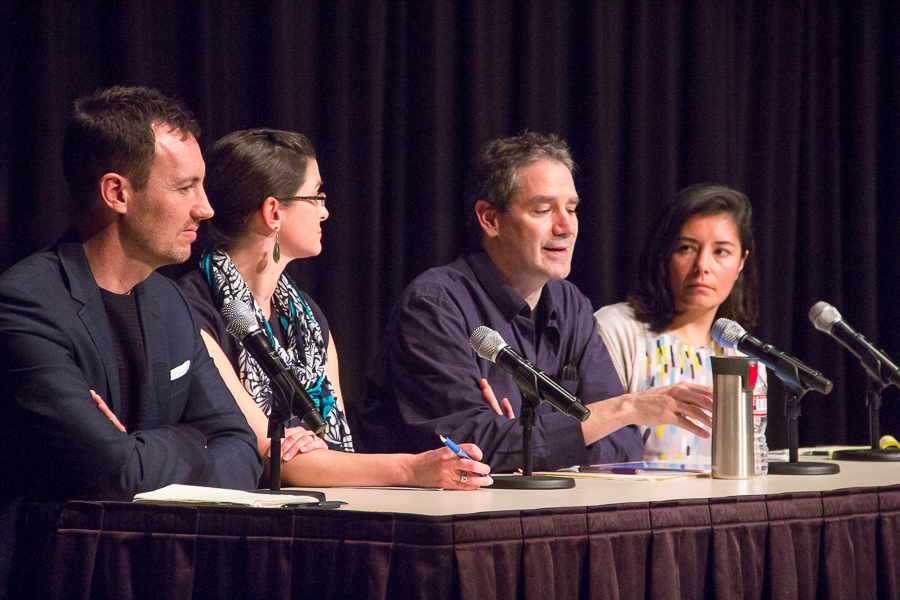
UC Davis’ “Dialogue and Discernment” series of academic discussions rolled out its first event on Feb. 22, “Science In a Post-Truth Era,” featuring four science faculty panelists, a moderator and Interim Chancellor Ralph J. Hexter.

The four faculty members provided opening statements affirming the dual importance of diversity in dialogue and discernment. The speakers described a perpetuated separation between science and society, and how scientists and the public must work together to shatter this wall and suture the two.

Hexter gave an introduction at the start of the round-table, orating his reverence for academia and upholding the value of scholarly process.

“Those that are part of the academic community have a special opportunity as well as a special responsibility to do better,” Hexter said. “This exploration of what is at stake and the idea of dialogue speaks to my expectation that its appearance in our survey title won’t puzzle anyone. But why did I also add ‘discernment?’ In my opinion, we must be skilled in employing discernment, which I define as a honed critical faculty encompassing knowledge, reason and more.”

The moderator, Deb Niemeier, a professor in the Department of Civil and Environmental Engineering and the School of Education, spoke to the audience after Hexter, explaining the issues and goals that would be addressed in the talk.

“Generally speaking, the aim of scientists and the public would appear to be compatible,” Niemeier said. “And yet, scientists are facing marginalization and suppression from public and political leadership, so what is going on? That’s the purpose of this roundtable today.”  

The speakers focused on the importance of scientific expertise and discipline, highlighting that while bolstering diversity of hypothesis and scientific freedom is important, scientific standards must also be upheld in the process.

Benjamin Houlton, a Chancellor’s Fellow professor in the Department of Land, Air and Water Resources and the director of the UC Davis John Muir Institute of the Environment, jokingly described climate change as one “of the issues that wakes me up in a cold sweat at night.” Houlton explained how he saw truth as a constant search with a multitude of hypothesis, and how absolutism within political and social contexts can damage science.

“Scientific process to me is like a limit function in calculus — you can approach the truth but never quite get there,” Houlton said. “Scientists don’t have the drop on truth — what we do have the drop on is a process that protects ourselves from ourselves. If you take the case study of climate change, over decades of intense research there’s been several hypotheses for why we see the warmth of the planet increasing. We now have a working model of the climate system which says humans are disproportionately responsible for changes in climate.”

Houlton and the other speakers referenced political administrations in misrepresenting the scientific and expert community with the public, corporate and political manipulation of science. The speakers posited that political influence on science has challenged free academic discourse.

Since his inauguration, President Donald Trump has defunded the Environmental Protection Agency (EPA), rolling back the clean water acts and revising former President Obama’s 2015 climate change regulation, which targeted coal-fired power plants. Trump’s administration has also removed online climate and environmental public data.

“Someone with fossil fuel connections is now part of the EPA,” Houlton said. “It’s an assault to society when we elect these officials.”

The panelists discussed how non-environmentally friendly institutions impede scientific progress.

Houlton cited that “one-eighth of people around the world die of air pollution” and that industry catalyzes this damage through a system in which “the less climate scientists do, the more institutions make.”

Tessa Hill, an associate professor of in the Department of Earth and Planetary Sciences, ocean acidification expert and recipient of the Presidential Early Career Award for Scientists and Engineers views public opinion and scientific opinion as often unnecessarily at odds.

“The post-truth era is long lived for a climate scientist,” Hill said. “We have for a long time lived in a swirl of misinformation. An attempt to use misinformation was and is used against a growing body of scientific evidence and consensus in terms of where the scientific method brought us to where we are today.”

Veronica Morales, an assistant professor in the Department of Civil and Environmental Engineering, described scientific discovery as a “torturous journey to the truth,” and said that the full scientific process is often arduous.

Joe Dumit, a professor of anthropology and the director for the Institute of Social Sciences, illuminated his ideology on discerning between between corporate and public beliefs. He told the audience that he begins his class each day with the question: “What’s the difference between facts and public relations?”

In addition, Houlton described social media’s role in changing people’s views of climate change.

“Social media and internet has provided a voice to everybody, and suddenly everyone’s opinion kind of carries the same way,” Houlton said. “A single tweet from the POTUS about climate now carries as much weight as a couple decades of papers because of who it comes from. I think we haven’t developed a reasonable way to use this new appendage of social media and the internet.”

Jared Kohn, a third-year English major, similarly believes that the rise of internet and media misinformation has created a diminished expert opinion, sullying the respect for academic and expert findings.

“I don’t think the concept of a post-truth society begins and ends with Trump, I think it’s a situation that’s been developing and growing,” Kohn said. “I almost feel like it began with the inception of the internet because the expert opinion becomes diminished amongst information now being everywhere. An inability to trust the concept of expertise was facilitated by a rise of information.”

Attendees then had the chance to ask the panelists questions. One community member asked if it was time for scientists to hang up their lab coats and become activists, while others asked how science could become more publicly accessible, using examples like NASA artistic renderings or YouTube videos.

The next event in the Dialogue and Discernment series, titled “Milo War: Campus Activism and Freedom of Speech in the Age of Outrage,” was led by professor Robert Ostertag from the Department of Cinema and Digital Media on March 9.


Written by: Aaron Liss — campus@theaggie.org

Davis alumna presents art exhibit inspired by women’s rights

JENNIFER HIRSHFIELD / COURTESY

Jennifer Hirshfield explains importance of being present, painting politics

It’s in your newsfeed, it’s part of your dinner conversation; it’s seemingly unavoidable. Politics is everywhere — in 2017 more than ever — so when painter and Davis alumna Jennifer Hirshfield tied her smock and picked up her paintbrush, she disregarded her teachers’ warnings to keep paint and politics separate.

“We always try to stay away from politics in art — but not anymore,” Hirshfield said. “All bets are off right now. […] I couldn’t not do it. I couldn’t ignore it.”

The Santa Rosa based painter’s exhibit, Hineni… Here I Am, is her most recent body of work; it includes portraits inspired by women’s rights and the Women’s March. The exhibit is currently showing at the Walter A. Buehler Alumni Center, where it will remain until March 31.

“The actual body of work was, to a tee, influenced by politics and the Women’s March,” Hirshfield said. “I learned under the great artists of the Bay Area Figurative Movement, so right now, working with a figure, some of those figures were actually modeled from women at the march. I’m definitely influenced by what’s going on right now.”

Hirshfield describes her work as a manifestation of the philosophy of “being present.” First hearing the term through Leonard Cohen’s song and album You Want it Darker, Hirshfield’s exhibit pays tribute to the Hebrew phrase “hineni.”

JENNIFER HIRSHFIELD / COURTESY

“More specifically, it means ‘Here I am,’ and it’s interpreted as ‘Being present,’” Hirshfield said. “In this particular body of work, I felt it was more about being unapologetic about your beliefs […] Kind of of like: this is what I got; this what you get.”

Hirshfield places strong emphasis on this notion of being present. The culmination of her politically-charged art highlights the intensity of politics in everyday life.

“Even though it’s a Hebrew word, it’s the Buddhist aspect of [“hineni”] that influences me — being present,” Hirshfield said. “And that includes everything from sitting here under these blooming trees to my ocean paintings of Annadel [State Park].”

Hirshfield explained that after she was diagnosed with breast cancer, “being present” became the centerpiece of her solace. She acknowledges that it was this diagnosis that encouraged her to pursue her art more seriously.

“When I moved back [to California], I actually got breast cancer,” Hirshfield said. “At that point I said, okay, I’ve studied psychology, I’ve taught primary education […] but art was my passion — it was where I was going to go.”

Her love for art was cultivated during her studies at UC Davis. Graduating in 1987 with degrees in both art and psychology, many of Hirshfield’s art lessons were taught by internationally-recognized painters from the Bay Area Figurative Movement.

“[In Davis], the academia is mixed into the town,” Hirshfield explained. “So for instance, if you’re going to have a show, there’s all these references to the professors that you learned under. Or even having shows supported within the art department, like by Manuel Neri — the way he worked with us one-on-one, and he integrated himself into the campus. You’d be eating bagels together with your professor in the Coffee House. There was not a big boundary between being a professor and being a student. […] There was always this integration of the creative world connected with the actual people you’re working and learning under.”

After many years of painting and teaching, Hirshfield’s art comes full circle; Hineni…Here I Am, is showing on the same campus that kindled her passion in the first place. She hopes, too, that the Pence Gallery may pick up the exhibit.

“For the women’s studies majors, I think it would be great for students to come through. For anyone this interested in women’s issues, I really want to reach out and say, ‘Come see the show,’” Hirshfield said. “At the alumni center, one girl who worked there looked at the piece and said, ‘Thank you so much for doing that piece,’ and that piece reads, ‘My body, my choice.’”

The message behind Hirshfield’s exhibit is pertinent and even assertive, but its explicit imagery is simply necessary. The implications of her art are as poignant as the art itself.

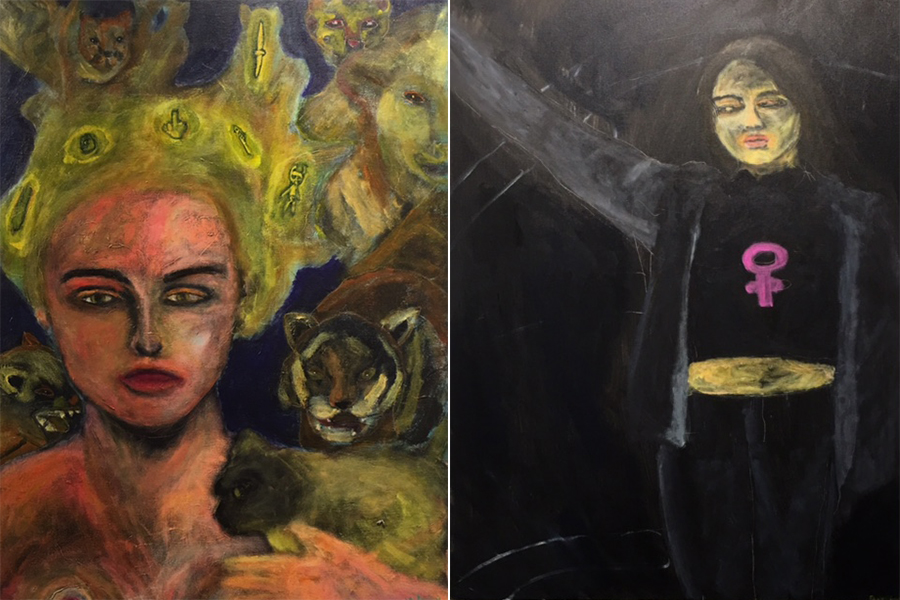
“The subject matter is very forthright. There’s no kind of figuring it out; it’s convicted and moved and making a message,” Hirshfield said. “There’s one of a woman, and she has lions behind her, but a kitty cat in front — it refers to sexual assault on campuses, or anywhere for women. It’s so rampant. […] And I really felt like it’s a horrible subject, but it’s a true subject.”

But this is exactly why Hirshfield’s art is so pertinent not only in its location, but in its timing. Her paintings tell a story, from start to finish, of a bleak beginning but a powerful, female ending.

“The first image is just [a portrait of a woman] from the bust up,” Hirshfield said. “And she is looking pensive, sad — I wouldn’t even go so far as saying crushed — but it was a very demure piece. From that, going chronologically, the last piece of the show is of two women, one with her arm out, [flexing]. And they look like all power. Like nothing is going to stop them.”
Written by: Ally Overbay — arts@theaggie.org

New type of glasses developed at the UC Davis Eye Center

GLENN YIU / COURTESY

Mirror-rimmed spectacles provide improved comfort, function for patients after retinal surgery

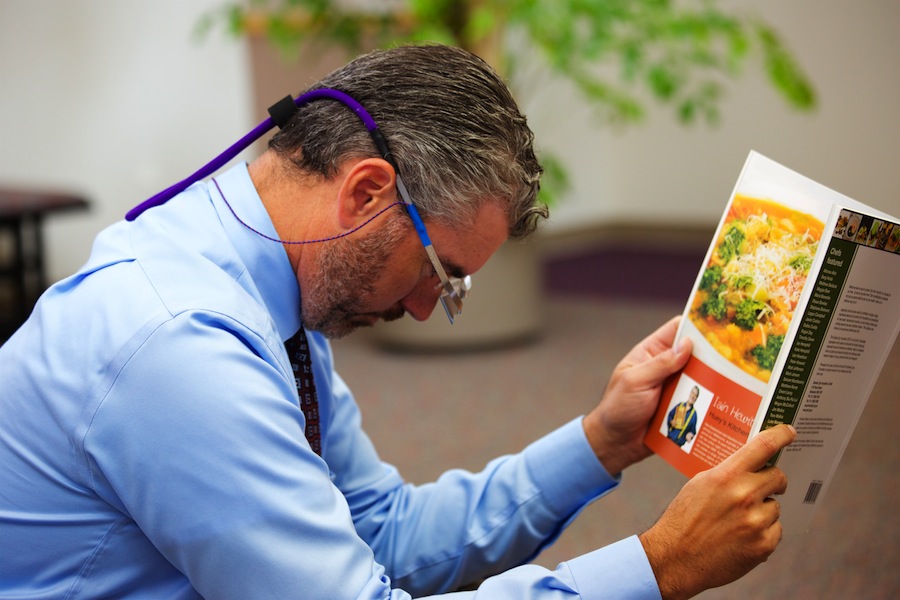
Mirror-rimmed spectacles — glasses adapted at the UC Davis Eye Center — allow a person to see their surroundings while lying in a face down position.

Glenn Yiu, an assistant professor of ophthalmology at UC Davis, published a pilot study in the online journal Retina, in which he tested these glasses on patients one week after retinal surgery. It was found that the new design of glasses significantly improved visual function and quality of life compared to using a mirror to see one’s surroundings.

After retinal eye surgery, it is necessary for patients to recover in a head down position for about a week. This is to help reattach the damaged structures in the eye and achieve the optimal effect of the surgery.

“We rent the glasses one to two weeks at a time with a hold deposit of $20,” said a certified optician at the UC Davis optical shop who preferred to remain anonymous. “It’s something patients can use after an eye surgery that requires them to have their head faced downward.”

The mirror-rimmed spectacles change the direction of light by bending it to a certain angle. The glasses have a set of prisms that have a mirror at the base, so a person in a head down position is able to see their surroundings.

The study reported that patients used the glasses for 51 percent of the hours they were awake and 90 percent reported excellent comfort while wearing them.

The retina is an extremely thin, light sensitive structure that lines the inside of the eyeball, similar to how wallpaper lines surfaces. This layer of tissue sends visual signals to the brain, however, it is possible for the retina to tear or become detached from the eyewall.

“If the retina is detaching and moving away from focal point of light, an individual perceives vision with a curtain of shadow that can impede vision,” said professor Paul FitzGerald of the UC Davis Department of Cell Biology and Anatomy.

Other symptoms of retinal detachment include seeing flashes of light and an increase in floaters, which are little specks that travel across an individual’s field of vision caused by tiny pieces of cellular debris moving about.

Older individuals are more prone to retinal tears and detachments compared to younger people.

“As you get older the fluid [in the eye] begins to break up, and there is a process of gel turning into liquid,” FitzGerald said. “With the occurrence of a retinal tear, that fluid can leak through and build up behind the retina.”

Retinal detachment can also cause consequences to the anatomy of the eye. The main issue is with the light sensory cells contained within the eye, specifically the rods and cones. Rods and cones are the most metabolically active cells in the body, requiring a high energy demand and need for much oxygen and nutrients to survive.

If a retinal detaches or tears, the rods and cones are displaced and not able to access enough nutrients and oxygen. Death of these cells can lead to vision loss.

However, eye surgeries such as laser, cryopexy or freeze treatment can help stop small tears or holes in the retina.

The most common surgery is gas injection, in which an eye doctor injects a gas bubble into the eye to help hold the retina against the eyewall so it can be properly treated and heal correctly. Gas is used because it is lighter than fluid and can float inside the eye.

“If a person sits upright after the surgery, the gas bubble inserted won’t be positioned appropriately, and it is less likely the retina will reattach and reduces the success of the surgery,” Yiu said.

The mirror-rimmed spectacles were adapted for this very reason and help patients cope with the recovery position.

Another potential application of these glasses regarding health is use by patients who receive Magnetic Resonance Imaging.

This diagnostic technique allows scientists to take images of the soft tissue and bones of the body, but in order to do so, a patient must lie in the very confined space of the machine.

For claustrophobic patients, wearing mirror-rimmed spectacles allows them to see out and around the machine so they feel more comfortable.

Glasses, called “belayer glasses,” are spectacles of the same principal idea that exist to aid rock climbers. Belayers, the people who hold the ropes steady and assist in holding the weight of the climber, have to be constantly looking up.

Belay glasses, which change the angle of light, relieve neck strain by allowing the person to keep their neck straight yet have vision of what is above them.

“The awareness of prism use to change direction of light is not new in application, but I wanted to discover if it works from a patient standpoint,” Yiu said.

The goal of the study was to see if the glasses could improve the comfort of patients who were healing after retinal surgery.

“One of the measurements used for this study was the National Eye Institute Visual Functioning Questionnaire,” Yiu said. “It showed improved quality of life of patients who used the glasses compared to those who used mirrors and support props to manage resting face down.”

The glasses adapted and tested at the UC Davis Eye Center have a wide range of application use and though use of physics and light optics; individuals are able to see their surroundings without directly looking at it.


Written by: Shivani Kamal — science@theaggie.org

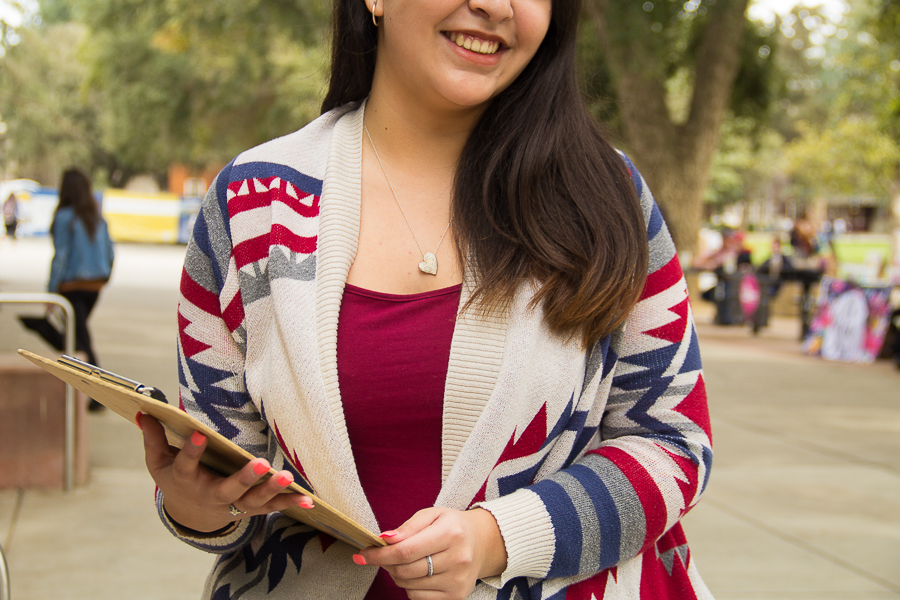
Humor: Student crosses same road seven times to avoid people with clipboards

LAURA LONG / AGGIE

A look into avoidance tactics students use against weirdly friendly solicitors
Who’s that person who just said “hi there!” to you with such enthusiasm? Is it your best friend? Is it a coworker you’re running into outside of work? No. It’s a stranger who would like you to take “just one minute of your time” to help stop Donald Trump.

People like this are popping up all over campus. They don’t all want the same thing, but all of them are equally terrifying to many students.

“I was just trying to walk from the library to the CoHo to grab some lunch,” said Becky Trombone, a third-year plant biology major and the Guinness World Record-holder for the largest pile of dirt constructed entirely using a single toe. “But on my way I had to avoid so many of these solicitors that I crossed a single road seven times. I’ve never put so much effort into a single activity. I just couldn’t handle the penetrating eye contact that they always make. It feels like they can look into my eyes and immediately know all my darkest secrets. It’s too much to handle. And why do they always say ‘hi’ to me when I’m still so far away from them? It’s just weird.”

Not all students view these campus mainstays with such pessimism, however. Some find encouragement in the causes they fight for.

“I think these people are amazing,” said Randal Chung, a first-year managerial economics major and professional human wall clock. “They told me that together we could stop Donald Trump! And all they needed was my credit card information! Plus my Social Security Number, home and school address, the original copy of my birth certificate and a photo of my entire family. But that’s it. Oh, and the GPS tracker they installed in my skull. But that’s all. And now together we’re going to stop Donald Trump. Who knows how we’re going to do it, but I’m not worried at all.”
Written by: Brian Landry — bjlandry@ucdavis.edu

Design major’s international living experiences inspire creativity

MEENA RUGH / AGGIE

Sustainability, empathy drive Blanco’s motivation

From plant biology to comparative literature to theater to chemistry, third-year design major Bronte Blanco has truly tried it all.  

“I would get super inspired by the things I was learning, but nothing really stuck,” Blanco said. “I was bad at acting, but I liked stage managing, so I did a stage-managing job. When I did that I met the girl who was a double-major design and theater major, and she introduced me to design and I was like, ‘Okay I’ll dabble, I’ll see how I like it.’”

Although she was initially skeptical, Blanco found that design was the perfect fit for her.

“I thought design seemed cool, but it also seemed kind of useless and superficial and you’re not really doing anything for the world,” Blanco said. “But it’s interesting, the more you take design classes [‘design’] becomes a really relative term.”

She found that her experience of going to a high school centered around engineering boosted her enthusiasm towards the subject.

“It was basically everything I was doing with my engineering career minus all the math,” Blanco said. “So it was all the innovation and artistic work I was into with no obligation to be a mathematician or any of the science stuff that I wasn’t good at.”

Additionally, Blanco discovered design aligned well with her childhood experiences of moving internationally since her dad is in the hotel business.  

“I’ve lived close to Madagascar [Mauritius]; I’ve lived in Portugal, Mexico, and I’ve lived across America; and recently my dad moved to Singapore,” Blanco said. “Having the experience of living in all these different places you get a good sense of everyone’s different cultures and what they struggle with and what their societies are founded on and the things they excel at. Being aware of that has made me more empathetic and want to hear about the changes they want to see.”

Despite living in many places, Blanco identifies Hawai’i as home. She has found that the focus on sustainability in Hawai’i has influenced her own views.

“We learn about reuseable energy from middle school all the way into high school, all of our projects are focused on that, so for me that’s the first thing I gravitate towards because I’m like ‘yes this important and I’ve been told this is important since I was young,’ that’s inspiring to me,” Blanco said. “So I want to find a way I can be a designer but also in the environmental realm of things.”

She finds the best part about design is the impact it can have on others’ lives.

“You get to watch your idea and see it come to life, and you also get to see it solve the problem hopefully,” Blanco said. “That’s so rewarding to be part of whether it’s just you or a team of people who make differences in people’s lives in that way.”

Blanco has no specific focus in her design work and has taken a multidisciplinary approach, although the aspects she enjoys most are exhibition design and coding. Recently she worked with design professor Tim McNeil to create an exhibition that shows how the Manetti Shrem Museum was built.

“That was really great because it pushed me to do things I never thought I could do,” Blanco said. ”It gave me the confidence to believe I had the ability to lead projects because before I feel like I didn’t take that stand. But for this one I was put in a position where I didn’t really know very much, but due to deadlines that had to be met, and him encouraging me throughout the process, I got see an exhibition go from nothing to being up and getting to watch people come in and really enjoy it.”

Students can visit Blanco’s exhibition in Room 124 in Cruess Hall.
Written by: Abigail Wang — arts@theaggie.org

UC Davis hosts guest lecturer to celebrate new $1.5 million endowed chair in Jain Studies

KARIN HIGGINS / UC DAVIS

Davis resident Mohini Jain sponsors chair on ancient Indian religion

To celebrate the creation of a new endowed chair in Jain studies at UC Davis, Middlebury Collect President Laurie Patton gave a presentation to a standing-room-only crowd on Feb. 21.

The Mohini Jain Presidential Chair for Jain Studies is backed by a $1.5 million endowment from Davis resident Mohini Jain. The chair will be housed in the Religious Studies Department.

“This evening’s lecture by President Patton honors Mrs. Mohini Jain’s long history of giving to UC Davis and the commitment to education and principles of robust dialogue [that are] a part of the university’s academic initiative,” said Archana Venkatesan, the chair of the Religious Studies Department. “[…] It has been truly a pleasure, a privilege, to know Mohini as a friend [and] a mentor.”

Interim Chancellor Ralph J. Hexter gave opening remarks before Patton took the stage. Hexter thanked Jain for her donation to the university and explained the chief goal of the new position.

“This evening’s event is so special [because] it allows us to honor Mrs. Mohini Jain, a long-time and treasured friend of UC Davis,” Hexter said. “[…] Mohini and her family have endowed a presidential chair at UC Davis. This chair is dedicated to the study of Jainism in the religious studies department, and the hope is the chair will serve as an interdisciplinary leader on campus in the study of Indian religions and the religions of Southeast Asia more broadly.”

According to a statement by Jain to UC Davis Dateline, she is most excited to see the societal impact that this new chair will bring to the university.

“Jainism is a very ancient and important religion and philosophy that champions truth, nonviolence and a multiplicity of viewpoints,” Jain said. “In our multicultural, global world, it is important to escape boxed-in points of view. I am hopeful the impact of the chair at UC Davis will be a broadening of minds and a renewed focus on dialogue and peace.”

Susan Kaiser, vice dean of humanities, arts and cultural studies in the College of Letters and Sciences, highlighted the great educational value that the new chair will bring.

“The Jain chair will be used to do some wonderful things at UC Davis,” Kaiser said. “[…] The endowed chair will promote a robust research profile with peer-reviewed publications and books and articles, contributing to an international reputation in Jain studies […] The chair will greatly enhance the religious studies department […] making this department one of the truly accomplished religious studies departments in the nation.”

Patton then took to the stage to present a roughly 50 minute lecture.

“I just have to say: standing room only in a lecture on the early Indian religions,” Patton said. “Something must be going right with the world. It’s delightful to be here at UC Davis and to celebrate this new chair in Jain studies.”

The moral standing of this new chair is very important to Patton.

“The idea of a chair to explore the complexity of early Indian religions, with a focus [on] Jainism, and with a focus on how they can make peace in the world today, is a dream come true,” Patton said. “There are very few people like you who exist in the world and I really mean that.”

Jain said that she chose to donate to the religious studies department because the humanities at times can be undervalued.

I also always have felt that the department of religious studies, humanities, have been undervalued,” Jain said. “For what they offer, somehow people don’t recognize always. Whenever the donations go and chair establishments, they go to engineering and many other departments that are more visible, maybe with immediate gains.”

Written by: Kenton Goldsby — campus@theaggie.org

Police Logs

NICKI PADAR / AGGIE

A good way to kick off March

Feb. 28

“Man ran towards RP yelling and recording her with his phone.”


March 1

“Request extra patrol during the evening hours for multiple subjects jogging on the North Davis Greenbelt with dogs off leashes.”


March 2

“Unknown subject threw an egg at RP’s resident last night.”


Unknown caller “was looking for garden services.”


March 3

“RP requests to speak to an officer to obtain information about riding motorized go carts in the streets.”


“Female rummaging through the bed of a parked truck…wearing underwear only and no pants.”


“Sandwich board sign posted advising right turn only onto one way street which would direct traffic in the wrong direction.”


March 4

“Male took brick from neighbor’s yard. RP approached male and told him to return the bricks. Male stated he didn’t think they were being used and put them back.”
Written by: Sam Solomon — city@theaggie.org

Stack parking price breakdown

VENOOS MOSHAYEDI / AGGIE

TAPS to create alternatives to single auxiliary vehicular use

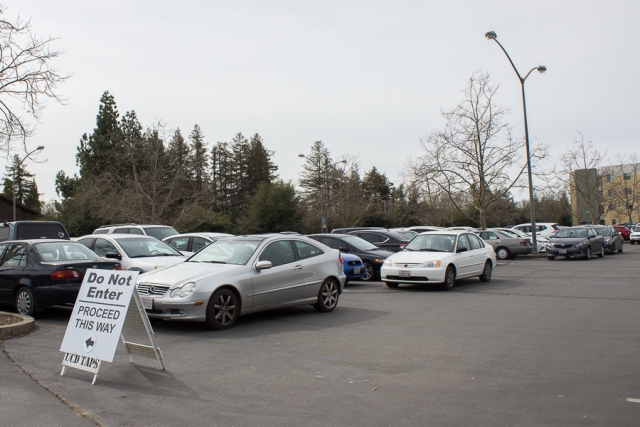
The colder, rainier months of Winter Quarter often lead to an influx of students driving to campus. To accommodate the increased numbers of vehicles, Transportation and Parking Services (TAPS) implemented the stack parking program on Feb. 13.

The stack parking program started as a temporary solution to mitigate the augmented amount of cars being driven to campus during the winter months. The program is meant to be dissolved at the end of Winter Quarter, as more students decide to use active transportation, such as biking or walking, to get to campus during Spring Quarter.

The number of spaces created by stack parking is contingent upon the parking facility’s space inventory and layout,” the TAPS website reads. “For example, the daily parking capacity in Lot 47 will increase by 100 spaces and in the Quad structure by 120 spaces.”

Based on fiscal estimates provided by TAPS, the program will cost around $45,000 to operate. The daily cost at the Quad Parking Structure is $1,750.50, which pays for seven hired attendants, and $631.50 for Lot 47, which has four.

A long-term solution to accommodate student parking would be construction of a new parking structure. Currently the campus has three parking structures, the largest being the Pavilion Parking Structure, which is six stories tall and can hold a total of 1,453 cars. According to TAPS Director Clifford Contreras, it costs approximately $30,000 per space to build a parking garage. By this estimation, the Pavilion Parking Structure would have totaled around $43.5 million to construct.

Additionally, Contreras noted that stack parking provides more flexibility in terms of its presence and use.

“At the end of the day when we don’t use [stack parking] anymore, it goes away,” Contreras said. “It’s so expensive to build parking on campus.”

Rather than spend funds on accommodating for extra parking, TAPS plans on creating new initiatives to encourage alternative modes of transportation. Alta Planning and Design has been hired to create programs, engage the campus and conduct surveys to identify ways to reduce the number of single, auxiliary vehicular use.

“We see this as a stop gap measure to put in place until we are able to create reward packages,” Contreras said.

Contreras did not mention what these “reward packages” will specifically entail.

According to a 2015-16 UC Davis Campus Travel Survey Report, on average 22.9 percent of students drive their cars alone onto campus.

“On an average weekday, about 87.1 percent of people physically travel to campus, (approximately 38,319 people) including those living on campus,” the report read. “Among these, 45 percent bike to get there, 7 percent walk or skate, 23 percent drive alone, 5 percent carpool or get a ride, 19 percent ride the bus, and 1 percent ride the train.”

UC Davis is currently working toward a 10 percent reduction in the number of cars driven to campus by 2025. Contreras hopes that this can be achieved with help from new reward package programs.

Written by: Lindsay Floyd — campus@theaggie.org

Wellman and Olson Halls: More alike than different

ANH-TRAM BUI / AGGIE

The similarities between two bustling halls on campus

One thing all students at UC Davis have in common is the amount of time they spend in two of the most familiar buildings on campus: Olson and Wellman Halls.

“My first class when I came to Davis as a freshman was Math 17A in the mornings, and it was in Wellman,” said Karishma Sethi, a fourth-year global disease biology major. “I’ve had classes pretty much every single quarter in Wellman. Classes, club meetings or whatever it is, I’m always in Wellman. I sometimes have class in Olson, [but] not as much as Wellman.”

Wellman Hall stands on the west edge of the Quad, distinct with its rosy bricks that mimic the vintage style of the Memorial Union. According to UC Davis archivist Kevin Miller, the namesake of the hall, Harry Richard Wellman, was a major player in California society who attended and taught at UC Berkeley and also served as the director of the Federal Reserve Bank of San Francisco for 11 years. After these career stints, he served as vice president of the University of California from 1958-1967 and then as acting president for an additional two years.

“At the time it was designed for classroom space, and it was built at the same time as Kerr next door,” Miller said. “My understanding is that Wellman was kind of innovative and kind of a fresh design at the time. This kind of [building had] multiple access points at different levels, it was larger and more comfy.”

Indeed, Wellman appears to be a comfortable space, with a nice sprawling lawn out front and a deep-set, private courtyard in the back. Inside on the main level is a convenient computer room, where students can enjoy a cozy atmosphere filled with the soft patter of keyboards in use.

“[Since] this is my first year here, I like the look of Wellman, especially the computer lab with the wood paneling. I like the feel of it […] it might be a little old, but it’s nice and vintage,” said Mareylene De La Cruz, a third-year Japanese major. “[I] definitely think it’s a nice thing that Davis offers a [printing] room like this. It’s a nice resource to have because I know Wellman is a building where students have a lot of classes, so it’s nice to have somewhere you can go really quick and print something or have a nice quiet, chill area where you can study.”

Wellman Hall is not home to offices or labs — unlike Olson Hall. Situated at the southeast corner of the Quad, Olson Hall is a squat, concrete building that seems to be built into the ground instead of on top of it. According to Sethi, although Olson’s interior feels slightly gloomy, it lacks the narrow, cramped feeling of the hallways within Wellman.

“I like Olson,” Sethi said. “I think it’s a cool setup with the downstairs [and then] you’ve got the big steps coming up [in the main entrance hall]. I think the design of it is really cool. I’ve never seen a building like it before [and is] something I’ll probably remember ten years from now and think about […] that weird building that smelled really strange and is really old with zero [phone] service.”

This building was completed in 1963 — a few years before Wellman — along with Sproul Hall, which was under the same budget. It was named after Gus Olson, who attended UC Berkeley and then served on the University Board of Regents from 1951 to 1960. Olson was also a farmer, businessman and leader in the Davis community.

“[Olson Hall was] built mostly for classroom space but also [it had] early computer labs [as] this was the very early period of the computer age,” Miller said. “Also the second floor [is where] the TV studio used to be for the campus […] and there’s still a language lab in there.”

Not only were both Olson and Wellman architecturally innovative for their time and named after important figures involved in the UC system, they were also built in tandem with traditional high-rise buildings.

What is undeniable about both is that they are, and always have been, popular hubs on campus. Whether used for meeting up for class, conducting club meetings or even hosting movie nights, these buildings have never failed to resonate as safe and familiar spaces for UC Davis students.

“My impression is that in its recent history, at least in the 2000s, is that it became sort of a secret spot for students […] to get around at night,” Miller said. “[Students would] use a DVD player and have movie nights — apparently there were several rooms that were set up with AV, and at the time [people used] DVD players, so students would crash there and have an unofficial movie night. Sometimes the janitors would kick them out, sometimes they wouldn’t.”


Written by Marlys Jeane — features@theaggie.org

NAMI-Yolo hosts suicide prevention program in Davis

NICOLE WASHINGTON / AGGIE

National suicide rates on the rise

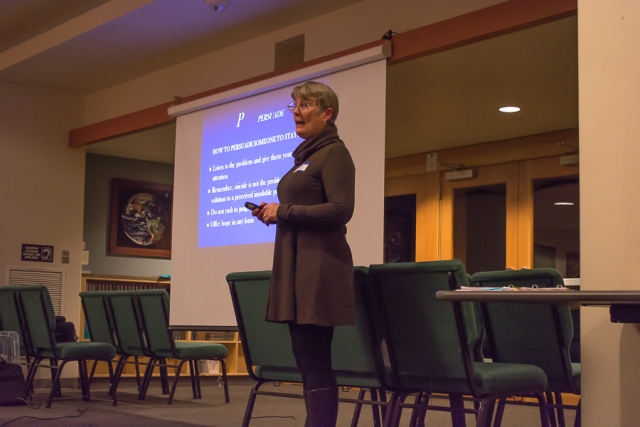
During a public suicide prevention program held on March 1 at the Unitarian Church in Davis, Donna Bousquet, a mental health trainer and longtime member of NAMI-Yolo, explained that younger people attempt suicide more often than individuals in older age groups, despite the fact that elderly individuals commit more successful suicides each year.

“Anyone can commit suicide,” Bousquet said. “There isn’t one specific person or group of people [that do].”

Bousquet recently led a room of nearly 40 members of the Davis community and surrounding Yolo County area through a Question Persuade Refer (QPR) program, held by the National Alliance on Mental Illness Yolo County (NAMI-Yolo), to provide information and resources to participants in attendance about suicide prevention.

NAMI is a non profit support and advocacy organization that strives to reduce the stigma surrounding psychiatric disorders such as bipolar disorder, clinical depression and schizophrenia in over 1,000 affiliates throughout the United States.

The Yolo County chapter hosts numerous programs and meetings during the year to provide resources to families, teens and adults in the region who may be struggling with mental health.

During the QPR program, Bousquet discussed the various warning signs and clues individuals who exhibit suicidal behavior may have. She also discussed the different methods that individuals can utilize when speaking to someone who may be suicidal, and provided resources to attendees about where to go to get help when someone is contemplating or attempting suicide.

For instance, Bousquet explained how individuals with suicidal tendencies may give direct clues through various statements such as “I’m tired of life, I just can’t go on” and “pretty soon you won’t have to worry about me.”

Individuals may also give behavioral or situational clues that can indicate they may be suicidal: expressing unexplained anger, drug or alcohol abuse or having experienced the death of a loved one. Bousquet stressed that suicidal ideation can happen to anyone no matter where they are in life.

“Many people have thoughts of suicide at different times in their lives,” Bousquet said. “Your job is connect that person to someone safe.”

Bousquet provided the Yolo County Suicide Prevention program’s number as a helpful resource that individuals can reach out to when faced with suicide, as it is a serious and rising issue that can be successfully prevented if addressed.

According to recent findings by the Centers for Disease Control and Prevention (CDC), overall trends of suicide in the United States increased by 24 percent in 2014 in comparison to 1999 numbers, observed for both males and females younger than 75 years old.

One attendee during the QPR program was a current UC Davis graduate student, Anahita Hamidi, who has been a member of NAMI-Yolo for about a year. She is glad to be a member of the organization because it has provided her with helpful resources and information about mental illness, something family members of hers have struggled with. She urges others to join if they are interested.

“Something like mental illness has a lot of stigma,” Hamidi said. “It is good to have the community aspect by having these conversations. […] This space is very invaluable to itself.”

For more information about becoming a member of NAMI-Yolo or attending its events, please visit its website. If you or someone you know is contemplating suicide, please call the Yolo County Suicide Prevention line at (888) 233-0228.


Written By: Anya Rehon — city@theaggie.org