57 F
Davis

Davis, California

Monday, December 22, 2025
Home Blog Page 646

Inside the Game: Pele Gianotti

CIERA PASTUREL / AGGIE FILE

The Aggie sat down with the UC Davis women’s basketball forward, who was recently named to the all-Big West Conference first team

Height: 5’11”

Year: Junior

Position: Forward

Major: Political Science

Hometown: Myrtle Creek, Oregon

High School: Roseburg HS ‘14

History: Riddle High School, Roseburg High School, three-time all-state selection in basketball

Accolades: 2016- 2017 All-Big West First Team, Big West Player of the Week for Feb. 27, 2015-2016 Big West Conference Honorable Mention, 2015-2016 Big West All-Academic Team


Junior forward Pele Gianotti is a driving force behind the UC Davis women’s basketball team, leading the team — owners of eight straight victories at press time — in scoring. On March 6, Gianotti was named a member of the all-Big West first team. The California Aggie had the chance to sit down with Gianotti to ask about her basketball career so far and what she hopes to achieve as an Aggie and as a player.


How long have you been playing basketball? What got you into the sport?

I’ve been playing it forever, I feel like. You know, you do the YMCA thing, so first grade, maybe? But I didn’t actually start loving it until sixth grade, seventh grade, when I went to a basketball camp and realized, ‘Whoa, this is fun being able to do these different drills and being good at it.’


How did you end up playing at UC Davis? What was the process like?

I played for a club basketball team in Spokane, Washington, and they were pretty good. I just got recruited by [head coach] Jen [Gross] by coming to the tournaments that we all played at. [I] made a couple phone calls, she offered me [a spot on the team]. I had never really heard of [UC] Davis, but as soon as I stepped on campus, I was like, ‘Wow, this is for me. I love it.’ The end.


What is the ultimate goal for you to achieve athletically at UC Davis during your next couple years?

The biggest one for us right now is just to win the Big West Conference Tournament. That’s basically what I’ve been working towards since freshman year. The coaches have been talking about it, how great an experience it is to cut down the nets and that’s all I want for this team.


How do you feel the team is doing right now?

I think we’re doing really well. Our offense is really flowing well. Everybody is super confident and because of that, we’re able to make shots, hit passes, do things that maybe earlier in the year we weren’t able to. Our defense is also helping us out a lot. Other teams aren’t able to score and we are. I think overall, everyone is just super confident.


You were just named the Big West Player of the Week.

I’m feeling pretty happy. I didn’t really expect it. Channon Fluker [of Cal State Northridge] has gotten it like the last three times and she’s been doing really well. I had a good week last week, but overall, our team has just been playing super well. I didn’t really even know I was a contender.


How did you feel about those games against Cal Poly and UC Santa Barbara? (In recent games Gianotti shot 12-for-19 overall and 7-for-11 for three pointers. She also made 13-13 of her free throws during that time as well.)

I was just playing and taking what was available to me. The coaches have been saying, ‘Hey, you’re a good player.’ In the beginning of the season, it was touch and go with my shot, but lately I’ve been hitting a couple and realizing that. I’ve just been playing with the team, not doing anything special, just taking what’s available.


How does the team react to your performance this season and the accolades you have received? What is the level of support from them?

Good. Yesterday, Dani [Nafekh] and Morgan [Bertsch] were looking on Instagram because they knew I was a contender [for Player of the Week] and they were like, ‘Oh my gosh, you’re going to get it. You’re going to get it.’ They were super excited for me and the coaches, obviously, are like, ‘congrats!’ but overall, it’s about the team and none of us are better than anyone else, that’s for sure.


You’ve had a lot of success in your basketball career thus far. Do you have plans/desires to continue playing after your time at UC Davis is through?  Where would you like to be?

I definitely want to play overseas. I don’t know where, but I also don’t really have any plans for my major, so I’m kind of like, let’s go do this! It’ll be fun. And obviously I love basketball and I love to travel, so that would be my dream.


Written by: Liz Jacobson — sports@theaggie.org

Aggies extend win streak to five

CAT TAYLOR / AGGIE

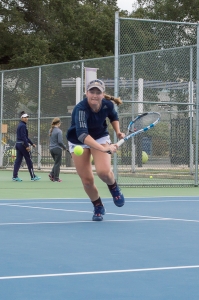
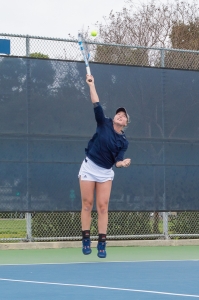
Women’s tennis team makes do with two successful matches home matches, one rain cancellation

The UC Davis women’s tennis team opened up its three-match weekend homestand with a 7-0 sweep of the Montana Grizzlies on Friday, March 3, giving the team its tenth win of the season in 13 games.

Each of the eight UC Davis players who participated in the match contributed to the team’s victory, starting with the three doubles matches. In the number-one spot, junior Kristy Jorgensen and sophomore Kelsie Bryant played fiercely, but they ultimately came up short against the superb tandem of the Grizzlies’ Hannah Sulz and Catherine Orfanos. Jorgensen and Bryant looked impressive early, winning each of the first three games. But the Grizzlies battled back; they took the next four games and ultimately held on for a 7-5 win.

“We were up at the start, but I think we just got a little bit too loose,” Jorgensen said. “We really should have just stayed on them, kept hitting [the ball] hard and go for our shots. We started to get a little nervous. We should have just stuck with our game. But that’s what we’re going to do tomorrow [against Cal Poly], so I’m stoked for it.”

The lone doubles loss, however, was the only blemish on the day’s contest for the Aggies, as victories in each of their remaining two doubles spots secured the first point for the Aggies. The tandem of Texas natives senior Samantha Martino and freshman Nikita Pradeep, along with the second-spot pairing of sophomore Isabella von Ebbe and freshman Kristina Breisacher, both won their matches six games to two.

CAT TAYLOR / AGGIE

In singles play, the Aggies solidified their victory by winning all six matches. The team’s two freshman, Breisacher and Pradeep, both earned straight-set victories at the three and five spots, respectively. Also winning in straight sets was junior Jessie Lee, who vanquished her opponent 6-3, 6-2 in her match at the number-four spot.

Fresh off their intense match in the doubles, Jorgensen and Montana’s Sulz were pitted against each other in the number one-singles contest. This time the Aggies came up victorious, as Jorgensen beat Sulz in straight sets to earn her team its decisive fourth point of the afternoon.

“It feels really good,” Jorgensen said. “It’s a good way to start the weekend. I was hitting my shots a lot better than I have been and my serve felt good. Everything felt good. I’m excited for the matches this weekend.”

The most thrilling match of the day, however, was the number-two singles contest between junior Lani-Rae Green and Montana’s Lidia Dukic. Dukic took the first set with a 6-4 victory, but Green evened the match in the second by locking-in a 6-4 victory of her own, thus forcing a final tie-breaker set. Despite the fact that both players knew that the match had no influence on the outcome of the overall contest, both sides continued to play with high energy and flaring passion. In the end, Green held on to win 11-9 in an intense final set to earn the seventh and final point for the Aggies.

“For me, I was playing more for the team at that point,” Green said. “I looked up at the scoreboard and [saw that] everyone else had a pretty good time out there, so I was like ‘I want to win for the team today.’ I wasn’t playing my best, especially in the first half and I really wanted to turn in around. I think I just found a way to win it. That’s my thought process: stick it out, throw some more stuff at [my opponent] and see what can happen.”

As two juniors who have been around UC Davis tennis for some time, Green and Jorgensen reflected on their thoughts on this year’s team in general.

“It’s my third year, so I’ve seen three different squads,” Green said. “I think the energy this year is completely different from what we’ve seen in the past. We’ve had some great wins and some close losses [this season], but every day at practice and every match I’ve seen, all the girls are out here working really hard and fighting to improve every single day. I think that’s an amazing thing to have on a team. We all have the same goal in mind, and we are all working hard to support each other, and not only to make ourselves better, but to make the overall team better.”

Jorgensen had positive things to say about the team as well.

“I honestly think that this is the best team that I’ve been on since I’ve been here,” Jorgensen said. “The team vibe; everyone just loves tennis, and we love training hard. Every match, you look down, you look at your teammates and you know that they are going to fight. I just love this team.”

Friday’s victory over the Grizzlies was both UC Davis’ fourth shutout win of the season and its fourth consecutive win. What is going right for the squad in this sudden hot streak?

“Everything,” said head coach Bill Maze. “You just sort of get on these rolls sometimes, and we’re on one, so don’t jinx it. I think today’s match was really great preparation for tomorrow, we have a big one against Cal Poly. I’m glad that everyone won because the way to gain confidence is to win. I think [the t

CAT TAYLOR / AGGIE

eam is] going to feel good going into tomorrow.”

The Aggies kept their momentum rolling as they took on Cal Poly the next day and put together a dominant 6-1 victory over the Mustangs, posting their first conference win of the season and extending their winning streak to five matches. The Ags started off 1-0 after winning the doubles point with comebacks from doubles partners Jorgensen and Bryant and von Ebbe and Breisacher, each pair dominating 6-4 sets.

From there, UC Davis took control, with four of its players winning in straight sets. Pradeep wrapped up her match in a 6-2, 6-1 sweep with von Ebbe finishing soon after with her own 6-2, 6-0 victory. Lee topped her opponent 6-1, 6-2 to clinch the overall match for the Aggies. Green rounded out the straight-set wins for the Ags 6-3, 6-2 while Breisacher added to the victory with her 6-4, 3-6, 10-7 tiebreak.

With their win, the Aggies moved to 11-3 on the season, 1-2 in the conference and 7-1 at the Marya Welch Tennis Center heading into Sunday’s matchup.

Scattered rain prevented the Aggies and Bobcats from completing their match Sunday morning. The Ags came in looking to extend their five-match homestand, but the match ended with the teams tied at 1-1.

The Bobcats clinched the doubles point by winning two of the three doubles matches. Martino and Pradeep posted a 6-2 win for UC Davis. The Aggies came back in singles play with von Ebbe winning in straight sets 6-2, 6-0 right before the rainstorm hit.

With this unfinished duel not affecting its record, the UC Davis women’s tennis team hits the road next weekend looking to extend its current winning streak to six with a match at Nevada on Friday, March 10, followed by Saint Mary’s on Sunday, March 12. The Aggies will next host at the Marya Welch Tennis Center on March 26 against Northern Colorado.
Written by: Dominic Faria and Nicolette Sarmiento — sports@theaggie.org

UC Davis Basketball sends seniors out with a bang

NATALIE SKLOVSKAYA / AGGIE

Aggies complete perfect season at home with 68-59 victory over Hawai’i

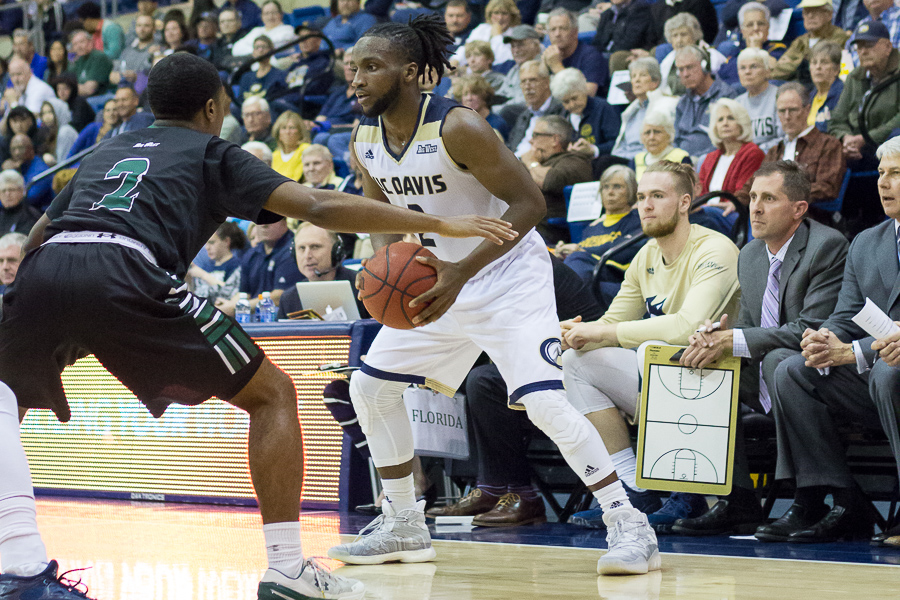
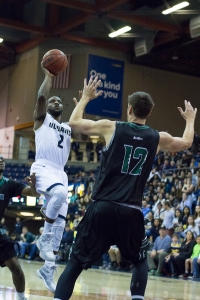
In their final home game at The Pavilion on Thursday night, the Aggies honored senior guards Brynton Lemar, Darius Graham, Lawrence White and senior forwards J.T. Adenrele and Georgi Funtarov with pre- and post-game ceremonies. After the festivities, the UC Davis men’s basketball team went to work against last season’s Big West champion, the University of Hawai’i. After a close first half and a slight lead by Hawai’i in the second, the Aggies rode the hot shooting of Lemar down the stretch to a 68-59 victory.

The Aggies’ first possession of the game resulted in a thundering alley oop slam by White, who was assisted by Lemar. This set the tone for UC Davis’ offensive possessions, which were marked by a barrage of three-pointers by Lemar and a series of dunks by both White and junior forward Chima Moneke. Despite the Aggies’ prolific offense, Hawai’i was able to remain close in the first half due to multiple defensive breakdowns by UC Davis.

In the second half, the Aggies’ three-point lead quickly dwindled as they came out of the halftime break. The Rainbow Warriors capitalized on the Aggies’ sluggish play and built a 40-34 lead. With Hawai’i threatening to break the game open, the Aggies flipped a switch and began to play like the well-rounded team UC Davis fans have come to expect in home game showdowns. With 7:30 remaining in the second half, Lemar caught fire, hitting three of his four three-point shots to lead the comeback. Graham added a three-pointer of his own to put the Aggies ahead 63-54.

NATALIE SKLOVSKAYA / AGGIE

In the final homestand, the Aggies leaned heavily on their senior leadership, but it was Moneke who put the nail in the coffin with a resounding putback slam that blew the roof off of The Pavilion. Head coach Jim Les credits the Aggies’ playmaking abilities to their athleticism.

“We want to be aggressive using that athleticism defensively,” Les said. “That defense gets us out in the open floor where [Moneke and White] can make some spectacular plays.”

In the end the Aggies’ strong second half play was enough to earn them the 68-59 victory over the Rainbow Warriors.

The Aggies ended the year with a perfect 11-0 home record. Adenrele, who was part of the first Aggie squad to complete the milestone two seasons ago, was impressed with this year’s team.

“Just to go undefeated the first season was impressive for us, [but] to come back and do it again and be a part of that, was really special,” Adenrele said.

Les fittingly attributed the win to his group of senior players.

“We’ve been led by our seniors all year, and for them to be able to accomplish this on senior night with a win and go out undefeated at home and have a chance on Saturday to play for a Big West title is really special,” Les said.

After the game, Les and the Aggie seniors addressed the crowd. All five players credited their success at UC Davis to their families and the support of the Aggie community.

NATALIE SKLOVSKAYA / AGGIE

“There are so many people that play a part in the building of a successful basketball program, from game day operations to our equipment, medical staff, media relations; our fans have been unbelievable,” Les said. “Everybody’s pulling in the right direction. We’re working hard but we’re having a lot of fun doing it and that’s what Aggie basketball should be about.”

The win set up a showdown for the Big West title between UC Davis and UC Irvine two days later, where UC Irvine took the regular season crown after blowing out UC Davis 79-49. The Aggies will open the Big West tournament on Thursday, March 9 as the second seed.


Written by: Rowan O’Connell-Gates — sports@theaggie.org

Last week in Senate

HANNAH LEE / AGGIE

The ASUCD Senate gathered at the Memorial Union on Feb. 23 at 6:10 p.m. for its weekly meeting.

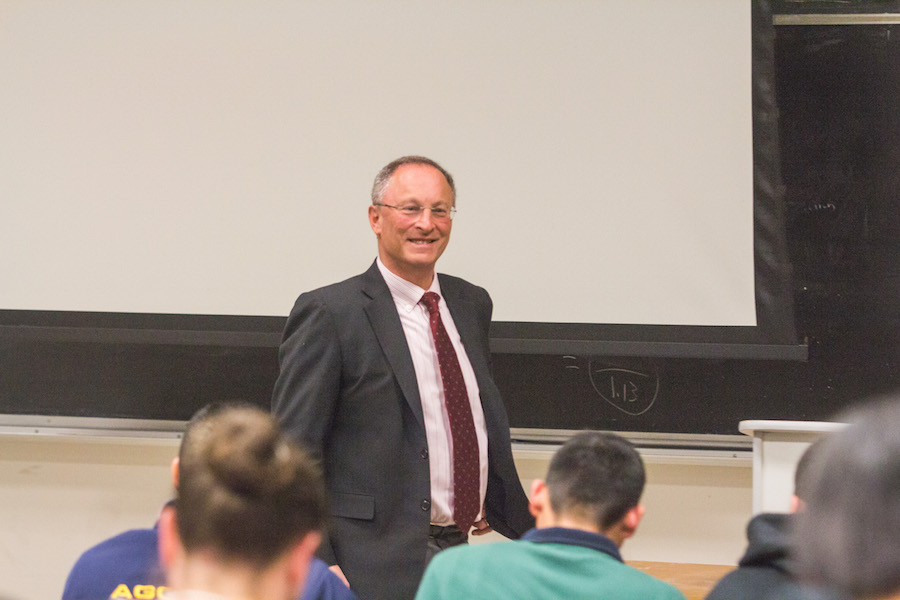
The meeting began with a speech by Davis Mayor Robb Davis. Davis’ speech touched on various issues such as housing, sanctuary cities, infrastructure, hate crimes, the city’s relationship with the university and its recent divestment from Wells Fargo.

“You’re all elected officials, you know what that means,” Davis said while speaking to the Senate. “It’s a very public role. You hold yourself up to a lot of criticism, you make hard decisions and most of the time about half the people aren’t happy. But I’ve really enjoyed it from the perspective of learning my community.”

Following Davis’ speech, the Police Chief Search Committee spoke in an effort to gather suggestions in the process of hiring a new police chief. Since former police chief Matt Carmichael took on a new position at the police department at the University of Oregon, the university has been working to hire a new chief.

Several campus units were present at the meeting to give their reports and updates, including Unitrans, the Coffee House, the Sexual Assault Awareness Advocacy Committee, the Elections Committee, the Aggie Reuse Store and Whole Earth Festival (WEF).

Senate Bill #48, a bill to amend the 2016-17 budget for WEF and reallocate funds within the budget, was passed unanimously with a vote of 12-0-0.

Afterward, the Senate took up SB #47. The bill, which seeks to amend section 604(B) of the ASUCD bylaws, concerns a violation of California labor codes. The section requires unit directors to submit a written report at the end of each pay period. A unit director who fails to submit one will not be paid for that period until a report is submitted. Seeing the portion as unenforceable, the Senate unanimously passed the bill.

SB #46 will allocate $453.88 to purchase an HP Laserjet Pro 400 M401dne Monochrome Laser Printer for Picnic Day. After discussion, the bill passed unanimously.

The Senate took up a new resolution authored by Environmental Policy and Planning Commission chair Sarah Risher. Senate Resolution #8 demands that the University of California divest from “all remaining holdings in fossil fuels and reinvest in companies that meet the environmental, social and corporate governance (ESG) criteria.” The resolution passed unanimously.

Next, the Business and Finance Commission, which advises the Senate on the fiscal concerns of ASUCD, gave presentations for audits of the Pantry, Housing Advising for Undergraduate Students and Creative Media.

The Senate then took up SB #45 to mend the jurisdiction and name of the Internet and Networking Committee (INC). The bill renames INC as the Technology, Internet and Networking Committee (TINC) and provides specification as to what types of technology the committee may purchase. The bill passed unanimously.

SB #44 will shift the responsibilities of the Academic Senate (AS) student representative delegation to the Academic Affairs Commission (AAC).

These responsibilities, previously held by the AS, include recommending ASUCD programs and policies in areas of Academic Affairs, disseminating information concerning student development of course and curriculum with Undergraduate Education, appointing commissioners to attend Academic Senate Committee meetings as ex-officio members and sending at least one representative to attend all Academic Senate and Undergraduate Council meetings.

The bill passed unanimously.

SB #50 will codify the procedure for hiring Academic Senate Committee Representatives and relations with the Academic Senate. The bill passed unanimously.

The Senate also took up Resolution #9, authored by ASUCD President Alex Lee, which moves to submit a proposal to the Academic Senate to reform General Education (GE) accreditation. The proposal seeks to give GE credits for existing AP exam scores for corresponding classes. UC Davis is the only school in the UC system to not give these GE credits for AP exam scores.

After deliberation, the resolution passed unanimously.

The last agenda item was SB #37, which mandates quarterly commission presentations. SB #37 passed in February by a vote of 8-0-3, but was subsequently vetoed by Lee with a revision. The senate took up Lee’s revision and overturned the veto with a unanimous vote.

The meeting adjourned at 11:10 p.m.   


Written by: Ivan Valenzuela — campus@theaggie.org

Interim Chancellor Hexter holds second town hall meeting

DANIEL TAK / AGGIE

Community discusses mental health, financial aid, student population

Interim Chancellor Ralph J. Hexter received questions and concerns from students at a public forum on Feb. 28 from 6:30 to 7:50 p.m. at Everson Hall. The event was attended by over 25 people. Hexter was joined by faculty and administration officials who were able to answer more specific questions.

The discussion topics included financial aid, student population, mental health services and the political climate on campus.

Students questioned the distribution of funds for financial aid and whether there were plans to keep increasing tuition or lower fees for students. Hexter said that he understood the difficulty that students face when trying to pay tuition or to graduate with little debt and that one of the saddest things about the country is that it has allowed income disparity to grow. He said that a model that some people consider is the high tuition-high aid model, in which part of tuition would be able to be directly funnel into more financial aid. However, due to the high sticker price, many families are discouraged and believe that they will no longer be able to afford a UC education.

Hexter believes that public education is in the middle of many contradictions and is fighting to keep it together despite challenges like antagonizing stories from the press about students having high levels of debt. The administration is making it a priority to explain the benefits of an education at UC Davis.

“The set of schools with the highest level of debt are for-profits, then the nonprofit privates and the lowest is the publics,” Hexter said. “Within the publics, the UC system has the lowest debt thanks to the return-to-aid programs. For UC Davis, […] about half of our students graduate without any debt whatsoever. Of that half that have debt, the average is under $20,000.”

Another student voiced concerns about the increasing student population — shortage of lecture hall seats, more dorms but less apartment space in the city, and the overcrowding of public spaces on campus, such as the dining commons and food areas. Hexter explained that the massive increase in student admission was due to UC Davis’ 2020 initiative growth plan, as well as a UC systemwide agreement to increase student population.

According to Hexter, Freeborn Hall is no longer used due to seismic problems, but new classrooms have been used or built in the Mondavi Center, Pitzer Center and Manetti Shrem Museum. There are plans to increase rooms in Haring Hall and Cruess Hall, and the biggest change will be the addition of a 600-seat auditorium in Storer Hall by Winter Quarter 2019. There are also plans to increase the size of dining halls, to build a new dining center in Tercero and to increase the number of food trucks in the space around the Silo.

“The Silo food trucks are the fastest way to add dining capacity,” Hexter said. “Even as we build more dorm space […] we’re acknowledging that when we do triples we squeeze people, so we’re building to accommodate people from the get-go.”

Students also voiced their disapproval of current mental health services and asked for a plan to increase services. One student spoke at length about their negative experiences with CAPS and their difficulty with being misgendered and disrespected at the Student Health and Wellness Center.

Students also called for more Community Advising Network counselors, especially for undocumented students, victims of sexual assault and students who are neurodivergent. Hexter redirected the question to Milton Lang, associate vice chancellor for student life, campus community and retention services at the Student Affairs Office of the Vice Chancellor.

“We have gotten a lot of pushback from students, faculty and staff,” Lang said. “[…] counselors are overwhelmed by the volume of students they are trying to serve.”

Lang confirmed that the university is in the process of hiring seven or eight new counselors who would operate out of the Student Health and Wellness Center. Since the ratio of students to counselors is very high right now, Lang believes this is the best decision. Students were also disappointed by faculty and administration’s lack of awareness regarding students’ mental health experiences on campus. Sheri Atkinson, the executive director of community resource and retention centers, mentioned that more conversations were being held at the centers.

“[There is a] willingness to do intersectional work, a lot of folks acknowledge it’s an area that needs to be worked at,” Atkinson said.

Tensions ran high and students became emotionally charged as the conversation turned to the political climate and the discussion of free speech and Milo Yiannopoulos’ controversial visit to UC Davis earlier this quarter.

A student expressed displeasure about having professors who do not know how to be supportive or choose not to attend workshops to build their knowledge regarding student experiences. Regarding a particular incident in which a professor voiced a personally hurtful opinion during class hours, the student questioned why it was difficult to take action against faculty and place trust in the system.

Hexter admitted some trainings were mandatory whereas other trainings were only “encouraged.”

“We’re in a continuously merging and evolving situation and we’re learning, and faculty have to learn as well,” Hexter said. “It is a journey. What we have to do is, wherever anyone is, we nudge them further along wherever they are on this journey. […] The administration cannot tell the faculty what to think.”  

Donald Dudley, the director of Office of Student Support and Judicial Affairs (OSSJA), mentioned more places students could go to resolve issues regarding hate or bias. OSSJA is a resource for students who are uncertain about where to go to file a complaint. Hexter hopes to support those who are on the front lines to keep improving the university.

“[In] our office, we have case managers who really help to connect students with potential resources,” Dudley said.

ASUCD Senator-elect Rahi Suryawanshi, a third-year international relations major, was concerned about recent hate crimes and questioned how the administration ensures the safety of students and draws the line concerning hate speech.

Michael Sweeney, senior campus counsel, was on hand to answer any questions regarding legality.

“As a public institution we cannot tell people not to speak,” Sweeney said. “We are a public institution and have to follow government rules.”

Sweeney explained that for speech to be considered hate speech, a person must threaten to take a physical action against another being and it is only considered an issue after it has been uttered. He added that in order to prevent hate speech, one could enact a prior restraint, which could stop someone from speaking beforehand, but that this has very rarely worked. According to Hexter, censoring someone who has been invited by a public institution is difficult.

“The interim chancellor cannot prevent speaking under the First Amendment, even if it is hateful,” Sweeney said.

Hexter remained firm that guests would be welcome as long as situations remained nonviolent. Students were upset with Hexter’s email responses to the situation, in which Hexter defended Yiannopoulos’ right to speak on campus. Hexter added that there were discussions about contractual obligations for any campus guests to adhere to certain guidelines. Hexter answered a few more questions before wrapping up the town hall.

Students had mixed responses to the forum. Priyanka Sanghavi, a second-year cognitive science major, felt that the conversations were very interesting and that people were honest and civil.

“These town halls are extremely important because they foster mutual understanding and empathy between the administration and the students,” Sanghavi said. “Administrators need to have more open discussions because in a system as large and complex as a public university, they don’t always know right away when students are facing problems.”

Suryawanshi believes the conversation between students and administration is very important and must be held regularly.

“Admin forgets what it is to be students in this fast paced quarter system and these dialogues are necessary to remind them as well as to increase transparency between the two bodies,” Suryawanshi said via email. “[The] open dialogue steered in a similar direction as the others; the admin heard us out but failed to empathize with us.”

Written by: Jayashri Padmanabhan — campus@theaggie.org

2016 Green Party presidential candidate Jill Stein to speak at UC Davis

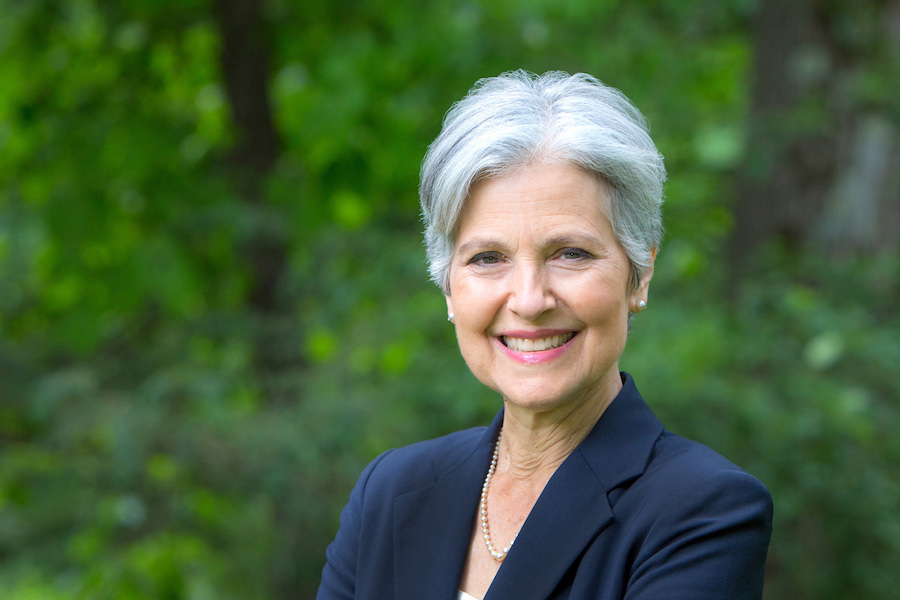
JILL STEIN

Stein to discuss politics, progressive grassroots organizing

Jill Stein, the 2012 and 2016 Green Party presidential candidate, will speak at UC Davis today. Her talk, which will take place at Wellman Hall 2 at 8:00 p.m., is part of an eight-day speaking tour and is sponsored by the Yolo and Sacramento Green Parties and the Black Student Union of UC Davis.

“Dr. Stein will be sharing her thoughts on the current political moment, progressive grassroots organizing and the importance of local action,” stated a press release.
Written by: Alyssa Vandenberg  — campus@theaggie.org

How to provide for Davis’ homeless

HANNAH LEE / AGGIE

Winter months pose increased challenges to at-risk population

Especially during the winter months, near-constant cold and wet conditions can be a health hazard, not to mention an extremely uncomfortable experience for those who cannot find shelter.

Over 130 homeless people lived in the City of Davis in 2015, according to a survey conducted over a single night that year. That number could very well be much higher, since it did not take into account those who might have found temporary housing for the night. According to The Davis Enterprise, the city allocates nearly $200,000 annually in total funding to programs like Davis Community Meals, Empower Yolo and the Interfaith Rotating Winter Shelter (IRWS).

The IRWS operates from late November to mid-March and is a predominantly volunteer-based organization that accepts anyone in need. The IRWS is only available until March 11, when it closes for the season, and it is crucial that resources and shelter remain available for homeless individuals.

The Editorial Board encourages readers to ensure that the treatment of homeless people does not stray towards the denigration of an at-risk population within the community.

In a recent city council meeting, Davis city leaders addressed the issue of panhandling. Although sit-and-lie ordinances have not been implemented in the City of Davis and were determined to be too severe of a reaction, the council discussed possible restrictions and solutions.

Panhandling is often the only reliable source of income for homeless individuals, and rejecting it outright would not incentivize panhandlers to leave the city, but would instead affect the conditions in which they live by criminalizing their actions. Davis officials must work to find solutions to address the problem of homelessness by providing ample resources to assist this population.

The Editorial Board urges the Davis community to get more involved by reaching out and supporting those who are facing hard times and severe housing insecurity.

Davis Community Meals offers a daily shelter from 8 a.m. to 4 p.m. Monday through Friday at 1111 H Street, which provides additional resources like showers, laundry services, counseling, internet access and more. The organization supplies hundreds of meals every month to those in need and runs a transitional housing program as well. To learn more about ways to help, readers may consider visiting daviscommunitymeals.org or calling (530) 753-9204.

Community members can also get involved with Homeless Outreach through Prevention and Education at Davis, or HOPE, an on-campus organization that strives to provide skills to homeless people and low-income individuals in the Davis area.

If nothing else, this Editorial Board urges readers to reach out, provide a hot meal or simply ask if a homeless individual has a place to stay for the night. Break the stigma — there’s always something to be done. No effort is too small to make someone’s day a little better.

Photo of the Week: 3/9/2017

Reflections at Mendocino. (NICHOLAS CHAN)

“I am a UC Entrepreneur” Campaign showcases entrepreneurial efforts across UC campuses

GENESIA TING / AGGIE

Students, faculty, staff, postdoctoral students, alumni invited to submit a 30-second video sharing what makes them an entrepreneur

On Nov. 18 of 2016, the University of California (UC) launched the “I am a UC Entrepreneur” Campaign to highlight entrepreneurship across the UC campuses. Students, faculty, staff, postdoctoral students and alumni from all 10 campuses are invited to submit a 30-second video sharing what makes them an entrepreneur. The videos are made up of individual stories and represent the depth and expansion of the UC’s entrepreneurial efforts across more than two dozen incubators and accelerators throughout the system.

Everyone who submits a video will receive a “UC Entrepreneur” T-shirt and have their video posted on the UC website.

At the end of this month, there will be a special lunch in which one eligible applicant with a qualifying video will be chosen at random from each campus to meet with UC President Janet Napolitano and Senior Vice President of Innovation and Entrepreneurship Christine Gulbranson. They will be accompanied by well-known venture capitalists Brook Byers of Kleiner Perkins Caufield & Byers (KPCB), Josh Green of Mohr Davidow Ventures and Brendon Kim of Samsung NEXT.

“This campaign is about celebrating the talent, creativity and passion that makes UC an entrepreneurial powerhouse,” Gulbranson said in a statement to UC Davis Dateline. “UC’s entrepreneurial community is so diverse that much of it goes unnoticed. But not anymore!”

Student entrepreneurship groups and clubs across all UC campuses are encouraged to promote the campaign, host video parties and assist each other in making their 30-second videos.

“My roommate has a lot of entrepreneurship skills so this would really help her out,” said Alicia Dwell, a fourth-year biology major. “A campaign like this is what makes the UC system the best place to thrive.”

Dwell believes this campaign is very important to her fellow friends and classmates.

“This actually sounds really neat,” said Alex Relay, a third-year computer science major. “I might just go home and submit a video myself!”
Written by: Demi Caceres — campus@theaggie.org

UC Davis professors elected to National Academy of Engineering

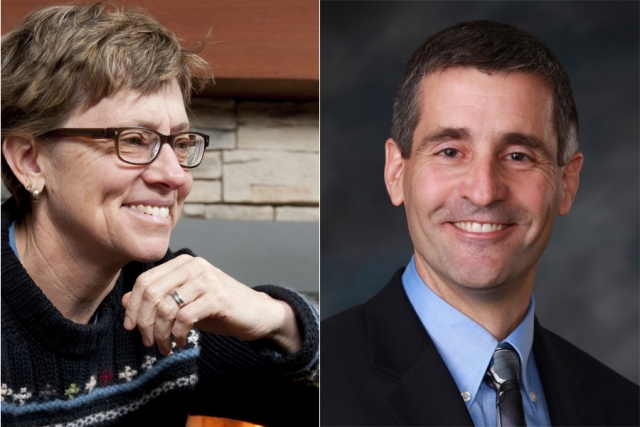
Dr. Niemeier, left; Dr. Boulanger, right (COURTESY)

Department of Civil and Environmental Engineering professors honored

Professors Ross Boulanger and Deb Niemeier have been elected as members of the National Academy of Engineering (NAE). Membership to the NAE is one of the highest professional honors awarded to engineers. The NAE honors those who have made outstanding contributions in the fields of engineering and technology.

Boulanger and Niemeier will be formally inducted in a ceremony in Washington D.C. in October. Thirteen current or retired faculty from UC Davis are members of the NAE. 84 new members and 22 foreign members, including nine other UC researchers, were also announced as elected individuals on Feb. 8.  

In an official NAE press release, Boulanger was recognized for “contributions to geotechnical earthquake engineering and the development of procedures for evaluating seismic behavior of soil-structure systems.” Niemeier was recognized “for developing groundbreaking tools to characterize the impact of transportation emissions on air quality and environmental justice.”

According to its official website, the NAE was founded in 1964 as a nonprofit to provide engineering leadership in service of the nation. Its mission is to advance well being by promoting engineering professions and using its members’ expertise to advise the federal government on matters involving engineering and technology. It is part of the National Academies of Sciences, Engineering and Medicine established by Congress.

New members are elected by current NAE members. The process of choosing members to elect takes almost an entire year. Nominations are called between February and May and then confidential peer committee reviews take place. The final list of nominations are voted on by all members in January of the following year and results are announced to the public in February.

Boulanger and Niemeier both work in the Department of Civil and Environmental Engineering at UC Davis. Niemeier is former department chair.

“This is a first for our College of Engineering to have two faculty members elected to the NAE in the same year,” said Jennifer Sinclair Curtis, the dean of the College of Engineering. “We are thrilled for Professors Boulanger and Niemeier and proud of their outstanding career accomplishments. They exemplify the exceptional quality of faculty throughout our college.”

Niemeier is founding director of the Sustainable Design Academy of UC Davis and the former director of the John Muir Institute of the Environment at UC Davis. She has served on a few panels for the NAE as well its Energy Systems and Environments Board.

“For me, it is a huge honor and I’m really grateful for all of the support that has been given to me by my colleagues and friends and the campus more generally,” Niemeier said via email. “It is also recognition of the incredible students who have worked in my lab and then gone on to be themselves exceptional engineers and scholars.”

Niemeier believes the NAE is important for the recognition of work that has been done by engineers all over the country and world.

“It is recognition that engineers can address social and environmental equities and do it in a way that helps to bring positive change,” Niemeier said.

Niemeier combined her knowledge in transportation with new knowledge in vehicle combustion and emissions to start working on ways of better estimating vehicle emissions. Previously, there were no methods for scaling emissions from vehicle tailpipes to estimate emissions loads at regional or airshed levels. These measurements are key inputs to estimate primary and secondary pollutant concentrations. If estimates are too low, there will not be enough emissions control technologies in policies, which could jeopardize health and the environment. If estimates are too high, too much control could result in economic inefficiencies.

“Students and I developed new algorithms for estimating vehicle emissions and new scaling techniques that allowed public agencies to better incorporate air pollutants into decision-making,” Niemeier said. “We helped write new regulatory guidance for EPA to help protect the public health and ensure that agencies practiced state of the art methods.”

Boulanger is director of the UC Davis Center for Geotechnical Modeling. His work revolves around studying how soil and structures such as buildings, bridges and dams respond to earthquakes.

“To find that people who I admire deeply would elect me into the academy is very humbling and very satisfying,” Boulanger said.

The NAE has various committees that make reports to government organizations and agencies. Boulanger believes that the independent advice the academies provide to the government is valuable.

“Those reports can be excellent summaries of where a profession has gotten to or current status of an issue that is important to the country,” Boulanger said. “They become good reference materials for researchers in the broader community and students. A lot of the products they produce are very useful.”  

Boulanger has not served on any committees with the NAE. His service activities have been through other organizations such as the American Society of Civil Engineers, the Earthquake Engineering Research Institute (EERI), the United States Society on Dams and the International Society of Soil Mechanics and Geotechnical Engineering. The EERI is a prominent society for dealing with multidisciplinary aspects of earthquake engineering and working toward better practices in reducing hazards. The Society on Dams deals with the environmental, flooding and water management aspects involving the official regulation of dams. Boulanger enjoys his work with the International Society, where he heads an earthquake research committee.


Written by: Jayashri Padmanabhan — campus@theaggie.org

Continued success with Short-Term Emergency Aid Committee Programs

NICKI PADAR / AGGIE

Last resort assistance provided to low income residents

The Short-Term Emergency Aid Committee (STEAC), a volunteer-oriented organization based in Yolo County, has been providing immediate, short-term aid to families and individuals at or below the poverty level since 1967.

This assistance comes in various forms, including food, rent, utilities and job preparedness aid. STEAC provides a safety net for those on the brink of a downturn and is often a last resort for those in need.

STEAC attributes its success through the years to unwavering support from donors and volunteers who work tirelessly to collect and distribute food, complete clerical work, assist with holiday programs and raise funds.

“We have 100 volunteers at STEAC, and we only have three part-time staff, so there is a huge outpouring of support within the community,” said Katy Zane, the executive director of STEAC. “Part of the reason why we are successful is because there are so many dedicated, civic-minded people in Davis, and they are also generous with their financial donations that help fund the [programs].”

STEAC’s Helping Hand Program helps food-insecure families or individuals by providing them with meals they may not have otherwise received.

Within the Helping Hand Program is a fairly new project called Food Packs for Kids at Montgomery Elementary School in Davis. The project aims to support elementary school students who participate in the school lunch program, sending them home with a weekend bag of food to ensure that their nutritional needs are met until they can return to school on Monday morning.

While STEAC does not necessarily help the homeless population directly, it takes preventative measures to keep low income residents from eviction through rental assistance (up to $600) or utility assistance (up to $200). In addition, the organization helps people move into long-term housing with first-month rent aid. These services are typically only provided once every two years.

For those seeking employment, STEAC provides appropriate clothing for job interviews and access to various documentation, including food handler certificates, identification cards and driver’s licenses.

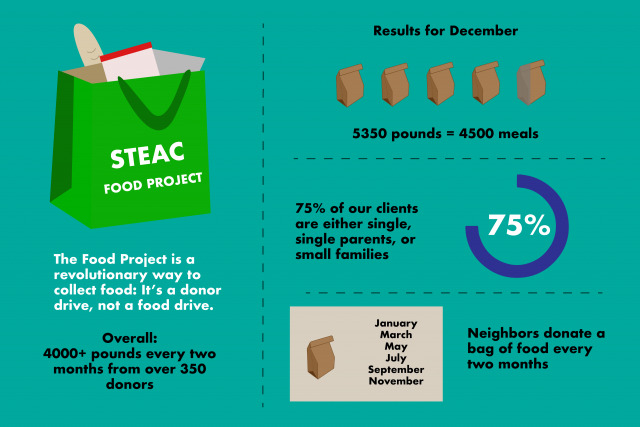
Kim Eichorn, a real estate agent in Davis, sits on the board of STEAC and also volunteers for the Committee’s Food Project, one of its Helping Hand Programs. The Food Project began in June 2015 with nearly 2,000 pounds of food for its first donation. Since then, the program has grown to over 35,000 pounds of food collectively.

The Food Project is a simple system of donations occurring six times a year, every two months. Volunteer neighborhood coordinators even pick up the donations at donors’ homes. A list of what the food closet needs, along with pickup dates, is available on the STEAC website.

“I am enthusiastic about the project,” said Darlene Boyce, a Food Project donor, in an interview with The Davis Enterprise. “We are restocking the STEAC food bank with things they need! In the end, it’s whatever works for our community and those who need a bit of help now.”

When compiling her donation bag, Boyce refers to the list given out by STEAC, which notes specific food items that the Food Project needs. STEAC often asks for cooking oil, canned fruits and vegetables, peanut butter, rice and pasta; this helps avoid problems such as an overabundance of ramen noodles or tomato soup.

“They’ve really won the hearts of people in Davis,” Eichorn said. “They get a lot of volunteers. I just have a lot of people who really enjoy the commitment […] Most people in Davis, if you say STEAC, they know exactly what it is […] People seem to really want to give and contribute and help.”
Written By: Bianca Antunez — city@theaggie.org

What your post-midterm Yoloberry order says about you

ZOË REINHARDT / AGGIE

Frozen yogurt as both celebratory treat, comfort food

On the quarter system, midterms roll around pretty much every week of your life. It’s only natural to hit up everyone’s local fro-yo shop, Yoloberry, at least one of those times.


  1. Chocolate yogurt with chocolate chips, oreo bits, hot fudge, and basically every chocolate topping possible.


If you’re a chocolate lover, this is your go-to because, let’s face it, that test was hard and you deserve this treat. You studied for the past nine nights in a row and it still didn’t go well. That just seems to be your fate no matter how hard you work. But your value doesn’t lie in the letter grade you see on Canvas next week — no, your value lies in your hard work and determination, not to mention your self-respect. You win some and you lose some but chocolate can help soothe the soul no matter what the outcome. You understand that better than anyone. What’s a better pick-me-up than a heaping bowl of chocolate goodness?

2. Low-fat vanilla yogurt with strawberries and whipped cream.


If you like simple desserts, there’s a good chance you are also the type of person who probably studied for the past two weeks before your midterm — and you definitely aced it. You know you did. Despite the good grade, you spent a lot of time in the library this quarter and haven’t gone out much. But that’s fine, because your version of a good time is chilling by yourself or maybe with a couple of close friends, and even though it’s the same thing you did last weekend, you’re the kind of person who knows what they want and how to get it — no matter what it is.

3. Sour gummy worms, fruity pebbles, rainbow sprinkles, sour tape, gummy bears, marshmallows and animal cracker cookies on top of one drop of yogurt


If you prefer any variation of miniscule amounts of yogurt and all of the colorful toppings, you embody the “yolo” in Yoloberry. Sugar-overload is no match for your bod! You could care less about how that test went — all that matters is that you and your taste buds deserve the best experiences this life has to offer. To you, that test score is not going to matter in 20 years, but you’ll probably remember the wonderful unicorn concoction you’ve just created and the awesome time you’re having with your friends while you consume it.

4. Berry-flavored yogurt with fruity poppers, kiwi, mango and a little mochi on the side.


If you are the kind of person who orders frozen yogurt with fruit on top, you probably think you’re making the right choice — just like you did with that last multiple choice question. Like keeping track of the amount of calories you consume a day, you’re meticulous about tests, and after comparing answers with your friends, confidence is low. But just like balancing your workout and study schedules, you, more than anyone, understand the true meaning of “cheat-day” after a tricky midterm.

5. Peanut butter chocolate swirl yogurt with bananas, almonds, Reese’s cup crumbles and chocolate sauce.


Eh, feelings are always up in the air for you after a midterm. Did it go well? Did it go terribly? Who knows. Certainly you don’t, and that’s kind of how life goes for you. Choices can be great, but you never truly know which direction to go and often the ones presented result in mild anxiety and indecisiveness. But like your choice in frozen yogurt, why not have it all?
Written by Marlys Jeane — features@theaggie.org

Who stole my handlebars?: Bike horror stories

GENESIA TING / AGGIE

From stolen wheels to popping tires, Davis has seen it all

It was nine o’clock in the morning when economics professor Gregory Clark left Peet’s Coffee in downtown Davis to discover that the back wheel of his bike was missing. Forced to walk his bike over to a nearby bike shop, Clark ended up paying nearly $70 in order to replace the wheel and get on with his day.

“It was expensive,” Clark said. “I was amazed that someone would steal it in the middle of […] the morning at Peet’s Coffee.”

Like Clark, almost every cyclist in Davis has run into a problem with their bike at one point or another. Whether it’s popping a tire on the way to class or getting a bike seat stolen overnight, as one of the largest bicycle towns in the nation, Davis is naturally prone to bike misfortunes.

“[My roommates and I] all kept our bikes on our front porch area,” said Rachel Preeg, a fourth-year viticulture and enology major. “There [weren’t] any bike racks there, so I always locked the frame to the wheel. I had been doing that for months, and then I woke up [one] morning and [my bike] was gone.”

Bike theft is one of the most common, if not the most crime in Davis, and the experience is not a pleasant one, especially for those who use their bikes as a primary mode of transportation.

“I pretty much bike everywhere unless it’s bad weather,” Preeg said. “I was super dependent on it. I got a new bike a week later.”

According to Jack Zuercher, a fourth-year statistics major and the business manager of the Bike Barn, a bike is brought into the shop with an essential part missing at least once a day. Replacing seats and seatposts — parts that are easy to lift off of bikes — can cost between $20 and $30, but each can total close to $80 when labor and taxes are factored in.

“Recently we had someone buy a $600 road bike from us,” Zuercher said. “In the grand scheme of things it’s not that expensive, but for the bikes that we sell it’s pretty expensive. He actually got his whole handlebar assembly stolen [on his old bike]. [The] cables were cut, [and the] shifters were gone. ”

One of the main reasons that bike theft is a high crime in Davis is its quick turnaround profit. Once stolen, bikes and bike parts are often easily sold online or to secondhand bike stores around town.

“One of my colleagues [got] his fancy bike [stolen],” Clark said. “He actually checked listings on the web and saw someone advertised his bike, because it was a very particular one. So he actually went and pretended he wanted to buy it, and […] took it back from the person and then charged [the thief] for his broken lock. It was a student who’d stolen it, and so he turned [the student] into Student Judicial Affairs. He thought they would expel the student from the university, but they didn’t actually, so he was very disappointed in the end.”

According to Zuercher, maintenance workers have found bolt cutters that bike thieves have left for themselves to cut locks in bushes around campus. However, Zuercher also believes that the majority of bike crimes occur as crimes of opportunity.

“There’s tons of people that come home from the bars at night and just take bikes off of racks that aren’t locked or will take seats that are unlocked,” Zuercher said. “Drunk kids walk […] through campus and they’re like, ‘Oh, I could steal this seat,’ and they open it up and take it.”

At the Bike Barn, Zuercher witnesses all kinds of bike misfortunes besides theft. Many people also come in with blown out tires and wheels on the verge of detachment.

“We get people actually all the time with the bolts completely off of their wheel,” Zuercher said. “Literally the only reason their wheel hasn’t completely fallen off is because they haven’t lifted it up a little bit. If that person were to go off of a curb or lift up their bike, their wheel would have fallen out. [It’s] super unsafe.”

Often, due to lack of attention to their bikes, students end up blowing out their wheels right in front of the Bike Barn.

“People will […] pump up their tube, and they won’t notice that their tire is unseated from the rim,” Zuercher said. “It’ll just pop and explode. We hear little firecrackers practically going off three times a day. We’ll […] go, ‘Tube sale!’ Eight bucks right there.”

Although some of these misfortunes may be unavoidable, there are plenty of preventative measures that Davis residents can take to limit their repair or replacement costs.

“In Davis, you’re likely to have broken tires, but you can buy […] stronger tires,” Clark said. “I always do that, because the cost of actually fixing the thing is so great. For not too much money, [you can] get these very strong tires and inner tubes.”

The Bike Barn also sells longer U-locks so users can wrap the lock around the frame, wheel and rack which is a safer, more effective way to lock. Because most seat and seatpost thefts occur with quick-release seat collars, they also sell seat collars that require Allen wrenches to be opened.

“Generally people don’t take care of their bikes as much as they should,” Zuercher said. “It just astounds me how many bikes are ridden on a daily basis in such poor condition. It’s not expensive to get your bike taken care of. You bring it to us, and I’d say 40 percent of the time we could fix it for free in the front, with just a little bit of work. If not, we can fix it for really cheap, and we’re on campus.”

If all else fails, Clark believes that having a less appealing bike is a safe bet — it works for him.

“The best security is not to have something fancy,” Clark said. “Have an older bike, or one that looks older. I don’t have a fancy one.”


Written by: Allyson Tsuji — features@theaggie.org

Humor: Prospective tour guide absolutely killing it with invisible crowd

BRIAN LANDRY / AGGIE

How invisible people are helping prepare the tour guides of tomorrow

Many tour-guide hopefuls have been practicing giving tours around campus for the past few weeks. It’s a great way for them to test out jokes and practice scripts without criticism if they bomb.

The California Aggie talked to a prospective tour guide about how these practice runs help him prepare.

“I like to use my practice tours as an opportunity to try out some fun jokes,” said Ram Slip-Taker, a second-year psychology major and professional howler. “Sometimes I’ll even just start howling in the middle of a tour. It’s unusual, but it really does grab people’s attention. And the people on my tours love it. I mean, I haven’t actually given a tour to any ‘real’ people yet, but the people whom I imagine I’m giving a tour to absolutely love my comedy. One time, one of these fake people laughed so hard she just straight-up died. It was horrible to be honest, or ‘tbh’ as I sometimes say if I’m feeling edgy. The funeral was so sad. I spoke and tried out some more of my jokes, but nobody laughed, which I thought was a little rude. Lovely service, though.”

Slip-Taker is not the only one who has found immense success with invisible tour guide crowds.

“My imaginary groups love when I tell them fun facts about UC Davis,” said Kimberly Drought, a third-year theater major and dirt farmer. “Like how there are cadavers in Haring, or how my son has been missing since before I was born. Sometimes I’ll even make things up if I don’t particularly like the attitude of a particular group. Once I told a tour that we’ve had rabies-infected bats before and that there has been a killer clown sighting in West Village. Obviously those things would never happen; they’re way too good to be true. But I was really just trying to lighten up the mood — these guys can get a little on-edge sometimes.”
Written by: Brian Landry — bjlandry@ucdavis.edu

UC President urged to resolve labor dispute

MORGAN TIEU / AGGIE

State legislators write letter to UC President, express concern for UC worker wages

Following the University of California (UC) workers’ strike on Jan 10. regarding fair wages and pension plans, a group of state legislators, consisting of 26 General Assembly members, composed a joint letter to UC President Janet Napolitano. The legislators voiced  their concern for the current state of this labor dispute and urged Napolitano to display leadership by facilitating a smooth resolution.
While the UC is the third largest employer in the state, wages for administrative, clerical and support workers have either remained stagnant or decreased by 24 percent in the past two decades. These declining conditions for UC workers coincide with the recent increase of UC tuition prices.
“[University of California] continuously fails to uplift communities” said Christian Castro, the communication coordinator for Teamsters Local 2010. “Tuition keeps getting more expensive, making it harder for our own citizens to attend college [meanwhile] you’re not paying the people who live in these communities enough and hurting them on the back end […] while executives are getting bigger bonuses.”
Since the strike, negotiators for the Teamsters and the university have resumed  bargaining.
“We believe that there have been improvements,” Castro said. “We are continuing to push and go back and forth to get a resolution that is fair for everyone.”
Castro stressed that one of union’s biggest concerns is fighting the 2016 retirement tier.

“What this is doing is going from a designed benefit plan with regular pensions, where you put in so much time and with a formula it says how much you get after you retire, and instead turning it into a 401(k)-style […] and there is no certainty you will get anything in your retirement,” Castro said.
Castro insisted that the union completely oppose this proposal, and he believes that “if you put 25 years of work, you should have a dignified retirement plan after.”
Castro also mentioned that Dr. Richard Pan, a pediatrician and senator representing the Sacramento region, is in the process of authoring a letter — cosigned by other members of Congress — in support of fair wages for UC workers.

Napolitano requested adopting a new retirement tier. In response, the UC Regents put forward a new pension plan. This new 401(k)-style plan is predicted to be a costly endeavor of $500 million in the first 15 years. As a result, according to Castro, the plan will provide “a lesser benefit to workers.”

While the union and the legislature were told they had the option of refusing the new retirement tier, Teamsters 2010 negotiators are currently bargaining.

“[We are] finding out that the UC lied to the us and are trying to force the new, more expensive and worse performing 401(k) on our bargaining units,” Castro said.

According to Lani Richardson, a UC Davis Teamster bargaining representative, the letter has, to an extent, ameliorated the cooperation of the UC negotiators.

“It is telling, and disappointing that our elected officials have had to weigh in, to remind the University they are expected and required to bargain in good faith [plus] make a fair proposal to our Union,” Richardson said via email. “I am hopeful that the letter will impress upon the University that…as a public institution — the UC’s executives must be held accountable.”

Richardson also wrote about the current state of the bargaining process.

“The UC promised the Unions and the California Legislature that retirement benefits would be collectively bargained — unfortunately, we’re finding that to NOT be the case,” Richardson wrote. “‘Collective Bargaining’ is just that… ‘Collective Bargaining’ not holding intransigence positions and saying, “here take this, we’re not interested in your needs or ideas.”

The UC Office of the President (UCOP) is also eager to reach a speedy and fair resolution to this conflict.

“The university shares the legislators’ urgency in bringing the negotiations with the Teamsters to a close,” said Ricardo Vazquez, UCOP media representative, via email. “Since the letter, UC has had several intensive bargaining sessions with the Teamsters with regard to the Clerical and Skilled Crafts Units […] the university is urging the Teamsters’ leadership to finalize a new contract without further delay, and we hope the Teamsters will take an offer to their members for a vote.”

He listed the provisions of the UC’s latest offer, which are now expired and thus require further bargaining to establish new offers.

According to Vazquez, the UC’s initial offer included anaverage 18 percent wage increase over a six-year contract. These increases are on top of the 22.5 percent in pay increases UC clerical employees received under the most recent five-year contract.”

This offer is intended to ensure that salaries for clerical workers remain market competitive.

“Currently, the average annual salary of a UC clerical employee is $47,300 — nearly 20 percent above the state average of roughly $39,200,” Vazquez said.

As for healthcare benefits, Vazquez said that the UC had offered “an average annual cost of just $384 for generous health benefits for employees and their dependents. By contrast, the average American worker typically pays more than $5,200 per year for less generous health benefits for just themselves.”

Negotiators from both sides are scheduled to return to the bargaining tables in the next few weeks.

“The university is urging the Teamsters’ leadership to finalize a new contract without further delay, and we hope the Teamsters will take an offer to their members for a vote,” Vazquez said.
Written by: Kimia Akbari — campus@theaggie.org