55.4 F
Davis

Davis, California

Monday, December 22, 2025
Home Blog Page 682

The Yolo Food Bank addresses food insecurity

0
ANH-TRAM BUI / AGGIE

The Yolo County community comes together for holiday food distribution

The Yolo Food Bank (YFB) provides meals and adequate food for individuals year-round in an effort to address food insecurity in Yolo County. Currently, YFB is gearing up for the 2016 holiday season with its Yolo County holiday food distribution throughout the month of November and a Thanksgiving fundraising event, the Running of the Turkey’s 5k Run & Walk.

YFB is the largest food relief organization in Yolo County. It is able to provide service to the community to address hunger in a number of different ways. Through its partnerships with over 60 nonprofits, like food kitchens and health clinics throughout the area,it is able to provide food to those in need. Additionally, through various direct distribution programs like its emergency food assistance program and its holiday meals distribution program, members of the organization are able to address different needs and serve diverse populations in the community.

“[Food insecurity] affects a wide variety [of individuals…] We see working families, single adults, students, seniors and more,” said Stephanie Villegas, the director of programs for the YFB.

She added that food insecurity weighs heavily on a large population of children throughout the county. About 10,000 children in Yolo County may be food insecure at any given time; also, some 31,000 adults, nearly 15 percent of the population, may experience food insecurity.

The annual report, Hunger in America 2014: Report for Food Bank of Yolo County,  describes that being food secure occurs when “all people at all times can access enough food for an active, healthy life.” However, many individuals and families living throughout the county who are food insecure do not know when their next meal is coming.

Luckily, there are food programs in place that can directly address hunger issues in the region. Take the holiday meals distribution event put together by the YFB that provides Thanksgiving meal kits for local families in Yolo County. YFB estimates that 2,000 meals will be provided this upcoming holiday season bringing local businesses, volunteers and families together.

The Davis Food Co-op, a locally-run grocery store in downtown Davis, donated funds for nearly 250 to 300 turkeys for families in Davis this year.

“We designate a certain amount to this program to the YFB for turkeys, and they depend on us,” said Lis Harvey, the marketing director at the Davis Food Co-op.

Because Harvey sees the daily negative effects of food insecurity on the community, she and others at the Co-op, were determined to do what they could to help at this time. Donating funds for turkeys to the YFB seemed to be the best way to do so.

She added that shareholders and customers of the Co-op are also active contributors towards the cause. At their checkout registers, customers are able to specifically donate money toward turkey purchases to the YFB, and Harvey notices that people are taking the initiative to help one another.

“We have generous shoppers, and we have the most generous community here in Davis […] Our customers appreciate donating money that goes directly to people in Yolo County,” Harvey said.  

Written By: Anya Rehon city@theaggie.org

Nov. 8 2016: An Election Day many may never forget

0
LUCY KNOWLES / AGGIE

Election results are in; Davis community concerned for what the future holds

As Election Day came to a close, and the results trickled in, it proved a difficult time for many as Americans worried about the next president and the future of the country. As the night progressed, some people rejoiced at the results of this year’s election, while many heads hung in sorrow.

By the end of the night, the United States elected a Republican-controlled Senate, a Republican-controlled House of Representatives and a Republican-controlled White House. As residents in a progressive state, many Californians and UC Davis students felt shock and terror regarding the choices the nation had made.

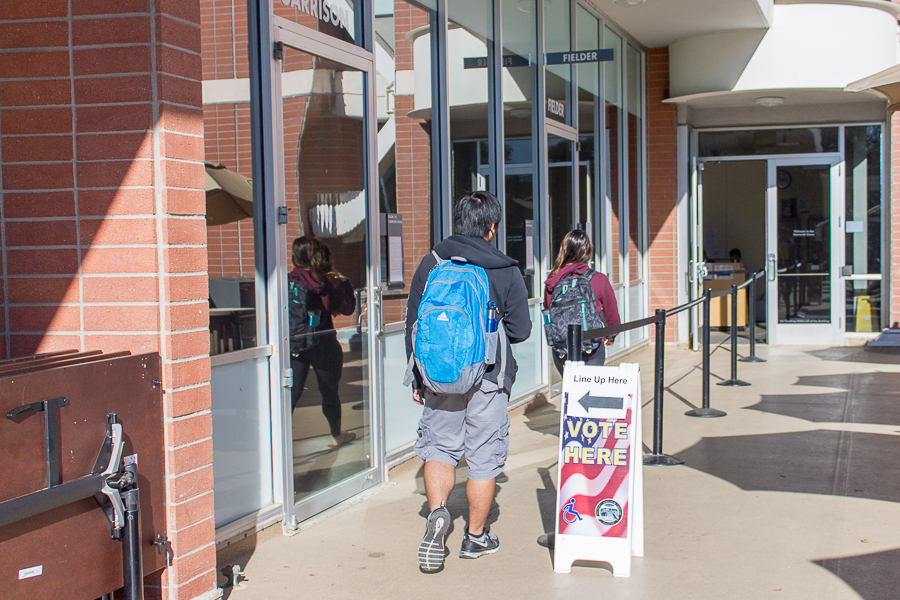
While students and residents ran to the streets in protest of Donald J. Trump’s presidential victory on Nov. 8, Davis mayor Robb Davis extended his hand and listened to the concerns of many people downtown, who felt fearful and concerned about the safety of certain groups of people.

“This is a time that we as a city need to come together and say what it is we value in each other,” Davis said. “We need to make commitments to each other and discuss how we are going to deal with vulnerable populations, people who are legitimately experiencing fear. We need to decide how we are going to be as people to counter to exclusion and hate that has been so much part of the campaign.”

Irene Ezran, a third-year Spanish and International Relations major, supports students’ rights to protest against Trump’s presidency.

“Had the opposition been a respectful candidate, I wouldn’t have been in favor of protesting so much, and instead I would have encouraged moving forward as a country,” Ezran said. “Given the fact that Clinton won the popular vote, and Trump’s rhetoric is offensive to millions of Americans, particularly immigrants, Muslims, women and disabled people, as students we have the right and duty to show that we do not stand by his values of hatred and intolerance.”

While the headline of this election was the race for presidency between Hillary Clinton and Donald Trump, there were also many regional measures for Californians to vote on:

Prop. 51 (Passed): Allows California to sell up to $9 billion in bonds ($7 billion going toward K-12 schools and the remaining $2 billion for community colleges) for the construction and modernization of school facilities. This results in a cost of approximately $17.6 billion (initial cost of $9 billion in addition to $8.6 billion in interest).

Prop. 52 (Passed): Indefinitely extends an existing statute imposing fees on private hospitals to fund Medi-Cal, care for uninsured patients, children’s health coverage, and provide grants to public hospitals. This creates little fiscal impact on the state and taxpaying individuals.

Prop. 53 (Failed): If passed, it would have required statewide voter approval for revenue bonds to be issued or sold for any project costing over $2 billion if funded, owned, or managed by the state; however, this measure failed so state revenue bonds may continue to be provided without voter approval.

Prop. 54 (Passed): Any bill or amendments to a bill must be posted on the Internet for a minimum of 72 hours before the Legislature can pass it. In addition, the legislature must also record their proceedings and post it on the Internet for public viewing. The fiscal ramification of this proposition results in a one-time $1 to $2 million cost, in addition to an annual cost of about $1 million for video and recording.

Prop. 55 (Passed): Enacted in 2012 (until 2018), this measure extends the increased income tax on earnings over $250,000 until 2030. The allocated funds will support K-12 schools, community colleges, and healthcare. Results in an approximate $4 to $9 billion in annual state revenue from 2019 to 2030.

Prop. 56 (Passed): Increases the state excise tax on cigarettes by $2 per pack. The tax rises from 87 cents to $2.87 on cigarette packs with e-cigarettes and other tobacco products increasing in similar amounts. This tax will go towards funding health care for low-income Californians.

Prop. 57 (Passed): Allows certain state prison inmates parole consideration if convicted of nonviolent felony offenses. In addition, the prison system can award sentencing credit to inmates for good behavior, rehabilitation or education. Moreover, juveniles are required to appear in juvenile court before being transferred to adult court. This relieves the state of about tens of millions of dollars annually and produces net county costs of about a few million dollars annually.

Prop. 58 (Passed): Allows public schools to more easily choose how to teach English efficiently for non-native speakers, whether in English-only, in dual-language immersion or in other types of programs. It also continues to require that public schools ensure students are proficient in English. There is no notable fiscal impact on the state or schools.

Prop. 59 (Passed): As an advisory measure, this proposition does not require any action by state or federal legislature, but asks elected officials to overturn the Supreme Court’s decision in Citizens United v. Federal Election Commission. This case ruled that it was unconstitutional to place political spending limits on corporations and unions. This asks the legislature to increase regulation on campaign spending and contributions. This presents no direct cost to state or local governments.

Prop. 60 (Failed): If passed, this proposition would have required adult film performers to use condoms during the filming of sexual intercourse and requires producers to pay for vaccines, tests, and medical exams with additional ways of enforcing those requirements. Not passing this measure means that adult film productions would continue to be subject to state and local workplace health and safety requirements.

Prop. 61 (Failed): Passing this measure would have prohibited state agencies from paying more for prescription drugs than the lowest price paid for the drug by the United States Department of Veteran Affairs. Its failure allows state agencies to continue to negotiate prices of drugs without reference to the prices paid by the Department of Veteran Affairs.

Prop. 62 (Failed): Passage would have repealed the death penalty and replaced it with life imprisonment without the possibility of parole; however, its failure continues the death penalty sentence.

Prop. 63 (Passed): Initiates new requirements for selling or purchasing ammunition, including a background check and approval from the Department of Justice. It also prohibits possession of large-capacity magazines and calls for the creation of a new court process for the removal of firearms from prohibited persons after being convicted of certain crimes. This increases the court law enforcement costs of California and its local governments by potentially tens of millions of dollars annually.

Prop. 64 (Passed): Legalizes marijuana for recreational use, possession and cultivation by adults 21 and older, and imposes state taxes on the sale and cultivation of cannabis. It allows for regulation of non medical marijuana business by local governments and imposes standards for marijuana products. The revenue will fund youth programs, environmental protection, and law enforcement.

Prop. 65 (Failed): If passed, this would have redirected the money collected from the sale of carryout bags to environmental projects. Its failure imposes that charges on carryout bags could fund any purpose.

Prop. 66 (Passed): Changes court procedures for legal challenges to death sentence, including limiting successive petitions, increasing available attorneys for appeals and setting time limits on challenges. The fiscal impact of this measure in unknown.

Prop. 67 (Passed): This proposition prohibits most stores from providing single-use plastic carryout bags and instead requires a 10 cent charge for any other carryout bags. The estimated cost of this measure in unknown but relatively small.


Written By: Bianca Antunez  city@theaggie.org

S.P.E.A.K. community bands together on Quad to protest Trump presidency

VENOOS MOSHAYEDI / AGGIE

Students against Trump’s goal of deporting undocumented individuals

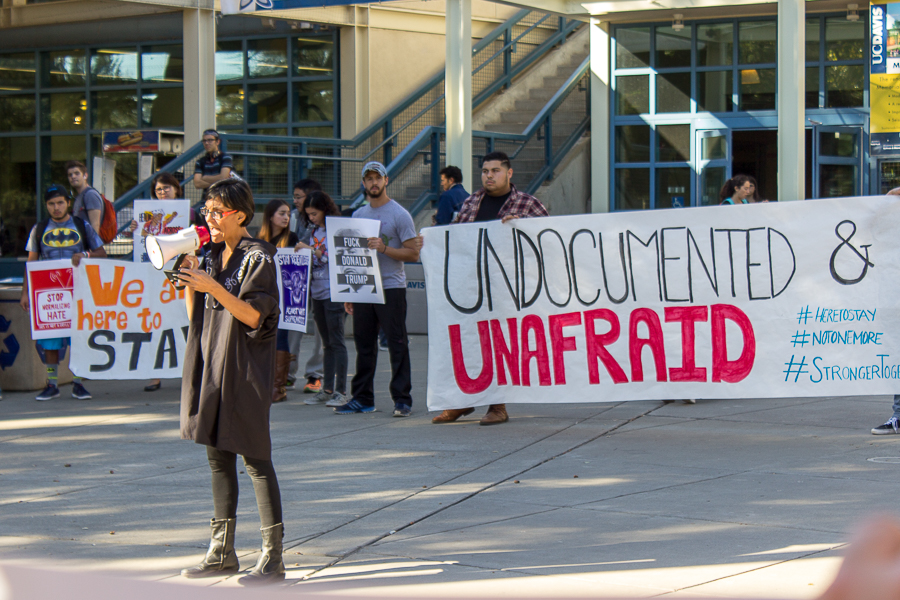
On Nov. 14, the Scholars Promoting Education Awareness and Knowledge (S.P.E.A.K.) community held a demonstration on the Quad to protest the election of Donald Trump

VENOOS MOSHAYEDI / AGGIE

and the subsequent threats of the deportation of undocumented students. S.P.E.A.K. held the demonstration in order to bring its community and its allies together to promote love, strength and resilience.

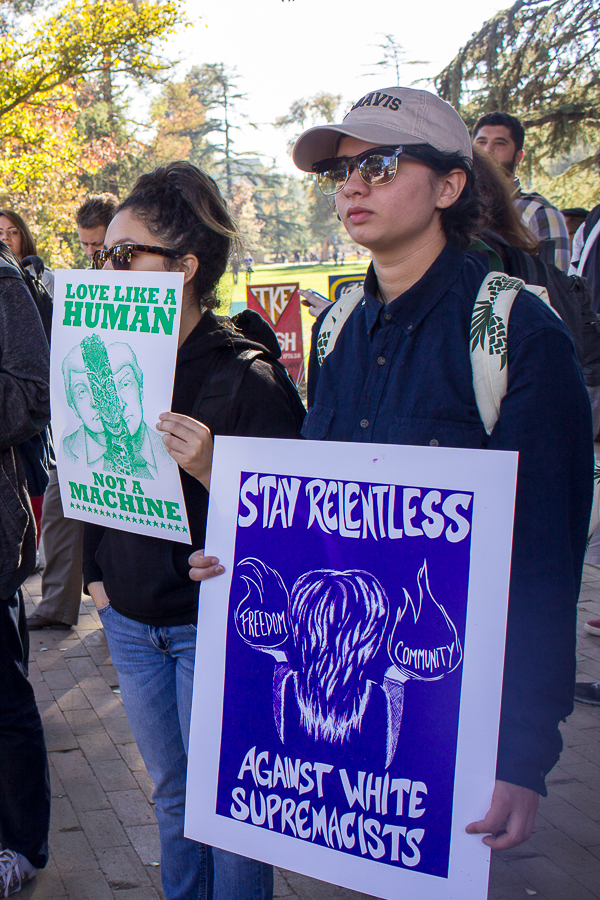
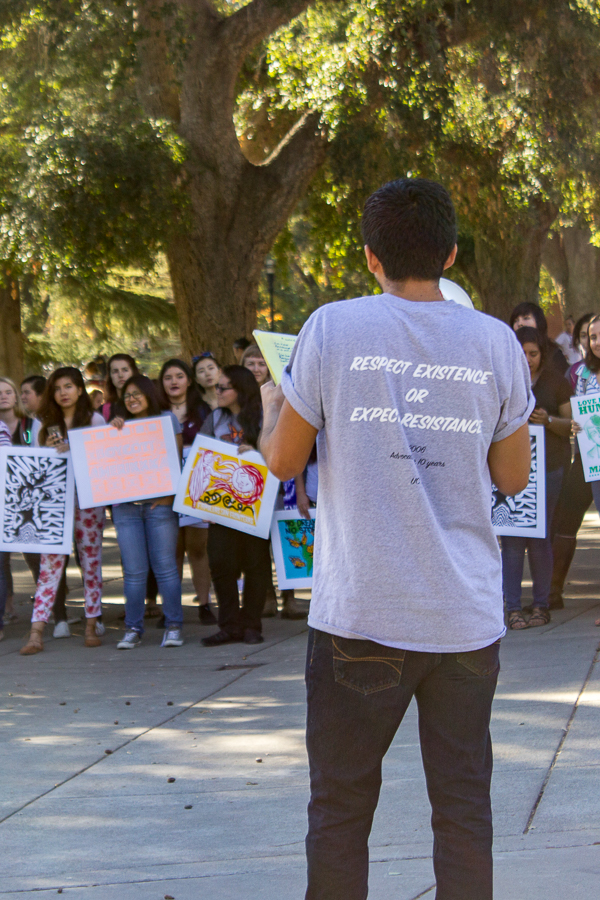
Students gathered in a circle around the Memorial Union flagpole at 1 p.m., holding signs that read “F*ck Donald Trump,” “children of immigrants grab back!” and “Amerikkkan Revolution.” Students in the circle as well as surrounding bystanders recited chants that reflected solidarity among undocumented students and their allies as well as chants that vehemently protested Trump’s anti-immigrant stance. Some of the chants included: “What does community look like? THIS is what community looks like,” and “Undocumented…Unafraid.”


VENOOS MOSHAYEDI / AGGIE

Speakers took turns using a megaphone to express their feelings regarding Trump’s stances on immigrant deportation.

According to one student who wished to remain anonymous, the protest came at an important time for the community to band together and demonstrate resistance.

“Historically, [S.P.E.A.K.] has provided undocumented students with a support system with resources that previous to the organization the institution nor other organizations had been able to provide,” the anonymous student said. “ We just want to make a clear statement that we are here to stay, we’re uniting and we’re looking to improve our conditions. We are going to fight. It’s cliche but the only thing we have is resistance at this point.”


Written by: Lindsay Floyd  — campus@theaggie.org

University of California among largest source of donations to Clinton

NICKI PADAR / AGGIE
NICKI PADAR / AGGIE

Despite UC support, Clinton loses presidential election to Trump

Individuals from the University of California (UC) system were the largest source of cash from any single organization for 2016 Democratic presidential nominee Hillary Clinton, according to a new study by the Center for Responsive Politics (CRP). Despite failing to secure the presidency, Clinton’s campaign outspent Republican nominee Donald Trump’s by more than $300 million.

“The money came from the organizations’ PACs; their individual members, employees or owners; and those individuals’ immediate families,” the CRP said on its website. “At the federal level, the organizations themselves did not donate, as they are prohibited by law from doing so.”

The CRP, an independent nonprofit organization based in Washington, D.C., is a research group which looks at the flow of financial contributions and its effects on elections and public policy.

Individuals from the UC raised more money than several large companies in the US, including many tech companies in Silicon Valley, another large source of funding for Clinton.

Employees for the UC raised $1.37 billion for the Democratic nominee. Workers affiliated with Alphabet Inc., the parent company of Google, were second in financial contributions, coming in at $1.32 billion.

“At first blush, I’m surprised,” said Jessica Levinson, a professor at Loyola Law School, in an article published by the San Francisco Chronicle. “People who work at UC make a lot less than people who work at Google or Alphabet, Inc., so in that sense it’s surprising, but you have to think about the size of the employer.”

Antoine Menager, a second-year economics major and executive director of the Davis College Democrats, believes that Clinton’s election loss was in part due to a disconnect between the Democratic party and its supporters.

“The idea that Democrats have of their base and the people who are actually voting for them is not exactly the same,” Menager said. “And I think that Democrats right now really need to, on a national level, need to focus in on reconnecting with voters, reconnecting with what people want and need out of their country.”

At UC Davis, students overwhelmingly supported Hillary Clinton. In an online survey conducted by The California Aggie, 71.3 percent of the approximately 200 respondents said that they would vote for Hillary Clinton. By comparison, 13.3 percent of respondents said they would vote for Donald Trump.

In the 2016 election, voter turnout fell from previous elections. While voter turnout in 2008 hit a peak of 61.6 percent for eligible voters, that number fell to 58 percent in 2012 and 56 percent in 2016, the lowest level in 20 years.

For many Democratic voters, Clinton’s loss became a wake up call for the state of the party.

“The Democratic party used to be a party of activists, of community organizers, of individuals who are on the street, on the ground, who had a direct connection with the people that they were supposed to represent,” Menager said. “I think it’s symptomatic of the disconnect that Democrats have with a certain portion of the American population. Even with all this money, she wasn’t able to make much headway in any of the battleground states.”


Written by: Ivan Valenzuela — campus@theaggie.org

Facing the Trump post-election nightmare

HANNAH LEE / AGGIE
HANNAH LEE / AGGIE

Trump’s triumph must stir student action

It’s been a trying few days. California voters saw the outcomes of key ballot provisions such as the legalization of recreational marijuana, easier parole options for criminals of non-violent crimes and increased legislative transparency. However, Donald Trump’s presidential upset greatly overshadowed these overdue victories.

The question on countless minds is: what now?  While half of the country is celebrating what others view as the greatest political upset in modern American history, and other masses of people are protesting in the streets and burning effigies, many are still completely unsure of how to react. Predictions by major news outlets and pollsters proved largely untrue, underestimating the amount of white voters that came out to support Trump.

What do we want to see from President-elect Trump? For a lot of minority groups, it’s difficult to say when we disagree with so many of his platforms and ideologies. In this position, one can only hope that Trump does exactly what numerous politicians have done before him: break his promises.

Otherwise, based on his official (and unofficial) platforms, we as a nation are looking at a wall between the U.S. and Mexico, blissfully paid for by the Mexican government. Trump’s extreme immigration policies have no sympathy for undocumented immigrants, so expect an increased presence of Immigration and Customs Enforcement officers. Trump has also expressed a desire to repeal the Affordable Care Act, which could leave millions of Americans without health insurance and might change the way certain medications, such as contraceptives and many prescription drugs, are priced.

There is also the pressing matter of the vacant Supreme Court seat. With both the House and Senate blocking President Obama’s Supreme Court nominations, which would have given the Supreme Court a liberal majority for the first time in 50 years, Trump’s nomination will most assuredly go through. When we look at the important landmark decisions that have already been made by the Supreme Court, we fear for the chance of future regression on women’s rights, LGBTQIA+ rights and the rights of marginalized communities.

To top it all off, the global market experienced volatility following Trump’s victory, with the Dow-Jones Industrial Average up 200 points as of Nov. 9, the value of the Mexican peso plunging, and European markets also experiencing shocks. Although financial markets are known to react quickly to changes and then return to moderately normal levels (see: Brexit), many are skeptical of whether Trump’s economic plan is actually sustainable in the long run.

So again, what now?

For now, this Editorial Board suggests that we as a community at UC Davis staunchly support those who have been callously marginalized by Trump and his supporters. For one, this means putting in time at the Women’s Resource and Research Center, the LGBTQIA Resource Center, the African Diaspora Center, the AB540 and Undocumented Student Center — any place that might need help in the wake of Trump’s racist and bigoted ideology. It could also mean donating to local organizations that aid marginalized communities. Or reach out to local leaders, state government and our new U.S. senator, Kamala Harris, and share your concerns.

Members of the Chicanx/Latinx community, the African American community, the Muslim community, the LGBTQIA community and undocumented immigrants, among so many other people from a variety of backgrounds, have been heinously targeted and victimized in the past. For those who can speak out, do so for those who do not have the privilege. We must stand  and fight for them, not just because we are members of the same community of UC Davis students, but because we as individuals recognize the fear, anxiety and very real threat that faces other human beings.

This Week in Senate

HANNAH LEE / AGGIE
HANNAH LEE / AGGIE

ASUCD Interim Vice President Adilla Jamaludin called to order the first November senate meeting in the Memorial Union’s Mee Room at 6:11 p.m. on Nov. 3. Senators Julie Jung and Ricardo Martinez were absent during quorum roll call. Martinez arrived late.

The senate began with questions for new senator Matthew Chase McFadden. Questions focused on McFadden’s knowledge of general ASUCD processes, his platforms and his commitment to being a senator. McFadden showed knowledge and interest regarding senatorial duties, environmental issues and issues surrounding Greek life.

Next, Office of Advocacy & Student Representation (OASR) director Georgia Savage and OASR deputy director Sarah Shemery presented a report that included what each staff member has been doing and gave an update on UC Davis breaking off from the University of California Student Association (UCSA).

Martinez expressed his disappointment with the lack of diversity in the Student of Color Conference (SOCC) leadership to the OASR representatives. Martín Giron, a student who attended the senate meeting, mentioned that multiple individuals from the Chicanx/Latinx community felt left out because SOCC is the only space for Chicanx/Latinx leaders to be represented.

Savage believed this discussion should be held one-on-one and not in front of the senate. Senators Martinez and Chiang left the room to speak personally with the OASR leaders outside of the Mee Room.

Hannah Ulansey, director of the Campus Center for Environment (CCE), presented a report about the CCE’s collaboration with the Center for Educational Effectiveness. The report also included Project Compost’s merger with CEE, implementing compost bins on campus and starting a “red cup clean up” campaign to reduce waste within Greek life at UC Davis.

Three confirmations were then made during the meeting. Amelia Evard was confirmed as the Whole Earth Festival co-director. Doris Cortez was confirmed as Student Health and Wellness Center chair. Lastly, Sarah Risher was confirmed as Environmental Policy and Planning commission chair. There were no objections to the candidates.

Ari Kelman, a representative for the Chancellor Search Committee and chair of the Faculty Subcommittee, presented Policy 7102, the Regent’s policy on how to search for a new chancellor. The faculty subcommission is assigned to do initial rounds of vetting. The chosen candidates can be ignored by President Napolitano.

Following presentations and confirmations, legislations were presided over. Senate Bill No. 12 concerns bylaw 1705F, which states that all units must include ASUCD in their titles on all social media page titles. This bill would exempt The California Aggie, KDVS and Unitrans from the bylaw. After further discussion, the senate decided to table the resolution.

Senate Bill No. 13 concerns raising the spending limit of elections. After senators expressed concerns of economic privilege affecting eligibility to vote, the bill failed to pass with Park, Molodanof and Jamaludin being the only three in favor.

Senate Bill No. 15 concerns awarding 10 nominated ASUCD volunteers with $1,000 awards for their service. After further discussion, the senate decided to table the resolution.

Senate Resolution #2 declares that the Senate is in solidarity with #NoDAPL (Dakota Access Pipeline) and the Standing Rock tribes. With no objections, the resolution passed.

Jamaludin adjourned the meeting at 10:20 p.m.


Written by: Yvonne Leong — campus@theaggie.org

Chase McFadden confirmed as new interim senator

IAN JONES / AGGIE
IAN JONES / AGGIE

McFadden’s confirmation follows Senator Dhindsa’s resignation earlier this quarter

At the ASUCD Senate meeting on Nov. 10, third-year environmental policy analysis and planning major Chase McFadden was confirmed as an interim senator. McFadden is replacing former senator Puneet Dhindsa, who resigned in early October.

“This appointment represents a unique opportunity to intimately familiarize myself with ASUCD operations and begin to understand some of the larger issues impacting this campus community,” McFadden said via e-mail. “I plan to work with the Environmental Policy and Planning Commission (EPPC) chair to re-establish that commission’s place in the legislative process and define its goals for the rest of the year.”

Because the newly elected senators will begin their terms at the start of Winter Quarter, McFadden will only serve as senator until the end of this quarter.


Written by: Alyssa Vandenberg  — campus@theaggie.org

Women’s basketball wins home opener

0
IAN JONES / AGGIE
IAN JONES / AGGIE

Aggies break two-year losing streak

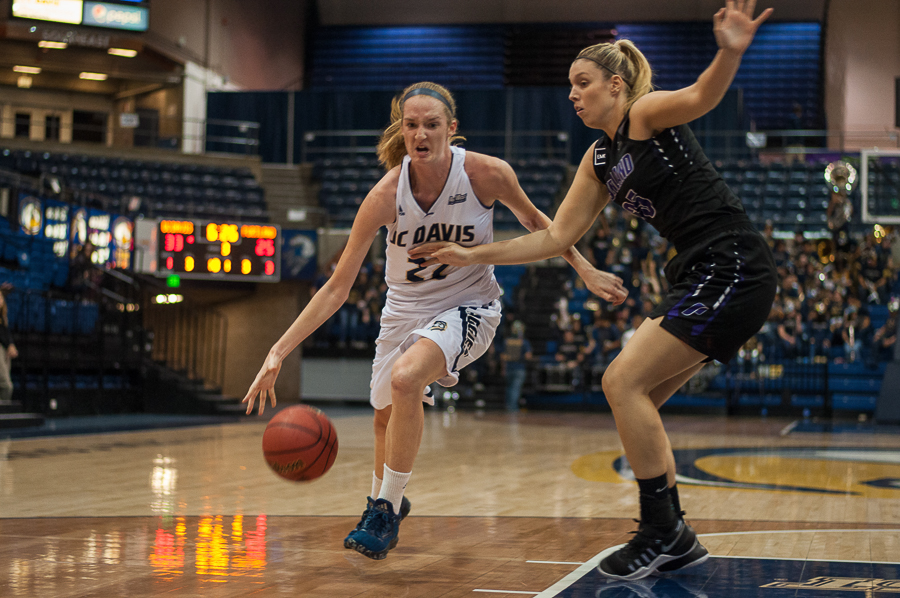
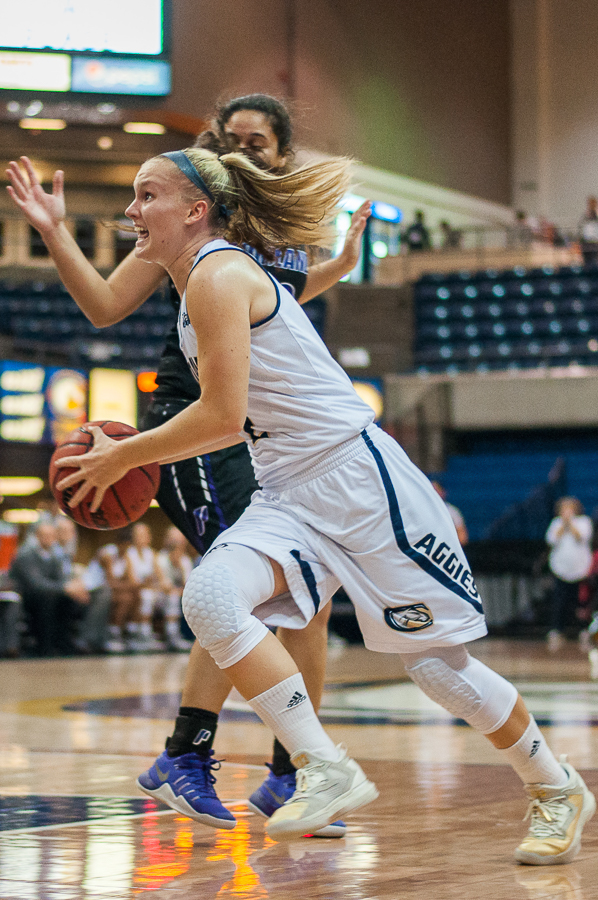
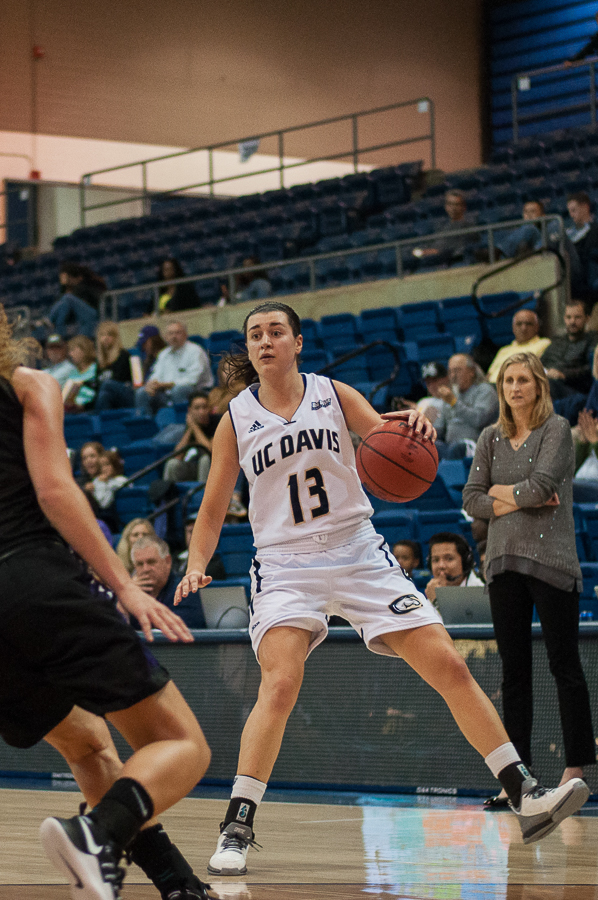
The Pavilion was filled with both cheers and jeers from an excited crowd on the night of Nov. 11 as the UC Davis women’s basketball team opened its regular season with a hard-fought win over the Portland State Pilots, 66-52.

The Aggies looked primed to begin their season with a head start in the Big West Conference — joining just three other schools (out of nine) in the division to win their openers. They showed an ability to deliver big wins in the two exhibition games leading up to the first regular season game, creating high expectations for a stellar 2016-17 season.

IAN JONES / AGGIE
IAN JONES / AGGIE

Friday night’s win was not the only reason for celebration, as multiple Aggies played some of their best ball to date. Junior forward Pele Gianotti was a key contributor to the win and witnessed an elevation in her game that produced a career high: 12 rebounds to go along with 20 points — an impressive double-double to start the season. Sophomore forward Morgan Bertsch continued the level of play that she showed during the two exhibition games by putting up 10 points and five rebounds, with six of those 10 points coming from the free-throw.

Junior guard Dani Nafekh matched her fellow guard, sophomore Kourtney Eaton, by scoring 12 points, and combined for half of the three-pointers made for the entire team with five.

“We’ve been working so hard […] we don’t really think about the opponent, but more on what we can do,” Eaton said. “We’ve been working so hard on our defense and changing some things

up this year [by] putting more pressure on the ball and forcing a little more turnovers.”

The Pilots didn’t allow the Aggies to run away with the game, desperately chipping away at the lead and keeping the point differential below 20. The Pilots were also able to control the paint

IAN JONES / AGGIE
IAN JONES / AGGIE

more effectively than UC Davis by scoring 28 of their 52 points from there, while the Aggies were only able to put up 14. However, the Aggies dominated beyond the arc — making 10 three-pointers to the Pilots’ three.         

This win marked the first time since the 2011-12 season that the UC Davis women’s basketball team has been able to come away with a victory in a home opener.

“This year’s team is just focused on playing really hard and competing, and we did that; we did a great job […] and I felt that our team competed really well tonight,” said head coach Jennifer Gross.

The team had 17 turnovers for the night, while Portland had 11.

“We did this to ourselves, just making risky passes and not taking care of the ball enough,” Gross said. “We know we have to take care of the ball to be able to win games against every opponent that we play.”


Written by: David Flores — sports@theaggie.org          

UC Davis Veterinary School holds monthly free pet clinic

ZHEN LU / AGGIE
ZHEN LU / AGGIE

One clinic helps veterinary students, undergraduates, a small community

Knights Landing is a small community in Yolo County where 16.9 percent of people fall below the poverty level. As a result, some residents find it hard to pay for their pets’ expensive veterinary bills. Luckily, students from the UC Davis School of Veterinary Sciences provide a monthly free animal clinic in Knights Landing, a project that benefits the veterinary students, undergraduate pre-vet students and the community (and pets) of Knights Landing.

According to Boram Lee, clinic co-director, the project started in 2009, when residents of Knights Landing reached out to the UC Davis School of Medicine for regular medical services. When the School of Veterinary Medicine joined, those services were expanded to include animal care. The institutions combined forces to create the One Health Clinic in Knights Landing, which formally opened in 2012 and operates every third Sunday of the month.

Kelly Yu, a second-year graduate student at the UC Davis School of Veterinary Medicine, is an intake coordinator for the Knight’s Landing One Health Clinic. Through the clinic, Yu is able to work with veterinarians and gain more experience with the animals. According to Yu, the clinic has grown quickly, and it has recently been able to enact new procedures such as conducting bloodwork.

In addition to the new services being offered, the clinic continues to offer spay and neutering services and preventative care.  

“Preventative care is basically just physical exams, and the physical exams are mainly done by the vet students at the school,” Yu said. “Generally […] we give them the yearly vaccines that they need, [and] update them as needed. We give them flea medications, which is a monthly thing, and we also give them deworming in case they have any sort of parasite.”

In addition to providing experience for veterinary students and animal care services to an underserved community, One Health also serves undergraduate pre-veterinary students.

Brigitte Clark, a fourth-year animal science major, is president of the Pre-Vet Students Supporting Diversity (PSSD) Club on campus. Through PSSD, undergraduate students can apply to volunteer at the clinic in Knights Landing and get experience with animals that can set them apart on veterinary school applications later on.

“The undergraduates are [placed] at different stations,” Clark said. “One station is pharmacy, where you’ll be drawing up the vaccines, and you’ll be pretty much getting the medicinal materials that the vet student needs. […] The next station is helping with the paperwork in the front, […] it’s called intake. You help patients get their paperwork done, you call out patients and you interview them. […] Another position that the undergraduates do is that they [act as] vet-tech assistants at each station.”

Clark volunteered at the clinic monthly until last year and said that the number of procedures that undergraduates have been able to help with has increased.

“Now what’s different is if you have a rabies vaccine you get to touch the animal and restrain them versus before […] the undergraduate students couldn’t touch the animals because of the insurance policies,” Clark said. “If you provide them with your rabies vaccinations and a couple of other things, you can restrain the animals now.”

While the clinic gives both veterinary students and pre-vet undergraduates experience for their chosen career paths, it also serves the community of Knights Landing with its mission of keeping pets healthy and owners informed.

“We actually set up a table [in the clinic] so we could have more one-on-one conversations with clients regarding […] pet health or any kind of questions they might have,” said Michelle Luis, a second-year veterinary student and one of the education coordinators for the clinic. “We try to just get clients to know about other factors that affect their animals’ health and their own health.”

While the education coordinators help to teach the pet owners about animal health, the benefits do not stop there. For Luis, one of the most rewarding parts of the program is engaging with the kids that stop by the table.

“For me, the outreach portion is really important, and that’s the part that I like the most,” Luis said. “Just trying to get kids excited to maybe go into [a veterinary] career in the future, or just pursue science further, or higher-level education in general.”


Written by: Meral Basit and Darien Barnett – science@theaggie.org

50,000 words in 30 days

CHARLES MIIN / AGGIE

First-year students take on NaNoWriMo challenge

Thousands of wordsmiths all over the world, from published authors to aspiring writers, hope to one day realize their dreams of writing a novel. While some achieve this goal, others never find the right time or opportunity to do so. For those determined to see their creative ideas come to life, NaNoWriMo is the perfect place to begin.

National Novel Writing Month (NaNoWriMo) challenges all of its participants to complete a 50,000-word novel throughout the month of November. To complete the challenge, one must write approximately 1,600 words a day. Last year, the nonprofit organization had nearly 450,000 participants and over 40,000 successful completions.

At UC Davis, a group of ambitious first-year students are taking on the NaNoWriMo challenge in a seminar taught by biological sciences professor Ian Korf. The class focuses on strategic writing techniques and exercises to help achieve the goal of 50,000 words. The students are participating as members of the Yolo County NaNoWriMo community, which is overseen by municipal liaisons Elisabeth Kauffman and Rose Butler. Kauffman, a freelance editor, has participated in NaNoWriMo every year since 2010.

“I think that NaNoWriMo is perfect for aspiring writers. You immerse yourself in your story for 30 days. You live it and you breathe it,” Kauffman said. “If you do not hit your 50,000 word count, then that’s okay. The whole point is to just have written words at all.”

NaNoWriMo began in 1999 in the San Francisco Bay Area when a group of friends decided to take on the daunting challenge of writing a novel in 30 days. Since then, it has grown into a worldwide phenomenon. Even some best-selling novels, including Water for Elephants by Sara Gruen and Fangirl by Rainbow Rowell, began as NaNoWriMo novels.

“The community is so supportive. People who participate in NaNoWriMo are not interested in snobby awards or recognition. They are only interested in how creative you are, and helping you find that creativity along the way,” Kauffman said.

On the NaNoWriMo website, participants have the opportunity to connect with other writers in their own communities and across the world. Through this community, writers gain support and inspiration from one another while focusing on their own creative journeys. Fellow writers encourage and push participants to meet their deadlines and complete the challenge.

“I don’t actually think NaNoWriMo is so much about writing as it is about time management and meeting deadlines,” Korf said. “If anyone could come away from their freshman year with any important skill, [that skill] would be time management.”

Korf is a published author and has completed NaNoWriMo himself multiple times in past years. For many of his students, this is their first time taking on the endeavor of writing a full novel.

“For me, the main goal is to hit the word count, but I also want to finish my story,” said Tristan Atkinson, a first-year theatre and dance major.

Atkinson is a member of Professor Korf’s seminar and is participating in NaNoWriMo for the first time.

“I’ve never written anything this long before, so I think I am going to have the most fun filling the parts in between the major plot points,” Atkinson said.  

Those interested in participating in NaNoWriMo can find more information at nanowrimo.org.


Written by: Sydney Odman –– arts@theaggie.org  

Comedy as modern storytelling

DOD NEWS / EJ HERSOM / PUBLIC DOMAIN

headshot_ssMike Birbiglia shows how comedy can transcend the disconnect between performer, audience

In a 2013 Netflix comedy special, My Girlfriend’s Boyfriend, Mike Birbiglia tells a story. The special takes place in a big, open performance hall, with a long, wide stage elevated from the ground. The audience sits around the stage, which holds a single black stool.

Mike Birbiglia’s work is storytelling at its core. His work dwells on storytelling in a hyper-verbal form, in contrast to stand-up that concentrates much more on performance, physicality and facial expression.

In the first minute, Birbiglia sits on the stool. He proceeds to rest both on the stool and the stage itself throughout the show. The set-up provides the perfect medium for a long story. The audience is comfortable and he has as much, or as little, space as he wants to move about as he tells his story.

And it’s a long story. Birbiglia speaks for over an hour on one arc which functions as a “how I met your mother” epic, involving stories from his childhood to the present. The special tracks the misadventures of his romantic past, leading up to his marriage to long-time girlfriend Jenny despite his continued ambivalence toward matrimony.

The special is funny, heart-wrenching, honest and frank. Birbiglia appears to the audience an average Joe with flaws, quirks and some unpopular opinions. He criticizes his own lack of fashion sense and classic “good looks.”  He seems approachable and authentic. The viewer feels as though they are listening to an acquaintance  — a well-rehearsed and humorous acquaintance  — answer the question: how did you meet your wife?

Comic Marc Maron, interviewing Birbiglia, noted that few comedians are able to work the long-form seen in My Girlfriend’s Boyfriend. What Birbiglia offers is an experience of storytelling integral to the general human experience: an iteration of our collective history.

Unlike storied comedians like Robin Williams, Jim Carrey and Will Ferrell, who are known for absurd physicality, and modern comics like Eric Andre, who shock and baffle the viewer, Birbiglia’s jokes rely on their as-written comedic value. His appearance, expression and body language are secondary to the writing itself.

Birbiglia’s style of comedy is most similar to that of Demetri Martin, a Greek-American comedian best known for his vernacular quips and comedy-in-song performances. In his Comedy Central special, Person, Martin sits on a stool playing guitar to a slew of unrelated but bizarrely consistent jokes, and draws sketches on a huge paper pad. In his Netflix special, Demetri Martin: Live (At the Time), he blurts: “Pets are animals that are not delicious,” “I don’t like fitted sheets; I feel like that’s a very passive aggressive design we’re dealing with” and “I find that athletic clothes are perfect for just sitting around in.” Martin takes an alternative approach to comedy like Birbiglia, but he’s not as intimate with his audience.

Because Birbiglia uses story to make his audience laugh, he connects with them on a more human level. Martin, who uses disconnected one-liners, is detached from his audience.

Although the two comics bear many similarities, it’s Birbiglia who makes the most of his form and craft. While Martin charms his audience, Birbiglia speaks from a place of authenticity in a medium that is deeply human. No comedian working today can make a better connection with their audience.  


Written by: Stella Sappington — sasappington@ucdavis.edu

Disclaimer: The views and opinions expressed by individual columnists belong to the columnists alone and do not necessarily indicate the views and opinions held by The California Aggie.

Preserving the Great Barrier Reef

NASA / KJELL LINDGREN [CC BY-NC 2.0] / FLICKR
NASA /
KJELL LINDGREN [CC BY-NC 2.0] / FLICKR
headshot_mcStudents, tourists need to respect their host countries
There’s a saying that I heard once that said “beauty is never tarnished.” Well, I hate to break it to whoever said that, but I doubt that they have ever lived in a place that has seen its natural beauty destroyed at an alarming rate. To be fair, I’m also just as sure that whoever coined that expression was also talking about people, and not travel destinations like the Great Barrier Reef.

Sure, travel is great. Being able to see unique sights unavailable to you in your home country, trying a new cuisine (even if it’s a different McDonald’s menu) and creating memories that last a lifetime are all great reasons to get out of town when it’s possible. But at the same time, what’s the real cost of these worldly pleasures? I mean beyond the costs of airfare, food and finding a place to sleep.

I recently traveled to Cairns, Australia and went snorkeling in the Great Barrier Reef. And while I may not have been in the ocean for too long (salt water irks me and I can’t see well without glasses) I did notice something that many people may or may not be aware of currently: the reef is dying.

I’d heard this statement before. It was probably in high school when I was taking AP Biology that I heard the ominous warning that the reef was in danger of not being a sight that my grandchildren would be able to see. Unfortunately, the warning was clearly ignored.

Only six years later, as a fourth-year in college, the reef looked miserable. The coral was bleached, chipped and the some of the creatures looked about as miserable as the Tank Gang from Finding Nemo looked when Darla tapped menacingly on the glass.

How can such rapid change occur to something which has stood for so long on this planet? People. People did this with all the travel the area faces. The ocean is filled with fumes from people flying to Cairns, pollution from around the world and sunscreen from everyone trying not to get skin cancer in this place where the UV index remains at a steady 10 for all daylight hours. And the reef hurts when people get in the water and accidentally chip the coral.

But even if all the ships and cruises go out to the ocean with the best intentions, as many of them do, and do everything in their power to try and give the reef a fighting chance, the sad fact is that the reef is still in danger. People love traveling. People love being able to say they did something great in a foreign country that they would be unable to do anywhere else.

And what better way to say this than taking physical proof of your presence in somewhere as great as the Great Barrier Reef? People take coral from the reef. But is showing off your adventures really worth taking part of a UNESCO heritage site? Isn’t it a lot of effort to try and get it past security knowing that if it’s found out, you are committing a federal crime? But it happens. It’s as if some crazy impulse exists to destroy the beauty of place you came to visit in the first place. It doesn’t make sense.

How far will people go to prove that they have gone to a world-renowned location? Will the monetary cost of travel really be worth it if there isn’t even anything to see anymore because it’s either been destroyed by climate change and the increasing impact of human presence?

To travel responsibly, especially for students abroad, is to follow a better saying I picked up as a Boy Scout: “Take only pictures, leave only footprints.”


Written by: Michael Clogston  — mlclogston@ucdavis.edu

Disclaimer: The views and opinions expressed by individual columnists belong to the columnists alone and do not necessarily indicate the views and opinions held by The California Aggie.

Humor: Nothing Beats A Good Venmo Stalk

CHELBERT DAI / AGGIE

headshot_yrYou can find out a lot about a person by looking at their purchase emojis
Social media stalking isn’t creepy. Claiming to be above social media stalking when you absolutely do stalk on social media, however, is 100 percent creepy.

It’s human nature. We love information. We want as much as we can possibly get. We’re social animals. Whether it’s keeping up with the Joneses, scoping out a potential flame or keeping tabs on an ex, everybody lurks.

Denying that you pay attention to publicly accessible information is like saying girls don’t poop or that you don’t get secretly happy when “Mr. Brightside” comes on at a party. You’re either delusional or a liar. So with that out of the way, and knowing that we’re in a safe space, I’m ready to divulge some of the best information-gathering (that’s the euphemism I’ll use from here on out to sound less bizarre and not get a restraining order filed against me) techniques I’ve picked up over the years.

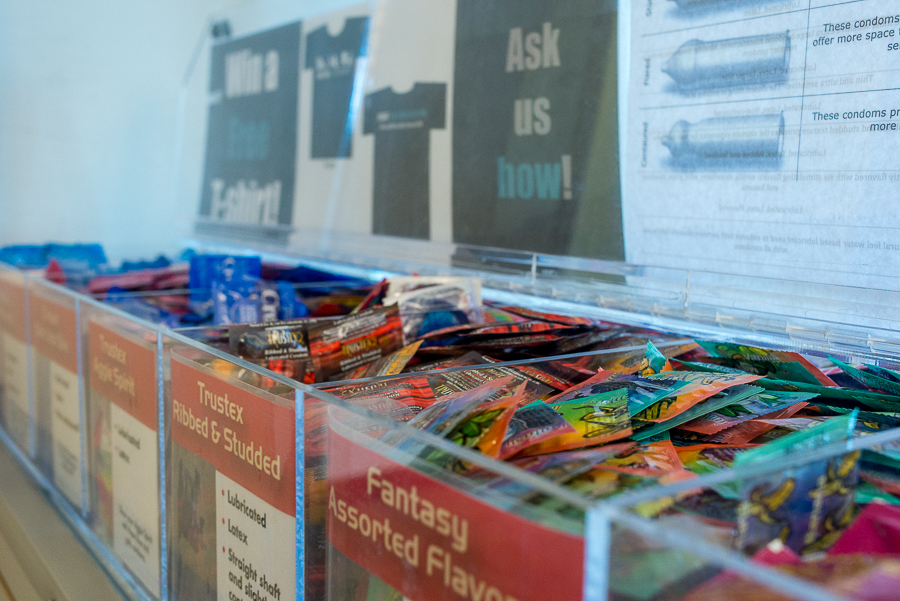
Now, this article would be much easier to write if everyone in college stopped withdrawing physical cash and instead only paid using some sort of social platform that takes something as functional yet personal as paying your friends and puts it all out there like some sort of drunk Snapchat story.

Wait a minute. There’s an app for that? You can pull up a feed and see who’s paid who for what? You can expose to everyone that you’re buying Snowglobe tickets from your on-again, off-again, and that you’re going to spend three days raging in a cabin while freezing your ass off in a sub-zero rave? You can figure out who’s paying utilities to whom, which friend always fronts money and why your goodie-two-shoes next-door neighbor always buys “fun stuff” from the white kid with dreadlocks every other week?

Venmo is a beautiful thing. Forget having a legitimate excuse for the homeless guy asking for money whenever I tell him I’m out of cash (yes, I already know I’m going to hell, you don’t need to remind me). It’s the most effective information gathering tool we have. I’m almost convinced that the founders didn’t even care about the fact that they’ve almost eliminated cash from the college life. They knew PayPal was around. They knew there were other peer-to-peer cashless solutions out there. They also knew that there was no way to see whether Megan’s been missing her monthly Rent (house emoji) payment. So Venmo was born.

I’m not saying that every tech company aims to scratch our collective gossip itch. I’m just saying that you can find out who won the break-up by seeing if your ex got fired from their “Sanitorial Management” job while you share with the world that you just got hired by a Fortune 500 company. LinkedIn is obviously about networking. It’s obviously about figuring out who you know where to help you on your job search. It’s an amazing tool and every student that isn’t on it as they apply for grown-up jobs is shooting themselves in the foot.

But a nice, relaxing LinkedIn lurk is underrated for information gathering. Not only do you get the obvious stuff like employment history, you also get some other juicy details like the “skills” they have and whether other people actually agree with Tim that he’s an accomplished public speaker (only four people endorsed him for it, so probably not). The key is to go on with incognito or private browsing, because if you go from your LinkedIn profile on someone else’s, they get a notification that you lurked. I know because an ex-girlfriend of mine’s new boyfriend had a little look at my profile and I got an email about it, so be safe out there.

Safe. Yes, be safe. The internet is amazing. I love social networking sites because they’ve brought me closer to my friends. I believe in putting yourself out there. But, at the same time, be aware of all the privacy settings at your disposal — it’s totally in your control what you do put out there and what people can see it (even on Venmo and LinkedIn).


Written by: Yinon Raviv — ravivyinon@gmail.com

The “Love Lab” as a mobile student service

0
ANH-TRAM BUI / AGGIE

Health Education and Promotion student assistants, volunteers discuss Love Lab safe-sex resources

It’s 6 p.m. on a Thursday evening at the Activity and Recreations Center (ARC). Midterms are over, and academically-exhausted students are rushing in for their evening workouts. In full view of visitors to the gym is a small cart with a lab-coated volunteer in attendance. Stocked with free pamphlets, condoms, dental dams and lubricant packets, the Love Lab is ready for a night on the job.

The Love Lab is a mobile cart housed on the third floor of the Student Health and Wellness Center (SHWC) inside the Health Education and Promotion office (HEP) that has visited the ARC weekly since its inception in 2007. It is open on Monday, Tuesday, Thursday and Friday from 9 a.m. to 4:30 p.m. to provide students with safe-sex products. Internal and external condoms, dental dams and informational pamphlets on safe sex are all available for visitors.

“We get a trickle of people coming in [the HEP office] during the week to visit the Love Lab,” said Meera Madra, fourth-year global disease biology major and sexual health student assistant at HEP. “People who know about the cart usually come into the Student Health and Wellness Center.”

The Love Lab is primarily run by HEP volunteers like Madra and Darren Frank, a HEP volunteer, who move the cart down to the ARC from the Student Health and Wellness building on Thursday evenings, weather permitting. Madra and Frank are tasked with manning the cart, answering any questions about safe sex and providing demonstrations on how to use the products offered.

“People are usually going into the ARC to exercise and not […] to pick up condoms,” Frank said. “The first night [this quarter] we got about 130 people, but [that number] goes up and down depending on how busy that week is and how many people actually go into the ARC.”

According to Frank, the students who are already familiar with the cart will take what they want while people that are seeing for the first time often take a longer time looking at the different products that are available. No matter what, watching the expressions on student’s faces approaching the cart never gets old, and each night looks different for the Love Lab.

“You get two reactions,” Frank said. “One is like ‘oh’ and [the student] will laugh and get this blushed face […] and leave. Or they’ll be like ‘that’s cool!’ and we will talk about it. Eventually, we will give [a visitor] a bag and they will pick out the condoms or buttons and information that we have.”

Once a student approaches the cart, volunteers offer to show them three different demonstrations, one for each type of condom that the Love Lab has. These demonstrations are interactive, as volunteers use a wooden dildo named “Woody” and a plastic vagina named “Gigi” to demonstrate how to properly use the condoms.

“At first [giving demos] was a little weird, and you still get [lubricant] on your hands –– it’s really gross,” Frank said. “[But] it’s nice, because depending on which one you do, it’s informative, and it’s nice to see how much they knew beforehand. You want to know the specifics about what to do.”

Students can win prizes by learning how to do the demonstrations themselves.

“We also have [the program] ‘Watch it, Teach it, Win It’,” said Chloe Tsudama, a fourth-year psychology major and HEP sexual health student assistant. “Volunteers teach students three [demonstrations] and [students] can come back to teach [the same demonstration] back once a week. If they can successfully teach all three back to the volunteers, they can get a free t-shirt.”

There are also videos of each demonstration on the Love Lab’s YouTube channel, for those who may prefer a less public learning experience. Along with these ‘How-To’ videos, the channel has other informational videos for safe sex practices. All of these resources reinforce the Love Lab’s focus on bringing its resources to students via mobile vehicles, rather than relying on visitors knowing where the Love Lab lives the rest of the week.

To increase visibility, the Love Lab also visits other sites on campus at least once a quarter. In previous years, the Love Lab has visited campus events like The Buzz, and soon, the Love Lab has a visit planned for the Student Community Center (SCC).

After two hours at the ARC with students learning, reiterating and practicing, it is time for the volunteers to roll the Love Lab back home. The evening was a success, as the students who often say hello took their usual products, and new visitors inquired on how to have safer sex. The Love Lab did its job and helped conveniently educate students about protecting themselves and others.

“With the Love Lab, we’re making sure that students have the knowledge to help themselves,” Frank said.


Written by: Amanda Cruz — features@theaggie.org