55.7 F
Davis

Davis, California

Monday, December 22, 2025
Home Blog Page 681

The dark underbelly of comedy

SGT. 1ST CLASS JEFF TROTH / PUBLIC DOMAIN

headshot_ssWhat do we make of comics struggling with mental illness?

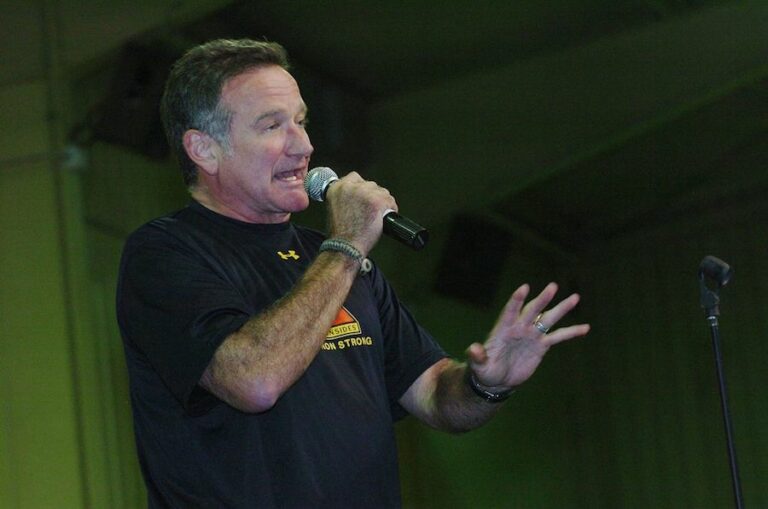
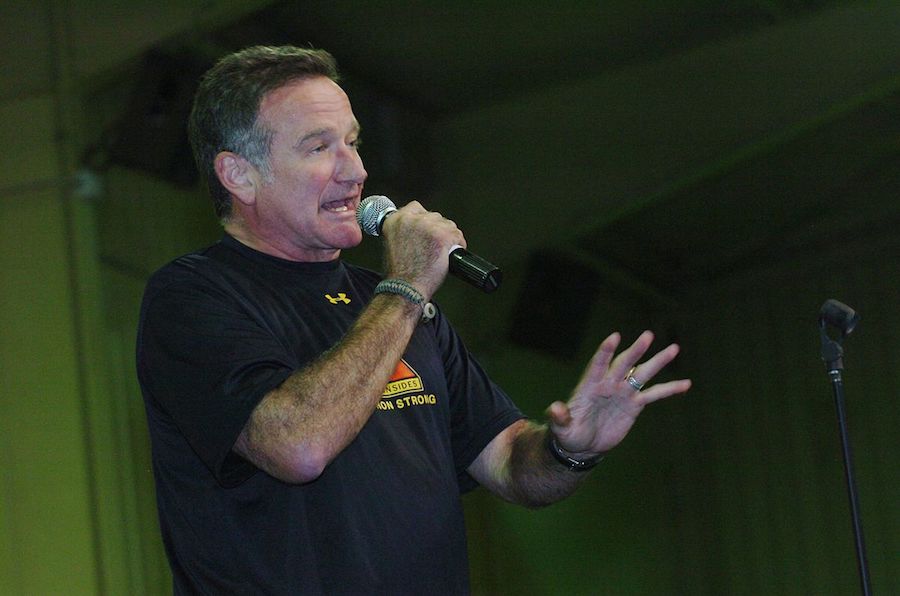
When Robin Williams passed in 2014, it felt like the whole world was in mourning. Williams was perhaps the most beloved comic force of our era, and his passing was riddled with questions, shock and confusion. How can someone who everyone loves kill themselves? Why was he so unhappy? How can someone who is so successful on seemingly every level be so fundamentally discontent?

A childhood favorite in my family was, and continues to be, RV. Perhaps one of Williams’ least critically acclaimed films, RV was nevertheless highly acclaimed in our house. We could have spent our time watching one of his real films, like Dead Poets Society or Good Will Hunting, but RV held a special place in our hearts.

In the film, Williams plays an affable dad in a high-stress job who forsakes his family vacation to attend a business meeting under the guise of wanting to connect with his family during an RV trip to Colorado, the location of the meeting. Williams plays his typical role: the sweet, bizarre dad-type who feels somewhat tortured.

The character we are so used to finding in Williams’ work made his death feel even more personal to his audience. Despite always being funny, there was the sense that William’s comedy sometimes came from a place of personal suffering. And he isn’t by any stretch of the imagination the only comic whose humor is somewhat rooted in pain.

At 43, Maria Bamford has been doing stand-up for just under half of her life, and the way she discusses battles with her mental health are uniquely her own: funny, utterly dark and wildly careening through topics from her parents to her bipolar condition. Bamford has struggled with anxiety, depression and OCD since her childhood. In an interview with comic Marc Maron, she discusses the mental health issues that plagued her childhood. She says she doesn’t talk about her eating disorder much: “It’s like, who hasn’t?”

In her stand-up, Bamford discusses these challenges outright. Because of her transparency, viewers feel less concerned about harm coming to her than they might otherwise. There seems to be a level of frankness — one that can enable her to joke about her illnesses — that seems to prohibit her from not attending to her mental health. Bamford acknowledges that while in some ways she is powerless to her illness, she does seem to have enough self-awareness to seek help.

Bamford is unique within her community of comics. Celebrated comedians like John Belushi, of the original Saturday Night Live cast, and Chris Farley, also an SNL legend, both passed before the age of 40 as a result of drug overdose. Their hilarious, over-the-top personalities as sketch comedians juxtapose strongly with their deaths. Their acts did not include bits about battling depression or addiction. Farley is remembered as hilarious, Belushi as an off-the-wall live performer.

An article in Cracked, “Robin Williams and Why Funny People Kill Themselves,” discussed the prevalence of mental illness, specifically depression, in comedians after Williams’ death. It claims that the general reaction of surprise was illogical. Many individuals who create a comic identity have an inner experience in opposition to their work. The author argues that people who are suffering create an exterior of humor which protects them from potential criticism of their true character, about which they may be insecure.

Bamford herself, in a conversation with Maron, acknowledges the irony of her career — presenting herself to be liked by others while simultaneously struggling to like herself. This irony is present in the case of Robin Williams, who was so loveable to his audience but, maligned by his depression, covertly struggled to love himself.

Comedy has the power to heal, convert, question and challenge. Comedians like Bamford bring mental health issues to light by finding humor in the struggles they inevitably bring. Despite the power in comedy like Bamford’s, perhaps the most troubling aspect of mental illness is that it is often unresponsive to a treatment like open discussion. It’s challenging to understand that Robin Williams was truly a tortured person who protected himself with his humor, but if we are to honor his legacy, we must take him for all that he is and was. His work in comedy may have stemmed from his mental health challenges, may have been an escape from them, or may not bear any relation to them at all.

Comedians prove that humor can live in a destructive harmony with despair. Perhaps as the culture which holds these people becomes more receptive to and understanding of mental illness, the humor which is born from self-loathing will all but disappear, replaced by a Bamford-esque form of honest, self-deprecating, therapeutic discussion of facing and overcoming — but also failing — the insecurity and illness so many comics face.


Written by: Stella Sappington — sasappington@ucdavis.edu.

Disclaimer: The views and opinions expressed by individual columnists belong to the columnists alone and do not necessarily indicate the views and opinions held by The California Aggie.
Water is sacred, water is life

0
Morgan Tieu / AGGIE
Morgan Tieu / AGGIE

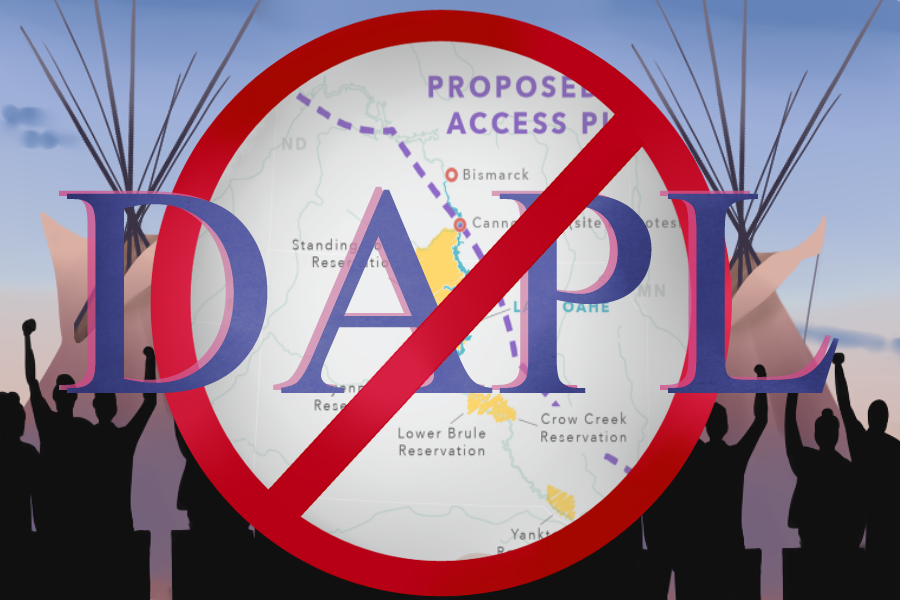
Protesters gather at State Capitol Building for NODAPL rally

“Water is sacred, water is life,” chanted hundreds of demonstrators in protest of the Dakota Access Pipeline at the front of the State Capitol building in downtown Sacramento on Nov. 8.

For the past several months, national attention has been drawn to the controversial Dakota Access Pipeline in North Dakota. Thousands have traveled to the Standing Rock Indian Reservation to protest with the Sioux tribe, including Sophia Baker, one of the Sacramento rally organizers.

“My cousin Lilly and I created the event on Facebook after my boyfriend and I came back from North Dakota,” Baker said. “We came back here and decided we needed to do something for people who can’t go out to North Dakota in California.”

From there, they immediately went to work. Lilly Baker spearheaded the event by calling different local tribes and getting people to come together. The event also included guest speakers from the Coyote Valley Band of Pomo Indians from Mendocino County and the Chippewa tribe, as well as a youth group that performed a tribal dance. According to Baker, the main objective was to bring the issue to a broader scale and make more people aware of the pipeline’s potential consequences.  

Initially, the pipeline was supposed to run through North Dakota’s capitol, Bismarck, The U.S. Army Corps of Engineers deemed this pipeline option not viable and rerouted it to run through the land of the Sioux, who argue that this violates indigenous rights and several treaties. In fact, much of the controversy surrounding the pipeline centers around the right to clean water.

The pipeline runs beneath the Missouri River, the main water source for the tribe. Protesters argue that such a vital resource for life shouldn’t be put under such a large scale risk. Many also argue that if the pipeline were to have an accidental leak or rupture, the Sioux would be left without clean water for an extended period of time.

Priscilla Hunter of the Coyote Valley Band of Pomo Indians shares this fear.

“Indian people are getting tired. Enough is enough you know?” Hunter said. “Destroying our sacred lands, destroying the water and the environment, for our children, that could poison a lot of water and rivers.”

According to Hunter, 10 tribes in Mendocino County alone have passed resolutions to stop the pipeline. Efforts have reached people across the nation thanks to social media according to Fred Short, the American Indian spiritual leader for California.

“This is how information gets out,” Short said. “Now you can see on Facebook and the Internet you know, it’s all over with people putting out all the information. We have people here that are returning from Standing Rock, and they’ll be able to share some of that […] it’s no longer people standing still and saying nothing.”

The pipeline was expected to be completed by Jan. 2017, but protests could potentially cause this date to be moved later. As the issue gains more attention, more protests are organizing in local areas around the country in hopes of getting politicians to stand with Standing Rock.

“We need to hold all of our politicians and all of our corporations accountable for what they’re doing to people and their right to clean water,” Baker said in a closing remark at the event. “There’s no politics involved in it, it’s literally people’s right to clean water that we’re trying to get people to focus on. If they can do it in North Dakota, they can do it anywhere.”


Written By: Andie Joldersma city@theaggie.org

Achieve UC program encourages students to apply to UCs

ALEXA FONTANILLA / AGGIE FILE

UC leaders, officials visit schools and communities

University of California (UC) President Janet Napolitano, along with UC chancellors, leaders, academic advisors and alumni, will visit California schools and communities this fall to encourage students and families to pursue a UC education.

The visits to 100 schools and other community outreach programs are a part of Achieve UC, an initiative by the UC Office of the President (UCOP) to increase enrollment and diversity on UC campuses. The UCOP aims to provide students from a variety of backgrounds the resources to help them prepare for the UC system. The program caters to students seeking a four-year degree as well as to those hoping to transfer from community colleges. Key objectives of the program are affordability and access.

Through Achieve UC, UCOP wants to fight misconceptions that the UC system is unaffordable. Regardless of achievement or family income, a UC education can be affordable, and financial aid plays a key role in ensuring this. A press release by the UC states, “More than half of California undergraduates pay no tuition, and three-quarters pay less than full tuition.”

“[The program is a regional model where] each campus will be connecting with schools in their local area […] it’s a way to help increase access in terms of students who may be first in their family to get a four-year degree, low income, underrepresented and get a wide variety of students that access,” said Ebony Lewis, the executive director for Undergraduate Admissions.

Lewis said that it is important to bring the program directly to the students. Each year, the interest and number of applications to the UC system increases, but Achieve UC focuses on increasing exposure to first-time applicants and students from disadvantaged backgrounds. Not all applicants are aware that they are evaluated based on more than just test scores and grade point average by the universities.

Rogelio Villagrana, the director of the UC Davis Early Academic Outreach Program (EAOP), expressed the importance of letting young people know about the opportunities because they are more likely to take advantage of them.

“The more that they know what the requirements are, the more likely they are to meet those requirements,” Villagrana said.

Achieve UC differs from other initiatives because of the direct connection between university leaders and the students and their families.

“When you have the opportunity to have individuals at a university in positions that the families see as valued […] it creates the possibility for communication and dialogue between university staff and the community,” Villagrana said.

Achieve UC outreach events include workshops, academic advising, application assistance and inspirational messages to encourage students to reach for a UC education.

Napolitano is confident that a UC education is accessible to all students.

“You do your part: work hard, take advantage of leadership opportunities and push yourself to take challenging classes,” Napolitano said in a press release. “And no matter who you are, where you come from or how much money you and your family have, we’ll do our part to help you get there.”


Written by: Jayashri Padmanabhan — campus@theaggie.org

UC transfer application deadline extended

DANIEL TAK / AGGIE
DANIEL TAK / AGGIE

Transfer students given their best chance for admission

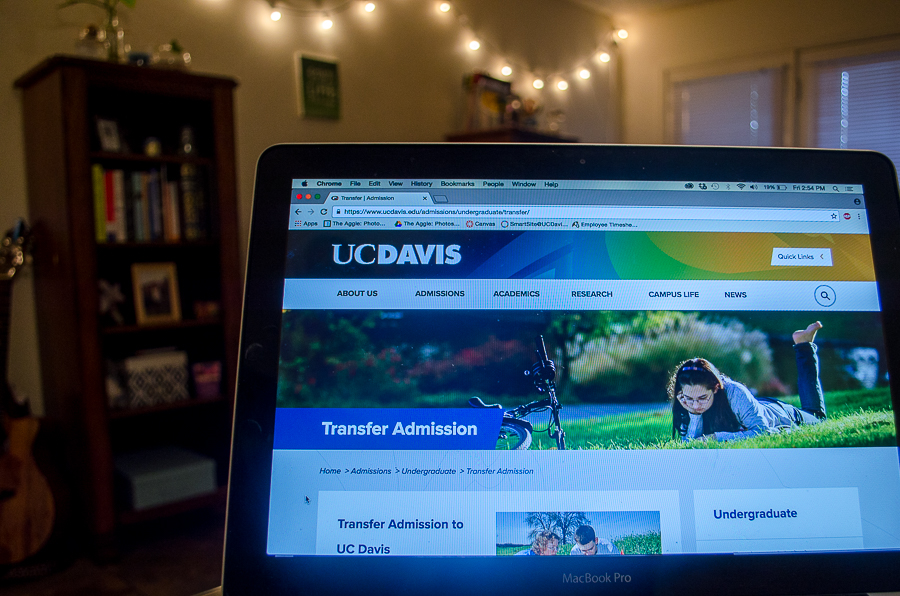
The University of California (UC) announced on Oct. 31 that the fall 2017 deadline for transfer applications would be extended to Jan. 3, 2017 across all UC campuses in an effort to aid transfer applicants.

“Additional time will help hard-working, eligible students across the state give their best shot at applying to [the] UC,” UC President Janet Napolitano said in a press release.

Though the new deadline is approximately a month later than the regular November submission period, January transfer applications will still be reviewed fairly and all applicants will receive their decisions at the same time in April.

However, some majors may not be available to students who apply in January if they fill up during the priority filing period. Students are therefore encouraged to apply in November to avoid not getting into their desired major.

For UC Davis specifically, all majors remain open during the November deadline except undeclared ones, according to the UC Admissions website.

Ebony Lewis, executive director of Undergraduate Admissions, said the purpose of the extension is to give transfer applicants more time to improve their applications.

“It’s to provide more access and opportunities for transfers to apply to the University,” Lewis said in a phone interview. “The University of California has the goal to increase the enrollment of transfer students […] to have a ratio of two freshmen to one transfer student.”

Transfer student Lauren Frizzi, a third-year cognitive science major, said that the application extension may be helpful to students who want to revise their applications over the winter break but who did not have time to perfect them before the November deadline. Frizzi also said that preparation is key regardless of the deadline; she believes that the UC is doing its best to accommodate transfer applicants.

“I knew I wanted to go to Davis, so I […] made sure I had all of the requirements, GE recommendations and experience,” Frizzi said. “It seems like statistically they have a pretty high percentage for the transfer acceptance rate.”

Because the UC is meant to serve California students, its press release accordingly states that 92 percent of incoming transfer students are coming from California community colleges, and 59 percent of all transfer applicants were accepted into the University. Just this year, 5,000 California students were enrolled at the UC, and there are plans to enroll 5,000 more by 2019.

The deadline extension is just one way these potential UC students are aided during the application process. For students like Frizzi, Davis is guiding the efforts to support transfers by streamlining the most popular majors, promoting guaranteed admission and creating the Transfer Admissions Planner, said Lewis.

“UC Davis developed the Transfer Admission Planner that all of the UC campuses use,” Lewis said. “[Applicants] can input the coursework they are currently enrolled in and then, all along their time spent in community college, they can update their information with their grades. We also have staff members working […] to best advise students […] in order to be […] strong applicants.”

Alongside the goal of enrolling more transfer applicants, Lewis concluded that the UC aims to offer admission to students from varying backgrounds.

“I really want to underscore the rich diversity our transfer students bring to campus,” Lewis said. “We’re excited for the coming year and to see where it leads.”


Written by: Jeanna Totah — campus@theaggie.org

Anti-diversity posters discovered on campus

UC DAVIS HMR 1 HUMANWRONGS/HUMAN RIGHTS / FACEBOOK

Interim chancellor Hexter denounces incident as an attack on diversity

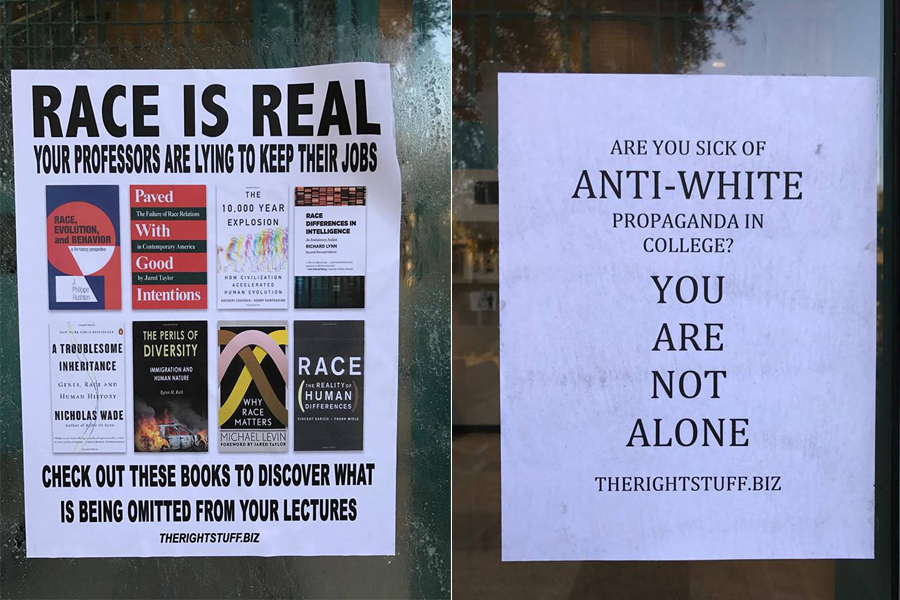
Several anti-diversity posters were found in Sproul Hall, Olson Hall and around the Memorial Union on Nov. 14. These posters included phrases such as “are you sick of anti-white propaganda in college?” and “race is real.” The posters also advertised racially charged books, such as The Perils of Diversity and Race Differences in Intelligence, as well as a racially-charged website. The site includes phrases like “democracy is an interracial porno” and “we’re white and we’re not sorry.”

In a Facebook post, ASUCD reported that students should also be aware of posters with razor blades hidden in the tape, as some found on campus injured several campus faculty and students during a protest last week.

On Nov. 14, an e-mail from the Office of the Chancellor was sent to students and staff informing them of the posters and reaffirming the UC Davis Principles of Community.

Interim chancellor Ralph J. Hexter sent a second e-mail on Nov. 16 further condemning the incident.

“Although the First Amendment may give someone the right to criticize UC Davis’ proud commitment to diversity, it also gives me the right to condemn messages such as the ones we were subjected to this week,” Hexter said in the e-mail. “These posters were designed to fuel hatred directed at virtually every member of our campus community. I encourage vigorous discussion of difficult issues, and I welcome all points of view, but I will not remain silent when confronted with messages designed to stifle discussion by promoting fear and intolerance.”

Many UC Davis faculty members, such as professor in the department of history Kathryn Olmsted, share Hexter’s concern that these posters perpetuate racism and intolerance. Olmsted views the racial sentiment of these posters as a well-defined historical thread within America.

“Theories that there’s a conspiracy against white people have a long history in the United States,” Olmsted said. “You can go back to second Ku Klux Klan in the 1920’s and see this anger among white Protestant Americans that feel like their country is being changed. They believe that white men in particular are losing their place in society and their authority.”

English professor Matthew Stratton related the posters to contextual events within current American politics.

“We’re seeing them all over the country, the grotesque reality of what used to be extremely fringe,” Stratton said. “That has been encouraged and normalized by the media, by the last election. So it’s no surprise that we’re starting to see reports of this happening and worse, all over.”

Written by: Aaron Liss — campus@theaggie.org

UPDATE (11/18/16): The UC Davis Office of Strategic Communications confirmed that there were no blades hidden in the tape of the posters.

Joseph and the Amazing Technicolor Dreamcoat

RUSS CASENHISER / COURTESY

The Biblical saga of Joseph and his coat of many colors comes to life

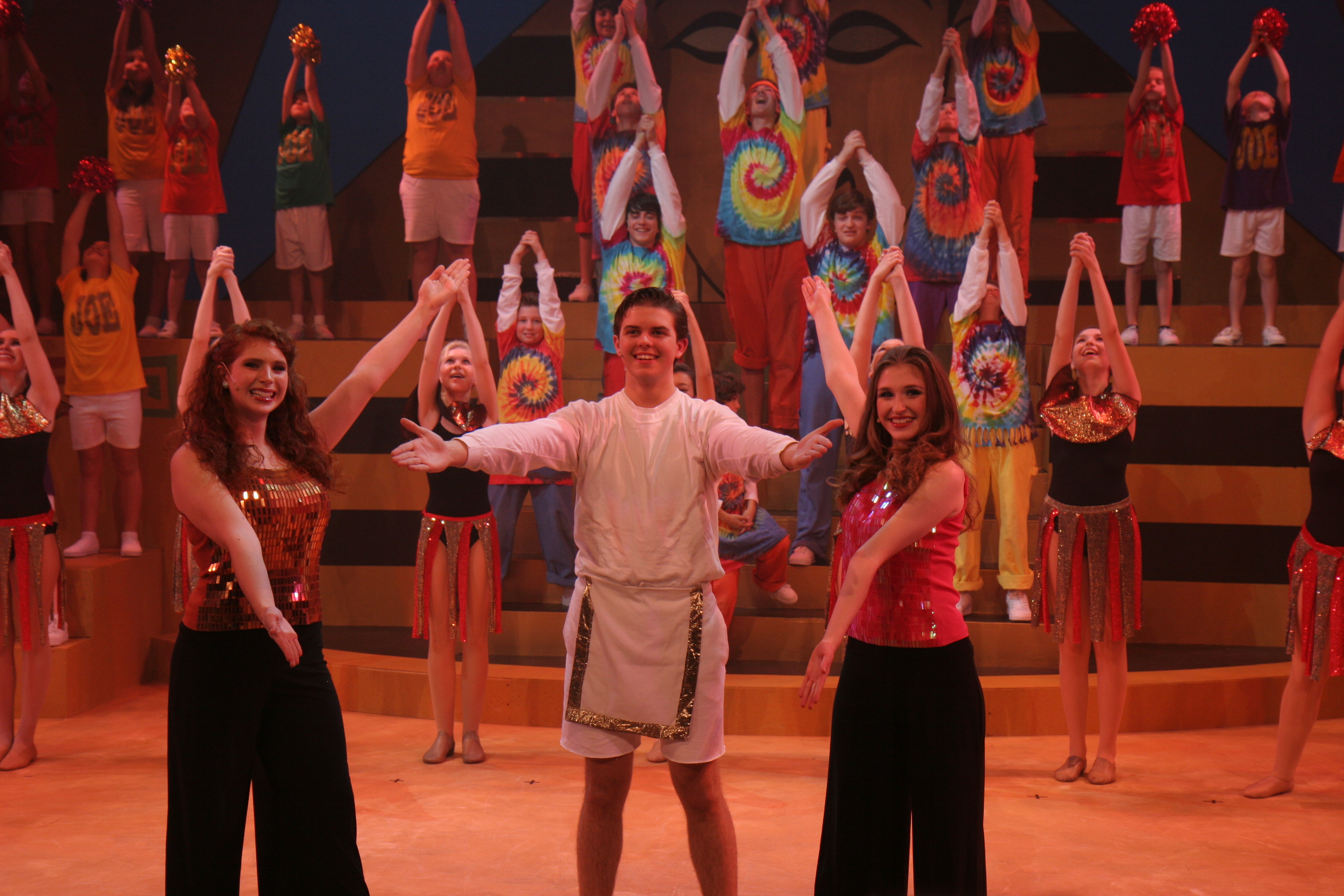
The Davis Musical Theater Company will be presenting a production of Joseph and the Amazing Technicolor Dreamcoat on Saturday, Nov. 19.

The story is based on the “coat of many colors” story of Joseph from the Bible’s Book of Genesis. The titular character is a boy whose ability to have prophetic dreams result in him enduring a series of adventures in which his spirit and humanity are continually challenged.

The company’s main goal is to conserve the classic American musical art form by producing quality, affordable, family-oriented theatrical musicals open to the Davis community. The theater also provides a training ground for amateur theatrical performers, directors, choreographers, musicians and technicians. The production will feature young performers assuming the lead roles.

Diana Henderson, a third-year biological sciences and theater double major, has worked at theaters around Davis and reassured that the production will delve into important issues.

“The play really goes into the impact power has on how people are perceived and [it is] so relevant nowadays considering the presidential elections and how we put people up on this pedestal without actually knowing them,” Henderson said.   

Power certainly is one of the main themes of the play. Joseph starts out as a slave sent to Egypt, but his special ability lands him second-in-command to the Pharaoh. As the play progresses, we see a shift in Joseph’s identity and a shift in how he is perceived by others.

Jeff Rossetti has acted in productions put on by his high school, and explained how these plays not only display young talent, but are also important for the community to see.

“I believe Joseph [and the Technicolor Dreamcoat] will be entertaining while also providing an important message […] there will be a variety of musical styles, like rock n’ roll and calypso, while also incorporating tales from the Old Testament […] it’s a really unique play,” Rossetti said.

Ever since its premiere back in 1970, Joseph and the Technicolor Dreamcoat has been quite popular, praised for its concept and incorporation of a Biblical story with a musical backdrop. The popularity of this production is no secret. According to Really Useful Group, a media company involved in theater and film, over 20,000 schools and amateur theatre groups have performed Joseph and the Technicolor Dreamcoat.

The actors in the play also receive heavy praise because the play is almost completely sung, with little spoken dialogue.

“It’s a difficult play to perform because it requires so much from you […] you have to sing while also acting and that’s what makes this play so special for the actors and the audience,” said Lisa Sousa, a fifth-year economics and political science double major, who acted in a past production of Joseph and the Technicolor Dreamcoat put on by her high school. .

The Davis Musical Theater Company will present Joseph and the Technicolor Dreamcoat from Nov. 19 through Dec. 11. Tickets are $8 and the play is open to all ages. For more information please visit www.dmtc.org.

Written by: Krishan Mithal — arts@theaggie.org


Note, November 20, 2016: Changes made to reflect accuracy. 

Relationship science class to be offered winter quarter

NADIA DORIS / AGGIE
NADIA DORIS / AGGIE

New course focuses on romantic relationships

“Why won’t any of my relationships last?” Students at UC Davis can finally find the answer to this and more of life’s most debilitating questions in a new winter course offered by UC Davis’ Psychology Department.

Psychology 51: Relationship Science: Love, Lust and Evolution is a four-unit course which will cover the universal aspects of relationships, emphasizing the romantic and pave the way for students to develop and interpret questions about the world through a scientific lense.

“The class is on the field of close relationships and evolutionary psychology,” said Paul Eastwick, associate professor in the UC Davis Psychology Department. “It is a class that focuses on the science of close relationships […] the way that people form relationships, the way that they maintain relationships [and] what happens to people when they break up. It mainly has a focus on romantic relationships, although we’ll do a little bit of discussion about other important kinds of relationships, too, like family relationships and friendships.”

Eastwick is a first-year professor at UC Davis and worked in conjunction with the university to provide the Relationship Science course next quarter. In the class, Eastwick will work with students to help them understand world topics through social and psychological bases.

“I think it’s a good example of how you can apply psychological methods and ways of understanding the world through a topic that people are naturally very interested in,” Eastwick said. “What’s really important is that we’re able to instill a deeper appreciation for the social science way of understanding and testing predictions about the world. When it comes to close relationships, we want people to also achieve some of the literal concrete knowledge about what makes relationships work, and how they can function better.”

Mark Cubillan, fourth-year psychology major and academic peer advisor in the Psychology Department, thinks the class could be impactful for students of any major in their career goals.

“I would recommend undergraduate students who have taken PSC 1 […] take the class, because I think it’ll be very interesting,” Cubillan said. “I have interest in learning more about the evolution of attraction and relationships […] and it give us insights into how we are as a people right now, universally and culturally.”

The class is open to all undergraduates and will be a valuable resource for students looking to gain academic insight into their own states of being.

“It’s intended to be the kind of class that you can take and get a lot out of if you are a psych major or planning to be,” Eastwick said. “[But] it can also be [useful] if you are majoring in something else. If you are interested in scientific approaches or the human condition, it’s a perfectly reasonable class for you.”

Andrea Barragan, third-year psychology major, was prompted to take Relationship Science when she saw it advertised in the Psychology Department’s newsletter.

“I think that overall it’s a really good and practical class that people would want to take. I’m happy they’re offering something like this because […] it’s scientific […] I know [the information is] rooted in data and research,” Barragan said.  

Remember Relationship Science: Love, Lust and Evolution for the upcoming pass two registration dates.

Written by: Darien Barnett — science@theaggie.org

Why are birth control and cold medicine harder to get than a gun?

ALEXA FONTANILLA / AGGIE

headshot_taConsumer protection laws will be vitally important in solving the gun epidemic

The beginning of a recent Inside Amy Schumer skit introduces the “OrthoEsterin,” a new, low-dose birth control pill. “Ask your doctor if birth control is right for you,” the ad continues. “Then, ask your boss if birth control is right for you. Ask your boss to ask his priest. Find a Boy Scout and see what he thinks. Tap a mailman on the shoulder. Tell him you didn’t mean to startle him. Then, ask him if birth control is right for you.”

In the ad, Amy Schumer finally receives her birth control from the pharmacy after this arduous, evidently satirical process — only to find out she will have to go through it again next month due to the no-refill caveat of “controlled” prescription medicines. Cut to the next scene: a little boy walks up to the same pharmacist and asks for a gun. The pharmacist hands one across the counter and says, “Remember, that’s your right.”

Although greatly exaggerated, Amy Schumer’s skit highlights the gross disparity between obtaining something as personal as birth control and gaining access to something as potentially dangerous as a gun.

You don’t actually need to ask countless people for their permission to get on birth control, but there are a couple steps you need to go through. You need a prescription and then you need to visit a health care provider, a clinic or a Planned Parenthood center. Once you’re there, your health care provider asks you about your medical history and conducts any other medical exams he or she sees fit.

But, in most states, purchasing a gun requires no such inquiry about a past history, whether it be a criminal record or a possible mental illness.

Cold medicine, too, is often harder to get than a gun. Pseudoephedrine is a drug found in some over-the-counter and prescription cold medicines such as Sudafed or Entex. Pseudoephedrine, however, can also be used to produce methamphetamine illegally, which is why The Combat Methamphetamine Epidemic Act of 2005 works to limit the monthly amount of pseudoephedrine-containing cold medicine an individual can purchase. There is no law that limits how many guns you can buy.

New Jersey passed its “one-gun-a-month” law in 2009, only one of three states in the United States to do so. The law prevents individuals from buying more than one handgun in a 30-day period and aims to prevent mass distribution of guns by private firearm sellers. New Jersey took its cue from Virginia, which effectively passed the one-gun-a-month law in 1993 but saw its repeal in 2012 — despite drastic reductions in out-of-state gun crimes that traced back to Virginia gun dealers.

If more states adopted the same approach to guns as they did cold medicine, mass gun sales and gang activity would surely drop in the same way the Virginia law allowed.

Comparing apples to oranges is always a risky game, especially when it comes to such a widely-disputed topic as guns. Still, it is interesting to note how birth control, a personal choice which affects no one but the individual taking it, and cold medicine, which most people wouldn’t even think to buy to produce meth, are more tightly regulated than guns, which take innocent lives on a daily basis.

Written by: Tamanna Ahluwalia — tahluwalia@ucdavis.edu

Disclaimer: The views and opinions expressed by individual columnists belong to the columnists alone and do not necessarily indicate the views and opinions held by The California Aggie.
HUMOR: Undeclared senior decides that he, too, can someday be president

SPAVAAI [CC BY-NC-ND 2.0] / FLICKR
headshot_evRonald Dump makes his case: ‘Why not me?’

Ronald Dump woke up on Saturday with a goal in mind. The 22-year-old decided that he wanted to be President of the United States of America. Dump is an undeclared fourth-year student from Beverly Hills, Calif. who has taken nearly 160 units of general education courses during his time at UC Davis.

Dump admits to being apathetic and never having had goals in life. He acknowledges that he’s never had much going on, and cites Dwight Eisenhower as an inspiration as he, too, never held political office before assuming the presidency.

“I don’t really feel much about anything, ya know? I rolled out of bed the other day and decided that I wanted to make a difference,” Dump said. “I want to be President of the United States. I have no experience, but who cares? This decision is big. Really big. It’s going to be huge. The future is bright.”

Instead of taking the conventional route that many students interested in politics have and majoring in political science or economics, Dump’s lack of political knowledge has actually sparked his interest. One random person tells him something, and he goes with that. Dump thinks that being impressionable and unpredictable will help him move forward.

“Too often, we have students that get so engaged in their lives at such a young age that they burn themselves out,” Dump said. “This is different. I have no experience, and I think that I’m going to be very fit when the time comes. Presidents have gone to Ivy League schools. I didn’t. I’m an outsider, and I like that. I’ll just learn on the job.”

Dump’s sole political experience was in third grade, when he ran for class president. Dump’s platform then was based on giving his classmates a vending machine on the second floor of the building. The third, fourth and fifth-graders all shared the second floor, while the first and second-graders were left on the first floor. Only the third-graders would get to buy food. Dump lost the election.

Dump admits to lacking experience, but he touts his well-roundedness. Due to the amount of general education courses he’s taken, Dump’s knowledge of seemingly everything plays toward a bright future.

“I believe that given Ronald’s introductory-level knowledge of chemistry, economics and the English language, he will thrive when he becomes old enough to be president,” said Lauren Michelle, who works at Counselors for the Future. “He can help design weapons, figure out the debt situation and negotiate deals given the knowledge he will have accrued once his time as an unfocused Aggie is up.”

Dump’s plan for the future remains unclear. He does not entirely know what he wants to major in, but that isn’t stopping him. Once he finds his passion, he plans to pursue marketing until he turns 35. Then, he’s determined to begin his presidential campaign.

But even Dump’s close friends, aware of his lack of his experience, are questioning his decision. They acknowledge that he wants to make a difference, but they feel this might not be the best route to take.

“This is ludicrous. I’ve known the kid since we were nine, but change has to come at an earlier time than this,” said Ike Dense, Dump’s best friend. “He has no experience. I don’t want someone with no experience in the Oval Office.”

“I support him, but he can make a difference and support his cause elsewhere,” said another friend, Judy Tiuooliani. “He wants to go into marketing — let him do that and share his beliefs, but he shouldn’t try and change the country by becoming president. We appreciate the effort that he’s making, but no real vision or experience beyond an elementary school vending machine is inadequate.”

While this may seem alarming to some, Dump’s determination sets him apart. In the land of opportunity, Dump can do what he wants and pursue his dreams of becoming the leader of the free world. Until then, Dump is going to have to find a major that will help him get his degree.

The future, however, might be bright for the fourth-year. Nobody expects him to win. He has a dream, no experience and, up to this point, no goals. But only the future will tell; nobody has ever assumed so much responsibility with so little experience. The people will decide whether we go down that rabbit hole.

Written by: Ethan Victor — opinion@theaggie.org

Clogston Abroad: Australia reacts to the presidential election

GAGE SKIDMORE [CC BY-SA 2.0] / FLICKR and SARDAKA [CC BY-SA 3.0] / FLICKR
headshot_mcI was in class in Australia as the final results for the U.S. presidential election were becoming clearer. Those few hours will be burned into my memory forever. I felt extreme despair and sorrow and frustration and was left speechless as I watched the electoral college numbers accumulate under Trump’s name. After I saw the final results, I went to sleep in hopes that it was some kind of awful nightmare I could sleep away but I woke up the next day disappointed. It wasn’t.

And when I went to my internship on Nov. 10, I saw the effects of our election in Sydney, Australia. While I knew that the Australian media portrayed Trump mainly in terms of his radical policy proposals, I failed to realize how high his disapproval rating was in Australia. I saw the confusion on the faces of people in the streets and on the train. I saw the fear of the future on the front cover of the newspaper and the omnipresent shock of it all.

I asked my coworkers how the election made them feel, what they thought about it all, what they thought this meant for their futures and for ours as Americans.

They were stunned at the fact that Trump, a media star and “businessman” at most, would now hold the most powerful office in the United States and arguably the world.

They struggled to understand that a win in the popular vote did not automatically confer a winner. They said the electoral college sounded archaic, unstable and was an inaccurate portrayal of what the public actually wanted.

But this election’s result also brought other concerns for Australians.

What about health care necessary for the Australians on vacation in America? Trump’s platform states that he has every intention of removing Obamacare.

What about the safety of non-white Australians who travel to America — or of any person of color visiting the states? How about any person in America that does not belong to the very specific categories Trump has deemed superior to all the others?

Australians are reeling from how some Americans believed that Trump, with all of his glaring problems, should be elected into office. Some stated that there was a lower voter turnout than they would have expected with such rivaling forces this year. Others also pointed to the intense difficulty of voting in the United States. They wondered if weekday voting during working hours, in addition to many other obstacles such as voter ID laws, skewed the results one way or another. In Australia, everyone is required to turn in a ballot on election day — even if it they are left blank.

It seemed that my Australian coworkers knew just as much, if not more, about the election than the majority of Americans. They knew the platforms of the two main candidates, their respective policies and even which states were swing states.

One coworker expressed that fear was the driving factor in current American politics: fear of losing jobs and fear of quick, radical changes. According to her, these sources of anxiety, amongst others, ran rampant enough to allow Trump to get elected.

And yet, Australia remains hopeful for America. They love seeing so many people uniting and working hard to ensure that democratic ideals and justice are protected in the United States. They believe that while Trump’s election is a huge upset, now people will overcome it like any other challenge Americans have overcome before.

So really, Australians sound like most Californians. They’re at a loss for words as to how to describe what has just happened. They fear for our safety, especially the safety of minorities and all the other citizens whose lives have been endangered by the hateful speech and violence that pervade America.

This gives me hope as an American citizen who was born abroad. It lets me know, as it should you, that even across oceans, people want this hatred and fear to be over just as much as we do.

Written by: Michael Clogston — mlclogston@ucdavis.edu

Disclaimer: The views and opinions expressed by individual columnists belong to the columnists alone and do not necessarily indicate the views and opinions held by The California Aggie.
Men’s water polo posts loss against Pacific

0
BRIAN LANDRY / AGGIE

Aggies take tough 7-11 loss against Pacific Tigers, honor graduating senior Tennyson May

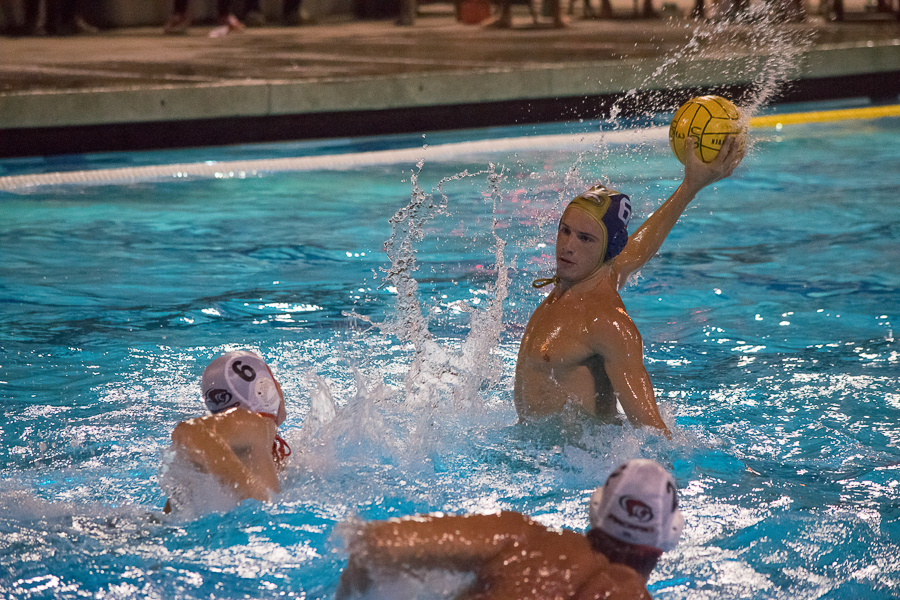
In an exciting game at Schaal Aquatics Center last Saturday night under the lights, the UC Davis men’s water polo team played a hard-fought match against the Pacific Tigers, which ended in a 7-11 loss for the Aggies. Heading into this game, the NCAA had Pacific ranked as No. 5 and UC Davis as No. 8. This loss brings the team’s overall record for the season to 21-5.

The beginning of the first period proved very promising for the Aggies, as sophomore attacker Ido Goldschmidt assisted junior attacker Cory Laidig at the 5:44 mark to put the Aggies on the board 1-0. Pacific soon tied the game up, and quickly took the lead at the 1:19 mark on a 6-on-5 conversion, 2-1. UC Davis used the short time left in the first period to its advantage, as freshman center Eric Martel tied the game up for the Aggies at 2-2. Junior goalkeeper Spencer Creed racked up an impressive four saves against the Tigers in the first.

On a five-meter penalty shot and a goal in the second period, Pacific extended their lead on the Aggies 5-3. Another goal by the Tigers increased the lead on UC Davis to 6-3 at halftime. The only goal for the Aggies in the second period was scored by sophomore utility Nick Coufal.

BRIAN LANDRY / AGGIE

The third period of play proved to be very exciting for the UC Davis, as sophomore utility Sasa Antunovic brought the Aggies to within two goals of the Tigers twice. Antunovic scored an impressive three-goal hat trick this period, his first being at the 6:55 mark and the second just a minute later.

After two goals by the Tigers, increasing their lead to 9-5, sophomore center defender Riley Venne put the ball in the back of the net at 2:15, helped by an assist from Goldschmidt. Antunovic was not far behind, and scored his third which reduced the Tigers’ lead to 9-7.

Pacific increased its lead with two more goals in the fourth period of play. Though UC Davis outshot the Tigers 26-25, the Aggies could not make any more goals, and the game ended 11-7, Pacific.

“[We] are facing a different caliber of an opponent than some of the other teams that we face. It is a much more difficult game a different level of pressure in terms of getting punished for your mistakes,” said head coach Daniel Leyson. “I think it is a positive for us. We have never played Pacific this close, being within a couple goals. With a couple different plays we are much closer. That is the difference in these types of games is that you have to convert your crucial opportunities.”

BRIAN LANDRY / AGGIE

Even with the Aggies’ tough loss, the night was not complete without honoring lone senior center and captain Tennyson May, who played his last game at Schaal Aquatics Center.

“It is pretty surreal,” May said. “It is one of those moments that you think about and never really think is actually going to come. It is a cool feeling. I love this team, I love this school and to be a part of this is the best thing that has ever happened to me.”

The next match for UC Davis men’s water polo will be at the Western Water Polo Association Championships hosted by Santa Clara from Nov. 18 to 20, where the Aggies will enter as the number one seed.

Written by: Ryan Bugsch — sports@theaggie.org

Aggie women start basketball season 2-0

0
CAT TAYLOR / AGGIE FILE

Bessolo erupts as the Aggies demolish Holy Names by 40 points at the Pavilion

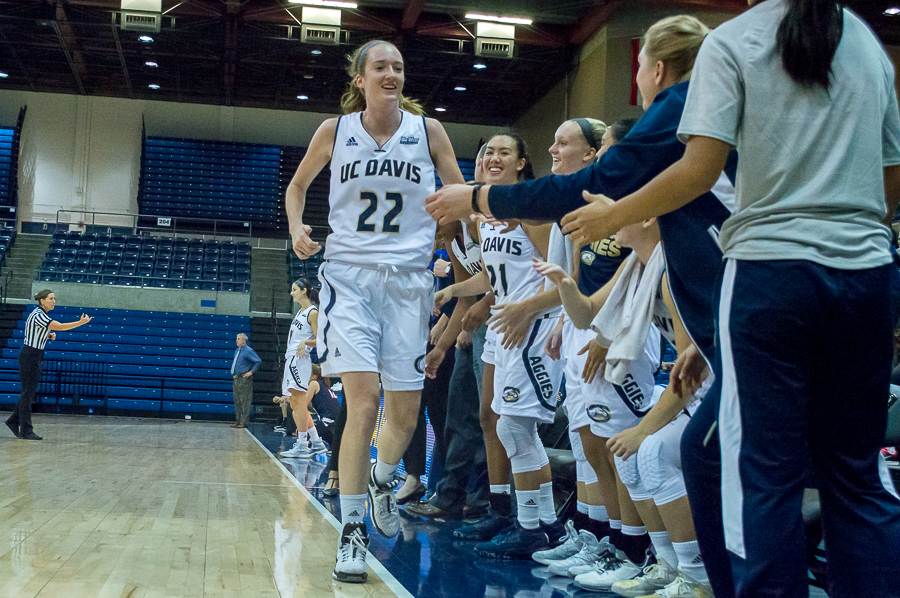
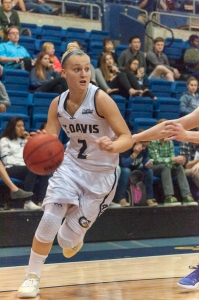
Even after her team throttled Holy Names by a score of 91-51 on Sunday afternoon at the Pavilion, UC Davis women’s basketball head coach Jennifer Gross said that her team still has lots of areas to improve on.

Despite leading the Hawks 49-22 at halftime, Gross wasn’t satisfied with her team’s defensive effort. During the break, she let her squad know that the team needed to do a better job securing defensive rebounds.

“Quite honestly [the defensive rebounding] wasn’t good enough in the second half either,” Gross said. “So that’s an area where we’re really going to have to focus our efforts and really get better there.”

An area that Gross was pleased with was the Aggies’ fast start on Sunday. UC Davis hopped up to a fast 7-0 lead before Holy Names was even able to put points on the board. Sophomore center Morgan Bertsch broke the net first, scoring ten opening quarter points to go along with two Aggie rebounds. Junior forward Pele Gianotti also hit from downtown en route to five first quarter points.

“We came out with a lot of urgency and focus,” Gross added. “And for the most part we got better [on Sunday].”

After the hot start, UC Davis led the Hawks, 23-6, after a quarter of play.

During the second quarter, it was Holy Names who struck early. The Hawks’ starting point guard, Lindsay Littlejohn, hurt the Aggies from behind the arc, tallying three triples for a nine-point quarter. However, the Aggie offense continued to produce on the opposite end, recording 26 second-quarter points. Gianotti found the net on four separate occasions and UC Davis freshman phenomenon forward Nina Bessolo scored six points in just five minutes of action.

IAN JONES / AGGIE FILE

“I think [Nina’s] going to be a tremendous player,” Gross said. “She’s obviously a phenomenal athlete and she can be such a spark for us, both defensively and offensively.”

Gross is confident that once Bessolo becomes more accustomed to the speed of college basketball, she’ll become a consistent playmaker for the Aggies. The young Aggie looked right at home on Sunday, tallying a career-high 16 points to lead UC Davis, along with eight rebounds, two blocks and two steals.

“She just needs to let the game come to her,” Gross said. “But I can already see greatness.”

Starting the second half with a 27-point advantage, UC Davis junior guards Dani Nafekh and Rachel Nagel kept the Holy Names defense on its toes. Nafekh connected with Nagel across the court early on, translating into a Nagel floater from 10 feet out.
Next, Nafekh fed three separate Aggie shooters on three-pointers (Bessolo, Sophia Song and Karley Eaton) — which included freshman forward Song’s first career Aggie points. Nafekh finished the quarter with five assists.

After three tilts, UC Davis had a 40 point lead, 76-36. And the UC Davis defense didn’t stutter in the fourth quarter either. For a nearly four-minute stretch, the Aggies kept the Hawks from scoring in the fourth and forced Holy Names down into the paint, where the Hawks scored 12 of their 15 fourth-quarter points.

Gross said the Aggies have been focused on improving their team defense since day one this season, and to watch her players lock down on Holy Names, even with her two bigs (Bertcsh and redshirt junior center Marly Anderson) on the sideline, was extremely pleasing.

“When Marly and Morgan are out we have Lauren Beyer,” Gross said. “She might have limited minutes, but she’s one of the smartest players out on the court. She’s been here for a while and she’s always in the right place at the right time and does a great job anchoring our defense for us.”

With three formidable post players at her disposal in Bertsch, Anderson and Beyer, Gross has a handful of options to pick and choose from this season as the Aggies go up against some of the Big West’s tougher frontcourts.

“We also have young kids that are athletic and can compete with them,” Gross said, hinting at the Aggies 6-foot-2 freshman center Emma Gibb.

Now 2-0, UC Davis will have a week off before hitting the road to take on Pacific in Stockton next Monday, Nov. 21. The Aggies will return to the Pavilion again on Wednesday, Nov. 23 at 7 p.m. to face Montana State.

Written by: Owen Yancher — oyancher@gmail.com

Owen Yancher is a student at Sacramento City College

Beautiful and functional

0
CHELBERT DAI / AGGIE

Historical wetland habitats provide nature space to de-stress

A huge mass of black swarms across the sky, momentarily blocking the golden rays of the late afternoon sun. It twists and turns, gracefully bending and bulging into different shapes until it sinks back down to earth, disappearing in the tall brown grasses of the marshland.

This morphing mass that can be seen across the Central Valley is actually made up of thousands of small individual forms — birds. This phenomenon is called a murmuration.

“You’ll be driving along the highway, and over an open field, a grassland or across the valley, you see a huge flock of birds,” said Sami LaRocca, a tour guide for the Davis Wetlands. “The birds act as this one organism, and it’s just phenomenal to watch. Sometimes they fill the whole sky, twisting […] over themselves to make intricate artwork. It’s just wonderful.”

According to LaRocca, many observers of these murmurations believe they are made up of one type of bird, but these flocks are often more than a single species. Birdwatchers enjoy watching murmurations and try to point out the oddities in each one.

“[The birds] come together to find a place to roost at night and they use their energy to connect with one another,” LaRocca said. “While they’re going around they’re chattering […] and don’t run into each other hardly ever.”

The Davis Wetlands is one of many popular destinations among the birding community. The Wetlands host a large variety of wildlife besides these birds — mammals, reptiles, amphibians and many species of trees, shrubs, grasses and emergent aquatic plants inhabit the area as well.

LaRocca has been a docent with the Yolo Basin Foundation for the past 12 years, but it wasn’t until about three years ago that she learned about birds. Now she feels confident enough in her knowledge that she leads tours of the wetlands for fellow birdwatchers and other local residents of the area.

“Our mission statement says [that the Yolo Basin Foundation] is an environmental education nonprofit dedicated to the stewardship of wetlands in the Yolo Basin,” said Michael Herrera, community outreach and volunteer coordinator for the Yolo Basin Foundation. “[The Yolo Basin Foundation] leads educational tours of the Davis Wetlands and the Yolo Bypass [Wildlife Area].”

These tours are available to the public the first Saturday of every month at the Davis Wetlands and the second Saturday of every month at the Yolo Bypass Wildlife Area; both serving as opportunities to learn more about why the Yolo Basin is considered a prime location for wetland restoration. Indeed, until the turn of the century, much of the Central Valley existed as wetlands. In fact, about 95 percent of the original wetlands have been lost due to urban and agricultural manipulations of the land.

It may seem strange that the vast spaces of farmland we see today used to be marshlands during most of the year. As students, there is a universal generalization that the Central Valley is simply flat, empty land best fit for agriculture, and has always been that way. This assumption, however, is wrong. The local environment used to be very different.

“The Yolo Basin is the historic term for the large floodplain that existed between Davis and Sacramento,” said John T. McNerney, a Wildlife Resource Specialist for the City of Davis, in an e-mail interview. “Today the ‘basin’ is generally referenced to as the Yolo Bypass which is contained by levees on the east and west sides. The Bypass moves Sacramento River flood waters past the city of Sacramento to the delta.”

The Yolo Wildlife Area is managed by the California Department of Fish and Wildlife, while the Davis Wetlands are owned and maintained by the City of Davis. Both areas, though, are part of a growing effort to preserve and restore native habitats.

Not only do the Davis Wetlands provide support for native wildlife, but they are part of the wastewater treatment process. In 1970, the City of Davis constructed the Water Pollution Control Plant, colloquially referred to as the wastewater treatment plant. It receives raw sewage from the City of Davis, which undergoes a series of treatment processes until it reaches an advanced secondary level before it is released into the watershed.

“The Davis Wetlands were constructed in 1999 to restore wetlands habitat and provide additional wastewater and stormwater treatment,” McNerney said. “At the moment, the Davis Wetlands are considered part of the wastewater treatment process. They act as polishing basins for additional removal of suspended solids and nutrients from the wastewater. Likewise, the Wetlands detain stormwater runoff to allow the settling of suspended solids and sediments.”

Under federal law, water that is treated at the secondary level is not meant for human use, but does not bother the waterfowl that occupy the ponds, or tracts, of transitioning wastewater. The aquatic vegetation within these tracts filters the water, oxygenates it and allows microorganisms to contract. If it weren’t for the wastewater treatment plant and the wastewater from the community, the birds and other animals that rely on this type of marsh environment would be without a habitat.

There are a total of 220 acres of permanent wetlands, 44 acres of seasonal wetlands, 26 acres of riparian woodlands and 208 acres of grassland. Essentially, there is a lot of nature that the wetlands have to offer, and it’s only a 15 minute drive (30 minute bike ride) away from the heart of campus. With the stress of school and pressures of responsibilities, these spaces offer an opportunity to escape to a beautiful place as well as learn about the native environment, and maybe even pick up birdwatching as a new hobby.

Any and all of these places around here are wonderful places to go on tours,” LaRocca said. “You don’t have to be a scientist or have an interest in birds, [it’s good for] you [if you] just want to get out in nature and breathe fresh air. […] It’s as fresh as you can get, especially in our polluted society.

Written by: Marlys Jeane — features@theaggie.org

Every drop counts!

0
NICKI PADAR / AGGIE
NICKI PADAR / AGGIE

UC Davis wins Causeway Classic Blood Drive, students save lives

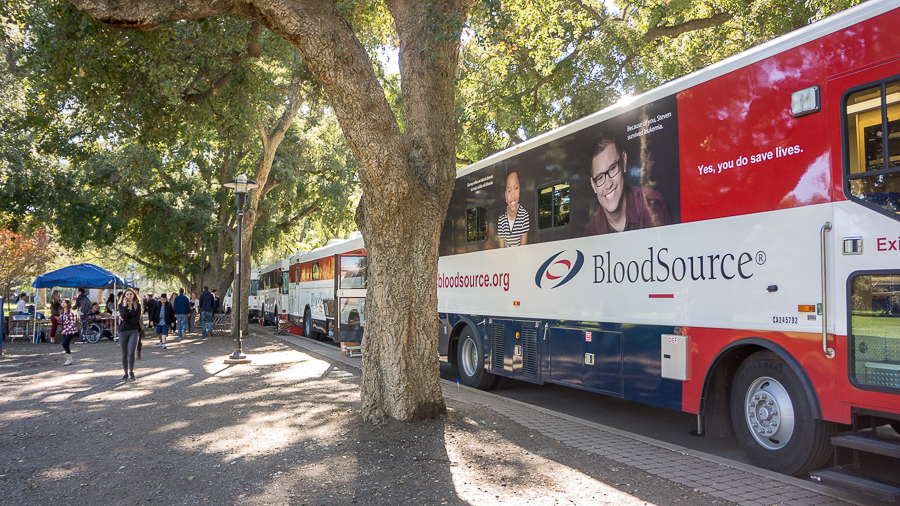
Congratulations Aggies! UC Davis has officially won the annual Causeway Classic Blood Drive. Organized by BloodSource, the three-day event allowed 1,031 UC Davis students to successfully donate blood in competition with California State University, Sacramento, giving thousands of patients a second chance at life.

Felicia Roper, a blood drive coordinator and account manager for BloodSource, believes the blood drive was both a friendly competition and a great cause to save lives.

“We are here five times a year and we invite everyone to come out every time they get a chance,” Roper said. “We’ve had a great turnout [this time]. It looks like […] there’s going to be a lot of lives that are saved.”

        High schools and colleges are often hot spots for blood drives. Roper explains how introducing young people to blood donation is a great way to help develop the lifelong practice of being a donor.

“One pint can actually save three lives [from] our high school population, we receive typically around 17 or 18,000 pints a year,” Roper said. “High schoolers love to donate blood. What we find is a lot of people who donate in high school carry [the practice] into college. And if they didn’t donate in high school it’s a perfect opportunity for new donors to get started.”

Annie Truong, a third-year statistics major,  is a part of Alpha Phi Omega, and was motivated to donate blood by the fraternity’s required hour of community service for the country at large.

“This is my first time giving blood, so I’m kind of scared,” Truong said.

Nonetheless, Truong stayed determined to swallow her fear and make a difference. Also there to donate blood was Jeanelle Smoot, a third-year chemistry major.

“I don’t know if I actually save lives but I’m sure it helps, so it’s a really nice feeling,” Smoot said.

On a similar note of optimism and helping others, Ryan Borden, a third-year biochemistry major, explained why he helps run the event as one of the student co-directors. Borden was highly involved with setting up and publicizing the event, and didn’t allow a rainy day to fade out the cause.  

“We did all the publicity A-boards, posters [but] on Monday it poured, so some of them faded. […] On Tuesday I went back and put another poster on top,” Borden said.

Borden enjoys the enthusiasm of the campus when the bloodmobiles come to the Quad.

“I really like the atmosphere of the blood drive,” Borden said. “I feel like there’s a lot of campus support. When I’m ‘flyer-ing’ for my other organizations a lot of people don’t take the fliers. But for the blood drive people [tend to say] ‘no’ and then they [say] ‘oh blood drive ok!’ I like that we can make such a big impact, because it is really important.”

In addition to the organizers and donors, nurses play a pivotal role in the blood drive by actually drawing the blood from the volunteers. Abie Lee, a nurse who works for BloodSource, helped make the event possible. Explaining why she chose this job, Lee shared her devotion towards supplying those in need with essential blood.

“Having the blood drive keeps hospitals with their blood supply,” Lee said. “If we don’t have many volunteers who donate blood then patients don’t have the blood to use for surgeries [or] transfusions.”

Though she doesn’t directly work with patients in a hospital, Lee finds it rewarding that the whole process of donating blood comes full circle.

“We have some people who work for [BloodSource] and also have jobs at the hospital, and every now and then they’ll send us a photo [of a surviving patient],” Lee said.

There are some misconceptions about blood drives surrounding proper preparation tactics to follow prior to donating. These misconceptions may unnecessarily lead to an unpleasant experience while donating, such as fainting and weakness.

“Come prepared,” Roper said. “If you are going to come donate blood, eat a good meal beforehand. People think ‘Oh I’m gonna give blood, I shouldn’t eat,’ because that’s what they do for a blood test.”

Roper believes in the importance of blood donation, and the very tangible impact it has on the lives of others.

“There is a need for blood donation,” Roper said. “A lot of people I know are scared of needles and it’s a really big thing that we hear, but it’s a small sacrifice to save a life.”

Written by: Sahiti Vemula — features@theaggie.org

Venerating our Veterans

0
MORGAN TIEU / AGGIE
MORGAN TIEU / AGGIE

Reception, resources bring recognition, respect to UC Davis veterans

UC Davis held its first-ever reception in honor of Veteran’s Day on Wednesday Nov. 9.

“[The University of California Office of the President] (UCOP) had a series of events that they wanted each of the campuses, if they could, to do something to honor veterans,” said Bruce Mattos, event organizer and member of the Veteran Constituency Group (VCG). “I brought it back to our team here at the VCG that I think we should just do a veterans appreciation event and invite our campus veterans, whether they’re students, faculty and staff, out of respect to them and their service.”

The Davis reception featured veteran and guest speaker U.S. District Judge Morrison C. England Jr., who served from 1988 until he was confirmed as a federal judge in 2002. In addition to England, veterans from the Wounded Warrior project, a national military and veterans charity service organization, also spoke at the event.

In thanks, Lodi Woodbridge Rose Society donated a flower arrangement for the service, as well as rose arrangements for every veteran in attendance of the event. Safe Credit Union also donated a gift basket for a raffle.

This event is just to thank people,” Mattos said. “It’s a good way to celebrate [Veteran’s] week — it’s not just because we have the day off, [the reception is] kind of understanding that there’s more to it. Being a [veteran] myself, it does have meaning to me.”

The VCG was recognized as a constituent group in November of 2014. Since then, they have worked to be a resource group for faculty, staff and student veterans.

“We are one of the newer constituent groups and our main goal is letting people know we exist,” said Diane Carr, vice chair of VCG.

The VCG reviews campus policies and procedures affecting veterans in relation to employment and educational opportunities and promotes the general welfare of veterans, service members and military family at UC Davis.

Veterans can utilize the Transfer Reentry Veterans Center (TRVC), located in Dutton Hall, as a resource on campus. Located inside TRVC is the Veterans Affairs (VA) office.

“The [Veterans Affairs office] is specifically for our student veterans and dependents of veterans because they have educational benefits that need to be administered,” said Victor Garcia, advisor at TRVC. “There’s a lot of paperwork involved not only [for] the VA [office] but also the school, so the VA office kind of serves as that middle person for those benefits.”

With the completion of the Memorial Union (MU) renovation will come a new Veterans Success Center. The opening of the Veterans Success Center is tied to the completion of the MU renovation. Garcia said that it was fated that the Veterans Success Center would be housed in the Memorial Union.

“Part of the goal with the renovation is to re-educate the campus community that the Memorial Union is not the ‘MU’ — it’s the Memorial Union and bring that [name] back,” Garcia said. “The Memorial Union is really one of the places here on campus that should not be initialized because it was dedicated to Aggie alumni and students that have died in service.”

This center will be specifically for veterans or dependents of veterans and will contain the VA office and offer veteran specific services like workshops and counseling. Currently, the VA office has one staff member work with the administration of veteran benefits. The new Veterans Success Center will allow for a center coordinator, along with this existing staff member.

“What we have here at UC Davis for our student veterans is great but we are doing it with limited resources,” Garcia said. “To be able to say that we’re almost going to double the amount of resources at least personnel wise — that’s where it gets really exciting. [The expansion] will allow us to really [meet the specific needs of] veteran and dependents of veteran programming.”

The TRV center tied yellow ribbons around the quad during the week of Nov. 7 to honor veterans. Some of the trees also have information sheets on them to explain what the ribbons symbolize in order to raise further awareness.

“I think we do a fairly decent job of providing resources to our students given what resources we have,” Garcia said. “What the campus can do more is the campus community can educate themselves a little bit more on what the experiences are of student veterans or military affiliated students. There’s a lot that the campus can do to educate themselves on these experiences […] so that when they are interacting with these students they can have a better understanding of what issues and concerns are specific to that student.”

Megan Kennedy, veteran and admissions analyst and advisor for Undergraduate Admissions, graduated from UC Davis in 2014 after three years of service. Kennedy now works with the veteran and military population specifically.

“I advise [veterans] on how to get to UC Davis [and] how to meet our admission and eligibility requirements,” Kennedy said.

As a student veteran, Kennedy faced certain struggles while transitioning to campus. According to Kennedy, improper diagnosis of her psychological issues led to panic attacks and anxiety that strained her grades.

“One of the other problems was I also had physical disabilities,” Kennedy said. “A big challenge was that the Student Disability Center [sorts you] by the type of disability you have. As a veteran who has multiple things going on, you don’t get individualized attention, so that was a little bit of a struggle.”

Kennedy also found navigating UC Davis and its different offices to be difficult. In the future, Veterans can use the upcoming Veterans Success Center, VCG, and other organizations on campus as resources to ease their transition.

“As a student, as an alum, [and] as a staff member I try to still advocate for [the campus] to understand that there are so many things going on, there are so many things we have to keep track of,” Kennedy said. “The veteran center is going to be crucial in helping our veterans because that way there’s going to be a central place they can go.”

Written by: Fatima Siddiqui — features@theaggie.org