55.7 F
Davis

Davis, California

Monday, December 22, 2025
Home Blog Page 680

The truth about kava

AMY HOANG / AGGIE
AMY HOANG / AGGIE

What kava is, what it’s used for, common myths

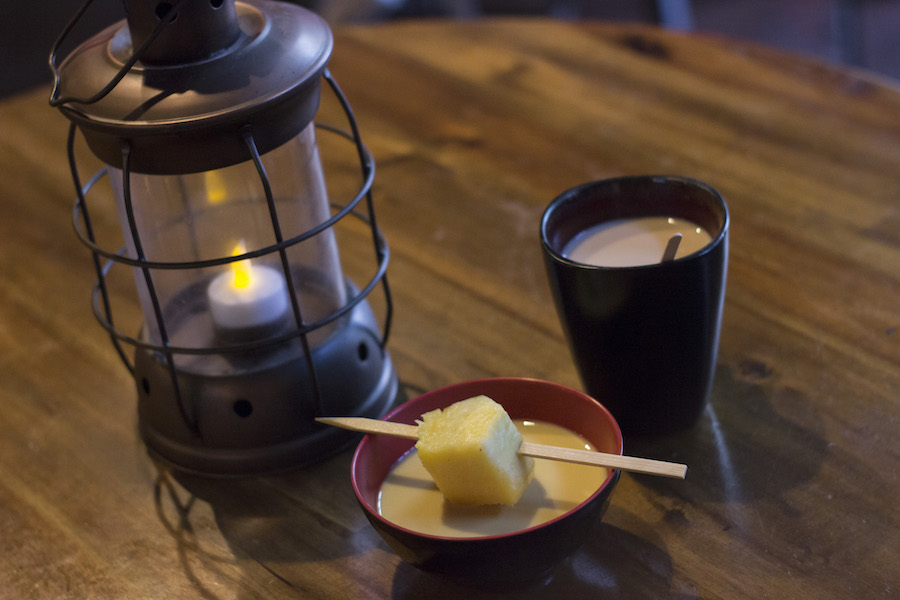
Kava is a root that has been used ceremonially, medicinally and recreationally for over 2500 years in Polynesian, Melanesian and Micronesian cultures. Recently, kava bars have been popping up in the United States, and demand for the root is growing steadily.

Travis Lowin and Tyler Blythe are co-owners of The Root of Happiness Kava Bar, which has locations in Davis and Rancho Cordova. When they opened their own kava bar, Lowin and Blythe saw that there was a significant lack of testing in the field.

“Originally, what we noticed with kava is that there really wasn’t a standard of quality,” Lowin said. “Is it being tested for purity microbiologically? Are you [testing] for pure microbes whenever it comes in? Is it being ran through for not only the purity, but also the quality?”

Because of the lack of quantifiable standards in the kava industry, Lowin and Blythe made it a personal mission to test their products before offering them to the public, and they established a system for measuring kava potency and quality.

“Everything we serve here, you can literally pull out the binder and go through,” Lowin said. “From our concentrated powders, to our lemon honey concentrate, to the raw materials in general.”

Kava is largely associated with having calming properties, both for the body and the mind. Glenn Reddy, a second-year economics and computer science major at Vanderbilt University, was recently visiting a friend in Davis when he decided to go to The Root of Happiness.

“Because it was something that was entirely legal, and it was something that you didn’t have to be 21 for […] I really didn’t expect much at all,” Reddy said. “[After a few drinks] I was very content to relax and to sit on the very plush couches. It felt really nice.”

Kava’s relaxing properties can be directly attributed to its chemical composition.

“The active ingredients [in kava] are kavalactones. There’s 18 total identifiable kavalactones, six of which contribute the pharmacological effect,” Blythe said. “It’s not like a  standardized, one-chemical deal […] It’s six different chemicals, and each chemical has multiple pharmacological contributions to the whole effect.”

These kavalactones interact with the human body to produce calming effects in multiple ways. In addition to affecting calcium channel blockers, kavalactones interact with the endocannabinoid system, which has a role in the modulation of pain and inflammation.

“The human body already has this fascinating endocannabinoid system and within it, you [have a] very intricate network of cannabinoid receptors that our body naturally knows how to use to process naturally occurring chemicals, let’s say in plants, that interact with that system,” Lowin said. “We found kavalactones, [which] obviously come from kava, but directly interact with a benefit within the endocannabinoid.”

As indicated by the name, the cannabinoid system is also affected by cannabis. However, it also is stimulated by black pepper, rosemary and other plants, according to Blythe.

A curious abnormality of kava usage is the reverse tolerance principle. Kava users find that the more often they consume kava, the less kava they have to take to feel the effects. This idea seems counterintuitive when compared to more commonly consumed substances like alcohol and coffee, whose effects are abated with time. According to Blythe, one possible explanation is the stability of the kavalactones.

“There’s long-term acting chemicals that hang around in kava. Whether [or not] they’re affecting you on a noticeable level, they’re still lingering around, they are long half-life chemicals,” Blythe said. “That’s one explanation for what it is, is that they hang around. Maybe for a day or two, maybe for longer. After you’ve been [consuming the chemicals] day after day after day, it accumulates in your system.”

One of the largest concerns around the root deals with a reported trend between kava usage and liver toxicity. According to Blythe, these concerns can be ameliorated.

“What happened in the early ‘90’s to 2000’s is that a bad batch of kava got made, and due to the poor quality controls, record keeping wasn’t up to spec,” Blythe said. “That [instance] traced back to one pharmaceutical company in Germany, Schwabe Pharmaceuticals, who had made a batch of [bad] kava extract and gotten a bunch of people sick.”

Because the recordkeeping was so poor, Blythe said that there are still a lot of unanswered questions about the purity, quality and extractions methods that Schwabe Pharmaceuticals used. However, even the reported cases of liver toxicity were few and far between, according to Blythe.

“We have 500 million daily doses of kava being distributed within Europe over a 10 year period [and] 37 cases of possible correlation of liver toxicity were reported,” Blythe said. “A group of three German scientists who were in charge of investigating those cases narrowed all of them down to three [legitimate] cases […] So out of 500 million daily doses distributed over a decade in Europe, due to one [bad] batch of kava, we had three cases of liver toxicity and never again.”

In starting Root Of Happiness, Blythe and Lowin are excited to offer kava as an alternative to other substances. Winding down at the end of the day with a bowl of kava as opposed to the traditional cold beer is the more relaxing option, according to Blythe.

“[Kava] soothes all your day to day tension,” Blythe said. “It kinda feels like how you should feel without kava. Just kind of calm, and soothing and easy going.”


Written by: Meral Basit – science@theaggie.org
UC Davis releases 2015-2016 annual Campus Travel Survey results

AMY HOANG / AGGIE
AMY HOANG / AGGIE

Results reveal a decrease in the university’s carbon footprint

Over the past eight years, UC Davis has sent an annual questionnaire to a sampling of faculty, students and staff asking about their means of travel to campus, their length of commute and more. The survey, titled the Campus Travel Survey, is a joint project between Transportation Services (TAPS) and the Institute of Transportation Studies (ITS) at UC Davis.

The most recent survey for the 2016-2017 school year was distributed on Oct. 31 by Interim Provost and Executive Vice Chancellor Ken Burtis. Results of the travel survey from last fall were released in late October. The results were detailed last month by Eric Gudz, a recent graduate of the ITS, and Drew Heckathorn, a current graduate student in the ITS.

The survey revealed that as the number of people traveling to campus has increased in the past year while the number of people driving alone to campus has fallen. The overall carbon footprint shrank, from 7.8 pounds of carbon-dioxide-equivalent per capita each weekday in the 2014 to 2015 school year to 7.2 pounds per capita in 2015 to 2016.

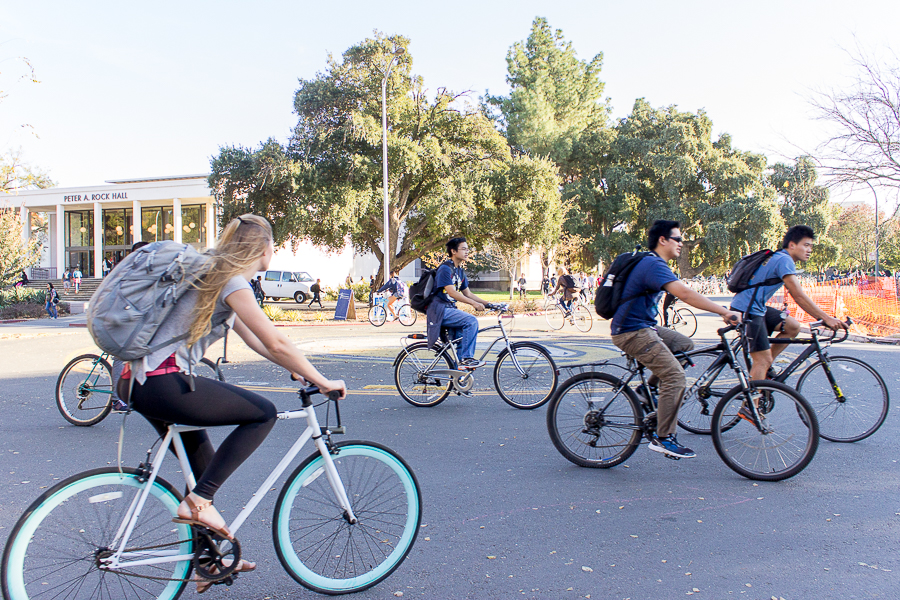
From the 2014 to 2015 to the 2015 to 2016 school year, 1.7 percent more people traveled to campus in general, 0.3 percent fewer people bicycled and 0.5 percent more people walked or skated. 1.5 percent fewer people drove alone and 1.2 percent of people rode buses more often. 45.3 percent of the campus community reported mostly biked to campus.

Drew Heckathorn, a graduate student researcher and masters student within the Transportation Technology and Policy Department, said that these results show that UC Davis is a leader in sustainability.

“The results obtained last year continue to support UC Davis’ reputation as a sustainable transportation leader,” Heckathorn said. “UC Davis claims the least amount of personal vehicles brought to campus per capita than any other UC campus with reported information, which means more people biking, taking transit, walking and carpooling.”

Luis Armenta, third-year psychology and neurobiology, physiology and behavior double major, has been biking to campus for three years now and feels that it is the best way to get to school and commute within campus.

“Riding a bicycle to class makes up for the 30 minutes of exercise a day that is hugely recommended,” Armenta said.  “Buses get really crowded during prime time, so skipping that is a blessing.”

For this year’s survey, Heckathorn said that they added a few questions to see people’s perceptions and attitudes towards biking as well as some questions regarding emerging technologies such as ridesharing services like Uber and Lyft. These additional questions were guided by research conducted by Ph.D. students associated with the Institute of Transportation Studies.

The results of this survey affected the Long Range Development Plan (LRDP), in particular the commute mode share and geographic distribution of commuters, to inform the transportation element of the plan. The LRDP intends on reducing the number of drive-alone commute trips to campus, and these results are helpful in showing the current level of drive-alone commuting and the geographic distribution of these trips.

Director of Transportation Services Clifford Contreras believes that this survey helps the campus understand its transportation options better to make improvements.

“The feedback generated from the annual Travel Survey is important to shaping the future of transportation on campus,” Contreras said. “Responses from the survey over the past eight years have resulted in a number of transportation infrastructure and program improvements that have shifted our mode share splits to more sustainable modes. It’s the continued growth of these preferred modes that will assist the campus in achieving its goals of reducing traffic congestion, greenhouse gas emissions and vehicle miles traveled.”


Written by: Demi Caceres — campus@theaggie.org

Plant and animal sciences at UC Davis rank number one in the world

BECCA RIDGE / AGGIE
BECCA RIDGE / AGGIE

Program leaders attribute ranking to accomplished faculty, innovative research

UC Davis was named the top university in the world for plant and animal sciences by U.S. News and World Report on Oct. 24.

UC Davis’ plant science program has received high rankings for several years, last year placing second in the world. Joseph DiTomaso, chair of the Department of Plant Sciences, attributes the high rankings to UC Davis’ renowned faculty and innovative programs.

“[The plant science program] has accomplished faculty who do well in research and getting grants,” DiTomaso said. “They are able to take a scientific concept and apply and test it in the field to translate it to what most stakeholders want to see.”

According to DiTomaso, program leaders plan to look to the future and adapt their material based upon what they think the most dire topics will be. Areas that will receive more emphasis in the coming years include climate change, agricultural efficiency and solutions to the current California drought.

The Animal Science Department at UC Davis, including veterinary sciences, has been ranked number one for three consecutive years. Davis sets its program apart through cutting-edge research, a large veterinary residency program and a unique holistic approach called One Health.

Anneka Christie, second-year animal science major, said that the program works with students and provides ample opportunities to further their educations.

I truly love the Animal Science Department,” Christie said. “There are so many amazing and unique opportunities available. The faculty always seem to have the students’ interests at heart, plus this program opens a lot of doors.”

The U.S. News and World Report also placed UC Davis second in the world for agricultural science, and fourth for environment and ecology. Overall UC Davis received a ranking of 42nd globally out of 1000 universities across 65 countries.

These rankings are based upon criteria that include research, quantity of published papers and overall reputation.

To create the pool of 1,262, U.S. News first included the top 200 universities in the results of Clarivate Analytics’ global reputation survey,” said the U.S. News Website. “Next, U.S. News added institutions that had published the largest number of articles during the most recent five-year period (2010-2014) that was used for the bibliometric data, de-duplicated with the top 200 from the reputation survey.”


Written by: Lindsay Floyd — campus@theaggie.org

Linking environmental toxicants and human health

BRIAN LANDRY / AGGIE FILE

Multi-disciplinary studies aim to to reduce environment-related diseases, produce the next generation of environmental health scientists

What do autism, obesity, asthma, respiratory illness, allergies and a weakened immune system all have in common? They’re all outcomes linked to the environmental exposure of toxins in the air, pollutants in drinking water and even common household and personal-care products.

Environmental health science is the study of how the environment and surroundings impact human health and disease. This may include natural settings of the air, water and soil, indoor settings like home or work as well as the social features of the environment.

Dangerous environmental exposure impacts human health not only in underdeveloped areas, but also locally, near the San Joaquin and Central Valley Region, a total of 18 counties in Northern California.

“California has 2 out of the top 3 cities [Bakersfield and Porterville] with highest ozone level due to agriculture and high sun exposure […] and because of this there is a correlation between ozone and respiratory diseases,” said Scott Simon of the Department of Biomedical Engineering and vice president of the Federation of American Societies for Experimental Biology.

Studying how and why the environment changes is crucial in order to apply it to benefiting human health and prevent disease.

Over the past few thousand years, human civilization has drastically changed the composition of the environment with the development of agriculture, industrialization and disposal of various wastes. New pollutants in air composition, different microorganisms in soil and increased ocean acidification are only a few examples of alterations to the planet.

The composition and features of human surroundings constantly and rapidly evolve, not only due to human activity, but from interactions between other organisms, natural disasters, weather and unknown contributors.

The National Institute of Environmental Health Sciences (NIEHS), established in 1966, has contributed greatly to improving human health by studying the changes in the environment and our surroundings. Celebrating its 50th anniversary this year, the institute hopes to spread awareness of their history and milestones.

Significant and historic research funded by NIEHS included studies linking exposure to asbestos, mineral fibers found in rocks and soil, as well as lung tumors and mesothelioma. Workers in construction, shipbuilding and manufacturing were found to be at greatest risk for exposure. Published in the Journal of the American Medical Association in 1967, this study also found that smokers exposed to asbestos had a 10 times greater risk of developing lung cancer than nonsmokers.

Environmental Health Science is a field of science that encompasses multiple disciplines, such as medical, veterinary medical, government policy, engineering and agricultural and environmental sciences, with the aim to reduce environmental related disease.

Over the last few years, NIEHS studies focus on collaborating with the World Health Organization (WHO), with specific emphasis on children’s environmental health, climate change and human health, developmental origins of health and disease, e-waste and indoor air pollution.

“[The information from studies] can help the community to develop strategies or policies to reduce the specific source [of pollutant],” said Qi Zhang of the Department of Environmental Toxicology.

Zhang is currently working on targeting new techniques for measuring compounds in air pollution that contribute to cardiovascular disease. Zhang’s environmental health science study is funded by the the UC Davis Environmental Health Sciences Center, in collaboration with NIEHS.

The center at UC Davis has environmental health studies focused upon improving human health specifically in the San Joaquin and Central Valley region.

Wilson F. Ramírez-Duarte, a postdoctoral scholar, Tomofumi Kurobe, a project scientist and Swee Teh of the Department of Anatomy, Physiology and Cell Biology and School of Veterinary Medicine are working on a study funded by the center, which has to do with drought-related contaminants on local well and tap water on a fish model.

“If adverse [health] effects are observed in fish cultured in well water (e.g. mortality, abnormal swimming behavior, carcinogenic effect, endocrine disruption), we will initiate analytical chemistry to investigate causative chemicals,” Teh said. “[Eventually] this will provide us a list of contaminants that need to be regulated, and […] help protect public health in the local communities.”

Environmental exposures such as air pollutants, contaminated water and toxic compounds in surrounding areas can cause major health problems. Understanding how the environment changes and impacts human health has led scientists into the future of preventative disease and treatment.


Written by: Shivani Kamal — science@theaggie.org

UC Davis football head coach Ron Gould released from five-year contract

BRIAN LANDRY / AGGIE FILE

Causeway Classic win not enough to overcome 12-33 record over four years

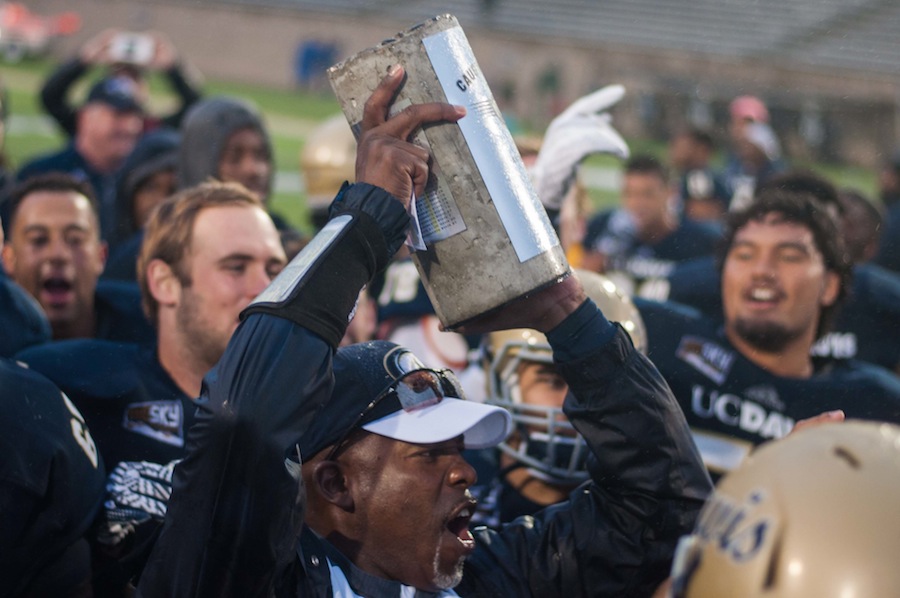
UC Davis athletics director Kevin Blue announced the release of football head coach Ron Gould from his five-year contract early Monday morning following a dismal 3-8 season. Gould’s release comes two days after the Aggies’ third Causeway Classic victory against Sacramento State under his four-year tenure leading the program.

Since his 2012 start at UC Davis, the football team has gone 12-33. Gould served as running backs coach at University of California, Berkeley for 16 years before becoming head coach for the Aggies.

In a statement, Gould said that he was grateful for the chance to lead the UC Davis football and thanked the student-athletes for their character and commitment to the program and academic prowess.

“Although we were not able to reach our goals on the field, I couldn’t be more proud of all that we accomplished during my time at UC Davis. I want to thank my outstanding staff and their families for their commitment to mentoring and developing the young men in our program,” Gould said in the statement. “We have made tremendous progress and laid the foundation for a very bright future for UC Davis Football. My wife (Teresa) and I will be forever grateful for the time that we had at UC Davis and the amazing relationships we have forged.”

Blue is expected to comment on this decision later on today.

Read a recent profile on Gould here.

Written by: Nicolette Sarmiento — sports@theaggie.org

Aggies win big against Sac State

0
IAN JONES / AGGIE
IAN JONES / AGGIE

UC Davis football defeats Sac State 48-30 in the 63rd Causeway Classic

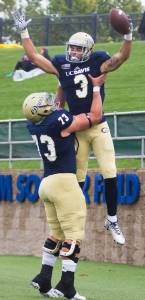
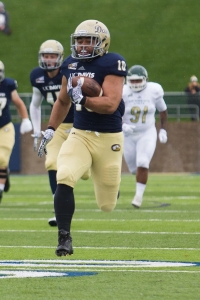
Coming off of a tough loss to Montana State, the UC Davis football team geared up for the 63rd Causeway Classic at Aggie Stadium against the Sacramento State Hornets last Saturday. The cold, windy and rainy weather did not stop the Aggies from performing, as three players put up career-high numbers, breaking school records in the process.

Seniors running back Manusamoa Luuga and quarterback Ben Scott, along with sophomore wide receiver Keelan Doss all had tremendous games that contributed to the 48-30 victory, giving UC Davis its second straight Causeway Classic win.

“Those guys said that they wanted to keep the trophy at home, and it’s at home. The hat goes off to all the guys in that locker room,” said head coach Ron Gould. “I can’t be more pleased with the effort of this football team, and with the heart and the character that has been exhibited by these men. Sometimes people don’t see the foundation, you only see when you start putting the house together, but the foundation is solid, and it is because of the character of the men that we have here.”

IAN JONES / AGGIE
IAN JONES / AGGIE

The game started off strong for the Aggies; Luuga ran the ball for a 58-yard touchdown on the Aggies first possession, leading 7-0. Sophomore running back Josh Kelley ran for a 17-yard touchdown later in the quarter after Sac State had equalized, pushing the score to 14-7.

Scott threw three touchdown passes to Doss, all in the second quarter at 12, 57 and six yards. The Hornets earned a field goal and a rushing touchdown to bring the score to 34-17 at the half.

Early in the third quarter, Sac State scored an early 10 points off of a 35-yard field goal and a fumble recovery for a touchdown, shrinking the lead to 34-27. Scott completed a touchdown pass to senior tight end Nehemiah Winston at 6:24 for a 14-yard touchdown in the third quarter, and threw another touchdown to Doss in the fourth for an incredible 58 yards to extend the lead to 48-27.

After a field goal by Sac State in the fourth, the Aggies were able to hold onto their defense and finish the game 48-30.

Luuga ran the ball for a career-high 249 yards and earned him over 1,000 rushing yards overall on the season, and his one touchdown allowed him to break through the Aggie’s single-season top 10 in touchdowns, rushing for 11 on the year. Luuga’s performance is the third-highest single game total in school history.

“The biggest thing that pushed me was that this could be my last game ever,” Luuga said. “I wanted to give my all for coach and my teammates. I don’t know what the future is going to bring, but I wanted to take the win and today, we did that.”

The passing game for UC Davis was attributed by Scott’s 14 of 24 completed passes, 292 passing yards and five touchdowns, all without being sacked even once.

“It isn’t about me or about the other seniors,” Scott said. “It is bigger than what we know. It’s about Aggie Pride and about taking pride in your university. We don’t lose to Sac State, and I think our record over the years shows it. We find a way to come together to play against those guys.”

IAN JONES / AGGIE
IAN JONES / AGGIE

The offense clicked for the Aggies throughout the entire game, proven by Doss who totaled 207 receiving yards and four touchdowns, tying the school record for most touchdowns in a game. His 207 yards put Doss as the fifth Aggie in UC Davis history to go over 200 yards.

The defense held Sac State to only 232 total yards. Sophomore safety Ryan Parenteau and junior linebacker Ryan Bua each had 10 tackles, Bua earning two sacks to go along with it.

UC Davis finished the game with 598 total yards, its second highest of the year, and the season-high 306 of those yards came from the rushing game. The win broke the Aggies’ three-game losing streak to finish 3-8 overall and 2-6 in the Big Sky Conference. The 3-2 home record for UC Davis was the first winning home record since 2012.

“That’s our team: the grit, the heart and the passion,” Gould said. “When I tell you guys that we are close, we are close. I don’t know why things didn’t turn out the way we wanted to this year, but I will tell you that the men in that locker room are special individuals. They came to work every day, busted their tails and had a smile on their face. That was the reason we were able to be victorious tonight.”

Written by: Ryan Bugsch — sports@theaggie.org

The Gould standard

0
Coach Ron Gould. (BRIAN LANDRY / AGGIE)

Former UC Davis football head coach Ron Gould

It’s 1:26 p.m. on a rainy Monday afternoon. Five men are sitting in a room with whiteboards for walls, which are blackened by marker ink and color-coded magnets labeled with random, short words like “base,” “tex” and “ace.”

There’s an oval-shaped table in the center of the room surrounded by a dozen chairs; one of the men sitting is scribbling frantically on his bright yellow notepad while the others chat casually about their wives and weekends.

More men file in and fill a chair, each greeted by the company present, until there are eighteen people crammed into a room that’s only slightly bigger than a walk-in closet.

One seat — the seat — at the head of the table is still empty, a throne of sorts.

It’s 1:30 p.m. now. The last man shuts the door, and the casual atmosphere is replaced with tacit respect — maybe even fear. “Sup, coach?” they all ask in unison.

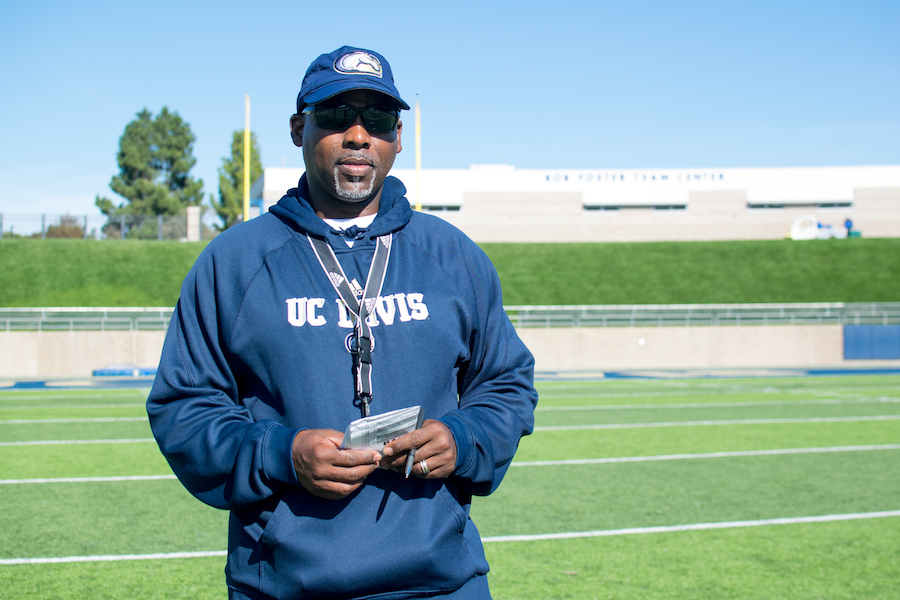
Former head coach Ron Gould takes his seat. “What do you guys have for me today?” His voice is raspy from shouting on the field for so many years. “I want some good news.”

Everyone turns to the man in the far corner opposite Gould as he clears his throat and says, “Well, Coach, I’m not too sure about Spencer.”

“How is that good news?” Coach Gould demands. The rest of the men laugh, but the coach is waiting for an explanation. With Portland State coming to town this weekend, he’s anxious to know what — or who — he’s got to work with.

“Tell me more,” Gould says. The meeting begins.

***

Even though Gould’s office is very tidy, he spends countless hours every week there — watching film, hosting high school or professional coaches, talking to prospective Aggie players and their families.

There’s a flat screen that’s paused on a potential high school recruit’s film from last week’s game. On his desk are pictures of his two sons, Tevin and Trae, who are both going to school in Oregon. Gould sat down with both of them to ensure they didn’t feel pressured to play football for the wrong reasons. Neither one of them does.

Next to their pictures is a brick that has the UC Davis emblem on it and the phrase “Every Man a Brick, Together a Wall,” reminding him of his primary goal as head coach: creating strength through togetherness.

***

Ron Gould was born and raised in Tucson, Arizona, where he played football as defensive back at Scottsdale Community College for a year before earning a scholarship to Wichita State. After its program was discontinued, Gould went to the University of Oregon to continue playing football and eventually graduate in 1988 with a bachelor’s degree in criminology.

He stayed with the Ducks as a graduate assistant until he was offered a defensive back assistant coaching job at Portland State and, later, Boise State. Gould eventually made his way to UC Berkeley, where he was the running back coach for ten years before moving up to associate head coach in 2008.

In 2012, Gould took the head coaching job at UC Davis.

“I’d never been on campus before I got hired,” he said. “But I knew it was a highly academic, diverse school.”

Since his appointment, Gould has taken UC Davis’ football program to a new level — both on the field and in the classroom. He emphasized how high his expectations are for prospects because UC Davis has such a rigorous core curriculum.

“We have four pillars that we look for in recruits: athletic ability, academics, character and competitive spirit,” he said. “We don’t compromise one for the other.”

He emphasized the necessity of well-rounded players, doing their part as full-fledged adults in the community.

Gould wants each player to feel important. His priority lies with his desire to develop the men on his team as athletes, students and, most especially, people. He constantly reminds them, “If football is the only thing I’ve taught you, then I have failed you.”

He and his wife, Teresa, moved to Davis after spending almost 16 years in Berkeley. Teresa served as interim athletic director until the university named Kevin Blue for the position this past spring. With the Goulds so involved in collegiate athletics, the UC Davis athletic staff has become like family.

“Coach Gould loves to cook,” said Mike Robles, assistant athletic director and communications coordinator. “He invited the entire staff and team over and we thought, there’s no way coach would actually be cooking for all of us and he goes, ‘Oh yeah? Come on over.’”

***

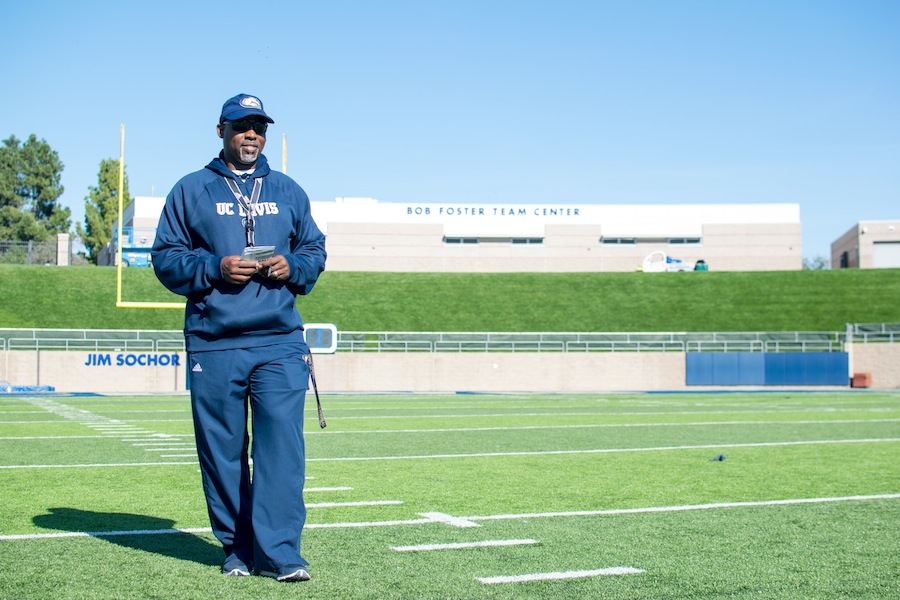
When Coach Gould blows the whistle, chaos ensues. With a quick shuffle, dozens of players hustle into their respective sections — offense, defense, quarterbacks and running backs — with their designated coach across Jim Sochor Field.

Gould is in the dead center of the commotion, calm and collected, directing each section like a conductor of an orchestra, trying to restore order in the music: blown whistles, strained shouting, bodies crashing into each other, the football meeting the arms of their intended receiver.

The timer on the jumbo screen overlooking the field is counting down from 05:00 and buzzes loudly throughout the stadium as soon as it reaches 00:00 before resetting. Each time it does, the configuration of the field changes into something completely different from the one before — Coach knows how to make the most out of these practices.

This goes on for two hours before Coach calls the team in for a huddle, ready to deliver the make-it-or-break-it evaluations.

On his wrist he wears a rubber bracelet with “RESPECT THE PROCESS” typed across the band.

“Be patient, respect the process, and good things will happen,” Gould said.

It’s why he has in-team programs he likes to call Big Brother, much like a mentoring program, and Accountability Program, in which players nominate teammates as coaches and are drafted onto five different teams. He wants them to bond and trust one another like brothers.

“If one member of the team is slacking, either in the classroom or just in the community, the others are just as responsible,” he smiles. “That way they’re helping one another succeed both on and off the field.”

***

In the heart of Aggie Stadium, the Bruce Edwards Club Room is empty after a long night of football. The UC-Davis-emblem-patterned backdrop that sits behind the table at the front of the room has a spotlight on it expectantly.

Soon enough, Coach Gould appeared through the sliding door and took a seat at the table. His eyes are bloodshot, but he still holds his shoulders high, prepared for anything that comes his way.

One of the reporters asked, “What happened tonight?”

The Aggies just lost to the Portland State Vikings. Badly. It was a disappointing regression. Definitely not up to Coach Gould’s standards.

As he takes his time to articulate, he may be thinking back to what he said during practice a few days before.

“No one is born a leader, okay,” he said. “They may have leadership qualities, but it’s using those qualities that makes someone a leader.”

For Coach Ron Gould, this is his way of respecting the process. This loss reminds him that there’s much more work to be done. He holds his team and, therefore, himself to the highest standard both on the field and off it.

Coach Gould finally put his hands up slowly and sighed, “We just didn’t execute.” He shook his head. “I told the players, ‘You can’t talk about it. You got to be about it.’ We just have to get back to Aggie Football.”

With only two games left in the season, the only thing the UC Davis football team has left to do is to get back up and finish strong. And with a leader like Ron Gould, that feat shouldn’t be that hard to accomplish.

Written by: Nicolette Sarmiento — sports@theaggie.org

HUMOR: The finsta must die

KELSEY GREGGE / AGGIE

headshot_yrDelete your account

I was on a date some years ago, and, while scrolling through my photo library to show her something on my phone, my worst nightmare happened.

“Is that me?!”

She spotted my screenshot of her Facebook photos, the ones I sent my friends when I told them about my plans.

I looked her in the eyes and told her:

“Yup. That’s you. I wanted to show off to my friend what a pretty date I have this weekend.”

Looking back at it, I don’t think I could have said anything better in the moment. I wasn’t trying to position it or be smooth or suave or apologetic. I was honest. I’ve learned over the years that in these social situations, with enough confidence and the right phrasing, honesty is the best route to win people over dates, job interviews, new friends, what have you.

I’ll own the fact that I spent my 19th birthday completely alone after a long day of work, drinking whiskey by myself while softly crying to Drake, only to get up the next morning at 6 a.m. I’m not a completely open book, but I’ll give the people some excerpts and chapters for free.

I totally understand the point of fake Instagram, or “finsta,” accounts. By making a hidden, private profile and selecting a small group of close friends to follow, people feel free to embarrass themselves, trash their exes and vent about their lives without caring about social conventions like double-posting or human decency. It’s an act of rebellion. Instead of writing, taking multiple takes, editing, tuning and marketing ourselves, the finstas let us freestyle and jam without care for the final product.

I don’t reject the finsta as a response to the circumstances. I reject the circumstances themselves. I question that we feel compelled to do this in the first place. I’m pushing back on the idea that we need to fine-tune and face-tune our ways to show our friends our awesomeness.

There are three main issues I see with the thinking behind finstas. One is the notion that we can’t totally be honest when we present ourselves. Honesty isn’t just about the courage to put yourself out there, flaws and warts and all. It’s about the assurance that people will still like you (and your posts) regardless of whether your honest self is as dope as you think. And I’ve found that people really respect, appreciate and even admire that honesty. You’ll win over a lot more people from authenticity than you will from romanticizing yourself.

Another is that it shows that we care too much about likes on our actual Instagrams. I’m not saying likes are meaningless. You’re goddamn right the likes mean something. A like is a rush of dopamine. It’s a chicken nugget of attention. You’re allowed to like chicken nuggets. Healthy? No. Sustainable? Not at all. The only delicious food in the world? God no.

I care about getting likes on Instagram because I’m not an unfeeling sociopath, but it has to stay healthy. I see people with finstas and it makes me feel as if every real Instagram post is just for the likes. Rather it should be a mix of sharing your life with your friends in order to stay connected — a collection of little postcards you send yourself when you look back and reflect, and the sweet, delicious likes.

I take issue with having one account in which you’re only hitting home runs and one account where you get to practice and mess around. You’re not a professional sports player performing for the fans, you’re a normal human being with a social life. We all feel like we’re the protagonists of our own movies, so your movie would be much better if you stop going for the cheap gags and easy cliches.

And finally, it’s immoral.

I find mutual dislikes of other people one of the strongest bonds people make. Talking trash about people you can’t stand and making fun of your exes is petty, yes, but I think it’s human when kept within reason. That’s not the problem. I do all of that in my messages and groupchats with my friends.

It just feels different to me when those nastier things are kept in conversation, in which people are mean and then they move on to the next topic. It’s different when it’s kept on a virtual log, when it’s posted for perpetuity or when it’s not an ephemeral conversation topic anymore. Even though less than 20 people see it, it crosses the boundary of basic decency to that person, however awful they may be.

No one’s reading this piece and running out and deleting their secret accounts. I can name at least ten people who’ll screenshot this and destroy me in the caption on their accounts. The finsta won’t die. But I really hope that the rinsta (real Instagram) works on itself and starts doing yoga and eating healthier.

We’re not brands, we’re not celebrities, we’re not perfect people with perfect lives that look flawless from every angle. An ugly selfie here and there won’t drive away followers and slash your like count and mess up your ratio.

You don’t always have to be dope. Sometimes, being relatable is just as good.

Written by: Yinon Raviv, who’s tired of being made fun of on the internet by his exes — reach him at ravivyinon@gmail.com

Joel Embiid captures the spotlight

0

BRENT BURFORD [CC BY 2.0] / FLICKR
Aggie Columnist Michael Wexler talks Philadelphia 76ers’ young center Joel Embiid’s hot start to NBA career after two absent seasons

When the NBA season started, I put out my predictions for the 2016 season, which included choosing Kris Dunn of the Minnesota Timberwolves to be the NBA 2016-2017 Rookie of the Year.

“Kris Dunn […] has seemingly won the position battle over Ricky Rubio for starting point guard. While I haven’t followed Dunn particularly closely, I like him over Joel Embiid, who’s going to have a season of distraction as his quest to earn the love of Kim Kardashian continues.”

Dunn is off to a very interesting start. An elbow injury to Ricky Rubio has opened up an expanded role for the young guard, and the results have been mixed. His struggles on the offensive end have been well-documented. He is shooting an extremely-inefficient 36.7 percent from the field while averaging a mere 5.3 points and 4.2 assists per game. On the other end of the floor, his tendency to gamble on defense has resulted in a solid 1.8 steals per game. Dunn’s numbers aren’t particularly eye-popping; however, the numbers of Joel Embiid of the Philadelphia 76ers have stood out immensely.

While I’m wary of reneging on my commitment to Dunn as the ROY due to Embiid’s extensive injury history, I will admit that I was wrong to write off Embiid after his first two seasons, in which he totaled zero minutes on the court.

For those unfamiliar with Embiid’s past, here is the breakdown: Embiid missed his rookie campaign with a broken navicular bone in his right foot, and the same injury recurred during his sophomore season. The Philadelphia Inquirer claimed that the 76ers believed this injury to be career-threatening.

Before this slew of injuries, Embiid was regarded as a generational talent and was a consensus number one overall pick; the fact that he only fell two slots when Philadelphia drafted him reflects upon Embiid’s tremendous talent — talent we are seeing now. It is still early, and while I haven’t been watching every minute of every Sixers game, Embiid’s numbers are outstanding.

At first look, his numbers were impressive. After five games of play, Embiid was averaging 17.6 points per game along with 6.8 rebounds and 2.6 blocks on 48.3 percent shooting from the field, and an unheard of 66.7 percent from deep. These numbers, especially the unsustainable 3-point percentage, are impressive for anyone, especially a rookie, but they stand out because these stats have been accumulated in heavily-managed minutes.

Embiid is averaging only 21.4 minutes per game, so these numbers are literally unheard of. I know it’s a small sample size, so this comparison must be taken with a grain of salt, but when extrapolating Embiid’s statistics to the often-used 36 minutes per game, the results speak for themselves.

Player in Rookie Year (games) PPG/36 REB/36 AST/36 BLK/36 STL/36 TO/36 FG% FT%
J. Embiid (5) 29.6 11.4 2.0 4.4 1.0 7.4 48.3% 76.5%
K. Abdul-Jabbar (82) 24.1 12.1 3.4 N/A N/A N/A 51.8% 65.3%
S. O’Neal (81) 22.2 13.2 1.8 3.4 0.7 3.6 56.2% 59.2%
H. Olajuwon (82) 20.9 12.0 1.4 2.7 1.2 2.9 53.8% 61.3%

Comparing Embiid’s numbers to three of the greatest NBA centers of all time through five games is something ESPN would probably do to prey on the minds of feeble and naive 13-year-old basketball fans via their show First Take — so the answer is yes, I made this graphic half-jokingly.

The point still stands, though, that Embiid’s tremendous success thus far is a delight to many. Foot injuries have derailed the careers of NBA greats such as Bill Walton and Yao Ming, so Embiid suffering similar injuries at the young age of 20 was hard to watch. After his second surgery, many (including myself) were quick to label Embiid as the NBA’s next big bust.

When you google “Joel Embiid Greg Oden,” 25,300 results appear, demonstrating a comparable career path to the 2007 first overall draft pick, whose career was quickly and painfully ended by debilitating knee injuries. Fortunately, Embiid’s play thus far has proven the naysayers wrong. Embiid is back in the conversation with other young stars such as Karl Anthony-Towns and Rudy Gobert.

Seeing young kids’ dreams dashed by chronic injuries is heart-wrenching, so I wish Joel Embiid good health in his quest to become one of the most dominant bigs in the NBA.


Written by: Michael Wexler — sports@theaggie.org

A summer in Cambodia

RACHEL MURADIAN / COURTESY

UC Davis students spend summer abroad working to improve sanitation in Cambodian floating communities

Joanne Wu, Rachel Muradian and Eugene Yao Guan’s trip to Cambodia wasn’t the typical study abroad experience. While other students might have spent their summers working, taking summer classes or relaxing, these UC Davis mechanical engineering (ME) students spent their summer abroad prototyping water treatments in floating communities along the Tonle Sap Lake in Cambodia.

Muradian, a fifth-year ME major, as well as Wu and Guan, UC Davis alumni, decided to do their ME senior design capstone project on developing a sanitation solution with Wetlands Work! (WW), a social enterprise based in Cambodia that designs and builds innovative constructed wetland systems to treat various contaminated waters. The three spent their winter and spring quarters designing water treatment systems before traveling to Cambodia in August 2016 to begin building the prototypes.

“Once we started working on the project and communicating with the company in Cambodia, all of our conversations were about how much easier things would be if we were just on location to figure things out,” Muradian said.

According to Guan, floating communities, or villages living on or near water, are especially vulnerable to water treatment issues. Without proper water treatments, these communities expel waste directly into nearby bodies of water, which can lead to bacterial infections, such as diarrhea if consumed.

“[Water treatment] is an issue for floating communities because they are living on the water and there’s no way for them to filter what goes into the river,” Guan said.

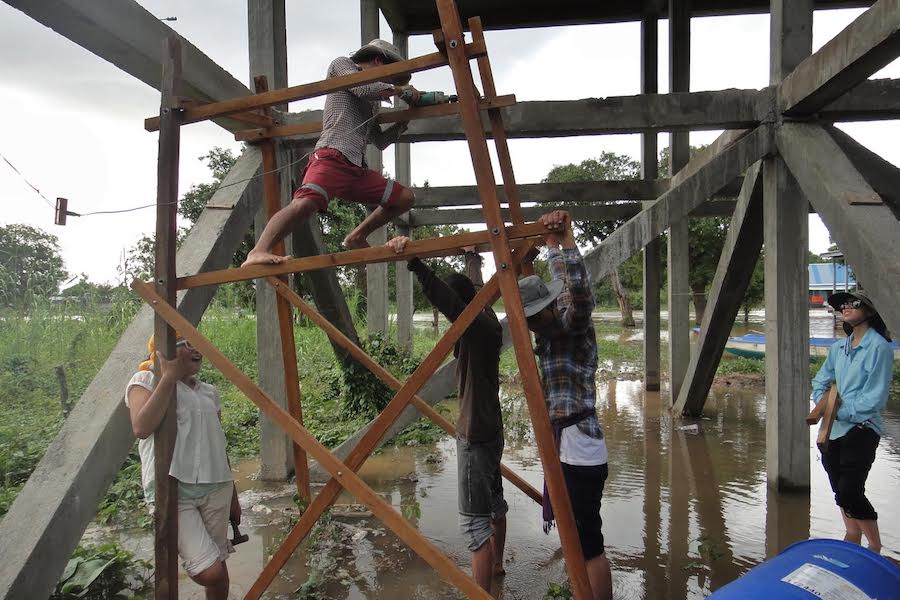
WW uses a sanitation solution called HandyPod that has been mostly successful at reducing pathogenic content in Tonle Sap Lake, but the solution is expensive and used primarily for floating houses, not stilted houses along the lake. The team worked with WW to modify the HandyPod system by minimizing the water system costs and adapting it for stilted houses.

The group focused on designing and building a stand alone stilted support structure for the HandyPod and a hand crank allowing floating community residents to extend or reel in tubing.

During the process of prototyping their water treatment designs, the group quickly learned that the limited supplies available in Cambodia led to major adjustments to their initial designs. With the support and assistance from Cambodian locals, those setbacks didn’t stop them.

“What could be seen as inconveniences actually helped us repurpose our project,” Wu said. “It was sort of an exercise in rolling with the punches.”

Wu, Muradian and Guan worked with local Cambodian residents and students to figure out how to modify the prototypes with the supplies available in Cambodia.

“It was really a lesson in flexibility, and it was really cool to learn from the Cambodians about how they go about building and designing,” Muradian said.

By the end of the trip, the support structure proved to be almost completely functional while the hand crank needed additional work to improve its functionality. WW was pleased with the team’s work and will use their prototypes to improve future sanitation problems in floating communities.

Guan looks back on the experience as one that helped him become more independent and bold. Not only did his team learn about Cambodia’s culture and history, he said, but they also made a difference in the residents’ lives.

“Helping others doesn’t necessarily mean going somewhere and telling people what to do, but rather working with them to help them come up with a solution,” Guan said. “Whatever input they have is viable.”


Written by: Emma Sadlowski – science@theaggie.org

Kanye at the Golden1 Center, abruptly cancels set

NICKI PADAR / AGGIE
NICKI PADAR / AGGIE

He dropped the mic — literally.

I only wrote two notes before Kanye West’s doomed performance Saturday night.

The first note compared the Golden 1 Center to the baseball games I attended as a kid; vendors walked up and down the stairs screaming “ice cold lemonade” and rolling their R’s in “churros.” The second was about a fan’s outfit: she wore a white t-shirt with 20 or so floating Kanye heads. I noted she received compliments every time she went up and down the stairs to her seat.

But I should have written about what I heard over the media team’s walkies behind me: Kanye was still on his plane at 10 p.m., an hour after the show’s supposed start time. Or about the fans — fans like my friend who paid an exorbitant amount of money to sit in a seat so high I’m surprised her nose didn’t bleed. I should have written about the two young boys in their matching $40 Saint Pablo t-shirts, whom I later watched shuffle home, heads down, their mother repeatedly apologizing.

Or about Kanye’s giant floating stage, how it moved from side to side while a mob of fans followed him, in devotion, underneath his feet.

But instead I wrote about the hype, because — like the audience beneath his stage — it’s so easy to get caught up in it. So easy, in fact, that Kanye entangled himself.

He arrived on stage second to Kid Cudi — the first of the night’s many surprises (albeit, the only pleasant one). They sang “Beautiful Morning,” and the crowd went bezerk. Excitement subdued, however, when the two rappers hugged for an uncomfortably long period of time. Better yet, if you read any of Saturday night’s headlines before about 11:30 p.m., they read, “Beef between Cudi and West Expelled” and “Rappers Reconcile,” amongst others. Of course, these articles were buried miles deep in light of the night’s later drama.

Kid Cudi left the stage after they floated back to the front, leaving Kanye alone to rap “Wolves” and part of “Famous.” That is, before he did what Kanye does best: interrupt everyone — including himself. But an interruption isn’t complete without a rant. And so, for the sake of a complete Yeezy experience, he ranted about the following:

“Radio, f*ck you.”

Asked Jay Z’s hitmen not to aim at his head.

“Radio, f*ck you.”

Explained that radio is made of good people, but people who play all the wrong tracks.

“Radio, f*ck you.”

“Radio, f*ck you.”

Some incoherent commentary about Beyonce, Jay Z, Frank Ocean, MTV and Taylor Swift, emphasizing that they are great people (followed by, “we are ALL great people”), only to continue assailing them.

Declared that “feelings matter,” and middle America’s feelings were spoken for in the election.

“Radio, f*ck you.”

Explained he had similar feelings to middle America (cue audience throwing shoes, shirts, water bottles, etc.)

Asked someone (it sounded like “Joe the sound man”) to bring him back to the front. As he sailed above the audience on his throne, he said, “Let Ye be Ye.”

And then he dropped the mic — literally and figuratively.

This was not unexpected. Nothing from Saturday night was new to his fans, to the press, to the outsiders laughing at ticket holders for “paying to watch a child perform.” (Fortunately, Ticketmaster announced Sunday that refunds would be issued.)

But this has yet to impede on his dedicated fanbase. Amongst the crying (yes, crying) fans and riots, the man in front of me still bought a pair of $1,000 YEEZY’s.

Renowned music journalist Lisa Robinson writes in her memoir There Goes Gravity that Kanye stands for something his younger fans simply cannot understand; his rants and interruptions and cancelled sets are the most genuine embodiment of movement lost to our generation — of punk.

“When he stormed on stage during the 2009 MTV Awards I emailed him to say it was very punk rock. But no one else shared my appreciation. He was vilified; the President of the U.S. called him a jackass. He left the country for a year. But after all the hatred and the lunacy that came at Kanye, his own tirades and unpredictable antics, he once again made magnificent work,” Robinson writes.

And so, despite Kanye’s undeniably large ego and inconsiderate cancellation of shows, Robinson brings up an interesting point: maybe Kanye isn’t insane — he was simply born a few generations too late. Maybe we should, in fact, just let Ye be Ye.


Written by: Ally Overbay – arts@theaggie.org

Moana, the first-ever Polynesian Disney princess

Morgan Tieu / AGGIE
Morgan Tieu / AGGIE

Why it’s important that Disney attempts to diversify its cast of characters

Throughout the sustained success that Disney has experienced over the years, the mass media and entertainment conglomerate has oftentimes been accused, rightly so, of cultural appropriation and having a white-centric worldview.

The first Disney princess film, Snow White and the Seven Dwarfs, came out in 1937, and it wasn’t until 1992 that the company featured its first princess of color, Jasmine from Aladdin. And even Jasmine’s casting was tainted by Disney’s white-washing; the character was voiced by Linda Larkin, a white voice actor, which is also the case for many Disney princesses of color.

The lack of diversity among its cast of princesses, many of whom are often portrayed as helpless characters in need of a savior, sends a potentially harmful message to young girls growing up in an increasingly diversified world. The coming generations need Disney princesses that look like them.

The newest disney film, Moana, will soon hit theaters, featuring the first-ever Polynesian Disney princess. Although Moana, the first princess without a romantic interest, was initially praised for its progressive premise, some believe that Disney’s attempt to create a more diverse community within its cast of characters only results in ethnic stereotyping.

In the past, Disney has faced controversial claims over its portrayal of different cultures and ethnicities, such as the Native Americans in Pocahontas and the Chinese in Mulan. This instance is no different, as there are definitely aspects of Moana that align with certain stereotypes of Polynesian culture.

For example, some critics have been particularly disillusioned with the stereotypical appearance of the oversized and heavily-tattooed character of Maui, a demi-god that Moana meets along her journey. In contrast to his intimidating appearance, Maui wears his heart on his sleeve and joins Moana on her quest to save her island. Despite backlash toward the character, it is made clear in the film that Maui is not just an average individual, but a god, hence his powerful and muscular figure.  

“I think that Disney is doing its best to take progressive steps toward the empowerment of minorities and women especially, and are in no way intentionally appropriating the cultures of its characters. I think that regardless of what they decide to do, they’re gonna be criticized,” said Pahrmis Hashemi, a first-year neurobiology, physiology and behavior major.

Regardless of these criticisms, Moana will surely be a princess unlike any other before her. In comparison to the usual damsel-in-distress heroines of Disney’s past, Moana is a strong, independent protagonist set upon achieving her goals with the help of her friends and hilarious sidekick Heihei the rooster.

Additionally, her appearance strays from the unrealistic body images typical of past Disney princesses with their slim waists and dainty figures, such as Elsa and Anna of Frozen or Ariel of The Little Mermaid. In contrast, Moana breaks the mold of how the classic Disney princess appears, with her thick eyebrows, wild hair and more realistic body type. Moana also harbors no love interest throughout the movie, placing her in a role more akin to that of an action hero, rather than a princess waiting to be saved by the prince.

Regardless of the controversy Moana might present, the Polynesian princess will undoubtedly be a strong role model for young girls to look up to and admire, a sentiment that embodies the best of what Disney offers to its audience. At the end of the day, Moana is a Disney movie, filled with mythical legends, catchy tunes and what is sure to be an entertaining film-going experience for all.

Moana will hit theaters everywhere on Nov. 23.  


Written by: Sydney Odman arts@theaggie.org

Preview: Chess, the Musical

Nicki Padar / AGGIE
Nicki Padar / AGGIE

The Davis Musical Theater company prepares for fourth production of Cold War chess match musical

Upon contacting Steve Isaacson, the Davis Musical Theater Company’s (DMTC) co-founder and director of the newest performance of 1980’s Chess, the Musical for an interview, he insisted I receive a full tour of backstage and free tickets to the upcoming show. Not only did I discover the hospitality of the theater company, but I witnessed the warmth and passion put into the show, all the way down to the light set-up.

“At the start of Act Two, which takes place in a church, I have 70 LED candles [as the lighting], so when the curtains open up it looks beautiful,” Isaacson said. “I don’t want to tell you too much, but I’m so proud of the show.”

Chess will run at DMTC through Dec. 4 and marks the fourth production of the show by DMTC. According to the DMTC website, “the story involves a romantic triangle between two players in a world chess championship, and a woman who manages one and falls in love with the other.”

“It is an extremely powerful story,” Isaacson said. “The story involves Americans and Russians and is so significant now. The show was relevant when it was written in the 1980’s when the Berlin Wall was about to come down, but the current political climate and our head-butting with Russia is a perfect set-up for this show. But that’s not why we chose it; it sells very well. It just happened to fall into place, but I wish it didn’t.”

However, the Russian-American dynamic of Chess has been intrinsic in production.

“The [costume] concept is chess,” Isaacson said. “The Russians are in black and the Americans are in white. As Florence, the American chess second, falls in love with Anatoly, the Russian chess champion, her costumes move from a light grey to a grey palette. His goes from a black to a dark grey.”

Dramatic and serious musicals are not necessarily characteristic of DMTC, however.  

“DMTC does a lot of light-hearted and old, standard musicals, so Chess brings a new-ish show to the area and one that is not produced very often,” said leading actress Ashley Holm, who plays Florence. “It’s not a happy show. It has its light-hearted moments, but it’s more of a dramatic show than what DMTC usually does […] I’d like to say it is one of the better productions I’ve done at DMTC.”

The show begins with a battle in the prologue and ends with a “big twist that is not in every production of the show.”

“Every rehearsal I’m crying, and the audience is going to be in tears by the end of the show,” Isaacson said.

Rehearsals for the show have been going on for six weeks, but have had some complications.

“We recently had to make changes because the guy who is playing Molokov, the Russian chess second and KGB agent, tripped over a set piece and shattered his elbow and has to get surgery. We had to call someone to step in,” Isaacson said.

Adjusting to the difficult music has also been a challenge in rehearsal.

“The first couple days of rehearsal were a little rough for me musically,” Holm said. “Some of the melody lines clash completely with the music so it is hard to find your place. You have to know the music really well to be confident with it. It is some of the hardest music I’ve had to learn since I’ve never done a show with this sort of rock-style to it. It is definitely different among musicals.”

With lyrics by Tim Rice (Jesus Christ Superstar, Joseph and Amazing Technicolor Dreamcoat) and music by Björn Ulvaeus and Benny Andersson of ABBA (Mamma Mia), the show stands on its own musically.

“The music is very powerful, and the way it affects the cast is the way it will affect the audience,” Isaacson said. “ABBA is actually really good. Songs from ‘Mamma Mia’ are the typical ABBA songs, and there are definitely a couple songs that you’re like ‘oh my god, that’s ABBA.’ Sometimes, though, you’re like ‘these are the guys from ABBA? This is incredible!’ Some standout songs are ‘Anthem,’ You and I’ and ‘Endgame’ which is the big finale.”

For first-year art history major Audrianna Escobedo, who plans to see the show, the various aspects of music in Chess are what make the the musical stand out.

“The music is kinda like Phantom of the Opera crossed with rock,” Escobedo said. “Since the show is based during the Cold War, Russia is like the formal classical music, but America is like the 1950’s rock. It all works even though they are so different. It’s become more common for musicians that are more pop-culture to write music for musicals. It think it is an extra way theater people can be creative that can bring more people to the theater. People might know ABBA and come for them even if they don’t know the show.”

With an intense, dramatic show ahead for DMTC, the small local theater is confident about the success of the performance.

“I try to make the show about the actors, the lights, the set and the costumes,” Isaacson said. “I can’t do what they do on big stages, so I try to do it with talent.”

For tickets to Chess, the Musical visit www.dmtc.org.


Written by: Caroline Rutten — arts@theaggie.org

Professors as pals

0
BRIAN LANDRY / AGGIE

Faculty-student relationships can prove mutually beneficial

In effort to get to know her upper division French students, professor Claire Goldstein  invited her class for lemonade and a game of boules, a French game similar to bocce. As the students engaged in cultural activities, Goldstein got the opportunity to interact with them outside of the classroom, and she thoroughly enjoyed their conversations.

“I like to know what [students are] doing, […] what they’re interested in and their experiences,” Goldstein said. “I get some of my best ideas about teaching from really hearing what students are [saying and] their perspectives.”

From organizing committees, to having meals, to casually chatting, many UC Davis faculty members are making the effort to connect with their students.

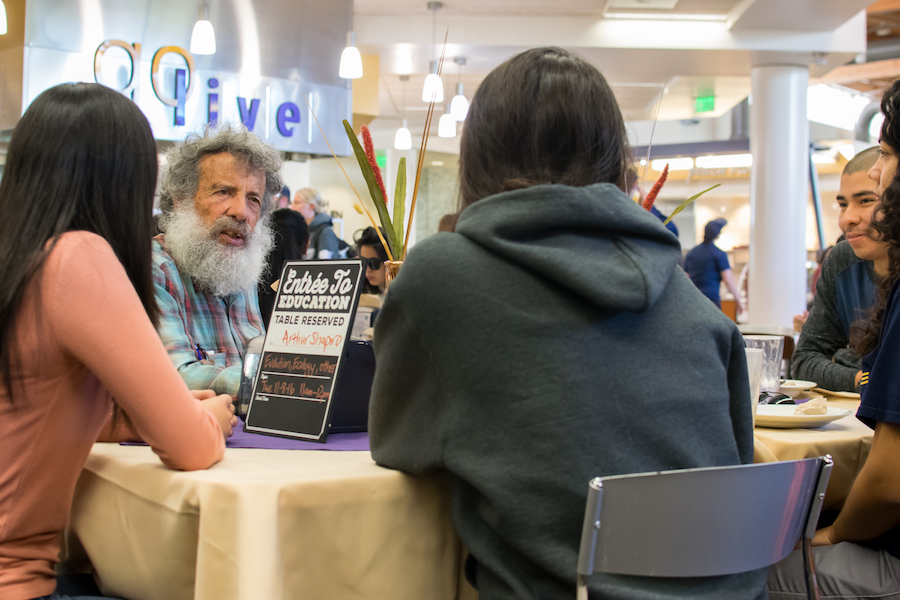
One program on campus that tries to foster such connections is the Entrée to Education (E2E) program, planned by Student Housing, which invites a faculty member to eat a free meal with up to 10 students in the dining hall of their choice. Brandon Petitt, the director of the Office of Student Development, worked in a committee alongside students to create the program.

“[We were] looking at ways to engage students to ensure their success [by specifically engaging] students with faculty on campus,” Petitt said. “One key idea was [for students and faculty to] have a meal together. Where we finally landed was on the Entrée to Education program.”

For the last two years, the E2E program has been providing students with dining hall access the opportunity to dine with faculty. Carolyn Thomas, professor of American Studies and Vice Provost and Dean for Undergraduate Education, recently participated in the program and said that, although mostly just resident advisors (RAs) joined her, it was a worthwhile experience.  

“It went well,” Thomas said. “There were mostly RAs who were there when I went [and] we talked about housing, […] what the experience is for students who are RAs and how much they enjoy working with first year students. We also talked about their classes [and] concerns that they had.”

Thomas said she was so impressed with the RAs who showed up to eat with her that she invited them to join her advisory board one RA took her up on the offer which, she said, “was a really nice outcome.” Thomas’ advisory board is a diverse group of about 10 students which meet with her once a quarter to talk about concerns or ideas about undergraduate education. Goldstein explained exactly what a faculty member can get out of prioritizing active outreach.

“[I get to learn about] what [students] want to know, what they want to understand [and] what they think they understand about what’s happening,” Goldstein said. “It’s good for [students] to have the opportunity to meet faculty in [informal] situations.”

After Jasneek Attwal,  a fourth-year neurobiology, physiology and behavior major, invited her chemistry professor to attend the annual Prytanean Women’s Honor Society’s Dinner for Ten event — in which students of the society bring one faculty member of their choosing to a large dinner — she said she was both excited and nervous.  

“He said yes and [the dinner] was wonderful,” Attwal said. “They sat us with people from different departments, even Prytanean alumnae, and we had one of the coolest conversations ever. It expanded from bees, to biochemistry, to mosquitoes, to politics, to different types of law it was really fun. And I definitely had a [closer] relationship with my professor after.”

Both Attwal, who serves as the treasurer for the Prytanean Women’s Honor Society, and Sheila Kulkarni, a third-year chemistry major who serves as the historian, will help organize the Dinner for Ten this year. Both Attwal and Kulkarni said they feel fostering student and faculty relationships outside the classroom is important for both parties.

“[Building connections] really enriches the educational experience for both students and teachers,” Kulkarni said. “It’s difficult for teachers to understand how students absorb knowledge, so getting to know your students as people, getting to understand how they learn, who they are as students and as people is very important in helping [faculty] teach and interact with their students on a very human level.”

Some faculty members are even willing to live in close proximity with students. Petitt acknowledged landscape architecture professor David de la Peña who, alongside his family, lives in Primero Grove. De la Peña explains that meeting with his neighbors in an informal setting is what helps him get to know them the best.

“I am there to help students connect with faculty in a comfortable setting,” de la Peña said in an e-mail interview. “Last week, we served churros and Mexican hot chocolate and chatted with a dozen or so students about moving to Davis about good places to hike and about study abroad. It can be hard for students sometimes to connect with all of the things happening on campus, so it’s fun to see them get engaged and contribute their energy.”

Student-faculty interactions can be mutually beneficial for both parties involved. Thomas said she encourages students to involve themselves in events which connect them to faculty because it helps to make students “more active in class” as well as more confident to approach professors about their work outside of the classroom. Additionally, she encourages faculty to do the same.

“Coming into Segundo [Dining Commons] and sitting down over a meal […] is very different [than the classroom],” Thomas said. “It makes us better teachers when we really take time to get to know our students as people.”

When students and faculty take the time to get to know each other, the results can be emboldening to everyone involved.

“Teaching […] is a collaborative experience that is born out of a relationship that involves trust and a mutual interest,” Goldstein said. “I really love getting to talk to UC Davis students in a non-classroom setting. I love hearing [about] all the rich things they’re up to, and thinking about and involved in. It’s really inspiring for me, and I’m happy to teach here.”


Written by: Hannah Holzer — features@theaggie.org

Humor: Student not offered any flyers at MU tables because he was ‘too ugly’

CHARLES MIIN / AGGIE

headshot_blTabling students provide insight into how they decide to whom they offer material

An ugly incident occurred this past week on our campus. A student claimed that he was not offered a single flyer while walking past the Memorial Union (MU) tables because of his looks. 

The student in question, Roger Dirkmund, a second-year human development major and aspiring hand model, said he got some strange looks as he passed the MU tables.

“It was odd because typically when I walk past that area, I can’t help but feel like there are flyers being shoved in my face left and right,” Dirkmund said. “But that day was different. People who were tabling would quickly make eye contact with me and then look away without saying anything.”

The California Aggie talked to some of the students who were tabling in an attempt to understand their reasoning for ignoring Dirkmund. One of these students was Emily Strickland, a third-year astronomy major and astrology fanatic.

“Yeah, I’m going to be honest, I didn’t like the way he looked,” Strickland said. “I mean he looked like a nice person and all, but his hair seemed really greasy and I just didn’t want to deal with that. All I’m saying is he should really invest in some matte hair product instead of glossy. Not to mention that the way he was walking totally told me that he was a Gemini, and my club doesn’t have enough room for two Geminis to join, so obviously I couldn’t offer him a spot. The Grass Club is a competitive organization to get into, and I won’t be blamed for something that’s out of my control.”

Another tabler that fateful day was Damien Blascock, a third-year aerospace engineering major and amateur lamp collector.

“He just didn’t have ‘the look’ you know?” Blascock told The Aggie. “There was something funny about his nose for sure, and I think I also saw a pimple, and I just don’t have time to just be everybody’s dermatologist, you know? The Semi-nude Beach Volleyball Club needs people who are serious about their looks. Not people with pimples. Disgusting.”

Still, Dirkmund plans to make another journey through the MU tabling area, and this time is determined to at least get an offer from the Faces for Radio Club.


Written by: Brian Landry — bjlandry@ucdavis.edu