57.6 F
Davis

Davis, California

Tuesday, December 23, 2025
Home Blog Page 689

Letter to the Editor: Not your victim

HANNAH LEE / AGGIE
HANNAH LEE / AGGIE

Holding journalists and representatives accountable

Rap music, as it was intended, has lit a fire and got white people in their feelings. In an opinion column written last week by opinion editor Eli Flesch on what is now termed the “Chance the Rapper Controversy,” a host of ideologies were invoked to obfuscate the racial realities for Black and Brown people in higher education. We’re gonna be doing a read, and breaking it all the way down.

Before we delve into the many ways in which this article supports white supremacy and a racist institution, we feel compelled to address the title: “Identity politics risk polluting the American university.”

Black and Brown people have long been considered a “polluting” force to American institutions. Intentionally or not, the article’s orientation is that the work of Black communities in higher education and the reactionary violence which arises from that work are “polluting” something pure. Such harkening back to “better days” is the same logics we see every day from Trump, white supremacists and fascists. Purity narratives both rely on history, while denying its realities.

The narrative that identity politics serves as an “infection,” downplays the structural and political choices faced by Black people on this campus. What Flesch calls “identity politics,” otherwise known as an uncritical position based solely along the boundaries of identity, is for us a starting place of solidarity and the representation of a politics more complex than comprehended by the liberal anti-Blackness presented in Flesch’s argument.

Acknowledging that power structures exist in the liberal tradition doesn’t do anything to further anti-racist actions within the University. When Black people address that there are physical and material ways to intervene in the everyday structures of racism, they are often violently attacked. That scenario doesn’t implicate the politics of victimhood — it’s the manifestation of structural privilege which demands that Black bodies be sacrificed for white feelings.

In other words, if white feelings were not such a delicate commodity to protect, we would not have Black sacrifices.

This denial of historical reality is intimately wrapped up in the claims of a so-called “culture of victimhood.” Stephen Steinberg, a writer and scholar on American race relations, confronts the fascination of the liberal imagination with “culture” and argues that to understand the products of so-called “culture,” we must always look primarily at the structural forces shaping their livelihoods. By obsessively focusing on culture, we support the dual notions embodied in “American meritocracy.” Either you have the “right” set of cultural values and so are successful (the Horatio Alger Myth), or you have “bad” cultural values which keep you from being successful (the culture of poverty thesis). Both ignore the criteria for success and blame those experiencing structural oppression.

And so there is no culture of victimhood, only a continued call by the oppressed to those who benefit from structural racism to acknowledge that their lives are shaped not by their individual choices or mentalities, nor by their love or hatred for any one person, but they are shaped by the histories and structures of white supremacy into which they are born.

It doesn’t matter if I, as a Black person, hate or love white people because I lack the power to systematically deny them access to life, justice and humanity. By focusing their attention on the “attitudes” of the oppressed, liberals can find themselves supporting the systems of oppression they ostensibly stand against.

I have some true tea for y’all; it’s not our attitudes that expose us to violence — it’s the insistence that nothing is happening even as we drink lead-filled water, live in poverty and are killed or incarcerated by white supremacy. That’s on y’all.

The problem then is two-fold here, both an issue of representation and one of journalism. The Associated Students of UC Davis are supposed to be student leaders, self-proclaimed representatives of the student body and yet there is only a single Black person in their body. It’s unsurprising then that their body reflects their broader politics.

Although they claim to represent Black students on campus, they remain silent on structural reforms for Black students unless it is fought for tooth and nail. The continued silence on the problems of The Aggie, its blatant anti-Blackness and misogynoir, is a form of white supremacy. By doing nothing, you’ve put the work of anti-racism onto those most affected by anti-Blackness. You’ve put it on the students you say you represent. You abdicate responsibility, and in doing so benefit from a system that thrives on Black exploitation.

We call on you to do better — to be proactive in lifting up Black voices and leaders — and also in proactively taking up the issues facing Black students on this campus. We are here. We live in a racial reality, even if it’s not talked about.

So how do these racial realities end up so far from our conversation at The Aggie? This is not the first time that we’ve seen non-Black authors at The Aggie utilize the words of Black people as weapons against the righteous anger many of us feel at the structural and interpersonal injustices we face every day. Dr. Cornel West is a part of our community’s ongoing conversation, but let us be clear — he is only one voice.

The Aggie’s history around cherry-picked quotes and uncomplicated narratives around Black history aids in constructing anti-Black articles while simultaneously claiming they are doing us a favor by talking about race. This habit isn’t limited to historical figures either.

Eli Flesch used quotes from Black students without their permission and with blatant disregard for context. With the plethora of Black writers and cultural voices we’d like to expand the conversation so it looks more holistic within the Black tradition. Malcolm X, Franz Fanon and Stokely Carmichael all advocated on behalf of Black self-determination because they recognized that whiteness is not solely about identity but a set of structural and economic relations.

By putting West in conversation with these other voices, we see that action must be taken out of radical love; a love for our communities and our futures. It means the kind of love Assata Shakur spoke on when she said we must “love and support one another.” What it doesn’t mean is accepting that the urgent matter of liberation, of living, of being held second to dialogue or to white feelings.

It means rejecting whiteness, and the social and material relationships of exclusion founded on slavery and Native genocide. It means that utilizing the logics of whiteness won’t get us free; that we must be inimical to those logics. It means that being oppositional can be a radical form of self-love and empowerment. To assume our anger leads to nihilism only means we’ve become complacent to the fact that the rules structuring our society are built on anti-Blackness.

Both the original comment and the responses supporting that post argued not simply that oppression exists but that it must be dealt with for us to live. When a simple suggestion that we displace whiteness at a concert brings threats of violence, beatings and more — when as small a request as that leads to violence — it demonstrates that Black calls for structural and material change are inimical to the liberal discourse of the university in which we all are expected to occupy the same positions of power. We don’t, but we could — if non-Black people weren’t so quick to protect their material investments “they earned” off the structures of anti-Blackness.

This is the fundamental limitation of liberalism. Dialogue and conversation do nothing to change actual structures of power.

Let’s bring this down to a practical level. When the women’s senior lacrosse players had a party themed after racist caricatures of latinx folks, the University’s response was that they needed more education. But the realities of anti-Blackness and white supremacy on our campus is not rooted in ignorance, and to ground these realities in simple prejudice or unconscious bias misses the fact that access to structures, institutions and resources are what is at stake here — not simply a matter of knowing.

Providing these students education on the topic of white supremacy and anti-blackness does not remove the heavily ingrained behaviors and ideologies that they were raised with and internalized. It is simply a scapegoat for white-serving institutions to wipe their hands clean of the incident without keeping people accountable for the harm they continue to perpetuate and normalize.

We should be clear, our position is radical and not liberal — thus there are areas where we will fundamentally be at odds. Our analysis extends beyond single identities to address politics of solidarity, of class, sexuality, disability — our politics extend beyond “identity” to the material and social conditions which make these identities pertinent. Conversation only goes so far, and as many of us face the material realities of death, discrimination and poverty, we must move beyond the liberal position of conversation and discourse.

Oppressed peoples have spent an enormous amount of time and energy educating and talking with their oppressors. And that work will still continue. But that work must always be paired with actions that change the lived realities, the material conditions, under which we live.

As the neoliberal university continues to spin diversity and tolerance as the buzzwords of the day; while they continue to do little to address hate crimes happening to our communities; and while they refuse to do the hard work of evaluating the roots of higher education in racism we must necessarily move beyond words.

Instead of policing the work of Black people, instead of calling for more dialogue, it’s time to address what actions and structural changes must be made to deal with these problems. Polemics like love and hate focus our attention on individuals, on internalizing policing methods, hiding the fact that structural access to affect and emotion and their attendant material freedoms is a critical part of whiteness. Black people can be angry. That doesn’t make us victims or nihilists. It makes us aware of our social and material position.

James Baldwin says, “To be a Negro in this country and to be relatively conscious is to be in a rage almost all the time.” Do not mistake our anger for nihilism. Our anger is also our hope — that the way things are is not what it will be.

Arguing that working within the system, rather than for its dismantling, is “better” is to believe that the rules are fundamentally fair — that justice will be served if we work within the framework of current politics.

We too think that justice can be served; we’ve simply realized that our political imaginations should not, and cannot, be contained within a system built on our blood, sweat and tears.

Signed,

B.B. Buchanan

SWERV, UCD Sociology Dept.

Kyla Burke

Alum
Humor: Student shouts out answer a split second before everyone else to show his brilliance

BRIAN LANDRY / AGGIE

headshot_bl

How a brave student inspired a generation by speaking up when everybody else was also willing to speak up

UC Davis is such a large institution with so many brilliant students that it’s probably impossible to say there’s a single one that outsmarts the others ー until now.

Eric Dukakis, second-year neurobiology, physiology and behavior major and Albert Einstein impersonator, showed that he is indeed better than all of us in every possible way during his organic chemistry lecture last Tuesday. A classmate of Dukakis described the event that took place.

“It was really a sight to behold,” said Emily Strangler, second-year chemistry major and star of TLC’s I Didn’t Know I Was Pregnant. “Our professor asked us what element is represented by a ‘C’ and Eric shouted the answer out at an unnecessarily loud volume a fraction of a second before everyone else said the answer. It was incredible. Everyone burst into applause. The girl sitting next to me started crying. I mean sure, everybody knew the correct answer, but Eric said it first, which makes him better than all of us by miles.”

It’s rumored that the professor teaching the class stopped lecturing, offered Dukakis a research position in her lab, a new car and $100,000 cash for his unprecedented achievement.

“In that moment I just had such a rush of emotions; I’m not even really sure what came over me,” said professor Michelle Rodriguez. “I realized that Eric was so much better than all of my other students and that his courage to speak up when everyone else was also willing to speak up made me really like him and want to give him an A in my class.”

Dukakis has been awarded a Nobel Peace Prize, nominated for an Oscar and a Grammy and might even be made the new chancellor of UC Davis because of the courage he showed in organic chemistry that day.

“I guess I was just having a moment of pure genius,” Dukakis told The Aggie. “I’m thinking about running for President of the United States in a few years. I think this nation the United States, that is could really use someone who is a leader like I am and isn’t afraid to take risks, also as I am. We could also use someone who is really well-spoken and cool and a genius like me.”

Possibly the most important message that we should take from this inspiring story is that we will simply never be as good as Eric Dukakis. And if that doesn’t inspire you, then I’m not sure what will.


Written by: Brian Landry — bjlandry@ucdavis.edu

Please Don’t Censor This: Exposing the war on campus speech

headshot_niUndergraduates at fault for perpetuating a devious trend against intellectual freedom
Janet Napolitano’s recent editorial on the merits of preserving free speech at universities is becoming increasingly necessary in the current political age. She observes the recent trend of college students suppressing views that even marginally sound marginalizing.

Her most striking point: “If it hurts, if it’s controversial, if it articulates an extreme point of view, then speech has become the new bête noire of the academy. Speakers are disinvited, faculty are vilified, and administrators like me are constantly asked to intervene.”

It’s an interesting turn of events when Janet Napolitano offers up a searing indictment of the repressive tendencies that litter contemporary college culture. Take note, because Napolitano is not your typical demagogue whining about the rise of political correctness.

She was a rock-solid pillar of the Obama administration and the groundbreaking Arizona governor who vetoed 180 bills against a Republican-dominated state legislature. Her track record suggests she might be in favor of the “safe space” –– but her editorial says otherwise.

Napolitano’s words have been echoed in all corners of academia and government. We all know the firestorm surrounding the University of Chicago’s dean of students and his freshmen welcome letter. His words reflect the sentiments burgeoning among journalists and leaders in defense of free discussion.

Even Barack Obama recently lambasted the rising tide of censored speech, saying that students shouldn’t “have to be coddled or protected from different points of view.” Instead of censoring antithetical opinions, he said, students should be making arguments that affirm the theory-clashing ideal of universities.

I’ve encountered some adherents and quite a few more dissidents to this sage advice. Remember the evangelical preachers who roamed the quad last spring? Their preaching was often extreme to the common ear, which many felt warranted harsh sanctioning. I saw a couple of  Davis students confront the evangelists intellectually and civilly –– the proper choice. They went “high” instead of “low.” But most didn’t get Michelle’s memo.

Many students abusively belittled and harangued the preachers. Others demanded their forced removal from campus. One student wrote that not only are “open” campuses “a fundamentally flawed idea,” but they also create an atmosphere that is unsafe to students.

It’s this idea of ‘safety’ that is so harmful to the young minds universities are supposed to cultivate. Where is the excitement surrounding controversy? What happened to intellectually-curious students meeting the other side head-to-head? It’s certainly absent where I look.

Calls to silence controversial speech also undermine the community standards UC Davis strives to uphold.

“We must understand and value both our individual differences and our common ground,” reads the official UC Davis Principles of Community. “We further recognize the right of every individual to think, speak, express and debate any idea…”

Previous generations relished opportunities for such open and honest dialogue in their classrooms. Today, universities are hotbeds of grassroots trigger warnings, safe spaces and ironic protests against “hostile” speech.

To be fair, the barebones idea of trigger warnings and safe spaces are not without merit. In practice, however, these phrases can morph from benign warning systems (originally for rape victims) to tools used for burying divergent opinions. They began as shields against trauma –– now they’re used to demonize and subvert intellectual freedom.

This is the crux of Napolitano’s message. There’s a right way to handle diverse opinions, and it certainly doesn’t include censorship. Let’s all agree on that.


Written by: Nick Irvin — ntirvin@ucdavis.edu

Disclaimer: The views and opinions expressed by individual columnists belong to the columnists alone and do not necessarily indicate the views and opinions held by The California Aggie.

Make the essay great again: Why I chose to write an English paper in Trump’s voice

headshot_efTaking academic risks can help students learn more effectively

Two important things happened to me in middle school: I was accepted into honors English and President Obama was inaugurated after an election season that sparked my deep interest in politics. And while this country has changed profoundly in those eight years since President Obama took office, the way I wrote my English essays stubbornly remained the same: formulaic and utterly predictable.

So a couple of weeks ago I staged a little protest and chose to examine the fallibility of leadership in Alice’s Adventures in Wonderland with the voice of perhaps the most fallible, unqualified and just plain stupid leader alive: Donald J. Trump.

It never really hit me that this might have been a bad idea.

I wasn’t particularly hell-bent on making a statement or being funny. My goal, first and foremost, was to make an original argument on a seminal piece of children’s literature. I just didn’t want to write another essay that would begin to collect dust the second I turned it in.

As the number of English majors declines across the country and students’ interest in literature becomes a second thought to the prospect of a better-paying job, it’s especially important that students are making academic decisions in step with what makes them happiest.

For me, that meant combining the thrill of the political process with the thrill of good writing.

Writing in Trump’s voice helped me engage with the Wonderland more actively than I would have otherwise. Each year it seems I have more difficulty really sitting down and getting in between the lines, so to speak. Forcing myself to look at a text with a fresh perspective seemed like a worthwhile challenge — one that would serve my goal of providing interesting literary analysis.

Of course, the space between good intentions and a final product is often vast, and that’s exactly the space my professor occupied when she busted out the red pen to grade my paper. But her comment that my essay “doesn’t represent (ahem) standard academic discourse. (To say the least!)” was a point of pride.

Her criticism also confirmed what I feared the most: that writing in Trump’s voice — an idiosyncratic mix of discursivity, lack of focus and brashness — would detract from my first priority to write an essay that fully delved into an argument. In a way, my essay turned out to be a metaphor for Trump’s entire campaign: dotted with holes and unclear explanations — but, at least to me, entertaining as hell.

The writing process itself was a difficult exercise in balancing the speech patterns of a whiny fifth-grader with the elevated prose expected from a college essay. Add the fact that I was writing my essay well into the morning it was due and you have a recipe for some sentences that were… less than excellent. Sad, even. The challenge of composing this essay blocked off the part of my brain that would normally tell me: hey, are you really putting 25 percent of your grade on the line so you can get in a joke about Marco Rubio being little? Are you really risking your credibility to imitate a man Fareed Zakaria unpretentiously called a “bullshit artist?” Does that give new meaning to BS-ing an essay?

But, in the end, it was an essay that I couldn’t have written earlier in my academic career. For most students, I would hope there’s a realization sometime in their schooling when it becomes clear that a poor mark on a test or an essay isn’t going to be the thing that wrecks them later on in life.

That isn’t an excuse to go out the night before a test, but rather to start taking academic risks. Not all the time — it’s good practice to hedge risk by taking safe bets that might include, for example, following the prompt. But enough so that a student can reaffirm to themselves that they ultimately determine what they learn — not a teacher, class or tutor.

It was a small consolation, this Trump essay, but it reflected a long period of frustration with my work. And though I won’t be writing anything similar for a while, it’s not because of the threat to my grade. It’s because there are tried and true methods of learning — that do require the active participation of the student — that are fulfilling when taken seriously. This is also why I didn’t feel as excellent about the Trump essay as I thought I would. It was just an alternative.

But, if you are so inclined to take a risk, do it with gusto. Do it bigly. Do it huge. Yuuuge.

And, if you’re lucky as me, you might get a more-than-generous ‘B’ for your work.


Written by: Eli Flesch — ekflesch@ucdavis.edu

Disclaimer: The views and opinions expressed by individual columnists belong to the columnists alone and do not necessarily indicate the views and opinions held by The California Aggie.

Inside the Game: Lauren Matias

ANH-TRAM BUI / AGGIE

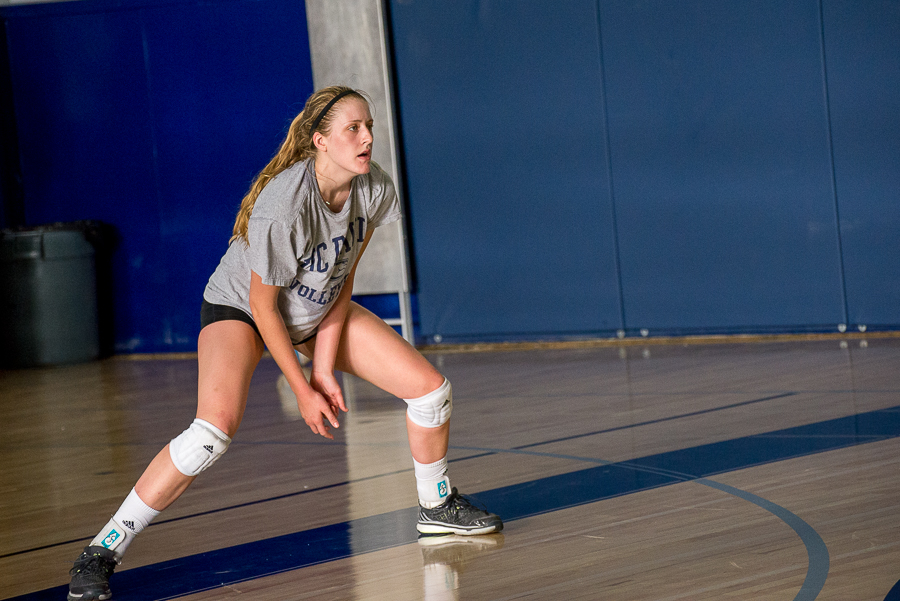
Women’s volleyball’s Lauren Matias earns collegiate accolades, looks forward to her years at UC Davis.

The pressure is on for everyone in their first year of college. However, it’s especially intense for student athletes, who juggle academic rigor and the anxieties of freshman year, as well as the discipline required to excel in collegiate sports.

Some say it’s impossible, but not for the rising star of UC Davis women’s volleyball, freshman outside hitter Lauren Matias.

After sitting out senior year in high school to focus on competing in the club season, Matias soon accepted an invitation to come play for the UC Davis women’s volleyball team and took collegiate play by storm.

The California Aggie had the chance to sit down with Lauren Matias to comment on her accomplishments as an Aggie and about the team moving forward.

Lauren Matias

Height: 6’2”

Year: Freshman

Position: Outside Hitter

Major: Undeclared/Exploratory Program

Hometown: Santa Cruz, California

High School: Harbor High School ‘16

History: Played with Main Beach VBC, played for Jan Furman, former legendary Davis volleyball club mentor.

Accolades: Two time Big West Freshman Player of the week, most kills in a match in the Big West in 2016, tied for third at UC Davis for most kills in a match.

How long have you been playing volleyball? What got you into the sport?

I have an older sister, so I started tossing the ball around third grade with her. She really inspired me to get started playing around sixth grade [and] I started playing club in ninth grade. It was a lot of fun to get to [play] because I was watching my sister do it.

What was the process like to play for UC Davis? Were you recruited, did you go to open tryouts?

It was a recruiting opportunity. I committed pretty young in my sophomore year [of high school]. I came on campus for a few unofficial visits and I really enjoyed the campus and the team and what we wanted to create out of Davis volleyball. I committed super young because I knew this was the place for me and I was going to do it sooner or later.

How does it feel when you see that over a short two-month time period, you receive the Big West Freshman of the Week twice?

It is super gratifying. Coming here, I didn’t know any of this would come out of it. The team is instilling so much confidence in me. Being a freshman, I didn’t know the system coming in and so it was a huge change for me. The team behind me has been great and I couldn’t do it without them.

You recorded 34 kills in the conference game against Cal State Fullerton and realized it was the most kills recorded in Big West 2016 play, and you tied for the third-most kills in a match in school history.

That was a lot of fun. I didn’t know how many kills I was getting but it all comes back to my team and being able to have those opportunities they helped me create. It was awesome at the end to see how many kills I got.

How does the team react to all of the records you have been breaking and the accolades you have received? What is the level of support from them?

They keep instilling confidence in me and getting me used to new situations so I can continue to attack at a high level, so they have been super supportive.

How do you feel the team is doing right now?

We are trying to take it one game at a time. We are working harder every day in practice and we still feel like we can still compete at a higher level. Having that kind of family mentality with the team is great and I think we can still continue to succeed.  

What does the team need to focus on moving forward?

We talk a lot about playing that “Davis volleyball” and we have talked about that being us attacking at a high and aggressive mentality. Also just instilling confidence in one another and controlling what we can control.

What is the ultimate goal for you to achieve athletically at UC Davis during your next few years?

I haven’t really thought about that yet. I think just contributing to the team as much as I can and trying to win that Big West title. Just take it one season and one game at a time because it is an awesome opportunity and it has been my dream for so many years.


Written by: Ryan Bugsch — sports@theaggie.org

Aggie Style Watch: fall edition

JAY GELVEZON / AGGIE

A man’s best friend is his greatest accessory

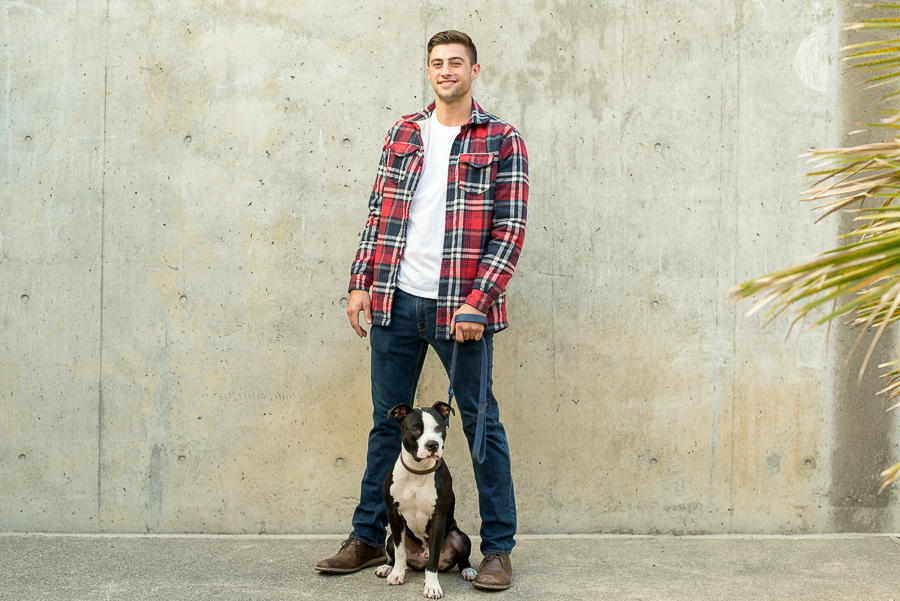
This week’s Aggie Style Watch is all about Josh Farnsworth, a fifth-year sociology major, whose favorite accessory is his dog, Wallace.

Farnsworth is a member of the rugby team, so his uniform and rugby merchandise take up a majority of his closest. When he isn’t in rugby clothes, though, he tends to lean toward the effortless classics.

JAY GELVEZON / AGGIE

ASW: What is your style inspiration?

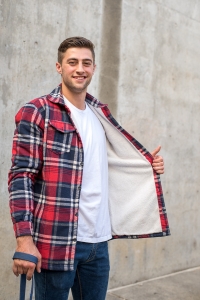
Farnsworth: My inspiration is a modern-type look, which is flannels,

leather boots, plain t-shirts, and jeans. When I get dressed up, I tend to look at celebrities like Ryan Gosling for inspiration.

ASW: Where do you shop?

Farnsworth: I tend to shop at places like REI, Patagonia and sometimes Marshalls because of their great deals. I love being outdoors so I need stores that will accommodate that.

ASW: What is your go-to outfit?

Farnsworth: My go-to outfit usually consists of my high-top Chucks, cargo shorts, a North Face long sleeve shirt and a Patagonia hat. I’m normally wearing something rugby-related, like hats, shirts or beanies.

JAY GELVEZON / AGGIE

ASW: How would you describe your style?

Farnsworth: I would describe my style as active. I wear clothes that allow me to go from class to taking Wallace out to play to rugby practice. When it gets colder, I tend to just wear jeans, a flannel and a beanie.

ASW: Do you have any advice for someone who wants to be more fashionable?

Farnsworth: Just to be comfortable in your clothes and wear what you like.


Written by: CaraJoy Kleinrock – arts@theaggie.org

Bringing Davis art history to life

libraryart_fe_venoos_moshayediThe stories behind the art murals found in the Peter J. Shields Library
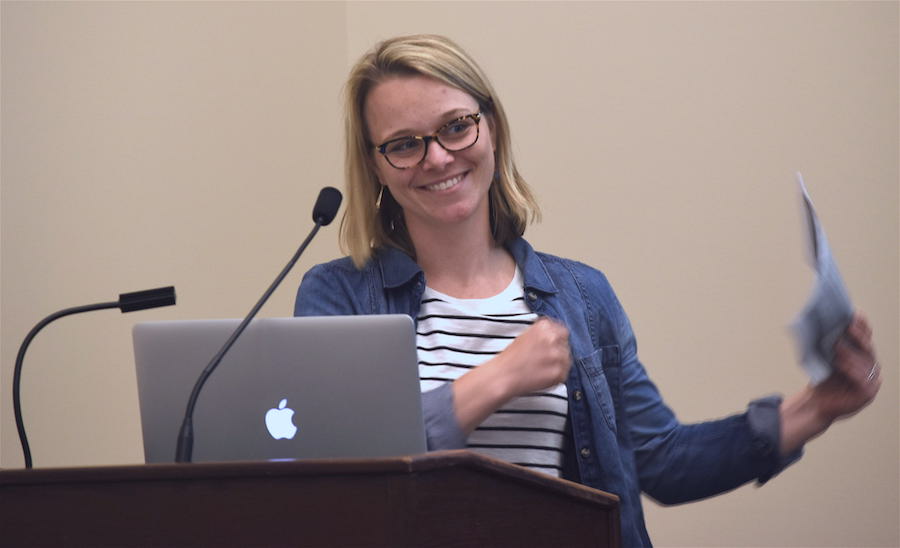

It’s the night before a midterm and dozens of students are hard at work, reviewing their textbook and lecture notes at the library. After studying for a solid five hours straight, one student decides it’s time for a break. They stand up, take a relaxing walk around the first floor, and are suddenly greeted by a group of ducks swimming toward them on a splash of water.

With a 24-hour study room, two computer rooms and five floors of desks, chairs and books, it’s no wonder that the Peter J. Shields Library was voted the “Best Place to Study” by readers of The California Aggie last spring.

Aside from providing a quiet study environment, Shields Library is also home to a wide array of gifted, donated and loaned artwork for the community to enjoy. Most pieces were created by alumni or artists who were once part of the UC Davis faculty, many of whom have gone on to become celebrated artists with pieces displayed throughout the world.

“We’re really excited to […] have such a vast collection of art to help enhance the experience of anybody that comes and visits the library,” said Jean Korinke, director of development for the UC Davis Library and UC Davis alumna. “[The pieces are] a main focal point for tours that we give […] and one of the more popular things [the visitors] see and hear about.”

Upon stepping into the Shields Library lobby from the main entrance, visitors see two sculptures near the main staircase. The sculptures were created in 1991 by David Gilhooly, who attended UC Davis as both an undergraduate and graduate student in the 1960s. Gilhooly’s ceramic works significantly contributed to the Bay Area’s Funk Ceramic Movement.

“The Funk art movement of California […] was born during this period in the ‘60s and early ‘70s,” said Jessica Nusbaum, associate director of communications and marketing for the UC Davis Library. “The core art faculty [and students] who were [at Davis] at that time were […] a community of artists who were constantly challenging each other, building off of each other’s work, providing creative inspiration and really pushing the frontiers of their art to new places.”

Correlating to the library’s staircase beside them, Gilhooly’s sculptures explore a common motif of stairs: one of them features a flock of ducks swimming down a staircase; the other displays food spilling down a flight of stairs.

Other notable artists whose work can be found in the library are George Longfish and Wayne Thiebaud. Longfish taught as a Native American studies professor at UC Davis for 30 years until 2003, and much of his art centers around Native American identities, history and heritage.

His artwork can be seen on the right side of the library from the main lobby, including the vibrant mural near the computer lab. Longfish’s personal painting style includes bright colors and incorporation of text.

Thiebaud, a world-renowned northern California artist whose work can also be seen at Sacramento’s Crocker Art Museum, began as a UC Davis assistant professor in 1960 and taught for almost 40 years. In 1994, he was presented the National Medal of Arts by President Bill Clinton.

Thiebaud is known for his paintings of everyday items, from lipsticks to diner desserts one of his works portraying a candy counter can be found by the elevators on the first floor of Shields Library.

“It’s really impressive how important the artists and the teachers at UC Davis were during that period of time,” Korinke said. “When we were primarily still thought of and focused on agriculture, the art department that was here was phenomenal, and they really made an impact [on California art].”

The artwork in Shields Library affects the UC Davis community in various ways, creating a more relaxed, pleasant atmosphere in a studious environment.

“I really like that [the art pieces] are vibrant,” said Ivan Munkres, third-year biochemistry major and Shields library employee. “They bring life into the library in a place where everybody’s just studying. [The art is] something nice to look at when you look up from your math homework.”

The artwork has also proven to be a way for alumni to emotionally reconnect with the campus. A few months ago, a campus organization formed in 1964 called the Art, Garden and Literary Society hosted a reunion at UC Davis.

As the alumni toured Shields Library and viewed the artwork together, many of them told personal anecdotes about the artists themselves, having taken classes with the artists while they were students at UC Davis.

“[The tour] was really a nice way to re-engage alumni, [and] they remembered [the artists] very fondly,” Korinke said. “Many of them had pieces […] by the artists because […] before [the artists] were overly successful, a lot of the people that worked with them collected their art or bought their art.”

Shields Library is also home to the Department of Special Collections, which gathers and preserves historical documents owned by UC Davis, and is closely linked to the University Archives. Both Special Collections and the library artwork make Shields Library an area carrying much of UC Davis’ history and legacy.

Students who wish to learn more about the these art pieces can go on one of the library’s tours. The next opportunity will be on Nov. 5 for Parents’ Weekend.

“The library [has a] role [of] being historian and storyteller for the university,” Nusbaum said. “The art in the library is another way that [the] history of this university comes to life.”


Written by: Jennie Chang — features@theaggie.org

UC Davis mourns loss of plant biologist Sharon Gray

COURTESY
COURTESY

Gray struck, killed by rock while in East Africa for plant biology research project

UC Davis plant scientist Sharon Gray was struck and killed on Oct. 4 by a rock that crashed through the window of the vehicle she was riding in on the outskirts of Ethiopia’s capital, Addis Ababa. She was 30.

Gray was in the East African nation to attend a meeting regarding the commencement of a plant biology research project.

According to the Netherlands Institute of Ecology, which was also involved in the research project, Gray’s death was not a direct consequence of the large-scale protests currently occurring in Ethiopia, but rather the result of a random act by a few individuals who were throwing stones at passing vehicles.

Gray was postdoctoral student at UC Davis who studied the impact of climate change on plant life. Her graduate work focused on the response of soybean plants to high carbon dioxide levels in the presence of drought, and showed that plants did not respond as the scientific community had anticipated.

Before her passing, Gray had just completed her National Science Foundation-funded postdoc project, which characterized the responses of a drought-tolerant wild species of tomato and a drought-sensitive domesticated species of tomato.

Siobhan Brady, associate professor in the Department of Plant Biology and the Genome Center at UC Davis, travelled with Gray on the trip to Ethiopia, and the two worked closely together at UC Davis. Brady said that Gray was a charismatic and wonderful person to work with and was very knowledgeable about her topic of research.

“She worked so hard, was patient, funny [and] incredibly smart,” Siobhan said.

“She had an extensive background in physiology and statistics, which was so useful not only to my lab, but to several departments. Her smile lit up a room. In a room where there were ‘big voices,’ that is, people who speak loudly and can sometimes dominate, she would persevere and ask critical, thoughtful questions. I really admired this about her.”

Gray was born in Carbondale, Ill. and grew up in Lindenhurst, Ill. with her parents, three brothers and two sisters. She earned her undergraduate and doctoral degrees from the University of Illinois Urbana-Champaign before joining the Plant Biology Department at UC Davis in 2013.

In 2014, she married R.J. Cody Markelz, a postdoctoral researcher in plant biology at UC Davis who was also from Illinois. They met as freshmen at Urbana-Champaign in an introductory biology class.

According to Markelz, Gray met a young Ethiopian scientist who had access to a wide range of molecular equipment and tools, but who needed training in how to use them.

“[Gray] really wanted to bring her to UC Davis for training and was so motivated to remove this barrier to learning when the resources were already in place,” Markelz said in a statement for UC Davis Dateline.

Gray also mentored undergraduates at Urbana-Champaign and UC Davis, as well as high school students from Davis High and Pioneer High in Woodland.

UC Davis alumna An Nguyen had Gray as a mentor for two years before graduating recently with a degree in biotechnology.

“Sharon meant a lot to me and was a big part in the success of my undergraduate career,” Nguyen said in a statement for UC Davis Dateline. “I couldn’t have done it without her support. Even now, I aspire to be able to give the same valuable mentorship to someone else as she had done for me.”

To honor Gray and her work, Gray’s family is raising money via GoFundMe to mentor women in science.

“The mission of this current campaign is to make something positive out of this tragedy,” Markelz stated on the GoFundMe site.

Savithramma Dinesh-Kumar, professor and chair of the Department of Plant Biology, believes Gray was a woman who was truly cherished and destined for great things.

“Sharon was liked by everyone in the Plant Biology Department at UC Davis,” Dinesh-Kumar said. “It is a great loss to the Plant Biology Department, UC Davis and the scientific community.”

Acting Provost Ken Burtis and the dean of the College of Biological Sciences Mark Winey released a statement expressing their condolences and honoring Gray’s work and her dedication to UC Davis.

“On behalf of the entire UC Davis campus, our hearts and condolences go out to Sharon’s husband and extended family,” Burtis said. “Even in tragedy, we hope that we all can find some comfort in the wonderful work [Gray] was engaged in that will better the lives of so many around the world.”


Written by: Demi Caceres — campus@theaggie.org

The Editorial Board’s Proposition Endorsements

HANNAH LEE / AGGIE
HANNAH LEE / AGGIE

Your voter guide to all Nov. 8 ballot measures

Though California’s presidential choice in this consistently Democratic stronghold may be a forgone conclusion, the fight to pass 17 propositions — the most since 2000 — remains far more contentious, with measures on whether to legalize recreational marijuana and repeal the death penalty among the most notable choices voters will have to make this November.

In an effort to convince you, the student-voter, of the importance of these propositions to the state of California, the Editorial Board has compiled a short analysis and recommendation for each ballot measure. We hope that you will further research the propositions most likely to affect your own life so as to make the best decision possible.

Read below for information on all 17 propositions.

Prop 51: School Bonds

What it is:

If passed, Prop 51 would allow a total of $9 billion in general obligation bonds to be used for school construction and modernization of K-12 public schools, community colleges, charter schools and vocational education facilities. The bonds would cost an estimated $17.6 billion to be paid off by taxpayers over the next 35 years. Advocates argue that many educational institutions need to be maintained or upgraded to meet safety standards, that it would increase educational access, is financially prudent and would even help the economy. Opponents claim that local control should be given to the funds instead of state officials deciding the allocation of the bonds, that poorer districts are less likely to receive sorely needed money, that construction companies are disproportionately favored and that California cannot afford the extra debt.

Our recommendation: YES

Improving school facilities is essential to creating effective learning communities, and this proposition would help schools expand their influence to surrounding areas. For elementary schools, upgraded buildings and resources would lead to better educational opportunities for students, and for community colleges an improvement in facilities would ensure that post-high school education is available to more people, which would help to further their own careers and the California economy.

Prop 52: Hospital Fees

What it is:

Prop 52 would permanently extend the lifeline of a fee that hospitals pay to the state of California. This fee actually benefits hospitals, as the federal government matches all funding that the state directs to Medicare (Medi-Cal in California). The fee aims to create a safety net for the state in the case of an economic downturn that leads to increased enrollment in Medi-Cal. Nearly a third of all Californians are on Medi-Cal currently, and supporters of the initiative argue that it would significantly reduce hospital losses while extending the health care services provided to those on Medi-Cal. Prop 52 would also ensure that all funds are used properly.

Our recommendation: YES

The proposition has almost-universal support and no real organized opposition. Among its supporters are hundreds of hospitals, health care associations and clinics. The Editorial Board would like to join almost every major newspaper across the state in endorsing Prop 52.

Prop 53: Infrastructure

What it is:

Prop 53 would require voter approval for state “megaprojects” that cost over $2 billion in state revenue bonds. The California High-Speed Rail, for instance, might need voter approval before implementation in California. Proponents say that voters can hold politicians accountable and stop blank checks. However, this proposition could delay local infrastructure. There is also no exemption for emergencies and disasters.

Our recommendation: NO

Needing voter approval before using taxes on state projects seems like a good idea on paper, but it could limit local projects by requiring voter approval from faraway regions. California residents could also vote down key statewide projects. The stipulation that there is no exemption for emergencies or disasters seals the deal. Should an earthquake along the San Andreas fault take out half of the state, victims would be forced to wait for voters to approve rebuilding efforts.

Prop 54: Legislative Transparency

What it is:

Proposition 54 would mandate that the final versions of all bills before the California legislature be published online 72 hours prior to a vote. Public meetings would also be made readily available online for up to 20 years. Proponents argue that Prop 54 would help prevent last-minute deals from being brokered behind closed doors. But others say that the bill would do nothing to prevent special interests from influencing votes in the final moments before a vote is held.

Our recommendation: YES

Considering that the final language of many major bills is released only days before a vote — including a 1996 piece of legislation that deregulated California’s energy industry — Prop 54 is needed to give lawmakers and the public time to take a fair look at any consequential decision. Even though it may not prevent the back-wheeling tactics typical in Sacramento, the Editorial Board endorses Prop 54 for its promise to increase transparency in the capitol.

Prop 55: Income Tax

What it is:

Prop 55 would continue a proposition passed in 2012 that increased the income tax on small businesses, individual Californians who earned more than $263,000 and joint incomes totaling at least $526,000. Supporters of the proposition in 2012 billed it as a temporary fix to the recession. This is set to expire in 2018, and Prop 55 would continue the tax rate until 2030. This tax would bring in an estimated $4 to $9 billion annually from 2019 through 2030 that would be used for education and healthcare.

Our recommendation: YES

The state of California has experienced a $6 billion influx to revenue due to this tax, and we would like to see these funds continued. Prop 55 would neither raise nor lower the current tax rate for the wealthiest Californians and would continue to bring a significant amount of money to local schools and a smaller amount to healthcare in the state.

Prop 56: Tobacco Tax

What it is:

A “Yes” on Proposition 56 would favor an increase of $2 on the current $0.87 tax on tobacco products in the state of California. Currently, the $0.87 tax funds tobacco prevention programs, environmental protection, breast cancer research and screenings, as well as developing programs for children within the state. The $2.87 tax could further funding spent on reducing tobacco usage, training physicians and preventing dental illness and services within Medi-Cal, and the allocation of the original $0.87 tax revenue would not change.

Our recommendation: YES

The average tax on tobacco products in the United States is $1.65, meaning that 34 states have higher tobacco taxes than California, though it was the first to enforce a statewide smoking ban. The Editorial Board cannot argue against the allotment of additional funds to go towards medical research and children’s programs, and encourages its readers to think of the benefits a tax like this can have on our communities — the best of which would be fewer individuals purchasing and smoking cigarettes.

Prop 57: Prison Populations

What it is:

A yes on Prop 57 would increase the parole and “good behavior opportunities” of felons convicted of nonviolent crimes. It also allows judges (not prosecutors) to make the decision of whether some juveniles should be tried as adults in court. The proposition would serve as a way to reduce California’s overcrowded prison population, which saves taxpayers money and focuses on rehabilitation rather than incarceration for nonviolent offenders. However, this proposition comes with its fair share of complicated loopholes. Those in opposition cite the fact that this piece of legislation is poorly drafted and might allow criminals who have committed rape, “lewd acts” against children and human trafficking to be released early from prison since the phrase “nonviolent crimes” is not directly defined in Prop 57 or California state law.

Our recommendation: YES

There are currently over 129,300 people in custody in Calif., with crimes ranging from the possession of drugs to murder in the first degree. For certain individuals, a lifetime in prison is not the solution — it would benefit taxpayers, the system and the individuals if instead of overcrowding prisons, rehabilitation was made the focus for those people. Ideally, the proposition language regarding “nonviolent crimes” would be more clearly defined, to prevent any exempt crimes from finding a loophole.

Prop 58: Bilingual Education

What it is:

A yes on Prop 58 would reintegrate bilingual education into public schools and retract the need for parental waivers if a student wants to take a non-English-only class. Prop 58 is an attempt to repeal Prop 227, the “English in Public Schools” Statute of 1988 that eliminated bilingual classes for “Limited English Proficient” (LEP) students, and required them to take one-year of intensive English before merging into English-only education.

Our recommendation: YES

Those in favor argue that well-designed bilingual programs will serve as catalysts for the success and academic proficiency of non-English speaking students, while also giving English-speaking students a chance to learn a second language. Those opposed contend that passing Prop 58 would sacrifice policies that have enhanced language education. The Editorial Board stands by Prop 58. Vote YES and help support our public schools’ immigrant and nonnative English speaking students.

Prop 59: Citizens United

What it is:

Prop 59 asks whether California elected officials should use their authority to propose and ratify an amendment to the federal Constitution that would overturn the United States Supreme Court’s decision in Citizens United v. Federal Election Commision, which ruled that it is unconstitutional to have laws that place certain limits on corporate and union political spending.

Our recommendation: YES

Voting yes on Prop 59 would not overturn the Citizens United Supreme Court decision, but would “send a message” to officials that a majority of California residents believe it is constitutional to place limits on political spending by corporations and unions. While this may seem frivolous, a yes vote would show California officials that voters do not want politicians to be “bought” by corporations or unions.

Prop 60: Mandatory Condoms

What is it?

Prop 60 would make use of condoms mandatory in pornographic films and holds producers of pornographic media financially responsible for certain preventative and routine healthcare. Prop 60 also grants agency to private viewers, making it possible for them to sue any performers or industries they see breaching those measures.

Our recommendation: NO

The adult film industry already requires performers to get tested for sexually transmitted diseases every 14 days. The stringent rules Prop 60 would enforce may only serve to drive the industry underground, resulting in a devoid of regulations altogether. The vast majority of adult performers oppose Prop 60 in an attempt to fight off one more legal barrier of the myriad they already face. The Editorial Board sides with keeping the state from policing sex between consenting adults. Vote ‘NO’ on Prop 60 to support the community it most affects.

Prop 61: Drug Prices

What it is:

“Yes” on Prop 61 would support regulating drug prices in California by mandating that state agencies pay the same amount as the U.S. Department of Veterans Affairs for pharmaceuticals.  This measure would apply when the state directly purchases drugs for state programs, covering about 12 percent of Californians. This proposition gives state agencies power to negotiate the prices of pharmaceuticals.

Our recommendation:  NO CONSENSUS

This proposition is a direct response to the failed measures on drug price transparency in the legislature, combating the 500 percent increase in EpiPen prices and Turing Pharmaceuticals’ 5,000 percent price hike on AIDS medication. It also has the possibility to save the state a large amount of money, and provide easier access to medications for those on state-funded health plans. However, this proposition could increase prices for veterans and put their federally mandated 24 percent discount for pharmaceuticals in jeopardy.

Prop 62 and Prop 66: Death Penalty

What it is:

Prop 62 would repeal the death penalty and make life in prison without the possibility of parole the maximum sentence available for murder. This change would also be retroactively effective, meaning that inmates who are currently on death row would have their sentence changed.

Prop 66 would keep the death penalty, but enforce stricter deadlines for appealing a death sentence, limiting appeals to a five-year period after sentencing.

Our recommendation: YES on 62 and NO on 66

The death penalty is a barbaric and ineffective method of doling out justice; it is state-sponsored murder. California has carried out 13 executions since 1978. Anyone who thinks the death penalty is merely fair punishment for those who have committed atrocious crimes is ignoring the fact that our criminal justice system disproportionately targets people of color. And in a report published by the NAACP, defendants were far more likely to receive a death sentence if his or her victim was white, as opposed to a person of color.

As of December 2012, more than 140 countries and 19 states have abolished the death penalty, either in law or practice. What’s California waiting for?

Prop 63: Gun Control

What it is:

If Prop 63 were to pass, large-capacity ammunition magazines would be prohibited, and more stringent regulations would be enforced when acquiring ammunition. The proposition also supports stricter legislation to ensure people who are prohibited from owning guns do not continue possessing or gain access to ammunition. Those in support believe it will, for the most part, keep guns out of the hands of the wrong people. However, the opposition claims Prop 63 does not address the issue of terrorists’ and violent criminals’ access to firearms, and that money used for the proposition might be diverted away from local law enforcement.

Our recommendation: YES

There have been over 46,300 shooting incidents since the beginning of 2016 in the United States, according to The Gun Violence Archive. To reiterate from a 2015 Aggie editorial, “no one living in the United States, excluding the military and law enforcement, needs an assault rifle or high-capacity ammunition.” Vote “YES” on Prop 63 to start trying to solve America’s gun violence problem.

Prop 64: Recreational Marijuana

What it is:

Prop 64 would legalize the recreational use and possession of marijuana, making it available for public sale to adults 21 years of age or older. Advocates say Prop 64 would create a safe and effective regulatory system for the sale and taxation of cannabis products. But potential downsides, critics charge, would include higher rates of DUI and crime — in addition to tougher business conditions for small marijuana farmers.

Our recommendation: YES

With a few minor caveats, The Aggie confidently endorsed Prop 64 in a previous, more detailed editorial. Legalizing marijuana would not just increase tax-revenue for drug-research and rehabilitation programs, but it would also be a step toward solving the more intractable problem of mass-incarceration — a form of modern-day slavery for people of color, who are arrested at far greater rates for drug possession than whites.

Prop 65 and 67: Bag Ban

What it is:

If passed, Prop 67 would validate the statewide plastic bag ban passed in 2014 by the state legislature. Under the current bag ban, grocers receive the money collected from the fee.

Prop 65 determines who would receive the $0.10 customers pay per bag. A “yes” would give the funds to the Environmental Protection and Enhancement Fund, while a “no” would allow grocers to continue receiving the money. If Prop 67 fails but Prop 65 passes, local bag bans would still exist, with local governments choosing who receives the money. If both Prop 67 and 65 fail to pass, nothing would change—local bag bans would continue, with grocers receiving the money from the bag fees.

Our recommendation: YES on 67, NO on 65

The Editorial Board endorses Prop 67. Every year, Californians use billions of plastic bags, which end up in landfills, sewers and nature. Our environment matters, and passing this proposition would be a major step in protecting it.

The Editorial Board encourages students to vote “no” on Prop 65. If Prop 65 passes, it will be difficult for grocers to implement Prop 67, as current bag bans are financed by the $0.10 customers pay per bag.

Humor: Embrace the L

loss_opWhat losing can do for you

The best thing to ever happen to me was the first time I asked a girl to dance.

I was in the sixth grade. My skater phase. Yeah, I had the skinny jeans and Vans, and I only wore Billabong, Quiksilver and Hurley shirts. My mom kept trying to tell me that Zumiez skate shop was trash, but that’s where my people gathered — of course she wouldn’t get it.

So, it was in this phase that I walked up to the girl at the dance and, as smooth as a walrus trying to be low-key, asked her in my deepest, manliest, huskiest (it definitely cracked) voice possible if she wanted to slow dance to R Kelly.

She laughed. Not just a chuckle, or a sweet little “aw-shucks” kind of blushing giggle.

She snorted. She guffawed. She literally laughed in my face when I put myself out there, all vulnerable, in my Enjoi hat.

That was an L. Oh, wow. It was so humiliating. Luckily my buddies were supportive. They’re such wonderful people — they laughed at me so hard that my self-esteem was obliterated. That night, even though I’m super over it, October 16th, 2008, was the night I started the process of becoming who I am today.

We love winners. That’s obvious. But in the same way that we love winners, we also really love the finished product. We love amazing albums like Yeezus, 808s and Heartbreaks, and My Beautiful Dark Twisted Fantasy. We fawn over world-class shows like Breaking Bad and The Wire and season one of True Detective. On dates, we ask each other what our favorite movies, books and songs are because we’re at the point where that can say a lot about a person.

But all of those completed projects took a breathtaking amount of time, energy and risk to create. The amount of effort may even be more impressive than the actual work itself. Because it’s not just hard — it’s also inglorious.

I gave a speech my junior year of high school. It was the best thing I’ve ever written. I rose to the pressure and delivered it as well as I could have. People in the audience still ask me about it today. I visualize myself back in that moment before every job interview, every final and every date.

No one saw that I spent my entire spring break, from morning until night, locked in my house, re-writing over and over again. I wrote seven totally different speeches. I paced, shouted, timed and gestured in front of a mirror for more hours than I’d spend in a classroom during a school week. I didn’t go out. I didn’t see a single person. My girlfriend at the time wanted to murder me for not responding to her texts. I was riled up: pure caffeine.

Power-striding, focused, confident, hit-every-pause-and-nail-every-applause-line, capture-the-room Yinon in a tailored suit was a surface layer built on an inner core of sleep-deprived, nervous wreck, losing his voice Yinon who forgot to change sweatpants while finishing his final draft at 4 a.m. on a Wednesday night during spring break.

But I’ve also obviously given terrible speeches that were poorly written and poorly delivered. Plenty of L’s in that department. We’re a culture that glorifies the win. And we respect but don’t fully understand or explain the grind behind the victories. And we completely demean, disrespect and disassociate from the L’s.

We forget that the beautiful wedding pictures on Instagram only came to life because of the untagged, tucked-away, occasionally deleted posts of the ghosts of exes past. We don’t realize that the multi-hundred “liked” LinkedIn status announcing the dream job sprouted from those heart-wrenching emails that regret to inform and wish you the best.

It’s the reason that behind every gorgeous, perfectly-captioned Facebook profile picture in 2016 lie haunting predecessors of acne, awkwardness and awful fashion choices from 2009.

Collectively, I don’t think we’ll ever get around to lionizing people failing, grinding and restarting. Individually, though, we need to accept not just the shiny end result, but also the entire, messy, ego-bruising, anxiety-inducing and just plain stressful process.

On a personal level, we need to mentally push ourselves to love the blank pages and slow starts and cold-blooded rejections, because those cold-blooded rejections are the most helpful things anyone can do for us. Those L’s aren’t just crappy moments for us to feel awful about ourselves. They’re moments when life shows us, instead of telling us, what we can do to act better, do better and be better.

I’ve been taking L’s, and I’ll keep taking L’s. I don’t think I’ll ever love it, but I’m getting better at turning the L’s into the springboards to my next W. I’m at a point where I don’t hate them anymore. Now, before any leap I take, I can take a sober look at the rewards and the risks and realize that no matter how bad the L is, I’ll be okay.


Written by: Yinon Raviv — ravivyinon@gmail.com

Democratize UC holds demonstration at Memorial Union

ALEXA FONTANILLA / AGGIE

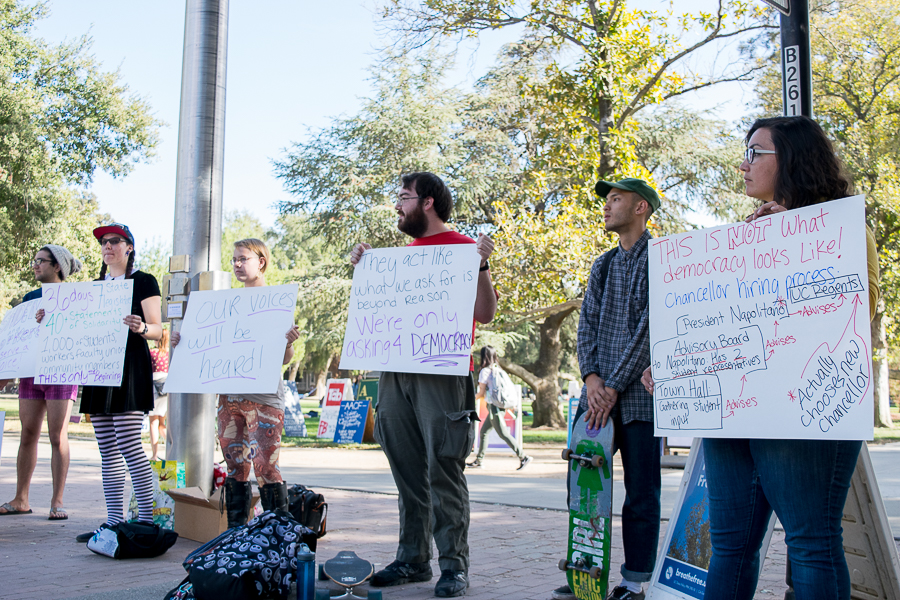
Demonstrators demand for more student voices present in selection of new UC Davis chancellor

A small group of demonstrators coalesced around the flagpole at the Memorial Union on the afternoon of Oct. 11 to advocate for greater student representation in the selection of UC Davis’ new chancellor. This follows the resignation of former chancellor Linda P.B. Katehi on August 9, 2016.

“Democratize UC,” the group who organized the demonstration, is a continuation of the Fire Katehi movement that staged a 36-day sit-in at Mrak Hall.

“We are just […] pissed off because we don’t want another Katehi: another big-business overlord, greedy, piece-of-s**t person that doesn’t give a s**t about anyone else but their salary and their friends who are also hella rich and in the administration,” said Becca Payne, a third-year technocultural studies major. “We want someone who actually cares about the students.”

The core of the demonstration revolved around the selection process for the new chancellor.

“The town hall is what is going on right now,” Payne said during the demonstration. “This is when we as students […] are supposed to give our input in what we want in a new chancellor. This town hall is merely a pathetic advisory to the actual advisory board. The advisory board has two student representatives — just two, one undergrad and one graduate student representative. This advisory board is only an advisory board to [UC President] Napolitano. Napolitano gets to pick whoever […] she wants to then present to the UC Regents and then the UC Regents then approve her suggestion of who the new chancellor is going to be.”

According to the UC Davis, the aforementioned advisory panel will conduct interviews of potential chancellors and forward semifinalist names to UC President Napolitano, who will make her final nomination to the UC Regents.

According to Payne, although the process of picking a new chancellor is important, there are also pressing day-to-day issues affecting UC Davis students. This includes struggles to keep up with an extremely fast-paced academic climate.

“Maybe that’s because of the quarter system that we are on,” Payne said. “Maybe because this university and this institution doesn’t actually give a s**t about the students and doesn’t actually give a s**t if we learn or not. They just want us to get our degrees and get […] out.”

Bernadette Fox, a fourth-year international relations and women’s studies double major, spoke next. Fox accused Napolitano of conniving to keep student voices out of the chancellor selection process.

“Let’s be real, we all know that Napolitano probably already has someone picked out for the chancellor,” Fox said. “So her way of patting us on the back, making us feel like our voices are being heard, is holding a meeting at the Mondavi Center […], when the majority of undergrads have classes to get to. Don’t think that’s a coincidence; that’s the stuff they plan on purpose to let you know they don’t really give a s**t what you think.”

Fox believes that the chancellor selection process does not actually include student involvement.

“I find it very telling that the current process is structured in a manner that allows the UC Regents and President Napolitano to essentially add anyone they want to the pool of applicants while subsequently choosing to dismiss all applicants recommended by the advisory board,” Fox said via e-mail. “They’ve engineered a system that allows for them to choose whomever they want while simultaneously giving the illusion that they’ve considered ‘our input.’ And I put that in quotations because thus far there’s been limited and little attempt to create a way for student, faculty and worker input to be heard.”

Many students sitting at the MU were able to watch the demonstration. Trevor Lynn, a fourth-year physics major, felt comfortable when interacting with the protestors.

“This is first and foremost a student-[driven] protest,” Lynn said. “[The demonstrators] are all incredibly nice, very welcoming, really positive, especially in the face of how negative a lot of these things make us feel, certainly make me feel. I feel it’s really easy to get angry about a lot of these things, but the overwhelming feel of this demonstration is really positive which is great.”


Written by: Kenton Goldsby — campus@theaggie.org 

Marriott Residence Inn proposal moves to City Council for final vote

Amy Ye / The Aggie
Amy Ye / The Aggie

Extend your stay in Davis at the new Marriott hotel

After the promising Hyatt House proposal was quashed in the Davis Planning Commission, Davis may finally be getting the extended-stay hotel it has been waiting for. Keep an eye out for the new Marriott Residence Inn near Mace Ranch, which the Davis Planning Commission recently voted unanimously in favor of.

According to the plan, proposed at a public hearing for the Residence Inn Hotel, the new hotel will have four stories with 120 rooms and suites, all complete with kitchens. The hotel also plans to include an outdoor pool, bicycle accommodations and sustainability components such as solar water heating and storm water treatment.

“[Davis needs an extended stay hotel] primarily because one doesn’t exist now, and extended stay hotels address […] a unique niche within the hospitality or hotel industry,” said Eric J. Edelmayer, vice president of development with Jackson Properties, the agency that proposed this hotel.

Edelmayer hopes that the hotel will address the rising need in Davis for an accommodation that allows travelers to stay more than a couple of nights. With Davis’ growing economy and population, those involved with the project anticipate that the Marriott Residence Inn will not only be utilized, but will also bring business to the surrounding neighborhood.

“With the nature of some of the companies and businesses currently operating in Davis […] that have clients who travel from around the country, from outside of the area, from around the world, who are often visiting for training and meetings, we think this type of hotel would certainly benefit their type of clients, and also the UC Davis Aggie community as well,” Edelmayer said. “[You] can have professors, parents and what have you traveling to an area, who might attempt to stay for longer than just a couple of nights, and would appreciate having the additional amenities that an extended-stay hotel offers.”

Despite the quick approval from the Planning Commission and little backlash from nearby neighbors — as Davis residents experienced with the Hyatt House proposal — the Marriott Residence Inn is still receiving some criticism. Some residents think that the environmental impact — which would involve relocating one of the last breeding pairs of burrowing owls — is too substantial, despite the efforts of project managers to create a sustainable hotel.

“Their sustainability plan is non-existent,” said Alan Pryor, a local resident, in a previous interview. “I think this is the right product, the right location […] but I respectfully request the applicant up their game to a minimum of LEED gold.”

The hotel currently reaches CALGreen Tier 1 certification, which is Davis’ basic requirement for developments. This issue is expected to be brought up again when the proposal makes its way to the City Council in late October.

The next step for the project? Get the green light from Davis City Council. Then, Davis can relish in its first extended-stay hotel.


Written By: Samantha Solomon – city@theaggie.org

UC Davis alumnus publishes culinary science book

JASON JAACKS / COURTESY

Ali Bouzari reveals the secret ingredients to understanding food science

UC Davis alumnus Ali Bouzari’s new food science and culinary book, Ingredient, examines the scientific agents that help us cook our food. The book serves as an illustrated guide to cooking for people of all culinary levels, and introduces readers to the behind-the-scenes ingredients responsible for food production.

After obtaining his Ph.D. in food biochemistry from UC Davis in 2014, Bouzari worked with chefs, food scientists and culinary students and helped lead cooking seminars. He was inspired to create a guide that helped cooks across a spectrum of skill levels easily understand the fundamentals of cooking.

“The idea that I could write something that could be applicable to a paleo-nutritionist, a chef in a fine dining restaurant and my grandmother cooking food for Thanksgiving — the idea that one set of principles in one book could help all of those people do exactly what they wanted to do better was really intriguing to me,” Bouzari said.

In his book, Bouzari describes eight key Ingredients (with a capital “I”), which include water, sugars, carbs, lipids, proteins, minerals, gases and heat. These Ingredients act as fundamental building blocks that work behind the scenes in the foods we cook.

Bouzari personifies each Ingredient in its own chapter and provides vivid images to keep readers engaged and actively thinking.

“Being able to visualize and grasp the concepts at play is very important to [Bouzari],” Tyler Simons, graduate student in the Department of Food Science and Technology and colleague of Bouzari, said. “The book is only about one-third text with the rest being photographs and illustrations. This format creates an environment that is hands-on and intuitive while teaching the scientific principles behind the world of food science. It’s not a book designed for Ph.D level scientists; it’s a book designed for anyone who wants to understand the world of food a little bit better.”

The book also explains how Ingredients work behind the scenes when regular ingredients are limited. In doing so, said Bouzari, readers will have a better scientific understanding of what happens during the process of cooking.

Bouzari was recently featured on Zagat’s 2014 30 under 30 and Forbes’ 2015 30 under 30 and is currently the chief science officer of Pilot R+D, a culinary development company based in Northern California.

Although Bouzari has moved away from food science research, he still attributes some of his understanding of food and culinary science to his time at UC Davis.

“[Bouzari] is incredibly passionate about food science,” said Dirk Holstege, a professor of environmental toxicology and colleague of Bouzari. “He’s very entrepreneurial and has always been a hard worker.”

According to Simons, Bouzari’s book provides a basis and context for every recipe, cookbook and restaurant meal, helping readers to truly understand what’s going on under the hood of their barbecue brisket or grilled cheese sandwich.


Written by: Emma Sadlowski – science@theaggie.org

UC Davis releases 2015 Clery crime statistics

LUCY KNOWLES / AGGIE

The university received reports of 28 rape cases, 15 cases of domestic violence, 54 burglaries

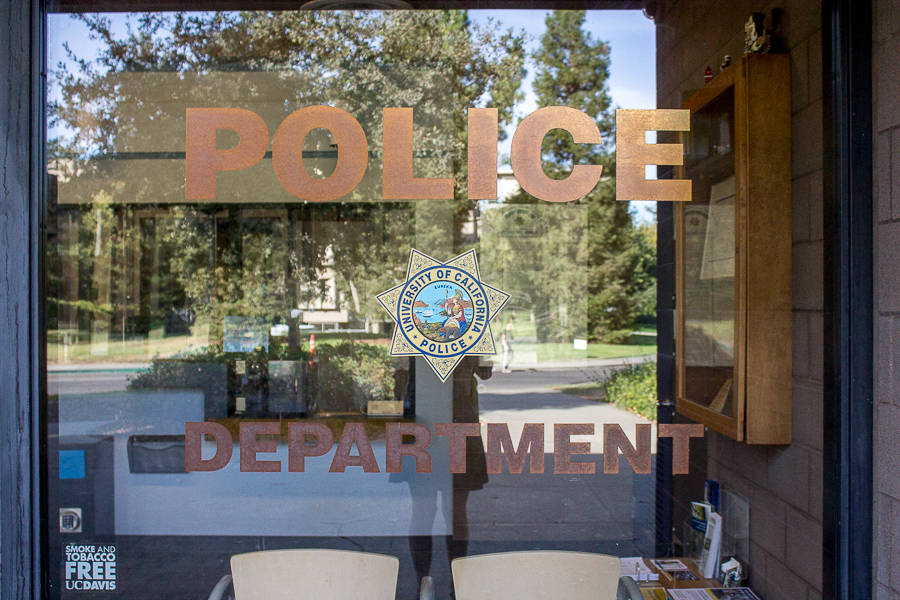
UC Davis released the Annual Security and Fire Safety Report to the UC Davis community via e-mail in late September. Under the federal Jeanne Clery Disclosure of Campus Security Policy and Campus Crime Statistics Act, otherwise known as the Clery Act, this report is required to be publicly released.

The data includes information on campus safety programs and summary statistics of crimes in 2015 on or around UC Davis property, which include the campus, medical center and the Sacramento branch.

The goal of the Clery Act is to ensure students, prospective students, parents and employees have access to accurate information about crimes committed on campus and campus security procedures.

UC Davis received reports of 28 cases of rape, 20 cases of fondling and one case of statutory rape in 2015. The university’s statistics also included five cases of dating violence, 15 cases of domestic violence and 22 cases of stalking.

The Clery statistics additionally reported 62 arrests for liquor offense, 38 for drug offenses and eight for weapon misdemeanor.

In 2015, UC Davis received nine cases of hate crimes: four cases of vandalism, three cases of intimidation and two assault cases.

The university also received reports on 22 cases of aggravated assault, 54 burglaries and nine auto thefts. These statistics do not include simple theft cases such as bike theft or unattended backpacks being stolen.

Compared to the 2014 Clery report, the statistics have risen in most categories of crime, including rape, domestic violence and hate crimes. Andy Fell, UC Davis associate director of media and news relations, attributes the crime increase to a higher frequency of reporting in 2015.

Reported crime can be received by police and campus security authorities, which include university employees like deans, coaches, resident assistants and faculty advisors for student clubs. UC Davis has more than 900 campus security authorities surveyed by the 2015 Clery report.

The Center for Advocacy, Resources and Education (CARE) also provides aggregate data for disclosures on sexual violence, but only with permission from the victims with their identities not disclosed.

Sarah Meredith, director of CARE, said the limitations of the Clery statistics makes the reporting inaccurate and not fully representative of the UC Davis community.

“[The Clery report] is based on geography and not on affiliation to the campus,” Meredith said. “For example, if we have a student experience a clery crime, if they experience the crime not on a UC Davis owned or leased property, then the crime will not be on it.”

Although CARE statistics can be included in the Clery report if the victim approves, Meredith also said reporting to confidential resources, like the counseling services and harassment and assistant prevention program, are not counted in the Clery report.

Safety initiatives set in place on campus that have improved in 2015 include an expansion of the Safe Rides services and the installation of the emergency call stations on campus.

According to Fell, the UC Davis Safe Ride services are the largest in the nation. The expansion includes service after Unitrans stops running and Safe Rides servicing downtown.

Many of the new blue light emergency call station installations are located in the arboretum.

“[Blue light phones] give people security and [are] a presence to discourage people,” Fell said. “It is a useful psychological tool to discourage crime and gain safety.”

Meredith said CARE is building a peer education program to do outreach to other students. In addition, CARE employees want to make programs that shift culture to support healthy relationships and communication and to eliminate victim blaming.

“[If victims] feel more supported, then they will feel more supported to go report [abuse],” Meredith said.

Martin Marquez, a third-year statistics major, said the statistics he read about did not make him feel unsafe on campus.

“I think these numbers are pretty low compared to places where I grew up,” Marquez said. “I think crime is inevitable unfortunately, but I think the university overall does a good job of responding to crime and of preventing it. Not to say it’s a utopia, but there’s only so much that can be done.”

Marquez believes increased surveillance and further extension of Safe Rides on campus will improve UC Davis crime rates.

“Many people don’t like it, but surveillance can be an effective tool for deterring crime, and for responding to it,” Marquez said. “Usually crimes happen more at night because they are easier to get away with, since it is easier to avoid witnesses. Surveillance can be that witness that helps deter crimes before they happen […] Current programs such as Safe Rides are effective and helpful, and if anything should be expanded further.”


Written by: Yvonne Leong — campus@theaggie.org