55.4 F
Davis

Davis, California

Monday, December 22, 2025
Home Blog Page 475

Co-Ops: The communities within our community

0
CIERA PASTUREL / AGGIE FILE

Students find a sense of community in cooperative living

Campus culture often encourages students to focus on themselves — to better improve their personal situations and therefore, be more successful coming out of college. There’s a small group of students on our campus, however, who have dedicated themselves to the betterment of their own small communities: Co-ops. A co-op is defined as an autonomous association of persons united voluntarily to meet their common economic, social and cultural needs and aspirations through a jointly-owned and democratically-controlled enterprise. More simply put, cooperative housing is a group of people who choose to live together and create a community which thrives on mutual cooperation.

Davis has many co-ops located on campus and downtown that serve as living options for students interested in this way of life. Many of these on-campus co-ops are a part of the Solar Community Housing Association (SCHA), a university nonprofit run by residents of co-ops on campus. It’s mission statement is “SCHA is committed to providing low-income cooperative housing that works to confront and critique systems of oppression through ecological awareness, inclusive self-governance and alternative economic models.” One co-op that falls under SCHA is the Tri-Cooperatives located behind Segundo. Davis alumna Francesca Tettamanzi was a resident of the Tri-Cooperatives and feels this mission statement was central to her college experience.


“Living in the Tri-Cooperative impacted me because it allowed me to walk into leadership roles,” Tettamanzi said. “This was really important to me because as a student, I feel we are constantly fighting to get to a certain place in life, and the Tri-Cooperative allowed me to gain experience that I can apply to my adult life.”

Social justice is also a central idea emphasized in the SCHA mission statement. Tettamanzi believes this expectation enhanced her college experience and her ability to view the world with a wider scope of understanding.

“Living cooperatively made me work with people who did not necessarily come from the same places or have the same perspectives as me, and I think that taught me the valuable skill of cooperating with people different than myself,” Tettamanzi said.

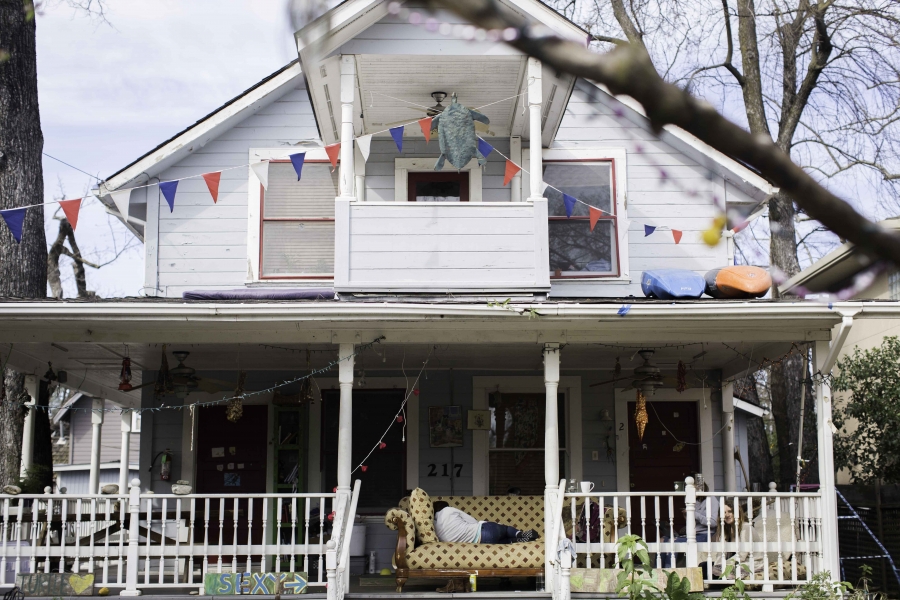
Not all Davis co-ops are affiliated with SCHA, however, and as a result, these co-ops must find the best way to function independently. One of these co-ops is located in Downtown Davis and is known as Turtle House. Turtle House functions based on the people living in it, making mutual respect and cooperation from its residents vital to its survival. Fourth-year psychology major John Lynch has found both a home and a community living at Turtle House. Lynch believes the culture at Turtle House is very much dependent on the residents living there on a year-to-year basis and their specific demands.

“When you are dealing with cooperative living you are dealing with 20 different identities, 20 different incomes, 20 different schedules and 20 different people with different needs,” Lynch said.

Lynch also believes the culture of Davis has a significant impact on its co-ops. Turtle House in particular has events in which residents show art, or perform music  events that lend themselves to the culture and vibe of the space.

“Davis fosters an environment that is often progressive, artistic and environmentally friendly,” Lynch said. “Turtle house is a space that facilitates events related to this for us, like being able to have shows in the basement.”

Lynch argues that the sense of agency given to residents is empowering in itself. Because each resident is at the core of its function, Turtle House is a space which reflects the needs of the people in it.

Assistant professor of communication, Seth Fry is an expert on cooperative living and has dedicated much of his undergraduate and postgraduate life to understanding the in’s and out’s of cooperative living. Having attended the University of California, Berkeley for his undergraduate degree, Fry lived in various co-ops and went on to be a founding member of a graduate co-op at the University of Indiana, Bloomington. He has since gone on to study co-ops all over the United States and around the world. Fry shares Lynch’s belief that cooperative living can be incredibly empowering and can introduce students to an alternative way of living.

“My journey with co-ops started with going to parties, but it ended up leading me down a path of political and economic empowerment, both because of its affordability and because of the experience it gives you being an effective participant in democracy,” Fry said.

This is especially relevant for young people living in the current political climate. Fry believes that those who participate in democracy in everyday life are better able to make informed decisions when it comes to voting.

“To prevent democracy being taken over by Demagogues, we need citizens who are savvy and know how to vote against corruption,” Fry said. “In my mind, people who live in co-ops have the day-to-day experience that make them informed of both the upsides and the downsides of democracy.”

Cooperative living is not only an effective way to find a community within UC Davis but has many real-world implications that students often overlook. By fostering a way of living based in growth and responsibility, students receive much more out of co-ops than simply a place to live.

Written by: Miki Wayne  — features@theaggie.org

 

Going Zero Waste as a College Student

ANDREA GONZALEZ / AGGIE

Easy, cheap ways to go zero waste

It’s no secret that the planet and its inhabitants suffer from the decisions we make as consumers. Earlier this month on the shores of Indonesia, a dead whale was found with over 6 kilograms of plastic (roughly 1000 plastic bags, plates and cups) in its stomach, which is thought to be the cause of its death. This is but one instance in an infinite number of situations where consumerism has contributed to global death and decay. So, how does one combat these horrors? They reduce their carbon footprint. What is the easiest (and cheapest) way to do that? Going zero waste.

This may seem tough, especially for a low-budget college student who barely scrapes by on ramen noodles and $3 merlot from Trader Joe’s. But, despite the rumors, going zero waste is easier than ever, especially for a student at UC Davis. From opting out of using Keurig K-Cup Pods to bringing reusable bags to the grocery store, the possibilities are endless.

First on the list of easy ways to go zero waste: coffee. Let’s get this straight, coffee is a lifeblood. If you go to college and you don’t drink coffee, you’re probably much healthier than the rest of us. But for those avid coffee drinkers, a key zero waste asset is the French press.

For the time crunched college student, the conveniency of a Keurig may seem ideal. But put into perspective, single serve coffee makers produce a ridiculous amount of waste. French presses are magic makers that work without the need for a paper filter or plastic pod, just a plunger and a pot makes a batch of coffee without the possibility of preparatory waste ending up in an animal’s stomach. Plus, French presses are incredibly affordable and can be purchased on Amazon for around $20.

When thinking about zero waste opportunities in the kitchen, disposables may be easily thrown away but not so easily broken down. That is, paper plates, towels and anything plastic while convenient are not cheaper than the alternative and are bad for the environment. The money spent on disposable amenities can be money spent on dish soap.

Needless to say, the disposable route and the idea of not having to clean up after eating may seem appealing, but in the end, someone or something has to face the repercussions. Whether it eventually lands in a landfill or the tides of the ocean, the life of the plastic fork doesn’t end in the garbage can.

One can dive into the endless abyss of the internet and reference a number of studies on the environmental impacts of paper and plastic, but our imaginations are probably more realistic than not. All else equal, reusable kitchen amenities are cheaper, longer lasting and better for the environment than their alternates. If you’re serious about going zero waste, this a no-brainer. On that note, let’s not forget about the wastefulness of plastic zip-lock baggies; their alternative would be an eco-friendly bee’s wax paper that is flexible and reusable. Wrap your food in these bad boys and your kitchen will be free from the wrath of the zip-lock, or if you decide against buying the “bee’s wrap,” you can always become a Tupperware hoarder. It happens to the best of us.

In the bathroom, consider either a shorter shower or a longer bath, and for the porcelain throne, there is the time-old saying: “If it’s yellow, let it mellow; if it’s brown, flush it down.” Less water use, the better.

Although not nearly as much as other recyclables, shampoo and body wash bottles stack up over time. Consider opting for soap bars. Lush cosmetics sells a wide range of shampoo, face and body wash bars that are all plant-based and vegan and have nothing to do with animal testing. A quick Google search will find a large selection of zero waste, fair trade deodorants, dental floss and more. Discovering new products can become one of the most fun parts of transitioning to zero waste — change up that bathroom game.

Outside of the house exists a wasteful wonderland. While keeping reusable bags handy is a well-known rule of thumb, remember to abstain from using the plastic produce bags within the grocery store. Their zero waste solution is reusable mesh produce bags. Keep them in your grocery bags at all times and you’ll be thankful every time you reach for them.

When you go to flex these reusable bags, consider visiting stores that sell in bulk because they allow you to bring your own containers to fill with items such as rice, almonds or coffee. Just write down the weight of the empty container, give it to the clerk and they’ll do the math and cut the price. Also, bulk sale is always substantially cheaper than buying pre-packaged goods.

For daily adventures, there are a few accessories that deserve a spot in the everyday backpack. Starbucks, along with most coffee shops, will fill any cup-like container you hand them when ordering a drink. Seriously, your local baristas will fill a Mason jar to the brim with your favorite drink if you just supply the container.

That being said, step one: put a Mason jar in your backpack. It will come in handy. Step two: never touch a one-time use plastic straw for the rest of your life if you can. There are reusable straw keychains for sale that you can add to your bag that will immediately curb your plastic straw usage, thus keeping you away from waste and keeping waste away from the nostrils of sea turtles. Step three: to-go wooden cutlery is a total lifesaver. Packable knife, fork, spoon (and chopstick) combos are easy to wash and easy to pack. They come in handy on a regular basis, whether you’re at a park bench or even your favorite restaurant. Final step: pack a rag. The days of disposable napkins are at an end and the handkerchief is now in.

Take all that has been listed (reusable cutlery, straw and cup), wrap them in a rag, put it in your bag and you’ve got yourself a zero waste toolkit to take with you everywhere. With this, you may actually go through the entire day without contributing any waste while eating.

Paying a visit to the bookstore is also worth mentioning,  as you can marvel at the many options they provide for the environmentally concerned student: reusable water bottles, refillable soy-ink pens, post-consumer-waste composition journals. You name it.

These are the most basic essentials when it comes to going zero waste on the fly. Of course, there is a larger and better list out there somewhere that will direct you towards a long life of being zero waste. But, for the college student lifestyle, these are some of the first steps you can take towards reducing your carbon footprint today.

Written by: Clay Allen Rogers — arts@theaggie.org

Humor: Unitrans B Line miraculously arrives on time during peak hours

ALLYSON KO / AGGIE

Probably the most shocking thing to come out of this year so far


In a freak accident of inexplicable proportions, the Unitrans B Line arrived at the Memorial Union perfectly on time during the 1 p.m. bus rush today.

“I don’t know how to describe what it’s like to get here on time for once,” described Deanya Later, the bus driver at the time of the incident. “But I’ll just say now that this wasn’t supposed to happen. I think an accident on this scale could affect the cosmos itself.”

Bus driver Later was a last-minute cover for the B line after the original driver, who just goes by “The Licktitious,” called in sick.

“Usually, the B line is supposed to be late,” Later continued. “Too many people take the B every day, so when a driver starts on that route, they’re told explicitly to make students as late as possible in order to discourage them from getting on in the future. I thought I was following that directive as well as I could, but apparently not.”

Later later told The California Aggie about a few methods Unitrans used to force a late arrival, which makes this story even more remarkable. They stopped at every stop, waited for potential stragglers, even picked up three people in wheelchairs. Perhaps the most blinding, shocking insanity to come out of this testimony? It was also raining.

According to witnesses, the B line was so packed that some people were forced to not only remove their backpacks, but also their coats to make more room. Students on the bus at the time reported that, at one point, the B remained stationary for 20 minutes while the driver yelled, “If I could have everyone please move back behind the yellow line” over the lull of passengers, who apparently had no idea that they need to move for more people to get on the bus and therefore continued to not move behind the line “or at all.” This lead to a slew of uncomfortable shuffling and looking around in dumbfounded confusion.

But even with all of this — in addition to the B hitting every light, stop sign and yield possible and Later filing accident reports for every scraped tree and near-missed curb — the bus still managed to arrive at its stop on time.

Unitrans issued a statement regarding the incident just a few hours afterward.

“We are aware that the B line, our usually latest bus line, somehow managed to get students to class on time during the afternoon rush. Rest assured, we will do everything in our power to make sure this will not establish a new paradigm for the B line, and an incident such as this will never happen again. Unitrans wants to ensure that the B line remains firmly in its space-time orientation, which means being late when students need it most.”


Written by: Conner Shaw — cjshaw@ucdavis.edu

(This article is humor and/or satire, and its content is purely fictional. The story and the names of “sources” are fictionalized.)

Is it love at first swipe?

0
CAITLYN SAMPLEY / AGGIE

Davis students and faculty comment on the use of Tinder in college

Back in August, the popular dating application, Tinder, created a new feature that made it easier for college students to connect with each other. When Tinder was first introduced back in 2014, the app was used primarily on college campuses to encourage students to engage with one another in various ways. Since then, Tinder has gained the reputation of being an app used for hookups and a place to look for potential partners.

Associate professor Paul Eastwick teaches PSC 51: Love, Lust, and Human Evolution, an undergraduate class focused on human relationships.

Some view Tinder as a platform to find partners for potential hookups, but Eastwick details why he believes that Tinder is a viable way to start a relationship whether it’s serious or casual.

“I think Tinder is absolutely a good way to meet a potential partner,” Eastwick said. “The best thing that Tinder, and really all online dating platforms can offer, is the ability to introduce you to people that you might not have otherwise met and that’s something they do really well, they expand the pool of possibilities for you.”

Eastwick explained how the idea that Tinder is not a strong foundation for a relationship is not necessarily true.

“Those early intentions, before you meet a person face to face are overrated,” Eastwick said. “That’s the sort of typical course that relationships take, is that they meet somebody and they sort of figure it out from there, and sometimes ‘figuring it out’ means that you hook up and it doesn’t really go anywhere and sometimes ‘figuring it out’ means its takes a while and you realize you really like the person, so in that sense anything that expands peoples pool is a perfectly great way to meet a partner.”

Although there are a multitude of dating apps available, Tinder seems to be one of the most widely used dating application in college. Eastwick explains why he believes this might be.  

“I think most users of Tinder are using it because it’s fun to use in the moment,” Eastwick said. “From my understanding, it’s sort of rewarding to swipe through and get matches […] and because of that, I think Tinder feels more like a game which makes it more enjoyable in and of itself. The eHarmony that I remember from a few year ago was kind of like ‘a thing you had to do’. You would get a few profiles a day, and you would have to look through them and see what you thought, which is not meant to be as much goofy and fun as Tinder is.”

Since Tinder was released in late 2012 to a few college campuses, there has been a significant increase in the amount of users. Eastwick offered a potential change to the app that might make it more successful in helping users find partners.

“I think the most successful dating apps are like to be the ones that leverage people’s existing social networks,” Eastwick said. “Essentially, what it’s doing is not only introducing you to people that you wouldn’t have met otherwise, but also pointing you to the ways that your social networks may overlap and having friends in common and having the support of those friends for your relationship is generally a good thing […] hopping to a brand new social network is a harder thing to do.”

Up until the start of Fall Quarter, third-year managerial economics major Stephen Fallon was an avid user of Tinder.

“I think Tinder’s intended purpose is for people to meet new people and where you go from there is up to your discretion,” Fallon said. “From my personal experience, I always like to just go with the flow and that’s just kind of like my trademark, just because you can meet some really cool people off of Tinder from just talking to them, but then there are also some people that you just do not vibe with.”

Fallon describes his experience as a ex-Tinder user.

“I was so against Tinder before I got it, and once I finally downloaded it, it was like the dam broke down,” Fallon said. “On the first week, I was averaging 6 hours a day, that’s how bad it was […] so when I say I had Tinder, I had Tinder. It was an awesome way to kill time, and I felt like God when I was swiping through like ‘no, yes, yes, no.’ Then when I got back to school I had more responsibilities and I was like ‘what the hell am I doing with my life’ so I deleted the app.”

After matching with a person on Tinder, both individuals have the opportunity to message each other, start a conversation and possibly meet in person. Fallon explains when he felt he was willing to meet up with someone in person and how long they stayed in touch for.

“It depends on the eagerness of the person,” Fallon said. “I’ve had like one girl that I exchanged maybe three messages with and we met up, but it was really weird. And then I was talking to this other girl for over a month and a half and then we finally met up, but it was way better to meet up with someone that I waited longer for because it felt like I had already known her so we didn’t have to do all the, ‘Where’s your family from?’ shit […] On average I would say that I keep in touch with my matches for three weeks, but then there are some that I have been friends with for over six months.”

Personally, Fallon could never see himself starting a serious relationship with someone he met on Tinder.

“I don’t think that Tinder is a good way to start a relationship,” Fallon said. “But I know someone who literally got married to someone he met on Tinder, so I guess it can happen […] I think in general [Tinder] should be used for people you want to meet casually and talk to, but I guess the best way to be in a relationship is to fall ass-backwards so I guess I will play the devil’s advocate for that.”

Fallon detailed how he used Tinder more at home than while he was at college.

“I think I use Tinder a lot more at home because I am constantly new meeting people through clubs and organizations [on campus],” Fallon said. “Whereas at home, i’m not trying to see the same people from high school, that just sucks, so instead it’s like ‘oh this person is five miles away, do you want to grab coffee?’”

Lillian Cheung, a second-year undeclared major, explained why she uses Tinder and what type of people she hopes to engage with on the app.

“I personally use Tinder to meet new people and potentially meet someone I can consider having a casual or serious relationship with,” Cheung said. “As a bisexual female, I’ve been exploring my interest in girls more lately, but I still don’t know how to approach girls so Tinder is a way to meet them. As I’m becoming more comfortable with myself and my sexuality, Tinder is a way to meet people and explore what I like and don’t like.”

Cheung explained how she uses Tinder more than other dating applications because of its widespread advertisement on a college campus.

“It’s more popular because we hear about Tinder more than any of the other dating apps and it’s been normalized in society,” Cheung said. “I heard about Tinder first because of the phrase ‘swipe right’ and it became an ongoing joke in society to say you would swipe right on someone if you thought they were cute.”

Third-year mechanical engineering major Reese Short explained why he is an advocate for Tinder although he has never been a user.

“I’m an advocate for the hookup generation,” Short said. “People don’t like to talk about it, but everyone has needs and Tinder establishes a pretty easy way to come to an ideal that you are both going to consent to something. So you both essentially go and read the situation with the person and you mutually match and then you can talk on Tinder first and say ‘this is what I want’ and you can basically set those boundaries before you even meet up with a person.’

Being on a college campus with over 35,000 students it can be hard to form close relationships, Short explained. Tinder gives people the chance to have that one-on-one interaction without feeling intimidated to talk to someone in person.

“It’s easier than going up to people and talking to them in person,” Short said. “In high school, you were in such a small area and you knew everybody and everyone knew each other. But here, I haven’t had a class under 150 people yet, and I can see how someone could be intimidated by that. [Tinder] just gives people the confidence to go talk to someone and meet someone new.”


Written by:  Sneha Ramachandran — features@theaggie.org


Grave Shadows

TRACY MCCLUNG / COURTESY

Part six of a continuing series about experiences on an archaeological dig in Poland

Last summer I was at an archaeology field school run by the Slavia Foundation in Poland. The site had both Bronze Age (IV and V Period) cremations and Early Modern (16th -18th century) coffin burials. Scraping away layers of dirt with a trowel, I was looking very closely for changes in the color of the dirt. This could reveal whether or not I had stumbled upon an Early Modern coffin burial.

Features, or items in the dirt that cause the ground to change color, were usually much lighter or much darker than the dirt around it at the site in Poland. The dirt inside the features or surrounding the features was called ‘fill’. Although I had never been on an archaeology dig before, it did not take long for the other students and I to tell when we had found features at the site. As a lot of archaeology sites do not have such clear changes in the dirt, we considered ourselves lucky.

“So some of the feature fill here [in Poland] is like kind of marbly and that’s because the sand moves differently,” said Ashley Stewart, the field osteologist. “Like for example, in Alabama, Mississippi, it’s mostly clay or like silty loam, and those dirts move differently than sand. Sand moves more fluidly and so it creates different looking features which is really cool.”

The other students and I were looking for coffin shadows, or the darker spots in the dirt that resembled a rough coffin outline. Due to the few hundred years of decomposition, the dirt above where the coffins were buried had changed color. The fill surrounding the coffins stayed the same.

“So in Mississippi, the cemetery I dug there […] the fill is like black,” Stewart said. “It’s so, so, so dark, and then you have this lighter, typically red clay around it. But every feature in the U.S. that I’ve ever dug in my entire life has been dark. And it’s crazy because here some of the features are light in color, and it blew my mind. And I know it’s just because the dirt’s different, but like it was crazy to see. We even joked one time, like two or three years ago […] there was this weird circle in the ground, but it was light in color and every single person on that dig was like ‘I’ve never seen a feature be lighter than the ground around it’ and now I have.”

The Early Modern burials were Christian burials, as the remains were placed in coffins and laid east to west. This helped make it obvious when we had a found a coffin shadow, for only so many features have this characterization. Just a few feet under the coffin shadows would be human remains and decomposed coffin wood.

“[Right now] we have a clear outline but don’t have a burial outline,” said Alexis Henderson, a student at the archaeology field school. “The burial line is right as you’re about to hit the skeleton.”

Just as the decomposed coffin wood changed the color of the dirt, the decomposing remains do the same. The change in color due to decomposed remains is called the burial line, and this means one should be able to find the skeletal remains by scraping some dirt away with a trowel.

The first sites that Adam Szczesny, one of the archaeology instructors, worked on were rather difficult, as it took him a long time to tell the features apart. Instead of a cemetery, Szczesny had excavated city remains and a Roman War camp in Syria and Bulgaria.

“In Syria, it was really different because when I went there and our professor showed us the site, I saw nothing,” Szczesny said. “And he told us that it is a city, and I couldn’t recognize the walls from the dirt because they were so similar. After a few weeks I saw a slight difference, and it was obvious for me where the house ended, where the suburbs were. Every site is different. In Poland […] every dig is quite visible after taking the first layer of soil off.”


Written by: Rachel Paul— science@theaggie.org


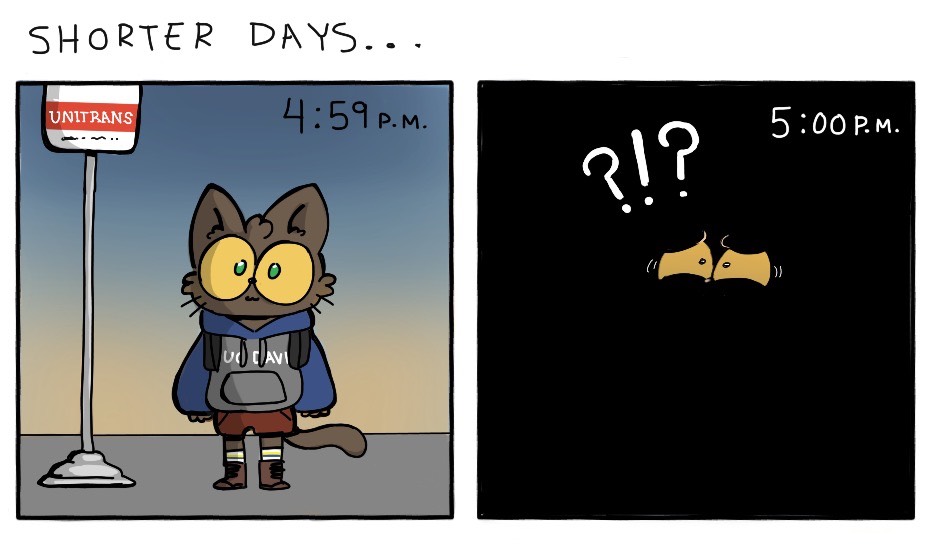
Cartoon: Shorter Days

DIANA OLIVARES / AGGIEWritten by: DIANA OLIVARES — deolivaresvalencia@ucdavis.edu


Proposition 12 passes, may cause price of pork, eggs to rise

ANDREA GONZALEZ / AGGIE

Farms outside of California, agricultural research at UC Davis affected

Proposition 12, also known as the Farm Animal Confinement Initiative, passed on Nov. 6 by a 61 to 39 percent vote. It established minimum space requirements for breeding pigs and egg-laying hens. Additionally, it banned the sale of veal, pork from breeding pigs and eggs from hens that don’t meet the space requirements.

While this was seen as a victory for many animal rights’ groups, such as the Humane Society of the United States, many agricultural groups are worried about the impacts of Prop. 12.

The Farm Animal Confinement Initiative was an extension of a similar ballot initiative that was passed in 2008 and named Proposition 2. This banned the confinement of breeding pigs, veal and egg-laying hens in a manner that did not allow them to turn around freely, lie down or fully extend their limbs.

“Californians know that locking farm animals in tight cages for the duration of their lives is cruel and compromises food safety,” said Wayne Pacelle, the president of the Humane Society to the LA Times. “All animals deserve humane treatment, especially those raised for food.”

Prop. 12 now quantifies the amount of square feet that is permissible for marketable meat. By 2020, Prop. 12 will ban the confinement of calves in areas with less than 43 square feet per calf. Egg-laying hens must have areas with more than one square foot of floor space per hen. By 2022, breeding pigs must have more than 24 feet of usable space, and all eggs must be laid by cage-free hens.

According to Erica Sanko, the executive director of the California Pork Producers Association, there is a misconception that surrounds Prop. 12 and its requirements for pork production. While local farms will be affected, there will be a larger national impact on pork producers that import pork into the state of California.

“This applies to any hog farmer regardless of location — California or out of state (i.e. Iowa),” Sanko said via email. “California imports much of its pork products from across the United States, where a significant majority of pork is produced using conventional production methods that are not required to comply with Proposition 12. Therefore, hog farmers who produce pork that will be sold in California will have to change their production housing practices to comply with the minimum square-feet requirements.”

According to Sanko, many pork producers in California had already changed their practices in 2008 when Prop. 2 was passed. But a study done in 2010, according to Sanko, estimated that the cost of transitioning the broader pork industry to the new system is between $1.9 billion and $3.2 billion.

“There is a significant cost to hog farmers when changing from one housing system to another,” Sanko said. “Those costs will be passed on to California consumers in the form of higher pork prices.”

Additionally, according to the California Legislative Analyst’s Office, the measure will likely cause the prices of veal, pork and eggs to rise.

“This measure would likely result in an increase in prices for eggs, pork, and veal for two reasons,” according to the website. “First, this measure would result in many farmers having to remodel or build new housing for animals—such as by installing cage-free housing for hens. Second, it could take several years for enough farmers in California and other states to change their housing systems to meet the measure’s requirements.”

According to Alison Van Eenennaam, an extension specialist for animal biotechnology and genomics at UC Davis, it is unclear to what extent the proposition will affect the agricultural research at UC Davis.

“Cage free [is] worse for chicken welfare, environment and increased costs relative to furnished caged alternatives, as clearly shown in [a] sustainable egg coalition study,” Eenennaam said. “We will have to see how [the California Department of Food and Agriculture] decides on impact to the University of California Research.”

According to a blog post by Eenennaam, scientific and agricultural research was struck out of the language included in Prop. 12, and therefore, the research at UC Davis might be affected.

“The implications of this change to the research exemption on things such as teaching, scientific or agricultural research, especially for genetic and nutrition research (we need individual cages to collect observations or phenotypes on each animal, and to record which egg comes from which hen), may well not be discovered until after the ballot votes are cast when agriculturalists and scientists go to perform specialized research on calves, pigs, or poultry,” Eenennaam said in her post.

Sanko believes that pork producers are most likely to make decisions on how their pigs are contained.

“Producers make housing decisions thoughtfully based on pig behavior, genetics, daily health care needs and life stage,” Sanko said. “The changes may result in: increased aggression and competition between sows, increased negative effects associated with environmental extremes, increased exposure to hazards that result in injuries and limited access to appropriate food and water.”


Written by: Hannan Waliullah — city@theaggie.org


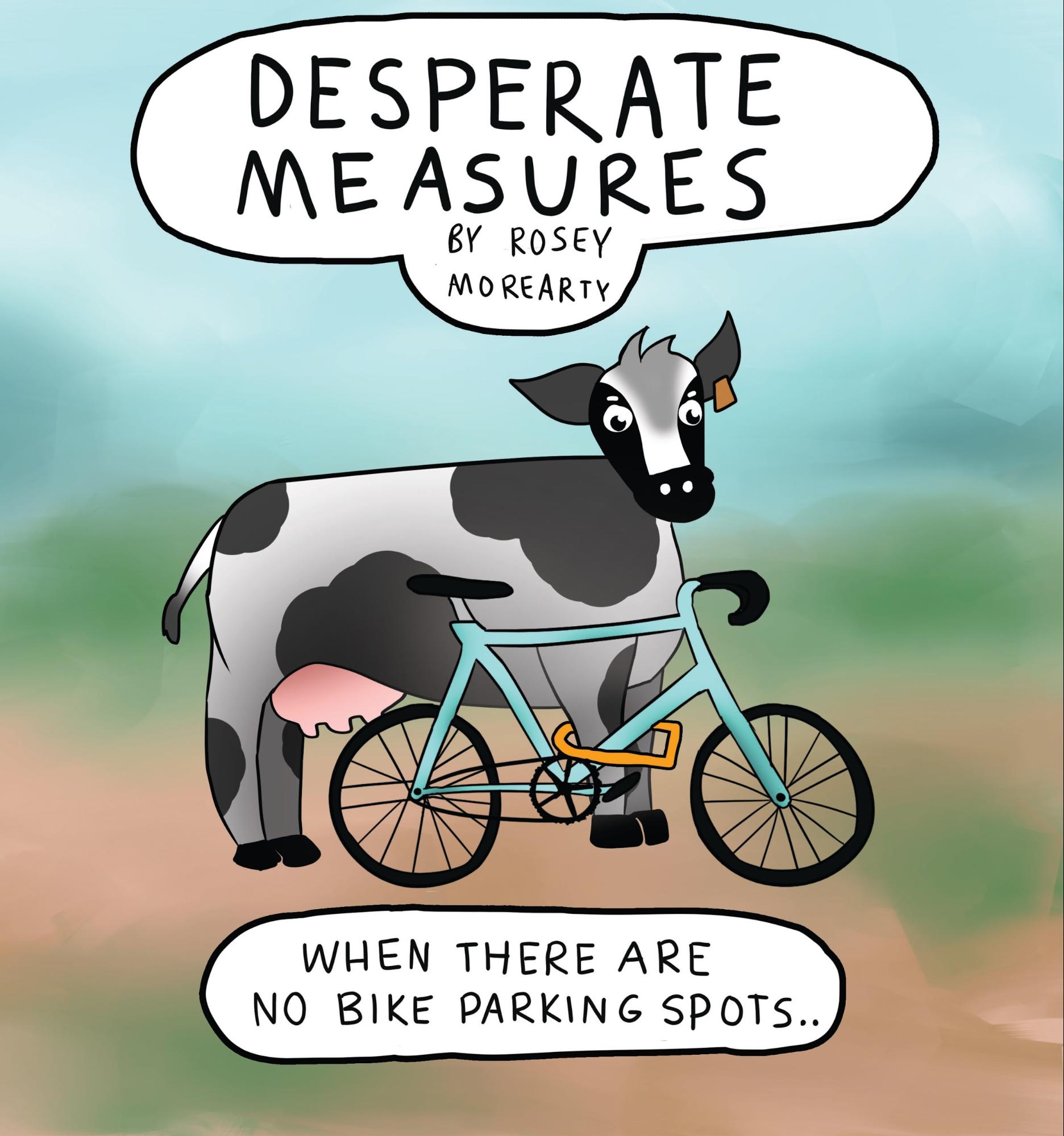
Cartoon: Desperate Measures

ROSEY MOREARTY / AGGIE

Written by: Rosey Morearty  — rosey@morearty.org


Humor: Student engages in chess match, banjo duel, game of wits with Satan in battle for GPA

DAVIS WHALEN / AGGIE

The devil went down to Wellman 2

For one student, getting the grades they need for grad school wasn’t a matter of hard work. Instead, it was a matter of besting the King of Air himself in a series of traditional duels: the usual good ole fashioned Satanic chess match, banjo duel and game of wits.

“Before, getting good grades was a matter of hard work,” said second-year computer science major Max Sydow. “And I already knew that wasn’t gonna happen. So instead, I decided that I’d hit up Satan with a casual seance and see what’s up with him. I heard you can either sell your soul or best him with banjos, so obviously I opened up a few YouTube tutorials and got cookin’. I’m nearly as good as Steve Martin at this point. As for the chess game, I’m just gonna wing it. I don’t think it could be much harder than checkers, and frankly I would always beat my little brother Johnny at that. Granted, he’s six, but still. And for the game of wits, I’ve already got a great riddle or two lined up. I’m certain he hasn’t heard the one about the newspapers.”

When asked whether he could have simply invested the time spent learning the banjo into coding and studying for midterms, Sydow just shrugged.

“I mean, yeah, I guess you’re right. But I get a lot more out of putting off my future than embracing it. Anyways, who wouldn’t love to banjo duel Satan?”

Since the writing of this article, it seems that Sydow has completely disappeared off of this mortal realm. His GPA has also disappeared. We were able to reach Sydow for comment as he was spending eternity in the black gaping darkness of hell.

“Was it worth it? you ask. I’d say yeah. I mean, sure, I’m stuck here in hell. But at least I don’t need to study for midterms.”

Written by: Aaron Levins  — adlevins@ucdavis.edu
(This article is humor and/or satire, and its content is purely fictional. The story and the names of “sources” are fictionalized.)

The inner workings of SeaDoc Society

KATY FOSTER / NOAA FISHERIES

Delving into how the SeaDoc Society strives to help marine mammals

As the homes of various animals are being disturbed due to the overwhelming influence of human activity, increasing conservation efforts have been taking place to help these individuals survive within their changing environment. One of the organizations dedicated to this conversation is the SeaDoc Society, a program of the Karen C. Drayer Wildlife Health Center dedicated to helping marine wildlife along with their surrounding ecosystem.

Alexa Dickson, an intern for SeaDoc society during summer 2018, was able to experience the inner workings of this program through helping run the marine mammal stranding network in the San Juan Islands. Alongside her co-intern, Dickson managed the hotline on Orcas Island connected to calls reporting sightings of strandings.

Once receiving a call, the interns, with the help of volunteers, conducted physical exams on the animals and determined whether the animals required medical attention or if they should be left to let nature take its course. Dickson explained that a large part of her position entailed her communicating with the public and educating them on the proper rules of conduct pertaining to animals. She explained that she faced some difficulties through these communications, as the public was not always understanding of the program’s decisions to leave stranded animals.

“Dealing with those mix of emotions was very difficult,” Dickson said. “As well as having those conversations over and over again can be really hard for us because we just feel like we can’t get through to them and we can’t help them to understand why we’re doing what we’re doing.”

Dickson hopes that the public can understand that these decisions are not easy to make nor are taken lightly by the program staff. If the veterinarians and scientists determined the stranding was caused by human activity, intervening actions usually took place. However, if there were no signs of human causation, decisions were made to let nature take its course. These determinations were made through careful consideration of the current state of the ecosystem along with profiles on each animal. Dickson stated that conservation medicine cannot be based on hard and fast decisions but rather requires deliberation of many different factors.

“I think my main takeaway is that conservation medicine is not just medicine,” Dickson said. “It involves a lot of other things that you have to be involved with. You have to be involved with politics. You have to be involved with how you’re perceived by the public. You have to be involved in education.”

During her time with SeaDoc Society, Dickson also worked with killer whales, specifically J35, a case where a mother orca carried her dead calf over a long distance. Through taking data on J35 and observing her over a period of seven hours, Dickson explained that the experience was interesting from a scientific perspective along with being emotionally concerning.

SeaDoc Society was also involved in another killer whale tragedy — the case of J50. In this situation, a baby killer whale’s health began to deteriorate until she ultimately disappeared. Despite SeaDoc Society’s effort to offer medical attention, the first clinical intervention attempted by the program on a sick orca, J50 was pronounced dead.

According to Joe Gaydos, senior wildlife veterinarian with the Karen C. Drayer Wildlife Health Center and chief scientist for SeaDoc Society, this initial attempt brought the program’s attention to the fact that it needs better tools to examine and diagnose the health of these killer whales in order to treat them. He hopes to eventually offer annual examinations for each killer whale in the southern resident killer whale population once the proper tools are developed.

In parallel with this case of clinical intervention, Gaydos has visited Gorilla Doctors, another program of the Wildlife Health Center located in Rwanda, to study the work and role of Gorilla Doctors in treating the mountain gorillas. Kirsten Gilardi, co-director of the Karen C. Drayer Wildlife Health Center at the School of Veterinary Medicine at UC Davis and U.S. Director for Gorilla Doctors, explained that the Gorilla Doctor program was initially established in the mid-1980’s by primatologist Dian Fossey when she put in a global alert for veterinarians to help mountain gorillas being injured by illegal snares. Since then, the program has grown to treat mountain gorilla injuries and human-induced illnesses such as respiratory diseases, leading to an increase in the mountain gorilla population whereas all other great ape populations are decreasing.   

“We don’t capture gorillas, take gorillas and bring them out of the park to a gorilla hospital. All the work happens in the forest,” Gilardi said. “We can do our work because most of the mountain gorillas are habituated to the presence of people to facilitate the gorilla tourism which occurs in [Rwanda, Uganda and the Democratic Republic of Uganda,] and that’s how we get close enough to see that they’re injured or ill.”

Gaydos explained that Gorilla Doctors’ ability to treat the animals without taking them into captivity facilitates the improvement of not only the health of the individual, but also the whole population. He hopes to adapt these skills to efforts of clinical intervention with SeaDoc Society and other future conservation efforts.

“I think the interesting thing here is that when you are able to take care of large, charismatic animals that are in the ecosystem, you also take care of the ecosystem,” Gaydos said. “That’s a big thing that we want to realize, is that even, whether it’s with Gorilla Doctors or with SeaDoc, working on gorillas or killer whales, we’re interested in helping individual animals to benefit the individual as well as the population, but we’re also working to make changes at the ecosystem level that benefits those animals.”


Written by: Michelle Wong — science@theaggie.org

NBA prospect Darius Bazley signs New Balance shoe deal worth $14 million

ALLYSON KO / AGGIE

Top NBA prospect Darius Bazley signs shoe deal with a guaranteed $1 million payout

With the decision to increase player salaries in the NBA minor league, also known as the G League, next season, increasing numbers of prospective players are putting off college in hopes of entering the G League straight out of high school.

In April, officials approved a new salary extension for G League players, increasing player pay from either $26,000 or $19,000 for the five month season to $35,000, or $7,000 a month. These changes will represent either a 35 or 84 percent raise depending on the classification of the player. NBA teams now also have the option to offer select G League players extended contracts worth around $125,000.

An increased salary provides a new option for high school prospects, incentivizing them to enter the G League immediately instead of pursuing a college career. One of this year’s top basketball prospects, Darius Bazley, is taking full advantage of these new options.

The 18 year-old, 6-foot-9 forward attended Princeton High School in Cincinnati and originally planned to play forward at Syracuse University.

In a surprising decision, Bazley announced that playing in college was no longer his priority. He informed Syracuse that he would instead be taking a year off to wait for the 2019 NBA Draft in hopes of joining one of the current G League teams.

Bazley signed with agent Rich Paul this year. Paul currently represents some of the top NBA players, such as Lebron James and John Wall. With a new agent to guide him, Bazley recently announced that he would spend most of the upcoming basketball season as an intern at New Balance. The only difference between Bazley and other interns: a shoe contract worth a guaranteed $1 million with a possibility of up to a $14 million payout if he reaches certain performance incentives, including Rookie of the Year.

With the decision to take time off before joining the NBA, Bazley can now wait for the official salary changes to take place next season and try to capitalize on a G League deal with a hefty check that could reach up to $200,000, if he is drafted. Bazley will use the time to train for next year’s draft and work with the New Balance marketing department.

“There will be some things he misses out on, but I’m not worried at all — not with the talent and skill set he has,” Paul told the New York Times in a recent interview. “No matter what we do this year, he still has to be developed in the NBA. You see it even with the highest draft picks — it’s not like you come into the league as a rookie and set the league on fire.”

Basketball fans, including Syracuse men’s basketball Head Coach Jim Boeheim, will be waiting to see if Bazley will become a NBA-level athlete in the time he has chosen to take off. With new avenues being offered to young basketball prospects in an effort to strengthen the attention given to the G League, Bazley’s journey could prove instrumental in forging a path for future high school stars.

Written by: Ryan Bugsch — sports@theaggie.org

Review: House of Cards

JAMIECHEN / AGGIE

Netflix delivers strong conclusion to original series

On Nov. 2, Netflix released the long-awaited finale to its original series, “House of Cards.” The release of the final season was delayed in the wake of sexual-assault allegations surrounding Kevin Spacey. Netflix concluded it would write out Frank Underwood, Kevin Spacey’s character, from the series — opening up many plot avenues. Given the unprecedented events that occurred outside of the studio, the series had a strong finish.

Season five left the audience with a powerful cliffhanger where Claire Underwood, played by Robin Wright, uttered the words, “It’s my turn.” This was just after she declined a call from her husband, who was at the mercy of Claire as he awaited a pardon from her. The plot left the audience speculating how she would behave as the presidential incumbent.

The fight for power and influence between the private sector and the federal government was introduced in season five when Frank Underwood visited the secret society that allegedly covertly runs the country. However, the fight for power became the overarching theme that presided over the new season.  

A wave of new cast members were introduced this season. Power-siblings Bill and Annette Shepard, played by Greg Kinnear and Diane Lane, run The Shepard Freedom Foundation, which is rumored to be based on the Koch brothers — business partners that hold a strong influence over politics.

Melody Cruz, played by Athena Karkanis, is a White House reporter that was rejected by Claire Underwood early in the season after she proposed an interview with the President. Scorned, she left reporting and landed a job as a political commentator. It was clear throughout the season that her over-exaggeration of the White House’s actions that caused public outcry and polarization aren’t far from the realities of the current administration and their hostile relationship with the press.

Duncan Shepard, played by Cody Fern, is the son of Annette Shepard, who acts as a consultant of some sort. His back-door entry into the media allows him to actively play gatekeeper of the news. At one point in the season, he mentions simply acquiring a newspaper publication to filter what people can read and have access to. He was also involved in the creation of a phone application that secretly gave The Shepard Freedom Foundation access to personal information to influence voter preferences — sound familiar?

Claire Underwood certainly made strides for women in politics this season. Not only did she become the first female president, but she assembled the first all-female cabinet. Also, she is pregnant with Frank Underwood’s child, which she decides to keep. This plotline represents the idea that women don’t need to choose between career and family because they are more than capable of successfully handling both.

The series finale of House of Cards delivered several great performances and seamlessly incorporated the reality of the changing political world. The show tastefully touched on social issues that concern women in the present-day. All without Frank Underwood.

All eight episodes of season six of House of Cards are available for streaming on Netflix.


Written by: Josh Madrid – arts@theaggie.org


After DACA repeal fails, UC leaders express gratitude

JESSE STESHENKO / AGGIE FILE

Injunction against DACA repeal efforts upheld

On Nov. 8, 2018, the UC issued a message of support for the Ninth US Circuit Court of Appeals’ decision to uphold its injunction against the Department of Homeland Security’s efforts to repeal Deferred Action for Childhood Arrivals.

“The court decision ensures that the 800,000 beneficiaries of DACA will be able to retain or renew their grants and continue to legally work, study, serve in the military, and live in the United States,” stated a press release from the UC Office of the President (UCOP).

The UC has encouraged students who are DACA recipients to renew their grants as soon as possible and has called upon the Trump Administration to halt its “efforts to rescind the program,” according to the UCOP email.

Furthermore, the UC system is the first institute of higher education to file a lawsuit against the Administration for its long-term efforts to rescind DACA.

The statement from UCOP also noted that, while the 9th Circuit Court’s ruling is positive news, DACA recipients do not deserve to have their futures jeopardized by the “rise and fall…[of] events in litigation.” The UC therefore continues to urge Congress to “enact permanent protection for Dreamers, including a path to citizenship.”

Written by: Rebecca Bihn-Wallace — campus@theaggie.org

The Aggie Reuse Store: an on-campus store to meet your thrift shopping needs

JUSTIN HAN / AGGIE

A conversation with the director and store manager at the Aggie Reuse Store

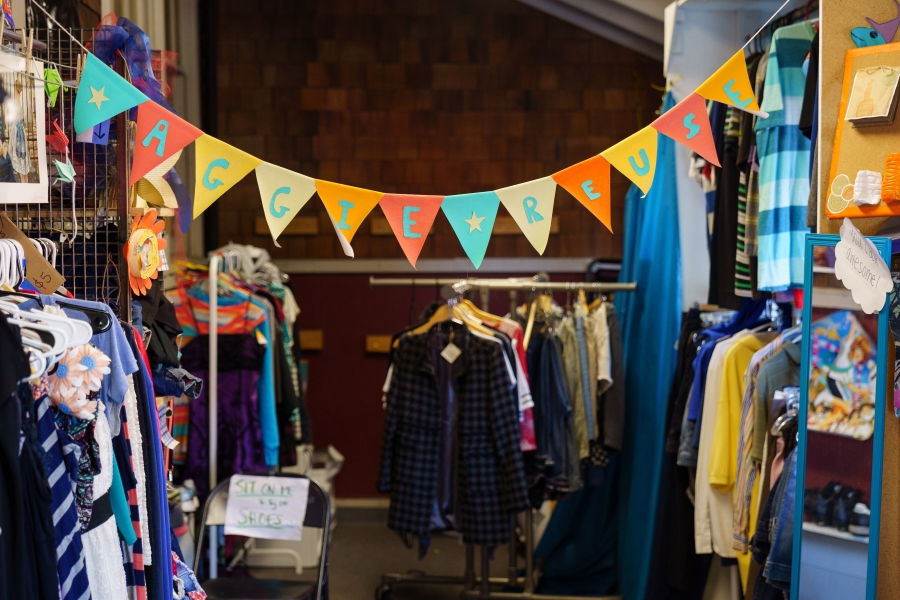
The Aggie Reuse Store can go unnoticed if you frequent the Memorial Union but seldom stop by the Silo, but thrifters frequent this on-campus resource for its large array of second-hand items for student-friendly prices.

Angela Ruan, director of the Aggie Reuse Store, talked about what students can expect when they walk into the store.

“Some popular items are textbooks, books, clothing, shoes, houseware, office supplies, electronics, board games, DVDs,” Ruan said. “But we also get a lot of treasures that can’t be put into a category like crystal lamps or a cardboard cutout of Jack Sparrow.”

Trisha Patrice Madayag, the store manager of the establishment, described the location as a useful place to find affordable and quality products.

“The store is a great resource for cheap and quality stuff that other students probably just don’t have space for anymore,” Madayag said. “ It’s an awesome place to find great deals and meet awesome people.”

Not only is it the UC Davis campus thrift store, but it is completely student-run. Interns are hired at the beginning of every quarter.

”Everybody in our 60 person team are all full time undergraduate students, all coming from different majors and in different years,” Madayag said. “All of our ideas and our events are created by students […] A lot of cool things we have done in the past – our concert, Spring Fling Jams, our fashion show and our fast fashion campaigns are all brainstormed by and executed by students.”

The store holds various social events throughout the year to engage and encourage students to get involved in the thrift store and learn more about the essence of it, which, according to Ruan, is to “divert items from going to the landfill and find a way to reuse or ‘upcycle’ it or, in [her] opinion, give it a second life.”

Ruan encouraged students to check out the store and its various social festivities.

“We have a lot of cool events, like workshops, sales, events, campaigns open to the public throughout the quarter where we highly encourage everyone to come out in their free time.” Ruan said. “We usually have scheduled sales throughout the quarter and lot of flash sales.”

All the items in the store are either made by the upcycling team, donated or procured from the lost and found. Madayag talked about what students can expect for the winter specials at the store this year.

“We have a lot of heavy coats ready to be put into the store,” Madayag said.” We also have a ton of scarves and umbrellas.”

In addition to coats and umbrellas, items such as chemistry books and lab manuals are some of the best sellers at the store. While some other items like books to read for leisure don’t sell much.

“We have a lot of great books, but there are just a lof them to go through that customers sometimes just graze over them,” Madayag said.

The store receives adequate funding from the ASUCD, along with a variety of other sources.

“We believe we get adequate funding from ASUCD to operate well.” Ruan said. “However, as our teams and our ideas get bigger we have recently realized we may soon outgrow our budget. However, this has caused us to be more creative with our resources, like reaching out to other organizations for donations or partnering with other organizations. We also try to apply for grants, such as TGIF, to help fund our big ideas.”

Next time a student checks the weather forecast just the night before their 9 a.m. class the next morning, only to realize they don’t have an umbrella or a raincoat, it might just be a good idea to make a quick stop at the store to check out the freshly stocked winter gear.

“For sure [check out] our umbrellas and gloves,” Madayag said. “No one really knows when the rain comes at times, so a lot of people come in desperate to keep their backpacks and laptops dry.”

Getting involved in this sustainable, completely student-run store is quite an easy task as opportunities for students to apply as interns are ample and accessible to students of all classes on campus.

“If a student wants to really get involved with Aggie Reuse Store, applying to be an intern

is a great way to do it.” Madayag said. “If students want to get involved but not apply, the upcycling and marketing teams also hold workshops several times during the quarter where you can make crafts and/or become more environment.”

Just like any other campus organization, the Aggie Reuse store provides a great sense of community to some students who begin working or interning there, along with valuable life and work skills. Ruan shared her story, in particular.

“Many members of the store can tell you that I frequently tell this story.” Ruan said.” I would say Aggie Reuse Store is where I first found my community at UC Davis and where I first felt like I belonged.”

Ruan’s first quarter at UC Davis was devoted to staying in her dorm and studying. When she eventually switched her major to managerial economics, she pushed herself to get more involved, ultimately finding the Aggie Reuse Store. There, she found friends that she doesn’t believe she would have otherwise met due to their different majors.

“Through the Aggie Reuse Store, I got exposed to other opportunities to get involved and I would say it is where I developed my confidence and my identity,” Ruan said. “Since I first joined the store, I have seen how my community has expanded as a result. It has been a vital part of my college career. I can honestly thank the Aggie Reuse Store for everything I am today that I am proud of. I hope to create this environment for current and future interns and hope they can also find a community and have access to resources in their time here.”

Written by: Rabiya Oberoi  — features@theaggie.org


After the midterms: What’s ahead for the city of Davis?

CAITLYN SAMPLEY / AGGIE

Davis voters give the go-ahead on Measures L and M, funding schools and housing developments

Lawn signs supporting Measures L and M were a common sight around Davis leading up to the midterm elections, and this widespread support was reflected at the polls on Nov 6. Both measures passed, pushing forward two plans to improve housing and schools in Davis.

Voter turnout in Yolo County saw a slight boost in 2018, with roughly 50 percent of registered voters casting ballots, according to data from the Secretary of State’s office. This is an increase from the 46 percent of Yolo County residents who voted in the last midterm election in 2014.

Measure L was the closer of the two races, with 56 percent voting yes on the measure and 43 percent voting no, according to Yolo Elections Office reports. Passage of the measure gave the green light to the West Davis Active Adult Community, one of the largest land development proposals in the city’s recent history. The WDAAC is a housing project that will build a new community of roughly 500 homes for seniors on farmland near Covell boulevard.

Developers can begin planning the project in earnest, now that the WDAAC has been given voter approval. Dave Taormino, the developer behind the WDAAC, said this process will take about eight months to complete before construction can begin.

“We’re in the process of preparing maps and completing the studies that follow from the the election, in terms of drainage, floodplain work and also the tentative maps that define each lot’s dimensions and where utilities go,” Taormino said. “It’s our goal to be under construction of the sitework and infrastructure by early summer of 2019.”

Supporters of Measure L hoped that new housing for seniors will free up more homes in Central Davis, allowing a new generation of families and student renters to move in. It will be a few years, however, before prospective homebuyers and renters see any relief.

“I would expect in 2020 […] that you’ll see resale homes also on the market from the buyers of our homes,” Taormino said. “Over a two to three year period, I expect about 260 resale homes will come on the Davis housing market.”

In the meantime, construction on the WDAAC could be a new source of traffic on Covell near Highway 113 for Davis commuters. Taromino believes, however, that any congestion will be minor.

“There will be obviously some additional traffic during the construction timeframe from trucks and what have you,” Taormino said. “But they typically won’t be there at the busy times, when typical commuter are going to be active.”

The other major city decision made by Davis voters was Measure M, a bond measure proposed by the Davis Joint Unified School District. The measure passed easily, with about a 73 percent yes vote citywide. Measure M approved roughly $150 million in funds to improve elementary, middle and high schools in the Davis area.

The DJUSD administration thanked voters for the approval with a statement released on their website, promising to use the new funds to improve facilities and security in local schools. Some of the proposed improvements include updating science and tech labs, athletic facilities, classrooms and school access for students and staff with disabilities.

Local Davis schools are in need of modernization to meet 21st century standards, according to the statement. Some of the facilities that will be replaced or renovated date back to the 1950s and ’60s.

“Many of the classrooms and buildings in Davis schools are over 50 years old and require updates,” the statement read. “Old plumbing and electrical systems need replacement and academic facilities need earthquake safety upgrades to provide a safe, healthful learning environment for students.”

Measure M will fund several projects, although funds can’t be used toward administrator and teacher pay.

“The Board of Education has evaluated the facilities needs of the District, and has identified projects to finance from a local bond measure at this time,” according to the text of the measure.

Increasing employee pay remains a priority for the school district going forward. Davis teacher salaries still lag behind nearby schools, according to administrator reports.

Written by: Tim Lalonde — city@theaggie.org