58.6 F
Davis

Davis, California

Monday, December 22, 2025
Home Blog Page 476

Yolo County increases services for homeless

OLIVIA KOTLAREK / AGGIE

City-county approved partnership expands winter services at local shelters

On Nov. 6, the Yolo County Board of Supervisors approved a city-county partnership with West Sacramento, Davis and Woodland to expand services to the homeless through interfaith shelters. According to the 2018 Yolo County Homeless Count, there were a total of 179 individuals located in an emergency shelter and 414 individuals utilizing a housing program on Jan. 30.

The county will provide $14,000 to the Davis Interfaith Rotating Winter Shelter. This funding will supply the shelter with medical staff for two nights a week through CommuniCare Health Services. The Davis shelter provides 40 beds to the local homeless and will be open seven nights a week in the winter.

The city of Woodland is partnering up with Yolo County to increase programs centered on serving the homeless communities.

“Homelessness is reaching epidemic levels throughout California,” said Tom Stallard, a member of Woodland City Council, via email.

In September, the Woodland City Council granted $40,000 to Yolo County to fund the Homeless Coordination Project for 2018. This project provides funding to increase services through shelters and social programs, especially during the winter.

“In Woodland, we adopted a housing first policy and are working on a housing development,” Stallard said. “Meanwhile, we have assigned two [police] officers to work full time with the homeless and our first-time social worker, through shelters.”

In addition to these actions, the funding will allow The Fourth and Hope interfaith shelter in Woodland to remain open seven nights a week during the winter.

“With new state funding sources, we are able to work on providing more permanent housing and shelters,” said Bill Pride, the executive director for Davis Community Meals and Housing, via email.

The county will provide an additional $14,000 to cover overnight staff for The Fourth and Hope interfaith shelter. It is also funding a new pilot program in West Sacramento to operate a rotating shelter at local church facilities five nights per week, which will serve 20 individuals.

In the past four years, annual funding for the homeless through the Yolo County Health and Human Services Agency has grown from $2 million to $6 million. This funding allows interfaith shelters to remain open to serve as accessible housing for homeless individuals.

Our local faith-based communities have come forward to provide Winter shelters so that those living outside can have a warm place to sleep, access to food, services and human connection,” said Karen Larsen, the director of the Yolo County Health & Human Services Agency, via email.

Despite local faith communities providing a location for shelters, funding is needed to hire regular and medical staff, provide food and source electricity.

“We have successfully housed hundreds of Yolo County residents, many of whom have been living outside for years,” Larsen said via email.

In a collaborative effort, local agencies will continue to work with interfaith shelters to provide more shelter during the coming winter. The city-county partnership with West Sacramento, Davis and Woodland will use the funding to increase shelter services for the homeless community. The county plans to use fundings to find permanent housing solutions and increase social programs.


Written by: Brooke Hill — city@theaggie.org

 

U.S. treatment of migrants a national embarrassment

CAITLYN SAMPLEY / AGGIE

Migrants should be met with open arms, not tear gas

Tensions between the Trump administration and the sensationalized migrant caravan developed into a violent clash on Nov. 25, when migrants gathered to peacefully protest the U.S.’s monthslong waitlist for asylum requests. Frustrated and desperate, a few hundred migrants — including women with small children — broke away from the protestors to scale the U.S.-Mexico border fence and were met by tear gas fired by U.S. Customs and Border Protection agents.

This confrontation came after the caravan of approximately 5,000 individuals, most of whom are fleeing violence, corrupt governments and extreme poverty in Honduras, Guatemala, El Salvador and Nicaragua, spent over a month trekking across Central America in hopes of applying for political asylum in the U.S. During this time, President Donald Trump resorted to his usual anti-immigrant demagogy, making unsubstantiated claims that the Central Americans are “hardened criminals,” and deployed about 5,800 troops to the southern border to combat them.

Yet contrary to the egregious disinformation about these refugees proliferating on right-wing media and Trump’s Twitter account since October, the Central American migrants are not “an onslaught of illegal aliens.” They are asylum-seekers, who decided to travel 2,500 miles, with blistered feet, to U.S. soil to flee dangerous conditions in their home countries. These are people suffering, deeply, and desperate for a better life — the life that America, in all its idealism, promises to those who need it most: the “huddled masses yearning to breathe free.”

Applying for asylum is not a crime. U.S. law maintains that foreigners — regardless of whether they arrive in the country at a designated port of entry or not — are entitled to request asylum. And if their claim for status is rejected because they aren’t deemed to have “credible fear” of persecution, they must return home. There is, therefore, no “national emergency” or “invasion,” and it’s a disgrace that the Trump administration would brandish military rhetoric, nativism and unjustified hysteria to portray such individuals as looming threats to our country.

Because the waitlist for U.S. asylum is backlogged for months — no thanks to Trump’s tightened cap on the number of requests that can be processed daily — caravan members are now huddled in a temporary shelter in Tijuana, where they face minimal food, poor sanitation systems, disease outbreaks and freezing nights. Surely if the Trump administration wanted to, it could quickly assemble the resources to review more than the current limit of 40 to 100 asylum petitions per day and expedite the process for the Central American migrants. Instead, it has chosen to demonize the asylum-seekers as “stone cold criminals” and keep them in limbo and poor conditions for months in Mexico.  

To depict a caravan driven by humanitarian and economic strife as a criminal army of thousands bent on rushing the border is inhumane, heartless and a gross overturn of American ideals. It’s a low for a nation that purportedly stands as a beacon of freedom and hope for those who seek refuge.

U.S. authorities must treat these individuals with basic humanity and compassion and process them expeditiously and fairly. When starving, exhausted and sick men, women and children fleeing violence arrive — and even pound — at our door, we should not shoot tear gas at them and label their entry a “national emergency.” We must have mercy for the plight of our fellow human beings and, should their asylum be granted, welcome them with open arms and softened hearts.

Written by: The Editorial Board

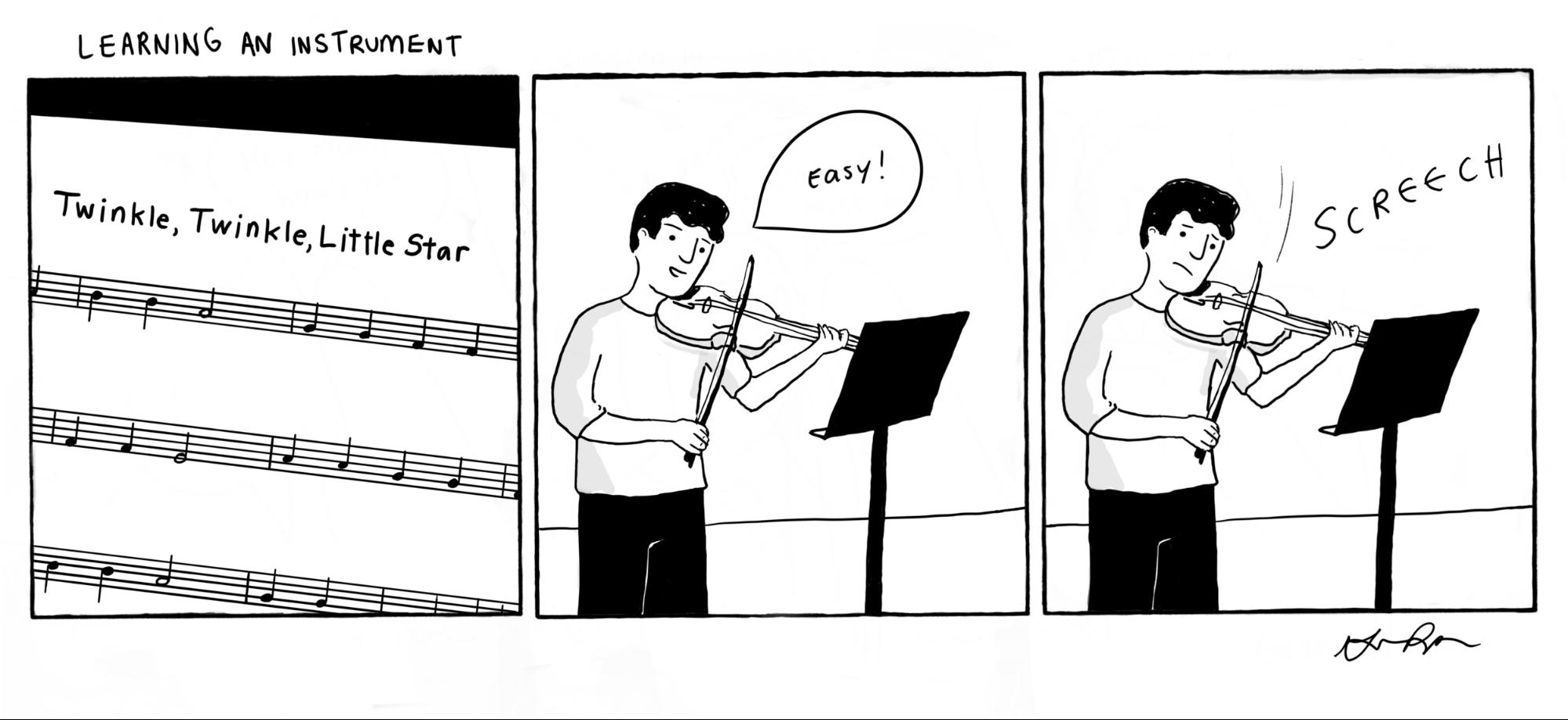
Cartoon: Learning An Instrument

GENEVIEVE RYAN

Written by: GENEVIEVE RYAN — geryan@ucdavis.edu


Humor: MAGA for the Win! California fires actually started by brave pro-Trump activist to protest “poor forest management”

CAITLYN SAMPLEY / AGGIE

Now that’s how you do the First Amendment!

Recent reports revealed that the wildfires that devastated towns like Pleasure, California were not, in fact, caused by climate change or poor forest management — they were actually started by a brave pro-Trump activist as a form of protest against California’s poor forest management.

The heroic activist, Frank Leonid E. Ottikaz-Hatte, claimed that he started the fires to demonstrate to lazy Californians just how dangerous their forest management strategies are.

“If California doesn’t clean up its act fast, it risks causing horrible, devastating fires with its poor forest management,” Ottikaz-Hatte said.

California’s poor forest management (an absolute disaster, a total mess) is the leading cause of wildfires, being responsible for 11 out of every 10 deadly, fast-spreading fires that could otherwise be attributed to extreme aridity as a result of climate change. This is why Ottikaz-Hatte felt obligated to raise awareness.

“Shouldn’t you be raking?” Ottikaz-Hatte said to pushy “reporters,” quoting one of his many custom T-shirts intended to promote climate change skepticism.

Since the Global Climate Change Alarmismists in the Leftstream Fake News Media have claimed that extreme weather events and unpredictable precipitation patterns linked to climate change likely played a role in the rapid spread of the Camp, Woolsey and Hill Fires, President Trump made sure to assert very strongly and powerfully that poor forest management was definitely to blame. (It is a known fact that, when people assert things very strongly and powerfully, they are definitely telling the truth.)

While cynics and skeptics suffering from Trump Derangement Syndrome have agreed that there is room for improvement when it comes to forest management strategies, they have cast doubt on President Trump for waiting until a fire crisis to spring his genius insights about forest management on the general public.

The “journalists” claim that Trump was oblivious on the topic of forest management until he learned that he could exploit the disaster for political gain by casting doubt on climate change, when in fact, he was informed the whole time and was simply waiting for the perfect moment to exploit a disaster for maximum political gain by casting doubt on climate change.

This is a genius play because, not only does it absolve Trump’s climate change-denying allies of responsibility, it also puts all blame for the fires squarely where it belongs  — on the lazy Californians, or “victims,” who refuse to rake their way to a Great Climate.

President Trump did not acknowledge intelligence reports linking Ottikaz-Hatte to the fires, not wanting to share credit for calling out the forest management problem.

“Frank is a great guy and would not do this, people are saying he’s a class act, and believe me, I know Frank,” President Trump said. “I met him at one of my rallies.”

However, when social media posts emerged in which Ottikaz-Hatte said Trump’s violent rhetoric and climate skepticism inspired him, Trump distanced himself.

“Look, I don’t know this Frank person — ahh — I don’t know what I said, I don’t remember!” Trump said.

Written by: Benjamin Porter — bbporter@ucdavis.edu

(This article is humor and/or satire, and its content is purely fictional. The story and the names of “sources” are fictionalized.)

Gerrymandering undermines American voters and threatens the future of the country

OLIVIA KOTLAREK / AGGIE

Republicans have used gerrymandering to sway elections for the past decade

While the most recent midterm elections yielded results that some would ecstatically call a “blue wave,” the lack of House seats picked up by Democrats in states like North Carolina and Wisconsin underscores the use of gerrymandering to sway elections — a benefit primarily felt by Republicans.

In Wisconsin, Democrats won all the statewide offices but failed to win seats in the assembly or the state Senate, both of which have maintained a staggering Republican majority. In North Carolina, Democrats won the popular vote by 79,000 votes — a majority — but only won 54 out of 120 seats (45 percent). The 2016 election played out similarly in North Carolina, with Democrats winning 47 percent of the statewide popular House vote, yet only garnering 23 percent of the seats. Obviously this isn’t North Carolina’s first incident with illegal congressional redistricting.

In 2011, North Carolina was forced by a Supreme Court decision to redraw its congressional districts because they were found to be illegally gerrymandered along racial lines, which by definition is unconstitutional. Since the court’s decision, however, North Carolina’s election results prove that the state has yet to create more equal districts.

Wisconsin and North Carolina aren’t the only ones guilty of unequal, possibly illegal, redistricting; in fact, the Associated Press conducted a study which determined that partisan gerrymandering has benefited Republicans far more than Democrats — best exemplified by the 2016 presidential election.

The Associated Press analyzed 435 U.S. House races and around 4,700 state House and Assembly seats up for grabs in 2016 and found four times as many states with Republican-skewed state House and Assembly districts than Democratic ones. Traditional battleground states, such as Michigan, North Carolina, Pennsylvania, Wisconsin, Florida and Virginia, were among those with significant Republican advantages in their U.S. or state House races.

So how is it that Republicans continue to lose a majority of votes for the House and yet typically hold a majority of House seats?

Republican dominance in myriad states began in the 2010 elections, which gave the party full control of 25 state legislatures and 29 governorships. The timing couldn’t have been more fruitful; Republicans gained majorities just in time to biasedly redistrict the map based off the 2010 Census. Presently, Republicans control 33 state legislatures and 33 governorships — not to mention the presidency, the judiciary and the Senate. Traditional battlegrounds states in the 2016 election all had districts drawn by Republicans after the last census in 2012.

While Republicans are the primary perpetrators of redistricting in their party’s favor, a lawsuit has also been filed against Maryland, where Democrats hold control. This simply goes to show that either party is willing to exploit the system to their benefit when the ability to do so is within their means. This is not a partisan issue — this is a Constitutional issue that concerns the rights of all Americans.

Fortunately, not all states are waiting for the Supreme Court to mandate equal districting. States like California, Arizona, Ohio and, most recently, Michigan have successfully implemented or passed anti-gerrymandering initiatives. The only reason why all states haven’t done this is because they are not legally obligated to do so. The Constitution allocates the power to set “the times, places, and manner” of federal elections to state legislatures, a power that affords members of the majority party considerable advantage and, therefore, one that is not easily forfeited. The states that have intently acted to curb partisan gerrymandering have done so as a result of the efforts of voters, who were able to obtain control of political boundaries from legislators — legislators that prefer choosing their voters rather than having to rely on their voters choosing them.  

In California, for example, after four years of incumbent Democrats sweeping state legislative and Congressional elections, voters passed Proposition 11 in 2008, creating an independent commission responsible for drawing districts. This did not pass without a fight: the bill was contested amongst key democratic leaders like Nancy Pelosi and, in total, Democratic political leaders spent $7 million in an effort to defeat the measure. Both Democratic and Republican legislatures across the nation have stifled measures to minimize political manipulation when it comes to redistricting. It is significant, however, that Republicans are the disproportionate beneficiaries of gerrymandering.

If the GOP continues to dominate absent of a majority of support from their constituents, it’s likely that we are waiting to see one of two things play out: either people will realize what’s happening, reject it and therefore trigger the fall of the Republican party, or people will ignore this and the GOP will continually become a party that no longer requires votes to win elections.

No matter what, consistently governing against the will of a majority of Americans has torn and will only continue to tear our country apart.  


Written by: Hanadi Jordan — hajordan@ucdavis.edu

Disclaimer: The views and opinions expressed by individual columnists belong to the columnists alone and do not necessarily indicate the views and opinions held by The California Aggie.

Mapping Poverty

MICHAEL LEAHY / AGGIE

Where someone lives and who they live around complete the puzzle of their social and economic mobility.

UC Davis’ Center for Poverty Research recently hosted the Geographies of Poverty Conference. Its attendees were eager to join the day-long event filled with conversation and multi-disciplinary efforts to confront poverty from economic and sociological perspectives. Attendees came from across the country, comprising of research faculty, graduate students, undergraduates and community members.

“The conference allowed them to look at their research in a new setting, and it gave the community the opportunity to be part of the conversation on the subjects,” said Jessica Harold, a conference organizer and the manager of the UC Davis Center for Poverty Research.

The conference was divided into four sessions of speakers with topics ranging from early education and consequences of historically segregated water provisions to immigrant assimilation and housing. Research faculty affiliates from the Center for Poverty Research moderated each session and the discussion that followed.

Maria Rendon, an assistant professor at UC Irvine, offered a snapshot of her qualitative research on neighborhood mechanisms that drive generational poverty. She focused on the children of Latino immigrants living in high-poverty neighborhoods in Los Angeles, Calif.

“Urban neighborhoods mattered for these youth,” Rendon said. “Race, class segregation and urban violence organized their daily lives.”

Rendon found that second-generation Latino/as heavily relied on kin and neighborhood ties to navigate the job market.

“Social support, day-to-day support from kin and community ties lifted prospects for young men and inhibited second-generation decline,” Rendon said. “For the first generation, some are here because of a brother or parent connection, so they are driven to migrate because of kin ties. It is the same idea for the second generation when finding labor or accessing the job market.”

Rendon noted that this was true even for life after college.

“Many men with college degrees go home and end up in the same situation,” Rendon said.

Ending her presentation, Rendon emphasized a sense of optimism in the second-generation despite the hurdles to social mobility. Resolute optimists held the belief that there was nothing holding them back, emboldened by immigrant narratives and meritocracy reinforcement, hypersegregation, kin-based social support and encouragement.

Paul Jargowsky, director of the Center for Urban Research and Urban Education at Rutgers University, concluded the conference with an assessment of fair housing progress across the United States.

“Housing affordability is not equally distributed,” Jargowsky said. “People with low-income need more affordable housing. There’s not enough affordable housing, creating stress as they may be competing with moderate-income people.”

People with low-income backgrounds spend between 50 percent to 100 percent of their income just to afford housing.

“Although the Fair Housing Act of 1968 eliminated explicit discrimination at the point of sale of housing, we don’t have ‘truly integrated’ living patterns,” Jargowsky said. “A lot of the suburbs built became completely white. Segregation is calculated on census tracts, not city jurisdiction. Nationally, segregation levels are mostly maintained at the city jurisdiction.”

Thus, the exclusion of disadvantaged groups from certain communities is a conversation that demands more attention. The hope is that research efforts can eventually propel and guide policymakers.

“We hope to put research and policy into a more digestible format,” Harold said. “The main benefit of this research is to enact change. If this information can be used to change a law, policy, or access to resources, it can take away the burden on disadvantaged groups. That is the ultimate goal.”


Written by: Foxy Robinson — science@theaggie.org


Men’s basketball stumbles late, falls in Causeway Classic

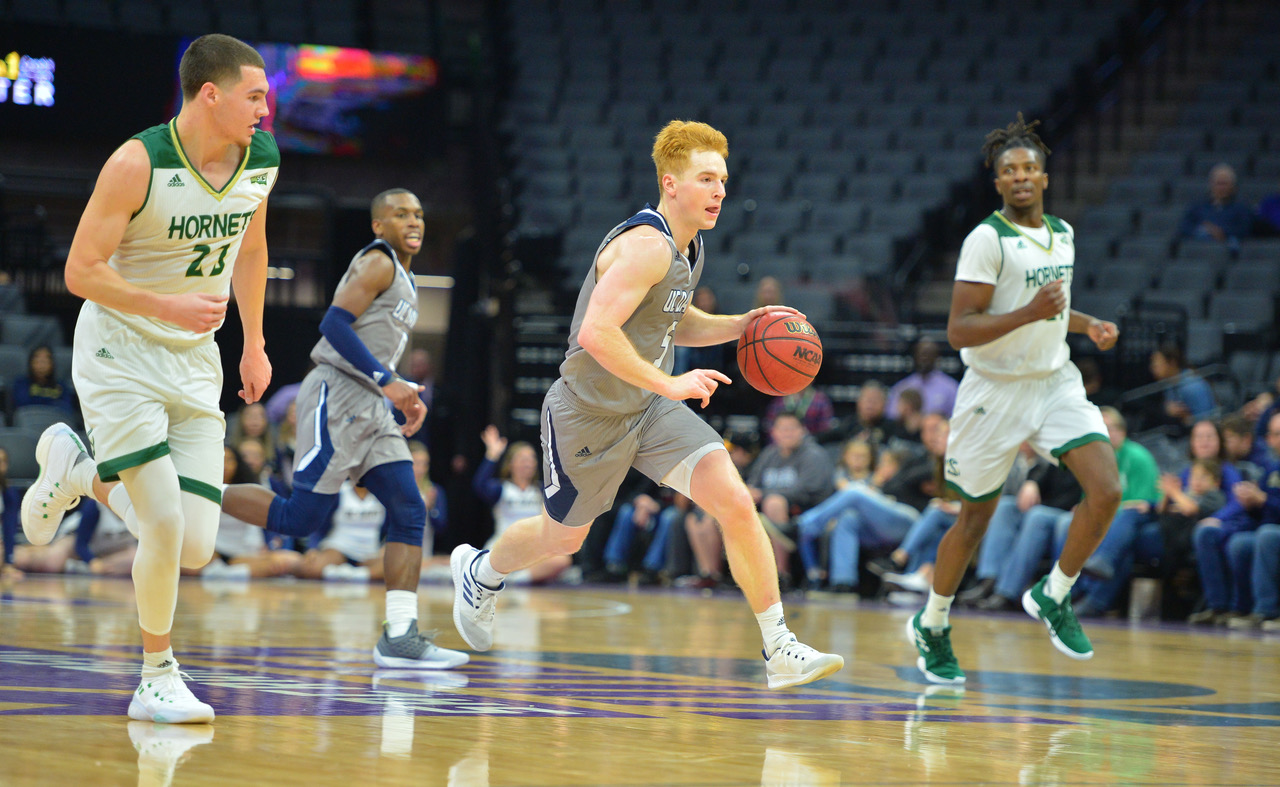
WAYNE TILCOCK / COURTSEY

Despite late lead, Aggies unable to put Sac State away

Since opening in 2015, the Golden 1 Center in Sacramento has been home to the men’s basketball’s version of the Causeway Classic. It’s a rivalry which, on paper, offers regional bragging rights and the satisfaction of owning the loser until the following year. As UC Davis entered with a 1-4 record, the Aggies hoped to use the game to get back on the winning side and build momentum before conference play commences.

Sacramento State, on the other hand, came into the game having played (and won) just one game outside of a friendly exhibition versus Bethesda. In front of a local crowd and playing on the same floor that a handful of NBA stars competed on just 24 hours before, both teams came out wanting to win.

It was a slow start for both teams, with each struggling to find momentum. Each team scored just four points in the first five minutes of the game. An early drive by junior guard TJ Shorts II looked to swing momentum the Aggies’ way but was waved off by the referees who called an offensive foul.

The teams continued to exchange baskets, with Sacramento State amassing a series of miniature leads which peaked at 28-20 following a three-point basket from sophomore guard Ethan Esposito. The Aggies would respond, however, with a 7-2 run, cutting the lead to three at half time.

Despite the early struggles, the Aggies were eventually able to take a 36-35 lead thanks to a three-pointer from junior guard Stefan Gonzalez. The two teams continued exchanging baskets for several minutes thereafter until senior guard Siler Schneider managed to extend the Aggie lead to four. Schneider would come up big again after Sac State tied it up, hitting a pair of threes to open up a six-point lead. UC Davis Head Coach Jim Les praised Schneider’s fearlessness during those big moments.

“He’s a kid that likes the moment,” Les said. “He’s willing to take and make big shots for us.”

Sac State responded once more, scoring five straight points before botching a fast break opportunity and turning the ball over on the ensuing possession. With just 10 seconds left, senior guard Marcus Graves would give Sac State the lead for good on a fast break layup. Schneider was unable to tie the game, missing a floater on the following possession. UC Davis ultimately lost 58-55.

Les credited the Hornets’ late-game surge to their ability to do what needed to be done and not back down.

“Give Sac State credit,” Les said. “They made the big plays down the stretch when they needed to. We struggled a little bit on both ends of the floor […] We needed one more defensive stop and couldn’t come up with it.”

Both teams struggled with sloppy offense throughout the game. Sac State amassed 21 turnovers while UC Davis committed 19 of its own. According to Sac State Head Coach Brian Katz, being able to win despite these negatives is what allows a team to succeed.

“You’ve got to be able to win ugly,” Katz said. “Because you’re not going to be able to win great offensively every night, but if you defend and rebound you can win ugly, and we won ugly today.”

Schneider led the Aggies with 15 points on 6-14 shooting to go along with two rebounds and two assists. Shorts was next with 11 points on 5-14 shooting to go along with six rebounds, three assists and five turnovers. The Hornets saw a balanced effort, with Graves, Esposito and junior guard Izayah Mauriohooho-Le’afa pitching in 11 points of their own.

Having entered the season with five losses in their first six games, Les believes the team must improve as a unit and not point fingers.

“I think, when all is said and done, that it’s going to be a good team,” Les said. “We all need to be better. Me as the coach — as the head coach needs to be better, and we also have to play better. It falls on all of our shoulders, but I like the character in that locker room.”

The Aggies didn’t have long to dwell on the heartbreaking loss, with Indiana University waiting in the shadows three days later. The Aggies lost 76-62 to the Hoosiers, putting their record at 1-6 overall.

The Aggies will have a chance to come back on Nov. 29, at 7 p.m. when they take on Northern Arizona. The game will also be televised on Big West TV.


Written by: Bradley Geiser — sports@theaggie.org


Ramen rated

1
DAVIS WHALEN / AGGIE

Students discuss the popularity of instant noodles

Instant noodles are considered to be the quintessential college student snack — most have tried them at some ungodly hour or knows someone who has. According to the World Instant Noodles Association, instant noodles were first made in Japan in 1958 by Momofuku Ando. They were called “Chicken Ramen” and were made by dehydrating seasoned, cooked noodles.

Since then, a number of brands of instant noodles have emerged, each with a variety of flavors. First-year neurobiology, physiology and behavior major McKenna Ma likes the miso flavor from Sapporo Ichiban, a Japanese-based brand that has more than 10 flavors of instant ramen. Ma enjoys instant ramen but thinks that there is a range, and while some are quite good, others are not at all.

“I don’t like the [Nissin] Cup Noodles,” Ma said. “I think they’re really gross and they put a bad name to any instant ramen. I think instant ramen is actually not that bad, but […] on the spectrum, there’s trash ones and good ones. [Nissin Cup Noodles] are not quality.”

Ma has a seven-day unlimited meal plan at the dining commons, and she said that although there’s technically no reason for her to eat instant noodles, she does on weekends when she spends time with friends who don’t have unlimited meal plans. She thinks that certain instant noodles are both convenient and tasty, which makes them the perfect food for college students.

“I think it’s just so easy,” Ma said. “You literally just need hot water or a microwave, but also I think it tastes good because, you know, MSG. That stuff always tastes good. There’s a lot of variety, so it appeals to different tastes.”

Ma said her boyfriend, on the other hand, doesn’t like instant noodles. She stated he doesn’t like the taste and thinks they are “gross” and “incredibly unhealthy.” His preferred college snack foods are Kraft Mac & Cheese and “dino nuggets.”

“It’s kind of annoying because whenever I make instant ramen,”  Ma said. “He looks down upon it and makes comments on how it’s gross.”

For first-year animal science major Mairead Ryan, instant noodles are an easy and cheap way to treat herself if the food in the Dining Commons (DC) doesn’t appeal to her. Ramen is a food that reminds her of family. Her mom would make instant ramen for her and her friends sometimes, instead of taking them out to eat Japanese food.

“I’ve always enjoyed ramen my whole life,” Ryan said. “My cousins in Kenya grew up in the Kibera slums and they love ramen, or Indomie, which is the brand there. It was very inexpensive and a source of sodium which they could afford. They still love ramen and when I go visit, we eat it often. Every time I have ramen I’m reminded of them, and I actually think Kenyan ramen is much better.”

Ryan considers ramen a special treat and doesn’t feel bad about her consumption of instant ramen, because she doesn’t eat it too often and when she does, she generally eats it with some sort of protein or vegetable.

Alternatively, first-year biochemistry and molecular biology major Aparna Manoj treats instant noodles as a guilty pleasure.

“I know it’s not too good to have all the time,” Manoj said. “But sometimes when the weather gets really cloudy or gloomy I want something that’s hot or spicy. I guess I go for it when I don’t want to spend the work to make something — that’s when I usually get [instant noodles].”

Manoj has a five-day unlimited meal plan, so she tends to eat instant noodles on the weekends. She says that she eats instant noodles “fairly frequently” when she stays in Davis, which is generally every other week.

“By the end of the week, I get tired and I want food that’s hot and I can just microwave it,” Manoj said. “It’s all good.”

Manoj also classifies instant noodles as a sort of comfort food. For her, there is more flavor in instant noodles than in much of the food in the DC — and that’s what makes it the stereotypical college food.

“When people go off to college, they need something that’s convenient and easy to eat that also has some flavor,” Manoj said. “A lot of people tend to feel homesick and usually when you’re sick of DC food, [it’s nice to have] something that has a bit more resemblance to what you ate growing up.There’s this combo — everyone calls it this typical college food but ultimately, I think it’s [also] a really strong comfort food.”

Instant noodles are often associated with having monosodium glutamate (MSG), which is a flavor enhancer that some consider unhealthy. Some people are not fans of the fact that instant noodles tend to have extremely high levels of sodium, both of which Ma acknowledges.

“Oh gosh, it’s so bad for you because, again  — oh my gosh, all the sodium and MSG,” Ma said. “It’s not the greatest, but it tastes good so we put it into our bodies […] we probably shouldn’t be eating as much of it as we do.”


Written by: Anjini Venugopal features@theaggie.org

Davis fire relief benefit to aid California fire victims

0
OLIVIA KOTLAREK / AGGIE

Tens of thousands of dollars raised by donations alone

Following devastating fires in nearby Butte County, the city of Davis hosted a benefit event to raise money on Nov. 17. Located at the Davis Senior Center, the event featured live music, food trucks and Sudwerk beer.

Local band Mumbo Gumbo as well as Mike Blanchard and the Californios performed on stage. The bands played the sets free of charge according to Lucas Frerichs, a Davis city council member and organizer of the event.

“All we are asking for in terms of an ‘admissions ticket’ is to bring in a gift card, or cash or check and just make a donation,” Frerichs said. “What we’re hearing is that people don’t need stuff donated, they really need access to gift cards so they can actually go and get the things they need.”

While this particular event didn’t accept non-monetary donations, the Davis Police Officers Association is accepting items such as clothing, toiletries and towels at Davis Police Station on Fifth Street. Online donations can also be made through the North Valley Community Foundation on its website.

“We’re working very closely with the police department, but also the fire fighters,” Frerichs said. “We are also working with some of our counterparts in Butte County and the city of Paradise as well.”

A portion of all the profits of food and drink businesses at the event also went toward the effort. Melanie Dubberley and Farrell Scott, owners of the Farmland Street food truck, chose to donate 20 percent of their profits from the event to the cause.

Scott, who has family members in the affected areas, expressed her initial enthusiasm to contribute by donating some of their profit.

“When we found what this [event] was going to be all about, we definitely wanted to participate as well in that respect, let alone just to be here and help everybody,” Scott said.

As the food truck is local to Woodland, Dubberly appreciates the opportunity to aid the local community.

“Community is really important to us, and giving back to the community,” Dubberly said. “So, each individually, we wanted to do what we could for people who are suffering. It was a no-brainer, of course Farmland Street wants to participate too.”

Tracy Walton, a member of the band Mumbo Gumbo, shared her excitement to support her fellow band member.

“Our drummer, Rick Lotter, is the brother of Scott Lotter, who is on the city council in Paradise, so it made a lot of sense for Mumbo Gumbo to play since we have been dying to something for them,” Walton said. “Everybody on the band signed on right away.”

Davis’ local radio station KDRT broadcasted the entire event on air and advertised ways of donating online using Twitter.

“If you tune into KDRT right now you’re hearing that music,” said Shawn Witte, a sixth-year graduate student in computational topology and a KDRT radio DJ. “In between, we’re broadcasting everything they’re saying from the stage, and we’re also talking about the fire benefit.”

Witte touched upon his personal contributions to the relief effort.

“I am one of the few people here who has no personal connection to the fire,” Witte said. “I had some Target gift cards that I’ve had for a while and that I’ve been meaning to use, but they could use them better than I can.”

Davis hosted a similar event last year to support those affected by the fires in Sonoma and Napa counties, raising about $30,000. Frerichs emphasized the importance of reaching out to neighboring areas.

“We really feel like in Davis, if our community ever faced a situation like this, we would just hope that other people would come to our aid,” Frerichs said. “So that’s how we approached this situation. You see this devastation in another community, and we can only help them. We have to do something.”

Frerichs announced at the end of the event that around $54,000 had been raised, excluding proceeds from food and drink.

“We knew that Davis would be generous, we didn’t know they’d be $60,000 generous,” Walton said. “Davis is wonderful, and they love their citizens and their former citizens.”

Written by: Renee Hoh — city@theaggie.org

An end to falling back and springing forward?

0
ALLYSON KO / AGGIE

California approves ballot to end practice of daylight savings

On November 4, California residents gained an extra hour of sleep at 2 a.m. due to the end of daylight savings time. Daylight savings will begin again on March 10, 2019. This practice could soon change, after California voters advanced Proposition 7, a bill that could end daylight savings if it moves forward.

This practice began in 1918 during World War I as a means of conserving energy and was used year-round starting in 1942. This extra hour of daylight in the morning allowed those fighting in the war to have light and heat earlier in the day so that the supplies necessary for lighting and heating could be conserved. Now, almost 100 years later, people are beginning to question the purpose of changing the clocks back and forward.

“Daylight saving time has definitely impacted me on Saturdays, for game days,” said Sophia Warda, a second-year psychology major at UC Davis and an operations intern for UC Davis football. “With football, we start around 7 a.m. when it’s still dark, and then some days we will end around 8, 9, or even 10 p.m. It’s so weird starting work when it’s dark and ending when it’s dark too. As football is year-round, we experience the negatives of falling back and springing forward, unfortunately.”

Around 152,560 people have requested an end to daylight savings time with various opinions about why it should be abolished. With war efforts not being a factor any longer, it is actually proven that DST does not decrease energy use, defeating the purpose, according to a Business Insider report.

One example in Indiana claimed that even though less electricity was being used in the morning, energy was being used more in the afternoon when homes did not have the chance to become cooler — as 6 p.m. felt like 5 p.m. — and air conditioning was turned on. What was saved in the end was utilized at the end of the day, according to the same Business Insider report.

Researchers have even found an impact on health associated with daylight savings. The number of heart attacks increased by 10 percent on the following Monday and Tuesday after the switch, as reported by the University of Alabama in 2012. An observed amount of work-related injuries and car accidents were also taken into account and are more prominent after the start or end of DST. Although there is a correlation, it cannot be determined whether or not DST caused these injuries and car accidents.

Other studies exhibit results supporting daylight savings time, however, as more light at the end of the day has been shown to motivate people to go out, spend money and be more active. This boosts sales in many industries as a result, according to the Business Insider report. Furthermore, the report showed that a small amount of saved energy over the time span of a year added up to estimated savings of $130 million.

“Honestly, it doesn’t affect me too much though,” said Matthew Neufeld, a third-year communication major and member of the UC Davis basketball team. “I’d say it’s nice in the fall when we can get that extra hour of sleep, but in the spring it usually takes more of a toll on me losing that hour. But as athletes, we are kind of used to it — if we have a game on the east coast, that’s three hours we have to adjust to.”

Others do not mind the time change and whether or not it gets taken away or kept.

“I have no problem with spring forward and fall back,” said Italian professor Jay Grossi. “I really like the extra sunlight in the spring and summer in the early evening and in the fall and winter the extra sunlight in the early morning. I honestly do not understand the big deal about the change.”


Written by: Lauren Tropio — city@theaggie.org


Cities mobilize to provide accurate information regarding unhealthy smoke

0
JEREMY DANG / AGGIE

Butte County fire has significant impact on air quality in Yolo County

The Butte County fire made a heavy impact on Northern California as the smoke resulted in numerous hazardous environments. Cities that became suffocated with smoke had to mobilize and inform residents to stay indoors for safety.

Jenny Tan, the public information officer for the Yolo-Solano Air Quality Management District, elaborated on how the fire affected surrounding cities.

“Air quality has been impacted in the entire Sacramento region, including Yolo and Solano counties,” Tan said via email. “The air quality in Yolo-Solano AQMD has been in the ‘Unhealthy’ category from Saturday (Nov 10) to today (Nov 14). Our District comprises of all of Yolo County and the northeastern portion of Solano County that includes Rio Vista, Dixon and Vacaville. I do know that UC Davis cancelled classes on Tuesday and Wednesday and that the Davis Joint Unified School District had students stay indoors for recess and PE on 11/13.”

Mary Ann Limbos, the deputy health officer for Yolo County, indicated that the public had to adapt to the conditions in order to stay safe.

“What we are really stressing to the public is to limit outside activity as much as possible and stay indoors,” Limbos said. “We feel that limiting the exposure to the best of your ability is the best way for the public to protect themselves right now.”

Tan also advised residents to stay indoors, as the Yolo-Solano Air Quality Management District strived to update everyone about the air quality.

“I don’t have the complete view of how the County has reacted but we here at the District are consistently sharing messages and alerts and updating the community on air quality on our social media accounts and website,” Tan said via email. “If you smell smoke, you’re breathing it.”

Limbos emphasized that the best way for cities to react is to keep people informed.

“I think it’s really important for people to be informed,” Limbos said. “What the cities and counties are trying to do is to provide accurate and up-to-date information so that residents can make good decisions about keeping themselves and their families safe. This includes putting out websites for reliable guidance about air quality.”

While the Air District cannot strictly prohibit activities, it can advise residents and keep them up to date with the information.

“The Air District does not have jurisdiction over what individual agencies or facilities do in terms of cancellations or postponements of activities, games, class, etc,” Tan said via email. “However, at the District we are continually posting on our social media accounts and website information about air quality, especially during wildfires. We recently created a ‘Wildfire Smoke Information’ page that has some helpful information about what is in wildfire smoke, its health impacts, helpful maps on air quality and smoke plumes, as well as other information.”

While the fires have affected countless cities, there are a number of factors that determine the severity in each location.

“A lot of it depends on the proximity to the fire,” Limbos said. “Different areas in Yolo County and surrounding counties have had different levels of air quality index measures depending on the temperature, wind currents — it’s really a changing number depending on the day and when you’re measuring it. It’s a widespread effect, depending on proximity and what is happening with the weather at the time. The counties in the surrounding areas are really trying to get the info out to their residents about the current conditions, and how to check or monitor the ongoing conditions so that they can modify their activities accordingly and how to protect themselves.”

Limbos emphasized that it is crucial residents stay informed and that the information remains accurate.

“There’s hopefully been a very good response to stay safe and have people limit their activities as much as possible,” Limbos said. “That’s really important to know what the conditions are, and know how to find out the future conditions to keep yourself safe.”

Beth Gabor, the public information officer for the Yolo County’s Office of Emergency Services, directed inquires and information to Regional Public Health Officers press releases so that residents could stay involved and aware.

“Air quality issues really fall under the jurisdiction of the Air District and Public Health,” Gabor said via email. “The Office of Emergency Services is more involved right now in assisting Butte County in response to the fire and those impacted. Regional Public Health Officers are working on a press release right now continuing to advise residents to stay indoors; it really is the best response to bad air quality.”

Written by: Stella Tran — city@theaggie.org

UC Davis’ relief effort for Camp Fire Victims

ZACHARY LACSON / AGGIE

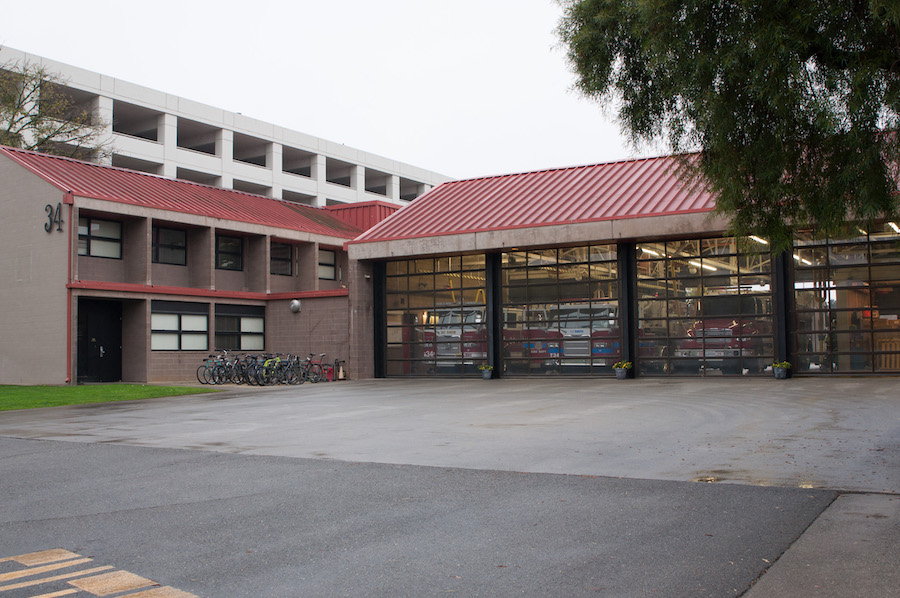
UC Davis School of Veterinary Medicine, Police Department, Fire Department respond to wildfire

The Davis community has organized various relief efforts in response to the recent Camp Fire burning in Butte County. The fire, which began on Nov. 8, has been reported as the state’s worst wildfire on record. It burned approximately 152,250 acres as of Nov. 21.

UC Davis Chancellor Gary May issued a message to the UC Davis Community on Nov. 9, stating that the UC Davis administration followed “the Camp Fire in Butte County with concern for all who have been impacted or whose loved ones, including animals, have been injured, displaced or lost.”

According to UC Davis Police Department Chief Joseph Farrow, the UC Davis Police and Fire Departments have been actively responding to the Camp Fire.

“The police department was part of the massive evacuation effort and are now providing police patrol protecting the unoccupied residences from looters and burglars,” Farrow said. “They are also involved in the rescue of domestic animals. The fire department was initially involved in fire suppression. They sent a team up there and were in the front lines battling the fires.”

Farrow added that these combined efforts are part of the state’s mutual aid program.

“When the governor declares a state of emergency, local departments like ours are asked to send available resources to assist,” he said.

UC Davis Fire Chief Nathan Trauernich added that the UC Davis Fire Department was called to the Camp Fire in Paradise “in the first few hours of the incident.”

“We sent a fire engine with a crew of four as part of a type I engine strike-team from Yolo County,” Trauernich said via email. “They were deployed for over a week and a half working alongside thousands of firefighters from across the state to battle the blaze. We also sent a single resource, taskforce leader, out to the fire as well.”

In terms of local relief efforts, the UC Davis Fire Department organized a donation drive for the victims of the Camp Fire.

Here on the homefront UC Davis Fire Engineer Paul Rush, Fire Engineer Kyle Dubs, and Firefighter Corrie Beall put together a donation drive at the campus fire station asking the community to donate new and unused items,” Trauernich said. “In a five day span, they collected over 140,000 lbs of donations and we made trips to Oroville five times with 16′ box trucks, twice with 10′ trailers, three times with SUVs, and once with a pickup.”

Students and community members can support Camp Fire victims through volunteer efforts. Trauernich stated the Hope Center in Oroville “still needs volunteers to help sort and distribute donated items and the American Red Cross is running shelters they may need volunteer support. Those interested in making a financial contribution should consider the California Fire Foundation at: cafirefoundation.org.”

“Words can’t begin to describe how proud I am of our campus firefighters, student firefighters, student EMTs, and the UC Davis community for supporting this impressive undertaking and for the generosity of those who gave,” Trauernich said.

The UC Davis School of Veterinary Medicine also responded through aid efforts aimed at helping livestock, pets and other animals impacted by the wildfires. A University News article summarizing the efforts stated “various members of the Veterinary Emergency Response Team, or VERT, have been at the Butte County Fairgrounds each day since Nov. 9, treating a variety of animals.”

The article went on to describe the expanse of animals being treated on campus.

“The most serious cases continue to be brought to campus, and the Veterinary Medical Teaching Hospital now holds eight goats, two pigs, a miniature horse, three full-size horses, a llama, five chickens, a duck, a goose and 27 cats,” the article reported.


Written by: Priyanka Shreedar — campus@theaggie.org


Fewer than 7 percent of students elect six new senators

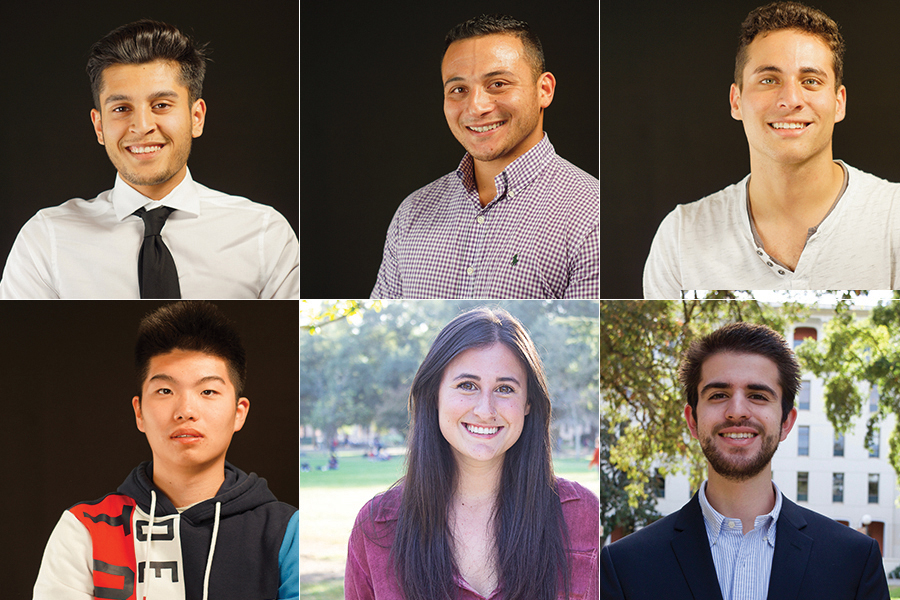
from top left to bottom left: SEAN KUMAR (AGGIE STUDIOS / COURTESY), RICHARDO ZAPARDIEL (AGGIE STUDIOS / COURTESY), ALEXIS RAMIREZ (AGGIE STUDIOS / COURTESY), NOAH PEARL (ALEXA FONTANILLA / AGGIE), MAYA BARAK (VENOOS MOSHAYEDI / AGGIE), PEIYUAN (TONY) CHEN (AGGIE STUDIOS / COURTESY)

Students vote to create new “Student Advocate” position

The results of the 2018 ASUCD Fall Election were released Friday, Nov. 16, and a total of 1,914 students voted, according to the ASUCD elections website.

In Fall 2017, UC Davis enrolled approximately 29,200 undergraduate students. Using this figure, fewer than 7 percent of students voted in the election.

Rodney Tompkins, a fourth-year psychology major and the chair of the Elections Committee, said via email that the low voter turnout followed trends of past elections.

This reflects the necessity of the Association and its elected officials to find relevant ways to effect change on campus,” Tompkins said. “While the voter turnout was low, we may also attribute some lack of participation to [the] Camp Fire and its effects on our campus.”

Eight candidates ran for six open senatorial positions. The six newest ASUCD senators are third-year undeclared major Peiyuan (Tony) Chen, fourth-year political science — public service major Richardo (Ricky) Zapardiel, third-year statistics and political science double major Noah Pearl, fourth-year political science major Alexis Ramirez, second-year neurobiology, physiology and behavior major Sean Kumar and third-year international relations major Maya Barak.

Barak, Pearl, Zapardiel and Kumar ran on the Unite! slate and Ramirez and Chen represented BASED. Ramirez will graduate before completing the entirety of his term, which will require the need for an interim senator. Zapardiel also stated he might graduate before completing his entire term.

The breakdown on the ASUCD elections website shows that the primary choice for 66.09 percent of voters was a member of the Unite! slate. Additionally, 25.6 percent of voters voted for a candidate who ran as a BASED candidate, and 8.31 percent voted for an independent candidate.

According to Tompkins, several proposed measures that were on the Fall Election ballot passed, including the ASUCD Constitutional Cleanup Amendment and the Elections Committee Amendment.

The ASUCD Constitutional Cleanup Amendment had intuitive effects, streamlining outdated language of the Constitution,” Tompkins said. “The passing of the Elections Committee Amendment results in the Committee being an independent body with specific hiring processes and guidelines.”

One amendment that passed, the Student Advocate Amendment, will create an “elected position of the ‘Student Advocate,’” which Tompkins said “has been considered effective on other UC campuses.”

“The position can be seen as one that, ideally, lacks room for a personal agenda, since one who assumes the position should be focused solely on the desires of the student body,” Tompkins said. “The role of a ‘Student Advocate’ is to base oneself in the general voice of the student body, working to provide incremental advice to the Table that directs the Association to changes that affect more than those within earshot.”

Constitutional Amendment #56 was also passed, which, according to Tompkins, “created the elected position of the ASUCD External Vice President.”

“The ASUCD Vice President has now assumed the title of ‘ASUCD Internal Vice President,’ while the Office of Advocacy and Student Representation Director position now has the title of ‘ASUCD External Vice President,’” Tompkins said. “This is a way for the university to elect the official that will represent the voice of the UC Davis student body outside of the association.”


Written by: Sabrina Habchi — campus@theaggie.org


UC Davis football prepares to host first FCS playoff game

OLIVIA KOTLAREK / AGGIE

Aggies will take on Northern Iowa on Saturday at 4 p.m.

Aggie Stadium will host its first-ever FCS playoff game on Saturday afternoon when the UC Davis football team takes on the Northern Iowa Panthers in a second round matchup.

UC Davis students are encouraged to come out to the stadium early for a special student tailgate starting at 1:30 p.m. Some of the attractions for this free event include live music from DJ Gio, food trucks, free Pepsi products, $2 pizza and $3 beers (for students aged 21+). In addition, tickets to the game are free for students, thanks to the partnership between UC Davis Athletics and ASUCD. Tickets can be picked up in advance at the CoHo or Aggie Stadium ticket office.

“It’s a big day for the program and school, so we look forward to sharing that day with everybody,” said junior linebacker Nas Anesi.

Early weather reports indicate a rain-free day with mostly sunny skies, much to the delight of UC Davis head coach Dan Hawkins.

“Let’s pack this thing!” Hawkins proclaimed. “It’s not finals yet, let’s go! The weather’s going to be great. It’s been a little rainy lately, but it’s going to clear up.”

Saturday’s affair will be televised nationally on ESPN3, giving the entire nation a chance to see what UC Davis is all about.

“Let’s really show the country what kind of great community and school we have here, and put on a show for everybody,” said offensive coordinator Tim Plough.

After a wildly successful 9-2 run in the regular season, the Aggies earned the No. 6 seed in the FCS playoffs and a first round bye.

Meanwhile, Northern Iowa was victorious in a first round game last weekend, edging Lamar University 16-13 in a low-scoring slugfest.

“I think they do a really good job of running the ball and have a very physical o-line, one of the best we’ve seen so far this season,” said junior linebacker Nas Anesi. “We look forward to the challenge of being physical and it being a hard-nosed game.”

The Panthers finished fourth in the Missouri Valley Conference this season with a mark of 6-5. Their biggest victory of the campaign was a 24-7 triumph over South Dakota State, the fifth-seeded team in the tournament.

This is the fourth time in the last five seasons that Northern Iowa has earned a berth into the FCS playoffs, advancing to the second round three times and making a run to the quarterfinals in 2015. All in all, this is UNI’s 20th FCS postseason appearance.

“When you get to this point in the year, there’s only 16 teams left in college football playing right now,” said junior quarterback Jake Maier. “They’re one of the elite. We have a lot of respect for them in what we’ve seen on film.”

In fact, Northern Iowa has participated in this tournament eight times in the past dozen seasons, showing remarkable consistency year in and year out.

“They’re used to the schedule, the grind, and going on the road,” Hawkins said. “They’re used to playing football in December. It’s new for our guys and something we set out as a goal when we started a long time ago.”

Without divulging their game plan, the Aggies have shown confidence in the strategies they’ve been constructing this week.

“We feel like our gameplan does a great job of attacking them where they might be weak in other areas,” Maier said. “We’re hopeful we can execute that plan.”

The team has closely studied Northern Iowa on film this week and picked up on some trends, many of which will influence their plan of attack on Saturday afternoon.

“They like to drop a lot of people in coverage, so we’ll prepared for everything,” said senior wide receiver Keelan Doss. “If they try to switch up their game plan, we’ll adjust to that as well. At the end of the day, it’s just going out there and executing our game plan and getting ready to go.”

The week-long break, combined with the Thanksgiving holiday, was not only a chance for UC Davis players to rest and heal their bodies, but also a rare opportunity to return home and spend time with friends and family. Outside of the team’s regular season bye week in late September, players have not had the freedom to leave campus for an extended period of time and truly take their minds off football.

“During the football season, you don’t get a lot of time to see your family because you’re always out there grinding,” Maier said. “Anytime you get a break to be with your family and the people that’ve been supporting you all season long, it’s really special.”

Even with this brief intermission in the season, Hawkins has been impressed with his team’s focus in practice this week and commended its level-headed nature throughout the long season.

“We try not to have a parade or have a funeral, and just really learn to take it all in everyday and hang in there and get better,” Hawkins said.

This type of attitude has continued to pay dividends on the field and will ensure that the team keeps its composure in a high-pressure environment on Saturday despite the lack of playoff experience on the roster.

“None of us have ever been in this situation at all,” Maier said. “The guys have really been motivated all season to get to this point. Now that we’re finally here, we just have to remind ourselves that it’s the same game we’ve been playing for the last 11 weeks. If we do that, we’ll be just fine.”

Throughout the fall, Maier has been a huge proponent of pushing his teammates to yearn for more and never be satisfied with where they’re currently at.  

“Just having that championship standard is really what we’ve been focusing on,” Maier said. “Just coming out here everyday and practicing at the highest level we’ve been at all season long. We’re always trying to climb to the next level.”

Plough took notice of this attitude from the first day of the offseason and gives a lot of credit to the players for taking charge of their own destiny from the very beginning.

“Once the last game ended a year ago, they worked for this moment and they deserve all the credit,” Plough said. “We [the coaches] are kind of just along for the ride, if we can help in any way. It’s a great feeling to be a part of as a former Aggie and it gives me a great deal of pride to see those guys play the way they do.”

Anesi also credited the mental aspect of the game as a pivotal reason for the team’s drastic improvements on the defensive side of the ball, compared to last season. After giving up an average of 32 points per game last year, the UC Davis defense cut that number down to 27.8 this season, which is the fourth-best mark among teams in the Big Sky. It also finished second in the conference in both sacks and interceptions.

“It’s just the mindset,” Anesi said. “Everybody’s on the same page and wants to achieve the same goals. With that unified mindset, we were able to accomplish a lot of things and people start to realize how much potential this team has and how talented we are.”

No matter what happens on Saturday afternoon, this will undoubtedly go down as one of the best seasons in UC Davis football history, and a true turning point in the program’s transition to the Division-I level.

If the team manages to secure a victory, that would likely set up a rematch with Big Sky foe Eastern Washington, who handed the Aggies their only conference loss of the season. Nevertheless, as the Aggie players would surely tell you, the only game that matters right now is the next game on the schedule — Northern Iowa.


Written by: Brendan Ogburn — sports@theaggie.org


California fire relief doesn’t end with containment

CAITLYN SAMPLEY / AGGIE

Students, faculty, staff should unite to support relief effort

When officials announced on Nov. 25 that the Camp Fire in Butte County was 100 percent contained, California seemed to exhale a sigh of relief as smokey skies began to clear and air conditions returned to normal. Though the parts of our state that surround the affected area have been able to mostly able to return to their previous routines through resumed work and academic schedules, the residents of Butte County remain in a state of uncertainty with 88 confirmed deaths and 203 people still unaccounted for due to the fires.

Though we see it flashing on a banner on the bottom of the daily news broadcast or in every headline since Nov. 13, it is important to unpack the weight of what just ravaged Northern California — the deadliest wildfire in the state’s history. The fire consumed 153,336 acres of land, taking nearly 14,000 homes in its path. Though we as students have returned to our lectures and set our eyes on finals, there is nothing to return to for many Butte County residents. This being said, it is essential for those who are fortunate and secure to donate in whatever way they can to the relief of this natural disaster.

Donating to the American Red Cross is one of the easiest and most helpful ways to offer relief to those affected by the California wildfires. Donors can give any amount and can ensure that their money is going specifically to California wildfire relief by selecting it as their desired support area during the online donation process.

Thanks to the efforts of a family in Rocklin, a Facebook page allows those interested to adopt a family from Paradise and directly donate money, clothing and/or food to that family. This facilitates direct communication between the families and the donors about what they actually need, which is less often a teddy bear donated through the mail and more often money or a warm meal.

Students can help in small and feasible ways. Lyft partnered with United Way to offer a “round up” option to users of the ride-share service. By selecting the “donate” option on the app’s menu, riders can round their trip up to the nearest dollar to donate to wildfire relief.

On our own campus, there are actions being taken to assist those affected. The School of Veterinary Medicine has been rescuing and healing animals that were lost in the fires. In particular, a multitude of family pets have been healed, leading to an outcry on Facebook for their owners to claim them. Though many pets have been returned to their families and touching videos of reunions have been posted, there are still many who remain unclaimed.

Through jumbled emotions of relief due to the containment of the fire and devastation left behind, California now has deep scar that will take time to heal. It’s clear through the outpouring of donations and help that Californians step up when natural disasters strike. Though presidential posts claim that fires could have been prevented with a rake, fellow Californians understand the unpredictable chaos that these disasters start and end with.

The Editorial Board encourages students, faculty and staff to donate to the relief effort in whatever way they can, be that through money, resources or time. Though we were briefly affected by two weeks of campus closure, those of Butte County will continue to live with the effects of these fires for years to come. It is our duty to ease these new and heavy burdens that they did not choose to carry.

Written by: The Editorial Board