57.8 F
Davis

Davis, California

Sunday, December 21, 2025
Home Blog Page 487

Lies on Instagram

MELINDA / CHEN

Instagram users often glorify their lives to attract more “likes,” attention

In many ways Instagram has surpassed Facebook in terms of social engagement levels. And as far as Snapchat is concerned, it still doesn’t hold a candle to Instagram.

There’s no question that Instagram has perks like community building, self-identity and self-expression, but, it has contributed to increasing levels of depression, anxiety and bullying. Instagram is the worst social media platform for mental health and well-being when compared to five other major platforms, according to a recent survey. What was once a niche for aspiring photographers has now turned into a rat race, where the majority of users get trapped in the cheese bait of comparison.

This comparison trap has resulted in the popularization of an acronym “FOMO,” or fear of missing out, which may be the primary reason for why Instagram is even more addictive than a cigarette. We experience FOMO every time we log into our accounts, and it’s no surprise that we like to peek into our friends’ lives each time we’re online. Going through all the recent stories (which is more like a library of unlimited beer and morning coffee) and posts of our friends while designing a blueprint to step up our own Insta appeal, culminates to projecting ourselves differently. This leads to the inception of a virtual identity that strives to get as much attention as possible from followers.

This phenomenon results in a new generation of pretenders constructing their virtual images based on lies, which keep stacking up until we lose our true essences. It may seem somewhat hard to digest, but showcasing our day-to-day lives based on whether our Instagram community will approve or posting something that our followers might admire yet which we don’t admire in the same way is problematic. Haven’t we all been guilty of throwing away that unfinished morning coffee whose picture we just posted or documenting a workout in a gym we probably won’t show up at again for another month? What about posting some throwback photo (featuring some cute quotes or captions) with a school friend whom you haven’t actually talked on the phone with in years, let alone met up with?

Instagram is kind of like an arena of turf wars among people who wrestle with each other, showing off their lavish lifestyles in order to gain as many likes and followers as possible. I call this a virtual hierarchical system, where people are ranked based on the number of likes and followers they possess. Young people are more likely to be drawn into this system that measures a person’s worth by these superficial factors. And recently, there have been developments like Sarahah, an anonymous messaging service, through which anyone can ask or write anything while remaining anonymous. Various youth have put their Sarahah app’s link on their Instagram bios, which is visible even if we keep our profile private. Young men and women are more sensitive to verbal abuse or cyber bullying, and this feature has made them even more vulnerable.

Instagram is the go-to app for business and promotion as well as for aspiring photographers, models, illustrators, comedians and other artists. It is by far a better platform than all other social media platforms in existence, and in no way do I deem Instagram fully responsible for all of the pretending we observe on it. We are mainly responsible for this as we are the ones who have formed virtual images so far from reality.

So rather than portraying our life as different pages of a lifestyle magazine on Instagram or taking that perfect selfie (which doesn’t exist), we need to embrace new experiences — not because they’ll look cool on Instagram, but because they’re something that we want to cherish alone, without the pressure of comparison. Just because some of our friends are doing something or putting their completed bucket lists on Instagram, doesn’t mean that we have to do the same. Doing so could make us miss out on the present, where there are countless real world friends (not just virtual) with whom you can take a break from this rat race of comparison with. Friends with whom you can savor the experiences of a lifetime. Experiences that are kept in your personal vault of memories, rather than shared with the whole world.


Written by: Kanwaljit Singh — kjssingh@ucdavis.edu

Disclaimer: The views and opinions expressed by individual columnists belong to the columnists alone and do not necessarily indicate the views and opinions held by The California Aggie.



Police Logs

SHEREEN LEE / AGGIE

Respect your elders

October 17

“Male subject in Arroyo Park looking over fence.”  

“Several bicycles in the area without bike lights.”


October 18

“Reporting party had a strange encounter with a woman who came to her door and asked for help getting a key off a key ring — reporting party concerned for possible casing.”


October 19

“Elderly female stating she has three unknown subjects in her son’s room. Reporting party’s son is not home.”

“Elderly male, appeared agitated and was yelling to himself.”


October 20

“Has been drinking male standing in reporting party’s courtyard, refusing to leave.”


October 21

“Request animal control callout for a dead bird, which is now bagged up and placed outside her house.”

“Older male sitting in a white Honda Civic parked next to the dumpster area. He was staring at reporting party while she was unloading her groceries; reporting party felt uneasy.”


October 22

“Agitated transient male loitering in the area with metal pole and keeps banging it on the fence.”

“Reporting party advised he was sleeping in the bathroom in U153’s office and overslept and tried to leave and alarm went off and he is locked inside the office—requested officer to assist with letting him out.”

“Reporting party was assaulted by a housemate after a verbal argument over cleaning the kitchen.”


Two interim senators confirmed after summer resignations

VENOOS MOSHAYEDI / AGGIE

Sydney Hack, Maria Martinez confirmed to Senate

Two interim senators were recently confirmed following resignations by Gaven Kaur and Jake Sedgley. Kaur and Sedgley, in addition to Danny Halawi and Andreas Godderis, are four of six student senators elected in the uncontested Fall Elections who ultimately resigned from their positions.

Kaur, a third-year psychology and communication double major, resigned from her position in an email obtained by The California Aggie.

“This summer I interned for an education policy firm in Sacramento and was offered a position for the school year,” Kaur wrote. “I have decided to accept that position since education is a field that I am interested in working in post-grad. […] It wouldn’t be possible for me to give ASUCD the amount of attention and time that it deserves along with holding this other porisiton.”

Halawi and Godderis’ positions were filled by Daniella Aloni and Devo Leichter, who currently sit on the table in interim positions. Kaur and Sedgley’s vacancies were recently filled after the confirmation of two interim senators.

Sydney Hack, a third-year international relations major, replaced Kaur. Maria Martinez, a first-year political science major, replaced Sedgley.

As a former member of the Judicial Council, Hack said that she applied to fill the interim senator position because she saw a lot of legislation that she “was not a fan of”. She also observed that certain aspects of the Bylaws, which she believed were unconstitutional, remained unchallenged and wanted to address that.

“When you get [on the Judicial Council], it’s not about if the policy is a good idea or a bad idea or well-written, it’s just about if it’s constitutional,” Hack said. “I decided to leave Judicial Council, come to Senate and work on the Bylaws, making sure the ones going through are constitutional and well-written, and changing anything in the actual existing Bylaws that would be challengeable.”

Martinez said that she’s always wanted to get involved with ASUCD because of her involvement in student government and other leadership positions at her high school.

“I always wanted to do Senate because I just wanted to be more of a liason for the students and ASUCD,” Martinez said. “Especially being a first year, I think there’s a lot of disconnect, because we’ve barely got here. I think I’m able to connect with other students too, because I’m first-gen. I wanted to join ASUCD, so I can do more advocacy work for the students.”

Hack mentioned personal characteristics she believes will make her successful as a senator.

“I’m a pretty good multitasker, so I’m really organized and on top of everything […] which is really important for Senate, because you have meetings, you have to go to commissions, you have to write bills, and see bills and offer your thoughts on things,” Hack said. “I also think my internal knowledge of the association [and] my internal capabilities are really aligned with one specific goal of combing through the bylaws and making sure everything is constitutional.”

Martinez said her enthusiasm for the position of ASUCD senator will serve as an asset to her during this period.

“I’m very enthusiastic to learn about the Bylaws and interact with students and just get started,” Martinez said. “I know some people have a negative connotation with ASUCD, but I’m more enthusiastic to work and create projects. I don’t see this as a job, I see it as an opportunity to do tangible change and help people.”

Addressing student concerns about ASUCD, Hack commented on the way partisanship and bureaucratic red tape can delay attempts to improve student life.

“Most of the bills that are passing are so much lower stake that it shouldn’t be so polarized, and that’s just a matter of senators becoming friends with each other and not seeing it as an us-versus-them kind of thing,” Hack said. “From an internal side of it, some of the policies within the association make it difficult for things to get passed. You have so many hoops to jump through for certain types of legislation or for people outside the association to write legislation, so that’s just a matter of cleaning up and simplifying internal runnings.”

Martinez said she hopes UC Davis students can trust her to achieve her goals as interim senator.

“I feel like I could connect with a lot of different minority groups on campus and they should feel assured that I’m not here just to build my resume,” Martinez said. “I actually want to help the community … They might not trust other people in ASUCD, but I hope people from marginalized communities and other communities can find comfort from me sitting on the table.”

Martinez’s main goal is to increase ASUCD’s transparency.

“I want to make people realize that it’s more than just a student government,” she said. “There’s programs that are actually implemented to help students.”

In order to accomplish her goal, Martinez plans on expanding ASUCD outreach and promoting the association through tabling.

Hack also linked the lack of expansive ASUCD outreach to the resignations of four of the six senators elected during the uncontested Fall 2017 election.

“I think the danger of uncontested elections is that people don’t have skin in the game, and I think we are seeing so many of the uncontested senators resigning because they didn’t have to appeal to communities and fight like the Winter senators did,” Hack said. “That’s just a matter of ASUCD expanding outreach, and getting people who were interested in the position, and having enough people run that [they] feel the need to stay.”

By increasing transparency, Martinez hopes that students will get more involved and better understand ASUCD.

Meanwhile, Hack’s main goal is to streamline processes within the association.

“I just want the association to be running as well as it can, because if that’s happening, then senators who were elected by communities can better serve them,” Hack said. “Then, hopefully if it’s simplified, the students will understand it better and can feel like they can come to a Senate meeting and know what’s happening.”

Neither Hack nor Martinez plan to run for a senatorial position in the upcoming Fall Elections, though neither have ruled out running for student government positions in the future.


Written by: Sabrina Habchi — campus@theaggie.org


First year students fill up on food, battle ‘Freshman 15’

0
MELINDA CHEN / AGGIE

After living the all-you-can-eat lifestyle at the dining commons, some freshman experience the weight gain consequences.

It’s 11p.m., time for “Late Night.” You have finally finished all of your Math 17A homework so you drag yourself out of your room and walk the short distance to the dining commons. You walk in and your nose instantly fills with the scents of pizza, the pasta bar, crepes, cereal and warm cookies. You have your card swiped and then fill your plate to the brim with food and sit down. You dig into your newly-established fourth meal of the day: “Second Dinner.”

Since dorm rooms lack kitchens and the equipment necessary for cooking food, most freshman eat their meals at any of the three dining commons located at each residence hall. Students living in the dorms have the option of either a five- or seven-day meal plan, in which they can go to the dining hall an unlimited amount of times and eat an unlimited amount of food on those specified days. Due to the trend of over-eating at the dining commons, many students are aware of the well-known threat of the “Freshman 15,” or gaining an extra 15 pounds while living in the dorms.

“At the dorms, it’s all-you-can eat,” fifth-year Jessica Lam said.

Since the dining commons are one of the few ways to access easy meals as a freshman, first-year managerial economics major Connor McCabe said that he eats a lot when there, so he doesn’t get hungry later.

“You just eat as much as you can when you are there because you do not want to go back,” McCabe said.

Because of the freedom to eat as much as you want, Lam said that she has witnessed many freshmen binge-eat.

“I feel like it’s true for a lot of people, I see, like, a lot of people with three or four dishes in their hands, eating lots of food,” first-year nutrition science major Laurel Reeves said.

McCabe said that he doesn’t see the “Freshman 15” as a concern for him. He said it is more of a problem for those who don’t exercise as often as he does.

“I think that ‘Freshman 15’ is just a thing that people say that just gives them an excuse to eat and gain 15 pounds,” McCabe said.

For third-year English major Jazmin Respicio, she said she gained weight her freshman year, but needed to, so she did not mind the “Freshman 15.”

“I definitely feel like I ate more while I was a freshman because the dining commons was available to me,” Respicio said. “I think it is good because the dining commons has a lot of different kinds of foods and it is a pretty good balance of that so I was totally cool with it.”

For first-year political science – public service major Elizabeth Steinbach, who does not live on campus, said she worries more about losing weight than about gaining the “Freshman 15”. Without a meal plan or dining hall nearby, Steinbach said she has to cook all her food for herself.

“I am trying to pack it on,” Steinbach said. “I am not a good cook so I don’t like the taste of my food, so I do not want to eat it.”

In order to combat the weight gain many first year students experience, Reeves said she recommends exercising at the gym and biking around campus.

“I think probably just, like, watch what you are eating, portion sizes and just because there are four different meals, does not mean that you have to eat all of them,” Reeves said.

Steinbach said that cooking her own food has helped her better understand the importance of good nutrition, so she recommends students cook for themselves if they want to decrease their first-year weight gain.

“When you realize what you are cooking, you know the ingredients that you’re putting in,” Steinbach said. “Once you are aware of what you are putting into your body, it’s a lot easier than just stacking up some premade food onto your plate. You are a lot more aware of what you are eating.”

Compared to eating at home, Reeves said that some meals at the dining commons are similar, like making salads at the salad bar.

For McCabe, his eating habits are pretty comparable to how he ate at home. At home, he used to eat more home cooked meals and had more availability to snack foods.

First-year George Kinshofer said that he has to remember to eat healthy food, like fruits and vegetables, instead of just his favorite dining commons meal: cheeseburgers.

“My mom used to make me eat fruits and vegetables so when I am by myself, I have to remind myself to do it,” Kinshofer said.

Overall for Kinshofer, he said his eating habits have not changed much since when he lived and ate at home.

“I eat like a champion,” Kinshofer said. “At home I would eat just as much as I eat here. I think this food is better than the food at home.”

Overall, McCabe said that compared to the schools that his other friends attend, UC Davis’ food seems to be high quality.

“The fact that we have three places you can go to at most times, even if you really wanted to, alone is a lot better than most places have to offer,” McCabe said.

Lam said she thinks the UC Davis dining hall system is unique since students with meal plans can eat as much as they want, unlike other places where food is priced per item.

“We don’t try to make quantity an issue, you can eat as much as you want,” Lam said. “I do think we have it pretty lucky here at Davis.”

Written by: MARGO ROSENBAUM — features@theaggie.org


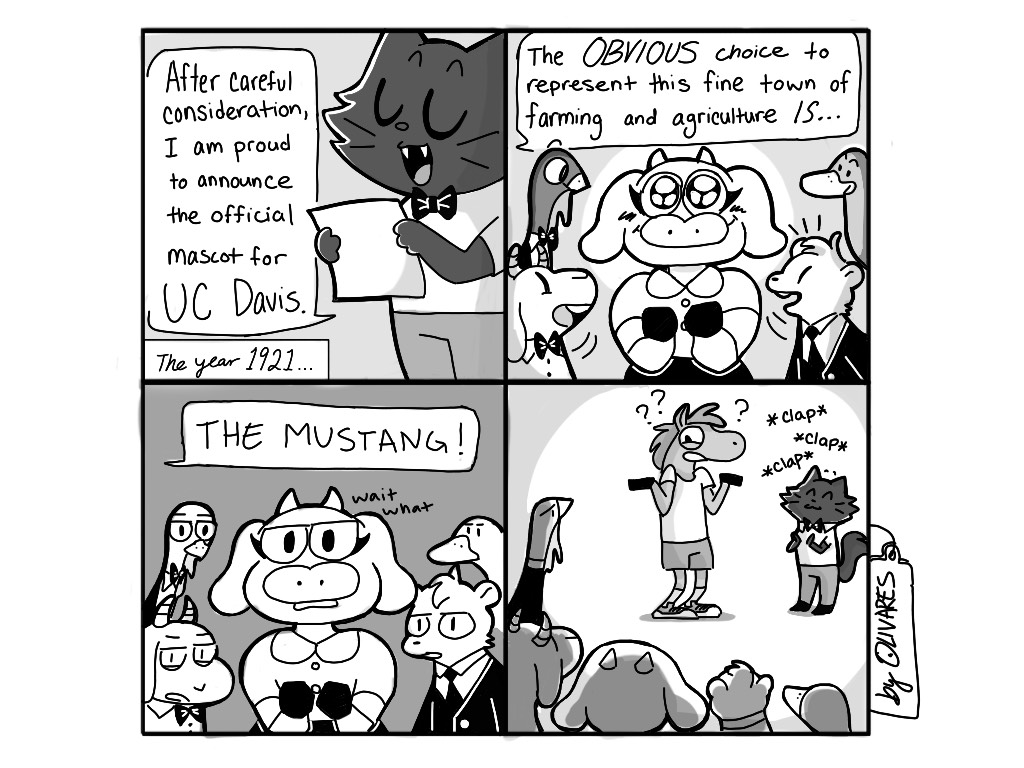
Cartoon: The Obvious Choice

DIANA OLIVARES / AGGIE

By DIANA OLIVARES — deolivaresvalencia@ucdavis.edu

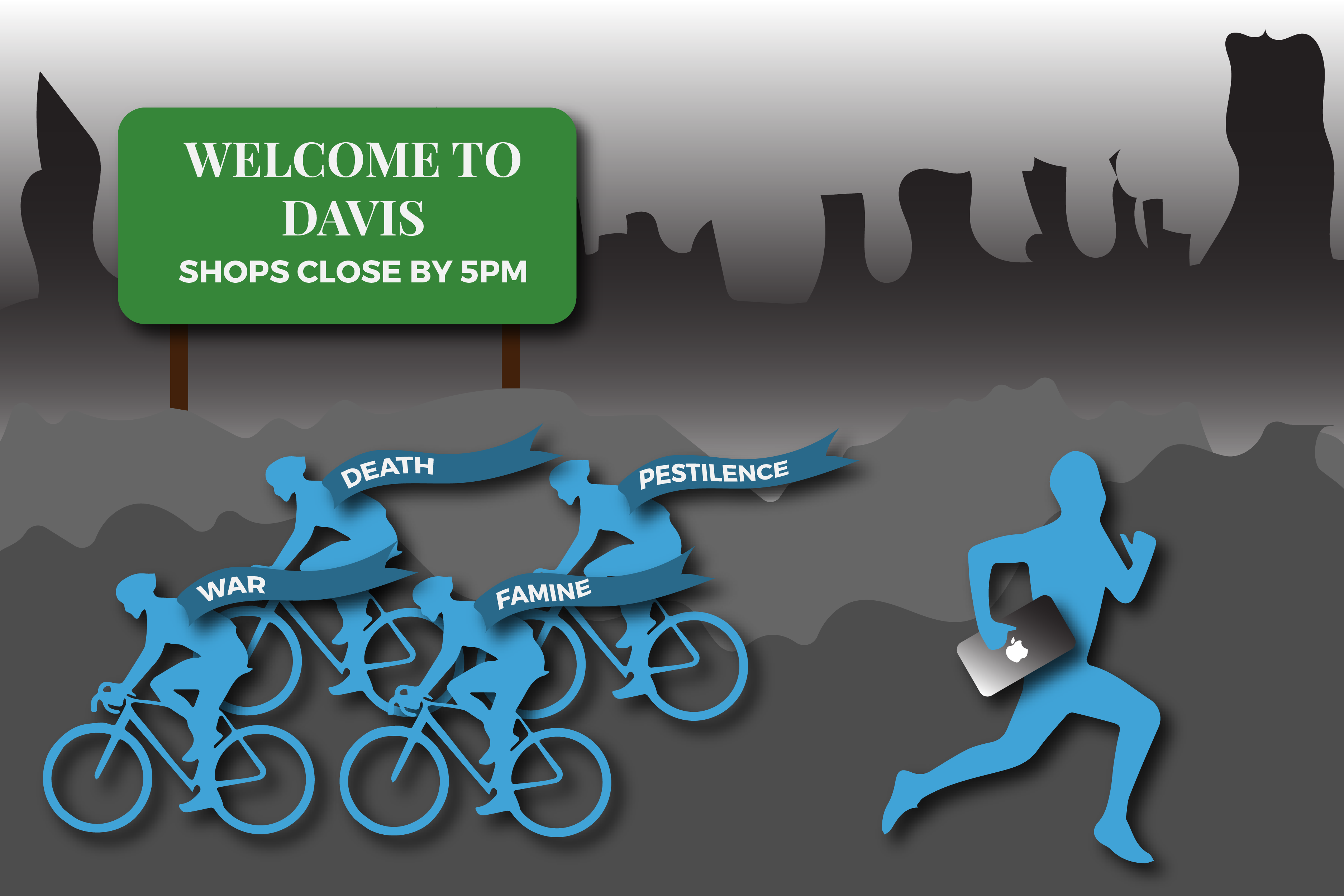
Humor: Surviving the off-campus wasteland — Part 2

OLIVIA KOTLAREK / AGGIE


A view into the insanity that surrounds sweet, innocent UC Davis

Since the release of our last story on the horrors of off-campus Davis, The California Aggie has reported on several more events occurring in the off-campus wasteland. Whole restaurants shut down by cockroach-rat shapeshifters with an unquenchable hunger for crepes — and blood, probably. A fledgling, street cookie business with a secret ingredient — human matter. Assaults, road and freeway closings, a literal homicide — all somehow more mundane than that last one.

This week, however, we have a shocking development you have to see to believe. Sitting in front of me, at this very moment, is a real-life survivor of the off-campus wasteland.

“My name is Travis Snott, and I’m a survivor of the off-campus wasteland. That’s how you wanted me to say it, yeah? I just want to make sure I’m, you know, I’m getting it right.”

Yes, he got it right, just like we planned. Travis Snott, an 18th-year student at UC Davis, lived in the off-campus wasteland from 1999 to the current year, and now he finally feels safe enough to tell his story.

“So basically, yeah, I was just biking home one day to my apartment on J Street at, I want to say 2 a.m.,” Snott said. “Sure, I had a couple beers, but it was the early 2000s, so that was kind of the only thing to do around here for fun. Anyways, yeah, as I’m approaching J, I hear the sound of bike tires behind me. So I turn around. All I remember is seeing these four bikers — well, technically five, but that couple was bonded at the hip — and wiping out.”

After recounting this story, Snott stated that most of his memory comes in flashes.

“I felt like I was in another world, or maybe just seeing the real world for the first time,” Snott continued. “Davis became an apocalyptic hellscape after that. I mean, Jesus, have you seen the quality of these roads? I got a flat tire after every intersection, and when I went to go fix it, my bike would just be gone when I got back. I did that 20 times before I gave up. Oh, and the cockroaches? I’m surprised Crepeville is the only place to shut down recently, because I’ve conversed with the Five Roach Families and they told me, ‘Pain will be doled where it’s deserved.’ So that’s a thing.”

Snott’s stories confirm many of the rumors we could not support in our last article, such as the Davis Flasher’s Club, which only recently came back to campus in 2015, the underground Sewer Cow Mafia — the original founders of Lazi Cow as a money laundering scheme — and something called “D’vsai,” a real-life Cthulhu in Davis that changes the weather at will. And Snott’s advice for surviving the off-campus wasteland?

“Well, usually what I do is just smoke a lot of weed. But, then again, I don’t know if that necessarily helped. Actually, looking back, that might explain a lot of what happened to me. Anyways, I’ve got to head back. The wasteland calls!”


Written by: Conner Shaw — cjshaw@ucdavis.edu

(This article is humor and/or satire, and its content is purely fictional. The story and the names of “sources” are fictionalized.)

Monsanto protesters arrested

CAITLYN SAMPLEY / AGGIE

A fight for environmental social justice results in trespassing charges

On Oct. 15, eight environmental and social justice protesters were arrested by Yolo County sheriff deputies outside of the Woodland Monsanto/Bayer Plant. Among the arrested were Michael Kerr, Susan Roberts, Pamela Osgood, Carmen Mateo and James Lee Clark Sherly.

The protestors were charged with trespassing on the Monsanto/Bayer Plant. They were released from custody the same day and are scheduled to return on Jan. 22, 2019 for a court date in the Yolo County Superior Court.

“We wanted nation[al] attention,” said Mauro Oliviera, a member of the March Against Monsanto group. “[The] same group has been doing it all year. We were on the Pacifica news network every weekend. We would like to get up the food chain within our democracy.”

At 5 a.m. on Oct. 15, an estimated 50 activists flooded the gates of the plant, blocking entrance to the facility. They were seen waving banners, calling attention to glyphosate and other chemicals produced by Monsanto. Some even brought out traditional Native American drums and sang folk songs.

“We have to strike while the iron’s hot because behinds the scenes, deals are going on,” said Bob Saunders, a member of the March Against Monsanto group. “They’re gonna try to reverse the decision [Johnson v Monsanto] or repeal it, and it could get tied up in courts forever. We just felt that it’s really timely.”

Monsanto is an agriculture and biotechnology company that specializes in pesticides and conducts experiments with genetically modified organisms (GMOs). As of 2013, the company has planted seeds on over 252 million acres worldwide. It holds thousands of U.S. patents for various seed varieties and other agricultural technologies. 

With the recent merge of Monsanto with Bayer, a German drug-making and chemical company, Bayer sought to remove the name of “Monsanto,” as it believed that it was viewed as a negative influence on the company.

“Monsanto is evil,” Oliviera said. “We want to remind people that they and Bayer are one on the same.”

Protestors were most concerned about the company’s use of chemical pesticides, especially glyphosate, a chemical found in the pesticides and in the product Roundup. 

“They’re spraying glyphosate in schools there [Woodland School District],” Saunders said. “The more pressure we put on, sometimes it has a positive effect. “Essentially, it’s to bring attention on the use of pesticides [that] are sprayed on farm fields, on public parks and school grounds with children’s families.”

Monsanto argues that its programs are safe and beneficial to both farmers and the environment. The company’s GMOs “use resources efficiently,” as they not only give crops longer growing seasons, but also assist crops in fighting diseases and pests, according to Monsanto’s official website. The company also states that its use of glyphosate works “really well on weeds” and helps farmers “grow crops more sustainably.” Monsanto has stated that glyphosate is an efficient tool in managing and resisting weeds, though if used too often, may create some environmental risks.

The California Aggie reached out to Monsanto, but did not receive a response before the time of publication.

“We have bare bones research,” said Sharon Strauss, an evolution and ecology professor at UC Davis. “What are the effects in human health and what are the actions that [a] human takes to having GMOs? You need to have adequate research and adequate techniques. Having ready crops is obviously good, but it if increases Roundup [use] and creates super weeds, then that would be a bad outcome.”

In 2017, the Environmental Protection Agency published a first draft stating that “glyphosate is not likely to be carcinogenic to humans. The Agency’s assessment found no other meaningful risks to human health when the product is used according to the pesticide label.” The Environmental Protection Agency is scheduled to publish its interim registration review in 2019. In the meantime, the March Against Monsanto group encourages community members to fight for the environment.

“I would encourage people to do thing[s] that we are doing,” Oliviera said. “We always felt that things would get better with more numbers […] We need to look at the corruption and clap down on the corruption. We don’t have time. The number of species are dying at an alarming rate.”

Editor’s note: A previous version of this story erroneously stated that Monsanto controls 92 percent of the world’s seeds. That is incorrect. A previous version of this story also stated that California passed a law in 2013 banning the use of glyphosate. That is incorrect. The story has been updated to reflect these changes. The Aggie regrets the errors.

Written by: John Regidor — city@theaggie.org

Council approves ordinance to protect mobile home park residents

FARAH FARJOOD / AGGIE

Ordinance prevents relocation, closure of mobile home parks  

On Oct. 17, the Davis City Council approved an ordinance that protects residents of mobile home communities from being spontaneously relocated in a unanimous vote. The council also recommended providing additional protections for those living in mobile home parks.

There are currently four mobile home parks in Davis: Davis Mobile Estates, Rancho Yolo Mobile Home Park, Davis Creek Mobile Home Park and Slatter’s Court. Although most of the parks owners haven’t made any indication that they want to repurpose their parks, the ordinance will now protect residents from something like that happening.

Protecting mobile home communities is a fairly new idea in many cities across California, but San Jose and San Francisco recently introduced protections. In Davis, mobile home parks are one of the only options for non-government related low-income housing.

According to Ginger Hashimoto, a city administrative analyst, the ordinance proposed taking advantage of an in-state law that allows local governments to create more specific laws regarding the relocation or closure of a mobile home park. The purpose of this ordinance in particular — titled “Mobile Home Park Relocation Impact” — is to mitigate the effects of mobile home park relocation or closure to the residents.

“The exact purpose of this ordinance, essentially, is to ensure that park owners reasonably mitigate the adverse impacts of relocation on displaced residents,” Hashimoto said. “The proposed ordinance wishes to achieve this by establishing a set of local procedures and standards that must be addressed and analyzed in something called the relocation impact report.”

The relocation impact report will be written by a neutral consultant selected by the city. It will not supersede any pre-existing land use or zoning approving processes, however. Additionally, the council and city cannot use the ordinance as a tool to prohibit closure of the park.

Of the four mobile home parks in Davis, Rancho Yolo is the only park that has an existing protection, which means that the park is a legal lot and that a review process has to take place before any changes can be made. Other mobile home parks may have something similar, but the proposed ordinance will provide an additional layer of protection.

“Really the only other permitted uses for the Rancho Yolo property, as Mike already indicated, is a one single family dwelling or a duplex, or agricultural use,” said Kelly Stachowicz, the assistant city manager. “So anything else would require approval for the council.”

Along with the residential impact report, any proposed change to a mobile home park will require a public hearing before the city’s planning commision, social services commision and city council. The owners will also be required to pay relocation costs for the residents of the parks.

Staff began with the intention of bringing the idea to City Council and having a public hearing on a later date. However, the council approved the proposal of the mobile home park relocation ordinance, and made a suggestion to have a proposed stage II, which will include additional protections for residents.

According to Councilmember Lucas Frerichs, some other securities would include rent control for park residents and “stay in business” incentives for park owners. Right now, according to Frerichs, the goal is to get the basics in place.

“It’s been talked about in the public comments night,” Frerichs said. “There’s a variety of pieces to the housing puzzle. One is some additional new housing where it’s appropriate. But also, one of the other pieces is to preserve the existing housing stocks. That is one of the things that is exceptionally important. We have these four mobile home parks — in these, we have 400 units of extremely affordable housing, and there’s currently no protections in place at all in terms of if someone comes in and tried to do a conversion.”

Councilmember Will Arnold agreed with Frerichs. Many of the residents of the housing parks are senior citizens, and the affordability of the mobile home parks, according to Arnold, needs to be more protected.

“I support the passage of this ordinance because it’s critically important that we preserve the security and peace of mind of our senior citizens that live in this affordable housing in our community,” Arnold said. “Creating new affordable housing is expensive and hard to sight and is creating a lot of work. And it’s important to protect what we have, and this ordinance doesn’t go all the way in doing that, but I do think it’s a step forward in that process.”


Written by: Hannan Waliullah – city@theaggie.org


Reality of ICE detention facilities subject of UC Davis professor’s paper

JEREMY DANG / AGGIE

Study discovers high rates of solitary confinement in ICE detention facilities

A UC Davis professor recently authored a paper looking at the conditions inside U.S. Immigration and Customs Enforcement (ICE) detention facilities.

Caitlin Patler, an associate professor of sociology at UC Davis and a faculty affiliate at the Center for Poverty Research, in the Migration Studies Cluster, the Social Control Cluster, and the Human Rights Program, wrote the paper alongside two other co-authors, one of whom is also associated with the university.
The paper, titled “The Black Box Within a Black Box: Solitary Confinement Practices in a Subset of U.S. Immigrant Detention Facilities,” was based on research conducted by Patler and looked at why civil and administration immigration centers, like ICE facilities, mimic the prison system, bypassing limits to detention and rights to an attorney that the criminal justice system affords.

Nicholas Branic, one of the co-authors of the study, explained the title of the paper was meant to reflect the lack of transparency about detention facilities.

“As the title of our paper suggests, immigration detention facilities are a modern ‘black box’ in that we have a limited knowledge of how they operate and what goes on within their walls,” Branic said via email. “The recent investigations into child-separation policies within immigration detention facilities serve as a case in point, as the in-depth coverage of certain facilities that we saw was unprecedented and gave the public a view of how these facilities are operated.”

The study challenged understandings of detention centers as “non-punitive,” Patler said.

“Detention is not considered a punishment, legally,” Patler said. “It’s an administrative process. The argument is that it’s justifiable for something like indefinite detention.”

The study makes clear that immigration law is civil, as opposed to criminal, and “therefore, legally speaking immigrant detainees are not serving a sentence.”

“Despite this legal difference, scholars have drawn parallels between the systems of incarceration under criminal and immigration law,” the study states.

Both immigration centers and the prison system use solitary confinement for punishment under the potential guise of “protective custody,” according to Patler.

Patler accumulated her data via Freedom of Information Act requests. Through these requests, she examined 1,193 incidents of solitary confinement from the beginning of the instatement of ICE’s data collection beginning in 2013 throughout 2016.

The three authors of the paper analyzed six facilities under the jurisdiction of the California Field Offices in Los Angeles and San Francisco.

Patler looked at solitary confinement cases both under and over 14 days. She found the mean time period of these cases was three to four weeks, exceeding the first parameter.


Patler found that one of the only outcomes the study could unpack, given limited data, was facilities’ motivation for placing detainees in solitary confinement, and for how long. Patler utilized a computer model fed by datasets on detention facility data and detainee data to analyze why detainees ended up in solitary confinement.

“Results reveal significant differences in the use of solitary confinement by gender, mental illness status, whether the confined individual had an attorney, Field Office jurisdiction, and individual facility,” the study states. “In addition, we document the extensive use of solitary confinement for ‘protective custody’ and show that this category is potentially punitive in nature.”

According to Patler, solitary confinement is an inhumane solution, especially in civil and administrative processes like immigration.

“There’s well established research within criminal law about solitary confinement, led by psychiatrists and doctors [that] shows in that as little as 10 to 14 days, you can see the onset of mental health problems in people who are subject to solitary confinement,” Patler said.

The study found that only 14 percent of detained individuals are represented by an attorney, which Patler described as unfortunately low. Because immigration proceedings are civil and not criminal, there is no mandated public defender if a detained individual cannot afford a lawyer.  

According to Patler, ICE did not include information for almost a quarter of the cases, so these individuals may or may not have had an attorney. Additionally, Patler found a disproportionate rate of solitary confinement used for protective custody, which could be either protecting the detainee from themselves or from other detainees.

The study found that most protective custody cases were “detainees who had never broken facility rules.”

Patler found that disciplinary cases accounted for only 48 percent, while 52 percent were non-disciplinary.

“ICE says they are doing this for individuals safety, or safety of detained population — to protect others from them or themselves,” Patler said.

Patler discussed how ICE provided “very shoddy information,” with non-specific information including gaps in detainee information. According to Patler, “there is no reason that ICE doesn’t have this data.”

“The variable for the most missing data was attorney status,” Patler said. ”And other missing data was qualitative comments. Discipline — what’s the gradient? Are people who start a fight, or something smaller, getting the same treatment?”

According to the study, only “23% of protective custody cases included additional text information.”  

To Patler, what is most troubling is the fact that solitary confinement, which exacerbates mental illness, is being used to quarantine mentally ill patients who could be better treated by a psychiatrist.

“The findings suggest that immigrant detention facilities may be relying on solitary confinement to manage the behavior and needs of mentally ill detainees,” the study sates. “Indeed, our analyses reveal that over 57% of solitary confinement cases involved an individual with a mental illness, though these individuals are estimated to make up only about 15% of the ICE detainee population. … People who are mentally ill are overrepresented in 0-14 and over 14 days.”

Patler discussed widespread misconceptions about ICE detainees.

“People get a concept these are people who have just illegally entered, yet many of these people are in the interior [of America],” Patler said. “There is plenty of documented people [in ICE facilities].”

In Patler’s eyes, there should be no detaining of immigrants outside of the legal, criminal justice system.

“We don’t need immigration detention,” Patler said. “They are not serving a sentence. There is no reason to detain these people in the first place — immigration is being criminalized.”


Written by Aaron Liss — campus@theaggie.org


Aggies win sixth straight game in comfortable fashion

IAN JONES / AGGIE

Blowout victory puts UC Davis football on cusp of first ever Big Sky title

The UC Davis football team continued its magical 2018 season with a 42-20 win over visiting Northern Arizona University on Saturday afternoon at Aggie Stadium. The sixth consecutive victory for the Aggies, a program record, keeps them in first place in the Big Sky conference with a monumental showdown looming versus second-place Eastern Washington next Saturday in Cheney, Washington.

Last Wednesday, the FCS committee placed UC Davis at No. 3 in its top-10 rankings. The top eight seeds at the end of the season will automatically earn a bye in the first round of the FCS playoffs, a 24-team tournament that begins Nov. 24. The Aggies haven’t earned a berth in the FCS playoffs nor won the Big Sky conference title since moving up to the Division I level.

UC Davis was in cruise control for the majority of Saturday afternoon’s contest, jumping out to an early 21-0 lead after three possessions. This was a stark change from the previous three games in which the Aggies fell behind by double-digits before staging big comebacks.

“The emphasis was to start out fast, try to take the life out of them early and set the tempo for the rest of the game,” said junior quarterback Jake Maier.

Sophomore running back Tehran Thomas and senior wide receiver Keelan Doss each scored a pair of touchdowns, and the Aggies utilized a balanced attack on offense to keep the Lumberjacks guessing. UC Davis rushed for 215 yards on the ground, averaged an even five yards per carry and gained 262 yards through the air.

Thomas handled the largest workload of his career, carrying 24 times and running routes out of the backfield for a total of 150 all-purpose yards and two touchdowns.

“He’s a big guy that can be a battering ram, but he’s also fast,” said UC Davis Head Coach Dan Hawkins. “He’s hard to bring down.”

Northern Arizona was forced to counter with an extremely one-dimensional, run-heavy attack due to multiple season-ending injuries at the quarterback position prior to Saturday’s game. The team ran the ball a whopping 66 times versus just 12 pass attempts, despite trailing by double digits for most of the afternoon.

There was plenty of action at the beginning and end of the game, but the contest hit a lull in the second and third quarters. The teams combined for 12 punts during that span, eight of which resulted from three-and-out’s.

UC Davis received the opening kickoff and promptly drove 69 yards in eight plays to get the scoring started. The Aggies made a couple key plays on third downs, including a 16-yard catch by Doss and a 13-yard run by Maier to keep the chains moving. To cap things off, Doss streaked down the seam with a 25-yard touchdown catch to make it 7-0.

Just when it looked like Northern Arizona was going to even the score, senior linebacker Mason Moe jumped in front of a screen pass to the running back, intercepted the ball at the 10-yard line and returned it 37 yards the other way. Moe was named the National Defensive Player of the Week by Stats FCS for his performance against Montana last weekend which included 13 tackles and a forced fumble.

“In my opinion, he could be the defensive MVP in the conference,” Hawkins said. “He’s really that valuable. He’s kind of the classic Aggie linebacker that’s really smart. It’s hard to fool him or fake him out because he knows what’s going on.”

The Aggies wasted no time in taking advantage of the turnover, quickly finding the endzone just three plays later. UC Davis executed a running back screen to perfection, with offensive linemen kicking out to the right side and setting up the blocks that sprung Thomas to an untouched, 39-yard catch and run to the endzone.

On its third possession of the game, UC Davis was content to slow things down and establish the run. Besides a few completions to its wide receivers, the Aggies continually grinded out short gains on the ground with the likes of Thomas and senior running back Namane Modise, culminating in a 13-play drive that took over four minutes. Thomas scored his second touchdown of the first quarter, taking a direct snap in the backfield and coasting untouched for a five-yard score to make it 21-0.

“Whenever my number’s called, I just try to make plays for my team,” Thomas said. “I’m here for my team and my coaches and anything they need me to do, I’m willing to do.”

The Lumberjacks started to show signs of life on offense as the second quarter began. Northern Arizona imposed its will in the trenches, trudging 75 yards down the field on 13 consecutive running plays capped off by a one-yard touchdown run. Only two of those runs went for more than seven yards, as the visitors steadily grinded out short gains to tire out their opponent. The extra point was blocked by the Aggies, so the score remained 21-6.

UC Davis took the ball into enemy territory at the 38-yard line, but Maier tried to find Preece over the middle on a third play and was picked off by a Lumberjack defensive back.

Neither side could get anything going on offense in the final nine minutes of the half, and the teams headed into the locker room with the score at 21-6.

The teams continued to trade punts back and forth until midway through the third quarter, when Modise broke the scoring drought with a 43-yard touchdown run up the middle to make it 28-6.

Early in the fourth quarter, Doss grabbed a 16-yard touchdown catch over the middle to push the lead to 35-6. He finished the day with eight receptions for 103 yards, marking his 17th career game with at least 100 receiving yards –– now the all-time record in Aggie football history.

Northern Arizona scored a pair of 49-yard touchdowns in the following six minutes to get back within two scores at 35-20.

UC Davis slammed the door shut with a nine-play scoring drive near the end of the quarter, capped off by a two-yard touchdown run by senior quarterback C.J. Spencer.

Next Saturday’s clash with Eastern Washington is undoubtedly the most meaningful game the program has seen in several years. With a win, UC Davis would, at minimum, guarantee a share of the Big Sky title with one game left against Sacramento State. If the Aggies win out, they will take home the conference’s automatic bid to the FCS playoffs and a first round bye.

“It means a lot because we’ve given ourselves an opportunity, and that’s really all you can ask for,” Maier said. “We’re going to head down there, give everything we’ve got, have a great game plan like we always do and we’ll see if we can out-execute them.”


Written by: Brendan Ogburn — sports@theaggie.org


Humor: City of Davis collapses into sinkhole as workers dig to create underground parking structure

OLIVIA KOTLAREK / AGGIE


The Great Hole has claimed its sacrifice

Gesticulating wildly, as his eyebrows twitched and his face contorted, billionaire-playboy-philanthropist Noraa Snivel told me about the Great Hole.

“You just don’t understand MAN!” He stood up on his large, mahogany desk, situated in the middle of his mansion. He jumped up and down, and his $400 Versace slippers click-clacked away, echoing down the marble-lined hallway that stretched out behind us where Picassos and Van Goghs hung, the collectables of the obscenely wealthy. “We started something that just can’t be stopped. The Hole needs a sacrifice, and dammit, it’ll take us all with it if we don’t start coming up with ideas.”

A few months ago, Mr. Snivel mysteriously showed up at a community-led city planning meeting to address the horrible problem of parking that had reached a fever pitch in the city of Davis. He came, dressed in a black coat, not unlike a sith lord, and from the back of the room in the midst of the proceedings, his voice boomed over the masses — “BIG. HOLE…… BIG. HOLE…… BIG. HOLE…..” The whole audience, confused and frightened, swiveled in their seats to look at the man whose words filled up the room. And as silently and mysteriously as he came, he left.

Soon after “The Interjection” (as it became known amongst community members), construction for a “parking garage” began underneath the city of Davis. All day and night, the drilling could be heard. The pounding from below was like a creeping earthquake — a chilling reminder of the man in the cloak that haunted the heart of the citizenry. But most of the city did not mind sounds of construction, as long the construction wasn’t affordable housing for poor people.

It was only after a few months that people began to be afraid, as the Memorial Union had just gone up and disappeared one morning — quite literally disappeared, and along with it, most of the administration, who had been performing their nightly Satanic ritual to try and dispel the UC workers asking for liveable wages and rights and stuff. All that was left of the icon on campus was a giant hole. And it was only to grow bigger.

In press conferences regarding the hole, Noraa Snivel remarked this simple statement: “The hole must be built. The hole must be satiated.”

And not long after this statement, most of UC Davis had been swallowed whole. Entire liberal arts departments disappeared, but most students didn’t really seem to care. One fourth-year computer science major was heard to remark: “They teach books here?”

But then Kemper Hall, with its labs and students with strong earning potential, disappeared. And people began to demand answers from Mr. Snivel, who could say only “BIG. HOLE……!..!!”

So I came to Mr. Snivel for answers at his massive mansion, and this time he could only say this: “THE HOLE NEEDS A SACRIFICE.” And he ran out of the office. I followed closely behind and lost him for a bit. But then I saw him sprinting across the front lawn, wearing only a black Speedo with these words and symbols, written in hot pink letters, stretched across the ass:

“🍑  BIG HOLE 🍑”


He stood on the edge of the hole, which by now had reached his house, and peered down inside. I knew what he was going to do and called out to him. But he wouldn’t listen. The hole needed a sacrifice, and he was going to be it.

He did an incredible swan dive, and it seemed at least for a moment that he floated in the air like a divine feather, hovering in a ray of light, arms stretched out, his body rigid like a cross. Then he disappeared down into the blackness of the hole, falling for God knows how long.

And strangely, the hole stopped growing. But even to this day, no one can sleep, because the words “BIG HOLE” come out of the gaping blackness that sits in the middle of town. And all who hear it can only think about the human sacrifice sitting in the depths of that abyss, screaming out, keeping them only barely from the brink of destruction.

Written by: Aaron Levins  — adlevins@ucdavis.edu

(This article is humor and/or satire, and its content is purely fictional. The story and the names of “sources” are fictionalized.)

Cartoon: Reminder

ROSEY MOREARTY / AGGIE

By ROSEY MOREARTY — rosey@morearty.org


#MeToo is scared of the sex talk

RAEL HANUS / AGGIE

Talking about male sexuality is a good way forward

In the wake of the sexual assault allegations against Harvey Weinstein that kickstarted the #MeToo movement, the New York Times published an opinion piece by author Stephen Marche arguing for more discussions about masculinity.

“[We were] having a public conversation about male sexual misbehavior, while barely touching on the nature of men and sex,” Marche wrote.

One year later, Marche’s idea still holds water because most rapists are men. In a movement that overwhelmingly implicates men as the criminals and women as the victims, there’s a strange lack of conversations regarding male sexuality. America has grappled with gender roles, political revolutions and social restructuring. But the male purview of physical sex has gone largely unnoticed.

This is unfortunate because the mixture of “maleness” and “sex” has been around since ancient times, and it warrants discussion: “It’s no good keeping quiet about it. You’d not present such f–ked-out flanks if you weren’t up to something foolish,” wrote Catullus, an erotic poet from Ancient Rome trying to get the bottom of his friend’s sex life.

Things are still basically the same, even two thousand years later. Men think about sex twice as much as women do — around 19 times a day, if a study of college students at Ohio State can be believed. Atlanta’s underground sex economy alone brings in hundreds of millions in illicit revenue, much of it flooded by male clients.

Sex sells, and accessing it is a big reason why gang members –– who have a curious tendency to be young and male –– join their gangs in the first place:

“One of the most consistent findings in studies of gangs is that they tend to attract most male members at the ages when the males are beginning to compete for sexual access to females,” researchers wrote in the Journal of Sex Research during the mid-90’s.

If the seedy underbellies of 90’s gangland weren’t enough, another study at Western Illinois University found that opportunities to meet women were a big reason why fraternity members actually became members. This is not surprising. Popular frat culture hinges on the underlying principles of sex — we see this through restricted access to parties, the prevalence of rape incidents and movies like “Alpha House.”

And if frat culture wasn’t enough, how about the everyday Joe? The New York Times recently released the stories of eight normal, if unspectacular, men who regretted sexual misconduct they committed decades in the past. Each story revealed a young man who was preoccupied with sexual fulfillment at the expense of anything else. One man, describing how he groped a classmate’s breast during a rough-housing game his high school classmates used to play, wrote, “I think I did it because she seemed otherwise out of reach for me; perhaps such one-sided contact was all the intimacy I could ever hope to enjoy with her.” And so the stories continue.

The moral gap between sexual predators like Weinstein, inner-city gang members, fraternity brothers and the average guys cited by the New York Times is large. But their hyper-sexualities bear a striking resemblance to one another.

So what does this mean, and why does it matter that “normal” men have such strong sex drives? The rub is this: #MeToo prides itself on dismantling the male power structures that have seemingly given rise to sexual abuse and harassment. We see this all over, from Hollywood to Washington. And, indeed, power is involved in male misbehavior. But it’s disingenuous to name “power” as the reason for sexual misconduct and to assume that powerful men are the root cause of such vileness. Power is just a vessel that makes sex easier to acquire. The foundation of both sex crimes and consensual sex lies with sexual desire, in the powerful and the plebeian alike.

At one point earlier this year, Weinstein had the audacity to seek treatment for sex addiction. This was crass, and it led to questions over the validity of sex therapy. For some, however, therapy can help control the worst of our sexual impulses. Sex and pornography addiction was at the core of Terry Crews’ marriage troubles, and Tiger Woods enrolled in rehab for the same condition almost a decade ago.

Both Crews and Woods maintained enough decency to end their moral transgressions before they crossed paths with the criminality of Weinstein. They kept their hyper-sexualities somewhat at bay and sought help. In Crews’ case, it saved his marriage. And if they can manage their innate drives, recognize the problem and receive help, there’s hope for the rest of us.

#MeToo has wielded an admirable sword against criminal sex acts, and its aftershocks will be felt for many years to come. The way we continue these conversations about masculinity will dictate the effectiveness of the movement. The best way to curb the sexual desires of men who can do terrible things is to be open and honest about them.


Written by: Nick Irvin — ntirvin@ucdavis.edu

Disclaimer: The views and opinions expressed by individual columnists belong to the columnists alone and do not necessarily indicate the views and opinions held by The California Aggie.

College sports recruiting

0
OLIVIA KOTLAREK / AGGIE

A look into collegiate level recruiting processes, its importance to team development

While playing for a collegiate sports program may seem like a relatively simple task to accomplish, there is a lot more to joining a collegiate team than meets the eye. Even though a player is able to show up at a collegiate level try out and join a team as a “walk-on” player, recruiting is what drives the formation of collegiate level teams, specifically at the Division I level.

“I refer to recruiting as the lifetime of any program because that’s how you get the talent,” said Nicole Miller, assistant coach and recruiting coordinator for the UC Davis women’s volleyball team. “There are kids that are interested in your institution and sometimes those kids can help your program and sometimes they can’t. In order for [the team] to be competitive and to achieve the goals that you want, you have to recruit those type of athletes.”

Being the lifeline of the program, there is no specified time for recruiting players. A year-round surge of emails and discussions about bringing on new players is what makes recruiting an especially busy aspect of college sports.

“For one position, we can talk to maybe 12 to 15 players, and maybe have half of those come and visit,” Miller said. “But if it’s for one class, we can be emailing around 100 kids and maybe only some are interested, and then we have to get it down to the ones that we like. It is a lot trying to get them interested and then the communication piece as well.”

Because of the fact that one specific player out of high school can have multiple colleges or universities looking to recruit them, the recruiting process is a multi-step one. This helps coaching staff ensure that the players being brought on are right for the team.

“The steps would be communicating with their coaches to get an idea of what [the athlete’s] character is,” said Dan Conners, the UC Davis women’s volleyball head coach. “You have to communicate with them to gauge their interest in Davis and how they fit within the program, as well as watch them multiple times to make sure that what we evaluated we continue to see as helpful for our program moving forward. They [the steps in the process] are all equally important and each one plays a role.”

For Child and Meisel Families Director of Men’s Water Polo Daniel Leyson, getting to meet with a player in person is one of the biggest factors in recruiting them.

“The official visit is a huge part of it,” Leyson said. “Face-to-face contact is a huge part of it. I really like doing the home visits and sitting with the athlete and their parents and talking about our program. I think it is a great environment to see how they interact with their parents, or if the parents are doing all the talking is important to see if the guy is right for us.”

Recruiting athletes, however, doesn’t come without examining the prospective recruits academically. For Miller, current academic status can be a big factor in deciding to bring someone on.

“When I first talk to [a potential recruit],” Miller said. “If I talk to a junior, and they are interested in Davis, I will ask them about their academics, what they want to study and their SAT, because that matters for us since [the university is] highly academic.”

Not every athlete is being actively recruited by a slew of other programs. The players who are under the radar, but still have enormous potential, draw some coaches to diversify their recruiting style.

“Our job at Davis is to really try to find those people that are under the radar because the big, top level guys still are not yet coming to Davis, and that is just how it’s been,” Leyson said. “We are trying to break into that, and it’s hard because those are big schools that have different things to offer. We try to find those guys that are maybe overlooked because schools are looking at other players. It is a lot of research.”

Even though recruiting can be an incredibly stressful process of constant contact with multiple people, and wondering if players are going to produce once they get to the university, it is this process that coaches tend to enjoy.

“The only stress it might cause for me is the amount of time that it takes, and just balancing that with my work schedule and life,” Conners said. “Outside of that, I enjoy the recruiting process. I like evaluating players and communicating with them. I like talking to them and about their background and how they see the world and those sorts of things.”

Written by: Ryan Bugsch — sports@theaggie.org

Vegan Chef Challenge returns to Sacramento area

ZOË REINHARDT / AGGIE

Challenge inspires restaurants to include vegan items on menus

Every October for the past eight years, the Greater Sacramento area has hosted the Vegan Chef Challenge, a summons for local restaurants to feature unique vegan items on their menus. The turnout since 2011 has been brag-worthy, spanning from Rancho-Cordova to Sacramento to Davis, and now, over 80 restaurants participate in the challenge.

Each year brings new restaurants, new recipes and a large community of food lovers with the same objective in mind — to eat as many plant-based delicacies as possible. The challenge has entertained a number of focused competitions between restaurants trying to earn awards from the best dessert to the best burger.

As difficult as it is to imagine a tortilla without barbequed asada (steak) in its grips, Cantina Alley in Midtown, Sacramento quickly cured that skepticism with their take on traditional Mexican food. The restaurant’s vegan ambassador, Aaron Esquivel, gave compelling insight on their experiences with the challenge.

“When I started working at Cantina Alley, the only thing on the menu I could eat was the potato taco with no cheese,” Esquivel said. “That’s it. There were no vegan options. [But] in the 2017 challenge I had them do one vegan dish, […] the vegan sopes, and, like wildfire, they put us on the map. [Upon] creating that menu item, the owners took notice to the vegan market and realized they can provide that demand without compromising any of their promotional goals.”  

A traditional Mexican dish normally made of a thick tortilla, beans, cheese, rice and a choice of meat, are featured at Cantina Alley as 100 percent vegan. And they lived up to their reputation. When paired with their imported vegan craft beer, the combination is indescribable.

With or without meat, the sopes are crafted to fool even the most experienced abuelas. In fact, Esquivel says it’s a common practice for customers to order the vegan sopes as a side to their non-vegan entrée, due to their irresistibility. Because of this, the menu at Cantina Alley doesn’t label which items are vegan or not because most items are vegan-interchangeable.

Esquivel went on to comment on the popularity of the challenge and the rising number of vegan customers.

“This challenge shows restaurant owners and the community alike that veganism is not a fad, but a movement,” Esquivel said. “People are passionate about it and are willing to drive anywhere, spend money and go above and beyond to thank servers and chefs when they provide these vegan options. It has provided us with the opportunity to prove that vegan food is more accessible than ever and [that] it can be traditional and remind [us] of home, as well.”

At Golden Roads Brewery of Sacramento, head-chef Alberto Meza, commented on his adventures in vegan culture.

“Although this is [Golden Roads’] first year in the challenge, I started cooking vegan foods three years ago,” Meza said. “I like to create something that brings everyone to the table, including non-vegans. [Something] that everyone wants to give a shot without turning it down just because it’s vegan.”

Their cheesy elotes (street corn), avocado tacos (yes, more tacos) and dippable cauliflower wings were all vegan and delicious. On his process of creating these vegan dishes, Meza admitted it is a challenge.

“It’s a little harder [than creating non-vegan items] because you need to think outside the box and not use everyday ingredients like you normally would,” Meza said. “But whatever is going on in the vegan world, I like to bring it to the locals.”

In fact, Meza recounts not being a big fan of vegan food until he met a chef who taught him how to cook vegan, using spices and replacements for non-vegan ingredients.

“You definitely have to be more creative, whether that be with the spices or a sauce,” Meza said. “You have to know what flavor you’re going for and that is where the creativity comes into play.”

Since a majority of Meza’s recipes taste better than their non-vegan equivalents, I asked how the food fairs with non-vegan customers. Like its Midtown neighbor Cantina Alley, Golden Roads also doesn’t label whether an item is vegan or not.

“I just like to post that there are vegan options available because many of the items we sell are already vegan,” Meza said. “[We find it easier] to do it this way so nobody is scared to order what sounds good to them just because it’s vegan.”

Meza assured the entire vegan menu will continue to be available after the challenge is over, with more additions to come.

Vegan Instagram influencer Cait Luke spoke about her favorite dishes during this year’s challenge.
“I have really prepared this year, which has allowed me to go to many more restaurants,” Luke said. “My favorite part [about the challenge] is that breakfast and desserts have become more of a feature this year. Besides the food, I have connected with a number of people through Facebook and Instagram vegan-circles, who I now get together and have meals with, creating an inclusive community for me, and I love that.”

Luke discussed the difficulties vegans regularly face and how this challenge responds to them.

“One of the biggest problems is the social-factor — not everyone enjoys being dragged to vegan places, but this challenge acts as an anecdote for that issue,” Luke said. “I have had many meals with non-vegan friends, and being able to eat at a location that has options for me, my friends and my family is a great experience.”

Luke went on to discuss the lasting impacts that the Vegan Chef Challenge has.

“I have seen, over the years, that after the challenge, omnivore restaurants permanently implement these vegan options that we, including non-vegans, get to enjoy year round,” Luke said. “It shows restaurants, we are here, we are hungry and we want to give you business in return for the options you’ve provided. [Plus] when we inundate these restaurants every October, it really shows the force of the vegan community.”

The annual Vegan Chef Challenge concluded on Oct. 31. Although the vegan community has to wait 11 more months until the challenge returns, most of the restaurants that competed will offer their vegan menus permanently, allowing all food-lovers to rejoice in a year-round plant-based bliss together.

Written by: Clay Allen Rogers — arts@theaggie.org