55.4 F
Davis

Davis, California

Sunday, December 21, 2025
Home Blog Page 489

Bird’s the word

MERAL BASIT / BIRDSTRIKE THEATRE

Birdstrike Theatre hosts first performance with new troupe members

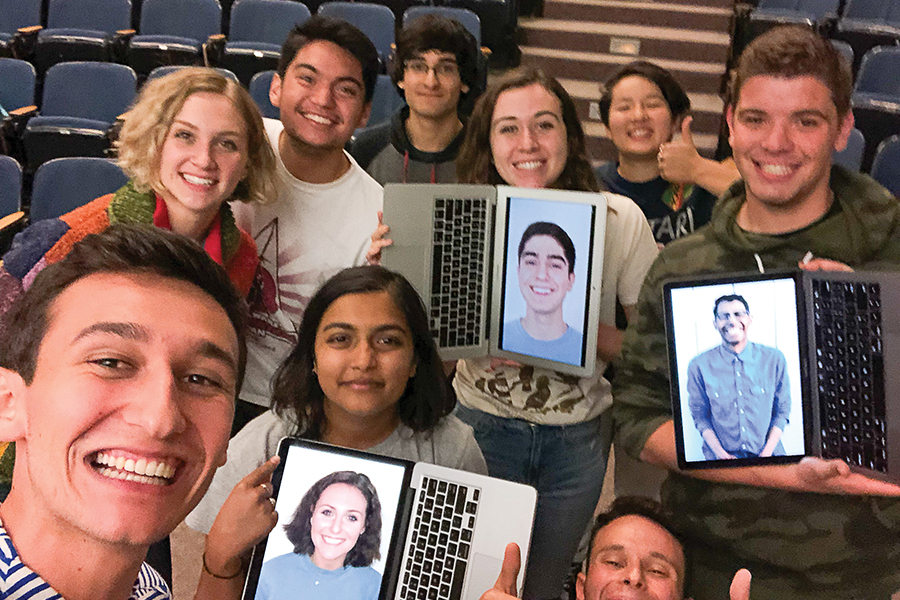
Birdstrike Theatre has endured as UC Davis’ premier improv group for 15 years. The group consists of 12 members who come together to perform every other Friday. As one of the only improv groups on campus, Birdstrike welcomes campus and community members to attend, asking for a $1 donation as an entrance fee.

Recently, Birdstrike held its annual auditions on Oct. 13 from 9 a.m. to 6 p.m. About 50 people tried out and three were asked to join the team. Less than a week later, Birdstrike’s second show of the quarter also doubled as a debut for these three newbies as they performed for the first time in front of a Davis audience.

Before attending the show, those interested in going could view the Facebook event for the performance, titled “Birdstrike Presents: Some Birds are Born.” There was a comical cover photo on the page that photoshopped the three new members into various movie posters with a banner beneath it that read, “in partnership with the student voter coalition.” This show already offered two new exciting aspects: they would be registering people to vote at the door and the three new members would be performing.

Sam Tick-Raker, a fourth-year psychology major on the team who joined as a first year, enjoys the first show with new members.

“It’s always an exciting process getting new members because we always get so much talent and it’s always fun to see how those new people are going to fit into our team dynamic,” Tick-Raker said. “It’s so cool seeing them go out onto the stage and doing a scene because we picked those people and now they are doing great and they’re funny. It feels like when you’re a parent and you see your kid go off to bat at t-ball or something. So yeah that’s the analogy, improv is t-ball.”

The enthusiasm of the Birdstrike team was apparent to the audience as they entered the Science Lecture Hall. As the Birdstrike members ran down the aisles screaming, it was clear that it didn’t matter if you came alone or with friends because Birdstrike had created an energetic and welcoming atmosphere. After calling in the new members with a Birdstrike style introduction the team began their show.

The group divided themselves and competed in a rap battle that mimicked the Beastie Boys’ rap structure. Each member approached the game with an originality that highlighted their own comedic style.

Chloe Wasil, a first-year theatre and dance major, is both a new member and the only first-year on the team.

“My favorite part of the show was probably the rap battle game we played at the beginning, just because it was really laid back, stress free and fun,” Wasil said.

After the rap battle, the members turned to the audience, asking for “things that make you think of fall quarter,” “things that make you extremely angry” and “the last popsicle you had,” validating every answer they received and encouraging all participation.

Jack Brady, a fourth-year managerial economics major in the audience, had only been to one previous Birdstrike show.

“I feel like it’s a very happy environment,” Brady said. “My favorite part of going to Birdstrike is that it’s very easy to get into the characters and enjoy the performance. They have a great group dynamic. It seems as if they’re a group of friends or even a family just performing on stage. They really click and it seems as if they know each other to the point of where their performance is seamless.”

For the audience, attending Birdstrike feels like a fun insight into the friendships and real-life relationships of the team. Although they’re putting on a show, their degree of comfort with the audience and with those around them is  positive and inclusive so that everyone who attends bonds through laughing and engaging with the Birdstrike team.

Regardless of seniority or age, Birdstrike is a genuine group of friends and members whose passion and love for their team is apparent in every scene and activity that they do.

“I love the team bonding aspect and I’m really looking forward to becoming close to all of the amazing people on the team,” Wasil said. “Improv is also something that’s out of my comfort zone and I’m looking forward to continuously pushing my boundaries and taking more risks.”

A type of performance that seems to synthesize a variety of different styles of acting and comedy, improv provides an outlet for creativity and individuality.

“We use a lot of our own experiences in improv and that shows a lot, whether that’s monologues or actually in the scenes,” Tick-Raker said. “That’s the weird thing about improv, it’s all made up. It’s only in that moment and it’s all fleeting and goes away and it can go crazy and you can play whoever you want but at the same time [our scenes are] grounded in reality.”

As the show ended and the audience dispersed, the room felt cheerful and jovial, with everyone chatting in banter and mimicking the types of jokes that Birdstrike had performed on stage. By the end of the show, the enjoyment that the Birdstrike members had while performing had spread to everyone, and it was clear that both the audience and the team were leaving in good spirits.

Birdstrike Theatre’s next show will be on Nov. 2 at 8 p.m. in the Sciences Lecture Hall.


Written by: Rosie Schwarz — arts@theaggie.org
 

Suspicious spots on campus

1
NICKI PADAR / AGGIE

Students reflect on the more peculiar parts of campus

Questionable places can be found on campus if you know where to look for them. Creepy messages on staircases, a worn jail-like bed in the bathroom and a building designed for people to get lost can lead students to ask, “Why?” and “What does it all mean?”

If you’ve ever had a class in Storer Hall, you may know about the room on the basement floor hidden inside the women’s bathroom. If you haven’t, it could be worth taking a trip down to go see it with your own eyes.

After taking the elevator down to the basement level of Storer, turn directly to the left and you’ll see the women’s bathroom. The bathroom looks like any other, except for the fact that there is an out-of-place door that is closed on the right side of the stalls. Open it, and you’ll find a run-down bed with indents marking the presence of someone- or something- that has used it. Chains lie on the floor beside and underneath the bed, giving off an eerie impression of a jail cell. But why would a jail cell be in the women’s bathroom?

Third-year Rayven Hernandez has heard rumors of what the room might’ve been.

“I had a class in Storer my first year,” Hernandez said. “I had a classmate who told me that the room was used for zoology research. She said the chains were used for animals who had to be isolated because they were too feral.”

However, Hernandez also heard rumors that the room is haunted and the chains inside rattle at night.

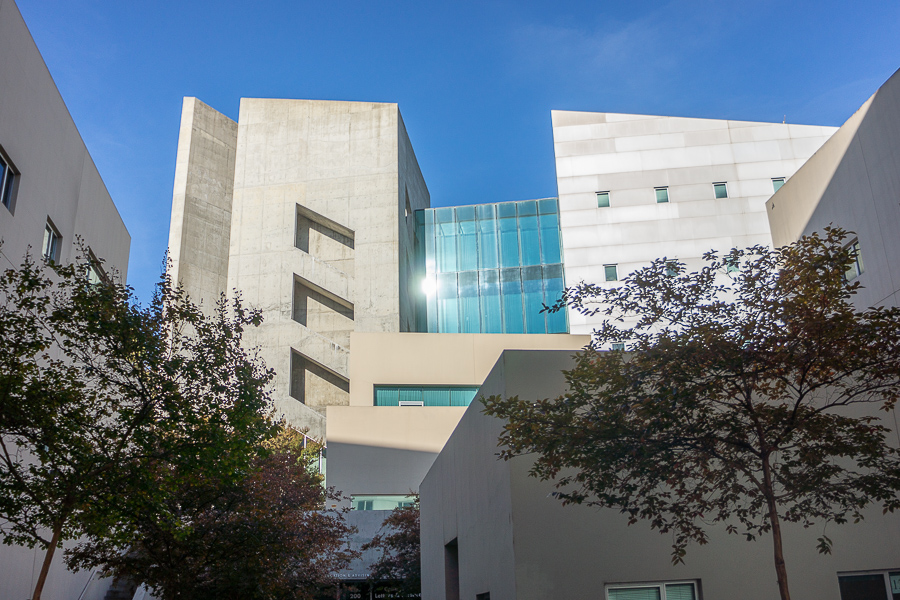
The Social Sciences and Humanities Building is perhaps the more obvious example of an unusual building structure on campus. More commonly known as “The Death Star”, students have reported numerous warnings about getting lost in the buildings complicated architecture.

According to the creator Antoine Predock’s website, the “forms of the facility suggest the geological forces that created the great Central Valley of California,”

While the building stands as a remarkable representation of the Central Valley, there is no doubt that newcomers should pay close attention when walking its halls.

“I was told that the Social Sciences and Humanities Building was built intricately, kind of like a maze, on purpose to set the whole building up as an experience so that you had to socialize with someone to find your way out of it,” said Nicole Chin, fourth-year psychology major.

She also advised that anyone who is new to The Death Star should probably get to know the building when the sun is still out.

“Battling The Death Star can be spooky at night, especially if you get lost,” Chin said.

The Art Building contains many displays of artwork ranging from paintings, portraits, sculptures and more. However, there is one particularly unusual sculpture that lurks on the staircase leading toward the roof. This staircase goes up to the fourth floor of the Art Building, but it doesn’t stop there. If you continue to venture one more flight up the staircase, you’ll find a latched door that opens upward onto the roof.

The staircase that leads to this latched door is marked with many cryptic messages and graffiti, but the thing that stands out the most is the life-sized sculpture of a “triangle-man” pointing toward the flight of stairs. It is almost as if the sculpture is asking you to look at the graffiti or go up the staircase. Written in big, blocky writing on the steps of the staircase is the phrase, “Nowhere Is Safe Everything Will Be Used Against Us”.

Unusual places like these can be found scattered throughout campus. UC Davis has a long history due to its unique beginnings, starting as an agricultural extension and morphing into its own campus, and each building has its own unique story.

“There’s still so many places I’ve heard about that I need to check out on campus,” Hernandez said. “There’s all these rooms and buildings that spook people, but I still haven’t found someone who knows a 100 percent true explanation for them.”

Written by SIERRA BURGUENO — features@theaggie.org


Chocolate galore!

JEREMY DANG / AGGIE

Davis Odd Fellows’ third annual Davis Chocolate Festival to help send children to summer camp

Chocolate lovers are in for a treat, as the Davis Odd Fellows is holding its third annual Davis Chocolate Festival as a fundraiser to cover summer camp costs for underprivileged kids. The festival will take place on Sunday, Nov. 4 from 3 to 6 p.m. in the Odd Fellows Hall in downtown Davis.

The Davis Odd Fellows Lodge is a fraternal order that “emphasizes active community support as well as social activities for members, in addition to the historical traditions,” according to their website.

Kurt Roggli, the co-chair of the Davis Chocolate Festival, has been an Odd Fellows member for about eight years. He helps organize the Davis Chocolate Festival with Dave Rosenberg, who was the former grand master of the Davis Odd Fellows.

“Chocolate is something that everybody likes — we thought this would be a great idea to indulge on our delights with chocolate and get people to come,” Roggli said. “Most of these Odd Fellows events try to raise money for a good cause, and one of the causes that Odd Fellows is involved in is sending needy kids in town to camp to give them something to do.”

Julie Roggli, the co-chair of the Davis Chocolate Festival, is helping her husband coordinate this year’s festival. She elaborated on the types of vendors and demonstrations that will be present at the festival.

“It’s all things chocolate — we’ve got seven vendors coming who will all have samples of chocolates from their stores, and they’ll also be selling chocolate,” Julie Roggli said. “We got a chocolate fountain, which will have cake and fruit, which people can dip with. We will also have a caterer that will be there and will have chocolate-filled sweet and savory crepes. We have a bar with chocolate infused drinks. There’s also music by According to Bazooka, a local group. […] we have a cupcake-decorating demonstration, and we have a chocolate-dipping demonstration. It’s two floors of everything you can think of with chocolate.”

The entry fee is $7, and vendors will give out free samples. Although people have to buy from the vendors if they want to take chocolate home from the festival, Kurt Roggli mentioned that people will still be able to get their fill of chocolate from the samples provided.

“We will also have crepes available for sale,” Kurt Roggli said. “The chocolate popcorn will be given away. The chocolate fountain will be free. If people come, they’ll probably get their fill of free chocolate, but if they want to take stuff home, then they’ll have the opportunity to buy some. The money that we’re collecting as the entry fee is what helps us send kids to camp.”

Julie Roggli explained that their goal for this festival is primarily to raise money to send kids to summer camp.

“The proceeds to this will go to the Davis Odd Fellows encampment, which helps with underprivileged kids for summer camp,” Julie Roggli said. “This is the third year we’ve done this.”

Kurt Roggli mentioned that he looks forward to the cookie bake off the most, as this will be a new demonstration.

“In the past, we had music. This year, we will have music with a good band, but the thing I am looking forward to the most is the bake-off,” Kurt Roggli said. “Maybe 25 people in town will put in their chocolate cookies that they make and we have judges like the Chancellor of UC Davis. They will be making final judgements about which cookies will be the best.”

The judges for the bake off include UC Davis Chancellor Gary May, food columnist Shelley Dunning and former Assemblywoman Helen Thomson.

In addition to the bake-off, Jennifer Schmidt, the owner of Davis Creamery, will give out ice cream and chocolate samples.

“We plan on serving different kinds of custom made chocolate ice cream,” Schmidt said. “We will be doing our regular chocolate, and we do a Mexican chocolate.”

Kurt Roggli believes the event will be successful.

“I think if people come, they’ll have a really good time,” Kurt Roggli said. “There are demonstrations, music, free food — what more can you want?”


Written by: Stella Tran — city@theaggie.org

Two Cemeteries

TRACI MCCLUNG / COURTESY

Part four of a continuing series about experiences on an archeological dig in Poland

Backpacks on, students of the Slavia Foundation’s field school trekked through the farmer’s field in Poland. For a total of six weeks, excavations would be continuing on a cleared piece of land that had been used as a cemetery twice before becoming farmland.

The site, Drawsko 1, had both Bronze Age (IV and V Period) cremated burials and Early Modern (16th-18th c) burials. Although the burials are easy to tell apart, as the cremated remains were in urns and the later burials were in coffins, everything had been mixed up. Stumbling into urns while digging for a coffin was common.

“But for me, the most interesting thing is that, you know, the same place was chosen by people during the Lusatian age and many years later, or a thousand years later,” said Tomasz Michalik, one of the archeology instructors for the Salvia Foundation. “And what is interesting for me is that what they [16-18th century people] thought when they were digging and found this pottery.”

During the Bronze Age in Poland, the Lusatian culture dominated the landscape. To bury their dead, people would burn the remains, cremating them. Then the burnt skeletons, which fragmented into small pieces, would be placed in a ceramic jar and buried. Often grave goods, like little jars and pots, were placed around the ceramic urns. Due to the cremation practices at the time, the remains were in pieces, as opposed to ash.

“It was cool because you could pretty much fit all of the bones in there [the urns] and there were still pretty big fragments,” said Lucia Valerio, an archaeology student. “So you can figure out if like the head was put in first or the feet.”

A thousand years later, the ancient graveyard was lost, and people in the 17th and 18th centuries used the area as a graveyard. When they buried their dead, the Bronze Age urns were found but were ignored or destroyed.

“We have one writing from 15th century, and this historian said that there was one village in Poland and that you can find growing pots on the soil,” said Maciej Gembicki, another archaeology instructor. “You can just gather whole pots from the soil in this magical land. Or they just thought that this is old pots, like garbage. It’s hard to say because we cannot reach these people and ask them.”

People in the 17th and 18th centuries used coffins to bury their dead in this area of Poland. It is not known what people of this time thought of the urns they found, however, during the excavation of the site it was not uncommon to find destroyed urns or pots on top of the coffin burials. This can be confusing at first, for things that are older are supposed to be found deeper in the ground than more recent items.

“The reason that we sometimes find urns inside of graves is that the people from the 17th century just dug a hole into these graves from Lusatian culture,” Gembicki said. “So they dig into and remove everything, and then they put in some skeleton, with a coffin of course, and they used the soil, mixed with pots, to fill the grave. Inside the graves everything is really mixed up, so you can find Lusatian graves, 17th century pottery, or other stuff.”

As time passed, the graveyard was forgotten. Before the accidental discovery of human remains in the early 20th century, farmers planted soybeans there. To this date, over 500 coffin burials have been removed from the site. Estimating the number of Bronze Age burials has been rather difficult, for they often just appear as small pieces of pottery.


Written by: Rachel Paul— science@theaggie.org


Aggies take down Causeway rivals

OLIVIA KOTLAREK / AGGIE

UC Davis men’s soccer claims eighth straight Big West playoff berth

In a test of resolve against a gritty Sacramento State Hornets side, the UC Davis men’s soccer team came out victorious in a causeway matchup to close out regular season play, as other Big West opponents jockeyed for playoff positions in the conference.

This season’s finale decided the fate of both teams. The Aggies advanced to the Big West tournament while the Hornets’ season ended on Saturday. With the win, the Aggies finished fifth in the Big West and booked a trip south to battle CSU Northridge on Wednesday.

“That was a playoff game and everybody kind of knows it,” said Head Coach Dwayne Shaffer. “And my players responded well, the whole week we were excited about a game, it felt nice to get a week off.”

The first time these teams played this season was an exhibition match at Aggie Stadium at the end of September in which senior defender Justin Wright broke through the Hornet backline to knock in a goal, snapping a 1-1 tie in overtime.

Although no team found the back of the net in the first half on Saturday, tensions ran high as four yellow cards were issued. Three of these cards were given to UC Davis, including one for the team, and one for Sac State. The Aggies fired off 10 shots to the Hornet’s five.

Senior midfielder Brian Quintero was injured in the first half and was unable to play after the seven minute mark.

At the 17-minute mark, Hornets forward Benji Kikanovic was run down by Aggie redshirt senior defender Roy Boateng on a breakaway opportunity. Kikanovic suffered an injury on the play, making him unable to play for the first half and part of the second half. Sac State appeared to take issue with the fact that no foul was called, as officials had to call a trainer to the field to tend to the injured Kikanovic.

The Aggies pushed on regardless and struck quickly in the second half.

They started off from the left side of midfield then crossed over to the right as the Aggies set up their attack. A pass to the center from Wright gave freshman midfielder Connor Tipton an easy look at the goal, Tipton’s quick reflexes in the box put the Aggies up 1-0.

Following the score, the Aggie midfield and backline managed to suppress the Hornet attack. Near the game’s end, a tussle nearly turned into a brawl as the Aggie backline and Hornet attackers collided.

All told, the Aggies took five shots on goal while the Hornets took four.

“I love coming over here to Sac State, the games are always really competitive,” Shaffer said. “I’m excited and happy for the team, now we get to compete for our goal, which is to win a Big West title and get into the NCAA tournament.”

Update:

The Aggies ended the Matadors’ season on Wednesday and advanced to the semifinals of the Big West tournament, 3-2. UC Davis put nine shots while CSUN fired off 11.

After a relatively even first half, the teams were tied at one. In the second half, an Aggie counterattack had the Matadors struggling to clear the ball and ended up gifting the Aggies with an own goal, making it 2-1.

Wright then broke through defenders on the right side and knocked the ball past CSUN’s goalkeeper high and to the left to give the Aggies some extra cushion, 3-1. The Matadors pressued the Aggie defenders and answered back when CSUN forward Johnny Rodriguez weaved through the backline and scored, 3-2.

UC Davis was able to thwart the Matadors aggressive last ditch efforts. CSUN found the back of the net in an attack in the 85th minute, but the goal was waved off because CSUN’s attacker was called offside.  

The Aggies postseason run will continue, as UC Davis is set to face UC Irvine at Anteater Stadium on Saturday. Kickoff is at 7 p.m.  


Written by: Bobby John — sports@theaggie.org


Field hockey looks to bounce back as conference tournament arrives

IAN JONES / AGGIE

Aggies fall 3-0 in regular season finale, focus shifts to upcoming tournament

The UC Davis field hockey team lost its regular season finale to visiting Stanford by a final score of 3-0 on Wednesday afternoon, pushing its overall record to 6-12. The Aggies, who went winless in league play, will now advance to the America East Championship Tournament, held at Stanford, for a date with Albany on Nov. 1 at 3:30 p.m.

On Wednesday, the Aggies fought hard against a tough Stanford side that holds a spotless 5-0 record in conference play. UC Davis had multiple opportunities to get on the scoreboard in the first half. Junior forward Lauren Gengarella nearly ended the Aggies’ four-game scoring drought on the first shot of the game, but the ball struck the left post and carried out of bounds. With under 10 minutes remaining before halftime, sophomore midfielder Madison Theodore fired a backhand shot that flew just wide to the right. The Aggies tallied three more shot attempts in the second half and even had a pair of corners early on, but the team failed to capitalize on the opportunities.

“Stanford is strong, powerful and experienced, while we’re still a young team,” said UC Davis Head Coach Britt Broady. “We’ve been inconsistent in our general play. Some games we are outstanding and in other games we’re slightly off in our timing and connection. Today, we absolutely brought it and took it to them. I’m really proud of the performance.”

The Cardinal jumped out to a quick lead with a goal in the ninth minute, as three attackers crowded in front of the UC Davis net and managed to slip the ball through junior goalkeeper Chelsea Bigelow.

Early in the second half, the visitors added a pair of goals in the span of two minutes to push the lead to 3-0. Both plays involved a long cross coming from the outside to an open attacker in front of the goal.

“There were two really unfortunate goals,” Broady said. “Who knows if we would’ve had video referral, if they would actually be goals or not.”

Overall, Broady was encouraged by the effort from her team on Wednesday and has reason to believe that they will put up a strong fight with everything on the line next week.

“If we come out with that kind of performance and connection, then it’s going to be a game and a battle,” Broady said.

Despite what the team’s record may indicate, it has been a season of growth and progression for the Aggies, a squad filled with 17 underclassmen.

“We’re trying to take it game by game, rather than looking at the season as a whole,” Broady said. “If we play that way, we’ll put ourselves in a position to win no matter who we’re playing.”


Written by: Brendan Ogburn — sports@theaggie.org


How Davis Celebrates Día de los Muertos

ALLYSON KO / AGGIE

What the holiday means to Davis students and faculty

As the air gets chillier and leaves start changing color, Davis students are buzzing with excitement for upcoming holidays and festivities. Between frantic party searching for Halloween night and gorging on mashed potatoes and stuffing on Thanksgiving, Latinx cultures will be celebrating Día de los Muertos, the Day of the Dead.

From Oct. 31 to Nov. 2, Día de los Muertos will be celebrated not only in its origin country of Mexico, but all around the world. Although the holiday’s traditions differ depending on where it’s being celebrated, the overall purpose of the holiday is to honor the memory of deceased family members and loved ones.

Many people within the Davis community will be taking part in Día de los Muertos festivities. Because it is such a widely celebrated holiday, its meaning and significance tends to be different for everyone.

The Director of the Chicanx and Latinx Academic Student Success Center at UC Davis, Cirilo Cortez, said that the holiday is a celebration of life.

“It’s a time to reflect, a time to celebrate the passing of those we loved, and a time to remember,” Cortez said.

While this holiday may center around death, Cortez stressed that the gatherings are full of joy and happiness. Families join together to recall happy, humorous, or tender memories of their loved ones, as well as to honor their passage into the afterlife.

“It can be sad passing away and it is. But I think [the holiday is] almost a celebration of new life,” Cortez stated.

Cortez described the traditions he has with his own family. When at home in Mexico, he cooks specific foods and makes drinks that the deceased family members enjoyed during their time on earth.

“We embrace family,” Cortez explained. “We get together, eat dinner. A time to reflect. [The whole celebration is] really family oriented.”

Luis Mendoza, a second-year undeclared life sciences major, discussed his family’s way of celebrating the holiday. In Northern Mexico, where he grew up, his family would put up a picture of a deceased family member and place their favorite foods around it along with the calaveras (decorated sugar skulls). Once the decorations were set up, Mendoza’s family gathered, regaled in fond memories and made tributes to their loved ones who had passed.

“You make like an altar and then you put like religious figures, pray to them, put their favorite foods … just like remember them for who they were,” Mendoza said.   

Remembrance is an important theme for this holiday. Mendoza explained how putting up altars, often referred to as “ofrendas,” and recounting old stories is meant to preserve the life of the deceased person within the hearts of their family and friends.

“You know the saying, you die twice? First when you actually die, then when they stop saying your name? This is the way of keeping that name alive,” Mendoza said.

For fourth-year psychology and Spanish major Andrea Ramirez, the holiday serves as a way to keep family traditions alive.

“For me, it’s a celebration that takes me back to my roots in Mexico,” Ramirez said. “My family and I migrated here when I was around seven years old or so. So most of what I know and my culture has been through my parents and what I’ve learned through them and each time I visit Mexico.”

By celebrating the lives of her ancestors who lived in Mexico, Andrea is able to stay connected to her Mexican heritage and identity. Ramirez and her family begin decorating an altar around Oct. 28, which is when they start to celebrate the holiday. On Nov. 2, she gathers with family and friends and celebrates the lives of her loved ones.

“We have very typical food or traditional food,” Ramirez said. “We have like bread, the favorite drinks of the people we’re celebrating. Flowers are very traditional as well.”

For students on campus who wish to celebrate among their peers, there is a student event on Nov. 1 from 6 to 8 p.m. The Department of Spanish and Portuguese will be hosting a Dia de los Muertos event in Sproul Hall. The event will include poetry readings and art exhibitions. They will also be serving horchata, a traditional Mexican drink, and other traditional food.


Written by: Alyssa Ilsley — arts@theaggie.org


Prospective senators: read before you run

CAITLYN SAMPLEY / AGGIE

Expectations of ASUCD Senate candidates

As ASUCD election season gets underway and prospective senators begin campaigning, the Editorial Board feels that it’s important that candidates understand what is expected of them.

First and foremost, Senate candidates should demonstrate a comprehensive knowledge of what ASUCD is and what their role in it would entail. In previous years, some candidates showed little to no understanding of the role that Senate plays in governing the campus, could not articulate the responsibilities of a senator and struggled to name even one ASUCD unit. Lacking basic knowledge of the job indicates either poor planning, apathy or sheer arrogance, none of which are qualities we want to see in our elected representatives.

Candidates have frequently struggled with the ASUCD budget, a worrying trend when one considers the millions of dollars that these candidates hope to control. We expect candidates to not only know what ASUCD’s annual operating budget is but also where the money comes from, how it’s spent, who it’s spent by and who makes those decisions. Candidates who cannot show that they will be informed and thoughtful custodians of student money should not expect student votes or support.

Candidates must demonstrate that they have good policies, not just good politics. They should not only have concrete, actionable ideas to attack the problems facing the campus and community but should know how to execute such ideas. We expect that candidates understand how to author and introduce legislation. We likewise expect senators to actually pass legislation to get things done — endless resolutions and statements aren’t replacements for legislation.

It’s become almost a cliché to say that ASUCD is toxic, but given the bickering, infighting, immaturity and pettiness that have plagued ASUCD for some time now, senators must expect to be held to a high standard of behavior. They should be ready to work, not engage in antics that make the Senate table look juvenile. Candidates should have attended Senate meetings to see how they’re run and should have a working knowledge of Robert’s Rules of Order. Senate meetings shouldn’t devolve into chaos because elected representatives don’t know the basic points of parliamentary procedure.

Finally, Senate is a body of elected representatives and, as such, we expect Senate candidates to be firmly committed to representing the needs and wishes of the student body. Candidates who run on a single-issue platform or with the goal of accomplishing a pet project are generally unsuccessful, as are candidates who commit to no issues at all in a misguided effort to please all of the people all of the time.

The strongest candidates will have a comprehensive platform of policies that will materially improve the lives of their constituents, a strong working knowledge of Senate procedures and a firm commitment to the responsibilities of elected office. Multiple incomplete terms have shown that being an ASUCD senator is not an easy undertaking and not a responsibility that should be taken lightly. It is the Editorial Board’s sincere hope that the coming election presents a pool of strong, qualified candidates.

Written by: The Editorial Board

Student leaders botch response to anti-Semitism once again

CAITLYN SAMPLEY / AGGIE

Refusing to call anti-Semitism what it is does disservice to Jewish community

The horrific shooting at a Pittsburgh synagogue over the weekend that left 11 Jewish individuals dead is an abhorrent anti-Semitic attack. The event and responses to it make it painfully evident that anti-Semitism is not a thing of the past.

The rate of anti-Semitic incidents in the U.S. is the highest it’s been in over two decades, according to the Anti-Defamation League. The fliers posted by neo-Nazis throughout campus and the swastikas drawn at Arroyo Park just two weeks ago are proof that the Davis community is not immune.

In the wake of these localized incidents, it is pertinent that Jewish students in our community feel supported by campus leaders and peers. Actions by student leaders in ASUCD, however, have made it apparent that anti-Semitism has yet to be widely recognized for what it is: a real and ever-increasing form of hate, worthy and deserving of attention.

At last week’s Senate meeting, Senate Resolution #2, which specifically condemned the anti-Semitic fliers posted around campus and denounced anti-Semitism, should have passed with little to no discussion.

While all members of the Senate table were in favor of the resolution, debate ensued over whether the resolution should add a clause to acknowledge all forms of discrimination faced by all religious minorities. In favor of effectively generalizing the resolution was the chair of the Ethnic and Cultural Affairs Commission chair and two student senators who ran on the BASED slate — two groups that have made it a priority to represent and uplift the voices of marginalized communities.

It is the Editorial Board’s strong belief that explicitly condemning a specific form of targeted discrimination does not erase the experiences of other marginalized and oppressed minorities. It’s disconcerting that some student leaders within ASUCD appear to think a resolution specifically regarding anti-Semitism must also denounce all forms of religious-based discrimination.

“De-Judaization” is a technical term to describe highly problematic efforts to de-emphasize and generalize textbook examples of anti-Semitic attacks as ones of broader “religious discrimination” instead of discrimination against the Jewish community. This kind of generalization works to erase the reality of anti-Semitism.

The anti-Semitic fliers posted around campus had Stars of David drawn across the foreheads of Jewish politicians and swastikas were drawn on the sidewalk in a Davis park.

Let’s call it for what it is: this was not an attack on all religious minorities, but an attack specifically meant to inspire hatred of Jews and fear in Jews.

Just two weeks ago, the Editorial Board criticized university officials and student leaders from ECAC for their well-intentioned but inadequate responses to the fliers. Since that time, the chancellor and other administrators have met with leaders from Jewish student organizations after they placed pressure on the administration to bring a meaningful change into fruition. Now, university leaders have made concrete plans to move forward and address anti-Semitism on campus.

Public officials who have made it their mission to be a voice for marginalized communities are not immune to criticism. When Jews talk about their experiences with anti-Semitism, don’t listen to speak — listen to learn. Now is the time to act thoughtfully and in solidarity with and support of the Jewish community.

Written by: The Editorial Board

Celebrating Día de los Muertos

0

Unwrapping the cultural significance of the Mexican holiday

Autumn signifies different things for different people. For some, the coming of fall and the changing of leaves represents growth and progress. For others, the season symbolizes comfort and warmth. For many people from the Chicanx/Latinx community, autumn is a time of remembrance. Día de los Muertos, a Mexican holiday celebrated on the first and second of November, entails the act of honoring the dead through various traditions and rituals. For the Mexican people, Día de los Muertos signifies the celebration of love and light for those who have passed away.

Día de los Muertos originated with the Aztec and the Toltec people thousands of years ago, but today it is celebrated by Hispanic people all over the world. The holiday is characterized by lively cultural traditions.

“Día de los Muertos […] is a celebration of the dead, primarily in Mexico, but other Latin American countries and even the United States have incorporated this into their culture,” said Julietta Zubia, third-year Spanish major and current historian for the campus organization, Chicanx-Latinx in Health Education. “There are lots of things that happen [during the holiday], like festivals and parades. Ultimately, it is a celebration of the people in your life that have passed away, so you go to the cemetery and you give ofrendas, which means offerings — things like food and toys and candy.”

The holiday is also celebrated by members of the Chicanx Latinx community here in Davis. In an effort to bring this essential aspect of Chicanx Latinx culture to the Davis community, the Center for Chicanx Latinx Academic Student Success (CCLASS) took measures to ensure that students have accessible means to celebrate the holiday.

“I know that here at the Chi-Lat center we have an alter set up so that students can come and bring the pictures of their loved ones,” said Sheccid Torres, a second-year biological sciences major, member of Chicanx-Latinx in Health Education and student assistant for CCLASS. “We already have it set up with the flowers and the candles, so students just bring in their pictures. It’s a good way to keep that tradition going, even here when you’re in school.”

Día de los Muertos, because of its close time proximity to Halloween, has often been lumped together with the more commercial holiday — some even go so far as to label the sacred Mexican holiday as a “Mexican version of Halloween,” completely disregarding the cultural significance and important implications that it holds for the Chicanx Latinx community. In recent years, it has become common to see the Catrina (skull) face makeup, which is commonly associated with Día de los Muertos, being used as a Halloween costume. This has raised a broader question surrounding cultural appropriation and how certain behaviors like this perpetuate a culture of intolerance.

“When people not of color do [the Catrina makeup], and they do it for Halloween, it’s cultural appropriation because they’re not taking into consideration the cultural background of it,” Zubia said. “It has become commercialized, and people are forgetting the real meaning of it.”

Torres believes that ignorance stands at the root of the problem and is to blame for the propagation of cultural appropriation that is so prominent in today’s society.

“I think that it stems from, for lack of a better word, ignorance,” Torres said. “It is important to spread awareness on what [the holiday] is and what it means to the population. I think it’s important for other people who aren’t in the [Chicanx Latinx] community to respect that.”

Anabelle Garza, UC Davis alumna and former member of Hermanas Unidas de UC Davis, believes that other cultures’ adaptations of Mexican traditions show growth within the Chicanx Latinx community. But according to Garza, this only holds true if both sides have a mutual understanding of the traditions being shared.

“Despite that we continue to be a minority, I think we have thrived in keeping our

cultural traditions alive,” Garza said. “I think when Americans do things such as put on the face

makeup, it should be a symbol of our growth as a Chicanx Latinx community — it shows

how far the Chicanx Latinx community has come with its traditional influences. People are adopting the culture’s elements because it’s different and it’s easy to popularize. But, if a tradition is going to be shared interculturally, it should be mutually understood.”

Torres feels that society can move forward to combat cultural appropriation by being mindful of the communities that will be directly impacted by the appropriation and by educating oneself on different cultures and how to respect them.

“We are in an institution where we have so much knowledge at our hands — being at Davis, there are so many classes that do shed light on different cultures,” Torres said. “It’s really important to take the time to become familiar with these, because the world isn’t just one single person. There are so many cultures out there, and I think it’s important to have at least somewhat of a background knowledge on where each person comes from.”


Written by: Emily Nguyen — features@theaggie.org


“Humanizing Deportation” exhibition showcases firsthand account of deportation

TREVOR GOODMAN / AGGIE

Multimedia exhibition featured at International House until November

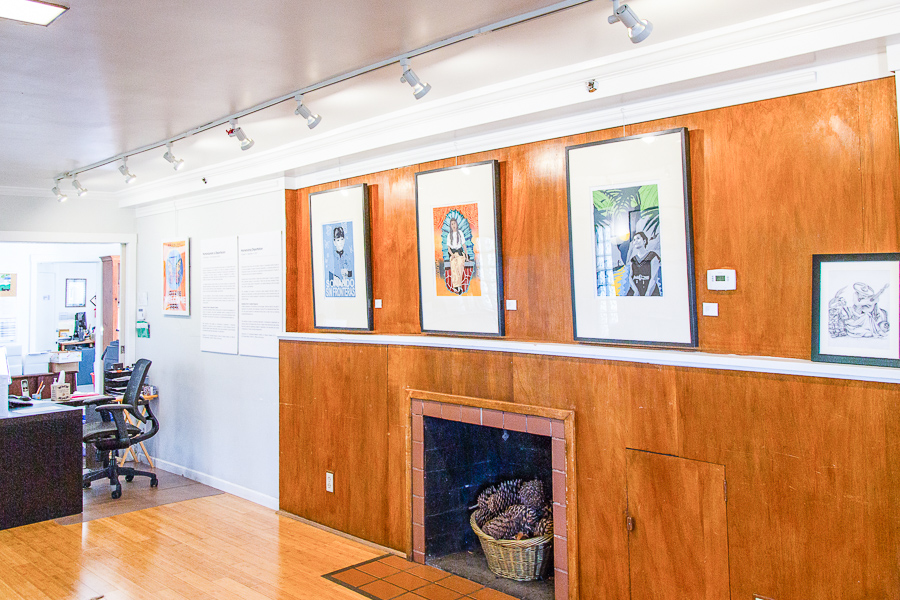
Until Nov. 6, the walls of the International House will be adorned with portraits of deported immigrants, videos of their stories and silkscreens. Stories of deportation across the border are being showcased as part of their “Humanizing Deportation” multimedia exhibit. The exhibition is a collaboration with the project of the same name.

The project “Humanizing Deportation” is an online collection of firsthand accounts that illustrate the experience of the deportation process. It began as a response to “a lack of firsthand knowledge regarding the experience of deportation and removal,” according to the project’s website. The stories are each five-to-10 minute videos that serve to give deportation a face.

Humanizing Deportation received its original funding in early 2016, and the first group of storytellers were trained in Nov. 2016. The training occured a week after the presidential elections, which, according to Project Coordinator Robert Irwin, had left a significant dilemma surrounding the future of immigration.

“Those of us who had signed up for the project — whatever ideas we had in mind, what kind of problematic things were happening — suddenly became much more grave and serious after the elections happened,” Irwin said. “We were all kinda shaken up by that. To spend that next week in Tijuana was pretty devastating.”

The research team was comprised of graduate students who have worked in different parts of Mexico, according to Sarah Hart, a member of the research team. They created stories that chronicled the experiences of people in cities across Mexico, including Tijuana, Juárez and Guadalajara.

Each story was recorded and transposed onto a photo-video presentation.

“[The stories are] very meaningful for the participants to see themselves, to hear their voice represented in the words that they want to use,” Hart said. “Many times, people are represented in negative ways or through statistics or in ways that they have no control over, so [the project is] trying to create a ‘do it yourself’ way for people to tell their stories.”

According to Hart, the accessibility of the videos stems from how simple it is to share them. Anyone with a phone or computer can access the videos and share them. Rijin Sahakian, the executive director for the International House, explained how when she came in last year, she was interested in doing an event on deportation because it was an issue that was prevalent in Davis and the surrounding areas. She reached out to Irwin in hopes of doing an iteration of the online archive as an exhibition.

“I definitely wanted to do something around this issue because it was an issue that was affecting a lot of people in our communities — [and it was] an issue that people were talking about — but also one that is very resonant with our community,” Sahakian said.

The exhibition includes programming throughout the course of its run, including a workshop on how to be a legal observer. The International House exhibition is also collaborating with the silkscreen studio Taller Arte de Nuevo Amanecer.

The exhibition is part of an ongoing mission of the International House to spread experiences surrounding issues that affect both our community and those around the globe. The International House will host a second part to this event in the spring, in which they’ll showcase responses to this exhibit from local artists.

“What we’re really trying to do is provide experiences that really engage people, connect people, that work with a global framework and address the fact that most of us have ties with different countries, with different cities, with different areas,” Sahakian said. “We want space to explore that and to tell our stories, in an engaging and interesting way, that’s really what we’re trying to do here at I-House.”

Irwin hopes that the viewers of the exhibit will become curious and spend time going through the collection and looking at more videos. He wants people to learn through these first-hand perspectives.

“Many of them are very moving because they’re [about] people talking about their lives and the things they’ve gone through, suffered and in many cases how they’ve overcome,” Irwin said. “They’re really moving wonderful stories.”

More information on the exhibition can be found on the International House website.

Written by: Hannan Waliullah – city@theaggie.org

Is #TimeUp for professional sports?

0
OLIVIA KOTLAREK / AGGIE

Professional sports continues to grapple with the #MeToo movement

On Oct. 7, Pittsburgh Steelers quarterback Ben Roethlisberger was met with cheers as he led his team to a decisive 41-17 victory over the Atlanta Falcons. In baseball, New York Mets infielder Jose Reyes was recently nominated for the Marvin Miller Man of the Year award, an award which commends players for their contributions on and off the field. Over in Europe, where soccer is king, Cristiano Ronaldo was praised by Juventus manager Max Allegri for his cool composure going into his first season with the club. Back in March, retired NBA superstar Kobe Bryant received his first Oscar for his animated short, “Dear Basketball,” as he prepared to debut his new ESPN program “Detail.” Former NBA star Isiah Thomas still works for NBATV.

In wake of movements such as #MeToo and #TimesUp, professional sports is yet to see the widespread fallout that Hollywood experienced at its onset. Of the aforementioned men, all of whom have received allegations of everything from domestic abuse to sexual harassment and assault, none have experienced the same downfall as have high-profile entertainers such as Bill Cosby, Louis CK or Kevin Spacey.

Former Baltimore Ravens running back, Ray Rice, briefly put a harsh spotlight on professional sports when a video of him assaulting his fiancé in an elevator forced the sporting world to rethink how it handles the gendered mistreatment of women.

As both a sports reporter for ThinkProgress and a co-host of “Burn It All Down” (which brands itself as “The Feminist Podcast You Need”), Lindsay Gibbs has covered cases like these. While she has seen some progress from the leagues with regards to how they handle issues of gendered violence, harassment and mistreatment, she has said that there’s a long way left to go.

“Gendered violence in sports has been a big topic in sports since the Ray Rice domestic violence case in 2014,” Gibbs said. “Since then, many leagues — especially the NFL and MLB — have reworked their policies and enhanced discussion about abusers. But there is still a huge prominence of the narrative that this is all just a “witch hunt,” and women are just lying to get revenge or money from men. And excuses are still regularly made for abusers”

With every new case of alleged mistreatment, many of the same tactics are used by both the fans and media to let accused abusers off the hook. The legal situations of the aforementioned men varied. Only Thomas was found culpable inside the court of law, after a lawsuit against the New York Knicks found Thomas, owner James Dolan and the organization responsible for a toxic work environment.

Roethlisberger, who was accused of rape by two separate women in 2009 and 2010, settled one case out of court, while the anonymous accuser in the second case chose not to file charges, citing a fear of how the fallout of such a public case might affect her.

Manning never faced criminal charges, but his accuser, Dr. Jamie Naughright, claimed that in 1996, Manning made sexually explicit contact with her in the locker room. Naughright filed a defamation suit against Manning after he spoke of the incident in a book.

Reyes had his charges of domestic violence dropped. Ronaldo, who was recently accused of a 2009 rape inside the Palms Casino in Las Vegas, denied the allegations, but continues to play while they are being investigated. According to Gibbs, Juventus’ lack of immediate action does nothing to appease the problem.

“It’s absolutely terrible,” Gibbs said. “It shows they don’t take violence against women (or sexual violence of any kind) seriously, and that talent wins out. The best thing to do when there are serious allegations is to sit the player while the investigation plays out […] There need to be processes in place for every team and sport to take accusations seriously and do investigations. And punishment and rehabilitation services need to be available, for the victim and the abuser.”

With many cases never reaching court, some will say that judging unproven accusations deprives these athletes the due process which they are owed. Others choose to ignore them all together.

This is, perhaps, the greatest problem that Gibbs sees in high-profile situations such as these.

“Everyone has to make their own decisions,” Gibbs said. “But it’s incredibly sad how many refuse to speak out, especially against Kobe.”

In 2003, Bryant was accused of rape by a 19-year-old worker at a hotel in Colorado. In the ensuing months, Bryant’s legal team attacked the accuser’s reputation, including details of her sexual history and stating her name despite the fact that she requested anonymity.

While Bryant’s reputation took a hit, including the loss of many lucrative endorsement deals, he was also praised by the media for appearing on the basketball court the same day that he appeared in court in Colorado. The case was eventually dropped when the accuser refused to testify.

The two parties settled out of court and Bryant issued an apology which confirmed the possibility of some perceived misconduct.

“I recognize now that she did not and does not view this incident the same way I did.”

Last year, the Lakers honored Kobe by retiring both 8 and 24, the numbers he wore during his career. Lakers owner Jeanie Buss also announced that the team will immortalize him with a statue in front of Staples Center in Los Angeles.

While much of this may seem bleak for fans who want more direct steps to be taken, all hope is not lost. Gibbs cited the recent conviction of Larry Nassar as a step in the right direction.

Nassar was convicted and will serve up to 175 years in prison for multiple counts of sexual abuse, after several dozen gymnasts, among them several high-profile Olympians, came forward and spoke out against his crimes.

However, there is still much to do be done, and it starts with holding people accountable.

“Journalists and fans have to keep holding this [sic] institutions and individuals accountable,” Gibbs said. “That’s the only way change will happen.”

Sports is often seen as an escape. People go to games, cheer for their teams and against their rivals to get away from the problems of the world around them. However, once sports becomes a means by which society ignores its biggest problems, change needs to happen. While certain steps have been implemented to ensure that change will come, the sports world — fans, players, coaches, owners and the media — must do better with the problems that are already in its lap.


Written by: Bradley Geiser — sports@theaggie.org


Reports from chancellor’s three task forces released

JEREMY DANG / AGGIE

Questions over whether recommendations on housing, food insecurity, mental health care are sufficient

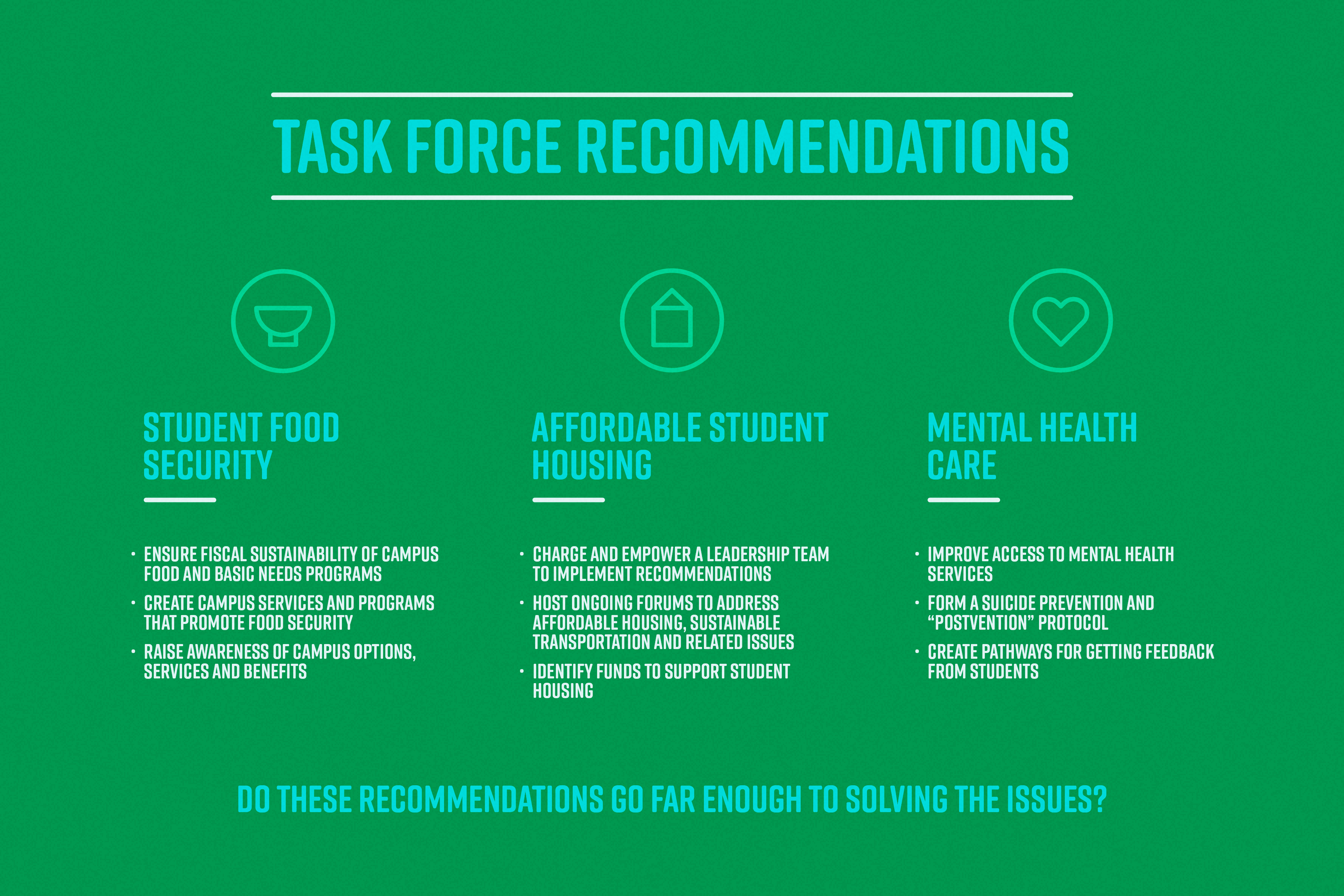
In response to vocal student concerns, Chancellor Gary May convened three task forces on student food security, mental health care and affordable student housing last spring. Each of the task forces recently released recommendations for improvement.

May asked each of the task forces to “review existing programs and options within its assigned topic area, consider improvements and make recommendations,” according to the UC Davis website. The university has now released the findings of each task force, as well as the university’s response to these recommendations.

Recommendations from the mental health task force included lowering the non-clinician workload given to clinicians, bolstering the staff that works at the university and setting up long-term hiring plans and cultural competency training.

The student food security task force recommended ensuring the long-term sustainability of on-campus resources, creating programs that promote food security, raising awareness about existing resources and advocating for related policies at the university, state and federal level.

Lastly, the affordable student housing task force recommended planning a forum with the City of Davis and university to discuss housing needs, identifying funds to support housing and monitoring housing trends.

In an official university response, May referred to these recommendations as “potential solutions that can be implemented in a reasonable period of time.”

Katrina Manrique, a fourth-year English major and the co-director of the Mental Health Initiative, served on the mental health task force. According to Manrique, UC Davis was too dismissive of the task force’s findings and recommendations, failing to specify its response to Manrique’s recommendations.

“Personally speaking, I am dissatisfied with the university’s response to our recommendations,” Manrique said via email. “I felt like the response was informational, however they lacked the specificity and depth that I had hoped for. There was a lot of mention about how SHCS and Student Affairs are currently assessing everything, however there was no specific say as to how they will follow up with students once they’ve assessed everything.”

Manrique said she thinks the university needs to focus more on transparency.

“There was no detail as to when they will finish assessing the quality of their services or how specifically they intend to communicate their assessments when finalized,” Manrique said. “How will we begin to know the results of their assessments or their next steps? Students are again being left out in the process and timing of these decisions. Students need to be absolutely aware of the changes and assessments that administration conducts.”

In Winter Quarter of last year, a contentious mental health town hall was held in response to a series of articles published in The California Aggie which exposed a leaked internal audit stating the university had spent $250,000 of student fees meant for the hiring of general counselors in a questionable manner.

After the publication of the article, the university released the audit and a second audit on student fees in their entirety.

As Co-Director of the Mental Health Initiative, Manrique occupies a unique position as a student with prior knowledge of the issues in Student Health and Counseling Services.

Manrique also referenced the 12 counselors UC Davis had planned to hire with student fees over the course of a four year period to bring the university in line with minimum student-to-staff ratios. The university has not hired these counselors. To Manrique, offering options like peer help and phone lines may be helpful, but the most crucial need is long-term clinician service.

“When I entered the Task Force, one of the things that I wanted recognized within the petition was the audit,” Manrique wrote. “In my opinion, the audit showed the inconsistencies between the promises of Student Affairs and Student Health and Counseling Services. It shows that the mental health fee, a fee which came from students, was being utilized for other needs in different departments which was contrary to their initial promise of hiring 12 counselors.”

Students deserve long term care, Manrique said, “not short term solutions.”

“[This] is why the recommendations emphasizes the need and prioritization of more counselors,” she said.

One of Manrique’s recommendations was to “establish and publicize a long-term hiring plan to ensure that Counseling Services meets the needs of a growing student population.” Other recommendations focused on increasing Community Advising Network (CAN) counseling and promoting cultural awareness.

Kauser Adenwala, a second-year political science major and external vice president of the Muslim Student Association, felt that the administration’s response to the three task forces was lacking.

“These are imminent challenges and must be attended to immediately,” Adenwala said.

Ellie White, a graduate student in the Center for Watershed Sciences at UC Davis, said the university should be directly helping disadvantaged students more, rather than simply validating students grievances.

“A structural way of solving the problem of houselessness is giving people the means to afford their rent,” White wrote. “As far as students who are not employed by the UC (i.e., a vast number of undergraduates), a “bold new plan” would be to provide housing for free.”

On the topic of food insecurity, White complimented the notes that that the task force made, but challenged them to question why students are food insecure in the first place.

So far the solutions I see are ‘educate and feed people free food’,” White said. “I love both these recommendations. They just don’t go far enough to get at the structural issues. Why do people experience food insecurity? Would you be food insecure if you have $1,000/month to spend on food and had time and knew how to cook nutritious meals? […] We need solutions that stop people becoming food insecure in the first place.”


Written by: Aaron Liss — campus@theaggie.org


Review: Insomnia Cookies

ZOË REINHARDT / AGGIE

New, late-night cookie delivery doesn’t disappoint

The city of Davis, notorious for quieting down by 9 p.m., has been gifted with Insomnia Cookies, a cookie shop which is open until 3 a.m., seven days a week. The Davis location opened its doors on Oct. 1 and is the company’s first store in California.

Insomnia Cookies, which was created in a dorm room at the University of Pennsylvania in 2003, now has over one hundred stores across the United States. Located in the heart of downtown Davis, Insomnia Cookies offers a selection of cookies, ice cream, brownies, cookie cakes and milk that are sure to satisfy any sweet tooth.

The cookies are served warm and practically melt in your mouth. I ordered one of the Deluxe cookies, which are significantly larger than the traditional offerings. I paired my chocolate peanut butter cup cookie with a bottle of cold milk, a classic combo. Combining Reese’s peanut butter cups with a cookie made for the perfect ratio of gooey, chocolatey goodness to alleviate my midterm season stress.

The “Cookiewich” is also a must-try. It is great for those who like to customize their dessert. Any flavor of ice cream can be sandwiched by your choice of cookies and satisfies any sugar craving.

Quite the intimate setting, the store has a modern, youthful feel. What Insomnia Cookies lacks in seating, it makes up for with its delivery service: the company delivers warm cookies right to your dorm or apartment. Ordering is made simple through the Insomnia Cookies website, making it easy to satisfy those late-night munchies. Delivery is available until 3 a.m., which is perfect for long nights of studying (or partying), or if you’re just not feeling up to maneuvering through the crowds of cyclists and increasingly horrific downtown traffic.

While Insomnia Cookies definitely has competition in Davis in the form of other cookie and ice cream shops, the company’s late hours and unique delivery approach appeal to college students and families alike. During the sleepless nights of midterms and finals, Insomnia Cookies is a welcome study break.


Written by: Cheyenne Wiseman – arts@theaggie.org


Police Logs

SHEREEN LEE / AGGIE

Squirrels: Friends or foes?

October 10

“Ongoing problem with transient / Currently urinating on the building. Employee requesting 602 and contact to see about further action.”

“Squirrel inside residence.”


October 11

“Subject came to reporting party’s door and stated he was in a contest and needed to contact 1200 people.”


October 12

“Transient male has been in restroom for approximately 25 mins, requested he be removed.”


October 13

“RP’s daughter states that her parents are next door to a residence that has 30-50 marijuana plants in the backyard say she is concerned for her parents due to the numerous coming and goings — grow lights on at night — homeowner has been put in a residential facility and her grandson is now living in the home — plants came be viewed from backyard of reporting party’s home — daughter lives out of town.”


October 16

“Reporting party and husband stayed in the hotel over the weekend and during the night they heard voices from an adjacent room and smelled sulfur. Both and reporting party and husband now think there was a meth lab.”

“On-going issue with tennant, X has a history of mental health illness and has been turning on all of the water in the parking lot causing flooding. X has also taken Comcast pods.”

“Heard only group of subjects outside yelling like having fun, then heard a big truck back into reporting party’s roommates parked vehicle, damage to vehicle.”