55.1 F
Davis

Davis, California

Saturday, December 20, 2025
Home Blog Page 491

America’s myth of “pulling yourself up by your bootstraps”

0
BRIAN LANDRY / AGGIE FILE

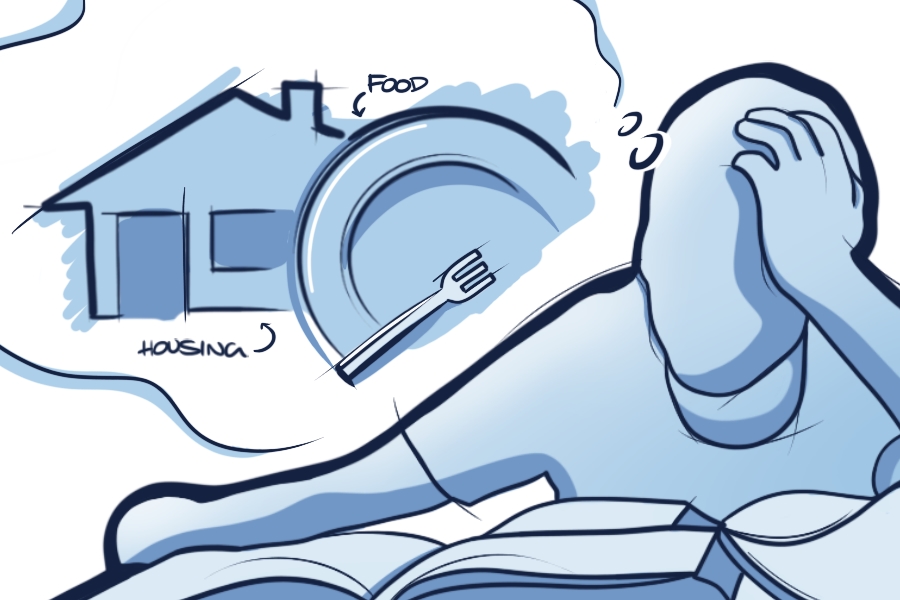
Rising cost of higher education has sent students into extreme debt

The United States has long been known as the land of opportunity, the place where any individual can form their own rags-to-riches story. While this isn’t necessarily untrue today, it’s definitely more difficult as we’ve progressed into a knowledge-based economy — where a high school diploma is no longer enough to secure employment.

In August of 2017, the unemployment rate was 2.4 percent for college graduates and 5.4 percent for high school graduates. It’s important to note that the number of people included in the labor force statistics has declined, as those with bachelor’s degrees are greatly underemployed, with many relying on internships. Student debt in the U.S. has more than doubled in the past decade — throwing in rising tuition costs and a stagnant median household income makes college campuses increasingly defined by socioeconomic status.

A popular mentality in the United States, established by the country’s notoriety as the land of opportunity, is that one should be able to “pull themselves up by the bootstraps.” No assistance, no handouts — it’s on the individual to make something of themselves. This is an argument commonly heard when discussing welfare or affordable education costs. And while pulling oneself up from the bootstraps was feasible then and now, the United States’  knowledge-based economy — in conjunction with a static median per capita income, rising tuition costs and increased student debt — has made obtaining a degree very expensive and subsequent “bootstrap pulling” that much more difficult.

Studies have shown that as family income rises, as do the chances of going to college. This has become problematic as college prices rise faster than the income levels of many Americans. It’s far more expensive for this generation of college students to attend school than it was for their parents. For the 1987-1988 school year (adjusted for inflation), students at public four-year institutions paid an average of $3,190. In 2017-18, that average rose to $9,970 — a 213 percent increase. The average tuition for a private nonprofit four-year institution was $15,160; 30 years later, that average is $34,740 — a 129 percent increase. The amount of student debt in the U.S. has greatly increased in the past decade, rising from $600 billion to $1.5 trillion, the average debt being $30,100 per borrower with women holding the majority of the debt.

Middle class families are being squeezed out of financial aid, making college campuses more rigid in the socioeconomic diversity of the student body, with wealthy students who can afford tuition on one end and poor students who receive federal Pell Grants on the other. It’s important to note that Pell Grants go to families making less than $50,000 a year, with the maximum amount of money granted being $5,920. This may provide financial relief to lower income families, but it fails to protect them from debt and also excludes many middle class families who just miss the cut off.

When adjusted for inflation, the median per capita income has largely remained unchanged since 2000; the average American family also makes slightly less than they did 15 years ago. Albeit many products have become cheaper, the cost of some of the biggest expenditures of middle class families (housing, college tuition, and health care) has increased at a rate that significantly surpasses that of inflation. The average American simply cannot keep up anymore, with more and more college students finding themselves having to pay for tuition on their own.

Technological advances, globalization and financial deregulation have created an income inequality that we have yet to bounce back from. In fact, the gap is only growing. With this growth, and with the median per capita income remaining stagnant, universities are looking to higher income families for revenue, while cutting off many middle class Americans from financial aid.

This ultimately serves to widen the gap and make universities unreflective of the economic diversity of the United States. Affordable tuition isn’t a handout nor is it indicative of American laziness; it has become a basic tool necessary for employment and for supporting oneself or one’s family. Taking on tens of thousands of dollars in debt at 18 isn’t pulling oneself up by the bootstraps — it’s financial risk, one that many don’t pay off for several decades after graduating. Graduates simply don’t make enough annual income to pay back their loans. Not everyone wants to take on debt before they’ve started their independent lives. Those who choose to pass on accumulating debt by not pursuing higher education tend to make less and are often times perceived as “less than” by degree holders. The current state of higher education institutions is set up to make affording tuition difficult and leave loans as the only answer, thereby perpetuating a cycle of student loan debt while further squeezing out middle class families. Education is becoming a more elusive tool to obtain in order to pull oneself up by the bootstraps. If we expect people to use education in this way, we should allow them to have an education in the first place.    

Universities are becoming money-making industries, and student loans pay the bills. If middle class (and poor class) families continue to suffer, income inequality will only fester and perhaps, one day, we’ll hit bottom. Similar to basic needs like access to clean water, the government may need to help make access to higher education more affordable.  


Written by: Hanadi Jordan — hajordan@ucdavis.edu

Sac Republic upset in home postseason match

0
KAELYN TUERMER LEE / AGGIE

Sacramento’s USL club loses 2-1 to Swope Park Rangers

Sacramento’s local soccer club, Sacramento Republic FC, hosted the first round of the USL Western Conference playoffs Saturday night, as the team took on seventh-seeded Swope Park Rangers.

In front of a crowd in attendance at Papa Murphy’s Park, the game opened with both sides vying for control. In the first 10 minutes, possession stood around 50-50.

It didn’t take much longer for the game to open up, as Sac Republic recorded the night’s first real challenge at goal. Midfielder Keven Aleman fired in a hard-hit shot from the top of the 18 that was knocked wide of goal by Swope Park goalkeeper Eric Dick.

The shot from Aleman seemed to awaken his squad. Sac Republic began to control possession and press forward following the attempt and finally broke through just a few minutes later.

In the 16th minute, midfielder Villyan Bijev capitalized off an errant Swope Park clearance, slotting the ball into the lower left corner of the net to put Sac Republic on top 1-0. The goal could not have been scored without the hustle of Sac Republic defender Shannon Gomez, who ran down a ball that appeared to have been rolling out of bounds near the left corner. Gomez made a diving slide to kick the ball back inside, across the Swope Park goal and ultimately forced the awkward attempt at clearance by a Swope Park defender and allowed the ball to fall at Bijev’s feet.

The early breakthrough understandably sent the fans into a frenzy, as Sac Republic did not let the foot off the gas pedal just yet. Two minutes following the goal, midfielder Jure Matjasic wasted no time, attacking Swope Park with a rocket shot from the right side that required an athletic save from Dick to stop the ball from going in.

The home team continued to hold possession and threatened to score again in the wake of the first goal, but Swope Park quickly found a way to counter Sac Republic’s aggression and quiet the crowd.

After Sac Republic failed to properly clear a Swope Park corner, midfielder Wan Kuzain found himself in possession of the ball inside Sac Republic’s 18-yard box. Kuzain danced through a couple of defenders and sent in a shot that narrowly beat Republic goalkeeper Josh Cohen to the near post, leveling the game at 1 a-piece.

“I saw the play forming — I know they worked for that, that’s their bread and butter,” Cohen said. “But it was opening up and we didn’t have the time to react to respond and so I tried to attract the ball as much as I could, saw it as it came around our defense. And the guy did well — he put it hard and low in the corner.”

Less than five minutes later, Swope Park struck again, this time off a well-placed shot from forward Hadji Barry. His teammate, midfielder Rassambak Akhmatov, sprinted along the right touchline and slid in a cross to the trailing Barry, who sat all alone behind the Republic defenders. Barry took a first-time touch and buried the ball past Cohen to put the visitors up 2-1.

Sac Republic Head Coach, Simon Elliott, was critical of his team’s miscues that allowed Swope Park to steal the lead.

“We turned the ball over on bad spots,” Elliott said. “They tried to block us on one side and we turned it over and then we let them play right through us. The three-v-two at the back — there are numbers up at the back and somehow we conspire to get numbers down on our back four, which should never happen.”

Sac Republic and the home crowd were stunned, as the game’s momentum seemed to have taken a complete turn after Bijev’s goal. Swope Park took the 2-1 lead into halftime and ultimately held strong throughout the second half to secure the upset victory and send Sac Republic out of the postseason.

Sac Republic didn’t leave the pitch without a fight, however, as the team forced the ball forward in the second half. Several near misses on shot attempts and cross connections haunted the home side. Sac Republic threatened on multiple occasions, but could not quite crack the defensive-minded Swope Park squad.

On top of Sac Republic’s inability to find the back of the net for a second time, it appeared that Swope Park took advantage of several injuries and time-wasting tactics as the game drew close to ending. This lack of urgency by a team in the lead is not uncommon in soccer, but it still frustrated the home side.

“Yeah, they were definitely wasting time,” Cohen said. “It’s frustrating, and would I do the exact same thing in their shoes? The answer is yes.”

Cameron Iwasa, Sac Republic’s forward and leading goal-scorer, was bottled up for the entirety of the evening. The team’s inability to get Iwasa the ball in a quality position was another major source of frustration. Iwasa was visibly disappointed following the match, and blamed his team’s loss on a lack of execution. His coach agreed, explaining more in detail about what went wrong.

“I think we need to give Cameron the ball — I mean, we can’t just lump stuff up to him, you know, we need to have a little bit of patience, we need to be able to play through pressure, we need to be able to handle the ball under a little bit of pressure,” Elliott said. “It’s a thinking game at the end of the day, it’s not just all fire and blood and brimstone and passion and all that — you have to think your way through situations, and I thought they did a better job of that then we did tonight.”

This was obviously a disappointing ending to what was otherwise a fantastic regular season for Sac Republic. The team finished second in the USL’s Western Conference and, going into Saturday’s match, had not lost a game since Aug. 18. Despite a season full of positives, the first-round postseason loss negated most of what the team accomplished and hoped to accomplish going forward, according to Elliott.

“No [I’m not proud of the way we battled today], because it’s a playoff game and it needs to be better,” Elliott said. “I don’t care how well the season went or how badly the season went. When you’re in the playoffs, it’s a whole different game. If you’re not prepared to bring it, then sorry — it’s simply not good enough.”

A great regular season can turn into a nightmare postseason, and unfortunately for Sac Republic, this turned out to be the case.

Written by: Dominic Faria — sports@theaggie.org

The Syrian refugee crisis is part of a long-held anti-refugee sentiment in the U.S.

MSTYSLAV CHERNOV [CC BY-SA 4.0] / FLICKR
Americans fail to uphold the ideals of Lady Liberty

The Syrian refugee crisis, the largest refugee and displacement crisis since World War II, has displaced over 11 million people. Syrians fleeing violence are primarily being hosted by countries that do not have the resources to take care of them. Only a fraction of these 5.6 million refugees are likely to become permanently resettled, leading hundreds of thousands to Europe to file asylum claims there.

The efforts of the Trump administration to limit immigration and refugee admittance has resulted in dwindling numbers of Syrian refugees accepted into the United States. This coincides with a decline in the number of Americans who think the U.S. has a responsibility to take in refugees. Consequently, the U.S. has accepted a grand total of 11 Syrian refugees in 2018. This number — in conjunction with a sharp decline in refugees accepted from a multitude of countries — has put the U.S. on track to resettle the fewest number of refugees in 40 years.

        The Syrian Civil War has torn the social and economic fabrics binding citizens to community; hospitals, schools, historical landmarks, utilities and water and sanitation systems are damaged or otherwise destroyed. Ensuing chaos and violence resulted in mass displacement, leading Syrians to look to other countries for assistance, at times to no avail. A child who was 5 or 6 years old when the war started in 2012 would now be 12 years old and has likely never attended a single day of school.

        Under the Obama administration, the refugee admittance target was 110,000; within days of Trump’s inauguration, he cut that number by over half, accepting a record low of 45,000 — a number that also poses a stark variance to former president Ronald Reagan’s 200,000 refugee admittance cap.

Much of the rhetoric surrounding the anti-refugee argument is grounded in irrational fear. Politicians and citizens seem to believe that radical Muslims are most likely hiding among Syrian refugees in order to infiltrate the U.S. and carry out violence in the name of Islam. It’s important to note that since the establishment of the Refugee Act of 1980, no person accepted into the U.S. as a refugee has been implicated in a major fatal terrorist attack. The vetting process instituted by the Trump administration has not made Americans any more or less safe than the procedures in place during prior administrations; all it has effectively done is condemn refugees to live in inhumane and dangerous conditions in their home countries or refugee camps, further aggravating an already dire situation.

The inflammatory rhetoric of the Trump era is also corrosive. In an attempt to stoke anti-refugee sentiments, Trump and other Republicans have reduced and compared the Syrian people to a bag of Skittles. The basic concept goes like this: If you had a bag of Skittles, and one of them was poisoned, would you let your children eat it? No, so therefore we shouldn’t let refugees in, right?

Reducing millions of people to a candy that may or may not be poisoned is a talking point intended to instigate fear — and successfully so.

But what appears to be an anti-refugee wave spurred by the Trump administration is really just a larger trend of American skepticism toward refugees that has been in place since WWII. In the years leading up to WWII, many Americans were suspicious of Jews fleeing the Nazis and nearly three-quarters opposed admitting a larger number of Jewish refugees. While Americans were doling out their suspicions, Jews in Germany were being slaughtered en masse. A chronology of American attitudes toward refugees is truly heartbreaking:


1939 — a majority oppose taking in German Jewish refugee children

1975 — a majority fear Vietnamese refugees will take jobs

1993 — a majority disapprove of giving Haitian refugees asylum

2015 — a majority oppose accepting Syrian refugees


In theory, Americans do support admitting refugees. In a poll conducted by Vanity Fair in 2011, participants were asked if the inscription on the Statue of Liberty should apply to immigration; 62 percent said it should. As many studies show, however, this sentiment doesn’t translate well to specific crises or actual policy. Rather, the U.S. adopts this sentiment when it’s too late.

Jews in Germany could have attained asylum in the U.S. if not for rampant skepticism; as a result, Jewish people who could have been saved were instead killed. Consider exactly what that means — because of Americans’ irrational fear and racist attitudes toward Jews, more died in the Holocaust than otherwise would have. And while the U.S. fought a war in Vietnam for democratic purposes, Americans were not willing to accept refugees from a crisis to which they contributed.

President Donald Trump retaliated against Syrian President Bashar al-Assad’s chemical attacks and joint bombings by Britain and France because, according to Trump, “We’re talking about humanity. And it can’t be allowed to happen.” The juxtaposition of President Trump’s invocation of humanity in regards to these attacks and, in contrast, denying refugee admittance makes his response seem more like a publicity stunt rather than genuine concern.

Similarly, the theoretical support of refugees from Americans makes it seem as though they aspire to the ideals of Lady Liberty. However, a history of rejecting and fearing refugees proves that they fail to take action when it is most needed. It’s time that the U.S. actually lives up to its pledged ideals. We can become the country we have always aspired to be.   


Written by: Hanadi Jordan — hajordan@ucdavis.ed

Disclaimer: The views and opinions expressed by individual columnists belong to the columnists alone and do not necessarily indicate the views and opinions held by The California Aggie.

No blackface this Halloween — or ever

CAITLYN SAMPLEY / AGGIE

Using marginalized cultures for costumes perpetuates racial stereotypes

Earlier this week, Megyn Kelly, the host of “Megyn Kelly Today” on NBC, defended blackface during a conversation about Halloween costumes, claiming that it wasn’t racist. Kelly justified blackface by saying that, when she was a child, “that was okay, as long as you were dressing up as a character.” Yet, the history of blackface is deeply rooted in racism.

Blackface in America began as a form of theatrical makeup used by non-black performers in minstrel shows, which relied on racial stereotypes of African Americans and African American culture to entertain white audiences. Performers in blackface became caricatures of African Americans, dehumanizing them for comic effect. This practice was widespread until the 1960s Civil Rights Movement. Blackface was never okay and has always been a way for white people to mock a person of color’s identity.

Megyn Kelly, a white woman in a position of influence and privilege, shouldn’t be the arbiter of what is or isn’t racially offensive. By excusing the practice of blackface and cultural appropriation, Kelly lends her hand to the process of “othering” black people and has hurt and offended millions of Americans.

Despite rumors about contract negotiations, no one has yet to officially confirm Megyn Kelly’s departure from NBC. The Editorial Board encourages NBC to take a strong stand against her comments.

Kelly’s comments are not an isolated incident. In Oct. 2015, members of the Sigma Phi Epsilon fraternity at UCLA hosted a “Kanye Western” themed party, in which women of the exchanging sorority, Alpha Phi, donned blackface in order to dress as the rapper Kanye West and exhibited racial stereotypes through their costumes. Earlier this year in April, members of the Lambda Chi Alpha fraternity at Cal Poly, San Luis Obispo, posted photos of themselves throwing gang signs with one member in blackface. The California Attorney General stated that the actions of the fraternity members were protected by the First Amendment, but this does not excuse the inherently racist and hurtful practice of cultural appropriation.

With Halloween approaching, it’s important to remember to not pick a costume that disenfranchises minorities and appropriates different cultures. When minority cultures and cultures of color are co-opted and turned into cheap costumes, it erases both the value and identity of millions of people, as well as hundreds of years of oppression and marginalization. When members of marginalized communities still face discrimination for their cultures, traditional garb or hairstyles, any appropriation of that culture is a direct affront to the struggles that minorities have faced and continue to face every day in America.

There is no excuse for continuing to perpetuate racial stereotypes about black people and other marginalized communities. Appropriating a culture for the sake of a Halloween costume is unequivocally racist. Don’t do it.

Written by: The Editorial Board

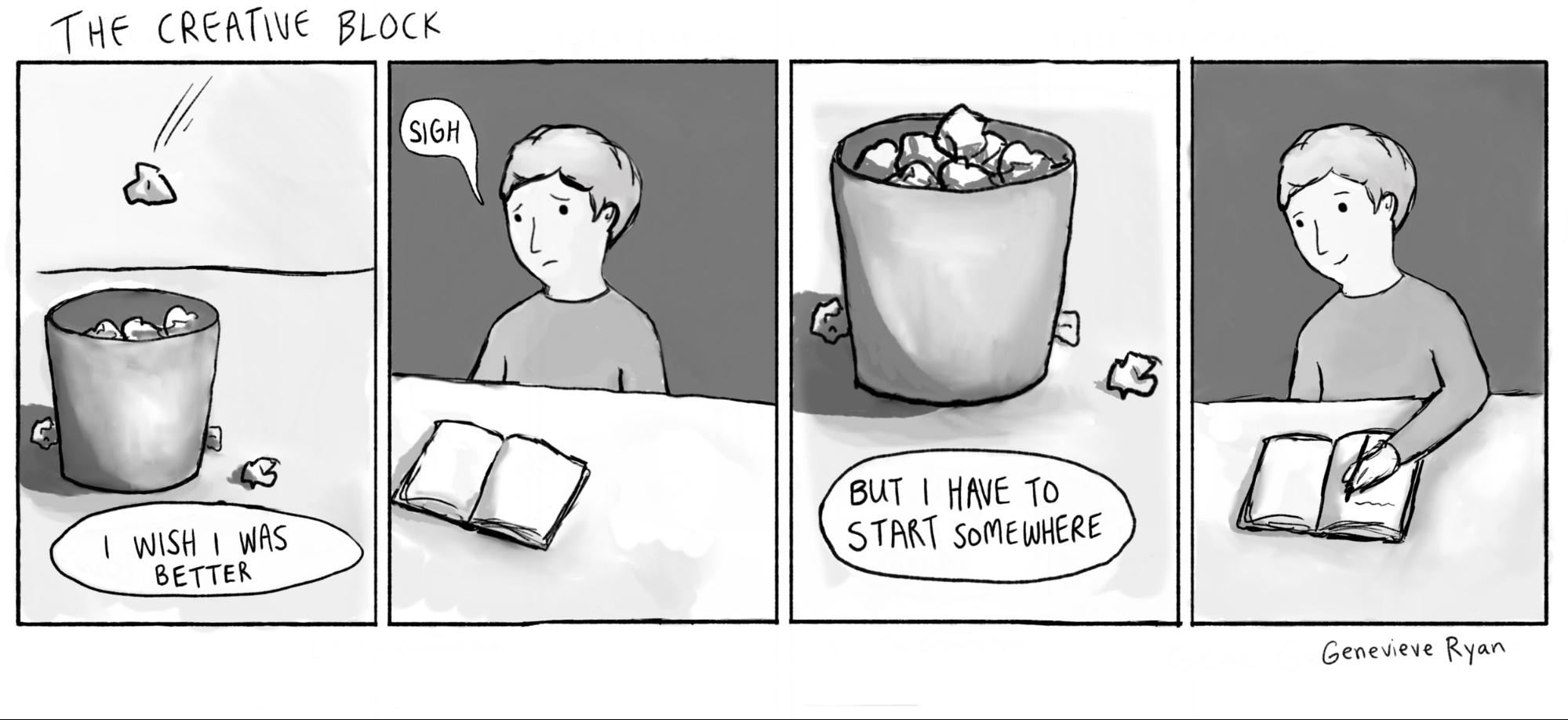
Cartoon: The Creative Block

GENEVIEVE RYAN / AGGIE

By GENEVIEVE RYAN — geryan@ucdavis.edu


Shaping your bones

TRACI MCCLUNG / COURTESY

Part three of a continuing series about experiences on an archeological dig in Poland

Sold in nearly every store this time of year, fake skeletons are a staple Halloween decoration. Unsurprisingly, these decorations are not very anatomically accurate and commonly  leave out bones, fuse unrelated bones together and miss many other important features of our bones. Over our lifetime, our bones change shape and develop features that can be used to identify us.

This summer I participated in the Slavia Foundation’s archaeological field school. We

excavated both Bronze Age (IV and V Period) cremations and Early Modern (16th -18th century) inhumation burials. These inhumation burials included a coffin that was buried deep in the ground. Once the Early Modern burials were excavated, we examined the skeletons for features that would tell us more about them. For example, features on the pelvis (hips) and cranium (skull) can help determine the sex of an individual.

“I like looking at sex estimation because it is the easiest one, because you can look at the pelvis and specific cranial features,” said Tiffany Loera, a student at the field school. “Also kid’s skeletons are interesting because they don’t have those features unless they hit puberty.”

As juveniles, our bones are not fully formed. When we grow older, many of our bones fuse, including those in our arms and legs. Interestingly enough, if juveniles contract a disease that affects bones, the effects of it can still be seen when they are adults.

“You can see rickets, that’s also a bowing of the tibia [leg bones bending, syphilis also does this], but there’s a way to tell the difference,” said Ashley Stewart the field osteologist.  “There’s this like line on the side, and if it bows it’s rickets, and if it’s straight it’s syphilis. You can see stuff that happened as a kid sometimes, but kids heal really well because their bones, we call it ‘green bone’, because they recover really quickly. So like if you break something as a kid and it sets well, you probably won’t notice.”

Certain skeletal parts can also be used to determine how healthy the person was. For example linear enamel hypoplasia, a condition in which teeth have bumps on them, usually indicates a poor diet or unfavorable environmental and living conditions.

“On the skeleton, you can see some parts of it, for example on the skull, you can see some marks which explain how somebody lived,” said Marta Gwizdala, the project osteologist. “For example, if there were good healthy conditions, if it was maybe not clean…about diet, some kinds of parasites.”

Those that do a lot of physical activity may have more ‘rough patches’ on their bones for muscles to attach. Other diseases such as arthritis, degenerative bone disease and tuberculosis can also be seen on skeletons. One fascinating albeit morbid area is exploring the effects of advanced diseases and trauma on bones.

At the field school, the most remarkable example of this was “skeleton number 39”. Somehow, this person endured trauma to their hip, which resulted in their upper leg bone completely fusing to the pelvis. Not only was their leg sticking straight out in an unmovable position but they lived for quite some time after this happened in 16th-18th century Poland.

“The femur and acetabulum are fused together,” said Victoria Swenson, the osteology instructor. “I want to X-ray it because I want to see what it looks like on the inside.”

Cemeteries such as the Drawsko One site are important for archeologists to understand the people who lived during that time. They can tell how healthy a population is, what diseases affected them and how old people were when they died. And for cases like skeleton 39, a paradox is created.

“It’s sad because we go ‘wow this person was so sick’ but then that goes into the osteological paradox… because you only get skeletal changes on things like that after a really long time,” Stewart said. “So it’s like that person had to be really healthy to make it that far, but they were also super sick so it’s like which is it?”


Written by: Rachel Paul— science@theaggie.org


Men’s water polo seeks improvement in midst of undefeated run

JULI PEREZ / AGGIE

Aggies win 26th straight league game, recognize need to clean up mistakes

The UC Davis men’s water polo team collected its fourth consecutive victory Friday afternoon with a 14-8 triumph over the Air Force Academy at Schaal Aquatics Center. The Aggies have yet to falter in league games, holding a 4-0 mark against Western Water Polo Association opponents and a 13-5 record overall. In fact, the team hasn’t dropped a conference game since October 2014, a winning streak of 26 games.

Despite racking up another victory, Child and Meisel Families Director of Men’s Water Polo Daniel Leyson was particularly frustrated with his team’s effort on Friday. The Aggies outplayed their opponent for a good portion of the afternoon, but allowed them to stick around and stay within striking distance due to some avoidable mistakes.

“It’s just very sloppy on our part and an inability to play in a controlled fashion that allows us to increase the score,” Leyson said. “We kept making stupid mistakes allowing them to score and that’s a really dangerous way to live.”

Nonetheless, Leyson recognized how well his team can perform when playing up to its full potential. The ultimate goal for the team would be a return to the NCAA tournament, where the Aggies advanced to the quarterfinal round last season.

“Our expectation is that we play much better,” Leyson said. “We have a good group and if we can bring it together at the end, we’ll be very, very strong. Today just wasn’t the level to which we aspire in this program and the guys know that.”

Senior attacker Marcus Anderson opened the scoring for the Aggies in the first quarter, firing a shot to the top-right corner of the net to make it 1-0. Just over a minute later, UC Davis cashed in on a powerplay opportunity, Anderson passed to freshman center Nir Gross who took advantage of an open look in front of the net. UC Davis piled on several more shot attempts before the end of the quarter, but came up empty.

The Aggies started the second quarter with a flurry of shots on target, but couldn’t find the back of the net again. The team finally broke through with a pair of powerplay goals by Anderson, two minutes apart, to push the lead to 4-0.

With three minutes left before halftime, Air Force got on the board by scoring on a penalty shot. Just before the break, UC Davis grabbed a pair of turnovers and turned each one into a goal on the other end thanks to junior attacker Yurii Hanley. Air Force managed to nab an even-strength score in between, but the Aggies still finished the half with a 6-2 lead.

Air Force quickly rattled off three straight scores in the first four minutes of the third quarter, suddenly making it a very close game at 6-5. UC Davis kept its composure and responded with a trio of scores in the following two minutes, with two coming from sophomore attacker Jack Stafford and another from Anderson. The teams traded goals in the final two minutes of the quarter to make it a 10-6 game.

UC Davis put the game away with four more goals in the fourth quarter, including two from sophomore utility Kyle Reilly and a fifth from Anderson, and held off a late comeback attempt by Air Force to take the 14-8 victory.

The Aggies have five more regular season games on the docket, including three within the league. UC Davis will look to win those games and finish undefeated in conference for the fourth straight season.


Written by: Brendan Ogburn — sports@theaggie.org


Flick or Treat

CAITLYN SAMPLEY / AGGIE

A list of Halloween movies that won’t disappoint

With the All Hallow’s Eve right around the corner, now is the perfect time to get in the spooky spirit by carving pumpkins, drinking apple cider and, of course, watching all of the following beloved Halloween classics.


“Hocus Pocus” (1993)


In my opinion, this is the best Halloween movie of all time. Bette Milder, Sarah Jessica Parker and Kathy Najimy never disappoint as the spooky and hilarious Sanderson sisters. “Hocus Pocus” follows the villainous Sanderson sisters, who were resurrected by Max Dennison in an effort to impress his crush in Salem, Massachusetts in the 1990s. The whole movie is a wild, entertaining ride as the witches adjust to the present, where Halloween is now a celebration. With its heartwarming end, the Sanderson sisters give us a perfect dose of witchiness.


“The Haunted Mansion” (2003)


You can never go wrong with a Disney classic. “The Haunted Mansion,” starring Eddie Murphy, is 90 minutes of silly, hilarious fun. Inspired by the Haunted Mansion ride at Disneyland, this movie has a love story, a creepy villain, the iconic Madame Leota and singing barbershop busts.


“It’s the Great Pumpkin, Charlie Brown” (1966)


An absolute classic, “It’s the Great Pumpkin, Charlie Brown” is a movie that will make the whole family smile. The Peanuts gang’s Halloween shenanigans will both warm your heart and provide some classic Halloween costume inspiration.  


The “Halloween Series,” “The Blair Witch Project” (1999) and “Children of the Corn” (1984)


I personally like to indulge in the sweeter side of Halloween, but if you align more with the spooky, I recommend these horror staples. The textbook definition of slasher horror, “Halloween” (1978) follows Michael Myers as he stalks Laurie Strode, who is played by Hollywood veteran Jamie Lee Curtis. The whole film is tense and will have you on the edge of your seat. “The Blair Witch Project” set in motion the found-footage aspect of horror and the unreliable first-person narrative. With this movie, it’s more what you can’t see that is frightening. “Children of the Corn” may be one of the worst Stephen King adaptations, but this 1984 cult favorite follows the hammy Malachai, known as  “He Who Walks Behind the Rows” as he gets the local children to ritually murder all of the adults in town. The whole movie, while not scary by 2018 standards, is still a must-see at least once in your life.


“Beetlejuice” (1988)

This early Tim Burton work is a staple of the season. The star-studded cast, which includes Alec Baldwin, Geena Davis, Michael Keaton, Winona Ryder and Catherine O’Hara, doesn’t disappoint. The movie is hilarious and does a fantastic job of making fun of the afterlife with its dark humor and just enough spookiness to raise your heartbeat a little. The soundtrack, which includes “The Banana Boat Song (Day-O)” by Harry Belafonte and “Jump In Line (Shake, Shake Senora)” by Danny Elfman, is undeniably one of the best parts of the movie.  


“The Shining” (1980)


Another Stephen King adaption to make this list, “The Shining” directed by Stanley Kubrick and starring Jack Nicholson is the perfect psychological thriller that will make you want to sleep with the lights on. While it may not have been King’s favorite adaptation, the deterioration of Jack Torrance’s sanity at the hands of evil supernatural forces will keep viewers’ eyes glued to the screen. This movie isn’t scary because of cheap shock effects, but rather because of the overall darkness and creepiness that inhabits the Overlook Hotel.

“Frankenstein” (1931)


It would be a shame to not include “Frankenstein” on this list. While this black-and-white classic may not be most people’s go-to choice for movie night, “Frankenstein” is arguably the most iconic horror flick of all time. It’s incredibly well written and its special effects haven’t stopped inspiring horror producers and directors.

Written by: Liz Jacobson – arts@theaggie.org

De-stress to impress: How to destress as a student

0
JAMIE CHEN / AGGIE

Tips to organize your life better to reduce stress levels

Transitioning into college or even just living up to the demands and reality of university life are often credited as being large stressors in the lives of young adults. Not only do students have to maintain their GPA’s, but they also feel obligated to maintain healthy, active social lives, all while trying to eat well and exercise regularly.

When it comes to managing stress levels, there are quite a few techniques that students say come in handy when they feel increasingly overwhelmed.

So when it comes to decreasing these newfound stress levels in students, there are two areas that are said to encourage relaxation and confidence in one’s schedule: physical health and mental health.

“I think finding a balance between school and self care is essential to one’s happiness,” said third-year art history major, Kennedy Field. “If one is not taking care of themselves mentally and physically, not only will they not perform to capacity scholastically, but they will probably find themselves amidst a mental health crisis. I find it sad that one of the things student neglect when they are overwhelmed is self care.”

Physical health is obtainable through campus resources such as the Activities and Recreation Center (ARC), as well as in apartment complex gyms or simple walks in the Arboretum, but students often feel that working out is difficult to fit into their schedules. When students are tired, it is difficult to push themselves to work out.

“I just feel uninspired to work out, mostly if my head feels congested, like there’s too many thoughts,” said second-year political science and English double major, Dylan Chicorel.

Even if you’re the kind of person who wakes up 10 minutes before class and eats Skittles for breakfast, there are still ways to incorporate these two facets of physical and mental health into your routine

“I manage my time by maintaining a schedule,” Chicorel said. “Sometimes things go awry and I have to improvise, which is frankly most of the time, however when managing my time and health, I’m just optimistic that everything will be alright.”

You don’t necessarily have to wake up at sunrise and run in the morning, but you could take some time during the day to blare out some tunes, put on those headphones and just run, walk or be active for 20 minutes. The Arboretum is a pretty scenic and popular spot for a lot of runners in the morning and evening.

“As much as I hate it, [running] but I feel like I just have to run when I’m stressed,“ said Jessica Chen UC Davis alumna. “It’s a pretty basic thing, nothing too phenomenal.”  

The ARC caters to students who wish to work out indoors or at night. It’s open till 12 a.m. most days and has equipment to get in a quick cardio workout.

“They [The ARC] have everything, and it’s a good place to work out,” said second-year wildlife and conservation biology major, Laura Poikonen. “My roommate and I planned to go there, but we literally went twice and that was pretty much it.”

Students often feel tempted by junk food during the school year, due to its low prices and accessibility. Consuming copious amounts of caffeine and sugar may give you momentary gratification, but it’s going to hit you later and end up making you more anxious. (And then you’ll stress about eating junk food in the first place, then stress about stressing. You know the drill.)

“I try to stay away from it [junk food] as much as possible,” Field said. “I guess the only types of junk food I eat are pastries, which I tend to eat when I am stressed or pmsing.”

Especially in stressful times like midterms or finals, it is suggested that students steer clear of excessive sugar and eat more healthy foods like whole grains, vegetables and fruits, etc. This may be a hard thing to do, especially when you have a whole buffet of tempting treats available at the Dining Commons. However, looking at what nutritional benefits are present in other food options will allow for a more balanced diet.

“You should know why you’re eating healthy in the first place, whether it is just a diet or a lifestyle,” said third-year biochemistry major, Nency Patel. “Giving in to cravings once in a while is important, otherwise it can throw you completely off track and you give up your goal entirely. So don’t go too harsh on yourself.”

Having some kind of emotional support, whether it is just being with your friends while you all sit in silence on your phones and scroll through Twitter, is also important in reducing stress. Just being in the presence of others can be greatly comforting for some students.

“For me, I am a social person and when I talk, it releases my stress,” Patel said. “I used to stress out a lot, but when I’m with my friends, that’s my time with them and it’s not gonna come back. Thinking about it [stress] is not going to help you in any way.”

Some students also find peace with animal companions by their sides.

“If you have a cat, pet them,” Field said.“Lay down on the grass, meditate or for me, what’s really de-stressing for me is going home and taking a walk and cooking is a big one too. And medicinal marijuana of course.”

Taking care of your mental health is just as important as physical health. An important question to ask yourself is: Am I getting enough time to myself where I’m not just sleeping or eating but practicing self-care through movies, music or a favorite food?

Sometimes, going a little off your schedule and doing something different can do the trick. Chicorel finds his relaxation through television, but also by maintaining an organized schedule.

“I manage stress with TV, but that’s not always around,” Chicorel said. “So my main method is organization of my priorities. By keeping track of my tasks at hand, I minimize future stress to be had.”

Managing stress levels all starts with tackling issues that you know can potentially stress you out. Managing time to achieve deadlines, meal-prepping and utilizing agendas are all tasks that UC Davis students use on a daily basis, but it’s also increasingly important to take time to relax and be with the people (or pets) that you love.


Written by: Rabiya Oberoi — features@theaggie.org


Humor: This Article is Offensive

JEREMY DANG / AGGIE

A detailed explanation of why this article is offensive on every possible level, and why you’re a horrible person if you aren’t deeply offended by it

If you haven’t already read this article, maybe you shouldn’t. Actually, you definitely shouldn’t. You probably wouldn’t be able to handle it.

In fact, I know you wouldn’t. You’re just too sensitive. Without me holding your hand, I don’t trust you to arrive at correct conclusions about the ideas in this problematic article on your own; at least not without expending inordinate amounts of energy toward critical thinking, which nobody should have to do.

I care passionately about protecting the emotional well-being of all my readers, not that I know any of you, if you even exist. Regardless of that, this is your last chance to stop reading if you don’t want to ruin your day, week, name, reputation and quite possibly your entire life. That was your final warning.

However, that was not a trigger warning, because none of the offensive statements made throughout this article include trigger warnings before them. Not even this one. See? Didn’t that bother you? Well, it should.

Additionally, this piece is not written in a way that you should be okay with. Even worse, I use language and terminology that should offend you, and if you aren’t culturally literate enough to understand why they are deeply offensive then f*ck you!

This article contains ideas that you may not want to expose yourself to. By reading this, one of three things could happen: it could offend you, it could change your opinions or worse, it could make them more nuanced.

I don’t actually know what any of your personal stances are on the vast array of issues discussed in this article, but I’m going to claim that I do. For this reason, I must inform you that this article crosses the line. I don’t know where you personally think the line is, I just know that in this article, I cross it. And which line is that? Any of them, all of them, it doesn’t even matter. It will offend you, and that should NOT happen, ever.

Maybe you aren’t offended yet. Maybe you even agree with some of what I’m saying. However, what would you think if I told you that other people who agree with these ideas are horrible people? You don’t want to be a horrible person, do you? Because if you agree with what I’m telling you to disagree with, then you are.

If you’re a good person with correct opinions about everything, like me, then hopefully you wouldn’t want to have any association whatsoever with horrible people. Being friends with horrible people is risky, because if horrible people influence you in any way, then you become a horrible person as well.

By encouraging you to not read what I have written, I am ensuring that your precious mind stays safe, guaranteeing that you remain sheltered within the intellectual equivalent of a padded room.

If your mind wandered outside and frolicked with any toxic, dirty and offensive ideas, please remember not to spread your intellectual germs. All employees must wash their hands before returning to work.


Written by: Benjamin Porter— bbporter@ucdavis.edu

(This article is humor and/or satire, and its content is purely fictional. The story and the names of “sources” are fictionalized.)

Candidate for state superintendent to sponsor student-authored legislation addressing college affordability

MICHAEL LEAHY / AGGIE

Assembly member Tony Thurmond plans to address student homelessness, decrease tuition if elected

Assembly member Tony Thurmond, who is running for California superintendent of public instruction, has committed to sponsoring student-authored legislation aimed at addressing college affordability. Thurmond held a media teleconference on Oct. 4 for student reporters in the California State University and University of California systems as well as a subsequent college affordability town hall at UC San Diego to speak directly with students throughout the state.

If elected superintendent — the highest elected education position in the state — Thurmond would serve on the CSU Board of Trustees and the UC Board of Regents. He has previously served in the assembly education committee, on the school board and city council and has worked as a social worker for 20 years.

During the teleconference for student reporters preceding the town hall at UCSD, Thurmond answered questions about his plans to address student homelessness, administrative bloat and decreasing tuition.

“It’s really unique for state leaders to take the opportunity to hear directly from students on what our needs are,” said Caroline Siegel-Singh, a UC San Diego student leader.  “I hope that in the future, folks in Sacramento can work on addressing the total cost of attendance and ensuring the basic needs of our campus communities are being met.”

The Aggie asked Thurmond about a recent article published by the San Francisco Chronicle, reporting that at the same time UC workers finally secured a 3 percent raise, a 3 percent raise will also be given to UC leaders — amounting to a $10,000 to $20,000 bonus for some administrators in certain cases.

“It’s outrageous, and I’ve said this directly to [Janet] Napolitano — you don’t cut people’s salaries and then give huge payments to administrators,” Thurmond said. “We’ve seen already what this kind of paying out of salaries has led to — UC squirreling away money that no one knew about, money that could have been used to fund critical programs for our students. I’m going to take the job as regent very seriously to make sure we work closely and every dollar is well spent and that it’s spent in the best interest of our students.”

Thurmond said he has worked closely with the American Federation of State, County and Municipal Employees 3299, which represents over 25,000 UC workers. One of AFSCME’s primary concerns is outsourcing, and Thurmond said he has written letters opposing outside contracting.

“The UC contracts out so many services that could be done in house and have a tremendous savings for the university,” Thurmond said. “As a legislator, I challenge UC leadership to end those practices. I’ve supported legislation that would ban this type of contracting out and I’ll continue to take that stance.”

On the issue of student homelessness, Thurmond said current data suggests 5 percent of UC students, 11 percent of CSU students and 25 percent of community college students are homeless.

“I’m open to all kinds of creative solutions, but I’m not willing to accept that we’re just going to tell our students, ‘You can just be homeless and hungry and that’s just the way it is,’” Thurmond said. “We’ve got to do better and we’ve got to create an environment that’s conducive to learning. When you’re worrying about where you’re going to rest your head, when you’re worrying about what you’re going to eat, that is not conducive to learning.”

Thurmond, a Temple University graduate, struggled to pay for food as a college student and said he has a personal relationship to issues that come with securing adequate financial aid.
On the topic of tuition, Thurmond said the $60 tuition decrease for the 2018-19 school year is not “something we can celebrate.” To further decrease tuition, he said there must be conversations about generating permanent revenue for higher education in the state.

Statistics presented at the town hall noted that state funding for higher education has declined from 18 to 12 percent of the state budget in the past 50 years.

“We need to provide direct dollars and help provide fellowships, scholarships, more financial aid, we need to look at how we work with the federal government so that students have to take out fewer loans,” Thurmond said. “And quite frankly, as superintendent, I intend to push back on Secretary DeVos and President Trump […] and say, ‘We should build an environment that protects our students from aggressive debt collectors.’”

Following the teleconference, Thurmond held a town hall with students and administrators from the UC, CSU and CCC system. Several days later, on Oct. 9, Thurmond announced plans to sponsor legislation “written by youth advocates, to address college affordability” in a press release sent by Thurmond’s campaign.

“Throughout my legislative career, I have introduced student-led bills and a few of them have been signed into law,” Thurmond said. “I believe that what’s important about being a trustee and a superintendent is listening to our students, and I intend to lead and govern that way. I believe we should be listening to students in that way.”

In the press release, Caroline Siegel-Singh, a student leader at UC San Diego, voiced support of the legislation.

“It’s really unique for state leaders to take the opportunity to hear directly from students on what our needs are,” said Caroline Siegel-Singh, UC San Diego student leader.  “I hope that in the future folks in Sacramento can work on addressing the total cost of attendance and ensuring the basic needs of our campus communities are being met.”


By: Lauren Tropio and Hannah Holzer — city@theaggie.org, campus@theaggie.org


Town hall focuses on UC Davis Police disarmament, militarization

KARIN HIGGINS / COURTESY

Training, hiring improvements sought as solution for disarmament

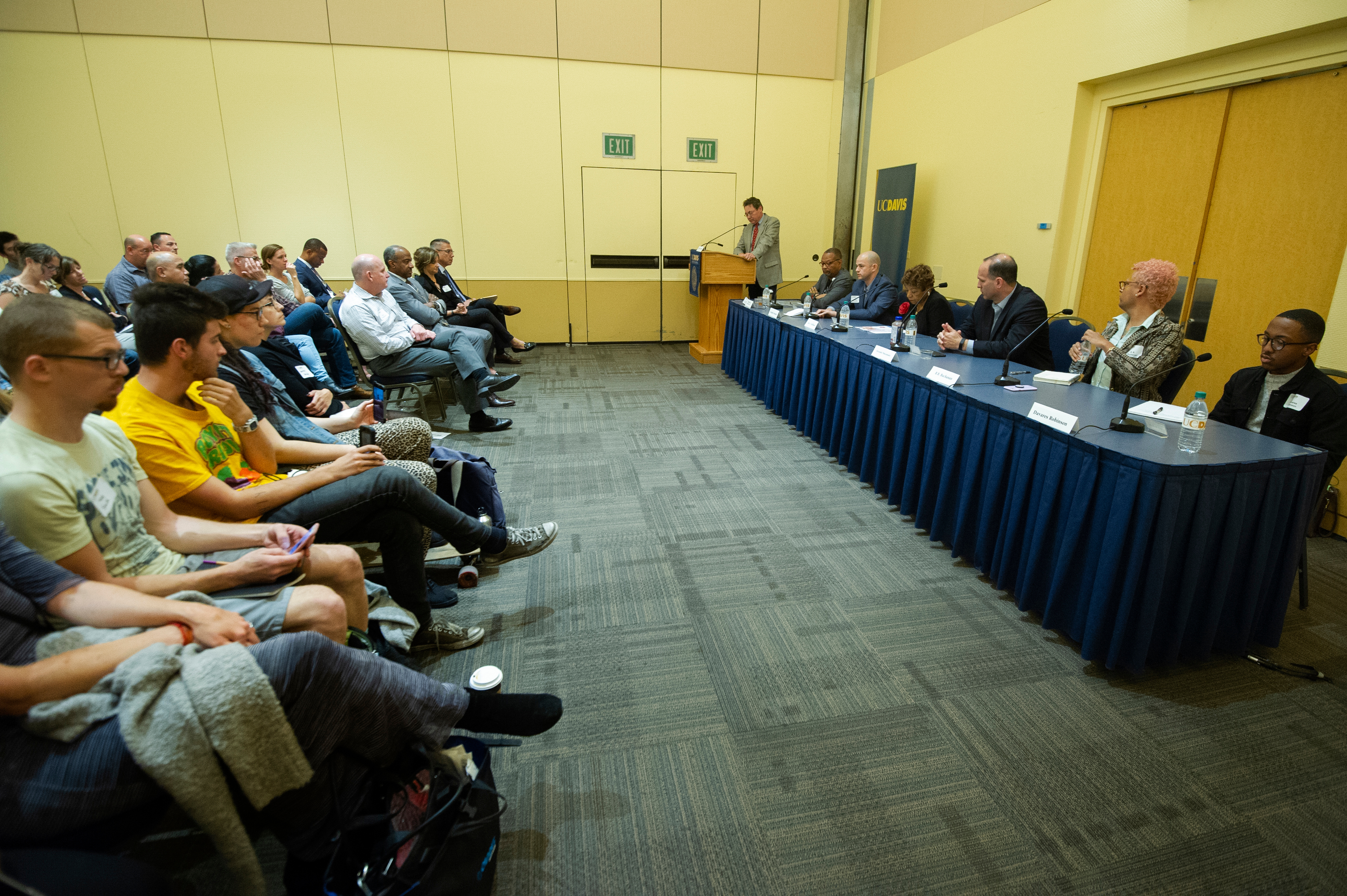
A town hall held on Oct. 15 in the Activities and Recreation Center Ballroom discussed a resolution forwarded by the UC Davis Graduate Student Association (GSA) to disarm UC Davis Police. The town hall was initiated by Chancellor Gary May after meeting with GSA members.

The discussion began with a proposal for the disarmament of the UC Davis police and later merged into the topic of police militarization.

On the discussion panel from UC Davis was B.B. Buchanan, a Ph.D. candidate in Sociology and Davares Robinson, a fourth-year political science major. Alex Bustamante, the chief compliance and audit officer for the University of California, Assemblymember Reginald Byron Jones-Sawyer Sr. (D-South Los Angeles), Alice A. Huffman, president of the California Hawaii National Association for the Advancement of Colored People and Woodland Mayor Enrique Fernandez were also present.

The panel was moderated by the UC Davis Law School Dean, Kevin Johnson.

Buchanan explained the GSA’s reasoning for demanding a disarming of campus police.

“The actual incidents in which police intervene in school shootings is relatively rare,” Buchanan said. “Shooting incidents happen relatively quickly.”

Instances of police intervention leading to use of deadly force were cited by Buchanan.

“Scout Schultz at Georgia [Tech] was killed by their campus police while having a mental health crisis,” Buchanan said. “We had a student at Portland State University who was also killed recently. […] The campus officers were not even indicted. These things happen and to argue that somehow we are safer with weapons, I think, is a fallacy.”

Buchanan also discussed the trend of arming police departments with military-grade weapons.

“We’ve seen the proliferation of militarized weaponry and equipment to respond to situations in which police are rarely intervening,” Buchanan said. “I really want to push back on this idea that police militarization equals safety. You can go in with great intentions, but the institution of policing can change what you are allowed to do.”

Huffman offered remarks on what she perceived as the balance between the handling of weapons by police and the preservation of safety within the UC Davis community.  

“I think you have to have the kind of police force on campus that respects students, respects individual rights [and] that really care about the diversity that we try to bring onto this campus,” Huffman said. “What I think you need on campus is what you are starting to get with this dialogue.”

Huffman emphasized that bringing military weapons on campus is, in her opinion, unnecessary.

“You certainly don’t need the kind of equipment that you are talking about,” she said. “We fought to get rid of all those tanks and things they are bringing into our community.”

On the other hand, Huffman said she believes that police need certain weapons to keep the campus community safe.

“You can’t tell people to protect you if you don’t give them the tools with which they need to protect you with,” she added.

Jones-Sawyer also spoke on the use of military weapons by the police.

“I can almost guarantee you bringing military vehicles on this campus is not something that is supported by anybody in this [current campus] administration right now,” Jones-Sawyer said. “Everytime I see legislation, it is going from people who want to eliminate military weapons all the way down to pepper spray. We are having that debate in the legislature right now.”

The need to train police officers was highlighted by Jones-Sawyer.

“We have to get to the officers that are here now,” Jones-Sawyer said. “Many of them may have been taught by officers who believe in a way to do things that totally do not fit 2018 and beyond. […] I know what you learned in the academy, I know what the chief told you, I know what is in this manual — throw it away.”

Bustamante added to Jones-Sawyer’s comments by stressing the need for accountability and diversity in the police force as a way to improve policing.

“I think there is a lot of issues [centered] around accountability and identifying the problems in transparency,” Bustamante said. “Identifying those officers who do things that show they should not be wearing a badge [is needed]. I think you are seeing the the state legislature there is a lot of trending now.”

Fernandez then stressed the need to hire the right people for the police force.

“Moving forward, the university should really assess who they are hiring and … allowing to be police officers,” Fernandez said. “I think the university is unique because there is leadership [at the administrative level]. Beyond that, I really think there needs to be effort in looking how we train our officers in de-escalating situations.”


Written by: George Liao — campus@theaggie.org


Students support resolution condemning anti-Semitic act at Senate meeting

CAITLYN SAMPLEY / AGGIE

Students from Jewish, Muslim communities voice support for legislation

ASUCD Vice President Shaniah Branson called the Oct. 11 Senate meeting into order at 6:10 p.m. in the Mee Room on the third floor of Memorial Union.

The meeting began with a presentation from Davis City Council Representative Dan Carson. Carson serves as a liaison between UC Davis and the City of Davis. He asserted the city’s intent to continue moving forward to build more student housing as stated in the university’s Long Range Development Plan.

“Our intention is never to discourage campus growth,” Carson said.

Carson addressed the American Federation of State, County and Municipal Employees, Local 3299, the UC’s largest union, and the lawsuit it filed against UC Davis and the UC Regents for the possible negative environmental impacts of such construction. He believes the lawsuit will be won in UC Davis’ favor and construction will continue.

ASUCD President Michael Gofman followed with his two nominations for interim senators. Maria Martinez, first-year political science — public service major, was chosen partly due to her experience with advocacy in her high school. Martinez pushed for a free SAT to be administered and plans to continue serving in community outreach.

Martinez’s nomination was confirmed.

Sydney Hack, a second-year international relations major, was next nominated. She previously served on the Judicial Council and stated that her platform would strive to fix inconsistencies in the bylaws to make them more user friendly.

Hack’s nomination was confirmed.

The Gender and Sexuality Commission confirmed a new chair after a quarter without one. The External Affairs Commission also confirmed a new chair.

Senate Bill #2 which calls, “to recreate International Undergraduate Student Committee [as] a permanent committee of the ASUCD Senate,” passed as amended.

There was a long discussion over SB #10 and SB #11. SB #10 would “formally recognize and define the default staff positions of the ASUCD Executive Branch.” SB #11 would “change the name of the Office of Advocacy and Student Representation (OASR) to the Office of the External Affairs Vice President (OEAVP).”

Debate ensued over whether the name change of OASR and its addition to the executive office would diminish OASR’s relationship with students. Ethnic and Cultural Affairs Chair Rina Singh voiced her concerns, stating that OASR’s name resonates with students as a space with their best interests in mind. Changing its name and absorbing it into the executive office may lose its resonance with students, Singh said.

SB #10 was withdrawn.

SB #11 was tabled for next week’s Senate meeting.

A vote to review emergency legislation was conducted. In a vote of 11-1, the table reviewed Senate Resolution #1. This resolution would adopt and endorse the non-legally binding “working definition” of anti-Semitism that the International Holocaust Remembrance Alliance uses and would condemn all groups and individuals who have expressed or committed acts of anti-Semitism.

The resolution was written in response to anti-Semitic fliers posted across campus. The definition reads:

“Anti-Semitism is a certain perception of Jews, which may be expressed as hatred toward Jews. Rhetorical and physical manifestations of anti-Semitism are directed toward Jewish or non-Jewish individuals and/or their property, toward Jewish community institutions and religious facilities.”

Dozens of students from the Jewish and Muslim communities on campus were present, waiting outside the doors of the Senate meeting, to voice their opinions on the resolution and to condemn anti-Semitism at UC Davis.

“The Muslim community is here to support the Jewish community,” a member of the public said. “[Anti-Semitism] goes against our faith and the human rights we believe.”

The resolution passed as amended.

A break began at 8:34 p.m.

The meeting reconvened at 8:50 p.m.

Three students were confirmed as members of the Sexual Assault Awareness Advocacy Committee. All three are members of Greek life and stated they wanted to integrate programs of awareness into sororities and fraternities.

During public discussion, a student spoke as a member of the disabled community. He noticed “not very welcoming areas,” on campus — some sections of sidewalks are rough and do not descend into the street, which makes it difficult for students with assistive scooters to cross. The student also recommended changing pool hours at Hickey Gym to consider students who require access to a pool for their physical therapy regimen.

Constitutional Amendment (CA) #58 would “create the position of Student Advocate within ASUCD.” UC Berkeley has such a position. A student advocate would be an elected position exempt from Senate. Students could call upon them regarding housing troubles, financial aid issues or other disputes.

CA #58 passed as amended.

The meeting adjourned at 11:39 p.m.


Written by: Elizabeth Mercado — campus@theaggie.org


HHS memo threatens transgender rights

CAITLYN SAMPLEY / AGGIE

Proposed gender definition could jeopardize Title IX protections

The Trump administration’s Department of Health and Human Services is considering changing federal laws to define gender as exclusively male or female, according to a memo obtained by The New York Times over the weekend. If accepted, this proposed rule would exclude those who identify with a gender different from the one assigned to them at birth from federal civil rights protections. This means that transgender people would become especially vulnerable to discrimination in the workplace, in health care and in education.

This is extremely concerning given the impact the change could have on transgender and gender non-conforming students. It would directly influence Title IX statutes and regulations, which explicitly forbid discrimination of any kind “on the basis of sex” across all educational institutions receiving federal funding. Since the law’s inception in 1972, the federal government has failed to concretely define whether “sex” indicates an individual’s gender identity or sex assigned at birth. In recent years and especially under the Obama administration, though, federal courts have decided several cases based on the interpretation that sex discrimination includes discrimination on the basis of sexual orientation and gender identity.

Based on the proposed HHS rule, however, the federal government would officially define “sex” as one’s sex assigned at birth. The state of California as a whole, which contains the largest 18- to 24-year-old transgender population in the nation, would in most cases still be governed by its own laws that are generally more supportive of the transgender community. But across California college campuses, the rights of transgender individuals to file federal Title IX complaints of discrimination would be threatened.

This is not the first time this administration has supported regulations impeding the rights of transgender individuals. Under President Donald Trump, the federal government has, time and time again, deliberately encroached upon the rights and freedoms that should be enjoyed by all non-binary and non-cisgender people. The HHS memo is yet another reminder that the current administration seeks to deny recognition to the LGBTQ community.

The Editorial Board strongly opposes this proposed rule on the basis that it intentionally seeks to withhold civil protections from and undermine the identities of transgender individuals. It jeopardizes the well-being of transgender college students who rely on Title IX regulations when cases of discrimination arise. More fundamentally, this rule blatantly denies the existence of the nearly 1.4 million transgender people living in the U.S. and perpetuates the marginalization of the transgender community.

The Editorial Board calls on the University of California to proactively combat this concerning proposal and to take all steps necessary to protect the rights of its LGBTQ students, faculty and employees. The Editorial Board also urges everyone to voice their opposition on the regulations.gov website if this rule becomes available for public comment. We all have a responsibility to promote equity and inclusion within our campus community and beyond.

Written by: The Editorial Board

AFSCME 3299 on strike

RAUL MORALES / AGGIE

UC’s largest labor union protests outsourcing, pay disparities, unsatisfactory offers from UC in midst of stalled negotiations

After a year and a half of deadlocked negotiations with the UC, the American Federation of State, County and Municipal Employees Local 3299 (AFSCME), the UC’s largest employee union, representing over 25,000 workers, is holding its second three-day strike in the past year.

Citing concerns about job outsourcing and racial and gender disparities in the UC, AFSCME’s strike started Monday and continues through Thursday, Oct. 25 with organized action taking place at UC Davis and UC campuses and medical centers throughout the state.

Between 200 and 250 people gathered on the first day of the strike at the field off of Orchard and La Rue Road, which served as a makeshift base. AFSCME workers wore green T-shirts. Members of the University Professional and Technical Employees, representing over 13,000 UC employees, who are striking in solidarity with AFSCME during all three days of the strike, wore blue shirts.
A 96 percent majority of AFSCME-represented employees voted to authorize a strike.

“The University’s decision to bypass collective bargaining and impose employment terms on patient care workers […] would increase healthcare premiums, flatten wages, lift the retirement age, and risk the continued outsourcing of UC jobs,” AFSCME’s website states.

In a press release published before the start of the strike, AFSCME’s president and vice president commented on what they perceive to be the UC’s choice to ignore workers’ concerns.

“When UC outsources … jobs, they’re eliminating what were once career ladders into the middle-class for women and people of color,” said AFSCME Local 3299 President Kathryn Lybarger in the release. “That is in major conflict with the University’s mission of serving as an engine of economic mobility for all Californians.”

Leticia Garcia-Prado, a medical assistant at the UC Davis Student Health Center and a representative for AFSCME, gave her reason for striking.

“Way more of our jobs are getting outsourced everyday,” said Garcia-Prodo, who was present at the first day of the strike. “On campus, there are more and more buildings going up. What UC is trying to do is … get those jobs that are presently done by UC workers [and] outsource to [different] companies.”

Garcia-Prado discussed how this outsourcing might affect her and her colleagues.

“A lot of custodians, a lot of groundskeepers — even the maintenance [workers] who maintain the buildings — those jobs are always being threatened,” she said. “UC can decide to have a UC job converted to outsourcing and that will be somebody else and not a UC employee.”

Garcia-Prado mentioned the practice of laying off existing UC employees and then rehiring them as a contract employees. “It is not fair for us,” she said.

Desiree Bates-Rojas, the president of the Labor Council for Latin American Advancement of Sacramento, a nationwide labor advocacy group who came to support the strike, spoke about job outsourcing.

“This is a fight about privatization,” Bates-Rojas said. “We want to defeat privatization. We want to stop privatization of worker’s jobs. And right here in our backyard, in Yolo County, in Davis, California, we have the people’s university, UC Davis. If they can’t get to the negotiating table with AFSCME […] to defend workers and families then we have a big problem.”

Bates-Rojas continued on to discuss issues surrounding privatization.

“Privatizing workers means a lot of things — one, it means destroying families,” she said. “It’s taking jobs away from people. It means paying lower wages. It means no protection for workers. […] Privatization means a to fuel a corporation to take democracy and liberty away from people.”

The UC responded to the strike and the concerns highlighted by AFSCME in a statement sent to The California Aggie by Claire Doan, the director of media relations for the UC Office of the President.

“For a year AFSCME leaders have refused to budge on their unreasonable demand of a 36 percent raise over four years for patient-care workers,” the statement reads. “That is nearly triple what other university employees have received and clearly unrealistic for a taxpayer-funded institution like UC.”
The statement claims that the spending on campus service contracts has remained relatively level, AFSCME patient care and service workers are compensated “at or above market rates” and specifically mentioned AFSCME’s recently-filed lawsuit against UC Davis which could stall the construction of additional student housing.

Last May, 53,000 UC workers participated in AFSCME’s first strike. Both UPTE and the California Nurses Association participated in a sympathy strike, but the CNA’s recently-finalized contract prohibits its employees from participating in any solidarity striking.
Union leaders, including from AFSCME and UPTE, had raised concerns about what they perceived to be intentional stalling tactics by the UC until after the Supreme Court ruled on the AFSCME v. Janus case. The court’s 5-4 ruling over the summer eliminated agency fees, effectively weakening the power of labor unions.
John de los Angeles, a spokesperson for AFSCME, told The Aggie in a recent article that the UC had sent out materials appearing to encourage workers to drop their union. A state agency recently filed two complaints alleging the UC engaged in illegal, union-busting activity, though the UC disputes these allegations.
Notably, the UC pointedly criticized AFSCME’s membership fees in its statement sent to The Aggie regarding the strike, saying AFSCME leaders have “no qualms pointing a finger at UC while choosing to take a larger portion of their members’ paychecks.”

“UC is hoping to see that the Supreme Court’s Janus decision has weakened UPTE,” a press release on UPTE’s website stated. “This is our most important opportunity to show UC that we are more committed than ever to making sure that all UC workers are treated with justice and dignity.”

Lucy Joseph, a campus vice-president for UPTE, spoke about her union’s support for ASFCME.

“UPTE is here to support our colleagues in the AFSCME patient care unit, and those are the people who run a lot of the tests and procedures that you might get — respiratory techs, x-ray techs, people like that,” she explained.

On the subject of using how outsourcing might affect the morale of existing UC employees, Joseph said for those who are trained to perform a specialized job, spending time supervising “a bunch of contract employees” makes it hard “to take pride in your work.”

An email sent by UC Davis Employee and Labor Relations stated the university respects the right of workers to engage in the strike and that all absences of employees scheduled to work at any time between Oct. 23 and 25 will be presumed strike related.

“If an employee’s absence between October 23 – 25, 2018 is not approved or cleared by medical documentation, that time will be designated as unapproved leave without pay,” the email states.

Describing her experience at the first day of the strike, Garcia Prado confidently said, “it’s great — we are out here supporting each other.”


Written by: George Liao and Hannah Holzer — campus@theaggie.org