55.6 F
Davis

Davis, California

Saturday, December 20, 2025
Home Blog Page 492

A new path for creative writers

0
FARAH FARJOOD / AGGIE

UC Davis English department introduces new graduate program to begin in 2019

The UC Davis English department will introduce a new two-year graduate program, a Master of Fine Arts Degree in Creative Writing (MFA), starting in the 2019-20 school year. The program is heavily focused on “studio time” meaning that students will concentrate on creating their own original work rather than simply studying books by other authors.

Fourth-year Talia Basma is currently pursuing a degree in English and hopes to earn an emphasis in creative writing. With graduation around the corner, Basma has been considering submitting an application to Davis’ new MFA program to further her education in creative writing.

“I only just started really looking into MFA programs,” Basma said. “I like the idea of applying to the UC Davis MFA program for a number of reasons including that the school isn’t too far away from my family [and] I love Davis as a school and place.”

Basma explained how the MFA differs from other creative writing programs she has been looking to apply to.

“The program seems to be very focused on creative writing, which is surprisingly hard to find,” Basma said. “I keep finding schools that supposedly have a great creative writing program, but then when I look further into it, they are actually more English [theory] focused and have creative writing on the side.”

However, being in a beginner program also comes with its faults, including lack of resources or experience. Basma weighed out the pros and cons of being a student in a new program.

“[The] fact is that it is so new can be good in that you get this experience where you’re working with the professors as everyone tries to figure the system out,” Basma said. “Yet that exact thing could be seen as a con because maybe you don’t want to deal with being a ‘lab rat’ and just want to get through the program.”

As for pros, Basma explained how a new program could also be extremely beneficial to students.

“Because the program is so new, it will probably be comparatively smaller than some other programs which will allow more intimate relationships between peers and professors,” said Basma. “This is definitely a good thing for writers because you want people who will read your work and help you improve, but also keep your voice intact and not change the writing to be something else entirely.”

Dr. Katie Peterson, an associate professor of English at Davis, illustrated a more detailed picture of what students can expect from the classes in the program.

A great aspect of the MFA is that it pairs workshop instruction in writing with seminar classes in literature,” Peterson said. “Our students will study writing and reading at the same time. We think one of the best ways to learn to write is to read deeply and variously and democratically – we don’t think you can do your best as a writer without studying books. If you want to write a book, you have to read some books and see how it’s done. And we’ve all been so buoyed in our work by those writers that we admire – poets and storytellers of the past and this present moment who refresh our perceptions and teach us how to see.”

Peterson explained what measures the faculty has taken to ensure that students coming into the program don’t feel like test subjects.

“The program is very similar to what we’ve been teaching for years here,” Peterson said. “The MA degree in Literature and Creative Writing was innovative during its time for integrating the reading of books and the writing of one’s own work. But the MFA became the accepted degree in the field, and we want to offer people not just an excellent curriculum but a degree they can use. But we’ve been teaching writers for years who go on to win significant awards in the field, publish with the best presses and do great work. We want to keep doing what we’ve been doing and do it better.”

For students looking to apply to the program for the following academic year, Peterson offered some insight as to what the admissions board is looking for in applicants.

“We are looking for your best, your most strange, your most memorable, your most bizarre and beautiful and heartbreaking work of any genre,” Peterson said. “Emily Dickinson famously said she knew it was poetry if she felt like the top of her head had come off. We want students whose work dares and risks and uses language with gravity and grace and shine and substance. We want writers who wish to take spiritual and personal risks and not simply write publishable or finished pieces.”

Undergraduate students who are not majoring in English, but still have an interest in creative writing can to take English 5F and 5P or apply to the 100-level creative writing program. Both courses have a rather small class size and are taught by writers publishing books in various genres, giving students a greater understanding of the various aspects of creative writing.

“We’re looking for people who keep coming back to language to think about the world and who need to write in order to do that thinking,” Peterson said.


Written by: Sneha Ramachandran — features@theaggie.org

 

Police Logs

SHEREEN LEE / AGGIE

Who is this Alonzo??

October 6

“Transient male at playground — appears to be upset; kicking the playground, shouting and taking off his shirt LS near carousel. Reporting party concerned for children that will be in the area shortly.”

“Ongoing issue unknown subject has been dumping cooking oil/grease in her front yard.”

“Subject was standing at the end of the driveway, he stepped back into the shadows when reporting party walked by, requested area check.”


October 7

“X is currently hitting staff with a metal fork. X is also spitting on staff.”

“Male subject knocked on reporting party’s door, when she asked who he was he stated ‘Alonzo’ and then left no description.”


October 8

“Reporting party believes unknown subject(s) attempted to force entry into two homes under construction over the weekend. No property loss at this time besides minor exterior damage to one of the homes for a window pry.”

“Complaint of cyclists not stopping at stop signs. Creating traffic issues for motorists. Request for extra traffic reinforcement/education in the area.”

“Two adult males hitting softball at field two which is closed.”

“Complaint of upstairs neighbors pounding on the floor.”


October 9

“Group of subjects playing game in backyard, yelling on and off when they win.”


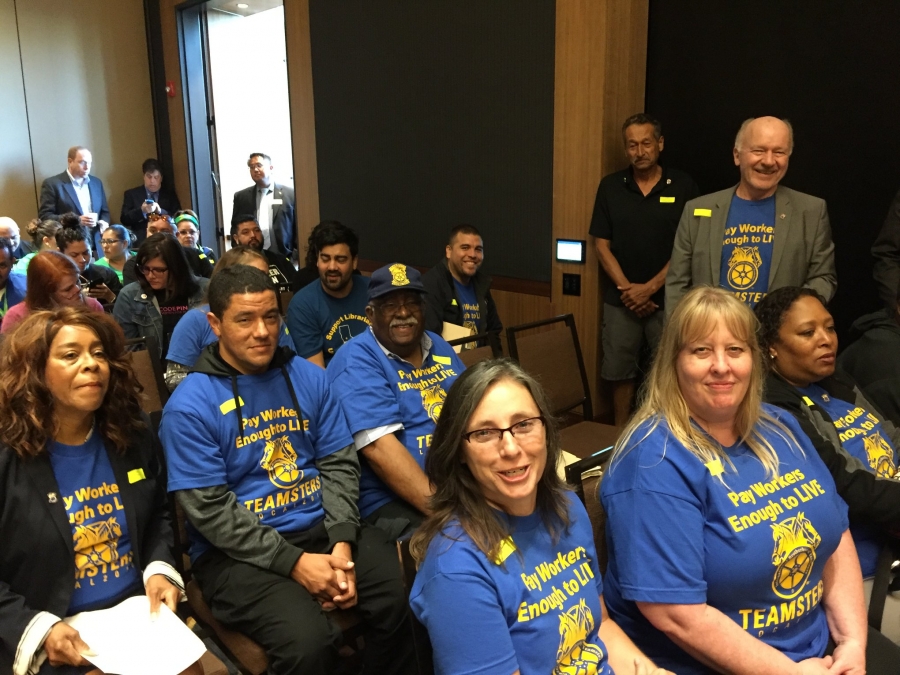
Concerns raised over understaffing of UC dispatchers

TEAMSTERS LOCAL 2010 / COURTESY

Understaffing reportedly leading to dispatchers working overtime, stress-related health issues

In late September, University of California Dispatchers asked the UC Regents for support in addressing the safety concerns caused by understaffing.

Public safety dispatchers work with campus police departments and take care of all emergency calls for the UC, including safety, fire and rescue calls. They also help assess the nature and priority of calls for assistance, determine and assign appropriate resources and document the resulting response.

According to a press release from Teamsters Local 2010, the union that represents dispatchers at every UC, campuses systemwide are so understaffed that many of the dispatchers go without breaks and lunch and may work 20 days in a row.

“No one should have to work 20 days straight just because they cannot hire enough people,” said Christian Castro, a communications coordinator at Teamster Local 2010.

In addition, all dispatchers were expected to pick up overtime everyday, which ended up impacting their personal life and families.

“In the last month, I and my colleagues have worked at least 18 consecutive days to ensure adequate staffing for the safety of our officers and the UCLA community,” said Lori Hancock, a UCLA dispatcher. “This is too much to ask of any employee, especially for those who have the well-being of others in their hands.”

According to the press release, many of the affected dispatchers had reported health issues including fainting, panic attacks and heart problems associated with workplace stress.

“They keep working because they care about their job and the safety of the students and community,” Castro said.

So far, the UC Regents have yet to give a response.

“They should hire more dispatchers so that the ones currently employed are not overexerted,” said fourth-year psychology major, Jeanette Vuong. “ These individuals are tasked with aiding students in need, which is a stressful job, and I highly doubt we absolutely have no funds to hire more dispatchers.”

Written By Clara Zhao — campus@theaggie.org

Man shot, killed in Davis apartments

OLIVIA KOTLAREK / AGGIE

Police confirm identity of shooter, victim

A woman is in custody after a man was shot and killed in an apartment complex near F and 10th Streets in Davis on Saturday morning, police say.

According to a press release on the Davis Police Department website, police received an emergency call on Saturday, Oct. 20 around 7 a.m., stating that a male was shot by a firearm on the 900 block of F Street. Police arrived at 7:11 a.m. and found the body of a 35-year-old man, later identified as Jamie Bryan Thomas Kinseth. He was pronounced dead on the scene.

Police arrested 29-year-old Hayley Katherine Gilligan in connection with the shooting. She is being held in Yolo County Jail on charges of homicide. The case is still under investigation.

The 911 caller, believed to be Gilligan, reported that a male had intruded into the caller’s home and that the caller shot the man, according to the Davis Police Department.

At the time of publication, the police say they have not yet identified a motive. Gilligan’s lawyer, Mark Reichel, told the KCRA3 Sacramento that she acted in self-defense.

“Once he was inside, she got very scared,” Reichel said. “Obviously, fearing for her life, this is what happened.”

Reichel stated that the victim had been previously romantically involved with his client, but that they were separated at the time of the incident.

The crime scene, at 979 F Street Apt. B, was still under investigation as of Tuesday afternoon. A white police van was parked on the street outside the apartment. The yellow tape that had circled the premises and the sidewalk the morning of the shooting had been removed, but officers in uniform still milled about the scene. Inside the house, officers with gloved hands shone flashlights through the window and wrote down notes. A table with forensic equipment, a box of yellow numbered tags and a box of waterproof shoe-covers stood outside the front door.  

Police on the scene Tuesday declined to comment, citing the ongoing investigations. Chief Deputy District Attorney Jonathan Raven also declined to comment on the matter beyond what was on the public record. He did confirm the name of the suspect and that the arrest occurred shortly after the police arrived on scene.

Kinseth’s family, however, released a statement on Sunday.

“We are shocked and devastated by the death of Jamie, our son, brother and uncle,” Kinseth’s family said to FOX40. “Our family greatly appreciates the love and support of our friends, and those who knew and loved him. Jamie was a private person, and we request that members of the media and the public respect our privacy during this incredibly difficult time.”

Editor’s note: A previous version of this article stated that F Street is in East Davis. That is incorrect. The article has been updated to reflect this change. The Aggie regrets the error.

Written by: Tim Lalonde — city@theaggie.org

Water, earth, fire, air

ALLYSON KO / AGGIE

North Davis mural in the works along greenbelt

North Davis has had a makeover: a mural along the greenbelt was painted by members of Paint the Street from Oct. 12 to 14. The North Davis Senda Nueva community came together in a band of cultures to figure out how to beautify their area and their solution unfolded over the past weekend.

Danielle Fodor, the lead artist for this project, elaborated on the power of art and its impact.

“These murals harness the power of the neighborhood while giving voice to the artist inside each of us,” Fodor said, according to Davis Enterprise. “Painting day is an explosion of energy — with a giant paint by number — where anyone, regardless of age or ability, can take part of the creation of a monumental piece of art.”

Nicholas Buxton, who is a part of the creative action team, explained the extent of the mural’s progress.

“We tried to make sure everyone in the neighborhood knew about it, and once that happened, the team got together to decide where the best place to do it would be,” Buxton said. “We had to discuss with neighbors to get their consent. Once we decided on a place, there were a whole bunch of workshops over the summer for ideas on a design with a total of three workshops. With an ambitious design, we had to fundraise and raise money.”

The mural was expected to stretch 10,000 square feet and was carried out in a paint-by-number style along the greenbelt and onto the cul-de-sac on the west end of Hacienda Ave.

“It’s a big project, and the great thing about the project was that it allows people to come out of their doors to meet their neighbors and envision something together — to collaborate and decide what would make our streets beautiful,” Buxton said. “We had indigenous art and traditions and African American contributions for the symbols as well. The cultural exchanges as well as the idea of how we want to make it more beautiful.”

The mural is titled “Elemental,” as it featured nature’s four elements — water, earth, fire and air. Judy Catambay, the assistant artist, explained how the mural included all of nature’s essence.

“The whole thing celebrates nature,” Catambay said. “Like with air, you’re going to see wood and dandelions and birds. Earth, you’ll have eagle feathers and things that are in the earth, like a dog. Each element has something that celebrates nature that lives in those elements. We infused symbols from multiple cultures as well.”

By fusing a multitude of cultures in the mural, Buxton believes it will be able to connect those who reside in the neighborhoods.

“I think it is really important because it connects people together,” Buxton said. “Part of our problems nowadays is that people are isolated and they don’t get a chance to be around a cross sector of ages and types of people.”

Buxton suggested that art can provide a means for imagination and community.

“I think it’s the way that art can both connect people together and unify those to talk and to volunteer together,” Buxton said. “It’s just a great way to bring people together. Also, it enables people to imagine and to be creative, and it’s a positive energy — to think about what’s possible. That opens up something that enables you to you think about ideas to make it work for everyone to address the social needs of the neighborhood. The combination of community and imagination is already a powerful dynamic, and the art can bring the two together.”

The artwork encompasses the community, as ideas from many voices were pitched during the meetings.

“There were kids and people who were from the senior center who were really involved,” Catambay said. “There was a man there who lived there — he didn’t speak much, but he drew a lot of whimsical birds. It’s going to be neat to see them come to life.”

Catambay also noted how rewarding the experience was for her.

“It’s quite a joyful and exhilarating event because you just see people from every walk of life coming out and getting involved with every age,” Catambay said.

Written by: Stella Tran – city@theaggie.org

Aggie EVO provides career advancement opportunities for student-athletes

0
OLIVIA KOTLAREK / AGGIE

Athletics program offers student-athletes resources for networking, internships,  career-prep

On top of academic loads and booked sports schedules, student-athletes often don’t have the time to focus on life after college. To help combat this issue, UC Davis Athletics has introduced a new program that is committed to assisting athletes in gaining experiences and grabbing opportunities to launch their individual careers post-graduation –– all while working around and maintaining their athletic careers.

Aggie EVO (short for student-athletes’ “evolution” throughout college), which was founded last year, is a program that helps prepare student-athletes for life beyond college and their individual sports. The system focuses on four different elements to aid students in achieving their career goals: skills that are valuable for professional workplaces, knowledge of what career paths are the best choices for them and how to take the next step, opportunities to visit different companies, events and land internships and jobs and the tools necessary to get these students closer to their goals.

Aggie EVO has created an entire four-year system with new goals for its student clients to achieve during each year of their college careers. The goals align with the system’s four key elements to success.

Fourth-year managerial economics major Lauren Mewes shared her experience in Aggie EVO, including how she first got involved in the program.

“Mike Lorenzen introduced the Aggie EVO program to the [women’s] field hockey team in a meeting and explained the various resources he constructed for student-athletes to better prepare for their next step after their sport ends,” Mewes said. “I then participated in the Aggie EVO World of Work field trip to Sacramento, which consisted of meeting Aggie Athlete Alumni at their respective workplaces and asking them various questions about their career paths. It was a valuable experience to be able to connect with former Davis student-athlete’s and learn from their advice.”

In a student’s first year, the ‘skills’ section is covered by creating a DiSC profile and learning self-awareness to help direct them towards career paths that they are passionate about. ‘Knowledge’ is achieved through completing the World of Work Examination and attending the spring student-athlete career fair. Taking hold of different chances to join clubs, doing volunteer work or taking on an internship covers the ‘opportunities’ section. The students are guided to finish their resume and create a 30-second video story about themselves to round out the ‘tools’ portion.

Students’ second year with the program separates out goals in the exact same four categories. An EQ-i Assessment is completed in ‘skills,’ and an experienced learning opportunity (ELO) is to be obtained to cover ‘opportunities,’ whether through a job, internship, research or various other activities. The ‘tools’ needed includes an updated resume, a video story extended to one minute and a professional LinkedIn profile. Students are required to complete a strengths/O*Net assessment, create an Aggie Job Link account, attend the spring student-athlete career fair and set up an informational interview for their ‘knowledge’ section.

By the time student-athletes enter into their upperclassmen years, their ‘skills’ portion has been completed. The student’s third year mainly consists of setting up three informational interviews, attending a career fair and beginning a separate ELO. The ‘tools’ needed for year three include keeping an updated resume, adding 30 more seconds to the video story and maintaining a LinkedIn Profile.

In the final year of being in the Aggie EVO system, athletes are required to have five informational interviews, take a World of Work Knowledge exam, attend a career fair and share a launch story with a coach and advisor. Like the previous years, the student’s resume and LinkedIn profiles are to be kept up to date and the final video story has a set time of two minutes. The program also offers set deadlines for the goals listed in order to keep their student clients organized. On top of giving students a schedule for success, the system also provides students with various resources around campus, such as job and internship fairs, resume and cover letter workshops and professional partnership and mentorship programs.

Mewes also explained how Aggie EVO has put her on the right path toward achieving her professional goals.

“After graduation I plan on pursuing a career as a commercial real estate broker,” Mewes said. “I have had the opportunity to intern with a team of brokers at CBRE these past two summers and many aspects of the job really interest me. I am so grateful that Mike Lorenzen has implemented a system filled with accessible resources that undoubtedly helps set up student-athletes for success.”

For more information about Aggie EVO or how to get involved in the program, visit the UC Davis Aggies athletics website.


Written by: Kennedy Walker — sports@theaggie.org


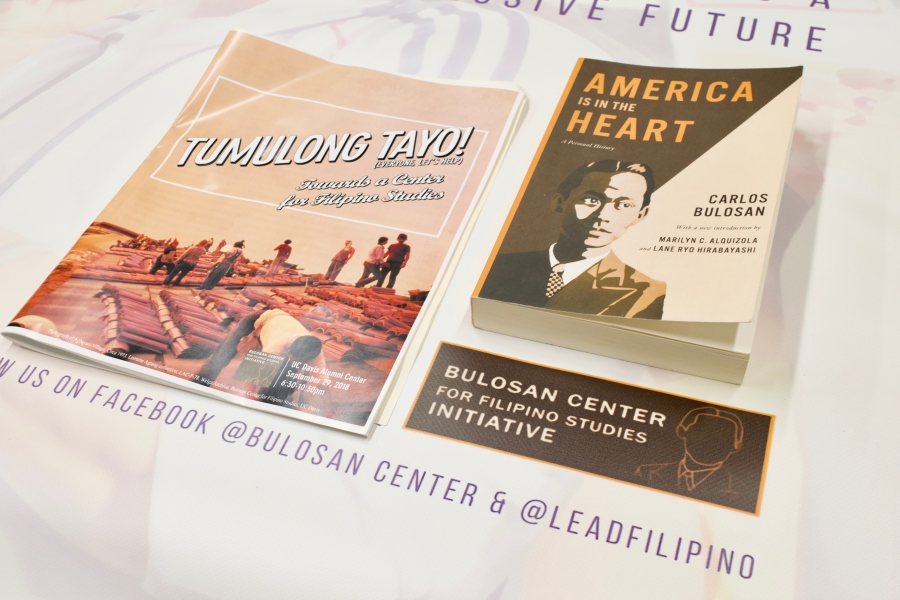
First Filipino-American research space at an American university opens at UC Davis

ALEXA FONTANILLA / AGGIE

Housed in Asian American Studies Department, The Bulosan Center is product of grassroots volunteers

On Sep. 29, a fundraising dinner marked the opening of the Bulosan Center for Filipino Studies. Formed within the Asian American Studies department and located on the third floor of Hart Hall, the center will serve as a space for undergraduate and graduate research and advocacy.

The Bulosan Center — named for Filipino writer Carlos Bulosan —  was initiated and completed under the leadership of Asian American Studies Department Chair and Professor Robyn Rodriguez. After completing her undergraduate studies at UC Santa Barbara, Rodriguez went on to graduate school at UC Berkeley where she and her peers noticed a need for Filipino representation among faculty.

Rodriguez, who became a professor, was recruited by UC Davis for her work with the Filipino diaspora.

“Having had the experience I had at graduate school and knowing the state of the field, knowing that I was probably one of only a handful at any UCs to do this kind of work, I thought this could be an opportunity to form a center,” Rodriguez said.

The Bulosan Center is also a result of the department’s work on the preservation of Filipino-American history.

Assemblymember Rob Bonta, the first Filipino-American California assemblymember, proposed Assembly Bill 123, mandating the inclusion of Filipino-American curriculum in K-12 history and social studies. In response to the need for corroborated accounts, the Asian American Studies department began a grant-funded project for an archive of the Filipino contribution to the 1960s farm workers struggle titled the Welga! Digital Archive.

“The problem was there isn’t a whole lot of scholarship or research on that topic and as a community we didn’t have any central archive where our experiences have been recorded and preserved,” Rodriguez said. “Even if teachers wanted to include this history there was very little to work with.”

In 2017, according to the UC Office of the President’s Disaggregated Data, there were 12,623 Filipino students in the UC system. Of those, 1,759 were from UC Davis. The Bulosan Center is the first of its kind as a space for Filipino-American Studies at a research university.

“It was about time … to have a specific space catering to not just our history but also issues facing our communities locally as well as nationwide as well as back in the Philippines,” said Wayne Jopanda, a Ph.D. student in the Cultural Studies Department and a volunteer at the Bulosan Center. “It’s not just a place for research. It’s a place for community engagement and to build those bridges between academia [and] our community, as well as other marginalized communities.”

In the summer of 2018, Rodriguez and a community of graduate and undergraduate students formed a coalition of volunteers interested in expanding the work of the Welga! Project. The idea became the conception of a center for Filipino studies on campus.

Volunteers collaborated with the National Alliance for Filipino Concerns, Migrante, LEAD Filipino, Philippine National Day Association and UC Davis Filipinx undergraduate student organizations to raise funds and lead up to the center’s launch on the Sep. 29.

It wasn’t until I came to UC Davis and started taking Asian American Studies courses and joined the [Filipino-American] community did I begin learning just how rich Fil-Am history was. I learned what an integral role our predecessors played in shaping my present,” said Leigh Bagood, third-year communication major and one of the center’s social media volunteers.

The effort was composed of a core group of volunteers that collected donations internationally and nationally, from the Davis community and from their own personal contributions to amass an amount of approximately $30,000. Their goal is to sustain their donorship for a consistent intake to fund their work in research and expansion.  

“We want to serve not just the UC Davis community on campus, but the UC system as well,” Jopanda said. “Whether that be through workshops, whether that be through Know Your Rights campaigns, whether that be through connecting with students in Public Health or the medical school and bringing folks around to provide potential health care services for folks who may not have health care or have access to that care. It’s really going to be reactionary to what’s needed in our community.”

Future projects for the Bulosan Center include expanding the Welga! Project to archive Filipino contributions to politics and activism, researching the consequences of trafficked Filipino immigrant workers and the funding for a national survey on Filipino health and mental health.

Rodriguez attributed the distinctiveness of the Bulosan Center in its capacity for research and its focus on Filipino-American history, compared to other collegiate Filipino centers of study who focus primarily on the Philippines.

“If you don’t have representation or support for research for your community from research institutions, and this is true for all minorities, then there’s a real risk that people’s histories and experiences won’t get preserved,” Rodriguez said. “People in the field of Filipino Studies recognize that this is huge even to have a tiny little space at a major research university where you have a center of gravity of people who are working hard and promoting this field of study.”

Written by: Elizabeth Mercado — campus@theaggie.org

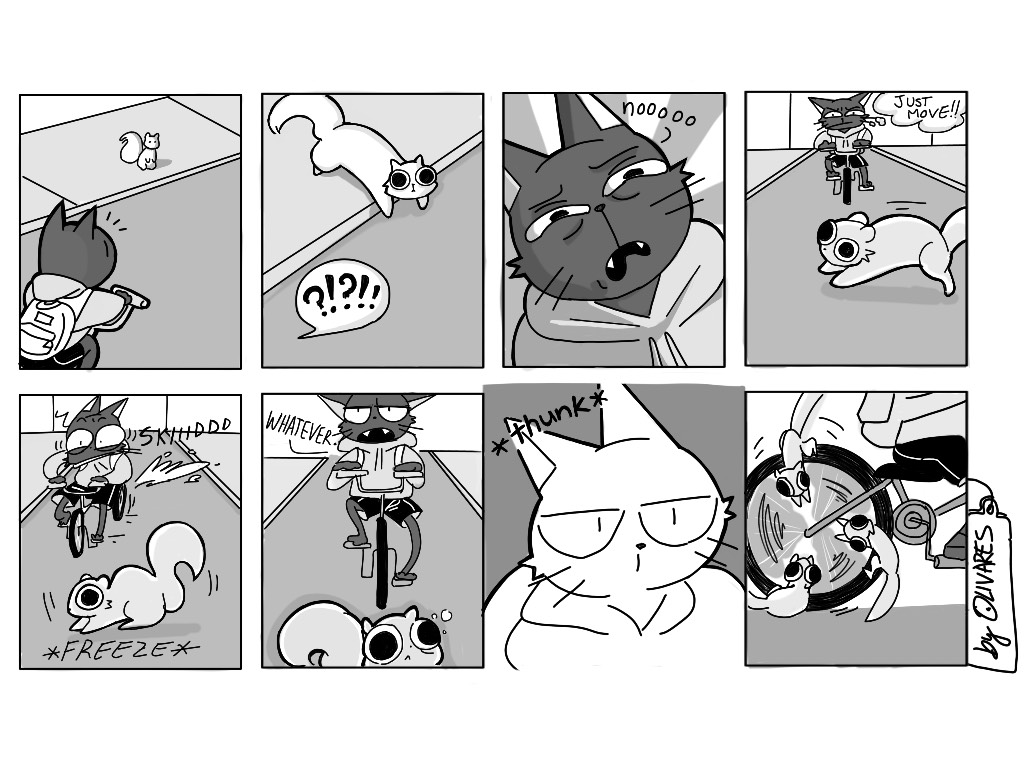
Cartoon: Squirrel Jam

DIANA OLIVARES / AGGIE


By DIANA OLIVARES — deolivaresvalencia@ucdavis.edu


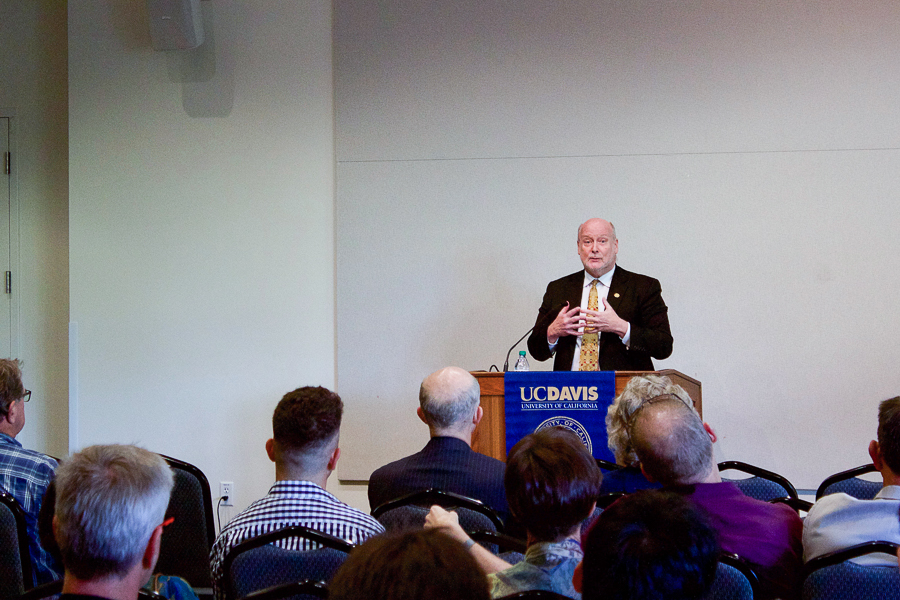
In speech at UC Davis, UC Irvine chancellor says universities cannot enforce hate speech codes

REBECCA CAMPBELL / AGGIE

“Free Speech on Campus” book advocates for free speech, even if offensive

On Oct. 4, UC Irvine Chancellor Howard Gillman spoke at an event titled “Free Speech On Campus” at the Student Community Center.

Gillman recently co-wrote a book of the same title with UC Berkeley Law School Dean Erwin Chemerinsky and used the event to promote the book and discuss free speech. Following his speech, Gillman answered audience questions.

The event was classified as a chancellor’s special event.

“While public spaces remain open to free speech, universities can draw the line at harassment, true threats or other speech acts unprotected by the First Amendment, as well as discrimination that encroaches upon dormitories and classrooms, for example,” a UC Davis news release, which discussed the event beforehand, explained.

After studying and teaching constitutional law his entire adult life, and amid recent instances of UC campuses being forced to face the complexities of free speech, Gillman spoke about his urge to write the book.

American campuses, Gillman said, are riddled with a generation of students who have been “so protected by their communities that they are not capable of coping.”

Gillman said that “the arguments for limiting hate speech are strong,” and acknowledged how hate speech “hurts marginalized communities.”

“Let’s acknowledge that ideas can be harmful,” Gillman said.

However, he argued that censorship and the regulation of ideas is even more harmful, and claimed that universities have no jurisdiction over hate speech.

“We argue that any viewpoint can be expressed on campus,” Gillman said. “It is still not legal for public universities, such as UC, to enforce hate speech codes.”

Gillman discussed having controversial speakers, like conservative Milo Yiannopoulos, who has mocked and doxxed transgender students on campuses he has visited, or white supremacist and alt-right figurehead Richard Spencer, on campus.

“I had Milo twice on campus,” Gillman said. “Milo or Richard Spencer are silenced while their critics are not. A campus cannot deny a speaker a forum.”

Gillman described what he called the “culture wars” happening at universities — both Gillman and Chemerinsky grew up among the civil rights movement and anti-war movement.

“We wrote our book in the hope that we could provide background on free speech,” Gillam said. “Students have no exposure to the history of free speech, or main arguments for why free speech might deserve special protection.”

Connor Gorman, a UC Davis graduate student worker, contested Gillman’s argument via email interview, citing perceived damage done by propping up marginalizing language under the guise of “free speech.”

“UC administrators often advocate for very limited and superficial notions of free speech while simultaneously being clear hypocrites when it comes to this issue,” Gorman said. “They fail to account for relevant power dynamics and the fact that oppressive, bigoted beliefs abound in U.S. society. In fact, the U.S. is based on structural violence that’s directed toward the most marginalized communities.”

To Gorman, allowing Yiannopoulos to speak became indirect support by administration, encouraging both implicit and explicit discrimination by not condemning hate speech.

“A true commitment to free speech would involve reducing the number of platforms provided to these ideas while increasing the exposure of ideas that challenge systems of oppression rather than upholding them,” Gorman said. “On top of this, UC administrators are notorious for their repression of student, worker and community actions that oppose their undeserved wealth and power from the infamous UC Davis Pepper Spray incident to the SJA charges brought against participants in a recent Mrak Hall sit-in.”

Amara Miller, a Ph.D. candidate in the Department of Sociology, echoed Gorman’s sentiments, saying via email that it’s ironic “UC administration is promoting ‘free speech’ given many of their new policies that seek to address controversial speakers on campus actually criminalize student counter-protest.”

“Administrative decisions about whose speech is highlighted, both in terms of […] dangerous speakers being given university platforms as well as this Chancellor whose voice is promoted here in this event, illustrate the way ‘free speech’ is already and always implicated in power relationships that amplify the voices of powerful white actors and silence the voices of marginalized communities on our campuses who are most directly impacted by far-right violence,” Miller said.

In his speech, Gillman reiterated his belief that all universities should allow alt-right speakers like Spencer or Yiannopoulos.

“Milo is coming back to my campus in a few weeks,” Gillman said. ”I can’t deny college Republicans their right just because I don’t like Milo’s views.”

Written by: Aaron Liss — campus@theaggie.org

Humor: Tips and tricks to get you fired on Halloween

ALLYSON KO / AGGIE

Blackface your way to unemployment

Halloween is one of the most wonderfully pagan of all the pagan holidays. It’s a night to let loose and live out your wildest (hopefully legal) fantasies. It’s also a chance to play dress-up, and who doesn’t like that? But while the costume options are limitless, the reality is that picking what to wear requires some careful consideration. It demands sensitivity and a bit of brainwork.

Now, if you read that and decided to turn your sensitivity and common-sense sensors off, I have the perfect idea for you to achieve what every person seems to be chasing: clout. Not only would you receive a limited supply of attention, but you will also be given the beautiful gift of unemployment.

Oh, don’t race to the comment section just yet — let’s talk this through. First things first, you have to decide what form of bigotry will get you the most attention. Most people go for the typical Native American-themed costume, which usually consists of a feather headdress purchased from the nearest Goodwill. However, nothing receives more attention than good old blackface.

That’s right. Go out to the nearest Ulta and purchase the darkest foundation you can find. Luckily for you, this isn’t 2015 when they only had four shades of caramel. Next, go to King’s Wigs and Beauty Supply in Sacramento and find the nappiest wig you can find with a horrendous frontal. Nothing upsets black Twitter like a jacked wig. Lastly, head down to Walmart and buy yourself a misshapen polychromatic sweater, brown slacks and some banana pudding, if you wanna get specific.

If you haven’t used your quick-witted noggin to imagine who this historic black figure is, let me help you. A Bill Cosby “sexy” costume is the perfect discriminatory costume that bridges the gap between blackface and sexual assault. So, after you complete this eye-catching look, be sure to post it on all of your public social media pages. Don’t be afraid to tag woke people of color to your masterpiece post. They will make it a priority to notify your now-former place of work since that was the obvious goal of your foolish escapades.

Anywho, be sure to enjoy your 2018 Halloween, because on Nov. 1 your privileged life will soon be humbled.


Written by: Hilary Ojinnaka — hiojinnaka@ucdavis.edu

(This article is humor and/or satire, and its content is purely fictional. The story and the names of “sources” are fictionalized.)

Passionate officers revive the French Club

0
DAVIS WHALEN / AGGIE

After a year of inactivity, the French Club is reinstated on campus

After a yearlong hiatus, the French Club is back at UC Davis. The club disbanded for the 2017-2018 school year, due to lack of new leadership. However, a new group of passionate individuals have recently revived the club and are hoping to make their mark on UC Davis.

Elias Heffan, a third-year computer science major, is the new president of the French Club. He recalled his experience coming out to the first version of the French Club as a freshman, and how the club dynamics were completely different from then to now.

“When I was a freshman, the club was active but it was really small,” Heffan said. “They met off campus at a cafe and the people that went were a lot of high level French speakers. When I went to that meeting, I felt really intimidated and they weren’t really inclusive of me.”

Kayden Gleaves, a third-year environmental science and management major, is another officer of the club. She noted how the goals of the current French Club have shifted to cater to needs that the previous club didn’t.

“We’re really excited just to get members involved in the club,” Gleaves said. “The previous version of the French Club wasn’t really inclusive because it was made up of mostly native speakers. Our main objective now is to try to unite everyone of all different levels through our love of the culture.”

Heffan recounted the history of the club, and the long journey it took to get back on its feet. He talked about how students attempted to restart the club several times in the 2017-2018 school year, but each time their attempts fizzled out. Heffan was able to restart the club by utilizing the Facebook page that still existed and reaching out to individuals that were also passionate about the language. Now, the officers have higher hopes for the club than in previous years.

“What I’m really excited about with the club is that people that aren’t taking French classes have a place where they can come and learn about and practice speaking French,” Heffan said. “Especially people like me who are computer science or STEM majors that don’t have room in their schedule to take classes can still keep up their language. A lot of people take French in high school and it allows them to continue practicing.”

Heffan went on to detail the club’s activities including social events and practicing the language.

“We are having conversation practices where people can practice French of all levels and feel comfortable,” Heffan said. “We’re also going to have a movie night, a French edition of jeopardy and a study abroad session to offer more information to people that may be interested in traveling abroad to France. We’re also going to be having social nights for the entire club and we’re currently planning on going bowling at the MU together.”

For people interested in learning French, the new club may be an invaluable resource for getting experience in the language.

“For people that don’t know any French, one of the best ways to actually learn is to first take a French class,” Heffan said. “That’s the best way to get the full exposure to everything French-related. You can also come to our club and get another look at everything that you’re learning in class, because it would really compliment everything that you’re learning in class.”

Heffan’s goals for the club stem from his initial experience in the old French club. He hopes to make this version of the club something that caters to all and is extremely inclusive.

“We just want to make a club that anyone who is interested in anything at all French-related can come to and enjoy and feel like they’re getting something out of it,” Heffan said. “I don’t want people to be afraid to let me know or the officers know if we can do something better. I just care about making a club that people really like.”

Vanessa Chavez, a second-year French and Italian major, is another club officer, and shared her goals for the club during this school year.

“I hope to share this love and passion with everyone, whether they speak no French or if they’re fluent in the language,” Chavez said. “Students should know that the club ranges from beginners to fluent speakers so it’s open to all levels. it’s also a way of learning a new language without taking the class or having homework. it’s also a fun way to socialize and meet new people. We’re all here just trying to learn and meet new people and I’m excited to make this club thrive again. I hope we have a huge body of new members so we can make our presence known, and I hope it encourages more people to pursue a languages, whether it’s French, Portuguese or anything else.”    


Written by Alyssa Hada — features@theaggie.org


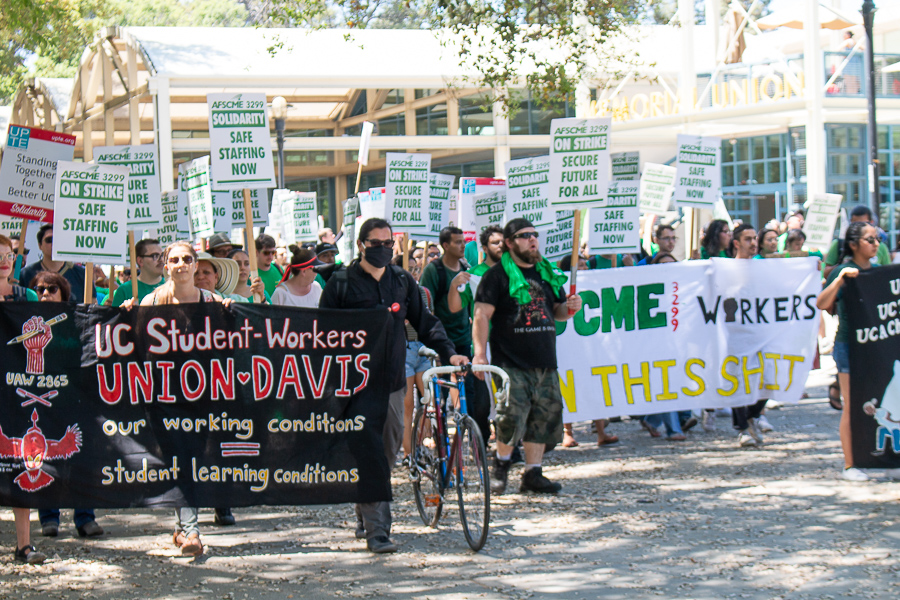
AFSCME’s lawsuit against UC Davis could stall construction of student housing

ZOË REINHARDT / AGGIE

AFSCME alleges UC Davis not complying with California environmental law

The American Federation of State, County and Municipal Employees (AFSCME), which represents over 25,000 UC workers, filed a lawsuit regarding UC Davis’ Long Range Development Plan (LRDP), which includes projects aimed to increase student housing in Davis. The lawsuit claimed the university did not adequately analyze the potential impact of these projects on “agriculture resources, air quality, biological resources, greenhouse gas emissions, noise, traffic, housing and populations and aesthetics.”

Both university and student government leaders have condemned and criticized the lawsuit for its potential to stall the construction of additional student housing amid a lengthy housing crisis in the City of Davis.

When asked for comment, John de Los Angeles, a spokesperson for AFSCME, said via email that he “cannot comment on the lawsuit at this time.”

According to Vice Chancellor of Finance, Operations and Administration Kelly Ratliff, the LRDP included an expansion of West Village and Orchard Park, with plans to add an additional 3,270 beds in West Village.

According to Kirsten Stevenson, the senior campus counsel for the UC Office of the President, the university went through a public input process before finalizing the LRDP. Stevenson said that AFSCME was one of many entities that weighed in on the environmental impact of the LRDP.

“Lots of individuals and entities — the City of Davis, Yolo County — submitted comment letters to say, ‘Hey you didn’t properly analyze this or mitigate this impact appropriately,’” Stevenson said. “Part of the law requires that whatever public agency is going through [this] process listens to those comments, reflects upon those problems and makes some decisions before they actually finalize the environmental impact report that is associated with the Long Range Development Plan.”

The law Stevenson referenced is the California Environmental Quality Act (CEQA), which aims to maintain the quality of the environment.

More information about the environmental impacts of the LRDP can be found on the UC Davis Campus Tomorrow website, which includes a document of all the comments received on the LRDP and the university’s responses to the comments.

Stevenson said that the City of Davis and Yolo County raised concerns about the LRDP and its environmental impact and eventually came to an agreement after negotiations. According to Stevenson, however, when AFSCME raised concerns later on, the university and AFSCME were unable to reach an agreement.

“[AFSCME] wound up filing a lawsuit and their claim is that the university has not complied with the California Environmental Quality Act,” Stevenson said. “They claim that, in a variety of different areas, we haven’t adequately mitigated the environmental impacts — for example, greenhouse gases or impacts to roads — of the plans that we are proposing to undertake.”

In a statement released Sept. 28, the university said it is “perplexed and profoundly disappointed” by the lawsuit.

“We have previously made a series of generous offers to AFSCME that would have benefited UC Davis’ represented service workers and enabled UC Davis’ housing projects to move forward,” the statement read. “Despite agreement that more student housing is a benefit to all, AFSCME’s suit will likely prevent UC Davis from building affordable student housing in the near term.”

Stevenson explained what she believes to be AFSCME’s argument in the lawsuit.

“I believe their position is that if the employees used for student housing projects on this campus are not university employees, there will be environmental impacts because the people who ultimately fill those positions will come from further away to work on the UC Davis campus,” Stevenson said. “So there will be more greenhouse gas emissions, and there will be more damage to the roads.”

One of AFSCME’s primary concerns is the UC’s outsourcing of jobs. While discussing potential outcomes of this lawsuit, Stevenson mentioned that she believes a court will never require the university to use UC employees during or after the completion of the LRDP.

“Bottom line, there is a very limited number of remedies available in this type of litigation, and there is no remedy whatsoever where a court would order us to hire university employees for a project,” Stevenson said.

AFSCME’s concern with outsourcing — the use of non-UC employees for work on campus projects — may be valid, as Stevenson said the employees that private developers hire are not chosen by the university.

“There’s a very discreet set of projects — public private partnerships — and they’re used for student housing projects, and it is a means of developing student housing that can be done more affordably for students,” Stevenson said. “When we bid those projects out to developers, we tell them to use whatever they want. They have to come back to us with a proposal, and if it’s university [workers], great.”

ASUCD President Michael Gofman, External Vice President Edgar Masias-Malagon and Democrat Delegate and Union Steward Sean Raycraft signed a joint statement discouraging AFSCME’s lawsuit and any efforts “that would delay progress on the university’s housing plan.”

“[We] condemn the use of students’ welfare as a bargaining chip, and urge AFSCME to consider the effect on students their actions will take,” the statement read.

The statement claimed that UC Davis students “have played a critical role in many of AFSCME’s efforts over the past few years,” making AFSCME’s lawsuit “appalling and disheartening” in that it might delay or stall the construction of additional student housing.

In response, the ASUCD Ethnic and Cultural Affairs Commission, posted a statement to Facebook regarding both the joint statement published by ASUCD and AFSCME’s lawsuit.

AFSCME’s concern with the LRDP was/is valid in that they believe student housing should not be taken up on the basis of contracting out UC jobs and putting womxn, immigrant, black and brown, working class individuals at harm,” the post said. “Moreover, it is utterly disappointing and immoral to […] somehow [imply] that ASUCD has, as an association, taken several initiatives to support UC workers. The truth is, it has not.”

A separate statement from ASUCD signed by Gofman, Masias-Malagon, Office of Advocacy and Student Representation Legislative Director Jake Sedgley and student Senator Alisha Hacker, discouraged any efforts that would delay progress on the construction of housing.

“[We] urge all parties to understand the real and acute consequences we the students would feel in any delay,” the statement read.


Written By: Sabrina Habchi  — campus@theaggie.org


Humor: Surviving the off campus wasteland

OLIVIA KOTLAREK / AGGIE


A view into the insanity that surrounds sweet, innocent UC Davis

Patchy lighting. Dead silence. A wave of crime and uncertainty on the brink of collapsing down on an unsuspecting populace. To you, this must sound like the plot of a noir film from the 1950s. If this was your first thought, good effort, but please never assume that you know what I’m talking about again. You have no idea what I’m going to say next, especially because this is no film noir. It’s the real-life story of Davis’ off campus wasteland.

Surprising, isn’t it? Most people see Davis as a peaceful college town connected to an uncomfortably flat campus. But there’s a threatening side to the town that goes beyond its similarly-uncomfortable flatness and, in my opinion, knowing what’s out there is the best way to help you improvise, adapt and overcome these trying times.

Downtown Davis is a hub for the plausibly horrific events plaguing our city. Laptop thieves pace around the corner of every dark alley connected to a coffee shop, waiting for their chance to steal the Macbook Pro your parents bought you after you “outgrew” your Macbook Pro from freshman year. Construction on Third Street seems endless. Different parts of the street close down seemingly without warning. Some students even report going into a store and coming out to a completely different street, causing mass panic and, in severe cases, the obligation to take a different path than usual.

It doesn’t stop there. Travel deeper into the wasteland to find sights unfathomable. Huge groups of raccoons roam Davis streets at night. We’re talking, like, between two and 10,000 raccoons picking trash, recyclables and, with confirmed accounts, vehicles clean with those adorable, furry paws. Take a wrong turn and you might be their next victim.

Travel deeper and you’ll spy burglars walk into houses while people are out, while people are home, while people are literally on their front porch watching them steal their television. Frisbee golfers ruin any respite at public parks as they passive aggressively wait for you to move out of their wind or from in front of their final chain basket on the best damn streak of their entire career. Students who have never driven a car before attempt to do so, stopping in the middle of lanes with their hazard lights on, as if that means something. Meanwhile, amateur bus drivers, bikers with no sense of the law and pedestrians with literal death wishes form a traffic hellscape. And rogue, solitary turkeys. That’s all I need to say.

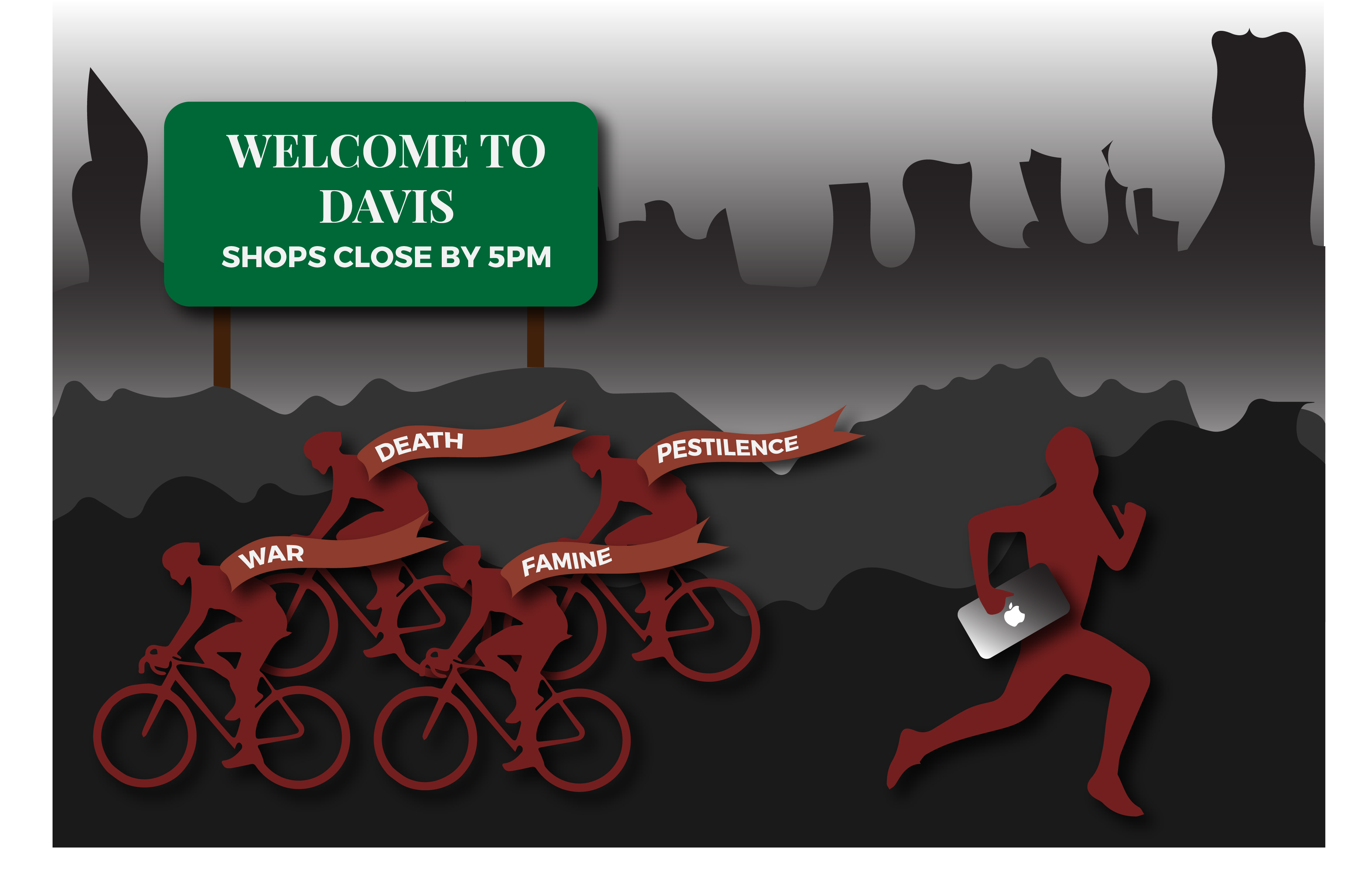
The worst, however, has not been revealed. There is another threat to your safety, one that only appears in the most dire of off-campus late nights: the Four Bikers of the Apocalypse. The Beach Cruiser, The Side-by-Side Couple, The Silent Passer and The “I SAID I WAS ON YOUR LEFT” weave through the chaos to ruin any patience or sanity you might have left.

This is part one of a two-part report. Stay tuned.


Written by: Conner Shaw — cjshaw@ucdavis.edu

(This article is humor and/or satire, and its content is purely fictional. The story and the names of “sources” are fictionalized.)

Guest: Our housing at their cost: A call for student solidarity with UC workers

DANIELLE MOFFAT / AGGIE

Students must support AFSCME’s strike

As students have found themselves in desperate need of affordable housing, the university has responded with the Long Range Development Plan, which recommends privatizing the housing process under the guise of cutting costs. This neglects students’ true allies — represented by AFSCME 3299 — who run the UC system: service workers, groundskeepers and custodial staff across the 10 UC campuses.

With the implementation of new housing, there is an opportunity for us to demand not only that these rooms are affordable and environmentally sound, but also that these criteria are met not at the expense of those who are already the least valued by the UC system. Private companies are not required to use unionized UC employees, and therefore these companies get to dictate whether their workers receive a living wage to build and maintain our housing. This private-public partnership is part of a growing trend to outsource jobs that would normally go to workers with benefits and representation under the false justification that it’s the only solution to housing students affordably.  

Interestingly, this privatization push also comes at a time when union workers plan to strike in the name of future job security, increased sexual harassment protections, fair wages and more. Building new housing in Orchard Park and expanding established facilities in West Village seems like a simple numbers game to the UC. In reality, it involves the complex process of employing individuals whose own qualities of life and costs of living need to be considered and held to the same priority as those of the students. Alleviating student debt by outsourcing jobs and thus avoiding accountability is not a just solution to the student housing crisis — it’s just a convenient one for the UC, and it shows that the UC places little to no value on the work that continues to maintain its very infrastructure.  

In addition, the irony of attending a university that applauds itself for serving a diverse population of students while simultaneously employing a less diverse population of workers is striking. One report, which looked at UC payroll and demographic data, shows that the portion of African Americans in the UC Service workforce (i.e., the workers who would normally be responsible for maintaining new campus housing facilities) has dropped by 37 percent over the past 20 years. The report also found that black workers make up a significantly larger share of the workforce at low-wage outsourcing companies.  

Worse than the privatization of projects is the attempt to divide the people who feed their families by mopping UC floors in the middle of the night and the students who pack these same halls, studying in sparkling-clean spaces during the day. ASUCD and UC Davis have both released statements urging AFSCME 3299 to concede and encouraging students to believe that an improved experience at UC Davis requires a poorer quality of life for the workers who support this experience day in and day out.  

Without students, there would be no learning community. But without the workers who maintain the campus infrastructure through their time and labor, all the luxuries of university life that we enjoy — like clean campus grounds, the dining commons, the construction of new buildings and maintenance of student housing — would halt.  If we have any interest in holding the university accountable for injustices against those who make our campus community possible, we must utilize our unique student role to advocate for public projects that employ a local workforce and stand in solidarity with UC workers, beginning with bridging the student-worker divide and supporting their strike. Join fellow students in demanding job security for the worker community and accountability from the UC at AFSCME 3299’s strike on Oct. 23 to 25 at La Rue and Orchard, as well as at the student solidarity rallies on Oct. 23 and 25 at 11:15 a.m. at Shields Library.  


The writer is a third-year transfer student at UC Davis and freelance writer.  


Written by: Raquel Victoria Navarro


Co-signed by:

United Students Against Sweatshops Local 143 at UC Davis

Students for Justice in Palestine at UC Davis

La Familia: Chicanx/Latinx Queer Support Group

La Raza Pre Law Student Association

IGNITE at UC Davis

Muslim Student Association at UC Davis

Students and Workers Ending Racial Violence (SWERV)

Pilipinx in Business and Law

Startuphub at UC Davis

Indian Student Association at UC Davis

Peruvian Student Association at UC Davis

ASUCD Dream Committee

Scholars Promoting Education, Awareness, and Knowledge (SPEAK) at UC Davis

Environmental Justice for Underrepresented Communities at UC Davis

People for the Elimination of Animal Cruelty Through Education at UC Davis

Peer Education and Community Empowerment at UC Davis

Pan Afro Student Organization at UC Davis

CENSOCA at UC Davis

Martin Giron, ASUCD OASR Organizing Director 17-18, SRRC Latinx/Chicanx Retention Coordinator

Destiny Padilla, ASUCD External Vice President 17-18, SRRC Latinx/Chicanx Retention Coordinator

Ellie White, Graduate Student

Bianca Montes, La Raza Pre Law Student Association

Ko Ser Lu Htoo, ASUCD Senator

Kauser Adenwala, External Vice President of Muslim Student Association at UC Davis

Nora Abedelal, Ethnic and Cultural Affairs Vice Chair

Blu Buchanan, Sociology PhD Candidate

Rina Singh, ASUCD Ethnic & Cultural Affairs Commission Chairperson

Haarika Vaddella, ME/SA Community Student Coordinator

Jonina Balabis, ASUCD Ethnic and Cultural Affairs Commissioner

Kimia Akbari, Other Collective, Editor-in-Chief

Alice Beittel, ASUCD Environmental Policy and Planning Commission Chair 18-19

Dinika Marwha, Vice President of the Indian Student Association at UC Davis

Kaelan Mikowicz, CA&ES CRU

Nangha Cuadros, Peruvian Student Association President

Jumoke Maraiyesa, ASUCD Senator

Yajaira Ramirez Sigala, ASUCD Senator 17-18, UC Undocumented Student Coalition, Police Accountability Board Student Life Rep

Fatima Garcia, IM Sports Coach for AB540 & Undocumented Student Center Soccer Team

Stephanie Funes, CCC Campus Climate and Community Outreach Coordinator

J’Son Jones, Historical Counselor

Alan Roberson, Communications Counselor, Pan Afro Student Organization

Tiana Williams, Finance Counselor, Pan Afro Student Organization

Eric Banks, Head Counselor, Pan Afro Student Organization

Angel Ballesteros, CCC PEACE Coordinator

Karen Vasquez, CCC PEACE Coordinator

Sage Lauwerys, ASUCD Office of Advocacy and Student Representation Former Organizing Director 18-19

Elizabeth Oramas Diaz, Former President of Davis College Democrats

Robert Zuniga, Central American South American & Caribbean Student Alliance

Lois Kim, Former ASUCD Environmental Policy and Planning Commission Chair ’18

Connor Gorman, Associate Instructor

May Supreme Court decision could open sports books

0
JAMIE CHEN / AGGIE

With states opening their books, many question what this means for sports

On May 18, the U.S. Supreme Court struck down the Professional and Amateur Sports Protection Act of 1992 (PASPA) in a 6-3 decision. The initial decision on PASPA prohibited states from attaching themselves to sports gambling operations, though thanks to a grandfather clause, Nevada and, on a limited scale, Delaware, Oregon and Montana, were able to maintain their sports books. The bill took the power away from states and made sports books a federal issue.

During the initial debates which eventually led to the passing of PAPSA, the act was championed by professional-basketball-player-turned-Senator Bill Bradley, who in 1991 said that he saw sports gambling as a means to see “athletes turned into roulette chips.” To Bradley, adding gambling to sports on a national level cheapened the product and took the attention away from the competition on the court.

By striking down the 1992 decision, it is now up to the states to decide whether or not they want to allow sports betting. The rise of digital sports books like Bovada, as well as pay-to-play fantasy leagues such as DraftKings and FanDuel have flourished –– all of which make sports-betting accessible to anyone who has an internet connection. One is no longer required a flight to Las Vegas or Reno to fill one’s itch to bet on games. While several states, such as New Jersey and West Virginia have either already introduced legislation allowing for sports books, California has yet to introduce any meaningful legislation.

As of right now, California has had no meaningful response to the decision. Currently, casinos can only be built on land which is owned by indigenous populations. Although card clubs and racetracks also offer gambling, the addition of a sports book would likely need the approval of current casino owners in order for it to work. In 2004, a measure was struck down that would allow for card dens and racetracks to operate slot machines, in large part due to opposition from the tribes who operate California’s casinos. While those who bet on horse races and card games can be benefited by skill and knowledge on the subject, opening the books for national sporting events could prove costly for casinos, depending on the event.

Another possible hurdle for nationally available sports books could be the sports leagues themselves. Although Las Vegas has recently begun acquiring professional franchises in the NHL, WNBA and NFL, having gambling and professional sports coexist in the same space has been a rarity. The NBA has come out in support of legalized gambling, while the NFL has raised questions about the integrity of the game if gambling becomes intertwined with the in-game experience. Some, such as Dallas Mavericks owner Mark Cuban, see it as an opportunity to add in-game excitement for those who may not otherwise enjoy an event.

Where sports books go from here is anybody’s guess. As gambling becomes more common in the culture of more and more states, the public may finally see what happens when it is a more widely available option for those who choose to partake. Although California appears to be a while off from legalizing sports betting, the states which are partaking in the more relaxed regulation of gambling may pave the way for an answer as to whether or not this new addition is good or bad for the leagues, the states and the fans themselves.


Written by: Bradley Geiser — sports@theaggie.org