55.4 F
Davis

Davis, California

Sunday, December 21, 2025
Home Blog Page 494

Lawsuit filed against city of Davis

CAITLYN SAMPLEY / AGGIE

Claims of racially discriminatory planned housing

lawsuit has been filed against both the city of Davis and the prospective West Davis Active Adult Living Community (WDAALC), a housing project targeted primarily for senior residents, on the basis of racial discrimination. Because the housing for this community is mostly restricted to those with connections to the city of Davis — a town that is predominantly white — the WDAALC is being discriminatory, according to the lawsuit.

The WDAALC is tentatively set to be built starting in the summer of 2019. In order to purchase a home there, the developer requires that the buyer have some prior connection to Davis; however, this does not necessarily mean they have to currently live in Davis. Measure “L,” resolution 18-094, sets aside land for the WDAALC. The development must be voted on by residents during the November elections.

There will be around 380 units built for the community, which will vary from single-story homes to apartments. The project will set aside 150 of these units for low-income seniors, 75 of them not being age-restricted. The houses are estimated to cost anywhere from $300,000 to $700,000. The area is a prime location for senior citizens, with Sutter Davis, Dignity Health and the UC Davis medical and CommuniCare offices nearby.

The suit was filed by Attorney Mike Merin, who will be representing litigant Samuel Ignacio, a man of Filipino and Hispanic heritage. The lawsuit states that he “brings this action on behalf of himself and all other similarly situated racial and ethnic minorities who desire to purchase residences in the proposed West Davis Active Adult Community.” The lawsuit claims that the plan’s mission, titled “Taking Care of our Own,” violates the Federal Fair Housing Act, the California Fair Employment and Housing act and the California ENRA act.

One of the concerns about the WDAALC is that it will be taking away space for other housing opportunities. But according to Dave Taormino, a developer for the WDAALC, senior housing is something the city of Davis needs. While it may not be fully meeting other needs — such as low income or student housing — the seniors’ old homes will become available in the housing market once they move to the WDAALC.

“An age-restricted project was the proposal submitted by the applicant,” said Katherine Hess, the city of Davis community development administrator. “The site had not been previously identified for housing development prior to 2013. The Senior Citizen Commission determined that the project would assist in meeting internal housing needs, particularly needs for senior housing.”

According to Ethan Walsh, the assistant city attorney, the vague restrictions regarding who can buy property at the WDAALC should become more concrete if measure L passes.

“The city’s position at this point in our agreement [is] that as a part of this project, we require that if the developer does move forward with this program, that they provide us more specific information on it, that [the] project would not violate fair housing laws,” Walsh said.  “At this point, the program hasn’t really formed yet, so it’s premature to take a position on whether or not it would discriminate.”

Taormino stated that Ignacio has not expressed any interest in applying to the community.

An individual who lives in Sacramento filed a lawsuit claiming that we’re discriminating against him because he doesn’t live in Davis or has any association to anybody in Davis,” Taormino said. “Never worked here, never lived here. He didn’t go to school here. He didn’t go to UCD. So he’s totally outside of the Davis community in every respect.”

According to Taormino, if Ignacio had applied, he would have been considered for approval. At least 10 percent of the land will be available for purchase by people who don’t have ties to Davis. And the restriction for the other 90 percent of land only applies to the first sale of the homes.

“If he applied he’d be approved, so how can we be discriminating against anybody,” Taormino said. “We’ve set aside 10 percent and so far nobody from the outside of Davis has applied. And that’s primarily because we’re not advertising — we’re just processing the project through the normal process inside of Davis.”

Taormino explained that over 2,000 Davis residents have expressed interest in buying property; however, only 380 units will be available at first. One of the goals of the living community is to free up bigger, family sized-houses that are currently being occupied by senior residents. These houses are scattered throughout areas of the city, and Taormino hopes the seniors will move out of their old homes to free up space for families and other people who need housing.

“Generally, [the family sized houses] are occupied by one or two persons that are designed and built for families with children,” Taormino said.

While the lawsuit has been filed, it has not been served yet. Walsh does not know when the city expects the lawsuit to be served. The California Aggie reached out to Merin, the prosecutor for this case, but did not receive a response. If measure L does not pass, the lawsuit might not be served.

“If the voters don’t approve it, then the project won’t go forwards anyways,” Walsh said.

Written by: Hannan Waliullah – city@theaggie.org

Lengthy debate ensues over applicant to Elections Committee position at Senate meeting

CAITLYN SAMPLEY / AGGIE

With Fall Elections around the corner, bylaw suspended to confirm chair

The ASUCD Senate meeting on Oct. 4 began with the confirmation of the Picnic Day unit director. Fourth-year double major Elise Pohlhammer was for the role.

Polhammer said Picnic Day was what convinced her to come to UC Davis. She has volunteered with the unit since her freshman year.

Senator Alisha Hacker then began the Elections Committee Chair confirmation. She described the position as a “hot potato” because of the challenges the association has faced filling it.

Rodney Tompkins, a third-year psychology major, served as interim elections committee chair for three weeks last spring and was the only applicant for the 2018-19 position.

Hacker motioned to suspend a bylaw which requires the position remain open an additional week if only one candidate applies. With Fall Elections around the corner, President Michael Gofman said it was imperative the position be filled immediately.

Senator Ko Ser Lu Htoo said the association would have received more applications for the position if it had been publicly advertised as an open seat. Htoo said the lack of publication was done on purpose and alleged “possible collusion or partiality.”

To this, Hacker stated that not every position is shared on the ASUCD vacancy website.

“We can’t get off the ground and have new people on this Table without a new Elections Chair,” Gofman said. “Calling the interview process has corruption and collusion behind it isn’t productive, has no evidence and for a theory there has to be evidence.”

After an additional line of questioning, Senator Simran Kaur said she thought Tompkins had “answered enough questions for long enough.” He was confirmed as Elections Committee chair without objection.

Following this, the senators commented on rules for allowing questions; they said questions regarding issues or qualms outside of the Senate table should not be brought into the confirmation process.

Fourth-year biology major Anne Marie Adachi was then confirmed as unit director for The Pantry. Adachi has volunteered at the Pantry since freshman year and said the unit will focus on fundraising.

Members of the Ethnic and Cultural Affairs Commission and Business and Finance Commission were confirmed.

Two new senate bills, SB #10 and #5, were introduced. The former deals with staff positions in the ASUCD Executive Branch and the latter would reimburse airfare for an undergraduate representative to attend the Federal Title IX lobbying trip in Washington, D.C.

Third-year English and cognitive science double major Anna Maria was confirmed as the Sexual Assault Awareness Advocacy Committee chair. Maria wants to reach out to the campus community and publicize the existence of SAAAC. Additional SAAAC members were later confirmed.

Proposed budgets for Creative Media and the Bike Barn were both approved.

A discussion ensued on whether ASUCD should allocated $1,000 to fund Safeboat, a program instituted to ensure first aid and medical attention is available during houseboats, an annual event on Lake Shasta filled with alcohol and partying.

Gofman explained the association’s allocation of money to continue funding Safeboat is a move to “endorse safety” not endorse partying. Vice President Shaniah Branson, however, raised concerns about the allocation of money to the program. Branson encouraged the table to close the budget and look into finding sponsors to fund Safeboat.

The 2018-19 ASUCD budget was then closed. After ex-officio and elected officer reports, the meeting adjourned at 9:58 p.m.

Written by: Aaron Liss and Hannah Holzer — campus@theaggie.org

Fast and Furious 9: Parked and loaded

0
JORDAN CHOW / AGGIE

Davis students comment on public transportation, campus parking

Many Davis students have had near-death experiences with a biker pushing the 15 mph speed limits. But biking is one of the many quirks Davis students love about their campus. Davis is often referred to as one of the “Bicycle Capitals of the Nation,” the city is home to thousands of cyclists and motorists alike, who together create a unique cycle-friendly environment.

But for those who don’t have the stamina or patience to bike on- and off-campus, students have the option of driving or taking the well-known Unitrans system to get around town. For those driving to campus, the university’s Transportation and Parking Services (TAPS) offers the C-level parking permit for $50 a month.

Second-year international relations major Sasha Feuerstein decided to bring her car to campus this year. Like many other students living over two miles away from campus, Feuerstein finds driving the most efficient and convenient form of transportation. Feuerstein explained her experience with parking on campus.

I definitely think there is very limited parking on campus,” Feuerstein said. “I was surprised when I ordered my parking permit that there was only one type of permit I could get [C-level] and many places are restricted during the day time with this type of permit. It seems there are really only two main parking garages on campus to choose from when parking before class.”

For most students, the prime parking spots on campus are Hutchinson parking lot and the parking structure behind the Memorial Union because of their proximity to classes. Finding parking after 9 a.m. on campus is difficult for any student with a C permit, Feuerstein said.

“Everyday I go to the Memorial Union parking garage because that is the most convenient location for me,” Feuerstein said. “I very rarely find a spot once I get to the C level parking areas and there are not many levels in that garage. After going all the way around the structure and back down again, I usually drive to the Pavilion garage and I can usually find someone pulling out of a spot there on the higher levels. I wish there was more available parking for type [sic] of permit I have. I think I generally just get lucky most days since I have later classes, but I feel bad for drivers trying to make it on time to their morning classes struggling to find parking in the morning.”

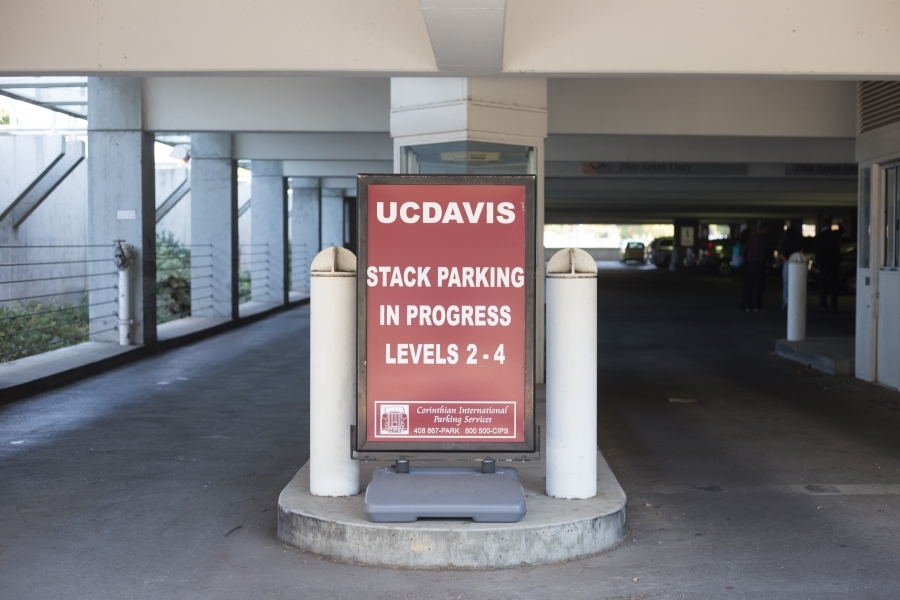
In an effort to resolve the limited parking available during peak hours on campus, TAPS recently implemented the stack parking service. Stack parking uses aisle space to its advantage by allowing students to double park their vehicles without disrupting the traffic on campus.  

Feuerstein recalled how other Davis students warned her about the parking situation on campus. To avoid this debacle, Feuerstein has debated taking UC Davis’ public transportation system, Unitrans.

“I would definitely consider taking the Unitrans if the parking situation proves too difficult,” Feuerstein said. “I would just be worried about arriving on time to everything, but I know so many people who rely on the buses.”

Feuerstein offered some advice for those struggling to find parking on campus.

“I would recommend leaving 45 min [sic] to an hour before their class starts,” Feuerstein said. “That’s what I do typically, and it gives me just enough time if I find a spot after looking around for some time and then walking to class from there.”

For those who don’t commute to school by car, second-year and evolutionary biology major Kiana Lindblad explained her daily routine for getting on campus.

I always bike to school because I know that I can count on myself to get there in time,” Lindblad said. “The buses can get super congested in the morning, which causes them to run late despite the drivers’ best efforts. Although I’ve never tried it I don’t see myself ever driving to school in the mornings.”

This year Lindblad started work as a driver for Unitrans, and offered her insight as both a driver and commuter on the Unitrans system.

“Driving the bus in the mornings I see how bad the traffic gets coming from the parking structure,” Lindblad said. “I don’t want to contribute to all the traffic and stress, so for me my bike is the best option.”

For those without access to a car or those who live too far off campus to bike, Unitrans is a viable option, Lindblad explained.

“The funny thing is I never used Unitrans before I started working for them, but honestly it’s a great resource that gets overlooked by students,” Lindblad said. “It’s included in your tuition, better for the environment and a hell of a lot cheaper than Uber[ing]. Unitrans has a bad rap because it can be late sometimes, but more often than not it gets you where you need to be on time.”

Lindblad also detailed her experience parking her bike on campus.

“Bike parking on campus can get tricky though with all the abandoned bikes,” Lindblad said. “It can be really frustrating at times when you have to park far from class when an unused bike is taking a space you could have used.”

Lindblad also offered her advice for students who struggle to find a convenient mode of transportation.

“If you’re having trouble getting to school I’d suggest getting really familiar with the bus lines, because there is often more than one that services your area,” Lindblad said. “If you live closer to campus I’d also suggest biking or walking, especially while we still have nice weather because once the rain starts the buses get packed. Plus if you walk or take the bus, parking isn’t an issue you even have to worry about.”

Phoebe Song, a third-year mathematics major, described what actions she believes the university and TAPS could take to make commuting to campus less chaotic.

“I realize that allocating funds is a whole process and this wouldn’t be a cheap project,” Song said. “Especially since it would also probably take a little longer to implement seismic safety structures or reinforcements, but expanding the parking structures to accommodate more cars would be really helpful. I would say lowering prices too, but I’m guessing that the prices are high purposely to encourage students to use alternative methods of transportation instead. But yeah just creating new parking spaces in any way, whether that be building new parking lots or expanding existing parking structures is I think the most direct way of making parking more efficient.”

Editor’s note: A previous version of this article used an offensive and ableist term to refer to the behavior of bicyclists. The word has been removed and the article has been updated to reflect this change. The Aggie sincerely regrets the error.

Written by: Sneha Ramachandran — features@theaggie.org


Humor: An investigation into professions you absolutely cannot wear rollerblades in

JEREMY DANG / AGGIE

Yes, it is as disturbing as you think

The issue of rollerblades in the workplace may not be something you hear about every day. In the movies, rollerblades are always portrayed as a slick and fun way for waiters and waitresses to quickly roll from table to table while perfectly balancing stacks of dishes in their gangly arms.

However, cultural documents like these do not show the darker side of rollerblades in the professional world. After lengthy investigations into several professions in which rollerblades have been used and abused, The California Aggie’s undercover reporters have discovered a grim reality.

At many hospitals throughout the country, medical professionals have experimented with using rollerblades. In the early stages, this seemed to be helpful in emergencies when patients needed to be quickly transported to the operating room. However, there have been many major problems with this system, including high-speed hallway collisions between stretchers being moved at over 25 miles per hour.

On one occasion, after Dr. Shay Kiyands completed his typical pre-surgery routine of stretching, washing his face and snorting some cocaine, he glided over to the operating room on his rollerblades, but forgot to take them off before beginning to operate. In the middle of the surgery, Dr. Kiyands leaned forward for a better angle, causing his left foot to slip backwards, running over the foot of another surgeon, who then accidentally punctured the patient’s left lung with his forceps. The patient was sedated and never informed that this occurred. Several surgeons were later overheard joking that the patient “probably wouldn’t ever notice since he chain-smokes and has emphysema anyway.”

Meanwhile, at a small funeral home in Nebraska, a large portion of the regular funeral-going crowd were taken aback when the funeral home director Abe Rasif entered the venue on rollerblades to distribute the obituaries and programs. While Rasif claims that it brings some “lightness” and “fun” to these “sad, dull and boring” events, attendees disagree.

“It seems inappropriate and just tonally-wrong,” said Ida Nodeudedgi, a local funeral crasher. “But perhaps I’d like the look more if he wasn’t wearing a cheap suit.”

Lastly, it seems that wearing rollerblades as the First Lady could potentially be a disastrous PR move, especially since Melania Trump is the most bullied person in the world.

“We wanted Melania to wear rollerblades at one of her next public appearances so she could send the message to kids that it’s important to strike a balance between being active outside and cyberbullying people on social media, but we know the Fake News Media would just criticize her,” said spokesman Ry Chizaz. “While we’ve now been advised against it, we remain confident that the First Lady would rock her rollerblades, whether visiting hurricane victims, detained migrant children or impoverished African children.”

We are also in possession of thousands of documents from our sources that detail the suspicious use of rollerblades by roofers, DMV workers, coal miners, faith healers, flight attendants, fisherman, lobbyists and clowns. However, we’ve received cease and desist letters from legal representatives within each of these industries compelling us to not publish our findings.


Written by: Benjamin Porter — bbporter@ucdavis.edu

(This article is humor and/or satire, and its content is purely fictional. The story and the names of “sources” are fictionalized.)

(Flu) shots, shots, shots, everybody!

CAITLYN SAMPLEY / AGGIE

Flu vaccine protects you, others

Last year, 80,000 people in the United States died from the flu and its complications. This marked the highest death toll from flu-related deaths in the last 40 years. A seasonal influenza vaccination is important for both personal and community health and now is the time to get it.

Although last year’s flu vaccine wasn’t as effective as the medical community hoped it would be, it still prevented an estimated 5.3 million influenza illnesses, 2.6 million influenza-associated medical visits and 85,000 influenza-associated hospitalizations, according to the Centers for Disease Control and Prevention.

Based on the flu strains that have been detected so far, the flu this year is expected to be milder and the vaccine more effective. However, an annual flu vaccination is still recommended by experts. The vaccination is the best way to help protect against the flu and its related complications, which can include pneumonia, stroke and heart attack.

The flu vaccine also has other benefits, including reducing the risk of flu-related hospitalization and the severity of illness in people who get vaccinated but still contract the strain. The annual flu vaccination also helps protect women during and after pregnancy against flu-associated acute respiratory infection.

The seasonal flu vaccine, like all other vaccinations, maintains herd immunity. Those with compromised immune systems and newborns who cannot get the seasonal flu vaccine depend on others to protect them.  

Any myths about the negative effects of the flu vaccine are just that — myths. The flu vaccination does not cause the flu, Guillain-Barré Syndrome nor, in any way, Autism Spectrum Disorders. Vaccines cannot be replaced by healthy hygiene and sanitation habits, though proper handwashing techniques and covering your cough are nonetheless important. Even if you’ve already had the flu already this year, it’s still pertinent to get the seasonal flu vaccination.

Flu season hit its peak last year in mid-February. The CDC recommends getting the flu vaccination by the end of October, but even if you choose to get vaccinated later, the vaccine remains beneficial through the season.

Getting the flu vaccine doesn’t have to be a hassle. UC Davis students and faculty are eligible for free flu shots. On Oct. 23 and 25 from 10 a.m. to 2 p.m., the Staff and Faculty Health and Well-Being Program and Healthy UC Davis are hosting a flu shot clinic in the lobby of the Cowell Building. No advance registration is required and shots are administered on a first-come, first-serve basis. Students, faculty and community members can also receive their free flu vaccine at pharmacies like Rite-Aid and CVS for free with most major insurance providers. Most hospitals and primary care physicians’ offices accept walk-ins for low-cost or free flu vaccines.

The Editorial Board encourages students to get their vaccine in order to protect themselves and those around them.

Written by: The Editorial Board

Clash with top-ranked UC Irvine ends in overtime draw for women’s soccer

RAUL MORALES / AGGIE

Goalkeeper Alexis Smith excels as UC Davis women’s soccer ties the undefeated Anteaters

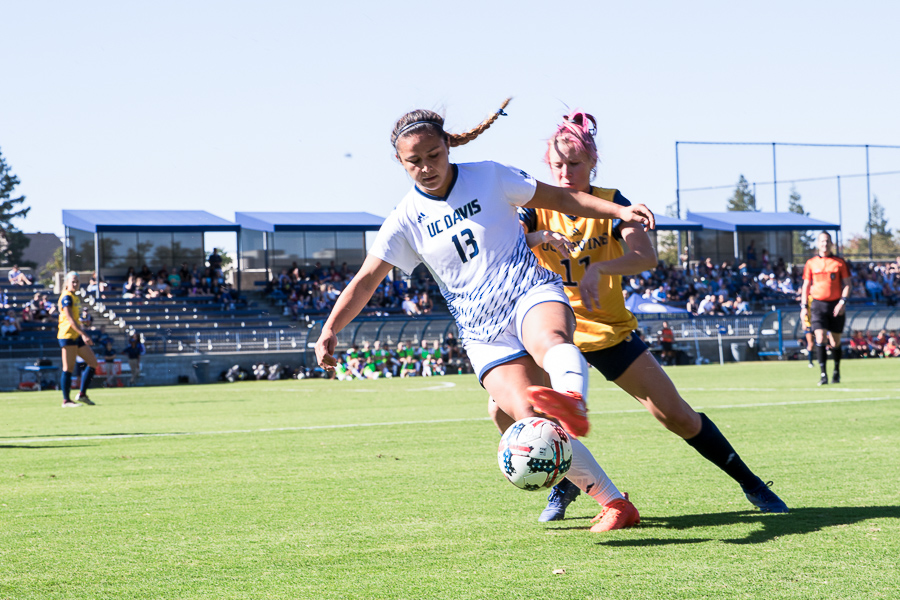
The UC Davis women’s soccer team took on a gritty UC Irvine team on Sunday, resulting in a double overtime draw. In league play leading up to the game, the Aggies carried a 2-2-1 record, while the UC Irvine team remained undefeated at 3-0-2.

The first half of the game started out slow, but with 18 minutes left, UC Davis goalkeeper Alexis Smith made an athletic save, setting up a sharp Aggie counterattack. The Aggies came close to scoring numerous times, with efforts spearheaded by redshirt sophomore Alicia Sloss, but were ultimately unable to capitalize. Aside from a yellow card committed by UC Irvine, the first half ended with little noise.

The Aggies dominated possession time in the first half, but the Anteaters did not concede easily. After controlling the pace for part of the first half, the Anteaters were able to fire off numerous shots, but couldn’t find the back of the net.

Head Coach Twila Kaufman commented on what she thought of her team’s performance given the stiff competition that UC Irvine provided.

“Obviously, we’re happy to keep the clean sleet. That’s a big deal against [this] team,” Kaufman said. “I think three out of their last four games, [UC Irvine] won it in the last 30 seconds of the game, so it’s good to put up a performance like that together for the whole game.”

Smith was able to come up with many saves in the 13th and 25th minutes, including one on a dangerous free kick, to keep UC Davis in contention. Senior midfielder Ari Zamora picked up a yellow card with 22 minutes remaining, but it did no harm as the defense cleared the ball away consistently. The scrappy play may have even fired up her team, as the Aggies went on one last run but were still unable to yield a goal.

The game then went to two 10-minute overtime periods. Both teams had numerous chances, but eventually the buzzer sounded with a blank sheet still showing on the scoreboard.

“[We had to] rotate six times through the back line. It wasn’t a stable back line, it’s a really big deal,” Kaufman said. “I think our team is disappointed that they didn’t get the win, which is a good thing – they’re gonna be hungry for the next game.”

Kaufman stated that, although she is satisfied with the game’s result, she knows that her team is capable of much more.

“I think this team is actually capable […] of scoring three goals a game, which […] is an abnormality in soccer. It’s a low scoring game, typically,” Kaufman said. “But, this team is capable of that so I think we’re inching closer to that. We just need to turn some of those ‘one step to the left’ or ‘one inch to the right’ is probably a goal.”

The Aggies will travel to take on the Cal State Northridge Matadors on Sunday. UC Davis’ next home game is set for Oct. 25 against CSU Long Beach.


Written by: AJ Seymour—sports@theaggie.org


Volleyball bounces back with a pair of wins

RAUL MORALES / AGGIE

Aggies more confident in Big West chances

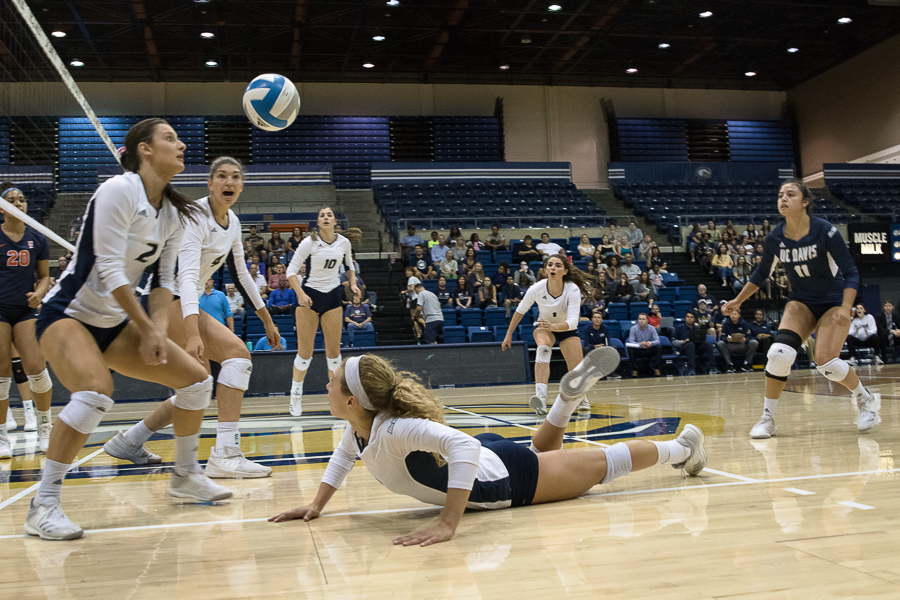
After a two-week road campaign in which UC Davis women’s volleyball lost three of four matches, the team returned to Davis to beat UC Riverside last Thursday in a closely contested five set match, 3-2, before cruising to a straight set victory against California State Fullerton, 3-0, on Saturday.

With this, the Aggies finished the first half of conference play 11-9 overall and 3-5 in Big West play. Head Coach Dan Conners said this is a positive development given the Aggies’  shaky start to conference play.

“I think we’re a really good team and we weren’t playing up to the level we are capable of,” Conners said. “This weekend gives us the belief that we’ll continue to perform at that level.”

The Aggies dropped the first two sets to UC Riverside by a margin of three points, 25-22.

Facing a potential loss, the Aggies found their groove in the third set after a series of UC Riverside attack errors off blocks from junior opposite Nicola Moore, freshman middle blocker Josie Ough and senior outside hitter Brianna Karsseboom, 5-1. The Aggie defense hamstrung the UC Riverside attack to a .026 average.

Redshirt freshman opposite Leonie Strehl hit a perfect five kills out of five attempts in the third set. Strehl believes it wasn’t so much a change in momentum, but rather a matter of the team syncing up.

“I think we just tried to get our mind set on the same page, we weren’t playing bad volleyball,” Strehl said. “Communication is key for us, we just played our game and stayed calm, when we stay calm and focused everyone does their job and we all come together.”

Moore swung 10 times and landed seven kills for an average of .700 in the fourth set. She landed more than half of her kill attempts at .519 for the match, a career high for the junior who was forced to sit out her 2016 and 2017 seasons due to injury.

For Strehl, a .333 hitting average was also a career high. After a redshirt season last year, Strehl felt comfortable with her role.

“After my redshirt season last year with a lot of growth and learning,I can really feel that all the hard work is really paying off,” Strehl said. “It’s exciting to connect with the team and finally be able to make a difference on the court.”

The Aggies were able to carry their aggressive play over to Saturday’s match against Cal State Fullerton; they took the match in straight sets without much pushback from the Titans, who fell to 6-14 overall and 0-6 in Big West Conference play.

UC Davis volleyball uses a three-setter system, according to sophomore setter Paloma Bowman. Senior setter Maddie Merlino did not play in either game. When asked why, Conners noted he could not comment on the matter. Without Merlino, the team relied on setting from Bowman and freshman setter Jane Seslar.

“There’s a lot of rotation, and if you don’t perform, you’re getting taken out. Now there isn’t that space for someone to get taken out, so you have to perform,” Bowman said.

Bowman said Merlino’s absence on the court raised the stakes, but hasn’t had too much of an impact on the team.

“So there’s a little more pressure, but I don’t think it changes the dynamic much. There’s just a different type of urgency, you have to perform all the time,” she said.

Bowman felt confident that the team worked out its kinks and believes the team is ready to move out of the sluggish start of Big West Conference play.

“It feels good, I think there’s just so many things that you have to work out in terms of chemistry, and I think we were finally able to do that this week,” Bowman said.  

Moving forward, Karsseboom has a game plan for the second half of conference play and thinks the Aggies will be better prepared.

“I think we’re going to have a really aggressive mentality going into the second half, since we have played these teams before, we know what they do and what they’re capable of,” Karsseboom said.

UC Davis will face UC Irvine on Saturday at 7 p.m. at the Pavilion. The Anteaters, ranked No. 2 in the conference, beat the Aggies in straight sets last month and held the Aggie hitting average to .040.


Written by: Bobby John — sports@theaggie.org


UC fails its workers again

CAITLYN SAMPLEY / AGGIE

Editorial Board supports AFSCME strike

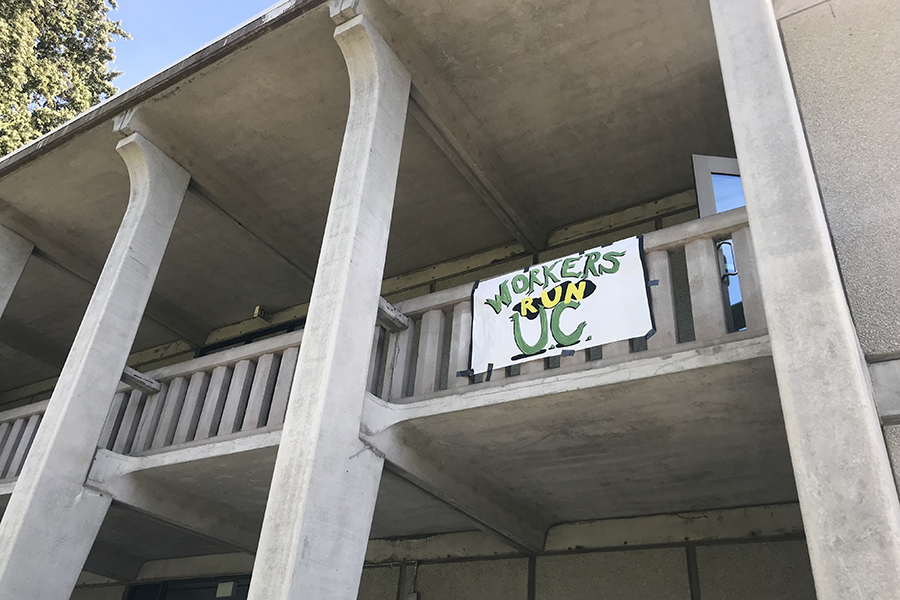
The American Federation of State, County and Municipal Employees 3299 — the University of California’s largest employee union — has once again voted to authorize a strike after simple requests for healthcare benefits and an increase in wages were repeatedly denied. The latest strike is planned on UC campuses for Oct. 23 to 25.

AFSCME 3299, which represents over 25,000 employees across the 10 UC campuses, protested last February. Workers picketed at the ARC and held signs that read: “UC Regents Survive on MY SALARY.” AFSCME went on strike May 7 to 9, authorized by a majority vote of 97 percent, to get its point across. The UC registered nurses, among several other healthcare professionals, also went on strike in solidarity with the AFSCME workers. After three long days of picketing, the UC’s last-and-best offer was a “3 percent across-the-board wages increase and a pro-rated, lump sum payment of $750,” according to an article by The Sacramento Bee. Unsatisfied, AFSCME 3299 declined the offer.

The matter is simply that the UC isn’t giving workers the proper benefits and salaries needed to make a living and provide for their families. Employees are forced to do a significant amount of physical labor just to barely scrape by.

The UC Office of the President, however, has fired back at AFSCME 3299, arguing that AFSCME’s only concern is money. And since many hospital and medical center workers are AFSCME members, UCOP has argued that a strike will unfairly hurt patients. This has been an ongoing dispute for many years and has become even more prominent since the May strike. In a 2013 statement released by UCOP during the last round of bargaining, AFSCME was “urged to show more flexibility, as UC has, and return to the bargaining table.”

Ironically, the UC has not been very flexible in its workers’ benefits. Its last offer was 3 percent annual raise, which can barely keep up with the rising costs of living. Claire Doan, a UC spokesperson, said that workers already receive good health care benefits and wages. Furthermore, she stated that the UC could not meet the demands of a 6 percent annual raise and that all AFSCME has done is “hurt care for our patients and our students,” according to an NPR news release.

Rather than giving AFSCME workers the 6 percent increase that they undoubtedly deserve, the UC lowered its final 3 percent offer, giving AFSCME only a 2 percent annual increase. Not only was this a slap in the face for AFSCME, it was also a blatant attempt on the UC’s part to maintain power and will AFSCME workers to continue to protest for their rights.

In addition, AFSCME has raised many concerns on outsourcing and pay disparities for women and people of color within the UC. Workloads have increased for remaining workers after others are injured, retire or quit. Pay has also been reduced while health care premiums and retirement ages have increased. Davena Woods, a senior custodian at UCLA and a member of the union’s bargaining team, has been one of thousands to fall victim to the unjust worker treatment, as she lives “paycheck to paycheck” and is “tired of just surviving,” according to a Q&A released by California Magazine.

The Editorial Board is in solidarity with AFSCME and all those who have protested to obtain the wages and benefits they deserve. The UC cannot function without its workers and thus its workers’ demands must be met.

Written by: The Editorial Board

Letter to the Editor: Administration counters The Aggie’s editorial criticizing UC Davis response to anti-Semitic fliers

CAITLYN SAMPLEY / AGGIE

To the Editor:

Re “UC Davis, ECAC fails Jewish community” (editorial, Oct. 15):

There are several misstatements in this editorial, it contains factual errors and it carries an accusatory tone. Campus leaders welcome constructive criticism, but the administration is not your enemy.

Chancellor Gary May released his statement about the fliers just after 2:30 p.m. on Oct. 8, expressing in clear language his distaste for the content of the fliers that had been posted around campus that morning. His statement unambiguously called the fliers anti-Semitic. We’d hardly call that “disorganized.” The statement was posted online, shared with media and distributed on social media channels, which are the fastest and most effective ways to get a message to a community.

As for grammatical errors, you didn’t include any examples. There was indeed an error in the link, but that was corrected within an hour of the statement being posted. The link included information about how to reach out for mental health support and counseling.

Chancellor May heard from students, faculty, staff and the broader community about the fliers. Many people were supportive and grateful, including the Consul General of Israel, the Academic Engagement Network, Hillel International chapters at Davis and Sacramento and parents. Some were also critical, and the Chancellor responded promptly to every email or letter he received (you linked to one of his responses). In each of these responses, he noted that he has invited the Anti-Defamation League to campus for a town hall and for smaller meetings. In the meantime, the Chancellor reached out to many in the Jewish community and offered to meet in person with individuals such as ASUCD President Michael Gofman and Aggies for Israel President Dana Benavi.

The UC Davis police department has been investigating this incident and has made it a priority. To say that the administration is not doing all they can or that they are responding “haphazardly” is an unfair characterization of what has happened and continues to happen to address this issue. Your editorial comes across as “us-versus-them.” We are all part of the same community; we are all impacted by incidents that hurt anyone in our community.

You write that the Office of the Chancellor sent a campus-wide email during AFSCME’s protest last spring. That is incorrect. Prior to union actions, a letter to the community was distributed and posted by the Vice Chancellor of Finance, Operations and Administration. The Chancellor sent a message to the community after union actions had ended.

The Chancellor has been consistent in how and when he issues statements when anything heinous happens on campus or to anyone in our community, including in response to the “it’s okay to be white” fliers that were distributed last year. It’s a stretch to compare expressions of intolerance related to anti-Semitism or white supremacy or other hate-filled messages with campus-wide Picnic Day messages.

When offensive incidents like this occur, there is a natural tendency to want to assess blame. Let’s try to direct the blame where it belongs: with the anti-Semites who posted the fliers. We all want a healthy, respectful climate in which to live, study and work. The last statement in your editorial is one we can agree on, and one which Chancellor May stressed in his statement as well: “The campus community must know that anti-Semitism of any kind will not be tolerated.”

Written by: Dana Topousis

The writer is the chief marketing and communications officer at UC Davis.

Enchanted Cellar is a hidden Halloween emporium

0
VENOOS MOSHAYEDI / AGGIE

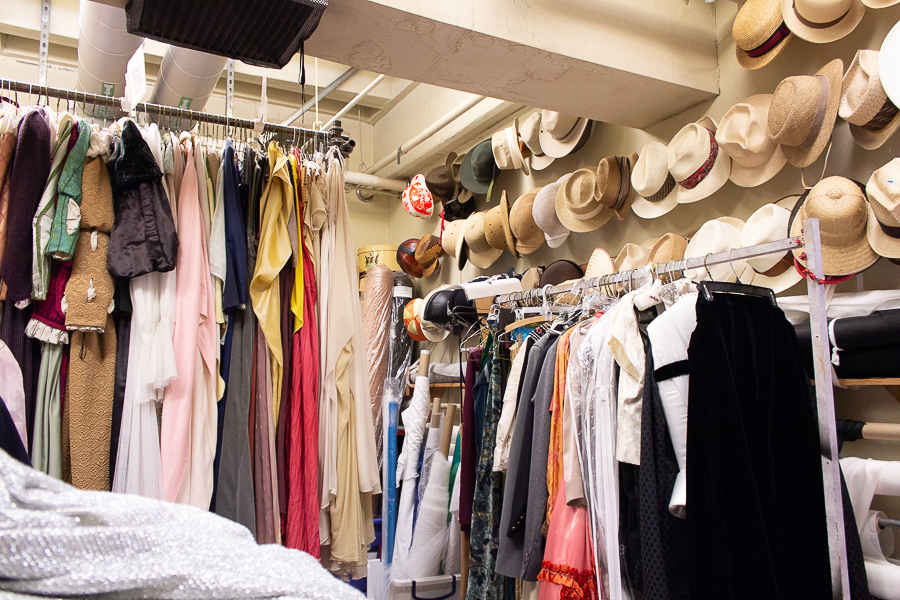
UC Davis Theatre department offers a wide variety of costume rentals for Halloween

With Halloween on the horizon, students are awaiting the moments when they can freely express themselves and who they are within, whether that be a ghost, a meme or a historical figure. For those who are filled with glee at the idea of becoming someone (or something) else for a night, the Department of Theatre and Dance’s Enchanted Cellar offers accessible costumes for UC Davis students to achieve their spooky dreams.

Fourth-year human development major Brooklyn Sofley explained why Halloween is her favorite time of the year.

“Halloween is the only holiday that lets you freely express yourself,” Sofley said. “If I were to walk around dressed as Guy Fieri on any other day of the year people would question me, but on Halloween it’s embraced and appreciated.”

If you’re lacking creativity or DIY skills this Halloween, the Department of Theatre and Dance has a solution for those looking for a costume of theatrical quality as opposed to Halloween store quality. The basement of Wright Hall is home to one of Davis’ hidden treasures: The Enchanted Cellar.

Roxanne Femling, an expert costume designer and Davis’ very own costume shop director, explained her role in the Enchanted Cellar.

“I take care of all the staff and students including the undergraduates and MFA students who come in to do costume design,” Femling said. “We are basically training them to work in a costume shop in terms of design and helping the [students] navigate designing costumes for a show.”

The idea of costume rentals started back in 2004 and has been an ongoing tradition upheld by the department. Femling explained how a good portion of the costumes are actually designed and put together by students of the department.

“We’ve been renting out costumes for 14 years,” Femling said. “People are always surprised when they come down to the basement, which is why we named it the ‘Enchanted Cellar’ because a lot of people don’t know that we’re even down here. It’s fun watching people think of something crazy and different and it helps the students and faculty get creative.”

Since last year, the Enchanted Cellar began exclusively renting out kits for Halloween-goers. Femling explained how the kits contain a variety of different props and makeup to make the costumes as intricate as possible. Students and faculty together researched different aspects of the costume and tried to implement those features into the kits.

“With our pre-made kits you get props such as wands and glasses for a something like a Harry Potter costume,” Femling said. “On average our kits start at $35 which includes everything from the wig all the way through the shoes and everything in between, our highest price would be about $65, and these fees also include dry cleaning fees.”

Femling detailed the most popular costumes that have been rented out over the past few years.

“A lot of people like the Marie Antoinette and King Louis XVI as a couples costume,” Femling said. “We also rent out a lot of Peter Pan and fairytale costumes, fairies and pirates. We did a whole Greek section as well as ghouls and goblins and next year we plan to do a section on villains! We do try to keep up with what’s with the media, so Game of Thrones costumes have been very popular and we actually built a set for that.”

These costume rentals are not only for students alone. Femling explained how a lot of people throughout the Davis community come down to visit the cellar.

“We get a lot of Davis students who rent from us and we also do get a good amount of faculty and staff members and even maintenance workers who rent from us which is always fun,” Femling said. “We even have people come down from the chancellor’s office and they always say ‘I didn’t even know this was here!’ ”

This year Halloween rentals will start October 17 and continue until the following Friday. The Enchanted Cellar will be open from 11 a.m. to 6:30 p.m. from Wednesday till Friday, but anyone is welcome to make an appointment by contacting the Enchanted Cellar. Renters who purchase a kit this Halloween can keep the costumes until November 2. Aside from Halloween, the community is welcome to rent out costumes throughout the year as long as an appointment has been made at least 24 hours in advance.

“Anyone can walk in and look at kits,” Femling said. “We have a room open for people to try things on. If they don’t see anything they like we are more than happy to put a kit together and make an appointment so we have more time to get you what you want.”

For more information about the Enchanted Cellar visit the website or the Facebook page and book your appointment for your costume needs this Halloween.   


Written by Sneha Ramachandran — features@theaggie.org


Police Logs

SHEREEN LEE / AGGIE

Some ubers are just that nice

September 29

“Reporting party’s friend is refusing to get out of the Uber that they took home.”


September 30

“White male adult tried to open the back screen door, and was tampering with the front door, male subject urinated and defecated in the back patio and then rubbed his butt on the window.”


October 1

“Can hear unknown subject on the roof of his house with possible running water and hose being turned on.”

“Reporting party and his 3 housemates left apartment for approximately 30 minutes and just returned and advised they are unable to open the apartment door — reporting party thinks unknown subject is inside and locked them out.”


October 3

“Two males were walking down the street and jumped onto two parked vehicles parked at reporting party’s location and threw trash cans into the street and are now westbound on Russell passing this location […]”


October 4

“At west gate — male standing at gate trying to get in.”

“Male subject driving a dark grey Toyota past half hour — stopping and then going, driving slow then put the vehicle in reverse and then doing donuts.”


October 5

“Cones knocked out of line and causing hazard; some cones are flattened/broken.”

“50 people in the park.”

“Hammering type noise — reporting party spoke with the neighbor who laughed at him.”


Filed complaints charge UC with illegal, union-busting activity

ALEXA FONTANILLA / AGGIE

UC may have repeatedly violated state law, UC denies charges

The University of California is facing allegations from unions and complaints from the Public Employee Relations Board (PERB) regarding violations of California state law.

John de Los Angeles, a spokesperson for the American Federation of State, County and Municipal Employees, which represents over 24,000 UC employees, commented on the union’s allegations in light of the U.S. Supreme Court’s ruling on the case AFSCME vs. Janus which effectively weakened the power of labor unions.

“The university, after the Janus decision, had been sending out mass communications to employees about the Janus decision,” de Los Angeles said. “Essentially, what they were handing out was instructions on how to drop your union — very much in violation of the law.”

De Los Angeles referred to AB 119 and SB 285, both of which were passed last year. AB 119 required public employers to provide unions “mandatory access to […] new employee orientation,” while SB 285 forbid public employers “from deterring or discouraging public employees from becoming or remaining members” of unions. Both laws were placed under the jurisdiction of PERB, a state agency which adjudicates issues between public employers and their employees.

Felix de la Torre, PERB’s general counsel, likened the agency to an “independent court system for labor relations…[that enforces] the state’s labor relations statutes” for public employers only.

AFSCME took grievances to PERB about the UC’s alleged violation of these state laws. In response, PERB filed complaints against the UC.

In this case, what happened was UC sent out a communication to all of its representative employees at the end of June after there was a Supreme Court decision involving the rights of employees to join or support unions, and it did so without complying with the law,” de la Torre said.

Danielle Smith, a media relations officer for the University of California Office of the President, said via email that “the University of California disputes the union allegations and will address them in the proper forum.”

De la Torre explained why the agency believes the university was in violation of state law.

“[The UC] didn’t ask the unions if they wanted to meet or confer, and it didn’t allow them to send out a simultaneous communication with [its] communication,” de la Torre said. “We agreed that, if those allegations were proven true, UC will have violated the state law on a number of occasions. I say that because UC not only sent it out initially in June, it continued to send things out in different formats throughout September.”

According to de la Torre, the next step following the filing of formal complaints would b to hold trials at PERB’s administrative hearing division.

“Those trials are to allow the parties an opportunity to present evidence to support the allegations and to give UC the opportunity to defend itself against these allegations,” de la Torre said. “Those are scheduled now for mid-November, and those are before an administrative law judge.”

This entire process could take a year or more because there is an appeal system involved.

“Once the judge issues a decision, either party could appeal to the five-member [PERB] board here appointed by the governor, which acts like an appellate body,” de la Torre said. “They’ll review the judge’s decision and find whether they agree with the judge or they don’t, and they’ll write their own decision. Then, that could eventually be appealed to the state’s appellate courts, so it could be a long road before we get to the final resolution on this matter.”

PERB went to court last week in an attempt to get an injunction against the UC.

“UC was continuing to violate the law despite the fact that we’d issued those complaints,” de la Torre said. “The court today ruled to deny that request, which is unfortunate, because one of the problems that PERB is going to face in this case is that, assuming the unions show that UC did violate the law by circulating these communications, it’s difficult to remedy after the fact.”

If the allegations against the UC are true, repercussions will potentially be complicated because employees cannot unread communications that are allegedly continuing to circulate.

“There have been numerous examples where UC has continued to circulate the letter,” de la Torre said. “When we were in court on Monday, UC didn’t deny the violations, it just argued against the order, claiming it had now gotten itself under control.”

AFSCME represents service workers and patient care workers throughout the UC system. De Los Angeles said he believes it’s important for students to be familiar with current and past allegations against the UC.

“The university is proposing to let health care premiums rise, they’re proposing to lift the retirement raise, they’re proposing to hold employee wages flat, they’re excluding outsourcing from the conversation to allow for more outsourcing,” de Los Angeles said. “These things represent a significant cost-savings for the university and at the same time that they’re doing this to workers, they discuss tuition hikes year after year.”

De Los Angeles believes there’s a common thread between the way the university treats its workers and the way it treats its students.

“While they’re asking students to possibly pay more and workers to accept less, they’re pocketing the extra money,” de Los Angeles said. “It’s really important to take a hard look at what’s happening to these workers because they are very much in line with what students are going through. Students are having a hard time affording education, there’s a high level of food insecurity, and this is all coming from the same source.”

Written By: Sabrina Habchi  — campus@theaggie.org

Experience Non-Transferrable

0

What it’s like being a transfer student at UC Davis

UC Davis admitted roughly 10,000 transfer students for the 2018-19 academic year. For many newly transferred students, most of whom have previously attended a junior college, learning the ins and the outs of the UC system can be a challenge all on its own. But then you also have to factor in housing, transportation, meal prepping and a multitude of other often stress-inducing elements pulled from the ever-so-mountainous pile of collegiate obligations. For some students, the transition from a junior college to a four-year university is a walk in the park. For others, it is nothing short of a nightmare.

UC Davis harbors a robust population of transfer students. In fact, nearly one-third of the entire student population is comprised of students who have transferred. One major roadblock that these students often encounter is unfamiliarity with the fast-paced nature of the quarter system. Natalie Boone, second-year transfer student and psychology major, said that she was slightly overwhelmed with just how rapidly a quarter can fly by.

“I realized when I got here that the pace was a lot quicker,” Boone said. “I signed up as a clinical nutrition major, which is a B.S. degree, and I still had some chemistry classes. I will compare those chemistry classes to the same chemistry [classes] I took at community college. I was an A or B student at community college, but when I first started here I was a B or C student. In the semester system you have some time to breathe, whereas the quarter system goes by a lot faster.”

Sara Abou-Adas, first-year transfer student and neurobiology, physiology and behavior major, recalled feeling not only surprised by the rigor of coursework at a UC campus, but the difficulty of life outside of classes.

“The first week I was really homesick and I kind of didn’t even want to be here because I didn’t really know the bus routes or anything like that,” Abou-Adas said. “Moving away and living on my own, I feel like I’m kind of behind and everyone [else] has already done all of this.”


This experience is not unique to Abou-Adas. In efforts to combat these kinds of feelings and ensure that students have a relatively easy time acclimating to campus life, UC Davis offers a variety of clubs, organizations, outreach programs and resources to its students.

These resources can, however, be obscure to newly transferred students. Abou-Adas points out a major flaw that many organizations and clubs often overlook when trying to recruit students — accessibility.

“All of my classes are by the Silo, and I heard that most of the tabling is done here [at the Memorial Union], so I don’t even really get to see anything of that stuff,” Abou-Adas said. “All of the [organizations] that I am going to join is through word-of-mouth, not from a club approaching me.”

Daniella Aloni, a second-year transfer student, communication major and current ASUCD senator, shared these sentiments regarding the success (or lack thereof) of UC Davis’ transfer-student outreach programs, saying that the school can definitely do more to educate students on the resources that are available to them.

“I feel like there are efforts that have been made to inform incoming transfer students about these various resources, clubs, organizations and so on but there is always room for improvement,” Aloni said.

Aloni extended her point by illustrating frustrations expressed by other transfer students about the school’s inability to create a campus that feels inclusive toward transfer students.

“To this day, I’m surprised by the amount of things I didn’t know about on our campus, and continue to find out about every day,” Aloni said. “I’ve heard complaints from other transfer students about how little they knew when coming to the campus. For the most part, from what I have noticed and been told, anything a student finds out about is from other students, or their professors who mention things in lecture.”

According to Aloni, college is only as good as you want to make it. Aloni advised all transfer students to go out of their comfort zones during their time at university and take the initiative to seek out any resources necessary. Aloni also stressed the importance of experimenting with new activities, classes and even friendships, because doing so allows students the opportunity for professional, social and personal growth.

“A piece of advice I’d like to share with any incoming or current transfer students is ‘try everything,’” Aloni said. “We have such a short amount of time on this campus and it flies by. This is your time to do anything that you have wanted to try, so don’t hold back. You are meant to be here. You earned this […] and deserve to be on this campus just like anyone else.”

Written by: Emily Nguyen — features@theaggie.org

A meaningful bicycle experience

JAMIE CHEN / AGGIE

Donations needed for The Bike Campaign

The Bike Campaign, a nonprofit organization in Davis, aims to provide people with the opportunity to use biking as a means of transportation. The organization seeks out bike donations throughout the year but particularly during the fall when people are settling into their new places and may not need their bicycles anymore.

Maria Contreras Tebbutt, the director and founder of The Bike Campaign, explained why she created the nonprofit.

“There are schools in our county where there are very few kids who ride their bikes to school in Woodland,” Tebbutt said. “As Davis prides itself as a bike friendly community, I would like to share that wonderfulness with all our neighbors. There was a hideous amount of traffic around schools, and I knew that the economic picture of families who attend these schools is pretty dire.”

Tebbutt indicated that the organization accepts bicycle donations year-round, but it is looking for donations at this time especially because many students leave their bicycles on campus after they stop using them.

“We are always looking for bikes for donation, especially in certain times of the year like when students are thinking about moving in August,” Tebbutt said. “They don’t have a bike rack, so what are they supposed to do with a bike? Often times, bikes get abandoned, and we’d like to offer a much better alternative. Wouldn’t it be wonderful if you donated your bike and, next semester, a student who cannot afford a bike is presented with a free bike? On top of that, they can get all the education and encouragement and support they need to have a great riding experience.”

Marlene Andrade, a third-year linguistics major transfer student at UC Davis, first came to Davis without knowing much about bicycling. She got the help she needed from The Bike Campaign.

“I came to UC Davis during Summer Session II,” Andrade said. “I was in a class called Healthful Living (PHE 44), and in this class [Tebbutt] came to present to us about safety. Since we’re more about healthy living — psychological and mental — that day, it was more about physical fitness. Maria came over from the bike campaign to talk about biking. I got to know her a little more as well as the organization.”

The Bike Campaign also has a bike buddy program so that people like Andrade can recieve bike education. After joining the organization, Andrade was given a bike buddy, Sarah Davis, a volunteer at The Bike Campaign.

“It’s been awesome so far, and I’m new at [being a bike buddy],” Davis said. “It’s been fun to share a little bit of knowledge about bicycling with people who don’t have that much experience. I’m really impressed with people who come to Davis who take that on because it could be quite daunting.”

Andrade elaborated on her decision to join and get assistance from a bike buddy.

“I wanted to join, and the reason why is because I came from a city where people mostly commuted,” Andrade said. “I didn’t have knowledge and experience about biking. I usually bike for fun, but I wanted to know a little more. There are so many intersections around the city, and I knew that I needed a bike buddy.”

Tebbutt noted the importance of bicycling and promoting bicycling education.

“Sometimes people don’t equate the fact that we are feeding vehicles thousands of dollars to the point that we do not have money to feed ourselves,” Tebbutt said. “I wanted to help alleviate that kind of situation.”

Tebbutt also stressed the importance of tangible experiences when it comes to learning about how to use a bicycle properly.

“Just because you know how to ride a bike does not mean that you are comfortable with riding a bike in traffic,” Tebbutt said. “We have 10 events scheduled where we work directly face-to-face with UC Davis students. You may be a good driver but you may be terrified of riding a bike in traffic. This is something that has to be learned and practiced. An important ingredient is that the experience needs to be shared.”


Written by: Stella Tran – city@theaggie.org


Humor: Student with part-time job and two internships, member of four clubs and taking 21 units: “I have too much free time”

JEREMY DANG / AGGIE


For this student, “senioritis” comes vaccinated

Everyone knows students have it difficult this time of the year. For some, it’s the first time they’ve ever lived away from home, met hundreds of people in a single day or seen a clique form and exclude them completely, leaving them utterly alone and hopeless. For others, it’s the annual occasion when they decide they had a good run, but this year is just not it, chief.

For one, and that one being fourth-year neurobiology, physiology and behavior, computer science and political science triple major and well-known annoying tryhard Rebecca Griswold, this quarter has wrought an unfortunate reality: She just has too much free time.

“The weekend before school started, I was doing my weekly calendar reorganization, which is usually my favorite pastime,” Griswold said. Her hands wrung nervously as she spoke, both legs restlessly jumping up and down with each syllable. “After putting down my classes —  I’m taking 21 units by the way, in case I didn’t already tell you (she did) — and my two internships at the UC Davis Health and Wellness Center and a local tech startup, then adding my hours as a waitress at Sophia’s and of course all my clubs and honor societies I’m part of —”

Unfortunately, at this point in the interview, our tape recorder mysteriously stopped working for the next two hours. We were unable to write down every single detail of Griswold’s extensive schedule, including her specific study time allocations and exactly how much time she allows her boyfriend to kiss her while she studies organic chemistry. Oh no! Too bad!

Fortunately, our recorder miraculously started working again as she finally started telling us about what we originally asked, as it concerns her free time.

“— but anyways, after I got all that in order, I took one final look at my work,” Griswold continued. “That’s when I realized there was this hulking, hour-long gap on Wednesdays from 3 p.m. to 4 p.m. A full hour of time when I have nothing going on. I just don’t know what I’m going to do with myself. It’s just way too much extra time.”

Extra indeed.

Griswold’s horrendous situation obviously warrants plenty of sympathy from her friends and coworkers.

“Um. Ok, we’re talking about Rebecca Griswold, right?” asked Kat Perkins, Griswold’s manager. “Alright, yeah, so when Rebecca comes into work, she goes into the bathroom and screams about how stressed she is for about 20 minutes. If anyone tries to come in to console her, she yells something like, ‘SERIOUSLY IT’S NO BIG DEAL BUT THE STRUGGLE IS REAL’ until they leave. So. Yeah. I’m going to say that she probably needs the free time more than anyone.”


Written by: Conner Shaw — cjshaw@ucdavis.edu
(This article is humor and/or satire, and its content is purely fictional. The story and the names of “sources” are fictionalized.)