55.4 F
Davis

Davis, California

Sunday, December 21, 2025
Home Blog Page 495

Cooking for yourself as a hungry college student

0
ALLYSON KO / AGGIE

Students offer support on how to stay fed while managing school, work and clubs

Transitioning from the dorms to living off campus is a change for many students. Students have the option to live with their close friends, have their own bathroom and live wherever they choose. However, some note that they soon find stress in the fact that they no longer have the dining commons readily available to them. Cooking for each meal can take a lot of time out of a student’s busy day, and with a full workload, spending time cooking can be an issue with a student’s schedule.


Justine Saruca, a fourth-year design major, found ease in cooking by using cooking gadgets to cut down on her time spent in the kitchen.

“Sometimes it’s too difficult for me to cook at home with such a busy schedule,” Saruca said. “I have an air fryer and a steamer that I use a lot. My steamer helps me steam food like vegetables and dumplings. It’s really easy to use and it only takes about a minute to cook. My air fryer is really helpful because I can just work on homework while I wait for my food to cook and it’s pretty healthy too. I mainly utilize that when I don’t have as much time to spend cooking.”

Other appliances, like a sous vide or crock-pot, can be used to cook food even when students are away from home. Many of these appliances can be turned on remotely using an application on a phone. They help students cut down on cooking time and have their meals prepared for them by the time they return home from a busy day on campus.

Christina Chang, a third-year statistics major, also uses cooking appliances to prepare her food on a busy schedule.

“I always cook rice ahead of time and my timer on my rice cooker is a huge lifesaver,” Chang said. “When I have class, my rice will start cooking at home at the time I set it to. I also cook a lot on the weekends and eat my leftovers throughout the week, too.”

In preparing her meals for the week, Chang provided some insight on how she decides what her weekly menu may look like.

“I get a lot of inspiration for what I want to cook from restaurants,” Chang said. “I’ll take note of what I like to eat when I go out and think about how can I make it at home. I really like Mexican food, but I always pay over $10 for it when it’s super easy to make something like a quesadilla at home. I really just think of ways that I can recreate meals at home; it’s so much easier. Plan ahead to see when you have free time; you need to buy groceries, prepare everything and cook your food. Make sure you have all the food that you need and make sure you have time to cook.”

Students often agree that the initial switch to cooking for themselves can be difficult, but is something they quickly become accustomed to. Yuanfen Liang, a fourth-year psychology major, described what she did to cope with the initial change, and how her experience in the kitchen has changed over time.

“When I first transitioned into having my own kitchen, I did eat out very frequently,” Liang said. “I definitely take advantage of when I go home; I’ll bring a lot of home-cooked food back with me. Now, I try to do a lot of meal-prepping; I’ll cook a week’s worth of food on a Sunday or Monday and eat that for the rest of the week. If I’m craving something else, I’ll cook a meal in the middle of the week if I have time, but meal prepping definitely helps when I’m too busy. I’ll also go out for food with my friends every once and a while, but when I’m on campus I tend to buy food from the Silo or the CoHo.”

Liang noted that treating cooking as a fun activity with friends definitely elevated her time in the kitchen.

“I cook with my friends very frequently,” Liang said. “We cook together on the weekends, because that’s when we’re most free. On some Fridays, we’ll have potlucks where my friends would each cook and bring their own food to share with everyone, and we would have a big dinner all together.”

Juggling classes, clubs and work, students have found that it can be challenging to make the time to prepare food for themselves. If all else fails, students have noted that some meals are much easier to cook than others, and can be done with extremely minimal time and effort.

“Pasta is one of the easiest things that I ever cook,” Liang said. “It’s so easy to cook a huge pot of noodles and just cook sauce separately. If you don’t know how to cook sauce, it’s super easy to just buy sauce and have salad on the side. I find that it’s a really good meal for a college student after a long day.”


Written by: Alyssa Hada – features@theaggie.org

 

NBA returns after busy offseason

0
OLIVIA KOTLAREK / AGGIE

Rebuilt and refocused teams look to dethrone Golden State Warriors

As the 2018-19 NBA season approaches, much has changed since the Golden State Warriors hoisted their third championship trophy in four years in June. Player transactions, coaching changes, offcourt drama and shifting landscapes have dominated the offseason. It was an offseason which saw former San Antonio Spurs all-star Manu Ginobili say goodbye after 16 seasons, while dozens of new young players say hello. After an extremely busy offseason, the new NBA season promises to be one of intriguing new storylines and continuing storylines from previous seasons.

As former superstars like Miami Heat guard Dwyane Wade, Atlanta Hawks forward Vince Carter and Dallas Mavericks forward Dirk Nowitzki are headed into the twilight of their careers, a new generation of talent, such as Phoenix Suns center Deandre Ayton and Dallas Mavericks guard/forward Luka Doncic are hoping to make their names synonymous with greatness. Sacramento Kings forward Marvin Bagley III will look to prove why he was selected second over all, while Denver Nuggets forward Michael Porter Jr. will look to show the thirteen teams who passed on him why they were wrong for doing so. While the story is yet to be told for these young players, others are looking to write a new chapter.

Out in the western conference, there was no bigger story than LeBron James’ move to Los Angeles, Calif. to play for the Lakers. Although James is headed into his 16th NBA season, when many players have long-since fallen off, he showed no signs of slowing down. However, after eight-straight seasons in the NBA Finals while dominating the Eastern Conference, continuing this streak out west will prove difficult for the NBA’s most prominent player.

In Minnesota, the saga of Jimmy Butler’s imminent departure from the Timberwolves appears to be ongoing, and where he lands could prove vital to the outcome of the season. The Houston Rockets have lost some of their depth with the departure of forward Trevor Aliza, but they hope to revitalize former perennial all-star Carmelo Anthony, who struggled last year in Oklahoma City. Still, with all the movement, the Golden State Warriors shocked the NBA world by acquiring all-star center DeMarcus Cousins on a one year deal. Cousins will miss the first part of the season as he recuperates from a torn Achilles’ tendon which ended his previous season in New Orleans. Should Cousins come back to anything resembling his all-star level, the Golden State Warriors, already considered perennial favorites after four-straight trips to the NBA Finals, should once again prove tough to beat.

In the eastern conference, the entire landscape shifted after James’s departure from the Cleveland Cavaliers. After four-straight trips to the NBA finals, the Cavaliers, now led by all-star forward Kevin Love, appear to be in a rebuild. The Boston Celtics, who found themselves just short of a trip to the NBA Finals despite a season and playoff-run which were plagued with injuries, hope to overtake that vacancy left by James’ exodus. In Toronto, where former NBA Finals MVP Kawhi Leonard was traded for all star forward Demar Derozan, the Raptors and new head coach Nick Nurse hope to repeat their previous regular season success and shake off the reputation that they cannot get it done come playoff time.

The Philadelphia 76ers may not have made a major splash on the free agent markets, but with a young core of Ben Simmons, Joel Embiid and Markelle Fultz, who missed most of the previous season for reasons which are still mysterious, the expected improvement of these three players may be enough to put the Sixers in contention as well. With the East headed into a brand new chapter, the intrigue that was gone while James dominated for nearly a decade should prove for an exciting race to the top.

With so much change, and a variety of brand new stories that have made for an intriguing offseason, the league appears to be headed for an exciting season with more questions than the past four seasons, where the same two teams met in every NBA Finals. However, with all the moving pieces and rising stars who are looking to make an immediate impact on the league, the number one question surrounding all of these will still be whether or not anyone will have what it takes to beat the Golden State Warriors and forge a dynasty of their own.


Written by: Bradley Geiser — sports@theaggie.org


Crepeville closed due to insect, rodent infestation

BRIAN LANDRY / AGGIE

Undergoing cleaning, suspected reopening Oct. 16

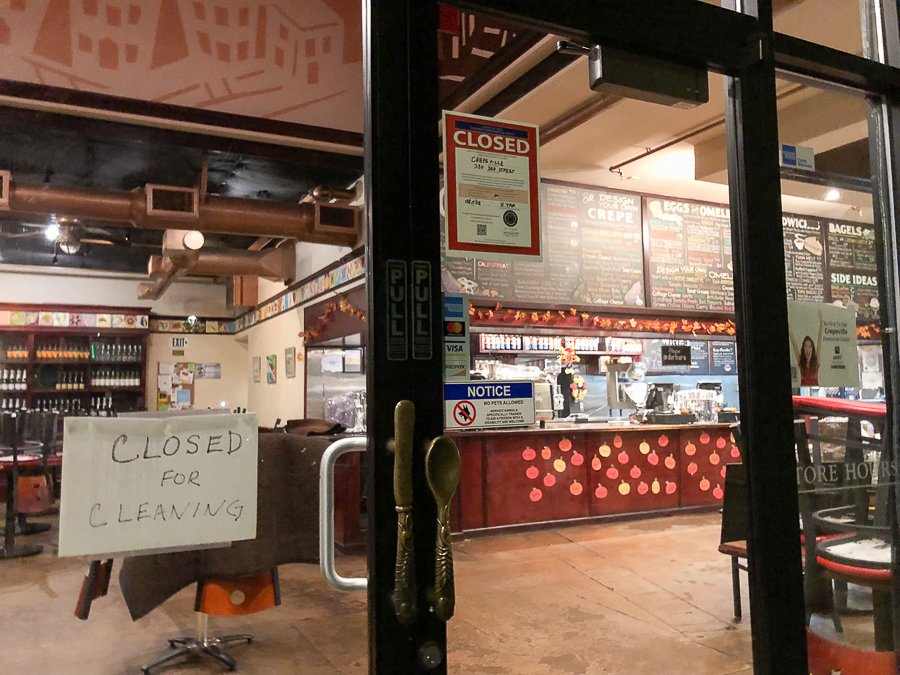
As of Monday, Oct. 15, a makeshift sign on a piece of paper was taped to the Crepeville door, reading: “CLOSED FOR CLEANING.” A second, more official sign was posted later by the Yolo County Division of Environmental Health, confirming that Crepeville was closed due to a “temporary suspension of health permit.”

The health code violation was issued because of an insect or rodent infestation. The sign read: “This facility was found to have violations which constitute an immediate danger to public health or safety. As a result, the permit to operate has been temporarily suspended and this facility has been ordered to remain closed until a written reinstatement of permit has been issued.”

The report was dated and signed by H. Tan, an environmental health specialist. A most recent copy of the inspection report, which is supposed to be located on the Yolo County website, is nowhere to be found. No health alerts have been made on the website since May 29, 2018.

Omar Namih, a second-year in the master of laws program at UC Davis, was approaching the double glass doors of Crepeville to meet his friends for dinner when he realized they were closed due to health code violations.

“I came [to Crepeville] almost daily because my friends like it,” Namih said. “It’s surprising [that Crepeville is closed] and it’s going to be hard to come back again.”

What is usually a bustling, inviting restaurant on a corner block of Third Street is now empty and dark with few passerbyers. The only people around were a few Crepeville workers, who were spraying down rags around the back. One of the workers was shocked and had no idea about the infestation at Crepeville. He stated, however, that Crepeville is to reopen on Oct. 16, around 10 a.m. However, no other information regarding the supposed reopening has been released, and the Division of Environmental Health was closed at the time this brief was written.

Students, community members and lovers of Crepeville will just have to wait to find out the answer to a question on many people’s minds: Will Crepeville reopen?


Written by: Kaelyn Tuermer-Lee — city@theaggie.org

UC Davis, ECAC fails Jewish community

CAITLYN SAMPLEY / AGGIE

University offers insufficient response to anti-Semitic fliers

On Monday, Oct. 8, anti-Semitic fliers appearing blame Jews for opposition to the Supreme Court confirmation of Justice Brett Kavanaugh were posted in numerous locations around campus. These fliers were also posted at UC Berkeley, Vassar and Marist colleges. The fliers were credited to a book club of The Daily Stormer — a local group of alt-right, white supremacist, Holocaust-denying neo-Nazis.

First and foremost, the Editorial Board condemns, in the strongest possible terms, anti-Semitism of any kind. It is especially frightening and vile to see such a targeted attack on the UC Davis campus.

Anti-Semitism on campus is nothing new. Two years ago, the same neo-Nazi group credited with this attack remotely sent anti-Semitic fliers to printers on campus. Given the history of anti-Jewish discrimination on campus, the university’s response to the posting of the fliers Monday should have worked to assuage deeply-rooted fears among the Jewish population with strong language and a proposed plan of action.

Instead the university’s response was disorganized, with grammatical errors and incorrect links to unrelated campus resources appearing in the initial draft of the chancellor’s statement. This situation warrants not only an official university response, at a bare minimum, but a strong stance. Not once did the chancellor mention the Jewish community or Jews in his statement, the group most affected by this aimed attack.

The Editorial Board stands in support of the myriad Jewish organizations calling for a more substantial response from the administration, in the form of trainings, mental health support and counseling for Jewish students.

Chancellor Gary May has responded to and said he is willing to accept these demands. In this response he also said mass e-mails are “reserved for imminent threats and emergencies.”

It is, however, frustrating that a campus-wide email has not and will not be sent out to all UC Davis students and staff members. Especially when the Office of the Chancellor sent a campus-wide email during AFSCME’s three-day protest last year and an email was sent from the university before Picnic Day.

It seems that an anti-Semitic attack targeting Jews, credited to a neo-Nazi group, could well be seen as threatening. University leaders — not social media — should inform students when incidents like these occur as well as the resources available to them.

As a response to the posting of the fliers, ASUCD’s Ethnic and Cultural Affairs Commission scheduled a Facebook event offering a safe space for individuals to discuss the anti-Semitic attack as well as an appropriate response action to the incident. ECAC did not, however, reach out to Jewish organizations or Jewish student leaders when coordinating the event — a huge and blatant oversight.

While university administrators and student government leaders might have good intentions with their responses, to not explicitly acknowledge or reach out to the group being chiefly targeted is incomprehensible. These haphazard actions are a huge disservice to the Jewish community at a time when they deserve and need the most support.

Well-intentioned groups must also understand that anti-Semitism exists on both the right and the left — in both explicit and implicit forms. Certain leftist groups have historically excluded Jews from liberal spaces because of actual or assumed Zionist ideologies. Anti-Semitism is often wrongly delegitimized. Like any other reprehensible form of discrimination, this form of hatred must be unequivocally and unilaterally condemned and denounced by university and student leaders.

It is undeniable that anti-Semitism is present on campus and in the Davis community. This is not a solitary incident and should not be treated as such. Discrimination in this form requires and deserves both short-term and long-term action. The campus community must know that anti-Semitism of any kind will not be tolerated.


Written by: The Editorial Board

Recent changes to Recreational Sports

0
DAVIS WHALEN / AGGIE

UC Davis Recreational Sports adds new fees, new leagues to program

The Intramural (IM) Sports program has taken full advantage of the new school year and have completely rebranded themselves. Now known as Recreational Sports, the program’s recent changes add in new leagues and requirements, with more opportunities for students to get involved with recreational sports.

Aside from changing its name, one of the most prominent changes to the Recreational Sports program is that all people wishing to participate in any sport must now purchase a Rec Sports One Pass. An annual pass is offered for $60 and lasts for the duration of the academic year, and a quarterly pass for $25; these passes will replace the team entry fees that were required in the previous years. However, those living in approved University Housing, including first-years, resident advisors and transfer students living in residence halls and student housing apartments, do not need to purchase a pass, as their pass is sponsored by the Student Housing department.

Third-year cognitive science major, Jonathan Davis, who works for Recreational Sports as a manager, commented on the change in fees.

“I believe this change was made because team captains would complain a lot that their teammates never paid them, either for the team registration fee or forfeits,” Davis said. “Personally, I think the idea of not having all the payment responsibility fall on one person is a good thing. However, if I was someone who wanted to play one and only one rec sport and I still needed to pay the quarterly pass, I wouldn’t be a happy camper.”

The sports program also added a new league to its roster. In addition to being able to compete in a competitive league with rankings, playoffs and prizes for the top teams, participants now have the option of competing in the Recreational league; this league is centered around being more of a social setting for beginners in a certain sport, and it does not offer playoffs or prizes at the end of the season. Participants are also now allowed to compete on one additional team per recreational sport, as long as the two teams are in separate divisions.

Bijan Askari, a second-year supervisor for Recreational Sports, shared his thoughts on why the option to compete in different leagues was added.

“I am guessing that this new shift in competitive vs non-competitive leagues offer a more laid back system for people who just want to play with friends and for those that want to compete for the prizes,” Askari said.

Farah Sevareid, a second-year genetics and genomics major who serves as the Athletics Chair for her sorority, Kappa Kappa Gamma, explained why she views the addition of different leagues as a positive change.

“Often competitiveness from just wanting to win can cause players to act aggressively, so with the added awards and playoffs, players may become more eager and desperate to win,” Sevareid said. “It was smart of UC Davis to add a recreational team without playoffs so beginners or […] people who do not like competition can play peacefully.”

Davis also expressed his opinion on the Recreational Sports’ choice to add in more leagues.

“We’ve always had multiple leagues representing different levels of skill. I think that by doing this, you are catering to as many students as possible, of all skill levels,” Davis said. “The fact that the recreational leagues won’t have playoffs or awards shouldn’t hinder participation by much, if any at all. I say this because I assume that those who choose to play in the recreational league are playing for the purposes of enjoyment or exercise, and aren’t all about competition and winning.”

The first week of the Recreational sports seasons are now known as a preseason week, where the game will not count in the competitive standings. Weeks two through five will continue to be in the regular season and will count toward rankings. The Captain’s Meetings have been moved to online and now involve passing a quiz with a few questions regarding the topics covered in the meeting and the rules for individual recreational sports. This quiz is required for all league sport captains. Residence Hall teams are not required to take the quiz, but the program highly recommends it.

For more information about the recent changes to Recreational Sports or to learn more about participating in a sport, visit the UC Davis Campus Recreation and Unions website.


Written by: Kennedy Walker — sports@theaggie.org


How college football is changing for players and coaches

JAMIE CHEN / AGGIE

NCAA rules allow play without full-year commitment

The 2018-19 season is the first year in which Division I college football players are able to play in a total of four games throughout the season without burning a year of eligibility, otherwise known as redshirting. The NCAA announced this in June, and has since received positive feedback from most coaches.

Under previous guidelines, players who participated in even just one snap had to use up an entire year of eligibility. The exception to this being the medical redshirt, where if a player was injured and played in less than 30 percent of the team’s regular season schedule, the player would still be allowed to save a year of eligibility.

Associate Commissioner for Compliance and Governance of the Big Sky Conference, Jaynee Nadolski, said one of the reasons this legislation was brought to the NCAA is because of the high number of injuries in college football. If a player injured himself and could not play, the only replacement for him may very well be someone who was planning on redshirting for that year.

Back in the 2015-16 season, wide receiver Brandyn Lee played as a true freshman because of multiple wide receiver injuries. Lee was called upon to play in 9 games that season.   Lee, now a junior, is a defensive back. In a case like Lee’s and when a team lacks depth in a position, a four-game cushion could buy precious time for a coaching staff to search for a roster solution.

The American Football Coaches Association unanimously supported this change to redshirt rules. Todd Berry, AFCA executive director who has coached in several capacities at the FCS and FBS level, thinks the opportunity is invaluable for players.

In January, when the AFCA met for its annual convention, Berry said it was hard to find something that all coaches can agree on.

“Very rarely will you find any coaching group or probably any part of society that is unanimous across every level,” Berry told reporters.

There is no doubt that coaching staffs across the country appreciate the opportunity to test out newer players without sacrificing a full year of their eligibility. But as the season rolls on, some have criticized the rule. Most notably, Alabama head coach Nick Saban has cited player transfer decisions as a drawback.

“It’s a little bit of a slippery slope when players start to decide whether they’re going to play or not,” Saban told reporters on an SEC weekly conference call. “I’m not saying there aren’t some circumstances out there where it’s not beneficial to the player to save a year so that he could play in another circumstance.”

Only time will tell if more players like Clemson quarterback Kelly Bryant, who is playing as a graduate student this season, will take advantage of the new rule and decide to transfer. Bryant made the decision to change schools after he lost the starting job to freshman quarterback Trevor Lawrence.

“I feel like it’s what’s best for me and my future,” Bryant told The Greenville News. “I was just going to control what I could control and try to make the most of my opportunity, but at the end of the day, I just don’t feel like I’ve gotten a fair shot.”

Among other notable players who announced their decision to transfer are Oklahoma State wide receiver Jalen McCleskey, Arkansas wide receiver Jonathan Nance and Auburn tight end Jalen Harris.

UC Davis featured 19 freshman on its roster this year and head coach Dan Hawkins likes the rule.

“I think it’s a great rule and we want to take advantage of it, if they get an opportunity to play four games we’re going to get them in four games,” Hawkins said. “I think it’s a great reward for those guys, it’s hard to redshirt, I’ve done it and it’s not a lot of fun.”

CFB is only five weeks in and without coming to any major conclusions about how this new redshirt rule will affect the game, it is likely to impact roster decisions made by coaches and allow players on the fence about their confidence, to test the waters without risking a year of eligibility.


Written by: Bobby John — sports@theaggie.org


Flies, Traumatic Brain Injury and the Tau Protein

ALLYSON KO / AGGIE

UC Davis assistant professor awarded prestigious grant to study tau protein in TBI

Kassandra Ori-McKenney, an assistant professor in the Department of Molecular and Cellular Biology, was recently announced as a Pew Biomedical Scholar. She has been awarded a four-year grant totaling $300,000 to study the role of the tau protein in the degeneration of neurons caused by traumatic brain injury (TBI).

The tau protein is a microtubule-associated protein partly responsible for stabilizing microtubules. Microtubules act as roadways for the transport of important materials and organelles like the mitochondria, which is responsible for energy production within the neuron. If this transport is disrupted, the neuron is affected. When tau is hyperphosphorylated or has too many phosphate groups attached to it, it aggregates into an insoluble form, which may affect the microtubules and lead to neurodegeneration. This hyperphosphorylation of tau has been connected to both TBI and also Alzheimer’s disease.

We know that tau is a very significant hallmark of Alzheimer’s so it’s important to study how phosphorylation affects tau and its behavior,” said Tracy Tan, a first-year graduate student in the biochemistry, molecular, cellular and developmental biology graduate group.

While part of the research involves studying the protein itself, another part of the research goes into monitoring the origin and spread of tau in the brains of flies with TBI, as well as the behavioral effects on the flies. In the future, there could also be experiments comparing the effects of repeated low-impact injury and one high-impact injury. Flies were chosen because their behaviors are well-documented and well-characterized and they serve as an excellent genetic model system.

Drosophila are a really wonderful genetic organism,” Ori-McKenney said. “We can therefore genetically determine which kinases are involved in modifying tau. The fly system is the most optimal system to do this because there is a published, validated assay to inflict traumatic brain injury on these flies and we have the genetic tools to be able to knock down or overexpress each of the genes that encode the different kinases.”

If DYRK1A happens to be the initiating kinase that responds to injury and is one of the first kinases that heavily modifies tau, it could lead to the potential of inhibiting that kinase within a very specified time window directly after an injury to prevent brain trauma.

The Pew scholarship provided Ori-McKenney with the resources to meet other scientists as well, giving her the chance to interact with other scholars studying fly behavior and fly genetics.

Professor Ori-McKenney is quite deserving of this prestigious award based on her impressive past productivity and based on her outstanding promise for future discoveries, some of which could have significant impact on human health,” said Mark Winey, dean of the College of Biological Sciences and a Pew Biomedical Scholar alumnus. “The Ori-McKenney lab studies a variety of proteins that bind the microtubules, some of which move on the microtubules, and they study how the proteins are controlled. Defects in the function of these proteins can contribute to neurodegenerative diseases.”


Written by: Kriti Varghese— science@theaggie.org


Chinese wedding dress exhibition comes to UC Davis

ZOË REINHARDT / AGGIE

Confucius Institute hosts Jiangnan University research group

On Oct. 6, at the International House, the “Double Happiness: Traditional Chinese Wedding Dress” exhibition made its California debut. The event was co-hosted by the China National Arts Fund, Jiangnan University, Jiangsu Intangible Cultural Heritage Research Base, the UC Davis Department of Design, the UC Davis International House and Davis Confucius Institute. The exhibition was on display from Oct. 6 to 9.

Professor Pan, assistant dean of the School of Design at Jiangnan University, chose to bring the exhibition to UC Davis because of the two schools’ history.

“Because Jiangnan University and UC Davis have collaborated before for more than 20 years in many fields, they picked this location,” said Michelle Yeh, a distinguished professor of Chinese, who translated for Pan. “Also, he feels that people on the west coast tend to know more about chinese culture.”

All of the wedding dresses and accessories on display were designed and created by Jiangnan University design students. Part of a larger multi-institute research project, these dresses represent the evolution of Chinese wedding dresses and Chinese wedding culture.

“[I am] very appreciative to have the opportunity to come here, to display and transport the traditional culture,” Chen Ying, a graduate student at Jiangnan University said to a translator.

The grand opening of the exhibition featured a lecture by Pan explaining the significance of a traditional Chinese weddings and how practices have changed throughout Chinese eras. It also informed Davis residents and UC Davis students of the customs and etiquette of a Chinese wedding. Furthermore, he discussed how the weddings are complex and solemn as well as deeply influenced by Confucianism.

One symbol mentioned was the significance of the color red, which symbolized vitality, passion, and festivity and the recurring images used in designs. Pan also discussed the new integration of tradition and modernity as a result of social progress and globalization. Current Chinese wedding customs are demonstrating a revert back to traditional imagery and motifs. And classic visual elements serve as a source of inspiration for modern design.

After the lecture, there was a question and answer segment. Those in attendance also had the opportunity to try on some of the pieces displayed.


Written by: Liz Jacobson – arts@theaggie.org


Undeclared freshman talk about their college experiences

0
JAMIE CHEN / AGGIE

Advice from former and current undeclared college freshman

Heading out into the world as you graduate from high school and walking into “adult life” in college can be challenging enough as it is, and if you don’t know what you want to study, you might think you’re in for a tough time, but that really might not be the case. UC Davis offers 100+ majors to its students, and many begin their journeys as “undeclared,” but find their way to their future academic emphasis in the knick of time.

“Some of my friends knew exactly what they wanted to do right after college, what job they wanted and I knew I wanted this general field but I had no clue what I wanted exactly,” said second-year cinematography and digital media and communication double major Michelle Demoss. “I just kind of took my time…’Oh, these classes kind of sound interesting and they fill up my GE’s so I’ll go for them.’”

Demoss talked about her experience of choosing classes as an undeclared major.

“Most classes I took were related to the field that I wanted to do, like cinematography and media of sorts,” Demoss said. “But I did take classes that were very random since I wanted to see if  I would like them.”

Demoss tied these classes into her choice of a career path that she discovered through her courses.

“I’m taking college more like an experience altogether,” Demoss said. “Even if I don’t work in communications in some way or if I don’t work in film, which will be really sad, but I at least had a good time in college and had a rounded experience and I know ‘science’ stuff, or I know how to build stuff  because of my job in theatre. I’m trying to do as many different things so if I don’t get something similar to my major, [I’ll still be prepared].”

First-year seminars are another campus resource available to undeclared students that can offer guidance. These classes are typically between one and three units, with a grading or pass/no-pass option, and cover topics range from the meaning of life to “drawing and the art of meditation.”

“First-year seminars are always interesting.” Demoss said. “Nowhere near my major but I thought it was very enlightening. The one I took was ‘Hunter Gatherer Society,’ and the violence between them. That was really weird but it was a fun experience.”

Max Lemann, a first-year undeclared student talked about his experience as he entered college without a specific major.

I feel like coming in undeclared took a weight off of my shoulders, allowing me to just take the classes that interest me in hopes of learning more about myself and what I will want to major in when I must decide,” Lemann said.

His thoughts on having over 100 majors available at UC Davis are similar to those of Demoss.

“Having 100-plus majors is a large pro for me,” Lemann said. “I enjoy the comfort of knowing that I have options. When I figure out what area of study interests me most, there is such a large chance that there will be a major available for me.”

When asked his thoughts on whether or not people end up in careers they majored in as an undergraduate, Lemann said: “I know that my dad majored in history and anthropology but is now an entomologist and museum curator, and my mom was a communications and journalism major who is now an elementary school teacher. I would try not to build judgments around that, but they certainly did not go into the field that they majored in.”

Choosing classes when you don’t know what will count towards your degree and what won’t is a challenging task for a lot of first-year students.

First-year undeclared student Amy Lu spoke about how she chose her classes as an undeclared major in order to best suit her academic plan.

“I am signing up classes by interest at this point, also by my potential study area,” Lu said. “For example, I am considering majoring in political science, that’s why I signed up for ‘Intro to Comparative Politics’ just to see if I actually like the content.”

These three undeclared students gave their advice to those who might be in a similar place in their collegiate journey. Demoss favored trying new things and remaining stress-free in the midst of your decision.

“Try new things,” Demoss said. “Have a social life. Don’t freak out, but study. Don’t worry too much about grades. This is gonna sound bad. But. You’re already in college, this is what my dad would always tell me. You’re already in college. Don’t stress yourself. The hard part is over. A doctor that has all Cs is still a doctor.”

Lemann highlighted avoiding nervousness and instead trying to find coursework that excites.

“I would just say that incoming undeclared freshman should not be nervous if they are,” Lemann said. “Look for classes that excite you and enjoy your studies as best you can.”

Lu told students to be cautious in their decision since it is long term, encouraging them to take steps necessary, no matter how long they are, to find the right fit.

“Be open-minded and don’t rush to make your decision, because sometimes it takes time to understand your true passion.” Lu said.

If you are currently an undeclared major, there are plenty of resources through advising, first-year seminars and your peers to help you gain insight toward what you want to do. But, from some students who have been in your shoes, the advice seems to be to try new things and go where you feel most excited.


Written by: Rabiya Oberoi – features@theaggie.org


Humor: Help: There’s a spider in my bathtub, this is one BIG BOY

JEREMY DANG / AGGIE

Please come help NOW

Oh SHIT this guy is big…Where did I put that fly swatter….F***….Why did God make spiders this big….Where is the fly swatter!

There’s a gallon of gasoline on the patio….Why the f*** do I have a gallon of gasoline on the patio?

I’m gonna burn this whole thing down…I can’t live in an apartment that has spiders this big…Damn, that’s One Big Boy!

I just wanted to take a bath….I just wanted to soak in my lavender-scented bath bomb that I got at the farmer’s market….a fair trade, organic homemade nice-ass bath bomb! I could use an atomic bomb right now…

Fire…burning…the flames lick up the sides of the apartment…within, the big boy black widow spider is atomized by one of the most basic elements…the element of destruction….I must destroy….I must sacrifice my home…all the things I own….I must appease the spider god….or it won’t stop….it’ll never stop unless I destroy…

But I can’t do it…to appease the spider gods I must destroy all that I love…….I must…must…..but the authorities will want me…arson….I must tear it all down….This social veneer can constrict me no longer…..What is a social life….school…..loved ones….in the face of the looming, ever present, big boy spider god that will sink its fangs into all I love…I must destroy what I love in order to survive….in order to build a new life…

Pour pour pour….faster pour….matches…..light it…..drop it…..FLAMES! FLAMES! FLAMES!

Run…..

My feet patter on the ground…..Behind me the flames grow higher….People are shouting but I must run run run……..There are no second chances…..The old me has been consumed in flames……..It’s over……The god has been appeased……I must move on to a new life……In this new world I will fashion, there will be no big boys….only me and my humanity……


Written by: Aaron Levins  — adlevins@ucdavis.edu

(This article is humor and/or satire, and its content is purely fictional. The story and the names of “sources” are fictionalized.)

City Council approves water meter opt-out program

JAMIE CHEN / AGGIE

Residents concerned with adverse health effects of radio transmissions

An opt-out option for the city’s new water meters was approved during a public hearing on Sept. 25. The vote was 3-1, with Councilmember Dan Carson not approving.

Through the water meter upgrade project, new advanced metering infrastructure meters have been installed in every Davis household. These water meters give residents online access to their water usage spending.

However, some residents have requested an option to opt-out of adapting to these new water meters. The main concern that prompted this is the potential harmful effects of the radio frequencies emitted from the AMIs. Though there have only been 27 requests — less than 1 percent of the Davis population — the city staff developed a plan for an alternative water meter.  These residents would retain the manual function of their water meters.

Davis residents who choose to opt out must submit an application to the public works water division. The agreement would appoint a city staff member to visit the resident’s house once a month to manually measure the water usage. Residents would be charged a fee for the manual reading and labor cost.

“Each individual has a variety of reasons for [opting out], but basically it all boils down to the radio transmitter systems,” said Mike Webb, the city manager, during the hearing. “So what staff has worked on is to develop a proposal that would provide an opt-out alternative.”

The residents who want to opt-out claim the the radio frequency may be a cause for adverse health effects. According to Ellen Cohen, who spoke during the hearing, 13 local governments in California have banned these smart meter installations, including Santa Cruz.

“These devices can cause arrhythmias and other heart problems, and fertility issues, cognitive impairment,” Cohen said. “Residents and cities around the country in which radio frequency water meters are used are increasingly complaining of headaches, dizziness, tinnitus, nausea [and] insomnia, since their installation.”

One resident, Karen Bloomquist, presented a map to the council which details all of these areas where there are high volumes of radio frequency.

[The map] shows the frequency strengths that are occuring along the street where people walk,” Bloomquist said. “Some of those areas are highly dangerous. I can picture a child walking down the street and just being radiated while they do something. Think about that.”

While the monthly fee for the manual water meter was originally set at $37.50, this was due to the duration (one hour) of the reading. However, Mayor Brett Lee amended it so that the estimate is lowered, as the reading should take no more than 30 minutes.

Carson was the only councilmember who didn’t vote yes on the proposal. He explained how he had done the research, and his conclusion was that the radio frequencies were not adversely harmful.

“I guess I’m guided by a career of believing in science and understanding that you have to take the weight of the evidence,” Carson said. “You can always find a particular study that says something different […] I want you to know I took those emails and those comments [that residents] made seriously, but I come out the other end feeling this program doesn’t make sense, and so I can’t support the opt-out program.”

While Councilmember Will Arnold and Mayor Pro-Tempore Gloria Partida agreed that the evidence behind these claims may not have been substantial, they approved of the resolution.

“I share [Carson’s] belief behind the radio frequencies,” Arnold said. “That however, doesn’t lead to the same conclusion — I support the opt-out program. If folks want to opt out, they can opt out. We have in front of us a breakdown of the fees [and] I personally think that those fees seem pretty reasonable.”

Fees for opting out of the water meter program will once again be reconsidered in a year  once more data is available about the popularity of the program and its true cost of labor.


Written by: Hannan Waliullah – city@theaggie.org


All students required to acknowledge Academic Code of Conduct online

FARAH FARJOOD / AGGIE

Department of Education found university had not sufficiently validated student attendance

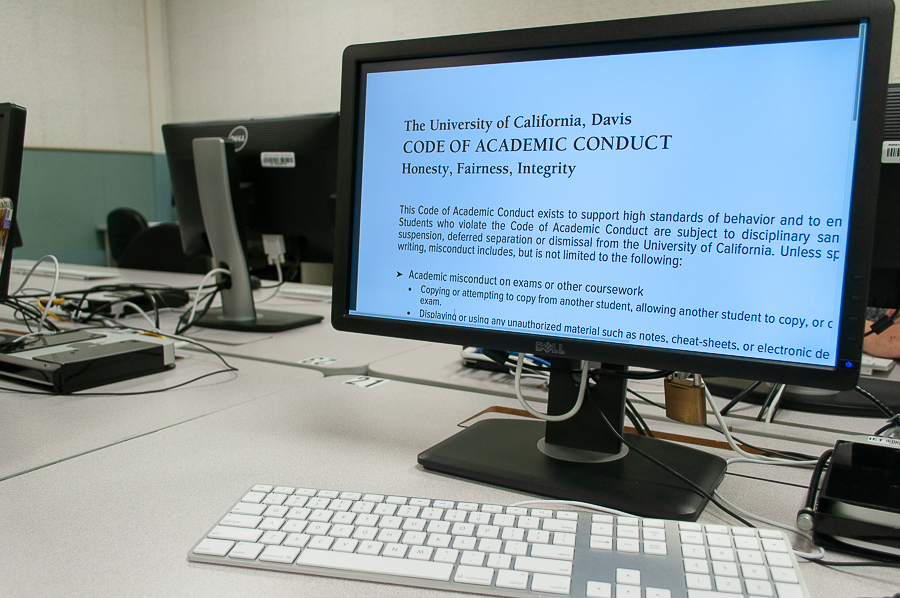
Starting this quarter, all students were required to acknowledge the Code of Academic Conduct for each course they were registered in as part of the new Academic Participation program.

According to the UC Davis website, the purpose of the acknowledgement was to keep track of which students had begun coursework.

“In 2017 the US Department of Education determined that UC Davis had not done enough to validate that students actually attended their registered classes,” the website stated. “In order to comply with this ruling, a method of allowing students to confirm that they have started work on a course was developed in cooperation with the Academic Senate and other key University stakeholders.”

In addition, it was recognized that more could be done to ensure students were aware of their responsibilities regarding academic honesty and the Code of Academic Conduct. The current acknowledgement process was designed to help educate students in this area as well.

Starting the first day of instruction, students received emails prompting them to accept the code. A student could do so by logging into their myUCDavis account, reading the Code of Academic Conduct and checking the boxes next to each of their registered courses to verify their acceptance of the code.

Professors and instructors were also encouraged to help enforce the new program by reminding their students on the first day of class to confirm participation online, familiarizing themselves with faculty responsibilities for enforcing academic honesty as well as adding information about the new requirement into their course introduction materials or syllabus.

According to the email sent out to students, failure to participate could bring significant consequences including prevention from registering in the next term and lowering or complete removal of financial aid.

In addition, the email made it clear that failure to acknowledge the Code of Academic Conduct did not relieve students of their responsibility to know and follow the code.

Despite the program’s good intentions, some students, such as fourth-year international relations major Lily Jenkel, were not convinced that the acceptance process would achieve its desired effects.

“I think most students won’t actually read it, they’ll just click submit,” Jenkel said.

Some professors and instructors also had mixed feelings about the new program.

“I think it’s good that it reminds students to look at the rules,” said Dr. Pamela Demory, a lecturer in the University Writing Program. “But it also feels a little heavy-handed, because it implies that students are likely to break the rules.”


Written by Clara Zhao — campus@theaggie.org


Senator, commission chair boycott president’s speech at first Senate meeting

CAITLYN SAMPLEY / AGGIE

In a Facebook post, Ethnic and Cultural Affairs commissioner alleges Gofman is discriminatory

The first ASUCD Senate meeting of the year was held on Sept. 27 in the Mee Room on the third floor of Memorial Union. At this meeting, a new interim senator and new association members were sworn in, President Michael Gofman delivered the State of the Association address and the introduction of new Senate initiatives was presented by Vice President Shaniah Branson.

The first meeting also saw contention, with a prolonged conversation during public discussion which took place after a declaration from Ethnic and Cultural Affairs Commissioner Rina Singh and Senator Ko Ser Lu Htoo that stated that they would not work with Gofman.

The meeting was called to order at 6:11 p.m. by Branson. A roll call was taken with eight senators in attendance, Senator Gaven Kaur was absent and Gofman was late.

Gofman gave the State of the Association Address. A key point of his speech was the association’s planning of this year’s Sunset Fest, a new event on campus. Gofman said that the event “was supposed to be a $5,000 loss,” but ended up being “a $9,000 profit.”

Gofman also addressed the resignation of three senators, all of whom were elected last Fall — Danny Halawi and Andreas Godderis resigned last year, and Jake Sedgley announced his resignation recently.

Gofman said that resignation announcements over the summer, as in the case of Sedgley, are not unusual and the association will need to quickly fill the open seat. Gofman concluded by saying he has high hopes for the year and thanked everyone in the association for their work.

The proceedings then moved to a discussion of the ASUCD budget. With Controller Meital Machulsky present, Gofman discussed three changes that occurred during the summer: the Sunset Fest made more money than expected, Office of Advocacy and Student Representation Director Edgar Malagon successfully negotiated down the University of California Student Association’s fee for UC Davis to $3,000 and the Creative Media services plan of making bulk purchases to save money.

Discussion then moved to the salary for Angela Ruan, third-year managerial economics major, who was later confirmed as assistant unit director for Aggie Reuse. The original budget for this position was set at $7,600. Ultimately, the budget was raised to $9,000.

Up next was the budget proposal for OASR. Malagon proposed using existing funds for positions including Public Engagement Assistant Director, Assistant Director of City/Community Affairs and Chief of Staff. The OASR budget was approved without objection.

The President’s budget for Creative Media was discussed next. Gofman said purchases of association-branded goods for Sunset Fest were done in bulk. He also said tabling material that could be generated by Creative Media were outdated and in order for the association to grow, new items would need to be purchased. The budget was approved without objection.

The proceedings moved from budget to Senate pro tempore elections. Sedgely was in this position but, due to his recent resignation, the position was opened. The candidates were Senators Alisha Hacker and Htoo.

Votes were taken, Hacker received seven votes and Htoo received three votes with two votes abstaining. Hacker was selected as Senate pro tempore.

Next on the agenda was unit and committee assignments. Senators volunteered to work with units and committees for the new academic year.

Mental Health Initiative Committee member confirmation came next. Deborah Widjaja, a fourth-year neurobiology, physiology and behavior major was confirmed without objection.

The interim senator confirmation to replace Jake Sedgely came next. Devo Leichter, a fourth-year political science major who served as a council member on the Judicial Council, applied for the position.

Gofman said Leichter had already helped him work on legislation. And Leichter said he was interested in a “constitutional cleanup amendment” to organize and format the Senate Bylaws with clarified terminology. Leichter was confirmed without objection.

Next was confirmation for the Environmental Policy and Planning Commission chairperson. Alice Beittel, a fourth-year environmental science and management major, was the EPPC chairperson before she studied abroad Spring Quarter. Beittel was confirmed without objection and the remaining members of EPPC were also confirmed.

A slate of new legislation for upcoming Senate sessions was listed. Among these were:  ASUCD Constitutional Amendment #55 and #56 and ASUCD Senate Bill #1, #2 and #3. These bills and amendments are found on the ASUCD web pages.

A break was held from 7:27 to 7:41 p.m.

Vice President Shaniah Branson presented goals, expectations and reminders for the new year. The detailed list of initiatives included the following: third-floor improvements, marketing/branding changes, an ASUCD digital calendar, ASUCD social media outlets and changes in Senate table attendance policies.

Among other proposals, Branson suggested setting Senate meeting time to a maximum of four hours.

Public discussion was next.

Fourth-year biomedical engineering major Kia Aliakbar, the chairperson for the committee on committees, discussed UC Davis’ 10-year strategic plan, also known as the To Boldly Go campaign. Because the campaign received limited response from students during the summer, Aliakbar urged the Senate to offer any suggestions and recommendations before the deadline in April.

Singh, the Ethnic and Cultural Affairs Commission chairperson, said that ASUCD was getting pushback from marginalized communities and sought input from the table.

“There’s so much stuff happening: racism, assault is all taking place, but we don’t even know about it,” Singh said. “How can we address it if we don’t even know about it?”

A recent ECAC Facebook post announced the commission’s plans to boycott the president’s State of the Association Address, alleging Gofman did not hold the commission’s values of inclusion and equity. Gofman “haha” reacted the post on Facebook.

Singh brought this up during public discussion, she asked what message Gofman’s choice to react to the post sends to the commission.

Htoo, who also boycotted the address, also penned a Facebook post explaining the decision.

“[Gofman] has been disrespectful to members of the LGBTQIA community, minorities, and refuse to listen to members of this Association,” the post read. “He is racist and refuses to use gender-inclusive language. He had conducted interviews with unfairness and injustice. He has been divisive and not trustworthy. With that being said, I don’t believe anything he said or will be saying. I don’t trust him.”

Gofman denied the allegations, he stated that he has not, nor has he ever been, purposefully discriminatory, and said that he doesn’t understand why “two people have decided
to make a political stand on grievances that were stated on abstract terms.”

In response, Senator Jumoke Maraiyesa asked Gofman why he “haha” reacted ECAC’s Facebook post, saying “your actions are speaking louder than your words.”

“I’m not going to apologize at laughing at a further attempt to further divide the association,” Gofman said. “This was someone else’s attack. If you want to spend another 25 minutes talking about a laugh react on a Facebook post go ahead.”

At another point in the meeting, Gofman spoke about the recent disagreements between UC Davis and the City of Davis about housing.

No public announcements were delivered.

Ex-officio reports were then entered into record and followed by elected officer reports and approval of past meeting minutes.

The meeting adjourned at 9:37 p.m.


Written by: George Liao — campus@theaggie.org


Cartoon: Adulting

ROSEY MOREARTY / AGGIE

By ROSEY MOREARTY 一 rosey@morearty.org


Letter to the Editor: Interfaith statement addressing anti-Semitic fliers at UC Davis

CAITLYN SAMPLEY / AGGIE

To the Editor:

Re “Anti-Semitic fliers posted throughout campus” (campus news story, Oct. 9):

In the early hours of Monday, Oct. 8, anti-Semitic fliers were distributed on the UC Davis campus as well as three other college campuses. The image was of recently-appointed Supreme Court Justice Brett Kavanaugh, surrounded by members of the U.S. Congress with a Star of David on their foreheads, depicted in a sinister fashion.  The flier, prepared by the neo-Nazi publication The Daily Stormer, suggests that Jews are behind “anti-white, anti-American, anti-freedom” movements. These are deeply troubling to us as faith leaders, and we condemn and repudiate what they insinuate.

As clergy and faith leaders, we do not agree on all aspects of theology, but we are convinced that it is better to live together in harmony as a civil society than to engage in hateful rhetoric, which too often has led to persecution and murder. We reject in principle any statement, religious or otherwise, that suggests these things. For those of us representing the Christian tradition, we recognize that the history of anti-Jewish and anti-Semitic sentiment in the church runs deep. We regret this history and are committed to a different path. Our U.S. Constitution protects the freedom of all individuals and faith communities to worship according to their conscience and convictions. We affirm this right with a full heart and mind. We condemn those who would attempt to sow seeds of discord and mistrust in our community.

We wish especially to address our Jewish friends and neighbors who are defamed and mischaracterized by this hateful literature. We offer ourselves as a supportive presence in the midst of this painful event, and we are resolved to repudiate hate speech or action of any kind. Further, we commit ourselves to the way of peace, to speaking the truth in love always and to continuing the work of healing a deeply broken world.   

Rev. Brandon Austin, United Methodist Church of Davis

Rev. Elizabeth Banks, Unitarian Universalist Church of Davis

Rabbi Seth Castleman

Rev. Dr. Pamela Dolan, Episcopal Church of St. Martin

Rev. Casey Dunsworth, Pastor and Program Director, The Belfry Lutheran Episcopal Campus Ministry

Hamza El-Nakhal, Islamic Center of Davis

John Fanous, Lead Pastor, University Covenant Church

Rev. Margaret Graydon, Deacon, Episcopal Church of St. Martin

Alex Haider-Winnett, Campus Minister, Unitarian Universalist Church of Davis

Rev. Christine Haider-Winnett, Via Sophia Ministries

Emily Hyberg – Executive Director, The Belfry Lutheran Episcopal Campus Ministry

Rev. Jeff Irwin, Davis Lutheran Church

Anne Kjemtrup, Davis Dein

Will Klier, Director of Davis Christian Fellowship

Rev. Morgan McLean, Unitarian Universalist Church of Davis

Rev. Dr. Chris Neufeld-Erdmann, Davis Community Church

Rev. Sara Nichols, Senior Minister, Center for Spiritual Awareness, Davis

Rev. David A. Peters, Pastor Emeritus, Davis Lutheran Church

Rev. Dr. Daniel R. Smith, Lutheran Church of the Incarnation

Sara Tillema, Director & Campus Minister, Cal Aggie Christian Association (CA House)

Rabbi Greg Wolfe, Congregation Bet Haverim

Affaf Waseem, Director of Middle Eastern/ South Asian Student Support

Rev. Jonathan Zachariou, Lead Pastor, Davis Christian Assembly