53.8 F
Davis

Davis, California

Friday, December 19, 2025
Home Blog Page 518

What’s next for Entertainment Council?

TREVOR GOODMAN / AGGIE FILE

After Chance, alt-J, BØRNS and Khalid, it can only get bigger and better.

When ASUCD’s Entertainment Council landed Chance the Rapper to perform on campus in Fall Quarter 2016, students didn’t believe it could get any better. But then, it did. In 2018, EC managed to bring not one, but two massive shows to the ARC Pavilion, including indie-rock performers alt-J and BØRNS and R&B artist Khalid. The question then remains: how will Entertainment Council top this year’s performances? Who will be the next musical sensation to grace the ARC Pavilion stage?

Conveniently enough, the answers to those questions are determined by the students of UC Davis themselves. This past fall, EC put out a survey to the student body inquiring as to what kind of artists students wish to see brought to campus. In turn, Khalid was at the top of that list.

“Genre-wise, I think that electronic music and hip-hop are really popular with students,” said Liz O’Neill, a third-year psychology and managerial economics double major and EC director. “The show we did with alt-J and BØRNS didn’t really sell out, and we only hit about half capacity. That kind of gives us an idea of what kind of population we’re trying to serve here.”

Although alt-J and BØRNS didn’t fully sell out, the audience demographic wasn’t just college students, with many adult members of the community also in attendance. Additionally, due to the nature of the presale, many UC Davis students at Khalid found themselves in the upper tiers of the ARC Pavilion rather than on the general admission floor level. EC also received some backlash for its annual Lawntopia event due to last-minute changes as a result of inclement weather.

“For Lawntopia, we also got a lot of backlash from people who weren’t students because we made it exclusive to undergrads,” O’Neill said. “But again, we do try to keep it undergraduate-exclusive because they’re the ones who are paying to make these events possible.”

In the future, EC will continue to survey students on their preferences for incoming performers via a link available on their website. According to O’Neill, the managing staff of EC has already begun reaching out to various promoters on what the coming year could bring. The unit also plans to put out another student body-wide survey in the coming months in order to get a sense of next year’s plans.

“I’d love to see an artist like James Bay or Rex Orange County coming to Davis,” said Alison Ritchie, a second-year human development major. “I think a lot of students at Davis are into music with more of a chill vibe, similar to that of Khalid.”

As for the opinions of the EC staff itself, O’Neill claims that she would love to see Cardi B in the Pavilion, as it would be a huge score for UC Davis to have such a high-profile performer on campus.

“I think Childish Gambino would be an ideal performer in Davis,” said Emmy Hughes, a third-year managerial economics major and EC promotions coordinator. “With our politically inclined campus and his forward thinking in creative endeavors, it would be such a massive show.”

Only time will tell as students anxiously await what’s to come from EC. For more information, visit the EC website.


Written by: Sydney Odman — arts@theaggie.org
Aggie Profiles: Daryl Lee

KAILA MATTERA / AGGIE

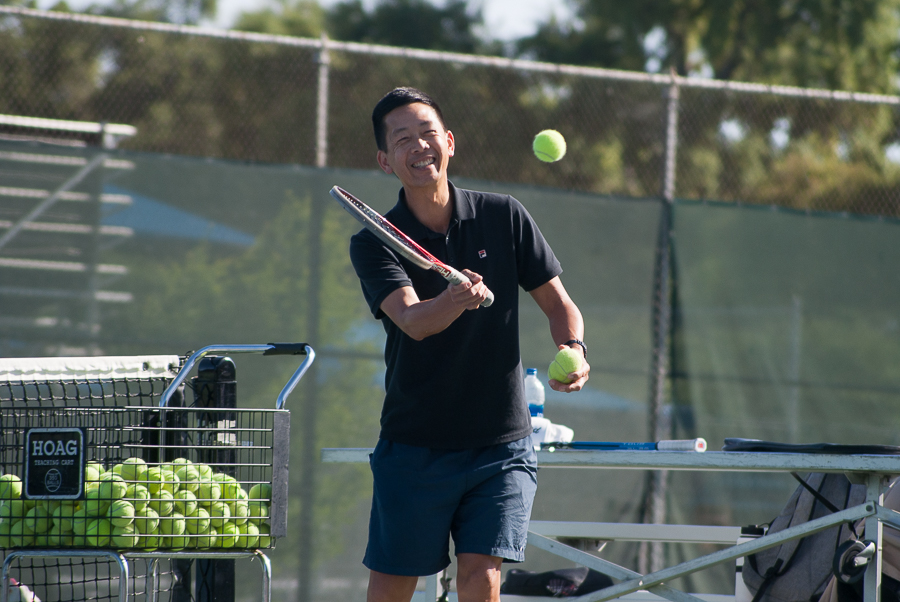
Former men’s tennis head coach discusses mentorship, sportsmanship

Just beyond the glass windows of the education building stretched Sacramento State’s tennis courts, their muted greens and reds an all-to-familiar sight for masters student Daryl Lee. It was the early 1990’s, and Lee was finishing up his degree in marriage, family and child counseling. However, regular glimpses of the tennis courts sparked an interest in Lee that would take him down a slightly different kind of career path than his degree would suggest.

“I got into college coaching at Sacramento State for a couple of years still during [my program],” Lee said. “I was the assistant coach at Sacramento State, and after I got the degree the opportunity to be the head coach here at Davis presented itself and I went for it.”

Lee was no stranger to the world of tennis, having played since he was young. One of his personal accomplishments includes ranking 48th in the top 50 singles in the 18-and-under division in the U.S. When it was time to go to college, Lee was given the opportunity to play for the men’s tennis team at Stanford University when he was recruited by the coach at the time, Dick Gould.  

“It was a great environment because there were a handful who were on the team when I was there that went on to the pro tour after and they were very successful,” Lee said. “Looking back on it, it was really invaluable to see that and see them in action at Stanford and see how they approached their craft.”

Although he wasn’t a starter at the time himself, Lee remembers the unbelievable talent of the other freshman on the team during his first year. It was 1983, the year that the Stanford men’s tennis team won the NCAA Team Championship. Lee recalled being out practicing on the courts as this news trickled in.

“I remember where I was practicing on the courts and, you know, we didn’t have internet or cell phones or anything like that, so we just kind of hear these off and on updates because it would be by the regular phone off the wall,” Lee said. “I was just like stunned because there were four freshman out of the six players in the starting line-up — that’s really unheard of.”

A Sacramento native himself, Lee returned to his hometown to pursue his master’s degree after receiving a B.A. in psychology at Stanford. According to Lee, since a young age he had always felt like mentorship was a suitable fit for him.

“[Mentoring has] always been the right niche for me,” Lee said. “I’ve always enjoyed passing on what I’ve learned. I think that’s a real gratifying thing to do in the workplace.”

This sense of self is what led him to hold multiple coaching positions at Sacramento State, including assistant men’s tennis coach in 1991 and 1992 as well as associate head women’s tennis coach between 1992 and ‘93. Lee then headed the UC Davis men’s tennis team from 1993 to 2012. He’s been a continuing lecturer in the Physical Education Program here since 1994.

“Back then coaches were hired as what’s called a lecturer/coach,” Lee said. “The primary position is to be a lecturer in the physical education department. I’ve been technically what’s called a continuing lecturer in the P.E. department from ’94 until 2018.”

Lee believes that physical education is essential for promoting health.

“To be physically active is really important, for a lot of basic reasons,” Lee said. “I try to get in the students’ shoes usually, and I see that obviously people are doing it for a variety of reasons, but some of the seemingly more primary reasons are to get away from the classes and to relieve some stress and to stay active. I can’t tell you how many times I’ve read in those reflection papers how people would not exercise if they had not signed up for the class.”

Not only does Lee recognize these benefits as crucial to a college students’ health and wellbeing both physically and mentally, as any physical exercise is, but that the P.E. program provides a vital social outlet for students as well.

“People can get lost, with how many students are here,” Lee said. “They can go to their classes and not talk to anyone, they just hear somebody ramble on for 50 minutes, take notes, and then leave, maybe have a little interaction with their roommate. It’s the social aspect [of P.E.] that I can’t underestimate as well.”

Lee tries to be observant of how his students appear when they walk on the court before class to how the leave when it’s over. He’s known since a young age the benefits of getting one’s endorphins running, and over the years he’s been able to learn how to notice when student has been positively affected by a bit of exercise.

“I kind of try to notice people’s facial expressions and body language when they come in,” Lee said. “I think that one of the things I try to do in the back of my mind is hope that maybe when people are done after that 45 minutes, when they’re on their way to the next class, that they’re in a little better mood, especially if they weren’t in a very good mood when they showed up. If it helps them, then it’s positive.”

When it comes to coaching, Lee deploys a distinct leadership style that’s focused on reinforcing values in his players he finds most important. Specifically, Lee recognizes that playing a sport on a team requires the coach to nurture an environment of positive interaction and mutual respect — starting with the most influential player.

“I think the secret to it is the interaction between the head coach, fundamentally, and the top player because everyone on the team is looking for guidance and direction, and most of all, inspiration,” Lee said. “They’re not looking at the coach, they’re looking to their number one player.”

Lee paints the picture like so: if the number one player is slacking in attitude or effort and the other players on the team can see this, then that opens the door for the rest of the team to slack as well. If this were to happen, players can justify their lack of a positive attitude or hard work by pointing fingers at the behavior of the top player.

To Lee, being the coach means fostering an overall positive attitude within the team when situations like this don’t happen, the kind of environment where no one can poke fingers and no one can make excuses. Lee boils his coaching philosophy down to promoting two main values: dignity and integrity.

Ultimately it starts with having a philosophy,” Lee said via email. “Winning is not a philosophy. That’s only a goal. A philosophy is about having principles. I think dignity and integrity are the most significant values to strive for. Interacting with athletes with mutual respect and understanding symbolize this. This engenders trust, which liberates athletes to perform at their best.”

Throughout his time as head coach, Lee’s commitment to these values and overall sportsmanship show in some of the men’s tennis team’s accomplishments. For one, while Lee was head coach, the tennis team won the UC Davis Men’s Team Grade Point Average Award eight times. In addition to this, the team won the Big West Conference Sportsmanship Team Award twice within the first five years of being in the conference. On top of that, in 2012 the team advanced to the semifinals of the Big West Conference Championships.

While Lee was coach, he was able to witness a number of athletes on the team truly excel, including a student named Greg Lee, who was awarded the NCAA Postgraduate Scholarship, the Arthur Ashe Leadership and Sportsmanship Award and UC Davis Male Athlete of the Year, among others. As a marker of his growth and success, Greg Lee was also a four-time All-American and attained a professional singles ranking on the Association of Tennis Professionals Tour.

“He was a player who was not heavily recruited but he had a great attitude,” Lee said. “He was a guy who accomplished more than I could have imagined, and any coach who has the opportunity to have that occur, that’s the height. I think the best quality is to have a curiosity about learning, and [that guy] had it because [he wasn’t this…] highly nationally ranked player at all, and yet [he was] making great progress.”

Through Lee’s experiences mentoring tennis, he’s had to consider how to make an environment in a team setting that is fundamentally based on individuality. Lee claims the key to making this happen, to be a truly effective mentor and coach, is to understand the sport, people’s individual personalities, how to communicate and most fundamentally of all, how to instill leadership in others.

“What I’ve found through the experience of it all is, as simplistic as it is, it is about leadership,” Lee said. “The secret to me is that how to foster an environment of leadership within the tennis team, because in the end, those players are going to be influenced more by their peers than they are by the coach.”


Written by: Marlys Jeane — features@theaggie.org

Woodland transit center project in the works

JEREMY DANG / AGGIE

Yolo County Transportation District joins forces with Woodland to plan for better transportation

The Yolo County Transportation District is collaborating with the City of Woodland to plan a new transit center in downtown Woodland to create a central place where people can come together, making travel more efficient. The transit center could also bring new businesses to the surrounding area.

Jose Perez, the district project manager for the Woodland Transit Center, described what the project involves.  

“It’s a multifaceted project,” Perez said. “It entails going out to the community — to the city of Woodland with our customers, riders, transits — and identifying the priorities for the community to identify a location for a future transit center in the city of Woodland.”

Xóchitl Rodriguez, the mayor pro tempore of Woodland, explained what the project’s goals are.

“The Woodland Transit Center Project is creating a center where we can bring all our buses at the same meeting point focusing on our local routes,” Rodriguez said. “The goal is to create a central location. We have a center close to the outskirts of Woodland right now, and we want it to be nearer to downtown, where folks can be connected to downtown and boost economic development while promoting alternate routes and all general modes of transportation.”

The project has been in the works through the Woodland Transit study.

“This project has been on the radar for quite some time now,” Rodriguez said. “We are focusing on how we can increase ridership to encourage businesses. Now we’re in the stage where we are trying to benefit the community to try and implement it.”

The study started in 2016 and the project soon followed, after the board’s consideration.

“Ultimately, the city and the YCTD board adopted the Woodland Transit study in 2016, and one of our recommendations was to identify a transfer location for the future buses in the city of Woodland,” Perez said. “The next adoption of that study is identifying if we do need the center and finding a right place for it.”

Because the center’s location is a priority, the board is looking to the community for inspiration.

“We’re hoping the community tells us,” Perez said. “Right now, our main goal is getting the mobility of the community in an efficient manner.”

After the community settles on a potential location, the board can start looking to modify the services and work toward a pulse network.

“One potential strategy is modifying our existing service for Woodland to be more of a pulse network,” Perez said. “To get it to work, we need a location and multiple modes and services can come in and allow access to more options. This is our key goal as a catalyst right now. We’re just reaching out to the community and identifying if we need to adjust those objectives. We want to make sure that whatever we end up accomplishing is directly beneficial, not only to our district but to the city and its residents as well. We want to hear from the community to modify and solidify the goals and objectives for this future facility.”

While the project is set, those working on its process are still looking into potential ideas.

“It’s in its initial stages right now,” Rodriguez said. “We want to make sure that we have access to bike storage, that we have charging stations for electric vehicles. In the long term, we’re looking for businesses to have around the transit center and a dimensional picture and we want to make sure that it’s a secure area [and] properly lit. We want an active transit center with constant movement.”

Furthermore, the board must also consider the feasibility regarding the cost of the transit center.

“We want to mitigate future costs for service operations and increase efficiency through a pulse network type of service for the city of Woodland, which will require a central location for that activity,” Rodriguez said.

Terry Bassett, the executive director of the Yolo County Transportation District, mentioned how planning for this project plays a part in the city’s development, according to The Davis Vanguard.

“Planning for a downtown transit center is an investment in Woodland’s future,” Bassett said. “We are looking to build a facility that will meet current and future transit riders’ needs for the next 20 years and beyond.”

Rodriguez also elaborated on how crucial this center is for transit riders.

“We went over what would work and what it would mean to put a transit center in downtown as far as congestion,” Rodriguez said. “I’m a transit rider myself, so I know how important it is to have this center and for drivers to have that feasibility.”


Written by: Stella Tran — city@theaggie.org

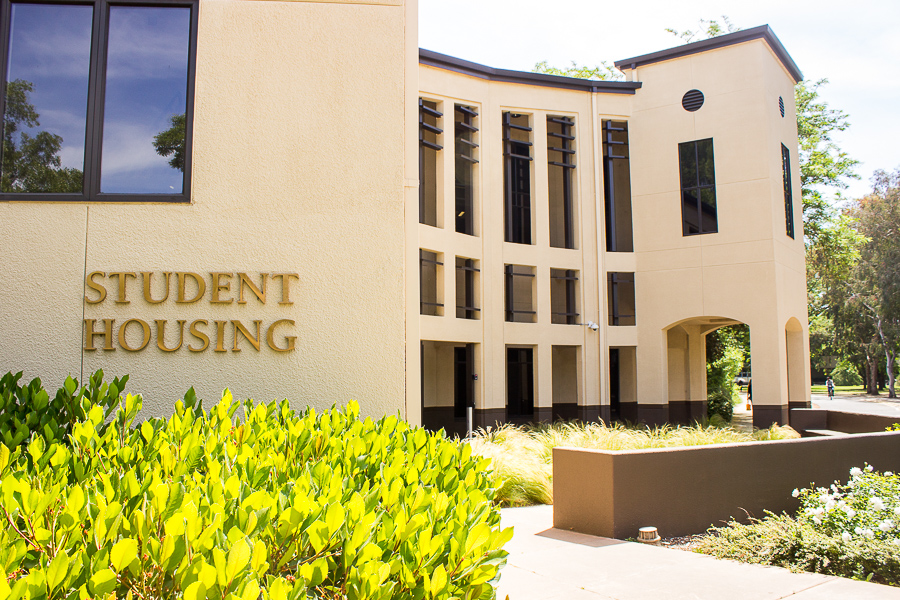
Student housing accused of perpetuating culture of fear among resident advisors

VENOOS MOSHAYEDI / AGGIE

Former resident-advisors accuse student housing of systematic racism, lack of representation

Inspired by a senior’s thesis detailing her own experiences with Student Housing as a former Senior Resident Advisor, several former resident advisors have also come forward to express their dissatisfaction with Student Housing’s management and what they say is a culture that perpetuates fear among student staff members.

Angela Kim, a fourth-year gender, sexuality and women’s studies major, wrote her thesis around the personal narratives of former RAs’ encounters with racism and constant pressure from student housing coordinators. After serving as an RA for one year and an SRA for one year, Kim applied again to serve as an SRA for the current 2017-2018 school year, but was not rehired.

Although Kim worked to address issues of racism, which she believes specifically targeted women of color during the 2016-17 school year while she served as an SRA, her demands were not addressed by coordinators. Despite the fear of potentially not being rehired, in Spring 2017, Kim began gathering testimony from more than a dozen former RAs and former professional staff at Student Housing to support her claims.

Kim’s thesis focuses on the experiences of herself and her staff of seven people of color and one white RA — the most diverse staff of RAs that year. According to Kim, because of her staff’s vocalness regarding instances of inequality and lack of inclusivity, they earned a reputation of being “loud women of color,” a phrase that was conveyed to Kim by coordinators.

Neither Kim nor anyone from her staff were rehired for the following year. Among Kim’s staff were seven women of color, with one genderfluid individual, five individuals with disabilities, and four individuals from lower socioeconomic backgrounds.

Among the grievances of Kim and a group of former RAs is Student Housing’s alleged failure to effectively implement tools to combat white supremacy and practice their vocalized commitment to inclusivity and diversity.

RAs attend weekly diversity training meetings that are run by their senior resident advisors to promote inclusivity and ensure RAs are able to relate to residents who come from diverse backgrounds.

In one week’s activity, resident advisors were asked to role-play what it would be like to be gay and what they might expect from their own imagined coming-out experience. Kim vocalized her concerns to student housing about the insensitivity of this activity and how one of her staff members who didn’t identify as straight had felt extremely uncomfortable during the activity.

Instead of employing experts in different areas of social justice and advocacy, like the Women’s Resource and Research Center and Cross Cultural Center, senior RAs are trained to facilitate diversity workshops.

Branden Petitt, the director of Student Housing and Dining Services, provided responses to Kim and other RA’s allegations.

“There are multiple days during fall training dedicated to social justice, equity and inclusion topics,” Petitt said. “Additionally, professional staff work with the senior resident advisors on a weekly basis throughout the academic year to help ensure they are prepared to lead diversity discussions.”

Petitt also stated that in the fall of 2017, the LGBTQIA+ Resource Center did give a presentation to RAs during training.

Out of 12 rehired SRAs for the current 2017-18 school year, 9 are white. Kim claimed that a lack of racial diversity among SRAs made their role fostering social justice presentations with residents misplaced.

Kim’s statistics come from her own investigation and the statistics could not be corroborated by Petitt or staff at Student Housing.

As compensation for their time spent serving as resident advisors, RAs receive no formal paycheck. Instead, RAs are guaranteed free student housing in university dorms and a meal plan, but with attached stipulations.

One of the RAs serving on Kim’s staff was Sabrina Younes, a fourth-year political science and psychology double major. Younes claimed that the free swipes into the Dining Commons were part of the RA job requirement, not part of the benefits, because resident advisors were expected to use them “to interact with [their] staff and to get to know [their] residents.”

Beyond this, resident advisors depend on their employers to provide housing and food security, acting as both landlords and bosses. In this regard, Kim described being called “at-will” employees, who receive no workers rights or union representation.

“We are all essentially competing to guaranteed housing,” Kim said.

Kim characterizes the environment as highly-competitive, not only after being hired, but throughout the year, if RAs want to be rehired.

“This compensated housing has the power to force employees into complicity and passivity,” Kim said.

Moreover, Kim described Student Housing’s right to terminate RA positions and subsequently their access to housing and food security with minimal notice.

Former RA Addison Montgomery, a third-year nutrition major, was fired from her position during the beginning of Spring Quarter last year. From the time of her meeting on a Monday, Montgomery was expected to vacate the dormitories in the following week and a half.

“It’s very difficult to find housing at the beginning of Spring Quarter,” Montgomery said.

According to most leasing laws, landlords are required to give tenants 90 days notice before eviction and, in specific situations, a minimum notice of 30 days.

Receiving no student aid and suddenly faced with the possibility of both homelessness and housing insecurity, Montgomery had 9 days to secure a new full-time job and a new place to live. Because Student Housing doesn’t give resident advisors paychecks, Montgomery struggled to find places to live that didn’t require any immediate payment.

Fearing the possibility of homelessness, Montgomery addressed her fears with staff coordinators who, according to Montgomery, suggested she try couch-surfing for the remainder of the school year.

“I told her, ‘I have worker’s rights,’ and she said, ‘No you don’t,’” Montgomery said, referring to her meeting with an officer at Student Housing.

Petitt confirmed that resident advisors do not receive any representation or resources through Student Housing to address instances of injustice involving coordinators. Instead, Petitt described resources on campus that are available to all students.

“RAs can use any campus resources residents and other students use to protect them from unlawful practices,” Petitt said. “We welcome feedback from student staff and try to create spaces where they feel comfortable providing that feedback.”

In the past week, Kim has been able to secure a meeting with some Student Housing staff, including Petitt, to discuss her grievances and those of other former RAs.

At the meeting, Kim plans to put forward a list of demands to help improve the experiences of RAs.


Written by: Ally Russell — campus@theaggie.org

Suspects identified in armed altercation at UC Davis

CAITLYN SAMPLEY / AGGIE

Assault with deadly weapon occurs outside Walter A. Buehler Alumni Center

On May 13, at around 1:30 a.m., UC Davis students and community members received a crime alert from the UC Davis Police Department regarding an assault with a deadly weapon on campus. The incident, which is described as a “physical altercation,” took place on May 12 at 11:46 p.m. in front of the Buehler Alumni Center.

“Suspects assaulted a victim and pointed a shotgun at victim(s),” the report stated. “Suspects fled the area after removing their long sleeve shirts and wore tank tops. Last seen in a late model, 2012-2017 red or burnt orange color Ford Mustang. Suspects were last seen westbound on Old Davis Road towards I-80.”

UCDPD has identified two suspects and arrested one. According to Andy Fell of UC Davis News and Media Relations, “the suspect had bailed out as of Monday afternoon and has a court date June 12. His name is Manwinder Jit Singh, age 20, of Sacramento. He is not a UC Davis student or employee.”

The report also stated that the “victim sustained facial injuries.”

Additional information about this incident or similar incidents should be given to UCDPD at 530-754-COPS (2677).


Written by: Hannah Holzer — campus@theaggie.org

Shorter showers don’t conserve that much water

CALIFORNIA NATIONAL GUARD [CC BY 2.0] / FLICKR
Agriculture is the real culprit in California’s water worries

After I graduated from high school, my family and I spent a month in a cabin on the west shore of Lake Tahoe, California. It was the August of 2014, one of the driest months for the state, so for the Sierras to be dusty at this time of the year is not unexpected. And it was dusty, the air so dry that your lips and skin felt as if one stray movement would encourage cracking like the packed earth beneath our feet.

We were hiking to a lake in Desolation Wilderness, about 12 miles southwest of South Lake Tahoe. After cresting the lip of a ridge at the end of the trail and lying eyes upon Lake Aloha for the first time, I could understand why people hiked to this lake: nestled in a perfect bowl of unbroken, blindingly white Yosemite granite, Aloha’s waters sparkled under the early afternoon sun.

But as we descended into the basin, it became disturbingly apparent that something wasn’t quite right. Twisting between pillars of rock that towered 20 feet above me, we lost ourselves in a maze of granite that should have been underwater.

The Golden Gate Weather Service reports that in the 2014 rainfall season, Northern California only reached 71 percent of the annual snowpack average — the waters of Lake Aloha were absurdly low because California didn’t receive enough rainfall to fill its shores.

Looking up at the sky that day — no clouds to be seen for miles — seemed like damning evidence enough.

Nothing is more sacred to a Californian than water. We’re oddly possessive of our droughts, treating them as if they occur only within state limits. So when we are told to treat our water consumption mindfully, we tend to take heed.

I’m sure we’ve all heard it phrased one way or another: Shorter showers will help save our water. But let me tell you that taking fewer and shorter showers do little but ease your conscience. In fact, lavish shower habits are the least of a Californian’s water worries.

Drive through the Central Valley and you’ll see where much of our water is consumed: farms, farms and more farms.

Since California’s economy which recently became the fifth largest in the world relies heavily on agriculture, it shouldn’t come as a surprise that California farms need most of California’s water. The California Department of Food and Agriculture reports that California’s agriculture alone accounts for $45.3 billion in profit — more than in any other state. And, as the state produces a majority of the country’s fresh produce, water is treated like the necessity it is. It appears as if this mindset will only become stronger, especially with the looming issue of global climate change.

For us Californians, our water will be one of the first casualties. In the coming decades, California is expected to see a 10 to 15 percent decrease in average rainfall due to a shift in global weather patterns controlled by melting ice caps.

If this study is true, a decrease in rainfall could be devastating for a state that grows more than half of the United States’ produce. Farming is a business that relies heavily on consistent rainfall; the Public Policy Institute of California figures that around 40 to 50 percent of California’s fresh water goes to agriculture and agriculture-related activities. However, it’s important to mention that these percentages vary per year and per amount of rainfall received in the following year.

Fewer showers are not going to save our water.

We need to stop shaming ourselves into thinking that 10-minute showers are the sole reason we are in this precarious position. Likewise, the agriculture industry needs to become more transparent with the amount of water it uses and stop shoving the blame onto Californians, whose water use is a fraction of the state’s.

This won’t solve the problem — not in a state perpetually plagued by drought after drought, nor in a state that’s responsible for producing much of the country’s food.


Written by: Erin Hamilton — elhamilton@ucdavis.edu

Disclaimer: The views and opinions expressed by individual columnists belong to the columnists alone and do not necessarily indicate the views and opinions held by The California Aggie.

Cartoon: N + S

By: Ariel Hilomen — abhilomen@ucdavis.edu

Disclaimer: The views and opinions expressed by individual cartoonists belong to the cartoonists alone and do not necessarily indicate the views and opinions held by The California Aggie.

Another year of putting off tuition increases

ALLYSON KO / AGGIE

UCs reconsider tuition hikes for 2018-2019 year

With the University of California consisting of 10 prestigious universities, hundreds of thousands of applicants compete against one another to try to get into at least one. In 2015, there was a low percentage of admitted students from the state of California, causing the UCs to significantly increase their in-state enrollment. Nonetheless, acceptance rates are dropping yearly. Since 2000, around 90,000 more students have gotten into a UC as a way to give more young adults the opportunity to get a degree from a UC. The issue resides now in the fact that many more students are being admitted, and tuition hikes are being considered. On May 1, UC President Janet Napolitano decided to not discuss this issue at the May meeting with the UC Board of Regents and to push off the 3 percent increase until consideration for the 2018-2019 year.

While UC appreciates the 3 percent increase, that amount remains far below what is needed to address critical issues such as unprecedented enrollment growth, increases in instruction and student services, and pressing deferred maintenance needs,” said Stephanie Beechem, a media relations spokesperson for Napolitano, via email. “The 3 percent increase is also less than UC expected under the terms of an agreement reached with the governor in 2015, which assured the university a 4 percent base budget increase for each of the following four years.”

Advocacy efforts, led by students and faculty, hope to secure more funding for the UC system in order to help those who pay their own tuition and those who cannot afford it. Beyond this 3 percent increase base, the UC structure intends to secure $140 million in additional state funds. Advocacy efforts are supposedly making a difference, as Napolitano claims, since this momentum may even cancel out the need for increases in tuition.

“They have tried to raise tuition three times in my four years here at Davis, like that is all you need to know when considering what a consistent, dominant problem it has been in my college experience,” said Ryan Calbreath, a fourth-year political science and economics major. “As you know, they have proposed a tuition hike and punted it until next year. On the surface, that is a good thing, until eventually it actually happens.”

Defensive actions include strikes on campus, like the walkout that took place earlier this year when the initial idea of a tuition increase was brought up. Calbreath has experienced the direct results from the UC system as it has slowly tried to raise tuition over the few years he has attended Davis. He described the attempt in comparison to a boiling pot of water, with tuition becoming much more expensive over time, differentiating how much students paid their freshman year compared to their senior year. Although the tuition increases can be viewed as miniscule in the short term, they add up exponentially when looking at the bigger picture.

“Since the year 1993-2000, there was a 318 percent increase in administrators, but 4.5 percent decrease in full-time paid professors, making us super top-heavy,” said Antoine Menager, a third-year economics and political science major. “We are controlled by a board of trustees. Unfortunately, we do not see any of that money directly — only the people at the top do — which really does help us realize how top-heavy the UC system is.”

As Napolitano claimed earlier, there is a need for more funding, but as Menager stated, the question many UC attendees now have is what this extra money is being put toward.

“With such little representation, it is much more difficult to have a voice heard when there are so few ways to get through this UC organization,” Menager said. “When there is an actual complication, the people that are the middle ground between students — and the men and women who have final say — just blame the governor for not enough funds.”

Therefore, budget cuts are oftentimes compensated by students, leaving them to face the repercussions. Rather than getting more out of paying more, students will instead have larger class sizes, less attention in discussions and increased tuition.


Written by: Lauren Tropio — city@theaggie.org

Davis Pride 2018

BRIANA NGO / AGGIE FILE

Run/walk, festival will celebrate individual uniqueness

The Davis Phoenix Coalition will be presenting the 5th annual Davis Pride festival on Sunday, May 20, with a full lineup of performances featuring American Idol finalist Effie Passero from Modesto, Calif. There will also be a 5K run/walk before the festival to raise funds for the Davis Phoenix Coalition, which supports LGBTQ youth.

This year’s Davis Pride director, Sandré Nelson, wanted this year’s event to be unlike those of other cities. Davis is a community with a wide variety of individuals of all ages and backgrounds, so creating an inclusive environment for everyone was a top priority.

“This year we’re trying to build on what we did last year,” Nelson said. “We’re raising the level of entertainment, bringing in more local entertainment and for the headliner, the American Idol candidate.”

Pride is a celebration of inclusion, and Nelson mentioned the importance of creating that kind of safe space.

“We wanted to be a community Pride celebration event where everyone feels welcome,” Nelson said. “We also wanted individuals to celebrate their uniqueness. Be proud of who you are and express yourself. We want to celebrate that during our event.”

Anthony Santistevan, a first-year psychology Ph.D. student, reminisced about his first Pride experience.

“I think my favorite aspect of Pride is the freedom it gives the queer community to be itself,” Santistevan said. “I remember walking through the streets of San Francisco during my first Pride with a huge smile on my face. I was holding my boyfriend’s hand with zero fear of being judged — it was the first time I could unashamedly be myself out in public. It was kind of a transformative experience because being gay was something I had built up in my mind as this terrible thing for so long. But there I was, with thousands of other queer folks, having the time of my life. It was beautiful.”

Davis Pride seeks to provide similarly memorable experiences for all who attend. Students make up a major part of the Davis population, and outreach to the student body will help create a lasting impact.

Talia D’Amato, a second-year political science public service major, emphasized that Pride brings awareness along with the celebrations.

“I think Pride festivals are really important because they make visible a community that is systematically ignored and suppressed,” D’Amato said. “Being able to thrive so brightly out in the open not only brings together the community but also inspires hope.”

Information about the festival is available on the Davis Pride website as well as on its Facebook page.


Written by: Josh Madrid — arts@theaggie.org

Student Fashion Association Presents: Tropical Bliss

JAZMINE ESCOBAR-SOLORIO / SFA

Annual charity fashion show returns May 20

The Student Fashion Association’s annual charity fashion show is right around the corner. This year, the club will present Tropical Bliss, which will be held on Sunday, May 20 from 6 to 8 p.m. at the UC Davis Conference Center. All proceeds from the show will go to Unidos Por Puerto Rico, which will help provide provisions for those affected by the recent hurricanes.


This event includes live performances and entertainers from students at UC Davis, including Bailer de Fuego, Afro Vibes and Unbound Progression Dance Group. The main event includes collections designed by UC Davis students and others.


Camille Ramos, a fourth-year textiles and clothing major, is also the president of the Student Fashion Association. She has been involved with SFA since her freshman year, so she has a lot of experience planning this event. Ramos is also in charge of the decorations committee, which is making the decorations for the photobooth, lobby, stage setup and lighting.

“In the winter we offer the fashion show class, where the students can get one unit and they can help create the fashion show in terms of ticket designs, the decorations, finding designers and models and all the logistics about it,” Ramos said.

In this class are the decoration committee, the fundraising committee (which is in charge of restaurant fundraisers), the Picnic Day flower crown sale (SFA’s biggest project and one that involves reaching out to sponsors) and a marketing team, which is in charge of creating marketing and social media plans. The club also has a talent and entertainment group, which is in charge of looking for student designers, performers and MCs.

“What makes this class unique is that it doesn’t focus on designing the apparel but focuses on the merchandising, the marketing, coordinating and the event planning of it all,” Ramos said.

SFA recently held its model bootcamp, the big rehearsal day when the student models meet their off-campus designers. The club has designers coming from the Fashion Institute for Design and Merchandising in San Francisco and California State University, Sacramento.

“They come in and meet their models. The atmosphere is just great because, when you’re planning a show, you have a visual, but then when you see everyone in the same space you get a better idea of how it’s going to go,” Ramos said. “It’s really exciting to see.”

The club posted a call for models, and a lot of students came out. Some of the designers brought their own models. Some even brought their own family and friends to model.

Demi Chang, a third-year design major, is SFA’s multimedia coordinator. She’s in charge of organizing the designers and making sure that their designs match the theme.

“The best part about this fashion show is that people can interpret it different ways,” Chang said. “Tropical Bliss is very open-ended […] People have been interpreting it in a lot of different ways — mainly from an environmental impact perspective, while others are doing more tropical wear, resort wear.”

Jazmine Escobar-Solorio, a fourth-year design major, is part of the officer board as SFA’s graphic designer. She is in charge of a lot of the club’s branding and also creates all the flyers and digital graphics for their events.

“From thrift store days to guest speaker events and even our annual charity fashion show, I get the opportunity to combine my love for fashion and design to create these marketing tools,” Escobar-Solorio said.

Doors open for the May 20 fashion show at 5:30 p.m., but ticket sales will open at 5 p.m. for $9.50 each. Presale tickets sale $7, which can be accessed via SFA’s Facebook page.

“All the members, models and designers have such a magnetic energy. The show is going to be so much fun,” Escobar-Solorio said.


Written by: CaraJoy Kleinrock — arts@theaggie.org

“The Bluest Eye” like you’ve never seen it before

NICHOLAS YOON / UC REGENTS

Puppets add different dimension to critically acclaimed novel, play

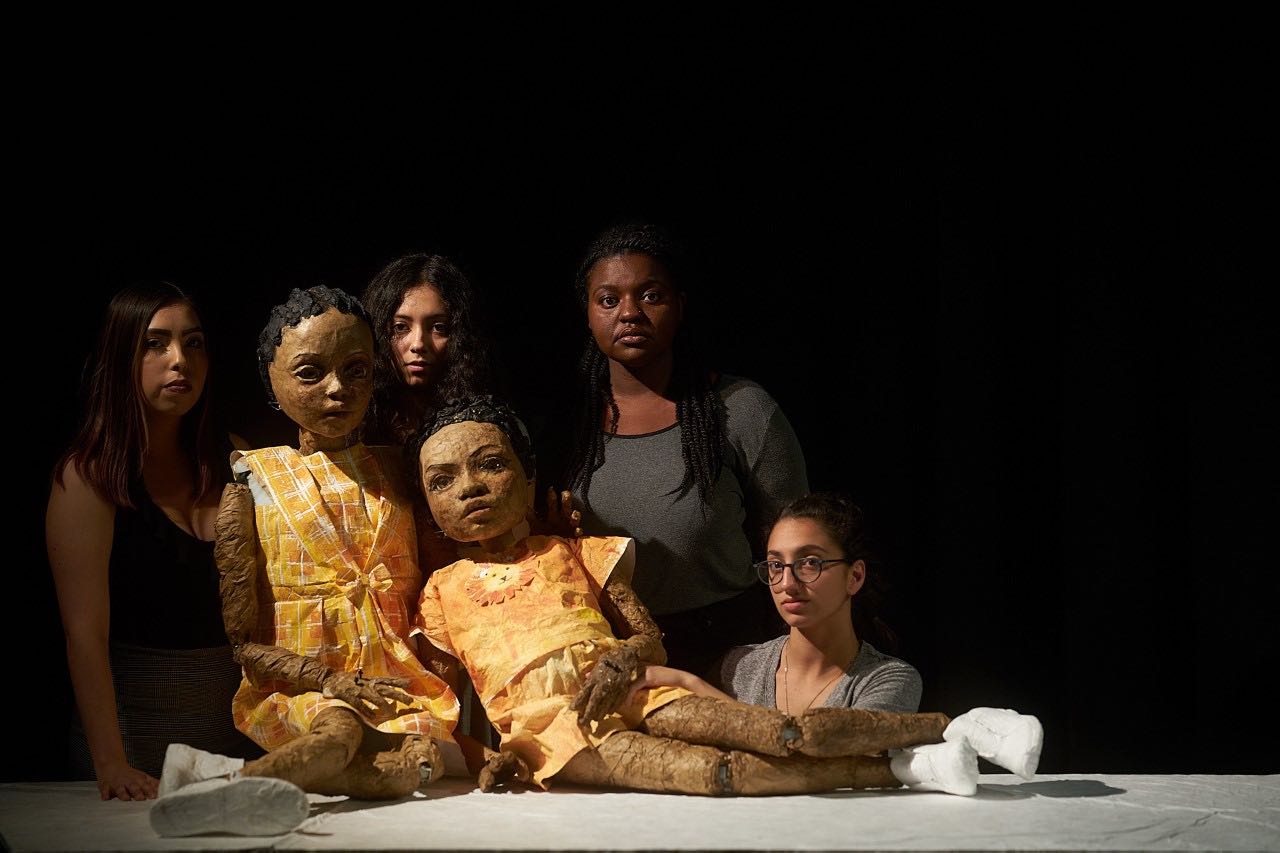
You may have been asked to read “The Bluest Eye” or possibly another Toni Morrison classic in a high school English class, but have you experienced it in play form? Better yet, have you ever seen the heavy story unfold through life-size puppets? From May 17 to May 19, the UC Davis Department of Theatre and Dance will be combining its adaptation of “The Bluest Eye” with puppets to deliver two hours of hard-hitting performances.

From the start, this production has been driven by student momentum. A student submitted “The Bluest Eye” as an idea for a future show to Margaret Kemp, the co-director of the play and an associate professor of theatre and dance.

“It really came — everybody asks this question — but it really came from the students because last spring I thought to more deeply engage the students in discovering new plays […] And this one, somebody submitted it,” Kemp said. “And it was the first one that I’d sent out that like within an hour people had sent emails back saying, I’ll read this part, I’ll read that part.”

Jasmine Washington, a fourth-year theatre and dance major, spoke of her diverse cast (composed of faculty and students alike) and noted fondly how well they work together.

“It’s interesting because our cast is like primarily people of color,” Washington said. “So even though it’s not an all-black cast like it’s supposed to be written, I think that there’s a lot of solidarity between minority groups. At the beginning of the process we would spend like hours just sitting down talking about the issues and it kind of wears on you after awhile because you’re doing the play and you’re talking about all these things. But it’s also kind of therapeutic in a way to like be able to talk about this in an open space and not be critiqued for how you’re going to say it.”

For Tiffany Nwogu, a second-year theatre and dance major, the depth behind the play resonated more as her time working with it progressed.

“At first it was essentially another play that I wanted to be a part of, but after getting more involved in it, I understood; I started understanding the big role it plays in society and how it’s not just for entertainment,” Nwogu said. “It’s actually speaking to the people on the things we choose to ignore or the things in society that’s been embedded for a long time and even in modern day society. I think that with Toni Morrison’s work, despite it being old, is still relevant today and I think it’s really great that I get to be a part of it and spreading the message. Lots of things are relevant sadly. But it’s just how we choose to go about it and like basically knead the wound.”
Washington also expressed similar sentiments on how disappointing and surprising it is that the issues in “The Bluest Eye” are still resonating with such relevance to today’s time. In acknowledging this, she said it is subsequently imperative to ask “what do we as a society to do to fix that and rectify that?”

“Like every time I see this play, every day I’m like hurting because I’m like, I know this is how it is still,” Washington said. “Like it really doesn’t feel like something that is glorifying it. It’s really like let’s look at the issues and let’s talk about it.”

Washington recalls her initial reluctance toward using puppets to deliver these important messages.

“I was honestly very wary about working with puppets […]” Washington said. “But my opinion has changed a hundred percent because I really do think that they add to the story. This story is so hard that I think that seeing it through puppets adds a different dynamic because it’s also like a little bit more heartbreaking seeing it on a puppet because you’re like, this is this innocent child like entity and then you’re just seeing these horrible things happening.”

Washington also discusses this new and challenging experience of meshing acting with puppetry. However, to help with this application of performing on two different levels (acting and puppetry), the department was able to enlist another co-director while Kemp handled the acting side.

“Janni Young is our other director and she’s from South Africa and she primarily works with puppets,” Washington said. “She’s done an amazing job with like trying to teach us how to articulate and how to make it look natural because there’s so many things that we do as humans that you think you could do with a puppet, but it’s like you cannot do it.”

Kemp realizes the puppets are enough of an artistic imposition on the play from her side.

“How can you engage in the story that’s outside of the dominant culture without appropriating that culture?” Kemp said.

Another factor that went into the decision for puppets was thinking about their historical significance.

“I’ll also say that puppetry in South Africa, when it started to be used for the same thing that we’re discussing, it was during the reconciliation trials where people told stories of the trauma of apartheid,” Kemp said. “People would come to the Truth and Reconciliation Commission and the stories had such a powerful impact on their bodies that they would pass out, they would get sick and somebody said, ‘well, we still have to tell the stories. How do we do that?’ Somebody said, ‘well, what if we used puppets? Would that help?’ And it did. And I feel that that historical trauma that’s part of the root of “The Bluest Eye” can be transferred in that manner.”

On why students should support this play, Nwogu lists three reasons.

“I really do think this is one, it’s one of the first puppet theaters like done on campus,” Nwogu said. “That experience is already new in itself. Two, I feel like there was a lot of people that enjoy Toni Morrison’s work in the literature and knowing if you just love her work and seeing it on stage, then that will be a good experience. Three, I feel that it’s completely magical. It makes you feel, without realizing, like you basically get put in a vulnerable place as you connect with the characters and the puppets.”

Kemp notes the importance of supporting peers and how students seeing the play would be a full circle ending to the immense student involvement and hard work that went into this production.

“We have so many people, like there’s one person in the shop — he comes almost every day,” Kemp said. “His name is Joseph. He is an engineering major and he’s totally committed to building these puppets and he’s never done anything like this. In fact, one of the puppets he wound up building totally by himself because he’s really invested in it.”

She also revealed that what she enjoys most about this co-directing position is being able to see the development of students.

“My [favorite] thing is to see the growth in the students because a lot of these students, I’ve had in more than a few classes and just seeing they’ve grown more in the 10 weeks — right now it’s only six weeks of working on this show — than they’ve grown in 10 weeks of class time,” Kemp said. “Every night they get to push themselves further than they have before and because they have the support of the entire company behind them to make that happen. So I think that for me it’s like a dream come true.”

Tickets for all four performances are now available for purchase online.


Written by: Cecilia Morales — arts@theaggie.org

Aggies finish spring season with first win

BRIAN LANDRY / AGGIE

The UC Davis Aggies women’s field hockey team won 3-1 against Olympic Club in final game of spring season

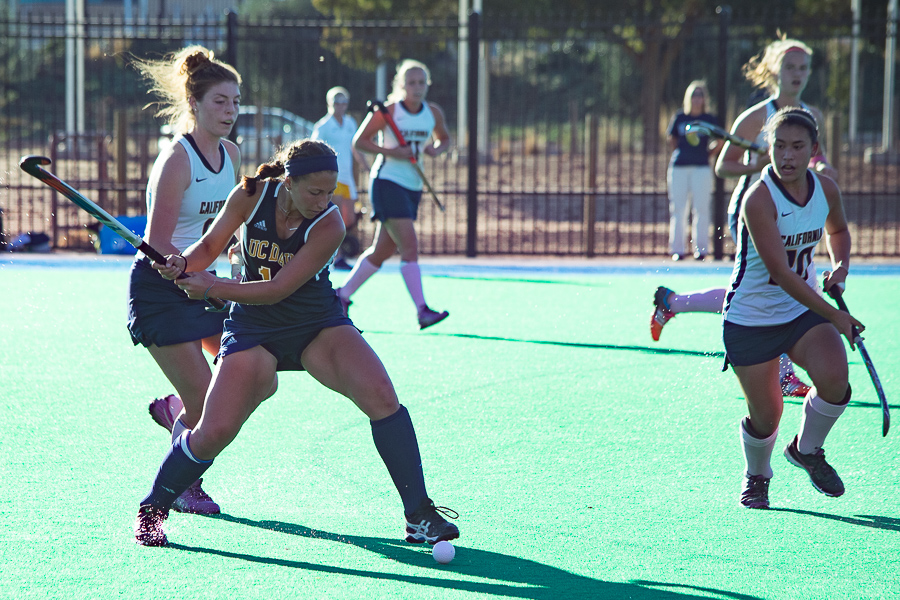
The UC Davis women’s field hockey team defeated Olympic Club 3-1 in a non-conference game at home on May 12. Going into its final game of the spring season, the Aggies spotted a fall season 1-17 overall record and a 0-7 conference record.

“We have really been building our tactical awareness positionally and address[ing] team concepts that we haven’t had the chance to address in the fall,” said head coach Britt Broady. “We have changed our system a bit and they [the team] has really invested in it and built on it, so it has been all about attacking.”

In a back-and-forth first quarter of play versus Olympic Club, possession remained equal among both teams. However, it was the Aggies’ defensive line that stepped up later in the quarter, sprinting hard for the ball and coming up with key stops that kept the score tied 0-0 at the end of the first.

Coming into the second quarter, UC Davis’ offense took over the field. A collection of passes led to a wide outside shot and a goal for the Aggies at the 14-minute mark to give them the 1-0 lead. Continuing their aggressive offensive passing performance, UC Davis placed another goal in the back of the net in the 11th minute to increase its lead to 2-0. At 7:15, Olympic Club worked its way down the field and produced a shot that was blocked by a diving save from the Aggie goalie. However, Olympic Club followed through on the block and rolled one past the goalie, decreasing UC Davis’ lead to 2-1.

At 15:20 in the third quarter, the Aggies ran the ball up the side of the field and took advantage of the Olympic Club goalie rushing out of the box. A nice pass into the center of the field provided an easy open net goal for UC Davis. At the end of the third quarter, the Aggies held a 3-1 lead.

The final quarter of play was a replica of the first, with both teams constantly changing possession of the ball. Neither team could add to its score, giving UC Davis the 3-1 win.

“With the game today, we [the team] felt that we played successfully,” Broady said. “Being the final game of our spring season we have been building toward a number of attacking and defending goals, which was our focus today. We capitalized on our moments and used our training techniques in a game setting, which was delightful to see.”

Looking toward next fall season, the team recently signed eight new incoming freshman from California, Kentucky and the Netherlands. Broady hopes that these players will fit in well with the team atmosphere.

“Fortunately, we have really built a great team culture, and I think that all of these eight freshman are going to fit into it seamlessly in terms of our hard work philosophies and our team atmosphere,” Broady said. “In terms of on-field stuff, we are pretty even in terms of positions and so how they are going to fit it and who is going to be ready right away, we will see.”

The Aggies will certainly look to next season to improve from last fall season’s record as well as fall season records from 2015-16: 8-12 overall and 1-5 in conference, respectively, as well as 2016-2017: 5-13 overall and 1-5 conference.


Written by: Ryan Bugsch — sports@theaggie.org

No Clucks Given for Backyard Birds

RACHEL PAUL / COURTESY

A UC Davis study found regulations for keeping, maintaining chickens are lacking in many areas

A recent UC Davis study showed that, while more people are getting backyard chickens, there are very few structures in place to protect them as well as a shortage of resources for flock owners.

“Very few of the cities required basic care in terms of food, in terms of water, veterinary care or vaccination,” said Jacqueline Kingsley, the main author of the study. “And [chickens] were only protected from cruelty in 2 percent of the municipalities I studied. And 98 percent of the municipalities don’t even have a regulatory structure to prosecute for cruelty against chickens […] if abuse and neglect is happening there’s no intervention strategy currently possible in a lot of these places.”

The study was done in Colorado due to laws requiring animal rescues to their make data available to the public. According to Kingsley, urban agriculture was nearly banned after World War II and cities have had to change the laws amid backlash from animal shelters.

“[Keeping chickens] is really a response, especially in urban areas, of wanting some control and knowledge about where their food comes from,” said Richard Blatchford, an assistant extension specialist for poultry at UC Davis. “And for poultry it’s really easy. Most people don’t have space for a cow. If you can take care of a dog or a cat you can pretty much take care of a chicken.”

Animal rescues argue that chickens will end up at their shelters and most places are not equipped to handle poultry. According to Kingsley, people who do not want chickens anymore  often dump them, and the chickens end up in shelters when people later come across them. Kingsley says that about half of the birds may have been abused and the other half look like they were well taken care of. However, those numbers are influenced by cockfighting, which is illegal. Very few legal protections have been put in place for backyard chickens because they are seen as food animals, not pets.

“And I say ‘pets’ because a lot of people report getting chickens for eggs or for food, but then a lot of people also report that they come to love these animals, that they become members of the family,” Kingsley said. “You see all of these fringe things popping up, like cottage industries around luxury designer chicken diapers, where you can bring your chicken into the house.”

Seeta Chaganti, an associate professor of English at UC Davis, has chickens. She does not let them into her house, but does see her chickens more as pets than food producers.

“I also thought it would be fun to have eggs, which it is, but at this point, the chickens are really pets, and I don’t care about getting eggs,” Chaganti said.

Ordinances have been put into place regarding the noise level associated with chickens and how smelly their coop can be, but there is not a codified way for chicken owners to receive information on how to care for their birds.

“Partly I have relied on other friends who are experienced keepers,” Chaganti said. “And partly I have relied on the social media site BackYard Chickens, which I recommend to anyone who is thinking about keeping poultry.”

Unfortunately, the internet does not work for the more serious issues that chickens might face. Chickens can get attacked by many different animals and can also get sick. Finding a veterinarian that will see these birds is difficult.

“Most small animal veterinarians will not see poultry,” Blatchford said. “So the big issue with lack of veterinary care isn’t so much disease issues, it’s what happens when you have a bird that needs to be euthanized.”

Without the proper training, flock owners can accidentally make their chickens suffer more while trying to put them out of their misery. Also, without mandated vaccinations, diseases can spread from backyard chickens into commercial farms, such as what happened in California in 2002 and in Egypt from 2006-2009.

Blatchford does not want to dissuade anyone from getting chickens, but he does want them to know that there are associated risks, such as salmonella and lead exposure. According to Blatchford, 10 multistate salmonella outbreaks occured last year from backyard chickens, leading to one death. The CDC has issued statements that warn people to be careful handling chickens.

“I think the problem in what [the CDC is] giving out is that they’re thinking chickens as food animals and not thinking about it as pets,” Blatchford said.

Researchers are also finding that chickens in urban areas seem to have more exposure to lead and that the birds will often not show symptoms of lead poisoning.

“It’s just a consequence of where we have the birds,” Blatchford said. “Urban areas especially have high concentrations of lead in the soil just because of what’s been the environment and what’s been there before.”

Concerned flock owners can get eggs and dead chickens tested by California Animal Health and Food Safety Laboratory Systems for a fee. There is a lab in Davis or the CAHFS website has instructions on how to ship eggs and birds.

Despite the risks, flock owners say keeping chickens is worthwhile. Blatchford has had chickens before and really enjoyed them. He said the birds can recognize people and have different personalities. Chaganti has been so moved by her experience raising chickens that she is planning on writing a book on how keeping chickens reshapes one’s senses.

“The process of learning about chicken-keeping necessarily involved learning about the poultry industry […] and that changed my eating habits and my general attitude toward animals as products,” Chaganti said. “I personally don’t think there’s a way for them [poultry farms] to be humane, and I don’t think animals are here to be commodities and conveniences for us. I feel very humble and grateful to have my two chickens, and I hope that I am giving them the comfortable, loving life that I think every chicken, every animal, deserves.”


Written by: Rachel Paul — science@theaggie.org

First-ever executive recall underway after students allege voter fraud

RAUL MORALES / AGGIE

Judicial Council adjusts unconstitutional bylaws

After the 2018 ASUCD Winter Elections, former Senator Andreas Godderis filed five Judicial Council complaints alleging voter fraud and accusing President Michael Gofman, Vice President Shaniah Branson and Unite members of violating ASUCD Bylaws 406(a)(c) and 406(A)(a)(i).

These bylaws state that a “violation of University and/or Student Housing Policy” includes “solicitation in residence halls and prohibited posting/distribution of campaign materials” and outlines the process for addressing voter intimidation and coercion. Witnesses within the filed complaints alleged that a Unite campaign staff member coerced votes for Unite candidates in Redwood Hall of the Tercero dormitories.

Officials who ran with the Unite slate in the Winter Elections and were elected to office include Gofman and Branson as well as Senators Atanas Spasov, Alisha Hacker and Brandon Clemons.

Fourth-year psychology and Spanish double major Becca Nelson, the former Gender and Sexuality Commission chair, attempted to initiate the process to recall an elected official after Godderis’ complaints were dismissed by the Judicial Council on the basis that all “complaints must be filed before the announcement of election results.”

The case Nelson v. ASUCD was filed with the Judicial Council; it challenges “the timeframe for which recall signature petitions can be released by Elections Committee.”

In light of the Judicial Council hearing held over this case, Nelson created a Facebook event page, asking students to attend the meeting to demand the right to an online recall petition.

“Elections Committee denied our right to petition for a recall of Michael Gofman and Shaniah Branson, along with other Unite! slate members complicit in election fraud,” the page stated. ”They are also denying an online petition and expect that we collect 2500+ (8% of the student body according to the ASUCD constitution) signatures ON PAPER PER CANDIDATE. Only 2600 students voted. We have the right to accountability + transparency.”

On April 26, a Judicial Council hearing regarding the recall of Gofman and Branson was held.

Gofman has been accused by former ASUCD officials such as Nelson of transphobia and homophobia. At the March 15 Senate meeting, David Heifitz, the former Business and Finance Commission chair, announced his resignation from his position, saying he would not “serve on the same table as people who are racist, transphobic [or] homophobic” following the election results.

As a senator, Gofman wrote an article defending Milo Yiannopoulos’ right to speak on campus, although he condemns the controversial figure. He was also removed from the ASUCD commission Campus Center for the Environment when he abstained from voting on a resolution urging the creation of an environmental justice course. Gofman said he took “vehement issue” with language that critiqued agricultural companies and definitions of the university as a colonialist power.  

According to Nelson, the allegations of voter coercion sparked the recall efforts. Obstacles arose, however, which served as loopholes to dismiss legal recall efforts such as unavailable petitions and the requirement that complaints must be submitted before the election. Nelson said there was a lack of response and communication when she asked ASUCD for petition forms.

The Judicial Council later found bylaws on the recall process to be unconstitutional in that the petitions must be submitted before the announcement of results.

“As with anything in the Association, the administrative procedures governing recalls are

laid out in the ASUCD Bylaws,” the majority opinion issued in the case Nelson v. ASUCD stated. “However, what would appear to be years of legislative tinkering has led to a mangled recall process that runs perpendicular to the ASUCD Constitution. Two blatantly unconstitutional aspects of the Bylaws include the timeline for initiating a recall, and the threshold for its success.”

The Judicial Council ruling struck several “unconstitutional bylaws” and clarified the recall process.

According to Judicial Council Chair Ryan Gardiner, who issued the majority opinion, the convoluted process and rigidness of submission dates did provide an unfair barrier to recall.

Nelson alleged purposeful miscommunication due to biased ASUCD officials who may be partial to Gofman and Branson. However, the majority opinion stated that Nelson’s “denial of rights occurred as a result of a bureaucratic and administrative process so difficult to navigate that it makes the exercise of one’s rights impossible.”

“On April 17th, 2018, Rebecca Nelson attempted to exercise her constitutionally guaranteed right to initiate a recall election against several ASUCD elected officials,” stated the majority opinion. “The process that ensued was riddled with inconsistency, confusion, miscommunication, and amounted to a denial of the petitioners right to recall. In this particular case, denial of rights did not occur as a result of an individual’s unconstitutional decision making. This case also shed light on the failure of several institutions within the Association, including the Bylaws, our system of elections administration, and the legislative process.”

The recall petition is currently available for pick-up at the Student Government Administrative Office.

In arguing for the option of online voting, Nelson said that requiring in-person petition signatures is technologically archaic and ableist against those immobile. She said that recall petitions should be held to the same regulations as original voting submissions — votes for the Winter Elections were submitted online.

Mahssa Rezaei, the current Elections Committee chair who took over after the previous chair resigned, explained at the hearing why the Elections Committee did not want to provide online petitions. She claimed that “there’s no system for online petition.” According to Rezaei, Creative Media (the committee that created the online voting platforms) is “too busy to code and create an online petition.”

Nelson asked about the possibility of creating a Google form or document.

At the Judicial Council hearing, Rezaei said they tried to go forward with online petitions but were “questioned at the committee by the constitutionality of this whole process.”

Ultimately, Rezaei reiterated the Elections Committee’s reasoning against providing online petitions, but did agree to make physical petitions available to Nelson in accordance with Judicial Affairs’ new ruling. In addition, the Elections Committee must prepare and present official petition forms to the petitioners within two academic days.

“Judicial Council’s ruling indicated that the decision to provide paper or electronic petitions is up to the discretion of the Elections Committee,” Rezai said. “In regards to the Google Form, in addition to the reasons we outlined during the hearing for having physical petitions, the committee also discussed possible issues that may arise with this form of an online petition. We have decided to move forward with providing paper petitions.”

Guidelines of the current petition still require signatures from 2,364 undergraduates, or 8 percent of undergraduate students within four weeks. The recall petition forms are currently available on the ASUCD website on the Elections page.


Written by: Aaron Liss — campus@theaggie.org

Editor’s note: An earlier version of this article stated that printable petitions are unavailable. It has been updated to reflect that printable petitions are available online. This article has also been updated to clarify Michael Gofman’s condemnation of Milo Yiannopoulos.

2018 Creator Challenge Series held

THOMAS MA / AGGIE

Event gives students opportunity to explore, create prototypes for start-up businesses

The 2018 Creator Challenge Series hosted by the UC Davis Student Start-Up Center was held over the course of two weekends in April and May.

According to Liz Tang, the director of the SSC, the Creator Challenge Series is “a mix between a hackathon and a start-up weekend.” Students of diverse majors including design, business and engineering worked in teams to create prototypes for start-up businesses.

The series was divided into three events: the Ideathon, the Create-a-thon and the Sharkathon.

The Ideathon, held on April 28, gave students the opportunity to play with new technology, exchange ideas with other students and meet successful entrepreneurs.

“With the Ideathon, we wanted to get their creative side working,” Tang said.

The Create-a-thon focused on execution and finding out whether the ideas were actually feasible. Starting at 4 p.m. on May 4, students slept over on campus and continued working through the next day.

Teams present at the event had a variety of innovative ideas.

One team worked on a bracelet that could help detect when someone is going into anaphylactic shock and provide a more convenient way for allergy patients to inject epinephrine into their bodies when they have an allergic reaction.

“I have a severe allergy to tree nuts, and the current methods of dealing with anaphylactic shock is expensive and cumbersome,” said Anusha Klinder, a second-year global disease biology major and member of the team. “I wanted to invent something that targeted anaphylactic shock more accurately.”

Another team worked on a platform that combines car sharing and ridesharing. Users of the platform had the option of joining a rideshare or renting a car if there wasn’t anyone else going to their desired location.

Other teams included a team working on a device to detect ulcer formation in diabetic patients and a team from China who had developed a mini program on the popular Chinese social media website, Wechat, that helped international students from China purchase and sell a variety of used goods from cars to food.

“I wanted an app to help me figure out little things like buying and selling used goods,” said Benda Zhu, the founder of the mini-program and a fifth-year mechanical engineering and economics double major. “I did this project because this app is exactly what I need.”

The first-place prize for the Create-a-thon was $1,000 dollars plus a start-up trip to San Francisco. The second-place prize was $750 and third place prize was $500. In addition, $1,000 prizes were awarded to teams who best incorporated health and sustainability in their projects.

Ten finalists from the Create-a-thon were then invited to the Sharkathon on May 6 where they had the opportunity to make a presentation and pitch their ideas to judges.

“It’s basically like the TV show Shark Tank,” said Hemali Patel, the lead project manager at the Creator Challenge Series.        


Written by: Clara Zhao — campus@theaggie.org